Archiv der Kategorie: Artificial Intelligence

The tyranny of messaging and notifications

Welcome to Mossberg, a weekly commentary and reviews column on The Verge and Recode by veteran tech journalist Walt Mossberg, now an Executive Editor at The Verge and Editor at Large of Recode.

Up until just a few years ago, I got around 350 emails a day, which presented me with an exhausting, time-consuming daily task that I grumbled about plenty. Now, because of social media and messaging services, that number has been cut by more than half. But things are actually worse.

These days, messages come at me from so many directions that it’s incredibly distracting and even harder to deal with. Friends, co-workers, business acquaintances and strangers contact me on multiple siloed services, which can signal subtle shades of immediacy or weight. And when I have to reach someone with something important and time-sensitive, I often wind up resorting to two or more similar but independent pathways, because I’m never sure which one will be likelier to work, since he or she is under a similar assault.

And then there are the notifications, ever-present on every operating system on every device. Sure, you can fine tune or even silence them with some work (more on that later), but most people don’t, or don’t know how, or feel they don’t dare. Notifications are supposed to save you time, but often they wind up doing the opposite.

Many mornings, it’s common for the lock screen of my iPhone and the right-hand side of my Mac’s screen to be jammed with notifications about „news“ I don’t care about, messages whose relevance has come and gone overnight, tips on birthdays of people I’m not close to, reminders of meetings I’m not attending, and warnings of traffic tie-ups on roads I don’t use. The signal-to-noise ratio is very poor, and gets only marginally better during the work day.

The confusion will only grow

And this weird, mixed-up communications structure is about to get more complex, because U.S. tech companies — following a strong trend in Asia — are turning messaging from a service into a platform, with supposedly intelligent bots and assistants and apps built into them. Apple is beefing up iMessage. Facebook is beefing up Messenger. Google, which has been behind in messaging, is launching two new platforms: Allo for text and images and emojis, and Duo for videos.

Maybe these bots and assistants and apps will be a means to controlling and focusing your messaging and communications, but that would be a hard, tricky job. More likely, I fear, they will just spew more messages and notifications they think — wrongly — you care about.

Alongside the race for consumer loyalty among these giants, there’s a parallel race to become the new-style internal messaging system for companies. In the lead so far is Slack, an unthreaded, sometimes chaotic series of chat rooms which my employer, Vox Media, uses, and which claims to be the fastest-growing business application on the market. Microsoft and others are trying to catch up. Slack is just another thing you have to keep up with.

I don’t know about you, but I expect to be pretty cautious about committing to Google’s new Allo service, once I’ve tried it out. Other new services inspire similar caution. All due respect to the smart folks at Google, but I’m just not sure I can handle yet another messaging service in my life.

Stop! Attention thief!

Sometimes, I yearn for the old days of email dominance (I can’t believe I typed those words). Why? Because despite the spam, you could be pretty sure you were good if you just checked it a few times a day, since most people used it as their primary means of written communication and they usually didn’t expect an immediate response.

A text, or short internet message, on the other hand, seems to demand instant attention, and may even lead to a whole thread of conversation. This can sometimes be delightful or enlightening, but it takes you away from the moment — from your thinking, reading, working. It steals your attention at a time of the sender’s choosing.

Even social network posts can act like this. You might be succeeding — for a while at least — in staying away from Facebook or Twitter while you work on a project or think through a problem. But then somebody acts on one of your posts, or even on a post you merely commented on, and boom! There’s a notification nagging at you. This happened to me as I was writing this column, because I forgot to kill notifications for awhile.

And, of course, a tweet or Facebook post can spawn a whole, sometimes heated, conversation that’s hard to ignore, even if you’re not browsing your whole feed for news or amusing GIFs.

The rabbit holes are everywhere, and it’s too easy to fall down them.

Dumb and dumber

One reason for the messaging overload, especially when it comes to notifications, is that too many apps just have no idea what’s relevant to you, or don’t care. For instance, I signed up for a local text alert service to get notified of things like dangerous storms on the way or bad road conditions, But I’m on the verge of shutting it off because it floods me with texts about anything worse than a fender bender on roads I never travel. It knows nothing about my driving habits and offers no way to teach it. Then, it compounds the distraction by texting me again when the irrelevant traffic tie-up is cleared.

Starbucks notifies me when I’m near one of its branches where I buy a lot of coffee. But the notification remains on my Apple Watch long after I’ve left the vicinity of that store. CVS notifies me of sales, when I really don’t care and I only wanted to know if my prescription is ready.

And to make some of these apps smarter, I might have to give up more of my personal information, which is a dangerous balance — especially when dozens of these apps start asking for it.

The big solution?

It would be nice if, like most email services, these major and forthcoming messaging services could somehow interoperate in the same client of your choice, so they could all somehow learn your preferences and you could use a single scheme of settings and preferences to control their behavior (maybe you could „snooze“ them) and their notifications. But that seems highly unlikely.  Palm’s webOS operating system had a feature something like this called Synergy, but it’s defunct.

So the big fix to this is probably up to the makers of the operating system platforms. They permit and control the notifications, at the least. They could create more and better user tailoring and learning that could be shared by all messaging services. But the problem, of course, is that the two big mobile OS makers, Apple and Google, are also deeply enmeshed in the messaging wars.

The small, available solution

So, what can you do? Well, you can be like me and vow to stick with one or two messaging services, turn off all notifications when need be, and, at times, when it really matters, put your mobile devices into airplane mode for an hour here and there, even on the ground.

Or, you could carefully tweak your notifications on iOS and Android. For instance, if you have an iPhone, you could open your Notification settings and go through the long list of apps you own, decide if you want notifications from each, and then, if so, what types of notification (sounds? lock screen snippets? A badge? one of two types of banners?)

And then, you could dive into the preferences on Facebook and Twitter, and quiet the notifications that stem from threads in which you are involved.

This might do the trick, but, if you’re a power user, it’s a daunting task. It’s like that vow you make, but never keep, to devote a bunch of time to paring down your list of Facebook friends.

A shorter, simpler list of steps outlined here should help.

But none of the excitement and energy around messaging as a new platform will go anywhere if managing the flow of messages is more trouble than they’re actually worth.

http://www.theverge.com/2016/7/6/12102874/walt-mossberg-messaging-notifications

Legendary car designer Henrik Fisker wants to build a self-driving car


Fisker Force 1 SideThe Force 1. VLF Automotive

Legendary car designer Henrik Fisker launched his comeback with the Force 1 in January — a $230,000 luxury sports car.

But Fisker isn’t planning on stopping with the Force 1. He’s already designing the next car to sell under his new company, VLF Automotive, based in Detroit. And the car designer is interested in pursuing electric cars again and ones with autonomous features down the road.

„What is the next vehicle out there in terms of electric cars and autonomous driving?“ Fisker told Tech Insider. „I’m spending a lot of time in that area and what that means in the future.“

Fisker said he’s interested in designing electric cars, as well as vehicles with autonomous features, but he declined to comment on whether or not he would ever actually pursue either one.

Before the Force 1, Fisker got his name in the car industry as a designer for BMW, Ford, and Aston Martin. He did initial design work for the Tesla Model S sedan. But when he broke off to design a hybrid dubbed the Fisker Karma, Tesla filed a suit alleging he copied some of Tesla’s technological innovations for the Karma.

An arbitrator eventually ruled in favor of Fisker. But Fisker Automotive went bankrupt in 2011, making the Karma a distant memory. Although Fisker Automotive went bankrupt, the Karma is a big reason Fisker is interested in entering the electric car market.

A new kind of electric car 

„I’m passionate about it because when I brought out the Fisker Karma, it was clear people thought, ‚Well, an electric car, even with a range extender, can be sexy and amazing,'“ he said. „Obviously, we had a major battery problem and that’s what brought Fisker Automotive down. But today we have the battery technology that has gone a lot further.“

Fisker said he wants to design a car that isn’t a traditional electric, four-door sedan. Fisker said he would want to „make a completely new car, with new proportions and a different design.“

„We still haven’t seen any cars take advantage of the electric powertrain in terms of how you proportion an electric vehicle versus traditional vehicles,“ he said. „Yes there’s electric cars, but they haven’t really done it in a beautiful way.“

Fisker would also want the electric car to „truly move the needle,“ he added.

That sounds similar to what secretive, electric car start-up Faraday Future is going for. Faraday Future teamed up with Aston Martin to make „a range of next-generation connected electric vehicles.“

Faraday Thumb21Faraday Future’s concept car. Rob Ludacer

The start-up is also using a Variable Platform Architecture (VPA) — a modular platform designed specifically for electric vehicles. The technology allows the chassis to be easily adjusted by changing the lengths of the rails and other structures:

modular

Using a VPA allows Faraday Future more flexibility in designing a variety of cars.

Autonomous cars will completely change car design

Electric powertrains, though, aren’t the only technology reshaping car design.

Fisker said that autonomous cars excite him because they open up all kinds of new opportunities for new ways to design a car.

For example, self-driving vehicles allow car makers to totally rethink the interior design of a vehicle. Fisker didn’t give specifics, but we’ve seen automakers experiment with building sofasand TVs into the interiors of autonomous cars.

„No one right now has any particular advantage in this space because no one has done it before. No one truly understands what the consumer wants,“ he said. „I just generally think the technology is enabling new ventures to take a new shot of what a car is.“

So when could we see a car from Fisker with autonomous features? Fisker is remaining hush on the subject.

„I’m definitely thinking about it,“ he said. „And it’ll probably be in the next two to three years that we’ll see the biggest changes in the car industry, maybe ever.“

http://www.businessinsider.com/henrik-fisker-interest-in-autonomous-electric-cars-2016-7

The social dilemma of autonomous vehicles

Here is the MIT Full Report posted in Science Magazine: http://science.sciencemag.org/content/352/6293/1573.full

Ethical question leaves potential buyers torn over self-driving cars, study says

Faced with two deadly options the public want driverless vehicles to crash rather than hurt pedestrians – unless the vehicle in question is theirs

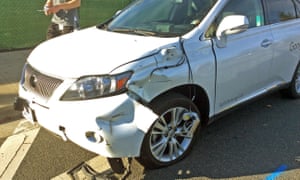
A self-driving Lexus SUV, operated by Google, after colliding with a public bus in Mountain View, California, in February 2016.
A self-driving Lexus SUV, operated by Google, after colliding with a public bus in Mountain View, California, in February 2016. Photograph: AP

In catch-22 traffic emergencies where there are only two deadly options, people generally want a self-driving vehicle to, for example, avoid a group of pedestrians and instead slam itself and its passengers into a wall, a new study says. But they would rather not be travelling in a car designed to do that.

The findings of the study, released on Thursday in the journal Science, highlight just how difficult it may be for auto companies to market those cars to a public that tends to contradict itself.

“People want to live a world in which everybody owns driverless cars that minimize casualties, but they want their own car to protect them at all costs,” Iyad Rahwan, a co-author of the study and a professor at MIT, said. “And car makers who offer such cars will sell more cars, but if everybody thinks this way then we end up in a world in which every car will look after its own passenger’s safety … and society as a whole is worse off.”

Through a series of online surveys, the authors found that people generally approve of cars that sacrifice their passengers for the greater good, such as sparing a group of pedestrians, and would like others to buy those cars, but they themselves would prefer to ride in a car that protects its passengers at all cost.

Several people working on bringing self-driving cars to market said that while the philosophical and ethical question over the two programming options is important to consider, real-life situations would be far more complex.

Brian Lathrop, a cognitive scientist who works on Volkswagen’s self-driving cars project, stressed that in real life there are likelihoods and contingencies that the academic example leaves out.

“You have to make a decision that the occupant in the vehicle is always going to be safer than the pedestrians, because they’re in a 3,000lb steel cage with all the other safety features,” said Lathrop, who was not involved in the new study.

So in a situation in which a car needs to, say, slam into a tree to avoid hitting a group of pedestrians, “obviously, you would choose to program it to go into the tree,” he said.

A spokesman for Google, whose self-driving car technology is generally seen as being the furthest along, suggested that asking about hypothetical scenarios might ignore the more important question of how to avoid deadly situations in the first place.

The problem seems to be how to get people to trust cars to consistently do the right thing if we’re not even sure we want them to do what we think is the right thing.

The study’s authors argue that since self-driving cars are expected to drastically reduce traffic fatalities, a delay in adopting the new technology could itself be deadly. Regulations requiring self-driving cars to sacrifice their passengers could move things forward, they write. But, in another catch-22, forcing the self-sacrificing programming could actually delay widespread adoption by consumers.

Susan Anderson, an ethicist at the University of Connecticut, and her husband and research partner, Michael Anderson, a computer science professor at the University of Hartford, believe the cars will be able to make the right call.

“We do believe that properly programmed machines are likely to make decisions that are more ethically justifiable than humans,” they said in an email. “Also, properly programmed self-driving cars should have information that humans may not readily have,” including precise stopping distance, whether to swerve or brake, or the likelihood of degree of harm.

How to get those cars “properly programmed”? The Andersons, who were not involved in the study, suggest having the cars learn from or be given “general ethical principles from applied ethicists”.

https://www.theguardian.com/technology/2016/jun/23/self-driving-car-safety-study-pedestrian-crashes

How Driverless Cars will Change Car Ownership forever

Own, share or subscribe: Car ownership in the self-driving era

Https%3a%2f%2fblueprint-api-production.s3.amazonaws.com%2fuploads%2fcard%2fimage%2f95598%2fautonomous-cars-1

Fast-forward 20 years. Driverless cars coast around every street in the country without a human driver behind the wheel. They’ve reached market saturation — the technology is as commonplace as cruise control is today.

The rise of self-driving cars leads to a host of questions, of course, but for the moment let’s focus on just one: Will you still be able own a car? Would you even want to? I mean, why buy when you can take an autonomous pod everywhere for far less?

Thing is, the answer to that question isn’t a simple yes or no. But finding the answer is rooted in trends happening right now.

Companies like Lyft have partnered with General Motors to incentivize people out of car ownership with sweetheart rental deals, which may actually work. On the flip side, high-end carmakers — at least the ones I’ve spoken to — don’t see car sharing as a part of their future business.

When looking at the picture of car ownership in the driverless era, several scenarios become apparent.They range from outright ownership to pay-per-ride transportation (AKA „mobility as a service“) with a few options in between. With that in mind, let’s start at the top and work our way down.

1. Full ownership

Today, aside from a few current car-sharing programs, the vast majority of cars are used only by their owners, and not shared, at least not in a structured way. Even after the widespread implementation of driverless tech, the direct-sales business for top-end brands like Bentley, Lamborghini and Aston Martin won’t change. Right now, the average car sits unused 94% of its life. Likely, a Bentley sits idle even more than that — probably nearing the 99% mark, as the average Bentley buyer owns around nine other vehicles in addition.


Holographic butler Bentley concept.

Image: Bentley

To the luxury car buyer, there’s nothing more luxurious than owning a $400,000 car that you virtually never use — whether it drives itself or not. Moreover, there’s nothing luxurious about sharing a car. Even with the introduction of autonomous driving (something Bentley has said it is working on), the ownership model will likely never change.

But it will shrink. Ownership in all other parts of the market will likely drop considerably, as the following models expand and take hold.

2. Fractional ownership

At the launch of the CT6 sedan, I chatted with Cadillac President Johan de Nysschen about the how the brand will tackle car sharing and autonomy.

Speaking broadly, de Nysschen imagined a world in which luxury brands like Cadillac would offer not just a traditional sales model but rather a brand-wide subscription model. He likened this to a model already offered in the private jet market called fractional ownership.


Cadillac CT6

Image: Nick Jaynes/Mashable

In the world of jets, fractional ownership means you buy equity in an aircraft brand rather than buy a single jet. Of course, the price you pay depends on how much you intend to use the jet. However, the benefits of fractional ownership over outright ownership are many. For example, maintenance, fueling, hangar costs and other private jet ownership headaches are handled by the brand, rather than the customer.

De Nysschen hypothesized that Cadillac could implement a similar system. For a nominal monthly fee, every morning an autonomous Escalade could arrive at your home and drive you to work. If you were feeling sporty on a Saturday morning and wanted to do some track driving, however, you could — with a touch of a Cadillac app — order up an ATS-V to take you to a nearby racing circuit.

Of course, just like with fractional jet ownership, fractional car fee scales would increase with the amount you intend to use the brand vehicles.

This way, you’re not just investing in a single vehicle but rather a brand as whole. Along with not needing to insure, park or maintain the car, you also wouldn’t have to worry about fueling it — a benefit de Nysschen hypothesized Cadillac would put into effect for customers even before autonomy becomes prevalent.

The model has some clear benefits. Not only does it give the fractional owner flexible access to a fleet of vehicles, but it still allows the customer to invest in and identify with a single brand. In other words, you’ll still be able to one-up your neighbor.

High-income neighborhoods of the future, just like today, will be still lined with Mercedes-Benzes, BMWs and Cadillacs. Instead of being rooted in single vehicles at individual residences, however, the latest and greatest company offerings will simply roll into your driveway on a daily basis.

3. Own + share

The next level isn’t so much as a step down from fractional ownership as a step sideways. That’s because I see it also suiting luxury buyers, but those who are a bit more tied to the traditional car ownership concept. I call it the „own + share“ level.

For this example, let’s use Volvo as the brand and the XC90 as the vehicle, since it will likely be one of the first fully autonomous cars sold to customers. When it goes on sale, you’ll likely still be able to go into a dealership and get a lease on a $55,000 Volvo XC90 full-size SUV and drive it away (or rather, have it drive you away).


Self-parking Volvo XC90

Image: Volvo Cars

However, instead of letting the car sit idle in your driveway at night or your parking structure at work, you’ll be able to opt into a Volvo car-sharing program. Or, the program might not be manufacturer-affiliated — ride-sharing companies like Uber and Lyft may end up handling programs like these.

Think of it in the same way as leasing a condo in Aspen that you don’t use much of the time. You still own the car, but when you’re not using it, it’s autonomously driving and chauffeuring people around. Intriguingly, this model is already being implemented — sans autonomy, of course.

BMW is running one in Seattle right now called ReachNow that offers chauffeur-driven services, valet vehicle delivery service, short- and long-term rentals as well as peer-to-peer car sharing. Now, imagine the cars could drive themselves, removing human drivers from the equation altogether.

This would be a happy medium between brand fractional ownership and full-blown car sharing. People who feel — for whatever reason — tied to owning a car still can. However, when they’re not using it, the car is out there making (or saving, depending how you look at it) money that can counterbalance the costs of ownership like fuel, insurance and maintenance.


Autonomous Volvo XC90

Image: Volvo Cars

4. Mobility services

We’re finally down to the market where the majority of city-dwelling Americans will likely find themselves: mobility as a service. This includes the newly founded Maven from General Motors and Ford’s FordPass app.

While both offer different services, both aim for the same goal: to monetize getting people from A to B without having to sell them a 3,000-pound lump of steel.

That means —  for a monthly fee — a mobility service app will get you where you need to go, whether that’s utilizing a shared car, hopping in a Lyft (a part of GM’s Maven), or riding an electrified Ford-branded bicycle to the train station (a pilot mobility solution tested by Ford).


Unlike fractional ownership or own + share, these services will be less about investing in a car, brand or quietly competing in an automotive cold war of one-upmanship with your neighbor. Instead, they’ll be about getting you places as efficiently and cheaply as possible, but still a step or two above public transportation.

Unlike the brand-driven fractional ownership, since Maven won’t be sexier in any way than FordPass (I assume), these services will be made and broken not by branding but by customer experience. They’ll also be driven by price. Think about it the way some people choose Amazon Prime over Hulu.

5. Pay per ride

We now come to the bottom rung of future mobility: pay-per-ride companies like Uber or Lyft. However, if you consider them in another light, these companies could be at the top of the pyramid, too, because — based upon current company models — they’re a great equalizer. Everybody uses them.

Regardless, these companies will likely operate similar to self-driving cars as they do with human-driven vehicles. The biggest difference being that Uber and Lyft will own the cars, rather than utilizing privately owned vehicles. Heck, Uber is rumored to have ordered $9.6 billion worth of Mercedes S-Class sedans.

However, as I suggested above with own + share, pay-per-ride companies could employ privately owned driverless cars, but I suspect the best business plan will be for the companies to own their own vehicles.

Whether Uber and Lyft own the cars or draw on private self-driving fleets, you’ll still be able to call up a car to your location and for a fee get to where you want to go.


General Motors and Lyft Inc. announced a long-term strategic alliance to create an integrated network of on-demand autonomous vehicles in the U.S.

Image: General Motors

Intriguingly, Lyft CEO Logan Green told me he imagines diversifying the ride experience in the future — beyond simply phasing in autonomous cars. Green envisions themed Lyft ride options. For example, Bostonians on the way to a Celtics game could opt for a Celtic-themed Lyft Line. Along those lines (pun intended), people could also choose a singles-themed ride coordinated with Match.com, for example.

Though Uber and Lyft might one day offer subscription services in addition to the pay-per-ride model, I suspect paying as you go will dominate, which could be the cheapest option for those who don’t need a regular mobility plan.

No longer the headline

Although I laid these examples from a most- to least-expensive structure, at least for the foreseeable future, these options will be available at all pricing levels.

By that I mean Chevrolet will likely continue to offer competitively priced (albeit autonomous) Silverado pickups to customers in rural Oklahoma, for example. That’s because a car-sharing or a mobility plan like Maven simply isn’t feasible when your nearest neighbor is 20 miles down the road.

Additionally, Bentley might well offer a fractional ownership plan in addition to its traditional bespoke sales model. Elite customers could desire a ground mobility plan similar to their private air travel experience.

Broadly, this all demonstrates that, although the mechanics of self-driving cars dominate headlines today, it’s the world after autonomy becomes commonplace — when driverless tech isn’t the headline anymore —- that will prove truly intriguing.

In this era, many more of us will be able to cast aside the idea of investing in a car for the next 11 years. Rather, we can just think about where we want to go and what we want to do we get there.

http://mashable.com/2016/05/30/car-ownership-autonomy-column

Facebook is starting to analyse users‘ posts and messages with sophisticated new artificial intelligence (AI) software

Facebook is starting to analyse users‘ posts and messages with sophisticated new artificial intelligence (AI) software — and that could have worrying implications for Google.

On Wednesday, the social networking giant announced DeepText — „a deep learning-based text understanding engine that can understand with near-human accuracy the textual content of several thousands posts per second, spanning more than 20 languages.“

DeepText is powered by an AI technique called deep learning. Basically, the more input you give it, the better and better it becomes at what it is trained to do — which in this case is parsing human text-based communication.

The aim? Facebook wants its AI to be able to „understand“ your posts and messages to help enrich experiences on the social network. This is everything from recognising from a message that you need to call a cab (rather than just discussing your previous cab ride) and giving you the option to do so, or helping sort comments on popular pages for relevancy. (Both are examples Facebook’s research team provides.)

The blog post doesn’t directly discuss it, but another obvious application for this kind of sophisticated tech is Google’s home turf — search. And engineering director Hussein Mehanna told Quartz that this is definitely an area that Facebook is exploring: „We want Deep Text to be used in categorizing content within Facebook to facilitate searching for it and also surfacing the right content to users.“

Search is notoriously difficult to get right, and is a problem Google has thrown billions at (and made billions off) trying to solve. Is someone searching „trump“ looking for the Presidential candidate or playing cards? Does a search for the word „gift“ want for ideas for gifts, or more information about the history of gifts — or even the German meaning of the word, poison? And how do you handle natural-language queries that may not contain any of the key words the searcher is looking for — for example, „what is this weird thing growing on me?“

By analysing untold trillions of private and public posts and messages, Facebook is going to have an unprecedented window into real-time written communication and all the contexts around it.

Google has nothing directly comparable (on the same scale) it can draw upon as a resource as to train AI. It can crawl the web, but static web pages don’t have that real-time dynamism that reflect how people really speak — and search — in private conversations. The search giant has repeatedly missed the boat on social, and is now trying to get onboard — very late in the game — with its new messaging app Allo. It will mine conversations for its AI tech and use it to provide contextual info to users — but it hasn’t even launched yet.

Facebook has long been working to improve its search capabilities, with tools like Graph Search that let the user enter natural language queries to find people and information more organically: „My friends who went to Stanford University and like rugby and Tame Impala,“ for example. And in October 2015, it announced it had indexed all 2 trillion-plus of its posts, making them accessible via search.

Using AI will help the Menlo Park company not just to index but to understand the largest private database of human interactions ever created — super-charging these efforts.

www.businessinsider.de/facebook-new-ai-deeptext-threatens-google-search-2016-6

How will open source AI change the tech industry?

After years in the labs, artificial intelligence (AI) is being unleashed at last. Google, Microsoft and Facebook have all made their own AI APIs open source in recent months, while IBM has opened Watson (pictured above) for business and Amazon has purchased AI startup Orbeus. These announcements have not drawn much media attention, but are hugely significant.

„In the long run, I think we will evolve in computing from a mobile-first world to an AI-first world,“ says Google CEO Sundar Pichai. What does the appearance of AI bots and machine learning on the open market mean for business, IT, big data, and for sellers of physical hardware?

What’s happening to the major AI platforms?

The AI APIs now opening up are essentially free platforms on which companies can build incredibly powerful analytics tools. „These hugely powerful tools, used, developed and backed by the world’s most advanced technology companies, are now available to anyone with the skills to use them,“ says Matt Jones, Senior Analytics Project Manager at analytics and data science company Tessella.

He continues: „Using these toolkits, individually or combined, anyone can integrate transformational AI or machine learning platforms – which are as sophisticated as anything currently on the market – to their business on a pay as you go, or free basis.“ The tech industry – and digital business in general – is on the cusp of something very big.

Google, Microsoft and Facebook

It may have announced plans for its Google Home speaker-assistant to rival Amazon’s Echo in ’smart‘ homes, but the search engine giant has much bigger plans for AI. Part of Google since January 2014, DeepMind’s AlphaGo neural network beat mankind at the ancient Chinese game of Go recently. DeepMind is the main attraction on TensorFlow a deep learning framework that Google made open source in 2015.

Meanwhile, Facebook is focused on developing its M bot platform that should see its Messenger app flooded with third-party apps that let companies and their customers execute tasks on the platform, such as paying bills, making bank transfers, and even ordering an Uber ride. The Facebook M virtual assistant will follow.

And over at Redmond, Microsoft Cognitive Services and the Microsoft Bot Framework is aimed at getting developers to create AI-powered apps and bots that work on everything from Skype and Office 365 to Slack and SMS.

Watson on the cloud

The existence and planned expansion of IBM’s cloud-based cognitive computing platform is well known, and Big Blue offers its Watson API on a ‚freemium‘ basis.

Around 80,000 developers have accessed the Watson collection of APIs since 2013 through a dedicated cloud platform that IBM is calling ’self-service artificial intelligence‘. It’s designed to help coders, data scientists and analysts create apps that tap into the power of the Watson supercomputer for prediction, natural language processing, and much more. Machine learning and text analytics will also soon be on the menu from IBM’s Watson Knowledge Studio.

Image recognition

While some invest in AI, others are making acquisitions to catch up. While IBM’s Watson has a new Visual Recognition API and Google’s image recognition is well known, Apple recently purchased ‚emotion measurement‘ (i.e. face recognition) company Emotient. Meanwhile, Amazon bought a deep learning neural networks startup called Orbeus, whose ReKognition API specialises in photo recognition, too.

Open season for developers

With the arrival on the cloud of high-power cognitive platforms, it’s open season for app developers, who are expected to use the fruits of AI to unleash better and better apps.

„IBM Watson, Google DeepMind and the like are incredibly high-power cognitive platforms that are enabling developers to do really interesting projects,“ says Frank Palermo, Executive Vice President of Global Digital Solutions at global IT services company VirtusaPolaris. „It’s great they are now making these cognitive platforms readily accessible – particularly for researchers and others scientific pursuits, but also for knowledge workers across all industries.“

For instance, the boom in online education could create AI-powered teachers, which could help improve retention rates.

What is the OpenAI project?

Elon Musk is getting involved in AI, too, by supporting OpenAI, a non-profit research company focused on advancing digital intelligence for the common good. „Elon Musk has launched the OpenAI project with a star-studded list of backers – Palantir CEO Peter Thiel, LinkedIn founder Reid Hoffman and Y Combinator president Sam Altman,“ says an impressed Jones.

OpenAI is headed up by machine learning expert Ilya Sutskever, ex-Google Brain Team member, and has just opened the OpenAI Gym in beta to help developers working with ‚reinforced learning‘, a type of machine learning that’s central to AI. Essentially, it’s about getting software to alter its behaviour in a dynamic environment in order to get a reward (you can’t give Siri a biscuit every time she ‚found this on the web‘).

What does this mean for the IT industry?

The arrival of AI means a changing of the guard in the tech industry, with disruption, innovation – and the complete domination of the cloud. Standalone data analytics platforms? No need. Expensive infrastructure? Ditto. Expertise, not investment, will become king. That, and superfast broadband.

„It will ultimately help to drive innovation and growth, and we could see new business models emerge,“ says Palermo, who thinks that Amazon’s entry into the AI market is especially interesting given the unbridled success of Amazon’s AWS.

„As with cloud before it, Amazon may start renting time on Orbeus by the hour so that knowledge workers can work on a specific project,“ he adds. „This will help to normalise the use of AI and cognitive capabilities and greatly enhance our ability to process information.“ However, reshaping computing does mean some pain-points.

The death of the black box

You need computing power and analytics? AI APIs have the answer. „Any task currently performed by a costly black box AI platform, such as identifying where to drill for oil, predicting disease outbreaks, optimising scientific experiments to develop new products, and predictive maintenance, can now be done in-house,“ says Jones. Crucially, a business using these AI APIs will maintain complete control and oversight of its data.

How disruptive could AI APIs be?

Very. The kind of expertise most companies – especially startups – only dreamed of will be available instantly, online, 24/7. Accessing the world’s most advanced computers via these open platforms will cost only the price of a data scientist’s salary or consultancy fee. „This is very important for a lot of the world’s businesses, and they need to take it seriously,“ says Jones. „If its true potential is realised, it will unleash a new generation of innovative startups that apply the latest AI techniques to disrupt the establishment.“

The intelligent future

For industries already migrating to the cloud at an alarming rate, AI raises the stakes even further. We already inhabit a world where the cloud’s scalable storage has enabled startups like Twitter, Spotify, Netflix and WhatsApp to challenge entrenched big players. By making the very latest AI open source and available to all online, the likes of Google, Facebook, Amazon and IBM could help create a new wave of businesses that harness data. That puts data analytics platforms, pricey IT infrastructure and storage devices on borrowed time.

http://www.techradar.com/news/world-of-tech/how-will-open-source-ai-change-the-tech-industry–1322242/1

Would you bet against sex robots? AI could leave half of world unemployed!

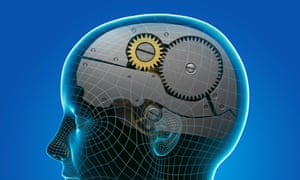
Thought Mechanism08 Dec 2011 --- A side view of a human female head with the human mind represented as a gear system. --- Image by Science Picture Co./Corbis
Artificial intelligence could put more than half the planet’s population out of a job, a computer scientist says. Photograph: Science Picture Co./Corbis

Machines could put more than half the world’s population out of a job in the next 30 years, according to a computer scientist who said on Saturday that artificial intelligence’s threat to the economy should not be understated.

Expert Moshe Vardi told the American Association for the Advancement of Science (AAAS): “We are approaching a time when machines will be able to outperform humans at almost any task.

“I believe that society needs to confront this question before it is upon us: if machines are capable of doing almost any work humans can do, what will humans do?”

Physicist Stephen Hawking and the tech billionaires Bill Gates and Elon Musk issued a similar warning last year. Hawking warned that AI “could spell the end of the human race” and Musk said it represents “our biggest existential threat”.

The fear of artificial intelligence has even reached the UN, where a group billing itself the Campaign to Stop Killer Robots met with diplomats last year.

Vardi, a professor at Rice University and Guggenheim fellow, said that technology presents a more subtle threat than the masterless drones that some activists fear. He suggested AI could drive global unemployment to 50%, wiping out middle-class jobs and exacerbating inequality.

Unlike the industrial revolution, Vardi said, “the AI revolution” will not be a matter of physically powerful machines that outperform human laborers, but rather a contest between human wit and mechanical intelligence and strength. In China the question has already affected thousands of jobs, as electronics manufacturers, Foxconn and Samsung among them, develop precision robots to replace human workers.

In his talk, the computer scientist alluded to economist John Maynard Keynes’ rosy vision of a future in which billions worked only a few hours a week, with intelligent machines to support their easy lifestyles – a prediction embraced wholesale by Google head of engineering Ray Kurzweil, who believes “the singularity” of super-AI could bring about utopia for a future hybrid of mankind.

Vardi insisted that even if machines make life easier, humanity will face an existential challenge.

“I do not find this a promising future, as I do not find the prospect of leisure-only life appealing,” he said. “I believe that work is essential to human wellbeing.”

Computer scientist Bart Selman told reporters at the conference that as self-driving cars, “household robots, service robots” and other intelligent systems become more common, humans will “sort of be in a symbiosis with those machines, and we’ll start to trust them and start to work with them”.

Selman, a professor at Cornell University, said: “Computers are basically starting to hear and see the way humans do,” thanks to advances in big data and “deep learning”.

Vardi predicted that driving will be almost fully automated in the next 25 years, and asked, for all the benefits of technology, “what can humans do when machines can do almost everything?”

He said that technology has already massively changed the US economy in the last 50 years. “We were all delighted to hear that unemployment went down to 4.8%” this month, he said, “but focusing on the monthly job report hides the fact that for the last 35 years the country has been in economic crisis.”

Citing research from MIT, he noted that although Americans continue to drive GDP with increasing productivity, employment peaked around 1980 and average wages for families have gone down. “It’s automation,” Vardi said.

He also predicted that automation’s effect on unemployment would have huge political consequences, and lamented that leaders have largely ignored it. “We are in a presidential election year and this issue is just nowhere on the radar screen.”

He said that virtually no human profession is totally immune: “Are you going to bet against sex robots? I would not.”

Last year, the consultant company McKinsey published research about which jobs are at risk thanks to intelligent machines, and found that some jobs – or at least well-paid careers like doctors and hedge fund managers – are better protected than others. Less intuitively, the researchers also concluded that some low-paying jobs, including landscapers and health aides, are also less likely to be changed than others.

In contrast, they concluded that 20% of a CEO’s working time could be automated with existing technologies, and nearly 80% of a file clerk’s job could be automated. Their research dovetails with Vardi’s worst-case scenario predictions, however; they argued that as much as 45% of the work people are paid to do could be automated by existing technology.

Vardi said he wanted the gathering of scientists to consider: “Does the technology we are developing ultimately benefit mankind?

“Humanity is about to face perhaps its greatest challenge ever, which is finding meaning in life after the end of ‘in the sweat of thy face shalt thou eat bread’,” he said. “We need to rise to the occasion and meet this challenge.”

In the US, the labor secretary, Thomas Perez, has told American seaports that they should consider robotic cranes and automatic vehicles in order to compete with docks around the world, despite the resistance of unions. In 2013, two Oxford professors predicted that as much as 47% of the US workforce, from telemarketers to legal secretaries and cooks, were vulnerable to automation.

Dire forecasts such as Vardi’s are not without their critics, including Pulitzer-winning author Nicholas Carr and Stanford scientist Edward Geist. Carr has argued that human creativity and intuition in the face of complex problems is essentially irreplaceable, and an advantage over computers and their overly accurate reputation.

Walking the line between the pessimists and optimists, Martin Ford, author of Rise of the Robots: Technology and the Threat of a Jobless Future, has suggested that automation will come down to politics today, telling National Geographic that if scientists and governments don’t address the issue “for lots of people who are not economically at the top, it’s going to be pretty dystopian”.

https://www.theguardian.com/technology/2016/feb/13/artificial-intelligence-ai-unemployment-jobs-moshe-vardi