Archiv der Kategorie: Artificial Intelligence

A High-Stakes Bet: Turning Google Assistant Into a ‘Star Trek’ Computer

Google’s new assistant will be incorporated in new products like Google Home, an Amazon Echo-like talking computer. CreditJustin Sullivan/Getty Images

Google is one of the most valuable companies in the world, but its future, like that of all tech giants, is clouded by a looming threat. The search company makes virtually all of its money from ads placed on the World Wide Web. But what happens to the cash machine if web search eventually becomes outmoded?

That worry isn’t far-fetched. More of the world’s computing time keeps shifting to smartphones, where apps have supplanted the web. And internet-connected devices that may dominate the next era in tech — smartwatches, home-assistant devices like Amazon’s Echo, or virtual reality machines like Oculus Rift — are likely to be free of the web, and may even lack screens.

But if Google is worried, it isn’t showing it. The company has long been working on a not-so-secret weapon to avert its potential irrelevance. Google has shoveled vast financial and engineering resources into a collection of data mining and artificial intelligence systems, from speech recognition to machine translation to computer vision.

Now Google is melding these advances into a new product, a technology whose ultimate aim is something like the talking computer on “Star Trek.”It is a high-stakes bet: If this new tech fails, it could signal the beginning of the end of Google’s reign over our lives. But if it succeeds, Google could achieve a centrality in human experience unrivaled by any tech product so far.

The company calls its version of this all-powerful machine the Google Assistant. Today, it resembles other digital helpers you’ve likely used — things like Apple’s Siri, Amazon’s Alexa and Microsoft’s Cortana. It currently lives in Google’s new messaging app, Allo, and will also be featured in a few new gadgets the company plans to unveil next week, including a new smartphone and an Amazon Echo-like talking computer called Google Home.

But Google has much grander aims for the Assistant. People at the company say that Sundar Pichai, who took over as Google’s chief executive last year after Google was split into a conglomerate called Alphabet, has bet the company on the new tech. Mr. Pichai declined an interview request for this column, but at Google’s developer conference in May, he called the development of the Assistant “a seminal moment” for the company.

If the Assistant or something like it does not take off, Google’s status as the chief navigator of our digital lives could be superseded by a half-dozen other assistants. You might interact with Alexa in your house, with Siri on your phone, and with Facebook Messenger’s chatbot when you’re out and about. Google’s search engine (not to mention its Android operating system, Chrome, Gmail, Maps and other properties) would remain popular and lucrative, but possibly far less so than they are today.

That’s the threat. But the Assistant also presents Google with a delicious opportunity. The “Star Trek” computer is no metaphor. The company believes that machine learning has advanced to the point that it is now possible to build a predictive, all-knowing, superhelpful and conversational assistant of the sort that Captain Kirk relied on to navigate the stars.

Photo

CreditStuart Goldenberg

The Assistant, in Google’s most far-out vision, would always be around, wherever you are, on whatever device you use, to handle just about any informational task.

Consider this common situation: Today, to book a trip, you usually have to load up several travel sites, consult your calendar and coordinate with your family and your colleagues. If the Assistant works as well as Google hopes, all you might have to do is say, “O.K., Google, I need to go to Hong Kong next week. Take care of it.”

Based on your interactions with it over the years, Google would know your habits, your preferences and your budget. It would know your friends, family and your colleagues. With access to so much data, and with the computational power to interpret all of it, the Assistant most likely could handle the entire task; if it couldn’t, it would simply ask you to fill in the gaps, the way a human assistant might.

Computers have made a lot of everyday tasks far easier to accomplish, yet they still require a sometimes annoying level of human involvement to get the most out of them. The Assistant’s long-term aim is to eliminate all this busywork.

If it succeeds, it would be the ultimate expression of what Larry Page, Google’s co-founder, once described as the perfect search engine: a machine that “understands exactly what you mean and gives you back exactly what you want.”

At this point, a few readers may be recoiling at the potential invasion of autonomy and privacy that such a machine would necessitate.

The Assistant would involve giving ourselves over to machines more fully. We would trust them not just with our information but increasingly with our decisions. Many people are already freaked out by what Google, Facebook and other tech companies know about us. Would we be willing to hand over even more power to computers?

Those are important questions, but they are also well down the road. For now, the more pressing question for the Assistant is: Will it even work?

Photo

Sundar Pichai, Google’s chief executive, calls the development of the assistant “a seminal moment” for the company. CreditJustin Sullivan/Getty Images

Google has technological advantages that suggest it could build a more capable digital assistant than others have accomplished. Many of the innovations that it has built into its search engine — including its knowledge graph database of more than a billion people, places and things, and the 17 years it has spent trying to understand the meaning of web queries — will form the Assistant’s brain.

Google has also been one of the leaders in machine learning, the process that allows computers to discover facts about the world without being explicitly programmed. Machine learning is at the heart of a number of recent advances, including Google Photos’ uncanny capacity to search through your images for arbitrary terms (photos of people hugging, for instance).

“We are in the process of transforming into a machine-learning company,” Jeff Dean, who is in charge of Google Brain, the company’s artificial intelligence project, told me this year. For each problem Google solves this way, it gets better at solving other problems. “It’s a boulder going downhill gathering more momentum as it goes,” Mr. Dean said.

If you use the Assistant today, you’ll see some of these advances. As my colleague Brian X. Chen explained last week, if your friend sends you a picture of his dog on Allo, Google Assistant will not only recognize that it’s a dog, but it will also tell you the breed.

That’s an amazing technological feat. But as Brian pointed out, it’s also pretty useless. Why does your friend care if you know his dog’s a Shih Tzu?

This gets to a deeper difficulty. The search company might have the technical capacity to create the smartest assistant around, but it’s not at all clear that it has the prowess to create the friendliest, most charming or most useful assistant. Google needs to nail not just Assistant’s smarts, but also its personality — a new skill for Google, and one that its past forays into social software (Google Plus, anyone?) don’t speak highly of.

Then there is the mismatch between Google’s ambitions and Assistant’s current reality. Danny Sullivan, the founding editor of Search Engine Land, told me that so far, he hadn’t noticed the Assistant helping him in any major way.

“When I was trying to book a movie, it didn’t really narrow things down for me,” he said. “And there were some times it was wrong. I asked it to show me my upcoming trip, and it didn’t get that.”

Of course, it’s still early. Mr. Sullivan has high hopes for the Assistant. It would be premature to look at the technology today and get discouraged about its future, especially since Google sees this as a multiyear, perhaps even decade-long project. And especially if Google’s future depends on getting this right.


Here’s the electric car Audi is building to take on Tesla

Audi E-tron quattroAudi

Tesla’s Model S and Model X are soon going to have some serious competition.

Last September, Audi revealed its all-electric e-tron quattro concept at the Frankfurt Motor Show. The SUV, which is slated to go into production by 2018, will have three electric motors, a range of 310 miles on a single charge, and quick charging capabilities.

Here’s a look at some of the features in the e-tron quattro that we hope to see in the production version.

Like the e-tron concept, Audi will most likely include piloted driving technology in its upcoming all-electric SUV.

Like the e-tron concept, Audi will most likely include piloted driving technology in its upcoming all-electric SUV.

Audi piloted techYouTube/Audi

The e-tron quattro concept has piloted driving technology, which uses radar sensors, a video camera, ultrasonic sensors, and a laser scanner to collect data about the car’s environment and create a model of the vehicle’s surroundings in real-time.

Audi currently has a lot of this tech in its newer vehicles, so it’s likely we will see a more advanced piloted system in the production version of the e-tron quattro.


Cameras could replace side view mirrors.

Cameras could replace side view mirrors.

Audi

The e-tron quattro has curved displays built into the front section of the doors that lets the driver view what is around them. There’s no guarantee we’ll see this in the production version, but automakers are beginning to experiment with new kinds of mirror designs.

For example, GM’s a digital mirror in the Chevy Bolt and the Cadillac CT6that uses cameras to stream whatever is behind you.

It will likely be covered in screens.

It will likely be covered in screens.

Audi

The e-tron quattro concept features two touch displays in the cockpit, one to the driver’s left to control lights and the piloted driving systems and one to the right where media and navigation is controlled.

The center console has two more OLED displays for climate control and infotainment.

With its 95 kWh battery, the e-tron quattro has an impressive range of 310 miles on a single charge.

With its 95 kWh battery, the e-tron quattro has an impressive range of 310 miles on a single charge.

Audi

To put that into perspective, Tesla’s Model X SUV with all wheel drive and a 100kWh battery has a range of 289 miles on a single charge. Audi has already said its range will beat this.

It may be able to fully charge in just 50 minutes.

It may be able to fully charge in just 50 minutes.

Audi

We know the production version will have quick charging capabilities, but we don’t know exactly how fast it will work. However, we’re hoping it’s in line with the e-tron quattro concept’s charge time.

The concept car has a Combined Charging System (CCS), meaning it can be charged with a DC or AC electrical current. It can fully charge with a DC current outputting 150 kW in just about 50 minutes.


The e-tron quattro concept is equipped with induction charging technology, so it can be charged wirelessly over a charging plate.

The e-tron quattro concept is equipped with induction charging technology, so it can be charged wirelessly over a charging plate.

Audi

We can’t say if this is a definite feature the production version will have, but our fingers are crossed.

It will have super fast connectivity.

It will have super fast connectivity.

Audi

Audi announced at CES this year that it is the first automaker to support the latest standard for mobile communications: LTE Advanced.

LTE Advanced is the latest enhancement to LTE, meaning that it can deliver larger and faster wireless data payloads than 4G LTE. We can almost certainly expect to see the technology integrated into the upcoming production car.

http://www.businessinsider.de/audis-electric-vs-tesla-2016-9?op=1

Self-driving cars are here, but that doesn’t mean you can call them ‚driverless‘

Volvo Driverless Car What I imagine I could’ve been doing on my way to college instead of holding a steering wheel for nine hours. (Not actually me) Volvo

I went to college nine hours away from home — easily doable in a day’s drive, but tedious nonetheless.

On one trip through the cornfields of Indiana, I remember turning to my friend wondering why we hadn’t figured out cruise control for steering wheels. I had already been cruising at a steady 70 m.p.h. for hours with my feet on the floor. Why did I have to touch the steering wheel to keep it in the lines too?

Less than six years later, the answer is that I don’t have to touch the steering wheel anymore. Self-driving cars are here, and they’re arriving faster than many predicted.

The pace at which a self-driving car went from myth to reality has caused all sorts of problems, from a talent shortage in the field to a sudden arms race in trying to build the best self-driving car on the market. Uber’s CEO Travis Kalanick called it „existential“ for the company to develop its own driverless car technology.

Yet, there’s still a large distinction — and years of development — between the self-driving cars hitting the streets today and the driverless cars that we dream of in the future. Most „driverless“ cars today still have a driver in the front seat. Teaching a car how to drive itself (even with a driver on hand) is just the important first step.

Dreams of driverless

It’s hard not to be seduced by the images of driverless cars.

Mercedes-Benz‘ concept car shows four seats all turned to face each other. Bentley’s driverless dream comes with a holographic butler — a future staple for the high-end autonomous car. The Rolls-Royce has a two person couch with a giant TV where the driver normally sits.

Bentley Bentley

Even Larry Page is rumored to be working on a flying car so we all finally get one step closer to“The Jetsons“ future we’ve envisioned.

However, what’s not acknowledged is just how hard it is to get cars to that point. When I asked Uber’s Kalanick just what’s holding truly driverless cars back, he laughed because there’s just so much — and a lot of it just that the technology hasn’t even been developed. A self-driving car shouldn’t freak out at a four-way intersection or turn off every time it goes over a bridge.

To get in a self-driving car today, it feels like having cruise control, but for the whole car. The autopilot keeps the car’s speed steady, it stays evenly inside the lines, and maintains the proper following distance. The only way to experience a self-driving car is to either own a Tesla or live in Pittsburgh and magically hail a self-driving Uber.

After taking a ride in Otto’s self-driving truck, I explained the experience to my 92-year-old grandmother as being in a plane: You have a licensed driver who does take off and landing, or in this case, getting onto the interstate, but then once it’s clear, you just set it to autopilot.

While having „self-driving cars“ in the hands in the public is a huge milestone, it’s just the beginning in the path to full autonomy.

Truly driverless cars remain years away — but still closer than you think. Ford, for example, plans to roll out its first fully autonomous carsfor ride-sharing by 2021. Google is aiming for 2020 , and Tesla is planning to make its vehicles part of car-sharing networkonce its cars are fully autonomous.

The impacts of that will be widely felt. Merrill Lynch predicted in a 2015 report that driverless taxis like Ubers will make up 43% of new car sales by 2040. The Boston Consulting Group also wrote in a 2015 report that driverless taxi sales are bound to incline. The BCG predicts that 23% of global new car sales will come from driverless taxis by 2040, which will result in a decline in vehicle ownership in cities.

Before we get to driverless though, we need to perfect self-driving. To do that, that means putting real self-driving cars to the roads in a test. That’s why they are here and happening now. Driverless will come next.

http://www.businessinsider.com/self-driving-vs-driverless-car-difference-explained-2016-9?IR=T

Artificial Intelligence Software Is Booming. But Why Now?

Marc Benioff, left, chief executive of Salesforce, talked with Matthew Panzarino, editor in chief of TechCrunch, at its Disrupt conference in San Francisco last week. Credit Beck Diefenbach/Reuters

SAN FRANCISCO — This is the year artificial intelligence came into its own for mainstream businesses, at least as a marketing feature.

On Sunday, Salesforce.com, which sells online software for sales and marketing, announced it would be adding A.I. to its products. Its system, called Einstein, promises to provide insights into what sales leads to follow and what products to make next.

Salesforce chose this date to pre-empt Oracle, the world’s largest business software company, which on Sunday evening began its annual customer event in San Francisco. High on Oracle’s list of new features: real-time analysis of enormous amounts of data. Oracle calls its product Oracle A.I.

Elsewhere, General Electric is pushing its A.I. business, called Predix. IBM has ads featuring its Watson technology talking with Bob Dylan. These moves, along with similar projects at most major tech companies and consulting firms, represent years of work and billions in investment.

There are big pushes in A.I. in agriculture, manufacturing, aviation and pretty much every other sector of the economy.

It’s all very exciting, the way great possibilities are, and clearly full of great buzzwords and slogans. But will other companies see any value in all this or understand if A.I. has value for them?

“No one really knows where the value is,” said Marc Benioff, co-founder and chief executive of Salesforce. “I think I know — it’s in helping people do the things that people are good at, and turning more things over to machines.”

Mr. Benioff wasn’t selling Einstein’s capabilities short. He was talking about the long-term value of artificial intelligence, which is passing through a familiar phase — a technology that is strange and new, that sometimes overpromises what it can do and is headed for uses not easily seen at the start.

Cloaked inside terms like deep learning and machine intelligence, A.I. is essentially a series of advanced statistics-based exercises that review the past to indicate the likely future, or look at current customer choices to figure out where to put more or less energy.

Perhaps a better question than “What is the value?” of this explosion of advanced statistics is “Why now?” That shows both the opportunity and why many companies are scared about missing out.

Much of today’s A.I. boom goes back to 2006, when Amazon started selling cheap computing over the internet. Those measures built the public clouds of Amazon, Google, IBM and Microsoft, among others. That same year, Google and Yahoo released statistical methods for dealing with the unruly data of human behavior. In 2007, Apple released the first iPhone, a device that began a boom in unruly-data collection everywhere.

Suddenly, old A.I. experiments were relevant, and money and cheap data resources were available for building new algorithms. Ten years later, computing is cheaper than ever, companies live online and in their phone apps, and sensors are bringing even more unruly data from more places.

Amazon, Google and the rest have exceptional A.I. resources for sale, but many older companies are wary of turning their data over to these upstarts. That, along with fear of a competitor getting on top of A.I. first, is a big motivation for some to try things out.

Salesforce is selling Einstein as a system that can work predictive magic without having to look at your data, in what Mr. Benioff calls a “democratizing” move that will create millions of A.I. users who are not engineers.

He said this on his way to attend a series of customer focus groups around the country, however — strong evidence that customers don’t get it yet, even if they’re willing to try it.

“There’s fear of Google and Microsoft controlling everything, and there’s a desire to apply A.I. to anything that’s digital,” said Michael Biltz, managing director of Accenture’s technology vision practice. “People are going to have to experiment, most likely first on pain points like security and product marketing.”

How will we know when the A.I. revolution has taken hold? A technology truly matures when it disappears. We don’t marvel at houses with electricity now, or the idea of driving to work at 60 miles an hour. We can say “phone” and mean a hand-held computer with NASA-level processing power and a professional-quality camera for taking selfies with our drones.

A.I. is probably heading for the same places, invisibly sorting through lots of data everywhere to continuously update and automate most of our lives. Goodness knows what the weird new tech thing will be about at that point.

Mercedes-Benz unveils a van that launch delivery drones

Mercedes-Benz Vans and drone tech startup Matternet have created a concept car, or as they’re calling it a Vision Van, that could change the way small packages are delivered across short distances.

The Vision Van’s rooftop serves as a launch and landing pad for Matternet’s new, Matternet M2 drones.

The Matternet M2 drones, which are autonomous, can pick up and carry a package of 4.4 pounds across 12 miles of sky on a single battery charge in real world conditions.

They are designed to reload their payload and swap out batteries without human intervention. They work in conjunction with Mercedes-Benz Vans’ on-board and cloud-based systems so that items within a van are loaded up into the drone, automatically, at the cue of software and with the help of robotic shelving systems within the van.

A self-flying, Matternet 2 drone hoists a package near a shipping container.

A self-flying, Matternet M2 drone hoists a package near a shipping container.


Matternet designed a hard-shelled case to protect and carry any given cargo. The drone’s payload can transmit data about the contents and destination of a given delivery.

For a logistics company using the Matternet M2 drones or Vision Vans, that data could serve as a kind of proof of delivery, and alert users the instant a package has arrived.

Andreas Raptopoulos, co-founder and CEO of Matternet explained that while all of this sounds and looks like the stuff of sci-fi, the vans with integrated drone technology could be put to immediate good use where regulations allow.

The Vision Van can, for example, launch a Matternet M2 drone with a payload to a final destination that’s not accessible to a van or driver, whether that’s due to traffic in a populated urban area or a lack of safe roads in a more rural or disaster-stricken area.

Mercedes-Benz Vision Van with a rooftop-integrated Matternet 2 drone.

Mercedes-Benz Vision Van with a rooftop-integrated Matternet M2 drone.


Or, the drones could fly a package from a distribution center or warehouse to a van so a driver can ultimately take the package down and walk it up to a customer’s doorstep nearby.

A division of Daimler, Mercedes-Benz may be better known for its luxury and sports cars. However, the Mercedes-Benz Vans unit sold 321,000 vehicles in 2015, according to a company financial statement, with popular models in travel and logistics including the Sprinter, Marco Polo, Vito (known as the Metris in the U.S.) and Citan.

According to a company press statement Mercedes-Benz has invested an undisclosed amount in Matternet. According to SEC filings, Matternet has so far raised $9.5 million of a targeted $11.5 million venture funding round.

Mercedes-Benz and Matternet unveil vans that launch delivery drones

How Facebook Chatbots Can Revolutionize Your Social Media Strategy

How Facebook Chatbots Can Revolutionize Your Social Media Strategy

The artificial intelligence era… It’s all about embedding human smarts in machines.

Facebook chatbots are one application of this revolution, as they rapidly gain popularity and provide a new tool for marketers to leverage. These chatbots are the incorporation of automatic chatbots within Facebook Messenger.

Chatbots offer flexibility in order to automate tasks, and assist in retrieving data. They are becoming a vital way to enhance the consumer experience for the purpose of better customer service and growing interaction.

In April 2016, Mark Zuckerberg announced that third parties could use the messenger platform to create their own personal chatbot. Since then, the popularity of chatbots has rapidly grown all over the world.

In social media marketing chatbots have evolved, but their prime functionality remains the same, and that is to improve real-time engagement. Customers are always searching for prompt and ready replies to their comments and queries. The chatbots are designed in such a manner that they are able to answer most of the queries placed by customers, without human intervention. And this helps in bonding a strong relationship with your customers and potential crowds, without paying for high overheads on staff.

Two chatbots that have gained immense popularity in no-time are Apple’s Siri and Chotu Bot.

Chatbots: Why such a buzz at present?

Modern advancement in the field of artificial intelligence, which includes neural networking and deep learning, have permitted chatbots to acquire data sets exactly the way the human brain works. This is revolutionary.

Chatbots are instigating a stir in the present world of consumer services. Facebook created a revolution for technology by launching Facebook messenger chatbots which permit businesses to generate an interactive experience, content, e-commerce guides and automate customer service. Messenger has reached more than 900 million users, plus it offers the most striking platform to implement your desired bots.

Maybe the most renowned example  of a chatbot is Apple’s Siri. Like all chatbots, Siri is a perfect combination of pre-defined scripts and neural systems to anticipate a precise reaction to an offered conversation starter or explanation, permitting clients to skip steps while speaking. Siri is a masterpiece that took years for such a huge organization with loads of assets to develop.

Siri for Facebook chatbots

The second example is a chatbot from an organization that is not as famous as Apple. But still the chatbot is so efficient that it has been able to create a lot of buzz for itself in the market.

The Chotu Bot helps you replace various software and get detailed information on various topics such as wiki search, PNR status, Vehicle registration number etc. inside your messenger. And the developers behind the Chotu Bot are preparing to update it so that it can reply to most of the queries asked from all around the planet.

Chotu Bot for Facebook chatbots

How can a Facebook chatbot assist your marketing?

Facebook allows brands to connect their potential customers independently through these messenger bots which leads to a new era in advertising.

The basic idea behind launching the messenger bots is to connect all the people directly to the business in order to automate customer engagement and interactions. Now there are more than 11,500 bots that have been developed on messenger and nearly 23,500 developers signed up in order to build their own bots using tools offered by Facebook. This means it assists you to automate informal interactions between businesses and users.

Recently Facebook announced new features for bots which can easily respond with video, audio, GIFs, and such files that make you build your own bots with ease.

How do chatbots help e-commerce platforms?

Chatbots assist the e-commerce industry by providing functionality in areas such as security, management, monitoring, and customer engagement which are key elements of e-commerce businesses.

Self-service and automation are the ideal way to go ahead in e-commerce, this the ultimate reason why businesses are using chatbots.

Here are just some ideas for how chatbots can make customer engagement easier:

Convenient, contextual and in control

Facebook messenger for chatbots is focused on generating the greatest customer engagement experience. They offer automated updates about traffic, weather, automated messages and much more.

Easy setup and cost savings

Bots help you save time and reduce the cost of hiring staff.

Unprecedented customer reach

The new receive/send API allows you to connect with more than 950 million people in and around the world. That’s the reason bots are growing as the key tool for businesses to gain wonderful networking and commercial opportunities.

How can you use chatbots?

Chatbots make it possible to offer a more proactive, personal, and efficient consumer experience.

how to use chatbots for Facebook chatbots

  • Chotu, one of the leading chatbot technologies, is an AI robot on Facebook messenger that assists in accelerating customer information acquisition through Facebook messages. It provides all the needed information from your messages itself, rather than relying on several different apps working together. Chotu performs multiple tasks at a single time and offers 24×7 customer service.

chotu for customer experience for Facebook chatbots

  • Pizza Hut announced that Facebook messenger chatbots assist their customers in asking questions, viewing their current deals and much more. This helps Pizza Hut interact with their customers more easily at any time and from any place.

36 love questions for Facebook chatbots

  • 36LoveQuestions is a wonderful Facebook messenger chatbot that asks you 36 exact questions in order to determine whether you are in love with someone or not.

Chatbots: From the “simple” customer to enterprises

At present, chatbots are very prevalent in the customer space. From a business point of view, transportation businesses and e-commerce delivery enhance their chances by allowing their customer to purchase products more efficiently.

customer space for Facebook chatbots

But bots are rapidly moving across to the enterprise space as most companies are now building their own chatbots in order to generate better engagement with their customers and create additional value for their brand.

How chatbots are minimizing the gap between customers and brands

Public vs. Private

One of the major problems that various organizations had to face while promoting on social media was to provide a primary customer service to their potential clients. The best thing about [messaging bot] is that you can have a ‘Message Us’ option and truly use this as a one-on-one, private channel.

Consistency

Messaging is a continuous and real-time process between a customer and a brand. You can have a real-time chat with a specialist from the brand, then you can leave and return a day later and see the history… That is truly energizing since that begins to effect customer behavior.

Accessing an audience of over a billion people

Facebook commenced this entire chatbot furor in April by permitting outside bots on its messenger. So even in the worst case, this is the potential crowd you can reach.

Include different systems (WhatsApp has not joined the chatbot fleeting trend yet) and the aggregate gathering of people on messaging platforms is well in an abundance of 1.2 billion. This is the crowd that you can target directly and provide each one special attention.

Who does not like a personal exclusive service?

Chatbots are poised to reform the customer-brand interaction. Facebook knows the potential of personal messaging and they know this idea can be really useful for brands to retain their audiences for a longer period of time.

Any organization today with a chatbot has the capacity to gain customer insights. The more insights they gain, the better the brand messaging will become, which ultimately indicates better targeting and more sales. The best part is that these chatbots are relatively cheap compared to other applications.

A business which takes time to understand chatbots and execute them have a better chance of offering things to their customer and this will really help them build a nice strong relationship over time.

Chatbots are the perfect fit for the modern e-commerce company looking to ramp up customer service.

Companies which are using chatbots are likely to experience better results and acquire the ability to advertise and market new products which ultimately generate customer engagement.

http://www.jeffbullas.com/2016/09/02/facebook-chatbots-can-revolutionize-social-media-strategy

Domino’s – half of the company’s U.S. orders are now digital

Domino’s Is One Step Closer to Delivering Pizzas by Drone

“This isn’t a pie-in-the-sky idea.”

Some of the world’s biggest companies—Amazon, Google—are itching to make commercial deliveries by drone, but a pizza restaurant may beat them to it.

On Thursday, Domino’s Pizza Enterprises—an international franchiser of the Domino’s Pizza brand—conducted a demonstration of pizza delivery by drone in Auckland, New Zealand as it stated its intent to be the world’s first company to launch regular drone delivery.

“We’ve always said that it doesn’t make sense to have a 2-tonne machine delivering a 2-kilogram order,” Domino’s Group CEO and managing director Don Meij said in a statement. The use of drones, “is the next stage of the company’s expansion into the artificial intelligence space and gives us the ability to learn and adopt new technologies in the business.”

Domino’s is partnering with drone delivery company Flirtey for this effort. The demonstration on Thursday was a final step in Flirtey’s approval process, Domino’s says. It expects trial store-to-door drone deliveries from select Domino’s New Zealand locations to get underway later this year, assuming Flirtey gets the regulatory okay to make commercial drop-offs.


Domino’s says it chose to launch this capability in New Zealand because the country’s current regulations allow businesses to tap unmanned aircraft for commercial uses. But the specifics of New Zealand’s Civil Aviation Authority drone rules—namely the requirement that all drones must remain in sight at all times—could still prove tricky.

“Both Domino’s and Flirtey are learning what is possible with the drone delivery for our products, but this isn’t a pie in the sky idea. It’s about working with the regulators and Flirtey to make this a reality for our customers,” Meij said.

7-Eleven has also partnered with Flirtey for its trial drone deliveries. Last month the convenience store chain demonstrated its own drone delivery—an order of coffee, donuts, a chicken sandwich, and, of course, a Slurpee—in Reno, Nev. The companies called the test the first time a drone had legally delivered a package to a U.S. resident who placed an order from a retailer. In the U.S., there are strict drone regulations, which have pushed companies to conduct testing overseas. The Federal Aviation Administration has released new commercial drone rules that take effect this month, but they don’t allow for flying drones at night or outside the line of sight of their operators—restrictions that could make drone deliveries impractical.

In a statement, Flirtey CEO Matt Sweeny said New Zealand “has the most forward-thinking aviation regulations in the world,” adding that Thursday’s demonstration “herald[ed] a new frontier of on-demand delivery for customers across New Zealand and around the globe.”

Drone delivery will let Domino’s reach more rural customers and to reach urban customers in a “much more efficient time,” Meij said.

Domino’s investment in technology is one reason for its recent success. The stock of its U.S. brand, Domino’s Pizza Inc., hit an all-time high earlier this week, reaching $151.10. In the past few years, it’s rolled out innovative ordering options, like allowing customers to place orders via emoji and Apple watches. A report in March said that half of the company’s U.S. orders are now digital.

http://fortune.com/2016/08/25/dominos-pizza-drone-delivery/

The new paradigm for human-bot communication

Editor’s note: Xuchen Yao is co-founder and CEO, and Guoguo Chen and Kenji Sagae are co-founders, of KITT.AI. Daniel Li is an associate at Madrona Venture Group.

Chatbots offer the promise of frictionless access to goods, services and information, but creating effective bots can be deceptively tricky.

The flip side of the opportunity to interact with users in a seamless, natural way is that user expectations can be prohibitively high. Bots need to be smart and provide greater convenience than apps — a very effective UI paradigm tailored for today’s mobile devices that has been carefully refined for more than a decade.

The good news is that the belief that bots must master human language or replace apps to succeed is false. Bots will engage with consumers in new ways that combine the strengths of humans and machines to allow both structured and unstructured information to be exchanged naturally and efficiently.

Communication velocity

One simple but intuitive way to measure the effectiveness of communication is to look at the amount of information exchanged per unit of time. Under this framework, text (e.g. SMS, chat, email) and speech (e.g. phone call) interactions differ in the amount of information that can be produced versus consumed.

image001

While we typically produce 120 to 140 words per minute when speaking, we can typically only write or type 40 to 70 words per minute. When we look at the speed of information consumption, reading speed in English is upwards of 200 words per minute, but listening speed is limited to the 120 to 140 words per minute of speech production.

SMS and chat apps have adapted to increase text production speed through autocorrect features and novel keyboards, but text production for humans will always be slower than consumption.

Imagine, however, a friend that can type, draw, look up information and find GIFs at superhuman speed, and produce buttons, menus and pictures to make your input faster. Better yet, your enhanced input is much easier for your friend to understand and does not take away the flexibility and familiarity of natural language when needed.

We may not be quite there yet, but we are very close, especially with well-constructed bots on certain platforms. Here is a look at the features of different bot platforms that are shaping human-bot communication toward a more efficient, robust and natural UI paradigm.

Quick-reply buttons

Quick-reply buttons are a simple and convenient way to save user time and prevent unexpected input. They are unique to human-bot communication as buttons are trivial for bots to create and easy for humans to use; benefits include enhanced communication speed and bot comprehension.

Facebook, Telegram and Kik bots all have quick-reply buttons, but under slightly different names, and some bots, such as the Sephora bot on Kik, use the quick-reply button as the primary mode of communication. Slack still lacks quick-reply buttons, but has message buttons with associated actions.

Telegram Custom Keyboard:

image002

Facebook Messenger Quick Replies:

image003

Kik Suggested Response Keyboard:

image004

Callback buttons

Callback buttons are similar to quick-reply buttons but allow for a broader range of potential interactions. When a callback button is clicked, it generates an HTTP call to a registered webhook that triggers a predefined action. Callback buttons are a great way to provide feedback, and they also provide a deeper analytics opportunity for the bot backend.

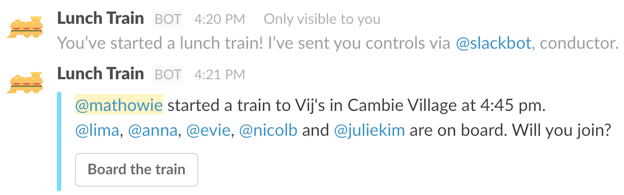
Slack Message Buttons:

image005

Messenger Postback Button:

image006

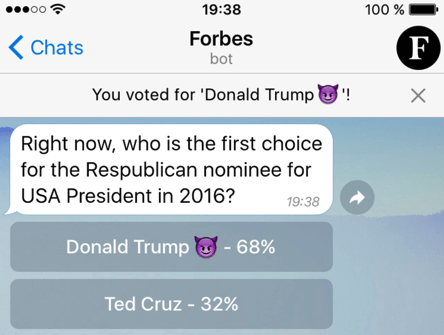
Telegram Callback Buttons:

image007

Structured information sharing

Sharing information that can be easily parsed programmatically takes the exchange of structured information from clunky in a language-only paradigm to easy and unambiguous in a hybrid paradigm.

For instance, sharing a location like “3rd & Madison” is ambiguous and slow for humans and machines to parse, while shared GPS coordinates can be quickly displayed with a map service and understood by bots.

Telegram SendContact and SendLocation:

image008

Facebook Messenger Location Sharing:

image009

Bot mentions

Inline bots are a great way to quickly obtain, send and share information during chats, without the need to jump out of the current interface (to go to another chat) or the current app (to go to another app).

Instead of multiple taps and menus to perform a specific function, an @ mention at a bot allows for a one-line interaction. Allowing bots to share conversational context with one another also greatly increases the speed of interaction because users no longer need to re-input data for each communication.

Telegram Inline Bot:

image010

Slack Bot Mention:

image011

The following table summarizes the added language-touch functionality provided by four popular chat and bot platforms. These features represent the beginning of a hybrid communication paradigm that will enable more efficient and effective communication with bots:

  • Quick-reply buttons: save user time and improve machine comprehension
  • Callback buttons: provide calls to action and back-end analytics
  • Structured info sharing: easily shares machine-readable information
  • Bot mention: make bots always present and easily accessible

image012

If your bot does not use a language-touch hybrid communication pattern, there are several other ways you can still take some of the UI mechanics from buttons and callbacks to build a better bot:

  • Build your system starting with humans in the loop to identify the most common communication patterns and exceptions to that pattern
  • Optimize dialogue for two-channel — fast and slow — communication with clear, well-defined responses (e.g., “Reply YES to buy”) or open-ended messages (“Can you tell me when the new Taylor Swift record comes out?”)
  • Use callback functions, even without native integration. For more complicated tasks, take users out of chat and move them to a point-and-click or touch interface that is better suited to the task at hand
  • Consider moving to a platform that is better optimized for new human-machine interaction

AI and NLP have a long way to go before bots achieve human-level communication. However, before that happens, new methods of human-machine communication will leverage the strengths of humans and machines to create new interaction paradigms that are as natural as our own language.

The new paradigm for human-bot communication

Silicon Valley Top 100

There’s a misconception that Silicon Valley is all about creating frivolous apps and getting paid buckets of money to do it while working in a frat house. Some of the brogrammer culture does exist in pockets, but it doesn’t define the cradle of innovation where thousands work and create in Silicon Valley.

Instead, after months of research and debate, Business Insider is proud to present the Silicon Valley 100, our annual list of the people who matter most and define what it means to be in Silicon Valley.

This isn’t another who’s who list based on long-standing reputation; rather it is a look at who made a difference in the past year. These are the star executives breaking new ground at companies, the venture capitalists who did more than make big bets on the future, and the companies that want to change industries and your life.


100. David Boies

100. David Boies

Jay Janner-Pool/Getty Images

Lawyer and board member, Theranos

Boies has provided legal counsel for a slew of troubled tech startups, ranging from Napster to Hampton Creek and now Theranos. The legal expert is defending the company from inquests by several government agencies and is considered a force to be reckoned with — he helped the US win the 1998 case United States v. Microsoft Corporation, in which the government accused Microsoft of becoming a monopoly.

99. Andre Iguodala

99. Andre Iguodala

Steve Jennings/Getty Images

Tech investor and NBA player

Iguodala plays for the Golden State Warriors, the NBA team owned by a spate of VCs, including Chamath Palihapitiya of Social Capital and Joe Lacob of Kleiner Perkins Caufield & Byers. Ben Horowitz, whom Iguodala describes as a „total brainiac,“ has taken the NBA free agent under his wing, teaching him about portfolio management.

Iguodala has invested in the stocks of Facebook, Twitter, and Tesla, and he appeared at Tech Crunch Disrupt in September. 

98. David Drummond

98. David Drummond

Andreas Rentz/Getty Images

Senior VP of corporate development, Alphabet

With Google’s restructuring into Alphabet, Drummond was pulled up to the top to oversee mergers and acquisitions for all of Alphabet’s ventures. He previously acted as Google’s first outside lawyer, working with Larry Page and Sergey Brin to secure Google’s earliest financing rounds. Drummond also still sits on the board of Uber.

97. Tony Xu

Cofounder and CEO, DoorDash

In March, the food-delivery startup DoorDash raised $127 million — but it did so in a down round, meaning the company raised money at a lower valuation than it previously held. The investment exemplifies the difficulty DoorDash and comparable startups in Silicon Valley are facing to secure funding as investors have grown wary of on-demand businesses. But Xu denies that the company just had a down round, holding on to the declaration that DoorDash is in good shape. The three-year-old startup is operating in 25 cities, has deals with major chains like Taco Bell, and recently expanded into alcohol delivery.

The company also has another edge in the food-delivery space, though: Unlike other meal-delivery services, DoorDash provides its own drivers, which makes it possible to order from restaurants that aren’t available on places like GrubHub, giving users more variety.

96. Manny Bamfo

96. Manny Bamfo

Recharge

Cofounder and CEO, Recharge

If you have ever craved a quick nap while away from home, you will understand the allure of Recharge. The app allows anyone near a partnering hotel to get some privacy for extremely short hotel stays — think hours or even minutes. Bamfo came up with the concept after noticing that on-demand Lyft drivers had nowhere to rest between jobs. Investors like it too, and in June the company raised a $2.3 million seed round led by Binary Capital.

95. Tom Reilly

95. Tom Reilly

Cloudera

CEO, Cloudera

Cloudera, a software company launched in 2008 that aims to help businesses — more than 20,000, in fact — make sense of huge data sets, has raised more than $1 billion in private funding. Investors include Intel, Google Ventures, and MSD Capital.

The company has been considering an initial public offering for more than a year to maintain its dominance in the market, but Reilly said in April that Cloudera would enter the public market only „when we’ve reached the right scale, when the business is more predictable, when there’s greater visibility.“ They may have good reason to wait a while longer: Fidelity, another investor in the company, marked down the value of its Cloudera stake, along with stakes in several other startups, by 37% in March.

94. Nirav Tolia

Cofounder and CEO, Nextdoor

Nextdoor, the private social-networking service for neighborhoods, became a tech unicorn last year after raising $110 million in funding at a valuation of $1.1 billion.

After establishing an active presence nationally in all 50 states, Tolia took Nextdoor international this year by expanding into the Netherlands. The social network is continuing to team up with local police departments to improve neighborhood crime response, but under Tolia it is also taking a firm stance against racial profiling.

93. Matthew Prince, Lee Holloway, Michelle Zatlyn

93. Matthew Prince, Lee Holloway, Michelle Zatlyn

Anthony Harvey/Getty Images

Not Pictured: Holloway.

Cofounders, CloudFlare

CloudFlare handles 10% of the internet’s traffic, giving it a lot of quiet control over the web. In April, the startup became the first company to widely activate a technology that lets webpages and apps load as much as 15% faster, potentially shaving precious seconds off of your search time. It will take a year for the speed boost to come to full fruition, but it could usher in a new class of web applications when it does.

The company’s internet dominance has attracted the eyes of investors. In September the company raised $110 million in a round led by Fidelity and joined by Google Capital, Microsoft, Baidu, and Qualcomm Ventures.

92. Xavier Niel

92. Xavier Niel

Wikimedia Commons

Founder, 42

Niel, the French billionaire, launched a free coding school in the heart of Silicon Valley with a $100 million fund. In the next five years, the school, called 42, is expected to have 10,000 students. Niel started the program as a tuition-free college alternative primarily focused on teaching coding and entrepreneurial thinking. A high-school dropout, Niel founded the first 42 school in Paris in 2013. The US version has garnered support from Snapchat CEO Evan Spiegel, Twitter and Square CEO Jack Dorsey, and Slack CEO Stewart Butterfield.

91. Ryan Hoover

91. Ryan Hoover

Steve Jennings/Getty Images

Founder, Product Hunt

When investors want to find the next big thing to sweep Silicon Valley, they turn to Product Hunt, a community review website where users can upvote and downvote new tech products and companies. A feature on the site can make or break a startup’s future, and as the founder and face of the company, Hoover holds the power to determine what is and is not cool.

That power turned Product Hunt into a hot startup itself, and the tech darling has raised $7.1 million in funding to date. In the past year the company also partnered with the workplace chat app Slack to make it even easier to monitor and browse the site, and it launched Product Hunt Live, which allows people congregate online and learn about the tech world straight from startup founders.

90. Javier Soltero

90. Javier Soltero

Wikimedia Commons

Corporate VP of Outlook, Microsoft

Soltero has accomplished a lot in a very short time: His startup Acompli was purchased by Microsoft in late 2014. By January 2015, Acompli had been rebranded Outlook Mobile, and it went on to win acclaim as one of the best ways to handle your email and calendars on iPhone and Android devices. With that success under his belt, Soltero was named corporate vice president of Microsoft Outlook less than a year later, guiding development of the ubiquitous productivity software across PCs, tablets, phones, and beyond.

89. Marwan Fawaz

89. Marwan Fawaz

Nest

CEO, Nest

Fawaz joined Nest, which is part of Google’s parent company, Alphabet, after CEO Tony Fadell stepped down in June. As the new face of Nest, Fawaz is tasked with turning the company around after its tumultuous year, which included product issues and complaints about Fadell’s management. Previously, Fawaz repositioned the Motorola Home business as its president, streamlining products and services and leading the transaction process to sell the business unit to Arris for $2.35 billion in 2013.

88. Marco Zappacosta

88. Marco Zappacosta

Thumbtack Inc

Cofounder and CEO, Thumbtack

In September, Zappacosta’s startup Thumbtack, a platform that matches professionals like personal trainers or electricians with potential customers, raised $125 million, pushing its valuation to $1.3 billion and giving the startup unicorn status. As a competitor to Angie’s List or Yelp, Thumbtack is a startup that is helping usher in the era of freelance work. Jeb Bush visited the startup’s headquarters last July during his presidential run to take a look at the sharing economy while making his rounds in the San Francisco Bay Area.

87. Jess Lee

87. Jess Lee

Jess Lee / Polyvore

Cofounder and CEO, Polyvore

Yahoo bought the social shopping site Polyvore last July reportedly for a price of about $200 million, saying the company’s expertise in community-driven experiences and retailer-supported commerce paired with Yahoo’s premium content showed „amazing potential.“ Lee said Yahoo CEO Marissa Mayer had a part in shaping her career when she interviewed Lee for Google’s elite associate product manager program back in the early 2000s. Since it joined the Yahoo family, Polyvore expanded in February to include a new menswear category, an area that Pinterest is also aggressively going after. 

86. Stacy Brown-Philpot

86. Stacy Brown-Philpot

TaskRabbit

CEO, TaskRabbit

After Leah Busque stepped down from the role of TaskRabbit CEO for a second time, Brown-Philpot took over in April, becoming the first black female CEO in Silicon Valley. The former Google employee studied startups and played a lead role in global consumer operations before joining TaskRabbit in 2013. She took unpopular but necessary steps — including layoffs — to get the startup on track toward its goal of profitability this year.

85. Joe Lonsdale

Founding partner, 8VC

Once dubbed one of the „hottest VCs since Andreessen Horowitz,“ Formation 8 broke up in November, with its founding partners, including Lonsdale, the Palantir cofounder, all leaving to start their own firms. The turnaround for Lonsdale was fast. Four months later, he had already raised $300 million for his new firm, 8VC. He now sits on the board of several hot startups including Oscar, Hyperloop One, and Wish.

84. Talia Jane

84. Talia Jane

Talia Jane/Twitter

Ex-employee, Yelp

Jane, a former Yelp employee, sparked conversations in Silicon Valley when she wrote an open letter to Yelp CEO Jeremy Stoppelman claiming that some of his employees just couldn’t make ends meet; hours later, she was fired. Her missive noted that she made only $8.15 an hour after taxes, claiming she couldn’t afford groceries and that „bread is a luxury“ to her. Her letter not only went viral, but it also made tech companies confront whether they were paying a living wage in light of San Francisco’s dizzying rent prices.

83. Chris Wanstrath

83. Chris Wanstrath

Brian Ach/Getty Images

CEO, Github

Described as the „Facebook for code,“ Github’s rapidly growing software development network is made up of over 15 million users. With more than 38 million projects available on the site, Github has become one of the largest communities of software developers on the web. Last summer, Github raised $250 million in series B funding, bringing total funding to $350 million and raising its valuation to $2 billion.

As for the future? Wanstrath told Business Insider in October that he wanted to make it easier for anyone to become a developer, and to do that he wants to focus on improving Github’s service.

82. Larry Ellison, Mark Hurd, Safra Catz

82. Larry Ellison, Mark Hurd, Safra Catz

Noah Berger/Reuters, Robert Galbraith/Reuters, and Justin Sullivan/Getty

CEO (Hurd and Catz), CTO and founder (Ellison), Oracle 

In the first year since Ellison, the Oracle founder and chairman, stepped down as CEO — he moved to the role of chief technology officer and was succeeded by co-CEOs Hurd and Catz — the company has set off on a startup-buying spree. In its fifth and most recent acquisition of 2016, Oracle purchased Opower, a cloud-based energy-management company used by more than half of the world’s largest utility companies, for $532 million. Before that it bought another cloud-services company, Textura, for $663 million, expanding its offerings in the construction industry.

Though Oracle’s cloud business is still just a fraction of the company’s overall revenue, Ellison thinks it could lead Oracle to become the first cloud-computing business to reach $10 billion in revenue. Catz was the top-paid female executive in 2015, earning nearly $57 million.

81. Phil Fernandez

81. Phil Fernandez

Marketo

CEO, Marketo

Marketo had been public for three years, but that never stopped the speculation that it was a ripe target for M&A. The rumors were finally put to an end in May after the private-equity firm Vista Equity Partners bought Marketo’s remaining shares of common stock for $1.79 billion. Fernandez said the all-cash deal would „allow Marketo to continue to focus on customer success and to remain the independent category leader.“ Before Marketo, Fernandez was an executive at Epiphany and Red Brick Systems and helped launch a few successful initial public offerings.

80. Shervin Pishevar

80. Shervin Pishevar

Sherpa Capital

Cofounder and managing director, Sherpa Capital

Pishevar was the person who persuaded Elon Musk to release his plans for the Hyperloop super-fast transportation system to the public back in 2013, and he is now the chairman of Hyperloop One, a startup that is trying to make Musk’s vision real. Pishevar is best known for his early investment in Uber back when everyone thought the ride-hailing company was overhyped, and, well, we all know how that turned out. Between his investments as a VC and his personal angel investments, he has had a stake in a huge list of other startups, including Klout, Parse, TaskRabbit, Tumblr, Warby Parker, and Washio.

79. Tim Kentley-Klay and Jesse Levinson

79. Tim Kentley-Klay and Jesse Levinson

Zoox

Cofounder (Kentley-Klay), cofounder and CTO (Levinson), Zoox

Zoox, a driverless taxi startup, has permission to test in California — it’s the only startup of its kind with a license to do so. The company recently closed a $200 million round, and it has reportedly been valued at $1 billion. Kentley-Klay and Levinson have stacked their staff with former Alphabet, Apple, and Tesla workers to build a technology that could rival Uber’s ride-hailing service, though the company tends to stay under the radar with its driver-free projects.

78. Ali Ghodsi

78. Ali Ghodsi

Databricks

Cofounder and CEO, Databricks

Databricks‘ data-crunching technology, Spark, allows for the real-time processing that powers new-wave technologies like self-driving cars and face-recognition tech. The concept fit the industry’s latest „big data“ trend: Companies are storing massive amounts of information and sifting through it to find business insights, and they are using all that data to offer their customers new programs and services. Ghodsi’s company really burst onto the scene last year when IBM announced plans to invest about $300 million over the next few years into the open-source version of Spark.

77. Dustin Moskovitz

77. Dustin Moskovitz

Asana

Cofounder and CEO, Asana

For Moskovitz, one of Facebook’s earliest employees, worker experience and profitability trump company growth. And Asana boasts an employee experience like no other: Its 190 employees enjoy homemade gourmet food all day long made by a professionally trained chef. In March, Moskovitz raised $50 million to keep his enterprise collaboration alive. The funds came from Facebook CEO Mark Zuckerberg and his wife, Priscilla Chan; Y Combinator president Sam Altman; Groupon founder Andrew Mason; and Peter Thiel’s VC firm Founder’s Fund, among others.

76. Nick Weaver

76. Nick Weaver

Eero

Cofounder and CEO, Eero

Those pesky Wi-Fi dead spots and slow loading speeds in your home no longer need to be an issue thanks to Weaver’s mesh networking device. Eero, which finally launched early this year after a series of delays, uses multiple devices to blanket your entire home with a smooth Wi-Fi signal. It was worth the wait, though. Silicon Valley investors gave Weaver $90 million to build his concept, which according to our reviews, really does boost browsing speeds.

75. Sukhinder Singh Cassidy

75. Sukhinder Singh Cassidy

Brian Ach/Getty Images

Founder and CEO, Joyus; Founder, theBoardlist

After experiencing sexism at her first Silicon Valley job, Cassidy knew the state of diversity in the industry needed to change. So she created theBoardlist, which helps startups and private companies find women to serve as independent directors on boards. The list of potential female board members comes entirely from recommendations of hand-selected successful Valley entrepreneurs, and the company has already compiled a list of 1,000 qualified women endorsed by about 200 business professionals and is hosting information on about 60 open board seats.

74. Ali Rowghani

74. Ali Rowghani

Joi Ito/Flickr

Managing partner, Y Combinator

Y Combinator CEO Sam Altman didn’t want a traditional late-stage venture capitalist to run the company’s VC fund, Continuity Fund, so he hired Rowghani, a former Twitter and Pixar executive. Rowghani leads growth investments in a lot of today’s hot startups — as long as they are Y Combinator alumni. The company’s investments in late-stage companies is a turning point for the accelerator, which used to be known only as the starting point for some of the biggest startups in tech.

73. Kris Gale and Vivek Garipalli

73. Kris Gale and Vivek Garipalli

Clover Health

Cofounders, Clover Health

Clover Health, founded by Gale and Garipalli, has been on a funding tear, raising $260 million in the past year to revolutionize insurance. It received a record-breaking $4 million investment from First Round, a firm that on average invests $500,000 in its targets. What sets Clover apart from other insurance companies is its use of software on every level of care: It builds a team that maintains users‘ profiles and can dispatch nurses on home visits, after a surgery for example, to make sure patients are following through on their instructions and feeling better.

72. Divya Nag

72. Divya Nag

Divya Nag/Website

Head of ResearchKit and CareKit, Apple

Before ResearchKit, Nag dropped out of Stanford, founded Stem Cell Theranostics, and built Stanford’s official medical innovation accelerator program. She joined Apple in 2014 and now leads the company’s charge into the health tech realm, specifically with its open-source developer toolbox that provides data storage and sharing. Medical personnel use the technology in hospitals as a way to monitor and keep tabs on their patients. Plus, researchers can use the data to study diseases and health trends.

71. Scott Dietzen

71. Scott Dietzen

Steve Jennings/Getty Images

CEO, Pure Storage

Dietzen, who previously held the positions of president and CTO at the VMWare-acquired email startup Zimbra, oversaw the company’s initial public offering in October; it was one of the few companies to go public in the past year. The company debuted at $17 a share but has since lost more than a third of its value as investors have soured on tech. 

70. Anne Wojcicki

70. Anne Wojcicki

Kimberly White/Getty Images

Cofounder and CEO, 23andMe

Two years after Wojcicki’s personal genetics company, 23andMe, was ordered by the Food and Drug Administration to halt operations for misrepresenting its testing reports as medical advice, the company relaunched last fall with $115 million in new funding at a valuation of $1.1 billion. It now offers a new $199 spit-and-submit test that provides users with 60-plus FDA-approved reports.

The more people know about their genetics, Wojcicki believes, the more informed their health and wellness decisions will be. And 80% of the company’s 1 million genotyped customers have agreed to share their data with 23andMe for potentially groundbreaking scientific and medical research. This spring, 23andMe reportedly opened a drug lab where it will test treatment ideas, potentially leading to future profit generation for the company.

69. Martin Roscheisen

69. Martin Roscheisen

Martin Roscheisen/Twitter

Cofounder, Diamond Foundry

After three years in hiding, the Santa Clara-based startup emerged claiming it had found a way to grow real diamonds in a lab. The breakthrough was enough to persuade 10 billionaires and members of Silicon Valley tech royalty to invest. Leonardo DiCaprio backs the venture as well. With this technology, Diamond Foundry hopes consumers will no longer have to question whether their diamonds were ethically produced.

68. Angela Ahrendts

Senior VP of retail and online stores, Apple

Since leaving her post as CEO of Burberry in 2014 to take over Apple’s retail and online operations, Ahrendts has reenvisioned what an Apple store could look like, positioning it as a contender in the luxury market. Under Ahrendts, the brand streamlined its inventory and added upscale, non-Apple products to its offerings, such as a futuristic speaker that retails for nearly $2,000.

Ahrendts aims to bridge the divide between Apple’s online and offline presence, adding features like a 24-hour meeting space, free Wi-Fi, and ornate decorations to stores, as debuted in San Francisco. Ahrendts hopes to make Apple stores a vital part of the communities they are located in, much in the way Apple products permeate modern life.

67. Dag Kittlaus

67. Dag Kittlaus

Noam Galai/Getty Images

Cofounder and CEO, Viv; Cofounder, Siri

Kittlaus decided that Siri „was only chapter one of a much bigger, longer story“ and recently unveiled Viv, an artificial intelligence company. The company is building what Kittlaus calls a „global brain,“ a new kind of voice-controlled virtual personal assistant that will be able to perform thousands of tasks. And it won’t just be stuck in a phone; it will be integrated into everything from fridges to cars. Viv has $30 million in funding and is the brainchild of Kittlaus, fellow Siri founder Adam Cheyer, and Siri software engineer Chris Brigham.

66. Dick Costolo

66. Dick Costolo

Getty / Steve Jennings

Cofounder and CEO, Chorus; partner, Index Ventures

Despite a public exit from Twitter last year, Costolo hasn’t left Silicon Valley. In January he announced plans to launch a fitness software startup with the goal of making fitness fun and social as well as shaking up how users motivate themselves to work out.

Costolo isn’t afraid to poke fun at Silicon Valley’s culture, either. He works as a consultant on the HBO show of the same name, expertly spoofing startup culture and the tech world. There might even be a fictitious version of Costolo on the show.

65. Mårten Mickos

65. Mårten Mickos

HackerOne

CEO, HackerOne

Mickos was named CEO of HackerOne last year after holding CEO positions at the database company MySQL and the HP-acquired Eucalyptus Systems. Along the way, Mickos has become a sort of fatherly pied-piper figure to a generation of socially awkward teen hackers, many of them living in developing countries. He is guiding them to the light of hacking for good, and earning some money, instead of causing mischief.

The hot cybersecurity startup HackerOne’s investors include Salesforce CEO Marc Benioff and Dropbox CEO Drew Houston, and Adobe and Yahoo are among its customers. Companies like Uber use the startup to hunt bugs on their software. HackerOne has raised $34 million in venture-capital financing from firms like Benchmark Capital and New Enterprise Associates.

64. Susan Wu, Laura I. Gómez, Erica Baker, Ellen Pao, Tracy Chou, Y-Vonne Hutchinson, Bethanye McKinney Blount, Freada Kapor Klein

64. Susan Wu, Laura I. Gómez, Erica Baker, Ellen Pao, Tracy Chou, Y-Vonne Hutchinson, Bethanye McKinney Blount, Freada Kapor Klein

Ashleigh Richelle/Project Include

Cofounders, Project Include

The nonprofit, started by eight successful women in Silicon Valley, is one of the biggest diversity initiatives in tech. Project Include asks tech companies to track their rates of inclusion to shed light on the industry’s slow diversification. Big players like Google, Microsoft, and Facebook know they lack in diversity, so the nonprofit wants to spark change — fast.

63. Todd McKinnon

63. Todd McKinnon

Okta

Cofounder and CEO, Okta 

McKinnon was a Salesforce engineer before founding Okta, now a seven-year-old cloud security startup valued at $1.2 billion. Okta, which connects and manages passwords and log-ins for services used by companies‘ employees, is reportedly toying with an initial public offering after hiring a Goldman Sachs banker in June. An Okta representative confirmed to Business Insider that the move was not for the purpose of an outright sale. Okta raised $75 million last September, bringing its total funding to about $230 million.

The competition in the cloud software space is fierce. This spring, Microsoft — an Okta customer, partner, and competitor — disinvited Okta from its coming tech conference because of „broad competition“ between the companies, only to change its mind a week later and reinvite the company.

62. Max Levchin

62. Max Levchin

Affirm

Cofounder and CEO, Affirm

Levchin, the longtime Silicon valley bigwig known for founding PayPal, left Yahoo’s board after a three-year stint „due to other commitments“ — the main one being his startup Affirm, the alternative lending company. In April, Affirm raised $100 million in a series D round that it plans to use to increase its distribution capacity, grow its merchant clientele beyond the 700 retailers it now works with, and expand to products beyond point-of-sale financing.

61. Ben Silbermann and Evan Sharp

61. Ben Silbermann and Evan Sharp

Pinterest

Cofounders, CEO (Silbermann), chief creative officer (Sharp), Pinterest

Pinterest hit over 100 million active monthly users and a $11 billion valuation this past year, spurring Silbermann and Sharp to ramp up their e-commerce plans. Their new buyable pins allow users to purchase items directly from the site’s pins.

Though the company reportedly generated more than $100 million in revenue in 2015, Silbermann continues to reject rumors the company will go public and plans to focus on international expansion. In April, Pinterest announced that over half of its more than 100 million monthly active users were international.

60. Steve Huffman

60. Steve Huffman

Reddit

CEO, Reddit

After founding Reddit, Huffman became its CEO after the social site’s users rebelled for infringements on free speech and interim CEO Ellen Pao resigned. Since taking over, Huffman enacted policies meant to stop Reddit’s abuse, like announcing that boards with content that incite violence or harm would be banned. Huffman’s other main focus has been turning on potential areas for monetization, like the site’s „I Am A…“ subreddit. In June, the startup announced it would automatically rewrite some links posted to help generate revenue from affiliates.

59. Rick Osterloh

59. Rick Osterloh

Tasos Katopodis/Getty Images

Senior VP of hardware, Google

Osterloh, previously the Motorola president, stepped into a newly created Google position a few months ago after reportedly turning down the CEO gig at DocuSign, a startup valued at about $3 billion. He now runs Google’s new hardware division, where he is responsible for unifying its diverse handful of products including its flagship Nexus phones and Google Glass revamp. His appointment may signify a new direction for Google or perhaps just the need for someone to figure out what the company’s direction should be.

58. Ben Hindman

58. Ben Hindman

Mesosphere

Cofounder, Mesosphere

Last year, the cloud-computing startup Mesosphere, which valued itself at $1 billion, reportedly declined a $150 million acquisition bid by Microsoft. Microsoft and Mesosphere will continue their technology partnership, which integrates Mesosphere’s flagship Data Center Operating System product with the Microsoft Azure cloud. Hindman created the company while at UC Berkeley, and now companies like Twitter and Airbnb use the technology to write code once and run it anywhere, on any server infrastructure.

57. Venkata „Murthy“ Renduchintala

57. Venkata "Murthy" Renduchintala

Intel

President of client and Internet of Things (IoT) businesses and systems architecture group, Intel

After Intel hired Renduchintala from Qualcomm, he became a major influence in repositioning Intel for the modern age. In November the company spent over $10 million in bonus payments alone to bring Renduchintala as president of the newly created group that oversees Intel’s largest revenue-generating businesses, including its PC and IoT chips. In April, CEO Brian Krzanich announced 12,000 layoffs and a $1.2 billion charge, and Renduchintala will be helping to decide what to cut. Renduchintala has been critical of Intel’s lack of product and customer focus, and he is the one leading the charge to make sure the company finds its way forward.

56. Joshua Reeves

56. Joshua Reeves

Gusto

Cofounder and CEO, Gusto

The human-resources software startup Gusto — formerly known as ZenPayroll — continues to grow, capitalizing on the recent troubles at Zenefits, one of its closest competitors. To keep Gusto thriving, Reeves focuses on putting customers first and curating a select team, rather than on expanding quickly and raising huge rounds of financing. That said, Gusto has raised more than $161 million, earning a $1 billion valuation in December.

55. Patrick Brown

55. Patrick Brown

Impossible Foods

Cofounder and CEO, Impossible Foods

Founded by Brown, a former Stanford biochemistry professor, Impossible Foods has engineered a plant-based burger that could be the answer to reducing animal-product consumption, especially for self-identifying meat lovers. Bill Gates and UBS are among the investors who think it is the answer: Impossible Foods has raised $183 million for its food concepts. The burger — which contains wheat protein, potato protein, and coconut oil, among other ingredients — looks like a beef patty and cooks the way it would. Alphabet Chairman Eric Schmidt praised meatless meat products as a possible world-changing technology, but Alphabet and Impossible Foods never secured a deal that was in the works last summer. Instead, the company is launching its meatless burger in New York.

54. Chris Lehane

54. Chris Lehane

Larry Busacca/Getty Images

Head of global policy and public affairs, Airbnb

Airbnb isn’t welcomed to every city with open arms, and former political guru Lehane is the man to help the startup find its way forward. Last fall, Airbnb spent millions to defeat a San Francisco ballot initiative that could have put a cap on the amount for which homeowners could rent their homes. Lehane gave a victory speech after the verdict, boasting of Airbnb’s NRA-rivaling membership numbers and its ability to mobilize its network of hosts. Lehane’s „SF-11“ group showcased the company’s usefulness and solidified it as a force for political change.

53. Chris Urmson

53. Chris Urmson

Youtube

Director of self-driving car project, Google

Google’s parent company, Alphabet, teamed up with the Department of Transportation to bring driverless-car technology one step closer to reaching the consumer market. Together, Google and the DOT aggregate data, better understand traffic patterns and congestion areas, and thus help driverless cars better navigate cities. So far, Urmson’s driverless-car prototype knows how to dodge streakers and women in wheelchairs, but it isn’t quite foolproof yet. Earlier this year, the prototype had a literal run-in with a bus. Surely, more tests are yet to come for Urmson and Google.

52. Doug Evans

Founder and CEO, Juicero 

After years in stealth mode and roughly $120 million in funding, Juicero, the company behind the „Keurig for Juice,“ finally launched in March. The countertop cold-press juicer churns out 8 ounces of organic, nutrient-dense juices. A Juicero app lets users keep track of juice pack deliveries and nutritional information.

Evans has made it his mission to help people lead healthier lives, though Juicero’s steep $699 price tag could deter potential customers. For now, only residents of California can purchase the product, but the company’s site teases that it will soon be available nationwide.

51. Bozoma Saint John

51. Bozoma Saint John

Matt Winkelmeyer/Getty Images

Head of global consumer marketing for Apple Music and iTunes, Apple

Saint John stole the show at this year’s Worldwide Developers Conference — she got the audience to rap along to the Sugarhill Gang’s „Rapper’s Delight“ and was dubbed „the coolest person to ever go onstage at an Apple event“ by BuzzFeed. Saint John ended up at Apple by way of the company’s acquisition of Beats Music, and before that she built Pepsi’s music and entertainment marketing group. Her team at Apple revamped Apple Music with features, like lyrics, that excited WWDC’s entire crowd.

50. Susan Wojcicki

50. Susan Wojcicki

FilmMagic for YouTube

CEO, YouTube

Since becoming CEO of Google’s YouTube division in 2014, Wojcicki has made a slew of changes. Under her lead, YouTube has dived into virtual reality, live programming, and a $10-a-month ad-free subscription service that aims to monetize the platform’s audience more effectively.

YouTube is also rapidly bulking up its advertiser base, signing a $200 million contract with the ad-buying firm Magna Global and experimenting with custom video ads for small businesses. Wojcicki recently introduced an extension of the site’s Preferred product that lets brands automatically place their content by YouTube’s fastest rising and most popular videos.

49. Marissa Mayer

49. Marissa Mayer

Justin Sullivan/Getty Images

CEO, Yahoo

Yahoo is struggling: revenue is down, investors are unhappy, and the company is bleeding money into acquisitions that aren’t providing the rescue the company needs. In the midst of Yahoo’s plight, many place the blame on Mayer for failing to turn things around in the four years since she took over.

But Mayer isn’t going down without a fight. She has stayed firmly at the helm of the company, determined to either figure out how to get Yahoo out of the red or dismantle the ship.
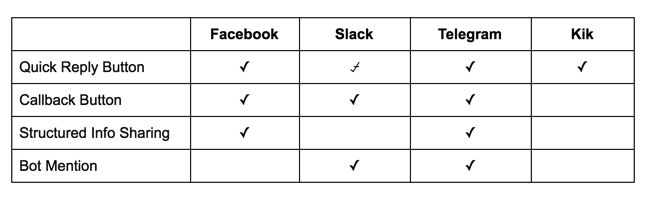
48. Nat Friedman

48. Nat Friedman

Xamarin

Cofounder and CEO, Xamarin

Xamarin, an open-source development company, allows programmers to write mobile apps that work on any popular operating system (iOS, Android, Windows) and then host them on their cloud of choice. When Xamarin, founded by Friedman, was getting its start in 2011, Microsoft was still considered an adversary by most open-source developers.

But no longer: Microsoft has begun to embrace open source as never before, and it bought Xamarin for a reported $400 million to $500 million in February. Xamarin’s new mission is to encourage developers to use Microsoft’s cloud instead of competitors‘ as the company works to grow its cloud business.

47. Chris Cox

47. Chris Cox

Stephen Lam/Reuters

Chief product officer, Facebook

The past year for Facebook has been all about video, and Cox is the man in charge of its product vision. The longtime Facebooker has led the full-blown charge into making video one of the top priorities both in your News Feed and for the company.

But his job isn’t all video. Cox is also behind the changes to the „Like“ button and also the new emoji reactions — don’t call them a „dislike button“ — that the company has seen this year. In June, Cox introduced more changes to the News Feed, including prioritizing friends‘ posts over those of publishers. Basically, whatever you see on Facebook is a result of Cox’s leadership over everything product at the social network.

46. Brian McClendon

46. Brian McClendon

Brian McClendon/Twitter

VP of advanced technologies, Uber

When Google announced its plans to create self-driving cars and a service to go with them, Uber turned to the former Google exec to head efforts against its automatic-car rival. Google Ventures (now known as GV) invested roughly $250 million in Uber in 2013, but the two companies‘ expanding ambitions mean they are increasingly eyeing each other’s turf. McClendon isn’t the only one who left Google for Uber: A LinkedIn search reveals that more than 300 Xooglers, or former Google employees, now work at Uber.

45. Chris Dixon

45. Chris Dixon

Noam Galai/Getty Images

Partner, Andreessen Horowitz

Dixon’s wheelhouse in venture capital is the crazy brainiac ideas that might just be our future. Dixon led the firm’s recent investment in the self-driving car and AI startup Comma.ai. The venture capitalist has also invested in moonshots like Nootrobox, which manufactures purportedly brain-assisting add-ons called nootropics, and Dispatch, which is building a fleet of self-driving delivery vehicles. Plus, he is a staunch supporter of the products made by the companies he invests in: He drinks Soylent and eats nootropics pills daily.

44. Garrett Camp

44. Garrett Camp

Flickr/Joi

Cofounder, Ubercofounder, StumbleUponfounder, Expa

Though he has shifted his focus to other projects, Camp is a multibillionaire thanks to his stake in the ubiquitous ride-hailing service Uber; his net worth is now at $6.2 billion.

This year, Camp launched the startup incubator Expa Labs, which has raised $100 million and will focus on providing a more hands-on experience to smaller cohorts of budding tech companies. Last August, he also bought back a controlling stake in StumbleUpon, the content-discovery website he cofounded as a graduate student in 2001 that learns what users like and recommends related sites to them.

43. Peter Szulczewski

Cofounder and CEO, Wish

Szulczewski has big plans for his e-commerce company. In 2015 he reportedly rejected multibillion-dollar acquisition inquiries from Amazon and Alibaba, and he projects Wish to sell $2 billion worth of goods this year. The company, which sells directly from merchants to consumers, spends big bucks on advertising, including an annual $100 million on Facebook ad space. Now people are wondering whether Wish could be the next Walmart of the online era. 

42. Jimmy Iovine and Eddy Cue

42. Jimmy Iovine and Eddy Cue

Angela Weiss/Getty Images

Cofounder, Beats Electronics; senior VP of internet software and services, Apple

Watch out, Spotify: Apple’s coming for you. After launching last June, with Apple executives Iovine and Cue leading the charge, Apple Music garnered 6.5 million paid subscribers in the first month after the free-trial period ended. A year later, that number had grown to 15 million paid subscribers.

Though the service still has a ways to go to catch up with Spotify’s 30 million paid subscribers, the rapid growth bodes well for the tech company. Apple launched the service as a direct challenge to Spotify’s prominence in streaming, and so far it is putting forth a good fight.

41. Ev Williams

Cofounder and CEO, Medium; founder, Obvious Ventures

Medium — the blogging platform used by tens of millions of people from budding writers to Valley mainstays to President Barack Obama — spent the year carving out some impressive real estate in the publishing sphere. This spring, the company created by Twitter cofounder and former CEO Ev Williams announced a $50 million round of funding, which followed a $57 million round in September.

In a post about the funding, the round’s leading investor, Spark Capital, wrote that the „publishing tool, network, and ecosystem“ was „solely focused on being the best place to read and write interesting stuff.“

40. Andrew Dreskin

Cofounder and CEO, Ticketfly

Pandora acquired the ticketing company Ticketfly for $450 million last year. Though Ticketfly is small compared with the ticketing giant Ticketmaster, the company is known for handling ticket sales for performances at smaller venues and the marketing and analytics for the venues it serves. Pandora plans to use the recent acquisition to build „the most effective marketplace for connecting music makers and fans.“

39. George Hotz

Founder, Comma.ai

Hotz is best known for his previous life as a hacker — he cracked the original iPhone in 2007 when he was 17, and he went on to break into the PlayStation 3 in 2010. Since then he has built a self-driving car from the comfort of his own garage and created Comma.ai — a kit that lets customers turn „dumb“ cars into self-driving versions — based on that technology. It caught the attention of Andreessen Horowitz, which invested $3 million in the startup.

38. Adam Bain

38. Adam Bain

Handout/Getty Images

Chief operating officer, Twitter

Before he became Twitter’s COO, Bain was on the short list to be the company’s CEO. The past year has seen stalling user growth and disappointing financial performance (Twitter stock hit an all-time low in May), but Bain has kept the money machine pumping against all odds.

37. Greg Clark

37. Greg Clark

Courtesy of Blue Coat

CEO, Symantec

Blue Coat, a security systems company, was on track to become the largest initial public offering in tech this year after the IPO market all but dried up. The company stopped short of going public, however, when Symantec offered to purchase it for about $4.65 billion in cash. Clark, the CEO at Blue Coat, then became Symantec’s CEO.

36. Orion Hindawi

36. Orion Hindawi

Courtesy of Tanium

Cofounder and CEO, Tanium

Hindawi attributes Tanium’s success to its focus on building a quality product before fixating on growth. Now the hot security startup claims to be cash-flow positive and growing at more than 250% a year. After raising $52 million, the company raised another $120 million a mere five months later. In that time, Tanium’s valuation doubled to $3.5 billion. The most impressive part? The company spends no money on sales and marketing, but rather it gets all its customers through word of mouth in the IT community.

35. Mike Cagney, Dan Macklin, Ian Brady, James Finnigan

35. Mike Cagney, Dan Macklin, Ian Brady, James Finnigan

SoFi ; LinkedIn

Cofounders, SoFi

The lending and wealth-management startup SoFi received a $1 billion funding round led by SoftBank last year that was the biggest financing round ever in the fintech industry. Since then, Cagney has been pursuing a $30 billion valuation and building up SoFi as a competitor with brick-and-mortar banks and online lending services. He also told Business Insider that the startup was considering an expansion into the world of life insurance.

34. Sheryl Sandberg

34. Sheryl Sandberg

Allison Shelley/Getty Images

Chief operating officer, Facebook

As UC Berkeley’s graduation speaker, Sandberg delivered a moving address about the death of her husband, Dave Goldberg, in May 2015. Her comments about resilience in the face of loss show that she is a force to be reckoned with, professionally and otherwise. For the past year, she has been a single parent to her two children while still leading Facebook as its chief operating officer. Outside that, she also backs Globality, a startup with the mission to advance the global economy by allowing more businesses to export products. Still, she says, „being a mother is the most important — and most humbling — job I’ve ever had.“

33. Patrick and John Collison

Cofounders, Stripe

There’s no slowing down the mobile-payment company Stripe. In July 2015 it received funding from a group of investors that included Visa and American Express. The $100 million round brought Stripe’s valuation to $5 billion.

Stripe also launched two new products: Relay allows businesses to sell products on other apps, and Atlas helps international companies start businesses in the US. In March, Collison was among a group of American business leaders who joined President Barack Obama on a trip to Cuba, one of the countries Stripe launched in this year, to try to bridge the gap between the two countries.

32. Diane Bryant

32. Diane Bryant

Intel

Senior VP and general manager, Data Center Group, Intel

In the midst of a declining PC market, Bryant keeps Intel alive as head of the company’s most profitable and fastest-growing unit, its Data Center Group. The unit creates chips that power internet services like autonomous cars, smart grids, and drones, and last year it generated $16 billion in revenue, or about 30% of Intel’s total sales. The company’s new focus on the Internet of Things puts Bryant at the forefront of Intel’s potential for innovation.

31. Keith Block

Chief operating officer, Salesforce

Salesforce CEO Marc Benioff loves what former Oracle sales star Block is doing for the company’s enterprise sales, so much so that he bought the COO a $41,000 watch. Block signed a record number of deals last quarter — 600 for at least $1 million each — and he secured a nine-figure contract with an unnamed company he described as „one of the world’s most respected companies.“ In May, Salesforce announced that the US Department of Health and Human Services signed a $100 million „blanket“ contract with Salesforce that also included a whopping $503 million budget just for related consulting services.

30. Rob Mee

30. Rob Mee

Pivotal

CEO, Pivotal

Pivotal recently caught the attention of Ford, which led to a $253 million investment round for the software-building and consulting startup that counts BMW, Twitter, and Best Buy as customers. Microsoft also participated in the round, which was Mee’s first as the newly appointed CEO. Together, Pivotal and Microsoft create an industry stronghold: They share 100 customers in the Fortune 500. Partnerships with Microsoft, Amazon, and Google’s cloud computing services make Pivotal an easy-to-use service, even for legacy companies like Home Depot.

29. Regina Dugan

29. Regina Dugan

Facebook

Head of Building 8, Facebook

This year, Dugan left her position as head of Google’s Advanced Technology and Projects Group for Facebook, where she was hired to spearhead the company’s new Building 8 initiative. The social network tasked Dugan and her team with creating hardware that will expand its product development efforts. It will be interesting to see where Dugan, who advocates rapid prototyping, takes Building 8.

28. Nathan Blecharczyk, Brian Chesky, Joe Gebbia

Cofounders, Airbnb

Airbnb became one of the most valuable startups in the world in December after securing a massive $1.5 billion funding round, raising its valuation to $25.5 billion. But that’s not enough for the billionaire founders‘ ambitious international expansion plan; they are now seeking a new round of funding that would raise Airbnb’s valuation to $30 billion, triple what it was just two years ago. The room-renting company has listings in 191 countries and projects that 129 million nights will be booked by year’s end.

There is just one thing stopping Airbnb from further growth: government roadblocks. In early June, for instance, the city of San Francisco backed Airbnb into a corner, requiring that the company list only properties that are registered with the city. Airbnb has sued the city to protect its renters who rely on their Airbnb income.

27. David Sacks

CEO, Zenefits

After launching in 2013, the insurance startup Zenefits grew to 1,600 employees in two years. Soon after, Zenefits fell off track for its $100 million sales target, intracompany communication spiraled out of control, and its sales licensing procedures came under question. CEO Parker Conrad suddenly left, and Sacks, the COO, took over the top spot. He has made rapid and decisive changes to get the company back on track, including cutting jobs, asking employees who weren’t committed to take a buyout, and cutting the value of the company by more than $2 billion as part of a deal with investors to avoid lawsuits.

26. Chuck Robbins

26. Chuck Robbins

Cisco

CEO, Cisco

Upon his appointment as CEO, Robbins reorganized Cisco’s leadership and restructured its engineering unit in a move to build closer relationships with the company’s legendary lead engineers, who used to report to John Chambers, now the executive chairman. Robbins also brought in new hires to head the areas of Cisco he plans to focus and expand upon, like networking, cloud computing, security, and IOT and applications. As Microsoft challenges Cisco with its new networking software, it is as important as ever that Cisco’s engineers focus on the company’s own networking software, Nexus 9000.

25. Palmer Luckey and Brendan Iribe

25. Palmer Luckey and Brendan Iribe

Wikimedia Commons and Brian Ach/Getty

Cofounders, CEO (Iribe), Oculus VR

It’s finally here! Four years after launching and two years after the $2 billion acquisition by Facebook, Oculus finally unleashed the Oculus Rift, its long-awaited virtual reality headset, to eager customers.

The product comes with a steep $600 price tag, but that didn’t deter consumers from champing at the bit for it. Preorders opened in January and sold out almost immediately, leaving the company struggling to keep up. The headset also launched in retail stores this May, giving customers another chance to try to score one.

24. Chamath Palihapitiya

24. Chamath Palihapitiya

Owen Thomas, Business Insider

Founder, Social Capital

Outspoken Silicon Valley investor Palihapitiya didn’t tread lightly this year. He decried the gender gap in tech, shared which startups he thought were „mostly crap,“ and publicly criticized Apple CEO Tim Cook. Through his more than $1 billion investment fund Social Capital, Palihapitiya is righteous in his conviction that today’s generation has the opportunity to put „a massive dent in human suffering and make trillions of dollars in return.“

The company he is most excited to put his money behind? Amazon, which he thinks could be a $3 trillion behemoth a decade from now. „We think this is the most incredible company being built today in the world,“ he said at an investment conference in May. Also this spring, the multimillionaire and part-owner of the Golden State Warriors launched a hedge fund, the impact of which remains to be seen.

23. Bill Gurley

23. Bill Gurley

Steve Jennings/Getty Images

General partner, Benchmark Capital

The thriving tech industry of the past few years hasn’t been quite as fruitful in 2016, with startups struggling to procure funding and a notable lack of initial public offerings. But many investors ignored the choppy waters — until Gurley stepped in.

In April, the prominent Benchmark Capital venture capitalist released a seminal piece about the tech bubble on his personal blog, predicting the end of the unicorn boom and finally getting fellow VCs to take note of the slowdown. Even more recently, Gurley again warned against late-stage investments, reminding lenders that they are companies‘ last resorts — not exactly the best way to kick off a business relationship.

22. John Zimmer and Logan Green

22. John Zimmer and Logan Green

Stephen Lam/Reuters

Cofounders, Lyft

Lyft cofounders Green and Zimmer are looking toward the future of transportation after raising $1 billion in the company’s latest funding round in January, more than doubling its valuation to $5.5 billion from $2.5 billion in 2015.

The ride-hailing app announced in May that it was testing a service allowing passengers to schedule Lyft rides up to 24 hours in advance; the company’s chief rival, Uber, announced a similar service only a few weeks later. In January, Lyft signed a partnership with General Motors, along with a $500 million investment, that aims to pursue the development of self-driving cars.

21. Jeff Lawson

21. Jeff Lawson

Flickr/Twilio

Founder, CEO, and chairman, Twilio

When the cloud software company Twilio filed for an initial public offering, it broke Silicon Valley’s 2016 tech startup drought. Originally expected to be valued at $12 to $14 a share, it exceeded expectations by pricing at $15 a share and has been on a tear since. A developer favorite — Lawson says 700,000 developers have used the software to date — Twilio integrates communications systems into existing apps like Uber, Lyft, and Airbnb. The behind-the-scenes software cuts costs and boosts efficiency for big tech ventures, allowing them to expand faster than if they had to build communications technologies on their own.

20. Chris Sacca

20. Chris Sacca

Alison Buck/Getty

Founder, Lowercase Capital

Sacca, the founder of the Silicon Valley VC firm Lowercase Capital, became a billionaire thanks to his company’s 4% stake in Uber, which most recently clinched a valuation of nearly $68 billion. Sacca was also an early-stage investor in Twitter, Instagram, and Kickstarter, establishing a reputation for spotting the hottest startups before they become household names.

But alas, he can‘t spot them all. In an interview with Vanity Fair, Sacca revealed that he declined to invest in Snapchat — an app he now uses daily. The cowboy-shirt-wearing investor starred in a few episodes of the investing show „Shark Tank“ last season, where he frequently locked horns with fellow billionaire, show regular, and longtime friend Mark Cuban.

19. Stewart Butterfield

19. Stewart Butterfield

Kimberly White/Getty Images

Cofounder and CEO, Slack

People just can’t get enough of the workplace messaging app Slack. At the end of March, the three-year-old company had its largest round of funding to date. Slack raised $200 million, bringing its estimated value to $3.8 billion. It is one of the fastest-growing business apps of all time, and most of that growth is organic. The company has done some TV spots and billboard campaigns, but it mostly relies on growth through word of mouth. It hired its first sales chief only in May after years of scaling on its own.

18. Sam Altman

18. Sam Altman

Getty Images

Founding partner and president, Y Combinator

Since taking over as president of the startup accelerator Y Combinator in early 2014, Altman has transformed the incubator into a more robust company, adding a research lab and late-stage growth fund. Acceptance into Y Combinator, which is known for producing elite Silicon Valley companies like Dropbox and Airbnb, serves as a sure-fire entrance into the competitive startup world.

Under Altman’s leadership, the company committed $10 million to YC Research, a lab separate from YC‘s startup program focused on developing technology for the greater good that will eventually be available to anyone — free. Y Combinator also raised $700 million to further invest in select maturing startups it believes will succeed long term. 

Altman’s newest plan is to grow Y Combinator from 200 companies a year to 2,000, thanks to the YC Fellowship program.

17. Kyle Vogt

17. Kyle Vogt

Twitter

Founder and CEO, Cruise

As tech companies and traditional car manufacturers vie for prevalence in the auto space, it feels like a race to see who will build the first mainstream self-driving car. And Vogt might be onto something big. His startup, Cruise, is developing technology that can retroactively transform any car into an autonomous one. His idea is so huge, in fact, that Vogt sold the startup to General Motors for more than $1 billion in March, making him the automaker’s point person in Silicon Valley.  

16. Reed Hastings

16. Reed Hastings

Ethan Miller/Getty Images

Cofounder and CEO, Netflix

Netflix and its fearless leader Hastings have continued to dominate, impress, and delight this year. The ubiquitous entertainment-streaming service was one of the biggest risers in the tech industry in 2015 as evidenced by its 95-spot jump on this year’s Fortune 500 list. With a plan for aggressive global expansion in motion and more than 600 hours of original content being added to its library throughout this year, Netflix expects to burn through another $1 billion in cash in 2016 to carry its growth efforts.

Netflix reached 81 million subscribers in April, but analysts estimate that the company will lose about 480,000 subscribers this year because of gradual price hikes, which are still estimated to pull in about $520 million in extra revenue.

15. Diane Greene

15. Diane Greene

Google

Founder, Bebop; senior VP of cloud businesses, Google 

Since Google’s parent company, Alphabet, bought Bebop for $380 million last year, Greene has been making waves at the Silicon Valley giant. Eight months ago, she was appointed head of the company’s cloud efforts. She upended Google for Work, hiring sales and support personnel, creating a Global Alliance program, and building industry-specific units for clients. By collaborating with Google’s customers, Greene and her team leverage data and tools from Google and other companies, transforming the way the cloud is used.

14. Peter Thiel

14. Peter Thiel

Torch Communications

Partner, Founders Fund; chairman, Palantir; founder, Thiel Fellowship; investor

Love him or hate him, Thiel is a force to be reckoned with in Silicon Valley. In May, it came out that the billionaire VC was the secret benefactor funding Hulk Hogan’s sex-tape lawsuit against Gawker — apparently as revenge for Gawker’s coverage of Thiel in the past. The staunch libertarian and longtime Republican supporter is also serving as one of Donald Trump’s California delegates.

But beyond all the drama, Thiel remains one of tech’s savviest investors through his Founders Fund, and Palantir, the big-data company he cofounded, continues to grow. Recently, it offered to buy back stock from current employees at a higher share price than many investors value the company at — provided that the employees agree not to discuss Palantir with outsiders and media.

13. Meg Whitman

13. Meg Whitman

Andrew Burton/Getty Images

President and CEO of Hewlett Packard Enterprise; chairwoman of HP Inc.

After years of sliding profits, troublesome acquisitions, and thousands of layoffs, Whitman decided to take drastic measures help boost Hewlett Packard back to its former glory. So she split the IT giant into two leaner, more focused ventures. Hewlett Packard Enterprise took charge of selling hardware, such as servers, while HP Inc. remained in control of printers and PCs.

Then in May, Whitman divided the company even further, spinning off HPE’s business enterprise services and merging with Computer Sciences in hopes of — once again — becoming a serious competitor in the information technology space. In addition to overseeing the entire undertaking, Whitman serves as HPE’s CEO and is on the board of all three new companies.

12. Dan Schulman

12. Dan Schulman

Business Insider

President and CEO, PayPal

After a 13-year marriage, PayPal and eBay parted ways in 2015 to form two separate companies. Schulman has been CEO of the former ever since. Under Schulman, the PayPal-owned Venmo has become the year’s most dominant peer-to-peer payment app, with 173 million active users in 2015. In April he announced that the company had its best quarterly earnings ever, despite an ongoing Federal Trade Commission investigation of the operation on suspicion of possible „deceptive or unfair practices.“

11. Sundar Pichai

11. Sundar Pichai

Justin Sullivan/Getty Images

CEO, Google

After Google restructured last year and formed Alphabet to oversee its growing cache of companies, Pichai took the reins as CEO of the new standalone subsidiary Google, which includes the company’s search, YouTube, and Android businesses.

Pichai is focusing heavily on artificial intelligence, unveiling several new applications at the Google I/O event in May, including a messaging app that uses „messaging bots“ to draft responses for users to make messaging easier and faster. Pichai has become one of the highest-paid CEOs in the tech world, making over $100 million in 2015.

10. Brian Slingerland, Scott Dylla, and Daniel Reiner

10. Brian Slingerland, Scott Dylla, and Daniel Reiner

Stemcentrx

Cofounders, Stemcentrx

Previously a Goldman Sachs vice president and a senior scientist at OncoMed Pharmaceuticals, respectively, Slingerland and Dylla publicly launched Stemcentrx in September (after seven years in stealth mode) along with Reiner, a serial investor and former telecom executive. Their mission: to end cancer by targeting cancer-specific stem cells.

Less than a year later, the pharma giant AbbVie bought the biotech startup for $10.2 billion, when the company was valued at $5 billion, in one of the largest tech acquisitions ever. AbbVie showed special interest in Stemcentrx’s lung-cancer-fighting drug Rova-T, which could grow the company’s oncology business. AbbVie hopes to bring the drug to market by 2018.

9. David Marcus

9. David Marcus

Brian Ach/Getty Images

VP of messaging products, Facebook

It has been nearly two years since Marcus left his cushy job as president of PayPal to join the Facebook team as vice president of messaging products, a move he has called a „once-in-a-generation opportunity.“ Under his rule, Facebook’s Messenger has grown into a beast of its own, with 900 million monthly active users as of April.

This year Marcus built out Messenger’s AI capabilities to include Spotify song sharing, Uber and Lyft ride hailing, food ordering, and flight tracking. And with the recent unveiling of chat bots for businesses, Messenger aims to make sure you never have to deal with human customer service again.

8. Marc Benioff

8. Marc Benioff

Kimberly White/Getty Images

Cofounder and CEO, Salesforce

It might not be a shiny, consumer-facing product, but the cloud computing software company Salesforce is crushing it and remains one of the hottest tech companies in the world. Helmed by Benioff, the $50 billion business boasts a 22% compound annual growth rate and is expected to rake in more than $8 billion in revenue this year.

Benioff has become a model CEO not just for financial success but also for social involvement, standing up for gender equality, workplace diversity, and LGBT rights. He has openly criticized legislation that could be used to discriminate against LGBT workers and publicly pledged to guarantee equal pay for men and women.

7. Tim Cook

7. Tim Cook

Stephen Lam/Getty Images

CEO, Apple

In the past 12 months, Cook guided the tech giant through the launch of Apple Music, which garnered 6.5 million paid subscribers in the first month after the service’s free-trial period; released the Apple TV 4, which can run third-party apps and access Siri; and introduced the iPad Pro, the company’s largest tablet, boldly declaring the end of PCs with it.

Under Cook, Apple also recently invested $1 billion into Didi Chuxing, the Chinese ride-hailing service that is blowing Uber out of the water in China. The deal was Apple’s first major investment since it bought Beats Electronics in 2014.

6. Jack Dorsey

6. Jack Dorsey

Kimberly White/Getty Images

Cofounder and CEO, Twitter and Square

As CEO of both Square and Twitter, Dorsey has his fingerprints all over Silicon Valley. In November he took the mobile payment company Square public, opening at $9 a share, lower than the $11 to $13 originally proposed. Though some outlets called it a flop, many entrepreneurs would kill for the company’s $3 billion market capitalization and $1.3 billion in revenue.

And after returning to Twitter as interim CEO last July (and officially appointed CEO in October), Dorsey has spent the past year turning the struggling social network around by solidifying its mission and making product adjustments, including plans to incorporate more live video and crack down on the hateful abuse many users complain about.

5. Reid Hoffman and Jeff Weiner

5. Reid Hoffman and Jeff Weiner

Kimberly White/Getty Images ; Chip Somodevilla/Getty Images

Cofounder and executive chairman (Hoffman), CEO (Weiner), LinkedIn

In March, Weiner gave his $14 million stock bonus back to LinkedIn employees after the company’s stock tumbled 40% following the company’s tepid February earnings report. Weiner hoped the move would help reinvigorate employees and improve morale.

By June, the company’s stock-price woes had become moot. The tech world shook after Weiner and cofounder Hoffman oversaw the professional social network’s sale to Microsoft for a stunning $26.2 billion in cash. The deal marked Microsoft’s largest acquisition ever, with the software giant paying a 50% premium to close the deal. Microsoft CEO Satya Nadella plans to eventually sync LinkedIn’s network with Microsoft Office, ideally bolstering the overall user experience on both sides.

4. Elon Musk

4. Elon Musk

VCG/Getty Images

CEO, Tesla; CEO and CTO, SpaceX; chairman, Solar City

Musk continues to be one of the world’s most influential entrepreneurs — and preeminent multitaskers. Musk has his eyes set on dominating land and space through Tesla Motors and SpaceX, two of the hottest and most progressive companies of our generation. In April, Musk unveiled Tesla’s mass-market Model 3, racking up 375,000 preorders in one month. The company is reportedly struggling to meet demand.

In June, Musk made a highly criticized all-stock offer for Tesla to acquire the floundering solar-energy company SolarCity; Musk owns 22% of the company and serves as its chairman. And if that weren’t enough, he also envisioned a futuristic transporation system called the Hyperloop that would take people from LA to San Francisco in less than an hour. One company building a system based on that idea has now secured $80 million in series B financing in May and has begun testing its technology.

3. Travis Kalanick

3. Travis Kalanick

Uber

Cofounder and CEO, Uber

Worth $68 billion, the ride-hailing service Uber, helmed by Kalanick, holds steady in its place as the most valuable private tech company in the world. Under Kalanick’s leadership, the startup also raised the largest round of venture capital ever, bringing in $3.5 billion from Saudi Arabia’s Public Investment Fund in June.

Uber continues to expand and innovate, particularly through new services, such as UberEats, which brings meals to New York City customers, and UberRush, which helps businesses make deliveries. Kalanick leads the charge as Uber expands and conquers new markets, even as it faces fierce competition in China.

2. Larry Page

2. Larry Page

Justin Sullivan/Getty Images

Cofounder and CEO, Alphabet

Once just a search engine, Google has grown so tremendously that its cofounders felt it was time to restructure the company. In a letter last summer, Page announced the creation of Alphabet, a holding company that oversees Google and numerous other subsidiaries. As Alphabet’s CEO, Page can focus on acquiring new technologies, fostering „moonshot“ projects, and developing talent — his first move was promoting Google’s Sundar Pichai from senior vice president to CEO.

In June, Bloomberg Businessweek reported that Page had personally acquired two companies working on creating a flying car, an investment unaffiliated with Alphabet.

1. Mark Zuckerberg

1. Mark Zuckerberg

Steve Jennings/Getty Images

Cofounder and CEO, Facebook

It has been a big year for Zuckerberg. At Facebook’s annual F8 developers conference in April, he laid out a 10-year road map for Facebook, detailing short-term plans to ramp up video, search, and apps, such as Instagram and WhatsApp, in the next five years. The company’s long-term focus will include bigger projects like drones, artificial intelligence, and virtual reality.

Zuckerberg also became a dad last fall, prompting him to pledge to give away 99% of his $50 billion fortune throughout his lifetime. He will do so primarily through a new organization he cofounded with his wife, Priscilla Chan, called the Chan Zuckerberg Initiative, which is aimed at making long-term investments in causes and organizations that will improve health, education, and equality.

http://www.businessinsider.de/silicon-valley-100-2016-6?op=1

Where Machines Could Replace Humans…

…and where they can’t (yet).

Sector-Automation.pdf

Will robots eliminate human jobs? Experts at the McKinsey Global Institute have long argued that’s the wrong question to ask about automation and the future of work. The reason: it fails to recognize the fundamental distinction between “jobs” and “tasks.”

Most jobs involve performing a variety of different tasks. An occupation like “travel agent” might involve a host of skills that are easy for machines to match: knowledge of geography or an ability to understand airline and train schedules. But it also requires other, hard-to-automate talents such as intuiting customers’ hopes and dreams and selling an appropriate travel package.

McKinsey analysts argue that, over the next decade, robots will take over many tasks—perhaps even half of all the things humans now get paid to do. But they see few occupational categories in which robots are likely to take over entire jobs. McKinsey’s research suggests that in years to come, humans will collaborate more and more closely with machines but not get pushed out of the workplace entirely.

Using data from the U.S. Bureau of Labor Statistics and O*Net, MGI recently conducted a detailed analysis of more than 2,000 work activities for more than 800 occupations. Their goal: to assess the technical feasibility, using currently demonstrated technologies, of automating three groups of occupational activities: those that are highly susceptible, less susceptible, and least susceptible to automation. In a recent article in the McKinsey Quarterly, MGI’s Michael Chui, James Manyika, and Mehdi Miremadi described some of the conclusions of that analysis. The whole article is worth reading.

You can get a sense of MGI’s analysis of which occupational categories are most and least vulnerable to automation from the graphic below. It’s a matrix depicting eight types of occupations across 19 different economic sectors. For each job box, the wider the color bars, the larger the percentage of time on the job spent on activities that can be automated. Yellow, green, and blue color bars indicate tasks that are highly automatable, while orange and red bars indicate tasks that are hard to automate. The implication: look for jobs with the skinny red lines and steer clear of the ones with the fat blue bars.


http://bento.hult.edu/where-machines-could-replace-humans