Where Machines Could Replace Humans…

…and where they can’t (yet).

Sector-Automation.pdf

Will robots eliminate human jobs? Experts at the McKinsey Global Institute have long argued that’s the wrong question to ask about automation and the future of work. The reason: it fails to recognize the fundamental distinction between “jobs” and “tasks.”

Most jobs involve performing a variety of different tasks. An occupation like “travel agent” might involve a host of skills that are easy for machines to match: knowledge of geography or an ability to understand airline and train schedules. But it also requires other, hard-to-automate talents such as intuiting customers’ hopes and dreams and selling an appropriate travel package.

McKinsey analysts argue that, over the next decade, robots will take over many tasks—perhaps even half of all the things humans now get paid to do. But they see few occupational categories in which robots are likely to take over entire jobs. McKinsey’s research suggests that in years to come, humans will collaborate more and more closely with machines but not get pushed out of the workplace entirely.

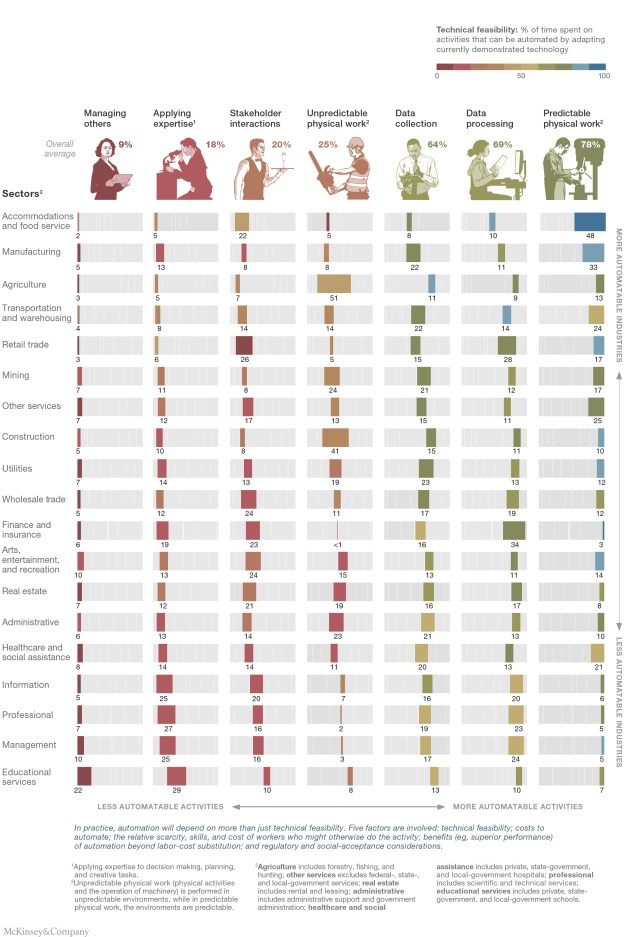
Using data from the U.S. Bureau of Labor Statistics and O*Net, MGI recently conducted a detailed analysis of more than 2,000 work activities for more than 800 occupations. Their goal: to assess the technical feasibility, using currently demonstrated technologies, of automating three groups of occupational activities: those that are highly susceptible, less susceptible, and least susceptible to automation. In a recent article in the McKinsey Quarterly, MGI’s Michael Chui, James Manyika, and Mehdi Miremadi described some of the conclusions of that analysis. The whole article is worth reading.

You can get a sense of MGI’s analysis of which occupational categories are most and least vulnerable to automation from the graphic below. It’s a matrix depicting eight types of occupations across 19 different economic sectors. For each job box, the wider the color bars, the larger the percentage of time on the job spent on activities that can be automated. Yellow, green, and blue color bars indicate tasks that are highly automatable, while orange and red bars indicate tasks that are hard to automate. The implication: look for jobs with the skinny red lines and steer clear of the ones with the fat blue bars.


http://bento.hult.edu/where-machines-could-replace-humans

Why Robots Are Our Friends

Clay Chandler interviews Mick Mountz about the future of Artificial Intelligence.

We’ve heard so much in the past year about technological change, the “Fourth Industrial Revolution,” and how everyone from Elon Musk to Steven Hawking is afraid of robots taking over the universe. What’s going on?

Society is trying to come to terms with the increasing pace of technological change and this exponential rise of new technologies, and put those concepts into understandable frameworks and metaphors. Calling what’s happening right now the Fourth Industrial Revolution brings to mind previous patterns of change and side effects—especially relating to jobs and employment.

Current discussions about robotics and artificial intelligence (AI) generally involve extrapolation of unchecked technology curves—which may be a relevant limit case, but is unlikely to be the probable outcome. These scenarios don’t often acknowledge how hard these complex technologies are to master, and the market and regulatory responses that impede and alter adoption trajectories.

What’s really new in all these discussions about robots and AI? Technological change has been a constant since the original Industrial Revolution. Don’t we always just adapt and move on?

The pace of change is quickening, but folks are also starting to see the convergence of hardware and software into seamless new solutions. At Kiva, we were the first material handling company to create the whole solution—a single integrated complex adaptive hardware and software system coordinating thousands of mobile robots in the storage, movement, and sortation of warehouse inventory in support of order fulfillment processes. This was an eye-opener for the industry, as the efficiency of these deployments would improve year-over-year via better software algorithms and optimizations, new hardware modifications, and changes to workflow processes. A second source of improvements, though, would stem from the “living, breathing” system adapting and tuning itself to better efficiencies. That is the fun and exciting part and the strangely interesting phenomenon that gives rise to these AI speculations. It should be noted, however, that those adaptive improvements were often an order of magnitude smaller than improvements conceived and developed by humans involving rigorously tested new features and algorithms deployed in software updates.

To generalize that observation—concerns around AI and robotics seemingly revolve around not understanding or knowing how these new complex adaptive hardware-software solutions will behave. The increased noise and discussion around the topic simply reflect the fact that we are finally starting to see more fielded examples of such systems. The Internet of Things (IoT) is the same old stuff (hardware) but now with improved, embedded, and connected software that turns this collection into a system capable of useful actions. My car now automatically closes the garage door as I leave the driveway (thanks to a software update earlier this year).

We keep hearing from pessimists about the idea that AI and robots are going to wipe out jobs, and optimists about how technology is going to make us all more productive. And yet neither of those things seems to have happened yet. U.S. unemployment is around 5% (of which probably half is “structural”). And for the past two decades, we haven’t seen any dramatic improvement in U.S. labor productivity. How come the impact of technology—whether positive or negative—doesn’t show up in the economic data?

Though I’m not an economist by any stretch, I would suggest that the impact of technology does show up in the data if you look in the right places. The price of oil was in the $20’s per barrel earlier this year—near the lowest inflation adjusted price ever. This was explained as an oversupply of oil, which I think reflects our technological progress in obtaining the oil that’s been there all along, together with demand-side efficiencies in cars, homes, mowers, and power plants that now use energy more efficiently as well.

When I was a kid growing up, I paid about 50¢ to fill my one-gallon gas can and mow three to four lawns for income ($3.51 during 1981 in 2015 dollars). Last summer I would have been paying about 34¢ inflation adjusted ($2.36 in 2015 dollars), and could probably mow five to six yards before needing a refill. My “mowing business” would be reporting better top and bottom lines today! Maybe corporate profits are where productivity ultimately shows up.

To make another point on productivity, we should be basing our metrics on the number of people employed, rather than unemployed as you simply can’t prove a negative. I suspect that the total output of the U.S. economy over the number of paid hours worked would show that we get more done each year per hour worked (though we probably need to take a fresh look at the GDP numerator too). At the same time, technology also provides a lot of new distractions; binge-watching shows because we can, Facebook, etc., can counterbalance productivity gains.

Is technology going to wipe out jobs? Or is it just going to change them? The McKinsey guys are always telling me not to confuse jobs with “tasks.” They argue you can probably automate half of all tasks, but not that many jobs. Does this sound true to you? And if so, what does it mean?

Jobs versus tasks is a decent framework for thinking about employment and automation. At Kiva, we automated the walking task that consumed about 70% of the pickers’ job time, but we didn’t automate the pickers’ job. When you look around the office environment, you see plenty of repetitive processes that are being automated to improve productivity, thus enabling the knowledgeable worker to focus on the more value-added tasks that actually drive the company forward.

On this point, I always joke that the blame goes all the way back to Gutenberg in 1440 AD, who put thousands of monks out of business when he invented the moveable type printing press, and thus transcribing the Bible and other important works page-by-page by hand was no longer necessary. We know those monks didn’t tweet their grievances, instead, they may have even thrown a party (maybe that’s when they began to focus on beer brewing). And ultimately, civilization benefited from the faster proliferation of printed knowledge.

The fact is that every single new technology, not just industrial waves, change the employment landscape. RF toll tags displaced human collectors standing in smoggy booths. The loom displaced the Luddites. The horseless carriage displaced the blacksmiths. Microsoft Word displaced the traditional secretary. Even the ranks of brave New York City bicycle messengers are more scarce now as email and electronic document signatures have taken over.

In today’s headlines, cab and truck drivers (monks) are high on the speculative list to be sidelined by automated self-driving vehicles (printing presses). While they probably won’t throw a party (after tweeting and litigating their grievances), a few decades from now we’ll all be scratching our heads about the time we used to allow humans to control multi-ton lethal projectiles by hand, in the same way it now seems incredulous that kids once had free range of the back seat without car seats or even seat belts.

Amazon’s experience with Kiva suggests that robots actually make the workplace better, and can make work more meaningful. Do you think that will be true in other settings as well?

Yes—when you automate the mundane portion of a task, the overall job becomes more interesting and meaningful. The human is asked to engage in higher order thinking, creative tasks, and problem solving. That’s true regardless of the setting.

What CAN’T robots do?

Never say never, but today’s robots can’t even pick a t-shirt from a clothing bin, let alone bubble wrap a wine goblet, or fold a pack slip into that sticky window on the outside of an e-commerce box. Those are mechanical tasks that will likely be tackled eventually, but even at that point, the bot will not be smart enough to determine whether a unit is damaged versus sellable, let alone understand the why of the situation.

If I’m a new business school graduate, what should I do to prepare myself for a career in this brave new world? How can anyone train for a job these days when the definition of what employers need seems to change so rapidly? How do I even think about what constitutes an actual “job”?

Don’t think about getting a “job”—think about creating change, moving the needle, pursuing a passion, or changing the game—and develop and use those skills that further those trajectories. Creativity, problem solving, convening, and motivating are skills that won’t be replaced by automation anytime soon.

What can business schools do to prepare students for the new workplace?

Most B schools have started emphasizing the importance of group projects involving teamwork as central to learning the people skills necessary for success in the new workplace. Then layer on some entrepreneurial challenges and context, and you’re moving in the right direction.

What does all this new technology mean for CEOs? How will it force them to think differently about their companies?

CEOs will be those individuals who understand these workforce and marketplace dynamics, and will create companies and solutions that ride these undercurrents as opposed to getting washed away by them. They will place greater importance on finding flexible, adaptable, creative human talent, and provide them with the productivity tools that allow them to automate the mundane and focus on the strategic priorities that grow the business.

Does the “fourth revolution” (if we want to call it that) favor big companies or small companies?

Without even researching the point, I’m going to say smaller companies always have the advantage when things shift or when transformations take place. Each industrial revolution was characterized by new little companies, individuals, and ideas that eventually became big companies and huge industries. Think of Ford competing with hundreds of existing auto startups in the early 1900’s and breaking down the auto patent pooling control of the largest incumbents of the day, or Edison and Tesla/Westinghouse bringing electricity out of tiny labs in an early standards war, or Fairchild Semiconductor becoming a startup that grew too big and too slow, and thus giving rise to “Fair-children” including Intel, AMD, and others resulting in Silicon Valley.

http://bento.hult.edu/why-robots-are-our-friends

Will Robots Steal My Job?

Robots-Woman201608

It’s not as far-fetched as you think.

New graduates starting a business career have plenty of challenges: landing a job, finding a place to live, scrambling to make rent—all while trying to plot the next step in their career. Increasingly, it looks like they’ll need to add another worry to the list: competing with robots.

If that sounds like the premise of some screwball sci-fi movie (or reminds you of this Flight of the Conchords video), think again. Over the past several years, a growing chorus of experts, including economists, technologists, and management consultants, have begun warning of widespread job losses in coming decades as advances in artificial intelligence and automation enable machines to take on more and more complex tasks.

– Gartner, an information technology and research advisory firm, estimates a third of jobs will be replaced by software, robots, and smart machines by 2025.

– In a 2013 study, Oxford professors Carl Frey and Michael Osbourne found that machines could replace about 47 percent of our jobs over the next 20 years.

– The McKinsey Global Institute recently concluded that, just by implementing technologies that already exist, global businesses could automate 45 percent of the activities they now pay workers to perform.

Some experts are less gloomy. J.P. Gownder, an analyst with the Boston-based high tech research firm Forrester, estimates that new automation will cause a net loss of “only” 9 million U.S. jobs by 2025. Gownder argues that even as it wipes out some jobs, automation will create new ones, including some entirely new job categories we haven’t even thought of yet. Andrew Moore, dean of the School of Computer Science at Carnegie Mellon University and former head of robotics at Google, says he finds no evidence technology is stealing jobs.

But the list of pessimists includes an imposing roster of science and technology heavyweights. Physicist Stephen Hawking worries about “anthropogenic AI”—robots that might decide to kill us off. He told the BBC recently that AI and robots “could spell the end of the human race.” Elon Musk, head of Tesla and SpaceX, calls artificial intelligence humanity’s “biggest existential threat” and has donated millions to efforts seeking ways to keep AI from turning on its creators.

Steve Wozniak, co-founder of Apple, recently told the Australian Financial Review, “computers are going to take over from humans, no question,” adding, “the future is scary and very bad for people… Eventually computers will think faster than us and they’ll get rid of the slow humans to run companies more efficiently.”

“Eventually computers will think faster than us and they’ll get rid of the slow humans to run companies more efficiently.”

Even former U.S. Deputy Secretary of the Treasury Larry Summers, long an advocate of technology’s unalloyed benefits, has changed his view, writing: “Until a few years ago, I didn’t think this was a very complicated subject. The Luddites were wrong and the believers in technological progress were right. I’m not so completely certain now.”

Luddites, of course, were 19th century British textile workers who rose up in rebellion against labor-saving production techniques. As that reference implies, the debate about whether technology destroys jobs goes back centuries—and the doomsayers have always been proved wrong.

One of techno-optimists’ favorite examples is agriculture. Two centuries ago, more than 80 percent of the U.S. labor force worked on farms. Today, thanks to advances in mechanization, farmers account for less than 2 percent of the U.S. workforce and we have more food at lower prices than ever.

But Martin Ford, author of the recent book Rise of the Robots: Technology and the Threat of a Jobless Future, argues the technologies driving the current transformation of the economy are different. Improvements in agricultural methods, he points out, weren’t readily transferrable to other sectors of the economy. By contrast, today’s technologies make use of broad-based, general-purpose intelligence. Machines are animated by algorithms that enable them to adapt, to learn, to think.

These brainy new bots are part of a host of other technological changes so sweeping that organizers of this year’s World Economic Forum in Davos, Switzerland proclaimed the dawn of a “Fourth Industrial Revolution,” a brave new world in which “billions of people connected by mobile devices with unprecedented processing power, storage capacity and access to knowledge” are conjoined with “emerging technology breakthroughs in fields such as artificial intelligence, robotics, the Internet of Things, autonomous vehicles, 3-D printing, nanotechnology, biotechnology, materials science, energy storage, and quantum computing.”

In the Davos chronology, the First Industrial Revolution used water and steam to mechanize production; the Second used electric power to create mass production; and the Third used electronics and information and technology to automate production. And now, in the Fourth, we are experiencing a “fusion of technologies that is blurring the lines between the physical, digital, and biological spheres.”

An early milestone in the emergence of thinking machines was May 1997, when IBM’s Deep Blue supercomputer defeated Garry Kasparov, then the world chess champion. Then in 2011, IBM’s supercomputer, Watson, triumphed over Jeopardy superstars Ken Jennings and Brad Rutter.

A year later, Boston-based Rethink Robots rolled out Baxter, a friendly looking robot designed to work alongside humans on the factory floor. Baxter wasn’t a multi-million-dollar super-computer; it was built to human scale and priced at $25,000. Baxter doesn’t have to be programmed—it can learn from watching the movements of people, or by allowing humans to move its flexible arms—and can beat any human at the popular logic game Connect Four. Thanks to recent upgrades, Baxter’s grip is soft enough to cook an egg.

More and better Baxters are coming. Amazon already has thousands of robots sorting items in its fulfillment centers, and envisions replacing delivery workers with a fleet of aerial drones. As of February, there were more than 260,000 robots working in U.S. factories, according to the trade group Robotic Industries Association.

China, which last year became the world’s largest market for industrial robots, means to be at the vanguard of this revolution. Foxconn, China’s largest private employer and a primary supplier to Apple, announced this year that it had installed robots to eliminate 60,000 jobs in a single factory.

Factory jobs aren’t the only jobs at risk. Any kind of office work that involves repetitive tasks such as filling out reports or preparing spreadsheets can be easily replaced with software. Computers are certain to take over many tasks now performed by paralegals and lawyers, especially in big cases where the discovery process can involve millions of documents.

Factory jobs aren’t the only jobs at risk. Any kind of office work that involves repetitive tasks such as filling out reports or preparing spreadsheets can be easily replaced with software.

The Associated Press has shown that computers can generate error-free corporate earnings reports and cover certain types of sporting events. Watson is far more accurate than human doctors at diagnosing lung cancer. A significant share of tasks performed by what are currently high-paying occupations such as financial planners, physicians, and equities traders can be automated with existing technologies.

And will we really need so many taxi drivers when ride-hailing platforms like Uber and Lyft can be paired with self-driving cars piloted by Google, Amazon and Baidu?

What will be left? It isn’t clear. Optimists insist robots will free humans from drudgery and enable us to focus on the types of imaginative tasks in which humans excel. And of course companies will still need engineers to design, program, oversee, and maintain all those computers.

Ford and others fear that, while advances in technology may not eliminate human work completely, they are certain to polarize the labor market, creating higher demand for a smaller number of people with a limited set of professional and technical skills.

How to survive this transformation? The best advice we can offer is to be flexible, keep learning, and prepare for the way you work to change far more rapidly than anything experienced by previous generations.

http://bento.hult.edu/will-robots-steal-my-job/

Tech Trends to Watch

It’s not just about robots. These seven other technologies will transform the future of work.

Advances in robotics and artificial intelligence aren’t the only tech trends reshaping the future of work. Rather, they are among the most visible of a confluence of powerful overlapping developments that strengthen, reinforce, and accelerate each other. The combination of these forces has led analysts to speak of a new era in the evolution of the global economy. Below, a primer on seven other new technologies driving that transition:


Digitization

One of the most remarkable and durable predictions about the pace of technological change in the modern era is Moore’s Law, the observation that the number of transistors on an integrated circuit doubles approximately every one or two years. Moore’s Law gets its name from Gordon Moore, co-founder of Intel, who first articulated the idea in 1965. Initially, Moore projected the number of transistors packed onto a silicon wafer to double annually for another decade. In 1975, he revised his estimate to doubling every two years and guessed it might hold a decade longer. In fact, Moore’s rule of thumb has held true for more than five decades and is used to guide long-term planning throughout the industrialized world. The latest Intel processor contains about 1.75 billion transistors compared to half a million compared to 2,300 transistors on the first microchip Intel sold commercially back in 1971.

Many experts think the physics of metal oxide technology will make it impractical to shrink transistors after around 2020. But even at a slower rate, the implications of such extraordinary gains in our ability to process and store data are far-reaching. If the invention of the microchip was the key technological breakthrough that unleashed the “Third Industrial Revolution”—destroying jobs in a slew of sectors including media, retail, financial, and legal services—unrelenting exponential advances in computing power have facilitated other profound new technological developments that now define the Fourth Industrial Revolution.


The Internet of Things

Smaller, faster transistors have made it possible for us to embed sensors and actuators in almost every imaginable object—not just computers, but also machines, hand-held gadgets, home appliances, cars, roads, product packaging, clothing, even humans themselves. Advances in mobile and wireless technologies have made it possible for all those “things” to exchange data with each other creating, in effect, an “Internet of Things.” This network of digitally enabled things has grown at such a staggering pace that, in data terms, it dwarfs the Internet that we use to connect with each other. Cisco predicts that by 2020, the number of connected things will exceed 50 billion—the equivalent of six objects for every human on the planet.

The real significance of the Internet of Things lies not in the profusion of data-gathering sensors but in the fact that these sensors can be connected, and that we can evaluate and act on the data collected via this new digital infrastructure in real time no matter what source it comes from or form it assumes. Suddenly every aspect of our lives can be made “smart.”


Big Data

Being able to collect loads of data and knowing how to analyze and interpret it are very different propositions. Today, more data crosses the Internet every second than were stored in the entire Internet just 20 years ago. Large companies generate data in petabytes—a quadrillion bytes, or the equivalent of 20 million filing cabinets worth of text. Gartner, a technology consultancy, definesBig Data in terms of “three Vs”: volume, velocity, and variety.

As the Economist put it, “Today we have more information than ever. But the importance of all that information extends beyond simply being able to do more, or know more, than we already do. The quantitative shift leads to a qualitative shift. Having more data allows us to do new things that weren’t possible before. In other words: More is not just more. More is new. More is better. More is different.”

Big Data will not only provide valuable new insights into consumer behavior, but will also change the way we work in all sorts of ways. It could change the hiring process, for example, and many employers are already using sensors and software to monitor employee performance and, indeed, their every move. In theory, Big Data can also work the other way, enabling prospective employees to ferret out employers who treat their workers badly. But my guess, for what it’s worth, is that Big Data will help tilt the balance of power decisively in favor of companies at the expense of workers.


Cloud Computing

What we have come to call “the cloud” is made up of networks of data centers that deliver services over the Internet. Unlike stand-alone computers, whose performance depends on the speed of their processor chips, computers connected to the cloud can be made more powerful without changes to their hardware. TheEconomist has called the shift to the cloud “the biggest upheaval in the IT industry since smaller, networked machines dethroned mainframe computers in the early 1990s.”

This shift will only accelerate as Moore’s Law comes to an end. Firms will upgrade their own computers and servers less often and rely instead on continuous improvement of services by cloud providers.

The clear leader in cloud computing is Amazon, which launched a separate cloud business, Amazon Web Services, in 2006. Today AWS boasts more than a million customers and offers a myriad of different services including encryption, data storage and machine learning. Other players include Google, Microsoft, Alibaba, Baidu and Tencent. These firms look well-positioned to disrupt traditional sellers of hardware and software. For small businesses, meanwhile, being able to purchase computer power, storage capacity, and applications as needed from the cloud will help lower costs, boost efficiency, and make it easier to deliver results quickly.


Self-driving Vehicles

Google surprised everyone with its 2010 announcement that it had developed a fleet of seven “self-piloting” Toyota Prius Hybrids capable of navigating public roadways and sensing and reacting to changes in the environment around it. Today, the idea of “autonomous vehicles” no longer feels like sci-fi fantasy. Audi, BMW, GM, Nissan, Toyota, and Volvo have all announced plans to unveil autonomous vehicles by 2020. Some experts estimate that by that year there could be as many as 10 million self-driving vehicles on the road.

The death of a Tesla driver using “autopilot” technology this past May marked the first fatality for self-driving cars and has raised questions about the safety of autonomous vehicles and, at the very least, highlighted the need for a new legal framework to sort out questions of liability. Still, governments have strong incentives to encourage the adoption of self-driving vehicles because of their potential to ease urban congestion and drastically reduce public speeding on roads, highways, and parking places. KPMG predicts all the technological and regulatory components necessary for widespread adoption of autonomous vehicles could fall into place as early as 2025. The employment implications of that shift are huge: according to data from the U.S. Census Bureau, truck, delivery, or tractor driver is the most common occupational category in 29 of the 50 American states.


 The Platform Economy

The widespread use of autonomous vehicles will have an even greater impact when paired with services like Uber and Lyft, which create online platforms for independent workers to contract out specific services to individual customers. KPMG estimates that combining autonomous vehicles in Uber or Lyft-like arrangements could reduce the number of cars in operation by as much as 90 percent.

The power of online marketplaces is not limited to the transportation sector. Online task brokers like TaskRabbit, Fivver, USource, and Amazon’s Mechanical Turk have given rise to a new model of work that has been called the “gig economy,” the “platform economy,” or “sharing economy.” Such platforms create a new marketplace for work by unbundling jobs into discrete tasks and connecting sellers directly with consumers. They make it possible to exchange not just services, but also assets and physical goods, as in the case of Airbnb, eBay, and Alibaba.

A recent study by the JPMorgan Chase Institute found that, as of September 2015, nearly 1 percent of U.S. adults earned income in via gig economy—up from just 0.1 percent of adults in 2012.

Many experts extol the virtues of the gig economy, pointing to the gig workers’ freedom to choose their hours and work from home. But these more flexible arrangements have a dark side. In many economies, particularly the U.S., employers shoulder the burden of providing health insurance, compensation for injury on the job, and retirement benefits. Freelancers have to take care of all those things on their own. While some highly talented stars will thrive as independent contractors, on balance, the gig economy, like advances in robotics, AI, and Big Data, gives employers the upper hand.


3D Printing

3D printing, sometimes called “additive manufacturing,” is often mentioned among the technologies that will change the way we work. Proponents predict that in the not-too-distant future, 3D printers will be able to manufacture everything from auto parts to shoes to human organs. Some think 3D printing will lead to wholesale “restoring” of manufacturing from low-wage economies like China back to advanced economies in the West, and might ultimately eliminate millions of manufacturing jobs.

But the range of products that can be produced cost-effectively with 3D printers remains relatively limited. 3D parts aren’t as strong as traditionally manufactured parts. Generally speaking you can only print in plastic, and the plastic required for 3D printing is expensive—meaning that it makes little sense to use the technology to produce large items on a mass scale. Programming and computer modeling necessary to print unique items is time-consuming and expensive. Count me among the skeptics. Still, even if the impact falls short of the rhetoric, 3D printing is another new technology that seems more likely to eliminate jobs than create new ones.

http://bento.hult.edu/other-tech-trends-to-watch

Facebook Is Not a Technology Company

At the close of trading this Monday, the top five global companies by market capitalization were all U.S. tech companies: Apple, Alphabet (formerly Google), Microsoft, Amazon, and Facebook.

Bloomberg, which reported on the apparent milestone, insisted that this “tech sweep” is unprecedented, even during the dot-com boom. Back in 2011, for example, Exxon and Shell held two of the top spots, and Apple was the only tech company in the top five. In 2006, Microsoft held the only slot—the others were in energy, banking, and manufacture. But things have changed. “Your new tech overlords,” Bloomberg christened the five.

But what makes a company a technology company, anyway? In their discussion of overlords, Bloomberg’s Shira Ovide and Rani Molla explain that “Non-tech titans like Exxon and GE have slipped a bit” in top valuations. Think about that claim for a minute, and reflect on its absurdity: Exxon uses enormous machinery to extract the remains of living creatures from geological antiquity from deep beneath the earth. Then it uses other enormous machinery to refine and distribute that material globally. For its part, GE makes almost everything—from light bulbs to medical imaging devices to wind turbines to locomotives to jet engines.

Isn’t it strange to call Facebook, a company that makes websites and mobile apps a “technology” company, but to deny that moniker to firms that make diesel trains, oil-drilling platforms, and airplane engines?

Part of the problem has to do with the private language of finance. Markets segment companies by industry, and analysts track specific sectors and subsectors. Exxon is an energy industry stock, while GE straddles energy, transportation, public utility, healthcare, and finance. The “technology” in the technology sector is really synecdoche for “computer technology.” Companies in that sector deal in software, semiconductors, hardware manufacturing, peripherals, data processing services, digital advertising, and so forth.

“Technology” has become so overused … that the term has lost all meaning.

For the NASDAQ exchange, where most so-called technology companies are traded, those industries are based on the Industry Classification Benchmark (ICB), a classification system developed by the London Stock Exchange’s FTSE Group. The ICB breaks the market down into 10 industries, each of which is broken down further into supersectors, sectors, and subsectors. The ICB technology industry counts “Internet” as a subsector of “Software & Computer Services,” for example. Companies are assigned to sectors and subsectors based on the (largest) source of their revenue (thus, GE is considered an energy company).

A company like Microsoft fits squarely into Technology, Software & Computer Services, because that’s where the majority of its revenue derives. Likewise, Apple is a traditional ICB “technology” company, in the sense that it makes most of its money from selling computer hardware. But the other companies in Bloomberg’s Monday top five are technology companies in a mostly vestigial way.

Almost all of Google’s and Facebook’s revenue, for example, comes from advertising; by that measure, there’s an argument that those firms are really Media industry companies, with a focus on Broadcasting and Entertainment. Of course, Alphabet is a lot like GE, or at least it aspires to be, with its investments in automotive (Self-Driving Car Project), health care (Calico), consumer goods (Nest), utilities (Fiber). But the vast majority of its revenue comes from Google’s ad business.

Amazon generates a lot of revenue from its Amazon Web Services (AWS) business—perhaps as much as $10 billion this year. It also derives revenue from manufacturing and selling computer hardware, like the Fire and Kindle. But thevast majority of Amazon’s revenue comes from international sales of consumer goods. Amazon is sort of a tech company, but really it’s a retailer.

A day later, at the close of the markets Tuesday, August 2, the tech sweep was already history. Exxon Mobil had pushed Facebook out of position five, topping the, uh, online broadcast media company’s $352 billion market cap by $8 billion, or 2 percent. Warren Buffett’s conglomerate Berkshire Hathaway also closed Tuesday at $354 billion in total value. Among Berkshire Hathaway’s top revenue drivers are insurance, manufacturing, and the obscure but ubiquitous McClane Company, which provides supply-chain management and logistics services for the grocery industry. It brought in $28 billion in revenue last year, or about $10 billion more than Facebook. Johnson & Johnson, which sells consumer and industrial health products from Actifed to Zyrtec, wasn’t far behind, with a $345 billion market capitalization at the close of business Tuesday.

Every industry uses computers, software, and internet services. If that’s what “technology” means, then every company is in the technology business—a useless distinction. But it’s more likely that “technology” has become so overused, and so carelessly associated with Silicon Valley-style computer software and hardware startups, that the term has lost all meaning. Perhaps finance has exacerbated the problem by insisting on the generic industrial term “technology” as a synonym for computing.

There are companies that are firmly planted in the computing sector. Microsoft and Apple are two. Intel is another—it makes computer parts for other computer makers. But it’s also time to recognize that some companies—Alphabet, Amazon, and Facebook among them—aren’t primarily in the computing business anyway. And that’s no slight, either. The most interesting thing about companies like Alphabet, Amazon, and Facebook is that they are not (computing) technology companies. Instead, they are using computing infrastructure to build new—and enormous—businesses in other sectors. If anything, that’s a fair take on what “technology” might mean as a generic term: manipulating one set of basic materials to realize goals that exceed those materials.

http://www.theatlantic.com/technology/archive/2016/08/facebook-is-not-a-technology-company/494183

Tesla misses 2016/Q2 Wall Street targets, but logs gains in vehicle production

Although Tesla fell far short of Wall Street estimates for earnings and revenue, the company showed progress in increasing its production capabilities, which have long been an issue for the electric automaker.

With these improvements, Tesla said it is on track to deliver 50,000 vehicles in the latter half of this year, which reaffirms its previous guidance.

Tesla shares wavered in trading after the closing bell.

The company reported a second-quarter adjusted loss of $1.06 per share on $1.56 billion in sales. That’s more than double the loss analysts, on average, were expecting. Thomson Reuters‘ consensus estimate called for a loss of 52 cents a share on revenue of $1.62 billion.

Telsa also continued to burn through cash as it invested in production improvements and the construction of its gigafactory in Nevada. But its cash position improved and stood at $3.25 billion as of June 30, fueled in part by a $1.7 billion offering in May. The company expects to log another $2.25 billion in capital expenditures this year to support its accelerated Model 3 production schedule.

Despite these results, Tesla investors remain much more focused on next year rather than these near-term earnings, said Ben Kallo, a senior research analyst at Robert W. Baird.

„I think this is actually what I call de-risking the quarter,“ Kallo told CNBC. „We got the quarter out of the way so now we got a couple months where Elon can start telling us more about the Model 3.“

Kallo is looking for the new model to be introduced in the back half of this year, and when it is, it will be a positive catalyst for the stock.

Tesla said Wednesday it completed the design phase for its Model 3, which it is being marketed as a more affordable version of its high-end cars. Some production equipment for the Model 3 is ready, and Tesla expects to begin building the body and general assembly centers later this year.

After the Model 3, the next priority will be developing the Model Y, a small crossover vehicle, CEO Elon Musk said during the company’s earnings conference call. Musk said he expects strong demand for this vehicle in the range of 500,000 to 1 million units a year.

14,402 vehicles delivered in 2Q

In a letter to shareholders, Tesla said that it finished the second quarter consistently making 2,000 vehicles per week. For the entire quarter, Tesla produced a record total of 18,345 vehicles, an 18 percent increase over the first quarter and up 43 percent over the second fiscal quarter of 2015. Nearly half of the cars it produced occurred in the final four weeks of the quarter.

Tesla said it delivered 14,402 new vehicles, consisting of 9,764 Model S and 4, 638 Model X, which was higher than the company stated in its July production update.

With the improvements in vehicle production efficiency, Telsa said it expects to make 2,200 vehicles a week by the end of the third quarter, and 2,400 a week by the end of the fiscal year.

Meanwhile, new vehicle orders rose 67 percent over the same quarter last year.

Tesla also is seeing increased demand from customers who want to lease their vehicles, and it expects direct leasing to rise from 8 percent of deliveries in the second quarter to about 15 percent of deliveries in the third quarter. While this trend is not surprising given the high cost of the Model S and Model X, Tesla will need to strike new deals with lenders to fund the program.

In its letter to shareholders, Telsa said it had reached its funding limit with a banking partner for its leasing program, but it expects to add new partners in order to continue to sign new leases.

The construction schedule for the Gigafactory manufacturing facility is on track to support volume Model 3 production in late 2017, the company said.

Favorable pricing for the Model S, which rose 3 percent sequentially, and improved manufacturing for the Model X, helped Tesla report „strong“ sequential gross margin increases. On a GAAP basis, its automotive gross margin was 23.1 percent. On a non-GAAP basis, gross margins increased 200 basis points from first-quarter to 21.9 percent.

More to come on autonomous drive technology

During the company’s conference call, Musk did not back off its push toward autonomous driving. In fact, the company said the new technology it is working on will „blow people’s minds.“

„It already blows his mind,“ he said, declining to provide more specifics information.

There has been some talk among analysts that a new version of autonomous drive technology might be rolled into the Model 3 when it is unveiled later this year.

On Monday, Tesla agreed to buy SolarCity for $2.6 billion, after first proposing the deal in June. The move signals that Tesla is trying to move from being an electric car company to a broad sustainable energy business by offering a wide range of integrated products.

http://www.cnbc.com/2016/08/03/tesla-reports-second-quarter-earnings.html

How to 10x Your Instagram Marketing

https://i0.wp.com/www.jeffbullas.com/wp-content/uploads/2016/08/How-to-10x-Your-Instagram-Growth-With-Optimization.jpg

There is a question I am asked often.

What social media network should I be using? And guess what? Everyone wants a black and white answer.

The reality?

It is shades of grey. But there is another thing. The goal posts keep moving as the social networks change the rules, the media they offer and their secret algorithms.

It is often confusing and overwhelming.

What all digital marketers need to do

But there is something that is an absolute core tactic for all marketers and entrepreneurs in a digital world.

And many don’t focus on this.

“Growing digital media distribution networks“.

This is one of the 10 commandments of any successful media company. It is also what all brands and digital entrepreneurs should be doing. Because all need to think like publishers.

Without this the content will not get the attention and engagement that it deserves. Without distribution, content is often hidden in the nooks and crannies of the web and is never seen, heard or viewed.

My initial tactic to reach the world with my content and get noticed was to use Twitter.

In the last 7 years I have focused on building a large following and tribe on Twitter and now we are approaching half a million followers.

How important has this been?

It has been the difference between anonymity and high global visibility.

The power of having hundreds of thousands of people being able to share your content for free is what made social media so exciting. It was the key to my success.

Crowd sourced marketing!

This was not available before the rise of the social web. It has been my secret sauce.

New kids on the block

But that was then and there has been a fast evolution of choices. More revolution than evolution. Shiny new social networks. And they are often visual and mobile.

We all know how overwhelming it can be to jump into a new social media platform, considering how rapidly new ones appear, and how competitive they can be. On top of that, to master your new channel – as you’ve probably learned, can be really frustrating if you don’t have a clear guide.

But you have no choice if you want to remain relevant and not end up in the social media backwater.

The Instagram kid

Ever since Facebook acquired Instagram, it’s quickly evolved into something more than just a photo sharing app. And it has over half a billion active users.

With all the noise on Facebook and other social media platforms… Instagram still manages to keep it simple and elegant.

That’s part of why people migrated to Instagram so quick, and use it so regularly – it’s beautiful, fun and engaging.

These deeply engaged users make great customers, if you can captivate them.

And since your website link is in your bio, increasing the number of eyes on your account equates to more website traffic.

So, if you can master how to attract your target audience to your account, it not only leads to increased traffic, but also conversions.

So why do so many people have trouble getting momentum on Instagram?

First, let’s debug one big misconception: You don’t have to set an advertising budget to grow your account. And you don’t need a large budget to do Instagram marketing well…

Where to start:

Study your target market and industry on Instagram.

  • Which accounts do they follow?
  • What hashtags are they using?
  • What are the most popular hashtags in your niche?

Get involved.

  • Join Instagram engagement communities where you exchange comments with each other.

This alone can

10x your engagement rate.

Choose a theme for your Instagram.

  • Pick a specific color palette that matches your brand image
  • Stick to the same type of filter style for every picture.

Next, gain your audience’s attention

I have an intimate understanding of the frustrations with working really hard and long on these channels, and not seeing results.

So I studied the trends and most successful Instagram accounts, and developed a scientific approach to hacking audience growth.

Let’s be clear: Optimizing your Instagram shouldn’t mean you simply put more hours into it.

Liking pictures, following people, unfollowing in a targeted and strategic way can consume hours of every day. It’s tedious, and frankly not a great use of your time.

Whether it’s you, or a social media agency that handles your account, this type of thing should be outsourced.

You and your agency know your brand best and for this reason, content should be your #1 focus.

It’s competitive, seriously.

Instagram is at about 500 million monthly active users and growing. This means you need an aggressive activity strategy to stand out.

Does the task of following and unfollowing hundreds of accounts in a day sound overwhelming? It is. I know because I used to do this manually on Twitter until I discovered how to do it via automation.

So let me show you exactly how to overcome this time-suck with Instagram with what till now has been a little known Instagram growth hacking platform.

Use an Instagram growth hacking service

Finding a reliable service for Instagram growth can be tricky. However, through a friend, I heard about a service that not only saves me a bunch of time, but can growth accounts 10x – in a very real way. Not spammy, not shady.

It essentially puts Instagram to work for me by gaining me real followers in my niche. It worked for me on Twitter so I decided to start testing it.

The results?

In just 7 days I have grown my Instagram account by nearly 1,000 followers using an Instagram growth hacking service. At this run rate I will hit over 55,000 followers in the next 12 months.

>>>> Grab your FREE trial now

It does this by automating the monotonous activity of choosing users to interact and engage, but does so in the most targeted manner.

How do you use it?

Let me introduce SociallyRich

The best part about their Service was that unlike other Instagram services out there, there’s no confusing dashboard to interact with.

You just provide your hashtags of interest, and the usernames of accounts to target, and they take care of the rest.

This saved me so much time to the point I no longer had to go on my Instagram, other than to post images.

https://i0.wp.com/www.jeffbullas.com/wp-content/uploads/2016/07/socially-rich-for-Instagram-Growth-With-Optimization-768x283.png

Your Instagram should be growing while you sleep, that will lead to an end result of monetizing your account whether you use your Instagram account for personal purposes, for your business, or blog.

SociallyRich was unlike any service of its kind, simply based on the results. I’d wake up, check my Instagram accounts and have 100+ new targeted followers daily.

Their customer support was also unlike many in the industry, even the CEO (Ramon Berrios) answered my emails immediately.

Next – 3 Tips on Retaining Engagement and Building a Community

Now that I’ve given you the tools for growing, you now have to build an engaged community that stays active on your page.

1. Turn on post notifications

Instagram has a new feature where users can turn on post notifications for their favorite account. Notify your followers to do this with a beautiful text image pointing to where the settings for this feature is on the screen.

turn on notifications for Instagram Growth With Optimization

2. Hashtag away

When researching hashtags in your niche, don’t worry whether you should use the popular hashtags or the smaller more focused ones. They both have upsides and downsides.

  • When you use a hashtag that millions of people are using, your picture can quickly get lost in the feed. However, in that short time frame, a lot of people that are also searching that hashtag may have seen it and engaged with it.
  • As for smaller and more focused hashtags, these are great to use because you can dominate that area, and stay on top of that feed. If you dominate this strategy you can make it to the popular page.

The only downside of using smaller hashtags is that you miss out on the thousands that could’ve also seen the image by using the popular hashtags.

https://i0.wp.com/www.jeffbullas.com/wp-content/uploads/2016/07/hashtags-for-Instagram-Growth-With-Optimization.jpg

The solution to this?

Use both. Hashtag away, it won’t hurt anyone.

The amount of people that will be turned off by the amount of hashtags you’re using are irrelevant compared to the amount of people that will see it for you using them all.

Although, keep in mind Instagram has a limit of 30 hashtags per post.

There is a strategy to this. So your caption doesn’t look like a mess:

  • Open up your notes and type down your caption in the following format: Caption, stars, hashtags (see image below)

https://i0.wp.com/www.jeffbullas.com/wp-content/uploads/2016/07/hashtags-2-for-Instagram-Growth-With-Optimization-673x1024.jpg

Having these hashtags in your notes will keep them handy and easy to use by just copying and pasting them every time you post.

Remember, consistency always beats a lack of activity when it comes to Instagram, so the easier you make it for yourself to post the more you will do so.

3. Instagram community groups

This is a game changer when it comes to engagement and activity on your page.

With a simple Google search of how to join Instagram community groups, you will find yourself joining a group in your niche (often called an “Instagram engagement community” that help each other grow).

These groups have methods in which you will comment on their pictures, and in return everyone in your group will comment on your pictures whenever you post. This can add a lot of value to your account when someone sees your pictures.

On top of that, whenever someone comments it will also show on the news feed of that person’s activity.

Put your Instagram marketing on steroids

I have given you the inside scoop and it’s over to you. Growing your digital distribution on one of the world’s fastest growing social networks is essential.

Now you have the blueprint for how to grow and monetize your Instagram account, as well as the steps on how to proceed. If you want some help, I would highly recommend giving SociallyRich a try.

There is nothing to lose.

The tyranny of messaging and notifications

Welcome to Mossberg, a weekly commentary and reviews column on The Verge and Recode by veteran tech journalist Walt Mossberg, now an Executive Editor at The Verge and Editor at Large of Recode.

Up until just a few years ago, I got around 350 emails a day, which presented me with an exhausting, time-consuming daily task that I grumbled about plenty. Now, because of social media and messaging services, that number has been cut by more than half. But things are actually worse.

These days, messages come at me from so many directions that it’s incredibly distracting and even harder to deal with. Friends, co-workers, business acquaintances and strangers contact me on multiple siloed services, which can signal subtle shades of immediacy or weight. And when I have to reach someone with something important and time-sensitive, I often wind up resorting to two or more similar but independent pathways, because I’m never sure which one will be likelier to work, since he or she is under a similar assault.

And then there are the notifications, ever-present on every operating system on every device. Sure, you can fine tune or even silence them with some work (more on that later), but most people don’t, or don’t know how, or feel they don’t dare. Notifications are supposed to save you time, but often they wind up doing the opposite.

Many mornings, it’s common for the lock screen of my iPhone and the right-hand side of my Mac’s screen to be jammed with notifications about „news“ I don’t care about, messages whose relevance has come and gone overnight, tips on birthdays of people I’m not close to, reminders of meetings I’m not attending, and warnings of traffic tie-ups on roads I don’t use. The signal-to-noise ratio is very poor, and gets only marginally better during the work day.

The confusion will only grow

And this weird, mixed-up communications structure is about to get more complex, because U.S. tech companies — following a strong trend in Asia — are turning messaging from a service into a platform, with supposedly intelligent bots and assistants and apps built into them. Apple is beefing up iMessage. Facebook is beefing up Messenger. Google, which has been behind in messaging, is launching two new platforms: Allo for text and images and emojis, and Duo for videos.

Maybe these bots and assistants and apps will be a means to controlling and focusing your messaging and communications, but that would be a hard, tricky job. More likely, I fear, they will just spew more messages and notifications they think — wrongly — you care about.

Alongside the race for consumer loyalty among these giants, there’s a parallel race to become the new-style internal messaging system for companies. In the lead so far is Slack, an unthreaded, sometimes chaotic series of chat rooms which my employer, Vox Media, uses, and which claims to be the fastest-growing business application on the market. Microsoft and others are trying to catch up. Slack is just another thing you have to keep up with.

I don’t know about you, but I expect to be pretty cautious about committing to Google’s new Allo service, once I’ve tried it out. Other new services inspire similar caution. All due respect to the smart folks at Google, but I’m just not sure I can handle yet another messaging service in my life.

Stop! Attention thief!

Sometimes, I yearn for the old days of email dominance (I can’t believe I typed those words). Why? Because despite the spam, you could be pretty sure you were good if you just checked it a few times a day, since most people used it as their primary means of written communication and they usually didn’t expect an immediate response.

A text, or short internet message, on the other hand, seems to demand instant attention, and may even lead to a whole thread of conversation. This can sometimes be delightful or enlightening, but it takes you away from the moment — from your thinking, reading, working. It steals your attention at a time of the sender’s choosing.

Even social network posts can act like this. You might be succeeding — for a while at least — in staying away from Facebook or Twitter while you work on a project or think through a problem. But then somebody acts on one of your posts, or even on a post you merely commented on, and boom! There’s a notification nagging at you. This happened to me as I was writing this column, because I forgot to kill notifications for awhile.

And, of course, a tweet or Facebook post can spawn a whole, sometimes heated, conversation that’s hard to ignore, even if you’re not browsing your whole feed for news or amusing GIFs.

The rabbit holes are everywhere, and it’s too easy to fall down them.

Dumb and dumber

One reason for the messaging overload, especially when it comes to notifications, is that too many apps just have no idea what’s relevant to you, or don’t care. For instance, I signed up for a local text alert service to get notified of things like dangerous storms on the way or bad road conditions, But I’m on the verge of shutting it off because it floods me with texts about anything worse than a fender bender on roads I never travel. It knows nothing about my driving habits and offers no way to teach it. Then, it compounds the distraction by texting me again when the irrelevant traffic tie-up is cleared.

Starbucks notifies me when I’m near one of its branches where I buy a lot of coffee. But the notification remains on my Apple Watch long after I’ve left the vicinity of that store. CVS notifies me of sales, when I really don’t care and I only wanted to know if my prescription is ready.

And to make some of these apps smarter, I might have to give up more of my personal information, which is a dangerous balance — especially when dozens of these apps start asking for it.

The big solution?

It would be nice if, like most email services, these major and forthcoming messaging services could somehow interoperate in the same client of your choice, so they could all somehow learn your preferences and you could use a single scheme of settings and preferences to control their behavior (maybe you could „snooze“ them) and their notifications. But that seems highly unlikely.  Palm’s webOS operating system had a feature something like this called Synergy, but it’s defunct.

So the big fix to this is probably up to the makers of the operating system platforms. They permit and control the notifications, at the least. They could create more and better user tailoring and learning that could be shared by all messaging services. But the problem, of course, is that the two big mobile OS makers, Apple and Google, are also deeply enmeshed in the messaging wars.

The small, available solution

So, what can you do? Well, you can be like me and vow to stick with one or two messaging services, turn off all notifications when need be, and, at times, when it really matters, put your mobile devices into airplane mode for an hour here and there, even on the ground.

Or, you could carefully tweak your notifications on iOS and Android. For instance, if you have an iPhone, you could open your Notification settings and go through the long list of apps you own, decide if you want notifications from each, and then, if so, what types of notification (sounds? lock screen snippets? A badge? one of two types of banners?)

And then, you could dive into the preferences on Facebook and Twitter, and quiet the notifications that stem from threads in which you are involved.

This might do the trick, but, if you’re a power user, it’s a daunting task. It’s like that vow you make, but never keep, to devote a bunch of time to paring down your list of Facebook friends.

A shorter, simpler list of steps outlined here should help.

But none of the excitement and energy around messaging as a new platform will go anywhere if managing the flow of messages is more trouble than they’re actually worth.

http://www.theverge.com/2016/7/6/12102874/walt-mossberg-messaging-notifications

What Millennials Entrepreneurs Can Teach Us About Success

Millennials are made for entrepreneurship. They are the generation that can teach us about dreaming big, doing good, and making their own rules.

Opinions about the Millennial workforce are easy to come by, and they range from bright predictions about their role in the future of franchises to the key to motivating them and even a list of reasons to stop „hating“ on this diverse group.

Though Millennials are often criticized by preceding generations for their attitudes in the workplace, whether those perceptions are accurate or not is debatable. For example, one study by IBM found that Millennials have largely similar values and attitudes about work as older generations, with existing disparities attributable to age differences.

However, there are qualities that make this generation uniquely suited for success as entrepreneurs. Here are 10 traits that give Millennials an edge in starting a business.

1. They aren’t willing to wait.

The Deloitte 2016 Millennial survey found that 25 percent of Millennials would have no hesitation in leaving their current employer in the next 12 months, and 44 percent didn’t expect to remain with their current employer after two years. This suggests that Millennials are not willing to stick around with an organization that isn’t fulfilling their desires, which is often the impetus for starting a business.

2. They have a strong sense of „why not.“

This generation has seen debilitating recessions and „too big to fail“ entities go bust. Entering the workforce in unstable economic times – or attempting to do so and not finding work – has given them a level of fearlessness about striking out on their own.

3. They are idealistic.

They don’t believe a business should exist solely to make money, but should contribute something meaningful to the world. They judge a company not by its profitability but by higher-minded ideals such as the quality of its products and services, employee satisfaction, customer service, even environmental impact. This sense of mission can help motivate entrepreneurs to persevere through the ups and downs of running a business.

4. They are immersed in the digital world.

As this generation has grown up, technology has constantly been evolving around them. As a result, they are not only familiar with the possibilities and opportunities of the online world, but it is ingrained into their lives, unlike any previous era. Using online platforms to forge connections with others or to pursue new ideas is as routine as breathing.

5. They are true to their personal values.

They are willing to stand up for what they believe in. In fact, approximately half of those surveyed by Deloitte say they have refused to do work that went against their personal value or ethics. This strong moral compass and sense of integrity is helpful when building their own business brands.

6. They are waiting longer to marry and start a family.

Only 26 percent of Millennials are married, compared to 36 percent of Generation Xers and 48 percent of baby boomers when they were in the same age range. This means that Millennials are willing and able to devote the time that starting a business requires.

7. They expect control over their careers.

More than 77 percent of Millennials feel their career paths are in their own hands. That means they take responsibility for forging their path instead of feeling that they don’t have control over their professional destinies, a critical mindset for entrepreneurs.

8. They place a premium on relationships.

Business owners know the importance of building relationships with others, from customers to vendors to the wider community. Millennials place a similar value on interpersonal relationships – just check out the number of people they are connected to on social media.

9. They are easily bored.

Growing up online has exposed them to a world of ideas and interests that’s instantly available at their fingertips – literally. As a result, they are prone to follow their passions and have little tolerance for mind-numbing boredom on the job. They insist that work be both stimulating and inspiring. The challenge and excitement of entrepreneurialism that allows them to pursue their interests can be a lure.

10. They are determined to succeed.

In the same way, they’ve witnessed today’s celebrities start out as homegrown YouTube sensations or college dropouts becoming Internet billionaires; they have a sense that anything is possible. They are willing to dream big and leverage their knowledge and passion for turning those dreams into reality.

http://www.inc.com/diane-gottsman/what-entrepreneurial-millennials-can-teach-us-about-success.html

App UIs Are All Starting To Look The Same. That’s Not A Bad Thing

Welcome to digital Pleasantville.

ADVERTISEMENT

Over the past several months, some innovative design leaders have taken minimal design to the next level. Facebook, Airbnb, and Apple have followed a similar blueprint to simplify prominent products in a way that reflects the trend of complexion reduction (CR) in mobile design.

WHAT THE HELL IS „COMPLEXION REDUCTION“?

You’ve never heard of complexion reduction, you say? Well yeah, that’s because I just made it up. It’s a trend that is beyond flat design, beyond minimal design, and independent of progressive reduction. Some may claim that it’s just the next step in minimal design—the inevitable result of designing for small screens that have little room for visual flourish—but I think it’s something more distinct. There are specific similarities and characteristics that define this new trend:

  • Bigger, bolder headlines
  • Simpler more universal icons
  • Extraction of color

The result? The user interfaces of some of our favorite apps are starting to look more and more like they could all be housed under the same brand.

THE PROOF

I first started taking notice of this trend in early May when Instagram released its redesigned UI.

Some of the changes included removing much of the blue and dark gray color used throughout the app, making headlines bolder, and simplifying the bottom navigation and icons. What was left was a black and white UI with bold headlines where the content shined and functionality was clear. I appreciated the less cluttered interface and was reminded a bit of a platform I have been an admirer of for quite some time: Medium. Medium has been rocking the black and white since launch in 2012, and has reduced clutter with each redesign since, effectively making Medium one of the originators of complexion reduction.

Shortly after the folks over at Facebook unveiled Instagram’s look, I opened up the Airbnb app and was struck by how familiar it looked. This was my first time browsing the app since the company released a redesign in April, yet I felt like I had seen it all before.

Airbnb’s redesigned UI didn’t get nearly the media coverage of Instagram’s redesign a month later (partly because it wasn’t accompanied by a shiny new app icon) but it followed many of the same CR tactics.

The mobile redesign introduced larger, bolder headlines, removed unnecessary imagery and color, and simplified the icons to make them more universally recognizable. What was left was a very black and white UI where the content shined and functionality was clear.

Apple is the latest example of complexion reduction. Last month at Apple’s Worldwide Developer Conference, the tech giant announced a number of exciting things for consumers to look forward to, including the release of iOS 10, which Apple is dubbing, „The biggest iOS release ever!“ (or at least since iOS 8 which was referred to as . . . „The biggest iOS release ever„).

One particular announcement caught my eye. That was the redesign of Apple Music. While the most important aspects of the redesign are UX updates and additional features, the aesthetic was the first thing I noticed. Caitlin McGarry, a staff writer at Macworld, described the updated appearance well, „It’s a totally new look, with giant cards, bigger and bolder fonts, and a clean white background that allows the album art to shine.“

Sound familiar? The design differs slightly from the blueprint used by Instagram and Airbnb (They use solid icons! What the heck Apple?) but the key elements are there: large bold headlines, black and white UI.

SO WHAT DOES IT ALL MEAN?

As I mentioned earlier, this means more and more of your favorite apps are going to start looking like one another. Why? Much like the NFL, tech is a copycat league. These redesigns were met with generally positive reviews (some people are complaining about a „lack of personality“ in these new black and white UIs but they’ll soon get over that. You open an app for it’s functionality, not it’s personality) so I expect apps both new and old to start jumping on the CR bandwagon.

This means your iPhone home screen will soon become nothing more than a colorful mosaic of bright portals transporting you to Pleasantville.

Now, whether you are for or against this monochromatic fad, it is undoubtedly a sign of progress. The product design process is advancing and evolving from the old segmented approach that encouraged superfluous design to a more holistic process that is truly focused on the user. In the old product design process, a UI designer may be handed wireframes by a UX or product person with the instructions „make it pretty.“ The designer would then spend hours or days adding color, removing color, changing color when the best solution may have been right there in front of them all along . . . the wireframes! As the lines between UX and UI design blur in today’s more integrated design process, designers become less worried about their specific responsibilities (like making it pretty) and focus on the ultimate goal of creating the best product for their user.

http://www.fastcodesign.com/3061616/app-uis-are-all-starting-to-look-the-same-thats-not-a-bad-thing