Archiv der Kategorie: Innovatoren

Auf den Spuren von Steve Jobs: “Stay hungry, stay foolish”

Auf den Spuren von Steve Jobs: “Stay hungry, stay foolish”


Steve Jobs erzählt in seiner Rede drei Geschichten, in der deutschen Übersetzung, am Ende des Artikels könnt ihr euch das Video zur Rede im Originalton ansehen.

“Stay hungry, stay foolish” – “Bleibt hungrig, bleibt verrückt”

Es ist mir eine grosse Ehre, zur Feier Ihres Abschlusses an einer der besten Universitäten der Welt heute zu Ihnen sprechen zu dürfen. Ich habe keinen Studienabschluss. Aber ich muss sagen, für mich kommt dieser Tag einem Abschluss sehr nahe. Ich möchte Ihnen heute drei Geschichten aus meinem Leben erzählen. Nichts Besonderes, einfach drei Geschichten.

Die erste handelt davon, eine Verbindungslinie zwischen den Punkten zu ziehen.

Ich habe das Studium am Reed College schon nach sechs Monaten hingeworfen, blieb aber noch anderthalb Jahre, bevor ich endgültig ging. Warum eigentlich?

Das reicht zurück in die Zeit vor meiner Geburt. Meine biologische Mutter war eine junge, unverheiratete Studentin, die beschlossen hatte, mich zur Adoption freizugeben. Ihr war es sehr wichtig, dass ich von studierten Leuten adoptiert würde. Ein Rechtsanwalt und seine Frau waren bereit, alles wurde in die Wege geleitet. Doch in letzter Minute erklärten die beiden, dass ihnen ein Mädchen lieber sei. Meine Eltern, die auf einer Warteliste standen, erhielten mitten in der Nacht einen Anruf: «Wir haben ganz überraschend einen kleinen Jungen, sind Sie interessiert?» Sie antworteten: «Ja, natürlich.» Meine biologische Mutter fand später heraus, dass meine Mutter keinen Uni-Abschluss und mein Vater keinen Highschool-Abschluss hatte. Sie weigerte sich, die Adoptionspapiere zu unterschreiben. Erst ein paar Monate später lenkte sie ein, als meine Eltern ihr versprachen, dass ich eines Tages studieren würde.

Und siebzehn Jahre später war es dann tatsächlich so weit. Aber naiverweise suchte ich mir ein College, das fast so teuer wie Stanford war, und alle Ersparnisse meiner Eltern, einfacher Leute, gingen für mein Studium drauf. Nach sechs Monaten wusste ich nicht mehr, wozu das alles gut sein sollte. Ich hatte keine Ahnung, was ich mit meinem Leben anfangen wollte und inwiefern mir das College helfen würde, eine Antwort zu finden. Und gab dabei das ganze Geld aus, das meine Eltern in ihrem Leben zusammengespart hatten. Ich beschloss, das Studium abzubrechen und darauf zu vertrauen, dass schon alles gut werde. Damals war ich verunsichert, aber aus heutiger Sicht muss ich sagen, dass es eine der besten Entscheidungen war, die ich je getroffen habe. Kaum hatte ich beschlossen, mein Studium hinzuschmeissen, brauchte ich die ganzen uninteressanten Sachen nicht mehr zu lernen und konnte in die Kurse gehen, die mich interessierten.

Es war alles andere als romantisch. Ich schlief bei Freunden auf dem Fussboden, weil ich kein Zimmer im Wohnheim hatte. Von dem Pfand, das ich für leere Cola-Flaschen bekam, kaufte ich mir etwas zu essen, und jeden Sonntagabend bin ich zehn Kilometer durch die ganze Stadt gelaufen, um einmal in der Woche im Hare-Krishna-Tempel eine anständige Mahlzeit zu bekommen. Ich fühlte mich wohl. Und vieles, was mir dank Neugier und Intuition über den Weg kam, erwies sich später als unschätzbar. Um nur ein Beispiel zu nennen:

Am Reed College gab es damals den vielleicht besten Kalligrafie-Kurs im ganzen Land. Jedes Plakat auf dem Campus, jedes Etikett war schön beschriftet. Weil ich ausgestiegen war und nicht an den üblichen Pflichtkursen teilnehmen musste, beschloss ich, mich mit Kalligrafie zu beschäftigen. Ich erfuhr etwas über Serifenschriften und serifenlose Schriften, über die unterschiedlichen Zwischenräume zwischen verschiedenen Buchstabenkombinationen, ich lernte, was wirklich gute Typografie ausmacht. Das war schön, historisch informativ und von einer Ästhetik, der man in den Naturwissenschaften nicht begegnet. Ich war fasziniert.

Von einer praktischen Anwendung schien das meilenweit entfernt zu sein. Aber zehn Jahre später, als wir den ersten Macintosh-Computer entwickelten, war alles wieder da. Und wir packten alles in den Mac. Es war der erste Computer mit schöner Typografie. Hätte ich diesen einen Kurs nicht besucht, hätte es beim Mac nie verschiedene Schrifttypen oder Proportionalschriften gegeben. Und da Windows einfach den Mac kopierte, hätte es das vermutlich auch nicht bei Personalcomputern gegeben. Wenn ich nicht ausgestiegen wäre, hätte ich nie diesen Kalligrafiekurs besucht, und Personalcomputer hätten nicht die schöne Typografie. Natürlich war es unmöglich, schon auf dem College die Punkte miteinander zu verbinden. Aber zehn Jahre später, im Rückblick, war alles ganz klar.

Noch einmal: Man kann die Punkte nicht verbinden, wenn man sie vor sich hat. Die Verbindung ergibt sich erst im Nachhinein. Man muss also darauf vertrauen, dass sich die Punkte irgendwann einmal zusammenfügen. Man muss an etwas glauben – Intuition, Schicksal, Leben, Karma, was immer. Diese Haltung hat mich nie enttäuscht, sie hat mein Leben entscheidend geprägt.

Die zweite Geschichte handelt von Liebe und Verlust.

Ich hatte Glück – ich habe schon früh herausgefunden, was ich gern machen wollte. Ich war zwanzig, als Woz [Anm.: Steve Wozniak] und ich in der Garage meiner Eltern mit Apple anfingen. Wir haben hart gearbeitet, und nach zehn Jahren war Apple von zwei Leuten in einer Garage angewachsen auf ein Zwei-Milliarden-Dollar-Unternehmen mit über 4000 Mitarbeitern. Im Jahr zuvor hatten wir unser bestes Produkt vorgestellt, den Macintosh, und ich war gerade dreissig geworden. Und dann wurde ich entlassen. Wie kann man aus seiner eigenen Firma fliegen? Nun ja, mit wachsendem Erfolg bei Apple stellten wir jemanden ein, der mir sehr geeignet erschien, das Unternehmen gemeinsam mit mir zu führen, und im ersten Jahr funktionierte es auch recht gut. Doch allmählich gingen unsere Vorstellungen auseinander, und schliesslich kam es zu Streit. In der Situation stellte sich unser Verwaltungsrat auf seine Seite. Mit dreissig war ich also entlassen. Und zwar sehr öffentlich entlassen. Der Inhalt meines ganzen Arbeitslebens war auf einmal weg. Es war niederschmetternd.

Eine ganze Weile wusste ich wirklich nicht, wie es weitergehen sollte. Ich sagte mir, dass ich die ältere Unternehmergeneration enttäuscht hatte, dass ich den Stab hatte fallen lassen, der mir gerade übergeben worden war. Ich setzte mich mit David Packard und Bob Noyce zusammen, wollte mich entschuldigen. Ich war gescheitert, öffentlich gescheitert und überlegte sogar, wegzugehen. Aber irgendwie stellte ich fest, dass mir meine Arbeit noch immer am Herzen lag. Die Entwicklung bei Apple hatte daran überhaupt nichts geändert.
Man hatte mich rausgeworfen, aber ich brannte noch immer. Und so beschloss ich, neu anzufangen.

Damals war mir das nicht klar, aber es zeigte sich, dass diese Entlassung das Beste war, was mir je passieren konnte. Statt der Bürde des Erfolgs erlebte ich wieder die Leichtigkeit des Anfängers, der unsicher sein darf. Es gab mir die Freiheit, eine der schöpferischsten Phasen meines Lebens zu beginnen.

In den nächsten fünf Jahren gründete ich Next, ich gründete Pixar und verliebte mich in eine wunderbare Frau, die dann meine Ehefrau wurde. Pixar produzierte den ersten computeranimierten Spielfilm, «Toy Story», und ist heute das weltweit erfolgreichste Zeichentrickfilmstudio. Dann, in einer erstaunlichen Wendung, wurde Next von Apple gekauft, ich kehrte zu Apple zurück, und die Technologie, die wir bei Next entwickelt hatten, ist der Kern der gegenwärtigen Apple-Renaissance. Und Laurene und ich haben eine wunderbare Familie.

All das wäre gewiss nicht passiert, wenn Apple mich damals nicht gefeuert hätte. Es war eine bittere Arznei, aber vermutlich brauchte sie der Patient. Manchmal knallt einem das Leben etwas an den Kopf. Dann darf man nicht das Vertrauen verlieren. Weitergemacht habe ich wohl nur deswegen, weil es mir Spass gemacht hat. Man muss herausfinden, was einem wichtig ist. Das gilt für die Arbeit wie für Liebesbeziehungen. Die Arbeit wird einen Grossteil Ihres Lebens einnehmen, aber wirklich erfüllt ist man nur, wenn man weiss, dass es etwas wirklich Grosses ist. Und das geht nur, wenn man seine Arbeit liebt. Wenn Sie noch nichts gefunden haben, suchen Sie weiter. Arrangieren Sie sich nicht. Wie bei allen Herzensangelegenheiten weiss man, dass es das Richtige ist, wenn man es gefunden hat. Und wie bei jeder wichtigen Beziehung wird es mit den Jahren immer besser. Suchen Sie also so lange, bis Sie das Richtige gefunden haben. Arrangieren Sie sich nicht.

Meine dritte Geschichte handelt vom Tod.

Als ich 17 war, las ich einen Satz, der etwa so ging: «Wenn man jeden Tag lebt, als wäre es der letzte, wird man irgendwann recht haben.» Das hat mich beeindruckt, und seitdem habe ich jeden Morgen in den Spiegel geschaut und mich gefragt: Wenn heute mein letzter Tag wäre, würde ich dann tun wollen, was ich heute tun werde? Und wenn ich allzu oft mit Nein antwortete, dann wusste ich, dass ich etwas ändern musste.

Die Überlegung, dass ich bald tot sein werde, ist für mich die wichtigste Hilfe bei den wirklich grossen Entscheidungen im Leben. Denn fast alles – anderer Leute Erwartungen, Stolz, Versagensangst – wird im Angesicht des Todes unwichtig, es bleibt nur, was wirklich wichtig ist. Wer bedenkt, dass er sterben wird, fällt nicht der Illusion anheim, er habe etwas zu verlieren. Man ist sowieso nackt. Es gibt keinen Grund, nicht der Stimme des Herzens zu folgen. Vor etwa einem Jahr wurde bei mir Krebs diagnostiziert. Morgens um halb acht wurde der Scan gemacht, der Tumor in der Bauchspeicheldrüse war unübersehbar. Ich wusste nicht einmal, was die Bauchspeicheldrüse ist. Die Ärzte meinten, es sei höchstwahrscheinlich ein unheilbarer Tumor, sie gaben
mir höchstens drei bis sechs Monate. Mein Arzt riet mir, nach Hause zu gehen und alles zu regeln, was im medizinischen Jargon nichts anderes heisst als: Richte dich auf den Tod ein. Es heisst, seinen Kindern in wenigen Monaten all das zu erzählen, wofür man eigentlich geglaubt hatte, noch zehn Jahre Zeit zu haben. Es heisst, alles zu regeln, so dass es für die Familie möglichst leicht ist. Es heisst, allen Lebewohl zu sagen.

Mit dieser Diagnose habe ich den Tag verbracht. Abends hatte ich eine Biopsie. Dabei wird ein Endoskop durch Schlund und Magen bis in den Darm geführt, mit einer Nadel werden der Bauchspeicheldrüse ein paar Tumorzellen entnommen. Ich war betäubt, aber meine Frau berichtete mir, dass die Ärzte weinten, als sie unter dem Mikroskop feststellten, dass es eine sehr seltene, therapierbare Form von Pankreaskrebs war. Ich wurde operiert, heute geht es mir gut.

So nahe war ich dem Tod noch nie gewesen, und ich hoffe, dabei bleibt
es noch ein paar Jahrzehnte. Heute, nachdem ich das überstanden habe, kann ich mit etwas mehr Gewissheit sagen als damals, als der Tod eine nützliche, aber rein intellektuelle Vorstellung war:

Niemand stirbt gern. Selbst diejenigen, die in den Himmel wollen, möchten deswegen nicht sterben. Und doch ist der Tod unser aller Schicksal. Niemand entkommt ihm. Und so soll es auch sein, denn der Tod ist vermutlich die beste Erfindung des Lebens. Er ist der Motor des Wandels. Er räumt mit Altem auf, um Platz zu schaffen für Neues. Heute sind Sie das Neue, aber irgendwann werden Sie die Alten sein und abtreten. Entschuldigen Sie diese drastische Formulierung, aber so ist es nun einmal.

Ihre Zeit ist begrenzt, also vergeuden Sie sie nicht, indem Sie ein fremdbestimmtes Leben führen. Hüten Sie sich vor Dogmen, denn das heisst nichts anderes, als sein Leben an den Ansichten anderer Leute auszurichten. Sehen Sie zu, dass der Lärm fremder Meinungen nicht Ihre innere Stimme übertönt. Und vor allem: Haben Sie den Mut, Ihrem Herzen und Ihrer Intuition zu folgen. Die beiden wissen schon, was Sie wirklich werden wollen. Alles andere ist sekundär.

In meiner Jugend gab es ein bemerkenswertes Buch, es hiess «The Whole Earth Catalog» und war eine der Bibeln für meine Generation. Geschrieben hatte es ein gewisser Stewart Brand, nicht weit von hier, in Menlo Park, und er brachte es mit seiner poetischen Ader zum Leben. Das war in den späten 1960er Jahren, vor Personalcomputer und Desktop Publishing, alles wurde mit Schreibmaschine, Schere und Polaroidkamera gemacht. Es war so etwas wie Google in Taschenbuchform, 35 Jahre vor Google – idealistisch, voller nützlicher Dinge und guter Ideen.

Stewart und sein Team brachten mehrere Auflagen heraus, und als das Buch seinen Weg gemacht hatte, gab es noch eine allerletzte Auflage. Das war Mitte der 1970er Jahre, ich war so alt wie Sie. Auf dem Umschlag der letzten Auflage war hinten eine Foto einer Landstrasse im frühen Morgenlicht, wie man das vielleicht erlebt, wenn man als unternehmungslustiger Tramper unterwegs ist. Darunter standen die Worte: «Bleibt hungrig, bleibt verrückt.» Das war die Abschiedsbotschaft. Bleibt hungrig, bleibt verrückt. Ich habe mir das immer für mich selbst gewünscht. Und heute, da Sie vor einem neuen Lebensabschnitt stehen, ist das mein Wunsch für Sie.

Bleibt hungrig, bleibt verrückt.
Vielen Dank.

Quelle: http://www.apfellike.com/2014/05/auf-den-spuren-von-steve-jobs-folge-3/


Siri’s Inventors Are Building a New Artificial Intelligence That Does Anything You Ask

Siri14_1

Viv was named after the Latin root meaning live. Its San Jose, California, offices are decorated with tsotchkes bearing the numbers six and five (VI and V in roman numerals). Ariel Zambelich

When Apple announced the iPhone 4S on October 4, 2011, the headlines were not about its speedy A5 chip or improved camera. Instead they focused on an unusual new feature: an intelligent assistant, dubbed Siri. At first Siri, endowed with a female voice, seemed almost human in the way she understood what you said to her and responded, an advance in artificial intelligence that seemed to place us on a fast track to the Singularity. She was brilliant at fulfilling certain requests, like “Can you set the alarm for 6:30?” or “Call Diane’s mobile phone.” And she had a personality: If you asked her if there was a God, she would demur with deft wisdom. “My policy is the separation of spirit and silicon,” she’d say.

Over the next few months, however, Siri’s limitations became apparent. Ask her to book a plane trip and she would point to travel websites—but she wouldn’t give flight options, let alone secure you a seat. Ask her to buy a copy of Lee Child’s new book and she would draw a blank, despite the fact that Apple sells it. Though Apple has since extended Siri’s powers—to make an OpenTable restaurant reservation, for example—she still can’t do something as simple as booking a table on the next available night in your schedule. She knows how to check your calendar and she knows how to use Open­Table. But putting those things together is, at the moment, beyond her.

Now a small team of engineers at a stealth startup called Viv Labs claims to be on the verge of realizing an advanced form of AI that removes those limitations. Whereas Siri can only perform tasks that Apple engineers explicitly implement, this new program, they say, will be able to teach itself, giving it almost limitless capabilities. In time, they assert, their creation will be able to use your personal preferences and a near-infinite web of connections to answer almost any query and perform almost any function.

“Siri is chapter one of a much longer, bigger story,” says Dag Kittlaus, one of Viv’s cofounders. He should know. Before working on Viv, he helped create Siri. So did his fellow cofounders, Adam Cheyer and Chris Brigham.

For the past two years, the team has been working on Viv Labs’ product—also named Viv, after the Latin root meaning live. Their project has been draped in secrecy, but the few outsiders who have gotten a look speak about it in rapturous terms. “The vision is very significant,” says Oren Etzioni, a renowned AI expert who heads the Allen Institute for Artificial Intelligence. “If this team is successful, we are looking at the future of intelligent agents and a multibillion-dollar industry.”

Viv is not the only company competing for a share of those billions. The field of artificial intelligence has become the scene of a frantic corporate arms race, with Internet giants snapping up AI startups and talent. Google recently paid a reported $500 million for the UK deep-learning company DeepMind and has lured AI legends Geoffrey Hinton and Ray Kurzweil to its headquarters in Mountain View, California. Facebook has its own deep-learning group, led by prize hire Yann LeCun from New York University. Their goal is to build a new generation of AI that can process massive troves of data to predict and fulfill our desires.

Viv strives to be the first consumer-friendly assistant that truly achieves that promise. It wants to be not only blindingly smart and infinitely flexible but omnipresent. Viv’s creators hope that some day soon it will be embedded in a plethora of Internet-connected everyday objects. Viv founders say you’ll access its artificial intelligence as a utility, the way you draw on electricity. Simply by speaking, you will connect to what they are calling “a global brain.” And that brain can help power a million different apps and devices.

“I’m extremely proud of Siri and the impact it’s had on the world, but in many ways it could have been more,” Cheyer says. “Now I want to do something bigger than mobile, bigger than consumer, bigger than desktop or enterprise. I want to do something that could fundamentally change the way software is built.”

Viv labs is tucked behind an unmarked door on a middle floor of a generic glass office building in downtown San Jose. Visitors enter into a small suite and walk past a pool table to get to the single conference room, glimpsing on the way a handful of engineers staring into monitors on trestle tables. Once in the meeting room, Kittlaus—a product-whisperer whose career includes stints at Motorola and Apple—is usually the one to start things off.

He acknowledges that an abundance of voice-navigated systems already exists. In addition to Siri, there is Google Now, which can anticipate some of your needs, alerting you, for example, that you should leave 15 minutes sooner for the airport because of traffic delays. Microsoft, which has been pursuing machine-learning techniques for decades, recently came out with a Siri-like system called Cortana. Amazon uses voice technology in its Fire TV product.

But Kittlaus points out that all of these services are strictly limited. Cheyer elaborates: “Google Now has a huge knowledge graph—you can ask questions like ‘Where was Abraham Lincoln born?’ And it can name the city. You can also say, ‘What is the population?’ of a city and it’ll bring up a chart and answer. But you cannot say, ‘What is the population of the city where Abraham Lincoln was born?’” The system may have the data for both these components, but it has no ability to put them together, either to answer a query or to make a smart suggestion. Like Siri, it can’t do anything that coders haven’t explicitly programmed it to do.

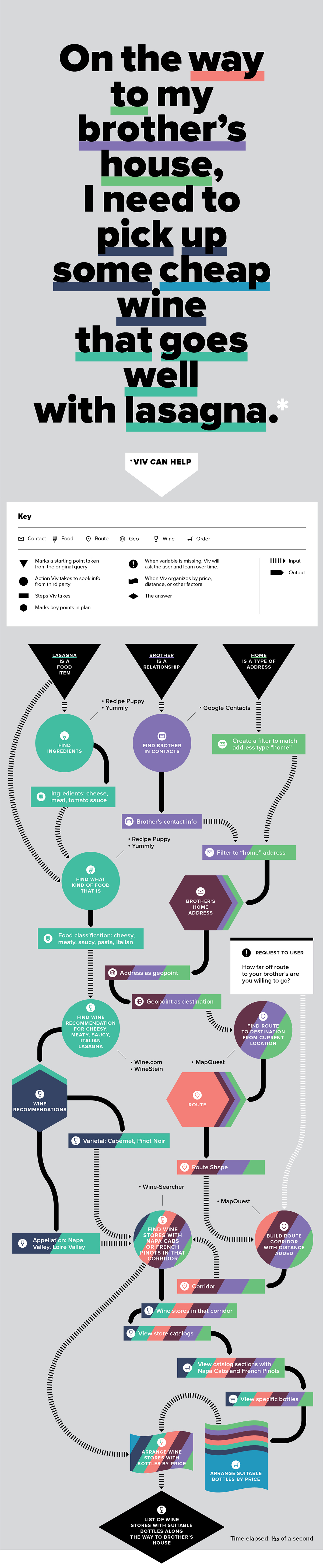
Viv breaks through those constraints by generating its own code on the fly, no programmers required. Take a complicated command like “Give me a flight to Dallas with a seat that Shaq could fit in.” Viv will parse the sentence and then it will perform its best trick: automatically generating a quick, efficient program to link third-party sources of information together—say, Kayak, SeatGuru, and the NBA media guide—so it can identify available flights with lots of legroom. And it can do all of this in a fraction of a second.

Viv is an open system that will let innumerable businesses and applications become part of its boundless brain. The technical barriers are minimal, requiring brief “training” (in some cases, minutes) for Viv to understand the jargon of the specific topic. As Viv’s knowledge grows, so will its understanding; its creators have designed it based on three principles they call its “pillars”: It will be taught by the world, it will know more than it is taught, and it will learn something every day. As with other AI products, that teaching involves using sophisticated algorithms to interpret the language and behavior of people using the system—the more people use it, the smarter it gets. By knowing who its users are and which services they interact with, Viv can sift through that vast trove of data and find new ways to connect and manipulate the information.

Kittlaus says the end result will be a digital assistant who knows what you want before you ask for it. He envisions someone unsteadily holding a phone to his mouth outside a dive bar at 2 am and saying, “I’m drunk.” Without any elaboration, Viv would contact the user’s preferred car service, dispatch it to the address where he’s half passed out, and direct the driver to take him home. No further consciousness required.

Siri14_2

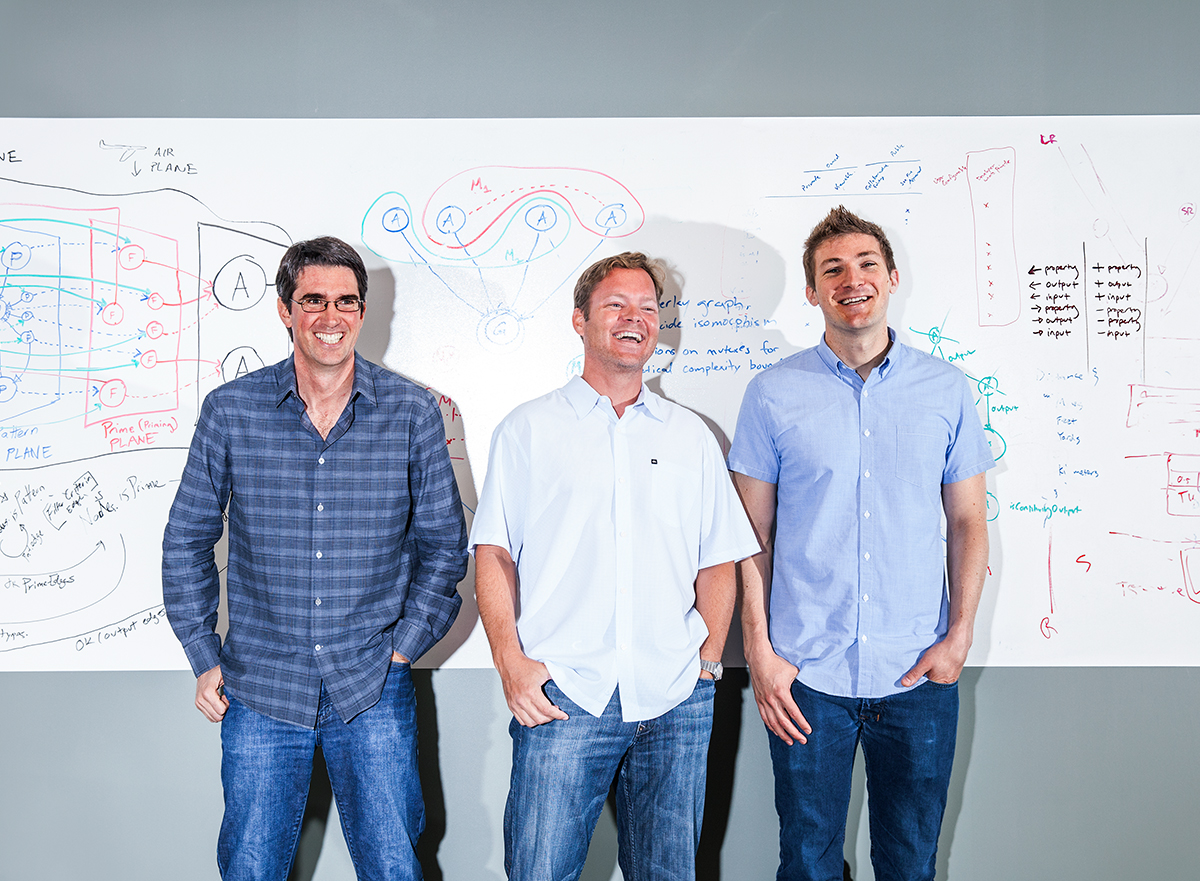
The founders of a stealth startup called Viv Labs—Adam Cheyer, Dag Kittlaus, and Chris Brigham—are building a Siri-like digital assistant that can process massive troves of data, teach itself, and write its own programs on the fly. The goal: to predict and fulfill our desires. Ariel Zambelich

If Kittlaus is in some ways the Steve Jobs of Viv—he is the only non-engineer on the 10-person team and its main voice on strategy and marketing—Cheyer is the company’s Steve Wozniak, the project’s key scientific mind. Unlike the whimsical creator of the Apple II, though, Cheyer is aggressively analytical in every facet of his life, even beyond the workbench. As a kid, he was a Rubik’s Cube champion, averaging 26 seconds a solution. When he encountered programming, he dove in headfirst. “I felt that computers were invented for me,” he says. And while in high school he discovered a regimen to force the world to bend to his will. “I live my life by what I call verbally stated goals,” he says. “I crystallize a feeling, a need, into words. I think about the words, and I tell everyone I meet, ‘This is what I’m doing.’ I say it, and then I believe it. By telling people, you’re committed to it, and they help you. And it works. ”

He says he used the technique to land his early computing jobs, including the most significant—at SRI International, a Menlo Park think tank that invented the concept of computer windows and the mouse. It was there, in the early 2000s, that Cheyer led the engineering of a Darpa-backed AI effort to build “a humanlike system that could sense the world, understand it, reason about it, plan, communicate, and act.” The SRI-led team built what it called a Cognitive Assistant that Learns and Organizes, or CALO. They set some AI high-water marks, not least being the system’s ability to understand natural language. As the five-year program wound down, it was unclear what would happen next.

That was when Kittlaus, who had quit his job at Motorola, showed up at SRI as an entrepreneur in residence. When he saw a CALO-related prototype, he told Cheyer he could definitely build a business from it, calling it the perfect complement to the just-released iPhone. In 2007, with SRI’s blessing, they licensed the technology for a startup, taking on a third cofounder, an AI expert named Tom Gruber, and eventually renaming the system Siri.

The small team, which grew to include Chris Brigham, an engineer who had impressed Cheyer on CALO, moved to San Jose and worked for two years to get things right. “One of the hardest parts was the natural language understanding,” Cheyer says. Ultimately they had an iPhone app that could perform a host of interesting tasks—call a cab, book a table, get movie tickets—and carry on a conversation with brio. They released it publicly to users in February 2010. Three weeks later, Steve Jobs called. He wanted to buy the company.

“I was shocked at how well he knew our app,” Cheyer says. At first they declined to sell, but Jobs persisted. His winning argument was that Apple could expose Siri to a far wider audience than a startup could reach. He promised to promote it as a key element on every iPhone. Apple bought the company in April 2010 for a reported $200 million.

The core Siri team came to Apple with the project. But as Siri was honed into a product that millions could use in multiple languages, some members of the original team reportedly had difficulties with executives who were less respectful of their vision than Jobs was. Kitt­laus left Apple the day after the launch—the day Steve Jobs died. Cheyer departed several months later. “I do feel if Steve were alive, I would still be at Apple,” Cheyer says. “I’ll leave it at that.” (Gruber, the third Siri cofounder, remains at Apple.)

After several months, Kittlaus got back in touch with Cheyer and Brigham. They asked one another what they thought the world would be like in five years. As they drew ideas on a whiteboard in Kittlaus’ house, Brigham brought up the idea of a program that could put the things it knows together in new ways. As talks continued, they lit on the concept of a cloud-based intelligence, a global brain. “The only way to make this ubiquitous conversational assistant is to open it up to third parties to allow everyone to plug into it,” Brigham says.

In retrospect, they were re-creating Siri as it might have evolved had Apple never bought it. Before the sale, Siri had partnered with around 45 services, from AllMenus.com to Yahoo; Apple had rolled Siri out with less than half a dozen. “Siri in 2014 is less capable than it was in 2010,” says Gary Morgenthaler, one of the funders of the original app.

Cheyer and Brigham tapped experts in various AI and coding niches to fill out their small group. To produce some of the toughest parts—the architecture to allow Viv to understand language and write its own programs—they brought in Mark Gabel from the University of Texas at Dallas. Another key hire was David Gondek, one of the creators of IBM’S Watson.

Funding came from Solina Chau, the partner (in business and otherwise) of the richest man in China, Li Ka-shing. Chau runs the venture firm Horizons Ventures. In addition to investing in Facebook, DeepMind, and
Summly (bought by Yahoo), it helped fund the original Siri. When Viv’s founders asked Chau for $10 million, she said, “I’m in. Do you want me to wire it now?”

It’s early May, and Kittlaus is addressing the team at its weekly engineering meeting. “You can see the progress,” he tells the group, “see it get closer to the point where it just works.” Each engineer delineates the advances they’ve made and next steps. One explains how he has been refining Viv’s response to “Get me a ticket to the cheapest flight from SFO to Charles de Gaulle on July 2, with a return flight the following Monday.” In the past week, the engineer added an airplane-seating database. Using a laptop-based prototype of Viv that displays a virtual phone screen, he speaks into the microphone. Lufthansa Flight 455 fits the bill. “Seat 61G is available according to your preferences,” Viv replies, then purchases the seat using a credit card.

Viv’s founders don’t see it as just one product tied to a hardware manufacturer. They see it as a service that can be licensed. They imagine that everyone from TV manufacturers and car companies to app developers will want to incorporate Viv’s AI, just as PC manufacturers once clamored to boast of their Intel microprocessors. They envision its icon joining the pantheon of familiar symbols like Power On, Wi-Fi, and Bluetooth.

“Intelligence becomes a utility,” Kittlaus says. “Boy, wouldn’t it be nice if you could talk to everything, and it knew you, and it knew everything about you, and it could do everything?”

That would also be nice because it just might provide Viv with a business model. Kittlaus thinks Viv could be instrumental in what he calls “the referral economy.” He cites a factoid about Match.com that he learned from its CEO: The company arranges 50,000 dates a day. “What Match.com isn’t able to do is say, ‘Let me get you tickets for something. Would you like me to book a table? Do you want me to send Uber to pick her up? Do you want me to have flowers sent to the table?’” Viv could provide all those services—in exchange for a cut of the transactions that resulted.

Building that ecosystem will be a difficult task, one that Viv Labs could hasten considerably by selling out to one of the Internet giants. “Let me just cut through all the usual founder bullshit,” Kittlaus says. “What we’re really after is ubiquity. We want this to be everywhere, and we’re going to consider all paths along those lines.” To some associated with Viv Labs, selling the company would seem like a tired rerun. “I’m deeply hoping they build it,” says Bart Swanson, a Horizons adviser on Viv Labs’ board. “They will be able to control it only if they do it themselves.”

Whether they will succeed, of course, is not certain. “Viv is potentially very big, but it’s all still potential,” says Morgenthaler, the original Siri funder. A big challenge, he says, will be whether the thousands of third-party components work together—or whether they clash, leading to a confused Viv that makes boneheaded errors. Can Viv get it right? “The jury is out, but I have very high confidence,” he says. “I only have doubt as to when and how.”

Most of the carefully chosen outsiders who have seen early demos are similarly confident. One is Vishal Sharma, who until recently was VP of product for Google Now. When Cheyer showed him how Viv located the closest bottle of wine that paired well with a dish, he was blown away. “I don’t know any system in the world that could answer a question like that,” he says. “Many things can go wrong, but I would like to see something like this exist.”

Indeed, many things have to go right for Viv to make good on its founders’ promises. It has to prove that its code-making skills can scale to include petabytes of data. It has to continually get smarter through omnivorous learning. It has to win users despite not having a preexisting base like Google and Apple have. It has to lure developers who are already stressed adapting their wares to multiple platforms. And it has to be as seductive as Scarlett Johansson in Her so that people are comfortable sharing their personal information with a robot that might become one of the most important forces in their lives.

The inventors of Siri are confident that their next creation will eclipse the first. But whether and when that will happen is a question that even Viv herself cannot answer. Yet.

Siri14_3

Source: http://www.wired.com/2014/08/viv/

Tim Cook – Making Apple his Own

Photo CreditMinh Uong/The New York Times


Tim Cook, Apple’s chief executive, was an adolescent boy in a small Alabama town in the early 1970s when he saw something he couldn’t forget.

Bicycling home on a new 10-speed, he passed a large cross in flames in front of a house — one that he knew belonged to a black family. Around the cross were Klansmen, dressed in white cloaks and hoods, chanting racial slurs. Mr. Cook heard glass break, maybe someone throwing something through a window. He yelled, “Stop!”

One of the men lifted his conical hood, and Mr. Cook recognized a deacon from a local church (not Mr. Cook’s). Startled, he pedaled away.

“This image was permanently imprinted in my brain, and it would change my life forever,” Mr. Cook said of the burning cross, in a speech he gave last December.

In the speech, he said his new awareness made him feel that no matter what you do in life, human rights and dignity are values that need to be acted upon. And then came the segue: His company, Apple, is one that believed deeply in “advancing humanity.”

Mr. Cook, who is 53, took over leadership of Apple nearly three years ago, after the death of Steve Jobs, the company’s revered founder. Like Walt Disney and Henry Ford, Mr. Jobs was intertwined with his company. Mr. Jobs was Apple and Apple was Jobs.

At the time, Mr. Cook was well regarded as a behind-the-scenes operations guy, but he was a relatively unknown quantity outside the company. He can be intensely private; for instance, the details of the cross-burning episode, like his reaction and the appearance of the deacon, he has shared with friends but not publicly. Even offering the outlines of that story in front of an audience, however, indicates how he is slowly beginning to reveal his own personality and style, and to define Apple leadership in his own image.

This is happening as Mr. Cook, who declined to be interviewed for this article, finds himself not only in the limelight, but also under scrutiny. Of late, the company has hit a snag that was years in the making: Its sales now are so large that many investors worry that it can’t continue to match the growth that brought it from $65 billion in sales in the 2010 fiscal year to $171 billion in 2013. In fiscal 2013, sales grew a mere 9 percent, far below an average just shy of 40 percent a year from 2004 to 2013. Profits slimmed. And the stock price fell nearly in half from its 2012 peak to the middle of 2013, vastly underperforming the market.

Investors have clamored for Apple wizardry — a much-anticipated iWatch or iTV, perhaps. To these critics, Mr. Cook is uninspiring, his social views window dressing, when what they want is magic.

“Where is the grand design?” asks Laurence I. Balter, chief market strategist at Oracle Investment Research. Mr. Balter credits Mr. Cook as having great skills in operations and in managing the supply chain, which entails getting the raw materials and machinery in place to build things — but not with having the vision to design them. “All we hear from Cook,” Mr. Balter says, “is there are some great products coming down the pike.”

Mr. Balter calls Apple a financial “Rock of Gibraltar“— it is sitting on $150.6 billion of cash — but he says he has serious questions about whether it can continue to be a hypergrowth company. Is it a stock for growth investors, he asks, “or widows?”

“Show me the product,” he says. “Show me the ingenuity.”

To shore up shareholder faith, Mr. Cook split the stock, increased the dividend and engineered a $90 billion buyback — steps that helped shares rebound almost entirely. He has taken other steps to strengthen the company, like pushing Apple products into China, a potentially huge market, and acquiring talent, most recently spending $3 billion to buy Beats, a music company that brings Apple two major music-industry shakers and deal makers, Dr. Dre and Jimmy Iovine.

Reflecting his personal views, Mr. Cook is trying to broaden Apple’s brand, too, taking to Twitter and other public venues to express support for environmentalism and gay rights (and for Auburn University football). He has also emphasized the use of sustainable products at the company. Early in his tenure, playing catch-up with other corporations, he established a program to match employee charitable contributions; he has upped the company’s own giving, too.

Jonathan Ive, the head of design at Apple and a name nearly as adored by its followers as Steve Jobs, says Mr. Cook has not neglected the company’s central mission: innovation. “Honestly, I don’t think anything’s changed,” he said. And that includes the clamor for some exciting new thing. “People felt exactly the same way when we were working on the iPhone,” Mr. Ive added.

“It is hard for all of us to be patient,” Mr. Ive said. “It was hard for Steve. It is hard for Tim.”

Spirit of Hardware Past

There is a mythology, with some part of truth, that Mr. Jobs was the soul of the design process, the company’s Innovator in Chief. For the original iPhone, Mr. Jobs checked in weekly with engineers, according to Francisco Tolmasky, a former Apple engineer who worked on the phone’s browser.

“Steve was really adamant,” Mr. Tolmasky reflected, adding that Mr. Jobs would say: “’This needs to be like magic. Go back, this isn’t magical enough!’”

Almost daily, employees would spot Mr. Jobs having lunch on Apple’s campus with Mr. Ive. These days, Mr. Ive said, he meets three days a week with Mr. Cook, generally in each other’s offices. But Mr. Ive said the design processes are essentially unchanged.

“Steve established a set of values and he established preoccupations and tones that are completely enduring,” Mr. Ive said. Chief among them is a reliance on small creative teams whose membership remains intact to this day. The philosophy that materials and products are intertwined also continues under Mr. Cook. For instance, when the company decided to use titanium to build a laptop, Mr. Ive said, he and Mr. Cook and Mr. Jobs thought about how to push the boundaries of the metal to get the look and feel they wanted. And Mr. Ive pointed to another enduring value: a complete focus on the product.

If Mr. Jobs was maniacal about design, Mr. Cook projects “quiet consideration,” Mr. Ive said. Mr. Cook digests things carefully, with time, which Mr. Ive said “testifies to the fact he knows it’s important.”

Lower-level employees praise Mr. Cook’s approachability and intellect. But some say he is less hands-on in developing products than his predecessor. They point to the development of the so-called iWatch — the “smartwatch” that Apple observers are eagerly awaiting as the next world-beating gadget. Mr. Cook is less involved in the minutiae of product engineering for the watch, and has instead delegated those duties to members of his executive cabinet, including Mr. Ive, according to people involved in the project, who spoke on condition of anonymity because they were not authorized to speak to press. Apple declined to comment on the watch project.

Mr. Cook appears to be interested in the smartwatch’s broader implications — for instance, that a watch might monitor heart rate and other vital measures, thus improving health and limiting doctor visits, according to these people. The watch is expected to be released in the fourth quarter, these people said.

Mr. Cook has also looked outside of Apple for experienced talent. He has hired executives from multiple industries, including Angela Ahrendts, the former head of Burberry, to oversee the physical and online stores, and Paul Deneve, the former Yves Saint Laurent chief executive, to take on special projects. He also hired Kevin Lynch, the former chief technology officer of Adobe, and Michael O’Reilly, former medical officer of the Masimo Corporation, which makes health monitoring devices. Not to mention the music men of Beats.

Mr. Cook is amassing a creative brain trust, according to Bono, the lead singer of the band U2, who befriended Mr. Jobs and worked closely with him and Apple’s team on developing a U2-branded iPod, as well as on charitable work in Africa. Mr. Cook is not saying “I’m here to replace him,” said Bono, who is a managing director and co-founder of the venture capital firmElevation Partners. “He’s saying, ‘I’ll try to replace him with five people.’ It explains the acquisition of Beats.”

Federighi

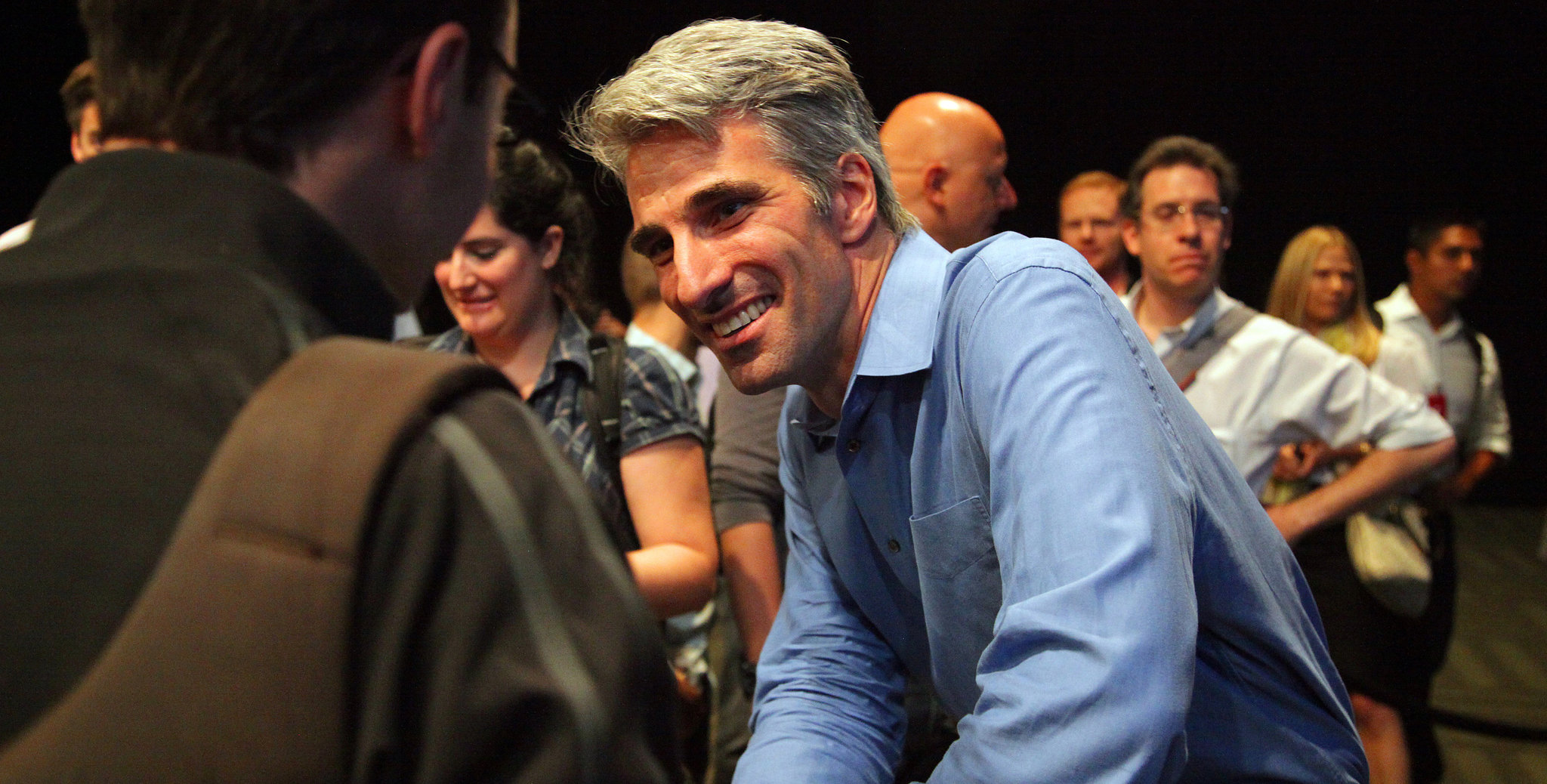
Craig Federighi, head of Apple’s software engineering. Mr. Cook has assembled a team of creative people — and has given them center stage. CreditJim Wilson/The New York Times

That doesn’t mean Mr. Cook is uninvolved in product decisions. Since he took over, the company has released a number of upgrades, including a smaller tablet, the iPad Mini. Mr. Cook “thought the world would love a smaller and less expensive tablet,” said Robert A. Iger, the chief executive of Disney and a member of Apple’s board. It was a product that Mr. Jobs thought did not have a market, he said.

Sales of the iPad Mini quickly exceeded those of the normal-size iPad, according to analysts. Gartner and ABI Research estimated that within the first year the smaller tablet went on sale, it accounted for 60 percent of overall iPad sales.

Still, some product iterations have brought mixed results. Last year, Apple for the first time introduced two new iPhones instead of just one: the high-end iPhone 5S, which sold like gangbusters, and the lower-cost, plastic-covered iPhone 5C, which disappointed.

What makes Apple’s challenge particularly daunting is the law of large numbers. Its sales are so big that even another new strong product — unless it’s a gigantic hit on the order of the iPhone — won’t lead to the kind of growth to which some investors have grown accustomed, noted Toni Sacconaghi, a financial analyst who covers Apple for Bernstein Research. He put it this way: If Apple makes an iWatch and sells 10 million units in the first year, it would add a mere 50 cents to its earnings per share, barely a single percentage point.

“Most people would say, if you sell 10 million units of something that would be incredible,” Mr. Sacconaghi said. But not so with Apple. “There are very few things that could move the needle,” he added.

Michael A. Cusumano, a professor in the Sloan School of Management at M.I.T., said he thought Apple no longer had the juice to create the world-beating product it needs. Professor Cusumano, who is working on a book about innovation, visited Apple’s headquarters in Cupertino, Calif., last fall and has talked to a half-dozen current and former employees about the company culture. He concluded that Apple without Mr. Jobs lacks a visionary to synthesize disparate ideas into a magical whole.

“Jobs would figure out how to put the pieces together,” Professor Cusumano said. “Everything just filtered through his eyes.”

“I think it’s going to be very difficult for them to come up with the next big thing,” he added. “They’ve lost their heart and soul.”

‘Just and Right’

Tim-Cook2

Inevitably, Tim Cook draws contrasts to the high-profile, hands-on style of his predecessor.CreditJustin Sullivan/Getty Images

If Mr. Jobs was the heart and soul of the company, Mr. Cook seems to be trying to cast himself as a different sort of leader. His Twitter feed is a mash-up of Apple hoopla and cheerful promotion of human rights and environmentalism. He wrote an opinion piece in The Wall Street Journal in support of proposed federal legislation protecting gay, lesbian and transgender workers.

He often quotes Martin Luther King, Jr. and Robert F. Kennedy but doesn’t much talk about the origin of his political views. The speech he gave last December, in which Mr. Cook mentioned the cross-burning, started to give some hints. “Since these early days,” he said, “I have seen, and I have experienced, many other types of discrimination.” All of those, he continued, “were rooted in a fear of people that were different than the majority.” Apple declined to say what he meant by the reference to discrimination he experienced, but it did confirm the details of the cross-burning story.

The speech was given at the United Nations, where Mr. Cook was accepting a lifetime achievement award from Auburn, his alma mater. He graduated from the university in 1982 with a degree in industrial engineering. He worked at IBM while earning a graduate business degree at Duke, then went to Intelligent Electronics and Compaq. In 1998, he was approached by Mr. Jobs when Apple was struggling, but as Mr. Cook recounted later in a 2010 commencement speech at Auburn, he saw it as a “once-in-a-lifetime opportunity to work for the creative genius.”

He rose to become executive vice president for worldwide sales and operations in 2002. In the period after he became C.E.O. in 2011, the working conditions in Chinese factories used by major tech companies, including Apple, came under increasing scrutiny. By April 2012, after suicides and accidents among Chinese factory workers, a quarter of a million people had signed a petition on Change.org urging Apple to improve working conditions in the factories. Apple since 2006 had already commissioned public reports on troubling practices inside many factories. In 2012, it also began publishing an annual list of its major suppliers, their locations, and what is made at the major ones, as well as reporting the working hours for more than a million factory employees.

Valerie Jarrett, a senior adviser to President Obama, said Mr. Cook’s building of a production plant in Arizona and a Texas factory for making high-end Mac computers domestically was “a tremendous vote of confidence for an iconic company that previously shipped jobs overseas.” (A majority of manufacturing is still done outside the United States — for instance, an estimated 90 percent of the iPhone’s hundreds of parts are made abroad.) Ms. Jarrett also praised Apple’s donation of $100 million to equip schools with technology, including iPads and high-speed Internet.

Apple also made a quick transition to using 100 percent renewable energy sources in its data centers, which makes it “the most aggressive of the companies that we evaluated in getting renewables online,” said Gary Cook, a senior policy analyst at Greenpeace.

Ryan Scott, the chief executive of Causecast, a nonprofit that helps companies create volunteer and donation programs, called Mr. Cook’s charitable initiatives a “great start.” But Mr. Scott added that its programs are “not as significant as what other companies are doing.” Apple’s ambitions “could be much higher,” he said, given its money and talent. By comparison, Microsoft says that, on average, it donates $2 million a day in software to nonprofits, and its employees have donated over $1 billion, inclusive of the corporate match, since 1983. In the last two years, Apple employees have donated $50 million, including the match.

Apple, too, has faced accusations from government officials on a number of troubling issues, including strategies to minimize its corporate taxes. (On the tax issue, Mr. Cook, told a Senate panel last year that Apple is the nation’s largest taxpayer and pays what it owes.) Last July, a federal judge ruled that Apple had illegally conspired with publishers to try to raise prices in the e-books market; Apple is appealing.

Mr. Cook’s public emphasis on social issues nonetheless puts him “on the cutting edge of an emerging new mind-set in corporate leadership about values and value creation,” said James E. Austin, an emeritus professor at the Harvard Business School. But Kellie McElhaney, a professor at the Haas School of Business at the University of California, Berkeley, said she “gets nervous” when C.E.O.s talk about doing what is “right” without making a business case.

“Right to whom?” she asked.

That’s a view shared by some investors. At a shareholder meeting on Apple’s campus in February, one shareholder — who later described himself as having free-market values — asked Mr. Cook whether Apple should avoid embracing environmental causes that lacked a clear profit motive.

Mr. Cook did not respond by saying, as many executives would, that environmentalism is pragmatic and good for the bottom line. His reasoning was moral.

“We do things because they’re just and right,” he said. He has a slight Alabama drawl and a cool delivery, but there was underlying pique in his voice when he rejected the idea that everything must be measured by return on investment. He concluded by telling shareholders, “If you want me to make decisions that have a clear R.O.I., then you should get out of the stock, just to be plain and simple.”

He received rousing applause from the crowd, which included Al Gore, a member of Apple’s board. But the shareholder who asked the question, Justin Danhof, mourned that “I’ve never had a C.E.O. react that way.” In the following days, some stock analysts echoed the dismay, with one columnist, Robert Weinstein of The Street, wondering whether Mr. Cook “is shifting Apple’s focus from an aggressive luxury tech innovator into more of an increasingly philanthropic-focused company.”

Lennon vs. Ringo

Two weeks ago, Mr. Cook stood on stage at the company’s annual developer’s conference in San Francisco in front of 5,000 enthralled software developers. These are the makers of apps for the iPhone and other gadgets, and Mr. Cook promised them something he called “the biggest release since the launch of the App Store.”

To tell the developers about it, Mr. Cook said, “I’d like to invite my colleague, Superman, back to the stage.”

Foo-Fighters

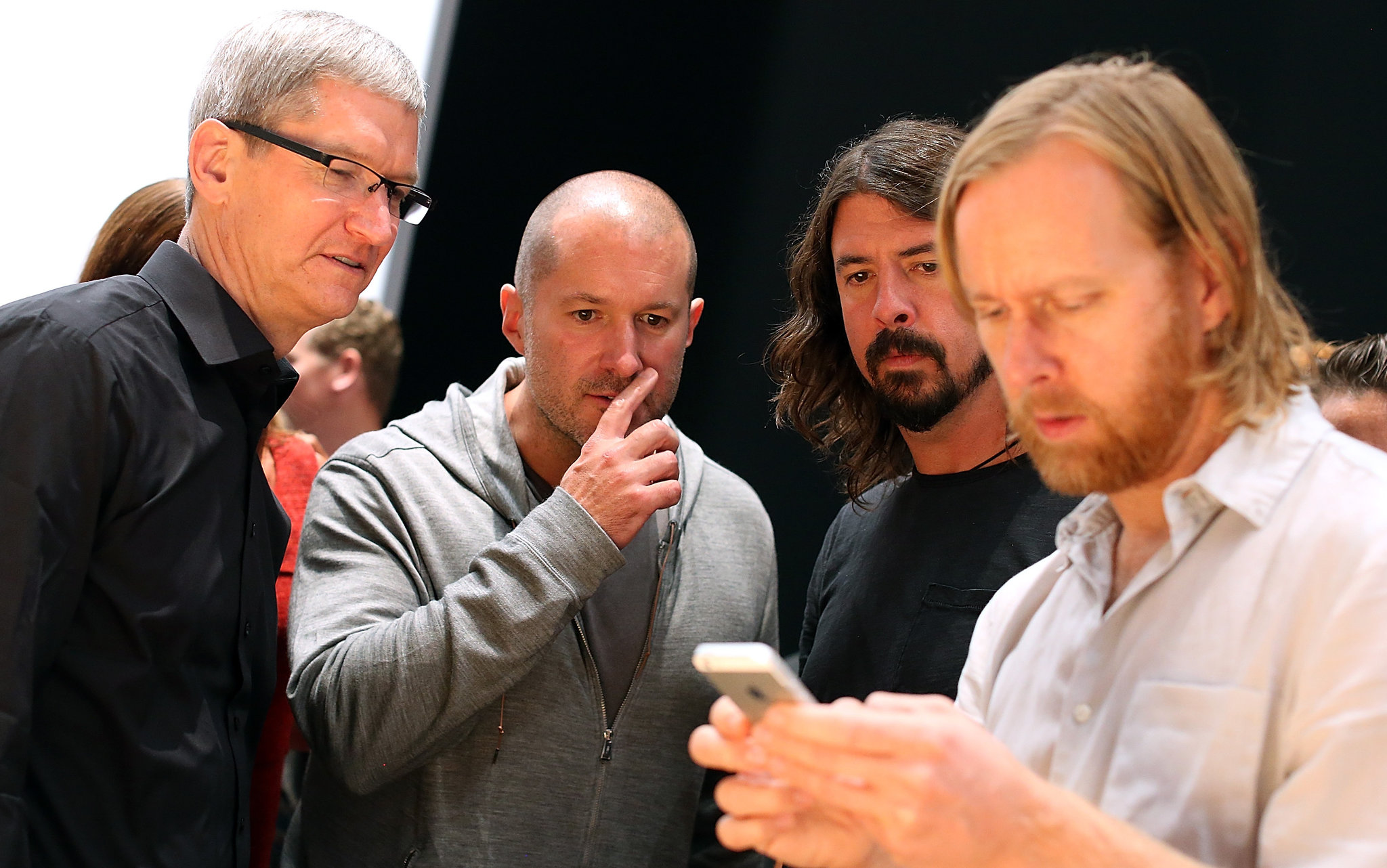
Mr. Cook watched with Jonathan Ive, Apple’s design chief, and Dave Grohl of the Foo Fighters as Nate Mendel, also from the band, tried out one of the phones at a company event.CreditJustin Sullivan/Getty Images

Of course, for years, the only Apple superhero was Mr. Jobs. As Mr. Cook walked toward the darkness, stage left, there was a moment of mystery. Then out sprang Craig Federighi, head of Apple’s software engineering. He passed Mr. Cook and headed into the limelight to describe the new release. It was not a new consumer product, but a set of software tools called a developer’s kit, which would help developers build better apps.

If the rest of the world yawned, the developers stood, and whooped.

Afterward, devotees like Jordan Brown, 25, and three of his colleagues, roamed the convention center.

The four men, who are with a health care app company called Orca Health, had traveled from Salt Lake City and had spent the previous night on the sidewalk to get a good seat at the keynote address. They were scruffy-faced and exhausted, but adrenaline-fueled. Mr. Brown said he viewed Mr. Cook “as someone making sure everything is clicking, but he’s not inspiring.” Mr. Federighi, on the other hand, “resembles Steve,” he said.

Mr. Brown’s colleague Chad Zeluff, 27, who saw Mr. Jobs deliver the keynote in 2007, put it this way: “Jobs is to Lennon what Cook is to Ringo.”

A floor away, Mr. Cook was surrounded by young developers, eagerly snagging selfies as the chief executive mingled post-keynote. Ringo is still a Beatle.

The Utah developers generally expressed support for Mr. Cook. It would be enough, they said, if he put the pieces together. And they said Apple was doing a good job in software innovation, which can add new features to existing devices even if Apple doesn’t produce a new gadget.

They hadn’t heard much about Mr. Cook’s social activism. “I was barely aware of it,” said Gary Robinson, 35, the oldest of the Utah developers. “It’s good, and important.

“But it’s not what matters to me,” he added. “It’s not why I’m here.”

As the conversation continued, though, the developers expressed some cracks in their confidence. For instance, their company has been building apps exclusively for the iPhone for three years, but in the last two months it has also started building apps for Android systems.

They found one thing particularly jarring in the keynote: Apple did not hew to its tradition of pairing hardware and software. Specifically, Apple introduced a program called Health — which helps consumers and doctors monitor health status, like heart rate or glucose levels — but did not also introduce a piece of hardware to measure those results. That is something the new smartwatch is rumored to do.

“They just released the software,” said Mr. Zeluff, sounding surprised.

“It’s something Steve wouldn’t have done,” Mr. Brown said. It’s an impossible comparison. But it’s the one that Mr. Cook is being held to, at least until he makes enough magic of his own.

Source:
http://www.nytimes.com/2014/06/15/technology/tim-cook-making-apple-his-own.html


Why Apple Could Win Big With Tesla’s Giant New Battery Factory

elon_musk

The first Tesla I ever saw was stripped down to the chassis, a bare-metal incarnation of the company’s flagship electric Roadster on display at an event in Silicon Valley. Without the need for an internal combustion engine, the two-seater’s petite frame was dominated by a huge battery. My first thought: “This looks like a giant cell phone on wheels.”

As it turns out, I was more right than I realized.

This week, years after that first sighting, Tesla announced plans for what it calls the “Gigafactory,” a 10-million-square-foot plant for making car batteries. The company hopes that the sheer scale of the operation, combined with the inventiveness of its engineers, will bring battery prices down far enough to finally bring its electric cars into the mainstream.

But it’s not just the prospect of a gasoline-free future that has sparked such excitement about the Gigafactory. The same basic lithium-ion tech that fuels Tesla’s cars also runs most of today’s other mobile gadgets, large and small. If Tesla really produces batteries at the scale it’s promising, cars could become just one part of what the company does. One day, Tesla could be a company that powers just about everything, from the phone in your pocket to the electrical grid itself.

Earlier this month, as rumors swirled that Apple might want to buy Tesla, San Francisco Chronicle reported that Tesla CEO Elon Musk had indeed met with the iPhone maker. Musk later confirmed that Tesla and Apple had talked, but he wouldn’t say what about.

Now that Tesla has announced the Gigafactory, Gartner auto industry analyst Thilo Koslowski thinks it would make more sense for Tesla to talk with Apple about something other than an acquisition. “Depending on the capacity of the factory and who the other investors will be, Tesla could start selling its batteries for other products besides cars,” Koslowski tells WIRED. “This could actually mean Tesla might build batteries for Apple.”

Better Batteries for Less Money

To begin erecting its factory, Tesla said it would seek $1.6 billion in debt financing — money that Apple itself could easily supply from its massive cash reserves. In fact, the world’s biggest company could easily put up the money for the entire Gigafactory, which Tesla estimates will ultimately cost between $4 billion and $5 billion. Though industry analysts say the global manufacturing capacity for consumer electronics batteries is already considerable, the economies of scale that Tesla is promising could give Apple access to a whole different level of efficiency, sophistication, and control.

Unlike many parts of the consumer electronics industry, battery-making factories are, in general, highly automated, which means that labor doesn’t factor significantly into production costs. As anyone who has seen Tesla’s car-making robots in action can attest, factory automation is something the company does really, really well. Deep involvement in the project from the start — say, as an investor — could give Apple exactly the kind of intimate involvement with a key supplier that it relishes. This sort of control defines its approach to products. For consumers, that could mean Apple getting better batteries for its devices for less money, just like Tesla wants to do for its cars.

gigafactory-tesla-660x642

Even if the Gigafactory never makes a battery for a single iPhone, however, its impact on the future of energy storage could be huge. The company says that, once fully operational, the plant will more than double the volume of lithium ion batteries produced in the world today. Sam Jaffe, a battery industry analyst with Navigant Research, says the price drops predicted by Tesla are in line with his firm’s forecasts, and that the cheaper batteries will bring Tesla closer to achieving its primary mission of making a widely affordable electric car, what Tesla is calling its “Gen III” mass market vehicle, or Model E. “The whole point of that model and the whole point of the company was to make that car,” Jaffe says. “It wasn’t to make sports cars or luxury cars. It was to make a family car comparable in price to a gasoline model.”

To reach that mass market, Tesla hopes to be cranking out batteries for 500,000 cars per year by 2020, supported by the Gigafactory. That’s compared to the 35,000 Model S sedans Tesla expects to make this year. Reaching that goal would mean not only a lot more electric cars on the road but a lot more batteries that would need to be replaced. The batteries that power Teslas are a lot like smartphone batteries: Eventually, they start losing their strength. Unlike smartphone batteries, getting down to 60 or 70 percent of their full capacity isn’t just inconvenient. It could leave drivers stranded. Tesla says it plans to fully integrate battery recycling into the Gigafactory’s operations, which could add to the cost savings.

Powering the Grid

But Koslowski says those old batteries could also become part of a robust secondary market. They could, for instance, store energy generated by home solar grids, which can make use of less-than-full strength cells because they don’t have to go anywhere. Already Tesla is supplying battery packs to SolarCity, the solar installer of which Musk serves as chairman, and the company believes that one day its batteries could even serve as backup energy sources for utilities themselves. Bullish Wall Street analysts even predict that, in addition to buttressing the renewable energy grid, Tesla could combine its expertise in cars, batteries, and digital technology to become a leading maker of self-driving vehicles.

Any of this coming to pass, of course, depends on whether the Gigafactory will actually accomplish what Tesla says it will. To bring prices down, battery industry consultant K.M. Abraham says, Tesla will have to figure out how to make its batteries without pushing up costs for component suppliers who would have to increase their output to meet the car maker’s demands. “Unless you come out with new low-cost materials, the battery prices will remain pretty much the same,” says Abraham, who is also a professor of renewable technology at Northeastern University.

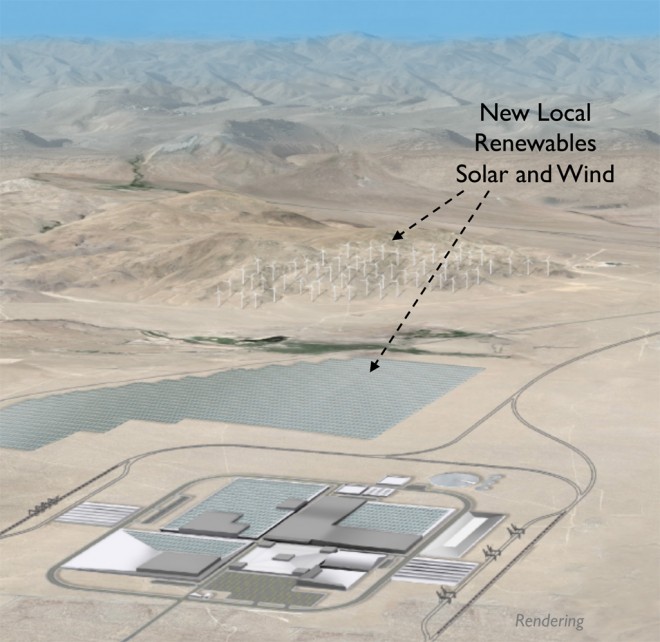
Though details from Tesla are scant, a diagram released by the company suggests it does plan to bring as much of the battery making process as possible within the Gigafactory’s walls. Tesla is also pledging to power much of the plant with its own wind and solar energy, a potential testing ground for using its batteries as part of the electrical grid. Diversifying into different uses could be especially crucial if demand for Tesla’s cars doesn’t hit the company’s own projections. Building a factory on such a massive scale is a huge risk if it only makes one thing, but that risk diminishes if Tesla has the ability to use its expertise to make batteries for many uses. If nothing else, Tesla is creating an unprecedented space just to see what’s possible when energy becomes mobile.

“It’s breathtaking, just the sheer size of it,” Jaffe says of the Gigafactory. “This is so beyond anything by comparison.”

Source: http://www.wired.com/business/2014/02/teslas-giant-battery-factory-save-apple/

The Pioneers Festival 2013

Pioneers Festival: Two founders, a palace and startups galore

  • Hofburg, Imperial Palace combined history and future technologies
  • Babywatch won this year’s Pioneers challenge
  • The Pioneers Festival provides a significant contribution to the Austrian business location”, Brigitte Jank, President of the Chamber oCommerce Vienna

Vienna, 31 October 2013 Gathering together 2,500 international guests and speakers, including Charles Adler (Kickstarter co founder), Adam Cheyer (Siri founder) and Chris Barton (Shazam co founder), Pioneers successfully pulled off another Pioneers Festival, the second event of its kind. Pioneers Festival kicked off at the House of Industry on Tuesday with its infamous Investors Day, while the actual Festival combined history and technology at the Imperial Palace the following two days.

The Investors Day The Investors Day on Tuesday, 29 October 2013 in the House of Industry was devoted to the Top 50 startups of the Pioneers Challenge and key investors including Sequoia Capital, Earlybird, and Accel Partners. Each startup was given three minutes to pitch their company to high class a jury. More than 670 startups from around the globe had applied to take part. At the end of the day, only 16 were chosen to present their ideas on the conference days.

History and technology come together in the Imperial Palace On Wednesday morning the Imperial Palace opened its doors for more than 2,500 tech enthusiasts in an environment combined with history and future technologies. After the official welcome by the two founders Andreas Tschas and Juergen Furian, the program was officially kicked off. “It’s nice to get to know new people, find new stories, learn things from lots of people with lots of experience. It’s great for me to absorb their information and their know–‐how,” said festival attendee Nadim El Gawhary of Egypt. It was up to the participants to decide what their individual Pioneers Experience should be. While inspiring talks and technology demonstrations by speakers like Phil Libin (Evernote) or Charles Adler (Kickstarter) captured the audience in the Arena, the Academy provided the school lessons for entrepreneurs they were asking for. Supported by Konica Minolta, high caliber mentors such as Dave McClure (500startups) and Chris Barton (Shazam) taught attendees what daily business really looks like.

Nobody can beat Babywatch, the finest of the Top 50 Startups The Startup Challenge Finale topped off the last day as the Top 8 startups took the stage and presented their companies. The young entrepreneurs battled it out in the Pioneers Challenge – in the end Babywatch, the home ultrasound device startup from Croatia took home the victory prize, winning the Pioneers World Tour sponsored by Coca Cola with stops in Shenzhen, Singapore, Atlanta, New York and San Francisco, and the Pioneers Award 2013.

Some impressions:

Brigitte Jank explains the constant growth of the startup scene in Vienna and acknowledges the Pioneers Festival as one of its reasons:

“The Pioneers Festival provides a significant contribution here, being a platform bridging the contact between startups and potential investors, and turning Vienna into Europe’s creative capital city,”, explains Brigitte Jank, President of the Chamber of Commerce Vienna.

Christoph Leitl, WKO President was impressed by this year’s event and pointed out the importance of the entrepreneurial spirit for Austria’s economy regarding the valuable contribution of domestic founders to Austrian business location: “Even in challenging times Austria remains an attractive business location. This is clearly proven by recent numbers on newly created companies: 114 start ups per day contribute significantly to the employment record in Austria. That brings great dynamism to our country!”

Andreas Tschas reflects on this year’s Festival: “I am extremely happy about our results after one year of hard work and would like to express my sincere thanks to everyone who supported us. There are too many people to name, however I would like to point out Konica Minolta and Pro7Sat1Puls4 as our Global Partners and their support of young entrepreneurs as a part of their corporate responsibility, as well as the Federal Ministry of Economy, Family and Youth, the Federal Ministry for Transport, Innovation and Technology, the Austria Wirtschaftsservice, the Chamber of Commerce as well as the Vienna Business Agency.”

More information on Babywatch can be found at: https://www.babywatchome.com/

All information on the Pioneers Festival: http://www.pioneersfestival.com

Press photos from Pioneers Festival can be found here: http://www.pioneers.io/festival/about/press

About Pioneers Festival: Pioneers Festival brings together national and international founders, startups, pioneers, investors, tech enthusiasts and media representatives once per year in Vienna to celebrate entrepreneurship and future technologies, to inspire and to educate. During the two day festival in the Vienna Hofburg, quality content by renowned speakers is discussed, the winners of the Pioneers Challenge are crowned, and a framework for a positive festival atmosphere is provided. Pioneers Festival was founded in the year 2012, making 30–‐31 October 2013 the second event.

Pioneers Festival Vienna, 30. bis 31. Oktober 2013

Pioneers-Festival-2013

Pioneers Festival versammelt die beeindruckendsten Unternehmer, Investoren, Medien und Startups 
● Stephen Lake (CEO Thalmic Labs, MYO), General Pete Worden (Direktor NASA Ames Research Center), Peter Platzer (Gründer Nanosatisfi), Adam Cheyer (Gründer von Apples Siri), Phil Libin (CEO Evernote) und viele mehr sind bestätigt 

● Operationen im All – privat vs. staatlich, NASA vs. NanoSatisfi: eine Diskussion über
Expeditionen ins All moderiert von Olivia Solon (WIRED)
● Europäische Premiere: MYO Gründer präsentieren ihre neue Gesture Control Technologie
● Charles Adler (Gründer Kickstarter) und Tom Hulme (IDEO London) diskutieren über
Entrepreneurship und dessen Rolle in der Gesellschaft
Vom 30. bis 31. Oktober versammelt das Pioneers Festival bekannte nationale und internationale Unternehmer, Investoren, Technologie-Experten, Medienvertreter und Pioniere aus den verschiedensten Bereichen, um ein neues Zeitalter des Pioniergeists einzuläuten. Mehr als 2.500 Teilnehmer tauschen sich in der Wiener Hofburg über Entrepreneurship und innovative Zukunftstechnologien aus. Somit treten sie in die Fußstapfen einiger der mächtigsten Menschen, die nicht nur Österreichs sondern auch Europas Geschichte in der Wiener Hofburg mitgeschrieben haben.
Die Finalisierung des Programms des Pioneers Festival steckt gerade im Endspurt und somit kann heute schon ein Ausblick auf einige der Highlights des diesjährigen Festivals gewährt werden.

Expeditionen ins All – privat vs. staatlich
Als der erste Mensch am Mond landete, war es der Staat, der ihn dorthin gebracht hatte und nicht ein privates Shuttle oder seine eigene Finanzierung. Bisher waren Expeditionen ins All rein staatliche Angelegenheit, doch im Laufe der letzten Jahre haben sich mehr und mehr private Initiativen in diese Richtung entwickelt. Der Direktor des NASA Ames Research Center General Pete Worden und NanoSatisfi Gründer Peter Platzer (von Präsident Barack Obama als “Champion of Change” ausgezeichnet) werden die Zukunft der Weltraumeinsätze diskutieren. Mit Olivia Solon von WIRED als Moderatorin ist eine hochkarätige Diskussion garantiert.

MYO’s Europa-Premiere
Thalmic Labs CEO Stephen Lake und seine zwei Mitgründer werden zum ersten Mal in Europa ihr beeindruckendes Gestenkontrollsystem live auf der Bühne präsentieren. Was ist Gestenkontrolle?
Stellen Sie sich einfach vor, ein Instrument zu spielen, ohne es in der Hand zu halten oder ganz einfach mit der Hand durch die Luft zu wischen, um die nächste Folie Ihrer Präsentation anzuzeigen.
Vor fünf Monaten sorgte das kanadische Startup mit einem Trailer für weltweite Begeisterung und eine 14,5 Millionen Dollar Finanzierung, die Thalmic Labs bei der Produktentwicklung sicher noch deutlich weitergebracht hat.

Vogelperspektive aufs Entrepreneurship – Was passiert?
Entrepreneurship ist das Herzstück der Diskussionen auf dem Pioneers Festival. Kritisch, provokativ und ehrlich – Themen wie der Einfluss des Individuums, „Lean Startup“, und die Daseinsberechtigung von Entrepreneurship sind geplant. Kickstarter Co-Gründer Charles Adler und Tom Hulme, Design Director bei IDEO London und Gründer von OpenIDEO, werden auf der Bühne ihre Sichtweise darstellen und den Status Quo von Entrepreneurship beleuchten. Diese Diskussion wird eines der Highlights des Festivals. Es wird in den Kern des Entrepreneurships eingetaucht und seine Auswirkungen auf die Gesellschaft
dargestellt.

Viele wunderbare Vortragende aus dem Vorjahr werden auch wieder dabei sein.
Co-Gründer von Siri Adam Cheyer zum Beispiel sagte 2012: „I came to inspire, but came away inspired. Amazing presentations, parties, and most of all people – unforgettable!”
Teilnehmer haben auch die einzigartige Möglichkeit, Evernote’s CEO Phil Libin zu einem persönlichen Meet & Greet zu treffen. Interessierte können sich hier anmelden um ihre Top 3 Fragen live auf der Bühne an Phil zu stellen.

Über Pioneers Festival: 
Pioneers Festival versammelt einmal im Jahr nationale und internationale Gründer, Startups, Pioniere, Investoren, Tech-Begeisterte und Medienvertreter in Wien, um Unternehmertum und innovative Zukunftstechnologien gebührend zu feiern, zu inspirieren und Wissen zu vermitteln. Während der beiden Festival Tage in der Wiener Hofburg werden qualitativ hochwertige Inhalte von renommierten Speakern diskutiert, der Sieger der Pioneers Challenge gekürt und mit dem Rahmenprogramm wird für großartige Festivalstimmung gesorgt. Pioneers Festival wurde im Jahr 2012 gegründet und findet somit dieses Jahr zum zweiten Mal von 30. – 31. Oktober 2013 statt. Veranstalter ist Pioneers, dessen Gründer
Andreas Tschas und Jürgen Furian bereits die Jahre zuvor die europäische Startup Szene aktiv mitgestaltet haben.

How To Run A Virtual Company

How To Run A Virtual Company

Although Yahoo! called everyone back to the office, you might be moving forward with an open, flexible work environment. Perhaps you don’t need all your employees physically present and you want to open the door to talented individuals across the country — or the globe.

Before you act, make sure you know what it takes to succeed as a virtual business.

Your Number-One Challenge: Social Interaction

Many people think the hardest part of transitioning to a virtual work life is learning the art of self-motivation. In reality, people struggle most with the social change. They don’t realize how much they interact with others in the office — or how those conversations break up the workday.

If you’ve hired solid employees, they’ll get their work done in either environment. But they’re not machines. They need personal connection; it’s what makes us human. Social interactions can waste time, but they’re also necessary for motivation. 

Closing the Cultural Gap

As you transition, the biggest difference for leadership is the loss of subconscious culture. Leaders have to be intentional about how they communicate and fill the social gap. My companies implemented some tactics to make the change feel less drastic:

  • All meetings that can be held via video must be, and you should allot a few minutes at the beginning and end of each meeting for open conversation.
  • Send a “feel good” email every Monday. Ours contains personal announcements, such as employee birthdays or vacation photos, along with articles about motivation and happiness.
  • Maintain company practices of recognizing accomplishments. Share big successes and milestones in emails and meetings, and recognize those who got you there.

Managing Virtually

Managing in a virtual environment requires rethinking traditional approaches to management and how those tactics translate over calls, video chats and email.

Key management challenges include:

  • Vision casting. Do the vision and company direction “stick” even when management isn’t around? Management needs to find ways to mentor, coach and share its vision in a virtual environment.
  • Autonomy. Can employees understand assignments and self-motivate when working remotely? What feedback and review systems need to be in place to help team members self-correct? Is the team empowered to make specific decisions without waiting for supervisor approval?
  • Meeting Schedules. Finding the balance between focused work time and meeting time can be challenging in any environment, let alone a virtual one. Set guidelines for the length and space between meetings. You should encourage five-minute meetings driven by agendas, rather than rely on longer, sprawling meetings.

The Art of Simple, Clear Communication

The best virtual teams will learn the importance of packaging the “who,” “what” and “why” of an assignment concisely (e.g., “John needs an article about the history of sword-fighting kittens written and approved by Bob by next Wednesday so we can make it to print in two weeks.”).

This clear communication can reduce friction and clarify details in advance, removing the need for excessive back-and-forth communication. Traditional work communications are plagued by repetitive clarification; virtual teams will relish the time savings of streamlined communication.

Working with Different Personality Types from Afar

A huge factor to keep in mind as you move toward a virtual setting is the difference between tech-oriented people and creative people. To succeed, you need individuals who are self-motivated, and this is even more important in virtual companies.

People with highly technical job responsibilities (developers, programmers, technicians) react differently to tracking their work than those with more creative roles (graphic designers, account representatives, even managers).

The Tech Crowd: Tracking time or task completion makes sense for many tech projects; it helps techies stay motivated throughout lengthy development processes. A large percentage of these workers are introverts who work well alone, and most don’t mind their work being tracked in detail.

The Creative Types: This is where you’ll meet resistance to tracking. When you implement tracking — even logging hours — it interrupts their thought process. The more you track them, the more they feel like drones and the poorer their work is.

The best way to approach tracking with creatives is to focus on results. Face-to-face interactions (including video) help keep them motivated and energized, as many creatives need to bounce ideas off others.

If you have a virtual customer service team, create systems to listen in on representatives’ calls and offer feedback. You can still use customer satisfaction to rate work, but the process should be more involved and intentional.

If you can be completely results-focused for reviews and feedback, that’s great. You can track all employees on your own terms. If you have to bill clients, don’t be afraid to make everyone log hours — just keep in mind that some won’t like it.


If you decide to take the plunge and become a more virtual business, be smart about it. Consider what needs to be done differently and what will remain the same. Make your decisions based on what’s best for your company and team, and you’ll find that going virtual will only make your business stronger.

Quelle: http://www.ceo.com/leadership_and_management/how-to-run-a-virtual-company/

Produktentwicklung – Pitch – Investorentermine

„Meine Tage in Kalifornien beginnen normalerweise gegen halb sechs Uhr in der Früh. Am Anfang sorgt der Jetlag dafür, dass man um diese Zeit auch ohne Wecker aufwacht. Danach wird es einfach zur Gewohnheit. So bekommt man noch ein Stück des österreichischen Arbeitstages mit und kann E-Mails und verpasste Anrufe beantworten. Nach dem Frühstück beginnt dann die eigentliche Arbeit, bestehend aus Produktentwicklung, Unternehmenspräsentation (Pitch), Investorenterminen und Administration.

Produktentwicklung

Der französische Schriftsteller Antoine de Saint-Exupéry hat es auf den Punkt gebracht: „Perfektion ist nicht dann erreicht, wenn es nichts mehr hinzuzufügen gibt, sondern wenn man nichts mehr weglassen kann.“ In der Produktentwicklung geht es – neben der Funktion – vor allem um das Kundenerlebnis. Die Bedienung sollte intuitiv sein und schnell den gewünschten Erfolg bringen. Man ist selbst meist betriebsblind, weshalb die Einbringung potentieller User bereits in frühen Phasen essenziell ist. Im Silicon Valley ist ein Kult um User-Tests entstanden. Es ist üblich, diese auf Facebook oder Craig’s List zu bewerben und als Entlohnung Gutscheine für Amazon oder iTunes anzubieten. Oft braucht man nur zwei bis drei Test-User, um herauszufinden, ob das neue Feature funktioniert oder nicht.

Unternehmenspräsentation – auch Pitch genannt

Bei der Unternehmenspräsentation – dem Pitch – verhält es sich ähnlich. Meistens hat man zwischen zwei und fünf Minuten Zeit, um sein Unternehmen zu präsentieren. So lernt man schnell gleich zum Punkt zu kommen. Der ideale Pitch besteht aus folgenden Komponenten: der Beschreibung des Problems, der Vorstellung des eigenen Produktes, dem Marktpotential, den bisherigen Erfolgen des Unternehmens (Wachstumsrate, namhafter Kunde), dem Team und aus welchem Grund man pitcht (Geld, Unterstützung, Partnerschaft). Man sollte in der Lage sein, sein Unternehmen in 30 Sekunden (Elevator Pitch), in 2 bis 3 Minuten und in 10 bis 15 Minuten zu beschreiben. Dafür gibt es jeweils eine Präsentationen, die man bei Interesse verschicken kann. Der Pitch ist die Eintrittskarte, mit der man begeistern kann und muss. Je genauer man weiß, was man will, desto eher gibt es einen Follow-Up Termin.

Investorentermine

Das Wichtigste zuerst: Bevor man nach Geld sucht, sollte man eine sogenannte „Advisory Round“ machen, in der man Unterstützung von Experten für Anteile am Unternehmen bekommt. Diese helfen dann in der Produktentwicklung, dem Business Development oder haben ein Netzwerk an potentiellen Investoren. Letztere wollen in Wahrheit drei Dinge: Ein tolles Team – bestehend aus einem Techniker, einem Designer und einem Branchenexperten, ein tolles Produkt – das bereits von Kunden genutzt wird und einem vielversprechenden Markt. Das gilt es, bei einem Investorentermin zu vermitteln. Ich hatte dutzende Termine unter anderem in Glaspalästen oder in Fast Food Restaurants. Die Fragen sind aber immer die gleichen: Was ist deine Vision? Erzähl mir etwas über euer Team! Woran arbeitet ihr gerade? Wer hat sonst noch in euch investiert? Was wollt ihr mit dem Geld machen, dass ich euch gebe?
Wenn man dann 30 bis 60 Minuten Rede und Antwort gestanden hat, darf man noch seine Unterlagen schicken und auf eine positive Reaktion hoffen. Oft ist es jedoch ein „Nein“, wobei das nicht wirklich wichtig ist. In Wahrheit geht es darum, Interesse zu wecken, mit den Leuten in Kontakt zu bleiben, sie regelmäßig über Neuigkeiten zu informieren und sie eventuell zu einem späteren Zeitpunkt nochmals anzusprechen.“

(Harald Trautsch, derStandard.at,16.5. 2013)

Quelle: http://derstandard.at/1363711247079/Ein-typischer-Tag-im-Silicon-Valley

Twitter Founders Move on to Their Next Big Thing

Twitter-founders

What do you work on after launching one of the largest social networks in the world? It took some time, but each of the three Twitter founders appear to have come up with their own answers to this question.

Ev Williams stepped down as Twitter’s CEO in late 2010 and scaled back his role at the company in the months that followed. He pursued new projects at The Obvious Corporation, a startup incubator that Twitter’s co-founders launched in the mid-2000s, and which served as the original home of Twitter. A few months later, Biz Stone announced that he too would be stepping away from day-to-day duties at Twitter and joining Williams at Obvious to focus on new projects.

Since then, the two Twitter founders and their team at Obvious have helped launch several startups including Medium and Branch, and have worked with or invested in a number of other promising startups like Neighborland and Findery. The underlying goal all along, according to Williams, was to use Obvious to figure out what he and Stone wanted to work on next.

„We rebooted Obvious in 2011 with a vague plan,“ Williams wrote in a blog post this week. „We started investing, incubating, and experimenting to figure out what worked and what we wanted to do at this stage in our careers; we just knew we wanted to work together do stuff that mattered.“ Now, nearly two years later, Williams says he and Stone have settled on their next projects. 

Williams says that he is now spending „about 98%“ of his time working on Medium, the publishing platform that Obvious announced a year ago.

Williams says that he is now spending „about 98%“ of his time working on Medium, the publishing platform that Obvious announced a year ago. Just like Twitter before it, Medium has been spun out from Obvious, and is now said to be operating as its own company, with a staff of about 30 people.

Stone, meanwhile, has committed himself to working on a new mobile startup called Jelly, which is also affiliated with Obvious. Details of the project are still vague, but Stone suggested in a blog post earlier in the week that it will be a free app that helps people „do good,“ and which will take up most of his time. „Personally, Jelly will command my full attention aside from some advisory roles elsewhere,“ he wrote.

Jack Dorsey, Twitter’s third co-founder, remains involved with the social network’s business operations, but most of his focus is outside the company. In October, Dorsey wrote on his personal Tumblr that he only works at Twitter on Tuesday afternoons. He spends the rest of his time running Square, the mobile payments company he co-founded in 2010 and which is now valued at more than $3 billion. As if Square isn’t enough of ambitious follow-up to Twitter, Dorsey has repeatedly expressed an interest in eventually running for mayor of New York City.

Whether these projects become the Next Big Thing like Twitter is unclear, but for each of Twitter’s founders, they represent the next big thing in their careers — and that may be just as important.

Quelle: http://mashable.com/2013/04/07/twitter-founders/

Status des Startup-Ecosystems in Österreich und CEE

Status des Startup-Ecosystems in Österreich und CEE


Das Startup-Ecosystem in Österreich boomt. Mit Superlativen wie „Boom“ sollte man zwar vorsichtig umgehen, aber zur Beschreibung des aktuellen Zustandes der Mobile- und Internetszene hierzulande scheint es angebracht. Die subjektive Wahrnehmung wird durch die Zahlen und Fakten gestützt, die – i5invest und SpeedInvest – in den letzten Monaten gesammelt und ausgewertet haben.
Hier kann man die Infografik hochaufgelöst herunterladen:
Download1Download2.

Hier die Zusammenfassung der Inhalte eines Pressegesprächs mit i5invest-Gründer Markus Wagner, SpeedInvest-CEO Oliver Holle, StartEurope Co-Founder Jürgen Furian und Niki Ernst, Initiator von Austrian Innovation Center Silicon Valley:

Speaker: Markus Wagner
i5invest 2007 gegründet als Inkubator (“Brutkasten”) für Online- und Mobile-Startups. Aktueller Track Record (“Exited”): 123people, adaffix, tupalo.com, integra performance, payolution.

Markus Wagner (i5invest) und dieIdee.eu

“Branche mit neuem Selbstbewusstsein – wenig Jammern, viel Tun”
“Noch nie gab es in Österreich eine so hohe Dichte an Online- und Mobile Startups”
“Österreichische Top-Startups halten im internationalen Vergleich mit, weitere Initiativen in diese Richtung sind aber gefragt”
“Wien hat große Chancen als Hub zwischen West- und Zentraleuropa. Damit wir das nicht ver¬schlafen starten wir die Initiative ‘Made in Austria goes Global’.”

Startup Eco-System 2007
– Initiative ging von einzelnen

Gründer-Persönlichkeiten aus
– Wenige Neugründungen
– „Gründen“ war keine Job-Option für Studienabgänger und Manager
– keine österreichische Startup-Szene
– kein internationales Netzwerk

Startup Eco-System 2013
– Die erste Nachwuchsgeneration gründet selbst (vom Trainee zum Gründer, Entrepreneur in Residence „EiR“-Programm bei i5invest etc.)
– Gründer coachen Gründer (i5/ SpeedInvest/Sektor5/austrianstartups.com/Startup Academy)
– Erste Serial Entrepreneurs investieren in Startups –> Business Angel Nachwuchs
– Zunehmend professionalisierte Gründerszene: Startup-Cluster Spengergasse, Events (Pioneers, StartupLIVE …)
– Strukturen besser etabliert, die Neugründungen begünstigen: Coworking-Spaces (Sektor5 …), Business Angels & Early Stage Fonds
– Eine sich organisierende Startup-Szene mit eigenen Medien (inventures.eu, austrianstartups.com, …)
– Internationale Sichtbarkeit für österreichische Startups, Unternehmen und „Innovation made in Austria“
– Die Startup-Szene entwickelt sich zu einem unkontrollierten chaotischen System – im besten Sinne!

Gründe
– Success-Stories einiger Unternehmen (3UnitedAG 2006, Qpass/ucp morgen 2007)
– Erfolgreiche Gründer bringen Kapital & Netzwerk in Neugründungen bzw.
– Professionalisierung der Startup-Strukturen ein
– Auf technischer Seite auch im internationalen Vergleich extreme hohes
– Ausbildungsniveau (TU Wien, WU, Hagenberg,…)
– Beginn des App-Booms, Boom im Performance Marketing
– i5invest: Seither rund 20 erfolgreiche Inkubationen mit einer Exit-Quote von aktuell bisher 30 Prozent, operative Erfolgsquote 75 Prozent, alle Unternehmen sind international tätig – das zeigt: Gründen muss nicht immer hochriskant sein, sondern ist auch eine Karriereoption!
– Startup-Boom in Deutschland strahlt aus
– Unser Binnenmarkt ist zu klein für klassische Copy-Cat Modelle – das zwingt uns zur Innovation und Internationalisierung
– SpeedInvest: Substanzielles Risikokapital für Early Stage Finanzierungen in der österreichischen Digital Industry
– Entwicklung der Shared Offices-Infrastruktur als Hubs für Startups der Creative Industry (aktuell über 20 relevante Coworking-Spaces)
– Zahlreiche Event- und Netzwerkserien für potentielle Unternehmer (u.a. Pioniers Festival mit internationaler Leuchtkraft)
– Staatliche Initiativen: AWS, „GmbH light“

Was wünsche ich mir für die nächsten 3 Jahre?
– Österreich/Wien wird #1 Startup-Location in der Region (Bratislava 40 Minuten entfernt und ungenutztes Kooperationspotential)
– Series A/B/C Investoren in Österreich
– Ausgebautes internationales Series A/B/C Finanzierungsnetzwerk (Investoren müssen sich kennen und gemeinsame Erfolgsbeispiele haben) – Return on Investment Fallbeispiele –> Exits
– Internationalisierungs-Unterstützung für Startups (Die beste Unternehmensfinanzierung ist Kundenumsatz)
– Breite Standortvermarktung von Österreich/Wien in CEE als Gründerzentrum
– Kein Jammern, tun!

Über Markus Wagner
Born in Vienna, Markus Wagner has worked in mobile & internet communication from the outset of his career. In 2000 he founded Xidris and acted as the company’s managing director until 2004. Xidris soon became one of Europe’s lead¬ing providers of mobile communication services. It was subsequently merged into the 3united AG which was sold to the US company VeriSign Inc. in early 2006. As Vice-President for Product Innovations & Business Development of VeriSign Markus divided his time between Vienna and New York and worked with US media companies such as NBC, CBS, FOX and ClearChannel to launch new interactive and content services. In 2007 Markus founded the business incubator i5in¬vest (CEE). He hold several supervisory board positions in European venture capital funds as well as startups. Markus was awarded as the Austrian Business Angel 2010 and won the Austrian Private Equity & Venture Capital Award 2010. Markus is co-founder of the Austrian web/mobile/high-tech cluster InitialFactor located in Vienna and co-organizer of the STARTUP WEEK.

Speaker: Oliver Holle
SpeedInvest 2011 gegründet als Super-Angel Fonds (aktuell rund 11 Millionen Euro). Bündelt Kapital privater Business Angels. Investiert in Online- und Mobile-Startups (Fokus bisher Österreich, zunehmend Fokus auf CEE). Aktuelle Investments (Auszug): kochabo.at, Shpock, Sip:Wise, Joblocal.

– „Es mangelt nach wie vor an österreichischem Risikokapital, es gibt aber positive Entwicklungen“
– „2012 konnten österreichische Online-Startups ein Exit-Volumen von über einer halben Milliarde Euro realisieren“
– „Österreichische Startups reüssieren in SV: INdoo.rs, runtastic, Sip:Wise, Everbill, BUFFER
– „Die aktuell heißesten Startups Österreichs kommen aus den Bereichen Mobile Apps, Mobile Fitness Tracking und E-Commerce“
– Speedinvest verdoppelt US-Ressourcen: 2. Senior Partner im Valley, Office in San Francisco, strategische Partnerschaft mit Blackbox Ventures und Rainmaker Capital

Austrian Startup Report 2011/2012
(Initator Speedinvest, Partner StartEurope, WU-Wien / Institut Franke)
– 1500 Startups, 250 Investoren, 200 Stakeholders befragt
– Ökosystem hat sich in letzten 2-3 Jahren massiv verbessert
– 40 Prozent der Gründer haben schon vorher Startup-Erfahrung gesammelt
– 70 Prozent der Startups sind mit Produkt oder zumindest Prototyp live
– geringe Kapitalanforderungen: 50% suchen 100.000-300.000 Euro
– Größere Finanzierungsrunden sehr selten und schwierig
– Steuern, Regulierungen als problematisch gesehen
– Förderlandschaft: positiv, aber noch zu intransparent
– Viele Gründer reden über die “Option Ausland”, kaum jemand tut es!

Nach wie vor ist in Österreich weniger privates Risikokapital vorhanden, als der Markt benötigen würde. Vor allem im Bereich der Anschlussfinanzierung, also der Finanzierung der Wachstumsphase der Startups, ist ein schwieriger Bereich. Bessere Strukturen und eine verbesserte Organisation des vorhandenen Business Angel Capitals hat nicht zuletzt SpeedInvest geschaffen.

Bei den Gründungsfinanzierungen wird der Mangel an Venture Capital durch das umfangreiche öster¬reichische Förderungssystem zumindest zum Teil ausgeglichen. Vor allem die Österreichische Forschungsförderungsgesellschaft (FFG) und die Fonds der Austria Wirtschaftsservice GmbH (AWS) haben in den letzten vielen Tech-Startups finanzielle Starthilfe gegeben.
Das AWS legt in Kürze einen neuen Fonds auf und erweitert damit das Förderangebot weiter:
– AWS Business Angel Fonds
– AWS Gründerfonds

2012 ist auch „Media for Equity“ in Österreich angekommen. In Deutschland schon lange von den großen Verlagen getrieben, haben hierzulande mittlerweile SevenOneMedia und das Verlagshaus Styria dedizierte Media for Equity-Angebote.
Im Bereich der Finanzierung scheint mit 1000×1000.at nun auch das Thema Crowdfunding in Österre¬ich Einzug zu finden.

Ein weiterer Trend ist die Professionalisierung des Business Angel Netzwerkes, das nicht zuletzt in der Gründung der AAIA (austrian angels investors association) seine Ausprägung findet.

Einer der wichtigsten Motoren der Wachstumsdynamik des Startup-Ecosystems sind erfolgreiche Exits. Anhand dieser Kennziffer ist die aktuelle Entwicklung in Österreich schön zu verfolgen. 2012 verzeichneten wir die Exits von insgesamt acht österreichischen Online- und Mobile-Startups. Dabei wurde ein geschätztes Volumen von rund 500 Millionen Euro realisiert (Details siehe Infografik).

Exits/Transaktionen österreichischer Online- und Mobile-Startups:
2012: acht Exits, 2011: neun Exits, 2010: sechs Exits, 2009: kein Exit, 2009: ein Exit, 2007: 2 Exits

Auszug aus den aktuell heißesten österreichischen Startup-Eisen
runtastic.com
Mobile Fitness Tracking. Über 15 Millionen App Downloads, Sportcommunity mit drei Millionen Usern. 45 Mitarbeiter.
shpock.com
Mobiler Flohmarkt, bereits mehr als 150k Downloads und #1 in Deutschland und Österreich.
wikifolio.com
Social Investment und Social Trading. 12 Millionen Euro „Assets under Management“ in wikifo¬lios nach nur fünf Monaten. Live in Deutschland, in Kürze Marktstart in Österreich.
kochabo.at
Lieferservice für Lebensmittel & Rezepte. Start in Österreich, bereits Akquisitation in der Schweiz, Start in Deutschland.
buusuu.com
Mobile Learning. Sitz in London.
SipWise.com
Open Source VOIP Provider mit Kunden in ganz Europa. 2010 gestartet, bereits Umsätze im sie¬benstelligen Bereich, am Sprung in USA.
Everbill.com
In Ö bekannt als EPUNet, jetzt finanziert durch Dave Mac Lure’s 500 Startups und zuhause im Silicon Valley.

Über Oliver Holle
Oliver is a serial entrepreneur with deep experience in the mobile and internet industry. While still a student in 1992, Oliver founded his first company SYSIS, one of the first European internet startups. A few years and much learnings later, Together with Werner and Daniel, Oliver turned SYSIS’s focus towards mobile, which resulted in 2004 in the formation of 3united AG, a local 3-way merger that created a top European player in the mobile content industry. Early 2006, 3united was acquired by VeriSign Inc. at a valuation of USD 67m. Oliver spent two years in Santa Cruz, working for VeriSign, building a US network and learning to surf. As a CEO of Speedinvest, Oliver is responsible for all things related to corporate development and strategy, from fundraising to strategic partnerships, all the way to M&A. Oliver has an MPhil in Economics from Columbia University.

Speaker: Jürgen Furian
STARTeurope wurde Ende 2009 als Organisation zur Aktivierung und Förderung von Unternehmertum in Österreich und Europa gegründet. Track Record: 35+ Startup Live – Veranstaltungen in ganz Europa, Organisation der Startup Week und des Pioneers Festivals in Wien, welches erstmals die Aufmerksamkeit der internationalen Startup Szene auf den Wirtschaftsstandort Österreich brachte. Verantwortlich für die Organisation von monatlichen Networkingveranstaltungen für die österreichische Startup Szene unter dem Namen “Startup Lounge”. Initiator des interdisziplinären Universitätskurses “Garage” (Wirtschaftsstudenten arbeiten an konkreten und realen Geschäftsideen mit Studenten anderer Universitäten).

– “Noch nie gab es innerhalb Österreichs so viel Aufmerksamkeit für das Thema Tech Startups – das hat Vor- und Nachteile”
– “Neben dem Bereich Finanzierung hat vor allem der Bereich ‘Ausbildung’/ ‘Aufklärung’(Gründen, Finanzierung, Trends, Know How …) einen großen Verbesserungsbedarf im österreichischen Ecosystem”
– “Internationale Vernetzung ist für österreichische Startups eine Pflichtaufgabe. Veranstaltungen wie das Pioneers Festival treiben diese voran”
– “Wien befindet sich in einem internationalen Standortwettbewerb und muss seine Rolle darin finden.”

Zahlen, Daten, Fakten zum Gründerevent Startup Live:
2009: 145 Teilnehmer 2 Veranstaltungen
2010: 293 Teilnehmer 4 Veranstaltungen
2011: 475 Teilnehmer 8 Veranstaltungen
2012: 1134 Teilnehmer 21 Veranstaltungen

Alter der Teilnehmer:
37% 25-29
33% 18-24
15% 30-34
6% 40-49

50% Studenten
22% weiblich, 78 % männlich

Erkenntnisse
– Interesse an dem Thema “Tech Startups” gestiegen
– Unterstützung innerhalb der Szene deutlich gestiegen
– Frauenquote immer noch zu gering
– Hauptsächlich dominiert von jungen Personen

Über Jürgen Furian
Jürgen is Co-Founder and Head of Business Development at STARTeurope.at.
STARTeurope, provides early stage start-up intelligence and support to entrepreneurs across Europe. STARTeurope are specialists in networking and connecting the start-up community with the right synergistic blend of technical and business expertise, including investment direction to private and public resources and mentoring help. The start-up event brands, Pioneers’ Festival, Startup Live and Startup Lounge, create positive environments that nurture, educate and promote entrepreneurship both nationally and internationally. Additionally, STARTeurope is uniquely positioned to provide corporations and start-ups a pathway to mutually benefit from each other — both in terms of new innovative products and from an intellectual, talent resource perspective.

Speaker: Niki Ernst
Austrian Innovation Center Silicon Valley ist eine Non-Profit-Organsiation. Sie wurde 2013 in Wien unter dem Claim “Connecting the Danube with Silicon Valley” gegründet.

– „Im Silicon Valley gibt es das vitalste und kompetitivste Online- und Mobile-Startupecosystem der Welt. Österreichische Unternehmen müssen dort Anschluss finden.“
– „Der österreichische Online- und Mobile-Markt hinkt Jahre hinter der Entwicklung im Silicon Valley. Diesen Gap müssen wir schließen.“

The aicsv connects Austrian companies, startups, researchers with the Silicon Valley by helping them find business & investment opportunities and scout technologies. We are facilitating connections among investors, business partners, influencers, thought leaders. Our goal is to support Austrians opening labs and regional subsidiaries. We are evangelizing and educating on values of innovation, entrepreneurship, diversity, open-mindedness, creativity etc. The aicsv is highlighting newest trends in the Silicon Valley and shows innovative potential of Austrian (and CEE) companies.

Über Niki Ernst
Niki has been working in the advertising industry since he was 8 years old. For some annoying, for some fun, for some kult, the tv commercial he acted in as a child in 1980 in was aired over 13 years without interruption. However his career continued after school in international advertising agencies like BBDO or McCann Erickson where he focussed on client service and network coordination for international clients like DaimlerChrysler or Siemens mobile. 2005 he graduated executive MBA at the Danube University in Krems. In 2008 he started with his own Agency, planetsisa and raised offices in Vienna and Salzburg. Since 2009 he is attached to the TEDx network and was assigned TEDxAmbassador in 2011. With his personal motivation both to connect and combine his passions and to reinvent the business model “advertising agency” he initiated the Innovationagency, a worldwide network of companies in the creative business in 2012. The innovationagency is a network of 12 companies in Berlin, Vienna, Zagreb, New York, Los Angeles and San Francisco – where he met other Austrian veterans to launch the AICsv.

Source: http://i5invest.com/2013/01/status-des-startup-ecosystems-in-osterreich-und-cee/#respond