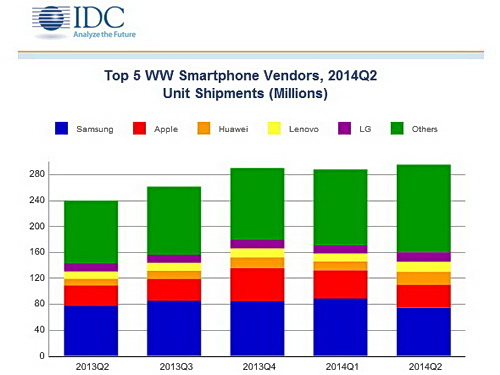
Im Ranking der weltweiten Top 5 der größten Smartphone-Hersteller müssen Samsung und Apple einige Marktanteile an die Konkurrenz von Lenovo und LG Electronics abgeben. Der große Gewinner beim globalen Absatzvolumen heißt Huawei.
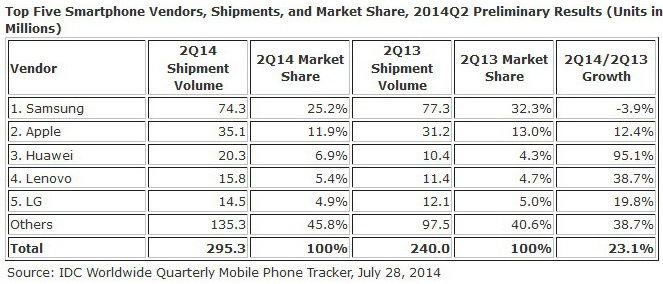
Die Chinesen jagen Apple und Samsung im Geschäft mit Smartphones deutlich Marktanteile ab. Laut den neuesten Zahlen der Marktanalysten von IDC für das vergangene Quartal Q2/2014 bröckelte der Marktanteil des weltweit größten Herstellers Samsung von 32,3 Prozent in Q2/2013 auf nun 25,2 %. Gleichzeitig verkaufte Samsung mit 74,3 Millionen Smartphones um fast 4 Prozent weniger Phones, als im Vergleichszeitraum des Vorjahres (77,3 Mio.).
Insgesamt wurden weltweit im 2. Quartal 2014 fast 300 Millionen Smartphones ausgeliefert. Das ist ein Plus von 23,1 Prozent (Q2/2013: 240 Mio.). Apple behauptet sich im globalen Ranking der Top 5 der weltweit größten Smartphone-Hersteller mit 35,1 Millionen iPhone Smartphones auf Platz 2 und steigerte damit sein Absatzvolumen um 12,4 Prozent (Q2/2013: 31,2 Mio.). Beim Marktanteil verliert Apple aber 1,1 Prozent und hält jetzt statt 13 Prozent noch 11,9 %.
Der große Gewinner im Ranking heißt Huawei. Der chinesische Telekommunikationsriese steigerte sein globales Liefervolumen um 95,1 Prozent, von 10,4 Millionen Smartphones auf 20,3 Mio. Geräte: Platz 3. Der Marktanteil von Huawei beträgt jetzt 6,9 Prozent (Q2/2013: 4,3 %). Auch für Lenovo auf Rang 4 lief das 2.Quartal 2014 gut: Absatzsteigerung um 38,7 Prozent von 11,4 auf 15,8 Millionen Phones und 5,4 Prozent Marktanteil (zuvor 4,7 %).
Für den südkoreanischen LG Electronics Konzern bleibt mit 14,5 Millionen (Q2/2013: 12,1 Mio.) und einem Marktanteil von nun 4,9 Prozent (Q2/2013: 5 %) Position 5. Die Verkäufe für das neue und sehr populäre Smartphone-Flaggschiff LG G3 werden sich IDC zufolge erst im 3. Quartal in den Absatzzahlen widerspiegeln.
Tim Cook, Apple’s chief executive, was an adolescent boy in a small Alabama town in the early 1970s when he saw something he couldn’t forget.
Bicycling home on a new 10-speed, he passed a large cross in flames in front of a house — one that he knew belonged to a black family. Around the cross were Klansmen, dressed in white cloaks and hoods, chanting racial slurs. Mr. Cook heard glass break, maybe someone throwing something through a window. He yelled, “Stop!”
One of the men lifted his conical hood, and Mr. Cook recognized a deacon from a local church (not Mr. Cook’s). Startled, he pedaled away.
“This image was permanently imprinted in my brain, and it would change my life forever,” Mr. Cook said of the burning cross, in a speech he gave last December.
In the speech, he said his new awareness made him feel that no matter what you do in life, human rights and dignity are values that need to be acted upon. And then came the segue: His company, Apple, is one that believed deeply in “advancing humanity.”
Mr. Cook, who is 53, took over leadership of Apple nearly three years ago, after the death of Steve Jobs, the company’s revered founder. Like Walt Disney and Henry Ford, Mr. Jobs was intertwined with his company. Mr. Jobs was Apple and Apple was Jobs.
At the time, Mr. Cook was well regarded as a behind-the-scenes operations guy, but he was a relatively unknown quantity outside the company. He can be intensely private; for instance, the details of the cross-burning episode, like his reaction and the appearance of the deacon, he has shared with friends but not publicly. Even offering the outlines of that story in front of an audience, however, indicates how he is slowly beginning to reveal his own personality and style, and to define Apple leadership in his own image.
This is happening as Mr. Cook, who declined to be interviewed for this article, finds himself not only in the limelight, but also under scrutiny. Of late, the company has hit a snag that was years in the making: Its sales now are so large that many investors worry that it can’t continue to match the growth that brought it from $65 billion in sales in the 2010 fiscal year to $171 billion in 2013. In fiscal 2013, sales grew a mere 9 percent, far below an average just shy of 40 percent a year from 2004 to 2013. Profits slimmed. And the stock price fell nearly in half from its 2012 peak to the middle of 2013, vastly underperforming the market.
Investors have clamored for Apple wizardry — a much-anticipated iWatch or iTV, perhaps. To these critics, Mr. Cook is uninspiring, his social views window dressing, when what they want is magic.
“Where is the grand design?” asks Laurence I. Balter, chief market strategist at Oracle Investment Research. Mr. Balter credits Mr. Cook as having great skills in operations and in managing the supply chain, which entails getting the raw materials and machinery in place to build things — but not with having the vision to design them. “All we hear from Cook,” Mr. Balter says, “is there are some great products coming down the pike.”
Mr. Balter calls Apple a financial “Rock of Gibraltar“— it is sitting on $150.6 billion of cash — but he says he has serious questions about whether it can continue to be a hypergrowth company. Is it a stock for growth investors, he asks, “or widows?”
“Show me the product,” he says. “Show me the ingenuity.”
To shore up shareholder faith, Mr. Cook split the stock, increased the dividend and engineered a $90 billion buyback — steps that helped shares rebound almost entirely. He has taken other steps to strengthen the company, like pushing Apple products into China, a potentially huge market, and acquiring talent, most recently spending $3 billion to buy Beats, a music company that brings Apple two major music-industry shakers and deal makers, Dr. Dre and Jimmy Iovine.
Reflecting his personal views, Mr. Cook is trying to broaden Apple’s brand, too, taking to Twitter and other public venues to express support for environmentalism and gay rights (and for Auburn University football). He has also emphasized the use of sustainable products at the company. Early in his tenure, playing catch-up with other corporations, he established a program to match employee charitable contributions; he has upped the company’s own giving, too.
Jonathan Ive, the head of design at Apple and a name nearly as adored by its followers as Steve Jobs, says Mr. Cook has not neglected the company’s central mission: innovation. “Honestly, I don’t think anything’s changed,” he said. And that includes the clamor for some exciting new thing. “People felt exactly the same way when we were working on the iPhone,” Mr. Ive added.
“It is hard for all of us to be patient,” Mr. Ive said. “It was hard for Steve. It is hard for Tim.”
Spirit of Hardware Past
There is a mythology, with some part of truth, that Mr. Jobs was the soul of the design process, the company’s Innovator in Chief. For the original iPhone, Mr. Jobs checked in weekly with engineers, according to Francisco Tolmasky, a former Apple engineer who worked on the phone’s browser.
“Steve was really adamant,” Mr. Tolmasky reflected, adding that Mr. Jobs would say: “’This needs to be like magic. Go back, this isn’t magical enough!’”
Almost daily, employees would spot Mr. Jobs having lunch on Apple’s campus with Mr. Ive. These days, Mr. Ive said, he meets three days a week with Mr. Cook, generally in each other’s offices. But Mr. Ive said the design processes are essentially unchanged.
“Steve established a set of values and he established preoccupations and tones that are completely enduring,” Mr. Ive said. Chief among them is a reliance on small creative teams whose membership remains intact to this day. The philosophy that materials and products are intertwined also continues under Mr. Cook. For instance, when the company decided to use titanium to build a laptop, Mr. Ive said, he and Mr. Cook and Mr. Jobs thought about how to push the boundaries of the metal to get the look and feel they wanted. And Mr. Ive pointed to another enduring value: a complete focus on the product.
If Mr. Jobs was maniacal about design, Mr. Cook projects “quiet consideration,” Mr. Ive said. Mr. Cook digests things carefully, with time, which Mr. Ive said “testifies to the fact he knows it’s important.”
Lower-level employees praise Mr. Cook’s approachability and intellect. But some say he is less hands-on in developing products than his predecessor. They point to the development of the so-called iWatch — the “smartwatch” that Apple observers are eagerly awaiting as the next world-beating gadget. Mr. Cook is less involved in the minutiae of product engineering for the watch, and has instead delegated those duties to members of his executive cabinet, including Mr. Ive, according to people involved in the project, who spoke on condition of anonymity because they were not authorized to speak to press. Apple declined to comment on the watch project.
Mr. Cook appears to be interested in the smartwatch’s broader implications — for instance, that a watch might monitor heart rate and other vital measures, thus improving health and limiting doctor visits, according to these people. The watch is expected to be released in the fourth quarter, these people said.
Mr. Cook has also looked outside of Apple for experienced talent. He has hired executives from multiple industries, including Angela Ahrendts, the former head of Burberry, to oversee the physical and online stores, and Paul Deneve, the former Yves Saint Laurent chief executive, to take on special projects. He also hired Kevin Lynch, the former chief technology officer of Adobe, and Michael O’Reilly, former medical officer of the Masimo Corporation, which makes health monitoring devices. Not to mention the music men of Beats.
Mr. Cook is amassing a creative brain trust, according to Bono, the lead singer of the band U2, who befriended Mr. Jobs and worked closely with him and Apple’s team on developing a U2-branded iPod, as well as on charitable work in Africa. Mr. Cook is not saying “I’m here to replace him,” said Bono, who is a managing director and co-founder of the venture capital firmElevation Partners. “He’s saying, ‘I’ll try to replace him with five people.’ It explains the acquisition of Beats.”
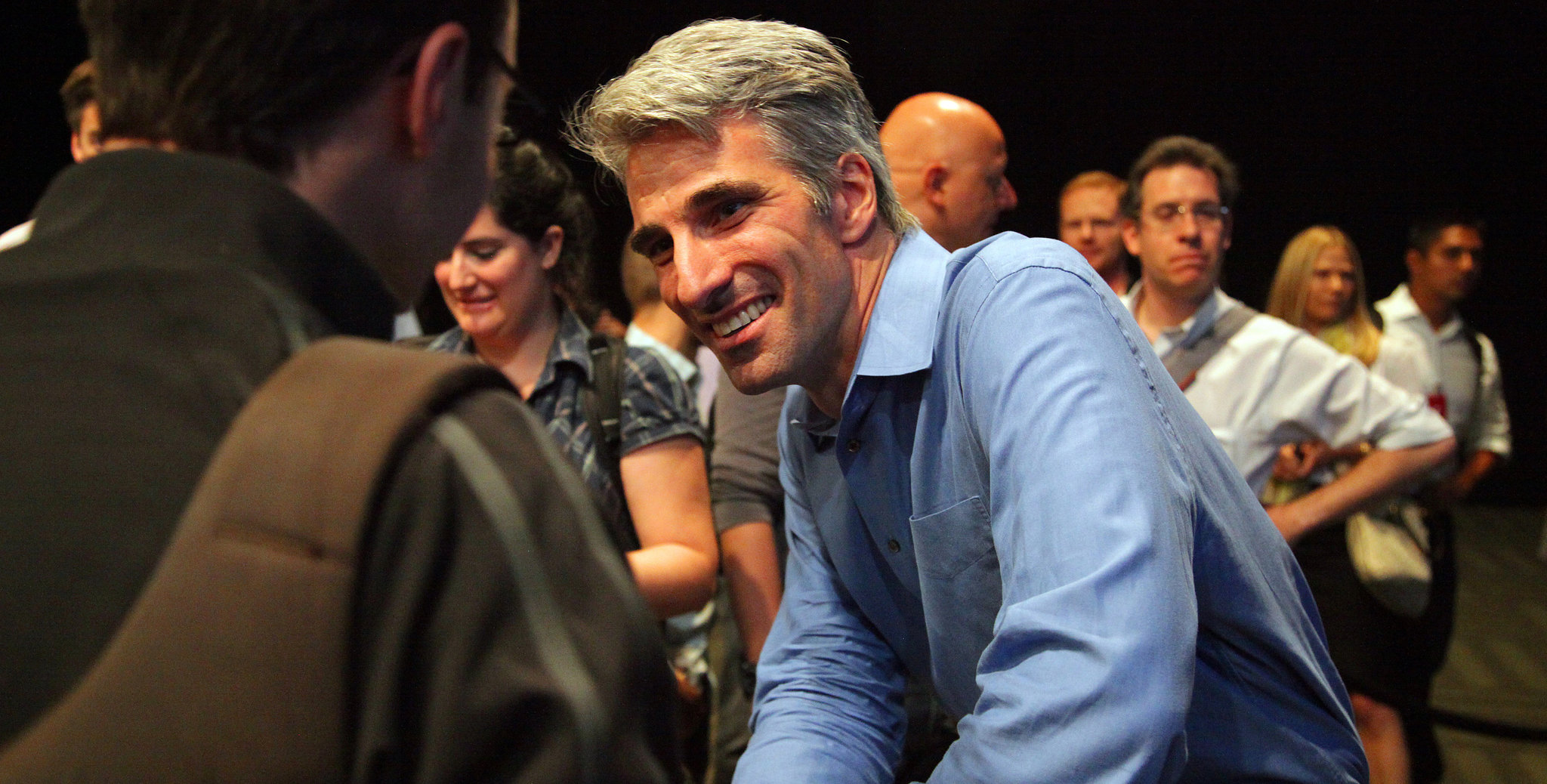
Craig Federighi, head of Apple’s software engineering. Mr. Cook has assembled a team of creative people — and has given them center stage.CreditJim Wilson/The New York Times
That doesn’t mean Mr. Cook is uninvolved in product decisions. Since he took over, the company has released a number of upgrades, including a smaller tablet, the iPad Mini. Mr. Cook “thought the world would love a smaller and less expensive tablet,” said Robert A. Iger, the chief executive of Disney and a member of Apple’s board. It was a product that Mr. Jobs thought did not have a market, he said.
Sales of the iPad Mini quickly exceeded those of the normal-size iPad, according to analysts. Gartner and ABI Research estimated that within the first year the smaller tablet went on sale, it accounted for 60 percent of overall iPad sales.
Still, some product iterations have brought mixed results. Last year, Apple for the first time introduced two new iPhones instead of just one: the high-end iPhone 5S, which sold like gangbusters, and the lower-cost, plastic-covered iPhone 5C, which disappointed.
What makes Apple’s challenge particularly daunting is the law of large numbers. Its sales are so big that even another new strong product — unless it’s a gigantic hit on the order of the iPhone — won’t lead to the kind of growth to which some investors have grown accustomed, noted Toni Sacconaghi, a financial analyst who covers Apple for Bernstein Research. He put it this way: If Apple makes an iWatch and sells 10 million units in the first year, it would add a mere 50 cents to its earnings per share, barely a single percentage point.
“Most people would say, if you sell 10 million units of something that would be incredible,” Mr. Sacconaghi said. But not so with Apple. “There are very few things that could move the needle,” he added.
Michael A. Cusumano, a professor in the Sloan School of Management at M.I.T., said he thought Apple no longer had the juice to create the world-beating product it needs. Professor Cusumano, who is working on a book about innovation, visited Apple’s headquarters in Cupertino, Calif., last fall and has talked to a half-dozen current and former employees about the company culture. He concluded that Apple without Mr. Jobs lacks a visionary to synthesize disparate ideas into a magical whole.
“Jobs would figure out how to put the pieces together,” Professor Cusumano said. “Everything just filtered through his eyes.”
“I think it’s going to be very difficult for them to come up with the next big thing,” he added. “They’ve lost their heart and soul.”
‘Just and Right’
Inevitably, Tim Cook draws contrasts to the high-profile, hands-on style of his predecessor.CreditJustin Sullivan/Getty Images
If Mr. Jobs was the heart and soul of the company, Mr. Cook seems to be trying to cast himself as a different sort of leader. His Twitter feed is a mash-up of Apple hoopla and cheerful promotion of human rights and environmentalism. He wrote an opinion piece in The Wall Street Journal in support of proposed federal legislation protecting gay, lesbian and transgender workers.
He often quotes Martin Luther King, Jr. and Robert F. Kennedy but doesn’t much talk about the origin of his political views. The speech he gave last December, in which Mr. Cook mentioned the cross-burning, started to give some hints. “Since these early days,” he said, “I have seen, and I have experienced, many other types of discrimination.” All of those, he continued, “were rooted in a fear of people that were different than the majority.” Apple declined to say what he meant by the reference to discrimination he experienced, but it did confirm the details of the cross-burning story.
The speech was given at the United Nations, where Mr. Cook was accepting a lifetime achievement award from Auburn, his alma mater. He graduated from the university in 1982 with a degree in industrial engineering. He worked at IBM while earning a graduate business degree at Duke, then went to Intelligent Electronics and Compaq. In 1998, he was approached by Mr. Jobs when Apple was struggling, but as Mr. Cook recounted later in a 2010 commencement speech at Auburn, he saw it as a “once-in-a-lifetime opportunity to work for the creative genius.”
He rose to become executive vice president for worldwide sales and operations in 2002. In the period after he became C.E.O. in 2011, the working conditions in Chinese factories used by major tech companies, including Apple, came under increasing scrutiny. By April 2012, after suicides and accidents among Chinese factory workers, a quarter of a million people had signed a petition on Change.org urging Apple to improve working conditions in the factories. Apple since 2006 had already commissioned public reports on troubling practices inside many factories. In 2012, it also began publishing an annual list of its major suppliers, their locations, and what is made at the major ones, as well as reporting the working hours for more than a million factory employees.
Valerie Jarrett, a senior adviser to President Obama, said Mr. Cook’s building of a production plant in Arizona and a Texas factory for making high-end Mac computers domestically was “a tremendous vote of confidence for an iconic company that previously shipped jobs overseas.” (A majority of manufacturing is still done outside the United States — for instance, an estimated 90 percent of the iPhone’s hundreds of parts are made abroad.) Ms. Jarrett also praised Apple’s donation of $100 million to equip schools with technology, including iPads and high-speed Internet.
Apple also made a quick transition to using 100 percent renewable energy sources in its data centers, which makes it “the most aggressive of the companies that we evaluated in getting renewables online,” said Gary Cook, a senior policy analyst at Greenpeace.
Ryan Scott, the chief executive of Causecast, a nonprofit that helps companies create volunteer and donation programs, called Mr. Cook’s charitable initiatives a “great start.” But Mr. Scott added that its programs are “not as significant as what other companies are doing.” Apple’s ambitions “could be much higher,” he said, given its money and talent. By comparison, Microsoft says that, on average, it donates $2 million a day in software to nonprofits, and its employees have donated over $1 billion, inclusive of the corporate match, since 1983. In the last two years, Apple employees have donated $50 million, including the match.
Apple, too, has faced accusations from government officials on a number of troubling issues, including strategies to minimize its corporate taxes. (On the tax issue, Mr. Cook, told a Senate panel last year that Apple is the nation’s largest taxpayer and pays what it owes.) Last July, a federal judge ruled that Apple had illegally conspired with publishers to try to raise prices in the e-books market; Apple is appealing.
Mr. Cook’s public emphasis on social issues nonetheless puts him “on the cutting edge of an emerging new mind-set in corporate leadership about values and value creation,” said James E. Austin, an emeritus professor at the Harvard Business School. But Kellie McElhaney, a professor at the Haas School of Business at the University of California, Berkeley, said she “gets nervous” when C.E.O.s talk about doing what is “right” without making a business case.
“Right to whom?” she asked.
That’s a view shared by some investors. At a shareholder meeting on Apple’s campus in February, one shareholder — who later described himself as having free-market values — asked Mr. Cook whether Apple should avoid embracing environmental causes that lacked a clear profit motive.
Mr. Cook did not respond by saying, as many executives would, that environmentalism is pragmatic and good for the bottom line. His reasoning was moral.
“We do things because they’re just and right,” he said. He has a slight Alabama drawl and a cool delivery, but there was underlying pique in his voice when he rejected the idea that everything must be measured by return on investment. He concluded by telling shareholders, “If you want me to make decisions that have a clear R.O.I., then you should get out of the stock, just to be plain and simple.”
He received rousing applause from the crowd, which included Al Gore, a member of Apple’s board. But the shareholder who asked the question, Justin Danhof, mourned that “I’ve never had a C.E.O. react that way.” In the following days, some stock analysts echoed the dismay, with one columnist, Robert Weinstein of The Street, wondering whether Mr. Cook “is shifting Apple’s focus from an aggressive luxury tech innovator into more of an increasingly philanthropic-focused company.”
Lennon vs. Ringo
Two weeks ago, Mr. Cook stood on stage at the company’s annual developer’s conference in San Francisco in front of 5,000 enthralled software developers. These are the makers of apps for the iPhone and other gadgets, and Mr. Cook promised them something he called “the biggest release since the launch of the App Store.”
To tell the developers about it, Mr. Cook said, “I’d like to invite my colleague, Superman, back to the stage.”
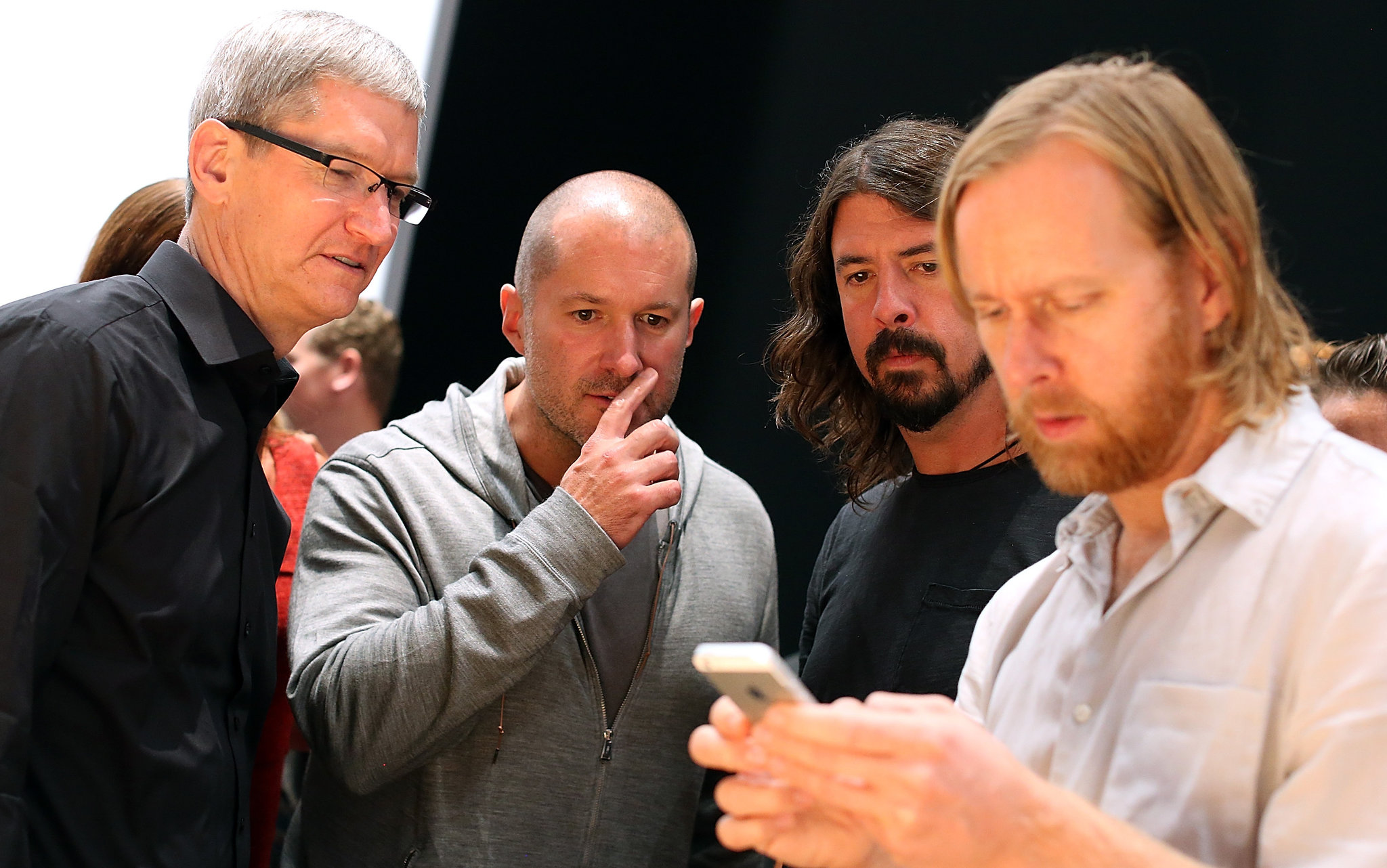
Mr. Cook watched with Jonathan Ive, Apple’s design chief, and Dave Grohl of the Foo Fighters as Nate Mendel, also from the band, tried out one of the phones at a company event.CreditJustin Sullivan/Getty Images
Of course, for years, the only Apple superhero was Mr. Jobs. As Mr. Cook walked toward the darkness, stage left, there was a moment of mystery. Then out sprang Craig Federighi, head of Apple’s software engineering. He passed Mr. Cook and headed into the limelight to describe the new release. It was not a new consumer product, but a set of software tools called a developer’s kit, which would help developers build better apps.
If the rest of the world yawned, the developers stood, and whooped.
Afterward, devotees like Jordan Brown, 25, and three of his colleagues, roamed the convention center.
The four men, who are with a health care app company called Orca Health, had traveled from Salt Lake City and had spent the previous night on the sidewalk to get a good seat at the keynote address. They were scruffy-faced and exhausted, but adrenaline-fueled. Mr. Brown said he viewed Mr. Cook “as someone making sure everything is clicking, but he’s not inspiring.” Mr. Federighi, on the other hand, “resembles Steve,” he said.
Mr. Brown’s colleague Chad Zeluff, 27, who saw Mr. Jobs deliver the keynote in 2007, put it this way: “Jobs is to Lennon what Cook is to Ringo.”
A floor away, Mr. Cook was surrounded by young developers, eagerly snagging selfies as the chief executive mingled post-keynote. Ringo is still a Beatle.
The Utah developers generally expressed support for Mr. Cook. It would be enough, they said, if he put the pieces together. And they said Apple was doing a good job in software innovation, which can add new features to existing devices even if Apple doesn’t produce a new gadget.
They hadn’t heard much about Mr. Cook’s social activism. “I was barely aware of it,” said Gary Robinson, 35, the oldest of the Utah developers. “It’s good, and important.
“But it’s not what matters to me,” he added. “It’s not why I’m here.”
As the conversation continued, though, the developers expressed some cracks in their confidence. For instance, their company has been building apps exclusively for the iPhone for three years, but in the last two months it has also started building apps for Android systems.
They found one thing particularly jarring in the keynote: Apple did not hew to its tradition of pairing hardware and software. Specifically, Apple introduced a program called Health — which helps consumers and doctors monitor health status, like heart rate or glucose levels — but did not also introduce a piece of hardware to measure those results. That is something the new smartwatch is rumored to do.
“They just released the software,” said Mr. Zeluff, sounding surprised.
“It’s something Steve wouldn’t have done,” Mr. Brown said. It’s an impossible comparison. But it’s the one that Mr. Cook is being held to, at least until he makes enough magic of his own.
Apple senior vice president of Software Engineering Craig Federighi speaks in front of a screen for the Yosemite operating system at the Apple Worldwide Developers Conference in San Francisco, Monday, June 2, 2014.
Image: Jeff Chiu/Associated Press
Apple gave developers a much-anticipated first look at iOS 8 and OS X 10.10 during Monday’s keynote presentation at the company’s annual World Wide Developers Conference.
The company unveiled an array of new and revamped features that will be coming to OS X and iOS — many of which may have looked a little familiar to those already used to popular third-party apps and services.
From messaging to fitness tracking to Google searches, here’s a look at some the apps and services Apple seems to be taking head-on with iOS 8 and OS X Yosemite.
Cloud storage platforms
Apple announced iCloud Drive, a cloud-based file management system that will be available on iOS 8 and OS X Yosemite, which will also work with third party apps and will run on Windows 8. Files stored in iCloud Drive can be viewed across devices and edits are automatically synced to the cloud do you can easily pick up where you left off.
Sound familiar? That’s because the system is very similar to Dropbox, Google Drive, Box, Microsoft’s OneDrive and pretty much every other cloud storage platform, though Box’s CEO, Aaron Levie, seems to be excited about the move. Apple also announced new pricing more in line with its cloud storage competitors— 20 GB will cost $0.99 a month while 200 GB will be $3.99.
Messaging apps
Messages, the most-used iOS app, is getting a huge overhaul in iOS 8 that borrows many features from some of the most popular third-party messaging apps. As if Snapchat didn’t have enough to worry about lately, Apple seems to be taking some cues from the disappearing messages app.
Photos and videos will now automatically disappear from message threads, unless actively saved. Additionally, the gesture-based controls for recording audio messages are not unlike those used in the video chatting features that debuted in Snapchat’s most recent update.
Messages is also getting voice messaging and the ability to mute or leave group threads, all of which are features already available in other popular messaging apps, including WhatsApp.
WhatsApp CEO Jan Koum has already expressed his displeasure with Apple over some of its new messaging features, though he did not elaborate on which ones.
Apple is also taking on apps like Google Voice and Skype with the ability to make phone calls from the desktop in Yosemite.
Photo editors
Apple’s new Photos app, includes an array of new smart editing tools. While you can still control things like levels, brightness and contrast independently, the new features allow you to adjust all of these at once to the optimum level with just one swipe.
Image: Apple
This is similar to many image editing apps that have features to automatically enhance and correct photos like Camera+, Afterlight and many others. Apple’s version will have an additional advantage though because all changes made within Photos will be synced with iCloud so the edited images will be available in real time across all of your devices.
Fitness trackers
Though we didn’t see the long-rumored iWatch during the keynote, Apple’s Health app, is still taking on the fitness tracking space.
Apple Senior Vice President of Software Engineering Craig Federighi speaks during the Apple Worldwide Developers Conference at the Moscone West center on June 2, 2014 in San Francisco, California.
The app will monitor all of your health-related information in one place, including stats from fitness tracking apps, and work with third-party apps like Nike+.
Google Now, Google searches
Apple’s Spotlight Search is being revamped for both iOS 8 and Yosemite. Not only will Spotlight search for content stored locally on your device, it will search Wikipedia, maps, news, movie showtimes and iTunes and App Store content.
Image: Apple
The new Spotlight also opts for Bing over Google for web searches in Yosemite. (It appears Spotlight searches in iOS 8 will continue to use Google, for now.) This change has already caused some to speculate whether Apple may be working on its own Siri-powered search engine.
Of course, whether or not Apple’s versions of these apps will eventually overshadow their third-party counterparts depends on how well they actually work. Apple has been known to epically miss the mark when it comes to launching new apps — Apple Maps is only just now enjoying a comeback, after a catastrophic rollout in 2012. But if Maps has taught us anything it’s that Apple tends to get it right eventually, and when it does, it sticks.
Kein anderes Unternehmen wird so unter die Lupe genommen und beobachtet wie Apple. Kaum ein anderes entfacht so viele Spekulationen und Gerüchte, generiert so viele Nachrichten und heizt die Phantasie über neue Produkte, Angebote und Technologien so an wie dieses Unternehmen aus Cupertino. Und das aus gutem Grund. Denn gerade Apple hat in der Vergangenheit mit seinen neuen Angeboten und Produkten bewiesen, dass es in der Lage ist, das Geschäft verschiedener Branchen grundlegend auf den Kopf zu stellen, und den Markt radikal zu ändern.
Doch gilt dies heute noch? In den letzten Jahren sind mit dem Übergang von Steve Jobs zu Tim Cook die Unkenrufe immer lauter geworden. Hat Apple seine besten Zeiten schon hinter sich? Steigt das Unternehmen ins Mobile Payment ein? Mit welchen Angeboten, in welcher Rolle? Holen sie vielleicht zum großen Rundumschlag aus? Oder ist der Zug für sie vielleicht schon abgefahren, weil sie bislang kein NFC (Near Field Communication) integriert haben? Oder läutet gar wegen der „Android-Strategie“ eines offenen Öko-Systems die Todesglocke für das Unternehmen?
Alles scheint offen. Apple lässt sich wie immer nicht in die Karten schauen. Warum auch? Es sind jedoch mittlerweile mehr als eindeutige Signale zu erkennen in welche Richtung das Unternehmen sich bewegt. Wenn wir die Vorgehensweise des Unternehmens aus der Vergangenheit ins Kalkül ziehen, dann sollten Apples Schachzüge im Mobile Payment sorgfältig beobachtet und begleitet werden. Das Zeitfenster für eigene selbstgestaltete Mobile Payment Strategien und Maßnahmen beginnt sich allmählich zu schließen.
Kein Wettbewerber in diesem Segment sollte davon ausgehen, dass er in 1-2 Jahren noch die Zeit dafür hat, seine Figuren in aller Ruhe auf dem „Next Generation Payment-Schachbrett“ auf zu stellen. Es ist zu erwarten, dass der erste Zug von Apple nicht „Weiß, von e2 auf e4“ sondern „Schachmatt“ ist.
Angstmache oder Trend? Was spricht dafür?
Fakten, Analysen und Einschätzungen in sieben Punkten mit anschließender Bewertung sollen in diesem Artikel aufgezeigt werden. Die ersten 4 von 7 folgen hier im Teil 1:
1. Die Fakten
Mit 600 Millionen iTunes-Nutzern ist die Kundenbasis 4,37 mal so groß wie bei PayPal und 3,4 mal so groß wie von Amazon. Täglich kommen 500.000 Kunden dazu. In den Vereinigten Staaten werden 66% der M-Commerce-Ausgaben über iOS-Anwendungen erzielt. In Deutschland nutzen 60% (nach den veröffentlichten Downloadzahlen) der 30 führenden Mobile Banking-Anwendungen (der deutschen Banken) dieses Betriebssystem. Entwickler oder die neuen Mobile-POS Startups wie z.B. Square, iZettle, Payleven lieben Apple-Endgeräte bzw. iOS.
Tim Cook meldete im letzten Monat den höchsten Umsatz der Firmengeschichte, und dass 51 Millionen iPhone 5S verkauft wurden. Das alles mit einer Marge über alle Endgeräte von 37,9 Prozent. 41% der Smartphone-Kunden in den USA sollen mittlerweile das iPhone nutzen und 57% des Mobilen Internetzugangs in China erfolgt über das iOS-Betriebssystem. Und iPhones erreichen eine Kundenzufriedenheit- und loyalität von über 90%.
2. Apple „Passbook“
Im Herbst 2012 führte Apple mit dem „Passbook“ einen „Barcode Payment Container“ ein, über den Coupons, Tickets, Bordkarten gespeichert werden können. Über eine technische Schnittstelle können Entwickler und Brands leicht Dienste in das Passbook integrieren. Mehr als 100 Brands wie z.B. Lufthansa, Air Berlin oder British Airways lassen Tickets in Passbook speichern. Mehr als 150 Brands wie Starbucks integrieren Gutscheine darin. Erste Gutscheinkampagnen wie z.B. von Harvester in England lassen aufhorchen.
3. Fingerprint Sensor: Touch ID
Sicherheit ist die größte Hürde für Kunden und Händler für ein erfolgreiches Mobile Banking und Payment und hat damit einen direkten Einfluss auf die Nutzungshäufigkeit und Akzeptanz der Services. Neben dem schnelleren Zugang zum Endgerät soll der Fingerabdruck zukünftig zur Authentifizierung genutzt werden. Eine wesentliche Voraussetzung für einen schnellen, attraktiven und sicheren Zahlungsprozess. In Amerika und Asien sind biometrische Verfahren im Alltag bereits weiter verbreitet als in Europa.
Es werden nicht nur hier folgende Fragen beantwortet werden müssen: Akzeptieren Kunden- und Händler die biometrische Technik? Was ist bei dieser Technik zu beachten? Welche Anforderungen stellen Banken und Händler? Ist die Technik geeignet für Online-Banking oder –Commerce? Was sagen die Aufsichtsbehörden dazu? Allen Anpassungen zu Trotz ist laut Tim Cook: „Mobile Payment via Touch ID on the way.“
4. Bluetooth Low Energy (BLE) und iBeacons
Der Technologiestandard BLE ist schon länger in den relevanten Smartphone- und Tablets der führenden Hersteller integriert und ist damit bislang weiter als NFC-Technik verbreitet. Durch die Nutzung von iBeacons – vorgestellt im September 2013 – sind dadurch Marketing- und GPS-Lösungen innerhalb von Läden möglich bis hin zu Mobile Payment im Zusammenspiel u.a. mit der Touch ID. Darüber hinaus sind BLE und die iBeacons eine Antwort Apples auf das „Internet der Dinge“, ein weiterer großer Trend, der mittel- bis langfristig die „mobile Nutzung“ von Smartphones und Tablets im Wirtschaftsleben integrieren wird.
5. Einflussfaktor: China Der chinesische Markt, der wichtigste Zielmarkt Apples, ist nahezu aus dem Stand der größte Mobile Payment-Markt der Welt geworden. Dabei überrascht weniger die Tatsache als die Schnelligkeit, mit der dies geschehen ist. Die Geschwindigkeit zeigt vor allem eins, es gibt einen riesigen Bedarf nach Mobile Payment. Damit passen übrigens auch die Gartner-Prognosen wieder. Die Chinesen sind in die Bresche von Google gesprungen. Die chinesische Zentralnotenbank berichtete unlängst von 1,6 Billionen US-Dollar in Mobile Payment, wobei die Transaktionen gegenüber dem Vorjahr um 213% und der Wert der Transaktionen um 317% gestiegen sind. 0,8 Prozent der Mobile Payment-Transaktionen haben NFC als Grundlage. China hat aktuell 500 Millionen Mobile Internet-Nutzer.
Was hat dies jedoch mit Apple zu tun? Apple hatte im vergangenen Jahr nach langem Ringen einen Vertrag mit China Mobile, dem mit 750 Millionen Kunden größten Mobilfunkbetreiber der Welt, abgeschlossen und damit endlich den Fuss im wichtigen chinesischen Markt. China Mobile setzt im Bereich Mobile Payment mit seinem Partner NTT Docomo auf NFC-Technik und hat innerhalb kürzester Zeit 3 Millionen Nutzer erzielt. Darüber hinaus wird chinesischen Banken die Zusammenarbeit bei einer Mobile Payment-Plattform (Kollaboratives Strategiemodell) angeboten im Zusammenspiel mit China Mobile. Die Milliarden-Dollar-Preisfrage lautet daher: Wie wird sich Apple jetzt entscheiden?
6. Einflussfaktor: Strategien Apple besitzt aufgrund seiner erfolgreichen Endgeräte-Strategien wesentliche Eckpfeiler der Mobile Payment-Wertschöpfungskette: die Kunden und Händler. Mit der Entscheidung für BLE und iBeacons sind kurzfristig schneller einsatzfähige Mobile Payment-Services mit geringerer Öko-System-Komplexität möglich. Fatal sind aktuelle NFC-Payment-Anbieter ist die aktuell fehlende NFC-Technik bei Apple. Da Länderübergreifend, auch in Deutschland die aktivsten Nutzer (ca. 60%) aus dem iOS-Lager kommen. Stickerlösungen sind eher als Second-Best-Lösungen anzusehen. Der Markt dürfte erst richtig abheben, wenn es integrierte Angebote gibt. Zu guter Letzt testet Apple seine Mobile Payment-Lösung vor der Einführung in den Markt ausgiebig in seinen Shops.
7. Innovationen und Patente Apple hat in der jüngsten Vergangenheit zahlreiche Patente für Mobile Payment-Services angemeldet. Dazu gehören „Zahlungen für Güter, die über ein Signal von einem Smartphone zu einem drahtlosen Empfänger veranlasst werden,“ oder „ein Sensor der biometrische und NFC-Technik kombiniert,“ oder „eine Methode und ein System, das Kredits verwaltet.“
Bewertung:
Von allen Teilnehmern hat Apple die komfortabelste Position, da es mit Abstand über die meisten Optionen verfügt, und es sich beinahe Aussuchen kann, welche Rolle es einnehmen möchte, und welche Einnahmen an der Wertschöpfungskette es erzielen möchte. Als Stichworte für die Rollenoptionen mögen folgende ausreichen: Hardwarelieferant (Smartphone, Lesegeräte), Trusted Service Manager, White Label Plattform oder „Weltbank“. Das Unternehmen hat höchstes „Game Changer Potential“ aufgrund seiner Finanzkraft, der überragenden Kundenbasis (Endkunde/Händler), seiner Erfahrung mit komplexen Innovationsproblemen, seiner Historie und der skizzierten Schachzüge. Dabei wird das Unternehmen zukünftig nicht einseitig den Markt bestimmen, sondern wird auf Marktentwicklungen in seinen wichtigsten Zielmärkten wie China reagieren müssen. Wenn sich die größten Mobile Payment-Branchen auf die NFC-Technologie festlegen, wird das Unternehmen reagieren müssen. Die Patente geben dabei die hilfreiche Fingerzeige.
Erwartungen
Apple wird NFC in seinen Endgeräten (Smartphone / Tablet) integrieren. (Argumente: Patente, China, wachsende Verbreitung von NFC-fähigen End- und Lesegeräte bis 2016).
Mit BLE / iBeacons hat sich Apple weitere Optionen im Marketing, Mobile Payment und Internet der Dinge geschaffen.
Apple wird sich nicht zu einer „Weltbank“ entwickeln. Dies ist erstens nicht erfolgreich und aufgrund der großen regulatorischen Anforderungen an Banken weltweit unternehmerisch nicht sinnvoll.
Apple wird versuchen, seine aktuelle Position, in zentrale Rollen in dem kommenden Mobile Payment Öko-System, zu übersetzen. Idealerweise als „White-Label-Plattform-Anbieter“.
Empfehlungen an Banken
Kurzfristig:
Design, Gestaltung und Umsetzung Digitaler Strategie
Einführung und Ausweitung von Mobile Banking-Services
Design einer eigenständigen Mobile Payment Strategie
Unternehmensstrategie
Vorantreiben der „Mobile Readyness“ des eigenen Unternehmens
Konsortium innerhalb der Branche / Branchenübergreifend
Enge Zusammenarbeit mit nationaler und europäischer Regulierung
Mittelfristig:
Einführung eines Mobile Payment Öko-Systems
Einführung einer Mobile Payment-Lösung
Dieser Artikel basiert auf einem Vortrag vom 18. März 2014 auf der Konferenz “Next Generation Payments” des Bankingclubs in Köln.
Der Autor: Thomas Lerner ist Management Berater, Autor, Trainer und Speaker bei Mobile Marketing, Banking, Payment und Banking Services. Im Dezember 2013 ist sein Buch „Mobile Payment“ in englischer Sprache erscheinen. Im Sommer 2014 erscheint sein neues Buch „Mobile Marketing / Mobile Banking“.
The first Tesla I ever saw was stripped down to the chassis, a bare-metal incarnation of the company’s flagship electric Roadster on display at an event in Silicon Valley. Without the need for an internal combustion engine, the two-seater’s petite frame was dominated by a huge battery. My first thought: “This looks like a giant cell phone on wheels.”
As it turns out, I was more right than I realized.
This week, years after that first sighting, Tesla announced plans for what it calls the “Gigafactory,” a 10-million-square-foot plant for making car batteries. The company hopes that the sheer scale of the operation, combined with the inventiveness of its engineers, will bring battery prices down far enough to finally bring its electric cars into the mainstream.
But it’s not just the prospect of a gasoline-free future that has sparked such excitement about the Gigafactory. The same basic lithium-ion tech that fuels Tesla’s cars also runs most of today’s other mobile gadgets, large and small. If Tesla really produces batteries at the scale it’s promising, cars could become just one part of what the company does. One day, Tesla could be a company that powers just about everything, from the phone in your pocket to the electrical grid itself.
Earlier this month, as rumors swirled that Apple might want to buy Tesla, San Francisco Chronicle reported that Tesla CEO Elon Musk had indeed met with the iPhone maker. Musk later confirmed that Tesla and Apple had talked, but he wouldn’t say what about.
Now that Tesla has announced the Gigafactory, Gartner auto industry analyst Thilo Koslowski thinks it would make more sense for Tesla to talk with Apple about something other than an acquisition. “Depending on the capacity of the factory and who the other investors will be, Tesla could start selling its batteries for other products besides cars,” Koslowski tells WIRED. “This could actually mean Tesla might build batteries for Apple.”
Better Batteries for Less Money
To begin erecting its factory, Tesla said it would seek $1.6 billion in debt financing — money that Apple itself could easily supply from its massive cash reserves. In fact, the world’s biggest company could easily put up the money for the entire Gigafactory, which Tesla estimates will ultimately cost between $4 billion and $5 billion. Though industry analysts say the global manufacturing capacity for consumer electronics batteries is already considerable, the economies of scale that Tesla is promising could give Apple access to a whole different level of efficiency, sophistication, and control.
Unlike many parts of the consumer electronics industry, battery-making factories are, in general, highly automated, which means that labor doesn’t factor significantly into production costs. As anyone who has seen Tesla’s car-making robots in action can attest, factory automation is something the company does really, really well. Deep involvement in the project from the start — say, as an investor — could give Apple exactly the kind of intimate involvement with a key supplier that it relishes. This sort of control defines its approach to products. For consumers, that could mean Apple getting better batteries for its devices for less money, just like Tesla wants to do for its cars.
Even if the Gigafactory never makes a battery for a single iPhone, however, its impact on the future of energy storage could be huge. The company says that, once fully operational, the plant will more than double the volume of lithium ion batteries produced in the world today. Sam Jaffe, a battery industry analyst with Navigant Research, says the price drops predicted by Tesla are in line with his firm’s forecasts, and that the cheaper batteries will bring Tesla closer to achieving its primary mission of making a widely affordable electric car, what Tesla is calling its “Gen III” mass market vehicle, or Model E. “The whole point of that model and the whole point of the company was to make that car,” Jaffe says. “It wasn’t to make sports cars or luxury cars. It was to make a family car comparable in price to a gasoline model.”
To reach that mass market, Tesla hopes to be cranking out batteries for 500,000 cars per year by 2020, supported by the Gigafactory. That’s compared to the 35,000 Model S sedans Tesla expects to make this year. Reaching that goal would mean not only a lot more electric cars on the road but a lot more batteries that would need to be replaced. The batteries that power Teslas are a lot like smartphone batteries: Eventually, they start losing their strength. Unlike smartphone batteries, getting down to 60 or 70 percent of their full capacity isn’t just inconvenient. It could leave drivers stranded. Tesla says it plans to fully integrate battery recycling into the Gigafactory’s operations, which could add to the cost savings.
Powering the Grid
But Koslowski says those old batteries could also become part of a robust secondary market. They could, for instance, store energy generated by home solar grids, which can make use of less-than-full strength cells because they don’t have to go anywhere. Already Tesla is supplying battery packs to SolarCity, the solar installer of which Musk serves as chairman, and the company believes that one day its batteries could even serve as backup energy sources for utilities themselves. Bullish Wall Street analysts even predict that, in addition to buttressing the renewable energy grid, Tesla could combine its expertise in cars, batteries, and digital technology to become a leading maker of self-driving vehicles.
Any of this coming to pass, of course, depends on whether the Gigafactory will actually accomplish what Tesla says it will. To bring prices down, battery industry consultant K.M. Abraham says, Tesla will have to figure out how to make its batteries without pushing up costs for component suppliers who would have to increase their output to meet the car maker’s demands. “Unless you come out with new low-cost materials, the battery prices will remain pretty much the same,” says Abraham, who is also a professor of renewable technology at Northeastern University.
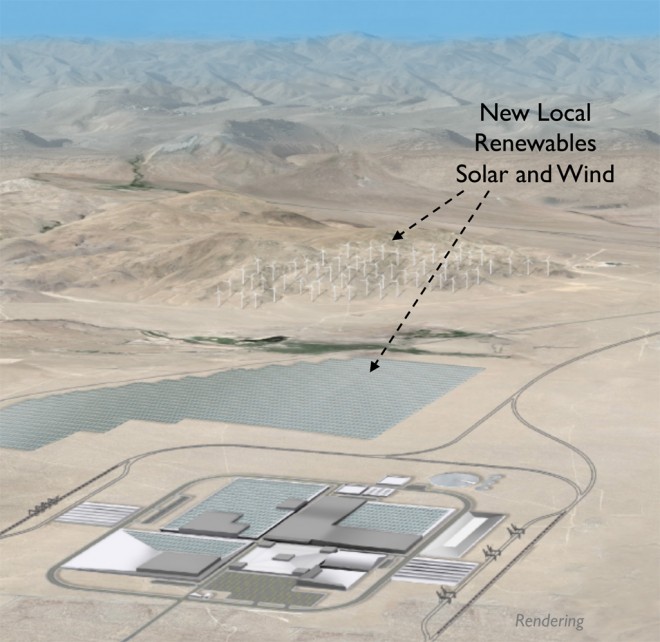
Though details from Tesla are scant, a diagram released by the company suggests it does plan to bring as much of the battery making process as possible within the Gigafactory’s walls. Tesla is also pledging to power much of the plant with its own wind and solar energy, a potential testing ground for using its batteries as part of the electrical grid. Diversifying into different uses could be especially crucial if demand for Tesla’s cars doesn’t hit the company’s own projections. Building a factory on such a massive scale is a huge risk if it only makes one thing, but that risk diminishes if Tesla has the ability to use its expertise to make batteries for many uses. If nothing else, Tesla is creating an unprecedented space just to see what’s possible when energy becomes mobile.
“It’s breathtaking, just the sheer size of it,” Jaffe says of the Gigafactory. “This is so beyond anything by comparison.”
Offizielle Ankündigung nächste Woche bei Elektronik-Messe CES in Las Vegas
Google und Audi planen laut einem Zeitungsbericht eine groß angelegte Kooperation. Dabei gehe es darum, dass Unterhaltungs- und Informationssysteme in Audi-Fahrzeugen künftig mit dem Google-Betriebssystem Android laufen, berichtete das „Wall Street Journal“ unter Berufung auf informierte Personen. Der Plan solle kommende Woche auf der Elektronik-Messe CES in Las Vegas vorgestellt werden.
Größeres Projekt
Das Vorhaben sei Teil eines größeren Projekts, das Android im Auto etablieren wolle, hieß es. Weiterer Teilnehmer dieser Allianz sei der Chip-Spezialist Nvidia. Android dominiert im Smartphone-Markt mit einem Marktanteil von zuletzt rund 80 Prozent.
Auch Apple im Auto
Auch Apple arbeitet daran, seine iPhones besser im Auto einzubinden. Seit vergangenem Jahr handelte der Google-Rivale Vereinbarungen für eine vertiefte Integration seiner Geräte und Dienste unter anderem mit General Motors, Daimler und BMW aus.
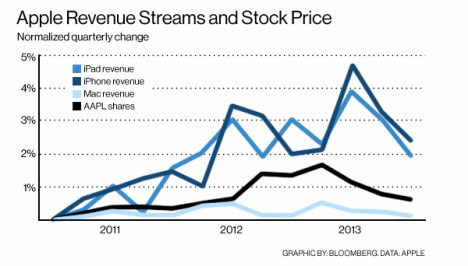
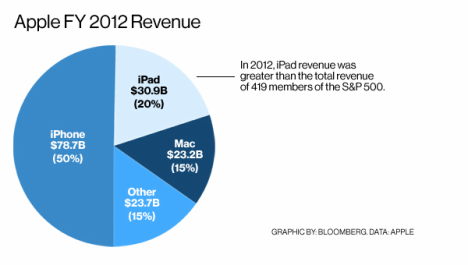
Vergleicht man den Verlauf der Einnahmen aus Apples iPad-Verkäufen der vergangenen Jahre, so fällt auf, dass sie sich ähnlich verhalten wie der Kursverlauf der Apple-Aktie. Auf diese Korrelation hat Mark Glassman von Bloombergs Businessweek hingewiesen.
Die Übereinstimmung erreicht 68 Prozent – im Vergleich dazu liegt sie zwischen iPhone-Verkäufen und Aktienkurs nur bei 62 Prozent, bei den Macs sogar nur bei 40 Prozent.
Für Börsenexperten und Anleger stellt diese Beobachtung eine äußerst verwertbare Information dar, die durchaus eine Grundorientierung auch für alle anderen bietet, die sich nicht sicher sind, wann sie am besten ihre Apple-Aktien kaufen oder loswerden sollten.
Einen weiteren guten Anhaltspunkt bietet natürlich auch die Verkaufszahl der jeweils einzelnen Einheiten an iPhones, iPads und Macs, wobei hier das iPhone – das etwa die Hälfte aller Apple-Einkünfte ausmacht – klar vorn liegt: mit 77-prozentiger Korrelation zum Aktienkurs, wohingegen die iPad-Verkaufszahl nur zu 68 Prozent dem Kursverlauf entspricht. Diese 68 Prozent sind wiederum viel angesichts der Tatsache, dass das iPad-Geschäft lediglich 20 Prozent der Gesamteinnahmen Apples ausmacht. Dies sind derzeit jedoch stolze 30,9 Milliarden Dollar. Dieser Wert ist größer als der Gesamtumsatz bei 419 Unternehmen des S&P 500 Index.
Kurz gefasst heißt das für den Anleger: eine klare Kaufempfehlung, wenn die iPhone-Verkaufszahlen und die iPad-Einkünfte ansteigen. Am 22. Oktober soll Apple die nächste Generation von iPads und iPad minis vorstellen, sechs Tage später wird das Unternehmen dann seine Bilanz für das vierte Quartal präsentieren. Und mit dem erst danach beginnenden Verkauf der neuen Tablets geht auch die Arbeit der Statistiker und Analysten, die den Erfolg oder Misserfolg des Geschäfts messbar aufbereiten, in die nächste Runde.
The iPad 4 looks almost exactly the same as its predecessor, the iPad 3. Apart from the Lightning connector, they appear identical, but the iPad 4 has a much more powerful processor the A6X. It also has a better front-facing camera and improved Wi-Fi connectivity. It still starts at $499 for a 16GB model (Wi-Fi only).
Back View
The back of the iPad 4 sports the familiar aluminum back.
Compared With iPad 3
Here’s the iPad 4 (black) beside the iPad 3 (white).
Back Comparison
The two tablets are virtually identical.
Missing Capacity Label?
The iPad 3 has a label that shows the capacity, but the iPad 4 does not.
Lightning vs. Dock Connector
The new Lightning connector is the only obvious physical difference between the two tablets. Although the connector „modernizes“ the iPad, it doesn’t enjoy the design benefits the iPhone 5 gained from shrinking the dock connector.
Label Close-Up
FaceTime Camera
The front-facing camera on the iPad 4 is now a 720p FaceTime camera. You can see how its performance has improved from the iPad 3 (left). Not only are images sharper, but color is improved, too.
Front-Facing Camera Sample, iPad 3
Here’s a photo taken with the front camera on the iPad 3.
Front-Facing Camera Sample, iPad 4
The same shot taken with the front camera on the iPad 4.
I’ve spent the last few days checking out the fourth-generation iPad, looking — no, hunting — for ways Apple‘s new flagship tablet differentiates itself from the previous model. While it’s hardly coal mining, it been an extremely challenging task.
iPad 4 looks almost exactly the same as what I’ll refer to from now on as the iPad 3, the tiny Lightningconnector port being the only sign this is a different product. While Apple has found a new love for progress in debuting the fourth-gen iPad a mere six months after iPad 3 (its mobile products used to iterate on tight annual schedule), it’s clearly not messing with success.
It’s also not going to do anything to upstage the pretty young ingenue in its product lineup, the iPad mini. Whereas the mini was the star of Apple’s most recent product circus, the company’s chief gadget wrangler, Phil Schiller, said everything he had to say about iPad 4 in less than three minutes. If you blinked, you missed a whole new iPad.
The result: Most people don’t even know there’s a new 10-inch iPad, which is probably just what Apple wants. While the iPad mini provides curious onlookers and anyone considering a smaller tablet something to look at, the same big-screen iPad is still there, still starting at $499, still setting the standard for the whole tablet market. The message: Sleep easy, world, because nothing’s changed.
Except it has. The iPad 4 performs noticeably better than the iPad 3. This isn’t just a matter of benchmarks or “theoretical” numbers, but those are certainly superior. Web sites load faster, apps launch quicker and the most processor-taxing iPad games run perfectly on the new iPad. Whether you’re a casual surfer or a power user, the new iPad improves your experience.
More Guts, a Bit More Glory
The iPad 4′s powers are due largely to the new A6X processor. Apple launched the A6 chip with the iPhone 5 in September, and the iPad takes it up a notch with quad-core graphics. Just like the iPad 3, the beefier graphics processing is needed to render images for the 2,048 x 1,536 retina display. The screen is the same, but Apple says it now performs up to twice as fast.
It’s not a lie. In benchmark tests, we found the iPad 4 performs at least twice as fast, looking at raw processing power. RunningGeekbench’s app, the iPad 4 got an overall score of 1,769 while its predecessor was ranked at just 768 — a massive difference. In repeated runs of SpeedTest.net, which tests connection speed, the iPad 4 was on average about 20% faster than iPad 3 on the same Wi-Fi network.
In real-world tasks, that translates into media-rich websites such as CNN.com (and Mashable, come to think of it) loading almost instantaneously and graphics-intensive apps launching lickety-split. In launching Solar Walk, for instance, a retina-optimized app loaded with high-res renderings of the solar system, the iPad 4 called it up a lot faster than iPad 3, saving several seconds. (Check out the video below for the full demo.)
Games launch faster, too. However, for actual gameplay, I couldn’t detect any difference at all. Slices, parries and stabs against the monstrous rivals in Infinity Blade II was fast and responsive on both iPads. Blasting pirates in Galaxy on Fire HD 2 was a pixel-perfect exercise on the two tablets, even at maximum resolution. And zombie brains from The Walking Dead spattered just as well on the iPad 3 as the iPad 4.
Playing games continuously on both tablets, the iPad 3 appeared to lose battery life considerably faster than the iPad 4. Apple does say the new processor runs more efficiently than the iPad 3′s, but the extra juice could be attributable to the device simply being brand new.
In any case, game developers have clearly built their games for the iPad 3, which was the best possible iPad experience for the last six months, so no game is going to choke the tablet the way Crysis used to be the gaming stress test for PCs. It’s going to take time for devs to create apps that really challenge the iPad 4, but when they do, the A6X processor will be waiting.
Eyes Front
The other upgrade to the iPad 4 is the front-facing camera, which is now an improved model able to capture 1.2-megapixel photos and 720p video. The upgrade puts it in line with pretty much all of Apple’s other products with front-facing cameras — from the MacBook Air to the iPad mini to the iPod touch.
The improvement is welcome. The iPad is an excellent device for video chatting because of its portability and Apple’s FaceTime service, which is generally superior in quality to rivals like Skype. With a good connection, the clarity is markedly better than on the iPad 3.
Any self-portraits you take with the front camera are improved as well. Shots are more detailed, with better color. Of course, if you really need to snap some pics of something, you may as well use the 5-megapixel camera in back, which is the same design as iPad 3.
Apple says the A6X chip improves both image stabilization and facial recognition, but in my short time with the iPad 4, I couldn’t detect any improvement over the iPad 3 on either of those features.
Lightning Strikes
Then of course there’s the Lightning connector, the big physical change from the previous model. In the iPad, though, Lightning’s small size doesn’t provide much benefit, Whereas Apple was able to shrink the iPhone considerably by replacing the dock connector with the smaller port, the iPad retains the same weight and dimensions.
To the user, Lightning doesn’t provide a lot of benefit over the old dock connector other than ensuring your iPad won’t go obsolete overnight. It’s great for Apple, though. Adding Lightning to the iPad proper brings the new port to all of Apple’s portable devices in time for the holiday — an impressive feat considering the connector didn’t exist officially until a month and a half ago.
Apart from the connector, there’s really no physical difference from the iPad 3. On our iPad, the label that indicates the storage capacity is missing, although that might simply be because it’s a review unit.
Why the iPad 4 Exists Now
When Apple unveiled the fourth-generation iPad, many owners of the iPad 3 were angry. After all, they had shelled out serious cash for the new iPad with retina display with a confidence that it wouldn’t be obsolete six months later. It was the Osborne Effect, but in reverse.
Yet here we are. Now there’s a shinier, newer iPad with a much faster processor, a better camera and that oh-so-cute Lightning connector. Dammit.
But there’s really nothing to be angry about, because iPad 3 owners aren’t missing out on anything significant. The iPad 2′s screen to a retina display — that was a major upgrade, but the spec bumps in iPad 4, while significant, don’t have much practical benefit yet.
It will take awhile for A6X-optimized apps to arrive, and the iPad 3 is already plenty fast. The front camera is improved, but it’s not like I was unrecognizable on FaceTime before. About the only thing with serious, tangible benefits is upgraded Wi-Fi, but in that case we’re talking only a few seconds difference, typically.
Forget the iPad 3 for a second, though, and it’s hard not to marvel at what Apple’s created here. Not only is the iPad 4 a turbocharged tablet with an impressive display, but it’s got a large selection of apps (275,000, at Apple’s last count) made especially for it.
That’s something no Android or Windows tablet can claim. As impressive as the Microsoft Surface and Nexus 10 are as devices, good luck finding Infinity Blade in either one of their app stores.
So while the iPad 4 isn’t worth the upgrade for iPad 3 owners, for anyone else thinking about a new full-size tablet this holiday, the choice is clear. The iPad, already the standard-bearer in the category, is now twice as powerful, has even faster connectivity and — oh yeah — is supported by the most consistent and easy-to-use mobile ecosystem in existence and the deepest tablet app selection by far.
Rival tablets may be able to beat Apple on price, and perhaps even a spec or two, but no one else comes close in terms of experience. Come to your senses and get an iPad already. There’s a reason it’s the most popular tablet in the world, and it’s never been clearer than in the iPad 4.
Apple’s stock dropped by more than 4% in early trading Wednesday, to as low as $556 a share, its lowest price in five months.
More significantly for investors, the stock is now down more than 20% in less than two months from its peak price of $705 a share on Sept. 21 when the iPhone 5 hit store shelves. This trading situation is commonly referred to as a bear market, with no bottom in sight.
For Apple, a combination of factors have plagued the stock over the past six weeks and continue to push down the price.
Supply Constraints
The stock’s initial downfall was caused largely by concern about supply constraints impacting sales of the iPhone 5. The stock began to decline after Apple reported lower-than-expected opening weekend sales for the device in late September, a fact that the company suggested was due to limited supply rather than demand.
Since then, CEO Tim Cook has assured investors that Foxconn, Apple’s manufacturing partner, has significantly improved production and will continue to catch up to demand. However, Foxconn’s chief renewed concerns Wednesday by noting at a business event that the manufacturer is still “falling short” of demand for the iPhone 5.
Executive Shake-Up
Apple dropped a bombshell last week when it announced a big executive shake-up, including the departures of the company’s iOS chief Scott Forstall and retail chief John Browett. Apple shrewdly announced the move on a day when the stock market was closed because of Hurricane Sandy, but once trading resumed, the stock began to drop.
For investors, the announcement raised concerns about the stability of Apple’s elite management team without Steve Jobs, and the departure of Forstall in particular raised concerns about the future of Apple’s mobile product innovations.
Competition in the Tablet Space
A particularly negative research report about Apple’s dwindling dominance in the tablet market didn’t exactly help the company’s stock either. According to IDC, Apple’s share of the tablet market declined from nearly 60% in the third quarter of 2011 to 50% in the third quarter this year, showing just how much the competition has grown.
Declining Profit Margin
Apple is clearly working to maintain its hold on the tablet market with the release of a new smaller and cheaper iPad mini. However, the downside, as the company pointed out in its most recent earnings call, is that this and other new devices are expected to cut into the company’s profit margins.
Apple projects that it will report a much lower profit margin in the December quarter than analysts had previously expected. Cook attributed this to the prolific roll out of new products, which have higher costs, and the fact that some products like the iPad mini are being sold closer to cost. At the end of the day, Apple’s absurdly high profit margins for its product is the big selling point for investors. As a result, some analysts reacted to the news by cutting their price targets for the stock.
Patent Verdict
Most recently, the stock took another hit after a federal jury in Texas ruled that Apple’s FaceTime video chat feature infringed on several patents held by VirnetX, a patent holding firm. The court ordered Apple to pay $368 million and VirnetX could potentially push to ban sales of Apple products that use these patents.
All in all, it has been a tough few weeks for Apple even with the successful launch of several new products.
The IPad out on the market for some days now, the successor is on the way already. Rumors tell that Apple will react in the first or second Quarter of 2013 to the introduction of the Google Nexus.
Analyst Ming-Chi Kuo of KGI Securities thinks Apple may feel pressure from Microsoft’s new Surface tablet, especially considering that the fourth-generation iPad is the same weight and thickness as the third-generation model.
„Though the iPad mini is expected to be successful, we think launching the lighter, thinner 9.7″ iPad as quickly as possible matters more for Apple strategically,“ Kuo explained.
If Microsoft Surface does catch on with consumers and businesses, it would pose a risk to Apple’s current dominance of the „post-PC“ world. For that reason, he thinks Apple will move quickly to redesign the iPad once again in the near future.
Apple is expected to employ „GF DITO“ touchscreen technology, otherwise known as GF2, in its redesigned iPad, according to Kuo. In combination with more power-efficient chips, Apple is expected to „dramatically lower the weight and thickness of the 9.7″ iPad,“ Kuo wrote.
Apple is said to already be employing GF2 display technology in the new iPad mini. That helped to make the device 23 percent thinner and 53 percent lighter than the full-size iPad.
The fourth-generation iPad unveiled by Apple on Tuesday marked an uncharacteristically short product life cycle for the company. It completely replaced the third-generation model, while the $399 iPad 2 remains without a high-resolution Retina display.
The new fourth-generation iPad carries the same price points as its predecessor, while packing in faster performance with a new A6X processor that Apple said doubles the speed of the system’s CPU and GPU. It also features Apple’s new Lightning connector, replacing the legacy 30-pin design found on the third-generation model.
Customers who recently purchased a third-generation iPad may be able to return their purchase and exchange it for the updated fourth-generation model at certain Apple retail stores.




 Doch gilt dies heute noch? In den letzten Jahren sind mit dem Übergang von Steve Jobs zu Tim Cook die Unkenrufe immer lauter geworden. Hat Apple seine besten Zeiten schon hinter sich? Steigt das Unternehmen ins Mobile Payment ein? Mit welchen Angeboten, in welcher Rolle? Holen sie vielleicht zum großen Rundumschlag aus? Oder ist der Zug für sie vielleicht schon abgefahren, weil sie bislang kein NFC (Near Field Communication) integriert haben? Oder läutet gar wegen der „Android-Strategie“ eines offenen Öko-Systems die Todesglocke für das Unternehmen?




 TheIdea – The Innovation Agency