Archiv der Kategorie: Innovation

Der Kreis derer, die als Chief Disruption Officer überhaupt nur annähernd in Betracht kommen, hat den Radius „null“

Ich bin eine eierlegende WollMilchSau – und der neue Chief Disruption Officer Deiner Firma!

Eierlegende Wollmilchsau

Eierlegende Wollmilchsau

Fotolia #83825279 | Urheber: jokatoons

Herausforderung: die Auftragsklärung

Ein neuer CDO soll bei den Konzernen oft den „Tanker bewegen und in Schnellboote verwandeln“, schließlich hört und liest man ja überall von Startups, Agil, Dynamik, Disruption und stetiger Veränderung. Da stellt sich doch die Frage (typischerweise an HR) wer erstellt den das JobProfil für einen Job, den es noch nie gab und dessen Ziele so faszinierend unterschiedlich, ja widersprüchlich sind. Schließlich wird jeder seine eigene Vorstellung davon haben, was der künftige CDO „endlich“ angehen soll – fragen Sie doch mal Kollegen aus unterschiedlichen Funktionen!

In der folgenden Liste habe ich einmal einige (Achtung Buzzword-Bingo) zusammengefasst:

Typische CDO Erwartungsperspektiven:

  • Neue(s) Business Modell(e) finden, entwickeln und bitte gleich den Return on Investment im ersten Jahr sicherstellen
  • Change Manager (Disruption, Innovation…) der die gesamte Organisation in die neue Arbeitswelt führt
  • Neue Vertriebs- und Finanzierungskanäle – vom Crowdfunding über Crowdstorming, Crowdworking und Social Marketing
  • Digital Mindset / Organisationsentwicklung – nachhaltige Veränderung der Unternehmenskultur
  • Board Coaching / Trainer für die anderen Vorstände
  • Smart Factory – die intelligente Fabrik, digitalisierte, automatisierte und vernetzte Produktionsumgebungen mit neuen agilen Werkzeugen bis zur Losgröße 1 (zugleich stetig wachsender Fokus auf Service-Orientierung stattfindet – also „nicht-produktion“)
  • BigData / Analytics / Predictive – alles was man mit Daten, deren Analyse und Vorhersagbarkeit so treiben kann
  • Rechtsanwalt – Arbeit 4.0, Zusammenarbeit mit Externen, Compliance… siehe unten „illegal“
  • Neues IT Framework – moderne Softwarearchitekturen, Werkzeuge und Apps einführen
  • Digitales Vorbild / Botschafter – Sichtbar werden für neuen Arbeitsstil, Führungskultur – am Besten auch nach außen werbewirksam
  • Digitale Prozesse / Digitale Effizienz – den systemischen Organisationsmotor generalsanieren
  • Social Media extern – von Arbeitnehmerattraktivität über Recruiting (von natürlich Digital Professionals) bis zu Wirkungsverbesserung durch virales Marketing
  • Interne Kommunikation und Zusammenarbeit (Enterprise Social Networking)… – die gesamte Belegschaft, inklusive Fabrikarbeiter mobil, vernetzt, zeit- und orts-unabhängig sowie skallierbar in Arbeit 4.0 führen

Diese Liste an Erwartungen ist sicher alles andere als vollständig, soll aber zeigen, dass es nicht einfach ist, das Profil für diese Position so zu definieren, dass der Inhaber überhaupt eine Chance hat Wirkung zu entfalten. Schließlich gilt es neben den fachlichen Aufgaben auch die bestehende Kultur, Politik, Seilschaften etc. kennen zu lernen und dann nachhaltig zu verändern.

Herausforderung: Woher nehmen, diese CDO – eierlegende WollMilchSau?

Wie einer der Headhunter mal so schön formulierte:

„der Kreis derer, die als CDO überhaupt nur annähernd in Betracht kommen, hat den Radius „null““

Es gibt keine Ausbildung zum CDO, typische Karrierewege erzeugen meist „system-stabilisierende“ Vertreter, wer will einem „jungen Wilden“ die Verantwortung über einen Konzern geben. Die Zahl derer, die in ähnlichen Rollen erfolgreich sind, ist äußerst überschaubar – Nachahmung schwierig- und oft auch nicht einfach übertragbar… auch die großen Consulting Riesen sind hier sicher keine Hilfe, da deren Reifegrad hier ähnlich jungfräulich ist (Es gibt keine Blaupausen, die man aus der Schublade ziehen könnte, keine Beweise, kaum Studien die als Handlungsanleitung taugen)

Also wird nach Kompromissen gesucht, das kann dann z.B. so aussehen:

  • wir nehmen eine(n), der schon Vorstand war/ist … dort findet man kaum Digital Natives (damit ist nicht vorrangig das Alter, vielmehr deren Haltung gegenüber neuen, disruptiven Entwicklungen gemeint, die noch nicht allgemein als erfolgreich, bleibend und wichtig/prägend anerkannt sind), aus Karrieregründen kaum jemanden, der mit Transparenz, Beteiligung und agilen Methoden risikofreudig umgeht
  • wir nehmen eine(n), der IT kann … wohl einer der häufigsten Fehler, Digitale Transformation mit IT zu verwechseln. Wohl ist ein guter Teil (ca. 20%) mit Software, Tools und IT KnowHow verbunden, der Großteil geht aber um völlig andere (oft sehr IT fremde) Themen – es geht sehr viel um Führung! siehe Liste oben
  • wir nehmen eine(n), der schon ein Startup erfolgreich gemacht hat … das führt auf beiden Seiten zu großen Enttäuschungen: Freiheit, Sicherheit, Vorgaben, Rahmenbedingungen, Größe, Internationalität… Assimilation garantiert
  • wir nehmen jemanden, der Karriere machen will und großes Potential zeigt … Wer Karriere machen will ist meist doch recht Regel-konform unterwegs. Wer traut es sich „alles“ in Frage zu stellen bei einem System, in dem er/sie groß werden will? Risikobereitschaft, Fehler machen (dürfen) sind nicht die üblichen Treiber einer erfolgreichen Karriere
  • wir suchen jemanden von Extern – klar, neue Besen kehren gut… wie sieht es aber mit der damit verbundenen sehr langen Anlaufzeit aus. Kann es sich z.B. ein Automobilkonzern in der heutigen Lage leisten jetzt mit jemandem bei null anzufangen, was die internen Kenntnisse, Netzwerke (oder besser Verstrickungen), Politik, Kultur angeht?

Den „fertigen“ CDO zu finden dürfte also ein schwieriges Unterfangen sein – eine Lösung wäre in meinen Augen mit der aktuellen Priorität zu beginnen und zu versuchen die fehlenden Merkmale zu intern zu entwickeln (ideal parallel mit allen anderen). Neben Kultur, Führung ist sicher „neues, konstantes Lernen“ auf allen Ebenen höchst relevant.

aus: https://www.linkedin.com/pulse/der-cdo-wirds-schon-richten-harald-schirmer

What mobile carriers should do next: Become banks

mobile-banking

If banking is something you do on an app, why shouldn’t your mobile carrier actually be your bank? It’s more than just an idea. Orange, Telenor, and O2 are all building their own operations.

In the UK alone, people use mobile banking apps more than 7,610 times a minute, or 4 billion times a year.

According to the “Way We Bank Now” report by the British Banking Association, they downloaded more than 13.8 million banking apps in 2015, up 25 percent from 2014.

All over the world people are switching away from branch-based banking, and even desktop Internet banking, to manage their financial lives through an app.

Why wouldn’t they? There’s no need to go anywhere. The user interface is typically better than it is on a PC. And the addition of biometrics (typically fingerprint) makes signing in so much easier and safer than passwords.

Of course, banking apps are made by banks. The carriers just provide the data packages that allow people to use use them.

But in the last year, a small number of European carriers have come to a radical conclusion: Let’s do more than just enable mobile banking apps; let’s build our own.

Orange has made headlines recently for just this reason. Earlier this year, it moved to acquire Groupama Banque, enabling it to leverage its banking license and benefit from its existing client network, thereby creating its own banking operation. Now, authorities in France and Europe have approved the deal.

Groupama Banque is currently owned by insurance firm Groupama. When the deal is completed, Orange will own 65 percent of it. Thus, the telco will be able to launch Orange Bank in France in January 2017, with Spain and Belgium to follow.

Actually, Orange already has some experience in the area. In October 2014, it launched Orange Finanse as a joint venture between mBank and Orange Polska. It’s not alone. O2 Germany launched a bank with Fidor in July, while Telenor is two years into its Banka Serbia launch.

Other operators are experimenting. Telefonica Spain announced a joint venture with CaixaBank and Santander, while in the US, T-Mobile launched a Visa card with banking features linked to a smartphone app (though it is now being wound down).

Needless to say, financial services are nothing new for mobile operators. In developing markets, they have launched text-based mobile money systems that have transformed the lives of millions. Vodafone’s M-Pesa has 25 million customers and 261,000 agents in 11 countries.

Meanwhile Orange has its own Orange Money service, which launched in Ivory Coast in 2008 and has 18 million customers in 14 countries across Africa.

In mature markets, the emphasis has been on NFC payments. The typical model was a contactless wallet app, with account credentials stored in the secure element of a SIM card. There were numerous launches — Softcard (US), Valyou (Norway), Buyster (France), SixPack (Denmark), and so on. Most have closed.

So why would operators switch focus to banking? The simple reason is that they believe they can build new and intuitive products. Why? Because they are mobile-first.

The theory goes that banks have a tendency to approach new mobile services by layering them on top of legacy IT systems. By contrast, operators should have the know-how to build much better mobile experiences that are consumer centric.

So O2 Banking customers can, for example, sign up via a video chat session with an agent. They can have a current account with a free MasterCard inside five minutes. They can also earn rewards of mobile data rather than pennies of interest.

Telenor Banka in Serbia launched in September 2014. It carefully targeted “premium” tech-savvy customers and cultivated them as brand ambassadors and to quickly spread the word on social media. By summer 2016, the bank had 180,000 customers (the biggest traditional bank in the country has 500,000 mobile users).

The Telenor Banka app was built around specific “pain points” such as currency transfer. In Serbia, people like to transfer their dinars for euros. Typically, they queue to do so with an agent, then queue again at the bank to deposit the cash back into their accounts. Telenor Banka lets them do the same in two clicks inside the app.

Users can also activate and deactivate their cards from inside the app. This helps people combat online fraud as they can “turn off” their cards apart from when they are actually making a payment.

All these launches are indicative of a dynamic moment in banking. Technology is making it easier for digital-only challenger banks (including mobile operators) to launch rival products. Regulation is helping too. The EU Payment Services Directive 2, coming into force in 2018, mandates that banks must open up APIs so that third parties (with user permission) can have access to account information.

In its Essentials 2020 review, Orange set a target of making €400 million ($435 million) from financial services by 2018. This compares to overall group revenues at Orange of €10.3 billion ($11.2 billion) in the third quarter of 2015 alone.

This is ushering in the idea of “banking as a marketplace,” which operators are keen to leverage. Here, banking apps offer account services but also act as a mini mall in which users can “shop” for foreign exchange, insurance, loans, and so on from specialists.

For telcos, it’s an opportunity to experiment with new customer centric business models while delivering CRM and achieving churn reduction. For banks and other key players in financial services, it’s a call to action to leverage their own assets in a way that creates value for the discerning mobile consumer.

What mobile carriers do next: Become banks

Web 3.0 A decentralized web would give power back to the people online

Recently, Google launched a video calling tool (yes, another one). Google Hangouts has been sidelined to Enterprise, and Google Duo is supposed to be the next big thing in video calling.

So now we have Skype from Microsoft, Facetime from Apple, and Google with Duo. Each big company has its own equivalent service, each stuck in its own bubble. These services may be great, but they aren’t exactly what we imagined during the dream years when the internet was being built.

The original purpose of the web and internet, if you recall, was to build a common neutral network which everyone can participate in equally for the betterment of humanity. Fortunately, there is an emerging movement to bring the web back to this vision and it even involves some of the key figures from the birth of the web. It’s called the Decentralised Web or Web 3.0, and it describes an emerging trend to build services on the internet which do not depend on any single “central” organisation to function.

So what happened to the initial dream of the web? Much of the altruism faded during the first dot-com bubble, as people realised that an easy way to create value on top of this neutral fabric was to build centralised services which gather, trap and monetise information.

Search Engines (e.g. Google), Social Networks (e.g. Facebook), Chat Apps (e.g. WhatsApp) have grown huge by providing centralised services on the internet. For example, Facebook’s future vision of the internet is to provide access only to the subset of centralised services it endorses (Internet.org and Free Basics).

Meanwhile, it disables fundamental internet freedoms such as the ability to link to content via a URL (forcing you to share content only within Facebook) or the ability for search engines to index its contents (other than the Facebook search function).

paltalk-tinychat

The Decentralised Web envisions a future world where services such as communication, currency, publishing, social networking, search, archiving etc are provided not by centralised services owned by single organisations, but by technologies which are powered by the people: their own community. Their users.

The core idea of decentralisation is that the operation of a service is not blindly trusted to any single omnipotent company. Instead, responsibility for the service is shared: perhaps by running across multiple federated servers, or perhaps running across client side apps in an entirely “distributed” peer-to-peer model.

Even though the community may be “byzantine” and not have any reason to trust or depend on each other, the rules that describe the decentralised service’s behaviour are designed to force participants to act fairly in order to participate at all, relying heavily on cryptographic techniques such as Merkle trees and digital signatures to allow participants to hold each other accountable.

There are three fundamental areas that the Decentralised Web necessarily champions:privacy, data portability and security.

  • Privacy: Decentralisation forces an increased focus on data privacy. Data is distributed across the network and end-to-end encryption technologies are critical for ensuring that only authorized users can read and write. Access to the data itself is entirely controlled algorithmically by the network as opposed to more centralized networks where typically the owner of that network has full access to data, facilitating  customer profiling and ad targeting.
  • Data Portability: In a decentralized environment, users own their data and choose with whom they share this data. Moreover they retain control of it when they leave a given service provider (assuming the service even has the concept of service providers). This is important. If I want to move from General Motors to BMW today, why should I not be able to take my driving records with me? The same applies to chat platform history or health records.
  • Security: Finally, we live in a world of increased security threats. In a centralized environment, the bigger the silo, the bigger the honeypot is to attract bad actors. Decentralized environments are safer by their general nature against being hacked, infiltrated, acquired, bankrupted or otherwise compromised as they have been built to exist under public scrutiny from the outset.


Just as the internet itself triggered a grand re-levelling, taking many disparate unconnected local area networks and providing a new neutral common ground that linked them all, now we see the same pattern happening again as technology emerges to provide a new neutral common ground for higher level services. And much like Web 2.0, the first wave of this Web 3.0 invasion has walked among us for several years already.

Git is wildly successful as an entirely decentralised version control system – almost entirely replacing centralised systems such as Subversion. Bitcoin famously demonstrates how a currency can exist without any central authority, contrasting with a centralised incumbent such as Paypal. Diaspora aims to provide a decentralised alternative to Facebook. Freenet paved the way for decentralised websites, email and file sharing.

Less famously, StatusNet (now called GNU Social) provides a decentralised alternative to Twitter. XMPP was built to provide a decentralised alternative to the messaging silos of AOL Instant Messenger, ICQ, MSN, and others.

Telephone switchboard operators circa 1914. Photo courtesy Flickr and reynermedia.

Telephone switchboard operators circa 1914. Photo courtesy Flickr and reynermedia.

However, these technologies have always sat on the fringe — favourites for the geeks who dreamt them up and are willing to forgive their mass market shortcomings, but frustratingly far from being mainstream. The tide is turning . The public zeitgeist is finally catching up with the realisation that being entirely dependent on massive siloed community platforms is not entirely in the users’ best interests.

Critically, there is a new generation of Decentralised Startups that have got the attention of the mainstream industry, heralding in the new age for real.

Blockstack and Ethereum show how Blockchain can be so much more than just a cryptocurrency, acting as a general purpose set of building blocks for building decentralised systems that need strong consensus. IPFS and the Dat Project provide entirely decentralised data fabrics, where ownership and responsibility for data is shared by all those accessing it rather than ever being hosted in a single location.

The real step change in the current momentum came in June at the Decentralised Web Summit organised by the Internet Archive. The event brought together many of the original “fathers of the internet and World Wide Web” to discuss ways to “Lock the web open” and reinvent a web “that is more reliable, private, and fun.”

Brewster Kahle, the founder of the Internet Archive, saw first hand the acceleration in decentralisation technologies whilst considering how to migrate the centralised Internet Archive to instead be decentralised: operated and hosted by the community who uses it rather being a fragile and vulnerable single service.

Additionally, the enthusiastic presence of Tim Berners-Lee, Vint Cerf, Brewster himself and many others of the old school of the internet at the summit showed that for the first time the shift to decentralisation had caught the attention and indeed endorsement of the establishment.

Tim Berners-Lee said:

The web was designed to be decentralised so that everybody could participate by having their own domain and having their own webserver and this hasn’t worked out. Instead, we’ve got the situation where individual personal data has been locked up in these silos. […] The proposal is, then, to bring back the idea of a decentralised web.

To bring back power to people. We are thinking we are going to make a social revolution by just tweaking: we’re going to use web technology, but we’re going to use it in such a way that we separate the apps that you use from the data that you use.

We now see the challenge is to mature these new technologies and bring them fully to the mass market. Commercially there is huge value to be had in decentralisation: whilst the current silos may be washed away, new ones will always appear on top of the new common ground, just as happened with the original Web.

Github is the posterchild for this: a $2 billion company built entirely as a value-added service on top of the decentralised technology of Git — despite users being able to trivially take their data and leave at any point.

 Similarly, we expect to see the new wave of companies providing decentralised infrastructure and commercially viable services on top, as new opportunities emerge in this brave new world.

Ultimately, it’s hard to predict what final direction Web 3.0 will take us, and that’s precisely the point. By unlocking the web from the hands of a few players this will inevitably enable a surge in innovation and let services flourish which prioritise the user’s interests.

Apple, Google, Microsoft, and others have their own interests at heart (as they should), but that means that the user can often be viewed purely as a source of revenue, quite literally at the users’ expense.

As the Decentralised Web attracts the interest and passion of the mainstream developer community, there is no telling what new economies will emerge and what kinds of new technologies and services they will invent. The one certainty is they will intrinsically support their communities and user bases just as much as the interests of their creators.

A decentralized web would give power back to the people online

Google Hits a Samsung Roadblock With New AI Assistant – Viv & Adam Cheyer

Google just debuted a digital assistant, which it hopes to place inside smartphones, watches, cars and every other imaginable internet-connected device. It’s already hit a snag.

The Alphabet division launched new smartphones last week with the artificially intelligent assistant deeply embedded. It also rolled out a speaker with the feature at its core and announced plans to let other companies tie their apps and services to the assistant.

A day later, Samsung, which just announced it was ending production of its problematic Galaxy Note 7 smartphones, said it was acquiring Viv Labs, a startup building its own AI voice-based assistant.

At first, the deal looked like a counter-punch to Samsung rival Apple — Viv is run by the creators of Apple’s Siri assistant. But buying Viv may be more of a problem for Google, because Samsung is the biggest maker of phones running Google’s Android mobile operating system.

Google strategy is now centered on the assistant, rather than its search engine, because it’s a more natural way for people to interact with smartphones and other connected devices. Getting all Android phone makers to put the Google assistant on their devices would get the technology into millions of hands quickly. But Samsung’s Viv deal suggests assistants are too important for phone makers to let other companies supply this feature.

Last week, despite the Note 7 crisis, Samsung executive Injong Rhee said the company plans to put Viv’s technology in its smartphones next year and then embed it into other electronics and home appliances. A Samsung representative and a Google spokeswoman declined to comment.

That’s a necessity for Samsung, according to some analysts and industry insiders.

„As AI is becoming more sophisticated and valuable to the consumer, there’s no question it will be important for hardware companies,“ said Kirt McMaster, executive chairman of Cyanogen, a startup that makes Android software. Mr. McMaster, a frequent Google critic, said other Android handset makers will likely follow Samsung’s move.

„If you don’t have an AI asset, you’re not going to have a brain,“ he added.

Google may already have known that some Android phone makers — known as original equipment manufacturers, or OEMs — were reluctant to embrace its assistant.

„Other OEMs may want to differentiate“ Google’s Android chief Hiroshi Lockheimer told Bloomberg before it released its own smartphones. „They may want to do their own thing — their own assistant, for example.“

Samsung and Google have sparred in the past over distribution. Google requires Android handset makers to pre-install 11 apps, yet Samsung often puts its own services on its phones. And the South Korean company has released devices that run on its own operating system, called Tizen, not Android.

Viv was frequently on the short-list of startups that could help larger tech companies build assistant technology. Founded four-years ago by Dag Kittlaus, Adam Cheyer and Chris Brigham, the startup was working on voice technology to handle more complex queries than existing offerings.

While it drummed up considerable attention and investment, Viv has not yet released its product to the public. And some analysts are skeptical of Samsung’s ability to convert the technology into a credible service, given its mixed record with software applications.

„It will be very hard to compete with Google’s strength in data and their AI acquisitions,“ said Jitendra Waral, senior analyst with Bloomberg Intelligence. „Samsung would need to prove that its AI solutions are superior to that of Google’s. They are handicapped in this race.“

Samsung is also focused on handling the fallout from its exploding Galaxy Note 7 phones, potentially taking management time away from its Viv integration.

But it’s a race Samsung has to join. In recent years, Samsung acquired mobile-payments and connected-device startups to keep up with Apple, Google and Amazon. Digital voice-based assistants may be more important, if they become the main way people interact with devices.

Silicon Valley titans are rushing into the space because of this potential. Amazon is trying to sign up developers for its Alexa voice technology. Apple has recently touted more Siri capabilities and opened the technology to other developers. And now Google, considered the leader in artificial intelligence, is making its own push.

„I don’t ever remember a time when every single major consumer tech company — and even enterprise companies — have been singularly focused on an identical strategy,“ said Tim Tuttle, chief executive officer of MindMeld Inc., a startup working on voice interaction software. „They’re all following the exact same playbook.“


http://adage.com/article/digital/google-hits-a-roadblock-ai-assistant/306244/

Amazon has a secret plan to replace FedEx and UPS called ‚Consume the City‘

Amazon has been quietlybeefing up its own shipping logistics network lately.

Amazon CEO Jeff BezosAmazon CEO Jeff Bezos

Although Amazon publicly says it’s meant to complement existing delivery partners like FedEx and UPS, a new report by The Wall Street Journal’s Greg Bensinger and Laura Stevens says Amazon has broader ambitions.

Eventually, Amazon aims to build a full-scale shipping and logistics network that will not only ship products ordered from Amazon, but also will ship products for other retailers and consumers.

In other words, Amazon is looking to compete against delivery services like FedEx and UPS, the report says. Internally, some Amazon execs call the plan „Consume the City.“

Here are other new details around Amazon’s logistics plan, according to the report:

  • Amazon recently hired former Uber VP Tim Collins as VP of global logistics.
  • It recruited dozens of UPS and FedEx executives and hundreds of UPS employees in recent years.
  • Test trials for last-mile deliveries are running in big cities like Los Angeles, Chicago, and Miami.
  • The company also experimented with a program called „I Have Space“ to store Amazon’s inventory in warehouses owned by other companies.

On top of that, InternetRetailer.com recently reported that Amazon has hired Ed Feitzinger, the former CEO of UTi Worldwide, one of the largest supply chain management companies, as VP of global logistics. Add that to the fact that Amazon has now built facilities within 20 miles of 44% of the US population, and Amazon is starting to look like a real threat to existing logistics networks.

According to Baird Equity Research, Amazon is looking at a $400 billion market opportunity by launching all these initiatives. They could also help Amazon reduce some of its shipping costs, which have been increasing every year.

People in the industry are starting to take notice, too, according to Zvi Schreiber, the CEO of Freightos, an online marketplace for international freight.

„After dominating e-commerce and warehousing, Amazon is moving farther up the supply chain and eyeing the logistics sector from all angles, particularly looking to leverage technology, capital, and manpower to make logistics more efficient,“ Schreiber told Business Insider.

„Given their track record of disrupting industries — from retail to warehousing and e-commerce fulfillment to cloud computing — the trillion-dollar freight industry is certainly tracking Amazon nervously.“

http://www.businessinsider.de/amazon-secret-plan-replace-fedex-ups-called-consume-the-city-2016-9

Here’s the electric car Audi is building to take on Tesla

Audi E-tron quattroAudi

Tesla’s Model S and Model X are soon going to have some serious competition.

Last September, Audi revealed its all-electric e-tron quattro concept at the Frankfurt Motor Show. The SUV, which is slated to go into production by 2018, will have three electric motors, a range of 310 miles on a single charge, and quick charging capabilities.

Here’s a look at some of the features in the e-tron quattro that we hope to see in the production version.

Like the e-tron concept, Audi will most likely include piloted driving technology in its upcoming all-electric SUV.

Like the e-tron concept, Audi will most likely include piloted driving technology in its upcoming all-electric SUV.

Audi piloted techYouTube/Audi

The e-tron quattro concept has piloted driving technology, which uses radar sensors, a video camera, ultrasonic sensors, and a laser scanner to collect data about the car’s environment and create a model of the vehicle’s surroundings in real-time.

Audi currently has a lot of this tech in its newer vehicles, so it’s likely we will see a more advanced piloted system in the production version of the e-tron quattro.


Cameras could replace side view mirrors.

Cameras could replace side view mirrors.

Audi

The e-tron quattro has curved displays built into the front section of the doors that lets the driver view what is around them. There’s no guarantee we’ll see this in the production version, but automakers are beginning to experiment with new kinds of mirror designs.

For example, GM’s a digital mirror in the Chevy Bolt and the Cadillac CT6that uses cameras to stream whatever is behind you.

It will likely be covered in screens.

It will likely be covered in screens.

Audi

The e-tron quattro concept features two touch displays in the cockpit, one to the driver’s left to control lights and the piloted driving systems and one to the right where media and navigation is controlled.

The center console has two more OLED displays for climate control and infotainment.

With its 95 kWh battery, the e-tron quattro has an impressive range of 310 miles on a single charge.

With its 95 kWh battery, the e-tron quattro has an impressive range of 310 miles on a single charge.

Audi

To put that into perspective, Tesla’s Model X SUV with all wheel drive and a 100kWh battery has a range of 289 miles on a single charge. Audi has already said its range will beat this.

It may be able to fully charge in just 50 minutes.

It may be able to fully charge in just 50 minutes.

Audi

We know the production version will have quick charging capabilities, but we don’t know exactly how fast it will work. However, we’re hoping it’s in line with the e-tron quattro concept’s charge time.

The concept car has a Combined Charging System (CCS), meaning it can be charged with a DC or AC electrical current. It can fully charge with a DC current outputting 150 kW in just about 50 minutes.


The e-tron quattro concept is equipped with induction charging technology, so it can be charged wirelessly over a charging plate.

The e-tron quattro concept is equipped with induction charging technology, so it can be charged wirelessly over a charging plate.

Audi

We can’t say if this is a definite feature the production version will have, but our fingers are crossed.

It will have super fast connectivity.

It will have super fast connectivity.

Audi

Audi announced at CES this year that it is the first automaker to support the latest standard for mobile communications: LTE Advanced.

LTE Advanced is the latest enhancement to LTE, meaning that it can deliver larger and faster wireless data payloads than 4G LTE. We can almost certainly expect to see the technology integrated into the upcoming production car.

http://www.businessinsider.de/audis-electric-vs-tesla-2016-9?op=1

Daimler präsentiert futuristisches Trio: Urban e-Truck, Vision Van und Future Bus

Der Mercedes Benz Urban eTruck feiert auf der Nutzfahrzeug-IAA seine Weltpremiere.Der Mercedes Benz Urban eTruck feiert auf der Nutzfahrzeug-IAA seine Weltpremiere.

Der Urban e-Truck, der Vision Van und der Future Bus – Mercedes zieht auf der Nutzfahrzeug-IAA die ganz große Elektroshow ab. Hinter den futuristischen Studien steckt aber mehr. Denn die Daimler AG versteht sich nicht mehr ausschließlich als Hersteller.

Es ist das gleiche Bild wie beim Pkw-Pendant in Frankfurt: Wer in diesen Tagen bei der Nutzfahrzeug-IAA in Hannover den Daimler-Stand besucht, wird auf eine Zeitreise mitgenommen. Denn hier stehen nicht die Laster von morgen, sondern die von übermorgen. Mit einem Aufwand, wie man ihn in dieser Branche so noch nicht erlebt hat, haben die Entwickler der Bus-und-Truck-Sparte aus dem Sternen-Imperium gleich drei visionäre Studien verwirklicht: Vision Van, Urban e-Truck und Future Bus.

Wie weit uns Mercedes mit diesen drei spektakulären Studien, die allesamt auf reinen Elektroantrieb setzen, in die Zukunft blicken lässt, weiß keiner genau. Wolfgang Bernhard, der für die Nutzfahrzeugsparte zuständige Daimler-Vorstand, ist allerdings überzeugt, dass die Zeitenwende bei der Elektro-Mobilität bereits eingesetzt hat und sie sich „viel dynamischer entwickelt, als wir das alle für möglich halten würden“.

Die Marschrichtung ist klar

Über 200 Kilometer soll der 25-Tonnen-Koloss rein elektrisch fahren.

Und kühn ergänzt der 56-Jährige, dass Daimler mit der Umsetzung der visionären Ideen „den Transport völlig neu erfindet“. Für Güter und Personen. Auf Autobahnen und in Städten. So sei der Urban e-Truck als erster emissionsfreier schwerer Truck die beste Antwort auf immer rigideren Zufahrtsbeschränkungen in verstopften Großstädten. Der sogenannte Verteilerverkehr im eher innerstädtischen Bereich könne mit ihm flüsterleise und sauber durchgeführt werden. Und mehr noch. Er ist komplett vernetzt, und bietet einschließlich eines intelligenten Reichweiten-Managements quasi ein Rundum-Sorglos-Paket für Transport- und Logistik-Unternehmen aus einer Hand.

Das umfasst eine flexible und effiziente Routenplanung, die Staus und sogar die Wetterlage einbezieht, die Optimierung des Energieverbrauchs, das Ansteuern der Ladestationen bis hin zum kompletten Lademanagement. „Das garantiert einen hoch effizienten Betrieb“, erklärt Bernhard. Und zudem will Daimler künftig auch noch stationäre Stromspeicher anbieten, die schon heute aus Antriebsbatterien von Elektroautos hergestellt werden. „Wir müssen uns von einem reinen Hersteller in einen Dienstleistungsanbieter verwandeln“, gibt der Kopf der Nutzfahrzeug-Division die Marschrichtung für die Zukunft vor.

Auch Langstrecke ist „physikalisch“ möglich

Während die Außenhaut des Urban e-Truck futuristisch anmutet, ist das Cockpit vergleichsweise konventionell gestaltet.

Ehrgeizige Pläne, wobei der Urban e-Truck aber allein schon technisch beeindruckt. Verantwortlich für den leisen Auftritt des 25-Tonnen-Kolosses sind zwei Elektromotoren an der Hinterachse direkt neben den Naben, die für eine Gesamtleistung von 340 PS sorgen und es im Zusammenspiel auf ein Drehmoment von 1000 Newtonmeter bringen. Damit ist volle Durchzugskraft direkt aus dem Stand garantiert. Die drei modularen Batteriepakete mit einer Gesamtleistung von 212 kWh sind immerhin für eine Reichweite von 200 Kilometern gut, was für eine Tagestour im Verteilerverkehr üblicherweise voll ausreicht. Die Ladezeit an einer 100-kW-Säule soll nur knapp über zwei Stunden betragen, allerdings sind solch potente Kraftquellen derzeit noch eine Seltenheit.

Und auch wenn die Lithium-Ionen-Akkus zusammen fast 2,5 Tonnen wiegen, wird der Stadt-Laster mit einer Nutzlast von 12,8 Tonnen, wie sie im Verteilerverkehr gängig sind, fertig. Auch der typische 7,4 Meter lange Kühlkoffer für den Frischedienst-Einsatz von Supermärkten und Einzelhandelsgeschäften mit Lebensmitteln lässt sich hinterm Fahrerhaus verbauen.

Mit seinen Drohnen soll der Vision Van vor allem den Lieferverkehr "auf der letzten Meile" revolutionieren.
Mit seinen Drohnen soll der Vision Van vor allem den Lieferverkehr „auf der letzten Meile“ revolutionieren.

Während Wolfgang Bernhard die Einführung rein elektrischer Antriebe im schweren Truck auf der Langstrecke für „physikalisch unmöglich“ hält, gibt er dem Verteiler-Lkw eine gute Chance. „Der Urban e-Truck würde im Vergleich zu einem Diesel-Lkw heute sicher einen Aufschlag in fünfstelliger Höhe erfordern“, erklärt der Nutzfahrzeug-Chef. Allerdings sei der stromernde 25-Tonner frühestens Anfang des nächsten Jahrzehnts serienreif und bis dahin seien die Batteriepreise allemal günstiger. Hinzu kämen aber auch noch die deutlich geringeren Betriebskosten. Denn erstens liegen die Stromausgaben rund 40 Prozent unter einem vergleichbaren Dieselverbrauch und zweitens besitzt ein E-Antrieb viel weniger Verschleißteile, was die Wartungs- und Instandhaltungskosten maßgeblich reduziert. Auch Ölwechsel fallen ja nicht mehr an.

Ohne Lenkrad, aber mit Drohnenlandeplatz

Mindestens genauso futuristisch von Chefdesigner Gordon Wagener gezeichnet präsentiert sich der Vision Van, der mit einer Cloud-basierten Steuerungssoftware ebenso in ein Gesamtkonzept einer komplett digitalisierten Lieferkette eingebunden werden soll. Das Fahrzeug kommuniziert beispielsweise auch über ein als „Kühlergrill“ gestaltetes Black Panel mit der Umwelt und soll vor allem den Lieferverkehr „auf der letzten Meile“ revolutionieren. So gibt es im Cockpit weder Lenkrad noch Pedalerie, dafür aber auf dem Dach zwei Landeplätze für Drohnen, die bei der Auslieferung den letzten Teil des Zustellungsweges vom Auto zum Kunden überbrücken sollen.

Eher als Meilenstein auf dem Weg zu einem autonom fahrenden Omnibus gilt der Mercedes Future Bus, der auch bereits in der Praxis bewiesen hat, dass mit einem City-Pilot an Bord zumindest teilautomatisiertes Fahren im öffentlichen Nahverkehr technisch bereits möglich ist. Auf der knapp 20 Kilometer langen Strecke vom Flughafen Amsterdam Schiphol bis nach Harlem musste der Fahrer jedenfalls kein einziges Mal Gas oder Bremse betätigen.

Dass Mercedes auf der Nutzfahrzeug-IAA mit den drei Zukunftsstudien aber nicht nur eine Show fern jeglicher Realität abzieht, beweist die Ankündigung, schon 2018 mit zwei voll elektrischen Fahrzeugen auf den Markt zu kommen. So ist ein ausschließlich mit Strom angetriebener Bus ebenso versprochen wie ein Sprinter mit E-Antrieb. Und schon im nächsten Jahr ist die Kleinserie eines Fuso e-Canter geplant. Der Kleinlaster der japanischen Tochter, ein Überbleibsel der einst gescheiterten Fusion mit Mitsubishi, setzt je nach gewünschter Reichweite auf individuelle Batteriesätze mit drei bis sechs Akkupacks à 14 kWh, mit denen die Kunden ihre Bedürfnisse in puncto Reichweite, Preis und Gewicht flexibel anpassen können. Er werde um einen vierstelligen Betrag teurer sein als ein vergleichbarer Diesel, würde in den Betriebkosten aber rund 1000 Euro auf 10.000 Kilometer einsparen und sich so bereits nach drei Jahren amortisieren.

http://www.n-tv.de/auto/Daimler-praesentiert-futuristisches-Trio-article18709651.html

BMW will electrify its regular cars – what happens to ‚i‘ models?

2017 BMW i32017 BMW i3

When the BMW i3 went on sale in the U.S. back in May 2014, it marked not only the debut of the German automaker’s first mass-market electric car, but also a new sub-brand.

BMW originally planned to group all its electric cars under the „i“ sub-brand, which currently includes all-electric and range-extended REx versions of the i3, as well as the striking and expensive i8 plug-in hybrid coupe.

But as BMW looks to expand the number of electric cars in its lineup, that strategy may soon change.

The carmaker plans to offer all-electric versions of its regular models, starting with the 3-Series sedan, X4 crossover, and Mini Cooper, reports WardsAuto.

The industry trade journal cites a report from the German newspaper Handelsblatt, which in turn is based on interviews with anonymous sources close to BMW chairman Harald Kruger.

The decision to sell all-electric versions of the 3-Series, X4, and Mini Cooper is partially motivated by the need to compete with Tesla Motors, and to match electric-car programs of other German luxury brands, the report said.

2017 BMW 330e i Performance2017 BMW 330e i Performance

The 3-Series in particular is likely the vehicle most directly targeted by the Tesla Model 3, the 215-mile, $35,000 electric sedan unveiled by the Silicon Valley company in April.

It has already been reported that an all-electric powertrain will be offered in the 3-Series—BMW’s core model—as part of a 2018 redesign.

While it initially resisted the idea, BMW may also view offering electric powertrains in its regular models as a less-expensive option than adding more dedicated „i“ models.

Both the i3 and i8 use carbon fiber-reinforced plastic body shells and aluminum subframes that aren’t shared with other models.

This reduces the profit margin of these „i“ models compared to the rest of BMW’s lineup.

In its latest 7-Series large luxury sedan, BMW has incorporated individual structural members of carbon fiber within a largely steel structure, meaning the dedicated CFRP body shells may not be needed.

2016 BMW X4 M40i2016 BMW X4 M40i

BMW is expected to launch an i5 extended-range electric crossover in 2018, as well as a convertible version of the i8 and a new electric flagship sedan code named „iNext.“

To some extent, though, the move away from dedicated BMW plug-in models has already begun.

In the U.S., the carmaker offers plug-in hybrid versions of the 3-Series sedan, as well as the X5 SUV, and the 7-Series sedan will follow.

These models wear „i Performance“ badges, but they have nonetheless obliterated the „i“ division’s short-lived monopoly on plug-in hybrids within the BMW lineup.

Whether there will be any further dedicated „i“ models after the i5 remains to be seen, but the shift in tactics underscores the slow spread of battery-electric powertrains across the lineups of more and more manufacturers.

In other words, electric powertrainsaren’t just for special vehicles any more.

http://www.greencarreports.com/news/1106218_bmw-will-electrify-its-regular-cars-what-happens-to-i-models

Digital Transformation: The re-alignment of technology and business models to more effectively engage digital consumers

„There is an Uber in every business“

Interview mit Brian Solis: "There is an Uber in every business"
»Too many businesses today take a technology-first approach to Customer Experience. This is not really customer centric.«

Why is it so difficult to create Customer Experience (CX) for many people and decisionmakers?
Customer Experience (CX) is a difficult process, because so many stakeholders interpret CX differently and then prioritize investments and resources accordingly. The IT-Department thinks it’s about technology. The Marketing-Department thinks it’s about omnichannel. The department customer service focuses on contact touchpoints. The Advertising-Department activates experiential events and campaigns. And the executives ask for customer data and make decisions based on narrow inputs and more so cognitive biases. I could go on and on. This is the reason why Customer Experience is a mess today. Everyone is perpetuating the problem by attacking CX from their silo and the losers are the customers. Yet, customers don’t see departments, they see one brand. Just »because this is how it’s always been done« is a recipe for digital darwinism today. Customer Experience is an opportunity not to just improve and integrate customer experiences, but also re-engineer business models and processes to compete in an era where customers are taking control of their experiences.

Who should own the experience? And what skills will be important in the future?
The best companies in Customer Experience take a different perspective regarding this question. They start with acknowledging that the person, who owns the customer experience, is the customer. Think about that for a second. They absolutely own their experience. Yet, here we are debating, who should own it and do everything, but understand their behaviors, expectations, preferences et al. I define Customer Experience this way: it’s the sum of all engagements a customer has with your brand in every touchpoint, in each moment of truth, throughout the customer lifecycle. The question to ask is then, what is the experience they have? What they expect additionally? What experiences they’re receiving from other companies? More so, how are their favorite apps – for example Uber or Tinder – changing their expectations and how should you rethink the customer journey to be native, frictionless, and delightful based on outside innovation? As such, the question who owns Customer Experience, is something that should be answered in a future state and work toward that goal now.

Companies excelling here are looking at ideal customer experiences and building inside and outside for them. New cross-functional groups lead collaboration to remove friction, optimize effective touchpoints and invest innovation based on new areas of opportunity. An empathetic customer-centric approach to CX improves retention, acquisition and relationships. Great Customer Experience is all the work, that you do so your customers don’t have to…

To what extent technology should play a role in Customer Experience?

Too many businesses today take a technology-first approach to Customer Experience, which is ironically not customer centric. I call this the remote control. No one likes the remote control. We use it, because we have to. I would go so far to say that we have a reluctant relationship with it. Yet, every year, even though we get a new generation of TV innovation, we still get a remote control that looks a little different, but also gets more complex along the way. Did you know that there are on average 70 buttons on this brick and at the same time, we all have phones or tablets where we interact with them using completely different gestures? Technology is not the answer, it’s an enabler. CX should start with the three »Ps« – people, purpose and promise. Technology should facilitate experiences and bring them to life.

What is the importance of CX as part of the digital transformation?

Digital transformation means something different to everyone. Just like Customer Experience. It is something, that is started independently in each group with different objectives. But like CX, everything is on a collision course towards convergence. Everything has to work together, otherwise you compete against yourself. I define digital transformation this way: The re-alignment of, or new investment in, technology and business models to more effectively engage digital consumers, create new value and deliver delightful and relevant experiences at every touchpoint in the customer journey. In my research, I’ve found that a common catalyst for rapid and ultimately holistic digital transformation is in fact Customer Experience. More so, by zooming in on the Digital Customer Experience (DCX) and asking what would my digital customer do and how is it affecting traditional behavior, companies can beeline towards fast innovation.

Customer Experience: Everything has to work together

This is the part where skeptics or laggards say: „Why would you focus on the digital customer? They’re a minority in the overall market. We should focus on customers as a whole!“ They’re right in some aspects. The thing is that ­they didn’t. They continued to invest in technologies and systems that distanced companies from people all in the name of efficiencies, scale and profitability. These actions weren’t customer-centric, they were shareholder- and stakeholder-centric. It’s the same argument with taxis in the face of Uber. They’ve had ­years to study how people were changing, how digital was affecting experiences and decision-making, how start-ups were placing customers at the center of services. Once Uber hit the market, it set a new standard for customer experience. People who take Uber don’t go back to taking taxis. There’s an Uber of everything on the horizon of every business and digital transformation is the best defense and offense to compete in a digital economy.

https://www.haufe.de/marketing-vertrieb/crm/interview-mit-brian-solis-there-is-an-uber-in-every-business_124_376216.html

These Technologies May Actually Deliver Elon Musk’s Dream of Changing the World

As Tesla founder Elon Musk promises to change the world, starting with a giant battery factory in the Nevada desert, investors from Toronto to Tokyo are quietly developing the next-generation technologies that may actually get him there.

Batteries, especially the lithium-ion variety used in mobile phones and electric cars, are likely to dominate the $44 billion or more spent on energy storage by 2024, according to Bloomberg New Energy Finance. Trouble is, they’re not the solution to all needs.

As well as the environmental impact of mining lithium, which has been blamed for starving flamingos in northern Chile, batteries lose their charge over time. They can balance minute-to-minute shifts in supply. But they can’t absorb solar power generated in summer, say, and deliver it in winter.

“We’re going to need a whole range of solutions to keep the lights on,” said Michael Liebreich, founder of Bloomberg New Energy Finance. “If your problem is that the sun doesn’t shine in winter, are you really going to buy a battery, charge it once a year during summer and use it once a year in winter? I don’t think so. You can’t just jump to batteries as the single solution.”

Storage devices are crucial to expanding the wind and solar industries and curtailing pollution because they allow what’s generated now to be consumed later. Just as refrigeration changed the way we handled food in the 20th century, energy storage will give grid operators and rooftop-solar consumers flexibility about when to use the power they produce — reducing the number of big power plants the world needs.

Here’s the leading energy storage projects on the drawing board that go beyond lithium-ion batteries:

Hydropower

Long before batteries, electricity was stored through plants that pump water uphill to a reservoir and release it through turbines when it’s needed. It’s long-lived enough to be hold solar power generated in the summer for use in the winter. Hydropower is renewable energy’s oldest technology and accounts for well over 90 percent of energy storage, according to the U.S. Department of Energy.

As well as classic hydroelectric stations, tidal lagoons may also offer energy storage in a similar way by holding water for short periods, according to Tidal Lagoon Power Ltd., which is planning to build six lagoons around the U.K. coast line.

Railpower

Trains can double as storage. In April, Advanced Rail Energy Storage won approval from the Nevada Bureau of Land Management for a $55 million project using rail locomotives.

ARES will build a 6-mile uphill rail corridor involving heavily-loaded trains. When power’s cheap, trains will be pushed up a hill. When the power is needed, they’ll be released down, supplying energy back to the grid through an overhead wire.

Chief Executive Officer Jim Kelly reckons the system can be deployed at about 60 percent of the cost of an equivalent pumped-hydro facility. The nine-month construction program is expected to start in the second quarter of 2017. Once complete, it could run for 40 years.

Air storage

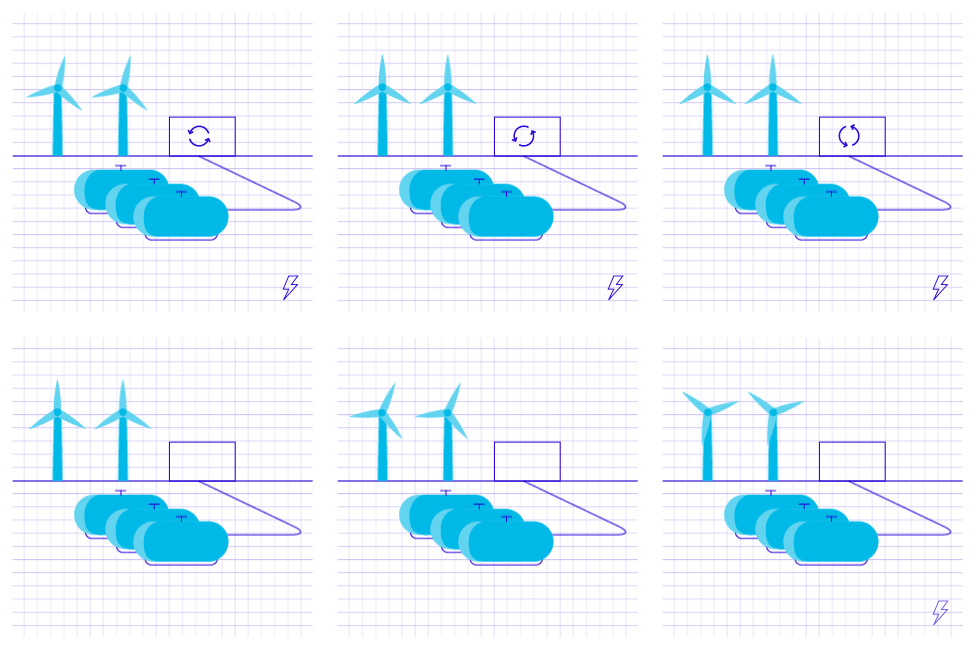
Compressed air storage sequesters a gas underground so it can be released later to drive a generation turbine whenever needed.

One project in Toronto sends the air underwater where it’s stored in balloons. When demand for power rises, the air comes back to the surface through a pipe, where it’s converted into electricity.

Compressed air storage requires a specific type of rock formation. The world has a handful of existing projects — one in Huntorf, Germany and another in McIntosh, Alabama. Several large scale projects have been put on ice, including the Iowa Stored Energy Plant near Des Moines and Dresser-Rand Group’s 317-megawatt Apex Bethel Energy Center in Anderson County, Texas.

Power-to-gas

Companies including carmaker Audi are developing power-to-gas technology that turns excess energy into hydrogen using electrolysis. The hydrogen can be directly injected into a gas network, or “upgraded” into methane and used as a substitute for natural gas.

Siemens, the world’s biggest power-equipment maker, is working on an approach that turns hydrogen into a clean ammonia, that could potentially provide emissions-free fertilizer that could be used by farmers everywhere.

Advocates say it can deliver both long and short-term back up power since the gas can be trapped indefinitely. That means it can shift electricity made in summer for use in the winter. It isn’t yet clear whether the economics will stack up.

Flywheels

Flywheels look nothing like a traditional battery. Think of a spinning drum that stores the kinetic energy in a way that can be made into electricity. Power is used to start the wheel turning. Then when electricity is in short supply, the flywheel turns a motor that generates electricity. They can deliver either short bursts or for longer periods.

Railway Technical Research Institute, a Tokyo-based developer of railroad technologies, is working on a flywheel that uses superconducting magnetic bearings that allow the wheel to spin with less friction. Its system also uses a plastic that’s reinforced with carbon fiber, making the flywheel stronger and faster. The bearings allow the flywheel to float without making contact with its housing, reducing energy lost through friction.

Railway Technical is developing the flywheel technology with Furukawa Electric Co. and Mirapro Co. They have set up a flywheel system at a 1-megawatt solar park in Japan’s Yamanashi prefecture. Temporal Power Ltd. and Beacon Power Corp. are also pursuing flywheel systems.

https://www.bloomberg.com/news/articles/2016-09-08/these-technologies-may-actually-deliver-elon-musk-s-dream-of-changing-the-world