Archiv der Kategorie: Einfachheit

Screenshots, die Teenager nicht mehr verstehen

1. Wenn Du cool warst, hast Du mit Netscape gesurft

Wenn Du cool warst, hast Du mit Netscape gesurft

2. So hast Du CDs gehört

So hast Du CDs gehört

Microsoft / Via guidebookgallery.org

3. Und Deine ersten MP3 Dateien mit Winamp

Und Deine ersten MP3 Dateien mit Winamp

4. Encarta war Dein Wikipedia

Encarta war Dein Wikipedia

poncheeto / Via reddit.com

5. Bei Solitaire konntest Du Dich nie für eine Kartenrückseite entscheiden

Bei Solitaire konntest Du Dich nie für eine Kartenrückseite entscheiden

Blinkle / Via reddit.com

6. Und Hearts hast Du eigentlich nie so richtig verstanden

Und Hearts hast Du eigentlich nie so richtig verstanden

Microsoft / Via compu-seite.de

7. Das war Dein liebster Windows 98 Hintergrund

Das war Dein liebster Windows 98 Hintergrund

Microsoft / Via imgur.com

Ouuuh! Man kann voll in meinen Computer reingucken!

8. Altavista war Dein Google

Altavista war Dein Google

9. Das Uh-Oh von ICQ wirst Du bis an Dein Lebensende im Ohr haben

Das Uh-Oh von ICQ wirst Du bis an Dein Lebensende im Ohr haben

Mail ru Group

10. Vor Photoshop hattest Du Paint

Vor Photoshop hattest Du Paint

Microsoft / Via designmeans.com

11. Und dann Kai’s Power Goo

Und dann Kai's Power Goo

MetaTools / Via amazon.de

12. Dein erstes Online-Verbrechen hast Du mit Napster begangen

Dein erstes Online-Verbrechen hast Du mit Napster begangen

Shawn Fanning, Sean Parker

13. So hast Du Pinball spielen gelernt

So hast Du Pinball spielen gelernt

14. Und Earthworm Jim hat Dir eine ganz neue Meinung zu Regenwürmer verschafft

Und Earthworm Jim hat Dir eine ganz neue Meinung zu Regenwürmer verschafft

Shiny Entertainment / Via youtube.com

Noch vor Worms!

15. “Keine Panik, ich hab noch 1 GB freien Speicher. Das reicht bis ans Ende der Welt!”

"Keine Panik, ich hab noch 1 GB freien Speicher. Das reicht bis ans Ende der Welt!"

Microsoft / Via sites.google.com

16. Minesweeper hast Du nach der ersten verlorenen Runde gleich immer wieder genervt ausgemacht

Minesweeper hast Du nach der ersten verlorenen Runde gleich immer wieder genervt ausgemacht

Microsoft

17. WinZip war Dein bester Freund, um Programme auf mehrere Disketten zu kopieren

WinZip war Dein bester Freund, um Programme auf mehrere Disketten zu kopieren

18. Die Windows 95 Bildschirmschoner waren 1995 dein erstes Whoa-Erlebnis

23 Screenshots, die Jugendliche von heute nicht mehr verstehen

19. Deine erste ernstzunehmende Spiel-Abhängigkeit hieß Moorhuhn

Deine erste ernstzunehmende Spiel-Abhängigkeit hieß Moorhuhn

phenomedia publishing

Auch wenn Du das nie zugeben würdest.

20. So bist Du ins Internet gegangen

So bist Du ins Internet gegangen

21. Myst war das Schwerste, das Du je gespielt hast

Myst war das Schwerste, das Du je gespielt hast

Cyan Worlds

Wie Monkey Island. Nur ohne Affen. Und ohne Humor.

22. Und You Don’t Know Jack das Lustigste

23 Screenshots, die Jugendliche von heute nicht mehr verstehen

23. Und: Du hast Computer noch wirklich richtig ausgeschaltet

Und: Du hast Computer noch wirklich richtig ausgeschaltet


Quelle: http://www.buzzfeed.com/philippjahner/arbeitsplatz


Iphone Killer: Your phone is ruining your life!

„Along the way, the Apple team landed upon the Watch’s raison d’être.

It came down to this: Your phone is ruining your life.

Like the rest of us, Ive, Lynch, Dye, and everyone at Apple are subject to the tyranny of the buzz—the constant checking, the long list of nagging notifications. “We’re so connected, kind of ever-presently, with technology now,” Lynch says. “People are carrying their phones with them and looking at the screen so much.”

They’ve glared down their noses at those who bury themselves in their phones at the dinner table and then absentmindedly thrust hands into their own pockets at every ding or buzz. “People want that level of engagement,” Lynch says. “But how do we provide it in a way that’s a little more human, a little more in the moment when you’re with somebody?” Our phones have become invasive. But what if you could engineer a reverse state of being?

What if you could make a device that you wouldn’t—couldn’t—use for hours at a time? What if you could create a device that could filter out all the bullshit and instead only serve you truly important information? You could change modern life. And so after three-plus decades of building devices that grab and hold our attention—the longer the better—Apple has decided that the way forward is to fight back.

Apple, in large part, created our problem. And it thinks it can fix it with a square slab of metal and a Milanese loop strap.

AppleWatch

“ Read more here: http://www.wired.com/2015/04/the-apple-watch/

Die Zukunft der Menschheit wird fantastisch

Wie werden wir in 100 Jahren leben? Diese Frage hat der Physiker Michio Kaku den 300 klügsten Köpfen aus Wissenschaft und Forschung gestellt. Die Antworten sind atemberaubend.

Schöne neue Welten: Zum Beispiel im All. In den siebziger Jahren des 20. Jahrhunderts machte man sich intensiv Gedanken über Kolonien im All als alternativem Lebensraum – zum Beispiel bei der Nasa. Die ließ auch gleich mal skizzieren, wie so etwas aussehen könnte. Hier: Eine „zylindrische“ Kolonie, entworfen von Rick Guidice.

Nein, die Welt wird nicht untergehen. Sie wird sich verändern. Dramatisch verändern. Auf Weltuntergangszenarien, die uns im warmen Wohnzimmer kalte Schauer über den Rücken laufen lassen, verzichtet Michio Kaku in seinem Buch „Die Physik der Zukunft“.

Im Gegenteil, der Star-Physiker und Bestsellerautor präsentiert sich als Optimist und glaubt fest daran, dass in 100 Jahren viel mehr Menschen viel besser leben als heute, und dass uns Wissenschaft und Forschung Wege in eine großartige, aufregende, wunderschöne Zukunft weisen können.

Warum sehen die meisten Menschen eher schwarz, wenn es um die Zukunft geht? Bücher über das Ende der Menschheit gibt es wie Sand am Meer. Die Katastrophe lauert an jeder Ecke. Das Klima, die Weltwirtschaft, Handystrahlen, Nanotechnik, das Internet – unser Ende scheint nah.

Das menschliche Gehirn ist ein Meister darin, lauernde Gefahren zu entdecken. In allen Ecken und Winkeln wird nach möglichen Bedrohungen gesucht. Mit diesem Erfolgsrezept der Evolution ist der Mensch sehr weit gekommen. Aber die Fähigkeit, auch gute Nachrichten wahrzunehmen, ist in unserer Spezies nicht sehr ausgeprägt.

Wie Forscher die Zukunft der Menschheit sehen

<br /><br />
Michio Kaku: Die Physik der Zukunft. Rowohlt-Verlag, 608 S.; 24,95 Euro<br /><br />

Foto: Rowohlt Michio Kaku: Die Physik der Zukunft. Rowohlt-Verlag, 608 S.; 24,95 Euro

<br /><br />
Der Autor Michio Kaku arbeitet und lehrt als Professor für theoretische Physik an der City University of New York<br /><br />

Foto: WireImage Der Autor Michio Kaku arbeitet und lehrt als Professor für theoretische Physik an der City University of New York

Für sein ausführliches Szenario auf fast 600 Seiten hat Michio Kaku 300 Forscher in aller Welt befragt, die in den Wissenschaftsgebieten der künstlichen Intelligenz, Raumfahrt, Medizin, Biologie und Nanotechnologie führend sind. Wie sehen sie unsere Zukunft? Wie wird die Welt in 100 Jahren aussehen? Die Antworten sind atemberaubend. Und Kaku ist mit seinem Optimismus nicht allein auf weiter Flur.

Die beiden Forscher und Autoren Peter H. Diamandis und Steven Kotler schreiben: „Zum ersten Mal in der Geschichte der Menschheit sind unsere Fähigkeiten heute so groß wie unsere Sehnsüchte und Wünsche. Der technische Fortschritt bietet uns die Möglichkeit, den Lebensstandard jedes Menschen auf der Erde deutlich zu verbessern.“

Ist das Science-Fiction? Ja. Aber im besten Sinne. Jede beschriebene technische Entwicklung ist mit den universell gültigen physikalischen Gesetzen vereinbar. Wir müssen für die folgenden Szenarien keine neue Physik erfinden. Keine neuen Naturkonstanten werden eingeführt, damit die Rechnung am Ende aufgeht und eine schwarze Zahl unter dem Strich steht.

Welche Vorhersagen eintraten

Kaku hat genau studiert, welche Vorhersagen vor 50, 70 und 100 Jahren gemacht wurden und welche davon eingetroffen sind. Dabei hat er festgestellt, dass immer die Forscher richtig lagen, die bereits bestehende Techniken in die Zukunft verlängert und weitergedacht haben. Immer nach dem Motto: Wo haben wir schon einen Schritt in die richtige Richtung gemacht?

Kaku scheut aber auch nicht davor zurück, immer wieder auf Science-Fiction-Serien wie „Raumschiff Enterprise“ hinzuweisen, deren Schöpfer offenbar häufig auf der richtigen Spur waren, wenn es um Voraussagen für die Zukunft ging. Können Sie sich an den sogenannten „Tricorder“ erinnern? Mit dem piepsenden Diagnosegerät hat „Pille“, der Schiffsarzt der „Enterprise“, berührungslos seine Patienten untersucht. In Zukunft werden wir über ein ähnliches Gerät verfügen, wenn die Forschung so weitermacht. Die gewaltigen Computertomografen werden auf die Größe von Smartphones zusammenschrumpfen und zum wichtigsten Utensil der Alltagsmedizin.

Willkommen an Bord der „Enterprise“. Machen wir uns auf die Reise in die Zukunft der Menschheit, die unsere Kinder wahrscheinlich noch erleben werden. Denn laut einer Voraussage der befragten Forscher wird der Mensch seine Lebenszeit in naher Zukunft dramatisch verlängern. Wunderbar, denn in der Welt der Zukunft sind die Aussichten einfach überwältigend.

Ist der Mensch der Zukunft unsterblich?

Zumindest werden wir das Altern in 100 Jahren erheblich verlangsamen können und die unbequemen Auswirkungen nicht mehr so drastisch spüren. Noch optimistischer ist Informatiker Gerald Sussman: „Ich fürchte, dass ich zur letzten Generation gehöre, die noch sterben muss.“ Aber wie kann das möglich sein? Helfen sollen die Wunder der Biotechnologie. Ein wichtiger Schlüssel für diese neuen Möglichkeiten der Medizin ist die Entschlüsselung der menschlichen DNA.

Der Physiker Francis Crick und der Genetiker James Watson lasen im Jahr 1953 als erste Forscher den Code der DNA als Abfolge von Nukleinsäuren. Das Buch des Lebens war aufgeschlagen. Seitdem ging es rasend schnell, und es wird nicht mehr lange dauern, bis jeder Mensch das Buch seines eigenen Lebens auf einer DVD mit sich herumtragen kann.

Bereits um das Jahr 2050 kann es dann möglich sein, den eigenen Alterungsprozess aktiv zu steuern. Defekte Gene werden schneller repariert und so das Leben der Zellen verlängert. Helfen kann dabei eine Reduzierung der Kalorienzufuhr, ohne die Nachteile wie Hunger und Lethargie in Kauf zu nehmen. Um unsere Jugend in Zukunft länger zu erhalten, sind fünf Punkte wichtig, an denen derzeit intensiv geforscht wird:

1. Die Züchtung gesunder Organe, die erkrankte Organe ersetzen können.

2. Die Anregung des Selbstheilungsprozesses von erkrankten Zellen.

3. Die gezielte Aktivierung von Genen, die den Alterungsprozess verlangsamen.

4. Ein gesünderer Lebenswandel.

5. Die frühe Erkennung von Krebs.

Doch die eigene Natur steht dem Menschen auf dem Weg zur Unsterblichkeit im Wege. Denn dass der Mensch im Laufe der Evolution immer sterblich geblieben ist, hat seinen Grund. Entwicklungsgeschichtlich ist der Tod für die Gemeinschaft von Vorteil. Denn nach ihren fruchtbaren Jahren werden Tiere irgendwann zur Belastung für die Herde. Sie sterben – und verbessern so die Chancen der eigenen Nachkommen zu überleben. Doch eine Neuprogrammierung dieser evolutionären Gegebenheiten und eine dramatische Steigerung der Lebenserwartung scheinen möglich.

Ist das ewige Leben überhaupt wünschenswert?

Wird unsere Erde nicht unter der Last der Menschen zusammenbrechen? Die Forscher haben einige Gegenargumente für dieses populäre Untergangsszenario gefunden: Wahrscheinlich werden die Menschen der Zukunft viel weniger Kinder bekommen. Das ist heute schon in Europa und Japan der Fall. „Das stärkste Verhütungsmittel der Welt ist der Wohlstand“, schreibt Kaku und schätzt, dass die Weltbevölkerung nicht ewig rasant weiter wachsen wird, sondern sich im Jahr 2100 auf dem Niveau von etwa elf Milliarden Menschen stabilisieren wird.

Derzeit leben etwa sieben Milliarden Menschen auf der Erde. Auch Bill Gates, Mitbegründer von Microsoft, ist dieser Meinung: „Das Beste, was man tun kann, um das Bevölkerungswachstum zu bremsen, ist, den Gesundheitszustand der betreffenden Menschen zu verbessern. Da, wo die Leute gesünder werden, bekommen sie innerhalb einer halben Generation auch weniger Kinder.“

Die Ernährung der vielen Menschen könnte ebenfalls gesichert sein, wenn wir in Zukunft bereit wären, gentechnisch veränderte Lebensmittel zu akzeptieren. Derzeit wird über die Gentechnik in Lebensmitteln noch erbittert gestritten und aus einer vielversprechenden Technik eine Weltanschauungsfrage gemacht.

Gentechnisch veränderte Lebensmittel

Wahrscheinlich wird sich die Gentechnik am Ende trotzdem durchsetzen. Genauer gesagt, sie hat sich schon durchgesetzt. Genetisch modifizierte Organismen sind die am schnellsten wachsende neue Technologie in der Landwirtschaft. Auf 38 Prozent aller Landflächen der Erde werden derzeit Lebensmittel angebaut. In den 60er-Jahren hätten wir für dieselbe Menge Nahrung noch 80 Prozent der Erdfläche gebraucht. Wir lernen dazu. Und das immer schneller.

Ein Professor für Gesundheitswesen an der Columbia University in New York hat noch eine Lösung für Ernährungsprobleme parat: vertikale Farmen in Form von Wolkenkratzern. Die Studenten von Dickson Despommier haben ausgerechnet, dass 150 vertikale Farmen, die als Hydrokulturen betrieben werden, ausreichten, um New York City mit Nahrung zu versorgen. Parabolspiegel versorgen die Pflanzen mit Sonnenlicht, nachts übernehmen Wärmelampen.

Fast drei Viertel des Endpreises von Nahrungsmitteln entstehen durch Lagerung, Transport und Versand. Der Kopfsalat aus vertikalen Farmen könnte sich seine Reisekosten sparen. In Japan werden bereits „Pflanzenfabriken“ betrieben, in denen die Angestellten bis zu 20 Mal im Jahr Salat ernten. Auch in Schweden, China und Singapur wird an solchen Anbaubetriebe gearbeitet.

Jeder Tag beginnt mit einem Gesundheitscheck

Ein ganz normaler Tag in der Zukunft beginnt mit einem automatischen Gesundheitscheck: Schon beim Zähneputzen im Bad wird der menschliche Körper von Sensoren gescannt. Vielleicht direkt vom Hightech-Badezimmerspiegel. Besonders das Gen p53 wird dabei genau unter die Lupe genommen. Denn fast an der Hälfte aller häufigen Krebsarten ist eine Mutation an diesem Gen beteiligt. Sollte es Hinweise auf Krebs geben, werden sofort Nanopartikel in den Körper injiziert, die die Krebszellen direkt ausschalten.

Nach der Morgentoilette erhalten Sie in Zukunft direkt detaillierte Informationen über ihren Gesundheitszustand. Sollte ein Organ erkrankt sein, wird direkt ein neues bestellt, gezüchtet aus Ihren eigenen Zellen. Der Mediziner ist ein intelligentes Computerprogramm, das jede Krankheit diagnostizieren kann. Besser als jeder Arzt aus Fleisch und Blut. Wenn Sie wollen, können Sie jederzeit direkt mit ihm sprechen. Er wird einfach als Hologramm in Ihre Wohnung projiziert. Nur bei unerklärlichen Phänomenen wird ein „echter“ Arzt direkt mit seinem Patienten kommunizieren. „Direkt“ heißt in diesem Fall: per Videotelefon.

Für die perfekte medizinische Versorgung der Zukunft wird die Stammzellenforschung besonders wichtig sein. Denn Stammzellen haben die Fähigkeit, sich in jeden Zelltyp des menschlichen Körpers zu verwandeln. Sehr viele Krankheiten werden durch ihren Einsatz heilbar. Auch so komplizierte Krankheitsbilder wie Krebs im frühen Stadium und Rückenmarksverletzungen.

Forscher lassen Fingerspitzen nachwachsen

Stephen Badylak von der University of Pittsburgh ist es gelungen, mit der Hilfe von Stammzellen Fingerspitzen nachwachsen zu lassen, die abgeschnitten waren. Ein Zentimeter Gewebe und der Fingernagel konnten bereits regeneriert werden. Sein nächstes Ziel ist es, ein ganzes menschliches Glied nachwachsen zu lassen. Er hat sich lange und intensiv mit Eidechsen beschäftigt, bei denen ein verlorener Schwanz nachwächst.

Anthony Atala ist Gewebeforscher an der Wake Forest University und schon einen Schritt weiter: „Die Zahl der Patienten, die auf der Warteliste für Organtransplantation stehen, hat sich in den vergangenen zehn Jahren verdoppelt. Die Anzahl der Transplantationen blieb gleich. Wir konnten bisher bereits menschliche Ohren, Finger, Harnröhren und Herzklappen im Labor züchten.“ Sein nächstes Projekt ist das Züchten einer Niere. Sie ist eines der kompliziertesten menschlichen Organe. Er hofft dabei auf eine Technik, die gerade dramatische Vorschritte macht: das 3-D-Druckverfahren.

Es ist ein alter Menschheitstraum, alle Krankheiten und das Alter zu besiegen. So ganz und endgültig wird das wahrscheinlich nie gelingen. Dafür ist der Gegner zu schlau und mächtig. Wir leben in einem Meer von Bakterien und Viren, die sich rasend schnell verändern. Und auf diese Veränderungen müssen wir uns immer wieder einstellen. Bis heute haben wir es trotz großer Bemühungen noch nicht einmal geschafft, das Rhinovirus zu besiegen. Der Schnupfen wird uns wohl für alle Zeiten verfolgen.

Die Zukunft der Energie

Fossile Brennstoffe gehen zu Ende. Irgendwann. Das steht fest. Viele Weltuntergangsszenarien haben mit diesem misslichen Umstand zu tun. Auch wenn gerade in den USA sehr erfolgreich neue Methoden zum Abbau immer neuer Reserven angewendet werden. Aber trotzdem sind die Aussichten nicht so schlecht, wie manche vermuten. Denn es gibt Alternativen. „Das Steinzeitalter endete nicht, weil es keine Steine mehr gab. Und das Ölzeitalter wird enden, lange bevor der Welt das Öl ausgeht“, sagt James Canton, Leiter der in San Francisco ansässigen Denkfabrik Institute for Global Futures.

Aber wo versteckt sich diese Energie der Zukunft? Am Himmel! In den Sternen! In diesem Jahrhundert werden wir die Energie der Sterne anzapfen, schreibt Kaku, also die der Sonne zum Beispiel. Eine andere Hoffnung ist drastische Energieeinsparung. Durch Magnetismus etwa werden Autos, Züge und Skateboards in Zukunft reibungslos durch die Luft gleiten. Der Energieverbrauch würde drastisch sinken.

Der Verbrauch von fossilen Brennstoffen verändert gerade unser Klima. Über das Ausmaß und die Gefährlichkeit streiten die Experten. Die Gefahren sieht auch Kaku, weil diese Methode der Energiegewinnung derzeit immer noch die günstigste ist. Besonders tief gelegene Gebiete wie das Mekongdelta in Vietnam, das Gangesdelta in Bangladesch oder das Nildelta sind durch den Anstieg des Meerwasserspiegels gefährdet. Doch Kaku sieht auch hier einen Ausweg: Mitte des Jahrhunderts sollten wir dank einer Kombination aus Kernfusion, Sonnenenergie und erneuerbaren Energien die Erwärmung stoppen können.

Umweltfreudliche Kernfusion wird ab 2030 Wirklichkeit

Die Energie, die bei einer Kernfusion frei wird, ist gewaltig – und nicht zu verwechseln mit der Kernspaltung, die wir in Deutschland gerade abgeschafft haben. Der Treibstoff für die Fusion ist Wasser. Ein Viertelliter davon enthält genauso viel Energie wie 500.000 Barrel Petroleum. Durch Kernfusion wird das gesamte Universum mit Energie versorgt. Wasserstoffgas wird unter gewaltigem Druck erhitzt, bis die Atomkerne miteinander verschmelzen. Diese Naturgewalt lässt auch die Sterne strahlen.

Bis heute ist es immer nur bei der Ankündigung dieser sagenhaften Technik geblieben. Kaku geht davon aus, dass im Jahr 2030 endlich die Zeit dafür gekommen ist. Fusionsreaktoren werden entstehen, die umweltfreundlich betrieben werden können, weil kaum Abfall entsteht und es nicht die Gefahr einer Kernschmelze gibt. „Wir wissen inzwischen, dass eine Fusion funktioniert. Die Frage ist nur, ob sie sich rechnet“, sagt David E. Baldwin von General Atomics, der einen der größten Reaktoren beaufsichtigt. Doch das scheint nur eine Frage der Zeit zu sein.

Forscher des Deutschen Luft- und Raumfahrtzentrums haben ausgerechnet, dass der Energieverbrauch der Welt für alle Zeiten gedeckt wäre, wenn wir es schaffen würden, die Energie der Sonnenstrahlung anzuzapfen, die die Wüste in Nordafrika jeden Tag abbekommt. Afrika wäre auf einen Schlag größter Energieexporteur der Welt. Die Leistung von Fotovoltaik-Anlagen, die aus Sonne Strom machen können, nimmt immer schneller zu. Die Kosten sinken durch bessere Herstellungstechniken.

Vielleicht haben Sie keine Lust, Ihr Hausdach mit hässlichen Sonnenkollektoren zu verschandeln. Dann gibt es wahrscheinlich schon bald eine Lösung. „Statt dass Sie Ihr ganzes Dach zur Fotovoltaik-Zelle umbauen müssen, genügen in Zukunft kleine Antennen, die die Photonen anziehen“, sagt Dr. Michael Strand, Leiter eines Forschungsteams. Vielleicht werden aus unseren Fenstern und Hauswänden Sonnenkollektoren, die auch aus künstlichem Licht Strom machen können.

Magnetautos gleiten widerstandslos über den Boden

In fernerer Zukunft liegt das Zeitalter des Magnetismus. Der größte Teil unserer Energie wird heute lediglich dazu verwendet, Reibungskräfte zu überwinden. Reibung zwischen Straßenbelag und Rädern, zwischen Karosserie und Luft. Bei Magnetautos wäre das anders. Einmal angeschoben, gleiten sie widerstandslos über den Boden, wenn auch der Luftwiderstand bleibt.

Lösungen für diese Technik liefert die Supraleitung. Die Kosten dafür sinken gerade rasant, und man muss die Umgebung nicht mehr so stark kühlen wie noch vor ein paar Jahren. Mit Supraleitungen könnten wir sehr starke, permanente Magnetfelder erzeugen. Im Labor kann man damit bereits Gegenstände zum Schweben bringen. Auf Youtube gibt es hübsche Videos zu diesem Thema. Bis zum „Hoverboard“ aus dem Film „Zurück in die Zukunft“, einem Skateboard, das scheinbar schwerelos durch die Luft gleitet, ist es also nicht mehr so weit, wie wir annehmen.

Zum Ende des Jahrhunderts könnte unsere Energie schließlich aus dem All kommen. Satelliten sollen in der Umlaufbahn die Sonnenstrahlung auffangen, bündeln und dann auf die Erde schicken. Schon jetzt spricht technisch nichts gegen diese Technik. Nur die hohen Kosten, um Satelliten in die Umlaufbahn zu bringen.

„Die Solarenergieproduktion im Weltraum könnte eine wichtige alternative Energiequelle sein, wenn fossile Brennstoffe verschwinden“, meint Kensuke Kanekiyo vom Institut für Energiewirtschaft, das im Auftrag der japanischen Regierung forscht. Für diese Pläne braucht es allerdings eine neue Generation von wirtschaftlichen Trägerraketen, die die Kosten senken.

Der Mensch ist in Zukunft also nicht auf fossile Brennstoffe angewiesen. Die größte Energiequelle leuchtet jede Nacht am Sternenhimmel über uns. Wir müssen nur noch lernen, sie anzuzapfen.

Die Zukunft der Roboter und Computer

Das Tempo der modernen Welt wird vom Tempo der Computer bestimmt. Und deren Geschwindigkeit nimmt stetig zu. Die Rechenkapazität von Computern verdoppelt sich etwa alle 18 Monate. Computerspielkonsolen besitzen heute mehr Rechenleistung als die Großrechner in vergangenen Jahrzehnten.

Ein Smartphone verfügt über mehr Leistung als die Nasa im Jahr der Mondlandung 1969. In Zukunft werden wir von Computern umzingelt sein. Sie sehen allerdings anders aus oder sind überhaupt nicht mehr als Computer zu erkennen. In jedem Gegenstand, jeder Wand, jeder Tapete, in allem, was uns umgibt wird sich ein rechnender Chip befinden, der mit dem Internet verbunden ist.

Unsere Umgebung wird intelligent. Ein Raum wird bemerken, wenn Sie ihn betreten, und er wird dafür sorgen, dass an den richtigen Stellen das Licht angeht und eine vernünftige Temperatur herrscht. Computer gehen in unserer Umgebung auf und werden unsichtbar und lautlos unsere Befehle ausführen, weil wir sie mit unseren Gedanken steuern.

Auch Autos werden intelligent. Sie fahren, vom Computer gelenkt, ohne Lenkrad und Fahrer zu ihrem Ziel. Die Insassen können sich entspannen, sich unterhalten oder einen Film schauen. Unfälle und Staus gehören der Vergangenheit an. GPS-Systeme und Radar sorgen für freie Fahrt und lenken sicherer durch den Verkehr der Zukunft, als es ein Mensch jemals könnte.

Das Telefon wird durch Telepräsenz ersetzt

Unsere Gesprächspartner erscheinen als 3-D-Hologramme, die mit uns an einem Tisch oder auf dem Sofa sitzen. Zum Glück gibt es einen Universalübersetzer, der dafür sorgt, dass Sie sich mit Menschen aus aller Welt unterhalten können.

Am Ende dieser rasanten Entwicklung wird der menschliche Geist in der Lage sein, Objekte in der Umgebung zu beherrschen, und der Computer wird in jeder Millisekunde unsere Wünsche lesen können – noch bevor sie uns bewusst werden. Wir erschaffen uns in jedem Moment unseres Lebens eine individuelle Umwelt. Eine Mischung aus virtueller und realer Welt. Objekte tragen neben einem Chip einen winzigen Supraleiter in sich, der magnetische Pulse erzeugt. Dadurch lassen sich Dinge allein mit der Kraft unserer Gedanken durch den Raum bewegen. Auch Roboter und Avatare.

Die Intelligenz von Robotern und Maschinen nimmt stetig zu. Eine menschliche Gestalt werden sie wohl nicht annehmen. Ihre Form verändert sich je nach Aufgabe, weil sie aus Modulen bestehen, die sich in immer neuen Formen zusammensetzen. So können sie verschiedenste Aufgaben für die Menschen erledigen. Sie reparieren die Infrastruktur der Städte. Rohrsysteme, Leitungen, Straßen und Brücken. Sie werden als Chirurg, Koch oder Musiker eingesetzt. Überall, wo größte Präzision gefragt ist. In Japan gibt es jetzt schon einen Roboterkoch, der Fast-Food-Gerichte zubereiten kann, und einen Roboter, der sehr gut Flöte spielt.

Simulation des menschlichen Gehirns

Das menschliche Gehirn ist im Gegensatz zum Computer unendlich langsam. Aber es kann Dinge, die dem Computern schwerfallen: Es behandelt viele Probleme gleichzeitig, es kann sehr schnell Muster erkennen, und es lernt ununterbrochen. Trotzdem sind die führenden Forscher auf diesem Gebiet sicher, dass Mitte des Jahrhunderts genügend Rechenleistung zur Verfügung steht, um das menschliche Gehirn zu simulieren. Bis jetzt haben wir allerdings noch nicht einmal vollständig verstanden, wie der Mensch denkt. Wir wissen nicht, wie ein Wurm funktioniert, obwohl die Lage sämtlicher Neuronen in seinem Nervensystem kartografiert ist.

Auch auf die Frage, wann Computer eine Art Bewusstsein entwickeln könnten, gibt es keine Antwort oder Vorhersage. Bis jetzt ist noch nicht einmal geklärt, was Bewusstsein eigentlich ist. Ein paar Dinge gehören wohl dazu: detailliertes Wahrnehmen der Umwelt, Selbstwahrnehmung, lautlos mit sich selber sprechen, Interaktion und vorausschauendes Handeln. In diesen Disziplinen sind Computer bis heute eher schlecht.

Ist es trotzdem denkbar, dass wir gerade an unserem Nachfolger in der Evolutionskette basteln? Werden uns die Computer überflügeln und irgendwann intelligenter als der Mensch sein? Wird am Ende die Erde zu einem gigantischen Supercomputer, weil die Maschinen die Macht übernehmen? Es gibt Forscher, die sich so ein Szenario ernsthaft vorstellen können. Danach werden unsere Computer am Ende ins All hinausziehen und andere Planeten, Sterne und Galaxien in Supercomputer verwandeln.

Computer, weit über menschlicher Leistungsfähigkeit

Prominenter Vertreter dieser eher abstrakt erscheinenden Idee ist der bekannte Unternehmer, Erfinder und Bestseller-Autor Ray Kurzweil. Ein Mann, der nicht gerade als Spinner gilt und quasi nebenbei den Synthesizer erfunden hat. Kurzweil meint, dass bereits im Jahr 2045 intelligente Computer sich selbst reproduzieren und die menschliche Leistungsfähigkeit weit übertreffen werden.

Mit ihrem unstillbaren Appetit nach immer mehr Energie verschlingen sie irgendwann alles und beeinflussen die Geschichte des Universums. Er nennt das „Singularität“. Inzwischen wurde eine Universität im kalifornischen Silicon Valley gegründet, die sich mit genau dieser Frage auseinandersetzt.

Eine andere Denkrichtung geht davon aus, dass der Mensch mit der Maschine verschmelzen wird. Unser Gehirn verbessert durch eine zusätzliche Schicht von Neuronen seine Leistungsfähigkeit. Ein erster matter Abglanz dieser Technik ist eine Brille, die uns Daten, Zahlen, den richtigen Weg und eine Gesichtserkennung direkt auf die Netzhaut projizieren kann. Dazu kommen elektronische Bauteile, die dem menschlichen Körper übernatürliche Fähigkeiten verleihen.

Vielleicht entledigen wir uns irgendwann komplett unserer plumpen Körper, und der menschliche Geist wird zu einem Computerprogramm, das man auf verschiedene Maschinen herunterladen kann.

Die Zukunft der Dinge

Was unterscheidet den Menschen von den meisten Tieren? Unter anderem, dass der Mensch alle Arten von Werkzeugen benutzt. Durch Pfeil und Bogen, später die Beherrschung von Schusswaffen, konnten immer mehr Menschen mit Nahrung versorgt werden. Die Hütten aus Lehm und Stroh wurden mit der Metall-Herstellung von größeren, solideren Gebäuden abgelöst.

Bereits jetzt steht uns das mächtigste Werkzeug zur Verfügung, das Menschen jemals besessen haben. Wir sind in der Lage, einzelne Atome, also den Grundbaustoff aller Dinge, die uns umgeben, zu manipulieren. So ist heute etwa die Produktion von Materialien denkbar, von denen wir bisher nur geträumt haben: Sie werden immer leichter, stärker, können mit neuen elektrischen und magnetischen Eigenschaften ausgestattet werden.

Per Rasterelektronenmikroskop lassen sich einzelne Atome beobachten und manipulieren. Noch vor wenigen Jahren erschien es ausgeschlossen, jemals ein Atom beobachten zu können. Jetzt können wir sogar mit ihnen spielen. Bei IBM in San Jose basteln Wissenschaftler aus einzelnen Atomen primitive Maschinen. Mit einer mikroskopischen Pinzette ist es möglich, ein einzelnes Atom an eine andere Stelle zu bewegen und zum Beispiel den Schriftzug IBM zu bauen.

Nanotechnologie eröffnet fantastische Möglichkeiten

Auch die US-Regierung glaubt an die Nanotechnologie in fast allen Bereichen der Wirtschaft und hat im Jahr 2009 1,5 Milliarden Dollar für die Forschung zur Verfügung gestellt. Wenn man Kaku folgt, hat sie gute Gründe dafür: „Mithilfe der Nanotechnologie ließe sich vielleicht bis Ende des Jahrhunderts eine Maschine bauen, die alles aus fast nichts schaffen kann.“

In der Medizin gäbe es für Nanogeräte sicherlich sinnvollere Einsatzgebiete. Moleküle, die aus Nanopartikeln bestehen, könnten Antikrebsmedikamente im menschlichen Körper an den Einsatzort bringen. So ließen sich die Nebenwirkungen der Chemotherapie, die auch gesunde Zellen angreift, eingrenzen. Nanopartikel würden von normalen Blutzellen abprallen und nicht in sie eindringen, weil sie zu groß dafür sind. Krebszellen weisen große, unregelmäßige Poren auf. Eine perfekte Angriffsfläche. Dort würden die Partikel gezielt die Wirkstoffe freisetzen.

Eine weitere medizinische Einsatzvariante ist das sogenannte „Nanoauto“, an dem jetzt schon geforscht wird. Ziel ist es, die Chirurgie komplett abzuschaffen. Reparaturarbeiten werden durch diese Nanoautos direkt im menschlichen Körper erledigt. Sie werden von Magneten durch unseren Blutstrom direkt zum erkrankten Organ gelenkt und führen hier operative Eingriffe aus.

Forscher bei Intel arbeiten daran, die Gestalt der Dinge auf Knopfdruck zu verändern. Computerchips in der Größe eines Sandkorns richten sich durch elektrische Ladungen aus und nehmen so unterschiedlichste Gestalt an. Wenn Ihnen ihr Handy zu groß für ihre Jackentasche ist, verkleinert es sich. Oder es entfaltet sich zu einem Bildschirm, auf dem Sie einen Film anschauen können. Schon jetzt denken Autodesigner darüber nach, wie man aus einem familienfreundlichen Kombi per Schalter ein Sportcoupé für das Wochenende machen kann.

Eine Software verändert die Gestalt von Möbel

Am Ende dieser Entwicklung steht die programmierbare Materie. Software bestimmt die Gestalt der Dinge. Unsere Umgebung wird die gewünschte Form annehmen, bevor wir darüber nachdenken, weil ein Computer unsere Gedanken liest und die Ausrichtung der Materie bestimmt. Wenn ein Möbelstück nicht mehr gefällt oder die Waschmaschine nicht mehr funktioniert, laden Sie eine neue Software herunter, die die Materie zu einem neuen, besseren Gerät programmiert. Kaku glaubt, dass man in Zukunft sogar ganze Häuser und Städte auf Knopfdruck entstehen lassen kann. Man muss nur noch die Lage festlegen und die Fundamente vorbereiten.

Besonders mutige Forscher halten es für möglich, dass Ende des Jahrhunderts eine universelle Maschine entsteht, die sie „Replikator“ genannt haben. Der „Replikator“ setzt alle denkbaren Produkte aus einzelnen Atomen und Molekülen zusammen. Dazu braucht es Nanoroboter, die sich selber reproduzieren können.

Klingt unglaublich, kommt aber in der Natur vor. Die Darmbakterien des Menschen reproduzieren sich in nerhalb von zehn Stunden selbst. Die Nanoroboter müssen dann Moleküle identifizieren und an bestimmten Stellen platzieren. Und dafür ordnen sie eine astronomische Anzahl von Atomen nach einem Masterplan neu an. Diese Nanobots sind derzeit noch nicht in Sichtweite.

Und es gibt natürlich Forscher, die energisch bestreiten, dass es diese Universalmaschinen jemals geben kann. Aber denken Sie an die Kraft des exponentiellen Wachstums. Und die mächtige Idee, dass wir in Zukunft alle Materie per Gedankenkraft beherrschen, wird dafür sorgen, dass wir vielleicht viel schneller eine Art „Replikator“ entwickeln können, als wir heute glauben.

Die Zukunft der Menschheit

Wohin gehen wir? Was ist das Ziel dieser Entwicklungen? Kaku ist sich sicher: All diese technischen Neuerungen führen die Menschheit auf den Weg in eine planetarische Zivilisation. Das heißt, dass wir auf unserem Planeten zusammenrücken. Wir werden uns ähnlicher. Wohlstand wird gleichmäßiger verteilt sein, Ländergrenzen lösen sich langsam auf.

Das Internet ist ein mächtiger Beschleuniger dieser Entwicklung zu einer planetaren Zivilisation. Wir können uns zum ersten Mal in der Geschichte der Menschheit in Echtzeit rund um den Erdball austauschen. Per Twitter unterhält man sich über alle Grenzen hinweg in jeder Sekunde. Ideen werden per Link in Lichtgeschwindigkeit ausgetauscht, verbessert und umgesetzt. Als planetare Sprachen nutzen wir jetzt schon Englisch und Chinesisch.

In der Wirtschaft sprechen wir von der Globalisierung – leider häufig nur im negativen Sinn. Kein Land kann es sich mehr erlauben, seine Wirtschaft isoliert zu betrachten und zu betreiben. Innerhalb einer Generation ist ein planetares Wirtschaftssystem entstanden. Rund um den Erdball wächst eine internationale Mittelschicht.

Auch die Menschen in China, Indien wollen so leben, wie sie es in vielen Filmen gesehen haben. Mit Doppelgarage, einer heißen Dusche, Flachbildfernseher im gemütlichen Wohnzimmer und Coffee to go auf dem Weg zur Arbeit. Ihr Ziel ist der Wohlstand, den wir in weiten Teilen Europas und Amerikas schon erreicht haben. Und sie sind auf einem guten Weg, dieses Ziel zu erreichen. Andere Länder werden folgen.

Die Kultur ist heute schon global. Junge Leute in Moskau, Berlin, New York und Tokio hören die gleiche Musik, kleiden sich ähnlich, konsumieren das gleiche Essen und sehen die gleichen Filme. Nachrichten, Sportereignisse, Umweltprobleme, Tourismus und Krankheiten sind längst globale Erscheinungen.

Am Ende könnte eine Weltregierung herrschen

Kriegführung wird immer schwieriger. Die Menschen haben heute mehr zu verlieren, die Familien sind kleiner und Nationalstaaten werden schwächer. Die Macht verlagert sich weg von National- und hin zu Zentralregierungen. In Europa ist diese Entwicklung in vollem Gange. Und wie man sieht, ist das kein einfacher Schritt. Aber gemeinsame Währung, Sprache und Kultur machen ihn unausweichlich. Am Ende dieser gesellschaftlichen Evolution kann schließlich so etwas wie eine Weltregierung stehen. Auch wenn Terroristen, religiöse Fundamentalisten oder Diktatoren etwas dagegen haben.

Diese Entfaltung kann sich sogar noch beschleunigen, wenn wir im All auf intelligentes Leben stoßen. Und dafür gibt es einige Hinweise. Kaku geht davon aus, dass wir noch in diesem Jahrhundert auf Grund der rasanten technischen Entwicklung eine fortgeschrittene Zivilisation im All entdecken. Eine direkte Kommunikation wäre wegen der gigantischen Entfernung allerdings unmöglich. Dafür ist dann auch die Kriegsführung nicht ganz einfach. Wieder keine Chance für Weltuntergangspropheten.

Unsere Zivilisation lässt sich sehr gut anhand des Energieverbrauchs beschreiben. Der Mensch lebte Jahrtausende durch die Kraft seiner zwei Hände. Es war die meiste Zeit der Menschheit ein kurzes und brutales Leben. Das Ende der Eiszeit vor 10.000 Jahren ermöglichte endlich die Landwirtschaft mit Rindern und Pferden. Dadurch gab es genug Energie für die Ernährung von mehr Menschen und die Gründung von Dörfern und Städten. Vor 300 Jahren erlebte der Mensch die industrielle Revolution. Maschinen lieferten noch mehr Energie. Zukünftige Generationen werden die Energie der Sonne, der Sterne und schließlich der gesamten Galaxie nutzen.

Internet als größter Wissensspeicher aller Zeiten

Heute entstehen Reichtum und Wohlstand aus Information. Davon gibt es derzeit mehr, als wir verarbeiten können. Schon bald wird der Speicherplatz nicht mehr ausreichen, um all die Daten zu verarbeiten, die wir in nie da gewesener Menge weltweit produzieren. Der Zugang zum Internet ist mittlerweile für fast jeden erschwinglich. In Afrika wächst die Flächenabdeckung von drahtlosen Netzen exponentiell. Noch in diesem Jahr werden 70 Prozent der Fläche versorgt sein.

Und bis Ende des Jahres ist der größte Teil der Menschheit an das Internet angeschlossen und damit an das universelle Kommunikationsnetz und den größten Wissensspeicher aller Zeiten. Diese Vernetzung kann ein Schlüssel für all die Entwicklungen sein, die Kaku in seinem Buch nachzeichnet. Eines lässt sich allerdings nicht technisch herstellen: menschliche Vernunft. Die müssen die Menschen zum Gelingen einer besseren Zukunft selbst beitragen.

Was meinen Sie? Glauben Sie, dass aus den Szenarien des Michio Kaku irgendwann Wirklichkeit wird? Wird alles genau so eintreffen, wie er es in seinen Büchern entworfen hat? Vielleicht ist das im Detail gar nicht so entscheidend. Der Autor und Wissenschaftler zeigt uns verschiedene Wege in die Zukunft auf, die die Menschheit zur Abwechslung mal nicht unwillkürlich in die Katastrophe führen müssen. Damit trifft er allerdings auf eine Gesellschaft, in der es in vielen Milieus zum guten Ton gehört, sich eher technik- und fortschrittskritisch zu geben. Wenn in Deutschland drei Minuten über das Internet diskutiert wird, ist man leider häufig schon beim Datenschutz oder Facebook-Mobbing angelangt.

Eine sachliche Gesprächsrunde über Vorteile der Gentechnik bei der Produktion von Lebensmitteln scheint in Deutschland ausgeschlossen. Kürzlich vermeldete die saarländische Landesregierung den Beitritt des Landes zum „Europäischen Netzwerk gentechnikfreier Regionen“. Die Landesregierung will gemeinsam mit anderen „eine Strategie entwickeln, damit das Saarland auch in Zukunft eine gentechnikfreie Anbauregion bleibt“.

Auch die Länder Thüringen, Nordrhein-Westfalen, Schleswig-Holstein und Baden-Württemberg haben sich dem Netzwerk angeschlossen. Ist das noch begründete Vorsicht oder schon Technologiefeindlichkeit? Eine Entscheidung gegen Gentechnik bedeutet auch, dass man unausgesprochen die Verknappung von Lebensmitteln hinnimmt. Das wird in dieser sehr emotional geführten Diskussion gern verschwiegen.

Nahrung gibt es offenbar genug – zumindest in Deutschland. Aber viele deutsche Wissenschaftsinstitutionen wie die Deutsche Forschungsgemeinschaft oder die Fraunhofer-Gesellschaft haben sich mehrfach und nachdrücklich für die Nutzung von Gentechnik ausgesprochen. Bisher gibt es keine bessere Lösung, um die Erde mit ihren vielen Menschen zu ernähren.

Kaku ist nicht nur Wissenschaftler. Er ist auch ein trickreicher Sachbuchautor. Er hat ein paar ziemlich gute Aussichten für uns parat, und das verkauft sich ziemlich gut. Für viele Zeitgenossen mag das vielleicht der eine oder andere Löffel Optimismus zu viel sein. Aber er versammelt in seinem Buch „Die Physik der Zukunft“ ein paar sehr gute Gründe für seine zuversichtliche Grundhaltung.

Es tut gut, einem Wissenschaftler zuzuhören, der fest davon überzeugt ist, dass der Mensch mit seinem Instrumentarium in der Lage ist, die übermenschlichen Probleme zu lösen. Wir Menschen haben nichts anderes als unser Gehirn, unsere Vernunft und die Wissenschaft. Aber das ist schon eine ganze Menge.

Schwimmende Städte
zgbdc5-66voci3mtig5blo81eg_original.jpg

Das Seasteading Institut hat 2009 zu einem Wettbewerb aufgerufen, in dem die schwimmende Stadt der Zukunft entworfen werden sollte.

Foto: The Seasteading Institute

Quelle: http://www.welt.de/wissenschaft/article112447946/Die-Zukunft-der-Menschheit-wird-fantastisch.html

Preisdiskrimierung, Big Data und objektiv richtige Preise einer Ware aufgrund persönlicher Werteinschätzung

Amazon Echo schlägt Wellen

Netzwerklautsprecher mit integriertem Personal Assistant

Original: http://www.heise.de/newsticker/meldung/Amazon-Echo-Netzwerklautsprecher-mit-integriertem-Personal-Assistant-2443970.html?hg=1&hgi=3&hgf=false

Bild: Amazon.com


Amazon hat überraschend „Echo“ vorgestellt, einen Netzwerklautsprecher, der nicht nur Musik abspielt, sondern permanent lauscht und auf Zuruf Fragen beantwortet, die Todo-Liste ergänzt und mehr.

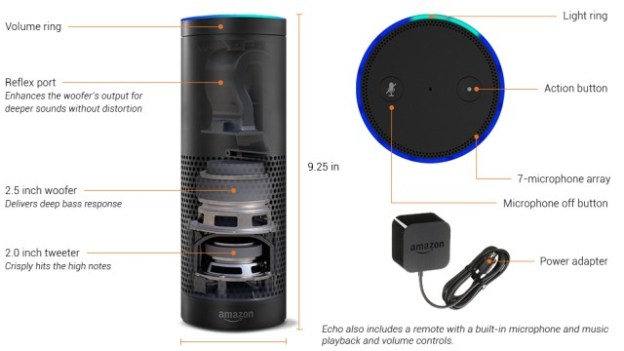
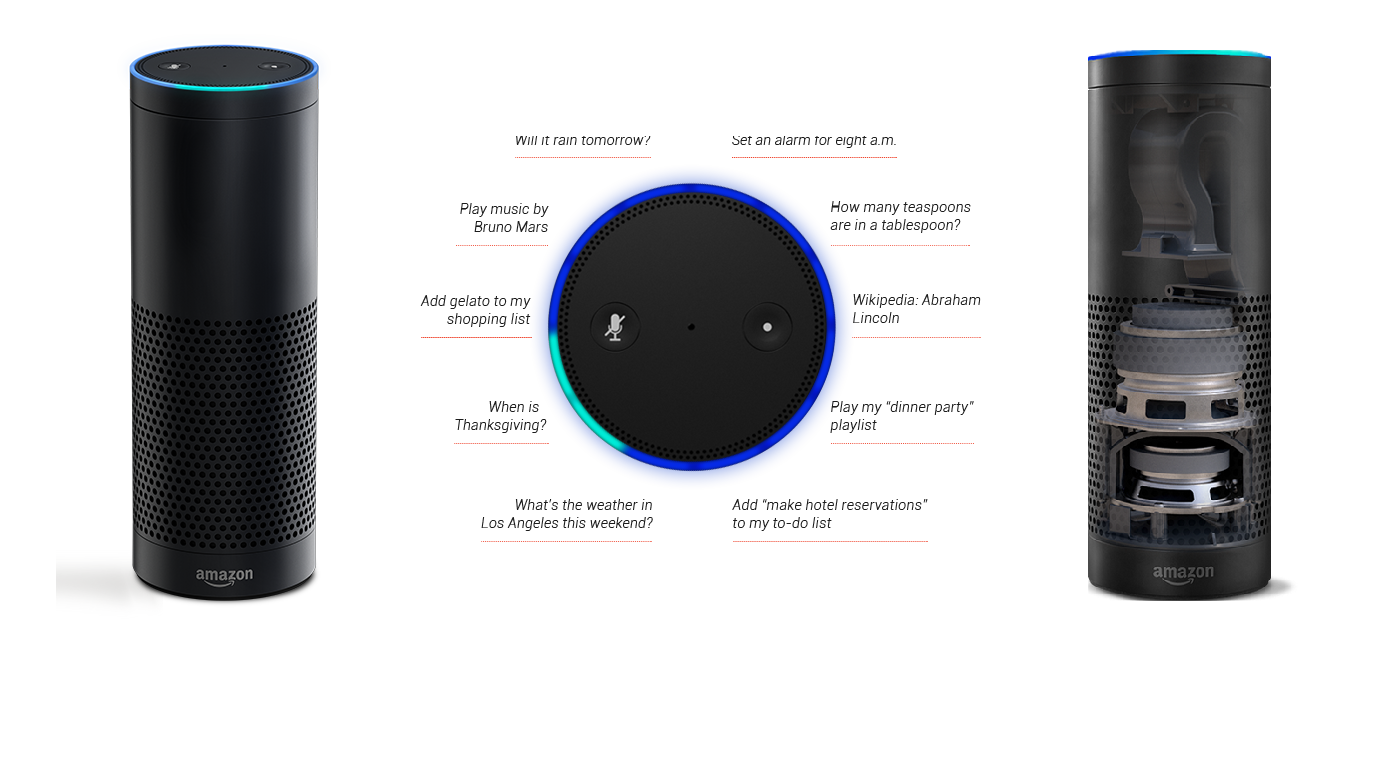
Die knapp 24 cm hohe schwarze Röhre mit einem Durchmesser von 8,3 cm „Amazon Echo“ ist einerseits ein über Bluetooth und WLAN verbundener Netzwerklautsprecher, der sich von Smartphone oder Tablet mit Musik von iTunes, Pandora und Spotify beschicken lässt. Andererseits wartet der mit Fernfeldmikrofonen und Spracherkennung ausgerüstete Echo auf Sprachkommandos. Dabei betont Amazon in dem Werbespot, dass man Echo nicht anbrüllen muss, sondern „überall im Raum gehört“ wird. Wie Apples „Siri“ und Googles „Ok, Google“ aktiviert ein offenbar wählbares Keyword – im Video „Alexa“ – den integrierten Personal Assistant. Alternativ soll man den Echo offenbar mit der dem Amazon Fire TV beiliegenden Voice Remote mit Mikrofontaste steuern können.

Laut Amazon gibt Echo Auskunft über das Wetter, buchstabiert Wörter, stellt den Wecker, spielt die Lieblingsmusik, rezitiert Wikipedia-Einträge, fügt der Einkaufsliste Einträge hinzu und so weiter. Das „Hirn“ von Echo sind die Amazon Web Services, über die ständig neue Kommandos ergänzt werden sollen.

Hochwertige Bass-Lautsprecher (2,5 Zoll) mit Bassreflex und Hochtöner (2 Zoll) versprechen klaren und verzerrungsfreien omnidirektionalen Klang. Über die Sprachsteuerung sollen sich Amazon (Prime) Music, iHeartRadio und TuneIn steuern lassen, während Musik von Spotify, iTunes und Pandora nur über Bluetooth von Mobilgeräten aus übertragen werden.

Amazon Echo gibt es vorerst nur in den USA zum Preis von 199 US-Dollar; Prime-Kunden müssen nur 99 US-Dollar bezahlen. Noch kann aber nicht jeder Echo kaufen. Interessenten müssen sich bewerben und bekommen eine Mail von Amazon, falls das Los auf sie fällt.

Fans von „Star Trek: The Next Generation“ („Computer … !?) werden ihre Freude an dem Gerät haben, wenn Echo das verspricht, was der Werbeclip von Amazon suggeriert. Auf Privatsphäre bedachte Naturen werden hingegen einen großen Bogen um den Lautsprecher machen und keinesfalls eine Amazon-Wanze im Wohnzimmer dulden – Microsoft kann ein Lied davon singen, man erinnere sich an das Horch und Guck der Xbox One. Ob es da hilft, dass Echo einen Schalter zum Deaktivieren des Mikrofon-Arrays besitzt, ist fraglich.

Doch was bezweckt Amazon mit dem Echo? Es wird ja kaum darum gehen, Eric Schmidt bloß zu beweisen, dass Amazon tatsächlich Googles größter Konkurrent ist. Sollte es wie beim Kindle (Fire) oder Fire TV (Stick) vor allem darum gehen, Amazons Inhalte besser an die Kunden zu bringen – also Bücher, Videos und Musik? Wohl kaum. Im Endeffekt dürfte es darum gehen, den Nutzern den perfekten Shopping-Assistenten an die Seite zu stellen, der die ausgesprochenen Wünsche direkt in dem Amazon-Einkaufskorb platziert …

Das liegt wohl an den grundverschiedenen Voraussetzungen. Star Trek
spielt aus menschlicher Sicht in einer Zukunft, in der die Existenz
des Individuums (zumindest der Spezies Mensch) ganz
selbstverständlich durch die allgemeinverfügbare Technik gesichert
ist. An der Stelle läßt sich die Technik wirklich nur noch gemäß der
Überzeugung der Spackeria (die sind seit NSA auch recht still
geworden) im Rahmen von Peinlichkeit gegen andere einsetzen. Heute
geht es dagegen darum, das Individuum bis an die Grenze der
(ökonomischen) Existenzfähigkeit auszupressen – und manchmal auch
darüber hinaus! (Source: http://www.heise.de/newsticker/foren/S-Re-Reaktion-der-Science-Fiction-Fans/forum-287951/msg-26049853/read/)

Die Zeit ergänzt: http://www.zeit.de/wirtschaft/2014-10/absolute-preisdiskriminierung

Jeder hat seinen Preis

Unendlich viele Preise für ein Produkt: Einer der größten kapitalistischen Träume ist gerade dabei, in Erfüllung zu gehen. Big Data macht es möglich

Konsum

Supermarkt  |  © dpa

Die Zeichen dafür, dass sich das kapitalistische Nirwana nähert, mehren sich. Florian Stahl sieht sie überall. Beim Einkauf im Netz, in den USA, in Deutschland. Beispielsweise kürzlich in New York, als sich der Professor für quantitatives Marketing an der Universität Mannheim bei Booking ausloggte, die Cookies löschte, dann seine Hotelanfrage noch einmal startete, diesmal anonym. Da war das gleiche Zimmer plötzlich günstiger. Weil der Algorithmus ihn nicht mehr identifizieren konnte, schlug er ihm einen anderen Preis vor. „Die Preismechanismen sind dabei, sich zu ändern“, sagt Stahl, „und zwar fundamental“.

Im Prenzlauer Berg, im Kaiser’s Supermarkt in der Winsstraße, wo sich Berlin früher zum Flirten traf, drängen sich die Kunden vor einem roten Ständer mit einem Bildschirm. Sie halten eine Karte vor den mannshohen Apparat. Weißes Licht streichelt ihre Hände, ihre Extrakarte wird gescannt, ein leises Summen begleitet das Erscheinen des Bons, darauf ihre Preisabschläge. Dann bin ich dran.

Ich checke ein in die Beta-Phase der dritten industriellen Revolution. Bald soll mich der Kaiser’s Algorithmus komplett verstehen, meine Wünsche vorhersagen können, noch aber kennt er mich nicht. Er hat bisher keinen einzigen Kassenzettel von mir gescannt, nur meine neue Extrakarte. Es ist ein Riesenerfolg in der Kundenkarten-Welt: Ein Drittel der Stammkäufer wurde in den ersten zwei Monaten seit der Einführung Nutzer. Mein Ausdruck zeigt „Ihre persönlichen Angebote heute“: Je 20 Prozent Abschlag für Harry Brot (noch nie gehört) und Bärenmarke Alpenfrische Vollmilch (dachte, die machen nur Kaffeesahne); für Barilla Nudeln gibt es 30 Prozent, für Ritter Sport und Lätta Margarine sogar 40.

Jeder zahlt einen anderen Preis

Hannes Grassegger ist Ökonom und schreibt unter anderem für "Brand Eins", DIE ZEIT oder die "NZZ". Er hat einen Essay über den Umgang mit dem neuen Datenkapitalismus veröffentlicht: "Das Kapital bin Ich"  |  © Kein & Aber

Hannes Grassegger ist Ökonom und schreibt unter anderem für „Brand Eins“, DIE ZEIT oder die „NZZ“. Er hat einen Essay über den Umgang mit dem neuen Datenkapitalismus veröffentlicht: „Das Kapital bin Ich“ | © Kein & Aber  |  © Kein & Aber

Vor gut hundert Jahren beobachtete Arthur Cecile Pigou, Professor in Cambridge, ein seltsames Phänomen: Er sah ins Herz des Kapitalismus und es war leer. Der Preis, um den sich die Marktwirtschaft als System der freien Preise dreht, existierte in Wahrheit gar nicht. In The Economics of Welfare von 1920 beschrieb Pigou seine Beobachtung im Kapitel Das spezielle Problem der Eisenbahntarife: Für eine identische Leistung, die gleiche Bahnfahrt von A nach B, zahlten Menschen freiwillig verschiedene Tarife, je nach Klasse. Pigou erkannte, was für die Ökonomie heute so elementar ist wie die Unschärferelation für die Physik: Es gibt keinen objektiv richtigen Preis einer Ware. Es gibt einzig persönliche Werteinschätzungen.

„Preisdiskriminierung“ nannte Pigou die Unterscheidung von Menschen nach den Preisen, die sie für das gleiche Produkt zu zahlen bereit sind. Für Händler ist sie eine wunderbare Möglichkeit, mehr für die gleiche Leistung zu kassieren. In der Vollendung der Preisdiskriminierung, der „Preisdiskriminierung ersten Grades“ könnten Anbieter, so Pigou, jedem einzelnen Käufer einen Höchstpreis für die Bahnfahrt setzen – und ihm so alles abnehmen, was er überhaupt zu zahlen bereit ist. Fortan lernte jeder Ökonomiestudent die totale Preisdiskriminierung als den heiligen Gral des Kapitalismus kennen.

An der Kaiser’s Kasse zeige ich die Extrakarte, piep!, registriert. Jeder Kauf verändert meine zukünftigen Preise: Ladenpreis minus persönlicher Rabatt. Erst einmal bin ich auf keines der Angebote eingegangen, weder Lätta noch Ritter Sport. Am Scanner hole ich mir den nächsten Bon. Wieder das gleiche Angebot. Dreimal muss ich da durch. Dann ist der Algorithmus angeblich soweit.

Personalisierte Angebote als letzte Möglichkeit, den Umsatz zu steigern

Fixe Preise schaffen einen versteckten Sozialvertrag, wie einheitliche Krankenkassenprämien. Hinter Einheitspreisen in Supermärkten, Bahnhöfen und Drogerien steckt ein Gesellschaftskonzept: Alle Käufer sollen gleich sein.
Einheitspreise schaffen Gewinner und Verlierer – dem einen ist etwas eigentlich mehr wert, dem nächsten ist es fast zu teuer. So subventionieren wir einander, vom Joghurtkauf bis zur Taxifahrt. Am meisten profitiert der Durchschnittsmensch. Im Massenmarkt seien personalisierte Preise bislang technisch unmöglich, sagt Florian Stahl, weil sie das Wissen über die Wertschätzung des Käufers für ein bestimmtes Produkt zu einem bestimmten Moment voraussetzten. In diese Wertschätzung könne theoretisch alles einfließen, bis hin zur Wetterlage, wie bei Eis oder Jacken. „Den individuellen Höchstpreis zu erkennen, ist eigentlich ein unendliches Problem“, sagt Stahl.

Lange entsprachen Preise im Alltag dem geschätzten Wert dessen, was unterschiedliche Käufer im Schnitt zu zahlen bereit waren. Bis die Computer kamen, das Internet, Facebook, Google, Scanner, Produkt-IDs, In-Store-Cams, Smartphones – ein Arsenal zur Datafizierung von Personen, deren Vorlieben, Verwandtschaftsverhältnissen, Jobs, Bewegungsmustern, Wertvorstellungen. Seit Kurzem gibt es nun Algorithmen, die die Daten zu dynamischen, individuellen Preisen zusammenrechnen können, wie zuerst die Flugpreise, dann die Hotelpreise, die Elektrizitätspreise und so weiter. Jetzt deutet sich an, dass sich alles herunterbrechen lässt auf den Einzelnen. Es ist, als ob ein Märchen wahr würde.

Das Klingelschild ist golden, Oderberger Straße 44, beste Lage im Prenzlauer Berg, direkt neben dem Modeladen Kauf Dich Glücklich. SO1 steht an der Klingel, kurz für Segment of One. Während in den USA mehr als die Hälfte aller Handelsunternehmen mit sogenannten Price Intelligence Verfahren und dynamischen Preisen experimentiert, jeder zwanzigste Preis bereits personalisiert ist, während die Preisschilder in Frankreich zunehmend durch Digitalanzeigen ersetzt werden, ist das Berliner Start-up SO1 einer der ersten deutschen Anbieter für totale Preisdiskriminierung.

Hier arbeiten 15 Statistiker, ITler, Ökonomen. Menschen, die Google und Henkel verlassen haben, um eine Vision Wirklichkeit werden zu lassen. Sie stecken hinter den roten Automaten in derzeit 30 Berliner Kaiser’s Testmärkten. Die Extrakarte sei eigentlich wie ein physischer Cookie, erklärt der junge Chef und Mitgründer Raimund Bau. SO1 trage die absolute Preisdifferenzierung aus dem Netz, wo Amazon oder Zalando längst so arbeiteten, in die Welt. Die Karten hätten eine anonyme Kundennummer, man brauche im Gegensatz zu anderen Kundenkarten keine persönlichen Informationen wie Namen oder Adresse. Darauf ist Bau stolz. Erfasst würden an der Kasse nur Kaufzeit, Produktnummer, Kartennummer und der gezahlte Preis. „Bei uns laufen die Daten aus den Kassen zusammen. Wir können beispielsweise identifizieren, wer ein Pepsikäufer ist, sogar wenn er nie Pepsi bei Kaiser’s gekauft hat.“ Das ergebe sich allein aus der erfassten Kombination gekaufter Produkte. Jedes Produkt sei ein statistischer Hinweis auf andere Produktvorlieben, so wie Weleda-Shampoo auf Bio-Obst hinweist.

Auf Basis der Wahrscheinlichkeiten, die aus Testmärkten bekannt seien, könnten nicht nur Vorlieben errechnet werden, so Bau, sondern auch die persönliche Zahlungsbereitschaft und Preissensibilität. „Wenn wir den Cola-Absatz erhöhen wollen, finden wir heraus, ob Du als Pepsi-Liebhaber für Cola ein potenzieller Kunde bist. Ob Du es wiederholt kaufen würdest, wenn Du es einmal ausprobierst. Wie viel wir Dir zahlen müssten, um Dich zum Cola-Kauf zu bringen.“ Lohne sich der Kunde für Cola, biete man ihm an den roten Automaten genau den passenden Preisnachlass für Cola. Resultat seien individuelle Preise.

Der gläserne Kunde

Heute arbeite SO1 noch mit Bons, bald werde vieles über Apps laufen, sagt Bau. „PayPal, Mastercard, Google arbeiten sicherlich an ähnlichen Methoden.“ Absolute Preisdiskriminierung sei eine weltweite Bewegung, die kaum aufzuhalten sei, weil in gesättigten Märkten wie dem Lebensmittelhandel der Preiswettkampf der einzige Weg sei, den Umsatz zu steigern. „Persil wäscht jetzt noch weißer“ ziehe nicht mehr, sagt Bau. Und altbekannte Promotionen via Coupons oder Rabattmarken hätten aufgrund der Streuung kaum Effekt. Sie würden vor allem von Leuten genutzt, die das Produkt sowieso kaufen würden. Die Extrakarte bringe dagegen pro Nutzer Umsatzsteigerungen im mittleren zweistelligen Prozentbereich. Für Bau eine Win-Win-Win-Win-Situation für Kunde, Händler, Produzent und SO1.

Das will sich auch IBM nicht entgehen lassen. Demandtec heißt die Software des Konzerns. Große Ketten, Lebensmittelhändler, Drogerien oder Baumärkte sollen sie nutzen, um ihre Preise auf Basis von persönlichen Kaufmustern, Konkurrenzpreisen oder anderen Einflüssen ständig zu optimieren. Das ermöglicht verschiedene Preise von Supermarkt zum Onlineshop zum Mobilgerät oder zwischen Gebieten. Eine zweite IBM-Software namens Xtify bietet Techniken, um Kunden jederzeit ortsbezogen mit Angeboten anzusprechen.

Alle Informationen werden zusammengenommen

Viele Geschäfte haben sich derweil zu veritablen Überwachungsdiensten entwickelt. Das Ziel: Kunden bis ins Detail ausforschen. In der Schweiz können die beiden führenden Supermarktketten Migros und Coop 80 Prozent aller Einkäufe Haushalten zuordnen, dank der Kundenkarten. Niemand weiß mehr über die Schweizer, über ihre Allergien, Aufenthaltsorte, Gewohnheiten, Familienstrukturen, Adressen. Bei der US-Kette Safeways nutzt fast die Hälfte aller Kunden eine App, die ihnen im Supermarkt spezifische Nachlässe anzeigt, beruhend auf der eigenen Shoppingvergangenheit. So entstehen personalisierte Preise.

Ich habe Harry Brot und Barilla Nudeln verbilligt gekauft. Die beiden Angebote fehlen jetzt auf dem dritten Ausdruck. Sonst ist alles beim Alten. Noch ein Einkauf, dann kann ich sehen, was der Kaiser’s Algorithmus von mir denkt. Ob er mir Cola anbietet?

„Von der Ernährung über die Mobilität bis zur Energieversorgung sind elementare Bereiche unseres Lebens von den neuen Preismodellen betroffen“, sagt der St. Galler Ökonom und Zukunftsforscher Joël Cachelin. Und diese Preise würden durch uns unbekannte und unüberprüfbare Kriterien bestimmt.

Alles wird verknüpft

Die für den Einzelnen bedrohlichste Möglichkeit wäre künftig die Verknüpfung aller Informationen über Firmen und Netzwerke hinweg. Jede unserer Handlungen und Äußerungen, auch vergangene, würde den Preis beeinflussen, den wir für etwas zahlen. Das Netz würde zu einer Art Credit History, wie Kritiker des neuen Facebook Werbedienstes Atlas befürchten.

In Dänemark bietet der Reiseveranstalter Spies derzeit schon Sonderpreise für Paare an, die in ihren Ferien nachweislich ein Kind zeugen. Der Werbegag ist ein Versuch, mit Preisen einem der größten Probleme Dänemarks zu begegnen: dem Mangel an Nachwuchs. Preise sind eines der wichtigsten Steuerungsmittel unserer Gesellschaft. Sie sind Politik. „Die Zeiten des Sozialvertrags im Preis gehen zu Ende“, sagt Florian Stahl. Zukünftig könnten Menschen sogar Identitäten tauschen, um niedrigere Preise zu zahlen.

Brotpreise starten Revolutionen. Was aber passiert mit einer Gesellschaft, deren Preissystem sich komplett ändert?

Nach dem dritten Einkauf gehe ich zum Automaten, um endlich mein persönliches Angebot zu erhalten. Das Licht des Scanners wärmt meine Hand. Mein Rabatt erscheint mit sanftem Summen. 20 Prozent auf Bärenmarke Milch, 40 Prozent auf Lätta Margarine.

Die Sueddeutsche schließt den Themenblock: http://www.sueddeutsche.de/digital/neues-produkt-echo-amazon-erfindet-den-lauschsprecher-1.2209840

Amazon erfindet den Lauschsprecher
Amazon Echo: Eine Dystopie in Zylinderform.

AmazonEchoDystopie

Die Gebrauchsanweisung für Amazons neues Produkt hat in ihrer deutschen Ausgabe 351 Seiten und erzählt nebenbei noch die Geschichte einer totalitären Diktatur. Es ist das Buch „1984“ von George Orwell – und das wichtigste Instrument in dieser Dystopie ist der Televisor, der bei allen Bürgern zu Hause fest installiert ist. Er hört alles, kann sprechen und dient auch als Fernseher.

Einen kleinen Unterschied gibt es allerdings: Ein Fernseher ist Amazons „Echo“ nicht und es bleibt auch jedem selbst überlassen, ob er die kleine, schicke, schwarze Säule bei sich zu Hause aufstellt, wo sie fortan auf Sprachkommando reagiert und ihrem Besitzer Fragen beantwortet. Wie zum Beispiel: Alexa, wie viel Uhr ist es? Alexa, wie buchstabiert man Mountainbike? Alexa, wie kocht man Bolognese? Das Codewort Alexa aktiviert Echo.

Das Gerät kann all das, weil es permanent mit dem Netz verbunden ist – und weil Echo offenbar alles hört, was um die kleine Säule herum gesprochen wird. Kein Hersteller hatte bislang die Chuzpe, dieses Gerät wirklich zu bauen und anzubieten. Amazon, der Lieferkonzern, hat die Chuzpe, unsere Gesellschaft zu verändern. Wenig innovative Buchhandlungen und Verlage zu ruinieren. Unseren Konsum zu protokollieren. Produkte will der Konzern seinen Kunden künftig per Drohne liefern – Amazon weiß schon, was gut für uns ist. Dieser Konzern also hat den Televisor gebaut. Herzlichen Glückwunsch!

Die Standleitung zu einem Amazon-Server

Und warum auch nicht. Die gesamte Umgebung um uns herum sammelt Daten. Unsere Handys sowieso, unsere Autos, Bankautomaten, Kassen, Kameras, öffentliche wie private, Payback-Karten, Webseiten, die wir besuchen. Dass Echo da so heraussticht, liegt an zwei Aspekten. Erstens: Echo soll im Wohn- und Schlafzimmer stehen. Das Gerät überwacht – oder bereichert – unser zu Hause. Zweitens: Echo ist, wie man es von Amazon kennt und erwartet, ein besonders innovatives Produkt. Es ist ein Wagnis, aber eines das sich lohnen könnte. Echo rückt uns dort näher ans Netz, wo wir bislang konsequent offline sind. Im Wohnzimmer, beim Faulenzen, beim Kochen, beim Schlafen, im Bett. Echo ist, einem Handy nicht unähnlich, die Standleitung unseres Lebens zu einem Amazon-Server. 199 Dollar kostet das Gerät in den USA, bislang können nicht alle Kunden bestellen, Amazon testet noch, wie das neue, ungewohnte Gerät angenommen wird.

Vielleicht hat Amazon deshalb einen betont konservativen Werbespot zu Echo gedreht, der vor allem suggeriert: Echo macht das Leben einfacher. Ansonsten bleibt alles, wie es ist. Vati hört die Nachrichten mit Echo, Mutti kann den neuen Mitbewohner erst nicht richtig bedienen, aber rafft es dann doch noch – so einfach ist Echo! – und kann in Ruhe mit Echos Hilfe kochen. Und es stimmt ja auch: Nicht das Gerät ist das größte Problem, sondern die fehlenden Regeln für das Gerät. Der Zwang, dem Kunden transparent zu zeigen, was mit ihm geschieht, wenn er das Gerät verwendet. Echo ist nämlich nur die Vorderseite des Produktes, das man erwirbt. Den schwarzen Zylinder kann man anfassen, aber für den Kunden nicht greifbar ist der Amazon-Webserver, der mit Echo verbunden ist und der mit jedem Wort, das in Echos Hörweite fällt, dazu lernt. Über den Sprechenden. Über seinen Tonfall, seine Stimmung, seine Wünsche, seine Probleme, seine Hoffnungen, sein Leben.

Daten, die besonders wertvoll sind

Echo sammelt jene Kategorie von Daten, die besonders wertvoll und besonders kritisch ist, nämlich personenbezogene Daten. Und der Service wäre nicht halb so bedenklich, wenn er klar geregelt wäre und für den Nutzer vollkommen transparent wäre, wie und wo seine Daten liegen, wer sie bekommt und was mit ihnen angestellt wird. Aber welchen Gesetzen gehorcht Echo überhaupt? Amerikanischen? Deutschen? Wer hat Zugriff auf die Daten? Was geschieht mit den Profilen, die unweigerlich entstehen, wenn Echo immer lauscht?

Amazon in Deutschland konnte eine entsprechende Anfrage der Süddeutschen Zeitung nicht beantworten und verweist auf die amerikanische Pressestelle, die bislang nicht reagiert hat. Auf der Echo Produktseite, auf der sich bislang nur amerikanische Nutzer um ein Gerät bewerben können, sind die Vorteile von Echo ausführlich erklärt. Der tolle Klang der Lautsprecher, wie genau Echo höre, was gesprochen wird, wie sich Echo mit anderen Geräten verbinden lässt. Der Hinweis zum Datenschutz aber führt nur zur ganz gewöhnlichen Amazon.com-Datenschutzseite, die Allgemeinplätze und Standardtexte für den Nutzer bereithält. Wer Echo besitzt, weiß deshalb tatsächlich nicht, wie ihm geschieht. Vielleicht ist es nochmal an der Zeit, die 351 Seiten der inoffiziellen Gebrauchsanweisung zu lesen.

2014′ Apple Special Event unboxing new Iphones, Apple Pay, Apple Watch and many more

See All the Glorious Gadgets From Apple’s Big Event

CUPERTINO, California—Today Apple unveiled a trifecta of new products that are surely sending worrisome ripples down the spines of the company’s competitors.

At a massive media event here at the Flint Center for Performing Arts, Apple announced two new large-screen iPhones, a new mobile payment platform, and an advanced touchscreen wristwatch. Judging by the numerous outbreaks of applause and the occasional standing ovation, the new products were met with great support by the huge audience of press, Apple employees, and VIPs from the entertainment, technology, and fashion industries.

But don’t worry if your eyes weren’t glued to the video livestream—or if you were one of the countless viewers who suffered from numerous drop-outs and technical problems and were left in the dark for much of the event. Here are the most important things you need to know about Apple’s big day.

The New iPhones: iPhone 6 and iPhone 6 Plus

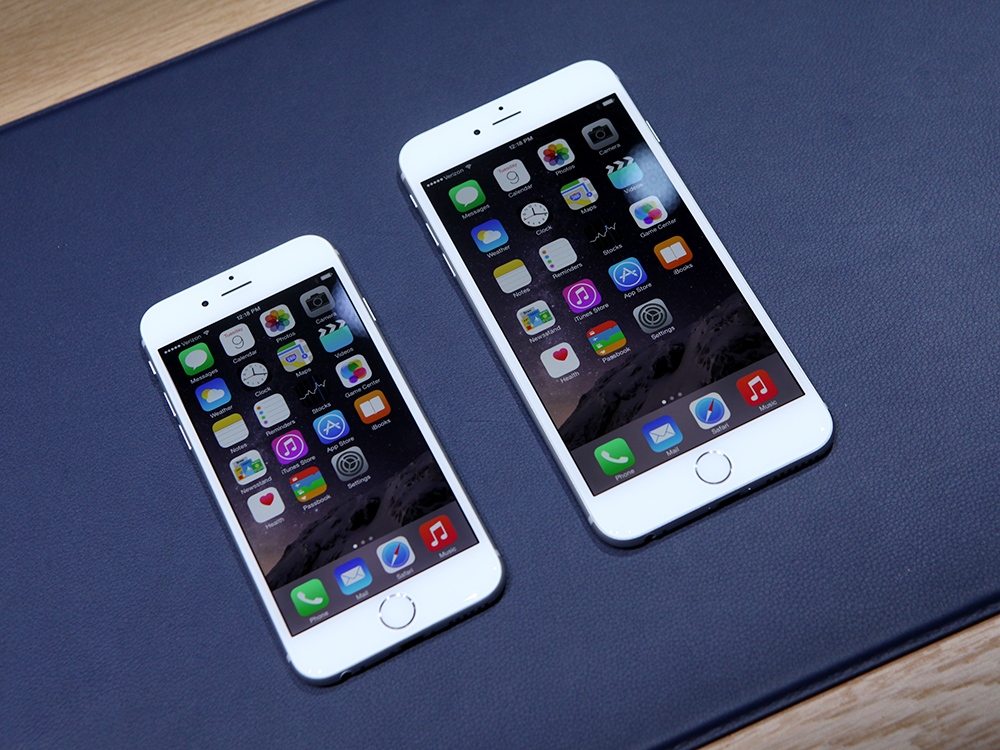
After a dramatic introductory video, Apple senior vice president Phil Schiller unveiled two new iPhone models today, the iPhone 6 and iPhone 6 Plus. Both are styled with a smooth, brushed aluminum rear face that curves gently into the front face. They look like small iPads.

The iPhone 6 has a 4.7-inch display with a 1334×750 pixel resolution. The iPhone 6 Plus features a 5.5-inch screen with full HD 1920×1080 display resolution. Other than this size difference, the phones are essentially the same.


AppleSpecialEvent20140909-Iphones

iphone6

On the rear, they’ve got an 8-megapixel shooter with an f/2.2 aperture 8-megapixel camera. It’s got a new sensor and speedier autofocus. The 6 has digital image stabilization, but the 6 Plus also has additional optical image stabilization that uses its gyroscope and the M8 coprocessor to cancel out extra shakiness. The front-facing camera gets some new features like HDR and a burst-shot mode.

Inside, an A8 processor promises to be up to 87 percent more efficient than its predecessor, offering CPU processing power up to 25 percent faster and GPU speeds up to 50 percent faster than the iPhone 5s’ A7 chip. The M8 motion coprocessor, in addition to aiding in image stabilization, can now tell when you’re walking, running or cycling, and can give you credit if you’re traversing up and down stairs thanks to a barometer that detects changes in air pressure.

Both devices feature Touch ID home buttons and NFC (more on that in a sec). The iPhone 6 goes on sale Friday, September 19th starting at $200 on contract for 16 GB, $300 for 64 GB, and $400 for 128 GB. The iPhone 6 Plus starts at $100 more.

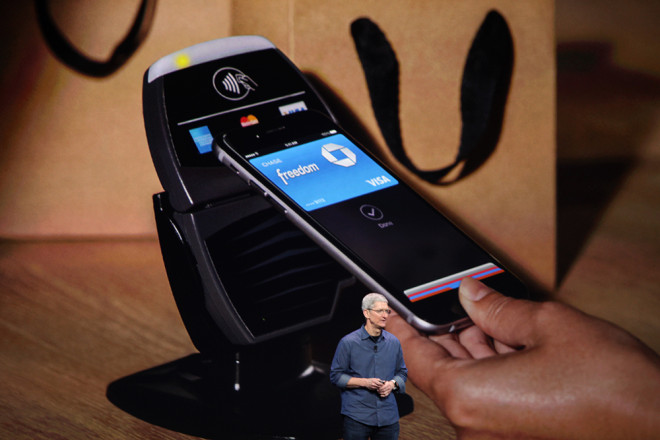
ApplePay, Apple’s Mobile Payment Initiative

“Payments is a huge business. Every day between credit and debit, we spend $12 billion, and that’s just in the United States,” Cook said to introduce what a huge space payments is—a huge space digital payments have yet to crack.

AppleSpecialEvent20140909-ApplePay

applepayday

Working with American Express, MasterCard, and Visa, the new ApplePay systemas been designed to work with over 220,000 merchants at launch, including familiar locations like Walgreens, Whole Foods, Macy’s, and Target. Using NFC, you simply tap your phone on a payment terminal to purchase things. It’s that easy. How it works is a bit more complicated though. It uses a combination of NFC, Touch ID, and a secure chip Apple calls the Secure Element. You add a card by snapping a photo of it, then getting verification from your bank. During a transaction, a unique device number, rather than the actual credit card information, is sent to the merchant along with a dynamic security code. Apple doesn’t collect your data—what you buy is between you and the merchant. And if you lose your iPhone, you can suspend payments with Apple’s standard-issue Find My Friends app without needing to cancel your actual credit card.

It will launch in the U.S. in October as an update to iOS 8.

Apple’s Wearable: The Apple Watch

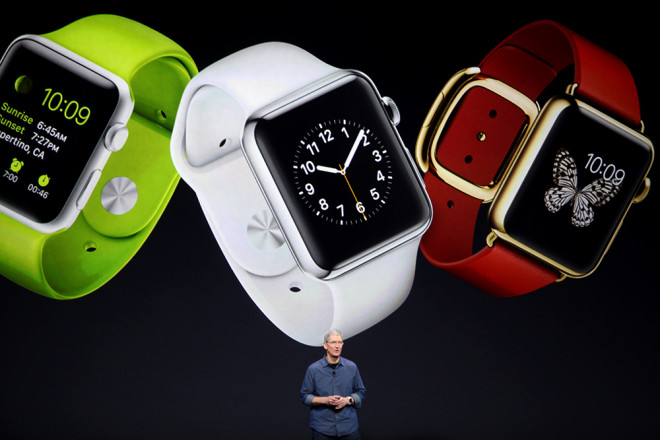
The biggest question mark surrounding today’s event was whether Apple would actually unveil its long-rumored wearable computing product. The company did not disappoint. The Apple Watch is officially here.

“Apple watch is the most personal device we’ve ever created,” Cook said after receiving a standing ovation and a round of wild applause. Apple’s CEO calls it “a new intimate way to connect and communicate direction from your wrist.”

The timepiece, which is accurate to within plus or minus 50 milliseconds, is not just technologically impressive. It’s also quite stylish. The faces and the different hardware choices let you trick out the watch to match your own personal style.

AppleSpecialEvent20140909-AppleWatch1

AppleWatchWristApps

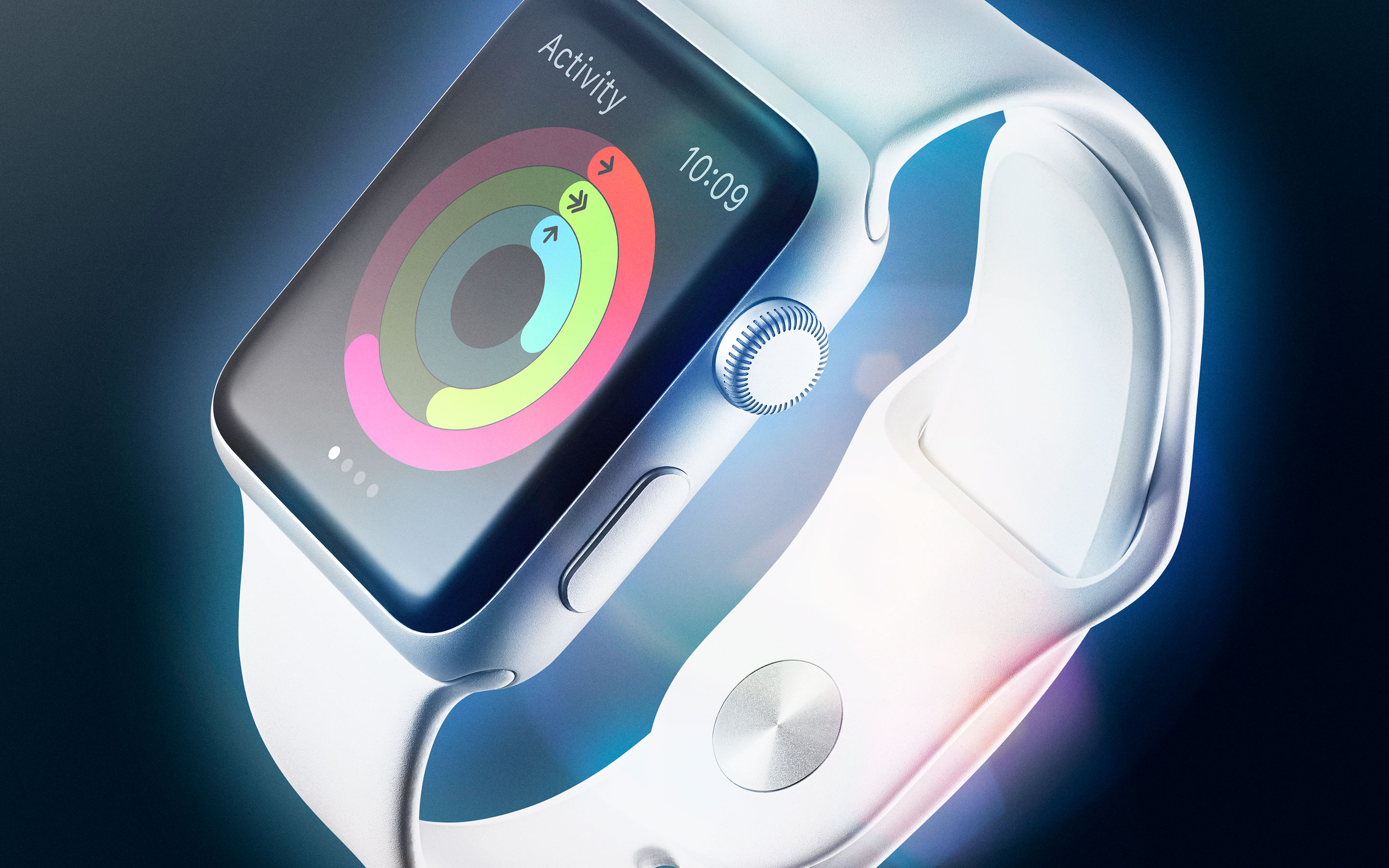
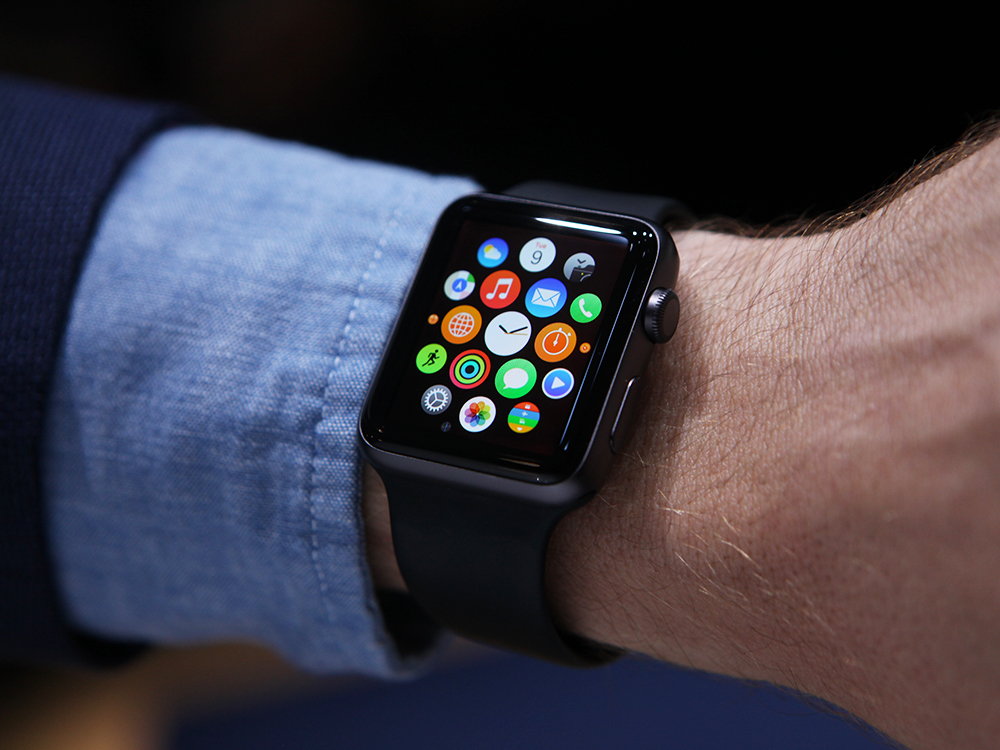
The watch face looks very similar to a traditional watch, including a dial on the side that Apple calls the “digital crown” that translates movement into digital data. Apple kept some of the tech specs on the vague side—the product won’t actually ship until next year. What we do know is that the display is a sheet of sapphire, and inside is a custom designed chip encapsulated to protect the electronics. On the rear are four sapphire lenses which hold LEDs and photo sensors for detecting your heart rate.

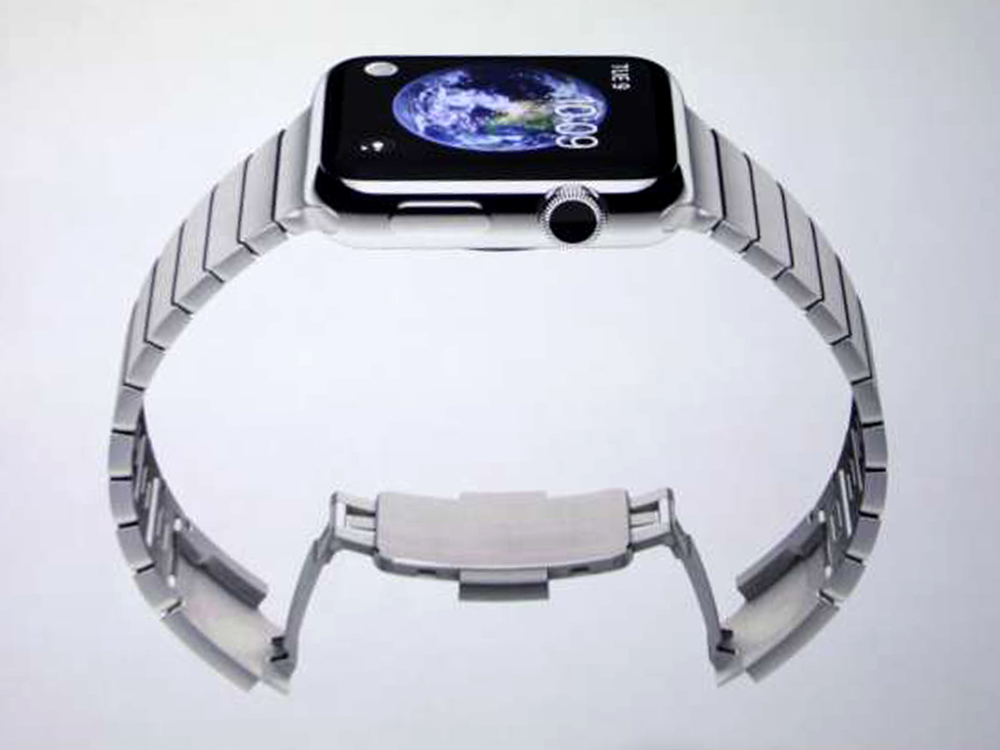
With regards to looks, the Apple Watch is a bit of a chameleon. It comes in three editions: Apple Watch, Watch Sport, and Watch Edition. Apple Watch is the most basic, Watch Sport is more durable, and Watch Edition is more exotic and made of gold. There are six different straps you can mix and match to suit your needs: a quilted leather strap with a magnetic clasping band, a traditional leather buckle, a stainless steel link bracelet, and a mesh chain loop are among the choices. The device comes in not just two band sizes, but two watch face sizes, to suit folks with different-sized wrists.

But it’s not just the hardware that’s customizable. “With every breakthrough, Apple has also had to have a breakthrough in user interface,” Cook said. What Apple didn’t do, he says, is take the iPhone and shrink the interface and strap it on your wrist. The display is too small, and it would make for a terrible user experience. Instead the digital crown is a key part of the navigation experience, as are onscreen taps and swipes.

The menu screen is composed of bubbles of circular app icons you can arrange however you like, including grouping them by “neighborhood” of related apps. Twisting the crown zooms in and out on the group of apps. To open an app, you tap it. A feature called Glances lets you swipe upwards from the bottom of the screen to cycle through a customizable series of data screens. Siri is built into the watch, so you can dictate questions like “What movies are playing tonight?” A new feature called Digital Touch lets you select a contact then send a super-quick message just based on taps and drawings that your contact can then feel (via a vibration) when it reaches their wrist. It’s intended for messages that have a more personal context—and are a lot less wordy—than your usual text message.

The Apple Watch has a number of other apps including Maps, notifications from third-party apps, and a lot of customizable watch faces. Third-party apps, like ones from American Airlines and W Hotels, are also on the way. A pair of Apple-built health and fitness apps use both the watch and your iPhone’s sensors to give you a holistic view of your daily activities, combining the features of a general activity tracker and an advanced sport watch.

The Apple Watch charges using an inductive charger that fits on the back of its rectangular face. There’s no word about exact battery life yet. Few details were given about pricing, as well. All we know is that the Apple Watch will start at $350, and that it will go on sale in early 2015.

AppleWatchMetal

Source: http://www.wired.com/2014/09/apple-event-faq

Audi RS7 Is as Fast as a Ferrari 458 at Half the Price

Wrong world America?

Whereas Europeans in well saturated markets like Germany and Austria pay easily more than double the price Americas customers pay for the same brands like Tommy Hilfiger, Audi, Ferrari only a friction.
Wrong world? Globalisation?
Wrong. The answer is. International brands try to globally subsidise their Americas Sales in order to keep the motor running and Americas Washing machine spinning.

Examples?
Ferrari 358: America: 230.000 USD, Germany Austria: 390.000 USD (+70 %)
Hilfiger Watch: America 10 USD, Germany Austria 75 USD (+750 %)
Michael Kors Sunglasses: America 44 USD, Germany Austria 150 USD (+340 %)
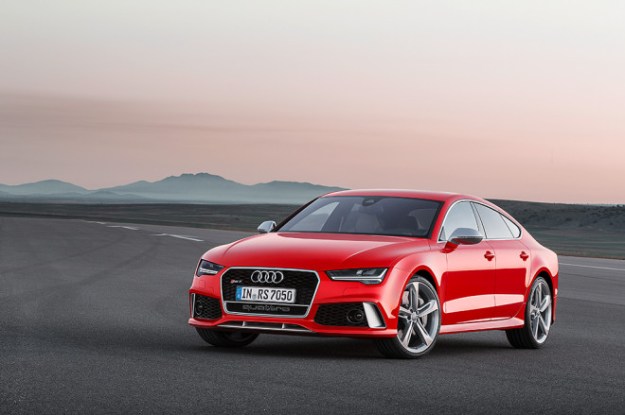
Audi RS7: America super pricey 122.000 USD, Germany Austria: 182.000 USD (+50 %)

Audi-RS7-2014

The new Audi RS7 is a conflicted car. It’s a five-door hatchback that can run neck and neck with a Ferrari 458 in the quarter mile. It marries straight-line performance with unexpected utility, and does it at a price that undercuts its similarly power-mad German competitors. Yet it’s not the vehicle you want to take to the track—the power overwhelms, and the Audi S7 is the better choice if you actually want to turn at high speeds.

But, good grief is this thing fast! Full throttle, the RS7 is 4,500 pounds of luxury hurtling forward like anti-aircraft fire. Say another nouveau-riche fellow pulls up next to you at a stoplight in his 458. Fear not. You’ll match him right through a quarter-mile drag race. As the two of you speed forward to 60 mph in around three seconds, he can ponder the fact that his $233,000 (at least) two-seat sports car is holding even with a ride that holds four people and their luggage comfortably.

With the RS7, Audi tips further away from its characteristic tight-lipped restraint than with any other car it makes, including the R8 V10 Plus.

America’s Most Powerful Audi

Based on Audi’s A7 Sportback, the RS7 is the company’s top dog performance sedan, a notch above the S8 in dynamics if not price. It starts for $104,900, we tested one worth $122,545. It’s the most powerful Audi ever offered in the United States, boasting a 4.0 liter twin turbo V8 that makes 560 horsepower and 516 pound-feet of torque. The engine makes so much power that the regular A7’s 7-speed double-clutch transmission can’t handle the torque.

Instead, the RS7 gets an 8-speed ZF single clutch transmission that sends power to all four wheels via the Quattro AWD system. The resulting 11.5 second quarter mile dash is Gran Turismo easy – just plant your foot, no drama.

Driving the car, these giggle-inducing numbers feel like lowball estimates. After sprinting off the line, the RS7 pulls like a rocket sled to an electronically limited 174 mph (an optional “Dynamic” package bumps top speed to the same 189 mph ceiling you get in the European version of the car).

Audi RS 7 Sportback

A Practical Ride

Yet it’s still a practical car. There really are four habitable seats, though your head will be bowed in the back if you’re over 5’10”. The space available easily exceeds what you get in competitors like Mercedes’ CLS63 AMG, Aston Martin’s Rapide, and BMW’s M6 Gran Coupe. The rear hatch and folding rear seats yield 49.1 cubic feet of cargo space, more than a BMW X1 crossover.

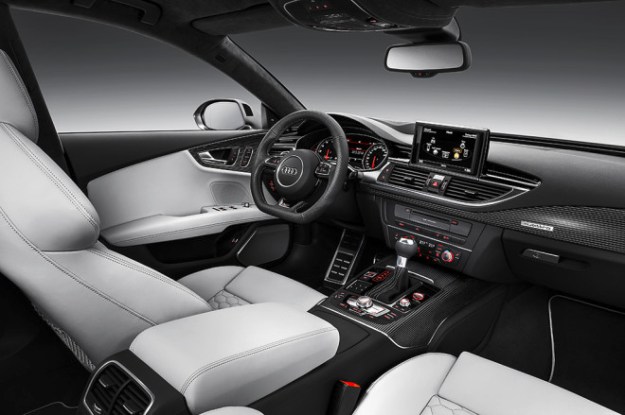
The interior nods to fun, spiced up with aluminum pinstriping across black wood dash and door inlays, web stitching on the excellent seats, a perforated steering wheel wrap, and machined-out aluminum door handles. On startup, little Bang & Olufsen tweeters—ostensibly there to improve acoustics, really made for impressing friends and dates—rise from the dash in sync with the 7-inch MMI display screen.

The exterior signals aggression with 21-inch wheels enclosing 15”/14” wave-design rotors and a huge black gloss grille. Our Misano red pearl test driver had matte aluminum trim and a pattern based on the Audi quattro ring in the tail lamps. The effect is handsome, but borders on vulgar in bright red.

There are other bits of awkwardness. Small aluminum steering wheel shifter paddles indicate Audi doesn’t think you’ll paddle shift much (it’s probably right). The brake ducts on the front splitter are cosmetic only and the plastic cover over the engine keeps you from ogling the fabulous twin-turbo V8. Too bad, because beneath it you find the turbos mounted atop the intake manifold. The layout largely eliminates turbo lag, but Audi doesn’t say how it keeps the turbos cool.

The RS7 doesn’t drive perfectly. It corners and stops very well, until you push the power close to the limit. The chassis is marvelously stiff but the power out-muscles the suspension. The rear sport (electronic) differential over-speeds the outside rear wheels in hard cornering but it cannot defeat the inevitable AWD understeer. Nor can it make up for the RS7’s mass. Steering feel is vague and the air suspension doesn’t communicate what’s happening underneath.

What all that means is that when you barrel into a corner 40 mph quicker than you expected (likely at first) the car lurches, struggling mightily with front-end plow as you add more and more steering. The well heeled toffs who can afford an RS7 may not instinctively understand this.

For all its gobsmacking power, the RS7 really isn’t an emotional car in driving terms. On long highway drives, it’s nice to be isolated from noise and vibrations, but it takes something away when you want to really feel the car. Fortunately for Audi, the competition isn’t much more involving.

But at least it’s the dominant sort of isolation, the kind that allows you to look through dark sunglasses at the sucker next to you and rev the engine with confidence.

Source: http://www.wired.com/2014/07/audi-rs7-review/

Has the self-driving car at last arrived?

Auto Correct

Has the self-driving car at last arrived?

by Burkhard Bilger

The Google car knows every turn. It never gets drowsy or distracted, or wonders who has the right-of-way.

The Google car knows every turn. It never gets drowsy or distracted, or wonders who has the right-of-way. Illustration by Harry Campbell.

Human beings make terrible drivers. They talk on the phone and run red lights, signal to the left and turn to the right. They drink too much beer and plow into trees or veer into traffic as they swat at their kids. They have blind spots, leg cramps, seizures, and heart attacks. They rubberneck, hotdog, and take pity on turtles, cause fender benders, pileups, and head-on collisions. They nod off at the wheel, wrestle with maps, fiddle with knobs, have marital spats, take the curve too late, take the curve too hard, spill coffee in their laps, and flip over their cars. Of the ten million accidents that Americans are in every year, nine and a half million are their own damn fault.

A case in point: The driver in the lane to my right. He’s twisted halfway around in his seat, taking a picture of the Lexus that I’m riding in with an engineer named Anthony Levandowski. Both cars are heading south on Highway 880 in Oakland, going more than seventy miles an hour, yet the man takes his time. He holds his phone up to the window with both hands until the car is framed just so. Then he snaps the picture, checks it onscreen, and taps out a lengthy text message with his thumbs. By the time he puts his hands back on the wheel and glances up at the road, half a minute has passed.

Levandowski shakes his head. He’s used to this sort of thing. His Lexus is what you might call a custom model. It’s surmounted by a spinning laser turret and knobbed with cameras, radar, antennas, and G.P.S. It looks a little like an ice-cream truck, lightly weaponized for inner-city work. Levandowski used to tell people that the car was designed to chase tornadoes or to track mosquitoes, or that he belonged to an élite team of ghost hunters. But nowadays the vehicle is clearly marked: “Self-Driving Car.”

Every week for the past year and a half, Levandowski has taken the Lexus on the same slightly surreal commute. He leaves his house in Berkeley at around eight o’clock, waves goodbye to his fiancée and their son, and drives to his office in Mountain View, forty-three miles away. The ride takes him over surface streets and freeways, old salt flats and pine-green foothills, across the gusty blue of San Francisco Bay, and down into the heart of Silicon Valley. In rush-hour traffic, it can take two hours, but Levandowski doesn’t mind. He thinks of it as research. While other drivers are gawking at him, he is observing them: recording their maneuvers in his car’s sensor logs, analyzing traffic flow, and flagging any problems for future review. The only tiresome part is when there’s roadwork or an accident ahead and the Lexus insists that he take the wheel. A chime sounds, pleasant yet insistent, then a warning appears on his dashboard screen: “In one mile, prepare to resume manual control.”

Levandowski is an engineer at Google X, the company’s semi-secret lab for experimental technology. He turned thirty-three last March but still has the spindly build and nerdy good nature of the kids in my high-school science club. He wears black frame glasses and oversized neon sneakers, has a long, loping stride—he’s six feet seven—and is given to excitable talk on fantastical themes. Cybernetic dolphins! Self-harvesting farms! Like a lot of his colleagues in Mountain View, Levandowski is equal parts idealist and voracious capitalist. He wants to fix the world and make a fortune doing it. He comes by these impulses honestly: his mother is a French diplomat, his father an American businessman. Although Levandowski spent most of his childhood in Brussels, his English has no accent aside from a certain absence of inflection—the bright, electric chatter of a processor in overdrive. “My fiancée is a dancer in her soul,” he told me. “I’m a robot.”

What separates Levandowski from the nerds I knew is this: his wacky ideas tend to come true. “I only do cool shit,” he says. As a freshman at Berkeley, he launched an intranet service out of his basement that earned him fifty thousand dollars a year. As a sophomore, he won a national robotics competition with a machine made out of Legos that could sort Monopoly money—a fair analogy for what he’s been doing for Google lately. He was one of the principal architects of Street View and the Google Maps database, but those were just warmups. “The Wright Brothers era is over,” Levandowski assured me, as the Lexus took us across the Dumbarton Bridge. “This is more like Charles Lindbergh’s plane. And we’re trying to make it as robust and reliable as a 747.”

Not everyone finds this prospect appealing. As a commercial for the Dodge Charger put it two years ago, “Hands-free driving, cars that park themselves, an unmanned car driven by a search-engine company? We’ve seen that movie. It ends with robots harvesting our bodies for energy.” Levandowski understands the sentiment. He just has more faith in robots than most of us do. “People think that we’re going to pry the steering wheel from their cold, dead hands,” he told me, but they have it exactly wrong. Someday soon, he believes, a self-driving car will save your life.

The Google car is an old-fashioned sort of science fiction: this year’s model of last century’s make. It belongs to the gleaming, chrome-plated age of jet packs and rocket ships, transporter beams and cities beneath the sea, of a predicted future still well beyond our technology. In 1939, at the World’s Fair in New York, visitors stood in lines up to two miles long to see the General Motors Futurama exhibit. Inside, a conveyor belt carried them high above a miniature landscape, spread out beneath a glass dome. Its suburbs and skyscrapers were laced together by superhighways full of radio-guided cars. “Does it seem strange? Unbelievable?” the announcer asked. “Remember, this is the world of 1960.”

Not quite. Skyscrapers and superhighways made the deadline, but driverless cars still putter along in prototype. Human beings, as it turns out, aren’t easy to improve upon. For every accident they cause, they avoid a thousand others. They can weave through tight traffic and anticipate danger, gauge distance, direction, pace, and momentum. Americans drive nearly three trillion miles a year, I was told by Ron Medford, a former deputy administrator of the National Highway Traffic Safety Administration who now works for Google. It’s no wonder that we have thirty-two thousand fatalities along the way, he said. It’s a wonder the number is so low.

Levandowski keeps a collection of vintage illustrations and newsreels on his laptop, just to remind him of all the failed schemes and fizzled technologies of the past. When he showed them to me one night at his house, his face wore a crooked grin, like a father watching his son strike out in Little League. From 1957: A sedan cruises down a highway, guided by circuits in the road, while a family plays dominoes inside. “No traffic jam . . . no collisions . . . no driver fatigue.” From 1977: Engineers huddle around a driverless Ford on a test track. “Cars like this one may be on the nation’s roads by the year 2000!” Levandowski shook his head. “We didn’t come up with this idea,” he said. “We just got lucky that the computers and sensors were ready for us.”

Almost from the beginning, the field divided into two rival camps: smart roads and smart cars. General Motors pioneered the first approach in the late nineteen-fifties. Its Firebird III concept car—shaped like a jet fighter, with titanium tail fins and a glass-bubble cockpit—was designed to run on a test track embedded with an electrical cable, like the slot on a toy speedway. As the car passed over the cable, a receiver in its front end picked up a radio signal and followed it around the curve. Engineers at Berkeley later went a step further: they spiked the track with magnets, alternating their polarity in binary patterns to send messages to the car—“Slow down, sharp curve ahead.” Systems like these were fairly simple and reliable, but they had a chicken-and-egg problem. To be useful, they had to be built on a large scale; to be built on a large scale, they had to be useful. “We don’t have the money to fix potholes,” Levandowski says. “Why would we invest in putting wires in the road?”

Smart cars were more flexible but also more complex. They needed sensors to guide them, computers to steer them, digital maps to follow. In the nineteen-eighties, a German engineer named Ernst Dickmanns, at the Bundeswehr University in Munich, equipped a Mercedes van with video cameras and processors, then programmed it to follow lane lines. Soon it was steering itself around a track. By 1995, Dickmanns’s car was able to drive on the Autobahn from Munich to Odense, Denmark, going up to a hundred miles at a stretch without assistance. Surely the driverless age was at hand! Not yet. Smart cars were just clever enough to get drivers into trouble. The highways and test tracks they navigated were strictly controlled environments. The instant more variables were added—a pedestrian, say, or a traffic cop—their programming faltered. Ninety-eight per cent of driving is just following the dotted line. It’s the other two per cent that matters.

“There was no way, before 2000, to make something interesting,” the roboticist Sebastian Thrun told me. “The sensors weren’t there, the computers weren’t there, and the mapping wasn’t there. Radar was a device on a hilltop that cost two hundred million dollars. It wasn’t something you could buy at Radio Shack.” Thrun, who is forty-six, is the founder of the Google Car project. A wunderkind from the west German city of Solingen, he programmed his first driving simulator at the age of twelve. Slender and tan, with clear blue eyes and a smooth, seemingly boneless gait, he looks as if he just stepped off a dance floor in Ibiza. And yet, like Levandowski, he has a gift for seeing things through a machine’s eyes—for intuiting the logic by which it might apprehend the world.

When Thrun first arrived in the United States, in 1995, he took a job at the country’s leading center for driverless-car research: Carnegie Mellon University. He went on to build robots that explored mines in Virginia, guided visitors through the Smithsonian, and chatted with patients at a nursing home. What he didn’t build was driverless cars. Funding for private research in the field had dried up by then. And though Congress had set a goal that a third of all ground combat vehicles be autonomous by 2015, little had come of the effort. Every so often, Thrun recalls, military contractors, funded by the Defense Advanced Research Projects Agency, would roll out their latest prototype. “The demonstrations I saw mostly ended in crashes and breakdowns in the first half mile,” he told me. “DARPA was funding people who weren’t solving the problem. But they couldn’t tell if it was the technology or the people. So they did this crazy thing, which was really visionary.”

They held a race.

The first DARPA Grand Challenge took place in the Mojave Desert on March 13, 2004. It offered a million-dollar prize for what seemed like a simple task: build a car that can drive a hundred and forty-two miles without human intervention. Ernst Dickmanns’s car had gone similar distances on the Autobahn, but always with a driver in the seat to take over in the tricky stretches. The cars in the Grand Challenge would be empty, and the road would be rough: from Barstow, California, to Primm, Nevada. Instead of smooth curves and long straightaways, it had rocky climbs and hairpin turns; instead of road signs and lane lines, G.P.S. waypoints. “Today, we could do it in a few hours,” Thrun told me. “But at the time it felt like going to the moon in sneakers.”

Levandowski first heard about it from his mother. She’d seen a notice for the race when it was announced online, in 2002, and recalled that her son used to play with remote-control cars as a boy, crashing them into things on his bedroom floor. Was this so different? Levandowski was now a student at Berkeley, in the industrial-engineering department. When he wasn’t studying or rowing crew or winning Lego competitions, he was casting about for cool new shit to build—for a profit, if possible. “If he’s making money, it’s his confirmation that he’s creating value,” his friend Randy Miller told me. “I remember, when we were in college, we were at his house one day, and he told me that he’d rented out his bedroom. He’d put up a wall in his living room and was sleeping on a couch in one half, next to a big server tower that he’d built. I said, ‘Anthony, what the hell are you doing? You’ve got plenty of money. Why don’t you get your own place?’ And he said, ‘No. Until I can move to a stateroom on a 747, I want to live like this.’ ”

DARPA’s rules were vague on the subject of vehicles: anything that could drive itself would do. So Levandowski made a bold decision. He would build the world’s first autonomous motorcycle. This seemed like a stroke of genius at the time. (Miller says that it came to them in a hot tub in Tahoe, which sounds about right.) Good engineering is all about gaming the system, Levandowski says—about sidestepping obstacles rather than trying to run over them. His favorite example is from a robotics contest at M.I.T. in 1991. Tasked with building a machine that could shoot the most Ping-Pong balls into a tube, the students came up with dozens of ingenious contraptions. The winner, though, was infuriatingly simple: it had a mechanical arm reach over, drop a ball into the tube, then cover it up so that no others could get in. It won the contest in a single move. The motorcycle could be like that, Levandowski thought: quicker off the mark than a car and more maneuverable. It could slip through tighter barriers and drive just as fast. Also, it was a good way to get back at his mother, who’d never let him ride motorcycles as a kid. “Fine,” he thought. “I’ll just make one that rides itself.”

The flaw in this plan was obvious: a motorcycle can’t stand up on its own. It needs a rider to balance it—or else a complex, computer-controlled system of shafts and motors to adjust its position every hundredth of a second. “Before you can drive ten feet you have to do a year of engineering,” Levandowski says. The other racers had no such problem. They also had substantial academic and corporate backing: the Carnegie Mellon team was working with General Motors, Caltech with Northrop Grumman, Ohio State with Oshkosh trucking. When Levandowski went to the Berkeley faculty with his idea, the reaction was, at best, bemused disbelief. His adviser, Ken Goldberg, told him frankly that he had no chance of winning. “Anthony is probably the most creative undergraduate I’ve encountered in twenty years,” he told me. “But this was a very great stretch.”

Levandowski was unfazed. Over the next two years, he made more than two hundred cold calls to potential sponsors. He gradually scraped together thirty thousand dollars from Raytheon, Advanced Micro Devices, and others. (No motorcycle company was willing to put its name on the project.) Then he added a hundred thousand dollars of his own. In the meantime, he went about poaching the faculty’s graduate students. “He paid us in burritos,” Charles Smart, now a professor of mathematics at M.I.T., told me. “Always the same burritos. But I remember thinking, I hope he likes me and lets me work on this.” Levandowski had that effect on people. His mad enthusiasm for the project was matched only by his technical grasp of its challenges—and his willingness to go to any lengths to meet them. At one point, he offered Smart’s girlfriend and future wife five thousand dollars to break up with him until the project was done. “He was fairly serious,” Smart told me. “She hated the motorcycle project.”

There came a day when Goldberg realized that half his Ph.D. students had been working for Levandowski. They’d begun with a Yamaha dirt bike, made for a child, and stripped it down to its skeleton. They added cameras, gyros, G.P.S. modules, computers, roll bars, and an electric motor to turn the wheel. They wrote tens of thousands of lines of code. The videos of their early test runs, edited together, play like a jittery reel from “The Benny Hill Show”: bike takes off, engineers jump up and down, bike falls over—more than six hundred times in a row. “We built the bike and rebuilt the bike, just sort of groping in the dark,” Smart told me. “It’s like one of my colleagues once said: ‘You don’t understand, Charlie, this is robotics. Nothing actually works.’ ”

Finally, a year into the project, a Russian engineer named Alex Krasnov cracked the code. They’d thought that stability was a complex, nonlinear problem, but it turned out to be fairly simple. When the bike tipped to one side, Krasnov had it steer ever so slightly in the same direction. This created centrifugal acceleration that pulled the bike upright again. By doing this over and over, tracing tiny S-curves as it went, the motorcycle could hold to a straight line. On the video clip from that day, the bike wobbles a little at first, like a baby giraffe finding its legs, then suddenly, confidently circles the field—as if guided by an invisible hand. They called it the Ghost Rider.

The Grand Challenge proved to be one of the more humbling events in automotive history. Its sole consolation lay in shared misery. None of the fifteen finalists made it past the first ten miles; seven broke down within a mile. Ohio State’s six-wheel, thirty-thousand-pound TerraMax was brought up short by some bushes; Caltech’s Chevy Tahoe crashed into a fence. Even the winner, Carnegie Mellon, earned at best a Pyrrhic victory. Its robotic Humvee, Sandstorm, drove just seven and a half miles before careering off course. A helicopter later found it beached on an embankment, wreathed in smoke, its back wheels spinning so furiously that they’d burst into flame.

As for the Ghost Rider, it managed to beat out more than ninety cars in the qualifying round—a mile-and-a-half obstacle course on the California Speedway in Fontana. But that was its high-water mark. On the day of the Grand Challenge, standing at the starting line in Barstow, half delirious with adrenaline and fatigue, Levandowski forgot to turn on the stability program. When the gun went off, the bike sputtered forward, rolled three feet, and fell over.

“That was a dark day,” Levandowski says. It took him a while to get over it—at least by his hyperactive standards. “I think I took, like, four days off,” he told me. “And then I was like, Hey, I’m not done yet! I need to go fix this!” DARPA apparently had the same thought. Three months later, the agency announced a second Grand Challenge for the following October, doubling the prize money to two million dollars. To win, the teams would have to address a daunting list of failures and shortcomings, from fried hard drives to faulty satellite equipment. But the underlying issue was always the same: as Joshua Davis later wrote in Wired, the robots just weren’t smart enough. In the wrong light, they couldn’t tell a bush from a boulder, a shadow from a solid object. They reduced the world to a giant marble maze, then got caught in the thickets between holes. They needed to raise their I.Q.

In the early nineties, Dean Pomerleau, a roboticist at Carnegie Mellon, had hit upon an unusually efficient way to do this: he let his car teach itself. Pomerleau equipped the computer in his minivan with artificial neural networks, modelled on those in the brain. As he drove around Pittsburgh, they kept track of his driving decisions, gathering statistics and formulating their own rules of the road. “When we started, the car was going about two to four miles an hour along a path through a park—you could ride a tricycle faster,” Pomerleau told me. “By the end, it was going fifty-five miles per hour on highways.” In 1996, the car steered itself from Washington, D.C., to San Diego with only minimal intervention—nearly four times as far as Ernst Dickmanns’s cars had gone a year earlier. “No Hands Across America,” Pomerleau called it.

Machine learning is an idea nearly as old as computer science—Alan Turing, one of the fathers of the field, considered it the essence of artificial intelligence. It’s often the fastest way for a computer to learn a complex behavior, but it has its drawbacks. A self-taught car can come to some strange conclusions. It may confuse the shadow of a tree for the edge of the road, or reflected headlights for lane markers. It may decide that a bag floating across a road is a solid object and swerve to avoid it. It’s like a baby in a stroller, deducing the world from the faces and storefronts that flicker by. It’s hard to know what it knows. “Neural networks are like black boxes,” Pomerleau says. “That makes people nervous, particularly when they’re controlling a two-ton vehicle.”

Computers, like children, are more often taught by rote. They’re given thousands of rules and bits of data to memorize—If X happens, do Y; avoid big rocks—then sent out to test them by trial and error. This is slow, painstaking work, but it’s easier to predict and refine than machine learning. The trick, as in any educational system, is to combine the two in proper measure. Too much rote learning can make for a plodding machine. Too much experiential learning can make for blind spots and caprice. The roughest roads in the Grand Challenge were often the easiest to navigate, because they had clear paths and well-defined shoulders. It was on the open, sandy trails that the cars tended to go crazy. “Put too much intelligence into a car and it becomes creative,” Sebastian Thrun told me.

The second Grand Challenge put these two approaches to the test. Nearly two hundred teams signed up for the race, but the top contenders were clear from the start: Carnegie Mellon and Stanford. The C.M.U. team was led by the legendary roboticist William (Red) Whittaker. (Pomerleau had left the university by then to start his own firm.) A burly, mortar-headed ex-marine, Whittaker specialized in machines for remote and dangerous locations. His robots had crawled over Antarctic ice fields and active volcanoes, and inspected the damaged nuclear reactors at Three Mile Island and Chernobyl. Seconded by a brilliant young engineer named Chris Urmson, Whittaker approached the race as a military operation, best won by overwhelming force. His team spent twenty-eight days laser-scanning the Mojave to create a computer model of its topography; then they combined those scans with satellite data to help identify obstacles. “People don’t count those who died trying,” he later told me.

The Stanford team was led by Thrun. He hadn’t taken part in the first race, when he was still just a junior faculty member at C.M.U. But by the following summer he had accepted an endowed professorship in Palo Alto. When DARPA announced the second race, he heard about it from one of his Ph.D. students, Mike Montemerlo. “His assessment of whether we should do it was no, but his body and his eyes and everything about him said yes,” Thrun recalls. “So he dragged me into it.” The contest would be a study in opposites: Thrun the suave cosmopolitan; Whittaker the blustering field marshal. Carnegie Mellon with its two military vehicles, Sandstorm and Highlander; Stanford with its puny Volkswagen Touareg, nicknamed Stanley.

It was an even match. Both teams used similar sensors and software, but Thrun and Montemerlo concentrated more heavily on machine learning. “It was our secret weapon,” Thrun told me. Rather than program the car with models of the rocks and bushes it should avoid, Thrun and Montemerlo simply drove it down the middle of a desert road. The lasers on the roof scanned the area around the car, while the camera looked farther ahead. By analyzing this data, the computer learned to identify the flat parts as road and the bumpy parts as shoulders. It also compared its camera images with its laser scans, so that it could tell what flat terrain looked like from a distance—and therefore drive a lot faster. “Every day it was the same,” Thrun recalls. “We would go out, drive for twenty minutes, realize there was some software bug, then sit there for four hours reprogramming and try again. We did that for four months.” When they started, one out of every eight pixels that the computer labelled as an obstacle was nothing of the sort. By the time they were done, the error rate had dropped to one in fifty thousand.

On the day of the race, two hours before start time, DARPA sent out the G.P.S. coördinates for the course. It was even harder than the first time: more turns, narrower lanes, three tunnels, and a mountain pass. Carnegie Mellon, with two cars to Stanford’s one, decided to play it safe. They had Highlander run at a fast clip—more than twenty miles an hour on average—while Sandstorm hung back a little. The difference was enough to cost them the race. When Highlander began to lose power because of a pinched fuel line, Stanley moved ahead. By the time it crossed the finish line, six hours and fifty-three minutes after it started, it was more than ten minutes ahead of Sandstorm and more than twenty minutes ahead of Highlander.

It was a triumph of the underdog, of brain over brawn. But less for Stanford than for the field as a whole. Five cars finished the hundred-and-thirty-two-mile course; more than twenty cars went farther than the winner had in 2004. In one year, they’d made more progress than DARPA’s contractors had in twenty. “You had these crazy people who didn’t know how hard it was,” Thrun told me. “They said, ‘Look, I have a car, I have a computer, and I need a million bucks.’ So they were doing things in their home shops, putting something together that had never been done in robotics before, and some were insanely impressive.” A team of students from Palos Verdes High School in California, led by a seventeen-year-old named Chris Seide, built a self-driving “Doom Buggy” that, Thrun recalls, could change lanes and stop at stop signs. A Ford S.U.V. programmed by some insurance-company employees from Louisiana finished just thirty-seven minutes behind Stanley. Their lead programmer had lifted his preliminary algorithms from textbooks on video-game design.

“When you look back at that first Grand Challenge, we were in the Stone Age compared to where we are now,” Levandowski told me. His motorcycle embodied that evolution. Although it never made it out of the semifinals of the second race—tripped up by some wooden boards—the Ghost Rider had become, in its way, a marvel of engineering, beating out seventy-eight four-wheeled competitors. Two years later, the Smithsonian added the motorcycle to its collection; a year after that, it added Stanley as well. By then, Thrun and Levandowski were both working for Google.

The driverless-car project occupies a lofty, garagelike space in suburban Mountain View. It’s part of a sprawling campus built by Silicon Graphics in the early nineties and repurposed by Google, the conquering army, a decade later. Like a lot of high-tech offices, it’s a mixture of the whimsical and the workaholic—candy-colored sheet metal over a sprung-steel chassis. There’s a Foosball table in the lobby, exercise balls in the sitting room, and a row of what look like clown bicycles parked out front, free for the taking. When you walk in, the first things you notice are the wacky tchotchkes on the desks: Smurfs, “Star Wars” toys, Rube Goldberg devices. The next things you notice are the desks: row after row after row, each with someone staring hard at a screen.

It had taken me two years to gain access to this place, and then only with a staff member shadowing my every step. Google guards its secrets more jealously than most. At the gourmet cafeterias that dot the campus, signs warn against “tailgaters”—corporate spies who might slink in behind an employee before the door swings shut. Once inside, though, the atmosphere shifts from vigilance to an almost missionary zeal. “We want to fundamentally change the world with this,” Sergey Brin, the co-founder of Google, told me.

Brin was dressed in a charcoal hoodie, baggy pants, and sneakers. His scruffy beard and flat, piercing gaze gave him a Rasputinish quality, dulled somewhat by his Google Glass eyewear. At one point, he asked if I’d like to try the glasses on. When I’d positioned the miniature projector in front of my right eye, a single line of text floated poignantly into view: “3:51 P.M. It’s okay.”

“As you look outside, and walk through parking lots and past multilane roads, the transportation infrastructure dominates,” Brin said. “It’s a huge tax on the land.” Most cars are used only for an hour or two a day, he said. The rest of the time, they’re parked on the street or in driveways and garages. But if cars could drive themselves, there would be no need for most people to own them. A fleet of vehicles could operate as a personalized public-transportation system, picking people up and dropping them off independently, waiting at parking lots between calls. They’d be cheaper and more efficient than taxis—by some calculations, they’d use half the fuel and a fifth the road space of ordinary cars—and far more flexible than buses or subways. Streets would clear, highways shrink, parking lots turn to parkland. “We’re not trying to fit into an existing business model,” Brin said. “We are just on such a different planet.”

When Thrun and Levandowski first came to Google, in 2007, they were given a simpler task: to create a virtual map of the country. The idea came from Larry Page, the company’s other co-founder. Five years earlier, Page had strapped a video camera on his car and taken several hours of footage around the Bay Area. He’d then sent it to Marc Levoy, a computer-graphics expert at Stanford, who created a program that could paste such footage together to show an entire streetscape. Google engineers went on to jury-rig some vans with G.P.S. and rooftop cameras that could shoot in every direction. Eventually, they were able to launch a system that could show three-hundred-and-sixty-degree panoramas for any address. But the equipment was unreliable. When Thrun and Levandowski came on board, they helped the team retool and reprogram. Then they equipped a hundred cars and sent them all over the United States.

Google Street View has since spread to more than a hundred countries. It’s both a practical tool and a kind of magic trick—a spyglass onto distant worlds. To Levandowski, though, it was just a start. The same data, he argued, could be used to make digital maps more accurate than those based on G.P.S. data, which Google had been leasing from companies like NAVTEQ. The street and exit names could be drawn straight from photographs, for instance, rather than faulty government records. This sounded simple enough but proved to be fiendishly complicated. Street View mostly covered urban areas, but Google Maps had to be comprehensive: every logging road logged on a computer, every gravel drive driven down. Over the next two years, Levandowski shuttled back and forth to Hyderabad, India, to train more than two thousand data processors to create new maps and fix old ones. When Apple’s new mapping software failed so spectacularly a year ago, he knew exactly why. By then, his team had spent five years entering several million corrections a day.

Street View and Maps were logical extensions of a Google search. They showed you where to locate the things you’d found. What was missing was a way to get there. Thrun, despite his victory in the second Grand Challenge, didn’t think that driverless cars could work on surface streets—there were just too many variables. “I would have told you then that there is no way on earth we can drive safely,” he says. “All of us were in denial that this could be done.” Then, in February of 2008, Levandowski got a call from a producer of “Prototype This!,” a series on the Discovery Channel. Would he be interested in building a self-driving pizza delivery car? Within five weeks, he and a team of fellow Berkeley graduates and other engineers had retrofitted a Prius for the purpose. They patched together a guidance system and persuaded the California Highway Patrol to let the car cross the Bay Bridge—from San Francisco to Treasure Island. It would be the first time an unmanned car had driven legally on American streets.

On the day of the filming, the city looked as if it were under martial law. The lower level of the bridge was closed to regular traffic, and eight police cruisers and eight motorcycle cops were assigned to accompany the Prius over it. “Obama was there the week before and he had a smaller escort,” Levandowski recalls. The car made its way through downtown and crossed the bridge in fine form, only to wedge itself against a concrete wall on the far side. Still, it gave Google the nudge that it needed. Within a few months, Page and Brin had called Thrun to green-light a driverless-car project. “They didn’t even talk about budget,” Thrun says. “They just asked how many people I needed and how to find them. I said, ‘I know exactly who they are.’ ”

Every Monday at eleven-thirty, the lead engineers for the Google car project meet for a status update. They mostly cleave to a familiar Silicon Valley demographic—white, male, thirty to forty years old—but they come from all over the world. I counted members from Belgium, Holland, Canada, New Zealand, France, Germany, China, and Russia at one sitting. Thrun began by cherry-picking the top talent from the Grand Challenges: Chris Urmson was hired to develop the software, Levandowski the hardware, Mike Montemerlo the digital maps. (Urmson now directs the project, while Thrun has shifted his attention to Udacity, an online education company that he co-founded two years ago.) Then they branched out to prodigies of other sorts: lawyers, laser designers, interface gurus—anyone, at first, except automotive engineers. “We hired a new breed,” Thrun told me. People at Google X had a habit of saying that So-and-So on the team was the smartest person they’d ever met, till the virtuous circle closed and almost everyone had been singled out by someone else. As Levandowski said of Thrun, “He thinks at a hundred miles an hour. I like to think at ninety.”

When I walked in one morning, the team was slouched around a conference table in T-shirts and jeans, discussing the difference between the Gregorian and the Julian calendar. The subtext, as usual, was time. Google’s goal isn’t to create a glorified concept car—a flashy idea that will never make it to the street—but a polished commercial product. That means real deadlines and continual tests and redesigns. The main topic for much of that morning was the user interface. How aggressive should the warning sounds be? How many pedestrians should the screen show? In one version, a jaywalker appeared as a red dot outlined in white. “I really don’t like that,” Urmson said. “It looks like a real-estate sign.” The Dutch designer nodded and promised an alternative for the next round. Every week, several dozen Google volunteers test-drive the cars and fill out user surveys. “In God we trust,” the company faithful like to say. “Everyone else, bring data.”

In the beginning, Brin and Page presented Thrun’s team with a series of DARPA-like challenges. They managed the first in less than a year: to drive a hundred thousand miles on public roads. Then the stakes went up. Like boys plotting a scavenger hunt, Brin and Page pieced together ten itineraries of a hundred miles each. The roads wound through every part of the Bay Area—from the leafy lanes of Menlo Park to the switchbacks of Lombard Street. If the driver took the wheel or tapped the brakes even once, the trip was disqualified. “I remember thinking, How can you possibly do that?” Urmson told me. “It’s hard to game driving through the middle of San Francisco.”

They started the project with Levandowski’s pizza car and Stanford’s open-source software. But they soon found that they had to rebuild from scratch: the car’s sensors were already outdated, the software just glitchy enough to be useless. The DARPA cars hadn’t concerned themselves with passenger comfort. They just went from point A to point B as efficiently as possible. To smooth out the ride, Thrun and Urmson had to make a deep study of the physics of driving. How does the plane of a road change as it goes around a curve? How do tire drag and deformation affect steering? Braking for a light seems simple enough, but good drivers don’t apply steady pressure, as a computer might. They build it gradually, hold it for a moment, then back off again.

For complicated moves like that, Thrun’s team often started with machine learning, then reinforced it with rule-based programming—a superego to control the id. They had the car teach itself to read street signs, for instance, but they underscored that knowledge with specific instructions: “STOP” means stop. If the car still had trouble, they’d download the sensor data, replay it on the computer, and fine-tune the response. Other times, they’d run simulations based on accidents documented by the National Highway Traffic Safety Administration. A mattress falls from the back of a truck. Should the car swerve to avoid it or plow ahead? How much advance warning does it need? What if a cat runs into the road? A deer? A child? These were moral questions as well as mechanical ones, and engineers had never had to answer them before. The DARPA cars didn’t even bother to distinguish between road signs and pedestrians—or “organics,” as engineers sometimes call them. They still thought like machines.

Four-way stops were a good example. Most drivers don’t just sit and wait their turn. They nose into the intersection, nudging ahead while the previous car is still passing through. The Google car didn’t do that. Being a law-abiding robot, it waited until the crossing was completely clear—and promptly lost its place in line. “The nudging is a kind of communication,” Thrun told me. “It tells people that it’s your turn. The same thing with lane changes: if you start to pull into a gap and the driver in that lane moves forward, he’s giving you a clear no. If he pulls back, it’s a yes. The car has to learn that language.”

It took the team a year and a half to master Page and Brin’s ten hundred-mile road trips. The first one ran from Monterey to Cambria, along the cliffs of Highway 1. “I was in the back seat, screaming like a little girl,” Levandowski told me. One of the last started in Mountain View, went east across the Dumbarton Bridge to Union City, back west across the bay to San Mateo, north on 101, east over the Bay Bridge to Oakland, north through Berkeley and Richmond, back west across the bay to San Rafael, south to the mazy streets of the Tiburon Peninsula, so narrow that they had to tuck in the side mirrors, and over the Golden Gate Bridge to downtown San Francisco. When they finally arrived, past midnight, they celebrated with a bottle of champagne. Now they just had to design a system that could do the same thing in any city, in all kinds of weather, with no chance of a do-over. Really, they’d just begun.

These days, Levandowski and the other engineers divide their time between two models: the Prius, which is used to test new sensors and software; and the Lexus, which offers a more refined but limited ride. (The Prius can drive on surface streets; the Lexus only on highways.) As the cars have evolved, they’ve sprouted appendages and lost them again, like vat-grown creatures in a science-fiction movie. The cameras and radar are now tucked behind sheet metal and glass, the laser turret reduced from a highway cone to a sand pail. Everything is smaller, sleeker, and more powerful than before, but there’s still no mistaking the cars. When Levandowski picked me up or dropped me off near the Berkeley campus on his commute, students would look up from their laptops and squeal, then run over to take snapshots of the car with their phones. It was their version of the Oscar Mayer Wienermobile.

Still, my first thought on settling into the Lexus was how ordinary things looked. Google’s experiments had left no scars, no signs of cybernetic alteration. The interior could have passed for that of any luxury car: burl-wood and leather, brushed metal and Bose speakers. There was a screen in the center of the dashboard for digital maps; another above it for messages from the computer. The steering wheel had an On button to the left and an Off button to the right, lit a soft, fibre-optic green and red. But there was nothing to betray their exotic purpose. The only jarring element was the big red knob between the seats. “That’s the master kill switch,” Levandowski said. “We’ve never actually used it.”

Levandowski kept a laptop open beside him as we rode. Its screen showed a graphic view of the data flowing in from the sensors: a Tron-like world of neon objects drifting and darting on a wireframe nightscape. Each sensor offered a different perspective on the world. The laser provided three-dimensional depth: its sixty-four beams spun around ten times per second, scanning 1.3 million points in concentric waves that began eight feet from the car. It could spot a fourteen-inch object a hundred and sixty feet away. The radar had twice that range but nowhere near the precision. The camera was good at identifying road signs, turn signals, colors, and lights. All three views were combined and color-coded by a computer in the trunk, then overlaid by the digital maps and Street Views that Google had already collected. The result was a road atlas like no other: a simulacrum of the world.

I was thinking about all this as the Lexus headed south from Berkeley down Highway 24. What I wasn’t thinking about was my safety. At first, it was a little alarming to see the steering wheel turn by itself, but that soon passed. The car clearly knew what it was doing. When the driver beside us drifted into our lane, the Lexus drifted the other way, keeping its distance. When the driver ahead hit his brakes, the Lexus was already slowing down. Its sensors could see so far in every direction that it saw traffic patterns long before we did. The effect was almost courtly: drawing back to let others pass, gliding into gaps, keeping pace without strain, like a dancer in a quadrille.

The Prius was an even more capable car, but also a rougher ride. When I rode in it with Dmitri Dolgov, the team’s lead programmer, it had an occasional lapse in judgment: tailgating a truck as it came down an exit ramp; rushing late through a yellow light. In those cases, Dolgov made a note on his laptop. By that night, he’d have adjusted the algorithm and run simulations till the computer got it right.

The Google car has now driven more than half a million miles without causing an accident—about twice as far as the average American driver goes before crashing. Of course, the computer has always had a human driver to take over in tight spots. Left to its own devices, Thrun says, it could go only about fifty thousand miles on freeways without a major mistake. Google calls this the dog-food stage: not quite fit for human consumption. “The risk is too high,” Thrun says. “You would never accept it.” The car has trouble in the rain, for instance, when its lasers bounce off shiny surfaces. (The first drops call forth a small icon of a cloud onscreen and a voice warning that auto-drive will soon disengage.) It can’t tell wet concrete from dry or fresh asphalt from firm. It can’t hear a traffic cop’s whistle or follow hand signals.

And yet, for each of its failings, the car has a corresponding strength. It never gets drowsy or distracted, never wonders who has the right-of-way. It knows every turn, tree, and streetlight ahead in precise, three-dimensional detail. Dolgov was riding through a wooded area one night when the car suddenly slowed to a crawl. “I was thinking, What the hell? It must be a bug,” he told me. “Then we noticed the deer walking along the shoulder.” The car, unlike its riders, could see in the dark. Within a year, Thrun added, it should be safe for a hundred thousand miles.

The real question is who will build it. Google is a software firm, not a car company. It would rather sell its programs and sensors to Ford or GM than build its own cars. The companies could then repackage the system as their own, as they do with G.P.S. units from NAVTEQ or TomTom. The difference is that the car companies have never bothered to make their own maps, but they’ve spent decades working on driverless cars. General Motors sponsored Carnegie Mellon’s DARPA races and has a large testing facility for driverless cars outside of Detroit. Toyota opened a nine-acre laboratory and “simulated urban environment” for self-driving cars last November, at the foot of Mt. Fuji. But aside from Nissan, which recently announced that it would sell fully autonomous cars by 2020, the manufacturers are much more pessimistic about the technology. “It’ll happen, but it’s a long way out,” John Capp, General Motors’ director of electrical, controls, and active safety research, told me. “It’s one thing to do a demonstration—‘Look, Ma, no hands!’ But I’m talking about real production variance and systems we’re confident in. Not some circus vehicle.”

When I went to visit the most recent International Auto Show in New York, the exhibits were notably silent about autonomous driving. That’s not to say that it wasn’t on display. Outside the convention center, Jeep had set up an obstacle course for its new Wrangler, including a row of logs to drive over and a miniature hill to climb. When I went down the hill with a Jeep sales rep, he kept telling me to take my foot off the brake. The car was equipped with “descent control,” he explained, but, like the other exhibitors, he avoided terms like “self-driving.” “We don’t even include it in our vocabulary,” Alan Hall, a communications manager at Ford, told me. “Our view of the future is that the driver remains in control of the vehicle. He is the captain of the ship.”

This was a little disingenuous—necessity passing as principle. The car companies can’t do full autonomy yet, so they do it piece by piece. Every decade or so, they introduce another bit of automation, another task gently lifted from the captain’s hands: power steering in the nineteen-fifties, cruise control as a standard feature in the seventies, antilock brakes in the eighties, electronic stability control in the nineties, the first self-parking cars in the two-thousands. The latest models can detect lane lines and steer themselves to stay within them. They can keep a steady distance from the car ahead, braking to a stop if necessary. They have night vision, blind-spot detection, and stereo cameras that can identify pedestrians. Yet the over-all approach hasn’t changed. As Levandowski puts it, “They want to make cars that make drivers better. We want to make cars that are better than drivers.”

Along with Nissan, Toyota and Mercedes are probably closest to developing systems like Google’s. Yet they hesitate to introduce them for different reasons. Toyota’s customers are a conservative bunch, less concerned with style than with comfort. “They tend to have a fairly long adoption curve,” Jim Pisz, the corporate manager of Toyota’s North American business strategy, told me. “It was only five years ago that we eliminated cassette players.” The company has been too far ahead of the curve before. In 2005, when Toyota introduced the world’s first self-parking car, it was finicky and slow to maneuver, as well as expensive. “We need to build incremental levels of trust,” Pisz said.

Mercedes has a knottier problem. It has a reputation for fancy electronics and a long history of innovation. Its newest experimental car can maneuver in traffic, drive on surface streets, and track obstacles with cameras and radar much as Google’s do. But Mercedes builds cars for people who love to drive, and who pay a stiff premium for the privilege. Taking the steering wheel out of their hands would seem to defeat the purpose—as would sticking a laser turret on a sculpted chassis. “Apart from the reliability factor, which can easily become a nightmare, it is not nice to look at,” Ralf Herrtwich, Mercedes’s director of driver assistance and chassis systems, told me. “One of my designers said, ‘Ralf, if you ever suggest building such a thing on top of one of our cars, I’ll throw you out of this company.’ ”

Even if the new components could be made invisible, Herrtwich says, he worries about separating people from the driving process. The Google engineers like to compare driverless cars to airplanes on autopilot, but pilots are trained to stay alert and take over in case the computer fails. Who will do the same for drivers? “This one-shot, winner-take-all approach, it’s perhaps not a wise thing to do,” Herrtwich says. Then again alert, fully engaged drivers are already becoming a thing of the past. More than half of all eighteen-to-twenty-four-year-olds admit to texting while driving, and more than eighty per cent drive while on the phone. Hands-free driving should seem like second nature to them: they’ve been doing it all along.

One afternoon, not long after the car show, I got an unsettling demonstration of this from engineers at Volvo. I was sitting behind the wheel of one of their S60 sedans in the parking lot of the company’s American headquarters in Rockleigh, New Jersey. About a hundred yards ahead, they’d placed a life-size figure of a boy. He was wearing khaki pants and a white T-shirt and looked to be about six years old. My job was to try to run him over.

Volvo has less faith in drivers than most companies do. Since the seventies, it has kept a full-time forensics team on call at its Swedish headquarters, in Gothenburg. Whenever a Volvo gets into an accident within a sixty-mile radius, the team races to the scene with local police to assess the wreckage and injuries. Four decades of such research have given Volvo engineers a visceral sense of all that can go wrong in a car, and a database of more than forty thousand accidents to draw on for their designs. As a result, the chances of getting hurt in a Volvo have dropped from more than ten per cent to less than three per cent over the life of a car. The company says this is just a start. “Our vision is that no one is killed or injured in a Volvo by 2020,” it declared three years ago. “Ultimately, that means designing cars that do not crash.”

Most accidents are caused by what Volvo calls the four D’s: distraction, drowsiness, drunkenness, and driver error. The company’s newest safety systems try to address each of these. To keep the driver alert, they use cameras, lasers, and radar to monitor the car’s progress. If the car crosses a lane line without a signal from the blinker, a chime sounds. If a pattern emerges, the dashboard flashes a steaming coffee cup and the words “Time for a break.” To instill better habits, the car rates the driver’s attentiveness as it goes, with bars like those on a cell phone. (Mercedes goes a step further: its advanced cruise control won’t work unless at least one of the driver’s hands is on the wheel.) In Europe, some Volvos even come with Breathalyzer systems, to discourage drunken driving. When all else fails, the cars take preëmptive action: tightening the seat belts, charging the brakes for maximum traction, and, at the last moment, stopping the car.

This was the system that I was putting to the test in the parking lot. Adam Kopstein, the manager of Volvo’s automotive safety and compliance office, was a man of crisp statistics and nearly Scandinavian scruples. So it was a little unnerving to hear him urge me to go faster. I’d spent the first fifteen minutes trying to crash into an inflatable car, keeping to a sedate twenty miles an hour. Three-quarters of all accidents occur at this speed, and the Volvo handled it with ease. But Kopstein was looking for a sterner challenge. “Go ahead and hit the gas,” he said. “You’re not going to hurt anyone.”

I did as instructed. The boy was just a mannequin, after all, stuffed with reflective material to simulate the water in a human body. First a camera behind the windshield would identify him as a pedestrian. Then radar from behind the grille would bounce off his reflective innards and deduce the distance to impact. “Some people scream,” Kopstein said. “Others just can’t do it. It’s so unnatural.” As the car sped up—fifteen, twenty, thirty-five miles an hour—the warning chime sounded, but I kept my foot off the brake. Then, suddenly, the car ground to a halt, juddering toward the boy with a final double lurch. It came to a stop with about five inches to spare.

Since 2010, Volvos equipped with a safety system have had twenty-seven per cent fewer property-damage claims than those without it, according to a study by the Insurance Institute for Highway Safety. The system goes out of its way to leave the driver in charge, braking only in extreme circumstances and ceding control at the tap of a pedal or a turn of the wheel. Still, the car sometimes gets confused. Later that afternoon, I took the Volvo out for a test drive on the Palisades Parkway. I contented myself with steering, while the car took care of braking and acceleration. Like Levandowski’s Lexus, it quickly earned my trust: keeping pace with highway traffic, braking smoothly at lights. Then something strange happened. I’d circled back to the Volvo headquarters and was about to turn into the parking lot when the car suddenly surged forward, accelerating into the curve.

The incident lasted only a moment—when I hit the brakes, the system disengaged—but it was a little alarming. Kopstein later guessed that the car thought it was still on the highway, in cruise control. For most of the drive, I’d been following Kopstein’s Volvo, but when that car turned into the parking lot, my car saw a clear road ahead. That’s when it sped up, toward what it thought was the speed limit: fifty miles an hour.

To some drivers, this may sound worse than the four D’s. Distraction and drowsiness we can control, but a peculiar horror attaches to the thought of death by computer. The screen freezes or power fails; the sensors jam or misread a sign; the car squeals to a stop on the highway or plows headlong into oncoming traffic. “We’re all fairly tolerant of cell phones and laptops not working,” GM’s John Capp told me. “But you’re not relying on your cell phone or laptop to keep you alive.”

Toyota got a taste of such calamities in 2009, when some drivers began to complain that their cars would accelerate of their own accord—sometimes up to a hundred miles an hour. The news caused panic among Toyota owners: the cars were accused of causing thirty-nine deaths. But this proved to be largely fictional. A ten-month study by NASA and the National Highway Traffic Safety Administration found that most of the incidents were caused by driver error or roving floor mats, and only a few by sticky gas pedals. By then, Toyota had recalled some ten million cars and paid more than a billion dollars in legal settlements. “Frankly, that was an indicator that we need to go slow,” Jim Pisz told me. “Deliberately slow.”

An automated highway could also be a prime target for cyberterrorism. Last year, DARPA funded a pair of well-known hackers, Charlie Miller and Chris Valasek, to see how vulnerable existing cars might be. In August, Miller presented some of their findings at the annual Defcon hackers conference in Las Vegas. By sending commands from their laptop, they’d been able to make a Toyota Prius blast its horn, jerk the wheel from the driver’s hands, and brake violently at eighty miles an hour. True, Miller and Valasek had to use a cable to patch into the car’s maintenance port. But a team at the University of California, San Diego, led by the computer scientist Stefan Savage, has shown that similar instructions could be sent wirelessly, through systems as innocuous as a Bluetooth receiver. “Existing technology is not as robust as we think it is,” Levandowski told me.

Google claims to have answers to all these threats. Its engineers know that a driverless car will have to be nearly perfect to be allowed on the road. “You have to get to what the industry calls the ‘six sigma’ level—three defects per million,” Ken Goldberg, the industrial engineer at Berkeley, told me. “Ninety-five per cent just isn’t good enough.” Aside from its test drives and simulations, Google has encircled its software with firewalls, backup systems, and redundant power supplies. Its diagnostic programs run thousands of internal checks per second, searching for system errors and anomalies, monitoring its engine and brakes, and continually recalculating its route and lane position. Computers, unlike people, never tire of self-assessment. “We want it to fail gracefully,” Dolgov told me. “When it shuts down, we want it to do something reasonable, like slow down and go on the shoulder and turn on the blinkers.”

Still, sooner or later, a driverless car will kill someone. A circuit will fail, a firewall collapse, and that one defect in three hundred thousand will send a car plunging across a lane or into a tree. “There will be crashes and lawsuits,” Dean Pomerleau said. “And because the car companies have deep pockets they will be targets, regardless of whether they’re at fault or not. It doesn’t take many fifty- or hundred-million-dollar jury decisions to put a big damper on this technology.” Even an invention as benign as the air bag took decades to make it into American cars, Pomerleau points out. “I used to say that autonomous vehicles are fifteen or twenty years out. That was twenty years ago. We still don’t have them, and I still think they’re ten years out.”

If driverless cars were once held back by their technology, then by ideas, the limiting factor now is the law. Strictly speaking, the Google car is already legal: drivers must have licenses; no one said anything about computers. But the company knows that won’t hold up in court. It wants the cars to be regulated just like human drivers. For the past two years, Levandowski has spent a good deal of his time flying around the country lobbying legislatures to support the technology. First Nevada, then Florida, California, and the District of Columbia have legalized driverless cars, provided that they’re safe and fully insured. But other states have approached the issue more skeptically. The bills proposed by Michigan and Wisconsin, for instance, both treat driverless cars as experimental technology, legal only within narrow limits.

Much remains to be defined. How should the cars be tested? What’s their proper speed and spacing? How much warning do drivers need before taking the wheel? Who’s responsible when things go wrong? Google wants to leave the specifics to motor-vehicle departments and insurers. (Since premiums are based on statistical risk, they should go down for driverless cars.) But the car companies argue that this leaves them too vulnerable. “Their original position was ‘We shouldn’t rush this. It’s not ready for prime time. It shouldn’t be legalized,’ ” Alex Padilla, the state senator who sponsored the California bill, told me. But their real goal, he believes, was just to buy time to catch up. “It became clear to me that the interest here was a race to the market. And everybody’s in the race.” The question is how fast should they go.

At the tech meeting I attended, Levandowski showed the team a video of Google’s newest laser, slated to be installed within the year. It had more than twice the range of previous models—eleven hundred feet instead of two hundred and sixty—and thirty times the resolution. At three hundred feet, it could spot a metal plate less than two inches thick. The laser would be about the size of a coffee mug, he told me, and cost around ten thousand dollars—seventy thousand less than the current model.

“Cost is the least of my worries,” Sergey Brin had told me earlier. “Driving the price of technology down is like”—he snapped his fingers. “You just wait a month. It’s not fundamentally expensive.” Brin and his engineers are motivated by more personal concerns: Brin’s parents are in their late seventies and starting to get unsteady behind the wheel. Thrun lost his best friend to a car accident, and Urmson has children just a few years shy of driving age. Like everyone else at Google, they know the statistics: worldwide, car accidents kill 1.24 million people a year, and injure another fifty million.

For Levandowski, the stakes first became clear three years ago. His fiancée, Stefanie Olsen, was nine months pregnant at the time. One afternoon, she had just crossed the Golden Gate Bridge on her way to visit a friend in Marin County when the car ahead of her abruptly stopped. Olsen slammed on her brakes and skidded to a halt, but the driver behind her wasn’t so quick. He collided into her Prius at more than thirty miles an hour, pile-driving it into the car ahead. “It was like a tin can,” Olsen told me. “The car was totalled and I was accordioned in there.” Thanks to her seat belt, she escaped unharmed, as did her baby. But when Alex was born he had a small patch of white hair on the back of his head.

“That accident never should have happened,” Levandowski told me. If the car behind Olsen had been self-driving, it would have seen the obstruction three cars ahead. It would have calculated the distance to impact, scanned the neighboring lanes, realized it was boxed in, and hit the brakes, all within a tenth of a second. The Google car drives more defensively than people do: it tailgates five times less, rarely coming within two seconds of the car ahead. Under the circumstances, Levandowski says, our fear of driverless cars is increasingly irrational. “Once you make the car better than the driver, it’s almost irresponsible to have him there,” he says. “Every year that we delay this, more people die.”

After a long day in Mountain View, the drive home to Berkeley can be a challenge. Levandowski’s mind, accustomed to pinwheeling in half a dozen directions, can have trouble focussing on the two-ton hunks of metal hurtling around him. “People should be happy when I’m on automatic mode,” he told me, as we headed home one night. He leaned back in his seat and put his hands behind his head, as if taking in the seaside sun. He looked like the vintage illustrations of driverless cars on his laptop: “Highways made safe by electricity!”

The reality was so close that he could envision each step: The first cars coming to market in five to ten years. Their numbers few at first—strange beasts on a new continent—relying on sensors to get the lay of the land, mapping territory street by street. Then spreading, multiplying, sharing maps and road conditions, accident alerts and traffic updates; moving in packs, drafting off one another to save fuel, dropping off passengers and picking them up, just as Brin had imagined. For once it didn’t seem like a fantasy. “If you look at my track record, I usually do something for two years and then I want to leave,” Levandowski said. “I’m a first-mile kind of guy—the guy who rushes the beach at Normandy, then lets other people fortify it. But I want to see this through. What we’ve done so far is cool; it’s scientifically interesting; but it hasn’t changed people’s lives.”

When we arrived at his house, his family was waiting. “I’m a bull!” his three-year-old, Alex, roared as he ran up to greet us. We acted suitably impressed, then wondered why a bull would have long whiskers and a red nose. “He was a kitten a little while ago,” his mother whispered. A former freelance reporter for the Times and CNET, Olsen was writing a techno-thriller set in Silicon Valley. She worked from home now, and had been cautious about driving since the accident. Still, two weeks earlier, Levandowski had taken her and Alex on their first ride in the Google car. She was a little nervous at first, she admitted, but Alex had wondered what all the fuss was about. “He thinks everything’s a robot,” Levandowski said.

While Olsen set the table, Levandowski gave me a brief tour of their place: an Arts and Crafts house from 1909, once home to a hippie commune led by Tom Hayden. “You can still see the burn marks on the living-room floor,” he said. For a registered Republican and a millionaire many times over, it was a quirky, modest choice. Levandowski probably could have afforded that stateroom in a 747 by now, and made good use of it. Last year alone, he flew more than a hundred thousand miles in his lobbying efforts. There was just one problem, he said. It was irrational, he knew. It went against all good sense and a raft of statistics, but he couldn’t help it. He was afraid of flying.

Source: http://www.newyorker.com/reporting/2013/11/25/131125fa_fact_bilger?currentPage=all

10 Programming Languages You Should Learn in 2014

10 Programming Languages You Should Learn in 2014

Purina-hackathon-89
Image: Mashable, Nina Frazier Hansen
Headshots-18

By Rebecca Hiscott

The tech sector is booming. If you’ve used a smartphone or logged on to a computer at least once in the last few years, you’ve probably noticed this.

As a result, coding skills are in high demand, with programming jobs paying significantly more than the average position. Even beyond the tech world, an understanding of at least one programming language makes an impressive addition to any resumé.

The in-vogue languages vary by employment sector. Financial and enterprise systems need to perform complicated functions and remain highly organized, requiring languages like Java and C#. Media- and design-related webpages and software will require dynamic, versatile and functional languages with minimal code, such as Ruby, PHP, JavaScript and Objective-C.

With some help from Lynda.com, we’ve compiled a list of 10 of the most sought-after programming languages to get you up to speed.

1. Java

Java

Image: Mashable composite. Image: Wikimedia Commons

What it is: Java is a class-based, object-oriented programming language developed by Sun Microsystems in the 1990s. It’s one of the most in-demand programming languages, a standard for enterprise software, web-based content, games and mobile apps, as well as the Android operating system. Java is designed to work across multiple software platforms, meaning a program written on Mac OS X, for example, could also run on Windows.

Where to learn it: Udemy, Lynda.com, Oracle.com, LearnJavaOnline.org.

2. C Language

C Language

Image: Mashable composite. Image: Wikimedia Commons

What it is: A general-purpose, imperative programming language developed in the early ’70s, C is the oldest and most widely used language, providing the building blocks for other popular languages, such as C#, Java, JavaScript and Python. C is mostly used for implementing operating systems and embedded applications.

Because it provides the foundation for many other languages, it is advisable to learn C (and C++) before moving on to others.

Where to learn it: Learn-C, Introduction To Programming, Lynda.com, CProgramming.com, Learn C The Hard Way.

3. C++

C Plus Plus

Image: Mashable composite. Image: Wikimedia Commons

What it is: C++ is an intermediate-level language with object-oriented programming features, originally designed to enhance the C language. C++ powers major software like Firefox, Winamp and Adobe programs. It’s used to develop systems software, application software, high-performance server and client applications and video games.

Where to learn it: Udemy, Lynda.com, CPlusPlus.com, LearnCpp.com, CProgramming.com.

4. C#

C Sharp

Image: Mashable composite. Image: Wikimedia commons

What it is: Pronounced „C-sharp,“ C# is a multi-paradigm language developed by Microsoft as part of its .NET initiative. Combining principles from C and C++, C# is a general-purpose language used to develop software for Microsoft and Windows platforms.

Where to learn it: Udemy, Lynda.com, Microsoft Virtual Academy, TutorialsPoint.com.

5. Objective-C

Objective-C

Image: Mashable composite. Image: Wikimedia Commons

What it is: Objective-C is a general-purpose, object-oriented programming language used by the Apple operating system. It powers Apple’s OS X and iOS, as well as its APIs, and can be used to create iPhone apps, which has generated a huge demand for this once-outmoded programming language.

Where to learn it: Udemy, Lynda.com, Mac Developer Library, Cocoa Dev Central, Mobile Tuts+.

6. PHP

PHP

Image: Mashable composite. Image: Wikimedia Commons

What it is: PHP (Hypertext Processor) is a free, server-side scripting language designed for dynamic websites and app development. It can be directly embedded into an HTML source document rather than an external file, which has made it a popular programming language for web developers. PHP powers more than 200 million websites, including WordPress, Digg and Facebook.

Where to learn it: Udemy, Codecademy, Lynda.com, Treehouse, Zend Developer Zone, PHP.net.

7. Python

Python

Image: Mashable composite. Image: Wikimedia Commons

What it is: Python is a high-level, server-side scripting language for websites and mobile apps. It’s considered a fairly easy language for beginners due to its readability and compact syntax, meaning developers can use fewer lines of code to express a concept than they would in other languages. It powers the web apps for Instagram, Pinterest and Rdio through its associated web framework, Django, and is used by Google, Yahoo! and NASA.

Where to learn it: Udemy, Codecademy, Lynda.com, LearnPython.org, Python.org.

8. Ruby

Ruby

Image: Mashable composite. Image: Wikimedia Commons

What it is: A dynamic, object-oriented scripting language for developing websites and mobile apps, Ruby was designed to be simple and easy to write. It powers the Ruby on Rails (or Rails) framework, which is used on Scribd, GitHub, Groupon and Shopify. Like Python, Ruby is considered a fairly user-friendly language for beginners.

Where to learn it: Codecademy, Code School, TryRuby.org, RubyMonk.

9. JavaScript

JavaScript

Image: Mashable composite. Image: Wikimedia Commons

What it is: JavaScript is a client and server-side scripting language developed by Netscape that derives much of its syntax from C. It can be used across multiple web browsers and is considered essential for developing interactive or animated web functions. It is also used in game development and writing desktop applications. JavaScript interpreters are embedded in Google’s Chrome extensions, Apple’s Safari extensions, Adobe Acrobat and Reader, and Adobe’s Creative Suite.

Where to learn it: Codecademy, Lynda.com, Code School, Treehouse, Learn-JS.org.

10. SQL

SQL

What it is: Structured Query Language (SQL) is a special-purpose language for managing data in relational database management systems. It is most commonly used for its „Query“ function, which searches informational databases. SQL was standardized by the American National Standards Institute (ANSI) and the International Organization for Standardization (ISO) in the 1980s.

Where to learn it: Lynda.com, SQLCourse.com, TutorialsPoint.com, SQLZoo.net.

Source. http://mashable.com/2014/01/21/learn-programming-languages

How The Best CEOs Handle Email

Rule one: You don’t have to respond to everything.

November 07, 2013

If you’re like most people, you feel overwhelmed and frustrated by the amount of email you receive. You would rather spend time on high-impact projects instead of digging through your inbox.

But as we advance in our creative careers and add responsibility to our jobs, the amount of email (and texts, and calls, and meeting invites) we receive is likely only to increase. Getting on top of your communications—and staying ahead—requires subtle, yet important shifts in your mindset and strategies.

If you don’t have the time to complete your essential job functions, answering miscellaneous emails needs to fall off your to-do list.

Mainly, those who feel overwhelmed by email usually work from the assumption that if someone sends them something, they absolutely must read it and respond. However, effective people tackle email differently. Here’s how:

They always add value.

Before you send a reply, ask yourself: are you responding just to reply, to show you’re paying attention, or just to say “thanks?” If so, you’re typically wasting time that could be spent producing something of value and only encouraging people to respond, thus adding more email to your inbox.

They prioritize replies.

Give yourself freedom to delete messages that don’t require a response and/or from strangers. If you don’t have the time to complete your essential job functions, answering miscellaneous emails needs to fall off your to-do list. This saves you time by avoiding typing up the reply and reclaiming the mental space it takes to think about how to respond to random messages where the appropriate answer is unclear.
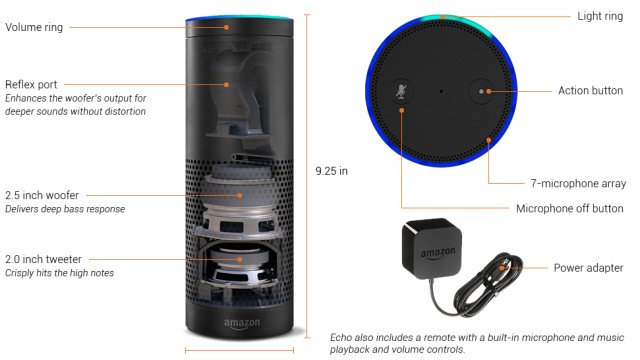
They save articles and videos for later.

From a video to a podcast to a survey, effective people know that a quick run through your inbox can turn into an hour or more lost productivity if you start following email rabbit holes. Put a time limit on how long you can spend going through your email. (Many of my clients set an alarm.) Wait to watch videos, read that article, or do other learning until you have some time set aside for such activities by keeping a “to watch/read” later list or folder or by using a service like Pocket. When you are in your inbox, you should only be doing one thing: answering emails.

They aim for a 24-hour turnaround.

If you reply within about 24 hours, you’re still being professional and many issues get sorted out without you. Recognize when the pressure to reply is real and required for things to get done, and when it is all in your head to “appear” responsive. Your career will be made on your ability to get things done, not your ability to answer emails immediately.

They use standard responses.

Text expanders are tremendously useful tools that you can use to quickly reply to emails that need a simple standard response (some text expanders for OSX are available here, here, and here). Text expanders, which are simple to use and inexpensive, allow you to type a two- or three-letter abbreviation that will expand to phrases like “Thanks! All the best, Elizabeth” or “I’ll take a look at the material and get back to you soon. Regards, Elizabeth.” You can also have entire paragraphs of text show up for commonly needed responses. This can cut down answering time from minutes to seconds.

They make answering tough emails an item on their to-do list.

Most of us work best when focusing on a single task for 45 minutes at a time and taking a short break afterward. For those emails that really do need you to reply but require some extra time, make them into a to-do item for later in the day. That way, you can quickly clean out your inbox (focusing on a single task) and then later come back to the messages that need 20 minutes or more for a thoughtful reply (again, a single task).

When possible, they bypass email all together.

If you find that the response would end up being too long by email, pop over to someone’s desk for a face-to-face chat or give them a call. A five-minute conversation can straighten out an issue that could have led to an extended email debate that would have disrupted an entire day. Particularly when emotions, miscommunication, and/or complex coordination are involved, consider transferring the discussion from email to another mode of discourse.

This article was originally published on 99u.com.

iPad könnte für Apple relevanter als iPhone werden

Vergleicht man den Verlauf der Einnahmen aus Apples iPad-Verkäufen der vergangenen Jahre, so fällt auf, dass sie sich ähnlich verhalten wie der Kursverlauf der Apple-Aktie. Auf diese Korrelation hat Mark Glassman von Bloombergs Businessweek hingewiesen.

Die Übereinstimmung erreicht 68 Prozent – im Vergleich dazu liegt sie zwischen iPhone-Verkäufen und Aktienkurs nur bei 62 Prozent, bei den Macs sogar nur bei 40 Prozent.

pie

Für Börsenexperten und Anleger stellt diese Beobachtung eine äußerst verwertbare Information dar, die durchaus eine Grundorientierung auch für alle anderen bietet, die sich nicht sicher sind, wann sie am besten ihre Apple-Aktien kaufen oder loswerden sollten.

Einen weiteren guten Anhaltspunkt bietet natürlich auch die Verkaufszahl der jeweils einzelnen Einheiten an iPhones, iPads und Macs, wobei hier das iPhone – das etwa die Hälfte aller Apple-Einkünfte ausmacht – klar vorn liegt: mit 77-prozentiger Korrelation zum Aktienkurs, wohingegen die iPad-Verkaufszahl nur zu 68 Prozent dem Kursverlauf entspricht. Diese 68 Prozent sind wiederum viel angesichts der Tatsache, dass das iPad-Geschäft lediglich 20 Prozent der Gesamteinnahmen Apples ausmacht. Dies sind derzeit jedoch stolze 30,9 Milliarden Dollar. Dieser Wert ist größer als der Gesamtumsatz bei 419 Unternehmen des S&P 500 Index.

pie

Kurz gefasst heißt das für den Anleger: eine klare Kaufempfehlung, wenn die iPhone-Verkaufszahlen und die iPad-Einkünfte ansteigen. Am 22. Oktober soll Apple die nächste Generation von iPads und iPad minis vorstellen, sechs Tage später wird das Unternehmen dann seine Bilanz für das vierte Quartal präsentieren. Und mit dem erst danach beginnenden Verkauf der neuen Tablets geht auch die Arbeit der Statistiker und Analysten, die den Erfolg oder Misserfolg des Geschäfts messbar aufbereiten, in die nächste Runde.

Quelle: http://www.macerkopf.de/2013/10/16/ipad-koennte-fuer-apple-relevanter-als-iphone-werden/