Facebook is starting to analyse users‘ posts and messages with sophisticated new artificial intelligence (AI) software — and that could have worrying implications for Google.
On Wednesday, the social networking giant announced DeepText — „a deep learning-based text understanding engine that can understand with near-human accuracy the textual content of several thousands posts per second, spanning more than 20 languages.“
DeepText is powered by an AI technique called deep learning. Basically, the more input you give it, the better and better it becomes at what it is trained to do — which in this case is parsing human text-based communication.
The aim? Facebook wants its AI to be able to „understand“ your posts and messages to help enrich experiences on the social network. This is everything from recognising from a message that you need to call a cab (rather than just discussing your previous cab ride) and giving you the option to do so, or helping sort comments on popular pages for relevancy. (Both are examples Facebook’s research team provides.)
The blog post doesn’t directly discuss it, but another obvious application for this kind of sophisticated tech is Google’s home turf — search. And engineering director Hussein Mehanna told Quartz that this is definitely an area that Facebook is exploring: „We want Deep Text to be used in categorizing content within Facebook to facilitate searching for it and also surfacing the right content to users.“
Search is notoriously difficult to get right, and is a problem Google has thrown billions at (and made billions off) trying to solve. Is someone searching „trump“ looking for the Presidential candidate or playing cards? Does a search for the word „gift“ want for ideas for gifts, or more information about the history of gifts — or even the German meaning of the word, poison? And how do you handle natural-language queries that may not contain any of the key words the searcher is looking for — for example, „what is this weird thing growing on me?“
By analysing untold trillions of private and public posts and messages, Facebook is going to have an unprecedented window into real-time written communication and all the contexts around it.
Google has nothing directly comparable (on the same scale) it can draw upon as a resource as to train AI. It can crawl the web, but static web pages don’t have that real-time dynamism that reflect how people really speak — and search — in private conversations. The search giant has repeatedly missed the boat on social, and is now trying to get onboard — very late in the game — with its new messaging app Allo. It will mine conversations for its AI tech and use it to provide contextual info to users — but it hasn’t even launched yet.
Facebook has long been working to improve its search capabilities, with tools like Graph Search that let the user enter natural language queries to find people and information more organically: „My friends who went to Stanford University and like rugby and Tame Impala,“ for example. And in October 2015, it announced it had indexed all 2 trillion-plus of its posts, making them accessible via search.
Using AI will help the Menlo Park company not just to index but to understand the largest private database of human interactions ever created — super-charging these efforts.
What’s happening is pretty simple. The hardware and the software running on any device itself have become way less interesting than the web apps and services, like the ones that Google and Amazon have made the core of their business.
Why buy a $700 iPhone when a $200 Android phone can access the same YouTube or Amazon Music as everyone else? All you need to do to get new Facebook features is refresh your browser or update your app. You don’t need a high-performance device to participate in the 21st century.
It’s a stark contrast with the traditional model for consumer electronics, where you’re expected to upgrade the hardware to keep pace with the new features they release.
And it could be a dire omen for high-margin hardware companies like Apple.
Meanwhile, web-first companies like Amazon and Google are more than happy to exploit this, even as our notions of what a computer actually is continue to shift. Just look at devices like Google Chromecast and the Amazon Echo.
The real brilliance of the Chromecast lies in what it isn’t, rather than what it is. It doesn’t have an interface of its own. You just push a button on your phone and have whatever YouTube video you’re watching or Spotify album you’re listening to appear on your TV screen.
A nice side effect: It’s relatively simple to take an existing smartphone app and add Chromecast streaming capabilities, and literally tens of thousands of apps have done that integration.
You don’t have to think about it or learn a new interface; you just click and go.GettyAmazon VP of Echo Mike George.
It means that every single day, I get more return on the initial $35 investment in the Chromecast I bought in 2014. But since all of the good stuff is happening in the apps, not the Chromecast itself, it’s extremely unlikely that I will ever have to replace this Chromecast, barring a hardware malfunction.
You could probably say the same thing about the Amazon Echo home voice assistant. Developers have released almost 1,000 „skills“ for the Amazon Echo’s Alexa platform, including the ability to call an Uber, play Spotify music, or order a Domino’s pizza.
These gadgets are getting better, not worse, the longer they stay on shelves. And while there may be periodic minor hardware improvements, they’re way more minor than the gap between an iPhone 5 and an iPhone 6, and far less necessary to keep getting maximum value from the device.
The pressure is on
This move is going to keep putting pressure on hardware-first manufacturers — especially those who rely on high margins, like Apple.
The Chromecast and the Echo are relatively cheap gadgets — because all the important, useful stuff about them lives in the cloud, they’re optimized to be small, efficient, and unobtrusive.
TeslaTesla’s autopilot mode scanning the road.
Amazon doesn’t need to make money on the Echo itself, as long as it drives more commerce to its retail business. Same with Google: as long as the Chromecast gets more people to watch YouTube videos and download more stuff from Google Play, they don’t have to make money from the gadget itself.
This trend isn’t going to kill off the smartphone, or the PC, or the tablet. But it means lower-cost gadgetry that lasts a lot longer. We’re only seeing the early stages of this shift now, but it has a lot of potential to shake up how we think about and how we buy our devices.
The art of asking questions is the source of all business success.
Whether you’re running a business, an aspiring entrepreneur, or somebody with big dreams, achieving requires that you have goals, plans, and a way to hold yourself accountable. If you really want to stay on track, a weekly check-in can be a valuable tool.
Spend some time every week with these important questions and keep your momentum going!
1. What did I learn from last week? If you’re determined to learn, no one can stop you. If you’re unwilling to learn, no one can help you.
2. What was my greatest accomplishment last week? Every accomplishment gives you a win, lending you confidence and motivation.
3. What have I struggled with in the past that might affect the upcoming week? Today’s struggle is developing the strength you need for next week.
4. What’s the first thing I want to accomplish this week? If you know your number one goal, you can spend your time concentrating on your priority.
5. What can I do right now to make this week go well? Good planning makes your odds of success much higher.
6. What can I do right now to make the week less stressful? If you know what stresses you out and you see what’s on the horizon, you can brace yourself for pressure.
7. What was the last week’s biggest waste of time? Identify the useless things that take up your time so you can avoid them.
8. How will I make sure that what I want to achieve gets done? What can you do this week to make sure you’re moving toward your goals? Make a plan for the groundwork to be in place.
9. Why is this something I want to achieve? Staying in touch with your why leads you naturally to your how and what.
10. Have I been sabotaging myself? Keep a careful watch out for your inner saboteur. Don’t let it set you back or slow you down.
11. What have I been putting off? Everyone procrastinates–but what do you really need to get started on?
12. What opportunities are still on the table? Try not to let an important opportunity get past you.
13. What do I want to change? Stay committed to your goals but flexible in your approach.
14. What steps are complete? Arriving at one goal is the starting point to another.
15. Is there anything more I need to be doing? Anything you haven’t already tried is fair game. You never know!
16. What do I think is stopping me? Forget all the reasons it won’t work and believe the one reason it will.
17. What roadblocks do I expect? Plan your detours in advance and a roadblock is no big deal.
18. What obstacles are getting in the way of my success? Remember, obstacles are the things you see when you take your eyes off your goal.
19. What should I be doing differently? Don’t be afraid of looking for a better way. Be afraid of not exploring anything new.
20. How am I making an impact? Are you doing what you were born to do?
21. What am I most grateful for? Even in the darkest hour, here is always something to be thankful for.
22. Is there anyone I need to thank? Who do you need to appreciate and acknowledge?
23. How will I know I’ve achieved success? Success is not the key to happiness; happiness is the key to success. If you love what you’re doing you will be happy AND successful.
24. What am I looking forward to? The answer to this question will get you motivated for next week and help you stay energized.
Spend some time with yourself every week taking stock, and you’ll never feel out of touch with where you are, where you want to be, and what you need to be doing.
After years in the labs, artificial intelligence (AI) is being unleashed at last. Google, Microsoft and Facebook have all made their own AI APIs open source in recent months, while IBM has opened Watson (pictured above) for business and Amazon has purchased AI startup Orbeus. These announcements have not drawn much media attention, but are hugely significant.
„In the long run, I think we will evolve in computing from a mobile-first world to an AI-first world,“ says Google CEO Sundar Pichai. What does the appearance of AI bots and machine learning on the open market mean for business, IT, big data, and for sellers of physical hardware?
What’s happening to the major AI platforms?
The AI APIs now opening up are essentially free platforms on which companies can build incredibly powerful analytics tools. „These hugely powerful tools, used, developed and backed by the world’s most advanced technology companies, are now available to anyone with the skills to use them,“ says Matt Jones, Senior Analytics Project Manager at analytics and data science company Tessella.
He continues: „Using these toolkits, individually or combined, anyone can integrate transformational AI or machine learning platforms – which are as sophisticated as anything currently on the market – to their business on a pay as you go, or free basis.“ The tech industry – and digital business in general – is on the cusp of something very big.
Google, Microsoft and Facebook
It may have announced plans for its Google Home speaker-assistant to rival Amazon’s Echo in ’smart‘ homes, but the search engine giant has much bigger plans for AI. Part of Google since January 2014, DeepMind’s AlphaGo neural network beat mankind at the ancient Chinese game of Go recently. DeepMind is the main attraction on TensorFlow a deep learning framework that Google made open source in 2015.
Meanwhile, Facebook is focused on developing its M bot platform that should see its Messenger app flooded with third-party apps that let companies and their customers execute tasks on the platform, such as paying bills, making bank transfers, and even ordering an Uber ride. The Facebook M virtual assistant will follow.
And over at Redmond, Microsoft Cognitive Services and the Microsoft Bot Framework is aimed at getting developers to create AI-powered apps and bots that work on everything from Skype and Office 365 to Slack and SMS.
Watson on the cloud
The existence and planned expansion of IBM’s cloud-based cognitive computing platform is well known, and Big Blue offers its Watson API on a ‚freemium‘ basis.
Around 80,000 developers have accessed the Watson collection of APIs since 2013 through a dedicated cloud platform that IBM is calling ’self-service artificial intelligence‘. It’s designed to help coders, data scientists and analysts create apps that tap into the power of the Watson supercomputer for prediction, natural language processing, and much more. Machine learning and text analytics will also soon be on the menu from IBM’s Watson Knowledge Studio.
Image recognition
While some invest in AI, others are making acquisitions to catch up. While IBM’s Watson has a new Visual Recognition API and Google’s image recognition is well known, Apple recently purchased ‚emotion measurement‘ (i.e. face recognition) company Emotient. Meanwhile, Amazon bought a deep learning neural networks startup called Orbeus, whose ReKognition API specialises in photo recognition, too.
Open season for developers
With the arrival on the cloud of high-power cognitive platforms, it’s open season for app developers, who are expected to use the fruits of AI to unleash better and better apps.
„IBM Watson, Google DeepMind and the like are incredibly high-power cognitive platforms that are enabling developers to do really interesting projects,“ says Frank Palermo, Executive Vice President of Global Digital Solutions at global IT services company VirtusaPolaris. „It’s great they are now making these cognitive platforms readily accessible – particularly for researchers and others scientific pursuits, but also for knowledge workers across all industries.“
Elon Musk is getting involved in AI, too, by supporting OpenAI, a non-profit research company focused on advancing digital intelligence for the common good. „Elon Musk has launched the OpenAI project with a star-studded list of backers – Palantir CEO Peter Thiel, LinkedIn founder Reid Hoffman and Y Combinator president Sam Altman,“ says an impressed Jones.
OpenAI is headed up by machine learning expert Ilya Sutskever, ex-Google Brain Team member, and has just opened the OpenAI Gym in beta to help developers working with ‚reinforced learning‘, a type of machine learning that’s central to AI. Essentially, it’s about getting software to alter its behaviour in a dynamic environment in order to get a reward (you can’t give Siri a biscuit every time she ‚found this on the web‘).
What does this mean for the IT industry?
The arrival of AI means a changing of the guard in the tech industry, with disruption, innovation – and the complete domination of the cloud. Standalone data analytics platforms? No need. Expensive infrastructure? Ditto. Expertise, not investment, will become king. That, and superfast broadband.
„It will ultimately help to drive innovation and growth, and we could see new business models emerge,“ says Palermo, who thinks that Amazon’s entry into the AI market is especially interesting given the unbridled success of Amazon’s AWS.
„As with cloud before it, Amazon may start renting time on Orbeus by the hour so that knowledge workers can work on a specific project,“ he adds. „This will help to normalise the use of AI and cognitive capabilities and greatly enhance our ability to process information.“ However, reshaping computing does mean some pain-points.
The death of the black box
You need computing power and analytics? AI APIs have the answer. „Any task currently performed by a costly black box AI platform, such as identifying where to drill for oil, predicting disease outbreaks, optimising scientific experiments to develop new products, and predictive maintenance, can now be done in-house,“ says Jones. Crucially, a business using these AI APIs will maintain complete control and oversight of its data.
How disruptive could AI APIs be?
Very. The kind of expertise most companies – especially startups – only dreamed of will be available instantly, online, 24/7. Accessing the world’s most advanced computers via these open platforms will cost only the price of a data scientist’s salary or consultancy fee. „This is very important for a lot of the world’s businesses, and they need to take it seriously,“ says Jones. „If its true potential is realised, it will unleash a new generation of innovative startups that apply the latest AI techniques to disrupt the establishment.“
The intelligent future
For industries already migrating to the cloud at an alarming rate, AI raises the stakes even further. We already inhabit a world where the cloud’s scalable storage has enabled startups like Twitter, Spotify, Netflix and WhatsApp to challenge entrenched big players. By making the very latest AI open source and available to all online, the likes of Google, Facebook, Amazon and IBM could help create a new wave of businesses that harness data. That puts data analytics platforms, pricey IT infrastructure and storage devices on borrowed time.
The headline data out of China hasn’t exactly been comforting of late. The country is grappling with the challenges of slowing GDP growth, rising debt levels, and volatile stock markets, to name just a few. But if the macroeconomic statistics seem bleak, the picture is brighter among the country’s entrepreneurial class. The quality of Chinese innovation is increasing, the funding environment is improving, particularly for early-stage companies, and the Chinese government is doing everything it can to make China Inc. a force to be reckoned with.
It should come as no surprise that a large portion of recent Chinese startups is aimed squarely at the country’s rapidly expanding middle class. The number of middle-class adults in China has grown by more than half since 2000, to a total of 109 million, more than the 105 million in all of North America, according to Credit Suisse’s 2015 Global Wealth Report. And their spending power has increased even more: Middle-class wealth jumped more than seven-fold during that time, from $1.7 billion to $7.3 billion. What Chinese people eat, drink, and wear, where they travel, and what they do for entertainment “will be the driving force of consumption in the next decade,” Michelle Leung, founder and CEO of Xingtai Capital Management, said at Credit Suisse’s 2016 Asian Investment Conference (AIC) in April.
Internet giants Baidu, Alibaba, and Tencent were at the head of the first generation of Chinese startups to successfully target the country’s burgeoning middle class. All three continue to build their businesses by rolling out new e-commerce, social media, and mobile payment products and services to middle-class consumers. While their size and momentum make them formidable adversaries to any startup seeking to compete with them, their collective success has also made it easier for startups when it comes to one key variable: capital. Whereas the Internet pioneers had to go overseas to scrounge up funding, today’s Chinese entrepreneurs are awash in both foreign and domestic capital. That kind of change brings its own challenges, including rising concern about high valuations and liquidity risk, but those are high-class problems when compared to no capital whatsoever.
Thomson ReutersSignage for Alibaba Group Holding Ltd. covers the front facade of the New York Stock Exchange
Early-stage funding has never been anywhere near as plentiful in China as it has been in the U.S. or Europe. A decade ago, it was positively scarce. Ramakrishna Velamuri, professor of entrepreneurship at the China Europe International Business School in Shanghai, says that when he first came to China in 2007, many so-called venture capital firms acted more like private equity firms, buying out companies instead of taking minority stakes. But that’s changing. While there is still more capital seeking to fund later-stage companies, a slew of domestic and foreign investors at the seed and angel stages has begun to emerge. “It’s been like a gold rush,” says Velamuri. “Lots of people who made money in real estate investments or in businesses have decided to become investors.”
Wu Yibing, head of the Singaporean sovereign wealth fund Temasek’s China business, says the fund believes strongly in Chinese innovation and has begun investing more aggressively in the country’s startups as a result. “Increasingly, to capture the China innovation theme, we are moving to earlier stages,” he says. By investing earlier on, he said, “you will be there with them when they become Didi Chuxing (a ride-sharing service) or Alibaba – and when that happens, they’ll be very expensive.”
The Chinese government has played an important role in the changes in the funding environment. Some 780 state-backed venture capital funds raised $231 billion in 2015, tripling the amount of assets under management in just a single year, to a total of $338 billion. While that money is also available for later-stage financings, such as a $4.5 billion fundraising round for Ant Financial, Alibaba’s financial services spinoff, the funds are squarely aimed at shoring up seed-stage and angel investing in China. And there’s even help before the money comes: Since it began its campaign to support entrepreneurship in 2014, the government has also opened 1,600 high-tech incubators for startups.
The flood of investor interest in Chinese startups has pushed up valuations to a degree that has begun to concern some investors, however. At the Credit Suisse 2016 Asian Investment Conference (AIC) in April, Wu compared China’s frothiness to that of Silicon Valley. At the same time, he noted a concurrent consolidation trend that has helped justify at least some of those valuations. The 2015 merger of ride-sharing apps Didi Dache and Kuaidi Dache into Didi Chuxing, for example, positioned the company to receive a $1 billion investment from Apple in May.
Reuters/Jason Lee
If the funding environment has improved dramatically, the same cannot yet be said for its flipside: liquidity. Stock markets have been volatile over the last 12 months, and the Chinese government has repeatedly banned IPOs for extended periods. December 2013 marked the end of a 15-month freeze, while 2015 saw a five-month shutdown between July and early November. Zhang Yichen, Chairman and CEO of China-focused private equity fund CITIC Capital Holdings, said at the AIC that his company focuses on buyouts primarily to control the exit strategy. When firms the company invests in do go public, Zhang said, CITIC typically tries to sell enough stock to pre-IPO funds before the offering to make back their money – just in case. Velamuri also points out that liquidity has been helped by China’s hot M&A market. In 2015, the Internet conglomerates Baidu, Alibaba, and Tencent invested $29 billion between them to acquire or take minority stakes in 134 firms.
For public-market equities investors seeking a piece of the startup action in China, the primary and secondary markets each present their own challenges. In the primary market, the number of promising startups is growing, but it’s still exceedingly difficult to pick winners and losers in a market as brutally competitive as China’s. And in the secondary market, it’s the usual story—too much money chasing too few success stories. Vincent Chan, Credit Suisse’s Head of China Research, notes that traditional industries such as banks and commodities companies still dominate Chinese public markets, while newer, high-growth sectors such as technology, communications, and media are tiny by comparison. “You end up with people paying a very high multiple for companies with a relatively small earnings base,” he says.
When the amount of capital available to fund promising startups shifts from not enough to more than enough, the challenges shift too. Today, liquidity and valuation risks are increasing for entrepreneurs and investors alike in China. But that’s also better than the alternative, which is no money available at all. For the time being, money is flowing, the Chinese government has committed to innovation as a national policy, M&A provides a viable exit route, and Chinese consumers are eager for the next, new thing. Whether this will prove another golden era for entrepreneurialism in China, only time will tell, but in the meantime, China’s startups are too busy figuring out new ways to cater to a fast-growing consumer base to worry about it. To find out more about China’s increasingly innovative startups, read our companion story here.
Ken Segall, who worked alongside the tech giant’s co-founder, says company’s incredible growth was rooted in his love of simplicity – but things have changed
Steve’ Jobs’ vision, strength and charisma made him the benevolent dictator – able to align all the forces within Apple. Photograph: Sipa Press/Rex Features
Four years ago, I wrote a book about Apple and the power of simplicity. It was the result of my observation, having worked with Steve Jobs as his ad agency creative director in the “think different” years, when Apple’s stellar growth was rooted in Steve’s love of simplicity.
This love – you might call it obsession – could be seen in Apple’s hardware, software, packaging, marketing, retail store design, even the company’s internal organization.
But that was four years ago.
Though Apple’s customers remain fiercely loyal, the natives are getting restless. A growing number of people are sensing that Tim Cook’s Apple isn’t as simple as Steve’s Apple. They see complexity in expanding product lines, confusing product names, and the products themselves.
Is this just perception, or is it reality? Has Apple developed a problem with simplicity? Or is it simply maturing as one should expect from a global company? It’s difficult to be objective because Apple has become the world’s most overanalyzed company. It’s created passionate fans and passionate detractors.
My experience with Steve has led me to admire Apple – but I also believe in tough love. This is a good time to put emotions aside and take a cold, hard look at Apple’s current “state of simplicity”.
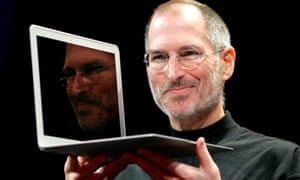
Steve Jobs holds up the MacBook Air at a conference in 2008. Photograph: Jeff Chiu/AP
First, we need to get one critical fact out of the way: Steve Jobs cannot be replaced. He had the credibility of the founder, extraordinary instinct, vision and energy, and he could make things happen by sheer force of will. It’s just not possible for Apple to be the same without him – but it can still succeed.
Tim Cook has a different style. Remember, he was handpicked by Steve to be Apple’s next leader, and he certainly knows how to make Apple run efficiently. He also recognizes that he doesn’t have Steve’s many talents, so he relies on the expertise of others in those areas where he is less experienced – such as product design and marketing.
That’s where things get a little more complicated. Steve’s vision, strength and charisma made him the benevolent dictator – able to align all the forces within Apple. That kind of performance doesn’t come as naturally to Tim.
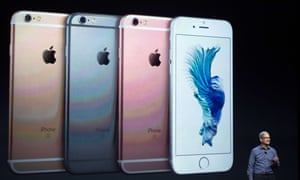
Apple CEO Tim Cook introduces the iPhone 6S last year. Photograph: Josh Edelson/AFP/Getty Images
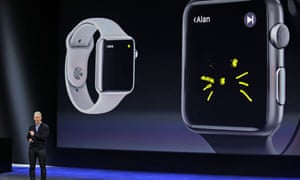
Apple now sells three different iPhones, four different iPads and three different MacBooks. The Apple Watch comes in seemingly infinite combinations of sizes and bands. The Apple universe is exploding with complexity! Or is it?
One could easily argue that a watch is a fashion product, so the decision here makes sense. And there is ample precedent for Apple expanding existing product lines. The original iPod, for example, successfully grew into a family of products.
Markets mature. A bigger audience has more diverse needs. If Apple were to ignore those needs, they would only force customers to go elsewhere. (As they did for several years by not making a big-screen iPhone.)
So, yes, Apple’s product lines have become more complicated. But really, are they that complicated? The company’s entire selection of products can easily fit on an average-size table. When a company cares about simplicity, it offers the right choices – not endless choices.
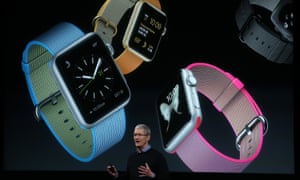
Cook speaks about the Apple Watch at the Apple headquarters earlier this year in Cupertino, California. Photograph: Justin Sullivan/Getty Images
Critics have had a field day complaining about the growing complexity of Apple software. Apple Music has been attacked mercilessly, and deservedly so. I personally find parts of it to be bewildering.
Apple’s ability to make software solid and simple has come under attack from a number of normally pro-Apple sites. Not that it excuses Apple, but many forget that such lapses also happened on Steve’s watch. He famously went ballistic over the flawed launch of Apple’s early cloud effort called MobileMe.
The fact is, even the best of companies make mistakes from time to time. What’s alarming the Apple crowd today is that the flaws and complexities now seem to be creeping into the products more frequently.
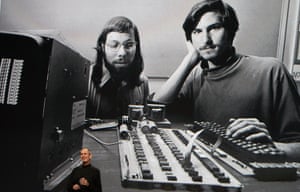
Steve Jobs speaks during an Apple event in 2010 – with a photo of him and Steve Wozniak in the background. Photograph: Justin Sullivan/Getty Images
Once upon a time, Apple’s product naming was extremely simple. Computers were Macs and consumer products were i-devices.
Now the consumer products are offered as i-things and Apple-things (Apple Watch, Apple Pay, Apple Music). But we’ll give Apple a pass on this one because the i is obviously on its last legs, and a transition like this doesn’t happen overnight.
I’m less forgiving when it comes to iPhone naming. With the current models consisting of iPhone 6S, iPhone 6S Plus and SE, Apple’s naming scheme is becoming noticeably less simple.
Then there’s the issue of the S. For some reason, Apple has decided that every other year, it should just add an S to the current model number, because the S-year improvements are internal only. So Apple’s own actions have served to train the public that S years are the “off years”. This is an absurdity, given that such revolutionary features as Siri, Touch ID and 64-bit processing have all been introduced in S models.
The S naming has only served to confuse customers, and make it significantly more difficult for marketing to do its job.
Complicated, yes. But bear in mind that Steve is the guy who started iPhone with the S-names in the first place.
A pedestrian passes a wall covered with Apple iPod advertisements in 2005. Photograph: Justin Sullivan/Getty Images
Apple has a lengthy, award-winning history in advertising. Even marketers in other industries have long considered Apple ads to be the gold standard.
This isn’t because Steve Jobs created great ads himself – it’s because he was adament about keeping the process simple. He trusted a small group of smart people at his longtime ad agency and he was actively involved in the process, week to week.
There were no middlemen, no multiple levels of approvals, and no focus group research. Trust me, few companies on earth work this way. It was Steve’s way of keeping complexity at bay.
With Steve’s passing, things changed dramatically. Apple is building a large in-house marketing group. Teams compete to produce new campaigns. More people are involved. In short, Apple is now managing its marketing more like a big company and less like a startup.
Cook explains the features of the new Apple Watch last year. Photograph: Eric Risberg/AP
I have zero doubt that Apple believes deeply in the power of simplicity. Simplicity is at the heart of the company’s products and the foundation of its vision for the future.
But simplicity is a matter of perception, and it’s hard to ignore the fact that Apple is struggling to present a simple image to its customers.
There is serious work to be done in rebuilding the perception of simplicity that helped Apple become the world’s most valuable company. Existing problems need fixing, as do the internal processes that have allowed complicated products to make it into the hands of customers.
That said, it’s important to put Apple’s issues in context. Despite its current challenges – and its lapses – I don’t see any other technology creating a simple experience as well as Apple.
We live in a complicated world, and the companies that deliver simplicity are the ones who win in the end.
Artificial intelligence could put more than half the planet’s population out of a job, a computer scientist says. Photograph: Science Picture Co./Corbis
Machines could put more than half the world’s population out of a job in the next 30 years, according to a computer scientist who said on Saturday that artificial intelligence’s threat to the economy should not be understated.
Expert Moshe Vardi told the American Association for the Advancement of Science (AAAS): “We are approaching a time when machines will be able to outperform humans at almost any task.
“I believe that society needs to confront this question before it is upon us: if machines are capable of doing almost any work humans can do, what will humans do?”
Physicist Stephen Hawking and the tech billionaires Bill Gates and Elon Musk issued a similar warning last year. Hawking warned that AI “could spell the end of the human race” and Musk said it represents “our biggest existential threat”.
The fear of artificial intelligence has even reached the UN, where a group billing itself the Campaign to Stop Killer Robots met with diplomats last year.
Vardi, a professor at Rice University and Guggenheim fellow, said that technology presents a more subtle threat than the masterless drones that some activists fear. He suggested AI could drive global unemployment to 50%, wiping out middle-class jobs and exacerbating inequality.
Unlike the industrial revolution, Vardi said, “the AI revolution” will not be a matter of physically powerful machines that outperform human laborers, but rather a contest between human wit and mechanical intelligence and strength. In China the question has already affected thousands of jobs, as electronics manufacturers, Foxconn and Samsung among them, develop precision robots to replace human workers.
In his talk, the computer scientist alluded to economist John Maynard Keynes’ rosy vision of a future in which billions worked only a few hours a week, with intelligent machines to support their easy lifestyles – a prediction embraced wholesale by Google head of engineering Ray Kurzweil, who believes “the singularity” of super-AI could bring about utopia for a future hybrid of mankind.
Vardi insisted that even if machines make life easier, humanity will face an existential challenge.
“I do not find this a promising future, as I do not find the prospect of leisure-only life appealing,” he said. “I believe that work is essential to human wellbeing.”
Computer scientist Bart Selman told reporters at the conference that as self-driving cars, “household robots, service robots” and other intelligent systems become more common, humans will “sort of be in a symbiosis with those machines, and we’ll start to trust them and start to work with them”.
Selman, a professor at Cornell University, said: “Computers are basically starting to hear and see the way humans do,” thanks to advances in big data and “deep learning”.
Vardi predicted that driving will be almost fully automated in the next 25 years, and asked, for all the benefits of technology, “what can humans do when machines can do almost everything?”
He said that technology has already massively changed the US economy in the last 50 years. “We were all delighted to hear that unemployment went down to 4.8%” this month, he said, “but focusing on the monthly job report hides the fact that for the last 35 years the country has been in economic crisis.”
Citing research from MIT, he noted that although Americans continue to drive GDP with increasing productivity, employment peaked around 1980 and average wages for families have gone down. “It’s automation,” Vardi said.
He also predicted that automation’s effect on unemployment would have huge political consequences, and lamented that leaders have largely ignored it. “We are in a presidential election year and this issue is just nowhere on the radar screen.”
He said that virtually no human profession is totally immune: “Are you going to bet against sex robots? I would not.”
Last year, the consultant company McKinsey published research about which jobs are at risk thanks to intelligent machines, and found that some jobs – or at least well-paid careers like doctors and hedge fund managers – are better protected than others. Less intuitively, the researchers also concluded that some low-paying jobs, including landscapers and health aides, are also less likely to be changed than others.
In contrast, they concluded that 20% of a CEO’s working time could be automated with existing technologies, and nearly 80% of a file clerk’s job could be automated. Their research dovetails with Vardi’s worst-case scenario predictions, however; they argued that as much as 45% of the work people are paid to do could be automated by existing technology.
Vardi said he wanted the gathering of scientists to consider: “Does the technology we are developing ultimately benefit mankind?
“Humanity is about to face perhaps its greatest challenge ever, which is finding meaning in life after the end of ‘in the sweat of thy face shalt thou eat bread’,” he said. “We need to rise to the occasion and meet this challenge.”
In the US, the labor secretary, Thomas Perez, has told American seaports that they should consider robotic cranes and automatic vehicles in order to compete with docks around the world, despite the resistance of unions. In 2013, two Oxford professors predicted that as much as 47% of the US workforce, from telemarketers to legal secretaries and cooks, were vulnerable to automation.
Dire forecasts such as Vardi’s are not without their critics, including Pulitzer-winning author Nicholas Carr and Stanford scientist Edward Geist. Carr has argued that human creativity and intuition in the face of complex problems is essentially irreplaceable, and an advantage over computers and their overly accurate reputation.
Walking the line between the pessimists and optimists, Martin Ford, author of Rise of the Robots: Technology and the Threat of a Jobless Future, has suggested that automation will come down to politics today, telling National Geographic that if scientists and governments don’t address the issue “for lots of people who are not economically at the top, it’s going to be pretty dystopian”.
A data-driven look at the link between the strategic moves of new CEOs and the performance of their companies highlights the importance of quick action and of adopting an outsider’s perspective.
The success of CEOs is deeply linked to the success of the companies they lead, but the vast body of popular literature on the topic explores this relationship largely in qualitative terms. The dangers of these approaches are well known: it’s easy to be misled by outliers or to conclude, mistakenly, that prominent actions which seem correlated with success were responsible for it.
We tried to sidestep some of these difficulties by systematically reviewing the major strategic moves (from management reshuffles to cost-reduction efforts to new-business launches to geographic expansion) that nearly 600 CEOs made during their first two years in office. Using annualized total returns to shareholders (TRS), we assessed their companies’ performance over the CEOs’ tenure in office. Finally, we analyzed how the moves they made—at least those visible to external observers1 —and the health of their companies when they joined them influenced the performance of those companies.2
The results of this analysis, bolstered by nearly 250 case studies, show that the number and nature of the strategic moves made by CEOs who join well- and poorly performing companies are surprisingly similar. The efficacy of certain moves appears to vary significantly across different groups of companies, however. What’s more, the sheer number of moves seems to make a difference, at least for CEOs who join poorly performing companies. Also, external hires appear to have a greater propensity to act.
These findings have important practical implications for new CEOs and the boards that hire them: focus early on a few bold moves well suited to the context of your company, and recognize the value of the outsider’s perspective—whether or not you are one.
Surprising similarities
The starting point for our analysis was a group of nearly 600 CEOs who left S&P 500 companies from 2004 to 2014 (identified in the annual CEO Transitions report produced by Spencer Stuart, the global executive-search and leadership-consulting firm).3 For each CEO’s first two years, we gathered information—from a range of sources, including company reports, investor presentations, press searches, and McKinsey knowledge assets—on nine strategic moves that chief executives commonly make.
We expected that CEOs taking the helm at poorly performing companies, feeling compelled to do something to improve results, would have a greater propensity to make strategic moves than those who joined well-performing organizations. To learn whether this idea was true, we looked at how each company had been performing relative to its industry counterparts prior to the new CEO’s arrival and then subdivided the results into three categories: well-performing, poorly performing, and stable companies.4 When we reviewed the moves by companies in each of these categories, we found that new CEOs act in similar ways, with a similar frequency, whether they had joined well- or poorly performing organizations. CEOs in different contexts made bold moves—such as M&A, changing the management team, and launching new businesses and products—at roughly the same rate (Exhibit 1).
Exhibit 1
Contextual contrasts
Although new CEOs transitioning into companies that have been performing well and CEOs transitioning into companies that have been performing poorly make similar moves with a similar frequency, that doesn’t mean those moves are equally effective. We measured the performance of companies by excess TRS over a CEO’s tenure. At companies where chief executives made strategic moves early on, we found striking contrasts between organizations that had been performing well when the new CEO took charge and those that had been performing poorly:
Organizational redesign was correlated with significant excess TRS (+1.9 percent) for well-performing companies, but not for low performers.
Strategic reviews were correlated with significant excess TRS (+4.3 percent) for poorly performing companies but were less helpful for companies that had been performing well.
Poorly performing companies enjoyed +0.8 percent TRS when they reshuffled their management teams. But when well-performing companies did so, they destroyed value.5
We recognize that excess TRS CAGR does not prove a causal link; too many other variables, some beyond a CEO’s control, have an influence. But we do find the differences that emerged quite plausible. It stands to reason that troubled companies would enjoy special benefits from major overhauls of management or strategy. Organizational redesigns are challenging for all companies and may, in some cases, be premature for organizations in significant flux.6 Also plausible was the finding that cost-reduction programs appear to improve a company’s TRS relative to those of its counterparts for both well- and poorly performing organizations, though the effect is strongest for weak ones.
A final point on context is that the bar for top performance varies significantly by sector. In some, such as investment services and automotive, the TRS CAGRs of top-performing organizations with new CEOs are more than 16 percent above those of their industry counterparts. In other sectors, such as media and telecommunications, a CEO’s company must outperform the market by only a few percentage points to be classed in the top quintile. The implication is that new CEOs seeking to calibrate their starting points and to prioritize strategic moves should look beyond top-level performance metrics to understand what it will really take to beat the market.
Bold bouncebacks
We also sought to compare the number of major moves that new CEOs made in parallel at well- and poorly performing companies. Well-performing companies had no discernible pattern. But in poorly performing ones, CEOs who made four or more strategic moves at the same time during their first two years achieved an average of 3.6 percent excess annual TRS growth over their tenures. Their less bold counterparts in similarly bad situations could claim just 0.4 percent excess annual TRS growth.
These findings are in line with earlier McKinsey research7 showing how difficult it is to reach higher levels of economic profit without making substantial strategic or operational shifts. That has also been our own experience working with new CEOs on turnarounds.
Outside views
When the time comes to appoint a new CEO, corporate boards face a difficult question: promote an executive from within or choose an outsider? We turned our own lens to this issue and found that the performance of outsiders and insiders differed significantly. Externally appointed CEOs have a greater propensity to act: they were more likely to make six out of the nine strategic moves we examined. The size of the gap in frequency—in other words, the chance an external CEO would make a particular move minus the chance an internal CEO would do the same thing—was much greater for the moves external CEOs opted to make (Exhibit 2).
Exhibit 2
External CEOs almost certainly have a leg up when it comes to bold action. They are generally less encumbered by organizational politics or inertia than their internal counterparts. They may also be more likely to take an outside view of their companies. It’s no coincidence, in our view, that the strategic moves that have the largest gaps in the propensity to act include some of the most far-reaching ones: organizational redesign, for example, or geographic contraction.
Poorly performing companies are more likely to appoint external CEOs, and corporate performance tends to revert to the mean. But the TRS edge of outside hires was substantial: over their tenure, they outperformed their internally promoted counterparts by a margin of more than five to one—on average, a 2.2 percent excess TRS CAGR, compared with 0.4 percent.
Clearly, this performance differential is the result of multiple factors, and it’s important to note that new CEOs need not come from outside companies to cultivate an outsider’s mind-set—or to be successful in their role.8
While our results are averages across multiple organizations and industries, they do suggest a few principles for new CEOs:
Adopt an outsider’s mind-set. On average, external hires appear to make more moves during their early years. This doesn’t mean that insiders are the wrong choice for boards. But it does suggest that it’s critical for insiders to resist legacies or relationships which might slow them down and that approaches which help insiders adopt an outsider’s mind-set have great potential. Equally, there is value in having outsiders who can lean into the boldness that their status naturally encourages. Some executives have done so by creating new ways to assess a company’s performance objectively—for example, by taking the view of a potential acquirer or activist investor9 looking for weak spots that require immediate attention. Others have reset expectations for the annual allocation of resources, changed the leadership model and executive compensation, established an innovation bank, and looked for additional ways to bring an external perspective to the heart of the leadership approach.
Don’t follow the herd. On average, new CEOs make many of the same moves, regardless of starting point. They will do better, however, by carefully considering the context of their companies and leveraging more scientific ways to assess their starting points. For instance, some new CEOs take stock of the economic-profit performance of companies relative to that of their peers and, in light of the starting position, assess the odds that potential moves will pay off.10
When you’re behind, look at the whole playbook. On average, CEOs taking the helm at underperforming companies do better when they make more major strategic moves, not fewer. That doesn’t mean they should try to do everything at once, but it does suggest a bias toward boldness and action. Plan a comprehensive set of moves that will significantly improve your company’s performance, and make sure that you aim high enough.11
New CEOs take the helm with a singular opportunity to shape the companies they lead. The best ones artfully use their own transition into the CEO role to transform their companies. But this window of opportunity doesn’t last long. On average, an inflection point arrives during year three of a CEO’s tenure. At that point, a CEO whose company is underperforming is roughly twice as likely to depart as the CEO of an outperforming one—by far the highest level at any time in a chief executive’s tenure. During this relatively short window, fortune favors the bold.
Words are poor conveyers of meaning. Visualizing what a strategy looks like when successfully executed allows people to help make it a reality.
Words are poor conveyers of meaning. Pictures can be one of the most versatile tools in any leader’s toolbox. Michelangelo started the David in 1501 at the age of 26 and famously said: „I saw the angel in the marble and carved until I set him free.“ He was intensely focused on freeing the slumbering figures in the stone.
Similarly, Picasso was able to visualize and capture realism in his painting from a young age, and evolved so immensely throughout his career eventually co-founded the cubist movement.
For many of us, our best „artistic“ moments happen on a napkin sketch at the kitchen table or at a bar. We use images, lines, stars, circles and arrows to first capture an idea. Then share it with someone else. That person’s perspective and questions are what encourage us to revise the sketch and improve its clarity and meaning.
The conversation around our napkin art is what drives the a-ha moment, the excitement. You, as a leader, can use visualization and visual iteration to free the figures (or your people) slumbering within your organization, and drive innumerable a-ha moments.
Here are three ways to do just that:
1. Use visualization to create clear meaning
Pepsi’s leaders used visuals like this to help their people understand the rationale behind their changing business model.
Even the most common terms in strategic plans (words like operational excellence, customer centric, innovation, accountability, high performance, collaboration, vision) suffer from lack of meaning. Instead, define meaning with a picture. Have each member of your team draw a picture of what a high performance team looks like to them.
Compare the pictures. Then create a single image made up of the strongest elements of each person’s initial drawing. As a team, tell one story (accompanied by the picture) of what a high performance team means. Pictures drive common understanding in a way that words often cannot.
2. Use visualization to think in systems
Many of the most complex issues we face are systems issues. It is hard to understand a system unless we can see it. Consider systems such as how we make money, or how to execute our business model. It’s tough to imagine without a diagram.
One well-known manufacturer found itself with hundreds of millions of dollars painfully tied up in working capital. The company tried unsuccessfully to reduce this amount for two years.
Finally it used imagery, pictures and metaphors to illustrate where the money came from, where it went, and how much is left afterwards. The business engaged all of its people to better understand how its economic system worked. Within six months, the company had freed up $300 million of working capital. Pictures make invisible systems tangible.
3. Use visualization to frame a process
Customer acquisition, supply chain, and new product/ process development are just three examples of key business processes. Many process errors occur at the handoff points where clarity of workflow between departments and people is not always clear and co-owned.
Instead, visualize or blueprint a major process step by step and highlight the key handoffs that often become the „process busters“ for the most important processes in your organization.
If Aristotle was right when he said the soul never thinks without a picture, and if everyone is right when they say a picture is worth a thousand words, then a grand visual metaphor for achieving organizational goals can be priceless.
When a picture is clear in our mind’s eye, we can make sense of it. When it is not clear, it is nearly impossible to take action on it. So, it doesn’t have to be the Sistine Chapel ceiling, but every extraordinary leader must know how to paint a picture for their people of where they are and where they want to go.
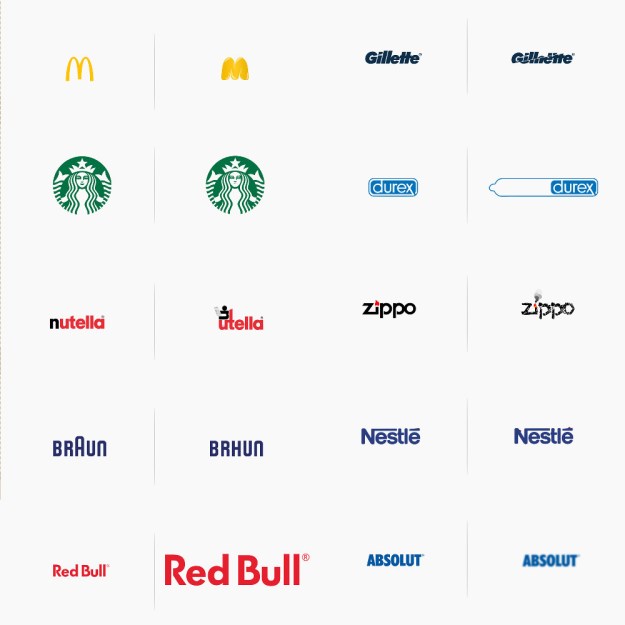
A fatter McDonalds logo? A caffeinated bitchy Starbucks logo? What would famous logos look like if they really were affected by the products they sell?
“For work, I always spend my time going around the web looking for trends and so on,” said Schembri from his home in Malta. “I was spending my weekend searching for articles and I found one on the food damages. Later on I “met” the McDonald’s logo and immediately I thought that logo was very skinny—it was a paradox, considering how fat people become after eating their products. So I decided to modify it by myself just to laugh. The rest of the story you can imagine.”
That led Schembri to doing a series of 10 logos, like fuzzing out the ABSOLUT vodka logo into how one might see it under the influence of alcohol, to putting the Durex logo inside of a condom.
Schembri’s approach is simple; he says he speaks as a product designer. “When you design something, you always start from the brand to develop a product as close as possible to the company family feeling,” he said. “This means at least 80% of the products in the market need to reflect the brand. What happens is the brands are also usually conditioned by the product image.”
A few others include a Nestle chocolate logo covered in pimples and a Zippo logo charred with smoke. Even though his playful approach can come across as critical, that wasn’t the plan.
“The idea was not to attack the brands but to create something funny,” he said. “Funny things make people smile and when people are happy they are also more inclined to share or comment—this is what this social era is teaching us, to give an emotion is the most important thing, never mind if its positive or negative, the important thing is to make people feel something.”
He feels it’s important to comment on consumption through design. “I think people in general never like to read ‘technical informational stuff’ and the key could be to give them a message, by using a funny way to make them think about something which is very important.”
The series can still be seen as critical of consumption—and specifically the consumption of edible products, like fast food. “Smoking and drinking can be dangerous but not like eating the wrong way,” said Schembri. “A wrong diet can slowly ruin your life.”
But what about Schembri? After making a comment on all the products and their logos, does he eat McDonalds and drink Starbucks coffee? He is, after all, personally connected to the brands. “I’m not addicted,” he said. “But yes, sometimes it’s the fastest way to eat when you travel a lot.”







 TheIdea – The Innovation Agency