Archiv des Autors: innovation

Knowhow weitergeben – Nur wenige Chefs fördern den Austausch ihrer Mitarbeiter

Mitarbeiter tauschen sich aus. Quelle: imago

Viele Chefs wissen, wie wichtig der Austausch ihrer Mitarbeiter ist – aber fördern ihn nicht.

Der Erfolg eines Unternehmens hängt davon ab, ob Mitarbeiter ihr Wissen teilen oder für sich behalten. Die Mehrheit der Chefs weiß das auch. Doch nur wenige Führungskräfte fördern den Wissensaustausch tatsächlich.

Wissensmanagement ist ohne Erfahrungsmanagement blind.

Der neue Mitarbeiter hat einen vorbildlichen Lebenslauf: Er hat studiert, promoviert und kann jahrelange Berufserfahrung in unterschiedlichen Unternehmen vorweisen. Doch zum wirtschaftlichen Erfolg seines neuen Arbeitgebers trägt er wenig bei: Er hat schlicht keine Ahnung von den Unternehmensstrukturen und -abläufen. Und die Kollegen verraten nix.

So etwas ist gar nicht mal selten – und kostet Unternehmen einiges, wie eine Studie der Wirtschaftsprüfung KPMG zeigt. Zwischen 50.000 und 500.000 Euro Produktionsausfallkosten können pro Unternehmen und Jahr entstehen, wenn sich neue Mitarbeiter alles selber beibringen müssen – vom Bedienen der Telefonanlage und der Software bis zu den Arbeitsabläufen. „Je höher der Transfer von Erfahrungswissen in einem Unternehmen ist, desto geringer fallen die Konfliktkosten aus“, sagt Günter Bruns, Senior Fellow der Rheinischen Fachhochschule Köln (RFH).

Bewusstsein ist da, wird aber nicht umgesetzt

Gemeinsam mit der Fachhochschule Burgenland und deren Projektpartner FHS St. Gallen hat die RFH das Europa-Institut Erfahrung & Management (Metis) gegründet, das 600 Führungskräfte in Deutschland, Österreich und der Schweiz zum Erfahrungs- und Wissensmanagement in ihren Betrieben befragt hat.

Die erfreuliche Nachricht: 85 Prozent der Chefs wissen laut Untersuchung, wie wichtig die Weitergabe von Erfahrungswissen ist. Aber nur ein Viertel der Befragten setzt das Wissen auch um. „Es gibt zwar ein Bewusstsein für Erfahrungswissen, aber in der Realität fehlt vielen Führungskräften die notwendige Entschlussfreudigkeit bei der Förderung der Weitergabe“, sagt Bruns. Durch kulturelle und damit oftmals auch sprachliche Barrieren mangele es in vielen Unternehmen an Wissen darüber, wie Mitarbeiter ihr Wissen möglichst effektiv weitergeben.

Kreative Querdenker sind gefragt Quelle: imago, Montage

Dabei hat die Untersuchung ergeben, dass der Erfahrungsaustausch in einem Unternehmen insbesondere dann von großer Bedeutung ist, wenn Mitarbeiter operative Probleme lösen, Entscheidungen treffen, komplexe Zusammenhänge erkennen oder sogar Krisen bewältigen müssen. „Wissensmanagement ist ohne Erfahrungsmanagement blind“, sagt Bruns. Denn die jeweiligen Kenntnisse haben in dem einen Unternehmen vielleicht einen hohen Stellenwert – in einem anderen aber wiederum so gut wie keinen. Und: Wie ist das Wissen zu bewerten? Ist es erst wenige Wochen alt oder schon überholt, weil der Mitarbeiter es vor mehreren Jahren erworben hat?

Trotzdem beurteilen laut Studie viele Chefs die typischen Wissensmanagementmethoden skeptisch – und setzen sie dementsprechend selten ein. Intranet, Social-Media-Plattformen, Storytelling oder Erfahrungsberichte ausscheidender Mitarbeiter würden sogar selten von jungen Managern genutzt werden. „Dieses Ergebnis zeigt, dass man sich von vielen Methoden verabschieden und die etablierten Methoden verbessern muss“, sagt Bruns. Das sei zum Beispiel das Storytelling – Betroffene berichten, wie sie Erfahrungswissen vermitteln. „Eine wichtige Voraussetzung dafür ist allerdings, dass der Feedback-Prozess, also das Vertrauen zwischen Absender und  Empfänger von Erfahrungswissen stimmt.“

Kleinen Unternehmen fehlen die Ressourcen

Neben effektiven Wissensmanagementmethoden brauchen Unternehmen für den optimalen Austausch nach Ansicht der Experten auch eine altersübergreifende Belegschaft. „Die Crux ist, die unterschiedlichen Generationen so zusammenzuführen, dass jeder seinen maximalen Nutzen daraus zieht“, sagt RFH-Präsident Martin Wortmann.

Bis vor einigen Jahren glaubten laut Wortmann noch viele Unternehmen, dass die Alten durch ihre mittlerweile starren Arbeitsweisen den Erfolg des Unternehmens mindern würden; die junge Generation blicke hingegen in die Zukunft und sei innovativ. Nur was viele vergaßen: „Jüngere Mitarbeiter sind leichter manipulierbar, steuerbar und beeinflussbar – weil ihnen die Erfahrung fehlt“, gibt Wortmann zu bedenken.

Mitarbeiter aus der Produktion werden unterschätzt

Hinzu kommt, dass sowohl kleine als auch große Betriebe unterschätzen, wie wichtig der abteilungsübergreifende Austausch in einer Organisation ist. „Führungskräfte aus oberen Etagen neigen dazu, dem Wissen eines Mitarbeiters, der beispielsweise die Maschinen in der Produktion bedient, zu wenig Bedeutung beizumessen“, sagt Wortmann. Entweder ignorieren sie aus Erfahrung des Experten deren Kompetenzen oder sie vertreten die Ansicht, dass deren Tätigkeit nur einen geringen Beitrag zum Erfolg des Unternehmens leistet. Dabei könnte sein Erfahrungswissen womöglich einen enormen Beitrag zur Verbesserung von Produktionsabläufen leisten.

Arbeit ist nicht zur Selbstverwirklichung daVöllig falsch. Wer die Arbeit nur wegen des Gehaltschecks macht, der wird langfristig nicht glücklich - sondern unzufrieden, unmotiviert und unproduktiv. Umgekehrt gilt: Mache nie dein Hobby zum Beruf. Der Grund liegt auf der Hand: Betreibt man das Hobby aus einer inneren Motivation (Neugier, Spaß, Glück) heraus, ist man im Beruf vor allem auf die Belohnung (= Gehalt) fixiert. Verliert man dann den Job, fällt man in ein Loch - beides ist nicht dann nämlich nicht mehr da: Motivation und Belohnung. Quelle: Fotolia

Viele Unternehmen halten laut Bruns das Wissen erfahrener Mitarbeiter vor allem dann für hinderlich, wenn sie mit Innovationen eine neue Zukunft einschlagen wollen. „Die Chefs vertreten häufig die Ansicht, dass Erfahrungen nur dazu dienen, das Alte gut zu finden.“ Das ist seiner Meinung nach falsch, denn: „Diese Mitarbeiter haben meist Erfahrungen mit Innovationen gemacht, die wiederum nützlich für neue Technologien sein können“, sagt Bruns.

Vor allem in kleinen Unternehmen vernachlässigen die Führungskräfte den Wissensaustausch ihrer Beschäftigten, wie aus der Befragung hervorgeht. Während große Konzerne oftmals in Weiterbildung und Mentoring investieren, beklagen die kleinen bis mittelständischen Betriebe, dass ihnen die Ressourcen fehlen, um den Wissenstransfer zu fördern. „Im Tagesgeschäft geht bei Klein- und mittelständischen Unternehmen der Transfer von Erfahrung häufig unter, weil ihnen im Vergleich zu größeren Unternehmen die nötigen Ressourcen fehlen“, sagt Wortmann.

http://www.wiwo.de/erfolg/beruf/knowhow-weitergeben-nur-wenige-chefs-foerdern-den-austausch-ihrer-mitarbeiter/14473692-all.html

5 Design Jobs That Won’t Exist In The Future

And seven jobs that will grow, according to design leaders at Frog, Ideo, Artefact, Teague, and more.

[Photo: Maskot/Getty Images]

Organ designers, chief drone experience designers, cybernetic director. Those are some of the fanciful new roles that could be created by the global design industry in the next few years.

But what about current design roles? How will they favor over the next 15 years? Will every company by 2030 have a chief design officer, or will they all go extinct? Should a generation of creatives who grew up worshipping Apple’s Jonathan Iveput all their eggs in the industrial design basket?

We talked to a dozen design leaders and thinkers from companies such as Frog, Artefact, and Ideo to find out which design jobs could die out in the next 15 years, and which could grow. There’s no empirical evidence behind these picks, so they shouldn’t be taken too seriously. Still, they represent the informed opinions of people who get paid to think about the future.

DESIGN JOBS THAT WILL DIE

UX Designers
User experience designers are among the most in-demand designers working today. So how could their jobs disappear? According to Teague designers Clint Rule, Eric Lawrence, Matt McElvogue, „UX design“ has become too broad and muddled. „The design community has played fast and loose with the title ‚UX designer,'“ they write in an email. „From job posting to job posting and year to year, it jumps between disparate responsibilities, tools, and disciplines. Presently it seems to have settled on the title representing democratized design skills that produce friendly GUIs.“ In the future, they predict that UX design will divide into more specialized fields. „The expanding domain of user experience and its myriad disciplines will push the title ‚UX designer‘ to a breaking point, unbundling its responsibilities to the appropriate specialists,“ they say.

Visual Designers
Visual designers are the ones responsible for the way an app looks. UX designers, meanwhile, are the ones who concentrate on how it feels. A lot of times, designers do both, but going forward, jobs that require just visual design skills are going to die out. That’s according to Charles Fulford, Executive Creative Director of Elephant, the San Francisco-based, Apple-centric stealth arm of the digital agency Huge. „Gone are the days of UX dumping a ton of wireframes on visual designers,“ he says, as well as „the days of visual designers being clueless about usability.“ What are needed instead are designers who can not only come up with the look of an idea, but make it real, with actual programming and prototyping skills.

Rob Girling, cofounder of the design consultancy Artefact, agrees. „In the next 10 years, all visual design jobs will start to be augmented by algorithmic visual approaches,“ he says. After all, design companies are increasingly turning to artificial intelligence to create previously impossible algorithmic designs, as well as crunch UX data on millions of users. „An AI-powered tool can automatically provide a designer with 100 variations of a layout, based on some high-level template, or style definition . . . We see early versions of these algorithmic procedurally generated tools already in use by game designers.“ For example, the 17 billion planet universe in the recent blockbuster video game No Man’s Sky was largely generated algorithmically.

The short version? If you’re a visual designer, it’s time to diversify.

Design Researchers
„When ethnographic research was new in design, there were designers who specialized in research,“ explains Harry West, CEO of Frog. „The role of design researcher is now evolving to become a fundamental skill and practice for all types of designers. Today, for any design challenge, it is assumed that you first learn what the customer wants; every designer must know how to set up customer research and learn from the source.“ Consequently, no one needs a dedicated design researcher anymore. „The role is so fundamental that every designer should know how to do it,“ says West.

John Rousseau, executive director at Artefact, puts a finer point on it: New technologies like machine learning and virtual reality are killing design research. „Design research as we know it may cease to exist—at least in terms of the types of ethnographic field work we do today,“ he says. „Research—-and researchers—-will likely be marginalized by new forms of automated data and insight generation, compiled via remote sensing and delivered through technologies like virtual reality.“

Traditional Industrial Designers
Most designers we asked predictably thought their own fields had rosy prospects. Not Markus Wierzoch, industrial design director at Artefact. He says that classically trained industrial designers who remain too attached to the „industrial“ parts of their profession—in other words, overly focused on the sculptural look of a product—will become, in his words, „designosaurs.“

„More than ever before, industrial design cannot exist in a vacuum,“ he writes. The issuer is that form no longer follows function and function only—software is also involved. That means industrial designers in the future will need to evolve to think about the total end-to-end user experience, a role Wierzoch calls the „post-industrial designer.“ (More on that below.)

Doreen Lorenzo, director of integrated design at UT Austin, also sees the role of the classically trained industrial designer dying off soon. „In the future, all designers will be hybrids,“ she says.

Chief Design Officers
„This is a trend as of late: to have an executive-level design figurehead,“ says Sheryl Cababa, associate design director, Artefact. But that role might—and should—die, because it’s redundant. „Good design is, fundamentally, interdisciplinary, which means that in a company that is design-oriented, all executives will be design practitioners, and the chief design officer position will vanish as quickly as it came.“

CEO Tim Brown echoes the idea that design will be embedded at the executive level, although he doesn’t necessarily think CDOs themselves are going to die out. „Business is moving from a long period where analytical skills were of extreme value in the search for efficiency, to one where creative and design skills will be essential to deal with complexity, volatility, and the requirements for constant innovation… CEOs will need to be designers in order to be successful.“

DESIGN JOBS THAT WILL GROW

Virtual Interaction Designers
Virtual and augmented reality is set to become a $150 billion industry by 2020, disrupting everything from health care to architecture. UT Austin’s Doreen Lorenzo thinks that more user interface designers will start strapping themselves into Oculus Rifts and becoming VI designers. „As more and more products become completely virtual—from chatbots to 3D projections to immersive environments—we’ll look to a new generation of virtual interaction designers to create experiences driven by conversation, gesture, and light,“ she writes.

Specialist Material Designers
Yvonne Lin of 4B Collective believes that in the near future, there will be a growing need for designers who can work in and across different types of materials. For example, she sees bamboo architects as being an up-and-coming design field, as the Western world embraces „the possibilities of a weight-bearing material that can grow three feet in 24 hours and can be bent, laminated, joined, and stripped,“ as Asia has.

She also says that designers who can sew will soon be in hot demand to create structural soft goods. What’s a structural soft good? Think of the kind of things MIT’s Neri Oxman designs, or wearables that are as much tech as textile: a blend of circuit boards and fabrics, like Google’s Project Jacquard.

„Today, there is a skill and knowledge gap between the soft- and hard-good world. Very few people know how to work in both,“ she says. „The intelligent mixing of fabrics (for comfort) and plastics and metals (for structure and function) would have significant benefits for health care and sports products. As people live longer and as sports participation increases the demand for these more comfortable and higher performance products will increase.“ Maybe even tomorrow’s Air McFlys.

Algorithmic/AI Design Specialists
Fifteen years down the road, few of the designers we spoke to were afraid that a robot or algorithm would take their jobs. Though „applied creativity is fundamentally hard to codify,“ as Artefact’s Rob Girling says, artificial intelligence will create new design opportunities—so much so that Girling and other designers we spoke to think that AI and algorithms represent growing field.

„Human-centered design has expanded from the design of objects (industrial design) to the design of experiences (adding interaction design, visual design, and the design of spaces) and the next step will be the design of system behavior: the design of the algorithms that determine the behavior of automated or intelligent systems,“ argues Harry West at Frog.

For example, designing the algorithm that determines how an autonomous vehicle makes the right human-centered decisions in an unavoidable collision. „The challenge for the designers is to tie the coding of algorithms with the experiences they enable.“

Post-Industrial Designers
„As every object becomes connected—from your couch to your fitness bracelet, the hospital room to your wallet—we need to think about connected experiences,“ says Artefact’s Markus Wierzoch. „[These] offer much broader value propositions, which means we need to change the [design] processes used to define these objects beyond their immediate form and function.“

Enter the postindustrial designer. Postindustrial designers will need to think of the total end-to-end user experience to build „tangible experiences that connect the physical and digital worlds,“ Wierzoch says.

For example, the designer of the future, charged with designing an electrical toothbrush, will need to make sure their toothbrush can connect to an app, give users brushing stats, as well as plug into the future smart home. It’s just not enough to design something that cleans your teeth well anymore. „Someone has to be responsible to stitch complex experiences together,“ Argodesign’s Mark Rolston says.

Design Strategists
Design researchers may find fewer opportunities in the next 15 years, but Artefact’s John Rousseau thinks design strategists will be indispensable. „The importance of design strategy will grow,“ he says. „Future design strategists will need the ability to understand and model increasingly complex systems“—for example, social media networks or supply chains—“and will design new products and services in a volatile environment characterized by continuous disruption and a high degree of uncertainty.“ In other words, a future defined by political, social, business, and tech disruption that can happen overnight. In such a future, Rousseau says, design strategists will be like ballerinas, dancing their companies in and out of trouble. „It will be more of a dance, and less of a march.“

Organization Designers
The org chart of the future isn’t going to be the same as the org chart of the past. That’s why Ideo partner Bryan Walker thinks dedicated organization designers will be on hand, helping make companies more „adaptive, creative, and prolific.“ These designers, he says, „will help reimagine all aspects of an organization from its underlying structures, incentives, processes, and talent practices to its physical workplaces, digital collaboration tools and communications. “

Freelance Designers
Get used to working in your pajamas. According to Teague’s Clint Rule, Eric Lawrence, and Matt McElvogue, the future of design is freelance. „Creative AI and global creative marketplaces will give individual designers on-demand access to skill sets previously only capable within large teams,“ they write. „The result is a surge in the specialization, efficacy, and independence of the designer.“ In their vision, freelancers won’t just toil away in solitude, they’ll form a „network of targeted micro-consultancies“ that compete with more traditional firms.

https://www.fastcodesign.com/3063318/5-design-jobs-that-wont-exist-in-the-future

Audi is reportedly building an electric luxury sedan to take on Tesla by 2020

Audi Prologue AvantAudi

Audi is getting serious about electric cars.

The automaker’s chief executive has given the OK for an all-electric, luxury sedan to take on Tesla’s Model S, according to a report from Autocar.

The car, which may be called the A9 e-tron, will have three electric motors, a range of more than 300 miles per charge, and will also feature level four autonomous driving, according to the report.

Stadler told Autocar that Audi will have three EVs in its line-up by 2020 and by 2025 it plans to have 25% of the cars it sells will have batteries.

In January, Audi committed to building an all-electric SUV  based off of its e-tron quattro concept, which was revealed last September at the Frankfurt Motor Show. The company plans to begin production on the SUV by 2018.

Stadler said that the production version of the e-tron quattro will go from 0 to 62 miles per hour in just 4.2 seconds and will have a top speed of 131 miles per hour.

One of the e-tron quattro’s most impressive functions is its inductive charging feature. This allows users to re-charge the vehicle by parking it over a re-charging plate, instead of having to plug it in.

According to the report, the new electric sedan will also have the inductive charging feature, as well as an autonomous parking function that enables the car to drive itself to a parking spot with a charging plate.

Audi E-tron quattroAudi’s e-tron quattro concept.Audi

Audi isn’t the only car maker ramping up its push into the electric car market.

Porsche, which is a sister company of Audi, plans to roll out a production version of its all electric car concept, the Mission E. Mercedes-Benz, Aston Martin, Volvo and others are also planning to have their electric cars ready by 2020.

Tesla isn’t just getting competition for its higher-end vehicles, though.

The electric car maker’s first mass market car, the Model 3, will also be going up against General Motors Chevy Bolt. And the Bolt, which is expected to go into production before the end of this year, will have a year head start on the Model 3, which isn’t expected to go into production until late 2017.

http://www.businessinsider.de/audi-a9-electric-sedan-will-take-on-tesla-2016-8

LAND YACHT – Mercedes’ next vehicle is a 20-foot luxury electric Maybach that you’ll “want to drive yourself”

The future of luxury cars isn’t all about flashy vehicles that drive themselves, at least that’s what Mercedes and Maybach want the super-rich to believe.

The Daimler-owned company unveiled a new electric car concept, the Vision Mercedes-Maybach 6, on Aug. 19. The “6” actually represents how many meters long this car is, just shy of 20 feet—which is a pretty standard size for speedboats, if not sports cars. Mercedes showed off the concept in a bright shade of red, but if it repainted the Vision in black, it probably would not look out of place in a mid-1990s Batman feature.

The Vision Mercedes-Maybach 6
It has gull-wing doors like a Tesla, but a very different ethos on the future of luxury vehicles. (Mercedes-Benz)

The Vision 6 has a massive 750-horsepower engine which has a range of about 200 miles on a single charge, and can hit 60 mph in under 4 seconds, according to Bloomberg. It can also charge up to a range of about 60 miles in five minutes—much more efficient than the average quick-charging cellphone—so you’ll never have to worry about range anxiety as you drive from Davos to Monaco, or wherever the one percent need to get to these days.

The Vision Mercedes-Maybach 6 interior
The interior kind of looks like a futuristic boat, too. (Mercedes-Benz)

While this concept car won’t be available for recent Maybach customers like Jay-Z to buy, it’s supposed to reflect what a high-end Mercedes will look like in the next decade or so, Bloomberg said. (Past Maybach models, which Mercedes relaunched as a brand in 2012, have cost between $100,000 and $1 million.) Mercedes executives likened the concept to a prized family heirloom, suggesting that it’s more than just a piece of technology that you’ll passively enjoy for a few years, and then move on to the next shiny new thing.

The Vision Mercedes-Maybach 6
(Mercedes-Benz)

“This is a car you want to drive yourself,” Gorden Wagener, Daimler’s head of design, told Bloomberg. “This is something you pass to your children, like a Leica camera or a chronograph watch. Driving has been a pleasure since 130 years and will stay that way another 130 years.”

The Vision Mercedes-Maybach 6
(Mercedes-Benz)

Although Mercedes itself is working on some (equally luxurious) self-driving cars, it seems that the company, sees the long-term future of cars at least in some part controlled by humans. Then again, Ford’s CEO Mark Fields previously told Quartz that he doesn’t see producing a self-driving Mustang anytime soon. Perhaps some slice of humanity will always just want to go really, really fast, in really, really expensive cars.

http://qz.com/762480/mercedes-next-vehicle-is-an-20-foot-luxury-electric-maybach-that-youll-want-to-drive-yourself

The new paradigm for human-bot communication

Editor’s note: Xuchen Yao is co-founder and CEO, and Guoguo Chen and Kenji Sagae are co-founders, of KITT.AI. Daniel Li is an associate at Madrona Venture Group.

Chatbots offer the promise of frictionless access to goods, services and information, but creating effective bots can be deceptively tricky.

The flip side of the opportunity to interact with users in a seamless, natural way is that user expectations can be prohibitively high. Bots need to be smart and provide greater convenience than apps — a very effective UI paradigm tailored for today’s mobile devices that has been carefully refined for more than a decade.

The good news is that the belief that bots must master human language or replace apps to succeed is false. Bots will engage with consumers in new ways that combine the strengths of humans and machines to allow both structured and unstructured information to be exchanged naturally and efficiently.

Communication velocity

One simple but intuitive way to measure the effectiveness of communication is to look at the amount of information exchanged per unit of time. Under this framework, text (e.g. SMS, chat, email) and speech (e.g. phone call) interactions differ in the amount of information that can be produced versus consumed.

image001

While we typically produce 120 to 140 words per minute when speaking, we can typically only write or type 40 to 70 words per minute. When we look at the speed of information consumption, reading speed in English is upwards of 200 words per minute, but listening speed is limited to the 120 to 140 words per minute of speech production.

SMS and chat apps have adapted to increase text production speed through autocorrect features and novel keyboards, but text production for humans will always be slower than consumption.

Imagine, however, a friend that can type, draw, look up information and find GIFs at superhuman speed, and produce buttons, menus and pictures to make your input faster. Better yet, your enhanced input is much easier for your friend to understand and does not take away the flexibility and familiarity of natural language when needed.

We may not be quite there yet, but we are very close, especially with well-constructed bots on certain platforms. Here is a look at the features of different bot platforms that are shaping human-bot communication toward a more efficient, robust and natural UI paradigm.

Quick-reply buttons

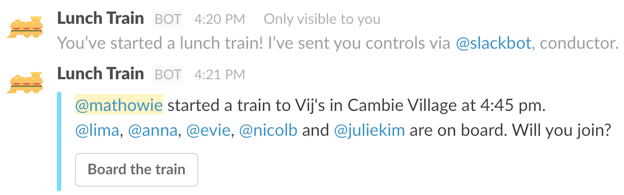
Quick-reply buttons are a simple and convenient way to save user time and prevent unexpected input. They are unique to human-bot communication as buttons are trivial for bots to create and easy for humans to use; benefits include enhanced communication speed and bot comprehension.

Facebook, Telegram and Kik bots all have quick-reply buttons, but under slightly different names, and some bots, such as the Sephora bot on Kik, use the quick-reply button as the primary mode of communication. Slack still lacks quick-reply buttons, but has message buttons with associated actions.

Telegram Custom Keyboard:

image002

Facebook Messenger Quick Replies:

image003

Kik Suggested Response Keyboard:

image004

Callback buttons

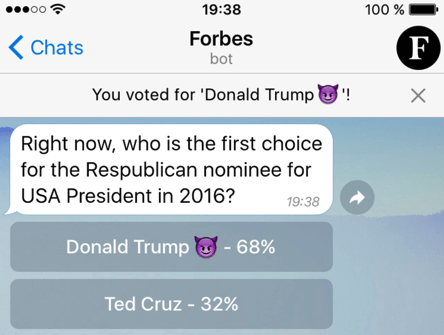
Callback buttons are similar to quick-reply buttons but allow for a broader range of potential interactions. When a callback button is clicked, it generates an HTTP call to a registered webhook that triggers a predefined action. Callback buttons are a great way to provide feedback, and they also provide a deeper analytics opportunity for the bot backend.

Slack Message Buttons:

image005

Messenger Postback Button:

image006

Telegram Callback Buttons:

image007

Structured information sharing

Sharing information that can be easily parsed programmatically takes the exchange of structured information from clunky in a language-only paradigm to easy and unambiguous in a hybrid paradigm.

For instance, sharing a location like “3rd & Madison” is ambiguous and slow for humans and machines to parse, while shared GPS coordinates can be quickly displayed with a map service and understood by bots.

Telegram SendContact and SendLocation:

image008

Facebook Messenger Location Sharing:

image009

Bot mentions

Inline bots are a great way to quickly obtain, send and share information during chats, without the need to jump out of the current interface (to go to another chat) or the current app (to go to another app).

Instead of multiple taps and menus to perform a specific function, an @ mention at a bot allows for a one-line interaction. Allowing bots to share conversational context with one another also greatly increases the speed of interaction because users no longer need to re-input data for each communication.

Telegram Inline Bot:

image010

Slack Bot Mention:

image011

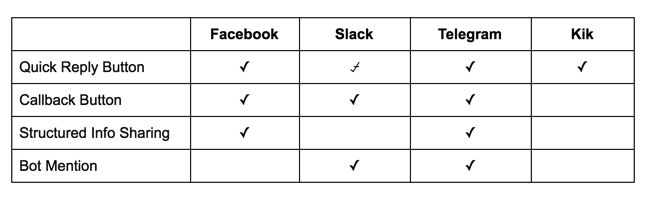
The following table summarizes the added language-touch functionality provided by four popular chat and bot platforms. These features represent the beginning of a hybrid communication paradigm that will enable more efficient and effective communication with bots:

  • Quick-reply buttons: save user time and improve machine comprehension
  • Callback buttons: provide calls to action and back-end analytics
  • Structured info sharing: easily shares machine-readable information
  • Bot mention: make bots always present and easily accessible

image012

If your bot does not use a language-touch hybrid communication pattern, there are several other ways you can still take some of the UI mechanics from buttons and callbacks to build a better bot:

  • Build your system starting with humans in the loop to identify the most common communication patterns and exceptions to that pattern
  • Optimize dialogue for two-channel — fast and slow — communication with clear, well-defined responses (e.g., “Reply YES to buy”) or open-ended messages (“Can you tell me when the new Taylor Swift record comes out?”)
  • Use callback functions, even without native integration. For more complicated tasks, take users out of chat and move them to a point-and-click or touch interface that is better suited to the task at hand
  • Consider moving to a platform that is better optimized for new human-machine interaction

AI and NLP have a long way to go before bots achieve human-level communication. However, before that happens, new methods of human-machine communication will leverage the strengths of humans and machines to create new interaction paradigms that are as natural as our own language.

The new paradigm for human-bot communication

Opera just released an Android app that gives you unlimited free VPN

Android VPN Client AppImage Source: Opera

Opera made waves back in April when it announced the addition of unlimited free VPN service to its desktop web browser. VPN, or virtual private networking, is a technology that allows people to mask their actual IP addresses by routing their internet traffic through a third-party server. This way, any software that might collect information about users as they visit a website will not be able to record a user’s actual IP. People also often use VPN services to spoof their region, with the most widely discussed example being people who use a VPN client to make it appear to Netflix as though they’re based in the United States.

VPN services are incredibly valuable to people who protect their privacy while surfing the web, but these services can also have costly subscription plans that limit the amount of data you can use each month. That’s why Opera’s initial announcement was so intriguing, but the company has no intention of stopping with desktop browsing.

Opera on Tuesday announced the release of a brand new Android app. DubbedOpera VPN for Android, the app does exactly what its name suggests, providing Android users with VPN service that will route their traffic through special servers to mask users’ info and prevent websites from tracking them. Of course, Android VPN clients are a dime a dozen. What makes Opera different from most, as we’re sure you’ve figured out by now, is that it offers users unlimited VPN service for free.

opera-vpn-for-android-2

“The Opera VPN app for Android sets itself apart from other VPNs by offering a completely free service – without a data limit, no log-in required, advanced Wi-Fi protection features and no need for a subscription,” said Chris Houston, who heads Opera’s VPN division.

Opera’s new VPN app for Android really couldn’t be easier to use. It’s as simple as opening the app and tapping connect, and for most users concerned only with privacy, that will be enough. People who want to mask their regions as well can choose from five different regions including the US, Canada, Germany, Netherlands and Singapore.

The app also includes a few additional features, such as the ability to scan Wi-Fi networks for security and display the number of ad trackers blocked over a certain period of time.

Opera VPN for Android is available as a free download on the Google Play store beginning immediately.

Opera just released an Android app that gives you unlimited free VPN

The 9 best cities to live in the world

The Economist Intelligence Unit just released a report that ranks the best and worst cities to live in the world.

In its „A Summary of the Liveability Ranking and Overview“ of 140 cities surveyed, it looks at which cities have the best living and worst living conditions. This includes healthcare, education, infrastructure, safety, and the threat of terrorism.

Interestingly, the rankings also take into account the generosity of expatriate relocation packages — funding a company gives to an individual when they decide to take up a role abroad.

The 140 surveyed were given a mark out of 100 across various sectors and then given an overall score out of 100.

9. Helsinki, Finland — It is only one of two European cities to make the top nine list. It scored full marks for stability and healthcare and highly across culture and environment, infrastructure and education.

8. Auckland, New Zealand — The city scored full marks for education but narrowly missed being seventh in the charts due to a score of 92.9 for infrastructure.

7. Perth, Australia — This is one of three Australian cities to feature in the top nine, thanks to perfect 100 scores across healthcare, education, and infrastructure.

7. Perth, Australia — This is one of three Australian cities to feature in the top nine, thanks to perfect 100 scores across healthcare, education, and infrastructure.

Getty

T=5. Adelaide, Australia — This city slinks into the top nine most liveable cities in the world due to its high scores across the board, and because Sydney dropped out of the top rankings. This is due to „owing to a heightened perceived threat of terrorism.“

T=5. Adelaide, Australia — This city slinks into the top nine most liveable cities in the world due to its high scores across the board, and because Sydney dropped out of the top rankings. This is due to "owing to a heightened perceived threat of terrorism."

Getty

T=5. Calgary, Canada — This is one out of three Canadian cities that ranked near the top of EIU’s survey and tied with Adelaide in Australia. It scored 100 for stability, healthcare, and education.

T=5. Calgary, Canada — This is one out of three Canadian cities that ranked near the top of EIU's survey and tied with Adelaide in Australia. It scored 100 for stability, healthcare, and education.

General view of the Pengrowth Saddledome and the Calgary skyline.Getty

4. Toronto, Canada — The most populated city in Canada got an overall score of 97.2 but missed out on ranking higher due to its infrastructure score dragging it down.

3. Vancouver, Canada — The major Canadian city received 100 for culture and environment, healthcare, and education and nearly perfect scores for stability.

2. Vienna, Austria — The city is one of only two European cities to make the top nine list with a score of 97.4.

1. Melbourne, Australia — The country’s coastal city is testament to EIU’s assessment that „those that score best tend to be mid-sized cities in wealthier countries with a relatively low population density. These can foster a range of recreational activities without leading to high crime levels or overburdened infrastructure.“


http://www.businessinsider.de/eiu-global-liveability-ranking-most-liveable-cities-in-the-world-2016-8?op=1

8 Powerful Lessons You Can Learn From the Career of Elon Musk

Elon Musk, in the words of one blogger who did a series of in-depth interviews with the Tesla and SpaceX founder, is, basically, „the raddest man alive.“ Who could fail to be impressed by a single entrepreneur who has set his sights on both getting humans to Mars and revolutionizing our energy economy?

Because Musk is so obviously extraordinary, it could be easy to feel like his career is a world apart — the efforts of a visionary that mere mortals like us could never emulate. But while it’s probably true that, for most of us, the ship has sailed on leading the way to interplanetary travel, that doesn’t mean folks with more down-to-earth careers have nothing to learn from the mogul.

When a user of question-and-answer site Quora asked the simple question, „What can we learn from Elon Musk?“ a host of devoted Musk watchers offered thoughtful answers. Among the best was a reply from blogger (and recent New York Times profile-ee) James Altucher, who took the time to listen „to every interview [Musk] ever did and compiled what I think are the most inspirational quotes.“

Here are a few of the 22 essential takeaways he extracted from all that research:

1. Focus on the impact of your dreams, not the odds.

Maybe, like Altucher, your initial reaction to this principle is to worry that your particular dreams might just be impossible. But, as Altucher reminds readers, this advice is coming from a man who wants to colonize Mars. Are you dreams really more of a long shot than that?

2. No one does amazing things for the money.

„I’ve interviewed over 100 people now on my podcast. Each of the 100 have achieved amazing results in their life,“ notes Altucher. „But none of them have done if for the money.“ Neither did Musk, who Altucher quotes as saying: „Going from PayPal, I thought: ‚Well, what are some of the other problems that are likely to most affect the future of humanity?‘ Not from the perspective, ‚What’s the best way to make money?'“

The takeaway: if you want to do great things, focus on the difference you’ll make in the world (or to yourself), not the financial rewards (or the glory).

3. Reason from first principles.

A lot has been written about Musk’s mindset, but Altucher sums up his unusual and incredibly effective approach with this quote: „Boil things down to their fundamental truths and reason up from there.“ In short, to improve your thinking, set received wisdom aside and try to look at the world with fresh eyes, using objective data and clear-headed observation.

4. Persistence pays.

Not all of the lessons of Musk’s career are off the wall and unexpected. Sometimes, he proves that conventional wisdom is right. Like with this quote: „Persistence is very important. You should not give up unless you are forced to give up.“

5. In hiring, talent beats numbers.

Some entrepreneurs tackle difficult problems by trying to throw a whole lot of warm bodies at them. Not Musk.

„It is a mistake to hire huge numbers of people to get a complicated job done. Numbers will never compensate for talent in getting the right answer (two people who don’t know something are no better than one), will tend to slow down progress, and will make the task incredibly expensive,“ Altucher quotes him as saying.

So next time you need to hire your way out of jam, spare a thought for this bit of wisdom and take the time to find the right talent rather than just hoping that brute numbers will save you.

6. Talent can’t compensate for a lousy personality.

According to Altucher, Musk is a late but fervent convert to the idea that great ability can’t compensate for a lousy personality.

Here’s the quote: „My biggest mistake is probably weighing too much on someone’s talent and not someone’s personality. I think it matters whether someone has a good heart.“ So, once more with feeling: don’t hire jerks!

7. Constantly question yourself.

You’d think that someone with Musk’s achievements might be satisfied with his efforts, but that’s not the case. Musk claims he constantly strives to improve himself.

„It’s very important to have a feedback loop, where you’re constantly thinking about what you’ve done and how you could be doing it better. I think that’s the single best piece of advice: constantly think about how you could be doing things better and questioning yourself,“ he said. If Musk isn’t resting on his laurels, neither should you.

8. Finding the right questions is most of the battle.

Apparently, Musk’s favorite book as a teenager was The Hitchhiker’s Guide to the Galaxy. Here’s the biggest lesson he took away from it: „It taught me that the tough thing is figuring out what questions to ask, but that once you do that, the rest is really easy.“


http://www.inc.com/jessica-stillman/8-powerful-lessons-you-can-learn-from-the-career-of-elon-musk.html

What can we learn from Elon Musk?

The three fundamentals to Elon Musks success.

1. UPDATING YOUR SOFTWARE

How to constantly build your knowledge and understanding.

An oft asked question of Musk – ‘How did he learn so much?’

Since childhood, he has been a tireless self learner. At the age of 10 he resorted to reading Encyclopedia Britannica after devouring every other book at home.

From interviews and discussions with Musk, its becomes apparent that he views people as computer systems, being made up of hardware (body) and software (mind). Recognizing that your software is one of the most powerful tools that you possess, Musk works tirelessly on updating his, feeding it with more knowledge and information when he wants to understand a problem.

Jim Cantrell, one of the founding team members of SpaceX comments on Musk’s incredibly fast learning ability:

“He literally sucks the knowledge and experience out of people that he is around. He borrowed all of my college texts on rocket propulsion when we first started working together in 2001.”

In 2000, before Musk had even set up SpaceX, he began devouring books on propulsion, avionics and aeronautical engineering. He already knew that his goal was landing people on Mars, now he just needed to upgrade his software with the information and tools on how to accomplish it.

A trait that underpins Musk’s model of thinking is being able to quickly consume and understand complex information, then plan with clarity how to apply it in making progress towards his goal. People are impressed with his deep knowledge across a wide range of technical subjects, from electrical, structural, mechanical, aeronautical, and software engineering through to business strategy and more.

“I think most people can learn a lot more than they think they can. They sell themselves short without trying.

One bit of advice: it is important to view knowledge as sort of a semantic tree — make sure you understand the fundamental principles, i.e. the trunk and big branches, before you get into the leaves/details or there is nothing for them to hang on to.”

Elon Musk

This habit of self learning and forcing himself to understand new concepts, gives him a huge internal database of knowledge that he is then able to run through his internal problem solving tool.

2. REASONING FROM FIRST PRINCIPLE

How to get to the nucleus of a problem and understand the facts.

Aristotle described a first principle as, “[the] first basis from which a thing is known”.

It means basing conclusions on fundamental truths, not on assumption or analogy.

Reasoning from first principles requires mental effort. It means boiling things down to their most basic truths, and reasoning up from those truths. It requires you to actively engage your brain and work ideas through.

The alternative to this is reasoning by analogy. Assuming something is true or correct because it’s similar to something else that has been done before.

Musk is a master of using the scientific method of first principle reasoning, and applying it to problem solving scenarios. Here is one example;

“Historically, all rockets have been expensive, so therefore, in the future, all rockets will be expensive. But actually that’s not true. If you say, what is a rocket made of? It’s made of aluminium, titanium, copper, carbon fiber. And you can break it down and say, what is the raw material cost of all these components? If you have them stacked on the floor and could wave a magic wand so that the cost of rearranging the atoms was zero, then what would the cost of the rocket be? And I was like, wow, okay, it’s really small—it’s like 2% of what a rocket costs. So clearly it would be in how the atoms are arranged—so you’ve got to figure out how can we get the atoms in the right shape much more efficiently.

And so I had a series of meetings on Saturdays with people, some of whom were still working at the big aerospace companies, just to try to figure out if there’s some catch here that I’m not appreciating. And I couldn’t figure it out. There doesn’t seem to be any catch. So I started SpaceX.”

Elon Musk

In our day to day, we make most decisions based on analogy. It would simply take too much mental time and capacity to question every single small decision during the day.

But when it comes to big decisions, it’s important to reason from first principle. Make sure you know the facts, data and figures, don’t just follow the crowd and assume.

3. HARD WORK

How to give your ideas the best chance of success.

Highly intelligent, fast learning, dynamic problem solving ability and lots of money, they’ve all contributed to the success of Musk’s endeavours. But there’s another key character trait to the man which has been critical to his success – an incredible and highly efficient work ethic.

“Work like hell. I mean you just have to put in 80 to 100 hour weeks every week. [This] improves the odds of success. If other people are putting in 40 hour work weeks and you’re putting in 100 hour work weeks, then even if you’re doing the same thing you know that… you will achieve in 4 months what it takes them a year to achieve.”

Elon Musk

The fact is that Elon Musk gets a lot done. Running two separate billion dollar companies requires making a lot of decisions and having eyes on many moving parts. Here are some of the key aspects to Musk’s working process that make him so efficient.

– 100 hours a week – has noted many times that at critical periods in the lifespan of his companies, he has gone from working 80-90 hour weeks up to doing 100 hours a week. It is not unusual for him to work seven days a week, normally rising at 7am and getting to bed around 1am.

– Batching – or multitasking, he combines multiple tasks which can be done together effectively e.g. Emailing while reviewing spreadsheets, meetings over lunch, etc.

– Scheduling – A man as busy as Musk needs to run to a tight schedule to be efficient. He spends Monday and Thursday at SpaceX in LA, Tuesday and Wednesday at Tesla in the Bay Area, and splits Friday between both. His assistant has his planner broken down into five minute slots, and there’s a long line of people trying to get ahold of him for that time. Efficient scheduling is a behaviour pattern seen in many highly successful people.

– Feedback loop – Musk is a strong believer in constructive criticism. He constantly bounces ideas off colleagues and advisors to sense check them. Open and honest criticism should be encouraged to help improve an idea or product. “Constantly think about how you could be doing things better and questioning yourself.” – Elon Musk

– Caffeine – „To get through the day, Musk relies on two stimulants: caffeine and a desire to help humanity colonize Mars. Until he recently started cutting back on the former, Musk consumed eight cans of Diet Coke a day, as well as several large cups of coffee. „I got so freaking jacked that I seriously started to feel like I was losing my peripheral vision,“ he says. If he realizes how crazy this sounds, he doesn’t let on.” – from Inc Magazine.


https://www.quora.com/What-can-we-learn-from-Elon-Musk

Ford Says It’ll Have a Fleet of Fully Autonomous Cars in Just 5 Years

Ford Fusion Autonomous Research Vehicles Use LiDAR Sensor Techno