Schlagwort-Archive: Tesla

Die Neue KFZ-Steuer für Elektroautos in Österreich ab 1. April 2025: Aktualisierte Berechnungslogik und Kostenübersicht

Die lange geltende Steuerbefreiung für Elektrofahrzeuge in Österreich endet bald. Ab dem 1. April 2025 werden auch Elektroautos der motorbezogenen Versicherungssteuer (mVSt) unterliegen, was für Besitzer dieser Fahrzeuge eine jährliche Mehrbelastung von mehreren hundert Euro bedeuten wird. Diese Änderung betrifft sowohl bereits zugelassene Elektrofahrzeuge als auch Neuzulassungen und stellt eine bedeutende finanzpolitische Wende dar. Im Folgenden wird die Berechnungslogik der neuen Steuer erläutert und für die gängigsten Elektroautomodelle in Österreich berechnet.

Die Berechnungslogik der neuen KFZ-Steuer für Elektroautos

Die motorbezogene Versicherungssteuer für Elektroautos wird auf Basis von zwei wesentlichen Fahrzeugmerkmalen berechnet: der Dauerleistung (30-Minuten-Nennleistung) und dem Eigengewicht des Fahrzeugs. Beide Werte sind im Zulassungsschein vermerkt und bilden die Grundlage für die Steuerberechnung. Anders als bei Fahrzeugen mit Verbrennungsmotor, bei denen die Steuer anhand der Motorleistung und des CO₂-Ausstoßes berechnet wird, wurde für Elektrofahrzeuge eine spezielle Berechnungsmethode entwickelt.

Die Steuerformel beinhaltet Freibeträge für beide Komponenten, die vor der eigentlichen Berechnung abgezogen werden. Bei der Dauerleistung werden 45 kW abgezogen, beim Eigengewicht sind es 900 kg. Nach Abzug dieser Freibeträge erfolgt die Berechnung anhand einer gestaffelten Formel.

Leistungskomponente (pro Jahr)

Die Berechnung der Leistungskomponente erfolgt nach dem Abzug des Freibetrags von 45 kW in drei Stufen:

  • Für die ersten 35 kW: 3 Euro pro kW (mindestens jedoch 30 Euro)

  • Für die nächsten 25 kW: 4,2 Euro pro kW

  • Für jedes weitere kW darüber: 5,4 Euro pro kW

Gewichtskomponente (pro Jahr)

Nach Abzug des Freibetrags von 900 kg wird die Gewichtskomponente ebenfalls in drei Stufen berechnet:

  • Für die ersten 500 kg: 0,18 Euro pro kg (mindestens jedoch 36 Euro)

  • Für die nächsten 700 kg: 0,36 Euro pro kg

  • Für jedes weitere kg darüber: 0,54 Euro pro kg

Die Gesamtsteuer ergibt sich aus der Summe der Leistungs- und Gewichtskomponente. Da die Steuer über die Kfz-Haftpflichtversicherung eingehoben wird, wird sie in der Regel gemeinsam mit der Versicherungsprämie bezahlt.

Die 20 gängigsten Elektroautos in Österreich und ihre Steuerbelastung

Auf Basis der verfügbaren Zulassungsstatistiken für das Jahr 2024 und ergänzender Daten zu Gewicht und Leistung der einzelnen Modelle kann die zu erwartende Steuerbelastung berechnet werden. Insgesamt wurden in Österreich im Jahr 2024 etwa 44.622 Elektroautos neu zugelassen, was einem Rückgang von 6,3 Prozent im Vergleich zu 2023 entspricht. Dabei entfielen lediglich 23,5 Prozent der Neuzulassungen auf Privatpersonen, während der Rest auf Firmenfahrzeuge entfiel.

Tesla Model Y – Spitzenreiter bei den Zulassungen

Das Tesla Model Y mit einer Dauerleistung von 153 kW und einem präzise dokumentierten Eigengewicht von 1.997 kg muss künftig mit einer jährlichen Steuerbelastung von etwa 780 Euro rechnen. Diese setzt sich zusammen aus einer Leistungskomponente von etwa 469 Euro (basierend auf der 30-Minuten-Leistung) und einer Gewichtskomponente von rund 311 Euro. Als meistverkauftes Elektroauto in Österreich sind von dieser Steueränderung viele Fahrzeugbesitzer betroffen.

BYD Seal – Der Newcomer auf Platz 2

Der BYD Seal hat sich als Überraschung auf dem zweiten Platz der meistverkauften Elektroautos positioniert. Mit einem Leergewicht zwischen 2.055 und 2.185 kg (je nach Ausführung) und einer geschätzten Dauerleistung von etwa 105 kW muss dieses Modell mit einer Steuerbelastung zwischen 714 und 760 Euro rechnen. Die chinesische Limousine hat 2024 einen bemerkenswerten Markteintritt in Österreich hingelegt und zeigt die zunehmende Akzeptanz von Marken aus Fernost im europäischen Markt.

Škoda Enyaq – Etablierter Favorit auf Platz 3

Der Škoda Enyaq 85x mit einer Dauerleistung von 77 kW und einem beachtlichen Eigengewicht von 2.384 kg wird künftig mit einer jährlichen Steuerbelastung von etwa 574 Euro belastet. Davon entfallen rund 96 Euro auf die Leistungskomponente und etwa 478 Euro auf die Gewichtskomponente. Der hohe Gewichtsanteil an der Gesamtsteuer wird bei diesem Modell besonders deutlich. Der Enyaq, für den Škoda 2024 ein Facelift eingeführt hat, fiel vom zweiten auf den dritten Platz zurück, blieb aber mit 2.310 Neuzulassungen eines der beliebtesten E-Autos in Österreich.

BMW iX1 – Starker Zuwachs auf Platz 4

Der elektrische BMW X1 (BMW iX1 xDRIVE30) mit einer Dauerleistung von 104 kW und einem Eigengewicht von präzise 1.940 kg wird künftig mit einer jährlichen Steuerbelastung von etwa 493 Euro belastet. Diese setzt sich zusammen aus einer Leistungskomponente von etwa 206 Euro und einer Gewichtskomponente von rund 287 Euro. Mit 2.291 Neuzulassungen im Jahr 2024 konnte der X1 ein beachtliches Wachstum verzeichnen.

BMW i4 – Stabiler Mittelklasse-Favorit

Der BMW i4, der mit 2.086 Neuzulassungen Platz 5 der meistverkauften Elektroautos in Österreich belegte, hat ein Leergewicht von 2.125 kg und eine 30-Minuten-Leistung von 105 kW (beim i4 eDrive40). Die jährliche Steuerbelastung wird sich auf etwa 567 Euro belaufen, wovon 210 Euro auf die Leistungskomponente und 357 Euro auf die Gewichtskomponente entfallen. Trotz des relativ hohen Gewichts bleibt der i4 aufgrund seiner ausgewogenen Verhältnisse ein beliebtes Modell in der elektrischen Mittelklasse.

Tesla Model 3 – Der Klassiker auf Platz 6

Das Tesla Model 3 mit einer Dauerleistung von 153 kW und einem genauen Eigengewicht von 1.851 kg wird künftig mit einer jährlichen Steuerbelastung von etwa 686 Euro belastet. Diese setzt sich zusammen aus einer Leistungskomponente von etwa 469 Euro und einer Gewichtskomponente von rund 217 Euro. Mit 2.077 Neuzulassungen und einem Plus von 6,7 Prozent konnte das Model 3, das im Herbst 2023 ein Facelift erhielt, seine Position auf dem österreichischen Markt festigen. Im Vergleich zum schwereren Model Y ist die Gewichtskomponente hier deutlich niedriger.

Audi Q4 e-tron – Premiummodell mit zunehmender Beliebtheit

Der Audi Q4 e-tron landete mit 1.599 Neuzulassungen auf Platz 7 der beliebtesten Elektroautos in Österreich. Mit einem Leergewicht von 2.145 kg und einer geschätzten Dauerleistung von etwa 90 kW wird die jährliche Steuerbelastung bei etwa 493 Euro liegen. Davon entfallen etwa 135 Euro auf die Leistungskomponente und 358 Euro auf die Gewichtskomponente. Als Premium-SUV positioniert, zeigt der Q4 e-tron, dass auch in höheren Preissegmenten die Nachfrage nach Elektrofahrzeugen wächst.

VW ID.4 – Der elektrische Tiguan-Nachfolger

Der VW ID.4 schaffte es mit 1.527 Einheiten auf Platz 8. Mit einem Leergewicht von mindestens 1.966 kg und einer geschätzten Dauerleistung von 85 kW wird die jährliche Steuerbelastung etwa 425 Euro betragen. Davon entfallen etwa 120 Euro auf die Leistungskomponente und 305 Euro auf die Gewichtskomponente. Als einer der ersten elektrischen Volumenhersteller im SUV-Segment hat der ID.4 eine wichtige Rolle in der Elektrifizierungsstrategie von Volkswagen.

Cupra Born – Sportlicher Ableger mit Designanspruch

Der Cupra Born, der im Vorjahr noch besser platziert war, rutschte mit 1.497 Neuzulassungen auf Platz 9 ab. Mit einem Leergewicht zwischen 1.811 und 1.946 kg (je nach Ausführung) und einer geschätzten Dauerleistung von 80 kW wird die jährliche Steuerbelastung zwischen 358 und 391 Euro liegen. Die sportliche Ausrichtung und das markante Design des Born sprechen besonders jüngere Käuferschichten an.

Volvo EX30 – Der Überraschungserfolg aus Schweden

Der Volvo EX30 schaffte es als Neueinsteiger mit 1.112 Zulassungen auf Platz 10. Mit einem Leergewicht von 1.850 kg (Single Motor) bzw. 1.960 kg (Twin Motor) und Dauerleistungen von 80 kW bzw. 105 kW wird die jährliche Steuerbelastung zwischen 374 und 517 Euro liegen. Als kompaktes Elektro-SUV mit Premium-Anspruch hat der EX30 eine interessante Nische besetzt und konnte trotz seines erst kürzlichen Markteintritts bereits viele Käufer überzeugen.

Weitere beliebte Elektroautomodelle und ihre Steuerbelastung

Für einige weitere beliebte Modelle, die zwar nicht unter den Top 10 rangieren, aber dennoch in Österreich verbreitet sind, können ebenfalls präzise Steuerbelastungen berechnet werden:

Der VW ID.3 mit einer Dauerleistung von 70 kW und einem dokumentierten Eigengewicht von exakt 1.934 kg wird künftig mit einer jährlichen Steuerbelastung von etwa 362 Euro belastet. Diese setzt sich zusammen aus einer Leistungskomponente von etwa 75 Euro und einer Gewichtskomponente von rund 287 Euro. Als kompakter Elektrowagen bleibt der ID.3 eine wichtige Säule im Elektrofahrzeugangebot von Volkswagen.

Der VW ID.5 Pro mit einer Dauerleistung von 89 kW und einem präzisen Eigengewicht von 2.117 kg wird künftig mit einer jährlichen Steuerbelastung von etwa 463 Euro belastet. Diese setzt sich zusammen aus einer Leistungskomponente von etwa 132 Euro und einer Gewichtskomponente von rund 331 Euro. Als Coupé-Version des ID.4 bietet der ID.5 eine sportlichere Alternative mit ähnlicher technischer Basis.

Der VW ID.7 Pro mit einer Dauerleistung von 89 kW und einem genauen Eigengewicht von 2.172 kg wird künftig mit einer jährliche Steuerbelastung von etwa 482 Euro belastet. Diese setzt sich zusammen aus einer Leistungskomponente von etwa 132 Euro und einer Gewichtskomponente von rund 350 Euro. Als Flaggschiff der elektrischen ID-Familie von Volkswagen positioniert sich der ID.7 im oberen Mittelklassesegment.

Besondere Fälle: Extreme im Preisspektrum

Interessant ist auch ein Blick auf Fahrzeuge, die besonders hohe oder niedrige Steuerbeträge aufweisen werden:

Der Audi Q8 e-tron mit einer Dauerleistung von 158 kW und einem beachtlichen Eigengewicht von exakt 2.724 kg wird künftig mit einer jährlichen Steuerbelastung von etwa 1.234 Euro belastet – eine der höchsten Steuerbelastungen im Elektroautosegment. Diese setzt sich zusammen aus einer Leistungskomponente von etwa 496 Euro und einer Gewichtskomponente von rund 738 Euro. Als Luxus-SUV im Premium-Segment ist der Q8 e-tron jedoch für eine wohlhabende Kundschaft konzipiert, für die diese zusätzliche Steuerbelastung vermutlich keine entscheidende Rolle spielen wird.

Am anderen Ende des Spektrums steht der Hyundai Inster mit einer Dauerleistung von 28 kW und einem Eigengewicht von präzise 1.503 kg, der mit einer jährlichen Steuerbelastung von lediglich 144 Euro rechnen muss. Diese setzt sich zusammen aus dem Mindeststeuerbetrag für die Leistungskomponente von 30 Euro und einer Gewichtskomponente von rund 114 Euro. Als eines der leichtesten und leistungsschwächsten Elektroautos auf dem Markt profitiert der Inster besonders von den Freibeträgen bei der Steuerberechnung.

Der Renault Zoe mit einer Dauerleistung von 51 kW und einem Eigengewicht von 1.577 kg wird künftig mit einer jährlichen Steuerbelastung von etwa 153 Euro belastet. Diese setzt sich zusammen aus einer Leistungskomponente von etwa 30 Euro (Minimumbetrag) und einer Gewichtskomponente von rund 123 Euro. Als eines der ersten massentauglichen Elektroautos bleibt der Zoe auch mit der neuen Steuer eine verhältnismäßig günstige Option.

Der kompakte BMW i3 mit einer Dauerleistung von 80 kW und einem erstaunlich geringen Eigengewicht von nur 1.345 kg wird künftig mit einer jährlichen Steuerbelastung von etwa 185 Euro belastet. Diese setzt sich zusammen aus einer Leistungskomponente von etwa 105 Euro und einer Gewichtskomponente von rund 80 Euro. Obwohl die Produktion des i3 bereits 2022 eingestellt wurde, sind noch viele Exemplare auf Österreichs Straßen unterwegs. Dank seiner innovativen Karbonkarosserie bleibt der i3 eines der leichtesten Elektroautos und profitiert entsprechend von der gewichtsabhängigen Steuerkomponente.

Auswirkungen und Kritik der neuen Steuer

Die Einführung der motorbezogenen Versicherungssteuer für Elektroautos wird in der Öffentlichkeit kontrovers diskutiert. Durch diese Maßnahme erhofft sich die Regierungskoalition nach Angaben des Verkehrsclubs ÖAMTC Mehreinnahmen von rund 65 Millionen Euro jährlich. Für das Jahr 2026 rechnet die Regierung sogar mit Einnahmen von 130 Millionen Euro, da die Zahl der E-Auto-Zulassungen kontinuierlich steigt.

Die Entscheidung stößt insbesondere bei Umweltverbänden und der Automobilwirtschaft auf Kritik, da sie die Attraktivität der Elektromobilität in einer ohnehin schon herausfordernden Marktphase weiter verringern könnte. Brancheninsider befürchten, dass sich vor allem Privatkäufer wieder verstärkt Verbrennungsfahrzeugen zuwenden könnten.

Allerdings bleibt der steuerliche Vorteil von elektrischen Firmenwagen unangetastet, was angesichts der Tatsache, dass rund 80 Prozent der Elektroautos in Österreich Firmenfahrzeuge sind, von Bedeutung ist. Zudem plant die Regierung Verbesserungen im Bereich der Ladeinfrastruktur, insbesondere an Autobahn-Raststätten, wo zusätzliche Schnellladestationen vorgesehen sind.

Fazit: Eine neue Ära für Elektromobilität in Österreich

Mit dem Ende der Steuerbefreiung für Elektroautos ab April 2025 beginnt in Österreich eine neue Phase der Elektromobilität. Die jährliche Mehrbelastung von durchschnittlich 400 Euro pro Jahr, in manchen Fällen sogar bis zu 500 Euro, stellt für viele E-Auto-Besitzer eine spürbare finanzielle Veränderung dar. Besonders schwere und leistungsstarke Elektro-SUVs werden dabei deutlich stärker belastet als leichte Kompaktmodelle mit geringerer Leistung.

Diese steuerliche Änderung fällt in eine Zeit, in der der Elektroautomarkt in Österreich ohnehin leicht rückläufig ist. Mit einem Rückgang der Neuzulassungen um 6,3 Prozent im Jahr 2024 gegenüber dem Vorjahr kämpft die Branche bereits mit Herausforderungen. Ob die neue Steuer diesen Trend verstärken wird oder ob andere Faktoren wie verbesserte Ladeinfrastruktur und neue, erschwinglichere Modelle diesen Effekt ausgleichen können, bleibt abzuwarten.

Für Kaufinteressenten lohnt es sich jedenfalls, bei der Modellauswahl auch die künftige Steuerbelastung zu berücksichtigen und vor dem Kauf eines Elektroautos die zu erwartenden Kosten genau zu berechnen. Die Besteuerung von Elektroautos markiert jedenfalls einen bedeutsamen Schritt in Richtung fiskalischer Gleichbehandlung verschiedener Antriebsarten, auch wenn die ökologischen Vorteile der Elektromobilität weiterhin durch andere Maßnahmen gefördert werden sollen.

Tabelle: Steuerbelastung der gängigsten Elektroautos in Österreich

Modell Dauerleistung (kW) Eigengewicht (kg) Leistungskomponente (€) Gewichtskomponente (€) Gesamtsteuer (€)
Tesla Model Y 153 1.997 469 311 780
BYD Seal 105 2.120 210 504 714
Škoda Enyaq 85x 77 2.384 96 478 574
BMW iX1 xDRIVE30 104 1.940 206 287 493
BMW i4 eDrive40 105 2.125 210 357 567
Tesla Model 3 153 1.851 469 217 686
Audi Q4 e-tron 90 2.145 135 358 493
VW ID.4 85 1.966 120 305 425
Cupra Born 80 1.878 105 253 358
Volvo EX30 (Single Motor) 80 1.850 105 240 345

Extreme Fälle: Höchste und niedrigste Steuerbelastungen

Höchste Steuerbelastungen

  1. Audi Q8 e-tron: 158 kW, 2.724 kg, Gesamtsteuer: 1.234 Euro

  2. Mercedes EQS 450+: 140 kW, 2.480 kg, Gesamtsteuer: 1.046 Euro

  3. BMW iX xDrive50: 140 kW, 2.555 kg, Gesamtsteuer: 1.083 Euro

  4. Tesla Model S: 155 kW, 2.240 kg, Gesamtsteuer: 1.011 Euro

  5. Porsche Taycan Turbo S: 160 kW, 2.380 kg, Gesamtsteuer: 1.144 Euro

Niedrigste Steuerbelastungen

  1. Hyundai Inster: 28 kW, 1.503 kg, Gesamtsteuer: 144 Euro

  2. Renault Zoe: 51 kW, 1.577 kg, Gesamtsteuer: 153 Euro

  3. BMW i3 120 Ah: 75 kW, 1.345 kg, Gesamtsteuer: 185 Euro

  4. Smart EQ Fortwo: 41 kW, 1.040 kg, Gesamtsteuer: 123 Euro

  5. Fiat 500e: 42 kW, 1.230 kg, Gesamtsteuer: 135 Euro
EVs Are Losing Up to 50 Percent of Their Value in One Year

https://www.wired.com/story/evs-are-losing-up-to-50-percent-of-their-value-in-one-year/

Some electric car brands are hemorrhaging value, with the worst losing as much as $600 a day. Learn which models to watch, why this is happening, and how you can game the market to your advantage.

Electric vehicle depreciation is something of a hot topic right now, and for good reason. On one hand, there are some fantastic deals to be had on the secondhand market, but on the other of course, there’s the thorny issue of some EVs losing half of their value in a single year.

Cars losing you a chunk of cash the instant they’re driven off the dealer lot is nothing new, especially at the pricier end of the market. And if you intend to keep your shiny new EV for a long time, then its worth after just a year or two matters far less. But what if you’ve experimented with your first EV then decided its range or your local charging infrastructure isn’t up to scratch, and want to sell within the first year? If that’s you, you’d better be prepared for a significant loss.

In a bid not to tar all EVs with the same brush, we’ve aimed to be balanced in our approach to discovering trade-in valuations. There’s plenty of color to be reported here, too—like the US dealer who actively warned our reporter against selling him their EV, or the story of a Mercedes EQE that lost more than $600 each day—but for now let us deliver the cold, hard numbers.


We are using two tools for this research. The first is an online appraisal system by Edmunds, the US automotive industry resource, and the second is Cap HPI, a vehicle valuation service for the UK auto trade. Let’s start with the UK electric trade-in landscape, then compare it with the US’s.

Main Offenders

Our first discovery was that, in the UK, various new electric cars lose 50 percent of their value in the first 12 months. Yes, you read that right—some EVs depreciate by 50 percent in a single year.


Now, this cannot be said of every EV, but Cap HPI data provided to WIRED by Parkers, a respected UK online car resource, revealed how six different EVs are all projected to halve in value after 12 months and 10,000 miles. These include the Audi e-Tron GT, which plummeted by 49 percent from £107,675 ($138,000) to £54,700 ($70,100), and the Ford Mustang Mach-E, which fell by 52 percent from £59,325 to £28,575. According to the data, a Polestar 2 would also lose 52 percent of its £52,895 sticker price in just 12 months.

The Tesla Model 3 fared only slightly better, falling by 45 percent in its first 12 months and 10,000 miles, while the Porsche Taycan fell by 49 percent and the Hyundai Ioniq 5 lost exactly half in the same period. These prices are all based on a midspec version of each car, since factors like battery size, trim level, and even paint color can have a marked effect on trade-in value.

Miley Face

But do you know what has less of an impact on depreciation? Mileage. If the long-range Polestar 2 mentioned above had covered 20,000 miles in its first year instead of 10,000—well above the annual UK average of just 7,000—its estimated trade-in value falls by only an extra £975, or a further 2 percent of its original price.

It’s a similar story with the Taycan. A 4S model with the long-range battery fell from £100,200 to £50,700 in its first 12 months and 10,000 miles. But if it had covered 20,000 miles in the same year it would have fallen by only another £2,650. Or, after two years and 20,000 miles it would be worth £44,175, according to the Cap HPI data. Age (beyond the first 12 months) has a similarly insignificant effect. A 10,000-mile Taycan is worth £50,700 after one year, or £46,600 after two years.

YouTuber The MacMaster has been charting the decrease in value of his own two-year-old Taycan, which dropped from a new price of £120,000 down to a Porsche dealership valuation of £44,650 in March earlier this year, leaving him in negative equity as he still owes approximately £64,700 on the EV. To make matters worse, the Porsche dealership giving the valuation supposedly refused to take his Taycan.

Remember, these are all estimated trade-in values. You would expect to earn more by selling the car privately, and you’d see the same car advertised for more by a dealer to ensure they make a profit.

Depreciation of the Tesla Model 3 also slows significantly after the first year. Cap HPI data states how a 2023 Model 3 Long Range would fall from £50,000 to £27,550 after one year and 10,000 miles, then by only an additional £2,500 after two years and 20,000 miles. Had the first 10,000 miles been spread over 18 months instead of 12, the price would fall by only an extra £825 in those six months.

The ability for Tesla, and other EV manufacturers, to update and upgrade a car’s software months or even years after it left the factory should help with long-term depreciation. We’ve seen how Tesla can push out major user interface upgrades, and even add entirely new features, over the air. Back in 2019, Jaguar pushed out a software update that claimed to increase the range of its I-Pace by up to 8 percent, and in 2022 the Polestar 2 gained Apple CarPlay—a feature that manufacturers used to charge handsomely for—via a free OTA update.

EV vs. ICE

As we said earlier, heavy day-one depreciation has long been par for the car ownership course. But how do year-old EVs stack up against similar internally-combusted cars? And more specifically, what happens when you compare two cars of a similar size and price from the same manufacturer? Cap HPI data has the answers and, again, the results are best viewed sitting down.


When comparing a gas-powered Audi Q7 55 with an electric Audi e-tron 55 SUV, both one year old and with 10,000 miles, the gas-powered car is worth 42 percent more after 12 months, despite costing less when new.


This is also true with lower-value cars. Cap HPI data showed how, after three years and 30,000 miles, a gas-powered Volkswagen Golf has a 46 percent price premium over an electric Golf.

We expected to find a similar difference between the gas-powered Porsche Panamera and electric Porsche Taycan. However, Cap HPI data suggests similar, midlevel 4S variants of each lose a similar amount of value over two years and 20,000 miles. The Panamera fell from £93,140 to £63,250, while the Taycan dropped from £84,030 to £53,000.

Auto America

Now for the US prices. According to Edmunds, a 2022 Porsche Taycan Turbo with 10,000 miles (well under the US annual average of 14,000) was worth about $106,000 at the time of writing in July 2024. That’s about $50,000 below what it would have cost new, not including optional extras, which pump up the retail price but tend not to affect resale value.

Historical data produced by Edmunds shows how the car’s value briefly rose from $129,000 to almost $131,000 between August and October 2023, but has fallen markedly since, tumbling by as much as $4,000 per month between November 2023 and February 2024 before dropping a further $10,000 over the next five months.


The valuation tool states: “This vehicle’s value is likely to decrease within the next month. Time is not on your side if you’ve been waiting to sell/trade for maximum value.” WIRED found just such a Taycan for sale in Los Angeles for $120,000, suggesting a dealer profit of roughly $13,000 before any negotiation.

Although initial depreciation isn’t as brutal in the US as the UK, there are still plenty of deals to be had. WIRED found a fully-loaded 2020 Taycan Turbo with just 5,000 miles on the clock for $92,000—a saving of $86,000 on the original purchase price. That’s the equivalent of more than $17 per mile in depreciation.

A 2023 Polestar 2 Long Range Single Motor with 10,000 miles on the clock has a trade-in value of $30,500, according to the Edmunds appraisal tool. This increases to $32,500 if sold privately, and the tool states an estimated dealer price of $35,000. The trade-in value represents a $20,000 or 40 percent drop from the car’s approximate retail price.


As with the Taycan, Edmunds says the Polestar 2’s value is trending down, but interestingly it increased in three of the previous eight months to July 2024. During our research WIRED saw how, in some cases, Edmunds would suggest holding onto the vehicle, since prices were on the up. As one EV specialist stressed to us, car values constantly change regardless of how they are powered.

Covid Consequences

The used-car market was turned on its head in the wake of the Covid-19 pandemic, as production slowed, key components such as microchips became scarce, and secondhand prices rose. According to iSeeCars, a US car search and research company, the effects are still being felt, and all cars held their value better in 2023 than in 2019. Prior to the pandemic, the average car would lose 50 percent of its value in five years, the company said, but by late 2023 this had fallen to 38.8 percent.

However, electric cars are performing less well, losing an average of 49.1 percent of their value in five years, according to analysis of more than 1 million 2018-model-year cars sold between 2022 and 2023.

A June 2024 study, also from iSeeCars, found used EV prices had fallen below gas-powered cars for the first time. Having analyzed more than 2.2 million used cars between May 2023 and May 2024, iSeeCars found the average used EV had fallen from $41,000 to $28,800, while the average gas car had fallen only slightly, from $32,700 to $31,400.

“It’s clear used-car shoppers will no longer pay a premium for electric vehicles, and in fact consider electric powertrains a detractor, making them less desirable—and less valuable—than traditional models,” said Karl Brauer, an analyst from iSeeCars.

Secondhand Supremacy

While undoubtedly a concern for anyone who plans to sell their nearly-new EV, the data is great news for secondhand buyers. From a £5,000 ($6,400) Renault Zoe and £12,000 ($15,000) Citroen e-C4 to a $25,000 Polestar 2 or a $30,000 Jaguar I-Pace, there are amazing deals to be had. And, what’s more, EV batteries are lasting longer than expected, according to Recurrent, whose community of 20,000 EV drivers states just 2.5 percent of battery packs have been replaced outside of manufacturer recalls.

It’s common knowledge among EV buyers that replacing a failed battery pack can be incredibly expensive. According to Recurrent, replacing an EV battery out of warranty costs between $6,500 and $20,000.


The fear of coughing up more cash than the car is worth to swap out a broken pack lingers in the mind of any driver whose EV is no longer protected by its manufacturer’s battery warranty, which often lasts for eight years or 100,000 miles. That said, battery failure is rare, and many aftermarket warranty providers now include EV battery cover, according to the RAC, a British breakdown company.

And the Loser Is …

Yet despite EV batteries lasting longer than expected, year-one depreciation horror stories remain. The most acute eample we’ve seen was of a Mercedes EQE run for six months by TopGear. An anonymous call to a Mercedes dealer revealed it had lost £40,000 ($51,000) in just three months and 4,500 miles. That’s close to 50 percent in 12 weeks, or the equivalent of about £480 ($615) per day.


Parkers data provided to WIRED told a less extreme story, but still revealed how a midrange Mercedes EQE 350 is estimated to plummet from a retail price of £89,290 to just £49,500 in its first 12 months. A gas-powered Mercedes E-Class also fell to just under £50,000 after one year, but it cost £20,000 less to start with.

Why Is This Happening?

Car depreciation is nothing new, especially at the luxury end of the market; anyone who has shelled out six figures for a German executive sedan will know what steep losses feel like.

Factor in the even higher costs of electric cars and their optional extras, plus the omnipresent concerns of EV range and charging infrastructure—then look at how quickly EVs are improving with every facelift, with new models gaining extra range, performance, and charging speed over their predecessors—and soft residuals are bound to occur.

Consider too how many of the EVs grabbing depreciation headlines right now are examples of first-generation technology. The Porsche Taycan, Audi e-tron, and Mercedes EQ families are all first attempts by legacy manufacturers caught napping by Tesla and, more recently, by a slew of low-cost, state-backed upstarts from China. They are the original, non-3G iPhones of their day and are now already being replaced by facelifted versions that go much farther and charge more quickly.

Discounts on new EVs also have an effect on the used market. Tesla is well known for its wildly fluctuating prices, but others have slashed prices recently, too. WIRED found official Porsche dealerships in the UK offering several brand-new (but previous-generation) Taycans with a £20,000 ($25,000) discount on their £110,000 list price. One example, a GTS Sport Turismo was being offered with a £33,500 discount.

With the new 2025 Taycan having only just arrived, discounts on last year’s tech are to be expected, and that’ll twist the knife even further on used prices, as well as on a secondhand market already filling up with three-, four- or five-year-old EVs that have just reached the end of their lease deal.

So, What Should You Do?

Despite rampant depreciation, EV sales are still on the up. They accounted for 18.5 percent of all new vehicle sales in the UK in July, according to the Society of Motor Manufacturers and Traders, up 18.8 percent on the previous year, and are outselling plug-in hybrids 2 to 1. According to Edmunds, 6.8 percent of new vehicles sold in the US in May were fully electric, four times that of plug-in hybrids.

For buyers who can charge at home—and perhaps benefit from associated tax incentives, too—buying a new EV can still be a sound financial decision, providing you intend to keep it for the long term. Buying the car outright, or with a bank loan, and selling it within 12 months will likely leave you significantly out of pocket. But, as the data in both the US and UK shows, prices tend to stabilize through subsequent years.


The best advice? Buy secondhand, unless you can truly afford to not care otherwise, and enjoy your bargain EV—complete with its low running costs and minimal maintenance requirements—for the half-decade or more still on the battery warranty.

Why Elon Musk should consider integrating OpenAI’s ChatGPT „GPT-4o“ as the operating system for a brand new Tesla SUV – Here are the five biggest advantages to highlight

  1. Revolutionary User Interface and Experience:
    • Natural Language Interaction: GPT-4o’s advanced natural language processing capabilities allow for seamless, conversational interaction between the driver and the vehicle. This makes controlling the vehicle and accessing information more intuitive and user-friendly.
    • Personalized Experience: The AI can learn from individual driver behaviors and preferences, offering tailored suggestions for routes, entertainment, climate settings, and more, enhancing overall user satisfaction and engagement. 
  2. Enhanced Autonomous Driving and Safety:
    • Superior Decision-Making: GPT-4o can significantly enhance Tesla’s autonomous driving capabilities by processing and analyzing vast amounts of real-time data to make better driving decisions. This improves the safety, reliability, and efficiency of the vehicle’s self-driving features.
    • Proactive Safety Features: The AI can provide real-time monitoring of the vehicle’s surroundings and driver behavior, offering proactive alerts and interventions to prevent accidents and ensure passenger safety.
  3. Next-Level Infotainment and Connectivity:
    • Smart Infotainment System: With GPT-4o, the SUV’s infotainment system can offer highly intelligent and personalized content recommendations, including music, podcasts, audiobooks, and more, making long journeys more enjoyable.
    • Seamless Connectivity: The AI can integrate with a wide range of apps and services, enabling drivers to manage their schedules, communicate, and access information without distraction, thus enhancing productivity and convenience.
  4. Continuous Improvement and Future-Proofing:
    • Self-Learning Capabilities: GPT-4o continuously learns and adapts from user interactions and external data, ensuring that the vehicle’s performance and features improve over time. This results in an ever-evolving user experience that keeps getting better.
    • Over-the-Air Updates: Regular over-the-air updates from OpenAI ensure that the SUV remains at the forefront of technology, with the latest features, security enhancements, and improvements being seamlessly integrated.
  5. Market Differentiation and Brand Leadership:
    • Innovative Edge: Integrating GPT-4o positions Tesla’s new SUV as a cutting-edge vehicle, showcasing the latest in AI and automotive technology. This differentiates Tesla from competitors and strengthens its reputation as a leader in innovation.
    • Enhanced Customer Engagement: The unique AI-driven features and personalized experiences can drive stronger customer engagement and loyalty, attracting tech-savvy consumers and enhancing the overall brand image.

By leveraging these advantages, Tesla can create a groundbreaking SUV that not only meets but exceeds consumer expectations, setting new standards for the automotive industry and reinforcing Tesla’s position as a pioneer in automotive and AI technology.

Elon Musk’s challenge: Stay ahead of the competition

DETROIT, Feb 24 (Source: https://www.reuters.com/technology/elon-musks-challenge-stay-ahead-competition-2023-02-24/) – Elon Musk will confront a critical challenge during Tesla’s Investor Day on March 1: Convincing investors that even though rivals are catching up, the electric-vehicle pioneer can make another leap forward to widen its lead.

Tesla Inc (TSLA.O) was the No. 1 EV maker worldwide in 2022, but China’s BYD (002594.SZ) and others are closing the gap fast, according to a Reuters analysis of global and regional EV sales data provided by EV-volumes.com.

In fact, BYD passed Tesla in EV sales last year in the Asia-Pacific region, while the Volkswagen Group (VOWG_p.DE) has been the EV leader in Europe since 2020.

While Tesla narrowed VW’s lead in Europe, the U.S. automaker surrendered ground in Asia-Pacific as well as its home market as the competition heats up.

Reuters Graphics
Reuters Graphics

The most significant challenges to Tesla are coming from established automakers and a group of Chinese EV manufacturers. Several U.S. EV startups that hoped to ride Tesla’s coattails are struggling, including luxury EV maker Lucid (LCID.O), whose shares plunged 16% on Thursday after disappointing sales and financial results.

Over the next two years, rivals including General Motors Co (GM.N), Ford Motor Co (F.N), Mercedes-Benz (MBGn.DE), Hyundai Motor (005380.KS) and VW will unleash scores of new electric vehicles, from a Chevrolet priced below $30,000 to luxury sedans and SUVs that top $100,000.

On Wednesday, Mercedes used Silicon Valley as the backdrop for a lengthy presentation on how Mercedes models of the near-future will immerse their owners in rich streams of entertainment and productivity content, delivered through „hyperscreens“ that stretch across the dashboard and make the rectangular screens in Teslas look quaint. Executives also emphasized that only Mercedes has an advanced, Level 3 partially automated driving system approved for use in Germany, with approval pending in California.

In China, Tesla has had to cut prices on its best-selling models under growing pressure from domestic Chinese manufacturers including BYD, Geely Automobile’s (0175.HK) Zeekr brand and Nio (9866.HK).

China’s EV makers could get another boost if Chinese battery maker CATL (300750.SZ) follows through on plans to heavily discount batteries used in their vehicles.

Musk has said he will use the March 1 event to outline his „Master Plan Part 3“ for Tesla.

In the nearly seven years since Musk published his „Master Plan Part Deux“ in July 2016, Tesla pulled ahead of established automakers and EV startups in most important areas of electric vehicle design, digital features and manufacturing.

Tesla’s vehicles offered features, such as the ability to navigate into a parking space or make rude sounds, that other vehicles lacked.

Tesla’s then-novel vertically integrated battery and vehicle production machine helped achieve higher profit margins than most established automakers – even as bigger rivals lost money on their EVs.

Fast-forward to today, and Tesla’s „Full Self Driving Beta“ automated driving is still classified by the company and federal regulators as a „Level 2“ driver assistance system that requires the human motorist to be ready to take control at all times. Such systems are common in the industry.

Tesla earlier this month was compelled by federal regulators to revise its FSD software under a recall order.

Tesla has established a wide lead over its rivals in manufacturing technology – an area where it was struggling when Musk put forward the last installment of his „Master Plan.“

Now, rivals are copying the company’s production technology, buying some of the same equipment Tesla uses. IDRA, the Italian company that builds huge presses to form large one-piece castings that are the building blocks of Tesla vehicles, said it is now getting orders from other automakers.

Musk has told investors that Tesla can keep its lead in EV manufacturing costs. The company has promised investors that on March 1 they „will be able to see our most advanced production line“ in Austin, Texas.

„Manufacturing technology will be our most important long-term strength,” Musk told analysts in January. Asked if Tesla could make money on a vehicle that sold in the United States for $25,000 to $30,000 – the EV industry’s Holy Grail – Musk was coy.

„I’d probably be asking the same question,“ he said. „But we would be jumping the gun on future announcements.“

Source: https://www.reuters.com/technology/elon-musks-challenge-stay-ahead-competition-2023-02-24/

Tesla’s Problems Go Way Beyond Elon Musk

The EV giant is alienating its customers, bringing in less revenue, and falling behind legacy carmakers.
Rain and the reflection of a bare tree on the hood of a black Tesla car
Photograph: David Gannon/Getty Images

For now, Alex Lagetko is holding on to his Tesla stocks. The founder of hedge fund VSO Capital Management in New York, Lagetko says his stake in the company was worth $46 million in November 2021, when shares in the electric carmaker peaked at $415.

Since then, they have plunged 72 percent, as investors worry about waning demand, falling production and price cuts in China, labor shortages in Europe, and, of course, the long-term impact of CEO Elon Musk’s $44 billion acquisition of Twitter. After announcing his plans to buy the platform in April, Musk financed his acquisition with $13 billion in loans and $33 billion in cash, roughly $23 billion of which was raised by selling shares in Tesla.

“Many investors, particularly retail, who invested disproportionately large sums of their wealth largely on the basis of trust in Musk over many years were very quickly burned in the months following the acquisition,” Lagetko says, “particularly in December as he sold more stock, presumably to fund losses at Twitter.”

Lagetko trimmed his exposure in early 2022 due to concerns over Tesla’s governance, but he is worried that the leveraged buyout of Twitter has left Tesla vulnerable, as interest payments on the debt Musk took on to fund the takeover come due at the same time as the social media company’s revenues have slumped.

But Tesla stock was already falling in April 2022, when Musk launched his bid for Twitter, and analysts say that the carmaker’s challenges run deeper than its exposure to the struggling social media platform. Tesla and its CEO have alienated its core customers while its limited designs and high prices make it vulnerable to competition from legacy automakers, who have rushed into the EV market with options that Musk’s company will struggle to match.

Prior to 2020, Tesla was essentially “playing against a B team in a soccer match,” says Matthias Schmidt, an independent analyst in Berlin who tracks electric car sales in Europe. But that changed in 2020, as “the opposition started rolling out some of their A squad players.”

In 2023, Tesla is due to release its long-awaited Cybertruck, a blocky, angular SUV first announced in 2019. It is the first new launch of a consumer vehicle by the company since 2020. A promised two-seater sports car is still years away, and the Models S, X, Y, and 3, once seen as space-age dynamos, are now “long in the tooth,” says Mark Barrott, an automotive analyst at consultancy Plante Moran. Most auto companies refresh their looks every three to five years—Tesla’s Model S is now more than 10 years old.

By contrast, this year Ford plans to boost production of both its F-150 Lighting EV pick-up, already sold out for 2023, and its Mustang Mach-E SUV. Offerings from Hyundai IONIQ 5 and Kia EV6 could threaten Tesla’s Model Y and Model 3 in the $45,000 to $65,000 range. General Motors plans to speed up production and cut costs for a range of EV models, including the Chevy Blazer EV, the Chevy Equinox, the Cadillac Lyric, and the GMC Sierra EV.

While Tesla’s designs may be eye-catching, their high prices mean that they’re now often competing with luxury brands.

“There is this kind of nice Bauhaus simplicity to Tesla’s design, but it’s not luxurious,” says David Welch, author of Charging Ahead: GM, Mary Barra, and the Reinvention of an American Icon. “And for people to pay $70,000 to $100,000 for a car, if you’re competing suddenly with an electric Mercedes or BMW, or a Cadillac that finally actually feels like something that should bear the Cadillac name, you’re going to give people something to think about.”

While few manufacturers can compete with Tesla on performance and software (the Tesla Model S goes to 60 mph in 1.99 seconds, reaches a 200-mph top speed, and boasts automatic lane changing and a 17-inch touchscreen for console-grade gaming), many have reached or are approaching a range of 300 miles (480 km), which is the most important consideration for many EV buyers, says Craig Lawrence, a partner and cofounder at the investment group Energy Transition Ventures.

One of Tesla’s main competitive advantages has been its supercharging network. With more than 40,000 proprietary DC fast chargers located on major thoroughfares near shopping centers, coffee shops, and gas stations, their global infrastructure is the largest in the world. Chargers are integrated with the cars’ Autobidder optimization & dispatch software, and, most importantly, they work quickly and reliably, giving a car up to 322 miles of range in 15 minutes. The network contributes to about 12 percent of Tesla sales globally.

“The single biggest hurdle for most people asking ‘Do I go EV or not,’ is how do I refuel it and where,” says Loren McDonald, CEO and lead analyst for the consultancy EVAdoption. “Tesla figured that out early on and made it half of the value proposition.”

But new requirements for funding under public charging infrastructure programs in the US may erode Tesla’s proprietary charging advantage. The US National Electric Vehicle Infrastructure Program will allocate $7.5 billion to fund the development of some 500,000 electric vehicle chargers, but to access funds to build new stations, Tesla will have to open up its network to competitors by including four CCC chargers.

“Unless Tesla opens up their network to different charging standards, they will not get any of that volume,” Barrott says. “And Tesla doesn’t like that.”

In a few years, the US public charging infrastructure may start to look more like Europe’s, where in many countries the Tesla Model 3 uses standard plugs, and Tesla has opened their Supercharging stations to non-Tesla vehicles.

Tesla does maintain a software edge over competitors, which have looked to third-party technology like Apple’s CarPlay to fill the gap, says Alex Pischalnikov, an auto analyst and principal at the consulting firm Arthur D. Little. With over-the-air updates, Tesla can send new lines of code over cellular networks to resolve mechanical problems and safety features, update console entertainment options, and surprise drivers with new features, such as heated rear seats and the recently released full self-driving beta, available for $15,000. These software updates are also a cash machine for Tesla. But full self-driving features aren’t quite as promised, since drivers still have to remain in effective control of the vehicle, limiting the value of the system.

A Plante Moran analysis shared with WIRED shows Tesla’s share of the North American EV market declining from 70 percent in 2022 to just 31 percent by 2025, as total EV production grows from 777,000 to 2.87 million units.

In Europe, Tesla’s decline is already underway. Schmidt says data from the first 11 months of 2022 shows sales by volume of Volkswagen’s modular electric drive matrix (MEB) vehicles outpaced Tesla’s Model Y and Model 3 by more than 20 percent. His projections show Tesla’s product lines finishing the year with 15 percent of the western European electric vehicle market, down from 33 percent in 2019.

The European Union has proposed legislation to reduce carbon emissions from new cars and vans by 100 percent by 2035, which is likely to bring more competition from European carmakers into the market.

There is also a growing sense that Musk’s behavior since taking over Twitter has made a challenging situation for Tesla even worse.

Over the past year, Musk has used Twitter to call for the prosecution of former director of the US National Institute of Allergy and Infectious Diseases Anthony Fauci (“My pronouns are Prosecute/Fauci”), take swings at US senator from Vermont Bernie Sanders over government spending and inflation, and placed himself at the center of the free speech debate. He’s lashed out at critics, challenging, among other things, the size of their testicles.

A November analysis of the top 100 global brands by the New York–based consultancy Interbrand estimated Tesla’s brand value in 2022 at $48 billion, up 32 percent from 2021 but well short of its 183 percent growth between 2020 and 2021. The report, based on qualitative data from 1,000 industry consultants and sentiment analysis of published sources, showed brand strength declining, particularly in “trust, distinctiveness and an understanding of the needs of their customers.”

“I think [Musk’s] core is rapidly moving away from him, and people are just starting to say, ‘I don’t like the smell of Tesla; I don’t want to be associated with that,’” says Daniel Binns, global chief growth officer at Interbrand.

Among them are once-loyal customers. Alan Saldich, a semi-retired tech CMO who lives in Idaho, put a deposit down on a Model S in 2011, before the cars were even on the road, after seeing a bodiless chassis in a Menlo Park showroom. His car, delivered in 2012, was number 2799, one of the first 3,000 made.

He benefited from the company’s good, if idiosyncratic, customer service. When, on Christmas morning 2012, the car wouldn’t start, he emailed Musk directly seeking a remedy. Musk responded just 24 minutes later: “…Will see if we can diagnose and fix remotely. Sorry about this. Hope you otherwise have a good Christmas.”

On New Year’s Day, Joost de Vries, then vice president of worldwide service at Tesla, and an assistant showed up at Saldich’s house with a trailer, loaded the car onto a flatbed, and hauled it to Tesla’s plant in Fremont, California, to be repaired. Saldich and his family later even got a tour of the factory. But since then, he’s cooled on the company. In 2019, he sold his Model S, and now drives a Mini Electric. He’s irritated in particular, he says, by Musk’s verbal attacks on government programs and regulation, particularly as Tesla has benefited from states and federal EV tax credits.

“Personally, I probably wouldn’t buy another Tesla,” he says. “A, because there’s so many alternatives and B, I just don’t like [Musk] anymore.”

CORRECTION 1/24/23 11:15AM ET: This story has been updated to reflect that Alex Lagetko reduced his stake in Tesla in early 2022.

Tesla Is Dead (And Elon Musk Knows It) – The $600+ billion company is a game-changer, but it won’t exist in 50 years

I will never forget the first time I drove a Tesla Model X. My producer rented one when we met up with a movie star to record narration for a film I was directing. “This better not be tacked onto the film budget,” I griped.

He grinned and tossed me the Tesla-shaped key. “It’s your birthday present.”

I dropped the body to its most ground-hugging setting, set the acceleration to Ludicrous Mode, and roared out of the airport. It was one of the most exhilarating rides of my entire life — almost as fun as the time I drove 150MPH with no plates and no insurance on a toll road as an idiot teenager.

Driving a Tesla X is a pure pleasure, but it doesn’t mean Tesla Inc. will survive.

In fact, forces are aligning that could easily wipe Tesla off the map. Here are seven reasons why Tesla probably won’t exist fifty years from now:

1. It doesn’t make money from selling cars

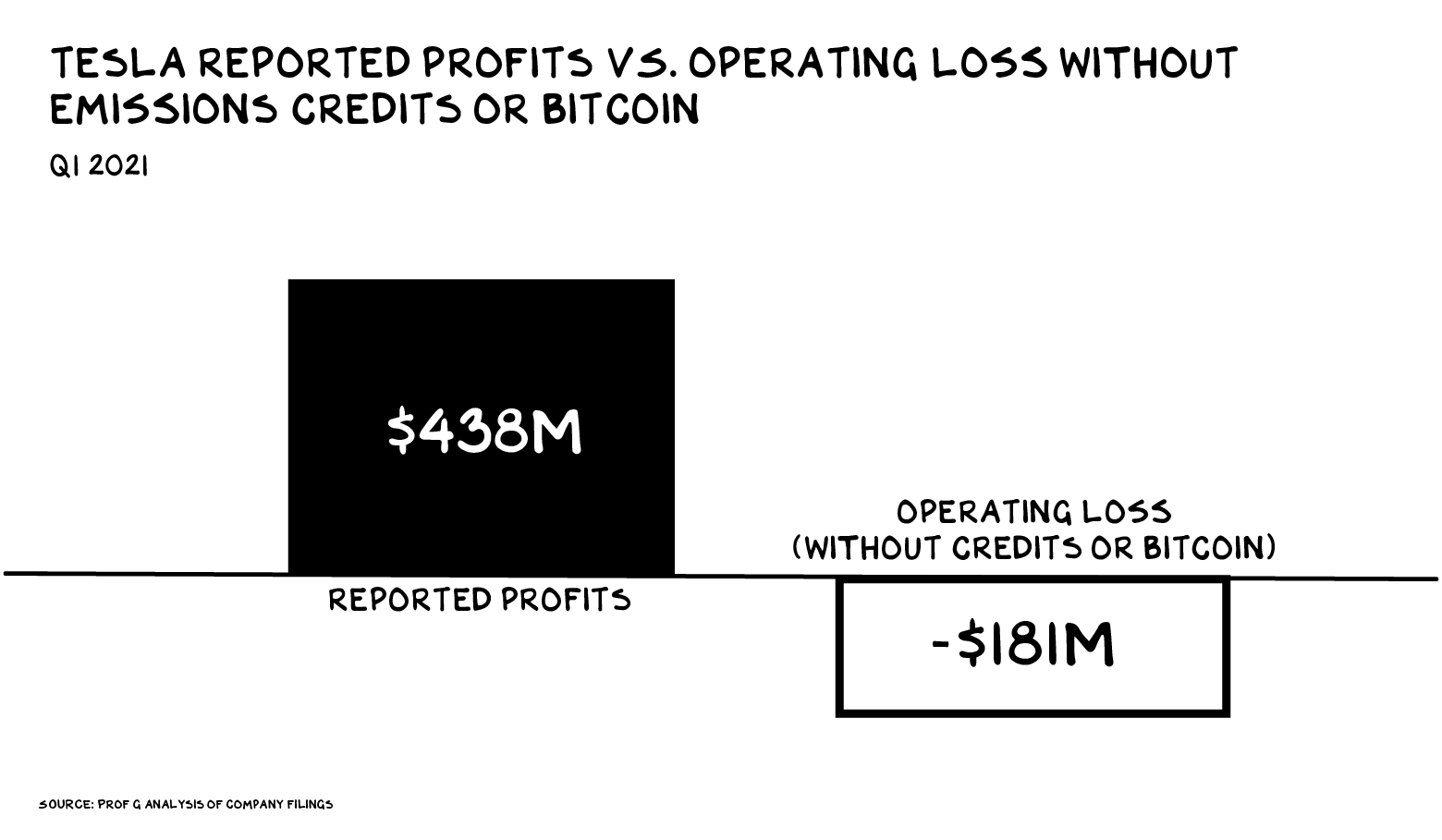
As professor Scott Galloway recently pointed out, if you subtract Tesla’s Bitcoin ponzi profits and emissions credits, Tesla actually loses money:

“Tesla posts an accounting profit, but in its most recent quarter, it was emissions credits (a regulatory program that rewards auto companies for making electric rather than gas vehicles) and — wait for it — $101 million in bitcoin trading profits that morphed earnings from a miss to a beat. What Tesla did not do last quarter was produce a single one of its two premium cars, the Model S or the Model X.”

Losing money doesn’t seem to worry speculators during peaks of irrational exuberance, but when the rubber meets the road and the stock bubble pops and corporate credit constricts, real investors will want no part in money-burning businesses.

And it won’t take a full market meltdown for Tesla to become a money-losing entity: If the global crypto ponzi bubble pops due to more countries banning or regulating it, or regulators do away with emissions credits, Tesla once again becomes a money-bleeding company.

Image credit: The Martian

2. Elon Musk is too distracted to remain CEO

One thing you’ve got to appreciate about Elon Musk is that he’s voraciously curious and wants to solve some of humanity’s biggest challenges.

But that’s not who you want as CEO of a publicly-traded company.

One of the reasons you don’t see most Fortune 500 CEOs on Joe Rogan and SNL and, you know, running five other companies, is because they’re heads-down focused on running one company. When he ran Disney, Bob Iger woke up at 4:15 AM every day. Apple’s Tim Cook gets up at 3:45 AM and reads 800 emails. Elon Musk also puts in absurd hours — I personally question if sleep deprivation is what rational shareholders are looking for in any CEO — but in Elon’s case, it’s spread across too many projects to be sustainable for decades to come.

3. Elon is already diversifying

Have you ever heard of Dan Schulman?

Me neither.

He’s a former AMEX guy, now the CEO of Paypal.

Elon is brilliant at getting out early and pivoting hard.

He did it with Zip2, and then Paypal, and now he’s putting out feelers to do it with Tesla:

SpaceX.
SolarCity.
Hyperloop.
The Boring Company.
Neuralink.
BTC and DOGE. (Side note: Elon knows he’s the king memer and could easily add $100 billion to his net worth by launching his own altcoin.)

It’s only a matter of time before one of these side hustles takes off and he steps down as Tesla’s CEO, if only because…

4. More regulation and oversight are on the way

Elon once again put Tesla in the crosshairs when he started manipulating the cryptocurrency markets.

Never forget how close he came to getting banned from leading a publicly-traded company by the SEC.

If he keeps up these sorts of shenanigans — and he needs to in order to keep the stock price pumped — it’s only a matter of time before government regulators and progressive politicians renew their efforts to rein him in.

Speaking of lawsuits: There are already rumblings that his SNL Asperger’s announcement should have been disclosed to investors — when the stock tanks, expect to see this admission somewhere in the shareholder lawsuit, whether it’s fair grounds or not.

5. The stock price is wildly overvalued

Cue the angry comments from hodlers. (But please note that I automatically delete comments if the poster doesn’t disclose their TSLA holdings.)

As a sound investment, $TSLA stock is one of the worst picks in the world. As a fun gamble/speculation, it’s one of the best. But, just like Bitcoin, small investors are going to lose hundreds of billions of dollars when the price bubble pops.

Because let’s face it: Tesla is a story stock.

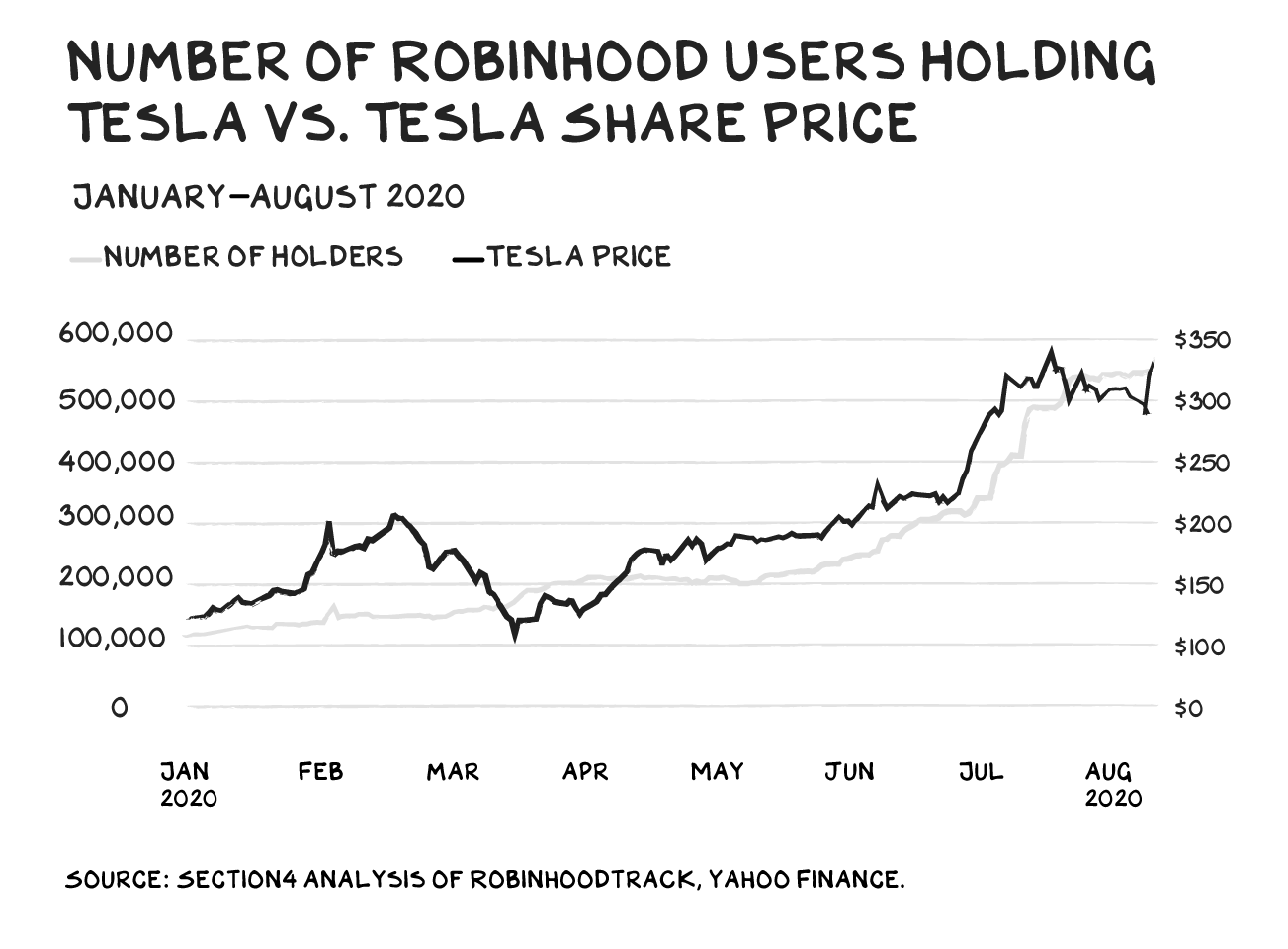
Don’t believe me? Just look at who’s been buying shares:

Image credit: Tulips to Tesla

Tesla stock is clearly being pumped by unsophisticated investors who haven’t done their due diligence regarding the company’s actual long-term worth.

The end result: When thousands of Tesla speculators lose their life savings, many will turn their backs on the company, if not become actively hostile.

What is $TSLA actually worth?

First, we need some context. The price-to-earnings (P/E) ratio is considered the benchmark number for comparing one company’s stock price to another. The ratio is based on the current stock price divided by the trailing 12-month earnings per share. If a stock price is $10/share, and the P/E ratio is 10, it means that company is earning $1 per share. If you buy a $10 share with a P/E of 20, it’ll roughly take you 20 years to break even.

  • Warren Buffett likes to buy stocks with a P/E of around 12.
  • The S&P 500’s long-term median P/E ratio is around 15.
  • The S&P 500’s current P/E ratio is around 44 — nearly triple its century-long average — despite the pandemic and a looming joblessness crisis. (#Bubble)
  • Apple’s P/E is typically <30.
  • Amazon hovers around 60.

Tesla’s P/E ratio is currently over 600.

That’s $0.99 worth of earnings for every $625 invested. Would you buy a business with an ROI of 0.001584%? Would you acquire a company that will take 600+ years to break even?

Cue the irrational exuberancers: “But Tesla’s future potential is huge!”

No, it’s not, not compared to its current price. To fall in line with the S&P’s historical averages and provide a reasonable rate of real return, Tesla would need to 40X its earnings. To provide a 10% annual return, it would need to 63X its earnings. Well over $2 trillion in annual revenue… 4+X more revenue than the largest revenue-earning company on earth. Not gonna happen.

Objectively, Tesla is wildly overpriced even compared to the overall market bubble. It’s a double bubble — the overall market bubble + the Musk fanboy story stock bubble. Tesla may very well be 13Xs better than the average S&P company right now, but that just means Tesla’s price bubble is that much more inflated once you scrub out all the irrational exuberance.

Tesla’s market cap is currently over $600 billion. If it traded at the same P/E as Amazon — arguably one of the strongest companies on earth — Tesla’s market cap drops to $60 billion. If you compare Tesla to Apple, which is a fair comparison and a far more rational P/E, it means that in reality, Tesla is probably only worth a measly $20 billion.

6. Volkswagen+ will come roaring back

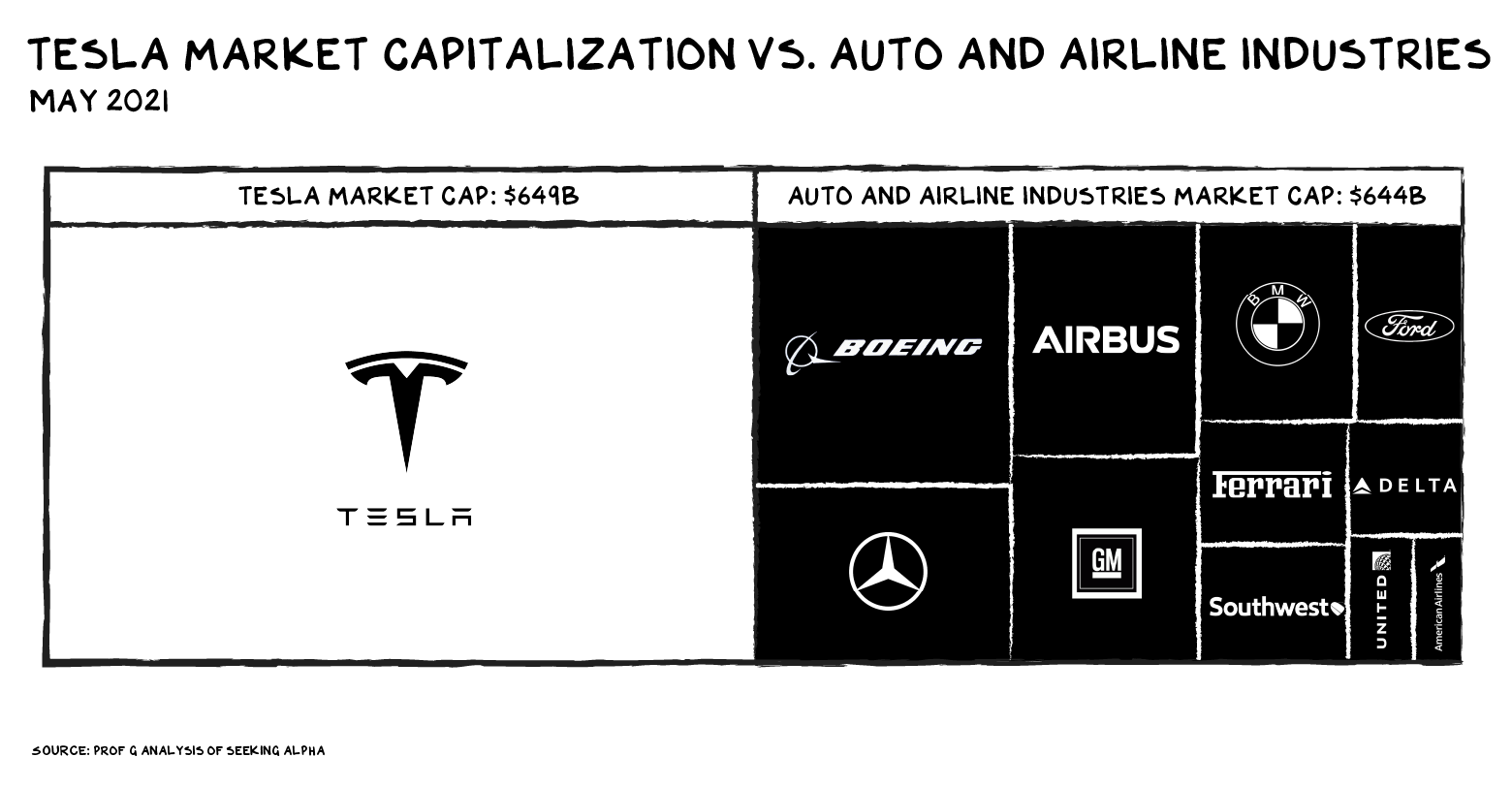
To put things in perspective, Tesla’s market cap is currently higher than Mercedes, BMW, GM, Ferrari, and Ford, plus all the major airlines… combined.

Image credit: The Martian

But does Tesla have more customers, wider distribution, better engineers, deeper pockets, and more political connections than the rest of the auto and airline industries?

Absolutely not.

All his major competitors have deeper capital pools, wider distribution networks, and far more customers. Musk has nowhere near the political power. And the innovation gap is closing rapidly. That’s why Elon is constantly seeking new capital and pulling out all the stops to keep pumping the stock, even going so far as to manipulate people’s psychology through stock splits.

Elon Musk has unquestionably (and rightly) created a Thucydides Trap in the automotive industry, but is Tesla really the Athens that can best Sparta?

The question is almost irrelevant because another company is about to out-Athens Tesla and stuff Elon in his own Thucydides trap:

7. Apple will drop an atomic bomb

When Apple releases an electric car — and you can bet your bottom dollar it will — we can safely assume it will rival Tesla for looks and coolness and will likely beat it on price, too.

Follow the money with me…

  • When Apple makes a car play, it could easily pop Tesla’s 600 P/E bubble…
  • If Tesla deflates to an Apple-level P/E of 30, Tesla is suddenly only worth $20 billion…
  • Which makes it instantly ripe for acquisition by one of the majors, be it Apple, Amazon, BMW, Mercedes, or even an old-school company like GM. (Never forget: Ford once bought Jaguar and Fiat once owned Maserati.)

To be clear, Tesla is an amazing company at a $20 billion valuation, and if Elon can’t keep the $TLSA stock price inflated indefinitely, an acquisition is inevitable. Never mind the bite in Apple’s logo… someone could chomp Tesla whole.

In Conclusion

I adore Tesla. Like Russia and HBO, it punches way above its weight.

I also like Elon, minus his market manipulation. He’s an extremely important person in the carmaking space. I’ll say it loudly: Elon Musk is the best thing to happen to the auto industry since Henry Ford. As a maverick agitator, he awoke the slumbering giants who’d happily relied on fossil fuel combustion for more than a century. We’re better for having him.

But, in the same way that Paypal will continue to lose ground to companies like Wise and Stripe, expect Tesla to lose ground to Volkswagen and Apple and whatever innovators come next. If things play out the way I predict regarding an eventual acquisition, fifty years from now Tesla probably won’t even exist.

In the meantime, don’t buy into the stock hype and endanger your family’s future.

Just rent a Model X for a weekend and enjoy the ride.

Source: https://medium.com/surviving-tomorrow/tesla-is-dead-and-elon-musk-probably-knows-it-2858c86589d0

Here’s the electric car Audi is building to take on Tesla

Audi E-tron quattroAudi

Tesla’s Model S and Model X are soon going to have some serious competition.

Last September, Audi revealed its all-electric e-tron quattro concept at the Frankfurt Motor Show. The SUV, which is slated to go into production by 2018, will have three electric motors, a range of 310 miles on a single charge, and quick charging capabilities.

Here’s a look at some of the features in the e-tron quattro that we hope to see in the production version.

Like the e-tron concept, Audi will most likely include piloted driving technology in its upcoming all-electric SUV.

Like the e-tron concept, Audi will most likely include piloted driving technology in its upcoming all-electric SUV.

Audi piloted techYouTube/Audi

The e-tron quattro concept has piloted driving technology, which uses radar sensors, a video camera, ultrasonic sensors, and a laser scanner to collect data about the car’s environment and create a model of the vehicle’s surroundings in real-time.

Audi currently has a lot of this tech in its newer vehicles, so it’s likely we will see a more advanced piloted system in the production version of the e-tron quattro.


Cameras could replace side view mirrors.

Cameras could replace side view mirrors.

Audi

The e-tron quattro has curved displays built into the front section of the doors that lets the driver view what is around them. There’s no guarantee we’ll see this in the production version, but automakers are beginning to experiment with new kinds of mirror designs.

For example, GM’s a digital mirror in the Chevy Bolt and the Cadillac CT6that uses cameras to stream whatever is behind you.

It will likely be covered in screens.

It will likely be covered in screens.

Audi

The e-tron quattro concept features two touch displays in the cockpit, one to the driver’s left to control lights and the piloted driving systems and one to the right where media and navigation is controlled.

The center console has two more OLED displays for climate control and infotainment.

With its 95 kWh battery, the e-tron quattro has an impressive range of 310 miles on a single charge.

With its 95 kWh battery, the e-tron quattro has an impressive range of 310 miles on a single charge.

Audi

To put that into perspective, Tesla’s Model X SUV with all wheel drive and a 100kWh battery has a range of 289 miles on a single charge. Audi has already said its range will beat this.

It may be able to fully charge in just 50 minutes.

It may be able to fully charge in just 50 minutes.

Audi

We know the production version will have quick charging capabilities, but we don’t know exactly how fast it will work. However, we’re hoping it’s in line with the e-tron quattro concept’s charge time.

The concept car has a Combined Charging System (CCS), meaning it can be charged with a DC or AC electrical current. It can fully charge with a DC current outputting 150 kW in just about 50 minutes.


The e-tron quattro concept is equipped with induction charging technology, so it can be charged wirelessly over a charging plate.

The e-tron quattro concept is equipped with induction charging technology, so it can be charged wirelessly over a charging plate.

Audi

We can’t say if this is a definite feature the production version will have, but our fingers are crossed.

It will have super fast connectivity.

It will have super fast connectivity.

Audi

Audi announced at CES this year that it is the first automaker to support the latest standard for mobile communications: LTE Advanced.

LTE Advanced is the latest enhancement to LTE, meaning that it can deliver larger and faster wireless data payloads than 4G LTE. We can almost certainly expect to see the technology integrated into the upcoming production car.

http://www.businessinsider.de/audis-electric-vs-tesla-2016-9?op=1

BMW will electrify its regular cars – what happens to ‚i‘ models?

2017 BMW i32017 BMW i3

When the BMW i3 went on sale in the U.S. back in May 2014, it marked not only the debut of the German automaker’s first mass-market electric car, but also a new sub-brand.

BMW originally planned to group all its electric cars under the „i“ sub-brand, which currently includes all-electric and range-extended REx versions of the i3, as well as the striking and expensive i8 plug-in hybrid coupe.

But as BMW looks to expand the number of electric cars in its lineup, that strategy may soon change.

The carmaker plans to offer all-electric versions of its regular models, starting with the 3-Series sedan, X4 crossover, and Mini Cooper, reports WardsAuto.

The industry trade journal cites a report from the German newspaper Handelsblatt, which in turn is based on interviews with anonymous sources close to BMW chairman Harald Kruger.

The decision to sell all-electric versions of the 3-Series, X4, and Mini Cooper is partially motivated by the need to compete with Tesla Motors, and to match electric-car programs of other German luxury brands, the report said.

2017 BMW 330e i Performance2017 BMW 330e i Performance

The 3-Series in particular is likely the vehicle most directly targeted by the Tesla Model 3, the 215-mile, $35,000 electric sedan unveiled by the Silicon Valley company in April.

It has already been reported that an all-electric powertrain will be offered in the 3-Series—BMW’s core model—as part of a 2018 redesign.

While it initially resisted the idea, BMW may also view offering electric powertrains in its regular models as a less-expensive option than adding more dedicated „i“ models.

Both the i3 and i8 use carbon fiber-reinforced plastic body shells and aluminum subframes that aren’t shared with other models.

This reduces the profit margin of these „i“ models compared to the rest of BMW’s lineup.

In its latest 7-Series large luxury sedan, BMW has incorporated individual structural members of carbon fiber within a largely steel structure, meaning the dedicated CFRP body shells may not be needed.

2016 BMW X4 M40i2016 BMW X4 M40i

BMW is expected to launch an i5 extended-range electric crossover in 2018, as well as a convertible version of the i8 and a new electric flagship sedan code named „iNext.“

To some extent, though, the move away from dedicated BMW plug-in models has already begun.

In the U.S., the carmaker offers plug-in hybrid versions of the 3-Series sedan, as well as the X5 SUV, and the 7-Series sedan will follow.

These models wear „i Performance“ badges, but they have nonetheless obliterated the „i“ division’s short-lived monopoly on plug-in hybrids within the BMW lineup.

Whether there will be any further dedicated „i“ models after the i5 remains to be seen, but the shift in tactics underscores the slow spread of battery-electric powertrains across the lineups of more and more manufacturers.

In other words, electric powertrainsaren’t just for special vehicles any more.

http://www.greencarreports.com/news/1106218_bmw-will-electrify-its-regular-cars-what-happens-to-i-models

Tesla misses 2016/Q2 Wall Street targets, but logs gains in vehicle production

Although Tesla fell far short of Wall Street estimates for earnings and revenue, the company showed progress in increasing its production capabilities, which have long been an issue for the electric automaker.

With these improvements, Tesla said it is on track to deliver 50,000 vehicles in the latter half of this year, which reaffirms its previous guidance.

Tesla shares wavered in trading after the closing bell.

The company reported a second-quarter adjusted loss of $1.06 per share on $1.56 billion in sales. That’s more than double the loss analysts, on average, were expecting. Thomson Reuters‘ consensus estimate called for a loss of 52 cents a share on revenue of $1.62 billion.

Telsa also continued to burn through cash as it invested in production improvements and the construction of its gigafactory in Nevada. But its cash position improved and stood at $3.25 billion as of June 30, fueled in part by a $1.7 billion offering in May. The company expects to log another $2.25 billion in capital expenditures this year to support its accelerated Model 3 production schedule.

Despite these results, Tesla investors remain much more focused on next year rather than these near-term earnings, said Ben Kallo, a senior research analyst at Robert W. Baird.

„I think this is actually what I call de-risking the quarter,“ Kallo told CNBC. „We got the quarter out of the way so now we got a couple months where Elon can start telling us more about the Model 3.“

Kallo is looking for the new model to be introduced in the back half of this year, and when it is, it will be a positive catalyst for the stock.

Tesla said Wednesday it completed the design phase for its Model 3, which it is being marketed as a more affordable version of its high-end cars. Some production equipment for the Model 3 is ready, and Tesla expects to begin building the body and general assembly centers later this year.

After the Model 3, the next priority will be developing the Model Y, a small crossover vehicle, CEO Elon Musk said during the company’s earnings conference call. Musk said he expects strong demand for this vehicle in the range of 500,000 to 1 million units a year.

14,402 vehicles delivered in 2Q

In a letter to shareholders, Tesla said that it finished the second quarter consistently making 2,000 vehicles per week. For the entire quarter, Tesla produced a record total of 18,345 vehicles, an 18 percent increase over the first quarter and up 43 percent over the second fiscal quarter of 2015. Nearly half of the cars it produced occurred in the final four weeks of the quarter.

Tesla said it delivered 14,402 new vehicles, consisting of 9,764 Model S and 4, 638 Model X, which was higher than the company stated in its July production update.

With the improvements in vehicle production efficiency, Telsa said it expects to make 2,200 vehicles a week by the end of the third quarter, and 2,400 a week by the end of the fiscal year.

Meanwhile, new vehicle orders rose 67 percent over the same quarter last year.

Tesla also is seeing increased demand from customers who want to lease their vehicles, and it expects direct leasing to rise from 8 percent of deliveries in the second quarter to about 15 percent of deliveries in the third quarter. While this trend is not surprising given the high cost of the Model S and Model X, Tesla will need to strike new deals with lenders to fund the program.

In its letter to shareholders, Telsa said it had reached its funding limit with a banking partner for its leasing program, but it expects to add new partners in order to continue to sign new leases.

The construction schedule for the Gigafactory manufacturing facility is on track to support volume Model 3 production in late 2017, the company said.

Favorable pricing for the Model S, which rose 3 percent sequentially, and improved manufacturing for the Model X, helped Tesla report „strong“ sequential gross margin increases. On a GAAP basis, its automotive gross margin was 23.1 percent. On a non-GAAP basis, gross margins increased 200 basis points from first-quarter to 21.9 percent.

More to come on autonomous drive technology

During the company’s conference call, Musk did not back off its push toward autonomous driving. In fact, the company said the new technology it is working on will „blow people’s minds.“

„It already blows his mind,“ he said, declining to provide more specifics information.

There has been some talk among analysts that a new version of autonomous drive technology might be rolled into the Model 3 when it is unveiled later this year.

On Monday, Tesla agreed to buy SolarCity for $2.6 billion, after first proposing the deal in June. The move signals that Tesla is trying to move from being an electric car company to a broad sustainable energy business by offering a wide range of integrated products.

http://www.cnbc.com/2016/08/03/tesla-reports-second-quarter-earnings.html

The 15 coolest concept cars revealed this year so far

Automakers are pushing bold, innovative ideas forward with their latest concept cars.

Faraday Thumb23Rob Ludacer

Whether it’s a car with nothing inside but a sofa and TV or an electric car resembling the Batmobile, concept cars give us a glimpse of how technology will shape the future of driving.

1. Volkswagen unveiled a microbus concept meant to give a modern spin to the classic Volkswagen bus at the Consumer Electronics Show in January.

1. Volkswagen unveiled a microbus concept meant to give a modern spin to the classic Volkswagen bus at the Consumer Electronics Show in January.

Volkswagen

Called the BUDD-e, the electric car gets up to 373 miles of range.

The doors open with a simple wave of the hand, and you can control the console’s interface by making hand gestures.

The doors open with a simple wave of the hand, and you can control the console's interface by making hand gestures.

Volkswagen

You can also use the interface to control things like the temperature and lighting in your house.

2. The big unveiling to come out of the Consumer Electronics Show was Faraday Future’s concept car, the FFZERO1.

2. The big unveiling to come out of the Consumer Electronics Show was Faraday Future's concept car, the FFZERO1.

Rob Ludacer

It can go from zero to 60 miles per hour in under three seconds.

Four motors placed over each wheel give the car a top speed of 200 miles per hour. It’s also capable of learning the driver’s preferences and automatically adjusting the internal settings.

Four motors placed over each wheel give the car a top speed of 200 miles per hour. It's also capable of learning the driver's preferences and automatically adjusting the internal settings.

Faraday Future

Although Faraday Future plans to release a production car in 2020, the FFZERO1 is just a show car.

3. LeEco, a Chinese tech company, unveiled its Tesla killer concept car at the Consumer Electronics Show.

LeEco is also partners with Faraday Future.

Called the LeSEE, the car has a top speed of 130 miles per hour. It also has an autonomous mode.

Called the LeSEE, the car has a top speed of 130 miles per hour. It also has an autonomous mode.

LeEco

The steering wheel will retract back into the dashboard when the car is in autonomous mode.

4. The Lincoln Navigator concept car comes with giant gullwing doors. It was unveiled at the New York Auto Show in March.

4. The Lincoln Navigator concept car comes with giant gullwing doors. It was unveiled at the New York Auto Show in March.

Ford

We won’t be seeing those doors in the production model of a Lincoln Navigator anytime soon, unfortunately.

The six seats inside can be adjusted 30 different ways, and there’s entertainment consoles on the back of four seats so passengers can watch TV or play games.

The six seats inside can be adjusted 30 different ways, and there's entertainment consoles on the back of four seats so passengers can watch TV or play games.

Ford

There’s even a built-in wardrobe management system in the trunk so you can turn your car into part walk-in closet.

5. BMW’s Vision Next 100 was unveiled at the Geneva Motor Show in March. It comes with an AI system called Companion that can learn your driving preferences and adjust accordingly in advance.

5. BMW's Vision Next 100 was unveiled at the Geneva Motor Show in March. It comes with an AI system called Companion that can learn your driving preferences and adjust accordingly in advance.

BMW

The side panels of the Next 100 are made of carbon fiber.

The steering wheel will retract into the dashboard when the car is in autonomous mode.

The steering wheel will retract into the dashboard when the car is in autonomous mode.

BMW

There’s also a heads-up display that will show information about your route on the windshield.

6. BMW added to its Vision 100 line in June. Here we see the Mini Vision Next 100 that was built for ridesharing.

6. BMW added to its Vision 100 line in June. Here we see the Mini Vision Next 100 that was built for ridesharing.

BMW

The car can recognize who you are when it comes to pick you up and will greet you with personalized lighting.

The steering wheel will shift into the center of the console when the car is in autonomous mode.

The steering wheel will shift into the center of the console when the car is in autonomous mode.

BMW

The BMW also comes with a heads-up display that will show information about your route on the windshield.

7. The last addition to the BMW Vision 100 line is this futuristic Rolls-Royce.

7. The last addition to the BMW Vision 100 line is this futuristic Rolls-Royce.

Rob Ludacer

The Rolls-Royce is also completely autonomous.

Because the car envisions a completely autonomous future, the interior is composed entirely of a two-person, silk sofa and a giant OLED TV.

Because the car envisions a completely autonomous future, the interior is composed entirely of a two-person, silk sofa and a giant OLED TV.

Rolls-Royce

There’s also a secret compartment in the car for storing your luggage.

8. McLaren unveiled a stunning concept car called the 675LT JVCKENWOOD at the Consumer Electronics Show.

8. McLaren unveiled a stunning concept car called the 675LT JVCKENWOOD at the Consumer Electronics Show.

McLaren

The McLaren 675LT comes with a wireless networking system so it could communicate with other cars on the road about traffic and accidents.

The car comes with a steering wheel that looks like a video game controller!

The car comes with a steering wheel that looks like a video game controller!

McLaren

The controller is meant to help the driver control the heads-up display while in motion.

9. Italian automaker Pininfarina unveiled a beautiful hydrogen-powered concept car at the Geneva Motor Show.

9. Italian automaker Pininfarina unveiled a beautiful hydrogen-powered concept car at the Geneva Motor Show.

Pininfarina

The car, called H2 Speed, refuels in just three minutes.

It has a top speed of 186 miles per hour and can go from zero to 62 miles per hour in 3.4 seconds.

It has a top speed of 186 miles per hour and can go from zero to 62 miles per hour in 3.4 seconds.

Pininfarina

The car can regenerate energy from braking.

10. Audi unveiled its connected mobility concept car in April. There’s a longboard integrated in the bumper in case you want to roll from the parking lot to work.

10. Audi unveiled its connected mobility concept car in April. There's a longboard integrated in the bumper in case you want to roll from the parking lot to work.

Audi

It conveniently pulls out when you need it and is stored in the bumper when you’d rather travel on foot!

The car’s infotainment system can calculate the fastest route based on real-time data and will suggest using the longboard if that seems faster.

The car's infotainment system can calculate the fastest route based on real-time data and will suggest using the longboard if that seems faster.

Audi

It will even show you the best parking spot to make the longboard portion of your commute shorter.

11. Aston Martin showed off a beautiful concept car in May called the Vanquish Zagato Concept.

11. Aston Martin showed off a beautiful concept car in May called the Vanquish Zagato Concept.

Aston Martin

All of the body panels in the Vanquish Zagato are made of carbon fiber.

Aston Martin made the car with Italian auto design company Zagato. The two have worked together since 1960.

Aston Martin made the car with Italian auto design company Zagato. The two have worked together since 1960.

Aston Martin

There’s not too many details on this car since it’s just a concept, but it sure is pretty.

12. Jeep showed off a crazy looking wrangler in March at the Easter Jeep Safari, an off road rally.

12. Jeep showed off a crazy looking wrangler in March at the Easter Jeep Safari, an off road rally.

Chrysler

That is a monster car.

The Wrangler Trailcat concept had to be stretched to 12 inches to accommodate the massive engine providing 707 horsepower.

The Wrangler Trailcat concept had to be stretched to 12 inches to accommodate the massive engine providing 707 horsepower.

Chrysler

It comes with racing seats from a Dodge Viper.

13. Toyota unveiled a strange-looking concept car dubbed the uBox to appeal to Generation Z in April.

13. Toyota unveiled a strange-looking concept car dubbed the uBox to appeal to Generation Z in April.

Toyota

The uBox is all-electric.

The interior is entirely customizable so it can transform into a mobile office or fit more people.

The interior is entirely customizable so it can transform into a mobile office or fit more people.

Toyota

It also comes with a nice curved glass roof that lets plenty of light inside.

14. French automaker Renault showed off a stunning, high-tech sports car dubbed the Alpine Vision in February.

The Alpine Vision is a two-door, two-seater sports car.

It can go from zero to 62 miles per hour in 4.5 seconds

The interior is decked out with a LCD gauge cluster in the center console.

15. Lastly, Croatian automaker Rimac designed a stunning, all-electric concept car for the Geneva Motor Show.

15. Lastly, Croatian automaker Rimac designed a stunning, all-electric concept car for the Geneva Motor Show.

Rimac

Called the Concept_One it can accelerate from zero to 62 miles per hour in just 2.6 seconds.

The Concept_One can reach a top speed of 185 miles per hour.

The Concept_One can reach a top speed of 185 miles per hour.

Rimac

It has a regenerative braking system that allows it to generate energy whenever it brakes.

http://www.businessinsider.com/coolest-concept-cars-revealed-in-2016-2016-6