Schlagwort-Archive: google+

Data Shows Google’s Robot Cars Are Smoother, Safer Drivers Than You or I

Data Shows Google’s Robot Cars Are Smoother, Safer Drivers Than You or I

Tests of Google’s autonomous vehicles in California and Nevada suggests they already outperform human drivers.

Data gathered from Google’s self-driving Prius and Lexus cars shows that they are safer and smoother when steering themselves than when a human takes the wheel, according to the leader of Google’s autonomous-car project.

Chris Urmson made those claims today at a robotics conference in Santa Clara, California. He presented results from two studies of data from the hundreds of thousands of miles Google’s vehicles have logged on public roads in California and Nevada.

One of those analyses showed that when a human was behind the wheel, Google’s cars accelerated and braked significantly more sharply than they did when piloting themselves. Another showed that the cars’ software was much better at maintaining a safe distance from the vehicle ahead than the human drivers were.

“We’re spending less time in near-collision states,” said Urmson. “Our car is driving more smoothly and more safely than our trained professional drivers.”

In addition to painting a rosy picture of his vehicles’ autonomous capabilities, Urmson showed a new dashboard display that his group has developed to help people understand what an autonomous car is doing and when they might want to take over. “Inside the car we’ve gone out of our way to make the human factors work,” he said.

Although that might suggest the company is thinking about how to translate its research project into something used by real motorists, Urmson dodged a question about how that might happen. “We’re thinking about different ways of bringing it to market,” he said. “I can’t tell you any more right now.”

Urmson did say that he is in regular contact with automakers. Many of those companies are independently working on self-driving cars themselves (see “Driverless Cars Are Further Away Than You Think”).

Google has been testing its cars on public roads since 2010 (see “Look, No Hands”), always with a human in the driver’s seat who can take over if necessary.

Urmson dismissed claims that legal and regulatory problems pose a major barrier to cars that are completely autonomous. He pointed out that California, Nevada, and Florida have already adjusted their laws to allow tests of self-driving cars. And existing product liability laws make it clear that a car’s manufacturer would be at fault if the car caused a crash, he said. He also said that when the inevitable accidents do occur, the data autonomous cars collect in order to navigate will provide a powerful and accurate picture of exactly who was responsible.

Urmson showed data from a Google car that was rear-ended in traffic by another driver. Examining the car’s annotated map of its surroundings clearly showed that the Google vehicle smoothly halted before being struck by the other vehicle.

“We don’t have to rely on eyewitnesses that can’t act be trusted as to what happened—we actually have the data,” he said. “The guy around us wasn’t paying enough attention. The data will set you free.”
Quelle: http://www.technologyreview.com/news/520746/data-shows-googles-robot-cars-are-smoother-safer-drivers-than-you-or-i/#

Start-ups: „Wer zu wenig verlangt, wird ausgelacht“

In der Heimat von Google und Facebook unterhalten sich „die mit den Ferraris“ auf Augenhöhe mit Jungunternehmern. Drei Österreicher erzählen von ihren ersten Gehversuchen im Silicon Valley.

Redwood city. Was die Bekleidung betrifft, erfüllen Patrick Schubert und Stefan Strohmer das Silicon-Valley-Klischee perfekt. Ihre kurzen Hosen, Stoffschuhe und T-Shirts passen zum Wetter: Es ist ein typisch heißer Sommertag in Redwood City, eine halbe Stunde südlich von San Francisco. Die 78.000-Einwohner-Stadt ist Sitz des US-Softwareriesen Oracle – und derzeit auch des Büros der beiden Waldviertler und ihrer Firma Questful. Im Rahmen des Programms „Go Silicon Valley“ der Wirtschaftskammer (WKO) und des Wirtschaftsministeriums sind sie von Juli bis September im Silicon Valley. Mit großen Zielen, aber ohne Illusionen. „Einer von zehn schafft es, aus seinem Start-up halbwegs etwas zu machen. Du musst richtig Gas geben“, sagt Schubert. Nur eine Idee mitzubringen, reiche nicht. Man müsse zumindest wissen, dass sie in der Praxis funktioniert – und im Idealfall schon Kunden haben. „Das Leben hier ist teuer. Mit leeren Händen herzukommen, ist Zeitverschwendung.“

Questful ist eine Internetseite, auf der die Teilnehmer von Veranstaltungen den Vortragenden Fragen schicken können. Die anderen Zuhörer können die Fragen „liken“ und der Vortragende so die beliebtesten auswählen. Schubert (24) programmiert, Strohmer (25) macht das Management. Questful ist nicht das erste, aber das „erste große“ Projekt der beiden. Ihr erstes entwarfen sie in einem Uni-Kurs – um dann den „klassischen Start-up-Fehler“ zu machen. „Du entwickelst ein Dreivierteljahr und kommst dann drauf, dass es keinen interessiert“, sagt Schubert. Perfektionismus in der Anfangsphase ist im Silicon Valley nicht gefragt. „Am besten bringt man sein Produkt möglichst früh auf den Markt. Man darf keine Angst haben, etwas zu Schlechtes herauszubringen“, sagt Strohmer.

Understatement nicht gefragt

Understatement ist fehl am Platz – besonders gegenüber potenziellen Investoren. „Man denkt hier in ganz anderen Dimensionen“, so Schubert. In Österreich fingen Unternehmer lieber klein an – anders im Valley: „Wenn du zu einem Investor sagst, du brauchst 100.000 Dollar, nimmt er dich nicht ernst. Du musst mindestens nach 500.000 bis einer Million suchen. Wenn du zu wenig verlangst, lachen sie dich aus.“ Auch der Wirtschaftsingenieur und der Wirtschaftsinformatiker haben gelernt, groß zu denken – und suchen einen Kapitalgeber, der fürs Erste 750.000 Dollar investiert.

Noch finanzieren sie fast alles selbst. WKO und Ministerium bezahlen den Arbeitsplatz in einem Großraumbüro. Für die Reise- und Lebenshaltungskosten müssen sie selbst aufkommen. Sie teilen sich Wohnung und Auto und brauchen zu zweit rund 3500 Dollar (2622 Euro) im Monat. „Wir haben in Österreich gearbeitet und Geld gespart. Das pulvern wir jetzt raus“, sagt Strohmer selbstbewusst.

Da ist der 33-jährige Gregor Zehetner in einer komfortableren Position. Sein Arbeitgeber, die IT-Firma Phactum, für die der Oberösterreicher im Management tätig ist, bezahlt ihm und seinem Kollegen Markus Minichmayr, 35, den Aufenthalt im Valley, um „Tapkey“ für den amerikanischen Markt aufzubauen. Mit Tapkey lassen sich Türen mit Smartphone und Google-Zugangsdaten aufsperren. In den USA wollen sie Schlosshersteller finden, die mit Tapkey zusammenarbeiten. Ihre Firma ist – anders als jene von Schubert und Strohmer – nicht mehr in der Anfangsphase. „Es ist nicht so, dass wir herkommen und schauen, was passiert. Es sind schon sehr viel Zeit und Geld in dieses Projekt geflossen.“

„Jeder hilft jedem“

Das Besondere im Silicon Valley ist für Zehetner, „dass jeder mit einer Idee im Kopf herumläuft und offen darüber spricht. Dadurch erhält man extrem wertvolles Feedback“. Jeder helfe jedem, ohne sofort eine Gegenleistung zu erwarten. „Weil die Leute davon ausgehen, dass ihnen bei Bedarf auch jemand hilft.“ Sympathisch und hilfreich findet er auch, dass es keine strengen Hierarchien gebe. „Die bereits Erfolgreichen mit den Ferraris“ unterhielten sich mit den Jungunternehmern auf Augenhöhe, sagt Zehetner. „Hier ist niemand besser.“

(„Die Presse“, Print-Ausgabe, 20.09.2013)

Quelle (Originalzitat aus Onlinepresse, 19.9.2013):

http://diepresse.com/home/techscience/sillicon/1454892/Startups_Wer-zu-wenig-verlangt-wird-ausgelacht?from=gl.home_tech

Why Google will crack Apple on the Tablet-Front soon

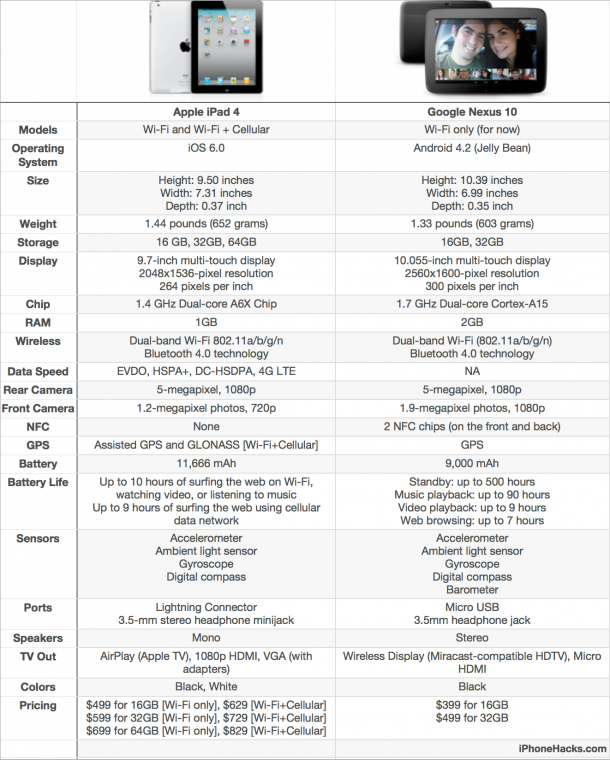
The Nexus 10 has the weaker eco-system in comp. with the IPAD 4 (Ipad with retina display) but is due to the introduction of Android 4.2 on the best track to become the new leader on the Tablet-Market.

The IOS System has lost its pace and is made competitive again with a new processor.

The specs tell the truth. Apple with its IPAD 4 has lost the lead and Google with the Nexus 10 has become the winner (on numbers). X-Mas 2012 will reflect in sales numbers who will be number one.

Source: Iphonehacks.com

Sean Parker „Power Users leave Facebook“

Spotify investor and former Facebook President Sean Parker had some harsh words for his favorite social network: Its problem isn’t privacy, it’s that some of its most active users are leaving for other services.

“The threat to Facebook is that power users have gone to Twitter or Google+,” Parker told the Web 2.0 Summit. They are leaving, he says, because Facebook isn’t giving them enough ways to manage a glut of information.

Parker: The digital revolution has removed barriers to sharing music. It doesn’t cost extra to create another copy of a song anymore and it’s easier than ever to get recommendations for music from friends. The result is that labels are lagging behind because they have layers of bureaucracy and protocols they no longer need. Bands are responding by using other distribution mediums (such as Spotify) in order to take charge of their own destinies.

Quelle: http://mashable.com/2011/10/17/sean-parker-web-2-summit/