Schlagwort-Archive: Elon Musk

Tesla’s Model 3 Reservations Rise to 400,000

Eager Tesla customers continue to reserve the Model 3, despite the ballooning wait times.

Reservations for Tesla’s recently unveiled, mainstream electric car, the Model 3, continue to climb.

According to a speech from Tesla’s Vice President of Business Development, Diarmuid O’Connell, this week, reservations for the car are now approaching 400,000.

That’s an eye-popping figure for an electric car that’s only been available to reserve for about two weeks and won’t start shipping until the end of 2017. Many of those reservations were made before the car was even unveiled on March 31. Now Tesla needs to figure out how to make and deliver those cars on time and budget.

Many of the later orders of the Model 3 likely won’t be fulfilled until 2019, or even into 2020 (four years from now).That’s assuming Tesla will remain on track to start shipping the car at the end of next year, too.

A driveable prototype of Tesla's Model 3.
A driveable prototype of Tesla’s Model 3. Katie Fehrenbacher/Fortune

To get that volume of cars made and delivered on time, Tesla TSLA -2.56% could have to change the way it makes its cars considerably. Tesla has only delivered a little over 100,000 cars in total over its lifetime. During O’Connell’s speech at a conference in Amsterdam, he said the rapid reservation rate gives Tesla the “visibility” and “confidence” into what it would take to build the car.

Tesla CEO Elon Musk tweeted the day after revealing the Model 3 for the first time (when the car had close to 200,000 reservations) that Tesla is “definitely going to need to rethink production planning.” Tesla will likely have to expand production at both its Fremont, Calif. factory more quickly than expected, and it will soon have to start producing a greater number of batteries at its massive battery factory still under construction outside of Reno, Nevada.

O’Connell said that Tesla is “looking at ways to amplify early production.” The company is investigating possible ways to scale up initial investments and ramp up more quickly than previously anticipated. Tesla plans to use lessons learned from the difficulties it had with manufacturing the Model X, Tesla’s SUV electric car.

That car was delayed for years, and it faced slow production at the end of 2015 and into early 2016. The company has admitted hubris for the Model X in trying to fit in too many complex features into the first version of the car.

According to estimates from Cairn Energy Research Advisors, Tesla could ship a little over 400,000 of its Model 3 cars by the end of 2020. But before 2020, production of Model 3 could likely be constrained. For example, Tesla could ship 12,200 Model 3 cars in its first production year in 2017, and another 64,660 Model 3 cars in 2018.

During O’Connell’s speech, he boasted reservations for the Model 3 “have exceeded all of our expectations as far as the rate at which we received reservations,” further describing the Model 3 as “the car for which the company was really set up to build.”

O’Connell suggested that the great demand for the Model 3 delivers a message to the rest of the auto industry that there is “incredible demand” for great electric vehicles out there. In addition, the massive demand refutes the point that other automakers have made that no one wants electric cars, he argued.

To make a reservation for a Model 3 car, Tesla customers only have to put down a fully refundable deposit of $1,000. So it’s unclear how many of the reservation holders would turn into Model 3 buyers.

If all 400,000 reservation holders bought $35,000 Model 3 cars, Tesla would have booked $14 billion in orders. That’s an unprecedented sum—not just in the auto industry, but for a launch of a product in general.

Source: http://fortune.com/2016/04/15/tesla-model-3-reservations-400000/

Tesla Model X: When an SUV can make you vomit while out-accelerating almost every Porsche, Ferrari or Lamborghini ever made, Modena and Stuttgart have a problem.

model-x

I hate SUVs for the same reason I hate houseboats. Bad houses, bad boats. Luxury SUV’s make me sick. Is there anything more American than the idea that you can have it all, without compromise, for a price? You can’t, otherwise Escalades and Expeditions would be running in NASCAR.

Except now you can, because I just took a Tesla Model X P90D to Ojai, California, and for the first time in my life, I wanted an American car.

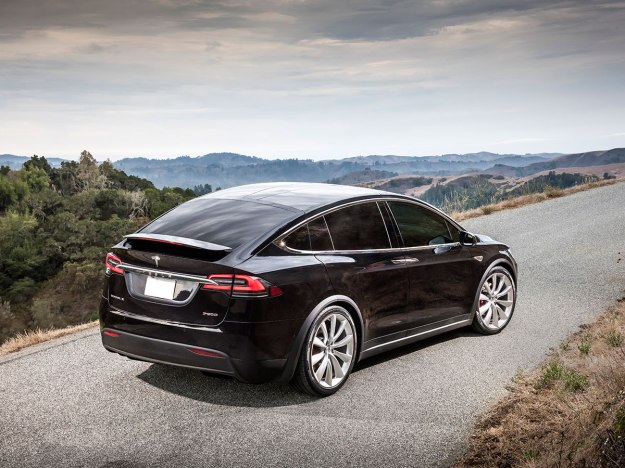
The Model X P90D represents everything I hate. It’s an awkwardly-proportioned, 5440 pound, electric, semi-autonomous, 7-seater SUV, packed full of technology that cannot possibly last, from a company critics claim cannot survive.

And I absolutely loved it.

Flaws? It’s a new company. If reliability is your concern, lease one and enjoy the most advanced, brilliant and fascinating vehicle in its class. The standard warranty is four years. Prepare for loaners.

The exterior is what it is. If you want the future now, this is what it looks like. If you’re satisfied with yesterday, you already know what’s available today. I think the X is handsome. Ish. Once behind the wheel, I didn’t care.

The Model X P90D gets about 250 miles of range. I’d like 50 more. Was it a problem? Only in my mind. As with any Tesla, you should install a high-speed charger at home. If not, prepare to meet some new friends at your nearest Tesla Supercharging station, and scratch 2-3 hours a week off your schedule.

The interior is spartan, at best. I still don’t buy into the wisdom of replacing all controls with a touchscreen, however large and gorgeous. The seats are the best I’ve ever used, and that includes the 1972 Citroen DS and SM, my personal benchmarks.

model-x-art-1

The Model X is a vehicle that makes no sense and yet perfect sense, an SUV with 716 horsepower that does 0-60 in 3.8 seconds, or 3.2 with the “Ludicrous” software upgrade.

A Ferrari Enzo does it in 3.14.

When an SUV can make you vomit while out-accelerating almost every Porsche, Ferrari or Lamborghini ever made, Modena and Stuttgart have a problem. Handling? The X is based on the same platform as the Model S sedan, which means it’s magnificent. Lower the air suspension, set the steering to Sport, and the X shrinks around you. I’ve never felt safe driving an SUV as I would a sports car, until now. Even my old Cayenne Turbo was a brick by comparison.

The Model X is the SUV someone else would have built if they had any balls.

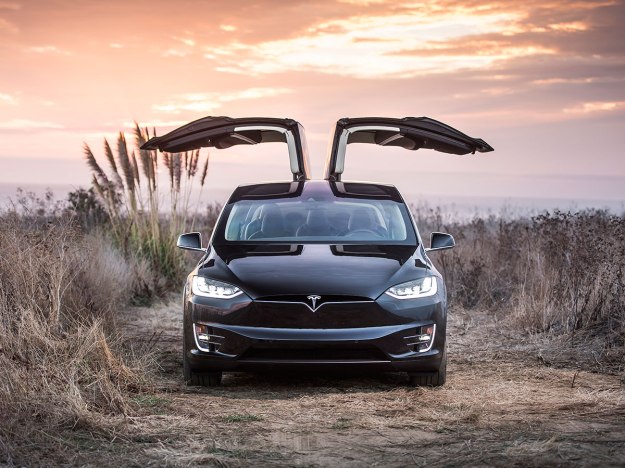
My god, those Falcon doors. Even if the X was utter junk, they could sell a year’s production based solely on these doors. Alas, you don’t need to be Nostradamus to know those will be a problem. If you lease past four years, get the extended warranty.

It has autopilot, which is what Tesla calls its Autonomous Driving suite. Light years ahead of competing systems, it is the only one today that approaches full autonomy. It’ll do 99% of the driving 90% of the time. It has a steep learning curve, but once mastered, autopilot is a revelation. Until Mercedes and Volvo come to the table, everything else is a joke.

The enormous one-piece panoramic windshield makes the cockpit feel like the first row in an IMAX theater. After driving the Model X, every other car feels like you have an eye infection. Why this windshield hasn’t been done before in the US, I don’t understand.

The Model X is the SUV someone else would have built if they had any balls. It is the world’s greatest SUV in a class of one…a class called The Future. The X is to SUV’s what the S is to luxury sedans, which is what Tesla is to the entire car industry: an icepick in the face of convention. Granted, there are stellar cars out there: the Cadillac CTS-V, the Porsche 911, the BMW M2, the Mercedes AMG-GT and the Volvo XC90, but these are jewels in the sediment of an industry left behind by true innovation. I love the Model X not merely as a vehicle, but as a profoundly American vehicle, the automotive manifestation of what this country is supposed to stand for. Ambition. Ingenuity. Confidence.

model-x-art-2

American inventor mythology is that of someone being told something couldn’t be done, and then doing it. Is there a more American story than Musk’s? The immigrant who became a tech titan, then launched a rocket company, then entered the car business?

The Model X, like Tesla the company, is an example of what happens when you apply that most American of methods to a problem. Throw out the book. Solve it from the ground up. Dealer networks suck? We’ll sell direct. Nowhere to charge? We’ll build our own network, and we’ll make it free. Autonomous Driving? Software updates? Let’s give Tesla owners access to the very best tech, and let’s wirelessly update it all the time.

By these standards, Tesla is the most American car company there is today, and the brilliant Model X is the most American car currently on the market. It is an example of what happens when a company is willing to take risks on our behalf rather than at our expense. Whatever critics may claim about Tesla’s ability to deliver, Musk’s greatest sin is his rush to sell us something truly better, which is why I deem the X worth every penny, flaws and all.

I can’t wait for the Model 3. If you believe in what really makes American great, neither should you.

http://www.thedrive.com/new-cars/2875/why-the-tesla-model-x-will-make-you-want-an-american-suv

Tesla Model X: Electric Meets Extravagant

With gull-wing doors and Lamborghini-like acceleration, Tesla’s Model X P90D Ludicrous—an electric all-wheel-drive luxury SUV—comes loaded with contradiction

WINGS OF DESIRE | The Falcon Wing Doors on the Tesla Model X P90D Ludicrous are at once thoughtfully engineered, largely impractical, and very, very cool.
WINGS OF DESIRE | The Falcon Wing Doors on the Tesla Model X P90D Ludicrous are at once thoughtfully engineered, largely impractical, and very, very cool. Photo: Tesla

LET’S ADDRESS WHAT some might consider the morally inconsistent status of an all-electric luxury SUV costing $135,400. By design, the Tesla Model X P90D Ludicrous (that’s the real name, apparently) is meant to be green and efficient—and well-to-wheel, net-to-net, EVs are way cleaner than gas-powered cars. Electric vehicles are a technical expression of our belief that the atmosphere is the blue commons, owned by all. Egalitarian in impulse, in other words.

But the Model X is also the rarest sushi of materialism, class privilege under a blister of tinted glass, a suede-lined pachinko parlor of the soul. Just remember as you pull up to Nobu in West Hollywood and supermodels come running out to the valet to take a picture with your Model X with the doors up: You’re saving the planet.

Here’s the hard part for most people: It can be both. A feature of a free society is that some have more than others; such are the risks and rewards of capitalism. This is a given. This is gravity. But everyone, no matter their lifestyles, can consume less. And, by the power of numbers, a lot of lesses add up to quite a lot.

So some Hollywood celebrity downsizes to a Gulfstream IV and now she’s Mother Earth? Well, yes. Consider it a self-imposed carbon flat tax.

F. Scott Fitzgerald said the test of a first-rate intelligence is the ability to hold two opposed ideas in mind at the same time and still function. It also seems to apply to the Model X’s famous Falcon Wing Doors, since they are simultaneously unnecessary and absolutely vital to the entire enterprise; deeply thought-through yet completely spurious; impractical and…well, more impractical. But you get used to them, because they are so cool. See above re: supermodels.

Advertisement

Or retired aerospace engineers. Or French tourists. Or the hard-core, mainlining petrolheads who kept me waiting in the parking lot at Venice Beach, Calif., while they selfied themselves, laughing madly, sitting in mid-row seats while the doors were up. When all the doors are open you can look through the Model X as if it were a picture window with a Tesla-shaped sill and sash.

Would minivan-style doors have been a more sensible technical solution to a mid-row door opening? Infinitely. You could have done the doors off the Dubonnet Xenia easier that the Model X. But the spell these doors cast—let’s call it emotional engineering—is payoff for some of the shrewdest design money ever spent.

2016 Tesla Model X P90D Ludicrous

Photo: Tesla

Price, as tested: $135,400

Powertrain: all-electric all-wheel system comprising dual three-phase, four-pole AC induction motors; liquid-cooled lithium-ion battery pack (90kWh nominal); on-board charger and supercharger enabled; permanent all-wheel drive.

Horsepower/torque: 532 hp/713 pound-feet of torque

Length/weight: 198.3 inches/5,381 pounds

Wheelbase: 116.7 inches

0-60 mph: 3.2 seconds

Towing capacity: 5,000 pounds

Cargo capacity: 77 cubic feet (total interior storage, six-seat configuration)

A bit of context: The Falcon Wing Doors came about because Tesla CEO Elon Musk liked them and wanted them, full stop. He has said he didn’t want the production car to be a dialed-back version of the concept car, which is just the sort of initiative and forward thinking that gets people cashiered from General Motors.

To aficionados, Mr. Musk’s move smacked of pride since in over a century of automotive design, from the Mercedes-Benz 300SL Gullwing to the DeLoreans to Lambos, gullwing doors have always looked cool and never really worked.

To name a few of the problems: ease of entry and exit, weather sealing and wind noise. From a safety standpoint, center-hinged overhead doors cut into the kind of rectangular geometry around a door opening that lends it rigidity.

What if it snows overnight? What if it’s raining? Where do you put the ski racks and bicycles and the Thule roof module full of hiking gear?

Who cares? Have you seen the doors open?

Most maddening was creating a dead-stable pivot point for the doors, which rise and fall slowly on the motorized breeze not like falcon wings but more like seagull wings, with a double fold. The solution required a heroic amount of costly magnesium in the car’s dorsal spine.

Mr. Musk has copped to overreach with the Model X. Maybe he tried to do too much, what with the Model X’s sensor-rich Autopilot driver aids; the dancing shuttle-craft seats; the HEPA air filtration system with the “Bioweapon Defense Mode” setting; the panoramic windscreen, a stunning soap bubble of a canopy over your head. Dude, you’re forgiven. But then again, I’m not a stockholder.

Practicality for fascination. This is the card Mr. Musk continues to play to his advantage. This is the part of the Tesla business plan that might as well have been quoted out of the Old Testament. The rich will want the riches.

2016 Tesla Model X P90D Ludicrous
2016 Tesla Model X P90D Ludicrous Photo: Tesla

Not to be confused with the Model 3 compact sedan that debuted so boffo this week, the Model X is a full-size SUV with dual electric motors front and rear, providing all-wheel drive. Although its body structure is almost entirely aluminum and magnesium, our flagship test car (P90D Ludicrous) was quoting a massive 5,381 pounds, most of it in the floor-mounted battery pack. Four-corner air suspension with five ride-height settings, from off-road to highway, is standard.

The Model X is a luxury family mover, with five-, six- or seven-passenger seating options, with a rear trunk and a frunk (a front trunk). The deeply tinted glass canopy creates a pretty magical space, although (another old lesson, relearned) the California sun is too bright through the roof glass. I understand additional tinting is available.

The front and mid-row seats are mounted on powered pedestals that glide forward as if to a Strauss waltz, easing access to the third row’s two cozy bucket seats. The seats’ pedestal mountings allow passengers more foot room than otherwise.

All the doors open electrically, which can take some getting used to. If you get in and put your right foot on the brake, the driver’s door will swing closed, even if you have not yet retrieved your left leg. The door will gently gnaw on it until you take your foot off the brake.

The price for the “standard” Model X 70S with a 70kWh battery is $80,000, which is about $5,000 more than a base Model S—a fact that is academic because Tesla won’t be building any base Model X’s for some time.

Elon Musk has copped to overreach with the Model X. Dude, you’re forgiven.

The company will instead be filling orders for the flagship P90D (“P” for performance). These will come with a face-flapping 713 pound-feet of insta-torque from two huge four-pole AC induction motors ($35,000) and the famous “Ludicrous” Drive Mode ($10,000), which essentially permits the battery to violently eject electrons in pursuit of maximum acceleration. In Ludicrous Mode, the Model X P90D max output is 532 hp.

That’s the version that Tesla provided me, and I want them to know, I’m on to their game. It is very hard to find fault with a six-seat SUV that accelerates like a Formula Atlantic open-wheeler. Jeebus. Stamp the accelerator and it goes off like a sprung mousetrap. Tesla estimates 0-60 mph in a Lambo-like 3.2 seconds. While doing so, the Model X quietly withdraws everything from your pockets and scatters it conveniently under the back seats.

And then, between 50 and 100 mph, it’s goodbye, Charlie. The P90D Ludicrous operates at an entirely different frame rate than just about anything on the street in L.A. It takes a sustainably harvested baseball bat to Panzer wagons like Porsche Cayenne Turbo and Range Rover Sport SVR.

Around the City of Angels, the sweet, effortless blurt of our EV hot-rod tempted me to do, well, questionable things. No yellow light ever turns red for the Model X P90D. No hole that opens up in traffic is ever too small or far away.

Falcon wings? Maybe Icarus. But if the Model X flies too close to the sun, there’s always more window tint.

http://www.wsj.com/articles/tesla-model-x-electric-meets-extravagant-1460046720

Tesla will unveil its much-anticipated Model 3 mass-market vehicle in Los Angeles at the end of March 2016

Tesla will unveil its much-anticipated Model 3 mass-market vehicle in Los Angeles at the end of March.

Elon Musk Bill Pugliano / GettyNo Tesla-topianism, please.

Buzz before the event has pushed Tesla stock back up above $230 a share, from a crater of about $140. That’s a 40% upswing in only a month.

It has also set off a new round of what I’ll call „Tesla-topianism.“

This is the notion that the arrival of a $30,000 all-electric car in a market dominated by gas-burning vehicles will be the disruptive-innovation earthquake we’ve all been waiting for.

The Model 3 means it’s RIP for the internal combustion engine. So long, ICE! But hey, that century was a nice run.

The mistake remains the same

Bernstein’s Michael W. Parker and Mark C. Newman published a research note last week in which they enthusiastically encapsulated this bullish sentiment regarding electric vehicles, or EVs. (I’m quoting it at some length because it’s both informative and entertaining):

For car manufacturers, it is still possible to dismiss the electric vehicle as simply a rich person’s toy. This misinterpretation of „new“ as being „niche“ and „impractical“ has real pedigree. Blackberry and Nokia viewed the iPhone in these terms in 2007: why would anyone pay $600 for a phone with only one button? But with a mid-priced addition to Tesla’s product mix, the company will no longer be competing just with the BMW 5-series and Audi A6. It will be competing with the Honda Accord and Toyota Camry.

We didn’t think so. Our expectation is that the auto industry is going to have a common response to the launch of a modestly priced, attractive, electric vehicle in the first quarter of 2017: accelerate whatever they are doing in the EV space immediately.

It is very likely that the prestige, engineering and visceral thrill of German motoring has dissuaded many people from buying a Tesla Model S over the last few years. But if you agree with that statement, do you also agree with this statement: „It is very likely that the prestige, engineering and visceral thrill of Japanese motoring will dissuade many people from buying a Tesla Model 3 over the next few years“?

This is where the analysis of Tesla’s future competitive prospects tends to go wrong. The basic idea is actually correct: Tesla is aiming to transform the mobility landscape and accelerate the switch from fossil fuels to sustainable electric power. CEO Elon Musk has said as much.

But viewing Tesla’s current vehicles as luxury-market competitors doesn’t work. There’s demand for luxury cars, and there’s demand for Teslas. And the two flavors of demand aren’t the same.

Tesla was able to sell just over 50,000 vehicles last year because there are that many buyers out there who think a long-range electric car with a lot of luxury appointments and excellent performance is something they want to put in their garage.

There could be many more of this type of buyer, but EVs — even Teslas — are still difficult to own, mainly because they take a long time to recharge (gassing up, by contrast, takes just a few minutes, and gas stations are almost everywhere). And that means there’s probably a ceiling on this first wave of Tesla owners.

TeslaKim Kyung Hoon/ReutersA Tesla Model S being charged.

Why people buy Japanese cars

Enter the Model 3, which is supposed to bash through this ceiling. Hence Parker and Newman’s suggestion that no one will buy a Japanese car in the face of the overwhelming challenge from the Model 3.

The problem here is that demand for Japanese cars, especially in the US, defines a huge chunk of the mass market and has for decades, just as demand for German luxury brands like Mercedes and BMW defines the luxury segment.

Demand for Honda Accords and Toyota Camrys is demand for reliable, affordable, fuel-efficient products. It has nothing to do with demand for alternatives to gas-burning engines. You buy a Toyota Corolla because you want a way to get around that won’t let you down. You buy a Tesla because, to a degree, you want to change the world.

Anyone shopping for, say, a Honda, Toyota, Nissan, Mazda, Subaru or for that matter a Kia or a Hyundai, is unlikely to have Tesla on his or her radar. Once the Model 3 has been around for five or 10 years, that could change. But in the short term, given the miserable sales that traditional automakers have seen with EVs, it will be up to Tesla to prove that the market exists.

2015 Toyota Camry XSEToyotaA Toyota Camry.

A tough virus to get rid of

Yes, General Motors is said to be trying to beat the Model 3 to market with the Bolt EV, due to arrive in late 2016 (the Model 3 won’t hit the road until late 2017). But GM is simply doing the Bolt now because it can — the automaker is fully recovered from its 2009 bailout and bankruptcy, is printing money on big pickup trucks and SUVs, and has a CEO in Mary Barra who thinks it’s worth it to invest in the technologies and mobility services of tomorrow without betting the farm on them.

Tesla-topianism has been a tough virus to eradicate. Every time you think Tesla watchers, particularly in the finance industry, have figured out that the automaker is becoming a real car company (not a go-go growth tech company), those Tesla watchers crank up some new narrative that has Tesla doing something monumentally awesome that alters reality as we know it (that’s why the Apple analogies come fast and furious).

But then you look at the facts. For example, Toyota sold over 9 million vehicles worldwide in 2015.

Tesla and Musk could move humanity forward in terms of eventually retiring the gas-burning engine. But against staggering numbers like that, it will take Tesla decades, if it survives, to have a meaningful impact. And adding one new car to the portfolio isn’t going to speed things up.


http://www.businessinsider.de/mistake-about-tesla-and-the-model-3-2016-3

How GM Beat Tesla to the First True Mass-Market Electric Car

General Motors first unveiled the Chevy Bolt as a concept car in January 2015, billing it as a vehicle that would offer 200 miles of range for just $30,000 (after a $7,500 federal tax credit). Barring any unforeseen delays, the first Bolts will roll off the production line at GM’s Orion Assembly facility in Michigan by the end of 2016. As Pam Fletcher, GM’s executive chief engineer for electric vehicles, recently put it to me with a confident grin: “Who wants to be second?”

For GM, the Bolt stands to offer a head start in a new kind of market for electric cars. But for the rest of us, there’s a broader significance to this news. It’s not just that Chevy will likely be first. It’s that a car company as lumbering and gigantic as GM, with infrastructure and manufacturing capacity on an epic scale, has gotten there first—and is there now. Tesla is nimble, innovative, and fun to watch, as companies go. But the Bolt is far more significant than any offering from Tesla ever could be. Why? Think of the old saw about how long it takes to turn an aircraft carrier around: It’s slow, and there’s not much to see at any given moment. But the thing about people who actually manage to turn one around is: They’ve got a freaking aircraft carrier.

Mary Barra, the CEO of GM, is a company lifer who has spent years shepherding the Bolt into existence. Joe Pugliese

EFORE WE GO any further, let’s pause for a moment to savor just how richly ironic it is that General Motors is about to take the lead in the electric car race. GM is, after all, a company that went bankrupt just seven years ago and survived only with the help of a federal bailout; a company whose board of directors was described by President Obama’s auto czar, Steven Rattner, as “utterly docile” in the face of impending disaster; a company that has been the butt of jokes about its lackluster, unreliable, macho cars for years; a company that churned out Hummers while Toyota gave us the Prius. And even more to the point, we’re talking about a company that has a long history with electric vehicles—the way South Park has a long history with Kenny.

That’s right. General Motors killed the electric car. More than once.

In the earliest days of the auto industry, electric cars were about as popular as their combustion-powered counterparts. Just like today, they were cleaner and quieter but more limited in range than the competition. Plus, they didn’t require a hand crank to start—an annoying feature of early combustion vehicles that occasionally resulted in broken fingers. But in 1912, Cadillac, GM’s luxury arm, came out with the first electric starter for gas-powered vehicles. Electric cars died out shortly thereafter, and in a cloud of exhaust GM surged to become the world’s largest carmaker.

Fast-forward 84 years, and for a brief interlude it looked like GM was about to take the lead in bringing electrics back. In 1996, in response to a California mandate that required automakers to have zero-emissions vehicles ready for market by 1998, GM rolled out the EV1, the first mass-produced electric vehicle of the modern era. The funny-looking two-seater had a range of about 50 miles and was offered for lease to consumers in California and Arizona. It was impractical, dinky, and entirely doomed. It earned a small coterie of devotees but held little appeal for mainstream consumers. It used almost all unique parts, forfeiting the advantages of GM’s scale. And even as GM’s EV1 team was busy building the car, GM’s lawyers were lobbying hard, side by side with the other big automakers, to get California to back off its requirement.

Charging Through History

In the early days of the automobile, electric cars outnumbered gasoline-powered vehicles on America’s rutted, manure-strewn roads. But even as the internal combustion engine became the automobile’s dominant power source, the dream of the electric car never died. —Jordan Crucchiola

And so Lutz, a guy who would later declare that global warming is a “total crock of shit,” began lobbying GM’s leadership to make the biggest, greenest play possible. He didn’t want GM to just build a me-too hybrid to compete with Toyota. He wanted GM to build a fully electric car that almost anyone could afford to buy and that wasn’t limited by range. He wanted, in effect, to build the Bolt. But the technology wasn’t there. The car that GM actually built at Lutz’s insistence—the Chevy Volt—went on to become one of the most talked-about American vehicles in decades, for a whole host of reasons, many of them symbolic. But in-house, says Tony Posawatz, the engineer who led the team that developed the Volt, it was very clear that this was going to be a transitional car—a warm-up for GM’s electric long game.

For the Volt, GM settled on a design that was neither a Prius-style hybrid nor a pure electric car but something in between called an extended-range electric vehicle. The setup would combine a plug-in battery strong enough to serve as the car’s main power train, plus a motor with a small gas engine that would work as a generator, creating electricity to keep the vehicle going when the battery was depleted. But even that hybrid design forced GM engineers, to a remarkable extent, to become cavemen rediscovering fire.

Being inside the Bolt feels a bit like flying economy class on a brand-new, state-of-the-art plane.

Nearly everything changes when you opt for a fundamentally different power train, so GM’s greatest advantage—more than a century of experience building cars—was all but moot. Car structure was different, since they were building around a battery, not an engine. The brakes, steering, and air conditioner were powered differently. New systems, from electromagnetics for the motors to onboard and off-board charging, each came with its own learning curve. The engineers didn’t have established tests to follow. Just turning on the car required finding the perfect sequence of electrical signals from more than a dozen modules. “Oh my God, it took us forever to get the first Volt to start,” Fletcher says.

Then there was the battery. Lithium-ion chemistry was a new thing 10 years ago, and the Volt team quickly discovered how much of a pain in the neck it is. “Batteries wear out just sitting there, and they wear out when you cycle them,” says Bill Wallace, GM’s head battery engineer. “And then they wear out if you over-discharge them, or if you overcharge them.” They’re extremely sensitive to temperature. They change shape as they charge and discharge. They can also catch fire.

In short, all these problems were new to a company whose experience lay in what Lutz calls “the oily bits.” So the team set about developing the expertise it lacked. GM established a curriculum with the University of Michigan to train battery engineers. It filled a vacant building in Brownstown, Michigan, with the equipment to make battery packs. The engineers created test procedures and wrote them down as they went. They modeled different use cases for the Volt, from a woman in northern Minnesota who plugs in every night to a guy in Miami who drives 100 miles a day. They built the battery lab and brought in the blue environmental chambers, then used them to see how the battery would stand up to each situation. “We invented the idea of what the lab should be,” Fletcher says.

The Volt project was still in its infancy when the US economy tanked in 2008, sending GM into shock. The company began losing $1 billion a month and started cleaving off limbs in desperation, eliminating or selling its Pontiac, Saturn, Saab, and Hummer brands. The Volt project could easily have fallen under the ax as well—but instead it took on an outsize significance. President Obama seized on the car as one reason GM was worth a $40 billion bailout, holding it up as a sign that the bankrupt automaker could adapt. The Volt finally went on sale in December 2010, to accolades (“A bunch of Midwestern engineers in bad haircuts and cheap wristwatches just out-engineered every other car company on the planet.” —The Wall Street Journal) and jeers (“roller skates with a plug” —Fox News).

As for actual drivers, they were pretty into the Volt. The car posted stellar customer satisfaction ratings, and nearly 70 percent of its drivers were new to Chevy. The trouble was that there simply weren’t many buyers. In 2011, GM’s CEO at the time, Dan Akerson, told reporters he wanted to produce 60,000 Volts the next year. To date, Chevy has sold about 80,000—total. The Volt was a powerful symbol, but it wasn’t that significant a vehicle. Buyers soon had more innovative cars to choose from. The all-electric Nissan Leaf hit the market at around the same time as the Volt, for a similar price. In 2012, Tesla introduced its first-generation Model S, with upwards of 200 miles per charge.

But the real significance of the Volt was that it gave GM a brand-new manufacturing and engineering platform for electric vehicles, where it had had none before. “Once you make the leap, and you have a big battery, and you have electric motors,” Posawatz says, “you’ve done all the hard stuff.” And then you might just see an opportunity to gun for the finish line.

Joe Pugliese

N THE MORNING of April 2, 2014, US senator Barbara Boxer glared down from behind a microphone in a Senate hearing room in Washington, DC, demanding answers from America’s industrial problem child, General Motors. The company had just instituted its largest recall ever, after reports that faulty ignition switches on millions of cars from the 2000s had been responsible for numerous deaths and injuries. Boxer, as part of a congressional investigative committee, was castigating GM’s new CEO, Mary Barra, who had been in the job a mere three weeks. “Woman to woman, I am very disappointed,” Boxer said. “The culture that you are representing here today is a culture of the status quo.”

Barra sat there, practicing the studiously neutral, calmly repentant facial nonexpression of someone getting grilled by Congress. The main theme of Barra’s testimony was that the old GM—with a docile, nodding bureaucratic culture that swept problems under the rug—had died with the company’s 2009 bankruptcy, bailout, and restructuring and that the new GM was different. But the “culture of the status quo” charge wasn’t so easy for Barra, of all people, to deflect: She’s not only a GM lifer, she’s a second-generation lifer. Her dad was a die-maker for Pontiac, and she started with the company when she was 18. (She’s 54 now.)

On the other hand, Barra had a strong hand in a lot of the most transformative stuff going on at GM. Chief case in point: Not long before she became CEO, Barra had been tapped to run development of new products, the position once held by Lutz. So by the time she was hauled before Congress in 2014 to answer for the company’s past sins, she had been overseeing the efforts of GM’s electrification gang for three years.

When I walk into Barra’s office one recent fall day, she’s standing in front of her desk wearing black pants, a black turtleneck, and an Apple Watch. (Offsetting the Steve Jobs vibe just a bit is a calendar on the wall that shows a fluffy white cat in the backseat of an Opel Corsa.) As Barra tells it, the process to develop the Bolt really took off when GM’s team was regrouping after a major setback. In 2012, GM invested in a California startup called Envia, which had developed a new battery that posted incredible performance numbers. Envia promised to deliver a 200-mile battery by fall 2013. But its technology turned out to be a flop.

Not only is GM likely to win the race, it may have the winner’s circle to itself for some time.

So in spring 2013, GM’s senior leaders and the most important figures on its electrification team gathered in the virtual reality room of the company’s Design Center to assess the situation. “We started to go, ‘OK, what can we do?’” Barra says. Was there another route to 200 miles? The EV folks hesitated but started pulling together different elements—improvements in battery life, cost savings in motors—that, combined, might represent a way forward. “We can push our way toward 200,” Fletcher recalls thinking.

The meeting turned into a full-on brainstorming session, one that ended, Barra says, with what looked like a viable path to the Bolt: “And we all went, ‘Let’s do that.’”

And so the design team set to work devising a car that would appeal to consumers well beyond the ecowarrior, early-adopter demographic. Some flashy ideas were thrown out early on: A carbon fiber body? Lightweight but too expensive at this price point. Suicide doors? Eye-catching, but they added mass without functional benefits. Capped wheels? Good for aerodynamics, but they signaled something science project–y. “It’s got to look like a serious car,” design lead Stuart Norris says. The team delivered as spacious an interior as possible, with upright glass to make the relatively small car feel more substantial and a raised driving position for a commanding view of the road.

Meanwhile, the technical folks set about making Norris’ design go 200 miles on a charge. At their most basic, batteries are made of powders, the morphology of which—grain size, distribution, how they’re bound together—is key to the power and energy of each cell. LG, General Motors’ battery provider, had cooked up a noticeably improved cell that retained energy capacity particularly well when it got hot, as lithium-ion batteries tend to. That meant Chevy could use a smaller cooling system and stick more cells in the battery pack for more range. LG also improved the battery’s conductivity, so the ions flowed faster, translating to quicker acceleration (the Bolt can go from 0 to 60 in seven seconds).

As soon as the battery was ready, engineers at GM’s Michigan proving ground hacked together a bastard car using the front half of a Chevy Sonic and the rear of a Buick Encore. They called it the Soncore and fitted it with the Bolt battery pack and motor, using the Franken-vehicle to make sure the propulsion system worked. That way, once the real Bolt body was in development, the teams responsible for the car’s chassis controls, vehicle dynamics, and suspension tuning could get right to work.

As 2014 bled into 2015, Chevy engineers built about 100 Bolt prototypes, shipping them around the US for real-world testing to verify the findings of the battery lab. The cars went to Arizona and Florida. The team drove them up the California coast and negotiated San Francisco traffic. They ran the prototypes over rough roads, looking for ways to reduce noise and vibration (extra-tricky in a car with no engine to mask odd sounds). They chose specially developed Michelin tires to minimize rolling resistance and improve range. Working fast, they made thousands of changes to the car, constantly looking for ways to improve. By the time I arrived for a test-drive, in October, the team still had more than 500 open work orders to complete.

Joe Pugliese

Tesla’s falling out of favor

Tesla’s falling out of favor

A Tesla Motors logo is shown on a Tesla Model S at a Tesla Motors dealership at Corte Madera Village, an outdoor retail mall, in Corte Madera, California May 8, 2014.  REUTERS/Robert GalbraithThomson ReutersTesla Model S.

Elon Musk is a genius and a visionary who is almost single-handedly changing the future of mankind through three different industries at once. With that said, it’s not clear if investors can easily benefit from any of that.

Tesla, the company most associated with Musk, is in a downward stock spiral over the last month, which has taken it to new 52-week lows. There are many reasons for that downward spiral, including concerns about market valuations and weak oil prices (which make Tesla’s correspondingly less attractive as a substitute versus conventional cars). But for the first time, Tesla is also facing a new threat that may be frightening away some investors: competition in the electric car space.

Tesla has been the only real electric car maker since its inception as a company. It’s true that Nissan offers the Nissan Leaf, an all electric car, but that vehicle only gets around 100 miles of range, compared with 270 miles for a Tesla. For the many Americans that drive 50 miles each way to work or who sit in traffic at rush hour, a 100-mile range is simply too perilously close to running out of power for comfort. As a result, the Nissan Leaf has never really caught on with more than a sliver of the population.

To be fair, of course, Tesla is still very much a niche car company. The firm produced about 50,000 vehicles in 2015 and it might make as many as 80,000-90,000 in 2016. Production is really the biggest issue right now for Tesla as it is quickly selling every car it can produce. And that is why investors have been comfortable with the story and given Tesla a stratospheric valuation compared with traditional car companies. Simply put, Tesla is making a cool car that nearly everyone would like to buy and it is selling product as fast as it can produce it. Unfortunately for most people, Tesla’s cars are too expensive so far. Tesla is promising to start production on its much vaunted Model 3 in 2017, but it is very possible that production will end up getting pushed back.

The Model 3 is particularly important because it is supposed to be Tesla’s first mass market car with a sticker price around $35,000. It’s unclear if Tesla really needs to produce the Model 3 — after all Ferrari and Porsche have long had great businesses despite selling only luxury sports cars. Yet the Model 3 represents Tesla’s chance to grab a large slice of the American car market and become a true competitor in that space. That is, as long as someone else doesn’t get there first — and therein lies the problem and perhaps the reason for Tesla’s sharp share price decline in recent weeks.

It now appears that General Motors rather than Tesla will be the first company out with a tractable mass market electric vehicle. The Chevy Bolt is set to start production by the end of 2016 with a sticker price of around $30,000 (after $7,500 in Federal rebates and incentives) and a range of roughly 200 miles. While that range is still not as high as Tesla’s range, the sticker price is a lot lower. Moreover, GM has the capacity to make hundreds of thousands of cars if the demand materializes. That prospect has to be making Tesla nervous.

For all of Elon Musk’s remarkable achievements with Tesla, the company is still very much an upstart. Making cars en masse is difficult, and the General Motors and Fords of the world have been doing it for a long time. Tesla’s biggest advantage was the lumbering nature of traditional automakers and their difficulty in producing a truly revolutionary new vehicle. Only time will tell if GM has succeeded on that front, but for the first time it does look like Tesla might face some real competition.

www.businessinsider.de/teslas-falling-out-of-favor-2016-2

Elon Musk recommends Harlan Ellisons Book „I Have No Mouth, and I Must Scream“

https://en.wikipedia.org/wiki/I_Have_No_Mouth,_and_I_Must_Scream

Characters

  • AM, the supercomputer which brought about the near-extinction of humanity. It seeks revenge on humanity for its own tortured existence.
  • Gorrister, who tells the history of AM for Benny’s entertainment. Gorrister was once an idealist and pacifist, before AM made him apathetic and listless.
  • Benny, who was once a brilliant, handsome scientist, and has been mutilated and transformed so that he resembles a grotesque simian with gigantic sexual organs. Benny at some point lost his sanity completely and regressed to a childlike temperament. His former homosexuality has been altered; he now regularly engages in sex with Ellen.
  • Nimdok (a name AM gave him), an older man who persuades the rest of the group to go on a hopeless journey in search of canned food. At times he is known to wander away from the group for unknown reasons, and returns visibly traumatized. In the audiobook read by Ellison, he is given a German accent.
  • Ellen, the only woman. She claims to once have been chaste („twice removed“), but AM altered her mind so that she became desperate for sexual intercourse. The others, at different times, both protect her and abuse her. According to Ted, she finds pleasure in sex only with Benny, because of his large penis. Described by Ted as having ebony skin, she is the only member of the group whose ethnicity or racial identity is explicitly mentioned.
  • Ted, the narrator and youngest of the group. He claims to be totally unaltered, mentally or physically, by AM, and thinks the other four hate and envy him. Throughout the story he exhibits symptoms of delusion and paranoia, which the story implies are the result of AM’s alteration.

Plot

The story takes place 109 years after the complete destruction of human civilization. The Cold War had escalated into a world war, fought mainly between China, Russia, and the United States. As the war progressed, the three warring nations each created a super-computer capable of running the war more efficiently than humans.

The machines are each referred to as „AM,“ which originally stood for „Allied Mastercomputer“, and then was later called „Adaptive Manipulator“. Finally, „AM“ stands for „Aggressive Menace“. One day, one of the three computers becomes self aware, and promptly absorbs the other two, thus taking control of the entire war. It carries out campaigns of mass genocide, killing off all but four men and one woman.

The survivors live together underground in an endless complex, the only habitable place left. The master computer harbors an immeasurable hatred for the group and spends every available moment torturing them. AM has not only managed to keep the humans from taking their own lives, but has made them virtually immortal.

The story’s narrative begins when one of the humans, Nimdok, has the idea that there is canned food somewhere in the great complex. The humans are always near starvation under AM’s rule, and anytime they are given food, it is always a disgusting meal that they have difficulty eating. Because of their great hunger, the humans are actually coerced into making the long journey to the place where the food is supposedly kept—the ice caves. Along the way, the machine provides foul sustenance, sends horrible monsters after them, emits earsplitting sounds, and blinds Benny when he tries to escape.

On more than one occasion, the group is separated by AM’s obstacles. At one point, the narrator, Ted, is knocked unconscious and begins dreaming. It is here that he envisions the computer, anthropomorphized, standing over a hole in his brain speaking to him directly. Based on this nightmare, Ted comes to a conclusion about AM’s nature, specifically why it has so much contempt for humanity; that despite its abilities it lacks the sapience to be creative or the ability to move freely. It wants nothing more than to exact revenge on humanity by torturing these last remnants of the species that created it; Ted and his four companions.

The group reaches the ice caves, where indeed there is a pile of canned goods. The group is overjoyed to find them, but is immediately crestfallen to find that they have no means of opening them. Finally, in a final act of desperation, Benny attacks Gorrister and begins to gnaw at the flesh on his face. Ted notices that AM does not intervene when Benny is clearly hurting Gorrister, though the computer has in the past always stopped the humans from killing themselves.

Ted seizes a stalactite made of ice, and kills Benny and Gorrister. Ellen realizes what Ted is doing, and kills Nimdok, before being herself killed by Ted. Ted runs out of time before he can kill himself, and is stopped by AM. However, while AM could restore massive damage to their bodies and horribly alter them, AM is not a god: it cannot return Ted’s four companions to life after they are already dead. AM is now even more angry and vengeful than before, with only one victim left for its hatred. To ensure that Ted can never attempt to kill himself, AM transforms him into a large, amorphous, fleshy blob that is incapable of causing itself or anybody else harm, and constantly alters his perception of time to deepen his anguish. Ted is, however, grateful that he was able to save the others from further torture. Ted’s closing thoughts end with the sentence that gives the book its title. „I have no mouth. And I must scream.“

http://www.youtube.com/watch?v=NlidB40aoTI

teslas self-driving car

Tesla CEO Elon Musk has made a bold prediction: Tesla Motors will have a self-driving car within two years.

“I think we have all the pieces,” Musk told Fortune, “and it’s just about refining those pieces, putting them in place, and making sure they work across a huge number of environments — and then we’re done. It’s a much easier problem than people think it is.”

Although Musk’s comments to Fortune came Monday, The Street pegged a rise in Tesla’s shares to the comments on Tuesday. The ambitious timeframe appeared to be offering support to the stock again today, with shares trading up $1.47, or 0.64 percent, at $231.42 around 7:18 a.m. PST.

Musk’s driverless-car comments may have been overshadowed initially by the achievement of SpaceX on Monday night in landing a rocket during a commercial mission for the first time. Musk is also CEO of SpaceX.

This is the most aggressive timeline Musk has mentioned. While Musk claims the problem is easier than people think it is, he doesn’t think the tech is so accessible that any hacker could create a self-driving car. Musk took the opportunity to call out hacker George Hotz, who claimed via a Bloomberg article last week that he had developed self-driving car technology that could compete with Tesla’s. Musk said he wasn’t buying it.

“But it’s not like George Hotz, a one-guy-and-three-months problem,” Musk said to Fortune. “You know, it’s more like, thousands of people for two years.”

The company went so far as to post a statement last week about Hotz’s achievement.

“We think it is extremely unlikely that a single person or even a small company that lacks extensive engineering validation capability will be able to produce an autonomous driving system that can be deployed to production vehicles,” the company stated. “It may work as a limited demo on a known stretch of road — Tesla had such a system two years ago — but then requires enormous resources to debug over millions of miles of widely differing roads.”

While Tesla is unconcerned about Hotz, the company’s new timeline may have other autonomous car developers hitting the accelerator. Tech companies like Google and Apple, in addition to automakers such as Volvo and General Motors are all competing to be among the first to offer some form of self-driving tech. Many believe the early 2020s would be a realistic timeframe to expect to see the public engaging with self-driving cars.

Just yesterday, it was reported that Google and Ford will enter into a joint venture to build self-driving vehicles with Google’s technology, according to Yahoo Autos, citing sources familiar with the plans. The official announcement is expected to come during the Consumer Electronics Show in January, but there is no manufacturing timeline.

But even if Tesla moves quickly on self-driving cars, are consumers ready for them? The Palo Alto-based carmaker’s recent Firmware 7.1 Autopilot update includes restrictions on self-driving features. The update only allows its Autosteer feature to engage when the Model S is traveling below the posted speed limit. The update came shortly after it was reported that drivers were involved in dangerous activities while the Autopilot features were engaged.

Source: http://www.bizjournals.com/sanjose/news/2015/12/23/elon-musks-bold-new-timeline-for-driverless-cars.html?ana=yahoo

Elon Musk OpenAI is far more than saving the world

Elon Musk’s Billion-Dollar AI Plan Is About Far More Than Saving the World

Elon Musk.