Schlagwort-Archive: autonomous driving

BMW demonstriert hochautomatisiertes Fahren

BMW arbeitet an Fahrzeugen, die ohne Eingriffe des Fahrers ihr Ziel erreichen.

Wieweit BMW derzeit mit seinem „hochautomatisierten“ Fahren ist, konnten wir in einem Testfahrzeug nördlich von München ausprobieren: Unser BMW fuhr nicht nur selbstständig gerade aus, sondern überholte auch wie von Geisterhand. Wir zeigen die Testfahrt im Video und beantworten im Interview mit einem BMW-Experten die wichtigsten Fragen rund um das „automatisierte Fahren.

Im November 2013 rückte PC-WELT mit der Video-Kamera im BMW-Forschungszentrum im Nordwesten von München an: Wir filmten eine längere Ausfahrt mit einem hochautomatisiertem Testwagen, der vollgestopft mit Umgebungserfassungssensoren und leistungsfähigen Rechnern eine vorgegebene Route über die A9 und die A92 zum Münchner Flughafen und zurück fuhr. Michael Aeberhard, Teilprojektleiter Hochautomatisiertes Fahren bei der BMW Group Forschung und Technik, saß hinter dem Steuer des 5er BMW – und machte während der Fahrt mit Tempo 120 lange Zeit nichts. Wobei: Ein paar Mal musste Aeberhard doch eingreifen, aber dazu später.

Nach unserer Rückkehr am BMW-Forschungszentrum beantwortete uns Dr. Werner Huber, Leiter Fahrerassistenz und Perzeption bei der BMW Group Forschung und Technik, die wichtigsten Fragen zu technischen und juristischen Details rund um das Thema automatisiertes Fahren.

BMW zeigt selbstfahrendes Auto – Video Zum Video

Begriffsdefinition: Assistiertes, teilautomatisiertes, hochautomatisiertes und vollautomatisiertes Fahren

Was bedeutet hochautomatisiertes Fahren eigentlich? BMW unterscheidet hierzu zwischen fünf verschiedenen Stufen des Fahrens:

a) Der Fahrer fährt komplett selbstständig und ohne nennenswerte Technik-Eingriffe

b) Der Fahrer fährt selbstständig, wird aber durch Fahr- und Sicherheitsassistenten unterstützt. Hier sind ACC, Totwinkelassistent und Spurhalteassistent sowie zunehmend auch Notbrems-Assistenten als typische Beispiele zu nennen. Dieses so genannte assistierte Fahren war lange Zeit hochpreisigen Fahrzeugen aus der Kategorie 5er/7er BMW, Audi A6 oder Mercedes-Benz E- und S-Klasse vorbehalten, findet aber mittlerweile auch immer größere Verbreitung in preiswerten PKWs wie beispielsweise dem Golf VII oder dem neuen Mazda 3.

c) Der Fahrer fährt teilautomatisiert mit deutlichen Eingriffen der Technik. Ein typisches Beispiel ist die Stop-and-Go-Funktion für Staus auf der Autobahn. Doch immer noch muss der Fahrer die Hände am Lenkrad haben und das Fahrzeug führen. Diese Technik hält nun so langsam Einzug in die Autos, BMW beispielsweise führt sie Ende 2013 als kostenpflichtige Option ein. Die neue S-Klasse bietet ebenfalls Stop-and-Go.

d) Das hochautomatisierte Fahren: Hier fährt das Fahrzeug bis zu einem bestimmten Grad selbstständig, man muss ihm nur noch die Geschwindigkeit und das Ziel vorgeben. Der Fahrer kann die Hände vom Lenkrad nehmen und beispielsweise auf dem Bildschirm im Armaturenbrett seine Mails checken. Er muss aber innerhalb eines vorgegebenen Zeitraums auf ein Warnzeichen des PKWs hin jederzeit und sofort eingreifen können. Der Fahrer kontrolliert also immer noch das Fahrzeug. Das demonstrierte uns BMW erstmals am 6. Juni 2013 auf der A9 nördlich von München im durchaus dichten Verkehr. In unserem heutigen Video dreht sich alles um dieses hochautomatisierte Fahren. BMW rechnet damit, diese Technologie um das Jahr 2020 herum serienreif anbieten zu können.

e) Das vollautomatisierte Fahren: Hier kann der Fahrer im Prinzip auf der Rücksitzbank bequem sich hinlegen und etwas schlafen. Er muss seinen PKW nicht mehr überwachen. Das ist aber noch völlige Zukunftsmusik, daran ist derzeit nicht zu denken.

Ausfahrt mit einem hochautomatisiertem BMW 5er auf der Autobahn

Am 28. November 2013 zeigte uns BMW den aktuellen Stand beim hochautomatisierten Fahren. Dazu fuhren wir in einem Testfahrzeug vom BMW Forschungszentrum in München aus auf der dreispurigen Autobahn A9 zunächst Richtung Norden und dann weiter Richtung Franz-Josef-Strauß-Flughafen auf der A92.

Unser Testfahrzeug wurde von unserem Fahrer Michael Aeberhard durch den Münchner Stadtverkehr auf die Autobahn gesteuert. Insofern war bis zum Erreichen der rechten Autobahnspur alles wie bei einem normalen Auto. Das Fahrzeug benötigte einige Sekunden, bis es seine Position korrekt auf dem Überwachungs-Bildschirm anzeigte. Der Fahrer stellte im Tempomat die gewünschte Geschwindigkeit (um die 120 Stundenkilometer) und im Navigationsgerät das Ziel, nämlich Richtung Norden, ein. Und nahm dann die Hände vom Lenkrad.

Aeberhard hatte während der Fahrt reichlich Zeit um uns technische Details des Testwagens zu erklären – weil der 5er tatsächlich die meiste Zeit ohne Lenk- oder Bremseingriffe des Fahrers fuhr. Konkret heißt das: Aeberhard hatte seine beiden Hände NICHT am Lenkrad und seinen rechten Fuß weder auf dem Gas- noch auf dem Bremspedal. Unser BMW fuhr aber keinswegs stur auf der rechten Spur einfach nur geradeaus, sondern wechselte selbstständig die Spur, um langsamer fahrend Fahrzeuge, beispielsweise LKWs, zu überholen. Nach dem Überholvorgang scherte unser Testwagen dann wieder selbstständig nach rechts ein.

Computer setzt den Blinker

Der BMW zeigte ein sehr defensives Fahrverhalten. So wurde er aus Gründen der Verkehrssicherheit eben programmiert. Ein menschlicher Fahrer hätte sicherlich schneller überholt und auch kleinere Lücken im vorbei fließenden Verkehr für Überholmanöver ausgenutzt. Unser BMW ging es dagegen gemütlich an und setzte erst dann links zum Überholen eines vor uns fahrenden LKWs an, als die Lücke zwischen zwei PKWs auf der mittleren Spur wirklich sehr groß war. Der Überholvorgang erfolgte jedoch völlig selbstständig: Der Testwagen setzte den linken Blinker und zog dann nach links auf die mittlere der drei Fahrspuren auf der A9. Nachdem wir an dem LKW vorbei gezogen waren, scherte der Testwagen wieder selbstständig auf die rechte Fahrspur ein. Das machte er mehrmals während der Testfahrt.

Rechts der Überwachungsbildschirm

Rechts der Überwachungsbildschirm
© BMW

Auf dem Kontrollbildschirm sahen wir ständig blaue Rechtecke, die PKWs und LKWs um uns herum symbolisierten. Dabei wurden auch Fahrzeuge angezeigt, die sich auf Parkplätzen befanden, an denen wir vorbei fuhren. Der vorne am BMW angebrachte Laser konnte sogar einige PKWs erfassen, die vor einem LKW fuhren, der wiederum direkt vor uns fuhr. Wir konnten also mit Hilfe des Lasers sozusagen durch den LKW durchschauen und sahen auf dem Kontrollbildschirm Autos, die wir mit bloßem Auge überhaupt nicht sehen konnten. Das lag daran, dass der Laser, der wie gesagt relativ tief am vorderen Stoßfänger des Testwagens angebracht war, unter dem vor uns fahrenden LKW „durchblicken“ konnte und damit das vor dem relativ hoch gebauten LKW fahrende Auto noch erfassen konnte.

Ohne Zweifel war es beeindruckend zu sehen, wie das Auto wie von Geisterhand selbstständig überholt und wieder einschert. Der Fahrer muss das Ganze aber immer überwachen und auf ein Warnsignal hin jederzeit eingreifen können. Man kann also nicht während der Fahrt ein Nickerchen, sondern muss auf dem Fahrersitz bleiben. Nur müssen eben die Hände nicht mehr am Lenkrad sein und man muss nicht mehr die Fußpedale bedienen.

Der Kontrollbildschirm vor dem Beifahrerplatz

Der Kontrollbildschirm vor dem Beifahrerplatz. In den Ecken links und rechts oben sieht man die Bilder von der Front- und von der Heckkamera unseres Testwagens. In der Mitte des Bildschirms ist die Autobahn mit den Fahrzeugen darauf abgebildet. Und wir mitten drin.

Ein paar Mal musste Aeberhard tatsächlich eingreifen. Beispielsweise als wir vor dem Autobahnkreuz von der A9 auf die A92 wechselten. Das hätte das hochautomatisierte Fahrzeug zwar grundsätzlich auch selbst geschafft, doch gerade in diesem Moment verhinderte ein rechts neben uns fahrender LKW den Spurwechsel – hier war menschliches Eingriffen einfach nötig.

In einem anderen Fall fuhren wir rechts und ein LKW links von uns wollte auf unsere Spur wechseln, um von der Autobahn abfahren zu können. Da unser Testwagen den Abbiegewunsch des LKWs nicht erkennen konnte und mit stoischer Ruhe einfach weiterfuhr ohne den LKW einscheren zu lassen, entschloss sich unser Fahrer doch zum Eingreifen und bremste den BMW ab – im Zweifelsfall haben 40 Tonnen eben doch mehr Überzeugungskraft als 1,7 Tonnen…

Doch insgesamt verlief die Fahrt im hochautomatisiertem Fahren beeindruckend souverän. Die Zukunft kann kommen. Was bis dahin aber noch passieren muss (technisch und rechtlich), wie der aktuelle Stand der Entwicklung ist und wann Sie das erste hochautomatisierte Fahrzeug kaufen können – das alles erfahren Sie im obigen Video.

Fahrzeugausstattung

Unser Testfahrzeug mit Automatik-Getriebe war rundherum mit Sensoren bestückt, mit denen es seine Umgebung wahrnimmt. Zusätzlich zu den von den bereits erhältlichen Sicherheitsassistenten bekannten Sensoren wie Radar, Ultraschall, Surround-View-Kameras sowie der Kamera hinter der Windschutzscheibe für den Spurverlassenswarner waren weitere Lasersensoren sowie Kameras eingebaut. Vorne, seitlich und hinten. Im Fahrzeug befand sich vor dem Beifahrersitz ein zusätzlicher Bildschirm, auf dem durchgehend die Position des Testfahrzeugs und die Lage aller erkannten anderen Fahrzeuge um uns herum angezeigt wurde.

Damit die Überwachungsrechner die genaue Position des Testwagens ermitteln können, sind GPS-Sender auf ihm befestigt. Das verwendete GPS-Signal wird noch zusätzlich verbessert, um die für GPS typischen Abweichungen heraus zu filtern und die Positionsbestimmung zentimetergenau zu machen.

Der Rechner steht im Kofferraum – und C++ ist auch mit von der Partie

Alle gesammelten Daten werden derzeit von einem mehr oder weniger handelsüblichen PC ausgewertet, der zusammen mit einem UMTS-Router im Kofferraum des Testwagens verbaut ist. Diesen Rechner können die Ingenieure direkt vom Fahrer- und Beifahrersitz aus bedienen, eine PC-Tastatur befindet sich hierzu vorne im Wagen und der kleine Monitor vor dem Beifahrersitz dient dann als PC-Bildschirm. Die Entwicklungsumgebung Visual Studio ist auf dem Rechner ebenfalls installiert, die Test-Ingenieure können also während der Fahrt sofort den Quellcode der Steuerungssoftware für das hochautomatisierte Fahren umprogrammieren (der Code wird übrigens mit dem bewährten Klassiker C++ geschrieben).

Straßenzulassung der Testfahrzeuge

Wieso darf BMW überhaupt Autos auf deutschen Autobahnen fahren lassen, bei denen der Fahrer die Hände vom Lenkrad nehmen darf? Diese Frage stellten wir Stefanie Schindler von der Forschungskommunikation von BMW. Die Antwort: „Alle unsere Forschungsfahrzeuge (egal, ob hochautomatisiert oder teilautomatisiert) haben eine spezielle Zulassung als Werkstestwagen/Versuchsfahrzeug. Diese Zulassung berechtigt uns dazu, so oft wie nötig mit unseren Versuchsfahrzeugen (auch mit unseren hochautomatisiert fahrenden Testfahrzeugen) auf der Autobahn zu fahren. Es muss jedoch stets ein geschulter Testfahrer den Wagen begleiten.“

Marktreife

BMW rechnet derzeit damit, so ein hochautomatisiertes Fahrzeug in zirka zehn Jahren anbieten zu können (bereits im Jahr 2011 fuhr ein Versuchsfahrzeug der BMW Group Forschung und Technik ohne Fahrereingriff auf der mehrspurigen Autobahn A9 von München in Richtung Nürnberg). Damit dieses Ziel erreicht werden kann, müssen nicht nur noch viele technische Hürden genommen werden (nur ein Beispiel: Wie erkennt der Wagen selbstständig eine Autobahn-Baustelle mit den vielen durchgestrichenen Fahrbahnlinien und verhält sich dort richtig?), sondern es muss auch noch die Rechtslage geklärt werden. Denn BMW will nicht haften, wenn ein Fahrer mit einem hochautomatisierten PKW selbstverschuldet einen Unfall baut. Wie uns BMW bestätigte, gebe es durchaus intensive Verhandlungen unter den Rechtsexperten und den zuständigen Behörden. Und die KFZ-Versicherer werden hier sicherlich auch noch ein gewichtiges Wort mitreden wollen.

Quelle: Artikel aus PCWelt, 21.01.2014 http://www.pcwelt.de/news/BMW_demonstriert_hochautomatisiertes_Fahren_-Haende_vom_Lenkrad-7942384.html
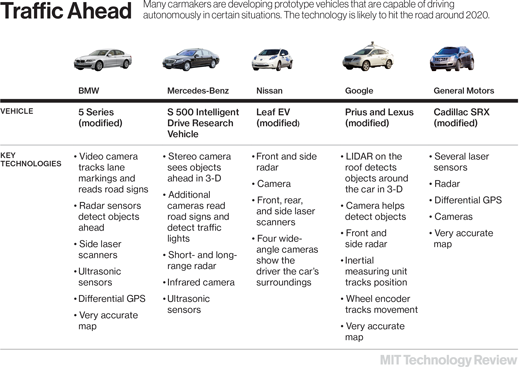
Driverless Cars Are Further Away Than You Think

Driverless Cars Are Further Away Than You Think

Why It Matters

Carmakers are developing vehicles that have an increasing ability to autonomously drive themselves, potentially reducing accidents and traffic congestion.

A silver BMW 5 Series is weaving through traffic at roughly 120 kilometers per hour (75 mph) on a freeway that cuts northeast through Bavaria between Munich and Ingolstadt. I’m in the driver’s seat, watching cars and trucks pass by, but I haven’t touched the steering wheel, the brake, or the gas pedal for at least 10 minutes. The BMW approaches a truck that is moving slowly. To maintain our speed, the car activates its turn signal and begins steering to the left, toward the passing lane. Just as it does, another car swerves into the passing lane from several cars behind. The BMW quickly switches off its signal and pulls back to the center of the lane, waiting for the speeding car to pass before trying again.Putting your life in the hands of a robot chauffeur offers an unnerving glimpse into how driving is about to be upended. The automobile, which has followed a path of steady but slow technological evolution for the past 130 years, is on course to change dramatically in the next few years, in ways that could have radical economic, environmental, and social impacts.The first autonomous systems, which are able to control steering, braking, and accelerating, are already starting to appear in cars; these systems require drivers to keep an eye on the road and hands on the wheel. But the next generation, such as BMW’s self-driving prototype, could be available in less than a decade and free drivers to work, text, or just relax. Ford, GM, Toyota, Nissan, Volvo, and Audi have all shown off cars that can drive themselves, and they have all declared that within a decade they plan to sell some form of advanced automation—cars able to take over driving on highways or to park themselves in a garage. Google, meanwhile, is investing millions in autonomous driving software, and its driverless cars have become a familiar sight on the highways around Silicon Valley over the last several years.The allure of automation for car companies is huge. In a fiercely competitive market, in which the makers of luxury cars race to indulge customers with the latest technology, it would be commercial suicide not to invest heavily in an automated future. “It’s the most impressive experience we can offer,” Werner Huber, the man in charge of BMW’s autonomous driving project, told me at the company’s headquarters in Munich. He said the company aims to be “one of the first in the world” to introduce highway autonomy.

Thanks to autonomous driving, the road ahead seems likely to have fewer traffic accidents and less congestion and pollution. Data published last year by the Insurance Institute for Highway Safety, a U.S. nonprofit funded by the auto industry, suggests that partly autonomous features are already helping to reduce crashes. Its figures, collected from U.S. auto insurers, show that cars with forward collision warning systems, which either warn the driver about an impending crash or apply the brakes automatically, are involved in far fewer crashes than cars without them.

cars.chartx519

More comprehensive autonomy could reduce traffic accidents further still. The National Highway Traffic Safety Administration estimates that more than 90 percent of road crashes involve human error, a figure that has led some experts to predict that autonomous driving will reduce the number of accidents on the road by a similar percentage. Assuming the technology becomes ubiquitous and does have such an effect, the benefits to society will be huge. Almost 33,000 people die on the roads in the United States each year, at a cost of $300 billion, according to the American Automobile Association. The World Health Organization estimates that worldwide over 1.2 million people die on roads every year.

Meanwhile, demonstrations conducted at the University of California, Riverside, in 1997 and experiments involving modified road vehicles conducted by Volvo and others in 2011 suggest that having vehicles travel in high-speed automated “platoons,” thereby reducing aerodynamic drag, could lower fuel consumption by 20 percent. And an engineering study published last year concluded that automation could theoretically allow nearly four times as many cars to travel on a given stretch of highway. That could save some of the 5.5 billion hours and 2.9 billion gallons of fuel that the Texas Transportation Institute says are wasted by traffic congestion each year.

If all else fails, there is a big red button on the dashboard that cuts power to all the car’s computers. I practiced hitting it a few times.

But such projections tend to overlook just how challenging it will be to make a driverless car. If autonomous driving is to change transportation dramatically, it needs to be both widespread and flawless. Turning such a complex technology into a commercial product is unlikely to be simple. It could take decades for the technology to come down in cost, and it might take even longer for it to work safely enough that we trust fully automated vehicles to drive us around.

German engineering
Much of the hype about autonomous driving has, unsurprisingly, focused on Google’s self-driving project. The cars are impressive, and the company has no doubt insinuated the possibility of driverless vehicles into the imaginations of many. But for all its expertise in developing search technology and software, Google has zero experience building cars. To understand how autonomous driving is more likely to emerge, it is more instructive to see what some of the world’s most advanced automakers are working on. And few places in the world can rival the automotive expertise of Germany, where BMW, Audi, Mercedes-­Benz, and Volkswagen are all busy trying to change autonomous driving from a research effort into a viable option on their newest models.

Shortly after arriving in Munich, I found myself at a test track north of the city getting safety instruction from Michael Aeberhard, a BMW research engineer. As I drove a prototype BMW 5 Series along an empty stretch of track, Aeberhard told me to take my hands off the wheel and then issued commands that made the car go berserk and steer wildly off course. Each time, I had to grab the wheel as quickly as I could to override the behavior. The system is designed to defer to a human driver, giving up control whenever he or she moves the wheel or presses a pedal. And if all else fails, there is a big red button on the dashboard that cuts power to all the car’s computers. I practiced hitting it a few times, and discovered how hard it was to control the car without even the power-assisted steering. The idea of the exercise was to prepare me for potential glitches during the actual test drive. “It’s still a prototype,” Aeberhard reminded me several times.

After I signed a disclaimer, we drove to the autobahn outside Munich. A screen fixed to the passenger side of the dashboard showed the world as the car perceives it: three lanes, on which a tiny animated version of the car is surrounded by a bunch of floating blue blocks, each corresponding to a nearby vehicle or to an obstacle like one of the barriers on either side of the road. Aeberhard told me to activate the system in heavy traffic as we rode at about 100 kilometers per hour. When I first flicked the switch, I was dubious about even removing my hands from the wheel, but after watching the car perform numerous passing maneuvers, I found myself relaxing—to my astonishment—until I had to actually remind myself to pay attention to the road.

The car looked normal from the outside. There’s no place on a sleek luxury sedan for the huge rotating laser scanners seen on the prototypes being tested by Google. So BMW and other carmakers have had to find ways to pack smaller, more limited sensors into the body of a car without compromising weight or styling.

Concealed inside the BMW’s front and rear bumpers, two laser scanners and three radar sensors sweep the road before and behind for anything within about 200 meters. Embedded at the top of the windshield and rear window are cameras that track the road markings and detect road signs. Near each side mirror are wide-angle laser scanners, each with almost 180 degrees of vision, that watch the road left and right. Four ultrasonic sensors above the wheels monitor the area close to the car. Finally, a differential Global Positioning System receiver, which combines signals from ground-based stations with those from satellites, knows where the car is, to within a few centimeters of the closest lane marking.

Several computers inside the car’s trunk perform split-second measurements and calculations, processing data pouring in from the sensors. Software assigns a value to each lane of the road based on the car’s speed and the behavior of nearby vehicles. Using a probabilistic technique that helps cancel out inaccuracies in sensor readings, this software decides whether to switch to another lane, to attempt to pass the car ahead, or to get out of the way of a vehicle approaching from behind. Commands are relayed to a separate computer that controls acceleration, braking, and steering. Yet another computer system monitors the behavior of everything involved with autonomous driving for signs of malfunction.

Impressive though BMW’s autonomous highway driving is, it is still years away from market. To see the most advanced autonomy now available, a day later I took the train from Munich to Stuttgart to visit another German automotive giant, Daimler, which owns Mercedes-Benz. At the company’s research and development facility southeast of the city, where experimental new models cruise around covered in black material to hide new designs and features from photographers, I got to ride in probably the most autonomous road car on the market today: the 2014 ­Mercedes S-Class.

A jovial safety engineer drove me around a test track, showing how the car can lock onto a vehicle in front and follow it along the road at a safe distance. To follow at a constant distance, the car’s computers take over not only braking and accelerating, as with conventional adaptive cruise control, but steering too.

Using a stereo camera, radar, and an infrared camera, the S-Class can also spot objects on the road ahead and take control of the brakes to prevent an accident. The engineer eagerly demonstrated this by accelerating toward a dummy placed in the center of the track. At about 80 kilometers per hour, he took his hands off the wheel and removed his foot from the accelerator. Just when impact seemed all but inevitable, the car performed a near-perfect emergency stop, wrenching us forward in our seats but bringing itself to rest about a foot in front of the dummy, which bore an appropriately terrified expression.

Uncertain road
With such technology already on the road and prototypes like BMW’s in the works, it’s tempting to imagine that total automation can’t be far away. In reality, making the leap from the kind of autonomy in the Mercedes-Benz S-Class to the kind in BMW’s prototype will take time, and the dream of total automation could prove surprisingly elusive.

For one thing, many of the sensors and computers found in BMW’s car, and in other prototypes, are too expensive to be deployed widely. And achieving even more complete automation will probably mean using more advanced, more expensive sensors and computers. The spinning laser instrument, or LIDAR, seen on the roof of Google’s cars, for instance, provides the best 3-D image of the surrounding world, accurate down to two centimeters, but sells for around $80,000. Such instruments will also need to be miniaturized and redesigned, adding more cost, since few car designers would slap the existing ones on top of a sleek new model.

Cost will be just one factor, though. While several U.S. states have passed laws permitting autonomous cars to be tested on their roads, the National Highway Traffic Safety Administration has yet to devise regulations for testing and certifying the safety and reliability of autonomous features. Two major international treaties, the Vienna Convention on Road Traffic and the Geneva Convention on Road Traffic, may need to be changed for the cars to be used in Europe and the United States, as both documents state that a driver must be in full control of a vehicle at all times.

Most daunting, however, are the remaining computer science and artificial-­intelligence challenges. Automated driving will at first be limited to relatively simple situations, mainly highway driving, because the technology still can’t respond to uncertainties posed by oncoming traffic, rotaries, and pedestrians. And drivers will also almost certainly be expected to assume some sort of supervisory role, requiring them to be ready to retake control as soon as the system gets outside its comfort zone.

Despite the flashy demos, I sometimes detected among carmakers a desire to hit the brakes and temper expectations.

The relationship between human and robot driver could be surprisingly fraught. The problem, as I discovered during my BMW test drive, is that it’s all too easy to lose focus, and difficult to get it back. The difficulty of reëngaging distracted drivers is an issue that Bryan Reimer, a research scientist in MIT’s Age Lab, has well documented (see “Proceed with Caution toward the Self-Driving Car,” May/June 2013). Perhaps the “most inhibiting factors” in the development of driverless cars, he suggests, “will be factors related to the human experience.”

In an effort to address this issue, carmakers are thinking about ways to prevent drivers from becoming too distracted, and ways to bring them back to the driving task as smoothly as possible. This may mean monitoring drivers’ attention and alerting them if they’re becoming too disengaged. “The first generations [of autonomous cars] are going to require a driver to intervene at certain points,” Clifford Nass, codirector of Stanford University’s Center for Automotive Research, told me. “It turns out that may be the most dangerous moment for autonomous vehicles. We may have this terrible irony that when the car is driving autonomously it is much safer, but because of the inability of humans to get back in the loop it may ultimately be less safe.”

An important challenge with a system that drives all by itself, but only some of the time, is that it must be able to predict when it may be about to fail, to give the driver enough time to take over. This ability is limited by the range of a car’s sensors and by the inherent difficulty of predicting the outcome of a complex situation. “Maybe the driver is completely distracted,” Werner Huber said. “He takes five, six, seven seconds to come back to the driving task—that means the car has to know [in advance] when its limitation is reached. The challenge is very big.”

Before traveling to Germany, I visited John ­Leonard, an MIT professor who works on robot navigation, to find out more about the limits of vehicle automation. ­Leonard led one of the teams involved in the DARPA Urban Challenge, an event in 2007 that saw autonomous vehicles race across mocked-up city streets, complete with stop-sign intersections and moving traffic. The challenge inspired new research and new interest in autonomous driving, but ­Leonard is restrained in his enthusiasm for the commercial trajectory that autonomous driving has taken since then. “Some of these fundamental questions, about representing the world and being able to predict what might happen—we might still be decades behind humans with our machine technology,” he told me. “There are major, unsolved, difficult issues here. We have to be careful that we don’t overhype how well it works.”

Leonard suggested that much of the technology that has helped autonomous cars deal with complex urban environments in research projects—some of which is used in Google’s cars today—may never be cheap or compact enough to be employed in commercially available vehicles. This includes not just the LIDAR but also an inertial navigation system, which provides precise positioning information by monitoring the vehicle’s own movement and combining the resulting data with differential GPS and a highly accurate digital map. What’s more, poor weather can significantly degrade the reliability of sensors, ­Leonard said, and it may not always be feasible to rely heavily on a digital map, as so many prototype systems do. “If the system relies on a very accurate prior map, then it has to be robust to the situation of that map being wrong, and the work of keeping those maps up to date shouldn’t be underestimated,” ­he said.

Near the end of my ride in BMW’s autonomous prototype, I discovered an example of imperfect autonomy in action. We had made a loop of the airport and were heading back toward the city when a Smart car, which had been darting through traffic a little erratically, suddenly swung in front of me from the right. Confused by its sudden and irregular maneuver, our car kept approaching it rapidly, and with less than a second to spare I lost my nerve and hit the brakes, slowing the car down and taking it out of self-driving mode. A moment later I asked Aeberhard if our car would have braked in time. “It would’ve been close,” he admitted.

Despite the flashy demos and the bold plans for commercialization, I sometimes detected among carmakers a desire to hit the brakes and temper expectations. Ralf Herttwich, who leads research and engineering of driver assistance systems at Mercedes, explained that interpreting a situation becomes exponentially more difficult as the road becomes more complex. “Once you leave the highway and once you go onto the average road, environment perception needs to get better. Your interpretation of traffic situations, because there are so many more of them—they need to get better,” he said. “Just looking at a traffic light and deciding if that traffic light is for you is a very, very complex problem.”

MIT’s Leonard, for one, does not believe total autonomy is imminent. “I do not expect there to be taxis in Manhattan with no drivers in my lifetime,” he said, before quickly adding, “And I don’t want to see taxi drivers out of business. They know where they’re going, and—at least in Europe—they’re courteous and safe, and they get you where you need to be. That’s a very valuable societal role.”

I pondered Leonard’s objections while visiting BMW and Mercedes. I even mentioned some of them to a taxi driver in Munich who was curious about my trip. He seemed far from worried. “We have siebten Sinn—a seventh sense,” he said, referring to the instinctive road awareness a person builds up. As he nipped through the busy traffic with impressive speed, I suspected that this ability to cope deftly with such a complex and messy world could prove useful for a while longer.

Quelle: http://www.technologyreview.com/featuredstory/520431/driverless-cars-are-further-away-than-you-think/

Data Shows Google’s Robot Cars Are Smoother, Safer Drivers Than You or I

Data Shows Google’s Robot Cars Are Smoother, Safer Drivers Than You or I

Tests of Google’s autonomous vehicles in California and Nevada suggests they already outperform human drivers.

Data gathered from Google’s self-driving Prius and Lexus cars shows that they are safer and smoother when steering themselves than when a human takes the wheel, according to the leader of Google’s autonomous-car project.

Chris Urmson made those claims today at a robotics conference in Santa Clara, California. He presented results from two studies of data from the hundreds of thousands of miles Google’s vehicles have logged on public roads in California and Nevada.

One of those analyses showed that when a human was behind the wheel, Google’s cars accelerated and braked significantly more sharply than they did when piloting themselves. Another showed that the cars’ software was much better at maintaining a safe distance from the vehicle ahead than the human drivers were.

“We’re spending less time in near-collision states,” said Urmson. “Our car is driving more smoothly and more safely than our trained professional drivers.”

In addition to painting a rosy picture of his vehicles’ autonomous capabilities, Urmson showed a new dashboard display that his group has developed to help people understand what an autonomous car is doing and when they might want to take over. “Inside the car we’ve gone out of our way to make the human factors work,” he said.

Although that might suggest the company is thinking about how to translate its research project into something used by real motorists, Urmson dodged a question about how that might happen. “We’re thinking about different ways of bringing it to market,” he said. “I can’t tell you any more right now.”

Urmson did say that he is in regular contact with automakers. Many of those companies are independently working on self-driving cars themselves (see “Driverless Cars Are Further Away Than You Think”).

Google has been testing its cars on public roads since 2010 (see “Look, No Hands”), always with a human in the driver’s seat who can take over if necessary.

Urmson dismissed claims that legal and regulatory problems pose a major barrier to cars that are completely autonomous. He pointed out that California, Nevada, and Florida have already adjusted their laws to allow tests of self-driving cars. And existing product liability laws make it clear that a car’s manufacturer would be at fault if the car caused a crash, he said. He also said that when the inevitable accidents do occur, the data autonomous cars collect in order to navigate will provide a powerful and accurate picture of exactly who was responsible.

Urmson showed data from a Google car that was rear-ended in traffic by another driver. Examining the car’s annotated map of its surroundings clearly showed that the Google vehicle smoothly halted before being struck by the other vehicle.

“We don’t have to rely on eyewitnesses that can’t act be trusted as to what happened—we actually have the data,” he said. “The guy around us wasn’t paying enough attention. The data will set you free.”

Quelle: http://www.technologyreview.com/news/520746/data-shows-googles-robot-cars-are-smoother-safer-drivers-than-you-or-i/#

Young people value access over ownership

The smartphone generation will be perfectly happy not dealing with the expense and hassle of car ownership — why would they when they can order up an autonomous Zipcar with a tap on their iPhone X?

Zitat aus: http://www.wired.com/geekdad/2012/10/self-driving-cars/

Self-Driving Cars

Google Self-Driving Car (photo by Flickr user MarkDoliner, CC Licensed)

Google Self-Driving Car (photo by Flickr user MarkDoliner, CC Licensed)


Over the past few years, there has been steady progress in the development of self-driving automobiles, and it’s pretty clear that we’re finally on the cusp of this technology going mainstream. As far as I’m concerned, driving is a waste of time, energy, and human life, so I, for one, welcome our autonomous vehicular overlords.

Signs of Change

The assertion that self-driving cars are on the verge of becoming a practical reality may seem a little bold, but the signs are clearly there. For example, California recently legalized autonomous vehicles, making them now legal in three states (Nevada and Florida are the other two). In fact, in relation to this, Bernard Lu, an attorney for the California Department of Motor Vehicles even went so far as to state that “The technology is ahead of the law in many areas” — and that was back in 2010.

And it’s not just some random GeekDad blogger that considers self-driving vehicles to be a near-term probability. GM predicts partially autonomous vehicles by 2015 and fully autonomous vehicles by 2020. Looking even further ahead, the IEEE predicts that 75% of vehices will be fully autonomous by 2040.

Simply put, the technology required to make self-driving cars a reality already exists right now. It’s currently expensive, but the cost will drop as economies of scale kick in.

The Tech Behind It

So what is the tech that makes autonomous vehicles possible? Well, the poster child for self-driving cars is definitely Google’s ongoing Driverless Car project. At last tally, the Google fleet has driven accident-free for over 300,000 miles (480,000 km), making it clear that the concept is completely viable. Each Google Driverless car is equipped with GPS, radar, video cameras, lidar (laser radar), and a lot of real-time computing power. Basic navigation relies on maps and GPS, with live sensor input to react to real-time changes. The entire setup costs about $150,000, which is obviously well beyond the reach of 99% of drivers, but, as mentioned above, this cost will scale down readily.

Another emerging technology that figures prominently in the future of autonomous vehicles is the concept of vehicular communication systems. Obviously vehicle-to-vehicle (V2V) communication and vehicle-to-infrastructure (V2I) communication will make it possible to dynamically route traffic in such a way as to maximize flow and minimize travel times. Say good-bye to traffic jams and road rage, kids.

Why it Will Be Great

In addition to no more traffic jams, self-driving cars promise many other benefits:

  • Fewer traffic collisions (computers are better than humans at focused, repetitive tasks such as driving)
  • Increased roadway capacity and reduced traffic congestion (V2V and V2I make dynamic traffic routing possible)
  • Relief of vehicle occupants from driving chores (you can sleep, watch a movie, read a book, knit a pair of socks, etc. instead of wasting time behind the wheel)
  • Everyone can enjoy the benefits of travel regardless of their physical abilities, age, or other current restrictions (and, yes, that means no more drunk drivers and innocent victims)
  • You’ll never need to worry about finding a parking spot close to your destination (the car will drop you off, then go park itself until you signal it back again)
  • Improved energy efficiency due to minimization of start/stop driving, and elimination of the weight of the unnecessary driver in some circumstances
  • Car-sharing services like Zipcar will be much more practical
  • Reduced need for traffic police, red light cameras, and other safety enforcement measures
  • Cargo transport and delivery vehicles will not need a driver at all

All of the above and more will make the society of the future a very different place than what we’re used to now. That kind of change is likely going to take some adjustment for us older folks, but what about the upcoming generations that will grow up with this? Well, we’re already seeing some signs of a change in attitude there.

The Millennials

Interestingly, the Millennials (people born between 1980 and 2000, approximately) have very different attitudes toward driving than us older folks. In particular, the Millennials are far less interested in drivingthan their parents and grand-parents. There are, of course, plenty of reasons for this attitude, including rising gas costs, an anemic economy, depressed wages, and increasing re-urbanization – none of which is likely to change much in the near future. All of these factors lead to a demographic that is open to the reinvention of vehicular transportation. As Sheryl Connelly, head of global consumer trends at Ford, said, “Young people value access over ownership.

The smartphone generation will be perfectly happy not dealing with the expense and hassle of car ownership — why would they when they can order up an autonomous Zipcar with a tap on their iPhone X?

Obstacles

Of course, there are going to be some bumps in the road on the way to our self-driving future. First up is the usual human resistance to change, though 50% of people surveyed today said they would be comfortable riding in a driverless car. That degree of acceptance suggests a rapid uptake once the technology becomes reasonable in price.

Another guaranteed problem is concern about safety. As mentioned before, autonomous vehicles will be far more reliable than human drivers; however, there will inevitably be an accident involving a self-driving car, and the event will be sensationalized by the media. In the end though, the desire to decrease the number of traffic-related fatalities in the world will drive adoption (just for reference, over 30,000 people die each year in vehicle-related deaths in the US alone).

From the GeekDad perspective, the most worrisome thing about autonomous vehicles that I can think of is the possibility of vulnerabilities in the software. We have serious issues with exploits in current operating systems and applications — how much riskier will it be when the compromised computer is rolling along at 60mph? Clearly these systems are going to require a level of security that will embarrass today’s military-grade gear.

Future Consequences

So what are the implications of large-scale adoption of self-driving vehicles? An obvious thought is the corresponding redesign of the road system. Just as we now have commuter lanes, there will undoubtedly be dedicated lanes for driverless vehicles. In fact, eventually the majority of lanes will be reserved for autonomous vehicles, with a few “slow” lanes left over for manually-operated cars and horse-drawn buggies. And if we look even further ahead, eventually it will be illegal to drive a car on public roads.

Another anticipated change relates to the fact that driverless cars need not even be “cars.” Vehicles of the future won’t necessarily just transport humans, so there will likely be a wide spectrum of designs, from large cargo transports to small pizza delivery mini-mobiles. Of course, the technology behind self-driving cars will transfer easily to trains, streetcars, subways, ships, and possibly even aircraft (though that last one makes me a little nervous).

As with any other labor-saving advance in technology, an inevitable consequence of autonomous vehicles will be the elimination of a lot of jobs. Yes, there will be new jobs created to build and service these vehicles, but I’m pretty sure that far more jobs will be eliminated than created. In theory, this should mean that the overall efficiency of the system is increased, and humans will have increased time available to do more valuable work; in practice though, the transition involves a lot of disruption.

Conclusion…

The signs are clear: autonomous vehicles are coming. The technology is already real, and it’s just a matter of scaling down the cost. Once that happens, there will be rapid adoption of driverless automobiles that will result in a complete redefinition of travel. Yes, there are some negatives to this impending transition, but overall, the shift to self-driving vehicles will be a net-positive for society.

And If you’re interested in autonomous vehicles, be sure to check out Brad Templeton’s Robocar page.