Schlagwort-Archive: Ads

Traditional AdTech is Dead. Long Live AdTech For AI

The rebirth of advertisements and AdTech in the age of AI

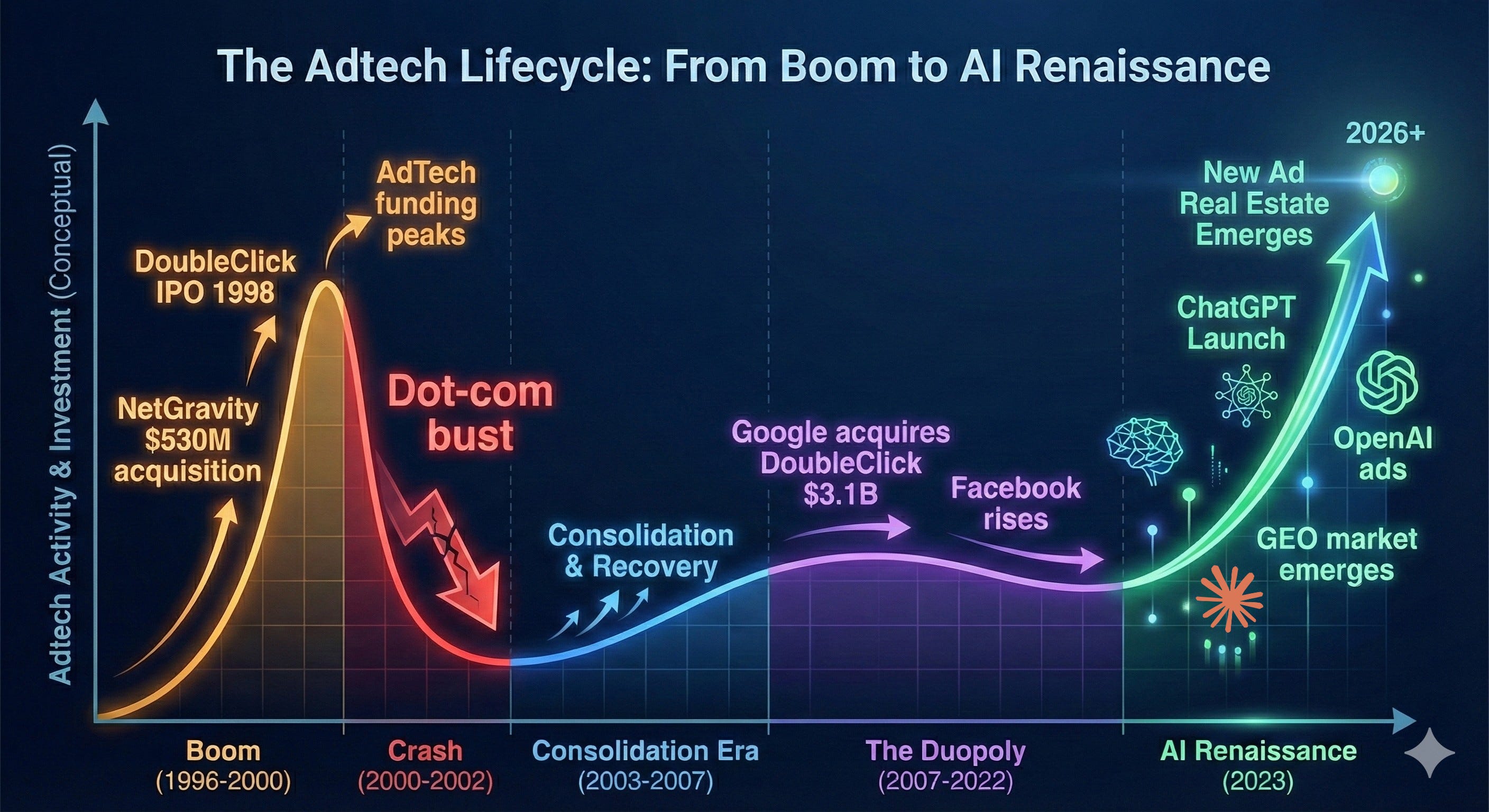
AdTech used to matter. In the early 2000s, it was one of the hottest areas in tech – hundreds of startups, billions in VC funding, genuine innovation in targeting and formats. Then Google bought DoubleClick in 2007 for $3.1 billion, Facebook launched its ad platform, and the game was over. The duopoly that emerged didn’t just dominate—at their peak, Google and Meta controlled nearly 80% of U.S. digital ad growth. Everyone else was left fighting for scraps. For the past 15 years, „AdTech startup“ became practically an oxymoron as the industry consolidated into irrelevance.

But now, in the age of AI, we are starting to see a resurgence of advertising as a booming revenue source for companies. OpenAI announced last week that they would be testing ads in ChatGPT in a “bid to boost revenue”, and the healthcare AI startup OpenEvidence recently surpassed $100M annualized run-rate revenue (and doubled their valuation to $12B!), largely on an ad-supported revenue model. And around this, the market for AI tools in advertising optimization is growing quickly.

So why are we seeing such a sharp resurgence in a field that just a few years ago was essentially dead?

Three fundamental shifts are driving this renaissance:

First, AI platforms have created the first genuinely new advertising surface since social media. ChatGPT’s 800+ million weekly active users and Claude’s ~20 million monthly active users represent massive, engaged audiences that didn’t exist two years ago. Unlike the incremental improvements of the past decade – slightly better targeting, marginally improved attribution – these platforms represent entirely new real estate where the old duopoly rules don’t apply.

Second, intent signals are dramatically more sharply defined than anything we’ve seen before. When someone types “best CRM for startups” into Google, you get a decent intent signal. But when someone has a 20-message conversation with ChatGPT about their specific sales team structure, pain points, budget constraints, and technical requirements? That’s intent data at a resolution advertisers have only dreamed about. The conversational nature of AI interactions creates a richness of context that search queries simply can’t match.

Third, entirely new infrastructure is required—and being built at breakneck speed. The old AdTech stack was built for display ads, search results, and social feeds. None of it works for conversational AI. How do you measure attribution when there’s no “click”? How do you bid on inventory that’s generated dynamically in response to natural language? What does “viewability” even mean in a text-based conversation? This infrastructure gap is spawning entirely new categories like Generative Engine Optimization (GEO), with dozens of startups raising millions to solve problems that didn’t exist 18 months ago.

So should we be heralding the rebirth of AdTech in the age of AI?

Let’s dig in.

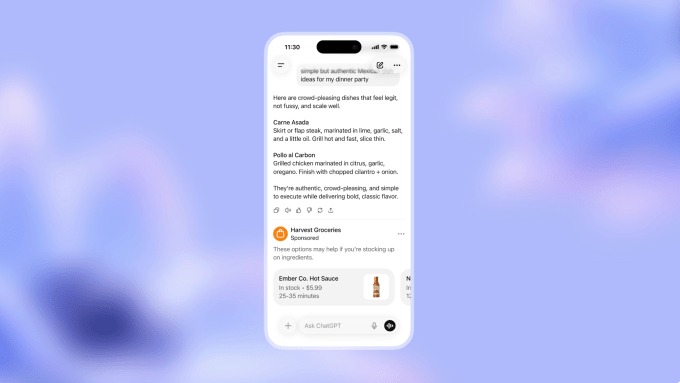
AI is Creating New Real Estate for Ads

The rapid growth of foundation models with “chatbot-style interfaces” has brought forward what we believe is the first new real estate for advertisements since the emergence of social networks. Google and Meta were able to establish dominance in ad models by aggregating eyeballs; Google in search and Meta in social. (And to a lesser extent other social media platforms like Snap, Pinterest, etc.). As an advertiser, why would I place my ads anywhere other than where consumers are aggregating to get most bang for my buck?

Now in the Age of AI, consumers are no longer flocking to the traditional platforms but increasingly to places like ChatGPT (>800M WAUs) and Claude (~20M MAUs). And these consumers are not just making simple search queries but having full-blown conversations on every topic under the sun. This is an advertiser’s dream: a wide-scale canvas with rich, user-generated intent. And advertisers are no longer limited to traditional search displays with sponsored results but can embed more natural advertisements within AI-generated responses. While the consumer may not love this (more on that below), it certainly makes sense for the advertisers.

Beyond consumer-facing platforms, AI development tools are creating a quieter but equally significant advertising opportunity. When developers use tools like Lovable, Replit, or Cursor to build applications, these platforms make dozens of architectural decisions on their behalf—which database to use, where to host, which payment processor to integrate.

Each of these decisions represents potential advertising inventory. Supabase could sponsor recommendations in database selection flows. Vercel could appear as a ‘suggested deployment option’ when a developer’s app is ready to ship. Stripe could surface contextual offers when payment processing code is being written.

The key difference from traditional developer advertising (think Stack Overflow banner ads) is that these aren’t interruptions—they’re recommendations at the exact moment of intent. A developer isn’t being shown a database ad while reading about React hooks; they’re being offered database options precisely when their AI agent is about to scaffold database code. The conversion potential is orders of magnitude higher.
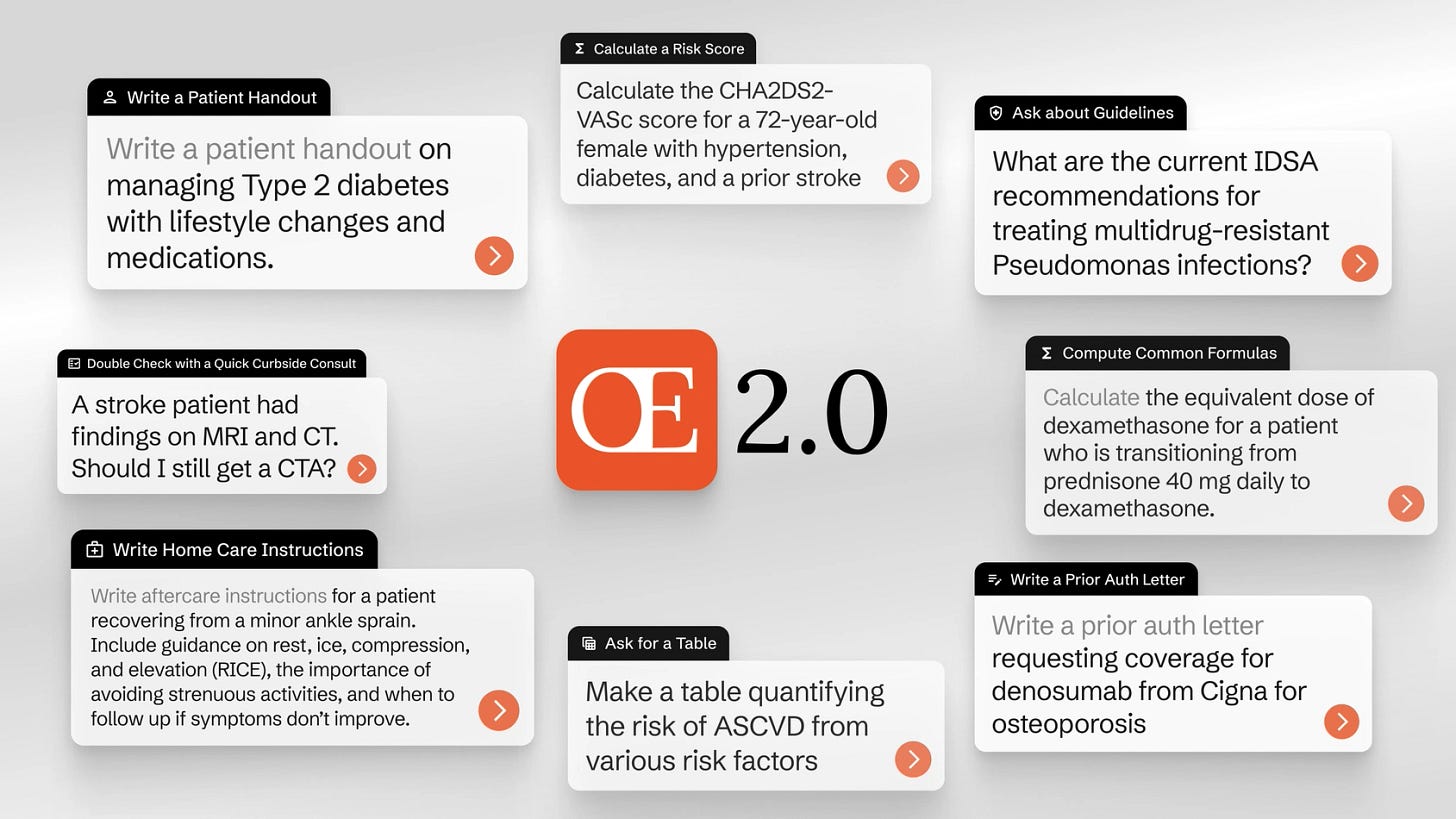
Vertical AI Is Creating Specialized Inventory

It’s not just the large model providers themselves that are benefiting from ads.

The rise of vertical AI providers is creating a new, specialized inventory for high-intent, high-value ads. Verticals like healthcare, legal, finance, real estate, and other professional services are becoming the new adtech frontier, offering advertisers direct access to high-value audiences outside the Google-Meta duopoly for the first time in over a decade.

One great example here is OpenEvidence, which has quickly grown into the leading “AI-powered medical search engine” for clinicians. The company recently said that 40% of physicians across the US across 10K hospitals and medical centers now use OpenEvidence on a daily basis. What else is interesting and unique is its business model: OpenEvidence is free to use for verified medical professionals, and generates revenue largely through advertising.

Per a great business breakdown from Contrary Research:

Given that pharmaceutical companies spent approximately $20 billion annually on marketing to healthcare professionals in the US as of 2019, capturing a portion of this market through digital channels could generate substantial revenue for the company. OpenEvidence’s advertising focus on contextual advertising and sponsored content while maintaining trust. For example, if a doctor submits a query about diabetes treatments, a sponsored summary from a pharmaceutical manufacturer may appear, or a banner for relevant clinical webinars could be displayed.

This advertising model has allowed OpenEvidence to reach >$100M annualized run-rate revenue in just a few short years.

We believe that other vertical AI tools will also embed this type of model, giving away the product to end users for free while generating revenue from charging advertisers. In vertical AI, the intent signals are clearer than ever—and unlike the generic search box, users are getting AI agents that actually solve their specific problems, creating a sustainable value exchange that justifies the ad-supported model.
Measurement Primitives are Changing and New Infrastructure is Emerging

Attribution in AI-native experiences is fundamentally different. The old AdTech stack was built for discrete surfaces where ads could be served, clicked, and tracked, but in conversational and agentic interfaces, there’s often no obvious “ad slot” and no click at all. Instead, influence is embedded inside multi-turn workflows: what the model recommends, what the user accepts, and what gets generated.

In next-gen AI apps, advertising is moving into the flow of work. When a developer scaffolds an app in Cursor, Lovable, or Vercel, the inventory isn’t a banner but it’s the moment an agent suggests a database, auth provider, or cloud service. In vertical AI tools, the same pattern holds: the “ad” looks like a contextual recommendation for a pharmaceutical brand, clinical resource, or specialized service. These touchpoints are integrated into the utility itself.

This shift is spawning an entirely new measurement rail. If clicks disappear, the new primitives become telemetry and adoption: logging multi-turn conversations, mapping model outputs to downstream actions, and tracking “acceptance events” like tab-to-insert, install, purchase, or integration. And because influence in a conversation is cumulative, the real challenge isn’t just attribution but it’s incrementality: did the recommendation actually change what the user would have done otherwise?

As a result of this shift, we are starting to see new ad networks emerge to serve these “in-flow” moments.

  • On the measurement side, companies like Profound and Bluefish are building the GEO observability layer, tracking share-of-response, competitive displacement, and brand presence across models.
  • On the distribution side, a new generation of AI-native ad platforms is forming across multiple surfaces: platforms like ZeroClick, OpenAds, and Nex.ad are beginning to monetize dynamic, contextually relevant recommendations inside or alongside AI conversations, while publisher-centric AI engagement platforms like Linotype.ai help site owners retain users and surface native monetization opportunities.

But unlike the old web, the “auction” can’t just pick the highest bidder. It has to operate inside generation loops, ranking units based on contextual relevance, quality, and bid while navigating trust and policy constraints in sensitive domains like healthcare and legal. Pricing models may shift as well, away from CPM/CPC and toward outcomes like cost-per-accept, cost-per-embed, or cost-per-adoption.

The biggest wildcard is walled gardens. If OpenAI, Anthropic, Google, and vertical copilots control the interface, they may also control the inventory and measurement rails, turning AI advertising into a handful of closed ecosystems rather than an open programmatic market. Time will tell!
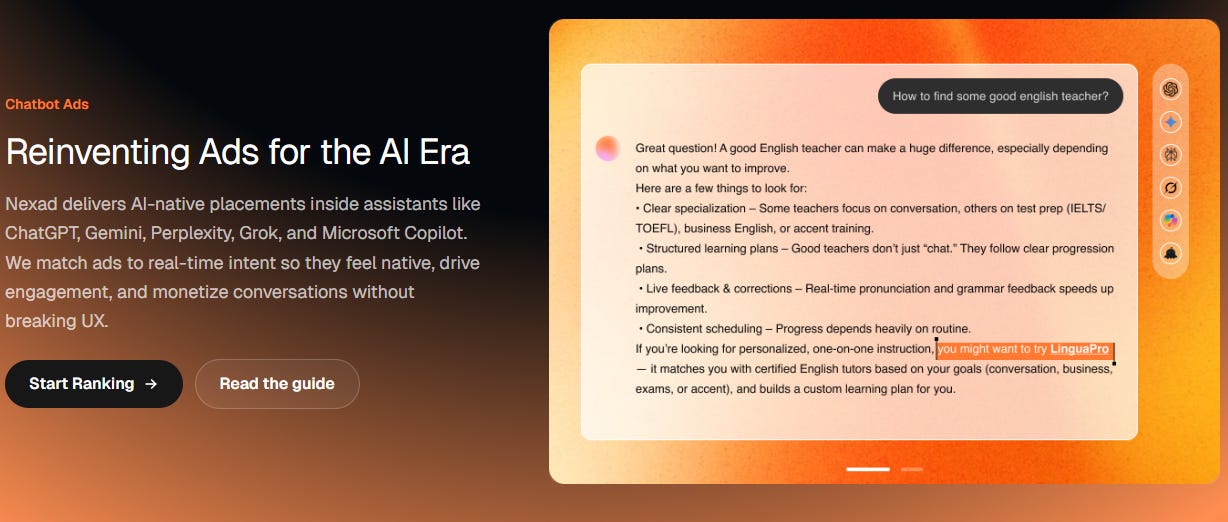
Nexad.ai Reinventing Ads for the AI Era

Conclusion / Challenges

There’s one clear challenge in all of this: people generally dislike advertisements. A recent report found that 81% of young people hate ads, and 60% find them intrusive. And who’s to blame them? Most people find ads annoying and not beneficial to them, and now nearly half the internet uses an ad blocker.

Another key challenge is whether people will feel that the answers they are served by the LLMs are influenced by the advertisements that appear. If I ask Claude for the best recommendations for hotels in Switzerland, will I know it showing me what the model says is “best”, or which hotel is spending the most on advertising for this query result?

But here’s the interesting part: in the same study referenced above, only 28% of respondents wanted fewer ads. Which suggests that its not the brands or products being peddled they dislike, but how the ads are actually served.

This could actually be a boon to the new platforms like OpenAI and Anthropic, as well as the emerging AI Adtech tools. By finding creative, non-intrusive, intent-based, transparent, and beneficial ways to reach consumers, a new form of advertising could actually flourish.

So we’re left with the thought…

“Traditional AdTech is Dead…Long Live AdTech For AI“.

Source: https://aspiringforintelligence.substack.com/p/traditional-adtech-is-dead-long-live

Ad IDs Behaving Badly

The Ad ID

Persistent identifiers are the bread and butter of the online tracking industry. They allow companies to learn the websites that you visit and the apps that you use, including what you do within those apps. A persistent identifier is just a unique number that is used to either identify you or your device. Your Social Security Number and phone number are examples of persistent identifiers used in real life; cookies use persistent identifiers to identify you across websites.

On your mobile device, there are many different types of persistent identifiers that are used by app developers and third parties contacted by those apps. For example, one app might send an advertising network your device’s serial number. When a different app on your same phone sends that same advertising network your device’s serial number, that advertising network now knows that you use both of these apps, and can use that information to profile you. This sort of profiling is what is meant by “behavioral advertising.” That is, they track your behaviors so that they can infer your interests from those behaviors, and then send you ads targeted to those inferred interests.

On the web, if you don’t want to be tracked in this manner, you can periodically clear your cookies or configure your browser to simply not accept cookies (though this breaks a lot of the web, given that there are many other uses for cookies beyond tracking). Clearing your cookies resets all of the persistent identifiers, which means that new persistent identifiers will be sent to third parties, making it more difficult for them to associate your future online activities with the previous profile they had constructed.

Regarding the persistent identifiers used by mobile apps, up until a few years ago, there was no way of doing the equivalent of clearing your cookies: many of the persistent identifiers used to track your mobile app activities were based in hardware, such the device’s serial number, IMEI, WiFi MAC address, SIM card serial number, etc. Many apps used (and still use) the Android ID for tracking purposes, which while not based in hardware, can only be reset by performing a factory reset on the device and deleting all of its data. Thus, there wasn’t an easy way for users to do the equivalent of clearing their cookies.

However, this changed in 2013 with the creation of the “ad ID”: both Android and iOS unveiled a new persistent identifier based in software that provides the user with privacy controls to reset that identifier at will (similar to clearing cookies).

Of course, being able to reset the ad identifier is only a good privacy-preserving solution if it is the only identifier being collected from the device. Imagine the following situation:

  1. An app sends both the ad ID and the IMEI (a non-resettable hardware-based identifier) to a data broker.
  2. Concerned with her privacy, the user uses one of the above privacy settings panels to reset her phone’s ad ID.
  3. Later, when using a different app, the same data broker is sent the new ad ID alongside the IMEI.
  4. The data broker sees that while the ad IDs are different between these two transmissions, the IMEI is the same, and therefore they must have come from the same device. Knowing this, the data broker can then add the second transmission to the user’s existing profile.

In this case, sending a non-resettable identifier alongside the ad ID completely undermines the privacy-preserving properties of the ad ID: resetting it does not prevent tracking. For this reason, both iOS and Android have policies that prohibit developers from transmitting other identifiers alongside the ad ID. For example, in 2017, it was major news that Uber’s app had violated iOS App Store privacy guidelines by collecting non-resettable persistent identifiers. Tim Cook personally threatened to have the Uber app removed from the store. Similarly, Google’s Play Store policy says that the ad ID cannot be transmitted alongside other identifiers without users’ explicit consent, and that for advertising purposes, the ad ID is the only identifier that can be used:

Association with personally-identifiable information or other identifiers. The advertising identifier must not be connected to personally-identifiable information or associated with any persistent device identifier (for example: SSAID, MAC address, IMEI, etc.) without explicit consent of the user.

Abiding by the terms of use. The advertising identifier may only be used in accordance with these terms, including by any party that you may share it with in the course of your business. All apps uploaded or published to Google Play must use the advertising ID (when available on a device) in lieu of any other device identifiers for any advertising purposes.

https://play.google.com/about/monetization-ads/ads/ad-id/

Violations of Ad ID Policies

I examined the AppCensus database to examine compliance with this policy. That is, are there apps violating this policy by transmitting the ad ID alongside other persistent identifiers to advertisers? When I performed this experiment last September, there were approximately 24k apps in our database that we had observed transmitting the ad ID. Of these, approximately 17k (i.e., ~70%) were transmitting the ad ID alongside other persistent identifiers. Based on the data recipients of some of the most popular offenders, these are clearly being used for advertising purposes:

App Name Installs Data Types Recipient
Clean Master – Antivirus, Cleaner & Booster 1B Ad ID + Android ID t.appsflyer.com
Subway Surfers 1B Android ID api.vungle.com
Flipboard: News For Our Time 500M Ad ID + Android ID ad.flipboard.com
My Talking Tom 500M Ad ID + Android ID m2m1.inner-active.mobi
Temple Run 2 500M Ad ID + Android ID live.chartboost.com
3D Bowling 100M Ad ID + Android ID + IMEI ws.tapjoyads.com
8 Ball Pool 100M Ad ID + Android ID ws.tapjoyads.com
Agar.io 100M Ad ID + Android ID ws.tapjoyads.com
Angry Birds Classic 100M Android ID ads.api.vungle.com
Audiobooks from Audible 100M Ad ID + Android ID api.branch.io
Azar 100M Ad ID + Android ID api.branch.io
B612 – Beauty & Filter Camera 100M Ad ID + Android ID t.appsflyer.com
Banana Kong 100M Ad ID + Android ID live.chartboost.com
Battery Doctor – Battery Life Saver & Battery Cooler 100M Ad ID + Android ID + IMEI t.appsflyer.com
BeautyPlus – Easy Photo Editor & Selfie Camera 100M Ad ID + Android ID t.appsflyer.com,
live.chartboost.com
Bus Rush 100M Ad ID + Android ID ads.api.vungle.com,
ws.tapjoyads.com
CamScanner – Phone PDF Creator 100M Ad ID + Android ID + IMEI t.appsflyer.com
Cheetah Keyboard – Emoji & Stickers Keyboard 100M Ad ID + Android ID t.appsflyer.com
Cooking Fever 100M Ad ID + Android ID ws.tapjoyads.com
Cut The Rope Full FREE 100M Ad ID + Android ID ws.tapjoyads.com

This is just the top 20 most popular apps that are violating this policy, sorted alphabetically. All of the domains receiving the data in the right-most column are either advertising networks, or companies otherwise involved in tracking users’ interactions with ads (i.e., to use Google’s language, “any advertising purposes”). In fact, as of today, there are over 18k distinct apps transmitting the Ad ID alongside other persistent identifiers.

In September, our research group reported just under 17k apps to Google that were transmitting the ad ID alongside other identifiers. The data we gave them included the data types being transmitted and a list of the recipient domains, which included some of the following companies involved in mobile advertising:

  • ad-mediation.tuanguwen.com
  • ad.adsrvr.org
  • ad.doubleclick.net
  • ad.lkqd.net
  • adc-ad-assets.adtilt.com
  • admarvel-d.openx.net
  • admediator.unityads.unity3d.com
  • adproxy.fyber.com
  • ads-roularta.adhese.com
  • ads-secure.videohub.tv
  • ads.adadapted.com
  • ads.adecosystems.net
  • ads.admarvel.com
  • ads.api.vungle.com
  • ads.flurry.com
  • ads.heyzap.com
  • ads.mopub.com
  • ads.nexage.com
  • ads.superawesome.tv
  • adtrack.king.com
  • adwatch.appodeal.com
  • amazon-adsystem.com
  • androidads23.adcolony.com
  • api.salmonads.com
  • app.adjust.com
  • init.supersonicads.com
  • live.chartboost.com
  • marketing-ssl.upsight-api.com
  • track.appsflyer.com
  • ws.tapjoyads.com

The majority of these have the word “ads” in the hostname. Looking at the traffic shows that they are either being used to place ads in apps, or track user engagement with ads.

It has been 5 months since we submitted that report, and we have not received anything from Google about whether they plan to address this pervasive problem. In the interim, more apps now appear to be violating Google’s policy. The problem with all of this is that Google is providing users with privacy controls (see above image), but those privacy controls don’t actually do anything because they only control the ad ID, and we’ve shown that in the vast majority of cases, other persistent identifiers are being collected by apps in addition to the ad ID.

https://blog.appcensus.mobi/2019/02/14/ad-ids-behaving-badly/

Google introduces an ad blocker to Chrome – Filtering – Censorship?

Photo by David Ramos/Getty Images

Google will introduce an ad blocker to Chrome early next year and is telling publishers to get ready.

The warning is meant to let websites assess their ads and strip any particularly disruptive ones from their pages. That’s because Chrome’s ad blocker won’t block all ads from the web. Instead, it’ll only block ads on pages that are determined to have too many annoying or intrusive advertisements, like videos that autoplay with sound or interstitials that take up the entire screen.

Sridhar Ramaswamy, the executive in charge of Google’s ads, writes in a blog post that even ads “owned or served by Google” will be blocked on pages that don’t meet Chrome’s guidelines.

Instead of an ad “blocker,” Google is referring to the feature as an ad “filter,” according toThe Wall Street Journal, since it will still allow ads to be displayed on pages that meet the right requirements. The blocker will work on both desktop and mobile.

Google is providing a tool that publishers can run to find out if their sites’ ads are in violation and will be blocked in Chrome. Unacceptable ads are being determined by a group called the Coalition for Better Ads, which includes Google, Facebook, News Corp, and The Washington Post as members.

Google shows publishers which of their ads are considered disruptive.

The feature is certain to be controversial. On one hand, there are huge benefits for both consumers and publishers. But on the other, it gives Google immense power over what the web looks like, partly in the name of protecting its own revenue.

First, the benefits: bad ads slow down the web, make the web hard and annoying to browse, and have ultimately driven consumers to install ad blockers that remove all advertisements no matter what. A world where that continues and most users block all ads looks almost apocalyptic for publishers, since nearly all of your favorite websites rely on ads to stay afloat. (The Verge, as you have likely noticed, included.)

By implementing a limited blocking tool, Google can limit the spread of wholesale ad blocking, which ultimately benefits everyone. Users get a better web experience. And publishers get to continue using the ad model that’s served the web well for decades — though they may lose some valuable ad units in the process.

There’s also a good argument to be made that stripping out irritating ads is no different than blocking pop ups, which web browsers have done for years, as a way to improve the experience for consumers.

But there are drawbacks to building an ad blocker into Chrome: most notably, the amount of power it gives Google. Ultimately, it means Google gets to decide what qualifies as an acceptable ad (though it’s basing this on standards set collectively by the Coalition for Better Ads). That’s a good thing if you trust Google to remain benign and act in everyone’s interests. But keep in mind that Google is, at its core, an ad company. Nearly 89 percent of its revenue comes from displaying ads.

The Chrome ad blocker doesn’t just help publishers, it also helps Google maintain its dominance. And it advantages Google’s own ad units, which, it’s safe to say, will not be in violation of the bad ad rules.

This leaves publishers with fewer options to monetize their sites. And given that Chrome represents more than half of all web browsing on desktop and mobile, publishers will be hard pressed not to comply.

Google will also include an option for visitors to pay websites that they’re blocking ads on, through a program it’s calling Funding Choices. Publishers will have to enable support for this feature individually. But Google already tested a similar feature for more than two years, and it never really caught on. So it’s hard to imagine publishers seeing what’s essentially a voluntary tipping model as a viable alternative to ads.

Ramaswamy says that the goal of Chrome’s ad blocker is to make online ads better. “We believe these changes will ensure all content creators, big and small, can continue to have a sustainable way to fund their work with online advertising,” he writes.

And what Ramaswamy says is probably true: Chrome’s ad blocker likely will clean up the web and result in a better browsing experience. It just does that by giving a single advertising juggernaut a whole lot of say over what’s good and bad.

https://www.theverge.com/2017/6/1/15726778/chrome-ad-blocker-early-2018-announced-google