Virtual Reality – Virtual Desktop
1 Antwort


Eager Tesla customers continue to reserve the Model 3, despite the ballooning wait times.
Reservations for Tesla’s recently unveiled, mainstream electric car, the Model 3, continue to climb.
According to a speech from Tesla’s Vice President of Business Development, Diarmuid O’Connell, this week, reservations for the car are now approaching 400,000.
That’s an eye-popping figure for an electric car that’s only been available to reserve for about two weeks and won’t start shipping until the end of 2017. Many of those reservations were made before the car was even unveiled on March 31. Now Tesla needs to figure out how to make and deliver those cars on time and budget.
Many of the later orders of the Model 3 likely won’t be fulfilled until 2019, or even into 2020 (four years from now).That’s assuming Tesla will remain on track to start shipping the car at the end of next year, too.

To get that volume of cars made and delivered on time, Tesla TSLA -2.56% could have to change the way it makes its cars considerably. Tesla has only delivered a little over 100,000 cars in total over its lifetime. During O’Connell’s speech at a conference in Amsterdam, he said the rapid reservation rate gives Tesla the “visibility” and “confidence” into what it would take to build the car.
Tesla CEO Elon Musk tweeted the day after revealing the Model 3 for the first time (when the car had close to 200,000 reservations) that Tesla is “definitely going to need to rethink production planning.” Tesla will likely have to expand production at both its Fremont, Calif. factory more quickly than expected, and it will soon have to start producing a greater number of batteries at its massive battery factory still under construction outside of Reno, Nevada.
O’Connell said that Tesla is “looking at ways to amplify early production.” The company is investigating possible ways to scale up initial investments and ramp up more quickly than previously anticipated. Tesla plans to use lessons learned from the difficulties it had with manufacturing the Model X, Tesla’s SUV electric car.
That car was delayed for years, and it faced slow production at the end of 2015 and into early 2016. The company has admitted hubris for the Model X in trying to fit in too many complex features into the first version of the car.
According to estimates from Cairn Energy Research Advisors, Tesla could ship a little over 400,000 of its Model 3 cars by the end of 2020. But before 2020, production of Model 3 could likely be constrained. For example, Tesla could ship 12,200 Model 3 cars in its first production year in 2017, and another 64,660 Model 3 cars in 2018.
During O’Connell’s speech, he boasted reservations for the Model 3 “have exceeded all of our expectations as far as the rate at which we received reservations,” further describing the Model 3 as “the car for which the company was really set up to build.”
O’Connell suggested that the great demand for the Model 3 delivers a message to the rest of the auto industry that there is “incredible demand” for great electric vehicles out there. In addition, the massive demand refutes the point that other automakers have made that no one wants electric cars, he argued.
To make a reservation for a Model 3 car, Tesla customers only have to put down a fully refundable deposit of $1,000. So it’s unclear how many of the reservation holders would turn into Model 3 buyers.
If all 400,000 reservation holders bought $35,000 Model 3 cars, Tesla would have booked $14 billion in orders. That’s an unprecedented sum—not just in the auto industry, but for a launch of a product in general.
Source: http://fortune.com/2016/04/15/tesla-model-3-reservations-400000/
Turns out Microsoft isn’t as interested in rating mustaches or guessing ages as it is helping the visually impaired navigate the world.
For the past few years, Microsoft has been steadily releasing goofy little apps that use neural networks to perform tricks ranging from guessing your age and rating your mustache to describing photographs (often comically) and even telling you what kind of dog you look like.
But why? Entertaining though these apps are, they all seemed a little random—until a couple of weeks ago at Build 2016, when Microsoft revealed that these experiments are more than just a sum of their parts. In fact, they represent stepping stones on the road leading to Seeing AI, an augmented-reality project for the visually impaired that aims to give the blind the next best thing to sight: information.
Built by Microsoft Research, Seeing AI is an app that lives either on smartphones or Pivothead-brand smart glasses. It takes all of the tricks Microsoft developed using those „goofy“ machine learning apps and combines them into a digital Swiss Army knife for the blind. By helping the visually impaired user line up and snap a photograph using their device, the app can tell them what they’re „looking“ at; it can read menus or signs, tell you how old the person you’re talking to is, or even describe what’s happening right in front of you—say, that you’re in a park, watching a golden retriever catch an orange frisbee. Presumably, it has some excellent mustache detection skills, too.
„This isn’t the first app for the blind,“ admits project lead Anirudh Koul. „But those apps are extremely limited.“ One app might be dedicated just to helping you know what color you’re looking at. Another might read menus and signs, or tell you what box you’re holding in the grocery store based on the barcode. There are even photography apps for the blind.
But the problem with all these apps is fragmentation. For a blind person, using them seamlessly is like having to screw in a different set of eyes every time you want to read a paper or identify a color. Seeing AI can do all of the above—and more—all within the same app.
Of course, having so much functionality introduces its own design challenges. According to Margaret Mitchell, Seeing AI’s vision-to-language guru, context is key when trying to decode visual information to text. „If you’re outside, for example, you don’t want it to describe the grass as a green carpet anymore than you want it to describe a blue ceiling as a clear sky when you’re indoors,“ she says. It’s also challenging to know how much information Seeing AI should give users at any given moment. Sometimes, it might be more useful to list what’s around a user, while other times, a scene-description is better, so knowing when to automatically switch between modes becomes important.

These are just some of the problems the Seeing AI team is trying to work out before their software becomes a consumer-facing product. But already, Seeing AI’s software is proving indispensable to Microsoft software engineer Saqib Shaikh, who lost his sight at the age of seven. He has helped the Seeing AI team test and tweak its software, as well as identify features that sighted people might not think of as useful, but which the visually impaired really need. For example: finding an empty seat in a restaurant. „His guidance has been amazing,“ says Mitchell. „He can exactly identify what we should be returning and why.“
Although apps that use its machine-learning algorithms are routinely released by Microsoft Garage, neither Koul nor Mitchell could say when Seeing AI would be available for everyone to download. They only say it is a „research project under development.“ But this isn’t just some silly web toy. When released, Seeing AI will be an app that can fundamentally change a person’s life, while continuing the grand tradition of accessibility pushing design forward in exciting directions.
www.fastcodesign.com/3058905/the-real-reason-microsoft-is-building-so-many-computer-vision-apps
Apple Inc. has constructed a secret team to explore changes to the App Store, including a new strategy for charging developers to have their apps more prominently displayed, according to people familiar with the plans.
Among the ideas being pursued, Apple is considering paid search, a Google-like model in which companies would pay to have their app shown at the top of search results based on what a customer is seeking. For instance, a game developer could pay to have its program shown when somebody looks for “football game,” “word puzzle” or “blackjack.”
Paid search, which Google turned into a multibillion-dollar business, would give Apple a new way to make money from the App Store. The growing marketing budgets of app developers such as “Clash of Clans” maker Supercell Oy have proven to be lucrative sources of revenue for Internet companies, including Facebook Inc. and Twitter Inc.
About 100 employees are working on the project, including many engineers from Apple’s advertising group iAd that’s being scaled back, said the people, who asked not to be identified because the plans are private. The effort is being spearheaded by Apple Vice President Todd Teresi, who led iAd.
If Apple goes through with the idea, “it’s going to be huge,” said Krishna Subramanian, the co-founder of Captiv8, which helps brands market using social media. “Anything that you can do to help drive more awareness to your app, to get organic downloads, is critical.”
In addition to paid search, the team is trying to improve the way customers browse in the App Store. The new search team hasn’t been working long and it’s unclear when any new changes will be introduced.
Apple declined to comment.
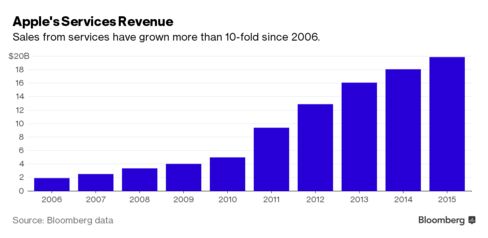
The App Store is a vital part of the Cupertino, California-based company’s business. The more software that customers download, the more likely they are to keep buying Apple’s products rather than switch to a phone or tablet made by another manufacturer. The store’s success was a key reason the iPhone and iPad became so popular with consumers and is central to Chief Executive Officer Tim Cook’s strategy of getting more sales from online services. Apple currently gets about 30 percent of each app sale, which is part of the $20 billion in services revenue the company generated last fiscal year.
The attempt to improve search is a sign that Apple knows the App Store has become harder for customers to navigate. First introduced in 2008, the store now has more than 1.5 million apps, with customers downloading more than 100 billion since its debut. App developers have for years urged the iPhone maker to add fresh discovery tools for users, arguing the crowded market makes it increasingly hard for people to discover new apps or build sustainable businesses.
Apple has taken steps to improve search in the past. In 2012, Apple acquired an app search-engine company named Chomp to help address the problem. In December, Cook changed the leadership of the App Store. He moved responsibility to Phil Schiller, Apple’s senior vice president of worldwide marketing, and away from Eddy Cue, the senior vice president for Internet, software and services, whose portfolio has expanded as Apple has built out new online services such as Apple Pay and Apple Music.

I hate SUVs for the same reason I hate houseboats. Bad houses, bad boats. Luxury SUV’s make me sick. Is there anything more American than the idea that you can have it all, without compromise, for a price? You can’t, otherwise Escalades and Expeditions would be running in NASCAR.
Except now you can, because I just took a Tesla Model X P90D to Ojai, California, and for the first time in my life, I wanted an American car.
The Model X P90D represents everything I hate. It’s an awkwardly-proportioned, 5440 pound, electric, semi-autonomous, 7-seater SUV, packed full of technology that cannot possibly last, from a company critics claim cannot survive.
And I absolutely loved it.
Flaws? It’s a new company. If reliability is your concern, lease one and enjoy the most advanced, brilliant and fascinating vehicle in its class. The standard warranty is four years. Prepare for loaners.
The exterior is what it is. If you want the future now, this is what it looks like. If you’re satisfied with yesterday, you already know what’s available today. I think the X is handsome. Ish. Once behind the wheel, I didn’t care.
The Model X P90D gets about 250 miles of range. I’d like 50 more. Was it a problem? Only in my mind. As with any Tesla, you should install a high-speed charger at home. If not, prepare to meet some new friends at your nearest Tesla Supercharging station, and scratch 2-3 hours a week off your schedule.
The interior is spartan, at best. I still don’t buy into the wisdom of replacing all controls with a touchscreen, however large and gorgeous. The seats are the best I’ve ever used, and that includes the 1972 Citroen DS and SM, my personal benchmarks.
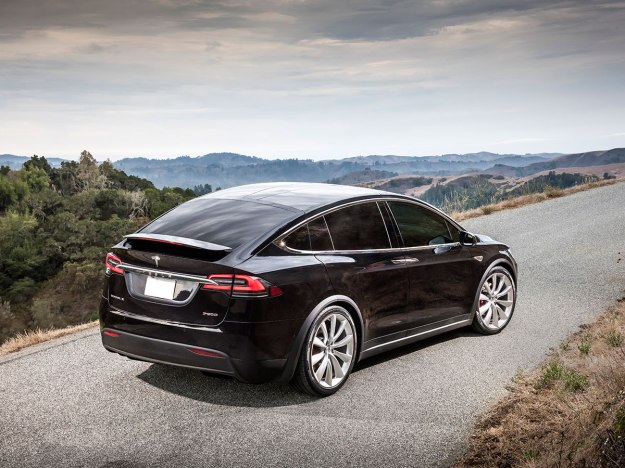
The Model X is a vehicle that makes no sense and yet perfect sense, an SUV with 716 horsepower that does 0-60 in 3.8 seconds, or 3.2 with the “Ludicrous” software upgrade.
A Ferrari Enzo does it in 3.14.
When an SUV can make you vomit while out-accelerating almost every Porsche, Ferrari or Lamborghini ever made, Modena and Stuttgart have a problem. Handling? The X is based on the same platform as the Model S sedan, which means it’s magnificent. Lower the air suspension, set the steering to Sport, and the X shrinks around you. I’ve never felt safe driving an SUV as I would a sports car, until now. Even my old Cayenne Turbo was a brick by comparison.
The Model X is the SUV someone else would have built if they had any balls.
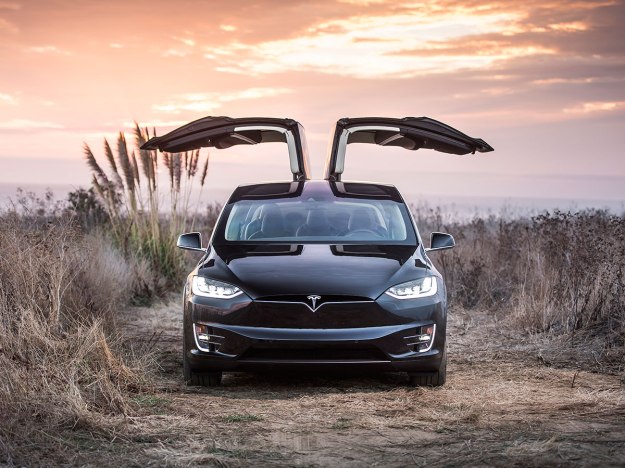
My god, those Falcon doors. Even if the X was utter junk, they could sell a year’s production based solely on these doors. Alas, you don’t need to be Nostradamus to know those will be a problem. If you lease past four years, get the extended warranty.
It has autopilot, which is what Tesla calls its Autonomous Driving suite. Light years ahead of competing systems, it is the only one today that approaches full autonomy. It’ll do 99% of the driving 90% of the time. It has a steep learning curve, but once mastered, autopilot is a revelation. Until Mercedes and Volvo come to the table, everything else is a joke.
The enormous one-piece panoramic windshield makes the cockpit feel like the first row in an IMAX theater. After driving the Model X, every other car feels like you have an eye infection. Why this windshield hasn’t been done before in the US, I don’t understand.
The Model X is the SUV someone else would have built if they had any balls. It is the world’s greatest SUV in a class of one…a class called The Future. The X is to SUV’s what the S is to luxury sedans, which is what Tesla is to the entire car industry: an icepick in the face of convention. Granted, there are stellar cars out there: the Cadillac CTS-V, the Porsche 911, the BMW M2, the Mercedes AMG-GT and the Volvo XC90, but these are jewels in the sediment of an industry left behind by true innovation. I love the Model X not merely as a vehicle, but as a profoundly American vehicle, the automotive manifestation of what this country is supposed to stand for. Ambition. Ingenuity. Confidence.
American inventor mythology is that of someone being told something couldn’t be done, and then doing it. Is there a more American story than Musk’s? The immigrant who became a tech titan, then launched a rocket company, then entered the car business?
The Model X, like Tesla the company, is an example of what happens when you apply that most American of methods to a problem. Throw out the book. Solve it from the ground up. Dealer networks suck? We’ll sell direct. Nowhere to charge? We’ll build our own network, and we’ll make it free. Autonomous Driving? Software updates? Let’s give Tesla owners access to the very best tech, and let’s wirelessly update it all the time.
By these standards, Tesla is the most American car company there is today, and the brilliant Model X is the most American car currently on the market. It is an example of what happens when a company is willing to take risks on our behalf rather than at our expense. Whatever critics may claim about Tesla’s ability to deliver, Musk’s greatest sin is his rush to sell us something truly better, which is why I deem the X worth every penny, flaws and all.
I can’t wait for the Model 3. If you believe in what really makes American great, neither should you.
http://www.thedrive.com/new-cars/2875/why-the-tesla-model-x-will-make-you-want-an-american-suv


LET’S ADDRESS WHAT some might consider the morally inconsistent status of an all-electric luxury SUV costing $135,400. By design, the Tesla Model X P90D Ludicrous (that’s the real name, apparently) is meant to be green and efficient—and well-to-wheel, net-to-net, EVs are way cleaner than gas-powered cars. Electric vehicles are a technical expression of our belief that the atmosphere is the blue commons, owned by all. Egalitarian in impulse, in other words.
But the Model X is also the rarest sushi of materialism, class privilege under a blister of tinted glass, a suede-lined pachinko parlor of the soul. Just remember as you pull up to Nobu in West Hollywood and supermodels come running out to the valet to take a picture with your Model X with the doors up: You’re saving the planet.
Here’s the hard part for most people: It can be both. A feature of a free society is that some have more than others; such are the risks and rewards of capitalism. This is a given. This is gravity. But everyone, no matter their lifestyles, can consume less. And, by the power of numbers, a lot of lesses add up to quite a lot.
So some Hollywood celebrity downsizes to a Gulfstream IV and now she’s Mother Earth? Well, yes. Consider it a self-imposed carbon flat tax.
F. Scott Fitzgerald said the test of a first-rate intelligence is the ability to hold two opposed ideas in mind at the same time and still function. It also seems to apply to the Model X’s famous Falcon Wing Doors, since they are simultaneously unnecessary and absolutely vital to the entire enterprise; deeply thought-through yet completely spurious; impractical and…well, more impractical. But you get used to them, because they are so cool. See above re: supermodels.
Or retired aerospace engineers. Or French tourists. Or the hard-core, mainlining petrolheads who kept me waiting in the parking lot at Venice Beach, Calif., while they selfied themselves, laughing madly, sitting in mid-row seats while the doors were up. When all the doors are open you can look through the Model X as if it were a picture window with a Tesla-shaped sill and sash.
Would minivan-style doors have been a more sensible technical solution to a mid-row door opening? Infinitely. You could have done the doors off the Dubonnet Xenia easier that the Model X. But the spell these doors cast—let’s call it emotional engineering—is payoff for some of the shrewdest design money ever spent.

Price, as tested: $135,400
Powertrain: all-electric all-wheel system comprising dual three-phase, four-pole AC induction motors; liquid-cooled lithium-ion battery pack (90kWh nominal); on-board charger and supercharger enabled; permanent all-wheel drive.
Horsepower/torque: 532 hp/713 pound-feet of torque
Length/weight: 198.3 inches/5,381 pounds
Wheelbase: 116.7 inches
0-60 mph: 3.2 seconds
Towing capacity: 5,000 pounds
Cargo capacity: 77 cubic feet (total interior storage, six-seat configuration)
A bit of context: The Falcon Wing Doors came about because Tesla CEO Elon Musk liked them and wanted them, full stop. He has said he didn’t want the production car to be a dialed-back version of the concept car, which is just the sort of initiative and forward thinking that gets people cashiered from General Motors.
To aficionados, Mr. Musk’s move smacked of pride since in over a century of automotive design, from the Mercedes-Benz 300SL Gullwing to the DeLoreans to Lambos, gullwing doors have always looked cool and never really worked.
To name a few of the problems: ease of entry and exit, weather sealing and wind noise. From a safety standpoint, center-hinged overhead doors cut into the kind of rectangular geometry around a door opening that lends it rigidity.
What if it snows overnight? What if it’s raining? Where do you put the ski racks and bicycles and the Thule roof module full of hiking gear?
Who cares? Have you seen the doors open?
Most maddening was creating a dead-stable pivot point for the doors, which rise and fall slowly on the motorized breeze not like falcon wings but more like seagull wings, with a double fold. The solution required a heroic amount of costly magnesium in the car’s dorsal spine.
Mr. Musk has copped to overreach with the Model X. Maybe he tried to do too much, what with the Model X’s sensor-rich Autopilot driver aids; the dancing shuttle-craft seats; the HEPA air filtration system with the “Bioweapon Defense Mode” setting; the panoramic windscreen, a stunning soap bubble of a canopy over your head. Dude, you’re forgiven. But then again, I’m not a stockholder.
Practicality for fascination. This is the card Mr. Musk continues to play to his advantage. This is the part of the Tesla business plan that might as well have been quoted out of the Old Testament. The rich will want the riches.

Not to be confused with the Model 3 compact sedan that debuted so boffo this week, the Model X is a full-size SUV with dual electric motors front and rear, providing all-wheel drive. Although its body structure is almost entirely aluminum and magnesium, our flagship test car (P90D Ludicrous) was quoting a massive 5,381 pounds, most of it in the floor-mounted battery pack. Four-corner air suspension with five ride-height settings, from off-road to highway, is standard.
The Model X is a luxury family mover, with five-, six- or seven-passenger seating options, with a rear trunk and a frunk (a front trunk). The deeply tinted glass canopy creates a pretty magical space, although (another old lesson, relearned) the California sun is too bright through the roof glass. I understand additional tinting is available.
The front and mid-row seats are mounted on powered pedestals that glide forward as if to a Strauss waltz, easing access to the third row’s two cozy bucket seats. The seats’ pedestal mountings allow passengers more foot room than otherwise.
All the doors open electrically, which can take some getting used to. If you get in and put your right foot on the brake, the driver’s door will swing closed, even if you have not yet retrieved your left leg. The door will gently gnaw on it until you take your foot off the brake.
The price for the “standard” Model X 70S with a 70kWh battery is $80,000, which is about $5,000 more than a base Model S—a fact that is academic because Tesla won’t be building any base Model X’s for some time.
‘Elon Musk has copped to overreach with the Model X. Dude, you’re forgiven.’
The company will instead be filling orders for the flagship P90D (“P” for performance). These will come with a face-flapping 713 pound-feet of insta-torque from two huge four-pole AC induction motors ($35,000) and the famous “Ludicrous” Drive Mode ($10,000), which essentially permits the battery to violently eject electrons in pursuit of maximum acceleration. In Ludicrous Mode, the Model X P90D max output is 532 hp.
That’s the version that Tesla provided me, and I want them to know, I’m on to their game. It is very hard to find fault with a six-seat SUV that accelerates like a Formula Atlantic open-wheeler. Jeebus. Stamp the accelerator and it goes off like a sprung mousetrap. Tesla estimates 0-60 mph in a Lambo-like 3.2 seconds. While doing so, the Model X quietly withdraws everything from your pockets and scatters it conveniently under the back seats.
And then, between 50 and 100 mph, it’s goodbye, Charlie. The P90D Ludicrous operates at an entirely different frame rate than just about anything on the street in L.A. It takes a sustainably harvested baseball bat to Panzer wagons like Porsche Cayenne Turbo and Range Rover Sport SVR.
Around the City of Angels, the sweet, effortless blurt of our EV hot-rod tempted me to do, well, questionable things. No yellow light ever turns red for the Model X P90D. No hole that opens up in traffic is ever too small or far away.
Falcon wings? Maybe Icarus. But if the Model X flies too close to the sun, there’s always more window tint.
http://www.wsj.com/articles/tesla-model-x-electric-meets-extravagant-1460046720
If artificial intelligence has its way, discounting could disappear, thanks to software that tells retailers exactly what and how many products to buy, and when to put them on sale to sell them at full price. Online shopping could become a conversation, where the shopper describes the dress of their dreams, and, in seconds, an AI-powered search engine tracks down the closest match. Designers, merchandisers and buyers could all work alongside AI, to predict what customers want to wear, before they even know themselves.
In the last few years, a trifecta of cheap, ubiquitous, powerful computing; big data; and the development of deep learning have triggered a revolution in artificial intelligence. The computing devices that now fill our everyday lives generate large data sets, which “deep learning” algorithms analyse to find trends, make predictions and perform specific tasks, such as identifying specific objects in an image. The more data presented to the algorithm, the more it “learns” to do a task effectively.
Earlier this year, in a blog post titled What’s Next in Computing?, Chris Dixon, partner at the venture capital firm Andreessen Horowitz, wrote, “Many of the papers, data sets, and software tools related to deep learning have been open sourced. This has had a democratising effect, allowing individuals and small organisations to build powerful applications.” As a result, AI might “finally be entering a golden age,” he wrote.
No area of life or business will be insulated from AI, in the same way that no part of society hasn’t been touched by the Internet.
These developments have provoked an AI arms race. Companies like Google and Apple are snapping up AI start-ups, and in the last year, milestones in the field have arrived faster than previously expected, such as last month, when Google’s AlphaGo program beat a human champion at Go, a strategy board game considered more complex than chess.
Already, big businesses are using AI — Kensho, a data-crunching AI software, is automating finance jobs at Goldman Sachs, while Forbes uses AI to automate basic financial news stories. IBM’s Watson — a set of algorithms and software that is the company’s core AI product — is available as a cloud service, enabling research teams to rapidly analyse large amounts of data, such as millions of scientific papers, to test hypotheses and discover patterns. By 2020, the market for machine learning applications will reach $40 billion, according to International Data Corporation, a marketing firm specialising in information technology.
“No area of life or business will be insulated from AI, in the same way that there’s no part of society that hasn’t been touched by computers or the Internet,” Kenneth Cukier, data editor at The Economist and author of books including Big Data: A Revolution that Will Transform How We Work, Live and Think, told BoF. “Today it seems shocking because it’s new. But in time, AI will fade into the background as just the way things are done.”
By presenting a cheaper, faster way of doing many tasks that companies currently employ humans to do, many predict AI will radically alter industries from transportation, to healthcare, to finance. In fashion, like in other industries, driverless trucks will likely reduce companies’ logistics costs, or software like that used by Forbes could be used to write formulaic text, such as product descriptions on e-commerce sites.
But for fashion, some of the biggest opportunities are in aligning supply and demand, scaling personal customer service, and assisting designers.
Aligning supply and demand
Currently, fashion brands and retailers work with a limited amount of data, to predict what products to order and when to discount or replenish them. If they predict wrong, the result is loss of income due to mark-downs, waste and popular items selling out. By analysing large amounts of data — say, the browsing and shopping history of every single one of a fashion brand’s online customers, as well as those of its competitors — AI can tell a retailer how to align product drops to match demand, and even how to display products in a store to sell as many as possible.
AI’s ability to make predictions like these has particular implications for a trend-driven industry like fashion. Today, the fashion market is visible online: an AI can crawl e-commerce sites to see which products are selling; it can analyse consumer data to learn which colours or materials customers in a specific country — or even city — are buying; and it can scoop up swathes of information from social media to identify trends and microtrends. This data — which was not previously available — could help brands be first to market with styles that are likely to become mainstream trends.
Edited, a data analytics company specialising in fashion, is already doing this. Edited’s software has “learned” to recognise apparel products in images, and natural language processing software, which can classify these products. Edited let this loose on a bank of data on 60 million fashion products, collected from retailers and brands in over 30 countries, in over 35 languages: the result is a searchable database of organised, structured information on each of these products.
“We can process the data in seconds. No one could ever do it manually,” says Geoff Watts, chief executive officer of the company. Brands that work with Edited “usually start by analysing their competitors’ historical pricing and assortment data to make more strategic decisions, ultimately leading to better sales, stronger inventory management and less discounting,” he says.
Ganesh Subramanian, former chief operating officer of e-commerce giant Myntra, and now co-founder of Stylumia, an AI-powered tool for fashion professionals, agrees that AI could stop fashion companies making important decisions in the dark. “A trend is nothing but a movement which has a beginning and a gradual adoption,” he says. Like Edited, Stylumia uses AI to make sense of a sea of data, from videos, e-commerce sites, social media, etc. “We can not only spot trends, but also come out with what is the relevant timing for [brands and retailers] to adopt,” he says.
Scaling personal service
In the days when luxury goods could only be bought in a few physical boutiques, one-to-one customer service was at the core of the industry. The Internet changed that dramatically, giving customers a seamless — but often impersonal — way to trawl thousands of products and purchase without exchanging a word. Could AI deliver that original one-to-one service at scale?
One way to do this is through chat bots, which can exchange messages, stories and information with humans. Already, Microsoft’s XiaoIce chatbot is being used by 40 million people on Chinese microblogging platform, Weibo. (Not all attempts to have bots interact with humans have been so successful: when Micosoft unleashed Tay, another chat bot, on Twitter last month, the bot “learned” from other users and rapidly began tweeting offensive messages.)
Machine learning can also enable brands to finely personalise their offerings to each market, or even, each individual customer. Thread, an online personal styling service, combines human stylists with machine learning algorithms. The AI crunches data like what human stylists thinks would suit an individual user, where they live and what the weather is like there, as well as the user’s ratings of products on the app, which items they click, and how customers with similar purchasing habits responded to product recommendations. The AI then trawls through 200,000 fashion products and makes a judgement on what products to recommend.
“Humans are limited in many ways,” says Thread founder and chief executive officer, Kieran O’Neill. Not only can AI process a vast amount of data — it can also “remember your preferences in a way that it’s just not practical for humans to do. A computer remembers everything,” he says. Michele Goetz, principal analyst covering cognitive computing and data at Forrester, agrees: “That’s where I think AI shines, being able to scale insight.”
IBM’s Watson — which is working with over 500 partners in industries including retail — has partnered with The North Face to offer “guided shopping” online. The AI asks shoppers questions on factors such as gender, time of year and technical product details, to deliver tailored recommendations. „Online shopping can be overwhelming. There are so many choices and products from so many different sources,” says Keith Mercier, ecosystem manager of Watson. AI, he says, “can help retailers make sense of massive amounts of unstructured data to improve and personalise the online shopping experience.“
Image recognition apps such as Snap Fashion and ASAP54 are also harnessing AI to build search engines for fashion. In theory, a user can snap a picture of someone on the street wearing a dress they like, or even something as abstract as a painting, and an image-recognition search engine will search a huge database of shoppable products and serve up similar items. When BoF tested these products, the search results were far from perfect, but Kieran O’Neill bets that “in the next three years it will become pretty good.”
AI-assisted Design
„There are AI systems today that compose music, write stories, and create artwork that no one can tell is machine-generated. So fashion design is surely not beyond AI’s capabilities,” says Pedro Domingos, author of The Master Algorithm, which predicts the revolutionary impact of machine learning, “What will likely happen, however, is not that AI will completely replace designers, but will become an indispensable tool for them.“
In the same way that the work of architects like Frank Gehry and Zaha Hadid relies on computer modelling, “Fashion designers armed with AIs will be similarly able to come up with radical new ideas: AI will amplify their creativity rather than replace it,“ reasons Domingos.
“AI will absolutely challenge and replace designers,” counters Kenneth Cukier. “Let’s get real — lots of design is trial and error or boring, repetitive work. AI can help with both by making more accurate predictions of what designs will work and taking over some of the repetitive tasks.”
Approaching AI now
Some believe fashion brands should strike early and invest. “They certainly need to have in-house AI teams, like other companies, whether by building them from scratch or by acquiring start-ups,” advises Domingos. “Those who wait and see risk falling behind, particularly in a fast-moving industry like fashion, where consumers are the main drivers and tastes are fickle.”
“The old world of personal touch is not necessarily going away, but it’s not the way you’re going to grow your brand even from a luxury standpoint,” argues Michele Forrester. When fashion brands thing about AI, she says, they need to consider the next generation of luxury customers, who were born into a world of social media, and handed at birth the ability to buy anything they want, from anywhere in the world. “They don’t have the patience for a one-on-one relationship,” she says.
Indeed, the next generation of big spenders is already using AI: GPS navigation shapes their driving habits, while algorithm-driven personalised recommendations from Spotify and Netflix influence the songs and shows they consume. “If you don’t have it, you are not aligned with the experiences they’re used to,” warns Goetz.
Others are more cautious. “The top tier brands should resist the temptation to buy into the AI world right now,” says Cukier. “Their business is being good at fashion, not smart at technology… Right now, the most promising technologies are still in the lab or in field trials, like self-driving cars. Big, smart, non-technology companies can afford to wait.”
Others agree that, for the moment, partnering with third party AI specialists is the way forward. “The smartest thing a business can do, is partner with a fashion-focused tech company with AI at its core,” says Geoff Watts of Edited. “Building AI teams from scratch, or acquiring AI start-ups and retrofitting them to have a retail focus, requires a substantial investment of time and money.”
Kieran O’Neill of Thread adds that, rather than dive straight in to AI investment, brands should build a strategy around AI, and work out on what the lowest hanging fruits are for their business. Some of the brands using Thread — such as Burberry, Jigsaw and Topman — signed up to sell on the platform, not because they needed the sales, but “because they really want to be close to the AI stuff we’re doing,” he says.
“Every company in every industry should be paying very close attention to AI,” advises Martin Ford. “There is no limit to how far it can go.”
http://www.businessoffashion.com/articles/fashion-tech/is-fashion-ready-for-the-ai-revolution
John Geraci:
“
When I worked at the New York Times, from 2013 to 2015, my job was to lead a team in the creation, launch, and development of a new, revenue-driving product that would help restore growth to the company’s bottom line — which, like the bottom lines of all newspapers around the world, has been endangered by wave after wave of new technology.
During those two years, I got to see and be part of a great, mission-driven company’s effort to grapple with moving into the 21st century, trying — for the first time in its existence, really — to be innovative and find new paths to growth. As someone who had spent most of his career working in and cofounding startups, it was big, heady stuff.
It was also a resounding failure. By the end of my two years there, two of the three products the company had launched to drive new revenue had been repositioned as free offerings intended to drive engagement, and the third had been shut down entirely; there were no meaningful plans for new products underway.
But the exercise wasn’t a complete failure. Those three products fit into a bigger story: how one company was trying, desperately, to discover the ingredients it needed to become truly innovative.
In my first year there, the Times was first focused on finding entrepreneurial employees. Indeed, that’s why I was hired. By hiring people who had cofounded companies, the Times was working to bring in entrepreneurial DNA into the building. That year there was much talk about entrepreneurship, lean approaches, hypotheses, etc.
During my second year, when it became utterly apparent that the new products were not going to hit their targets, the Times shifted to growth-minded leadership. We created a special executive board to evaluate new initiatives, and they tried to adopt VC mindsets in their approach. We had meetings where people talked about sizing opportunities, evaluating risks, and so forth.
None of this is an unusual story for big companies. Many companies were undergoing similar awakenings at the same time — becoming aware of the need for employees who were entrepreneurial, and then becoming aware of the need for top leadership who think like VCs. And although the Times wasn’t executing either particularly well the last I saw, they were well aware of the need and working toward that.
There is a third piece, however, that the Times, along with the rest of the corporate world, is still missing: the Ecosystem Mindset.
Most big organizations resemble organisms. They have discrete boundaries, inputs and outputs at specific places, and wholly internal engines. They are like a giant animal — head, eyes, mouth, stomach. This makes intuitive sense to us; it’s how we were taught to think of organizations. And it was useful and worked through the 20th century, when change was slow relative to how things are now.
The Times is a perfect example of company-as-organism. Employees at the Times rarely go offsite for lunch or meetings. When you work there, your network is inside the building. That’s where all of the action is, where the valuable information is traded, where the battles are fought, and where the victories are won. When the Core Team or the Newsroom Team or the Beta Team finds a solution, it is a Times solution. Naturally there are inputs and outputs to the company, but like an organism, these are discrete — a mouth, a nose, an ear. At the Times, the Strategy Team pursues and manages strategic relationships for the company, takes in the resources needed to stay alive, and channels those to the rest of the organism. It’s the model of the companies our fathers and mothers worked at. And it worked great for them.
But in today’s world, it doesn’t. Companies with the organism mindset are too slow to adapt to survive in the modern world. The world around them changes, recombines, evolves, and they are stuck with their same old DNA, their same old problems, their same old (failed) attempts at solutions.
Ecosystems, by contrast, are boundless, constantly able to grow, absorb new entities, adapt, react, and transform. They don’t acquire new elements by ingesting them, but by absorbing new components at the edges of the network. And when they do that, they create new value for the whole ecosystem.
Organizations that pursue strategies like these have what I call the Ecosystem Mindset. All startups have it, while almost no big companies do. It’s an understanding that your organization is not a bounded entity, complete unto itself, but part of a wider ecosystem. It comes with an implicit understanding that the solutions to your key challenges are not all inside the building, but are out there — and that you must locate and interact with them to thrive.
The venture firm Andreessen Horowitz is a great example of an organization that uses an ecosystem mindset to great effect. Other than those relatively few people in the firm focused squarely on the portfolio companies, everyone else is focused on what is out there, beyond the walls of the organization. Marketers market themselves, directors research deals, the executive talent team doesn’t recruit — that is very much “organism think.” Instead, they build relationships. Managing directors open doors to corporations for portfolio companies in the ecosystem — hundreds per month come through their doors. The entire firm is organized to function as a series of inputs and outputs, permeable membranes with the outside world around it. As Jeff Stump, a partner there, said to me, “If a pin drops in our network we want to know about it.”
They also measure the value of this activity, and expect to see a real ROI. They measure efficiency, productivity, quality of the network, quality of inputs and outputs. Rather than just networking, they continually ask the question, “Is our network working?”
When you think about that kind of organization, and the implications of that kind of continual network activity and the sheer volume of new ideas, new partnerships, and new collaborations it produces, and then you look back at big companies with their entrepreneurial employees and growth-minded leaders, you understand why organizations like the Times are not nailing it. They’re like a bear stuck in a swamp. All around them swirls new kinds of life interacting with itself, evolving, transforming, and they’re there with their fur and claws trying to swat at it all.
So what’s the solution for these companies, who have stocked themselves with entrepreneurial employees and VC-minded execs but still can’t seem to round the corner and start innovating and growing at a pace that keeps up with the outside world? Open the doors. Let the light stream in. Get out of the building. Interact. Not just the strategy team, not just the CEO, but everyone. The new value is not inside, it’s out there, at the edges of the network.
Embrace that, and grow.“
https://hbr.org/2016/04/what-i-learned-from-trying-to-innovate-at-the-new-york-times
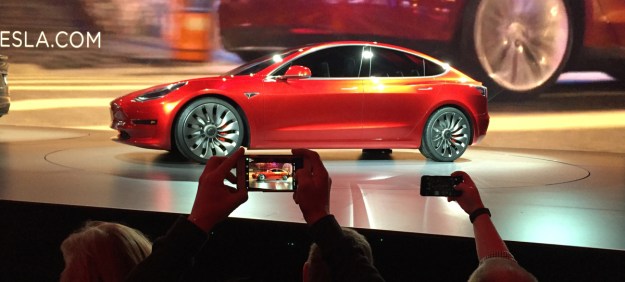
Tesla Motors unveils the new lower-priced Model 3 sedan at the Tesla Motors design studio in Hawthorne, Calif., Thursday, March 31, 2016. It doesn’t go on sale until late 2017, but in the first 24 hours that order banks were open, Tesla said it had more than 115,000 reservations. Long lines at Tesla stores, reminiscent of the crowds at Apple stores for early models of the iPhone, were reported from Hong Kong to Austin, Texas, to Washington, D.C. Buyers put down a $1,000 deposit to reserve the car.
In the first 72 hours, Tesla received 276,000 pre-orders for the upcoming Model 3. Given Tesla’s limited production capacity, the demand has by far surpassed the supply. Yet not one Tesla customer ever has to worry about paying some ridiculous dealer markup.
Before we go any further, let’s put that deposit number in perspective. The Model 3, with a starting price of $35,000 (before federal tax incentives) is entering one of the most hotly contested sales segments, the compact luxury sedan.
Cars like the BMW 3 Series, Audi A4, and Mercedes C-Class are crucial, high-volume vehicles to get buyers and lessees into the fold at a somewhat reasonable price point. The lease programs especially are designed to keep customers loyal and hopefully get buyers to move up the spectrum to more expensive vehicles as their income increases.
According to GoodCarBadCar.net, the top four best-selling small luxury sedans of 2015 were the 3 Series (94,527 units), C-Class (86,080 units), Acura TLX (47,080 units), and Lexus IS (46,430 units). In only three days, Tesla got more people to plunk down a deposit then the total combined sales of the top four compact sedans in an entire year. Of course, a deposit does not necessarily guarantee a sale, but the amount of interest in the Model 3 is staggering and turned out to be much more than initially predicted.
Usually, when an incredibly high-demand car hits the showrooms and dealers have waiting lists of customers, buyers tend to encounter something on the window sticker known as “ADM-Adjusted Dealer Markup” (you may see other acronyms that do the same thing.) Basically, the dealer tacks on an additional premium of extra profit that relates to what they think they can get for this car. They know some buyers won’t pay, but some will. It’s simple supply and demand economics. Some Porsche dealers are asking $115,000 for an $84,000 Cayman GT4. Ford dealers are tacking on markups to the Shelby GT350 that are almost twice the price of the car!
High-end cars like Porsches are targeted towards folks with a lot of income that probably can afford the premium if they so chose. The Model 3, on the other hand, is aimed at your average new car buyer—someone who most likely has to manage their budget a bit more carefully than your typical 911 GT3 buyer. It is important to Tesla’s success that when a potential customer runs the numbers and determines they can afford a Model 3 at whatever price point they desire, that the car is not snatched out of their reach by a dealership wanting to pad some profits.
Tesla’s direct sales model means that a dealer will never be able to sell a $35,000 Model 3 for $50,000, because out of the 276,000 people that are interested there will be at least a few hundred willing to pay the extra $15,000 to get one in their driveway. That’s not to say that folks willing to pay more aren’t getting preferential treatment. According to Tesla, Model 3 orders will not be first-come, first serve, but rather customers with more expensive configurations will get order priority over less expensive models. (Existing Model S and Model X owners get first crack too.)
But someone who ordered a $35,000 Model 3 can rest easy knowing that despite the popularity, as long as they are willing to wait, the price of that car will not change because some dealer wants to take advantage the market conditions.
People hate the car buying process because no matter how much research they do, at the end of the transaction they often feel like they got taken by the dealer. Whether or not that is reality doesn’t really matter. For many years, the dealers controlled the information, and while the internet has equalized the game in many respects, a lot of car buyers don’t walk away from a car purchase with a good feeling. This is why third party buying tools like TrueCar and haggle-free used car dealers like CarMax are so appealing; they reduce the price anxiety.
Of all the cool features that will be in the upcoming Model 3, the best might be the fact that you don’t have to be rich to buy a car and not feel like you got ripped off
Apple, the world’s most valuable company, isn’t shy about revealing how many of its computers, tablets, phones, and smartwatches are in use: over 1 billion, according to CEO Tim Cook.
But that number isn’t a good reflection of how many users Apple has, because many iPhone users also own a Mac or iPad, for example.
Analysts from Credit Suisse have crunched the numbers and collected some survey data, and have figured out a good starting point for the number of global Apple users.
Apple has 588 million users worldwide, Credit Suisse estimated in a note published on Monday. If there are exactly 1 billion active Apple devices in use, these findings mean the average Apple user owns 1.7 devices.
This figure is important as Apple is trying to change its story: The vast majority of its revenue comes from selling premium hardware. But Apple wants to become „a services company,“ like Google or Microsoft, because services provide a lot of the value in using a particular device — the best phone in the world with a sub-par mapping service, for instance, isn’t as useful as a cheaper phone that knows exactly where you are.
(Those companies also trade at a much higher price-earnings ratio than Apple does. The PE ratio is the market price of the stock divided by the last four quarters of income. The higher the PE ratio, the more expensive the stock.)
To understand a services business, analysts need to know how many users it has. Credit Suisse looked into products like iTunes, App Store, Apple Music, iCloud, and Apple Pay, and concluded that Apple’s services growth and potential means that the company warrants a higher valuation than it’s currently getting.
In fact, the note estimates that Apple services revenue could more than double by 2020 to $53 billion. Apple bragged that it managed to book $21 billion in services revenue last year, while alluding that that figure by itself was larger than some of its competitors. (Facebook reported $17.9 billion in revenue for 2015, for example.)
But it’s not just the size of Apple’s installed base that makes its services an attractive investment. Apple users are significantly richer than non-Apple users. According to Credit Suisse:
As Credit Suisse points out, Apple doesn’t even necessarily directly charge for all of its services. Its popular iMessage texting service, for example, is free, which means its price is essentially built into the cost of an iPhone or iPad.
As the analysts write:
While monetizing many of these services is not Apple’s primary objective, it does allow the company to price at premium levels. We would argue that whether it is the customer lock-in and essential headache of leaving the iOS ecosystem or the loyalty to the brand, the output is the same – once an individual or family is part of the Apple ecosystem, they will very rarely leave it.
The end conclusion is that while Apple books its revenues and earnings based largely upon a point of sale, the actual installed base of over 1bn active devices presents a largely reoccurring cash flow stream as users will replace and upgrade their devices due to the innovation and introduction of new products over time.
So the challenge for Apple is to increase the amount of services revenue it can generate from one of its customers — getting him or her to sign up for iCloud storage and Apple Music, for example, which come with monthly fees — while still providing good value for its premium computers and phones, which have Apple services baked into the price.
One problem is that Apple’s services can be unreliable, and have attracted snickers from those who think the company lags behind Google, Microsoft, and Amazon at providing basic software services like data storage.
But Apple’s clearly investing in this field. For example, it’s planning to open up several data centers and it’s been hiring distributed computing experts. It reportedly has a effort called „Project McQueen“ to do more of its online computing in-house. Online services are a critical challenge for the world’s most valuable company if it wants to become even more valuable.
Credit Suisse adjusted its target price for Apple to $150 from $140 per share.
www.businessinsider.de/credit-suisse-estimates-588-million-apple-users-2016-4
 TheIdea – The Innovation Agency