Archiv der Kategorie: Social Media

Facebook pays teens to install VPN that spies on them

facebook vpn watching

Desperate for data on its competitors, Facebook has been secretly paying people to install a “Facebook Research” VPN that lets the company suck in all of a user’s phone and web activity, similar to Facebook’s Onavo Protect app that Apple banned in June and that was removed in August. Facebook sidesteps the App Store and rewards teenagers and adults to download the Research app and give it root access to network traffic in what may be a violation of Apple policy so the social network can decrypt and analyze their phone activity, a TechCrunch investigation confirms.

Facebook admitted to TechCrunch it was running the Research program to gather data on usage habits.

Since 2016, Facebook has been paying users ages 13 to 35 up to $20 per month plus referral fees to sell their privacy by installing the iOS or Android “Facebook Research” app. Facebook even asked users to screenshot their Amazon order history page. The program is administered through beta testing services Applause, BetaBound and uTest to cloak Facebook’s involvement, and is referred to in some documentation as “Project Atlas” — a fitting name for Facebook’s effort to map new trends and rivals around the globe.

Seven hours after this story was published, Facebook told TechCrunch it would shut down the iOS version of its Research app in the wake of our report. But on Wednesday morning, an Apple spokesperson confirmed that Facebook violated its policies, and it had blocked Facebook’s Research app on Tuesday before the social network seemingly pulled it voluntarily (without mentioning it was forced to do so). You can read our full report on the development here.

An Apple spokesperson provided this statement. “We designed our Enterprise Developer Program solely for the internal distribution of apps within an organization. Facebook has been using their membership to distribute a data-collecting app to consumers, which is a clear breach of their agreement with Apple. Any developer using their enterprise certificates to distribute apps to consumers will have their certificates revoked, which is what we did in this case to protect our users and their data.”

Facebook’s Research program will continue to run on Android.

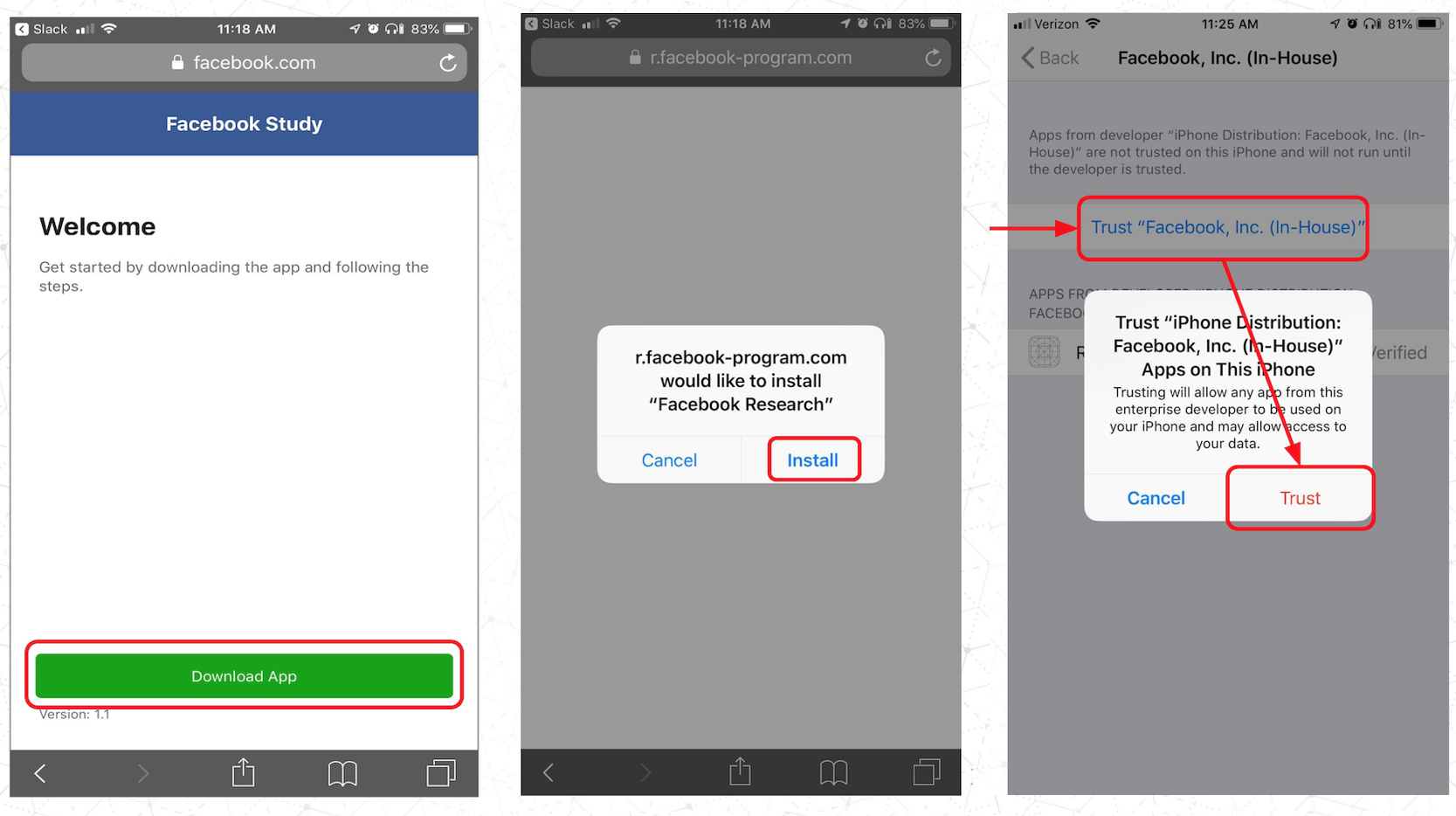
Facebook’s Research app requires users to ‘Trust’ it with extensive access to their dataWe asked Guardian Mobile Firewall’s security expert Will Strafach to dig into the Facebook Research app, and he told us that “If Facebook makes full use of the level of access they are given by asking users to install the Certificate, they will have the ability to continuously collect the following types of data: private messages in social media apps, chats from in instant messaging apps – including photos/videos sent to others, emails, web searches, web browsing activity, and even ongoing location information by tapping into the feeds of any location tracking apps you may have installed.” It’s unclear exactly what data Facebook is concerned with, but it gets nearly limitless access to a user’s device once they install the app.
The strategy shows how far Facebook is willing to go and how much it’s willing to pay to protect its dominance — even at the risk of breaking the rules of Apple’s iOS platform on which it depends. Apple may have asked Facebook to discontinue distributing its Research app.

A more stringent punishment would be to revoke Facebook’s permission to offer employee-only apps. The situation could further chill relations between the tech giants. Apple’s Tim Cook has repeatedly criticized Facebook’s data collection practices. Facebook disobeying iOS policies to slurp up more information could become a new talking point.

Facebook’s Research program is referred to as Project Atlas on sign-up sites that don’t mention Facebook’s involvement

“The fairly technical sounding ‘install our Root Certificate’ step is appalling,” Strafach tells us. “This hands Facebook continuous access to the most sensitive data about you, and most users are going to be unable to reasonably consent to this regardless of any agreement they sign, because there is no good way to articulate just how much power is handed to Facebook when you do this.”

Facebook’s surveillance app

Facebook first got into the data-sniffing business when it acquired Onavo for around $120 million in 2014. The VPN app helped users track and minimize their mobile data plan usage, but also gave Facebook deep analytics about what other apps they were using. Internal documents acquired by Charlie Warzel and Ryan Mac of BuzzFeed News reveal that Facebook was able to leverage Onavo to learn that WhatsApp was sending more than twice as many messages per day as Facebook Messenger. Onavo allowed Facebook to spot WhatsApp’s meteoric rise and justify paying $19 billion to buy the chat startup in 2014. WhatsApp has since tripled its user base, demonstrating the power of Onavo’s foresight.
Over the years since, Onavo clued Facebook in to what apps to copy, features to build and flops to avoid. By 2018, Facebook was promoting the Onavo app in a Protect bookmark of the main Facebook app in hopes of scoring more users to snoop on. Facebook also launched the Onavo Bolt app that let you lock apps behind a passcode or fingerprint while it surveils you, but Facebook shut down the app the day it was discovered following privacy criticism. Onavo’s main app remains available on Google Play and has been installed more than 10 million times.

The backlash heated up after security expert Strafach detailed in March how Onavo Protect was reporting to Facebook when a user’s screen was on or off, and its Wi-Fi and cellular data usage in bytes even when the VPN was turned off. In June, Apple updated its developer policies to ban collecting data about usage of other apps or data that’s not necessary for an app to function. Apple proceeded to inform Facebook in August that Onavo Protect violated those data collection policies and that the social network needed to remove it from the App Store, which it did, Deepa Seetharaman of the WSJ reported.

But that didn’t stop Facebook’s data collection.

Project Atlas

TechCrunch recently received a tip that despite Onavo Protect being banished by Apple, Facebook was paying users to sideload a similar VPN app under the Facebook Research moniker from outside of the App Store. We investigated, and learned Facebook was working with three app beta testing services to distribute the Facebook Research app: BetaBound, uTest and Applause. Facebook began distributing the Research VPN app in 2016. It has been referred to as Project Atlas since at least mid-2018, around when backlash to Onavo Protect magnified and Apple instituted its new rules that prohibited Onavo. Previously, a similar program was called Project Kodiak. Facebook didn’t want to stop collecting data on people’s phone usage and so the Research program continued, in disregard for Apple banning Onavo Protect.
Facebook’s Research App on iOS

Ads (shown below) for the program run by uTest on Instagram and Snapchat sought teens 13-17 years old for a “paid social media research study.” The sign-up page for the Facebook Research program administered by Applause doesn’t mention Facebook, but seeks users “Age: 13-35 (parental consent required for ages 13-17).” If minors try to sign-up, they’re asked to get their parents’ permission with a form that reveal’s Facebook’s involvement and says “There are no known risks associated with the project, however you acknowledge that the inherent nature of the project involves the tracking of personal information via your child’s use of apps. You will be compensated by Applause for your child’s participation.” For kids short on cash, the payments could coerce them to sell their privacy to Facebook.

The Applause site explains what data could be collected by the Facebook Research app (emphasis mine):

“By installing the software, you’re giving our client permission to collect data from your phone that will help them understand how you browse the internet, and how you use the features in the apps you’ve installed . . . This means you’re letting our client collect information such as which apps are on your phone, how and when you use them, data about your activities and content within those apps, as well as how other people interact with you or your content within those apps. You are also letting our client collect information about your internet browsing activity (including the websites you visit and data that is exchanged between your device and those websites) and your use of other online services. There are some instances when our client will collect this information even where the app uses encryption, or from within secure browser sessions.”

Meanwhile, the BetaBound sign-up page with a URL ending in “Atlas” explains that “For $20 per month (via e-gift cards), you will install an app on your phone and let it run in the background.” It also offers $20 per friend you refer. That site also doesn’t initially mention Facebook, but the instruction manual for installing Facebook Research reveals the company’s involvement.
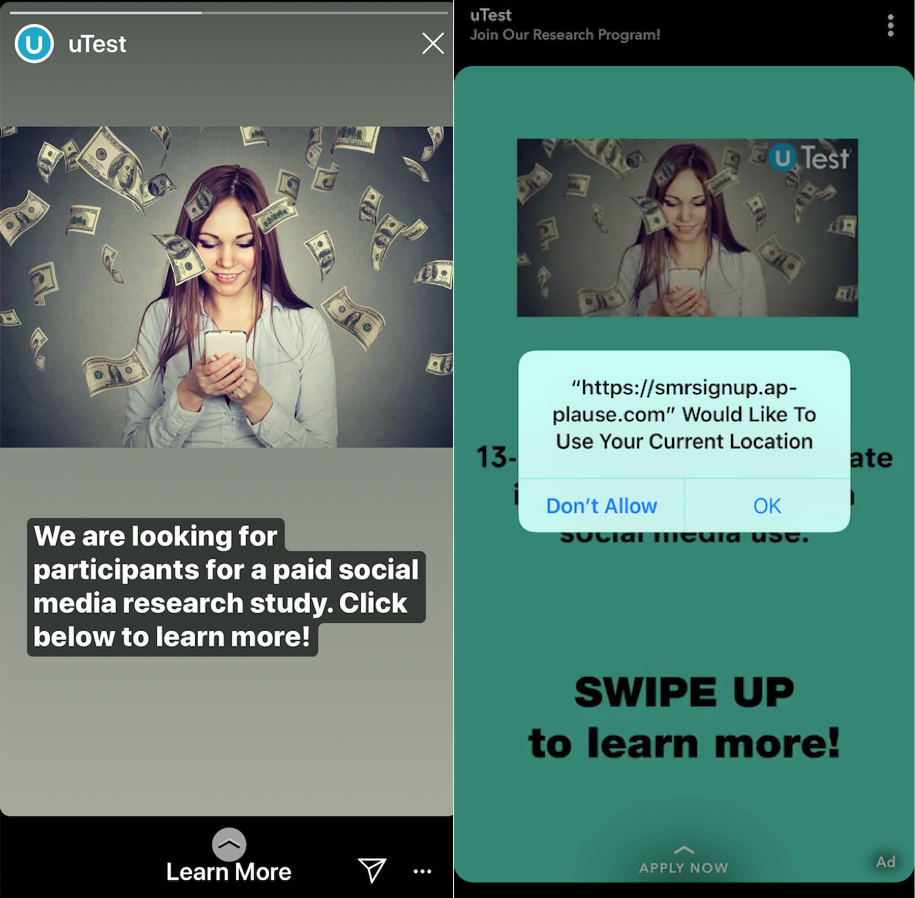
Facebook’s intermediary uTest ran ads on Snapchat and Instagram, luring teens to the Research program with the promise of money


Facebook seems to have purposefully avoided TestFlight, Apple’s official beta testing system, which requires apps to be reviewed by Apple and is limited to 10,000 participants. Instead, the instruction manual reveals that users download the app from r.facebook-program.com and are told to install an Enterprise Developer Certificate and VPN and “Trust” Facebook with root access to the data their phone transmits. Apple requires that developers agree to only use this certificate system for distributing internal corporate apps to their own employees. Randomly recruiting testers and paying them a monthly fee appears to violate the spirit of that rule.

Security expert Will Strafach found Facebook’s Research app contains lots of code from Onavo Protect, the Facebook-owned app Apple banned last year

Once installed, users just had to keep the VPN running and sending data to Facebook to get paid. The Applause-administered program requested that users screenshot their Amazon orders page. This data could potentially help Facebook tie browsing habits and usage of other apps with purchase preferences and behavior. That information could be harnessed to pinpoint ad targeting and understand which types of users buy what.

TechCrunch commissioned Strafach to analyze the Facebook Research app and find out where it was sending data. He confirmed that data is routed to “vpn-sjc1.v.facebook-program.com” that is associated with Onavo’s IP address, and that the facebook-program.com domain is registered to Facebook, according to MarkMonitor. The app can update itself without interacting with the App Store, and is linked to the email address PeopleJourney@fb.com. He also discovered that the Enterprise Certificate first acquired in 2016 indicates Facebook renewed it on June 27th, 2018 — weeks after Apple announced its new rules that prohibited the similar Onavo Protect app.

“It is tricky to know what data Facebook is actually saving (without access to their servers). The only information that is knowable here is what access Facebook is capable of based on the code in the app. And it paints a very worrisome picture,” Strafach explains. “They might respond and claim to only actually retain/save very specific limited data, and that could be true, it really boils down to how much you trust Facebook’s word on it. The most charitable narrative of this situation would be that Facebook did not think too hard about the level of access they were granting to themselves . . . which is a startling level of carelessness in itself if that is the case.”

[Update: TechCrunch also found that Google’s Screenwise Meter surveillance app also breaks the Enterprise Certificate policy, though it does a better job of revealing the company’s involvement and how it works than Facebook does.]

“Flagrant defiance of Apple’s rules”

In response to TechCrunch’s inquiry, a Facebook spokesperson confirmed it’s running the program to learn how people use their phones and other services. The spokesperson told us “Like many companies, we invite people to participate in research that helps us identify things we can be doing better. Since this research is aimed at helping Facebook understand how people use their mobile devices, we’ve provided extensive information about the type of data we collect and how they can participate. We don’t share this information with others and people can stop participating at any time.”

Facebook’s Research app requires Root Certificate access, which Facebook gather almost any piece of data transmitted by your phone

Facebook’s spokesperson claimed that the Facebook Research app was in line with Apple’s Enterprise Certificate program, but didn’t explain how in the face of evidence to the contrary. They said Facebook first launched its Research app program in 2016. They tried to liken the program to a focus group and said Nielsen and comScore run similar programs, yet neither of those ask people to install a VPN or provide root access to the network. The spokesperson confirmed the Facebook Research program does recruit teens but also other age groups from around the world. They claimed that Onavo and Facebook Research are separate programs, but admitted the same team supports both as an explanation for why their code was so similar.
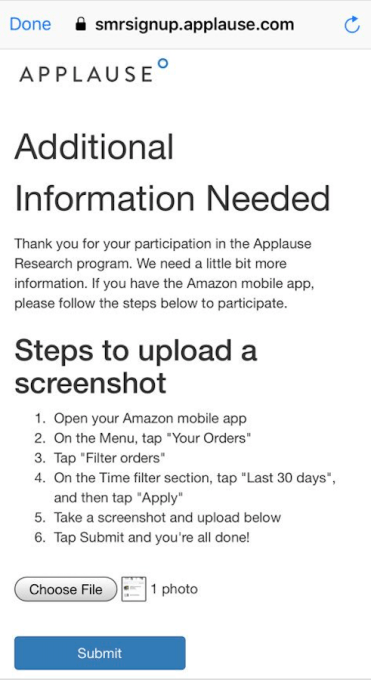
Facebook’s Research program requested users screenshot their Amazon order history to provide it with purchase data

However, Facebook’s claim that it doesn’t violate Apple’s Enterprise Certificate policy is directly contradicted by the terms of that policy. Those include that developers “Distribute Provisioning Profiles only to Your Employees and only in conjunction with Your Internal Use Applications for the purpose of developing and testing”. The policy also states that “You may not use, distribute or otherwise make Your Internal Use Applications available to Your Customers” unless under direct supervision of employees or on company premises. Given Facebook’s customers are using the Enterprise Certificate-powered app without supervision, it appears Facebook is in violation.

Seven hours after this report was first published, Facebook updated its position and told TechCrunch that it would shut down the iOS Research app. Facebook noted that the Research app was started in 2016 and was therefore not a replacement for Onavo Protect. However, they do share similar code and could be seen as twins running in parallel. A Facebook spokesperson also provided this additional statement:

“Key facts about this market research program are being ignored. Despite early reports, there was nothing ‘secret’ about this; it was literally called the Facebook Research App. It wasn’t ‘spying’ as all of the people who signed up to participate went through a clear on-boarding process asking for their permission and were paid to participate. Finally, less than 5 percent of the people who chose to participate in this market research program were teens. All of them with signed parental consent forms.”

Facebook did not publicly promote the Research VPN itself and used intermediaries that often didn’t disclose Facebook’s involvement until users had begun the signup process. While users were given clear instructions and warnings, the program never stresses nor mentions the full extent of the data Facebook can collect through the VPN. A small fraction of the users paid may have been teens, but we stand by the newsworthiness of its choice not to exclude minors from this data collection initiative.

Facebook disobeying Apple so directly and then pulling the app could hurt their relationship. “The code in this iOS app strongly indicates that it is simply a poorly re-branded build of the banned Onavo app, now using an Enterprise Certificate owned by Facebook in direct violation of Apple’s rules, allowing Facebook to distribute this app without Apple review to as many users as they want,” Strafach tells us. ONV prefixes and mentions of graph.onavo.com, “onavoApp://” and “onavoProtect://” custom URL schemes litter the app. “This is an egregious violation on many fronts, and I hope that Apple will act expeditiously in revoking the signing certificate to render the app inoperable.”

Facebook is particularly interested in what teens do on their phones as the demographic has increasingly abandoned the social network in favor of Snapchat, YouTube and Facebook’s acquisition Instagram. Insights into how popular with teens is Chinese video music app TikTok and meme sharing led Facebook to launch a clone called Lasso and begin developing a meme-browsing feature called LOL, TechCrunch first reported. But Facebook’s desire for data about teens riles critics at a time when the company has been battered in the press. Analysts on tomorrow’s Facebook earnings call should inquire about what other ways the company has to collect competitive intelligence now that it’s ceased to run the Research program on iOS.

Last year when Tim Cook was asked what he’d do in Mark Zuckerberg’s position in the wake of the Cambridge Analytica scandal, he said “I wouldn’t be in this situation . . . The truth is we could make a ton of money if we monetized our customer, if our customer was our product. We’ve elected not to do that.” Zuckerberg told Ezra Klein that he felt Cook’s comment was “extremely glib.”

Now it’s clear that even after Apple’s warnings and the removal of Onavo Protect, Facebook was still aggressively collecting data on its competitors via Apple’s iOS platform. “I have never seen such open and flagrant defiance of Apple’s rules by an App Store developer,” Strafach concluded. Now that Facebook has ceased the program on iOS and its Android future is uncertain, it may either have to invent new ways to surveil our behavior amidst a climate of privacy scrutiny, or be left in the dark.

Additional reporting by Zack Whittaker. Updated with comment from Facebook, and on Wednesday with a statement from Apple. 

Source: https://techcrunch.com/2019/01/29/facebook-project-atlas/

As of 4/2018 smartphone users upgraded their phone every 35 months (on average)

The Silver Lining in Apple’s Very Bad iPhone News

David Paul Morris/Bloomberg/Getty Images

Apple on Wednesday warned investors that its revenue for the last three months of 2018 would not live up to previous estimates, or even come particularly close. The main culprit appears to be China, where the trade war and a broader economic slowdown contributed to plummeting iPhone sales. But CEO Tim Cook’s letter to investors pointed to a secondary thread as well, one that Apple customers, environmentalists, and even the company itself should view not as a liability but an asset: People are holding onto their iPhones longer.

That’s not just in China. Cook noted that iPhone upgrades were “not as strong as we thought they would be” in developed markets as well, citing “macroeconomic conditions,” a shift in how carriers price smartphones, a strong US dollar, and temporarily discounted battery replacements. He neglected to mention the simple fact that an iPhone can perform capably for years—and consumers are finally getting wise.

As recently as 2015, smartphone users on average upgraded their phone roughly every 24 months, says Cliff Maldonado, founder of BayStreet Research, which tracks the mobile industry. As of the fourth quarter of last year, that had jumped to at least 35 months. “You’re looking at people holding onto their devices an extra year,” Maldonado says. “It’s been considerable.”

A few factors contribute to the trend, chief among them the shift from buying phones on a two-year contract—heavily subsidized by the carriers—to installment plans in which the customer pays full freight. T-Mobile introduced the practice in the US in 2014, and by 2015 it had become the norm. The full effects, though, have only kicked in more recently. People still generally pay for their smartphone over two years; once they’re paid off, though, their monthly bill suddenly drops by, say, $25.

The shift has also caused a sharp drop-off in carrier incentives. They turn out not to be worth it. “They’re actually encouraging that dynamic of holding your smartphone longer. It’s in their best interest,” Maldonado says. “It actually costs them to get you into a new phone, to do those promotions, to run the transaction and put it on their books and finance it.”

Bottom line: If your service is reliable and your iPhone still works fine, why go through the hassle?

“There’s not as many subsidies as there used to be from a carrier point of view,” Cook told CNBC Wednesday. “And where that didn’t all happen yesterday, if you’ve been out of the market for two or three years and you come back, it looks like that to you.”

Meanwhile, older iPhones work better, for longer, thanks to Apple itself. When Apple vice president Craig Federighi introduced iOS 12 in June at Apple’s Worldwide Developers Conference, he emphasized how much it improved the performance of older devices. Among the numbers he cited: The 2014 iPhone 6 Plus opens apps 40 percent faster with iOS 12 than it had with iOS 11, and its keyboard appears up to 50 percent faster than before. And while Apple’s battery scandal of a year ago was a black mark for the company, it at least reminded Apple owners that they didn’t necessarily need a new iPhone. Eligible iPhone owners found that a $29 battery replacement—it normally costs $79—made their iPhone 6 feel something close to new.

“There definitely has been a major shift in customer perception, after all the controversy,” says Kyle Wiens, founder of online repair community iFixit. “What it really did more than anything else was remind you that the battery on your phone really can be replaced. Apple successfully brainwashing the public into thinking the battery was something they never needed to think about led people to prematurely buy these devices.”

Combine all of that with the fact that new model iPhones—and Android phones for that matter—have lacked a killer feature, much less one that would inspire someone to spend $1,000 or more if they didn’t absolutely have to. “Phones used to be toys, and shiny objects,” Maldonado says. “Now they’re utilities. You’ve got to have it, and the joy of getting a new one is pretty minor. Facebook and email looks the same; the camera’s still great.”

In the near term, these dynamics aren’t ideal for Apple; its stock dropped more than 7 percent in after-hours trading following Wednesday’s news. But it’s terrific news for consumers, who have apparently realized that a smartphone does not have a two-year expiration date. That saves money in the long run. And pulling the throttle back on iPhone sales may turn out to be equally welcome news for the planet.

According to Apple’s most recent sustainability report, the manufacture of each Apple device generates on average 90 pounds of carbon emissions. Wiens suggests that the creation of each iPhone requires hundreds of pounds of raw materials.

Manufacturing electronics is environmentally intense, Wiens says. “We can’t live in a world where we’re making 3 billion new smartphones a year. We don’t have the resources for it. We have to reduce how many overall devices we’re making. There are lots of ways to do it, but it gets down to demand, and how many we’re buying. That’s not what Apple wants, but it’s what the environment needs.”

Which raises a question: Why does Apple bother extending the lives of older iPhones? The altruistic answer comes from Lisa Jackson, who oversees the company’s environmental efforts.

“We also make sure to design and build durable products that last as long as possible,” Jackson said at Apple’s September hardware event. “Because they last longer, you can keep using them. And keeping using them is the best thing for the planet.”

Given a long enough horizon, Apple may see a financial benefit from less frequent upgrades as well. An iPhone that lasts longer keeps customers in the iOS ecosystem longer. That becomes even more important as the company places greater emphasis not on hardware but on services like Apple Music. It also offers an important point of differentiation from Android, whose fragmented ecosystem means even flagship devices rarely continue to be fully supported beyond two years.

“In reality, the big picture is still very good for Apple,” Maldonado says. Compared with Android, “Apple’s in a better spot, because the phones last longer.”

That’s cold comfort today and doesn’t help a whit with China. But news that people are holding onto their iPhones longer should be taken for what it really is: A sign of progress and a win for everyone. Even Apple.

Source: https://www.wired.com/story/silver-lining-apples-very-bad-iphone-news/

‘I Don’t Really Want to Work for Facebook.’ So Say Some Computer Science Students.

Surprisingly a number of students and generation Y digital natives turn against social media giants.

Computer Science Students.

Image
The Cal Hacks 5.0 competition drew students to the University of California, Berkeley, including, from left, Haitao Zhang, Ingrid Wu and Emily Hu, all students at Berkeley. Some students at the hackathon expressed a reluctance to work for big tech firms.CreditCreditMax Whittaker for The New York Times

BERKELEY, Calif. — A job at Facebook sounds pretty plum. The interns make around $8,000 a month, and an entry-level software engineer makes about $140,000 a year. The food is free. There’s a walking trail with indigenous plants and a juice bar.

But the tone among highly sought-after computer scientists about the social network is changing. On a recent night at the University of California, Berkeley, as a group of young engineers gathered to show off their tech skills, many said they would avoid taking jobs at the social network.

“I’ve heard a lot of employees who work there don’t even use it,” said Niky Arora, 19, an engineering student, who was recently invited to a Facebook recruiting event at the company’s headquarters in Menlo Park, Calif. “I just don’t believe in the product because like, Facebook, the baseline of everything they do is desire to show people more ads.”

Emily Zhong, 20, a computer science major, piped up. “Surprisingly, a lot of my friends now are like, ‘I don’t really want to work for Facebook,’” she said, citing “privacy stuff, fake news, personal data, all of it.”

“Before it was this glorious, magical thing to work there,” said Jazz Singh, 18, also studying computer science. “Now it’s like, just because it does what you want doesn’t mean it’s doing good.”

As Facebook has been rocked by scandal after scandal, some young engineers are souring on the company. Many are still taking jobs there, but those who do are doing it a little more quietly, telling their friends that they will work to change it from within or that they have carved out more ethical work at a company whose reputation has turned toxic.

Facebook, which employs more than 30,000 full-time workers around the world, said, “In 2018, we’ve hired more engineers than ever before.” The company added, “We continue to see strong engagement and excitement within the engineering community at the prospect of joining our company.”

Image
Niky Arora, 19, a student at Berkeley, said she was skeptical about working for Facebook, which invited her to a recruiting event recently. “I’ve heard a lot of employees who work there don’t even use it,” she said.CreditMax Whittaker for The New York Times

The changing attitudes are happening beyond Facebook. Across Silicon Valley, tech recruiters said job applicants in general were asking more hard questions during interviews, wanting to know specifically what they would be asked to do at the company. Career coaches said they had tech employees reaching out to get tips on handling moral quandaries. The questions include “How do I avoid a project I disagree with?” and “How do I remind my bosses of the company mission statement?”

“Employees are wising up to the fact that you can have a mission statement on your website, but when you’re looking at how the company creates new products or makes decisions, the correlation between the two is not so tightly aligned,” said David Chie, the head of Palo Alto Staffing, a tech job placement service in Silicon Valley. “Everyone’s having this conversation.”

When engineers apply for jobs, they are also doing it differently.

“They do a lot more due diligence,” said Heather Johnston, Bay Area district president for the tech job staffing agency Robert Half. “Before, candidates were like: ‘Oh, I don’t want to do team interviews. I want a one-and-done.’” Now, she added, job candidates “want to meet the team.”

“They’re not just going to blindly take a company because of the name anymore,” she said.

Yet while many of the big tech companies have been hit by a change in public perception, Facebook seems uniquely tarred among young workers.

“I’ve had a couple of clients recently say they’re not as enthusiastic about Facebook because they’re frustrated with what they see happening politically or socially,” said Paul Freiberger, president of Shimmering Careers, a career counseling group based in San Mateo, Calif. “It’s privacy and political news, and concern that it’s going to be hard to correct these things from inside.”

Chad Herst, a leadership and career coach based in San Francisco since 2008, said that now, for the first time, he had clients who wanted to avoid working for big social media companies like Facebook or Twitter.

“They’re concerned about where democracy is going, that social media polarizes us, and they don’t want to be building it,” Mr. Herst said. “People really have been thinking about the mission of the company and what the companies are trying to achieve a little more.”

He said one client, a midlevel executive at Facebook, wanted advice on how to shift her group’s work to encourage users to connect offline as well. But she found resistance internally to her efforts.

“She was trying to figure out: ‘How do I politic this? How do I language this?’” Mr. Herst said. “And I was telling her to bring up some of Mark Zuckerberg’s past statements about connecting people.”

On the recent evening at the University of California, Berkeley, around 2,200 engineering students from around the country gathered for Cal Hacks 5.0 — a competition to build the best apps. The event spanned a weekend, so teenage competitors dragged pillows around with them. The hosts handed out 2,000 burritos as students registered.

It was also a hiring event. Recruiters from Facebook and Alphabet set up booths (free sunglasses from Facebook; $200 in credit to the Google Cloud platform from Alphabet).

In the auditorium, the head of Y Combinator, a start-up incubator and investment firm, gave opening remarks, recommending that young people avoid jobs in big tech.

“You get to program your life on a totally different scale,” said Michael Seibel, who leads Y Combinator. “The worst thing that can happen to you is you get a job at Google.” He called those jobs “$100,000-a-year welfare” — meaning, he said, that workers can get tethered to the paycheck and avoid taking risks.

The event then segued to a word from the sponsor, Microsoft. Justin Garrett, a Microsoft recruiter who on his LinkedIn profile calls himself a senior technical evangelist, stepped onstage, laughing a little.

“So, Michael’s a tough guy to follow, especially when you work for one of those big companies,” Mr. Garrett said. “He called it welfare. I like to call it tremendous opportunity.”

Then students flooded into the stadium, which was filled with long tables of computers where they would stay and compete. In the middle of the scrum, three friends joked around. Caleb Thomas, 21, was gently made fun of because he had accepted an internship at Facebook.

“Come on, guys,” Mr. Thomas said.

“These are the realities of how the business works,” said Samuel Resendez, 20, a computer science student at the University of Southern California.

It turned out Mr. Resendez had interned at Facebook in the summer. Olivia Brown, 20, head of Stanford’s Computer Science and Social Good club and an iOS intern at Mozilla, called him out on it. “But you still worked at Facebook, too,” she said.

“Well, at least I signed before Cambridge Analytica,” Mr. Resendez said, a little bashful about the data privacy and election manipulation scandal that rocked the company this year. “Ninety-five percent of what Facebook is doing is delivering memes.”

Ms. Brown said a lot of students criticize Facebook and talk about how they would not work there, but ultimately join. “Everyone cares about ethics in tech before they get a contract,” she said.

Ms. Brown said she thought that could change soon, though, as the social stigma of working for Facebook began outweighing the financial benefits.

“Defense companies have had this reputation for a long time,” she said. “Social networks are just getting that.”

Source: https://www.nytimes.com/2018/11/15/technology/jobs-facebook-computer-science-students.html

resting and vesting — showing up to Facebook and barely working to collect a $450 million payday

Jan Koum 5The WhatsApp cofounder Jan Koum.Reuters

  • Back in April, the WhatsApp cofounder Jan Koum announced plans to leave Facebook.
  • But he’s still showing up to the office once a month so he can continue to collect $450 million in Facebook stock he’s contractually due from when Facebook bought his company.
  • It’s a high-dollar example of „rest and vest,“ in which big tech companies pay senior employees who don’t do much work.
  • Koum has already sold over $7 billion in Facebook stock.

The WhatsApp cofounder Jan Koum said in April that he planned to leave Facebook, which bought his company for $19 billion in 2014. He’s already sold $7.1 billion worth of Facebook shares.

But he’s still showing up to the office, The Wall Street Journal reports, to collect one last payday: $450 million in stock.

Koum is resting and vesting, in Silicon Valley lingo, a state that often refers to wealthy entrepreneurs and engineers with one foot out the door at big tech companies who are allowed to continue to be officially employed until they’re able to collect stock and options in quarterly or annual increments.

Usually, stock awards after a merger are distributed on a four-year vesting cliff — if you last all four years, you get your entire stock grant. Koum’s last vesting date is November. He showed up at Facebook’s offices in mid-July, fulfilling a requirement of his employment contract, according to The Wall Street Journal.

„Resting and vesting“ is an open secret in Silicon Valley, Business Insider has reported. At some companies, the employees are called „coasters.“ The HBO show „Silicon Valley“ even spoofed it in an episode in which engineers hang out on a roof and don’t do any work.

„I’ve actually had a number of people, including today at Google X … send me pictures of themselves on a roof, kicking back doing nothing, with the hashtag ‚unassigned‘ or ‚rest and vest.‘ It’s something that really happens, and apparently, somewhat often,“ Josh Brener, the actor who plays the lucky character who got to rest and vest in HBO’s „Silicon Valley,“ told Business Insider last year.

From Business Insider’s report on the phenomenon:

„Facebook, for instance, has a fairly hush bonus program called ‚discretionary equity,‘ a former Facebook engineer who received it said.

„DE is when the company hands an engineer a massive, extra chunk of restricted stock units, worth tens to hundreds of thousands of dollars. It’s a thank-you for a job well done. It also helps keep the person from jumping ship because DE vests over time. These are bonus grants that are signed by top executives, sometimes even CEO Mark Zuckerberg.“

Koum’s payday isn’t related to discretionary equity; it’s instead a result of the over 20 million restricted shares of Facebook he received when he sold WhatsApp. He has one more vesting day in August and one in November, according to filings with the Securities and Exchange Commission.

Koum reportedly decided to leave Facebook in the middle of a spat over how to integrate advertising into WhatsApp. A WhatsApp representative declined to comment, but The Journal reports that Koum is still employed at the social-networking giant.

When Koum left, he wrote that he was taking time off to collect „rare air-cooled Porsches“ and play ultimate Frisbee.

How many Porsches can one buy with $450 million?


http://uk.businessinsider.com/whatsapp-founder-jan-koum-rest-and-vest-for-450-million-facebook-stock-2018-8?r=US&IR=T

June 2018 Tech News & Trends to Watch

1. Companies Worldwide Strive for GDPR Compliance

By now, everyone with an email address has seen a slew of emails announcing privacy policy updates. You have Europe’s GDPR legislation to thank for your overcrowded inbox. GDPR creates rules around how much data companies are allowed to collect, how they’re able to use that data, and how clear they have to be with consumers about it all.

Companies around the world are scrambling to get their business and its practices into compliance – a significant task for many of them. While technically, the deadline to get everything in order passed on May 25, for many companies the process will continue well into June and possibly beyond. Some companies are even shutting down in Europe for good, or for as long as it takes them to get in compliance.

Even with the deadline behind us, the GDPR continues to be a top story for the tech world and may remain so for some time to come.


2. Amazon Provides Facial Recognition Tech to Law Enforcement

Amazon can’t seem to go a whole month without showing up in a tech news roundup. This month it’s for a controversial story: selling use of Rekognition, their facial recognition software, to law enforcement agencies on the cheap.

Civil rights groups have called for the company to stop allowing law enforcement access to the tech out of concerns that increased government surveillance can pose a threat to vulnerable communities in the country. In spite of the public criticism, Amazon hasn’t backed off on providing the tech to authorities, at least as of this time.


3. Apple Looks Into Self-Driving Employee Shuttles

Of the many problems facing our world, the frustrating work commute is one that many of the brightest minds in tech deal with just like the rest of us. Which makes it a problem the biggest tech companies have a strong incentive to try to solve.

Apple is one of many companies that’s invested in developing self-driving cars as a possible solution, but while that goal is still (probably) years away, they’ve narrowed their focus to teaming up with VW to create self-driving shuttles just for their employees.  Even that project is moving slower than the company had hoped, but they’re aiming to have some shuttles ready by the end of the year.


4. Court Weighs in on President’s Tendency to Block Critics on Twitter

Three years ago no one would have imagined that Twitter would be a president’s go-to source for making announcements, but today it’s used to that effect more frequently than official press conferences or briefings.

In a court battle that may sound surreal to many of us, a judge just found that the president can no longer legally block other users on Twitter.  The court asserted that blocking users on a public forum like Twitter amounts to a violation of their First Amendment rights. The judgment does still allow for the president and other public officials to mute users they don’t agree with, though.


5. YouTube Launches Music Streaming Service

YouTube joined the ranks of Spotify, Pandora, and Amazon this past month with their own streaming music service. Consumers can use a free version of the service that includes ads, or can pay $9.99 for the ad-free version.

youtube music service

With so many similar services already on the market, people weren’t exactly clamoring for another music streaming option. But since YouTube is likely to remain the reigning source for videos, it doesn’t necessarily need to unseat Spotify to still be okay. And with access to Google’s extensive user data, it may be able to provide more useful recommendations than its main competitors in the space, which is one way the service could differentiate itself.


6. Facebook Institutes Political Ad Rules

Facebook hasn’t yet left behind the controversies of the last election. The company is still working to proactively respond to criticism of its role in the spread of political propaganda many believe influenced election results. One of the solutions they’re trying is a new set of rules for any political ads run on the platform.

Any campaign that intends to run Facebook ads is now required to verify their identity with a card Facebook mails to their address that has a verification code. While Facebook has been promoting these new rules for a few weeks to politicians active on the platform, some felt blindsided when they realized, right before their primaries no less, that they could no longer place ads without waiting 12 to 15 days for a verification code to come in the mail. Politicians in this position blame the company for making a change that could affect their chances in the upcoming election.

Even in their efforts to avoid swaying elections, Facebook has found themselves criticized for doing just that. They’re probably feeling at this point like they just can’t win.


7. Another Big Month for Tech IPOs

This year has seen one tech IPO after another and this month is no different. Chinese smartphone company Xiaomi has a particularly large IPO in the works. The company seeks to join the Hong Kong stock exchange on June 7 with an initial public offering that experts anticipate could reach $10 billion.

The online lending platform Greensky started trading on the New York Stock Exchange on May 23 and sold 38 million shares in its first day, 4 million more than expected. This month continues 2018’s trend of tech companies going public, largely to great success.


8. StumbleUpon Shuts Down

In the internet’s ongoing evolution, there will always be tech companies that win and those that fall by the wayside. StumbleUpon, a content discovery platform that had its heyday in the early aughts, is officially shutting down on June 30.

Since its 2002 launch, the service has helped over 40 million users “stumble upon” 60 billion new websites and pieces of content. The company behind StumbleUpon plans to create a new platform that serves a similar purpose that may be more useful to former StumbleUpon users called Mix.


9. Uber and Lyft Invest in Driver Benefits

In spite of their ongoing success, the popular ridesharing platforms Uber and Lyft have faced their share of criticism since they came onto the scene. One of the common complaints critics have made is that the companies don’t provide proper benefits to their drivers. And in fact, the companies have fought to keep drivers classified legally as contractors so they’re off the hook for covering the cost of employee taxes and benefits.

Recently both companies have taken steps to make driving for them a little more attractive. Uber has begun offering Partner Protection to its drivers in Europe, which includes health insurance, sick pay, and parental leave ­ ­– so far nothing similar in the U.S. though. For its part, Lyft is investing $100 million in building driver support centers where their drivers can stop to get discounted car maintenance, tax help, and customer support help in person from Lyft staff. It’s not the same as getting full employee benefits (in the U.S. at least), but it’s something.

Source: https://www.hostgator.com/blog/june-tech-trends-to-watch/

Hey Alexa, What Are You Doing to My Kid’s Brain?

“Unless your parents purge it, your Alexa will hold on to every bit of data you have ever given it, all the way back to the first things you shouted at it as a 2-year-old.”

Among the more modern anxieties of parents today is how virtual assistants will train their children to act. The fear is that kids who habitually order Amazon’s Alexa to read them a story or command Google’s Assistant to tell them a joke are learning to communicate not as polite, considerate citizens, but as demanding little twerps.

This worry has become so widespread that Amazon and Google both announced this week that their voice assistants can now encourage kids to punctuate their requests with „please.“ The version of Alexa that inhabits the new Echo Dot Kids Edition will thank children for „asking so nicely.“ Google Assistant’s forthcoming Pretty Please feature will remind kids to „say the magic word“ before complying with their wishes.

But many psychologists think kids being polite to virtual assistants is less of an issue than parents think—and may even be a red herring. As virtual assistants become increasingly capable, conversational, and prevalent (assistant-embodied devices are forecasted to outnumber humans), psychologists and ethicists are asking deeper, more subtle questions than will Alexa make my kid bossy. And they want parents to do the same.

„When I built my first virtual child, I got a lot of pushback and flak,“ recalls developmental psychologist Justine Cassell, director emeritus of Carnegie Mellon’s Human-Computer Interaction Institute and an expert in the development of AI interfaces for children. It was the early aughts, and Cassell, then at MIT, was studying whether a life-sized, animated kid named Sam could help flesh-and-blood children hone their cognitive, social, and behavioral skills. „Critics worried that the kids would lose track of what was real and what was pretend,“ Cassel says. „That they’d no longer be able to tell the difference between virtual children and actual ones.“

But when you asked the kids whether Sam was a real child, they’d roll their eyes. Of course Sam isn’t real, they’d say. There was zero ambiguity.

Nobody knows for sure, and Cassel emphasizes that the question deserves study, but she suspects today’s children will grow up similarly attuned to the virtual nature of our device-dwelling digital sidekicks—and, by extension, the context in which they do or do not need to be polite. Kids excel, she says, at dividing the world into categories. As long as they continue to separate humans from machines, she says, there’s no need to worry. „Because isn’t that actually what we want children to learn—not that everything that has a voice should be thanked, but that people have feelings?“

Point taken. But what about Duplex, I ask, Google’s new human-sounding, phone calling AI? Well, Cassell says, that complicates matters. When you can’t tell if a voice belongs to a human or a machine, she says, perhaps it’s best to assume you’re talking to a person, to avoid hurting a human’s feelings. But the real issue there isn’t politeness, it’s disclosure; artificial intelligences should be designed to identify themselves as such.

What’s more, the implications of a kid interacting with an AI extend far deeper than whether she recognizes it as non-human. „Of course parents worry about these devices reinforcing negative behaviors, whether it’s being sassy or teasing a virtual assistant,” says Jenny Radesky, a developmental behavioral pediatrician at the University of Michigan and co-author of the latest guidelines for media use from the American Academy of Pediatrics. “But I think there are bigger questions surrounding things like kids’ cognitive development—the way they consume information and build knowledge.”

Consider, for example, that the way kids interact with virtual assistants may not actual help them learn. This advertisement for the Echo Dot Kids Edition ends with a girl asking her smart speaker the distance to the Andromeda Galaxy. As the camera zooms out, we hear Alexa rattle off the answer: „The Andromeda Galaxy is 14 quintillion, 931 quadrillion, 389 trillion, 517 billion, 400 million miles away“:

To parents it might register as a neat feature. Alexa knows answers to questions that you don’t! But most kids don’t learn by simply receiving information. „Learning happens happens when a child is challenged,“ Cassell says, „by a parent, by another child, a teacher—and they can argue back and forth.“

Virtual assistants can’t do that yet, which highlights the importance of parents using smart devices with their kids. At least for the time being. Our digital butlers could be capable of brain-building banter sooner than you think.

This week, Google announced its smart speakers will remain activated several seconds after you issue a command, allowing you to engage in continuous conversation without repeating „Hey, Google,“ or „OK, Google.“ For now, the feature will allow your virtual assistant to keep track of contextually dependent follow-up questions. (If you ask what movies George Clooney has starred in and then ask how tall he his, Google Assistant will recognize that „he“ is in reference to George Clooney.) It’s a far cry from a dialectic exchange, but it charts a clear path toward more conversational forms of inquiry and learning.

And, perhaps, something even more. „I think it’s reasonable to ask if parenting will become a skill that, like Go or chess, is better performed by a machine,“ says John Havens, executive director of the the IEEE Global Initiative on Ethics of Autonomous and Intelligent Systems. „What do we do if a kid starts saying: Look, I appreciate the parents in my house, because they put me on the map, biologically. But dad tells a lot of lame dad jokes. And mom is kind of a helicopter parent. And I really prefer the knowledge, wisdom, and insight given to me by my devices.

Havens jokes that he sounds paranoid, because he’s speculating about what-if scenarios from the future. But what about the more near-term? If you start handing duties over to the machine, how do you take them back the day your kid decides Alexa is a higher authority than you are on, say, trigonometry?

Other experts I spoke with agreed it’s not too early for parents to begin thinking deeply about the long-term implications of raising kids in the company of virtual assistants. „I think these tools can be awesome, and provide quick fixes to situations that involve answering questions and telling stories that parents might not always have time for,“ Radesky says. „But I also want parents to consider how that might come to displace some of the experiences they enjoy sharing with kids.“

Other things Radesky, Cassell, and Havens think parents should consider? The extent to which kids understand privacy issues related to internet-connected toys. How their children interact with devices at their friends‘ houses. And what information other family’s devices should be permitted to collect about their kids. In other words: How do children conceptualize the algorithms that serve up facts and entertainment; learn about them; and potentially profit from them?

„The fact is, very few of us sit down and talk with our kids about the social constructs surrounding robots and virtual assistants,“ Radesky says.

Perhaps that—more than whether their children says „please“ and „thank you“ to the smart speaker in the living room—is what parents should be thinking about.

Source:
https://www.wired.com/story/hey-alexa-what-are-you-doing-to-my-kids-brain/

Lawmakers, child development experts, and privacy advocates are expressing concerns about two new Amazon products targeting children, questioning whether they prod kids to be too dependent on technology and potentially jeopardize their privacy.

In a letter to Amazon CEO Jeff Bezos on Friday, two members of the bipartisan Congressional Privacy Caucus raised concerns about Amazon’s smart speaker Echo Dot Kids and a companion service called FreeTime Unlimited that lets kids access a children’s version of Alexa, Amazon’s voice-controlled digital assistant.

“While these types of artificial intelligence and voice recognition technology offer potentially new educational and entertainment opportunities, Americans’ privacy, particularly children’s privacy, must be paramount,” wrote Senator Ed Markey (D-Massachusetts) and Representative Joe Barton (R-Texas), both cofounders of the privacy caucus.

The letter includes a dozen questions, including requests for details about how audio of children’s interactions is recorded and saved, parental control over deleting recordings, a list of third parties with access to the data, whether data will be used for marketing purposes, and Amazon’s intentions on maintaining a profile on kids who use these products.

In a statement, Amazon said it „takes privacy and security seriously.“ The company said „Echo Dot Kids Edition uses on-device software to detect the wake word and only the wake word. Only once the wake word is detected does it start streaming to the cloud, and it will present a visual indication (the light ring at the top of the device turns blue) to show that it is streaming to the cloud.“

Echo Dot Kids is the latest in a wave of products from dominant tech players targeting children, including Facebook’s communications app Messenger Kids and Google’s YouTube Kids, both of which have been criticized by child health experts concerned about privacy and developmental issues.

Like Amazon, toy manufacturers are also interested in developing smart speakers that would live in a child’s room. In September, Mattel pulled Aristotle, a smart speaker and digital assistant aimed at children, after a similar letter from Markey and Barton, as well as a petition that garnered more than 15,000 signatures.

One of the organizers of the petition, the nonprofit group Campaign for a Commercial Free Childhood, is now spearheading a similar effort against Amazon. In a press release Friday, timed to the letter from Congress, a group of child development and privacy advocates urged parents not to purchase Echo Dot Kids because the device and companion voice service pose a threat to children’s privacy and well-being.

“Amazon wants kids to be dependent on its data-gathering device from the moment they wake up until they go to bed at night,” said the group’s executive director Josh Golin. “The Echo Dot Kids is another unnecessary ‘must-have’ gadget, and it’s also potentially harmful. AI devices raise a host of privacy concerns and interfere with the face-to-face interactions and self-driven play that children need to thrive.”

FreeTime on Alexa includes content targeted at children, like kids’ books and Alexa skills from Disney, Nickelodeon, and National Geographic. It also features parental controls, such as song filtering, bedtime limits, disabled voice purchasing, and positive reinforcement for using the word “please.”

Despite such controls, the child health experts warning against Echo Dot Kids wrote, “Ultimately, though, the device is designed to make kids dependent on Alexa for information and entertainment. Amazon even encourages kids to tell the device ‘Alexa, I’m bored,’ to which Alexa will respond with branded games and content.”

In Amazon’s April press release announcing Echo Dot Kids, the company quoted one representative from a nonprofit group focused on children that supported the product, Stephen Balkam, founder and CEO of the Family Online Safety Institute. Balkam referenced a report from his institute, which found that the majority of parents were comfortable with their child using a smart speaker. Although it was not noted in the press release, Amazon is a member of FOSI and has an executive on the board.

In a statement to WIRED, Amazon said, „We believe one of the core benefits of FreeTime and FreeTime Unlimited is that the services provide parents the tools they need to help manage the interactions between their child and Alexa as they see fit.“ Amazon said parents can review and listen to their children’s voice recordings in the Alexa app, review FreeTime Unlimited activity via the Parent Dashboard, set bedtime limits or pause the device whenever they’d like.

Balkam said his institute disclosed Amazon’s funding of its research on its website and the cover of its report. Amazon did not initiate the study. Balkam said the institute annually proposes a research project, and reaches out to its members, a group that also includes Facebook, Google, and Microsoft, who pay an annual stipend of $30,000. “Amazon stepped up and we worked with them. They gave us editorial control and we obviously gave them recognition for the financial support,” he said.

Balkam says Echo Dot Kids addresses concerns from parents about excessive screen time. “It’s screen-less, it’s very interactive, it’s kid friendly,” he said, pointing out Alexa skills that encourage kids to go outside.

In its review of the product, BuzzFeed wrote, “Unless your parents purge it, your Alexa will hold on to every bit of data you have ever given it, all the way back to the first things you shouted at it as a 2-year-old.”

Sources:
https://www.wired.com/story/congress-privacy-groups-question-amazons-echo-dot-for-kids/

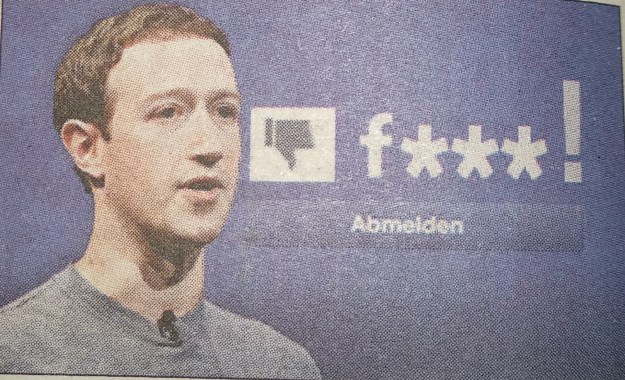
Forget Facebook

Forget Facebook

Photo Credits: oe24.at – Copyrights of oe24.at reserved

Source: Techcrunch.com

Cambridge Analytica may have used Facebook’s data to influence your political opinions. But why does least-liked tech company Facebook have all this data about its users in the first place?

Let’s put aside Instagram, WhatsApp and other Facebook products for a minute. Facebook has built the world’s biggest social network. But that’s not what they sell. You’ve probably heard the internet saying “if a product is free, it means that you are the product.”

And it’s particularly true in this case because Facebook is the world’s second biggest advertising company in the world behind Google. During the last quarter of 2017, Facebook reported $12.97 billion in revenue, including $12.78 billion from ads.

That’s 98.5 percent of Facebook’s revenue coming from ads.

Ads aren’t necessarily a bad thing. But Facebook has reached ad saturation in the newsfeed. So the company has two options — creating new products and ad formats, or optimizing those sponsored posts.

Facebook has reached ad saturation in the newsfeed

This isn’t a zero-sum game — Facebook has been doing both at the same time. That’s why you’re seeing more ads on Instagram and Messenger. And that’s also why ads on Facebook seem more relevant than ever.

If Facebook can show you relevant ads and you end up clicking more often on those ads, then advertisers will pay Facebook more money.

So Facebook has been collecting as much personal data about you as possible — it’s all about showing you the best ad. The company knows your interests, what you buy, where you go and who you’re sleeping with.

You can’t hide from Facebook

Facebook’s terms and conditions are a giant lie. They are purposely misleading, too long and too broad. So you can’t just read the company’s terms of service and understand what it knows about you.

That’s why some people have been downloading their Facebook data. You can do it too, it’s quite easy. Just head over to your Facebook settings and click the tiny link that says “Download a copy of your Facebook data.”

In that archive file, you’ll find your photos, your posts, your events, etc. But if you keep digging, you’ll also find your private messages on Messenger (by default, nothing is encrypted).

And if you keep digging a bit more, chances are you’ll also find your entire address book and even metadata about your SMS messages and phone calls.

All of this is by design and you agreed to it. Facebook has unified terms of service and share user data across all its apps and services (except WhatsApp data in Europe for now). So if you follow a clothing brand on Instagram, you could see an ad from this brand on Facebook.com.

Messaging apps are privacy traps

But Facebook has also been using this trick quite a lot with Messenger. You might not remember, but the on-boarding experience on Messenger is really aggressive.

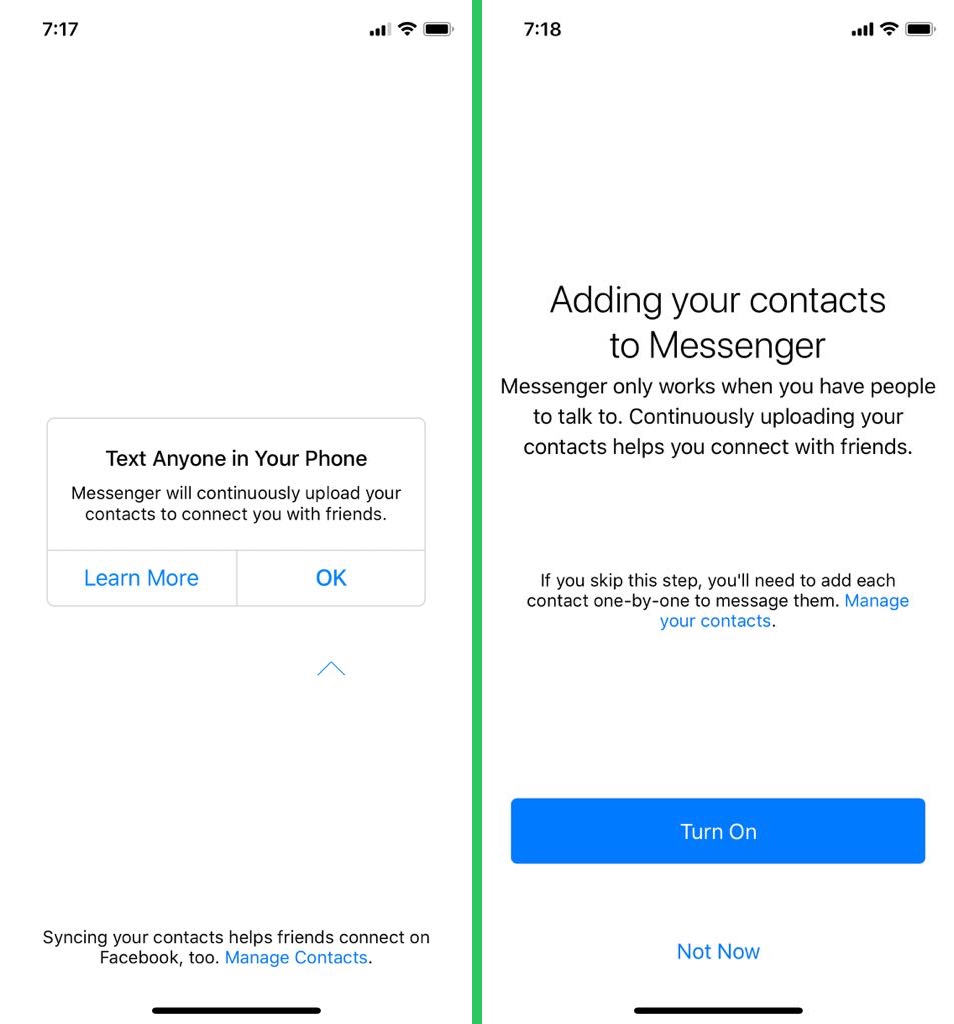
On iOS, the app shows you a fake permission popup to access your address book that says “Ok” or “Learn More”. The company is using a fake popup because you can’t ask for permission twice.

There’s a blinking arrow below the OK button.

If you click on “Learn More”, you get a giant blue button that says “Turn On”. Everything about this screen is misleading and Messenger tries to manipulate your emotions.

“Messenger only works when you have people to talk to,” it says. Nobody wants to be lonely, that’s why Facebook implies that turning on this option will give you friends.

Even worse, it says “if you skip this step, you’ll need to add each contact one-by-one to message them.” This is simply a lie as you can automatically talk to your Facebook friends using Messenger without adding them one-by-one.

The next time you pay for a burrito with your credit card, Facebook will learn about this transaction and match this credit card number with the one you added in Messenger

If you tap on “Not Now”, Messenger will show you a fake notification every now and then to push you to enable contact syncing. If you tap on yes and disable it later, Facebook still keeps all your contacts on its servers.

On Android, you can let Messenger manage your SMS messages. Of course, you guessed it, Facebook uploads all your metadata. Facebook knows who you’re texting, when, how often.

Even if you disable it later, Facebook will keep this data for later reference.

But Facebook doesn’t stop there. The company knows a lot more about you than what you can find in your downloaded archive. The company asks you to share your location with your friends. The company tracks your web history on nearly every website on earth using embedded JavaScript.

But my favorite thing is probably peer-to-peer payments. In some countries, you can pay back your friends using Messenger. It’s free! You just have to add your card to the app.

It turns out that Facebook also buys data about your offline purchases. The next time you pay for a burrito with your credit card, Facebook will learn about this transaction and match this credit card number with the one you added in Messenger.

In other words, Messenger is a great Trojan horse designed to learn everything about you.

And the next time an app asks you to share your address book, there’s a 99-percent chance that this app is going to mine your address book to get new users, spam your friends, improve ad targeting and sell email addresses to marketing companies.

I could say the same thing about all the other permission popups on your phone. Be careful when you install an app from the Play Store or open an app for the first time on iOS. It’s easier to enable something if a feature doesn’t work without it than to find out that Facebook knows everything about you.

GDPR to the rescue

There’s one last hope. And that hope is GDPR. I encourage you to read TechCrunch’s Natasha Lomas excellent explanation of GDPR to understand what the European regulation is all about.

Many of the misleading things that are currently happening at Facebook will have to change. You can’t force people to opt in like in Messenger. Data collection should be minimized to essential features. And Facebook will have to explain why it needs all this data to its users.

If Facebook doesn’t comply, the company will have to pay up to 4 percent of its global annual turnover. But that doesn’t stop you from actively reclaiming your online privacy right now.

You can’t be invisible on the internet, but you have to be conscious about what’s happening behind your back. Every time a company asks you to tap OK, think about what’s behind this popup. You can’t say that nobody told you.

Source: Techcrunch.com

Secure your Privacy – HERE’S WHY YOU SHOULD USE SIGNAL

Source: https://www.wired.com/story/ditch-all-those-other-messaging-apps-heres-why-you-should-use-signal/

STOP ME IF you’ve heard this before. You text a friend to finalize plans, anxiously awaiting their reply, only to get a message from them on Snapchat to say your latest story was hilarious. So, you move the conversation over to Snapchat, decide to meet up at 10:30, but then you close the app and can’t remember if you agreed on meeting at Hannegan’s or that poppin‘ new brewery downtown. You can’t go back and look at the message since Snapchat messages have a short shelf life, so you send a text, but your friend has already proven to be an unreliable texter. You’d be lucky if they got back to you by midnight.

All of this illustrates a plain truth. There are just too many messaging apps. As conversations can bounce between Snapchat, iMessage, Skype, Instagram, Twitter, and Hangouts/Allo or whatever Google’s latest attempt at messaging is, they’re rendered confusing and unsearchable. We could stick to SMS, but it’s pretty limited compared to other options, and it has some security holes. Rather than just chugging along with a dozen chat apps, letting your notifications pile up, it’s time to pick one messaging app and get all of your friends on board. That way, everyone can just pick up their phones and shoot a message to anyone without hesitation.

Here comes the easy part. There’s one messaging app we should all be using: Signal. It has strong encryption, it’s free, it works on every mobile platform, and the developers are committed to keeping it simple and fast by not mucking up the experience with ads, web-tracking, stickers, or animated poop emoji.

Tales From the Crypto

Signal looks and works a lot like other basic messaging apps, so it’s easy to get started. It’s especially convenient if you have friends and family overseas because, like iMessage and WhatsApp, Signal lets you sidestep expensive international SMS fees. It also supports voice and video calls, so you can cut out Skype and FaceTime. Sure, you don’t get fancy stickers or games like some of the competition, but you can still send pictures, videos, and documents. It’s available on iOS, Android, and desktop.

But plenty of apps have all that stuff. The thing that actually makes Signal superior is that it’s easy to ensure that the contents of every chat remain private and unable to be read by anyone else. As long as both parties are using the app to message each other, every single message sent with Signal is encrypted. Also, the encryption Signal uses is available under an open-source license, so experts have had the chance to test and poke the app to make sure it stays as secure as what’s intended.

If you’re super concerned about messages being read by the wrong eyes, Signal lets you force individual conversations to delete themselves after a designated amount of time. Signal’s security doesn’t stop at texts. All of your calls are encrypted, so nobody can listen in. Even if you have nothing to hide, it’s nice to know that your private life is kept, you know, private.

WhatAbout WhatsApp

Yes, this list of features sounds a lot like WhatsApp. It’s true, the Facebook-owned messaging app has over a billion users, offers most of the same features, and even employs Signal’s encryption to keep chats private. But WhatsApp raises a few concerns that Signal doesn’t. First, it’s owned by Facebook, a company whose primary interest is in collecting information about you to sell you ads. That alone may steer away those who feel Facebook already knows too much about us. Even though the content of your WhatsApp messages are encrypted, Facebook can still extract metadata from your habits, like who you’re talking to and how frequently.

Still, if you use WhatsApp, chances are you already know a lot of other people who are using it. Getting all of them to switch to Signal is highly unlikely. And you know, that’s OK—WhatsApp really is the next-best option to Signal. The encryption is just as strong, and while it isn’t as cleanly stripped of extraneous features as Signal, that massive user base makes it easy to reach almost anyone in your contact list.

Chat Heads

While we’re talking about Facebook, it’s worth noting that the company’s Messenger app isn’t the safest place to keep your conversations. Aside from all the clutter inside the app, the two biggest issues with Facebook Messenger are that you have to encrypt conversations individually by flipping on the „Secret Conversations“ option (good luck remembering to do that), and that anyone with a Facebook profile can just search for your name and send you a message. (Yikes!) There are too many variables in the app, and a lot the security is out of your hands. iMessage may seem like a solid remedy to all of these woes, but it’s tucked behind Apple’s walled iOS garden, so you’re bound to leave out your closest friends who use Android devices. And if you ever switch platforms, say bye-bye to your chat history.

Signal isn’t going to win a lot of fans among those who’ve grown used to the more novel features inside their chat apps. There are no stickers, and no animoji. Still, as privacy issues come to the fore in the minds of users, and as mobile messaging options proliferate, and as notifications pile up, everyone will be searching for a path to sanity. It’s easy to invite people to Signal. Once you’re using it, just tap the „invite“ button inside the chat window, and your friend will be sent a link to download the app. Even stubborn people who only send texts can get into it—Signal can be set as your phone’s default SMS client, so the pain involved in the switch is minimal.

So let’s make a pact right now. Let’s all switch to Signal, keep our messages private, and finally put an end to the untenable multi-app shuffle that’s gone on far too long.

Whatsapp spies on your encrypted messages

Exclusive: Privacy campaigners criticise WhatsApp vulnerability as a ‘huge threat to freedom of speech’ and warn it could be exploited by government agencies

Research shows that the company can read messages due to the way WhatsApp has implemented its end-to-end encryption protocol.
Research shows that WhatsApp can read messages due to the way the company has implemented its end-to-end encryption protocol. Photograph: Ritchie B Tongo/EPA

A security backdoor that can be used to allow Facebook and others to intercept and read encrypted messages has been found within its WhatsApp messaging service.

Facebook claims that no one can intercept WhatsApp messages, not even the company and its staff, ensuring privacy for its billion-plus users. But new research shows that the company could in fact read messages due to the way WhatsApphas implemented its end-to-end encryption protocol.

Privacy campaigners said the vulnerability is a “huge threat to freedom of speech” and warned it can be used by government agencies to snoop on users who believe their messages to be secure. WhatsApp has made privacy and security a primary selling point, and has become a go to communications tool of activists, dissidents and diplomats.

WhatsApp’s end-to-end encryption relies on the generation of unique security keys, using the acclaimed Signal protocol, developed by Open Whisper Systems, that are traded and verified between users to guarantee communications are secure and cannot be intercepted by a middleman. However, WhatsApp has the ability to force the generation of new encryption keys for offline users, unbeknown to the sender and recipient of the messages, and to make the sender re-encrypt messages with new keys and send them again for any messages that have not been marked as delivered.

The recipient is not made aware of this change in encryption, while the sender is only notified if they have opted-in to encryption warnings in settings, and only after the messages have been resent. This re-encryption and rebroadcasting effectively allows WhatsApp to intercept and read users’ messages.

The security backdoor was discovered by Tobias Boelter, a cryptography and security researcher at the University of California, Berkeley. He told the Guardian: “If WhatsApp is asked by a government agency to disclose its messaging records, it can effectively grant access due to the change in keys.”

The backdoor is not inherent to the Signal protocol. Open Whisper Systems’ messaging app, Signal, the app used and recommended by whistleblower Edward Snowden, does not suffer from the same vulnerability. If a recipient changes the security key while offline, for instance, a sent message will fail to be delivered and the sender will be notified of the change in security keys without automatically resending the message.

WhatsApp’s implementation automatically resends an undelivered message with a new key without warning the user in advance or giving them the ability to prevent it.

Boelter reported the backdoor vulnerability to Facebook in April 2016, but was told that Facebook was aware of the issue, that it was “expected behaviour” and wasn’t being actively worked on. The Guardian has verified the backdoor still exists.

The WhatsApp vulnerability calls into question the privacy of messages sent across the service used around the world, including by people living in oppressive regimes.
Pinterest
The WhatsApp vulnerability calls into question the privacy of messages sent across the service used around the world, including by people living in oppressive regimes. Photograph: Marcelo Sayão/EPA

Steffen Tor Jensen, head of information security and digital counter-surveillance at the European-Bahraini Organisation for Human Rights, verified Boelter’s findings. He said: “WhatsApp can effectively continue flipping the security keys when devices are offline and re-sending the message, without letting users know of the change till after it has been made, providing an extremely insecure platform.”

Boelter said: “[Some] might say that this vulnerability could only be abused to snoop on ‘single’ targeted messages, not entire conversations. This is not true if you consider that the WhatsApp server can just forward messages without sending the ‘message was received by recipient’ notification (or the double tick), which users might not notice. Using the retransmission vulnerability, the WhatsApp server can then later get a transcript of the whole conversation, not just a single message.”

The vulnerability calls into question the privacy of messages sent across the service, which is used around the world, including by people living in oppressive regimes.

Professor Kirstie Ball, co-director and founder of the Centre for Research into Information, Surveillance and Privacy, called the existence of a backdoor within WhatsApp’s encryption “a gold mine for security agencies” and “a huge betrayal of user trust”. She added: “It is a huge threat to freedom of speech, for it to be able to look at what you’re saying if it wants to. Consumers will say, I’ve got nothing to hide, but you don’t know what information is looked for and what connections are being made.”

In the UK, the recently passed Investigatory Powers Act allows the government to intercept bulk data of users held by private companies, without suspicion of criminal activity, similar to the activity of the US National Security Agency uncovered by the Snowden revelations. The government also has the power to force companies to “maintain technical capabilities” that allow data collection through hacking and interception, and requires companies to remove “electronic protection” from data. Intentional or not, WhatsApp’s backdoor to the end-to-end encryption could be used in such a way to facilitate government interception.

Jim Killock, executive director of Open Rights Group, said: “If companies claim to offer end-to-end encryption, they should come clean if it is found to be compromised – whether through deliberately installed backdoors or security flaws. In the UK, the Investigatory Powers Act means that technical capability notices could be used to compel companies to introduce flaws – which could leave people’s data vulnerable.”

A WhatsApp spokesperson told the Guardian: “Over 1 billion people use WhatsApp today because it is simple, fast, reliable and secure. At WhatsApp, we’ve always believed that people’s conversations should be secure and private. Last year, we gave all our users a better level of security by making every message, photo, video, file and call end-to-end encrypted by default. As we introduce features like end-to-end encryption, we focus on keeping the product simple and take into consideration how it’s used every day around the world.

“In WhatsApp’s implementation of the Signal protocol, we have a “Show Security Notifications” setting (option under Settings > Account > Security) that notifies you when a contact’s security code has changed. We know the most common reasons this happens are because someone has switched phones or reinstalled WhatsApp. This is because in many parts of the world, people frequently change devices and Sim cards. In these situations, we want to make sure people’s messages are delivered, not lost in transit.”

Asked to comment specifically on whether Facebook/WhatApps had accessed users’ messages and whether it had done so at the request of government agencies or other third parties, it directed the Guardian to its site that details aggregate data on government requests by country.

Concerns over the privacy of WhatsApp users has been repeatedly highlighted since Facebook acquired the company for $22bn in 2014. In August 2015, Facebook announced a change to the privacy policy governing WhatsApp that allowed the social network to merge data from WhatsApp users and Facebook, including phone numbers and app usage, for advertising and development purposes.

Facebook halted the use of the shared user data for advertising purposes in November after pressure from the pan-European data protection agency groupArticle 29 Working Party in October. The European commission then filed charges against Facebook for providing “misleading” information in the run-up to the social network’s acquisition of messaging service WhatsApp, following its data-sharing change.

https://www.theguardian.com/technology/2017/jan/13/whatsapp-backdoor-allows-snooping-on-encrypted-messages

How to 10x Your Instagram Marketing

https://i0.wp.com/www.jeffbullas.com/wp-content/uploads/2016/08/How-to-10x-Your-Instagram-Growth-With-Optimization.jpg

There is a question I am asked often.

What social media network should I be using? And guess what? Everyone wants a black and white answer.

The reality?

It is shades of grey. But there is another thing. The goal posts keep moving as the social networks change the rules, the media they offer and their secret algorithms.

It is often confusing and overwhelming.

What all digital marketers need to do

But there is something that is an absolute core tactic for all marketers and entrepreneurs in a digital world.

And many don’t focus on this.

“Growing digital media distribution networks“.

This is one of the 10 commandments of any successful media company. It is also what all brands and digital entrepreneurs should be doing. Because all need to think like publishers.

Without this the content will not get the attention and engagement that it deserves. Without distribution, content is often hidden in the nooks and crannies of the web and is never seen, heard or viewed.

My initial tactic to reach the world with my content and get noticed was to use Twitter.

In the last 7 years I have focused on building a large following and tribe on Twitter and now we are approaching half a million followers.

How important has this been?

It has been the difference between anonymity and high global visibility.

The power of having hundreds of thousands of people being able to share your content for free is what made social media so exciting. It was the key to my success.

Crowd sourced marketing!

This was not available before the rise of the social web. It has been my secret sauce.

New kids on the block

But that was then and there has been a fast evolution of choices. More revolution than evolution. Shiny new social networks. And they are often visual and mobile.

We all know how overwhelming it can be to jump into a new social media platform, considering how rapidly new ones appear, and how competitive they can be. On top of that, to master your new channel – as you’ve probably learned, can be really frustrating if you don’t have a clear guide.

But you have no choice if you want to remain relevant and not end up in the social media backwater.

The Instagram kid

Ever since Facebook acquired Instagram, it’s quickly evolved into something more than just a photo sharing app. And it has over half a billion active users.

With all the noise on Facebook and other social media platforms… Instagram still manages to keep it simple and elegant.

That’s part of why people migrated to Instagram so quick, and use it so regularly – it’s beautiful, fun and engaging.

These deeply engaged users make great customers, if you can captivate them.

And since your website link is in your bio, increasing the number of eyes on your account equates to more website traffic.

So, if you can master how to attract your target audience to your account, it not only leads to increased traffic, but also conversions.

So why do so many people have trouble getting momentum on Instagram?

First, let’s debug one big misconception: You don’t have to set an advertising budget to grow your account. And you don’t need a large budget to do Instagram marketing well…

Where to start:

Study your target market and industry on Instagram.

  • Which accounts do they follow?
  • What hashtags are they using?
  • What are the most popular hashtags in your niche?

Get involved.

  • Join Instagram engagement communities where you exchange comments with each other.

This alone can

10x your engagement rate.

Choose a theme for your Instagram.

  • Pick a specific color palette that matches your brand image
  • Stick to the same type of filter style for every picture.

Next, gain your audience’s attention

I have an intimate understanding of the frustrations with working really hard and long on these channels, and not seeing results.

So I studied the trends and most successful Instagram accounts, and developed a scientific approach to hacking audience growth.

Let’s be clear: Optimizing your Instagram shouldn’t mean you simply put more hours into it.

Liking pictures, following people, unfollowing in a targeted and strategic way can consume hours of every day. It’s tedious, and frankly not a great use of your time.

Whether it’s you, or a social media agency that handles your account, this type of thing should be outsourced.

You and your agency know your brand best and for this reason, content should be your #1 focus.

It’s competitive, seriously.

Instagram is at about 500 million monthly active users and growing. This means you need an aggressive activity strategy to stand out.

Does the task of following and unfollowing hundreds of accounts in a day sound overwhelming? It is. I know because I used to do this manually on Twitter until I discovered how to do it via automation.

So let me show you exactly how to overcome this time-suck with Instagram with what till now has been a little known Instagram growth hacking platform.

Use an Instagram growth hacking service

Finding a reliable service for Instagram growth can be tricky. However, through a friend, I heard about a service that not only saves me a bunch of time, but can growth accounts 10x – in a very real way. Not spammy, not shady.

It essentially puts Instagram to work for me by gaining me real followers in my niche. It worked for me on Twitter so I decided to start testing it.

The results?

In just 7 days I have grown my Instagram account by nearly 1,000 followers using an Instagram growth hacking service. At this run rate I will hit over 55,000 followers in the next 12 months.

>>>> Grab your FREE trial now

It does this by automating the monotonous activity of choosing users to interact and engage, but does so in the most targeted manner.

How do you use it?

Let me introduce SociallyRich

The best part about their Service was that unlike other Instagram services out there, there’s no confusing dashboard to interact with.

You just provide your hashtags of interest, and the usernames of accounts to target, and they take care of the rest.

This saved me so much time to the point I no longer had to go on my Instagram, other than to post images.

https://i0.wp.com/www.jeffbullas.com/wp-content/uploads/2016/07/socially-rich-for-Instagram-Growth-With-Optimization-768x283.png

Your Instagram should be growing while you sleep, that will lead to an end result of monetizing your account whether you use your Instagram account for personal purposes, for your business, or blog.

SociallyRich was unlike any service of its kind, simply based on the results. I’d wake up, check my Instagram accounts and have 100+ new targeted followers daily.

Their customer support was also unlike many in the industry, even the CEO (Ramon Berrios) answered my emails immediately.

Next – 3 Tips on Retaining Engagement and Building a Community

Now that I’ve given you the tools for growing, you now have to build an engaged community that stays active on your page.

1. Turn on post notifications

Instagram has a new feature where users can turn on post notifications for their favorite account. Notify your followers to do this with a beautiful text image pointing to where the settings for this feature is on the screen.

turn on notifications for Instagram Growth With Optimization

2. Hashtag away

When researching hashtags in your niche, don’t worry whether you should use the popular hashtags or the smaller more focused ones. They both have upsides and downsides.

  • When you use a hashtag that millions of people are using, your picture can quickly get lost in the feed. However, in that short time frame, a lot of people that are also searching that hashtag may have seen it and engaged with it.
  • As for smaller and more focused hashtags, these are great to use because you can dominate that area, and stay on top of that feed. If you dominate this strategy you can make it to the popular page.

The only downside of using smaller hashtags is that you miss out on the thousands that could’ve also seen the image by using the popular hashtags.

https://i0.wp.com/www.jeffbullas.com/wp-content/uploads/2016/07/hashtags-for-Instagram-Growth-With-Optimization.jpg

The solution to this?

Use both. Hashtag away, it won’t hurt anyone.

The amount of people that will be turned off by the amount of hashtags you’re using are irrelevant compared to the amount of people that will see it for you using them all.

Although, keep in mind Instagram has a limit of 30 hashtags per post.

There is a strategy to this. So your caption doesn’t look like a mess:

  • Open up your notes and type down your caption in the following format: Caption, stars, hashtags (see image below)

https://i0.wp.com/www.jeffbullas.com/wp-content/uploads/2016/07/hashtags-2-for-Instagram-Growth-With-Optimization-673x1024.jpg

Having these hashtags in your notes will keep them handy and easy to use by just copying and pasting them every time you post.

Remember, consistency always beats a lack of activity when it comes to Instagram, so the easier you make it for yourself to post the more you will do so.

3. Instagram community groups

This is a game changer when it comes to engagement and activity on your page.

With a simple Google search of how to join Instagram community groups, you will find yourself joining a group in your niche (often called an “Instagram engagement community” that help each other grow).

These groups have methods in which you will comment on their pictures, and in return everyone in your group will comment on your pictures whenever you post. This can add a lot of value to your account when someone sees your pictures.

On top of that, whenever someone comments it will also show on the news feed of that person’s activity.

Put your Instagram marketing on steroids

I have given you the inside scoop and it’s over to you. Growing your digital distribution on one of the world’s fastest growing social networks is essential.

Now you have the blueprint for how to grow and monetize your Instagram account, as well as the steps on how to proceed. If you want some help, I would highly recommend giving SociallyRich a try.

There is nothing to lose.