Archiv der Kategorie: Social Media

How you farewell a Facebook account. And what you can do next

If the lack of news is a deal-breaker for your use of Facebook, how can you delete your account – and what are the consequences?


With Facebook blocking all news pages and links from its Australian service, some people will be weighing up how they’ll continue to use the social media platform.

Facebook is ubiquitous, and for many of us serves as a link to our friends, family, events, photos and memories. After Facebook’s snap decision on Thursday to block Australians from seeing news articles on its platform, some users began experimenting with loopholes to continuing sharing news, even resorting to breaking up the text in creative ways or using pictures of cats when posting news stories, to throw Facebook off the scent. But in the hours since, those loopholes appear to have been closed.

Is the lack of news a deal-breaker for your use of Facebook? If so, how will you go about deleting your account – and what are the consequences? And are there good alternatives for services that serve news to you?

How will I get my news?

If you previously relied mostly on Facebook for news it’s time to find an alternative, and the service(s) you choose will depend on how you like to consume your content.

If you’re moving to a new social media network, Twitter is an obvious choice. On Twitter, as with Facebook, you get to pick your friends, companies, personalities and outlets, and see their updates in a feed. A lot of news outlets post the same stories to Facebook and Twitter, and may even be more active on the latter now Facebook is out. One advantage of Twitter is you can follow a wide variety of news without crowding your feed too much. For example, you can save curated lists of people and outlets, say, by topic or friend group, to keep things separated. Or you can save specific searches so you’re always up to date on a specific topic or hashtag (those little phrases starting with # that people use to categorise comments, like #auspol for Australian politics).


You could also try Reddit or Discord, if you’re more into discussing the news with a like-minded community.

If you’re sticking with Facebook to keep up with friends, you might just want a straight news service or aggregator to get the latest headlines. Google News is available on every type of device and is good for either skimming the headlines or diving deep into a topic. It has curated “top stories”, suggestions based on your tastes, and you can save favourite sources and topics to a custom feed. On mobile phones, a News Showcase feature lets you read some usually paywalled stories for free. Apple News is similar if you solely use Apple devices, though its premium offering Apple News+ is more curated and you need to pay for it.

For a more DIY option you can collect things called RSS Feeds, which show you every article published on a given website, but they can be messy. Some more advanced RSS reading services, like Feedly, make it easier to create your own news service.

Finally, you can always go directly to the outlets you like. Bookmark the topic pages on websites you’re interested in, or many news outlets also offer newsletters, podcasts and apps to make accessing news more convenient.

What happens to my photos and posts if I delete Facebook?

If you’ve been on the social network for years you might wonder what the repercussions would be if you deleted that app and nuked your account. And the truth is, depending on how you’ve used it, there can be consequences.


Completely deleting your Facebook account will delete all the posts and photos you’ve shared on the service, and remove you from conversations and posts on other people’s Facebook feeds. You will no longer be able to use Facebook Messenger or access any conversations you had there.

If you used Facebook to sign up to other services, such as Spotify or Instagram, you may find it difficult to access them once your account is deleted. Facebook hardware products, such as Portal smart displays and Oculus VR (virtual reality) headsets, require a Facebook account for most functions. In the case of Oculus, you could lose any games you paid for if you delete Facebook.

After 30 days your Facebook account data becomes unrecoverable, although Facebook says it may take 90 days until all your data is gone from its servers.

So how do I do it without losing all my stuff?

For a less nuclear option you can “deactivate” your account; in which case the company keeps your data and you can still use Messenger. Other apps and websites can still log you in with Facebook, and you can reinstate your account in the future.

So if you’re removing yourself from Facebook, you first have to decide whether you’d like the option to come back later. If you do, you should choose a deactivation. If not, you want a deletion. Either way you will go to the same place.

How do you delete or deactivate a Facebook account?

On a computer:

  1. Log in to Facebook and hit the triangle at the top right of the page.
  2. Click on Settings and Privacy, and then Settings.
  3. Click on Your Facebook Information, and then Deactivation or Deletion.

On the mobile app:

  1. Tap the three horizontal lines at the bottom (iPhone) or top (Android) right of the screen.
  2. Scroll down and tap Settings and Privacy, and then Settings.
  3. Scroll down and tap Account Ownership and Control, then Deactivation and Deletion. See below for how to recoup your old posts, including photos.

Deactivation is as simple as entering your password and confirming a few times, but if you’re deleting your account and want to keep your stuff there are a few loose ends to tie up first.

When leaving Facebook, you have a choice of a deactivation where Facebook keeps all your data, or a total deletion that locks you out for good.

When leaving Facebook, you have a choice of a deactivation where Facebook keeps all your data, or a total deletion that locks you out for good.

Facebook can send your photos and videos directly to another service, such as Dropbox or Google Photos. Or, alternatively, you can download and store any or all information from your Facebook account. This can take some time if you want to keep everything, as it might include years of posts, photos, videos, comments, messages, event details and group discussions, marketplace listings, location information and advertising data. To do either of these things, follow the steps above but at step three choose Transfer a Copy of Your Photos, or Download Your Information.

How do you access Instagram if you’ve ditched Facebook?

Next, you’ll want to make sure you can still access other services. You can keep using Instagram after a Facebook deletion but you may need to make some changes. Before deleting Facebook go to Instagram’s settings, hit Accounts Center, then Logging in Across Accounts, and make sure it’s turned off. If you originally signed up to Instagram via Facebook, this will prompt you to create a password. Now your Instagram and Facebook accounts are separated – but be aware they are the same company and do share your data.


As for non-Facebook apps and services you used Facebook to sign up for, most will have an option in their settings to choose a different login or unlink from Facebook. If you’re unsure if this applies to any services you use, go to Facebook’s settings and hit Apps and Websites to see a list of services you’ve linked to Facebook.

What are some other services for sharing photos?

Google Photos and Apple iCloud are services you may already be using to back up pics from your phone. But you can also use them to share pictures with others, tag people and make comments. If you’re specifically wanting to share photos of the kids you can set up shared folders in Google Photos that do this automatically. Tinybeans is another good app specifically made for sharing photos of kids with family members and friends.

If you’re deleting Facebook entirely and want a Messenger replacement, Signal is probably closest since it’s secure and has seamless integration between mobile and web. You could say the same for WhatsApp, but if you’re completely expunging Facebook from your life that’s a no-go. If you need all the goofy stickers and video chat features, your phone’s default iMessage or Android Messenger is as good as you may get.

Groups and events are the hardest Facebook features to replace, as it can feel like you’re going to miss out if you’re not on Facebook. But there are alternatives, just make sure you have a phone number and/or active email for each of your friends before you leave. Paperless Post is a good service that lets you create events, send invites and track RSVPs, and you can always create a group chat on your messaging platform of choice.


Source: https://www.smh.com.au/technology/how-you-farewell-a-facebook-account-and-what-you-can-do-next-20210219-p573wy.html

It’s time to unfriend Facebook when it resorts to starving us of news


If there was ever any doubt about Facebook’s cavalier attitude to the network of users it has created, this news blackout is definitive. To Facebook, we are all merely pieces of data to be observed, exploited and monetised. As citizens we are worthless.

Australians need to respond with our mouses. We need to unfriend Facebook and find alternative places to connect and collaborate, free of its surveillance models and reckless self-interest.


The 30 per cent of Australians who rely on Facebook as their primary source of news will have to find it elsewhere or live a fact-free life following the Big Tech behemoth’s decision on Thursday to purge journalism from its site.

Overnight, Facebook has removed access to its users from any site that smells like news: not only local major mastheads such as The Sydney Morning Herald and The Age, but also specialist sites like The Conversation and global leaders such as The New York Times.

News blackout ... Facebook is ignoring the public interest while acting in self-interest.

News blackout … Facebook is ignoring the public interest while acting in self-interest. Credit:iStock

It also seems Fire and Rescue NSW, the Bureau of Meteorology, MS Research Australia, Doctors without Borders and state health departments are among many placed on the blacklist, showing the scope of the Mark Zuckerberg edict from Silicon Valley.

This is an arrogant and reckless move that will be dangerous for all Australians who are relying on an evidence-based response to a global pandemic, but also self-destructive to Facebook. While Facebook argues it does not make much money from news in its network, it is wilfully turning a blind eye to its value. News provides the facts and evidence to anchor what it claims is a ubiquitous digital experience.

If there was ever any doubt about Facebook’s cavalier attitude to the network of users it has created, this news blackout is definitive. To Facebook, we are all merely pieces of data to be observed, exploited and monetised. As citizens we are worthless.

By rejecting the decisions of our elected representatives to implement the findings of the Australian Competition and Consumer Commission’s review of its monopoly power, Facebook is asserting its commercial interests should prevail over the public interest. Indeed, Facebook seems more comfortable with its networks supporting despots and dictatorships by algorithmically fomenting division than respecting a government working in support of democracy.

This decision was made hours after our elected leaders from across the political spectrum endorsed the work of experts to deliver a significant reform that will make our democracy stronger.

The News Media Bargaining Code, the brainchild of the ACCC and its chairman Rod Sims, was a systemic response to the monopoly power that Google and Facebook exert over advertising and its impact on public interest journalism.


Under Australian law there is now a legal mechanism to place a value on fact-based news within the digital platforms that have come to dominate our online world with their algorithmically powered engines of division, distortion and denial.

The spectre of the code – with its global precedence – has already begun to do its job. Google has rushed to finalise premium-content deals with media organisations. These deals will not only make the Australian media, which has shed more than 5000 jobs in the past decade, stronger; it will help address the built-in weaknesses of digital platforms that refuse to discriminate fact from fiction.

And they were only the first step in the program of digital platform reform that the ACCC has laid out to address the power of the Google/Facebook monopoly.


A review of privacy laws is currently under way, looking at the way Australians’ personal information is collected and monetised by online platforms with a view to designing consumer rights and protections. A separate process is focussing on the responsibilities social media should have to address harmful misinformation and disinformation, dispelling for good the myth that they are platforms with no broader social obligations for the harm they cause.

There’s also a review of the creepy world of ad-tech, where automated, virtual trading floors are running real-time auctions for our attention every time we visit a news page.

But this sort of expression on democratic reform is a red line for Facebook, which believes its network is stronger than our public institutions.

Australians need to respond with our mouses. We need to unfriend Facebook and find alternative places to connect and collaborate, free of its surveillance models and reckless self-interest.

Peter Lewis is the director of the Centre for Responsible Technology.

Source: https://www.smh.com.au/national/it-s-time-to-unfriend-facebook-when-it-resorts-to-starving-us-of-news-20210218-p573lt.html


Is it time to leave WhatsApp – and is Signal the answer!


The Facebook-owned messaging service has been hit by a global backlash over privacy. Many users are migrating to Signal or Telegram. Should you join them?

Whatsapp, Signal and Telegram app icons  on a smartphone screen
WhatsApp, Signal and Telegram: three leading choices for messaging services. Photograph: Rafael Henrique/Sopa Images/RexShutterstock
 

Earlier this month, WhatsApp issued a new privacy policy along with an ultimatum: accept these new terms, or delete WhatsApp from your smartphone. But the new privacy policy wasn’t particularly clear, and it was widely misinterpreted to mean WhatsApp would be sharing more sensitive personal data with its parent company Facebook. Unsurprisingly, it prompted a fierce backlash, with many users threatening to stop using the service.

WhatsApp soon issued a clarification, explaining that the new policy only affects the way users’ accounts interact with businesses (ie not with their friends) and does not mandate any new data collection. The messaging app also delayed the introduction of the policy by three months. Crucially, WhatsApp said, the new policy doesn’t affect the content of your chats, which remain protected by end-to-end encryption – the “gold standard” of security that means no one can view the content of messages, even WhatsApp, Facebook, or the authorities.


But the damage had already been done. The bungled communication attempts have raised awareness that WhatsApp does collect a lot of data, and some of this could be shared with Facebook. The BBC reported that Signal was downloaded 246,000 times worldwide in the week before WhatsApp announced the change on 4 January, and 8.8m times the week after.

WhatsApp does share some data with Facebook, including phone numbers and profile name, but this has been happening for years. WhatsApp has stated that in the UK and EU the update does not share further data with Facebook – because of strict privacy regulation, known as the general update to data protection regulation (GDPR). The messaging app doesn’t gather the content of your chats, but it does collect the metadata attached to them – such as the sender, the time a message was sent and who it was sent to. This can be shared with “Facebook companies”.

Facebook’s highly criticised data collection ethos has eroded trust in the social network. Its practices can put vulnerable people at risk, says Emily Overton, a data protection expert and managing director of RMGirl. She cites the example of Facebook’s “people you may know” algorithm exposing sex workers’ real names to their clients – despite both parties taking care to set up fake identities. “The more data they profile, the more they put people in vulnerable positions at risk.”

And the social network isn’t known for keeping promises. When Facebook bought WhatsApp in 2014, it pledged to keep the two services separate. Yet only a few years later, Facebook announced aims to integrate the messaging systems of Facebook, Instagram and WhatsApp. This appears to have stalled owing to technical and regulatory difficulties around encryption, but it’s still the long-term plan.


Why are people choosing Signal over Telegram?

Signal, a secure messaging app recommended by authorities such as the Electronic Frontier Foundation and Edward Snowden, has been the main beneficiary of the WhatsApp exodus. Another messaging app, Telegram, has also experienced an uptick in downloads, but Signal has been topping the charts on the Apple and Android app stores.

Signal benefits from being the most similar to WhatsApp in terms of features, while Telegram has had problems as a secure and private messaging app, with its live location feature recently coming under fire for privacy infringements. Crucially, Telegram is not end-to-end encrypted by default, instead storing your data in the cloud. Signal is end-to-end encrypted, collects less data than Telegram and stores messages on your device rather than in the cloud.


Does Signal have all the features I am used to and why is it more private?

Yes, Signal has most of the features you are used to on WhatsApp, such as stickers and emojis. You can set up and name groups, and it’s easy to send a message: just bring up the pen sign in the right-hand corner.

Signal has a desktop app, and you can voice and video chat with up to eight people. Like WhatsApp, Signal uses your phone number as your identity, something that has concerned some privacy and security advocates. However, the company has introduced pin codes in the hope of moving to a more secure and private way of identifying users in the future.

As well as being end-to-end encrypted, both WhatsApp and Signal have a “disappearing messages” feature for additional privacy. The major difference is how each app is funded. WhatsApp is owned by Facebook, whose business model is based on advertising. Signal is privacy focused and has no desire to analyse, share or profit from users’ private information, says Jake Moore, cybersecurity specialist at ESET.

Signal is supported by the non-profit Signal Foundation, set up in 2018 by WhatsApp founder Brian Acton and security researcher (and Signal Messenger CEO) Moxie Marlinspike, who created an encryption protocol that is used by several messaging services, including WhatsApp and Skype as well as Signal itself. Acton, who left Facebook in 2017 after expressing concerns over how the company operated, donated an initial $50m to Signal, and the open-source app is now funded by the community. Essentially that means developers across the world will continually work on it and fix security issues as part of a collaborative effort, making the app arguably more secure.

But there are concerns over whether Signal can maintain this free model as its user base increases to the tens, or potentially in the future, hundreds of millions. Signal is adamant it can continue to offer its service for free. “As a non-profit, we simply need to break even,” says Aruna Harder, the app’s COO.

Signal is exclusively supported by grants and donations, says Acton. “We believe that millions of people value privacy enough to sustain it, and we’re here to demonstrate that there is an alternative to the ad-based business models that exploit user privacy.”


I want to move to Signal. How do you persuade WhatsApp groups to switch?

The momentum away from WhatsApp does appear to be building, and you may find more of your friends have switched to Signal already. But persuading a larger contact group can be more challenging.

Overton has been using Signal for several years and says all her regular contacts use the app. “Even when dating online, I ask the person I want to go on a date with to download Signal, or they don’t get my number.”

Some Signal advocates have already begun to migrate their groups over from WhatsApp. Jim Creese, a security expert, is moving a neighbourhood text group of 100 people to Signal. He is starting with a smaller sub-group of 20, some of whom struggle with technology. Creese says most are ambivalent about switching “as long as the new method isn’t more difficult”.

He advises anyone who’s moving groups across apps to focus on the “why” first. “Explain the reasons for the change, how it is likely to affect them, and the benefits. Don’t rush the process. While WhatsApp might not be where you want to be today, there’s no emergency requiring an immediate move.”

Moore thinks the shift away from WhatsApp will continue to gain momentum, but he says it will take time to move everyone across. Until then, it’s likely you will need to keep both WhatsApp and Signal on your phone.

Moore is in the process of moving a family chat to Signal, for the second time. “When I originally tried, one family member didn’t understand my concerns and thought I was being overcautious.

“However, the recent news has helped him understand the potential issues and why moving isn’t such a bad idea. The next hurdle will be getting my mother to download a new app and use it for the first time without me physically assisting her.”

Source: https://www.theguardian.com/technology/2021/jan/24/is-it-time-to-leave-whatsapp-and-is-signal-the-answer

The Messenger Alternatives

Some use the internet, some function without servers, some are paid and others are free, but all these apps claim to have one thing in common—respect for user privacy

alternate apps_bgImage: Jaap Arriens/NurPhoto via Getty Images
Ever since WhatsApp announced an update in its privacy policy, thousands of people rushed to download messenger alternatives such as Signal and Telegram. While these two have been in the news for their security features that are tighter than the messaging giant’s, there are other applications that have been around, used for both facilitating consumer-to-consumer messaging and within enterprises for their internal communication.While some of these alternative apps need the internet, others don’t. Some function without servers with peer-to-peer technology, and are on a subscription model, while others are free to use. But they all claim to have one thing in common–respect for users’ privacy.

Although security and privacy-related technologies are constantly evolving making it difficult to lay down a clear benchmark for which app is completely secure, there are a few things users should be aware of to ensure their privacy is not compromised, say technology and privacy experts.First, says Divij Joshi, technology policy fellow at Mozilla Foundation, a global non-profit, “It’s definitely important to have a communications protocol based on end-to-end encryption.”End-to-end encryption refers to a system of communication wherein only the sender and receiver can read the messages and see the content shared.However, Joseph Aloysius, a Singapore-based student researcher in surveillance studies, says, “Even with encryption it is important that it is device-based end-to-end encryption, and not cloud-based. In addition, the encryption setting should be a default setting, not optional as seen in Telegram.”Another point to keep in mind is to ensure that technologies collect as little metadata–information not related to the message content but things like quantum or location of messages–as possible, adds Joshi.Second, they should be open source and left open for public auditing. “Ideally, it’s best if companies leave the server code open as Signal has done,” says Aloysius.Both Joshi and Aloysius are of the view that it is also necessary to ensure that the corporate practices of the application are clear and fair. “For instance, terms of use, the privacy policy, so they can’t alter the technology or data collection practices arbitrarily,” says Joshi.Although there has been an uproar about the latest changes to the privacy policy, WhatsApp continues to remain popular primarily due to its ease of use and convenience, say experts. “For some, it may also be a cost concern. There may also be a false sense of security since nothing apparent has gone wrong and there have been no consequences to date for them using the app for business purposes,” explains Heidi Shey, principal analyst, security and risk, Forrester.However, if you are a user who is concerned about privacy, here is a lowdown on alternatives to WhatsApp and the features they offer.Wickr

wickr

The San Francisco-based app, founded in 2012, is used by some of the biggest players in the federal space including the U.S. Department of Defense. It has also been validated by the National Security Agency as the, “most secure collaboration tool in the world,” says co-founder and CTO of Wickr, Chris Howell. He adds, “Our government and enterprise customers choose Wickr because we have the most secure, end-to-end encrypted platform on the market that enables sensitive mission and business communications without compromising compliance.”Wickr’s largest user base is in the US, followed by Europe, India and Australia, but it has seen an uptick in both their consumer and commercial platforms ever since WhatsApp announced plans to update its privacy policy, says Howell.While the app can be deployed by organisations in highly regulated industries such as banking, energy, healthcare and the federal government, one of its versions, Wickr Me, is more suitable for one-on-one conversations with family and friends. Wickr cannot identify owners because it doesn’t have access to any personal information. The data is encrypted and not accessible to the company. All the messages are stored on the user’s device and for a brief period on Wickr’s servers, but get deleted upon delivery. Since messages are end-to-end encrypted, even when messages are on the server, they are not available to the company.With Wickr Me, users can share files, photos, videos and voice messages, and also do video and audio conferencing. The messages are ephemeral, meaning they only exist for a limited amount of time and get permanently deleted from the sending as well as the receiving device after a while. Therefore, if the recipient doesn’t check Wickr frequently, the messages may never get delivered. “Wickr’s security architecture and proprietary encryption methodology is designed to ensure that only users can gain access to their message content. Users’ content is encrypted locally on their device and is accessible only to intended recipients,” explains Howell.Jami

jami

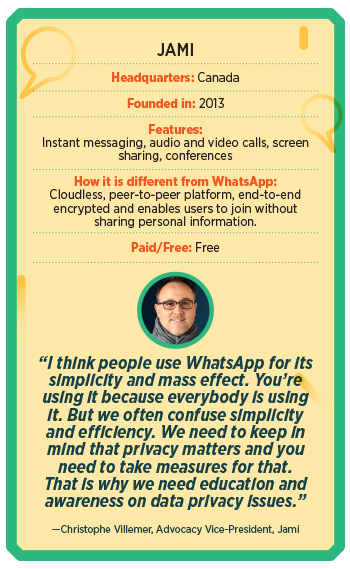
An open-source service, Jami doesn’t store users’ personal information on a central server, guaranteeing users full anonymity and privacy. Around since 2013, Christophe Villemer, advocacy vice-president of the Canada-based messenger app, says, “We really are a newcomer in the market, we estimate there are around 100,000 users around the globe but our community is growing every day.” He says Jami is peer-to-peer, which means it doesn’t require a server for relaying data between users. Therefore, users don’t have to worry about a third party conserving their video or data on its servers. With features such as HD video calling, instant and voice messaging, and file sharing, the service is free to use. All the connections are end-to-end encrypted. “At Jami, we think that privacy is a primary right on the internet. Everybody should be free not to give their data to corporations to benefit from an essential service on the internet,” says Villemer. “Also, we think that our solution, as it’s peer-to-peer, is globally better for the environment because it does not rely on huge server farms or data-centers,” he adds. Users of the service have no restrictions in terms of the size of the files they share, nor speed, bandwidth, features, number of accounts or storage. In addition, if users are on the same local network, they can communicate using Jami even if they are disconnected from the internet. “There will never be advertising on Jami,” says Villemer.Briar

briar

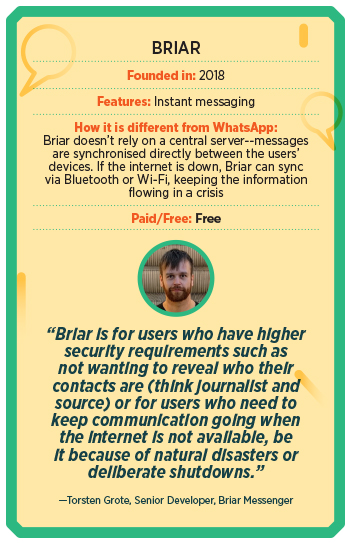
Briar Messenger is a not-for-profit organisation that started off as a project by Michael Rogers in an attempt to support freedom of expression, freedom of association, and the right to privacy. In India, Briar is extremely popular in Kashmir. Reason? It can work without the internet via Wi-Fi or Bluetooth. Launched in 2018, this application uses direct, encrypted connections to prevent surveillance and censorship. Briar allows users to form private groups (with one admin that can invite others), write blogs, and also create public discussion forums. The application doesn’t rely on central servers and sends across messages without leaking metadata.Torsten Grote, senior developer, Briar Messenger, says, “Briar is for users who have higher security requirements such as not wanting to reveal who their contacts are (think journalist and source) or for users who need to keep the communication going when the internet is not available, be it because of natural disasters or deliberate shutdowns.” So far, Briar has around 200,000 downloads on Google Play and around 100,000 downloads from their website. The application is also available on F-Droid and other independent stores, which don’t track downloads. However, “thanks to the WhatsApp policy change,” says Grote, “we are seeing 7x the usual number of downloads.”Threema

threema

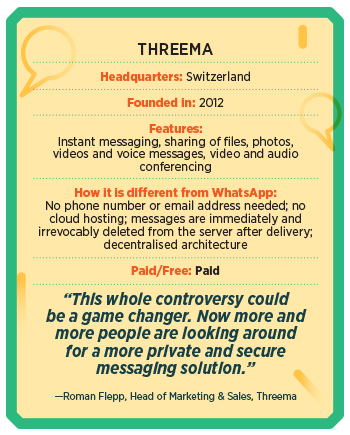
In 2012, three young software developers from Switzerland decided to create a secure instant messenger that would prevent the misuse of user data by companies and surveillance by governments. After Facebook bought WhatsApp in early 2014, the number of users climbed to 2 million in just a few weeks. “In Threema, all communication is protected in the best possible way by end-to-end encryption. Since Threema is open source, users can independently verify that Threema doesn’t have access to any user data that could be handed over to third parties,” says Roman Flepp, head of marketing and sales, Threema.One of Threema’s guiding principles is “metadata restraint”, which means if there is no data, no data can be misused, either by corporations, hackers or surveillance authorities. Currently, the messenger has over 9 million users. In the light of the recent WhatsApp privacy issue, Flepp claims the daily download numbers have increased significantly, by a factor of 10. This growth has been consistently high since the policy change was announced. He adds, “This whole controversy could be a game changer. Now more and more people are looking around for a more private and secure messaging solution.”The application can be used not only by individual users, but also businesses. Threema has various business solutions such as Threema Work and Threema Education. “Especially in the business environment, it is crucial that a secure and privacy-compliant solution is used for work-related communication. We see a great demand, more than 5,000 companies are already using our business solution Threema Work,” says Flepp. Currently, the team is working on creating a multi-device solution that will allow users to use Threema on multiple devices.****While a bunch of these applications are great options for secure peer-to-peer messaging, it is not a very sustainable revenue model for most of these companies. Hence, a few of them have moved to offer enterprise solutions. “For business use, a consumer-focused messaging app [like WhatsApp] is insufficient because it isn’t designed with business requirements for security, privacy, and compliance in mind,” says Shey.Post the recent announcement about the policy changes, a lot of government organisations and companies banned the use of applications like WhatsApp on company-issued devices and for work. We take a look at some applications that offer paid messaging solutions to businesses.Wire

wire

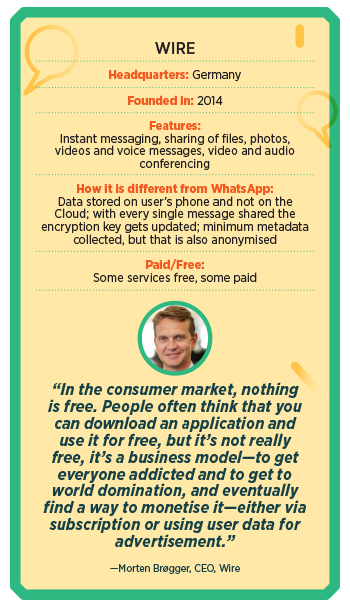
Though the idea for Wire was conceived in 2012, the product was only launched in 2014 and initially for consumers. However, in 2017, the Germany-based company decided to focus mainly on enterprises. This was because, says Morten Brøgger, CEO of Wire, “We were against giants like Facebook, and consumers were not willing to understand the importance of privacy and pay for it.” This was also around the same time that the General Data Protection Regulation (EU GDPR) was coming up, and privacy was becoming a major concern for organisations. “Hence, we felt the solution we built would be extremely compelling to enterprise consumers,” he adds.Currently, Wire has close to 1,800 paid customers, which mainly include governments and large enterprises, whereas, for the general free solution, they have about half a million monthly active users. Most of their paid customers are in Germany, North America, Australia, the Middle East, and some European countries.Most of the traditional enterprise SaaS solutions have a few risk points, including “man in the middle vulnerability” since the cloud provider is in the middle, which means all the processing and storage happens on the cloud. The main weakness here is that the cloud provider can technically access the encryption key, which means the cloud provider can technically read and listen to all your content. However, Wire has a very different architecture, wherein there is no man in the middle. “All the data resides in the application on your device. There is some storage on the cloud, for bigger files, and these are secured with individual encryption keys. But the encryption keys only exist on the devices of our users, there’s no copy of the keys on the cloud,” Brøgger says.Another USP of this open-source application is that every time you send or receive a message—be it a text message, call, video conference or screen share—the encryption key updates, hence giving each individual message a unique encryption key. Says Brøgger, “We don’t know who the users are, what they are using it for and we barely collect any metadata, whatever little is collected to help synchronise different devices is also anonymised.”Currently, the company is going at 400 percent revenue growth year-on-year. “We saw a great spike in the paid clients at the beginning of the pandemic, and now [due to the WhatsApp privacy policy issue] since enterprises are becoming more aware of the importance of privacy.”Troop

troop_messenger

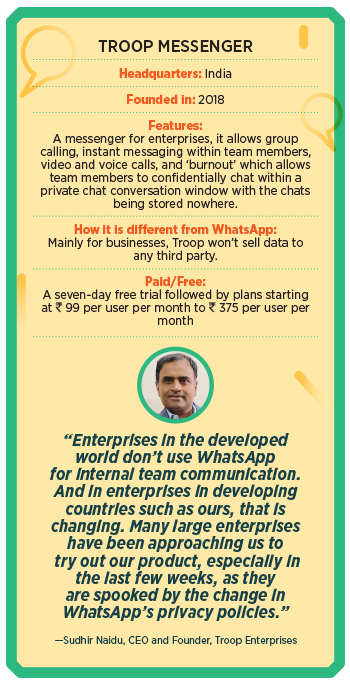
Troop Messenger was launched in mid-2018 as an internal messaging app for enterprises. “It is a home-grown, made in India, robust and a secured business messaging platform,” says CEO and founder Sudhir Naidu. A single platform, it enables internal teams to chat, make audio and video calls, convert them into conferencing, share screens, and create groups. It also features a self-destructible chat window to exchange secured information, and will shortly introduce an email client so users can both send e-mails and messages. “We have pledged that we would not sell any kind of user data to any third-party organisations. We assess and track all kinds of intrusions and attacks and follow the policy of honestly disclosing to clients if there is a breach which involves a threat to their data,” says Naidu. Additionally, Troop follows a stringent and comprehensive internal security framework and policy, in terms of development, testing and release.Besides Indian enterprises, Troop Messenger has been seeing good traction from the US, UK and the Middle East, informs Naidu. “We see three times the usual daily registrations for our platform, since the [WhatsApp] policy came out,” he says. “Businesses that were using WhatsApp before are actively looking out for much safer and business-oriented platforms such as ours,” he adds.Arattai

arattai

Zoho Corp, which has products like Zoho Mail and Zoho Business Suite, released a beta version of its messaging application Arattai, meaning chit-chat in Tamil, in the middle of the pandemic in 2020. “More than 70,000 users have already downloaded Arattai and we didn’t advertise at all,” says Praval Singh, VP, marketing at Zoho Corp. “The final application is close to being launched,” he adds. As a privately held company, Singh says, their focus is on user privacy. “We have retained that we’ve held that stance in many ways for our enterprise and business users. And we would like to take it forward with consumer applications as well. For example, we don’t use our own application or data of users to share with third parties, either as a monetisation strategy or for any other reason. So, data that sits on an application doesn’t go to a third party,” he says. In fact, they own their data centers. Therefore, they are not dependent on any third party or public clouds for storage. Spike

spike

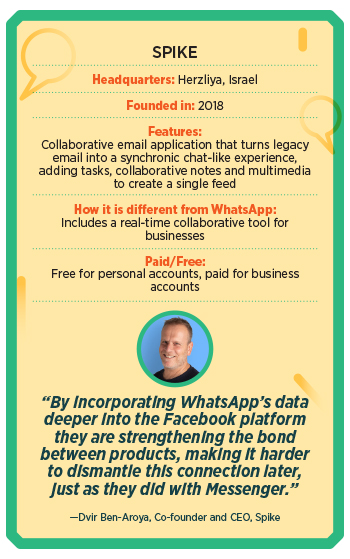
Initially released in October 2018, Spike is a conversational and collaborative email application that turns legacy email into a synchronic chat-like experience, adding tasks, collaborative notes and multimedia to create a single feed for work.Instead of using another application, Spike turns an individual’s email address inbox into a hub for chatting with co-workers, friends, and family–as well as a place to work on documents, manage tasks, and share files. Unlike WhatsApp groups, says Dvir Ben-Aroya, co-founder and CEO of Spike, “Spike groups provide a real-time collaborative tool for businesses, without switching between separate team messenger apps.” The application promises to store minimum data to provide fast communication and ensure privacy. Currently, Spike has over 100,000 active teams using this application.“We’ve seen a drastic uptick in users after the WhatsApp announcement, but since we track minimal user data, we cannot access specific data or directly attribute these users’ behaviour with correlation to using WhatsApp,” he says. Its highest user base is in the US, Germany, the UK, and it is very popular in India, especially among students and educators.(With inputs from Namrata Sahoo)

Source: https://www.forbesindia.com/article/take-one-big-story-of-the-day/whatsalt-the-messenger-alternatives/65909/1

WhatsApp Has Shared Your Data With Facebook for Years, Actually

WhatsApp Has Shared Your Data With Facebook for Years, Actually

“I don’t trust any product made by Facebook,” says Evan Greer, deputy director of the digital rights group Fight for the Future. “Their business model is surveillance. Never forget that.”

A pop-up notification has alerted the messaging app’s users to a practice that’s been in place since 2016.

two guys on the phone
Your encrypted messages are still safe, but it’s a rude awakening for many WhatsApp users.Photograph: Noam Galai/Getty Images

Since Facebook acquired WhatsApp in 2014, users have wondered and worried about how much data would flow between the two platforms. Many of them experienced a rude awakening this week, as a new in-app notification raises awareness about a step WhatsApp actually took to share more with Facebook back in 2016.

On Monday, WhatsApp updated its terms of use and privacy policy, primarily to expand on its practices around how WhatsApp business users can store their communications. A pop-up has been notifying users that as of February 8, the app’s privacy policy will change and they must accept the terms to keep using the app. As part of that privacy policy refresh, WhatsApp also removed a passage about opting out of sharing certain data with Facebook: „If you are an existing user, you can choose not to have your WhatsApp account information shared with Facebook to improve your Facebook ads and products experiences.“ 

Some media outlets and confused WhatsApp users understandably assumed that this meant WhatsApp had finally crossed a line, requiring data-sharing with no alternative. But in fact the company says that the privacy policy deletion simply reflects how WhatsApp has shared data with Facebook since 2016 for the vast majority of its now 2 billion-plus users.

When WhatsApp launched a major update to its privacy policy in August 2016, it started sharing user information and metadata with Facebook. At that time, the messaging service offered its billion existing users 30 days to opt out of at least some of the sharing. If you chose to opt out at the time, WhatsApp will continue to honor that choice. The feature is long gone from the app settings, but you can check whether you’re opted out through the “Request account info” function in Settings. 

Meanwhile, the billion-plus users WhatsApp has added since 2016, along with anyone who missed that opt-out window, have had their data shared with Facebook all this time. WhatsApp emphasized to WIRED that this week’s privacy policy changes do not actually impact WhatsApp’s existing practices or behavior around sharing data with Facebook. 

“Our updated Terms and Privacy Policy provide more information on how we process your data, and our commitment to privacy,” WhatsApp wrote on Monday. “As part of the Facebook Companies, WhatsApp partners with Facebook to offer experiences and integrations across Facebook’s family of apps and products.”

„I don’t trust any product made by Facebook.“

Evan Greer, Fight for the Future

None of this has at any point impacted WhatsApp’s marquee feature: end-to-end encryption. Messages, photos, and other content you send and receive on WhatsApp can only be viewed on your smartphone and the devices of the people you choose to message with. WhatsApp and Facebook itself can’t access your communications. In fact, Facebook CEO Mark Zuckerberg has repeatedly affirmed his commitment to expanding end-to-end encryption offerings as part of tying the company’s different communication platforms together. But that doesn’t mean there isn’t still a trove of other data WhatsApp can collect and share about how you use the app. The company says it collects user information „to operate, provide, improve, understand, customize, support, and market our Services.”

In practice, this means that WhatsApp shares a lot of intel with Facebook, including  account information like your phone number, logs of how long and how often you use WhatsApp, information about how you interact with other users, device identifiers, and other device details like IP address, operating system, browser details, battery health information, app version, mobile network, language and time zone. Transaction and payment data, cookies, and location information are also all fair game to share with Facebook depending on the permissions you grant WhatsApp in the first place.

“WhatsApp is great for protecting the privacy of your message content,” says Johns Hopkins University cryptographer Matthew Green. “But it feels like the privacy of everything else you do is up for grabs.“Get WIRED for $5. SubscribeAdvertisement

Facebook purchased WhatsApp in 2014 and noted at the time that it and the company’s chat platform Messenger would operate as “standalone” products. The slow shift toward integration has been controversial internally, and may have contributed to the departure in late 2017 and 2018, respectively, of WhatsApp cofounders Brian Acton and Jan Koum. A few months after leaving, Acton cofounded the nonprofit Signal Foundation. The organization maintains and develops the open source Signal Protocol, which WhatsApp and the secure messaging app Signal, among others, use to implement end-to-end encryption.

“Today privacy is becoming a much more mainstream discussion,” Acton said at the WIRED25 conference in 2019. „People are asking questions about privacy, and they want security and privacy built into the terms of service.”

Though this week’s WhatsApp privacy policy revisions don’t actually alter the messaging service’s behavior, it’s significant that users may have thought the company was offering an opt-out option all these years that didn’t actually exist. A level of data-sharing that some users disagree with and even fear has already been going on. Given the reality that Facebook has owned WhatsApp for the better part of a decade, this clarification seems to some like simply reckoning with the inevitable.

“I don’t trust any product made by Facebook,” says Evan Greer, deputy director of the digital rights group Fight for the Future. “Their business model is surveillance. Never forget that.”

source: https://www.wired.com/story/whatsapp-facebook-data-share-notification/

Signal Is Finally Bringing Its Secure Messaging to the Masses

Signal Is Finally Bringing Its Secure Messaging to the Masses

The encryption app is putting a $50 million infusion from WhatsApp cofounder Brian Acton to good use, building out features to help it go mainstream.
Moxie Marlinspike
Signal creator Moxie Marlinspike is ready for his encrypted messaging app to go mainstream.Photograph: Michelle Groskopf

Last month, the cryptographer and coder known as Moxie Marlinspike was getting settled on an airplane when his seatmate, a Midwestern-looking man in his sixties, asked for help. He couldn’t figure out how to enable airplane mode on his aging Android phone. But when Marlinspike saw the screen, he wondered for a moment if he was being trolled: Among just a handful of apps installed on the phone was Signal.

Marlinspike launched Signal, widely considered the world’s most secure end-to-end encrypted messaging app, nearly five years ago, and today heads the nonprofit Signal Foundation that maintains it. But the man on the plane didn’t know any of that. He was not, in fact, trolling Marlinspike, who politely showed him how to enable airplane mode and handed the phone back.

„I try to remember moments like that in building Signal,“ Marlinspike told WIRED in an interview over a Signal-enabled phone call the day after that flight. „The choices we’re making, the app we’re trying to create, it needs to be for people who don’t know how to enable airplane mode on their phone,“ Marlinspike says.


Marlinspike has always talked about making encrypted communications easy enough for anyone to use. The difference, today, is that Signal is finally reaching that mass audience it was always been intended for—not just the privacy diehards, activists, and cybersecurity nerds that formed its core user base for years—thanks in part to a concerted effort to make the app more accessible and appealing to the mainstream.

That new phase in Signal’s evolution began two years ago this month. That’s when WhatsApp cofounder Brian Acton, a few months removed from leaving the app he built amid post-acquisition clashes with Facebook management, injected $50 million into Marlinspike’s end-to-end encrypted messaging project. Acton also joined the newly created Signal Foundation as executive chairman. The pairing up made sense; WhatsApp had used Signal’s open source protocol to encrypt all WhatsApp communications end-to-end by default, and Acton had grown disaffected with what he saw as Facebook’s attempts to erode WhatsApp’s privacy.


Since then, Marlinspike’s nonprofit has put Acton’s millions—and his experience building an app with billions of users—to work. After years of scraping by with just three overworked full-time staffers, the Signal Foundation now has 20 employees. For years a bare-bones texting and calling app, Signal has increasingly become a fully featured, mainstream communications platform. With its new coding muscle, it has rolled out features at a breakneck speed: In just the last three months, Signal has added support for iPad, ephemeral images and video designed to disappear after a single viewing, downloadable customizable „stickers,“ and emoji reactions. More significantly, it announced plans to roll out a new system for group messaging, and an experimental method for storing encrypted contacts in the cloud.

Moxie Marlinspike
Photograph: Michelle Groskopf


„The major transition Signal has undergone is from a three-person small effort to something that is now a serious project with the capacity to do what is required to build software in the world today,“ Marlinspike says.

Many of those features might sound trivial. They certainly aren’t the sort that appealed to Signal’s earliest core users. Instead, they’re what Acton calls „enrichment features.“ They’re designed to attract normal people who want a messaging app as multifunctional as WhatsApp, iMessage, or Facebook Messenger but still value Signal’s widely trusted security and the fact that it collects virtually no user data. „This is not just for hyperparanoid security researchers, but for the masses,“ says Acton. „This is something for everyone in the world.“

Even before those crowdpleaser features, Signal was growing at a rate most startups would envy. When WIRED profiled Marlinspike in 2016, he would confirm only that Signal had at least two million users. Today, he remains tightlipped about Signal’s total user base, but it’s had more than 10 million downloads on Android alone according to the Google Play Store’s count. Acton adds that another 40 percent of the app’s users are on iOS.

Its adoption has spread from Black Lives Matters and pro-choice activists in Latin America to politicians and political aides—even noted technically incompetent ones like Rudy Giuliani—to NBA and NFL players. In 2017, it appeared in the hacker show Mr. Robot and political thriller House of Cards. Last year, in a sign of its changing audience, it showed up in the teen drama Euphoria.

Identifying the features mass audiences want isn’t so hard. But building even simple-sounding enhancements within Signal’s privacy constraints—including a lack of metadata that even WhatsApp doesn’t promise–can require significant feats of security engineering, and in some cases actual new research in cryptography.

Take stickers, one of the simpler recent Signal upgrades. On a less secure platform, that sort of integration is fairly straightforward. For Signal, it required designing a system where every sticker „pack“ is encrypted with a „pack key.“ That key is itself encrypted and shared from one user to another when someone wants to install new stickers on their phone, so that Signal’s server can never see decrypted stickers or even identify the Signal user who created or sent them.

Signal’s new group messaging, which will allow administrators to add and remove people from groups without a Signal server ever being aware of that group’s members, required going further still. Signal partnered with Microsoft Research to invent a novel form of „anonymous credentials“ that let a server gatekeep who belongs in a group, but without ever learning the members‘ identities. „It required coming up with some innovations in the world of cryptography,“ Marlinspike says. „And in the end, it’s just invisible. It’s just groups, and it works like we expect groups to work.“


Signal is rethinking how it keeps track of its users‘ social graphs, too. Another new feature it’s testing, called „secure value recovery,“ would let you create an address book of your Signal contacts and store them on a Signal server, rather than simply depend on the contact list from your phone. That server-stored contact list would be preserved even when you switch to a new phone. To prevent Signal’s servers from seeing those contacts, it would encrypt them with a key stored in the SGX secure enclave that’s meant to hide certain data even from the rest of the server’s operating system.

That feature might someday even allow Signal to ditch its current system of identifying users based on their phone numbers—a feature that many privacy advocates have criticized, since it forces anyone who wants to be contacted via Signal to hand out a cell phone number, often to strangers. Instead, it could store persistent identities for users securely on its servers. „I’ll just say, this is something we’re thinking about,“ says Marlinspike. Secure value recovery, he says, „would be the first step in resolving that.“


With new features comes additional complexity, which may add more chances for security vulnerabilities to slip into Signal’s engineering, warns Matthew Green, a cryptographer at Johns Hopkins University. Depending on Intel’s SGX feature, for instance, could let hackers steal secrets the next time security researchers expose a vulnerability in Intel hardware. For that reason, he says that some of Signal’s new features should ideally come with an opt-out switch. „I hope this isn’t all or nothing, that Moxie gives me the option to not use this,“ Green says.

But overall, Green says he’s impressed with the engineering that Signal has put into its evolution. And making Signal friendlier to normal people only becomes more important as Silicon Valley companies come under increasing pressure from governments to create encryption backdoors for law enforcement, and as Facebook hints that its own ambitious end-to-end encryption plans are still years away from coming to fruition.

„Signal is thinking hard about how to give people the functionality they want without compromising privacy too much, and that’s really important,“ Green adds. „If you see Signal as important for secure communication in the future—and possibly you don’t see Facebook or WhatsApp as being reliable—then you definitely need Signal to be usable by a larger group of people. That means having these features.“

Brian Acton doesn’t hide his ambition that Signal could, in fact, grow into a WhatsApp-sized service. After all, Acton not only founded WhatsApp and helped it grow to billions of users, but before that joined Yahoo in its early, explosive growth days of the mid-1990s. He thinks he can do it again. „I’d like for Signal to reach billions of users. I know what it takes to do that. I did that,“ says Acton. „I’d love to have it happen in the next five years or less.“

That wild ambition, to get Signal installed onto a significant fraction of all the phones on the planet, represents a shift—if not for Acton, then for Marlinspike. Just three years ago, Signal’s creator mused in an interview with WIRED that he hoped Signal could someday „fade away,“ ideally after its encryption had been widely implemented in other billion-user networks like WhatsApp. Now, it seems, Signal hopes to not merely influence tech’s behemoths, but to become one.

But Marlinspike argues that Signal’s fundamental aims haven’t changed, only its strategy—and its resources. „This has always been the goal: to create something that people can use for everything,“ Marlinspike says. „I said we wanted to make private communication simple, and end-to-end encryption ubiquitous, and push the envelope of privacy-preserving technology. This is what I meant.“

Source: https://www.wired.com/story/signal-encrypted-messaging-features-mainstream/

Tech companies tried to help us spend less time on our phones. It didn’t work.

Last year, tech companies couldn’t get enough of letting you use their products less.

Executives at Apple and Google unveiled on-device features to help people monitor and restrict how much time they spent on their phones. Facebook and Instagram, two of the biggest time sucks on the planet, also rolled out time spent notifications and the ability to snooze their apps — new features meant to nudge people to scroll through their apps a little less mindlessly.

These companies all became fluent in the language of “time well spent,” a movement to design technology that respects users’ time and doesn’t exploit their vulnerabilities. Since the movement sprang up nearly seven years ago, it has invoked mass introspection and an ongoing debate over technology use, which people blame for a swath of societal ills including depression and suicide, diminished attention spans, and decreased productivity.

But a year after Big Tech rolled out their time-well-spent features, it doesn’t seem like they’re working: The time we spend on our devices just keeps increasing.

Fortunately, the problem might not be that bad in the first place. Though correlations exist, there’s no causal link between digital media usage and the myriad problems some speculate it causes.

“Every time new tech comes out, there’s a moral panic that this is going to melt our brains and destroy society,” Ethan Zuckerman, director of the Center for Civic Media at MIT, told Recode. “In almost every case, we sort of look back at these things and laugh.”

What “time well spent” has done is spurred a whole cottage industry to help people “digitally detox,” and it’s being led in part by the big tech companies responsible for — and that benefit from — our reliance on tech in the first place. As Quartz writer Simone Stolzoff put it, “‘Time well spent’ is having its Kendall Jenner Pepsi moment. What began as a social movement has become a marketing strategy.”

Politicians are also jumping on the dogpile. Sen. Josh Hawley (R-MO) has proposed a bill to reduce what some call social media addiction by banning infinite scrolling and autoplay and by automatically limiting users to spending a maximum of 30 minutes a day on each platform. The bill currently has no cosponsors and is unlikely to go to a vote, but does demonstrate that the topic is on lawmakers’ radar.

These efforts, however, have yet to dent our insatiable need for tech.

The data on device usage

By all accounts, the time we spend attached to our digital devices is growing.

American adults spent about 3 hours and 30 minutes a day using the mobile internet in 2019, an increase of about 20 minutes from a year earlier, according to measurement company Zenith. The firm expects that time to grow to over four hours in 2021. (Top smartphone users currently spend 4 hours and 30 minutes per day on those devices, according to productivity software company RescueTime, which estimates average phone usage to be 3 hours and 15 minutes per day).

We’re spending more time online because pastimes like socializing that used to happen offline are shifting online, and we’re generally ceding more of our days to digital activities.

The overall time Americans spend on various media is expected to grow to nearly 11 hours per day this year, after accounting for declines in time spent with other media like TV and newspapers that are increasingly moving online, according to Zenith. Mobile internet use is responsible for the entirety of that growth.

Nearly a third of Americans said they are online “almost constantly” in 2019, a statistic that has risen substantially across age groups since the study was conducted the year before.

Not all our online activities are on the uptick, however.

Online measurement company SimilarWeb has found that time spent with some of the most popular social media apps, like Facebook, Instagram, and Snapchat, has declined in the wake of “time well spent” efforts — though the decline could instead reflect the waning relevance of those social media behemoths. At least for now, the average amount of time on those apps is still near historic highs:

Since overall time spent online is going up, the data suggests we’re just finding other places online to spend our time, like with newer social media like TikTok or with online video games.

Some have argued that sheer time spent isn’t important psychologically, but rather it’s what we’re doing with that time online. And what we’re doing is very fragmented.

Rather than use our devices continually, we tend to check them throughout the day. On average, people open their phones 58 times a day (and 30 of those times are during the workday), according to RescueTime. Most of those phone sessions are under two minutes.

Even on our phones, we don’t stick to one thing. A recent study published in the journal Human-Computer Interaction found that people switched on average from one screen activity to another every 20 seconds.

And what’s the result of all these hours of fragmented activity? Just one in 10 people RescueTime surveyed said they felt in control of how they spend their day.

What to do with our growing smartphone usage

It’s tough to separate finger-wagging judgments about tech from valid concerns about how tech could be degrading our lives. But the perception, at least, that tech is harming our lives seems to be very real.

Numerous articles instruct people on how to put down their phones. And richer Americans — including the people making the technology in the first place — are desperately trying to find ways to have their kids spend less time with screens.

MIT’s Zuckerman suggests building better “pro-civic social media,” since he thinks it’s already clear we’re going to spend lots of our time online anyway.

“I am deeply worried about the effects of the internet on democracy. On the flip side, I was deeply worried about democracy before everyone was using the internet,” he said. “What we probably have to be doing is building social media that’s good for us as a democracy.”

This social media would emphasize the best aspects of social media and would better defend against scourges like content that promotes political polarization and misinformation. He gave the example of gell.com, which uses experts to outline arguments for and against major social issues, and then encourages user participation to further develop and challenge the ideas.

Nir Eyal, author of Indistractable: How to Control Your Attention and Choose Your Life, thinks we’re overusing the language of addiction when it comes to technology usage. If we really want to limit our technology usage, he told Recode, solutions are close at hand.

“We want to think that we’re getting addicted because an addiction involves a pusher, a dealer — someone’s doing it. Whereas when we call it what it really is, which is distraction — now in the US, we don’t like to face that fact — that means we have to do something that’s no fun,” Eyal said.

Instead of blaming tech companies, he asks people, “Have you tried to turn off notifications, for God’s sake? Have you planned your day so that you don’t have all this white space where you’re free to check your phone all the time?”

For those who are addicted — a percentage he says is probably in line with the portions of the population that are addicted to anything else, like alcohol or gambling — he thinks tech companies should notify users that they’re in the top percentiles of usership and offer them resources, such as software tools and professional assistance (and his book).

In the meantime, the time we spend on our digital devices will continue to increase, and there’s still a need for conclusive research about whether that actually matters. Perhaps while we wait for clarity, we can turn off our notifications about how much time we spend on our phones.

Source: https://www.vox.com/recode/2020/1/6/21048116/tech-companies-time-well-spent-mobile-phone-usage-data


Facebook it’s Hell Inside. Facebook Scandals. Backstabbing. Resignations. Record profits. Time Bombs. In early 2018, Mark Zuckerberg set out to fix Facebook.

The confusing rollout of meaningful social interactions—marked by internal dissent, blistering external criticism, genuine efforts at reform, and foolish mistakes—set the stage for Facebook’s 2018. This is the story of that annus horribilis, based on interviews with 65 current and former employees. It’s ultimately a story about the biggest shifts ever to take place inside the world’s biggest social network. But it’s also about a company trapped by its own pathologies and, perversely, by the inexorable logic of its own recipe for success.

Facebook’s powerful network effects have kept advertisers from fleeing, and overall user numbers remain healthy if you include people on Insta­gram, which Facebook owns. But the company’s original culture and mission kept creating a set of brutal debts that came due with regularity over the past 16 months. The company floundered, dissembled, and apologized. Even when it told the truth, people didn’t believe it. Critics appeared on all sides, demanding changes that ranged from the essential to the contradictory to the impossible. As crises multiplied and diverged, even the company’s own solutions began to cannibalize each other. And the most crucial episode in this story—the crisis that cut the deepest—began not long after Davos, when some reporters from The New York Times, The Guardian, and Britain’s Channel 4 News came calling. They’d learned some troubling things about a shady British company called Cambridge Analytica, and they had some questions.

15 Months of Fresh Hell Inside Facebook

Scandals. Backstabbing. Resignations. Record profits. Time Bombs. In early 2018, Mark Zuckerberg set out to fix Facebook. Here’s how that turned out:

https://www.wired.com/story/facebook-mark-zuckerberg-15-months-of-fresh-hell/

Ad IDs Behaving Badly

The Ad ID

Persistent identifiers are the bread and butter of the online tracking industry. They allow companies to learn the websites that you visit and the apps that you use, including what you do within those apps. A persistent identifier is just a unique number that is used to either identify you or your device. Your Social Security Number and phone number are examples of persistent identifiers used in real life; cookies use persistent identifiers to identify you across websites.

On your mobile device, there are many different types of persistent identifiers that are used by app developers and third parties contacted by those apps. For example, one app might send an advertising network your device’s serial number. When a different app on your same phone sends that same advertising network your device’s serial number, that advertising network now knows that you use both of these apps, and can use that information to profile you. This sort of profiling is what is meant by “behavioral advertising.” That is, they track your behaviors so that they can infer your interests from those behaviors, and then send you ads targeted to those inferred interests.

On the web, if you don’t want to be tracked in this manner, you can periodically clear your cookies or configure your browser to simply not accept cookies (though this breaks a lot of the web, given that there are many other uses for cookies beyond tracking). Clearing your cookies resets all of the persistent identifiers, which means that new persistent identifiers will be sent to third parties, making it more difficult for them to associate your future online activities with the previous profile they had constructed.

Regarding the persistent identifiers used by mobile apps, up until a few years ago, there was no way of doing the equivalent of clearing your cookies: many of the persistent identifiers used to track your mobile app activities were based in hardware, such the device’s serial number, IMEI, WiFi MAC address, SIM card serial number, etc. Many apps used (and still use) the Android ID for tracking purposes, which while not based in hardware, can only be reset by performing a factory reset on the device and deleting all of its data. Thus, there wasn’t an easy way for users to do the equivalent of clearing their cookies.

However, this changed in 2013 with the creation of the “ad ID”: both Android and iOS unveiled a new persistent identifier based in software that provides the user with privacy controls to reset that identifier at will (similar to clearing cookies).

Of course, being able to reset the ad identifier is only a good privacy-preserving solution if it is the only identifier being collected from the device. Imagine the following situation:

  1. An app sends both the ad ID and the IMEI (a non-resettable hardware-based identifier) to a data broker.
  2. Concerned with her privacy, the user uses one of the above privacy settings panels to reset her phone’s ad ID.
  3. Later, when using a different app, the same data broker is sent the new ad ID alongside the IMEI.
  4. The data broker sees that while the ad IDs are different between these two transmissions, the IMEI is the same, and therefore they must have come from the same device. Knowing this, the data broker can then add the second transmission to the user’s existing profile.

In this case, sending a non-resettable identifier alongside the ad ID completely undermines the privacy-preserving properties of the ad ID: resetting it does not prevent tracking. For this reason, both iOS and Android have policies that prohibit developers from transmitting other identifiers alongside the ad ID. For example, in 2017, it was major news that Uber’s app had violated iOS App Store privacy guidelines by collecting non-resettable persistent identifiers. Tim Cook personally threatened to have the Uber app removed from the store. Similarly, Google’s Play Store policy says that the ad ID cannot be transmitted alongside other identifiers without users’ explicit consent, and that for advertising purposes, the ad ID is the only identifier that can be used:

Association with personally-identifiable information or other identifiers. The advertising identifier must not be connected to personally-identifiable information or associated with any persistent device identifier (for example: SSAID, MAC address, IMEI, etc.) without explicit consent of the user.

Abiding by the terms of use. The advertising identifier may only be used in accordance with these terms, including by any party that you may share it with in the course of your business. All apps uploaded or published to Google Play must use the advertising ID (when available on a device) in lieu of any other device identifiers for any advertising purposes.

https://play.google.com/about/monetization-ads/ads/ad-id/

Violations of Ad ID Policies

I examined the AppCensus database to examine compliance with this policy. That is, are there apps violating this policy by transmitting the ad ID alongside other persistent identifiers to advertisers? When I performed this experiment last September, there were approximately 24k apps in our database that we had observed transmitting the ad ID. Of these, approximately 17k (i.e., ~70%) were transmitting the ad ID alongside other persistent identifiers. Based on the data recipients of some of the most popular offenders, these are clearly being used for advertising purposes:

App Name Installs Data Types Recipient
Clean Master – Antivirus, Cleaner & Booster 1B Ad ID + Android ID t.appsflyer.com
Subway Surfers 1B Android ID api.vungle.com
Flipboard: News For Our Time 500M Ad ID + Android ID ad.flipboard.com
My Talking Tom 500M Ad ID + Android ID m2m1.inner-active.mobi
Temple Run 2 500M Ad ID + Android ID live.chartboost.com
3D Bowling 100M Ad ID + Android ID + IMEI ws.tapjoyads.com
8 Ball Pool 100M Ad ID + Android ID ws.tapjoyads.com
Agar.io 100M Ad ID + Android ID ws.tapjoyads.com
Angry Birds Classic 100M Android ID ads.api.vungle.com
Audiobooks from Audible 100M Ad ID + Android ID api.branch.io
Azar 100M Ad ID + Android ID api.branch.io
B612 – Beauty & Filter Camera 100M Ad ID + Android ID t.appsflyer.com
Banana Kong 100M Ad ID + Android ID live.chartboost.com
Battery Doctor – Battery Life Saver & Battery Cooler 100M Ad ID + Android ID + IMEI t.appsflyer.com
BeautyPlus – Easy Photo Editor & Selfie Camera 100M Ad ID + Android ID t.appsflyer.com,
live.chartboost.com
Bus Rush 100M Ad ID + Android ID ads.api.vungle.com,
ws.tapjoyads.com
CamScanner – Phone PDF Creator 100M Ad ID + Android ID + IMEI t.appsflyer.com
Cheetah Keyboard – Emoji & Stickers Keyboard 100M Ad ID + Android ID t.appsflyer.com
Cooking Fever 100M Ad ID + Android ID ws.tapjoyads.com
Cut The Rope Full FREE 100M Ad ID + Android ID ws.tapjoyads.com

This is just the top 20 most popular apps that are violating this policy, sorted alphabetically. All of the domains receiving the data in the right-most column are either advertising networks, or companies otherwise involved in tracking users’ interactions with ads (i.e., to use Google’s language, “any advertising purposes”). In fact, as of today, there are over 18k distinct apps transmitting the Ad ID alongside other persistent identifiers.

In September, our research group reported just under 17k apps to Google that were transmitting the ad ID alongside other identifiers. The data we gave them included the data types being transmitted and a list of the recipient domains, which included some of the following companies involved in mobile advertising:

  • ad-mediation.tuanguwen.com
  • ad.adsrvr.org
  • ad.doubleclick.net
  • ad.lkqd.net
  • adc-ad-assets.adtilt.com
  • admarvel-d.openx.net
  • admediator.unityads.unity3d.com
  • adproxy.fyber.com
  • ads-roularta.adhese.com
  • ads-secure.videohub.tv
  • ads.adadapted.com
  • ads.adecosystems.net
  • ads.admarvel.com
  • ads.api.vungle.com
  • ads.flurry.com
  • ads.heyzap.com
  • ads.mopub.com
  • ads.nexage.com
  • ads.superawesome.tv
  • adtrack.king.com
  • adwatch.appodeal.com
  • amazon-adsystem.com
  • androidads23.adcolony.com
  • api.salmonads.com
  • app.adjust.com
  • init.supersonicads.com
  • live.chartboost.com
  • marketing-ssl.upsight-api.com
  • track.appsflyer.com
  • ws.tapjoyads.com

The majority of these have the word “ads” in the hostname. Looking at the traffic shows that they are either being used to place ads in apps, or track user engagement with ads.

It has been 5 months since we submitted that report, and we have not received anything from Google about whether they plan to address this pervasive problem. In the interim, more apps now appear to be violating Google’s policy. The problem with all of this is that Google is providing users with privacy controls (see above image), but those privacy controls don’t actually do anything because they only control the ad ID, and we’ve shown that in the vast majority of cases, other persistent identifiers are being collected by apps in addition to the ad ID.

https://blog.appcensus.mobi/2019/02/14/ad-ids-behaving-badly/

Germany bans Facebook from combining user data without permission

Germany’s Federal Cartel Office, or Bundeskartellamt, on Thursday banned Facebook from combining user data from its various platforms such as WhatsApp and Instagram without explicit user permission.

The decision, which comes as the result of a nearly three-year antitrust investigation into Facebook’s data gathering practices, also bans the social media company from gleaning user data from third-party sites unless they voluntarily consent.

“With regard to Facebook’s future data processing policy, we are carrying out what can be seen as an internal divestiture of Facebook’s data,” Bundeskartellamt President Andreas Mundt said in a release. “In [the] future, Facebook will no longer be allowed to force its users to agree to the practically unrestricted collection and assigning of non-Facebook data to their Facebook user accounts.”

Mundt noted that combining user data from various sources “substantially contributed to the fact that Facebook was able to build a unique database for each individual user and thus to gain market power.”

Experts agreed with the decision. “It is high time to regulate the internet giants effectively!” said Marc Al-Hames, general manager of German data protection technologies developer Cliqz GmbH. “Unregulated data capitalism inevitably creates unfair conditions.”

Al-Hames noted that apps like WhatsApp have become “indispensable for many young people,” who feel compelled to join if they want to be part of the social scene. “Social media create social pressure,” he said. “And Facebook exploits this mercilessly: Give me your data or you’re an outsider.”

He called the practice an abuse of dominant market position. “But that’s not all: Facebook monitors our activities regardless of whether we are a member of one of its networks or not. Even those who consciously renounce the social networks for the sake of privacy will still be spied out,” he said, adding that Cliqz and Ghostery stats show that “every fourth of our website visits are monitored by Facebook’s data collection technologies, so-called trackers.”

The Bundeskartellamt’s decision will prevent Facebook from collecting and using data without restriction. “Voluntary consent means that the use of Facebook’s services must [now] be subject to the users’ consent to their data being collected and combined in this way,” said Mundt. “If users do not consent, Facebook may not exclude them from its services and must refrain from collecting and merging data from different sources.”

The ban drew support and calls for it to be expanded to other companies.

“This latest move by Germany’s competition regulator is welcome,” said Morten Brøgger, CEO of secure collaboration platform Wire. “Compromising user privacy for profit is a risk no exec should be willing to take.”

Brøgger contends that Facebook has not fully understood digital privacy’s importance. “From emails suggesting cashing in on user data for money, to the infamous Cambridge Analytica scandal, the company is taking steps back in a world which is increasingly moving towards the protection of everyone’s data,” he said.

“The lesson here is that you cannot simply trust firms that rely on the exchange of data as its main offering, Brøgger added, “and firms using Facebook-owned applications should have a rethink about the platforms they use to do business.”

Al-Hames said regulators shouldn’t stop with Facebook, which he called the number-two offender. “By far the most important data monopolist is Alphabet. With Google search, the Android operating system, the Play Store app sales platform and the Chrome browser, the internet giant collects data on virtually everyone in the Western world,” Al-Hames said. “And even those who want to get free by using alternative services stay trapped in Alphabet’s clutches: With a tracker reach of nearly 80 percent of all page loads Alphabet probably knows more about them than their closest friends or relatives. When it comes to our data, the top priority of the market regulators shouldn’t be Facebook, it should be Alphabet!”

Source: https://www.scmagazine.com/home/network-security/germany-bans-facebook-from-combining-user-data-without-permission/