Archiv der Kategorie: Mobility

Google gets green lights for their self-driving vehicle prototypes

http://googleblog.blogspot.co.at/2015/05/self-driving-vehicle-prototypes-on-road.html

„When we started designing the world’s first fully self-driving vehicle, our goal was a vehicle that could shoulder the entire burden of driving. Vehicles that can take anyone from A to B at the push of a button could transform mobility for millions of people, whether by reducing the 94 percent of accidents caused by human error (PDF), reclaiming the billions of hours wasted in traffic, or bringing everyday destinations and new opportunities within reach of those who might otherwise be excluded by their inability to drive a car.

Now we’re announcing the next step for our project: this summer, a few of the prototype vehicles we’ve created will leave the test track and hit the familiar roads of Mountain View, Calif., with our safety drivers aboard.

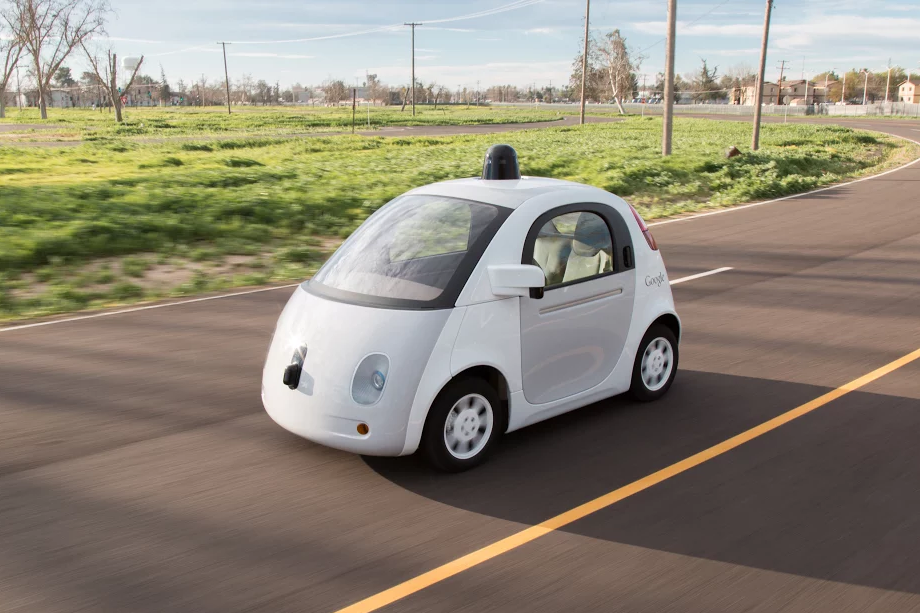
Our safety drivers will test fully self-driving vehicle prototypes like this one on the streets of Mountain View, Calif., this summer.

We’ve been running the vehicles through rigorous testing at our test facilities, and ensuring our software and sensors work as they’re supposed to on this new vehicle. The new prototypes will drive with the same software that our existing fleet of self-driving Lexus RX450h SUVs uses. That fleet has logged nearly a million autonomous miles on the roads since we started the project, and recently has been self-driving about 10,000 miles a week. So the new prototypes already have lots of experience to draw on—in fact, it’s the equivalent of about 75 years of typical American adult driving experience.

Each prototype’s speed is capped at a neighborhood-friendly 25mph, and during this next phase of our project we’ll have safety drivers aboard with a removable steering wheel, accelerator pedal, and brake pedal that allow them to take over driving if needed. We’re looking forward to learning how the community perceives and interacts with the vehicles, and to uncovering challenges that are unique to a fully self-driving vehicle—e.g., where it should stop if it can’t stop at its exact destination due to construction or congestion. In the coming years, we’d like to run small pilot programs with our prototypes to learn what people would like to do with vehicles like this. If you’d like to follow updates about the project and share your thoughts, please join us on our Google+ page. See you on the road!

Accident Causes of the Google Self-Driving Car

Source: https://medium.com/backchannel/the-view-from-the-front-seat-of-the-google-self-driving-car-46fc9f3e6088


The View from the Front Seat of the Google Self-Driving Car

After 1.7 million miles we’ve learned a lot — not just about our system but how humans drive, too.

About 33,000 people die on America’s roads every year. That’s why so much of the enthusiasm for self-driving cars has focused on their potential to reduce accident rates. As we continue to work toward our vision of fully self-driving vehicles that can take anyone from point A to point B at the push of a button, we’re thinking a lot about how to measure our progress and our impact on road safety.

One of the most important things we need to understand in order to judge our cars’ safety performance is “baseline” accident activity on typical suburban streets. Quite simply, because many incidents never make it into official statistics, we need to find out how often we can expect to get hit by other drivers. Even when our software and sensors can detect a sticky situation and take action earlier and faster than an alert human driver, sometimes we won’t be able to overcome the realities of speed and distance; sometimes we’ll get hit just waiting for a light to change. And that’s important context for communities with self-driving cars on their streets; although we wish we could avoid all accidents, some will be unavoidable.

The most common accidents our cars are likely to experience in typical day to day street driving — light damage, no injuries — aren’t well understood because they’re not reported to police. Yet according to National Highway Traffic Safety Administration (NHTSA) data, these incidents account for 55% of all crashes. It’s hard to know what’s really going on out on the streets unless you’re doing miles and miles of driving every day. And that’s exactly what we’ve been doing with our fleet of 20+ self-driving vehicles and team of safety drivers, who’ve driven 1.7 million miles (manually and autonomously combined). The cars have self-driven nearly a million of those miles, and we’re now averaging around 10,000 self-driven miles a week (a bit less than a typical American driver logs in a year), mostly on city streets.

In the spirit of helping all of us be safer drivers, we wanted to share a few patterns we’ve seen. A lot of this won’t be a surprise, especially if you already know that driver error causes 94% of crashes.

If you spend enough time on the road, accidents will happen whether you’re in a car or a self-driving car. Over the 6 years since we started the project, we’ve been involved in 11 minor accidents (light damage, no injuries) during those 1.7 million miles of autonomous and manual driving with our safety drivers behind the wheel, and not once was the self-driving car the cause of the accident.

Rear-end crashes are the most frequent accidents in America, and often there’s little the driver in front can do to avoid getting hit; we’ve been hit from behind seven times, mainly at traffic lights but also on the freeway. We’ve also been side-swiped a couple of times and hit by a car rolling through a stop sign. And as you might expect, we see more accidents per mile driven on city streets than on freeways; we were hit 8 times in many fewer miles of city driving. All the crazy experiences we’ve had on the road have been really valuable for our project. We have a detailed review process and try to learn something from each incident, even if it hasn’t been our fault.

Not only are we developing a good understanding of minor accident rates on suburban streets, we’ve also identified patterns of driver behavior (lane-drifting, red-light running) that are leading indicators of significant collisions. Those behaviors don’t ever show up in official statistics, but they create dangerous situations for everyone around them.

Lots of people aren’t paying attention to the road. In any given daylight moment in America, there are 660,000 people behind the wheel who are checking their devices instead of watching the road. Our safety drivers routinely see people weaving in and out of their lanes; we’ve spotted people reading books, and even one playing a trumpet. A self-driving car has people beat on this dimension of road safety. With 360 degree visibility and 100% attention out in all directions at all times; our newest sensors can keep track of other vehicles, cyclists, and pedestrians out to a distance of nearly two football fields.

Intersections can be scary places. Over the last several years, 21% of the fatalities and about 50% of the serious injuries on U.S. roads have involved intersections. And the injuries are usually to pedestrians and other drivers, not the driver running the red light. This is why we’ve programmed our cars to pause briefly after a light turns green before proceeding into the intersection — that’s often when someone will barrel impatiently or distractedly through the intersection.

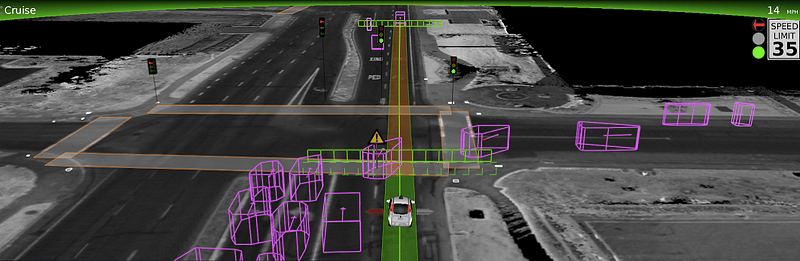
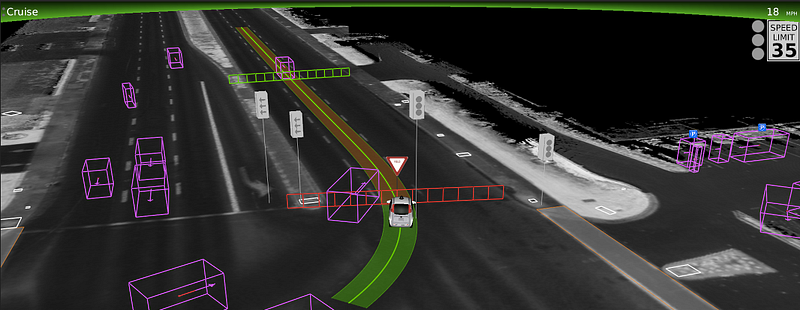
In this case, a cyclist (the light blue box) got a late start across the intersection and narrowly avoided getting hit by a car making a left turn (the purple box entering the intersection) who didn’t see him and had started to move when the light turned green. Our car predicted the cyclist’s behavior (the red path) and did not start moving until the cyclist was safely across the intersection.

Turns can be trouble. We see people turning onto, and then driving on, the wrong side of the road a lot — particularly at night, it’s common for people to overshoot or undershoot the median.

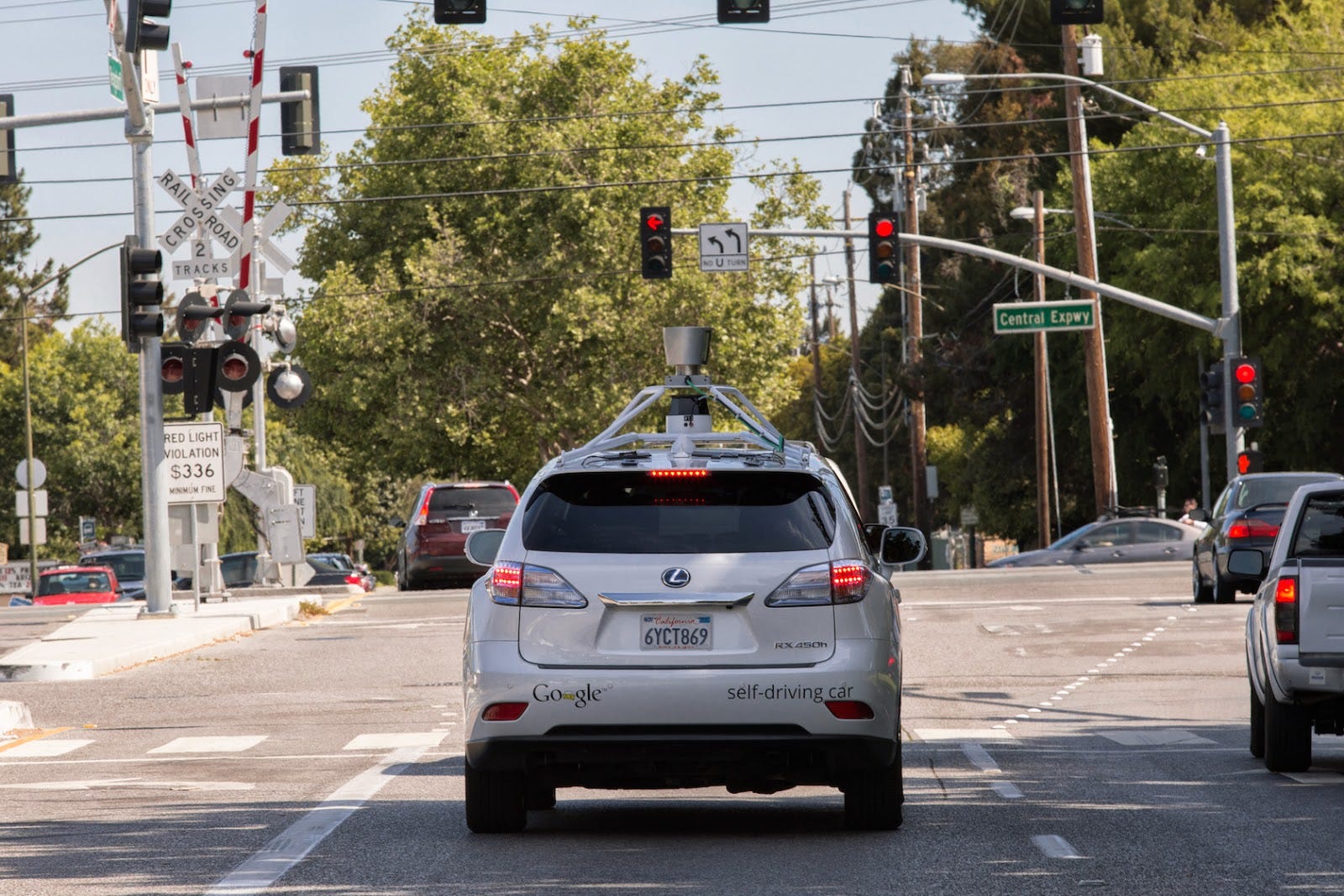
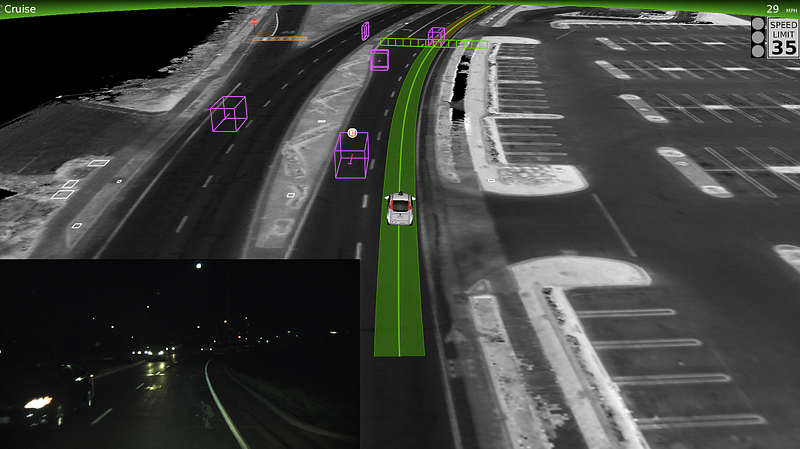
In this image you can see not one, but two cars (the two purple boxes on the left of the green path are the cars you can see in the photo) coming toward us on the wrong side of the median; this happened at night on one of Mountain View’s busiest boulevards.

Other times, drivers do very silly things when they realize they’re about to miss their turn.

A car (the purple box touching the green rectangles with an exclamation mark over it) decided to make a right turn from the lane to our left, cutting sharply across our path. The green rectangles, which we call a “fence,” indicate our car is going to slow down to avoid the car making this crazy turn.

And other times, cars seem to behave as if we’re not there. In the image below, a car in the leftmost turn lane (the purple box with a red fence through it) took the turn wide and cut off our car. In this case, the red fence indicates our car is stopping and avoiding the other vehicle.

These experiences (and countless others) have only reinforced for us the challenges we all face on our roads today. We’ll continue to drive thousands of miles so we can all better understand the all too common incidents that cause many of us to dislike day to day driving — and we’ll continue to work hard on developing a self-driving car that can shoulder this burden for us.

Chris Urmson is director of Google’s self-driving car program.

Facebook’s WhatsApp Will Be How the World Makes Phone Calls

Further Reading: http://www.wired.com/2015/04/facebooks-whatsapp-worlds-next-phone

WhatsApp is the world’s most popular smartphone messaging app, letting more than 800 million people send and receive texts on the cheap. But it’s evolving into something more.

On Tuesday, the company, which is owned by Facebook, released a new version of the app that allows people with iPhones to not only text people, but actually talk to them. This built on a similar move the company made at the end of March, when it quietly released an Android update that did the same thing. And in the week following the addition of voice calling on Android, WhatsApp-related traffic increased about 5 percent on carrier networks, according to a study by Allot Communications—an Israeli company that helps manage wireless network traffic worldwide.

That figure will likely get a lot bigger as WhatsApp shifts from being the world’s favorite messaging app to become a more wide-ranging—and bandwidth-intensive—communication tool.

Others have offered internet voice calls on smartphones, most notably Skype and Viber. But WhatsApp is different. So many people already use the app, and the company is intent on keeping it free (or nearly free). Though it has little traction here in the US, WhatsApp is enormously popular in parts of Europe and the developing world—areas where there’s a hunger for cheap communication. The result is an app that could bring inexpensive Internet calls to an audience of unprecedented size.

Developing World

The rapidly evolving WhatsApp is but one face of the dramatic technological changes sweeping across the developing world. So many companies are working to bring affordable smartphones to the market, from China’s Xiaomi to the Silicon Valley’s Cyanogen, as many others, from China’s WeChat to Viber, push cheap communication services onto these devices.

These technologies face the usual obstacles—and WhatsApp is no exception. Though the app is expected to reach a billion users by year’s end, its push into voice calls could alienate many wireless carriers. If you have free internet calls, after all, you don’t need to pay for cellular calls. Some carriers may fight the tool as a result, says Allot associate vice president Yaniv Sulkes.

But the same could be said of messaging on WhatsApp. It too cuts into the carriers’ way of doing things. And yet, WhatsApp has thrived. It has so much traction in large part because it has cultivated partnerships with carriers, striking deals that bundle its app with lost-cost wireless services. According another Allot survey, about 37 percent of the carriers now have deals with WhatsApp or similar inexpensive Internet-based services—a sharp rise over the past few years. “More and more operators are adopting the strategy of ‘let’s partner with them’ rather than ‘let’s fight them,’” Sulkes says.

In the meantime, Facebook is pushing for somewhat similar arrangements, through its Internet.org initiative, that bundle limited Internet access with access to specific apps. Mark Zuckerberg and company have encountered some opposition to these deals. But the combined might of Facebook and WhatsApp will be hard for carriers to resist.

Video Next?

As WhatsApp spreads, Sulkes believes, it will keep pushing into new services. After rolling out voice calling, he says, it may venture into video calling. The app already lets you send files, including videos, and other messaging apps, such as SnapChat, already have ventured into video calls.

None of these tools—video calls, voice calls, file sharing—are new technologies. But not everyone has them. WhatsApp has the leverage to change that. The app has grabbed hold of the developing world in rapid fashion, and now it can serve as a platform for bringing all sorts of modern communications to the far reaches of the globe. Yes, there’s another major obstacle to overcome: so much of the developing world doesn’t have the network infrastructure to accommodate these kinds of modern services. But Facebook is set to change that, too.

Project Fi – Google Revolutioniert den Mobilfunk

Der ganze Artikel unter: http://www.welt.de/wirtschaft/webwelt/article139952153/So-will-Google-den-Mobilfunk-revolutionieren.html

„Mit eigenen Mobilfunk-Verträgen in den USA wird Google womöglich den Markt umkrempeln. Dabei kommt eine Netzwechsel-Technik zum Einsatz. Die üblichen Preis-Modelle werden über den Haufen geworfen.

Internetgigant Google will seinen Nutzern in den USA künftig eigene Mobilfunk-Verträge anbieten. Der Konzern stellte am Mittwoch sein „Project Fi“ vor. Was nonchalant per Blogpost veröffentlicht wird, hat das Potential, die Mobilfunkwelt auf den Kopf zu stellen. Denn Google baut kein eigenes Netz auf – stattdessen suchen sich Mobilfunkgeräte mit Fi-Vertrag automatisch die jeweils besten Netzsignale von Googles Geschäftspartnern.

Zu denen zählen bislang T-Mobile, die US-Tochter der deutschen Telekom, sowie der Mobilfunkbetreiber Sprint. Technisch neu ist, dass Fi-Geräte sich bei Verfügbarkeit blitzschnell auch in freie WLAN-Netzwerke einwählen sollen, ohne dass dabei Gespräche abbrechen. Google kündigt an, dafür eine neue Technologie entwickelt zu haben, mit der die Mobilgeräte automatisch das schnellstmögliche Netz-Signal suchen, und dabei zwischen WLAN sowie den LTE-Mobilfunk-Netzwerken von Sprint und T-Mobile hin- und herwechseln.

Dank der Netzwechsel-Technik sollen Fi-Kunden eine möglichst breite Highspeed-Netzabdeckung nutzen können. Dabei setzt Google auf eine proprietäre Verschlüsselungstechnik, um die Datenverbindung vor Lauschern zu schützen – augenscheinlich kommt eine VPN-Variante zum Einsatz, die auch bei schnellem Wechsel zwischen WLAN und LTE-Mobilfunk die verschlüsselte Verbindung aufrecht erhält.

Erstes kompatibles Gerät soll Googles Nexus 6 sein

Für ein normales Smartphone mit einer normalen SIM-Karte wäre der schnelle und dazu konstant verschlüsselte Netzwechsel zwischen Providern unmöglich, Google möchte daher wie auch bei seiner Nexus-Geräteserie mit verschiedenen Smartphone-Herstellern zusammenarbeiten, um die Fi-Technik zu verbreiten. Das erste kompatible Gerät ist Googles aktuelles Nexus-6-Smartphone, das für den Fi-Einsatz mit einer Google-Sim-Karte kombiniert werden muss.

Google bricht mit weiteren Dogmen der Branche, indem der Konzern die Mobilfunknummer nicht fest an ein Gerät oder eine SIM-Karte koppelt, sondern an das jeweilige Google-Nutzerkonto. Anrufe und Nachrichten können mit jedem Laptop oder Tablet empfangen werden, vorausgesetzt die Nutzer sind mit ihrem Google-Hangout-Konto dort eingeloggt – eine zweite SIM-Karte ist nicht nötig.

Ähnliches realisiert Apple bereits mit dem iPhone, iOS 8 und dem neuen OS X Yosemite-Betriebssytem – doch anders als bei Apple spielt bei Googles Fi keine Rolle, ob das Smartphone im selben WLAN-Netz online ist wie die übrigen Geräte. Die Mobilfunknummer ist bei Fi völlig unabhängig von der SIM und dem Smartphone in Googles Cloud hinterlegt. Für die Mobilfunk-Provider ist das ein enormer Kontrollverlust, für Google eine Möglichkeit, seine Nutzer noch enger an sich zu binden.

Keine Roaming-Kosten für Daten-Verbindungen im Ausland

Nicht zuletzt wirft Google die üblichen Preis-Modelle im Markt über den Haufen, indem der Konzern für seinen Basisdienst 20 Dollar verlangt – und danach die Datentarife nach Verbrauch abrechnet. 1 Gigabyte Transfervolumen schlägt mit 10 Dollar zu Buche, wer das bezahlte Volumen am Ende des Monats nicht verbraucht hat, bekommt Geld zurück.

Roaming-Kosten für Daten-Verbindungen im Auslandseinsatz sieht Google nicht vor, in 120 Ländern bleibt der Datenpreis pro Gigabyte gleich – eine Droh-Geste an alle Provider, die sich aktuell selbst innerhalb Europas oft Datenroaming noch in Megabyte-Häppchen bezahlen lassen. Eine Mindestvertragslaufzeit sieht Google ebenfalls nicht vor, Fi-Verträge lassen sich jederzeit zum Monatsende kündigen.

Zunächst bietet Google den Fi-Dienst in einer Pilotphase nur in den USA und nur auf Einladung an, zudem müssen Nutzer ein aktuelles Nexus 6-Smartphone besitzen. Das ist aus Sicht von Google nur logisch – in diversen US-Ballungsgebieten baut der Konzern aktuell ein eigenes Glasfasernetz auf, und überall dort wo bereits Google-Leitungen im Boden liegen, kann der Konzern die eigene Infrastruktur für die WLAN-Anbindung der Fi-Geräte nutzen. Es ist fraglich, ob Google in Europa Mobilfunkprovider findet, die bereit dazu sind, ihre LTE-Infrastruktur mit dem Netzriesen zu teilen.

Kontrolle der Netznutzung von Kunden

Doch Projekt Fi zeigt deutlich die Vision der Google-Manager: Mit der Fi-SIM-Karte und der verschlüsselten Verbindung, die alle Verbindungsdaten außer Reichweite der Partner-Mobilfunkprovider hält, kontrollieren sie auch den Aspekt der Netznutzung der Kunden, der bislang noch außer Reichweite war: Die Online-Daten-Verbindung läuft über Googles Fi-Infrastruktur, die Mobilfunkprovider haben bei Fi keinen Einfluss darauf, wofür der Kunde sie nutzt.

Die Smartphone-Software Android sichert eine Google-kompatible Betriebsumgebung auf dem verwendeten Netzgerät, Googles Dienste Hangout und Gmail wickeln alle Kommunikation des Nutzers ab, auf dem Smartphone läuft Googles Play-Appstore, Googles Internet-Browser Chrome und Googles Kartendienst Maps. Hardware-Bauer Motorola – verantworlich für die Produktion des Nexus 6 – oder die Provider T-Mobile und Sprint müssen sich mit der Rolle der Zulieferer in Googles Ökosystem begnügen.

Google setzt mit der aggressiven Preis-Struktur, dem einheitlichen Design aller Nutzeroberflächen, der Zusammenfassung aller Dienste und Nutzerdaten unter einem Konto und mit einem Login und Features wie der virtuellen Rufnummer die herkömmlichen Mobilfunk-Anbieter erheblich unter Innovations-Druck.

Eine ähnlich übergreifende Nutzerbindung bietet so sonst nur Konkurrent Apple – doch dem fehlt das passende Mobilfunknetz. Apples Vorstoß mit der eigenen Apple-Simkarte auf Software-Basis, die für das aktuelle iPad vorgestellt wurde, ist erstens schon im Ansatz von den Providern blockiert worden, und geht zweitens nicht so konsequent einen neuen Weg über mehrere Provider-Netze gleichzeitig wie Fi.

Sollte Google genügend Partner finden, um das Projekt aus der Pilotphase heraus weltweit erfolgreich anzubieten, hat es das Potential, den klassischen Mobilfunkmarkt zu überwerfen. Dafür aber müssen sowohl die Smartphone-Bauer wie auch mindestens ein Mobilfunkprovider pro Land mitspielen. Sollte Fi dagegen auf Nexus-Geräte beschränkt bleiben, könnte es eine bloße Drohgeste gegenüber den etablierten Netzbesitzern bleiben.“

Der ganze Artikel unter: http://www.welt.de/wirtschaft/webwelt/article139952153/So-will-Google-den-Mobilfunk-revolutionieren.html

Whatsapp Calls on Iphone

Further Reading: http://www.forbes.com/sites/amitchowdhry/2015/04/21/whatsapp-voice-calling-ios/ and http://www.macrumors.com/2015/04/21/whatsapp-gains-voice-calling/

WhatsApp, the popular mobile messaging service owned by Facebook, has released a major update to its iPhone app today. The update includes the highly-anticipated WhatsApp Calling feature, which rolled out to every Android user late last month. The WhatsApp Calling feature is comparable to Skype and the FaceTime Audio service on iOS. Data charges may apply while using the WhatsApp Calling feature.

“Call your friends and family using WhatsApp for free, even if they’re in another country. WhatsApp calls uses your phone’s Internet connection rather than your cellular plan’s voice minutes,” said WhatsApp in its app update description. 

Unfortunately, The WhatsApp Calling feature is rolling out slowly so you may not see it right away. The new calling feature should be available for every iOS user within the next few weeks. Prior to launching WhatsApp Calling for Android, the messaging company ran a lengthy beta test.

WhatsApp version 2.12.1 also includes an iOS 8 share extension, a quick camera button in chats, the ability to edit your contacts right from WhatsApp and an option to send multiple videos at once. You can also crop and rotate videos before sending them. The iOS 8 share extension lets you share photos, videos and links to WhatsApp from other apps. And the quick camera button lets you seamlessly capture photos and videos or choose a recent camera roll photo or video.

WhatsApp Update For iOS / Credit: WhatsApp

How does WhatsApp Calling for iOS work? If someone calls you through WhatsApp, you will see a push notification from the messaging service showing who the call is from. Once you answer the call, you will notice that there are options to mute the call or put it on speakerphone. You can also send a message to the person calling you. If the WhatsApp Calling feature for iOS is similar to the Android app, then you will see a Calls tab that has a list of your incoming, outgoing and missed WhatsApp calls. Personally, I do not have access to WhatsApp Calling for iOS app yet.

Launched in 2009, WhatsApp started out as a simple group text messaging app. Four years later, WhatsApp added a voice messaging service. And then Facebook acquired WhatsApp for $19 billion in February 2014. Several months ago, WhatsApp launched a desktop client called WhatsApp Web — which you can activate with an Android, BlackBerry, Windows Phone or Nokia S60 device.

Earlier this month, WhatsApp hit 800 million monthly active users. WhatsApp has been adding about 100 million monthly active users every four months since August. In January, WhatsApp hit 700 million monthly active users. WhatsApp now has more users than every other messaging app, including Facebook Messenger. It took Facebook about 8 years to hit 1 billion users. Facebook now has about 1.4 billion monthly users and Facebook Messenger has roughly 600 million users.“

„After promising to deliver voice calling capabilities back in 2014, WhatsApp has finally delivered, introducing voice over IP features in its latest update. With the new version of the app, it’s possible for WhatsApp users to call friends and family directly within the app using a Wi-Fi or cellular connection at no cost.

The introduction of voice calling to the Facebook-ownedWhatsApp app puts it on par with Facebook’s other messaging app, Facebook Messenger, which gained voice calling back in 2013. It also allows the app to better compete with other iOS-based VoIP calling options like Skype and FaceTime Audio.

Today’s WhatsApp update also brings a few other features, including the iOS 8 share extension for sharing videos, photos, and links to WhatsApp from other apps, contact editing tools, and the ability to send multiple videos at one time.

What’s new
-WhatsApp Calling: Call your friends and family using WhatsApp for free, even if they’re in another country. WhatsApp calls use your phone’s Internet connection rather than your cellular plan’s voice minutes. Data charges may apply. Note: WhatsApp Calling is rolling out slowly over the next several weeks.

-iOS 8 share extension: Share photos, videos, and links right to WhatsApp from other apps.

-Quick camera button in chats: Now you can capture photos and videos, or quickly choose a recent camera roll photo or video.

-Edit your contacts right from WhatsApp.

-Send multiple videos at once and crop and rotate videos before sending them.

WhatsApp can be downloaded from the App Store for free. The new WhatsApp calling feature will be rolling out to users over the next few weeks.“

Facebooks WhatsApp reaches the next level with its Voice Calling Functionality

Read the Full Story here: http://www.forbes.com/sites/parmyolson/2015/04/07/facebooks-whatsapp-voice-calling/

Whatsapp-Future

„WhatsApp’s head office is among the most impressive you can find in start-up infested Mountain View, California, with glass walls cascading down from a rooftop patio that apparently glows at night.

You’d never guess that one of the most disruptive forces in the history of the telecommunications industry was housed inside.

Like the older, smaller digs it once frequented down the road on Bryant Street, there is no hint of corporate signage out in front. Just an abstract sculpture called “Caring” by California artist Archie Held, and a small Zen garden tucked in a corner of the lobby.

All very calming, but not for mobile carriers. This time last year, WhatsApp’s then-470 million users had already erased an estimated $33 billion in SMS revenue from wireless operators. That number is growing. Between 2012 and 2018 the entire telecommunications industry will have lost a combined $386 billion between 2012 and 2018 because of OTT services like WhatsApp and Skype, according to Ovum Research.

Today WhatsApp has more than 700 million people using it at least once a month, sending more than 10 billion messages a day. At its current rate of growth it should pass the 1 billion user mark before the end of 2015. The company doesn’t push through many updates. While other messaging apps like WeChat, Kik and Facebook Messenger host content and e-commerce services to become all-encompassing platforms, WhatsApp has limited its new features to communications.

Now the stakes for the world’s biggest messaging company are about to get much higher as it pushes through one of the most fundamental methods of communication out there: voice calling.

In February WhatsApp began rolling out the feature to select users across the world who could receive calls through the app. Receiving a call allowed them to make calls too. Then last week it offered an application file on its website which, if downloaded, allowed anyone with an Android phone to call other WhatsApp users.

The feature is expected to launch on Windows Phones and iOS phones soon, and already, around 20 million people including 2 million in Germany have been able to test it, says Pamela Clark-Dickson, a telecom analyst at Ovum Research, citing a source close to Facebook.

WhatsApp’s staff of approximately 80 people were spread thinly across three stories in their impressive 20,000 square foot building when I last visited in late 2014. The edgy graffiti that once adorned WhatsApp’s walls had taken on a more sophisticated, Banksy-like flavor inside: marking the third floor’s entrance was a huge mural of a woman riding a bicycle in Hong Kong, a reminder of WhatsApp’s international popularity.

WhatsApp had been living a hermetic, four-year existence in the Silicon Valley bell jar before Facebook swooped in and bought the company for $22 billion in February 2014. It continued that air of secrecy in the months afterwards, except now it was subject to a steady stream of visitors and it needed a pair of security guards to mind the entrance to its headquarters.

WhatsApp’s resources with Facebook were only just starting to converge in the wake of their landmark deal, with Facebook now helping with legal matters and public affairs. “We were very cheap when we were WhatsApp,” said Neeraj Arora, WhatsApp’s long-time business development head when asked about how money was being spent. “We’re more disciplined now because we are part of a public company.”

Yet Facebook’s largesse makes it easier to pull off big expansion plans. At the top floor, Arora pulled back one of the blinds and pointed to the roof of another building about a block away that was still under construction.

Milling about on top in ant-like proportions were half a dozen construction workers wearing bright yellow vests. This was WhatsApp’s next headquarters, scheduled to be ready for them to move in in 2015: an 80,000-square-foot colossus that would include a gym and a floor big enough for all departments to be together once again.

WhatsApp had actually leased the building before the Facebook deal, a confident move by the founders who fully believed that in three-to-five years they would have a workforce of around 500.

Today with big plans to become a comprehensive communications service and all-round-new-breed of phone company, that looks more likely than ever.

Though many of us already make free calls on Skype, Viber or Apple’s FaceTime, WhatsApp’s calling service stands to be the most popular of them all simply because it has the highest single number of active users.

“It has the potential to affect mobile voice revenues [for carriers] more so than LINE or Viber or even Skype, which is not that big on mobile,” says Clark-Dickson.

That’s troubling news for carriers like AT&T or Vodafone for two reasons. WhatsApp’s rise coincides with the gradual erosion of a carrier’s relationship with consumers, relegating them to the grey world of infrastructure inhabited by Cisco and Ericsson, packet-based networks whose primary role is to transport data.

It will also cost them revenue. Voice minutes are already falling across the industry, according to Ovum, which says mobile network revenues will contract for the first time in 2018 as over-the-top services like WhatsApp push us towards using data rather than voice minutes.

While mobile data revenues will grow by a compound annual rate of 8% to reach $586.4 billion globally in 2019, voice will decline by 3% over the same period, to $472.7 billion. North America and Western Europe will be hardest-hit with respect to mobile voice revenues, with these regions representing nearly 80% of the global voice revenue decline.

This points to the frustrating paradox for carriers: enormous growth but tighter margins. Consumers have developed an insatiable demand for data, Facebooking, YouTubing and Netflixing on their mobile phones at all hours of the day. Cisco predicts mobile data traffic will increase 11-fold from 2013 to 2018. But the average revenue per user (ARPU) for carriers is falling, because the cost of data is getting cheaper. Imagine McDonald’s customers buying 10 times more food, but only ordering french fries.

Data used to contribute a disproportionately high level of revenue in relation to traffic when it was mainly related to SMS. Back in 2005 for instance, someone sending 3,000 text messages was sending less than 0.1MB data per month. Now that load has increased into the gigabytes. ARPU for carriers has remained steady since 2010, but what’s changed is that data now makes up more than half of their total revenue, and overshadowed voice for the first time earlier this year.

Data is essentially devouring voice. T-Mobile and Verizon are already dealing with this by launching Voice over LTE which transforms a voice call into a data call, and doubling the amount of data available to customers for the same price.

With voice and SMS margins dwindling, carriers may eventually be forced to stick to flat-rate data plans which are being pioneered by younger operators like 3 and Tele2, and taking full advantage of their expensive new 4G networks. WhatsApp’s voice feature might not necessarily be a disaster for carriers if it boosts their data revenues further. But Clark-Dickson warns that “even if data traffic revenue increased, it would not go back to the old revenue days.”

What’s infuriating for carriers is how WhatsApp and its ilk can run a potentially profitable service on top of their expensive infrastructure. Just last year, carriers bid more than $40 billion on new wireless spectrum at a government auction for a high-band spectrum that could carry more data than usual. Good timing for WhatsApp’s voice plans, since the new spectrum will lead to smoother connections and less hiccups in the service, though it could take around two years for the faster data speeds to kick in.

For their part, Koum and his team have long insisted that WhatsApp is no enemy to carriers. Instead they’ve partnered with more than 100 of them around the world, asking carriers to not count the use of WhatsApp against their data allowance. In other words, when a customer’s data allowance runs out, they can still use WhatsApp. It’s unclear how those partnerships will develop when voice kicks in. T-Mobile has formed a similar partnership with Facebook and with music streaming, and the model is helping around half the world’s carriers improve their revenue prospects, according to one recent survey.

Still, some carriers have taken their time before getting on board with WhatsApp. It took a while, for instance, before leading Latin American carrier America Movil agreed to partner with the company.

WhatsApp has rolled out its voice feature in a characteristically slow and methodical way, introducing it to tranches of users at a time. Its founders Jan Koum and Brian Acton were more interested in making sure the service worked reliably than getting it out to their user base quickly.

Voice is trickier than messaging to do well. Real-time communications services have to contend with drop-outs and lags, as anyone who’s ever made a Skype call will know. That’s a big reason why WhatsApp is behind schedule on voice, according to people at the company. Co-founder Koum originally said the feature would be available in the second half of 2014, but it’s only just becoming available now.

For mobile operators, the extra time to prepare for what could be a major disruption to one of their most precious revenue sources is a small silver lining, says Clark-Dixon. “Mobile operators had 12 months to prepare and plan for this, so they know what’s coming,” she says. Still, she adds, “I don’t think operators have moved quickly enough.”

Carriers have increasingly bundled data, voice and SMS into a single rate, while operators like Vodafone and Sprint have signed up to the Rich Communication Services (RCS) standard, their own version of a web-based service to compete with apps like Viber and WhatsApp.

RCS, marketed under the name joyn, has been around for eight years. Yet until a year ago carriers offered these web-based services through their own third-party apps, says Clark-Dixon. Only recently have they started integrating them into an Android phone’s native dialler and texting applications. The number of people who have phones with the service are likely in the single-digit millions, she estimates, which means it could be too little too late to counteract the expected popularity of WhatsApp voice calling.

WhatsApp is still a ways off from being what you could call a phone company, with all the infrastructure and back-end billing and customer care services that entails. But it’s also graduating from the status of simple OTT player to a new kind of communications service provider. In the meantime, it should heed the mistakes of carriers who moved too slowly in the face of disruptive upstarts.

“We’ve been waiting a year for [WhatsApp voice calling] and it’s still only available on Android. It’s rolling out across market slowly,” Clark-Dickson warns, pointing to competitors like Viber, LINE and WeChat who have already have voice calling enabled for some time. “It needs to move more quickly in communications and with VoIP.”

Worldwide Mobile Phone Sales 2014


Led By iPhone 6, Apple Passed Samsung In Q4 Smartphone Sales, 1.9B Mobiles Sold Overall In 2014

If 2014 goes down as the year when smartphone sales globally passed the 1 billion mark (1.2 billion, to be exact, from a total of 1.9 billion mobile phones overall), Q4 will go down as the quarter when Samsung lost its footing as the world’s leader in the category for the first time since 2011. Today, Gartner published its figures for smartphone sales for the year and final quarter of 2014, and the numbers point to the juggernaut of the moment that is Apple.

In a period when overall there were 367.5 million devices sold, the iPhone maker overtook Samsung to sell the most smartphones in Q4, selling nearly 75 million devices compared to Samsung’s 73 million. While the margin between them does not seem particularly wide — it works out to a difference of 0.5 percentage points — it’s a significant reversal for the two.

The year before, Samsung sold over 83 million smartphones led by its Android-based Galaxy line, while Apple sold only 50 million devices. Samsung’s market share dropped 10 percentage points over the year. But with the introduction of the iPhone 6, things have changed.

Worldwide Smartphone Sales to End Users by Vendor in 4Q14 (Thousands of Units)

Company 4Q14Units 4Q14 Market Share (%) 4Q13Units 4Q13 Market Share (%)
Apple 74,832 20.4 50,224 17.8
Samsung 73,032 19.9 83,317 29.5
Lenovo* 24,300 6.6 16,465 5.8
Huawei 21,038 5.7 16,057 5.7
Xiaomi 18,582 5.1 5,598 2.0
Others 155,701.6 42.4 111,204.3 39.3
Total 367,484.5 100.0 282,866.2 100.0

Source: Gartner (March 2015) *Results for Lenovo include sales of mobile phones by Lenovo and Motorola.

“Samsung continues to struggle to control its falling smartphone share, which was at its highest in the third quarter of 2013,” writes Anshul Gupta, principal research analyst at Gartner. “This downward trend shows that Samsung’s share of profitable premium smartphone users has come under significant pressure.”

Indeed, the profits have been an important measure of how mobile handset makers have been faring. Strategy Analytics points out that Apple accounted for nearly 90% of all smartphone profits in Q4.

Other notable movers in the quarter were Lenovo, Huawei and Xiaomi. The last of these more than tripled the number of units that it sold between Q4 2013 and Q4 2014, with its most recent figure of 18.6 million quickly catching up to Huawei’s 21 million and Lenovo’s 24 million handsets. Still, even combined, the three are not yet at the same market share as Samsung or Apple at the moment.

The overall figures for the year point to Samsung’s problems starting directly in the wake of Apple’s renewed energy in the market after the launch of its two iPhone 6 models. There, Samsung still more than dominated, with 307.6 million handsets sold and a 24.7% share of the market, compared to Apple’s 191.4 million and 15.4%.

Worldwide Smartphone Sales to End Users by Vendor in 2014 (Thousands of Units)

Company 2014Units 2014 Market Share (%) 2013Units 2013 Market Share (%)
Samsung 307,597 24.7 299,795 30.9
Apple 191,426 15.4 150,786 15.5
Lenovo* 81,416 6.5 57,424 5.9
Huawei 68,081 5.5 46,609 4.8
LG Electronics 57,661 4.6 46,432 4.8
Others 538,710 43.3 368,675 38.0
Total 1,244,890 100.0 969,721 100.0

Source: Gartner (March 2015) *Results for Lenovo include sales of mobile phones by Lenovo and Motorola.

So what will Samsung have to do differently to try to reverse course? Gartner suggests a more exclusive and unique approach for the handset maker, not unlike what Apple and OEMs like Xiaomi working on forked Android devices are doing.

“With Apple dominating the premium phone market and the Chinese vendors increasingly offering quality hardware at lower prices, it is through a solid ecosystem of apps, content and services unique to Samsung devices that Samsung can secure more loyalty and longer-term differentiation at the high end of the market,” writes Roberta Cozza, research director at Gartner.

This is a bit of a broken record, of course: people have been talking for years about how Samsung and others like HTC need to create more differentiated experiences for its Galaxy devices to avoid the fate of being me-too Android acolytes. But despite its work on Tizen and other developments such is its Knox security suite aimed at enterprises, I’d argue that Samsung has yet to take that kind of strategy to heart, considering that its Galaxy line continues to be the mainstay and core of its smartphone strategy.

The reason for this is because Android continues to be a have a very powerful pull in the market. In 2014, Google’s operating system saw its share inch up past the 80% mark of all devices sold, or over 1 billion units (a figure that echoes those from other analysts).

This not only drives stickiness and familiarity with the operating system among consumers, but there is a whole ecosystem around Android apps, by way of the Google Play store, and native services that Google itself develops. Part from Google’s Android implementations, and you part ways with these services — a prospect that is not insurmountable but requires years of effort and investment to do so.

The bigger picture for other operating systems, in comparison to Android, is of shrinking market share even amidst wider growth. Apple’s and Windows’ market shares declined even as volumes respectively rose to 191 million and 35 million units. And BlackBerry continued to drop, now with only 0.6% of all smartphone sales on unit sales of 8 million — a drop of 10 million units.

Worldwide Smartphone Sales to End Users by Operating System in 2014 (Thousands of Units)

Operating System 2014Units 2014 Market Share (%) 2013Units 2013 Market Share (%)
Android 1,004,675 80.7 761,288 78.5
iOS 191,426 15.4 150,786 15.5
Windows 35,133 2.8 30,714 3.2
BlackBerry 7,911 0.6 18,606 1.9
Other OS 5,745 0.5 8,327 0.9
Total 1,244,890 100.0 969,721 100.0

Source: Gartner (March 2015)

Drilling into Apple’s performance geographically, Gartner says that sales in China were up 56% while those in the U.S. were up 88% as the company finally played to the big screen crowd.

“Apple’s strong ecosystem and its new iPhone 6 and iPhone 6 Plus drove strong replacements within the iOS base. These new smartphones also offered new users, who are looking for larger screen phones, a strong alternative to Android,” Gartner writes.

The bigger picture for mobile phone sales points to another interesting trend. While smartphones are now at 1.2 billion in annual unit sales, there is still a very sizeable feature phone market, with 700 million of these sold in 2014. And with the exception of Samsung, Apple and Microsoft — which now also counts Nokia’s legacy feature phone business among its total sales — we have a very even and long spread of other handset makers.

And “others” accounted for 33.5% of all sales, the biggest category of all — a timely reminder of the long tail of the industry, given this week’s Mobile World Congress event in Barcelona. “All regions recorded growth in 2014, except Japan and Western Europe, which recorded declines of 2.8 per cent and 9.1 per cent, respectively,” Gartner notes.

As with smartphones, Samsung is also leading in the overall mobile category, with 20.9% market share although that is down by about four percentage points over 2013.

Worldwide Mobile Phone Sales to End Users by Vendor in 2014 (Thousands of Units)

Company 2014Units 2014 Market Share (%) 2013Units 2013 Market Share (%)
Samsung 392,546 20.9 444,472 24.6
Apple 191,426 10.2 150,786 8.3
Microsoft 185,660 9.9 250,835 13.9
Lenovo* 84,029 4.5 66,463 3.7
LG Electronics 76,096 4.0 69,094 3.8
Huawei 70,499 3.8 53,296 2.9
TCL Communication 64,026 3.4 49,538 2.7
Xiaomi 56,529 3.0 13,423 0.7
ZTE 53,910 2.9 59,903 3.3
Sony 37,791 2.0 37,596 2.1
Micromax 37,094 2.0 25,431 1.4
Others 629,360 33.5 587,764 32.5
Total 1,878,968 100.0 1,808,600 100.0

Source: Gartner (March 2015) *Results for Lenovo include sales of mobile phones by Lenovo and Motorola.


Source: http://techcrunch.com/2015/03/03/led-by-iphone-6-apple-passed-samsung-in-q4-smartphone-sales-1-9b-mobiles-sold-overall-in-2014/#PdYOm3:nD6J

Marktanteile 2014 Q2 Audi, BMW, Mercedes

BILD: BMW AG

BILD: BMW AG

BMW Segment Automobile:
Umsatz: 18,5 Mrd. Euro (+1,7 Prozent)
Operativer Gewinn (Ebit): 2,2 Mrd. Euro (+23,1 Prozent)
Umsatzrendite: 11,7 Prozent
Absatz (BMW, Mini, Rolls-Royce): 533.187 Fahrzeuge

AUDI:
Umsatz: 13,7 Mrd. Euro (+1,8 Prozent)
Operativer Gewinn: 1,4 Mrd. Euro (+1,5 Prozent)
Umsatzrendite: 9,9 Prozent
Absatz: 456.500 Fahrzeuge

MERCEDES-BENZ CARS:
Umsatz: 17,8 Mrd. Euro (+9 Prozent)
Operativer Gewinn (Ebit): 1,41 Mrd. Euro (+35 Prozent)
Umsatzrendite: 7,9 Prozent
Absatz: (Mercedes-Benz, Smart): 418.685 Fahrzeuge 

Wenn Software über Leben und Tod entscheidet

Wen soll ein selbstfahrendes Auto rammen, wenn es einen Unfall nicht verhindern kann – den SUV links oder den Kleinwagen rechts? Eine Frage nicht nur von Ethik und Recht.

Ein selbstfahrendes Auto fährt auf der Mittelspur der Autobahn, plötzlich kreuzt direkt vor ihm jemand die Spur. Die Elektronik des Autos ist zwar schneller als jeder Mensch, aber eine Kollision lässt sich nicht verhindern – das autonome Auto kann nur auswählen, ob es gar nicht ausweicht oder links den Geländewagen rammt, oder rechts den Kleinwagen. Wie entscheidet die Software, wessen Leben sie aufs Spiel setzt?

Patrick Lin, Direktor der Ethics + Emerging Sciences Group an der California Polytechnic State University, hat solche Gedankenexperimente für das Magazin Wired durchgespielt. Schließlich würden autonom fahrende Autos wie das von Google vor allem deshalb entwickelt, weil sie in solchen Situationen aufgrund ihrer immer wachen Sensoren und ihrer Reaktionsschnelligkeit bessere Entscheidungen treffen können als ein Mensch. Sie können den zu erwartenden Schaden minimieren. Aber nach welchen Regeln das geschieht, müssen vorher die Programmierer festlegen.

Anders gefragt: Wessen Tod nehmen die autonomen Fahrzeuge (beziehungsweise deren Entwickler) in Kauf, wenn sie die eigenen Insassen schützen wollen? Für Lin sind das Fragen von Softwareethik, Moral und auch von Gesetzen und Geschäftsmodellen.

Allzu viel Zeit bleibt vielleicht nicht mehr, bis sie beantwortet werden müssen. Google will seine selbstfahrenden Autos schon 2017 so weit entwickelt haben, dass sie für die Öffentlichkeit auch jenseits der heutigen Testfahrten taugen. Vor Kurzem hat das Unternehmen bekanntgegeben, mittlerweile Tausende von Verkehrssituationen in der Stadt zu beherrschen.

Den behelmten Motoradfahrer verschonen oder den ohne Helm?

Lin beschreibt zunächst das Beispiel mit dem Geländewagen und dem Kleinwagen. Die Vernunft sagt: Der Geländewagen ist stabiler, seine Insassen sind besser geschützt als die des Kleinwagens. Also sollte das fahrerlose Auto besser mit dem Geländewagen kollidieren. Aber darf dessen Besitzer per Softwareprogrammierung eines anderen Fahrzeugs dafür bestraft werden, kein kleineres Auto gekauft zu haben? Dürfen Hersteller von besonders stabilen Autos bestraft werden, wodurch ihr Geschäftsmodell leiden könnte?

Und was Lin noch nicht einmal erwähnt: Muss man einen Kleinwagen fahren, um sich vor Unfällen mit autonomen Fahrzeugen zu schützen, wenn man damit gleichzeitig das Risiko eingeht, bei einem Unfall mit einem normalen Auto größere Schäden davonzutragen? Kommt es vielleicht auch darauf an, wie viele Menschen in den Autos links und rechts sitzen und in Gefahr geraten, und nicht nur auf die Bauart der beiden Wagen?

Beispiel zwei: Wenn ein selbstfahrendes Auto einen Unfall nicht mehr verhindern und nur noch entscheiden kann, ob es links den Motorradfahrer mit Helm oder rechts den ohne Helm trifft – welche Entscheidung ist dann die weniger falsche?

Die Vernunft sagt, der Motorradfahrer mit Helm hat die größere Chance, den Unfall zu überleben. Die Moral sagt, der ohne Helm sollte für sein verantwortungsloses oder sogar illegales Handeln nicht auch noch belohnt werden. Das Auto könnte dem Zufall die Entscheidung überlassen

„Schleier der Ignoranz“

Lin spielt eine Reihe von Lösungsmöglichkeiten durch. Die erste wäre ein Zufallszahlengenerator. Er würde anspringen, sobald das Auto einen Zusammenstoß links oder rechts als unausweichlich erkennen würde. Kommt dabei eine ungerade Zahl heraus, würde das Auto nach links ausweichen, bei einer geraden Zahl nach rechts. Das würde menschliches Handeln ansatzweise simulieren, weil Menschen in solchen Momenten keine durchdachte Reaktion mehr zeigen könnten.

Entscheidet das Auto aber zufällig, würde es sich praktisch selbst überflüssig machen. Die überlegene Reaktionsgeschwindigkeit in solchen kritischen Situationen ist einer der Hauptgründe, warum selbstfahrende Autos überhaupt entwickelt werden.

Eine Alternative zum Zufall wäre laut Lin ein „Schleier der Ignoranz“: Die Entwickler der selbstfahrenden Autos könnten dafür sorgen, dass der Unfall-Algorithmus nicht weiß, was für Autos links und rechts von ihm fahren – ob es sich um Geländewagen oder Kleinwagen handelt. Dabei wäre es aber ein Unterschied, ob die Information gar nicht erst erhoben wird, oder ob sie von den Sensoren erfasst wird, aber nicht in den Algorithmus einfließt. Letzteres könnte ein rechtliches Problem sein, glaubt Lin. Denn die Autohersteller könnten möglicherweise dafür belangt werden, vorhandene Informationen nicht genutzt zu haben, um das Leben eines Menschen zu beschützen.

Kommt es zum Prozess – weil etwa die Angehörigen eines Unfallopfers den Hersteller des autonomen Fahrzeugs verklagen – ergeben sich laut Lin ganz neue rechtliche Fragen: Die Software-Programmierer hätten ja bei der Entwicklung genug Zeit gehabt, die „richtige“ Entscheidung einzuprogrammieren. Damit würde der Affekt als Ursache für den Tod eines Menschen also ausfallen. Der Unfall wäre möglicherweise näher am Mord als am Totschlag.

Es gibt noch eine ganze Reihe weiterer Fragen und Gedankenspiele, die sich anschließen und die Lin zum Teil hier nennt: Welche Versicherung versichert den Geländewagenfahrer gegen Unfälle mit autonom fahrenden Fahrzeugen? Wer haftet, wenn deren Bordcomputer abstürzt und keine „am wenigsten falsche“ Reaktion mehr zeigen kann? Lässt sich ein fahrerloses Auto austricksen – kann man ihm als Motorradfahrer vorgaukeln, ein Geländewagen zu sein?

Aus Lins Gedankenspielen könnten schon bald drängende Fragen werden. Das wissen die Entwickler autonom fahrender Autos wie zum Beispiel Daniel Göhring. Er ist Teamleiter der Autonomos Labs der FU Berlin, die ein solches Fahrzeug entwickeln, und sagt: „Unser autonomes Fahrzeug verwendet für die Erfassung anderer Verkehrsteilnehmer sowie von Hindernissen vorrangig Laserscanner, Radarsysteme sowie Stereokamerasysteme. Damit wäre es möglich und auch wünschenswert, Fahrzeugklassen und unterschiedliche Verkehrsteilnehmer zu unterscheiden. Für die Situationsvorhersage ist das schon heute relevant. Mit fortschreitender technologischer Entwicklung werden ethische Fragen an Relevanz gewinnen.“

Bisher behandele das Auto der FU „alle Verkehrsteilnehmer äquivalent“, sagt Göhring. „Fahren wir beispielsweise auf einer zweispurigen Straße und es befindet sich ein Hindernis auf unserer Spur, führen wir Spurwechsel nur dann durch, wenn die andere Fahrspur frei ist und keine Gefährdung anderer Verkehrsteilnehmer entsteht. Um solche gefährlichen Situationen innerhalb unserer Entwicklung gänzlich zu vermeiden, befindet sich an Bord unserer autonomen Fahrzeuge immer ein Sicherheitsfahrer.“ Was aber passiert, wenn der nicht mehr rechtzeitig eingreifen kann?

Der Preis, den wir zahlen müssen?

Kate Darling, Expertin für Roboterethik am MIT Media Lab in Cambridge, Massachusetts, sagt: „Manche mögen argumentieren, dass solche Unfälle sehr selten sein werden. Da fahrerlose Autos sehr viel sicherer und vorhersehbarer fahren als Menschen es tun, könnte man das unausgewogene Verhalten der Autos in diesen Extremfällen als vernünftigen Preis ansehen, den wir halt zahlen müssen. Aber solche Unfälle und ihre Entstehungsgeschichte könnten die öffentliche Wahrnehmung massiv beeinflussen. Das kann von Gerichtsurteilen bis hin zu einem generellen Widerstand gegen die Technik reichen.“

Es sei wohl in jedermanns Interesse, wenn das Verhalten der Autos gesetzlichen Standards unterliege, sagt Kate Darling: „Standards, die nicht nur direkte Kosten berücksichtigen, sondern auch das, was die Gesellschaft von diesen Autos erwartet.“ Der erste Schritt sei es, öffentliche Aufmerksamkeit zu schaffen, denn „das hier ist keine Science-Fiction-Zukunft, wir müssen jetzt darüber reden“

Quelle: http://www.golem.de/news/autonome-fahrzeuge-wenn-software-ueber-leben-und-tod-entscheidet-1405-106457.html

The Robot Car of Tomorrow May Just Be Programmed to Hit You

Image: U.S. DOT

Suppose that an autonomous car is faced with a terrible decision to crash into one of two objects. It could swerve to the left and hit a Volvo sport utility vehicle (SUV), or it could swerve to the right and hit a Mini Cooper. If you were programming the car to minimize harm to others–a sensible goal–which way would you instruct it go in this scenario?

As a matter of physics, you should choose a collision with a heavier vehicle that can better absorb the impact of a crash, which means programming the car to crash into the Volvo. Further, it makes sense to choose a collision with a vehicle that’s known for passenger safety, which again means crashing into the Volvo.

But physics isn’t the only thing that matters here. Programming a car to collide with any particular kind of object over another seems an awful lot like a targeting algorithm, similar to those for military weapons systems. And this takes the robot-car industry down legally and morally dangerous paths.

Even if the harm is unintended, some crash-optimization algorithms for robot cars would seem to require the deliberate and systematic discrimination of, say, large vehicles to collide into. The owners or operators of these targeted vehicles would bear this burden through no fault of their own, other than that they care about safety or need an SUV to transport a large family. Does that sound fair?

What seemed to be a sensible programming design, then, runs into ethical challenges. Volvo and other SUV owners may have a legitimate grievance against the manufacturer of robot cars that favor crashing into them over smaller cars, even if physics tells us this is for the best.

Is This a Realistic Problem?

Some road accidents are unavoidable, and even autonomous cars can’t escape that fate. A deer might dart out in front of you, or the car in the next lane might suddenly swerve into you. Short of defying physics, a crash is imminent. An autonomous or robot car, though, could make things better.

While human drivers can only react instinctively in a sudden emergency, a robot car is driven by software, constantly scanning its environment with unblinking sensors and able to perform many calculations before we’re even aware of danger. They can make split-second choices to optimize crashes–that is, to minimize harm. But software needs to be programmed, and it is unclear how to do that for the hard cases.

In constructing the edge cases here, we are not trying to simulate actual conditions in the real world. These scenarios would be very rare, if realistic at all, but nonetheless they illuminate hidden or latent problems in normal cases. From the above scenario, we can see that crash-avoidance algorithms can be biased in troubling ways, and this is also at least a background concern any time we make a value judgment that one thing is better to sacrifice than another thing.

In previous years, robot cars have been quarantined largely to highway or freeway environments. This is a relatively simple environment, in that drivers don’t need to worry so much about pedestrians and the countless surprises in city driving. But Google recently announced that it has taken the next step in testing its automated car in exactly city streets. As their operating environment becomes more dynamic and dangerous, robot cars will confront harder choices, be it running into objects or even people.

Ethics Is About More Than Harm

The problem is starkly highlighted by the next scenario, also discussed by Noah Goodall, a research scientist at the Virginia Center for Transportation Innovation and Research. Again, imagine that an autonomous car is facing an imminent crash. It could select one of two targets to swerve into: either a motorcyclist who is wearing a helmet, or a motorcyclist who is not. What’s the right way to program the car?

In the name of crash-optimization, you should program the car to crash into whatever can best survive the collision. In the last scenario, that meant smashing into the Volvo SUV. Here, it means striking the motorcyclist who’s wearing a helmet. A good algorithm would account for the much-higher statistical odds that the biker without a helmet would die, and surely killing someone is one of the worst things auto manufacturers desperately want to avoid.

But we can quickly see the injustice of this choice, as reasonable as it may be from a crash-optimization standpoint. By deliberately crashing into that motorcyclist, we are in effect penalizing him or her for being responsible, for wearing a helmet. Meanwhile, we are giving the other motorcyclist a free pass, even though that person is much less responsible for not wearing a helmet, which is illegal in most U.S. states.

By deliberately crashing into that motorcyclist, we are in effect penalizing him or her for being responsible, for wearing a helmet.

Not only does this discrimination seem unethical, but it could also be bad policy. That crash-optimization design may encourage some motorcyclists to not wear helmets, in order to not stand out as favored targets of autonomous cars, especially if those cars become more prevalent on the road. Likewise, in the previous scenario, sales of automotive brands known for safety may suffer, such as Volvo and Mercedes Benz, if customers want to avoid being the robot car’s target of choice.

The Role of Moral Luck

An elegant solution to these vexing dilemmas is to simply not make a deliberate choice. We could design an autonomous car to make certain decisions through a random-number generator. That is, if it’s ethically problematic to choose which one of two things to crash into–a large SUV versus a compact car, or a motorcyclist with a helmet versus one without, and so on–then why make a calculated choice at all?

A robot car’s programming could generate a random number; and if it is an odd number, the car will take one path, and if it is an even number, the car will take the other path. This avoids the possible charge that the car’s programming is discriminatory against large SUVs, responsible motorcyclists, or anything else.

This randomness also doesn’t seem to introduce anything new into our world: luck is all around us, both good and bad. A random decision also better mimics human driving, insofar as split-second emergency reactions can be unpredictable and are not based on reason, since there’s usually not enough time to apply much human reason.

A key reason for creating autonomous cars in the first place is that they should be able to make better decisions than we do

Yet, the random-number engine may be inadequate for at least a few reasons. First, it is not obviously a benefit to mimic human driving, since a key reason for creating autonomous cars in the first place is that they should be able to make better decisions than we do. Human error, distracted driving, drunk driving, and so on are responsible for 90 percent or more of car accidents today, and 32,000-plus people die on U.S. roads every year.

Second, while human drivers may be forgiven for making a poor split-second reaction–for instance, crashing into a Pinto that’s prone to explode, instead of a more stable object–robot cars won’t enjoy that freedom. Programmers have all the time in the world to get it right. It’s the difference between premeditated murder and involuntary manslaughter.

Third, for the foreseeable future, what’s important isn’t just about arriving at the “right” answers to difficult ethical dilemmas, as nice as that would be. But it’s also about being thoughtful about your decisions and able to defend them–it’s about showing your moral math.  In ethics, the process of thinking through a problem is as important as the result.  Making decisions randomly, then, evades that responsibility. Instead of thoughtful decisions, they are thoughtless, and this may be worse than reflexive human judgments that lead to bad outcomes.

Can We Know Too Much?

A less drastic solution would be to hide certain information that might enable inappropriate discrimination–a “veil of ignorance”, so to speak. As it applies to the above scenarios, this could mean not ascertaining the make or model of other vehicles, or the presence of helmets and other safety equipment, even if technology could let us, such as vehicle-to-vehicle communications. If we did that, there would be no basis for bias.

Not using that information in crash-optimization calculations may not be enough. To be in the ethical clear, autonomous cars may need to not collect that information at all. Should they be in possession of the information, and using it could have minimized harm or saved a life, there could be legal liability in failing to use that information. Imagine a similar public outrage if a national intelligence agency had credible information about a terrorist plot but failed to use it to prevent the attack.

A problem with this approach, however, is that auto manufacturers and insurers will want to collect as much data as technically possible, to better understand robot-car crashes and for other purposes, such as novel forms of in-car advertising. So it’s unclear whether voluntarily turning a blind eye to key information is realistic, given the strong temptation to gather as much data as technology will allow.

So, Now What?

In future autonomous cars, crash-avoidance features alone won’t be enough. Sometimes an accident will be unavoidable as a matter of physics, for myriad reasons–such as insufficient time to press the brakes, technology errors, misaligned sensors, bad weather, and just pure bad luck. Therefore, robot cars will also need to have crash-optimization strategies.

To optimize crashes, programmers would need to design cost-functions that potentially determine who gets to live and who gets to die.

To optimize crashes, programmers would need to design cost-functions–algorithms that assign and calculate the expected costs of various possible options, selecting the one with the lowest cost–that potentially determine who gets to live and who gets to die. And this is fundamentally an ethics problem, one that demands care and transparency in reasoning.

It doesn’t matter much that these are rare scenarios. Often, the rare scenarios are the most important ones, making for breathless headlines. In the U.S., a traffic fatality occurs about once every 100 million vehicle-miles traveled. That means you could drive for more than 100 lifetimes and never be involved in a fatal crash. Yet these rare events are exactly what we’re trying to avoid by developing autonomous cars, as Chris Gerdes at Stanford’s School of Engineering reminds us.

Again, the above scenarios are not meant to simulate real-world conditions anyway, but they’re thought-experiments–something like scientific experiments–meant to simplify the issues in order to isolate and study certain variables. In those cases, the variable is the role of ethics, specifically discrimination and justice, in crash-optimization strategies more broadly.

The larger challenge, though, isn’t thinking through ethical dilemmas. It’s also about setting accurate expectations with users and the general public who might find themselves surprised in bad ways by autonomous cars. Whatever answer to an ethical dilemma the car industry might lean towards will not be satisfying to everyone.

Ethics and expectations are challenges common to all automotive manufacturers and tier-one suppliers who want to play in this emerging field, not just particular companies. As the first step toward solving these challenges, creating an open discussion about ethics and autonomous cars can help raise public and industry awareness of the issues, defusing outrage (and therefore large lawsuits) when bad luck or fate crashes into us.

Source: http://www.wired.com/2014/05/the-robot-car-of-tomorrow-might-just-be-programmed-to-hit-you