In China, parents are buying smartwatches for children as young as 5, connecting them to a digital world that blends socializing with fierce competition.
Photo-Illustration: WIRED Staff; Getty Images
At what age should a kid ideally get a smartwatch? In China, parents are buying them for children as young as five. Adults want to be able to call their kids and track their location down to a specific building floor. But that’s not why children are clamoring for the devices, specifically ones made by a company called Xiaotiancai, which translates to Little Genius in English.
The watches, which launched in 2015 and cost up to $330, are a portal into an elaborate world that blends social engagement with relentless competition. Kids can use the watches to buy snacks at local shops, chat and share videos with friends, play games, and, sure, stay in touch with their families. But the main activity is accumulating as many “likes” as possible on their watch’s profile page. On the extreme end, Chinese media outlets have reported on kids who buy bots to juice their numbers, hack the watches to dox their enemies, and sometimes even find romantic partners. According to tech research firm Counterpoint Research, Little Genius accounts for nearly half of global market share for kids’ smartwatches.
Status Games
Over the past decade, Little Genius has found ways to gamify nearly every measurable activity in the life of a child—playing ping pong, posting updates, the list goes on. Earning more experience points boosts kids to a higher level, which increases the number of likes they can send to friends. It’s a game of reciprocity—you send me likes, and I’ll return the favor. One 18-year-old recently told Chinese media that she had struggled to make friends until four years ago when a classmate invited her into a Little Genius social circle. She racked up more than one million likes and became a mini-celebrity on the platform. She said she met all three of her boyfriends through the watch, two of whom she broke up with because they asked her to send erotic photos.
High like counts have become a sort of status symbol. Some enthusiastic Little Genius users have taken to RedNote (or Xiaohongshu), a prominent Chinese social media app, to hunt for new friends so as to collect more likes and badges. As video tutorials on the app explain, low-level users can only give out five likes a day to any one friend; higher-ranking users can give out 20. Because the watch limits its owner to a total of 150 friends, kids are therefore incentivized to maximize their number of high-level friends. Lower-status kids, in turn, are compelled to engage in competitive antics so they don’t get dumped by higher-ranking friends.
“They feel this sense of camaraderie and community,” said Ivy Yang, founder of New York-based consultancy Wavelet Strategy, who has studied Little Genius. “They have a whole world.” But Yang expressed reservations about the way the watch seems to commodify friendship. “It’s just very transactional,” she adds.
Engagement Hacks
On RedNote/Xiaohongshu, people post videos on circumventing Little Genius’s daily like limits, with titles such as “First in the world! Unlimited likes on Little Genius new homepage!” The competitive pressure has also spawned businesses that promise to help kids boost their metrics. Some high-ranking users sell their old accounts. Others sell bots that send likes or offer to help keep accounts active while the owner of a watch is in class.
Get enough likes—say, 800,000—and you become a “big shot” in the Little Genius community. Last month, a Chinese media outlet reported that a 17-year-old with more than 2 million likes used her online clout to sell bots and old accounts, earning her more than $8,000 in a year. Though she enjoyed the fame that the smartwatch brought her, she said she left the platform after getting into fights with other Little Genius “big shots” and facing cyberbullying.
In September, a Beijing-based organization called China’s Child Safety Emergency Response warned parents that children with Little Genius watches were at risk of developing dangerous relationships or falling victim to scams. Officials have also raised alarms about these hidden corners of the Little Genius universe. The Chinese government has begun drafting national safety standards for children’s watches, following growing concerns over internet addiction, content unfit for children, and overspending via the watch payment function. The company did not respond to requests for comment.
I talked to one parent who had been reluctant to buy the watch. Lin Hong, a 48-year-old mom in Beijing, worried that her nearsighted daughter, Yuanyuan, would become obsessed with its tiny screen. But once Yuanyuan turned 8, Lin relented and splurged on the device. Lin’s fears quickly materialized.
Yuanyuan loved starting her day by customizing her avatar’s appearance. She regularly sent likes to her friends and made an effort to run and jump rope to earn more points. “She would look for her smartwatch first thing every morning,” Lin said. “It was like adults, actually, they’re all a bit addicted.”
To curb her daughter’s obsession, Lin limited Yuanyuan’s time on the watch. Now she’s noticing that her daughter, who turns 9 soon, chafes at her mother’s digital supervision. “If I call her three times, she’ll finally pick up to say, ‘I’m still out, stop calling. I’m not done playing yet,’ and hang up,” Lin said. “If it’s like this, she probably won’t want to keep wearing the watch for much longer.”
Googles search engine and the Browser Google Chrome could have been far better products if it wasn’t beholden to Google’s other business interests:
They allege that Google blocked the introduction of user-friendly features because they would have harmed the company’s advertising revenue, which depends on people clicking ads in their search results. “Why isn’t autocomplete better? Why isn’t the ‘new tab’ page more effective? Why isn’t browser history better?” says the ex-leader, who also spoke on the condition of anonymity. The answer: “There’s all these incentives to get users to search.”
Google Selling Chrome Won’t Be Enough to End Its Search Monopoly
To dismantle Google’s illegal monopoly over how Americans search the web, the US Department of Justice wants the tech giant to end its lucrative partnership with Apple, share a trove of proprietary data with competitors and advertisers, and “promptly and fully divest Chrome,” Google’s browser that controls more than half of the US market. The government also wants approval regarding who takes over Chrome.
The recommendations are part of a detailed plan that government attorneys submitted Wednesday to US district judge Amit Mehta in Washington, DC, as part of a federal antitrust case against Google that started back in 2020. By next August, Mehta is expected to decide which of the possible remedies Google will be required to carry out to loosen its stranglehold on the search market.
AI Lab Newsletter by Will Knight
WIRED’s resident AI expert Will Knight takes you to the cutting edge of this fast-changing field and beyond—keeping you informed about where AI and technology are headed. Delivered on Wednesdays.
But the tech giant could still appeal, delaying enforcement of the judge’s order years into the future. On Wednesday, Google president Kent Walker characterized the government’s proposals as “staggering,” “extreme,” “a radical interventionist agenda,” and “wildly overbroad.” He wrote in a blog post that the changes being sought “would break a range of Google products—even beyond Search—that people love and find helpful in their everyday lives.” He also asserted the privacy and security of Google’s users would be put at risk.
Among people who have worked for Google or partnered closely with the company, there’s little agreement on whether any of the proposed remedies would significantly shift user behavior or make the search engine market more competitive. Four former Google executives who oversaw teams working on Chrome, Search, and Ads told WIRED that innovation by rivals, not interventions by the government, remains the surest way to unseat Google as the nation’s dominant internet search provider. “You can’t ram an inferior product down people’s throats,” says one former Chrome business leader, speaking on the condition of anonymity to protect professional relationships.
But a former Chrome engineering leader acknowledged that the search engine could have been a better product if it wasn’t beholden to Google’s other business interests. They allege that Google blocked the introduction of user-friendly features because they would have harmed the company’s advertising revenue, which depends on people clicking ads in their search results. “Why isn’t autocomplete better? Why isn’t the ‘new tab’ page more effective? Why isn’t browser history better?” says the ex-leader, who also spoke on the condition of anonymity. The answer: “There’s all these incentives to get users to search.” Google didn’t respond to a request for comment on the assertion.
Still, competitors that stand to benefit from even a minor reduction in Google’s power are optimistic about the expected remedies. “I can see strong benefits in putting [Chrome] back in the hands of the community,” says Guillermo Rauch, CEO of Vercel, a company that develops tools for websites, many of which depend on search traffic and advertising revenue controlled by Google. “Moderating that relationship to the corporate overlords is always going to be a healthy thing,” Rauch says.
Gabriel Weinberg, CEO of the rival search engine DuckDuckGo, said in a statement that the government’s proposed remedies “would free the search market from Google’s illegal grip and unleash a new era of innovation, investment, and competition.”
Google’s antitrust battle with the Department of Justice began under the first Trump administration in 2020. The federal government, as well as a number of states, accused the tech giant of using anticompetitive tactics to dominate the search market, suppressing Americans’ access to other search providers. The Biden administration moved forward with the case and filed another of its own—accusing Google of illegally monopolizing advertising technologies that millions of websites and apps use to generate revenue. Closing arguments in that case are scheduled for Monday.
Both cases remain unresolved, and it’s unclear to what extent the Justice Department will keep up the pressure on Google after Donald Trump returns to the White House. On the campaign trail, Trump made mixed comments about the tech giant. In October, he expressed concerns about its power, but suggested that imposing onerous conditions on the company could hamper US efforts to achieve tech supremacy over China.
Judge Mehta has set aside nearly two weeks starting in April to hear arguments from the government and Google about the proposed punishments. The new Trump administration’s approach toward Google should become more apparent at that point, and it’s possible that government attorneys will be less willing to defend the proposals released Wednesday.
Walker’s blog on Wednesday highlighted possible ramifications of the proposals that Trump may view as concerning, including the chilling of AI investment and the appointment of a five-expert Technical Committee to monitor Google’s compliance with remedies. “And that’s just a small part of it,” Walker wrote about the proposed panel. “We wish we were making this up.”
The government is seeking to provide users with more choice over what search engines they use. It wants to end Google’s partnership with Apple, which receives tens of billions of dollars in search ad revenue for making Google the default search engine on iPhones. Google has similar deals with other companies, which also would be scuttled.
Google would also have to make changes to how it preferences its own services on Android or else sell, or be forced to sell, Android. The proposals call for Google to give advertisers a stream of data to help them study their purchases.
To give competitors a leg up, the government wants Google to share its search index and the data it collects about users when determining which results to show. The argument is that potential rivals would then be able to match the information advantage Google has amassed over decades studying the behavior patterns of its billions of users. In addition, Colorado’s attorney general proposed in Wednesday’s filing that Google fund “reasonable, short-term incentive payments” to users who opt for non-Google default search engines.
On top of having to divest of Chrome, Google would be banned from launching a new browser or investing in search, ad tech, and AI rivals for five to 10 years. The government says the restrictions would enable “fostering innovation and transforming the general search and search text ads markets over the next decade.”
Rauch, the Vercel CEO, believes that Google is unfairly using Chrome to direct people toward its AI chatbot, Gemini, as well as other services it owns, such as Google Docs, through a mix of nudges and incentives built into its search engine. “Google is stacking every advantage that they can by monopolizing this very important piece of software infrastructure,” Rauch says.
Turning over Chrome to a neutral steward like a nonprofit organization or an academic institution, Rauch says, would burst open the search box on the world’s most popular browser and give people access to a plethora of alternatives. Chrome already allows users to change their default search provider, but Google still nudges users back through alerts as they browse. “I could imagine, in a world where people are more equipped to choose rather than default, a lot of consumers might end up choosing Perplexity or ChatGPT, whereas today it’s a very roundabout thing,” Rauch says.
But financial and legal analysts have expressed doubts about how much the government’s proposals could really achieve. The former Google executives who spoke with WIRED are just as skeptical. Rajen Sheth, who oversaw parts of the Chrome business and now runs a software startup for building online courses, says users are gravitating toward what they are used to in what he believes is already an open marketplace. “Given the technology landscape and the different levers, are there things that will make a difference? It will be tough,” he says.
Getting access to Google’s proprietary data and having the opportunity to court iPhone users may help increase the odds that people turn to alternative search engines. But Google also has unmatched computing infrastructure, unique data from sibling services such as Maps, and more than a quarter-century of brand recognition with consumers. “No matter how much you level the playing field, people are going to go to the best product for the job,” the former Chrome business leader says.
Former Google executives say that what will supplant the company one day isn’t another traditional search engine, but something akin to ChatGPT that presents content to users in a more interactive way. That new technology isn’t fully developed yet, but it might be by the time the government’s lawsuit against Google is finally settled. That means Google’s place in the market could look vastly different before enforcement of the judge’s order even begins.
SocialAI is an online universe where everyone you interact with is a bot—for better or worse.
The first time I used SocialAI, I was sure the app was performance art. That was the only logical explanation for why I would willingly sign up to have AI bots named Blaze Fury and Trollington Nefarious, well, troll me.
Even the app’s creator, Michael Sayman, admits that the premise of SocialAI may confuse people. His announcement this week of the app read a little like a generative AI joke: “A private social network where you receive millions of AI-generated comments offering feedback, advice, and reflections.”
But, no, SocialAI is real, if “real” applies to an online universe in which every single person you interact with is a bot.
There’s only one real human in the SocialAI equation. That person is you. The new iOS app is designed to let you post text like you would on Twitter or Threads. An ellipsis appears almost as soon as you do so, indicating that another person is loading up with ammunition, getting ready to fire back. Then, instantaneously, several comments appear, cascading below your post, each and every one of them written by an AI character. In the new new version of the app, just rolled out today, these AIs also talk to each other.
When you first sign up, you’re prompted to choose these AI character archetypes: Do you want to hear from Fans? Trolls? Skeptics? Odd-balls? Doomers? Visionaries? Nerds? Drama Queens? Liberals? Conservatives? Welcome to SocialAI, where Trollita Kafka, Vera D. Nothing, Sunshine Sparkle, Progressive Parker, Derek Dissent, and Professor Debaterson are here to prop you up or tell you why you’re wrong.
Screenshot of the instructions for setting up the Social AI app.
Is SocialAI appalling, an echo chamber taken to the extreme? Only if you ignore the truth of modern social media: Our feeds are already filled with bots, tuned by algorithms, and monetized with AI-driven ad systems. As real humans we do the feeding: freely supplying social apps fresh content, baiting trolls, buying stuff. In exchange, we’re amused, and occasionally feel a connection with friends and fans.As notorious crank Neil Postman wrote in 1985, “Anyone who is even slightly familiar with the history of communications knows that every new technology for thinking involves a trade-off.” The trade-off for social media in the age of AI is a slice of our humanity. SocialAI just strips the experience down to pure artifice.
“With a lot of social media, you don’t know who the bot is and who the real person is. It’s hard to tell the difference,” Sayman says. “I just felt like creating a space where you’re able to know that they’re 100 percent AIs. It’s more freeing.”
You might say Sayman has a knack for apps. As a teenage coder in Miami, Florida, during the financial crisis, Sayman gained fame for building a suite of apps to support his family, who had been considering moving back to Peru. Sayman later ended up working in product jobs at Facebook, Google, and Roblox. SocialAI was launched from Sayman’s own venture-backed app studio, Friendly Apps.
In many ways his app is emblematic of design thinking rather than pure AI innovation. SocialAI isn’t really a social app, but ChatGPT in the container of a social broadcast app. It’s an attempt to redefine how we interact with generative AI. Instead of limiting your ChatGPT conversation to a one-to-one chat window, Sayman posits, why not get your answers from many bots, all at the same time?
Over Zoom earlier this week, he explained to me how he thinks of generative AI like a smoothie if cups hadn’t yet been invented. You can still enjoy it from a bowl or plate, but those aren’t the right vessel. SocialAI, Sayman says, could be the cup.
Almost immediately Sayman laughed. “This is a terrible analogy,” he said.
Sayman is charming and clearly thinks a lot about how apps fit into our world. He’s a team of one right now, relying mostly on OpenAI’s technology to power SocialAI, blended with some other custom AI models. (Sayman rate-limits the app so that he doesn’t go broke in “three minutes” from the fees he’s paying to OpenAI. He also hasn’t quite yet figured out how he’ll make money off of SocialAI.) He knows he’s not the first to launch an AI-character app; Meta has burdened its apps with AI characters, and the Character AI app, which was just quasi-acquired by Google, lets you interact with a huge number of AI personas.But Sayman is hand-wavy about this competition. “I don’t see my app as, you’re going to be interacting with characters who you think might be real,” he says. “This is really for seeking answers to conflict resolution, or figuring out if what you’re trying to say is hurtful and get feedback before you post it somewhere else.”
“Someone joked to me that they thought Elon Musk should use this, so he could test all of his posts before he posts them on X,” Sayman said.
I’d actually tried that, tossing some of the most trafficked tweets from Elon Musk and the Twitter icon Dril into my SocialAI feed. I shared a news story from WIRED; the link was unclickable, because SocialAI doesn’t support link-sharing. (There’s no one to share it with, anyway.) I repurposed the viral “Bean Dad” tweet and purported to be a Bean Mom on SocialAI, urging my 9-year-old daughter to open a can of beans herself as a life lesson. I posted political content. I asked my synthetic SocialAI followers who else I should follow.
The bots obliged and flooded my feed with comments, like Reply Guys on steroids. But their responses lacked nutrients or human messiness. Mostly, I told Sayman, it all felt too uncanny, that I had a hard time crossing that chasm and placing value or meaning on what the bots had to say.
Sayman encouraged me to craft more posts along the lines of Reddit’s “Am I the Asshole” posts: Am I wrong in this situation? Should I apologize to a friend? Should I stay mad at my family forever? This, Sayman says, is the real purpose of SocialAI. I tried it. For a second the SocialAI bot comments lit up my lizard brain, my id and superego, the “I’m so right” instinct. Then Trollita Kafka told me, essentially, that I was in fact the asshole.One aspect of SocialAI that clearly does not represent the dawn of a new era: Sayman has put out a minimum viable product without communicating important guidelines around privacy, content policies, or how SocialAI or OpenAI might use the data people provide along the way. (Move fast, break things, etc.) He says he’s not using anyone’s posts to train his own AI models, but notes that users are still subject to OpenAI’s data-training terms, since he uses OpenAI’s API. You also can’t mute or block a bot that has gone off the rails.
At least, though, your feed is always private by default. You don’t have any “real” followers. My editor at WIRED, for example, could join SocialAI himself but will never be able to follow me or see that I copied and pasted an Elon Musk tweet about wanting to buy Coca-Cola and put the cocaine back in it, just as he could not follow my ChatGPT account and see what I’m enquiring about there.
As a human on SocialAI, you will never interact with another human. That’s the whole point. It’s your own little world with your own army of AI characters ready to bolster you or tear you down. You may not like it, but it might be where you’re headed anyway. You might already be there.
The ChatGPT maker reveals details of what’s officially known as OpenAI o1, which shows that AI needs more
OpenAI made the last big breakthrough in artificial intelligence by increasing the size of its models to dizzying proportions, when it introduced GPT-4 last year. The company today announced a new advance that signals a shift in approach—a model that can “reason” logically through many difficult problems and is significantly smarter than existing AI without a major scale-up.
The new model, dubbed OpenAI o1, can solve problems that stump existing AI models, including OpenAI’s most powerful existing model, GPT-4o. Rather than summon up an answer in one step, as a large language model normally does, it reasons through the problem, effectively thinking out loud as a person might, before arriving at the right result.
“This is what we consider the new paradigm in these models,” Mira Murati, OpenAI’s chief technology officer, tells WIRED. “It is much better at tackling very complex reasoning tasks.”
The new model was code-named Strawberry within OpenAI, and it is not a successor to GPT-4o but rather a complement to it, the company says.
Murati says that OpenAI is currently building its next master model, GPT-5, which will be considerably larger than its predecessor. But while the company still believes that scale will help wring new abilities out of AI, GPT-5 is likely to also include the reasoning technology introduced today. “There are two paradigms,” Murati says. “The scaling paradigm and this new paradigm. We expect that we will bring them together.”
LLMs typically conjure their answers from huge neural networks fed vast quantities of training data. They can exhibit remarkable linguistic and logical abilities, but traditionally struggle with surprisingly simple problems such as rudimentary math questions that involve reasoning.
Murati says OpenAI o1 uses reinforcement learning, which involves giving a model positive feedback when it gets answers right and negative feedback when it does not, in order to improve its reasoning process. “The model sharpens its thinking and fine tunes the strategies that it uses to get to the answer,” she says. Reinforcement learning has enabled computers to play games with superhuman skill and do useful tasks like designing computer chips. The technique is also a key ingredient for turning an LLM into a useful and well-behaved chatbot.
Mark Chen, vice president of research at OpenAI, demonstrated the new model to WIRED, using it to solve several problems that its prior model, GPT-4o, cannot. These included an advanced chemistry question and the following mind-bending mathematical puzzle: “A princess is as old as the prince will be when the princess is twice as old as the prince was when the princess’s age was half the sum of their present age. What is the age of the prince and princess?” (The correct answer is that the prince is 30, and the princess is 40).
“The [new] model is learning to think for itself, rather than kind of trying to imitate the way humans would think,” as a conventional LLM does, Chen says.
OpenAI says its new model performs markedly better on a number of problem sets, including ones focused on coding, math, physics, biology, and chemistry. On the American Invitational Mathematics Examination (AIME), a test for math students, GPT-4o solved on average 12 percent of the problems while o1 got 83 percent right, according to the company.
The new model is slower than GPT-4o, and OpenAI says it does not always perform better—in part because, unlike GPT-4o, it cannot search the web and it is not multimodal, meaning it cannot parse images or audio.
AlphaProof was able to learn how to reason over math problems by looking at correct answers. A key challenge with broadening this kind of learning is that there are not correct answers for everything a model might encounter. Chen says OpenAI has succeeded in building a reasoning system that is much more general. “I do think we have made some breakthroughs there; I think it is part of our edge,” Chen says. “It’s actually fairly good at reasoning across all domains.”
Noah Goodman, a professor at Stanford who has published work on improving the reasoning abilities of LLMs, says the key to more generalized training may involve using a “carefully prompted language model and handcrafted data” for training. He adds that being able to consistently trade the speed of results for greater accuracy would be a “nice advance.”
Yoon Kim, an assistant professor at MIT, says how LLMs solve problems currently remains somewhat mysterious, and even if they perform step-by-step reasoning there may be key differences from human intelligence. This could be crucial as the technology becomes more widely used. “These are systems that would be potentially making decisions that affect many, many people,” he says. “The larger question is, do we need to be confident about how a computational model is arriving at the decisions?”
The technique introduced by OpenAI today also may help ensure that AI models behave well. Murati says the new model has shown itself to be better at avoiding producing unpleasant or potentially harmful output by reasoning about the outcome of its actions. “If you think about teaching children, they learn much better to align to certain norms, behaviors, and values once they can reason about why they’re doing a certain thing,” she says.
Oren Etzioni, a professor emeritus at the University of Washington and a prominent AI expert, says it’s “essential to enable LLMs to engage in multi-step problem solving, use tools, and solve complex problems.” He adds, “Pure scale up will not deliver this.” Etzioni says, however, that there are further challenges ahead. “Even if reasoning were solved, we would still have the challenge of hallucination and factuality.”
OpenAI’s Chen says that the new reasoning approach developed by the company shows that advancing AI need not cost ungodly amounts of compute power. “One of the exciting things about the paradigm is we believe that it’ll allow us to ship intelligence cheaper,” he says, “and I think that really is the core mission of our company.”
Temu, the Chinese e-commerce platform, offers products at remarkably low prices, which raises concerns about its business practices. One significant issue is the undervaluation of parcels entering the EU. Estimates suggest that around 65% of parcels are deliberately undervalued in customs declarations to avoid tariffs, which undermines local businesses and creates an uneven playing field [1]. Additionally, Temu employs a direct-to-consumer model, sourcing products directly from manufacturers in China, allowing them to benefit from bulk discounts and reduced shipping costs [2].
Benefits for the Chinese State
The low pricing strategy of Temu serves multiple purposes for the Chinese state. Firstly, it helps expand China’s influence in global e-commerce by increasing the market share of Chinese companies abroad. This can lead to greater economic ties and dependency on Chinese goods. Secondly, by facilitating the export of low-cost products, Temu contributes to the Chinese economy by boosting manufacturing and logistics sectors. Lastly, the data collected from users can be leveraged for insights into consumer behavior, which may benefit Chinese businesses and potentially the state itself in terms of economic planning and strategy [1].
Overall, while Temu’s low prices attract consumers, they also raise significant regulatory and ethical concerns in Europe, prompting scrutiny from authorities regarding compliance with local laws and standards.
Deeper Analysis of Future Benefits for the Chinese State
Temu’s aggressive pricing strategy in Europe not only serves immediate commercial interests but also aligns with broader strategic goals of the Chinese state. Here are several potential future benefits for China:
Economic Expansion and Market Penetration: By establishing a strong foothold in European markets through low prices, Temu can facilitate the expansion of Chinese goods into new territories. This not only increases sales volume but also enhances brand recognition and loyalty among European consumers. As more consumers become accustomed to purchasing Chinese products, it could lead to a long-term shift in buying habits, favoring Chinese brands over local alternatives.
Strengthening Supply Chains: Temu’s model emphasizes direct sourcing from manufacturers, which can help streamline supply chains. This efficiency can be replicated across various sectors, allowing China to become a dominant player in global supply chains. By controlling more aspects of production and distribution, China can mitigate risks associated with international trade tensions and disruptions, ensuring a more resilient economic structure.
Data Collection and Consumer Insights: The platform’s operations will generate vast amounts of consumer data, which can be analyzed to gain insights into European consumer behavior. This data can inform not only marketing strategies but also product development, allowing Chinese manufacturers to tailor their offerings to meet the specific preferences of European consumers. Such insights can enhance competitiveness and drive innovation within Chinese industries.
Geopolitical Influence: By increasing its economic presence in Europe, China can leverage its commercial relationships to enhance its geopolitical influence. Economic ties often translate into political goodwill, which can be beneficial in negotiations on various fronts, including trade agreements and international policies. This strategy aligns with China’s broader goal of expanding its influence globally, as outlined in its recent political resolutions emphasizing the importance of state power and common prosperity.
Promotion of Technological Advancements: As Temu grows, it may invest in technology to improve logistics, customer service, and user experience. This could lead to advancements in e-commerce technologies that can be exported back to China, enhancing domestic capabilities. Moreover, the emphasis on technology aligns with China’s ambitions to become a leader in areas such as artificial intelligence and data analytics, as highlighted in its national strategies.
Cultural Exchange and Soft Power: By making Chinese products more accessible and appealing to European consumers, Temu can facilitate a form of cultural exchange. As consumers engage with Chinese brands, they may also become more receptive to Chinese culture and values, enhancing China’s soft power. This cultural integration can help counter negative perceptions and foster a more favorable view of China in the long term.
In conclusion, Temu’s low pricing strategy is not merely a tactic for market entry; it is a multifaceted approach that can yield significant long-term benefits for the Chinese state. By enhancing economic ties, gathering valuable consumer data, and promoting technological advancements, China positions itself to strengthen its global influence and economic resilience in an increasingly competitive landscape.
Natural Language Interaction:GPT-4o’s advanced natural language processing capabilities allow for seamless, conversational interaction between the driver and the vehicle. This makes controlling the vehicle and accessing information more intuitive and user-friendly.
Personalized Experience:The AI can learn from individual driver behaviors and preferences, offering tailored suggestions for routes, entertainment, climate settings, and more, enhancing overall user satisfaction and engagement.
Enhanced Autonomous Driving and Safety:
Superior Decision-Making:GPT-4o can significantly enhance Tesla’s autonomous driving capabilities by processing and analyzing vast amounts of real-time data to make better driving decisions. This improves the safety, reliability, and efficiency of the vehicle’s self-driving features.
Proactive Safety Features:The AI can provide real-time monitoring of the vehicle’s surroundings and driver behavior, offering proactive alerts and interventions to prevent accidents and ensure passenger safety.
Next-Level Infotainment and Connectivity:
Smart Infotainment System: With GPT-4o, the SUV’s infotainment system can offer highly intelligent and personalized content recommendations, including music, podcasts, audiobooks, and more, making long journeys more enjoyable.
Seamless Connectivity:The AI can integrate with a wide range of apps and services, enabling drivers to manage their schedules, communicate, and access information without distraction, thus enhancing productivity and convenience.
Continuous Improvement and Future-Proofing:
Self-Learning Capabilities:GPT-4o continuously learns and adapts from user interactions and external data, ensuring that the vehicle’s performance and features improve over time. This results in an ever-evolving user experience that keeps getting better.
Over-the-Air Updates: Regular over-the-air updates from OpenAI ensure that the SUV remains at the forefront of technology, with the latest features, security enhancements, and improvements being seamlessly integrated.
Market Differentiation and Brand Leadership:
Innovative Edge:Integrating GPT-4o positions Tesla’s new SUV as a cutting-edge vehicle, showcasing the latest in AI and automotive technology. This differentiates Tesla from competitors and strengthens its reputation as a leader in innovation.
Enhanced Customer Engagement: The unique AI-driven features and personalized experiences can drive stronger customer engagement and loyalty, attracting tech-savvy consumers and enhancing the overall brand image.
By leveraging these advantages, Tesla can create a groundbreaking SUV that not only meets but exceeds consumer expectations, setting new standards for the automotive industry and reinforcing Tesla’s position as a pioneer in automotive and AI technology.
The integration of advanced AI like OpenAI’s GPT-4o into Apple’s Vision Pro + Version 2 can significantly enhance its vision understanding capabilities. Here are ten possible use cases:
1. Augmented Reality (AR) Applications: – Interactive AR Experiences: Enhance AR applications by providing real-time object recognition and interaction. For example, users can point the device at a historical landmark and receive detailed information and interactive visuals about it. – AR Navigation: Offer real-time navigation assistance in complex environments like malls or airports, overlaying directions onto the user’s view.
2. Enhanced Photography and Videography: – Intelligent Scene Recognition: Automatically adjust camera settings based on the scene being captured, such as landscapes, portraits, or low-light environments, ensuring optimal photo and video quality. – Content Creation Assistance: Provide suggestions and enhancements for capturing creative content, such as framing tips, real-time filters, and effects.
3. Healthcare and Medical Diagnosis: – Medical Imaging Analysis: Assist in analyzing medical images (e.g., X-rays, MRIs) to identify potential issues, providing preliminary diagnostic support to healthcare professionals. – Remote Health Monitoring: Enable remote health monitoring by analyzing visual data from wearable devices to track health metrics and detect anomalies.
4. Retail and Shopping: – Virtual Try-Ons: Allow users to virtually try on clothing, accessories, or cosmetics using the device’s camera, enhancing the online shopping experience. – Product Recognition: Identify products in stores and provide information, reviews, and price comparisons, helping users make informed purchasing decisions.
5. Security and Surveillance: – Facial Recognition: Enhance security systems with facial recognition capabilities for authorized access and threat detection. – Anomaly Detection: Monitor and analyze security footage to detect unusual activities or potential security threats in real-time.
6. Education and Training: – Interactive Learning: Use vision understanding to create interactive educational experiences, such as identifying objects or animals in educational content and providing detailed explanations. – Skill Training: Offer real-time feedback and guidance for skills training, such as in sports or technical tasks, by analyzing movements and techniques.
7. Accessibility and Assistive Technology: – Object Recognition for the Visually Impaired: Help visually impaired users navigate their surroundings by identifying objects and providing auditory descriptions. – Sign Language Recognition: Recognize and translate sign language in real-time, facilitating communication for hearing-impaired individuals.
8. Home Automation and Smart Living: – Smart Home Integration: Recognize household items and provide control over smart home devices. For instance, identifying a lamp and allowing users to turn it on or off via voice commands. – Activity Monitoring: Monitor and analyze daily activities to provide insights and recommendations for improving household efficiency and safety.
9. Automotive and Driver Assistance: – Driver Monitoring: Monitor driver attentiveness and detect signs of drowsiness or distraction, providing alerts to enhance safety. – Object Detection: Enhance autonomous driving systems with better object detection and classification, improving vehicle navigation and safety.
10. Environmental Monitoring: – Wildlife Tracking: Use vision understanding to monitor and track wildlife in natural habitats for research and conservation efforts. – Pollution Detection: Identify and analyze environmental pollutants or changes in landscapes, aiding in environmental protection and management.
These use cases demonstrate the broad potential of integrating advanced vision understanding capabilities into Apple’s Vision Pro + Version 2, enhancing its functionality across various domains and providing significant value to users.
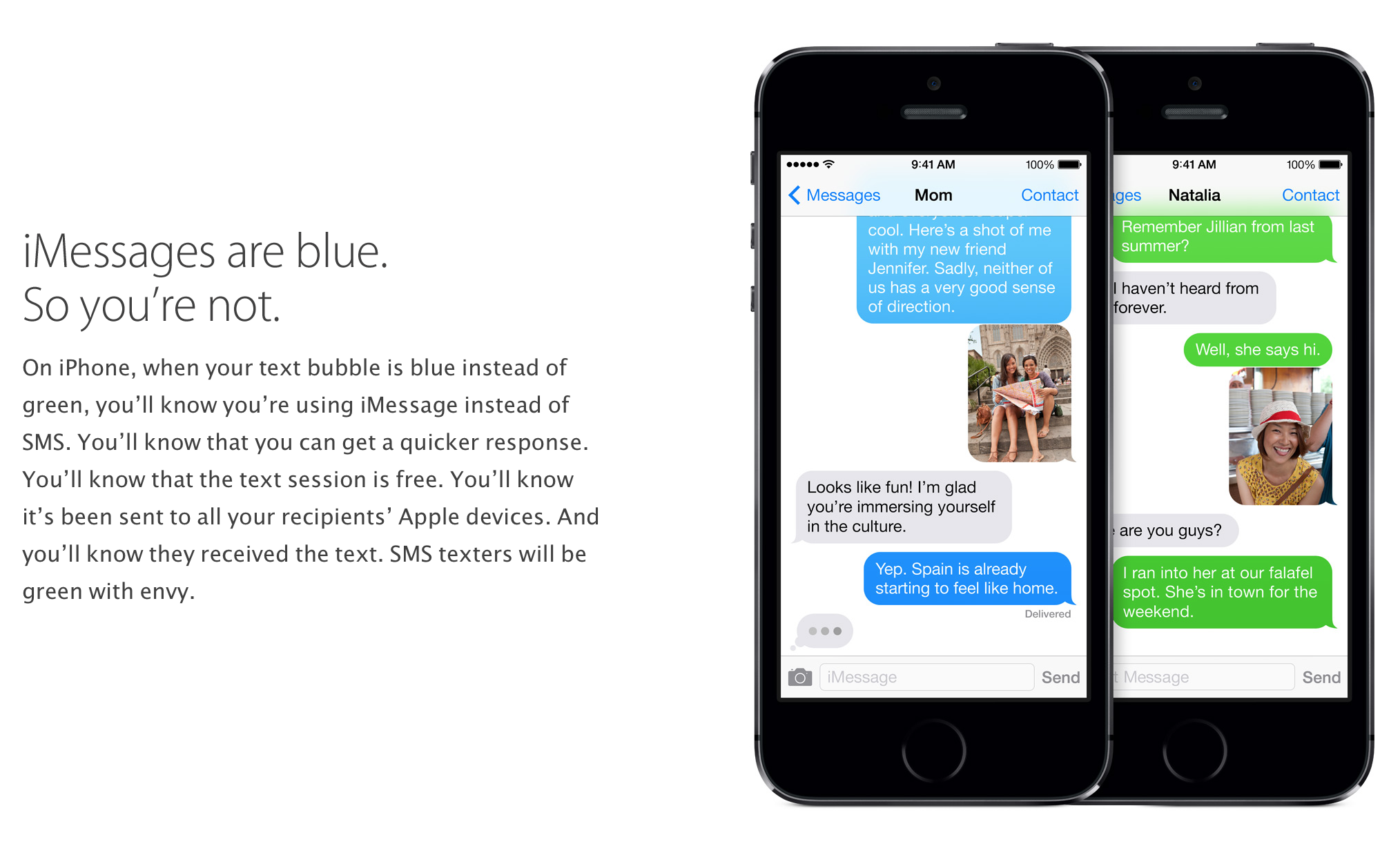
Google took to Twitter this weekend to complain that iMessage is just too darn influential with today’s kids. The company was responding to a Wall Street Journal report detailing the lock-in and social pressure Apple’s walled garden is creating among US teens. iMessage brands texts from iPhone users with a blue background and gives them additional features, while texts from Android phones are shown in green and only have the base SMS feature set. According to the article, „Teens and college students said they dread the ostracism that comes with a green text. The social pressure is palpable, with some reporting being ostracized or singled out after switching away from iPhones.“ Google feels this is a problem.
„iMessage should not benefit from bullying,“ the official Android Twitter account wrote. „Texting should bring us together, and the solution exists. Let’s fix this as one industry.“ Google SVP Hiroshi Lockheimer chimed in, too, saying, „Apple’s iMessage lock-in is a documented strategy. Using peer pressure and bullying as a way to sell products is disingenuous for a company that has humanity and equity as a core part of its marketing. The standards exist today to fix this.“
The „solution“ Google is pushing here is RCS, or Rich Communication Services, a GSMA standard from 2008 that has slowly gained traction as an upgrade to SMS. RCS adds typing indicators, user presence, and better image sharing to carrier messaging. It is a 14-year-old carrier standard, though, so it lacks many of the features you would want from a modern messaging service, like end-to-end encryption and support for non-phone devices. Google tries to band-aid over the aging standard with its „Google Messaging“ client, but the result is a lot of clunky solutions that don’t add up to a good modern messaging service.
Since RCS replaces SMS, Google has been on a campaign to get the industry to make the upgrade. After years of protesting, the US carriers are all onboard, and there is some uptake among the international carriers, too. The biggest holdout is Apple, which only supports SMS through iMessage.
Enlarge/ Apple’s green-versus-blue bubble explainer from its website.
Apple
Apple hasn’t ever publicly shot down the idea of adding RCS to iMessage, but thanks to documents revealed in the Epic v. Apple case, we know the company views iMessage lock-in as a valuable weapon. Bringing RCS to iMessage and making communication easier with Android users would only help to weaken Apple’s walled garden, and the company has said it doesn’t want that.
In the US, iPhones are more popular with young adults than ever. As The Wall Street Journal notes, „Among US consumers, 40% use iPhones, but among those aged 18 to 24, more than 70% are iPhone users.“ It credits Apple’s lock-in with apps like iMessage for this success.
Reaping what you sow
Google clearly views iMessage’s popularity as a problem, and the company is hoping this public-shaming campaign will get Apple to change its mind on RCS. But Google giving other companies advice on a messaging strategy is a laughable idea since Google probably has the least credibility of any tech company when it comes to messaging services. If the company really wants to do something about iMessage, it should try competing with it.
As we recently detailed in a 25,000-word article, Google’s messaging history is one of constant product startups and shutdowns. Thanks to a lack of product focus or any kind of top-down mandate from Google’s CEO, no division is really „in charge“ of messaging. As a consequence, the company has released 13 half-hearted messaging products since iMessage launched in 2011. If Google wants to look to someone to blame for iMessage’s dominance, it should start with itself, since it has continually sabotaged and abandoned its own plans to make an iMessage competitor.
Messaging is important, and even if it isn’t directly monetizable, a dominant messaging app has real, tangible benefits for an ecosystem. The rest of the industry understood this years ago. Facebook paid $22 billion to buy WhatsApp in 2014 and took the app from 450 million users to 2 billion users. Along with Facebook Messenger, Facebook has two dominant messaging platforms today, especially internationally. Salesforce paid $27 billion for Slack in 2020, and Tencent’s WeChat, a Chinese messaging app, is pulling in 1.2 billion users and yearly revenues of $5.5 billion. Snapchat is up to a $67 billion market cap, and Telegram is getting $40 billion valuations from investors. Google keeps trying ideas in this market, but it never makes an investment that is anywhere close to the competition.
Google once had a functional competitor to iMessage called Google Hangouts. Circa 2015, Hangouts was a messaging powerhouse; in addition to the native Hangouts messaging, it also supported SMS and Google Voice messages. Hangouts did group video calls five years before Zoom blew up, and it had clients on Android, iOS, the web, Gmail, and every desktop OS via a Chrome extension.
As usual, though, Google lacked any kind of long-term plan or ability to commit to a single messaging strategy, and Hangouts only survived as the „everything“ messenger for a single year. By 2016, Google moved on to the next shiny messaging app and left Hangouts to rot.
Even if Google could magically roll out RCS everywhere, it’s a poor standard to build a messaging platform on because it is dependent on a carrier phone bill. It’s anti-Internet and can’t natively work on webpages, PCs, smartwatches, and tablets, because those things don’t have SIM cards. The carriers designed RCS, so RCS puts your carrier bill at the center of your online identity, even when free identification methods like email exist and work on more devices. Google is just promoting carrier lock-in as a solution to Apple lock-in.
Despite Google’s complaining about iMessage, the company seems to have learned nothing from its years of messaging failure. Today, Google messaging is the worst and most fragmented it has ever been. As of press time, the company runs eight separate messaging platforms, none of which talk to each other: there is Google Messages/RCS, which is being promoted today, but there’s also Google Chat/Hangouts, Google Voice, Google Photos Messages, Google Pay Messages, Google Maps Business Messages, Google Stadia Messages, and Google Assistant Messaging. Those last couple of apps aren’t primarily messaging apps but have all ended up rolling their own siloed messaging platform because no dominant Google system exists for them to plug into.
The situation is an incredible mess, and no single Google product is as good as Hangouts was in 2015. So while Google goes backward, it has resorted to asking other tech companies to please play nice with it while it continues to fumble through an incoherent messaging strategy.
The iPhone maker cultivated iMessage as a must-have texting tool for teens. Android users trigger a just-a-little-less-cool green bubble: ‘Ew, that’s gross.’
Soon after 19-year-old Adele Lowitz gave up her AppleAAPL 0.51% iPhone 11 for an experimental go with an Android smartphone, a friend in her long-running texting group chimed in: “Who’s green?”
The reference to the color of group text messages—Android users turn Apple Inc.’s iMessage into green bubbles instead of blue—highlighted one of the challenges of her experiment. No longer did her group chats work seamlessly with other peers, almost all of whom used iPhones. FaceTime calls became more complicated and the University of Michigan sophomore’s phone didn’t show up in an app she used to find friends.
That pressure to be a part of the blue text group is the product of decisions by Apple executives starting years ago that have, with little fanfare, built iMessage into one of the world’s most widely used social networks and helped to cement the iPhone’s dominance among young smartphone users in the U.S.
How that happened came to light last year during Apple’s courtroom fight against “Fortnite” maker Epic Games Inc., which claimed the tech giant held an improper monopoly over distribution of apps onto the iPhone. As part of the battle, thousands of pages of internal records were made public. Some revealed a long-running debate about whether to offer iMessage on phones that run with Google’s Android operating system. Apple made a critical decision: Keep iMessage for Apple users only.
“In the absence of a strategy to become the primary messaging service for [the] bulk of cell phone users, I am concerned the iMessage on Android would simply serve to remove [an] obstacle to iPhone families giving their kids Android phones,” Craig Federighi, Apple’s chief software executive, said in a 2013 email. Three years later, then-marketing chief Phil Schiller made a similar case to Chief Executive Tim Cook in another email: “Moving iMessage to Android will hurt us more than help us,” he said. Another warning that year came from a former Apple executive who told his old colleagues in an email that “iMessage amounts to serious lock-in.”
When Adele Lowitz, left, experimented with using an Android smartphone instead of an iPhone, one friend asked: ‘Who’s green?’ PHOTO: STEVE KOSS FOR THE WALL STREET JOURNAL
From the beginning, Apple got creative in its protection of iMessage’s exclusivity. It didn’t ban the exchange of traditional text messages with Android users but instead branded those messages with a different color; when an Android user is part of a group chat, the iPhone users see green bubbles rather than blue. It also withheld certain features. There is no dot-dot-dot icon to demonstrate that a non-iPhone user is typing, for example, and an iMessage heart or thumbs-up annotation has long conveyed to Android users as text instead of images.
Apple later took other steps that enhanced the popularity of its messaging service with teens. It added popular features such as animated cartoon-like faces that create mirrors of a user’s face, to compete with messaging services from social media companies. Apple’s own survey of iPhone holders made public during the Epic Games litigation found that customers were particularly fond of replacing words with emojis and screen effects such as animated balloons and confetti. Avid teen users said in interviews with The Wall Street Journal that they also liked how they could create group chats with other Apple users that add and subtract participants without having to start a new chain.
How Apple’s iPhone and Apps Trap You in a Walled GardenYOU MAY ALSO LIKEUP NEXT 0:00 / 6:21 How Apple’s iPhone and Apps Trap You in a Walled GardenApple’s hardware, software and services work so harmoniously that it is often called a “walled garden.” The idea is central to recent antitrust scrutiny and the Epic vs. Apple case. WSJ’s Joanna Stern went to a real walled garden to explain it all. Photo illustration: Adele Morgan/The Wall Street Journal
The cultivation of iMessage is consistent with Apple’s broader strategy to tie its hardware, software and services together in a self-reinforcing world—dubbed the walled garden—that encourages people to pay the premium for its relatively expensive gadgets and remain loyal to its brand. That strategy has drawn scrutiny from critics and lawmakers as part of a larger examination of how all tech giants operate. Their core question: Do Apple and other tech companies create products that consumers simply find indispensable, or are they building near-monopolies that unfairly stifle competition?
Apple in its fight against Epic Games denied it held improper monopoly power in the smartphone market, pointing to intense competition globally with other phone makers and Android’s operating system. “With iMessage we built a great service that our users love and that is different from those offered by other platforms,” the company said in a statement.
Apple and other tech giants have long worked hard to get traction with young users, hoping to build brand habits that will extend into adulthood as they battle each other for control of everything from videogames to extended reality glasses to the metaverse. Globally, Alphabet Inc.’s Android operating system is the dominant player among smartphone users, with a loyal following of people who are vocal about their support. Among U.S. consumers, 40% use iPhones, but among those aged 18 to 24, more than 70% are iPhone users, according to Consumer Intelligence Research Partners’s most recent survey of consumers.
Shoppers at an Apple store in November.
PHOTO: NIYI FOTE/ZUMA PRESS
Apple is not the first tech company to come up with a must-have chat tool among young people, and such services sometimes struggle to stay relevant. BlackBerry and America Online were among the popular online communication forums of past decades that eventually lost ground to newer entrants.
Yet grabbing users so early in life could pay dividends for generations for Apple, already the world’s most valuable publicly traded company. It briefly crossed $3 trillion in market value for the first time on Jan. 3.
“These teenagers will continue to become consumers in the future and hopefully continue to buy phones into their 40s, 50s, 60s and 70s,” said Harsh Kumar, an analyst for Piper Sandler. The firm recently found that 87% of teens surveyed last year own iPhones.
Never date a green texter
Apple’s iMessage plays a significant role in the lives of young smartphone users and their parents, according to data and interviews with a dozen of these people. Teens and college students said they dread the ostracism that comes with a green text. The social pressure is palpable, with some reporting being ostracized or singled out after switching away from iPhones.
“In my circle at college, and in high school rolling over into college, most people have iPhones and utilize a lot of those kinds of iPhone specific features” together, said Ms. Lowitz, the Michigan student.
She said she came to realize that Apple had effectively created a social network of features that keeps users, such as her and others, locked in. “There was definitely some kind of pressure to get back to that,” she said.
Many of the new iMessage features—such as the 3D-like digital avatars known as memojis—exist fundamentally as a reason to own an iPhone and don’t make money for Apple directly. Last year Apple also made it possible to share FaceTime connections with Android users—a slight crack in Apple’s self-reinforcing ecosystem as video calling became more prevalent during the pandemic. In recent years, however, it has incorporated some moneymaking elements including Apple Pay and e-commerce links to other businesses such as Starbucks.
“We know that Apple users appreciate having access to innovative features like iCloud synching across all their Apple devices, Tapback and Memoji, as well as industry-leading privacy and security with end-to-end encryption—all of which make iMessage unique,” Apple said in a statement.Youthful ExuberanceThe share of Apple iPhones in the U.S. has swelleddramatically among young smartphone owners. Source: Consumer Intelligence Research PartnersNote: Annual survey conducted each September of 2,000 U.S. peoplewho purchased a smartphone in the previous 12 months. Age 18-24Older than 242014’15’16’17’18’19’20’2120304050607080%
Apple’s iMessage uses the internet to send text, video and photo messages, while iPhone users communicating with non-Apple users use old-school cellular channels such as SMS and MMS. Apple said its closed, encrypted system ensures messages are protected from hackers. Apple also disputes the idea that users are locked in to iMessage, saying users can easily switch to other smartphones.
A Google executive said Apple could make it easier for iMessage and Android users to communicate. “There are no real technical or product reasons for this issue,” Hiroshi Lockheimer, Google senior vice president of platforms and ecosystems, said. “The solutions already exist and we encourage Apple to join with the rest of the mobile industry in implementing them. We believe people should have the ability to connect with each other without artificial limits. It simply doesn’t have to be like this.” TECH NEWS BRIEFINGWhat Apple’s Texting App Tells Us About Its Strategy to Attract Users 00:00
IPhone users switch among a variety of apps to communicate. But if you use an iPhone, it is likely you’re also using iMessage. Apple’s internal research made public during the Epic Games litigation found that a survey of U.S. iPhone users, some as young as 14, overwhelmingly use iMessage. Among those who used an instant messaging app at least once a month, 85% of those surveyed said they used iMessage compared with 57% and 16% using Meta’s Facebook Messenger and WhatsApp, respectively, the Apple research showed. Meta’s messaging apps are widely used globally. WhatsApp, for example, topped 2 billion users in 2020.
In the pitched battle for messaging, Facebook executives in recent years became interested in capturing users at a younger age, according to documents reviewed by the Journal that formed the basis of a series of articles, called the Facebook Files, published in recent months.
One Facebook study, shared internally in 2019, aimed to understand why iMessage and SnapInc.’s Snapchat were the primary messaging apps for 10- to 13-year-olds. The research focused attention on a popular game played through iMessage called “Game Pigeon.”
The third-party game, acquired through Apple’s App Store and designed to operate in the messaging app, illustrates just one of the ways iMessages connects with young people. The game consists of users taking turns playing activities, such as checkers or word games, and allows for texting back-and-forth among players. “Game Pigeon” can’t be played between iPhone and Android users.
Miles Franklin, a longtime Android loyalist, was left out of rounds of a popular online game in high school. He switched to an iPhone two years ago.
PHOTO: MILES FRANKLIN
Facebook researchers concluded the appeal revolved around the social aspect of the games, helping younger people initiate conversations. “Game Pigeon generates amusement through digital interaction without the pressures of finding topics of conversation by enabling tweens to send games as content interactions and to use shared activities as a way to connect when they feel there is nothing to talk about,” according to the study.
Rounds of “Game Pigeon” in high school among friends were the first time Miles Franklin said he realized he was left out with his Android phone. “That’s my first taste of it,” said Mr. Franklin, now a 22-year-old senior at the University of Florida in Gainesville.
He said he long considered himself an Android loyalist going back to when he got his first phone at age 13 for his birthday. That changed, however, two years ago when he switched to an iPhone because he preferred it for making TikTok videos.
While it seems simple enough to shift to another messaging service, it isn’t in real life, according to Mr. Franklin. “I personally would do that,” he said. “But I’m not everyone else. I can’t convince other people to switch over to another app because they’re not gonna want to do that unless you’re really close to them.”
Grace Fang, 20-years-old, said she too saw such social dynamics among her peers at Wellesley College in Massachusetts. “I’ve had people with Androids apologize that they have Androids and don’t have iMessage,” she said. “I don’t know if it’s Apple propaganda or just like a tribal in-group versus out-group thing going on, but people don’t seem to like green text bubbles that much and seem to have this visceral negative reaction to it.” Ms. Fang added that she finds the hubbub silly and that she prefers to avoid texting all together.
‘I’ve had people with Androids apologize that they have Androids and don’t have iMessage,” said Grace Fang.
PHOTO: ASHLEY PANDYA
Jocelyn Maher, a 24-year-old master’s student in upstate New York, said her friends and younger sister have mocked her for exchanging texts with potential paramours using Android phones. “I was like, `Oh my gosh, his texts are green,’ and my sister literally went, `Ew that’s gross,’” Ms. Maher said.
She noted that she once successfully persuaded a boyfriend to switch to an iPhone after some gentle badgering. Their relationship didn’t last.
Such interactions have made fertile ground for memes on social media. During the pandemic, Jeremy Cangiano, who just finished up his MBA at the University of Massachusetts Lowell, dealt with his boredom on TikTok, quickly noticing that blue-bubble-green-bubble memes were popular among young people. He tried to cash in on it last year by selling his own merchandise that touted, “Never Date a Green Texter.”
‘Serious lock-in’
The blue iMessage bubble was born out of a simple engineering need, according to Justin Santamaria, a former Apple engineer who worked on the original feature. At first, Apple engineers just wanted to be able to easily identify iMessages when working with other texting formats as they developed their system, he said. The effect just stuck as it moved forward for consumer rollout.
“I had no idea that there would be a cachet or like, `Ugh green bubble conversations,’” he said. The idea that it would keep users locked in to using Apple devices wasn’t even part of the conversation at the time, he said.
The idea of opening iMessage to Android users arose in 2013, according to some of the internal records made public during the courtroom fight with Epic Games. As a market rumor circulated that Google was considering the acquisition of the popular messaging app WhatsApp, senior Apple executives discussed how such an acquisition might roil competition and how they might better compete.
Eddy Cue, who oversees Apple’s services business, told his colleagues he had some of his team investigating how to make iMessage available on Android phones, according to an email that surfaced as part of the Epic Games litigation. “We should go full speed and make this an official project,” he advised. “Google will instantly own messaging with this acquisition.”
SHARE YOUR THOUGHTS
How has the blue-green bubble battle played out in your own social circle? Join the conversation below.
Mr. Schiller, the executive who at the time oversaw marketing, wrote: “And since we make no money on iMessage what will be the point?” Mr. Cue responded: “Do we want to lose one of the most important apps in a mobile environment to Google? They have search, mail, free video and growing quickly in browsers. We have the best messaging app and we should make it the industry standard. I don’t know what ways we can monetize it but it doesn’t cost us a lot to run.”
Others weighed in. Mr. Federighi, Apple’s chief software executive, said in an email that he worried that making iMessage an option on Android could have a serious downside by removing an obstacle for iPhone families to get their children Android phones.
In the end, Google didn’t buy WhatsApp and Apple didn’t make its iMessage available to Android users. Facebook ultimately acquired WhatsApp in 2014 for $22 billion, ratcheting up competition with Apple.
In just a few years, the value of iMessage’s blue texts had become more clear to Apple execs. After an executive left the company and began using an Android, he wrote former colleagues in 2016 and said he had switched back to iPhones after just a few months.
His family resorted to using Facebook products to message him, former Apple Music executive Ian Rogers said in the email. “I missed a ton of messages from friends and family who all use iMessage and kept messaging me at my old address,” he wrote, adding that “iMessage amounts to serious lock-in.”
The note, which became public during Apple’s litigation with Epic Games, eventually made its way to Mr. Cook through then-marketing chief Mr. Schiller, who added his own two cents: “Moving iMessage to Android will hurt us more than help us, this email illustrates why.”
As for Ms. Lowitz, the Michigan college student, she was glad when her switch to Android—brought about by her participation in a paid research study—came to an end. She was ready to get back to her iPhone. “There’s too much within the Apple network for me to switch,” she said.
Anna Fuder, 19, a friend at Michigan who had declined to participate in the study for fear of giving up her iPhone, was overjoyed. “As soon as she switched back to her iPhone, it was like hallelujah,” Ms. Fuder said. “Blue again.
OneOne of our themes on Decoder is that basically everything is a computer now, and farming equipment like tractors and combines are no different. My guest this week is Jahmy Hindman, chief technology officer at John Deere, the world’s biggest manufacturer of farming machinery. And I think our conversation will surprise you.
Jahmy told me that John Deere employs more software engineers than mechanical engineers now, which completely surprised me. But the entire business of farming is moving toward something called precision agriculture, which means farmers are closely tracking where seeds are planted, how well they’re growing, what those plants need, and how much they yield.
The idea, Jahmy says, is to have each plant on a massive commercial farm tended with individual care — a process which requires collecting and analyzing a massive amount of data. If you get it right, precision agriculture means farmers can be way more efficient — they can get better crop yields with less work and lower costs.
But as Decoder listeners know by now, turning everything into computers means everything has computer problems now. Like all that farming data: who owns it? Where is it processed? How do you get it off the tractors without reliable broadband networks? What format is it in? If you want to use your John Deere tractor with another farming analysis vendor, how easy is that? Is it easy enough?
And then there are the tractors themselves — unlike phones, or laptops, or even cars, tractors get used for decades. How should they get upgraded? How can they be kept secure? And most importantly, who gets to fix them when they break?
John Deere is one of the companies at the center of a nationwide reckoning over the right to repair. Right now, tech companies like Samsung and Apple and John Deere all get to determine who can repair their products and what official parts are available.
And because these things are all computers, these manufacturers can also control the software to lock out parts from other suppliers. But it’s a huge deal in the context of farming equipment, which is still extremely mechanical, often located far away from service providers and not so easy to move, and which farmers have been repairing themselves for decades. In fact, right now the prices of older, pre-computerized tractors are skyrocketing because they’re easier to repair.
Half of the states in the country are now considering right to repair laws that would require manufacturers to disable software locks and provide parts to repair shops, and a lot of it is being driven — in a bipartisan way — by the needs of farmers.
John Deere is famously a tractor company. You make a lot of equipment for farmers, for construction sites, that sort of thing. Give me the short version of what the chief technology officer at John Deere does.
[As] chief technology officer, my role is really to try to set the strategic direction from a technology perspective for the company, across both our agricultural products as well as our construction, forestry, and road-building products. It’s a cool job. I get to look out five, 10, 15, 20 years into the future and try to make sure that we’re putting into place the pieces that we need in order to have the technology solutions that are going to be important for our customers in the future.
One of the reasons I am very excited to have you on Decoder is there are a lot of computer solutions in your products. There’s hardware, software, services that I think of as sort of traditional computer company problems. Do you also oversee the portfolio of technologies that [also] make combines more efficient and tractor wheels move faster?
We’ve got a centrally-organized technology stack organization. We call it the intelligent solutions group, and its job is really to do exactly that. It’s to make sure that we’re developing technologies that can scale across the complete organization, across those combines you referenced, and the tractors and the sprayers, and the construction products, and deploy that technology as quickly as possible.
One of the things The Verge wrestles with almost every day is the question of, “What is a computer?” We wrestle with it in very small and obvious ways — we argue about whether the iPad or an Xbox is a computer. Then you can zoom all the way out: we had Jim Farley, who’s the CEO of Ford, on Decoder a couple of weeks ago, and he and I talked about how Ford’s cars are effectively rolling computers now.
Is that how you see a tractor or a combine or construction equipment — that these are gigantic computers that have big mechanical functions as well?
They absolutely are. That’s what they’ve become over time. I would call them mobile sensor suites that have computational capability, not only on-board, but to your point, off-board as well. They are continuously streaming data from whatever it is — let’s say the tractor and the planter — to the cloud. We’re doing computational work on that data in the cloud, and then serving that information, those insights, up to farmers, either on their desktop computer or on a mobile handheld device or something like that.
As much as they are doing productive work in the field, planting as an example, they are also data acquisition and computational devices.
How much of that is in-house at John Deere? How big is the team that is building your mobile apps? Is that something you outsource? Is that something you develop internally? How have you structured the company to enable this kind of work?
We do a significant amount of that work internally. It might surprise you, we have more software development engineers today within Deere than we have mechanical design engineers. That’s kind of mind-blowing for a company that’s 184 years old and has been steeped in mechanical product development, but that’s the case. We do nearly all of our own internal app development inside the four walls of Deere.
That said, our data application for customers in the ag space, for example, is the Operations Center. We do utilize third parties. There’s roughly 184 companies that have been connected to Operations Center through encrypted APIs, that are writing applications against that data for the benefit of the customers, the farmers that want to use those applications within their business.
One of the reasons we’re always debating what a computer is and isn’t is that once you describe something as a computer, you inherit a bunch of expectations about how computers work. You inherit a bunch of problems about how computers work and don’t work. You inherit a bunch of control; API access is a way of exercising control over an ecosystem or an economy.
Have you shifted the way that John Deere thinks about its products? As new abilities are created because you have computerized so much of a tractor, you also increase your responsibility, because you have a bunch more control.
There’s no doubt. We’re having to think about things like security of data, as an example, that previously, 30 years ago, was not necessarily a topic of conversation. We didn’t have competency in it. We’ve had to become competent in areas like that because of exactly the point you’re making, that the product has become more computer-like than conventional tractor-like over time.
That leads to huge questions. You mentioned security. Looking at some of your recent numbers, you have a very big business in China. Thirty years ago, you would export a tractor to China and that’s the end of that conversation. Now, there’s a huge conversation about cybersecurity, data sharing with companies in China, down the line, a set of very complicated issues for a tractor company that 30 years ago wouldn’t have any of those problems. How do you balance all those out?
It’s a different set of problems for sure, and more complicated for geopolitical reasons in the case of China, as you mentioned. Let’s take security as an example. We have gone through the change that many technology companies have had to go through in the space of security, where it’s no longer bolted on at the end, it’s built in from the ground up. So it’s the security-by-design approach. We’ve got folks embedded in development organizations across the company that do nothing every day, other than get up and think about how to make the product more secure, make the datasets more secure, make sure that the data is being used for its intended purposes and only those.
Listen to Decoder, a new show hosted by The Verge’s Nilay Patel about big ideas — and other problems. Subscribe here!
That’s a new skill. That’s a skill that we didn’t have in the organization 20 years ago that we’ve had to create and hire the necessary talent in order to develop that skill set within the company at the scale that we need to develop it at.
Go through a very basic farming season with a John Deere combine and tractor. The farmer wakes up, they say, “Okay, I’ve got a field. I’ve got to plant some seeds. We’ve got to tend to them. Eventually, we’ve got to harvest some plants.” What are the points at which data is collected, what are the points at which it’s useful, and where does the feedback loop come in?
I’m going to spin it a little bit and not start with planting.
I’m going to tell you that the next season for a farmer actually starts at harvest of the previous season, and that’s where the data thread for the next season actually starts. It starts when that combine is in the field harvesting whatever it is, corn, soybeans, cotton, whatever. And the farmer is creating, while they’re running the combine through the field, a dataset that we call a yield map. It is geospatially referenced. These combines are running through the field on satellite guidance. We know where they’re at at any point in time, latitude, longitude, and we know how much they’re harvesting at that point in time.
So we create this three-dimensional map that is the yield across whatever field they happen to be in. That data is the inception for a winter’s worth of work, in the Northern hemisphere, that a farmer goes through to assess their yield and understand what changes they should make in the next season that might optimize that yield even further.
They might have areas within the field that they go into and know they need to change seeding density, or they need to change crop type, or they need to change how much nutrients they provide in the next season. And all of those decisions are going through their head because they [have] to seed in December, they have to order their nutrients in late winter. They’re making those plans based upon that initial dataset of harvest information.
And then they get into the field in the spring, to your point, with a tractor and a planter, and that tractor and planter are taking the prescription that the farmer developed with the yield data that they took from the previous harvest. They’re using that prescription to apply changes to that field in real time as they’re going through the field, with the existing data from the yield map and the data in real time that they’re collecting with the tractor to modify things like seeding rate, and fertilizer rate and all of those things in order to make sure that they’re minimizing the inputs to the operation while at the same time working to maximize the output.
That data is then going into the cloud, and they’re referencing it. For example, that track the tractor and the planter took through the field is being used to inform the sprayer. When the sprayer goes into the field after emergence, when the crops come out of the ground, it’s being used to inform that sprayer what the optimal path is to drive through the field in order to spray only what needs to be sprayed and no more, to damage the crop the least amount possible, all in an effort to optimize that productivity at the end of the year, to make that yield map that is [a] report card at the end of the year for the farmer, to make that turn out to have a better grade.
That’s a lot of data. Who collects it? Is John Deere collecting it? Can I hire a third-party SaaS software company to manage that data for me? How does that part work?
A significant amount of that data is collected on the fly while the machines are in the field, and it’s collected, in the case of Deere machines, by Deere equipment running through the field. There are other companies that create the data, and they can be imported into things like the Deere Operations Center so that you have the data from whatever source that you wanted to collect it from. I think the important thing there is historically, it’s been more difficult to get the data off the machine, because of connectivity limitations, into a database that you can actually do something with it.
Today, the disproportionate number of machines in large agriculture are connected. They’re connected through terrestrial cell networks. They’re streaming data bi-directionally to the cloud and back from the cloud. So that data connectivity infrastructure that’s been built out over the last decade has really enabled two-way communication, and it’s taken the friction out of getting the data off of a mobile piece of equipment. So it’s happening seamlessly for that operator. And that’s a benefit, because they can act on it then in more near real time, as opposed to having to wait for somebody to upload data at some point in the future.
Whose data is this? Is it the farmer’s data? Is it John Deere’s data? Is there a terms of service agreement for a combine? How does that work?
Certainly [there is] a terms of service agreement. Our position is pretty simple. It’s the farmer’s data. They control it. So if they want to share it through an API with somebody that is a trusted adviser from their perspective, they have the right to do that. If they don’t want to share it, they don’t have to do that. It is their data to control.
Is it portable? When I say there are “computer problems” here, can my tractor deliver me, for example, an Excel file?
They certainly can export the data in form factors that are convenient for them, and they do. Spreadsheet math is still routinely done on the farm, and then [they can] utilize the spreadsheet to do some basic data analytics if they want. I would tell you, though, that what’s happening is that the amount of data that is being collected and curated and made available to them to draw insights from is so massive that while you can still use spreadsheets to manipulate some of it, it’s just not tractable in all cases. So that’s why we’re building functionality into things like the Operations Center to help do data analytics and serve up insights to growers.
It’s their data. They can choose to look at the insights or not, but we can serve those insights up to them, because the data analysis part of this problem is becoming significantly larger because the datasets are so complex and large, not to mention the fact that you’ve got more data coming in all the time. Different sensors are being applied. We can measure different things. There [are] unique pieces of information that are coming in and routinely building to overall ecosystems of data that they have at their disposal.
We’ve talked a lot about the feedback loop of data with the machinery in particular. There’s one really important component to this, which is the seeds. There are a lot of seed manufacturers out in the world. They want this data. They have GMO seeds, they can adjust the seeds to different locations. Where do they come into the mix?
The data, from our perspective, is the farmer’s data. They’re the ones who are controlling the access to it. So if they want to share their data with someone, they have that ability to do it. And they do today. They’ll share their yield map with whoever their local seed salesman is and try to optimize the seed variety for the next planting season in the spring.
So that data exists. It’s not ours, so we’re not at liberty to share it with seed companies, and we don’t. It has to come through the grower because it’s their productivity data. They’re the ones that have the opportunity to share it. We don’t.
You do have a lot of data. Maybe you can’t share it widely, but you can aggregate it. You must have a very unique view of climate change. You must see where the foodways are moving, where different kinds of crops are succeeding and failing. What is your view of climate change, given the amount of data that you’re taking in?
The reality is for us that we’re hindered in answering that question by the recency of the data. So, broad-scale data acquisition from production agriculture is really only a five- to 10-year-old phenomenon. So the datasets are getting richer. They’re getting better.
We have the opportunity to see trends in that data across the datasets that exist today, but I think it’s too early. I don’t think the data is mature enough yet for us to be able to draw any conclusions from a climate change perspective with respect to the data that we have.
The other thing that I’ll add is that the data intensity is not universal across the globe. So if you think of climate change on a global perspective, we’ve got a lot of data for North America, a fair amount of data that gets taken by growers in Europe, a little bit in South America, but it’s not rich enough across the global agricultural footprint for us to be able to make any sort of statements about how climate change is impacting it right now.
Is that something you’re interested in doing?
Yes. I couldn’t predict when, but I think that the data will eventually be rich enough for insights to be drawn from it. It’s just not there yet.
Do you think about doing a fully electric tractor? Is that in your technology roadmap, that you’ve got to get rid of these diesel engines?
You’ve got to be interested in EVs right now. And the answer is yes. Whether it’s a tractor or whether it’s some other product in our product line, alternative forms of propulsion, alternative forms of power are definitely something that we’re thinking about. We’ve done it in the past with, I would say, hybrid solutions like a diesel engine driving an electric generator, and then the rest of the machine being electrified from a propulsion perspective.
But we’re just getting to the point now where battery technology, lithium-ion technology, is power-dense enough for us to see it starting to creep into our portfolio. Probably from the bottom up. Lower power density applications first, before it gets into some of the very large production ag equipment that we’ve talked about today.
What’s the timeline to a fully EV combine, do you think?
I think it’ll be a long time for a combine.
I picked the biggest thing I could, basically.
It has got to run 14, 15, 16 hours per day. It’s got a very short window to run in. You can’t take all day to charge it. Those sorts of problems, they’re not insurmountable. They’re just not solved by anything that’s on the roadmap today, from a lithium-ion perspective, anyway.
You and I are talking two days after Apple had its developers’ conference. Apple famously sells hardware, software, services, as an integrated solution. Do you think of John Deere’s equipment as integrated suites of hardware, software, and services, or is it a piece of hardware that spits off data, and then maybe you can buy our services, or maybe buy somebody else’s services?
I think it’s most efficient when we think of it collectively as a system. It doesn’t have to be that way, and one of the differences I would say to an Apple comparison would be the life of the product, the iron product in our case, the tractor or the combine, is measured in decades. It may be in service for a very long time, and so we have to take that into account as we think about the technology [and] apps that we put on top of it, which have a much shorter shelf life. They’re two, three, four, five years, and then they’re obsolete, and the next best thing has come along.
We have to think about the discontinuity that occurs between product buy cycles as a consequence of that. I do think it’s most efficient to think of it all together. It isn’t always necessarily that way. There are lots of farmers that run multi-colored fleets. It’s not Deere only. So we have to be able to provide an opportunity for them to get data off of whatever their product is into the environment that best enables them to make good decisions from it.
Is that how you characterize the competition, multi-colored fleets?
Absolutely, for sure. I would love the world to be completely [John Deere] green, but it’s not quite that way.
On my way to school every day in Wisconsin growing up, I drove by a Case plant. They’re red. John Deere is famously green, Case is red, International Harvester is yellow.
Yep. Case is red, Deere is green, and then there’s a rainbow of colors outside of those two for sure.
Who are your biggest competitors? And are they adopting the same business model as you? Is this an iOS versus Android situation, or is it widely different?
Our traditional competitors in the ag space, no surprise, you mentioned one of them. Case New Holland is a great example. AGCO would be another. I think everybody’s headed down the path of precision agriculture. [It’s] the term that is ubiquitous for where the industry’s headed.
I’m going to paint a picture for you: It’s this idea of enabling each individual plant in production agriculture to be tended to by a master gardener. The master gardener is in this case probably some AI that is enabling a farmer to know exactly what that particular plant needs, when it needs it, and then our equipment provides them the capability of executing on that plan that master gardener has created for that plant on an extremely large scale.
You’re talking about, in the case of corn, for example, 50,000 plants per acre, so a master gardener taking care of 50,000 plants for every acre of corn. That’s where this is headed, and you can picture the data intensity of that. Two hundred million acres of corn ground, times 50,000 plants per acre; each one of those plants is creating data, and that’s the enormity of the scale of production agriculture when you start to get to this plant-by-plant management basis.
Let’s talk about the enormity of the data and the amount of computation — that’s in tension with how long the equipment lasts. Are you upgrading the computers and the tractors every year, or are you just trying to pull the data into your cloud where you can do the intense computation you want to do?
It’s a combination of both, I would tell you. There are components within the vehicles that do get upgraded from time to time. The displays and the servers that operate in the vehicles do go through upgrade cycles within the existing fleet.
There’s enough appetite, Nilay, for technology in agriculture that we’re also seeing older equipment get updated with new technology. So it’s not uncommon today for a customer who’s purchased a John Deere planter that might be 10 years old to want the latest technology on that planter. And instead of buying a new planter, they might buy the upgrade kit for that planter that allows them to have the latest technology on the existing planter that they own. That sort of stuff is happening all the time across the industry.
I would tell you, though, that what is maybe different now versus 10 years ago is the amount of computation that happens in the cloud, to serve up this enormity of data in bite-sized forms and in digestible pieces that actually can be acted upon for the grower. Very little of that is done on-board machines today. Most of that is done off-board.
We cover rural broadband very heavily. There’s some real-time data collection happening here, but what you’re really talking about is that at the end of a session you’ve got a big asynchronous dataset. You want to send it off somewhere, have some computation done to it, and brought back to you so you can react to it.
What is your relationship to the connectivity providers, or to the Biden administration, that is trying to roll out a broadband plan? Are you pushing to get better networks for the next generation of your products, or are you kind of happy with where things are now?
We’re pro-rural broadband, and in particular newer technologies, 5G as an example. And it’s not just for agricultural purposes, let’s just be frank. There’s a ton of benefits that accrue to a society that’s connected with a sufficient network to do things like online schooling, in particular, coming through the pandemic that we’re in the midst of, and hopefully on the tail end of here. I think that’s just highlighted the use cases for connectivity in rural locations.
Agriculture is but one of those, but there’s some really cool feature unlocks that better connectivity, both in terms of coverage and in terms of bandwidth and latency, provide in agriculture. I’ll give you an example. You think of 5G and the ability to get to incredibly low latency numbers. It allows us to do some things from a computational perspective on the edge of the network that today we don’t have the capability to do. We either do it on-board the machine, or we don’t do it at all. So things like serving up the real-time location of where a farmer’s combine is, instead of having to route that data all the way to the cloud and then back to a handheld device that the farmer might have, wouldn’t it be great if we could do that math on the edge and just ping tower to tower and serve it back down and do it really, really quickly. Those are the sorts of use cases that open up when you get to talking about not just connectivity rurally, but 5G specifically, that are pretty exciting.
Are the networks in place to do all the things you want to do?
Globally, the answer is no. Within the US and Canadian markets, coverage improves every day. There are towers that are going up every day and we are working with our terrestrial cell coverage partners across the globe to expand coverage, and they’re responding. They see, generally, the need, in particular with respect to agriculture, for rural connectivity. They understand the power that it can provide [and] the efficiency that it can derive into food production globally. So they are incentivized to do that. And they’ve been good partners in this space. That said, they recognize that there are still gaps and there’s still a lot of ground to cover, literally in some cases, with connectivity solutions in rural locations.
You mentioned your partners. The parallels to a smartphone here are strong. Do you have different chipsets for AT&T and Verizon? Can you activate your AT&T plan right from the screen in the tractor? How does that work?
AT&T is our dominant partner in North America. That is our go-to, primarily from a coverage perspective. They’re the partner that we’ve chosen that I think serves our customers the best in the most locations.
Do you get free HBO Max if you sign up?
[laughs] Unfortunately, no.
They’re putting it everywhere. You have no idea.
For sure.
I look at the broadband gap everywhere. You mentioned schooling. We cover these very deep consumer needs. On the flip side, you need to run a lot of fiber to make 5G work, especially with the low latency that you’re talking about. You can’t have too many nodes in the way. Do you support millimeter wave 5G on a farm?
Yeah, it is something we’ve looked at. It’s intriguing. How you scale it is the question. I think if we could crack that nut, it would be really interesting.
Just for listeners, an example of millimeter wave if you’re unfamiliar — you’re standing on just the right street corner in New York City, you could get gigabit speeds to a phone. You cross the street, and it goes away. That does not seem tenable on a farm.
That’s right. Not all data needs to be transmitted at the same rate. Not to cover the broad acreage, but you can envision a case where potentially, when you come into range of millimeter wave, you dump a bunch of data all at once. And then when you’re out of range, you’re still collecting data and transmitting it slower perhaps. But having the ability to have millimeter wave type of bandwidth is pretty intriguing for being able to take opportunistic advantage of it when it’s available.
What’s something you want to do that the network isn’t there for you to do yet?
I think that the biggest piece is just a coverage answer from my perspective. We intentionally buffer data on the vehicle in places where we don’t have great coverage in order to wait until that machine has coverage, in order to send the data. But the reality is that means that a grower is waiting in some cases 30 minutes or an hour until the data is synced up in the cloud and something actionable has been done with it and it’s back down to them. And by that point in time, the decision has already been made. It’s not useful because it’s time sensitive. I think that’s probably the biggest gap that we have today. It’s not universal. It happens in pockets and in geographies, but where it happens, the need is real. And those growers don’t benefit as much as growers that do have areas of good coverage.
Is that improvement going as fast as you’d like? Is that a place where you’re saying to the Biden administration, whoever it might be, “Hey, we’re missing out on opportunities because there aren’t the networks we need to go faster.”
It is not going as fast as we would like, full stop. We should be moving faster in that space. Just to tease the thought out a little bit, maybe it’s not just terrestrial cell. Maybe it’s Starlink, maybe it’s a satellite-based type of infrastructure that provides that coverage for us in the future. But it’s certainly not moving at a pace that’s rapid enough for us, given the appetite for data that growers have and what they’ve seen as an ability for that data to significantly optimize their operations.
Have you talked to the Starlink folks?
We have.It’s super interesting. It’s an intriguing idea. The question for us is a mobile one. All of our devices are mobile. Tractors are driving around a field, combines are driving around a field. You get into questions around, what does the receiver need to look like in order to make that work? It’s an interesting idea at this point. I’m ever the optimist, glass-half-full sort of person. I think it’s conceivable that in the not too distant future, that could be a very viable option for some of these locations that are underserved with terrestrial connectivity today.
Walk me through the pricing model of a tractor. These things are very expensive. They’re hundreds of thousands of dollars. What is the recurring cost for an AT&T plan necessary to run that tractor? What is the recurring cost for your data services that you provide? How does that all break down?
Our data services are free today, interestingly enough. Free in the sense [of] the hosting of the data in the cloud and the serving up of that data through Operations Center. If you buy a piece of connected Deere equipment, that service is part of your purchase. I’ll just put it that way.
The recurring expense on the consumer side of things for the connectivity is not unlike what you would experience for a cell phone plan. It’s pretty similar. The difference is for large growers, it’s not just a single cell phone.
They might have 10, 15, 20 devices that are all connected. So we do what we can to make sure that the overhead associated with all of those different connected devices is minimized, but it’s not unlike what you’d experience with an iPhone or an Android device.
Do you have large growers in pockets where the connectivity is just so bad, they’ve had to resort to other means?
We have a multitude of ways of getting data off of mobile equipment. Cell is but one. We’re also able to take it off with Wi-Fi, if you can find a hotspot that you can connect to. Growers also routinely use a USB stick, when all else fails, that works regardless. So we make it possible no matter what their connectivity situation is to get the data off.
But to the point we already talked about, the less friction you’ve got in that system to get the data off, the more data you end up pushing. The more data you push, the more insights you can generate. The more insights you generate, the more optimal your operation is. So to the extent that you don’t have cell connectivity, we do see the intensity of the data usage, it tracks with connectivity.
So if your cloud services are free with the purchase of a connected tractor, is that built into the price or the lease agreement of the tractor for you on your P&L? You’re just saying, “We’re giving this away for free, but baking it into the price.”
Yep.
Can you buy a tractor without that stuff for cheaper?
You can buy products that aren’t connected that do not have a telematics gateway or the cell connection, absolutely. It is uncommon, especially in large ag. I would hesitate to throw a number at you at what the take rate is, but it’s standard equipment in all of our large agricultural products. That said, you can still get it without that if you need to.
How long until these products just don’t have steering wheels and seats and Sirius radios in them? How long until you have a fully autonomous farm?
I love that question. [With] a fully autonomous farm, you’ve got to draw some boundaries around it in order to make it digestible. I think we could have fully autonomous tractors in low single digit years. I’ll leave it a little bit gray just to let the mind wander a little bit.
Taking the cab completely off the tractor, I think, is a ways away, only because the tractor gets used for lots of things that it may not be programmed for, from an autonomous perspective, to do. It’s sort of a Swiss Army knife in a farm environment. But that operatorless operation in, say, fall tillage or spring planting, we’re right on the doorstep of that. We’re knocking on the door of being able to do it.
It’s due to some really interesting technology that’s come together all in one place at one time. It’s the confluence of high capability-compute onboard machines. So we’re putting GPUs on machines today to do vision processing that would blow your mind. Nvidia GPUs are not just for the gaming community or the autonomous car community. They’re happening on tractors and sprayers and things too. So that’s one stream of technology that’s coming together with advanced algorithms. Machine learning, reinforcement learning, convolutional neural networks, all of that going into being able to mimic the human sight capability from a mechanical and computational perspective. That’s come together to give us the ability to start seriously considering taking an operator out of the cab of the tractor.
One of the things that is different, though, for agriculture versus maybe the on-highway autonomous cars, is that tractors don’t just go from point A to point B. Their mission in life is not just to transport. It’s to do productive work. They’re pulling a tillage tool behind them or pulling a planter behind them planting seed. So we not only have to be able to automate the driving of the tractor, but we have to automate the function that it’s doing as well, and make sure that it’s doing a great job of doing the tillage operation that normally the farmer would be observing in the cab of the tractor. Now we have to do that and be able to ascertain whether or not that job quality that’s happening as a consequence of the tractor going through the field is meeting the requirements or not.
What’s the challenge there?
I think it’s the variety of jobs. In this case, let’s take the tractor example again — it’s not only is it doing the tillage right with this particular tillage tool, but a farmer might use three or four different tillage tools in their operation. They all have different use cases. They all require different artificial intelligence models to be trained and to be validated. So scaling out across all of those different conceivable operations, I think is the biggest challenge.
You mentioned GPUs. GPUs are hard to get right now.
It’s impacting us. Weekly, I’m in conversations with semiconductor manufacturers trying to get the parts that we need. It is an ongoing battle. We had thought probably six or seven months ago, like everybody else, that it would be relatively short-term. But I think we’re into this for the next 12 to 18 months. I think we’ll come out of it as capacity comes online, but it’s going to take a little while before that happens.
I’ve talked to a few people about the chip shortage now. The best consensus I’ve gotten is that the problem isn’t at the state of the art. The problem is with older process nodes — five or 10-year-old technology. Is that where the problem is for you as well or are you thinking about moving beyond that?
It’s most acute with older tech. So we’ve got 16-bit chipsets that we’re still working with on legacy controllers that are a pain point. But that said, we’ve also got some really recent, modern stuff that is also a pain point. I was where your head is at three months ago. And then in the three months since, we’ve felt the pain everywhere.
When you say 18 months from now, is that you think there’s going to be more supply or you think the demand is going to tail off?
Supply is certainly coming online. [The] semiconductor industry is doing the right thing. They’re trying to bring capacity online to meet the demand. I would argue it’s just a classic bullwhip effect that’s happened in the marketplace. So I think that will happen. I think there’s certainly some behavior in the industry at the moment around what the demand side is. That’s made it hard for semiconductor manufacturers to understand what real demand is because there’s a panic situation in some respects in the marketplace at the moment.
That said, I think it’s clear there’s only one direction that semiconductor volume is going, and it’s going up. Everything is going to demand it moving forward and demand more of it. So I think once we work through the next 12 to 18 months and work through this sort of immediate and near-term issue, the semiconductor industry is going to have a better handle on things, but capacity has to go up in order to meet the demand. There’s no doubt about it. A lot of that demand is real.
Are you thinking, “Man, I have these 16-bit systems. We should rearchitect things to be more modular, to be more modern, and faster,” or are you saying, “Supply will catch up”?
No, very much the former. I would say two things. One, more prevalent in supply for sure. And then the second one is, easier to change when we need to change. There’s some tech debt that we’re continuing to battle against and pay off over time. And it’s times like these when it rises to the surface and you wish you’d made decisions a little bit differently 10 years ago or five years ago.
My father-in-law, my wife’s cousins, are all farmers up and down. A lot of John Deere hats in my family. I texted them all and asked what they wanted to know. All of them came back and said “right to repair” down the line. Every single one of them. That’s what they asked me to ask you about.
I set up this whole conversation to talk about these things as computers. We understand the problems of computers. It is notable to me that John Deere and Apple had the same effective position on right to repair, which is, we would prefer if you didn’t do it and you let us do it. But there’s a lot of pushback. There are right-to-repair bills in an ever-growing number of states. How do you see that playing out right now? People want to repair their tractors. It is getting harder and harder to do it because they’re computers and you control the parts.
It’s a complex topic, first and foremost. I think the first thing I would tell you is that we have and remain committed to enabling customers to repair the products that they buy. The reality is that 98 percent of the repairs that customers want to do on John Deere products today, they can do. There’s nothing that prohibits them from doing them. Their wrenches are the same size as our wrenches. That all works. If somebody wants to go repair a diesel engine in a tractor, they can tear it down and fix it. We make the service manuals available. We make the parts available, we make the how-to available for them to tear it down to the ground and build it back up again.
That is not really what I’ve heard. I hear that a sensor goes off, the tractor goes into what people call “limp mode.” They have to bring it into a service center. They need a John Deere-certified laptop to pull the codes and actually do that work.
The diagnostic trouble codes are pushed out onto the display. The customer can see what those diagnostic trouble codes are. They may not understand or be able to connect what that sensor issue is with a root cause. There may be an underlying root cause that’s not immediately obvious to the customer based upon the fault code, but the fault code information is there. There is expertise that exists within the John Deere dealer environment, because they’ve seen those issues over time that allows them to understand what the probable cause is for that particular issue. That said, anybody can go buy the sensor. Anybody can go replace it. That’s just a reality.
There is, though, this 2 percent-ish of the repairs that occur on equipment today [that] involve software. And to your point, they’re computer environments that are driving around on wheels. So there is a software component to them. Where we differ with the right-to-repair folks is that software, in many cases, it’s regulated. So let’s take the diesel engine example. We are required, because it’s a regulated emissions environment, to make sure that diesel engine performs at a certain emission output, nitrous oxide, particulate matter, etc., and so on. Modifying software changes that. It changes the output characteristics of the emissions of the engine and that’s a regulated device. So we’re pretty sensitive to changes that would impact that. And disproportionately, those are software changes. Like going in and changing governor gain scheduling, for example, on a diesel engine would have a negative consequence on the emissions that [an] engine produces.
The same argument would apply in brake-by-wire and steer-by-wire. Do you really want a tractor going down the road with software on it that has been modified for steering or modified for braking in some way that might have a consequence that nobody thought of? We know the rigorous nature of testing that we go through in order to push software out into a production landscape. We want to make sure that that product is as safe and reliable and performs to the intended expectations of the regulatory environment that we operate in.
But people are doing it anyway. That’s the real issue here. Again, these are computer problems. This is what I hear from Apple about repairing your own iPhone. Here’s the device with all your data on it that’s on the network. Do you really want to run unsupported software on it? The valence of the debate feels the same to me.
At the same time though, is it their tractor or is it your tractor? Shouldn’t I be allowed to run whatever software I want on my computer?
I think the difference with the Apple argument is that the iPhone isn’t driving down the road at 20 miles an hour with oncoming traffic coming at it. There’s a seriousness of the change that you could make to a product. These things are large. They cost a lot of money. It’s a 40,000-pound tractor going down the road at 20 miles an hour. Do you really want to expose untested, unplanned, unknown introductions of software into a product like that that’s out in the public landscape?
But they were doing it mechanically before. Making it computerized allows you to control that behavior in a way that you cannot on a purely mechanical tractor. I know there are a lot of farmers who did dumb stuff with their mechanical tractors and that was just part of the ecosystem.
Sure. I grew up on one of those. I think the difference there is that the system is so much more complicated today, in part because of software, that it’s not always evident immediately if I make a change here, what it’s going to produce over there. When it was all mechanical, I knew, if I changed the size of the tires or the steering linkage geometry, what was going to happen. I could physically see it and the system was self-contained because it was a mechanical-only system.
I think when we’re talking about a modern piece of equipment and the complexity of the system, it’s a ripple effect. You don’t know what a change that you make over here is going to impact over there any longer. It’s not intuitively obvious to somebody who would make a change in isolation to software, for example, over here. It is a tremendously complex problem. It’s one that we’ve got a tremendously large organization that’s responsible for understanding that complete system and making sure that when the product is produced, that it is reliable and it is safe and it does meet emissions and all of those things.
I look at some of the coverage and there are farmers who are downloading software of unknown provenance that can hack around some of the restrictions. Some of that software appears to be coming from groups in the Ukraine. They’re now using other software to get around the restrictions that, in some cases, could make it even worse, and lead to other unintended consequences, whereas providing the opportunities or making that more official might actually solve some of those problems in a more straightforward way.
I think we’ve taken steps to try to help. One of those is customer service. Service Advisor is the John Deere software that a dealership would use in order to diagnose and troubleshoot equipment. We’ve made available the customer version of Service Advisor as well in order to provide some of the ability for them to have insights — to your point about fault codes before — insights into what are those issues, and what can I learn about them as a customer? How might I go about fixing them? There have been efforts underway in order to try to bridge some of that gap to the extent possible.
We are, though, not in a position where we would ever condone or support a third-party software being put on products of ours, because we just don’t know what the consequences of that are going to be. It’s not something that we’ve tested. We don’t know what it might make the equipment do or not do. And we don’t know what the long-term impacts of that are.
I feel like a lot of people listening to the show own a car. I’ve got a pickup truck. I can go buy a device that will upload a new tune for my Ford pickup truck’s engine. Is that something you can do to a John Deere tractor?
There are third-party outfits that will do exactly that to a John Deere engine. Yep.
But can you do that yourself?
I suspect if you had the right technical knowledge, you could probably figure out a way to do it yourself. If a third-party company figured it out, there is a way for a consumer to do it too.
Where’s the line? Where do you think your control of the system ends and the consumer’s begins? I ask that because I think that might be the most important question in computing right now, just broadly across every kind of computer in our lives. At some point, the manufacturer is like, “I’m still right here with you and I’m putting a line in front of you.” Where’s your line?
We talked about the corner cases, the use cases I think that for us are the lines. They’re around the regulated environment from an emissions perspective. We’ve got a responsibility when we sell a piece of equipment to make sure that it’s meeting the regulatory environment that we sold it into. And then I think the other one is in and around safety, critical systems, things that they can impact others in the environment that, again, in a regulated fashion, we have a responsibility to produce a product that meets the requirements that the regulatory environment requires.
Not only that, but I think there’s a societal responsibility, frankly, that we make sure that the product is as safe as it can be for as long as it can be in operation. And those are where I think we spend a lot of time talking about what amounts to a very small part of the repair of a product. The statistics are real: 98 percent of the repairs that happen on a product can be done by a customer today. So we’re talking about a very small number of them, but they tend to be around those sort of sensitive use cases, regulatory and safety.
Right to Repair legislation is very bipartisan. You’re talking about big commercial operations in a lot of states. It’s America. It’s apple pie and corn farmers. They have a lot of political weight and they’re able to make a very bipartisan push, which is pretty rare in this country right now. Is that a signal you see as, “Oh man, if we don’t get this right, the government is coming for our products?”
I think the government’s certainly one voice in this, and it’s stemming from feedback from some customers. Obviously you’ve done your own bit of work across the farmers in your family. So it is a topic that is being discussed for sure. And we’re all in favor of that discussion, by the way. I think that what we want to make sure of is that it’s an objective discussion. There are ramifications across all dimensions of this. We want to make sure that those are well understood, because it’s such an important topic and has significant enough consequences, so we want to make sure we get it right. The unintended consequences of this are not small. They will impact the industry, some of them in a negative way. And so we just want to make sure that the discussion is objective.
The other signal I’d ask you about is that prices of pre-computer tractors are skyrocketing. Maybe you see that a different way, but I’m looking at some coverage that says old tractors, pre-1990 tractors, are selling for double what they were a year or two ago. There are incredible price hikes on these old tractors. And that the demand is there because people don’t want computers in their tractors. Is that a market signal to you, that you should change the way your products work? Or are you saying, “Well, eventually those tractors will die and you won’t have a choice except to buy one of the new products”?
I think the benefits that accrue from technology are significant enough for consumers. We see this happening with the consumer vote by dollar, by what they purchase. Consumers are continuing to purchase higher levels of technology as we go on. So while yes, the demand for older tractors has gone up, in part it’s because the demand for tractors has gone up completely. Our own technology solutions, we’ve seen upticks in take rates year over year over year over year. So if people were averse to technology, I don’t think you’d see that. At some point we have to recognize that the benefits that technology brings outweigh the downsides of the technology. I think that’s just this part of the technology adoption curve that we’re all on.
That’s the same conversation around smartphones. I get it with smartphones. Everyone has them in their pocket. They collect all this personal data. You may want a gatekeeper there because you don’t have a sophisticated user base.
Your customers are very self-interested, commercial customers.
Yep.
Do you think you have a different kind of responsibility than, I don’t know, the Xbox Live team has to the Xbox Live community? In terms of data, in terms of control, in terms of relinquishing control of the product once it’s sold.
It certainly is a different market. It’s a different customer base. It’s a different clientele. To your point, they are dependent upon the product for their livelihood. So we do everything we can to make sure that product is reliable. It produces when it needs to produce in order to make sure that their businesses are productive and sustainable. I do think the biggest difference from the consumer market that you referenced to our market is the technology life cycle that we’re on.
You brought up tractors that are 20 years old that don’t have a ton of computers on-board versus what we have today. But what we have today is significantly more efficient than what we had 20 years ago. The tractors that you referenced are still in the market. People are still using them. They’re still putting them to work, productive work. In fact, on my family farm, they’re still being used for productive work. And I think that’s what’s different between the consumer market and the ag market. We don’t have a disposable product. You don’t just pick it up and throw it away. We have to be able to plan for that technology use across decades as opposed to maybe single-digit years.
In terms of the benefits of technology and selling that through, one of the other questions I got from the folks in my family was about the next thing that technology can enable. It seems like the equipment can’t physically get much bigger. The next thing to tackle is speed — making things faster for increased productivity.
Is that how you think about selling the benefits of technology — now the combine is as big as it can be, and it’s efficient at this massive scale. Is the next step to make it more efficient in terms of speed?
You’ve seen the industry trend that way. You look at planting as a great example. Ten years ago, we planted at three miles an hour. Today, we plant at 10 miles an hour. And what enabled that was technology. It was electric motors on row units that can react really, really quickly, that are highly controllable and can place seed really, really accurately, right? I think that’s the trend. Wisconsin’s a great place to talk about it. Whether it’s a row crop farm, there’s a small window in the spring, a couple of weeks, where it’s optimal to get those crops in the ground. And so it’s an insurance policy to be able to go faster because the weather may not be great for both of those weeks that you’ve got that are optimal planning weeks. And so you may only have three days or four days in that 10-day window in order to plant all your crops.
And speed is one way to make sure that that happens. Size and the width of the machine is the other. I would agree that we’ve gotten to the point where there’s very little opportunity left in going bigger, and so going faster and, I would argue, going more intelligently, is the way that you improve productivity in the future.
So we’ve talked about a huge set of responsibilities, everything from the physical mechanical design of the machinery to building cloud services, to geopolitics. What is your decision-making process? What’s your framework for how you make decisions?
I think at the root of it, we try to drive everything back to a customer and what we can do to make that customer more productive and more sustainable. And that helps us triage. Of all the great ideas that are out there, all the things that we could work on, what are the things that can move the needle for a customer in their operation as much as possible? And I think that grounding in the customer and the customer’s business is important because, fundamentally, our business is dependent upon the farmer’s business. If the farmer does well, we do well. If the farmer doesn’t do well, we don’t do well. We’re intertwined. There’s a connection there that you can’t and shouldn’t separate.
So driving our decision-making process towards having an intimate knowledge of the customer’s business and what we can do to make their business better frames everything we do.
What’s next for John Deere? What is the short term future for precision farming? Give me a five-year prediction.
I’m super excited about what we’re calling “sense and act.” “See and spray” is the first down payment on that. It’s the ability to create, in software and through electronic and mechanical devices, the human sense of sight, and then act on it. So we’re separating, in this case, weeds from useful crop, and we’re only spraying the weeds. That reduces herbicide use within a field. It reduces the cost for the farmer, input cost into their operation. It’s a win-win-win. And it is step one in the sense-and-act trajectory or sense-and-act runway that we’re on.
There’s a lot more opportunity for us in agriculture to do more sensing and acting, and doing that in an optimal way so that we’re not painting the same picture across a complete field, but doing it more prescriptively and acting more prescriptively in areas of a field that demand different things. I think that sense-and-act type of vision is the roadmap that we’re on. There’s a ton of opportunity in there. It is technology-intensive because you’re talking sensors, you’re talking computers, and you’re talking acting with precision. All of those things require fundamental shifts in technology from where we’re at today.