Archiv der Kategorie: Innovatoren

Apples next 50 Billion Dollar Business

Apple, the world’s most valuable company, isn’t shy about revealing how many of its computers, tablets, phones, and smartwatches are in use: over 1 billion, according to CEO Tim Cook.

But that number isn’t a good reflection of how many users Apple has, because many iPhone users also own a Mac or iPad, for example.

Analysts from Credit Suisse have crunched the numbers and collected some survey data, and have figured out a good starting point for the number of global Apple users.

Apple has 588 million users worldwide, Credit Suisse estimated in a note published on Monday. If there are exactly 1 billion active Apple devices in use, these findings mean the average Apple user owns 1.7 devices.

This figure is important as Apple is trying to change its story: The vast majority of its revenue comes from selling premium hardware. But Apple wants to become „a services company,“ like Google or Microsoft, because services provide a lot of the value in using a particular device — the best phone in the world with a sub-par mapping service, for instance, isn’t as useful as a cheaper phone that knows exactly where you are.

(Those companies also trade at a much higher price-earnings ratio than Apple does. The PE ratio is the market price of the stock divided by the last four quarters of income. The higher the PE ratio, the more expensive the stock.)

To understand a services business, analysts need to know how many users it has. Credit Suisse looked into products like iTunes, App Store, Apple Music, iCloud, and Apple Pay, and concluded that Apple’s services growth and potential means that the company warrants a higher valuation than it’s currently getting.

Apple as a subscription

In fact, the note estimates that Apple services revenue could more than double by 2020 to $53 billion. Apple bragged that it managed to book $21 billion in services revenue last year, while alluding that that figure by itself was larger than some of its competitors. (Facebook reported $17.9 billion in revenue for 2015, for example.)

But it’s not just the size of Apple’s installed base that makes its services an attractive investment. Apple users are significantly richer than non-Apple users. According to Credit Suisse:

  • Emerging market Apple users have 50% higher per-capita incomes
  • Apple users use their devices more often with 63% of mobile traffic coming from Apple devices compared to 29% from Android
  • Apple users tend to replace their old devices regularly
  • Apple enjoys a nearly 90% retention rate among its customers

As Credit Suisse points out, Apple doesn’t even necessarily directly charge for all of its services. Its popular iMessage texting service, for example, is free, which means its price is essentially built into the cost of an iPhone or iPad.

As the analysts write:

While monetizing many of these services is not Apple’s primary objective, it does allow the company to price at premium levels. We would argue that whether it is the customer lock-in and essential headache of leaving the iOS ecosystem or the loyalty to the brand, the output is the same – once an individual or family is part of the Apple ecosystem, they will very rarely leave it.

The end conclusion is that while Apple books its revenues and earnings based largely upon a point of sale, the actual installed base of over 1bn active devices presents a largely reoccurring cash flow stream as users will replace and upgrade their devices due to the innovation and introduction of new products over time.

So the challenge for Apple is to increase the amount of services revenue it can generate from one of its customers — getting him or her to sign up for iCloud storage and Apple Music, for example, which come with monthly fees — while still providing good value for its premium computers and phones, which have Apple services baked into the price.

One problem is that Apple’s services can be unreliable, and have attracted snickers from those who think the company lags behind Google, Microsoft, and Amazon at providing basic software services like data storage.

But Apple’s clearly investing in this field. For example, it’s planning to open up several data centers and it’s been hiring distributed computing experts. It reportedly has a effort called „Project McQueen“ to do more of its online computing in-house. Online services are a critical challenge for the world’s most valuable company if it wants to become even more valuable.

Credit Suisse adjusted its target price for Apple to $150 from $140 per share.


www.businessinsider.de/credit-suisse-estimates-588-million-apple-users-2016-4

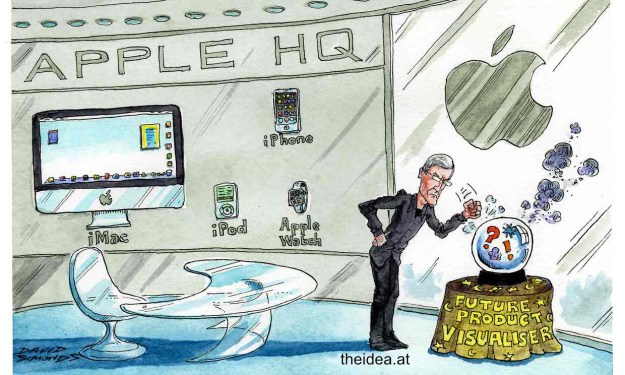
Apple The US giant, 40 years old and looking good, could soon go the dismal way of Sony and Microsoft unless it comes up with something better than the Watch

FutureProductVisualisernew

Does Apple have another 40 years ahead of it, now that it has 40 behind it? As the world’s most valuable public company hit its anniversary last week, it’s the obvious question, in a world where the pace of technological change, enabled by globalisation and the internet, is faster than ever. And the public pressures, from the row with the FBI over unlocking the San Bernardino killer’s iPhone to its tax avoidance through Ireland, aren’t shrinking either.

You only need look at Sony, the famed Japanese company that turns 70 in May (it was founded just after the second world war, in 1946), for an example of how things can go wrong. By its 40th birthday, Sony had invented the Walkman, the compact disc and the Trinitron TV. But the digital world, and then the death of founder Akio Morita, confounded it: despite the success of the PlayStation, it is a shadow of its former self, cutting jobs and struggling to find a space in which it can lead.

The death of Steve Jobs in 2011 was held to be as significant as Morita’s. Five years on, the evidence may not be obvious – but it’s there.

The first is the biggest: the iPhone. The smartphone, as a category, is unique: a computing and communications device that has a potential market of every person on earth. It has only reached about 2.5 billion people so far, but there is an obvious saturation point, even if it is a decade or so away. And analysis suggests that iPhone shipments have already plateaued.

Then, in 2010, the iPad seemed like the next big thing in computing, but in its six-year life it has gone from bang to whimper – twice as quickly as did the iPod, launched in 2001. But at least tablets sell well: the Apple Watch shows no sign of being a hit to compare with either of those, much less the iPhone.

The problem, then, is what Apple does next. Creating a portfolio of products people really want is harder than it sounds. There are well-supported rumours of a car, at some time in the future. So is Apple’s ambition to become the new General Motors? As with the phones and the tablets and the watch, one can only wonder what small slice of the world will be able to afford an Apple car, especially as there have been competitors at all sorts of prices for more than a century.

Cars might also seem old hat in a few years, given the rise of virtual reality systems which overwhelm the senses with new experiences, and artificial intelligence which can outplay the best humans. Maybe travel itself will become outdated. Microsoft (41 years old on Monday) Google (just 18) and Samsung Electronics (47, descended from the even older Samsung) are all making the running here, while Apple seems still to be sitting on the sidelines.

Apple’s power with customers lies principally in its brand, but its executives must avoid the countless dead ends that technology throws up (anyone for 3D TV?) in favour of the deeper streams that can sustain it. Beyond that, it must also stay relevant: Microsoft was once top of the pile, but the rise of the iPhone and Google’s Android left it flat-footed, and it has taken nearly a decade to start finding its way again. If Apple were to miss out on the next wave, whatever that might be, its brand would be tarnished. After that, it’s a long way down.

Chief executive Tim Cook does at least have the reassurance that there are more than 500 million people in the world using upwards of a billion Apple devices. That’s a big audience. The challenge is keeping the show entertaining enough to retain them.

The Aramco float gets stranger and stranger

Get ready for the world’s biggest – and strangest – flotation. Saudi Arabia is to sell shares in its state oil company and its deputy crown prince is prepared to talk dates, which implies seriousness. The public offering will happen next year or maybe in 2018, Mohammed bin Salman said on Friday.

This is part of a hugely ambitious restructuring of the Saudi economy in which the central feature is the establishment of a sovereign wealth fund that will seek to buy non-oil assets. Put a rough value of $2tn on Saudi Aramco – the company’s claimed oil reserves, after all, make Exxon’s look small – and this fund would put equivalent Norwegian or Singaporean versions in the shade. In theory, the Saudis could buy several of the world’s biggest companies, or vast swaths of property in western capitals, and still have spare change.

In practice, life will not be so simple. The Saudis will initially be selling “less than 5%” of Aramco, which is hardly a rushed exit from oil. And, if the state continues to own 95%-plus, whose interests come first? Aramco, remember, accounts for more than half Saudi Arabia’s GDP and it has become entwined in the state’s vast social security programme.

More share sales could follow. But it is hard to believe Saudi Arabia would ever be happy to give up management control of the company, which is what is required if Aramco is ever to be just another investment within the new sovereign wealth fund. The regime, surely, would still want to use its oil to wield political power in its rivalry with Iran.

That is the strange part of the float: investors, in effect, are being offered the chance to be back-seat passengers in a company that, to a large degree, will continue to be an arm of the Saudi state. Wait to see if the flotation documents include fully audited details of the oil and reserves, which have always been kept under close wraps. Only if full disclosure is offered is it really a new world.

Living wage isn’t a step forward for those who miss out

There has been plenty of fanfare around the national living wage. George Osborne went to Asda to highlight what the new £7.20 hourly pay floor means for millions of workers around the UK. It is Britain’s biggest pay rise by the number of people affected and has rightly been welcomed as a step to tackling working poverty, particularly among low-paying industries like retail and restaurants.

But spare a thought for those who will not see their pay packets grow this month. Only over-25s get the new national living wage. So for younger workers Osborne’s new wage merely widens the pay gap between young and old. And while it’s fashionable to demonise big business, the new pay sinners are more likely to be middle-class employers of dogwalkers, babysitters and gardeners. Millions of workers paid cash-in-hand in Britain’s shadow economy also risk missing out.

Successful Innovators at the age of 25

What were the most successful people in tech doing when they were 25?

At the time, many were already founding or making deals with multimillion-dollar companies, or simply dreaming up how they could make their dent in the universe.

In other words, it varied from tech titan to tech titan, and it all goes to show that there’s no one path to success.

To underscore that point, we’ve compiled these snapshots to show you what they were up to at 25.

Steve Jobs took his company public and became a millionaire.

Steve Jobs took his company public and became a millionaire.

Justin Sullivan/Getty Images

By the end of its first day of trading in December 1980, Apple Computer had a market value of $1.2 billion, making its cofounders very rich men. Jobs, one of the three cofounders, was 25.

He later told biographer Walter Isaacson that he made a pledge at that time to never let money ruin his life.

Larry Ellison was working odd jobs as a programmer.

Larry Ellison was working odd jobs as a programmer.

Oracle

After moving to Berkeley, California, at 22, the college dropout turned billionaire Oracle founder used what he picked up in college and taught himself about computer programming. He found odd technical jobs at places like Fireman’s Fund, Wells Fargo, and AMPEX until finally landing at Amdahl Corporation, where he worked on the first IBM-compatible mainframe system.

Jeff Bezos had a cushy job in finance.

Jeff Bezos had a cushy job in finance.

Chip Somodevilla/Getty Images

At age 24, the future Amazon founder and CEO went to work at Bankers Trust developing revolutionary software for banking institutions at that time, according to the book „Jeff Bezos: The Founder of Amazon.com“ by Ann Byers.

Two years later, Bezos became the company’s youngest vice president.

Elon Musk was running his first internet company.

Elon Musk was running his first internet company.

REUTERS/Danny Moloshok

Before turning 25, Musk dropped out of his PhD program at Stanford to join the dot-com boom and launch his first internet company, Zip2, which provided business directories and maps, Ashlee Vance reports in „Elon Musk: Tesla, SpaceX, and the Quest for a Fantastic Future.“

Compaq bought the company for $307 million four years later, and Musk used the money to launch his next startup venture, PayPal.

Marissa Mayer was still in her first year working as Google’s 20th employee.

Marissa Mayer was still in her first year working as Google's 20th employee.

AP Photo

At 24, Mayer became employee No. 20 at Google and the company’s first female engineer. She remained with the company for 13 years before moving to her current role as CEO of Yahoo.

Google didn’t have the sorts of lavish campuses it does now, Mayer said in an interview with VMakers: „During my interviews, which were in April of 1999, Google was a seven-person company. I arrived and I was interviewed at a ping pong table which was also the company’s conference table, and it was right when they were pitching for venture capitalist money, so actually after my interview Larry and Sergey left and took the entire office with them.“

Since everyone in the office interviewed you in those days, Mayer had to come back the next day for another round.

Mark Zuckerberg’s Facebook was cash positive for the first time and hit 300 million users.

Mark Zuckerberg's Facebook was cash positive for the first time and hit 300 million users.

AP Photo/Manu Fernadez

Zuckerberg had been hard at work on Facebook for five years by the time he hit age 25. In that year — 2009 — the company turned cash positive for the first time and hit 300 million users. He was excited at the time, but said it was just the start, writing on Facebook that „the way we think about this is that we’re just getting started on our goal of connecting everyone.“

The next year, he was named „Person of the Year“ by Time magazine.

Alphabet Executive Chairman Eric Schmidt was building a deep background in computer science.

Alphabet Executive Chairman Eric Schmidt was building a deep background in computer science.

Business Insider

Schmidt spent six years as a graduate student at UC Berkeley, earning a master’s and Ph.D. by age 27 for his early work in networking computers and managing distributed software development.

He spent those summers working at the famed Xerox PARC labs, which helped create the computer workstation as we know it. There, he met the founder of Sun Microsystems, where he had his first corporate job.

In his early years as a programmer, „all of us never slept at night because computers were faster at night.“

Sheryl Sandberg had met mentor Larry Summers and was getting a Harvard MBA.

Sheryl Sandberg had met mentor Larry Summers and was getting a Harvard MBA.

Jonathan Leibson/Getty Images for AOL

At age 25, Sandberg had graduated at the top of the economics department from Harvard, worked at the World Bank under her former professor, mentor, and future Treasury Secretary Larry Summers, and had gone back to Harvard to get her MBA, which she received in 1995.

She went on to work at McKinsey, and at age 29 was Summers‘ Chief of Staff when he became Bill Clinton’s Treasury Secretary.

Her time at HBS was a ways before Google, but that experience helped her see the potential of the internet, she said in a commencement speech to HBS grads last year:

„It wasn’t really that long ago when I was sitting where you are, but the world has changed an awful lot. My section, section B, tried to have HBS’s first online class. We had to use an AOL chat room and dial up service (your parents can explain). We had to pass out a list of screen names, because it was unthinkable to put your real name on the internet. And it never worked. It kept crashing … the world wasn’t set up for 90 people to communicate at once online. But for a few brief moments though, we glimpsed the future, a future where technology would power who we are and connect us to our real colleagues, our real family, our real friends.“

Bill Gates was making the first big deals of his life.

At 21, Gates founded Microsoft with Paul Allen after dropping out of Harvard, but his first big break came because of a cleverly made deal with IBM.

In 1980, IBM needed an operating system for their upcoming computer, and contracted Microsoft to create it. Instead of creating an operating system the 25 year old Gates decided to license one called CP/M86. 

He then changed course and bought a clone of that operating system called QDOS, that he could license to any company he wanted. The operating system became known as MS-DOS and became wildly popular.

Larry Page and Sergey Brin incorporated Google.

Larry Page and Sergey Brin incorporated Google.

Ralph Orlowski/Getty Images

Both Brin and Page were 25 when they started Google in 1998, having met years earlier at orientation at Stanford.

Their first investment was $100,000 from Sun Microsystem’s co-founder Andy Bechtolsheim, but there was a problem. The check was made out to Google Inc., but Google hadn’t yet been incorporated. The two filed the necessary paperwork before being able to cash the check.


Evan Spiegel is currently worth $2.1 billion.

Evan Spiegel is currently worth $2.1 billion.

AP Photo/Jae C. Hong

At age 21, Spiegel pitched the idea of Snapchat to his class at Stanford, but it didn’t go over so well. Three months after the initial pitch, the app was released under the name Picaboo, and later renamed Snapchat.

Snapchat has since gone mega viral, making Spiegel worth $2.1 billion. He’s currently 25 years old.

Michael Dell had recently taken his company public.

Michael Dell had recently taken his company public.

REUTERS/Steve Marcus

At 19, Michael Dell began selling computer parts out of his college dorm room under the name PC Limited.

After a year at college, Dell decided to leave school to focus on PC Limited, which was later renamed Dell Computer Corporation. In 1988, when Dell was 23, Dell Computer Corporation went public, raising $30 million.


Jack Dorsey was sketching out Twitter on LiveJournal.

Jack Dorsey was sketching out Twitter on LiveJournal.

Mike Blake/Reuters

At 20, Dorsey hacked into Dispatch Management Services, a courier service founded by Greg Kidd. Kidd was so impressed he hired Dorsey to drop out of NYU and join the company.

Four years later he joined LiveJournal, and sketched out his concept for Stat.us, which morphed into Twit.tr.

Satya Nadella had just joined Microsoft.

Satya Nadella had just joined Microsoft.

BI

At age 22, Nadella moved from his home in Hyderabad, India to America where he received his masters degree in Computer Science from the University of Wisconsin-Milwaukee.

Nadella then started a brief stint at Sun Microsystems before joining Microsoft at age 24, where he’s stayed ever since.

http://www.businessinsider.de/famous-tech-people-at-age-25-2016-3?op=1

Tesla’s falling out of favor

Tesla’s falling out of favor

A Tesla Motors logo is shown on a Tesla Model S at a Tesla Motors dealership at Corte Madera Village, an outdoor retail mall, in Corte Madera, California May 8, 2014.  REUTERS/Robert GalbraithThomson ReutersTesla Model S.

Elon Musk is a genius and a visionary who is almost single-handedly changing the future of mankind through three different industries at once. With that said, it’s not clear if investors can easily benefit from any of that.

Tesla, the company most associated with Musk, is in a downward stock spiral over the last month, which has taken it to new 52-week lows. There are many reasons for that downward spiral, including concerns about market valuations and weak oil prices (which make Tesla’s correspondingly less attractive as a substitute versus conventional cars). But for the first time, Tesla is also facing a new threat that may be frightening away some investors: competition in the electric car space.

Tesla has been the only real electric car maker since its inception as a company. It’s true that Nissan offers the Nissan Leaf, an all electric car, but that vehicle only gets around 100 miles of range, compared with 270 miles for a Tesla. For the many Americans that drive 50 miles each way to work or who sit in traffic at rush hour, a 100-mile range is simply too perilously close to running out of power for comfort. As a result, the Nissan Leaf has never really caught on with more than a sliver of the population.

To be fair, of course, Tesla is still very much a niche car company. The firm produced about 50,000 vehicles in 2015 and it might make as many as 80,000-90,000 in 2016. Production is really the biggest issue right now for Tesla as it is quickly selling every car it can produce. And that is why investors have been comfortable with the story and given Tesla a stratospheric valuation compared with traditional car companies. Simply put, Tesla is making a cool car that nearly everyone would like to buy and it is selling product as fast as it can produce it. Unfortunately for most people, Tesla’s cars are too expensive so far. Tesla is promising to start production on its much vaunted Model 3 in 2017, but it is very possible that production will end up getting pushed back.

The Model 3 is particularly important because it is supposed to be Tesla’s first mass market car with a sticker price around $35,000. It’s unclear if Tesla really needs to produce the Model 3 — after all Ferrari and Porsche have long had great businesses despite selling only luxury sports cars. Yet the Model 3 represents Tesla’s chance to grab a large slice of the American car market and become a true competitor in that space. That is, as long as someone else doesn’t get there first — and therein lies the problem and perhaps the reason for Tesla’s sharp share price decline in recent weeks.

It now appears that General Motors rather than Tesla will be the first company out with a tractable mass market electric vehicle. The Chevy Bolt is set to start production by the end of 2016 with a sticker price of around $30,000 (after $7,500 in Federal rebates and incentives) and a range of roughly 200 miles. While that range is still not as high as Tesla’s range, the sticker price is a lot lower. Moreover, GM has the capacity to make hundreds of thousands of cars if the demand materializes. That prospect has to be making Tesla nervous.

For all of Elon Musk’s remarkable achievements with Tesla, the company is still very much an upstart. Making cars en masse is difficult, and the General Motors and Fords of the world have been doing it for a long time. Tesla’s biggest advantage was the lumbering nature of traditional automakers and their difficulty in producing a truly revolutionary new vehicle. Only time will tell if GM has succeeded on that front, but for the first time it does look like Tesla might face some real competition.

www.businessinsider.de/teslas-falling-out-of-favor-2016-2

Elon Musk recommends Harlan Ellisons Book „I Have No Mouth, and I Must Scream“

https://en.wikipedia.org/wiki/I_Have_No_Mouth,_and_I_Must_Scream

Characters

  • AM, the supercomputer which brought about the near-extinction of humanity. It seeks revenge on humanity for its own tortured existence.
  • Gorrister, who tells the history of AM for Benny’s entertainment. Gorrister was once an idealist and pacifist, before AM made him apathetic and listless.
  • Benny, who was once a brilliant, handsome scientist, and has been mutilated and transformed so that he resembles a grotesque simian with gigantic sexual organs. Benny at some point lost his sanity completely and regressed to a childlike temperament. His former homosexuality has been altered; he now regularly engages in sex with Ellen.
  • Nimdok (a name AM gave him), an older man who persuades the rest of the group to go on a hopeless journey in search of canned food. At times he is known to wander away from the group for unknown reasons, and returns visibly traumatized. In the audiobook read by Ellison, he is given a German accent.
  • Ellen, the only woman. She claims to once have been chaste („twice removed“), but AM altered her mind so that she became desperate for sexual intercourse. The others, at different times, both protect her and abuse her. According to Ted, she finds pleasure in sex only with Benny, because of his large penis. Described by Ted as having ebony skin, she is the only member of the group whose ethnicity or racial identity is explicitly mentioned.
  • Ted, the narrator and youngest of the group. He claims to be totally unaltered, mentally or physically, by AM, and thinks the other four hate and envy him. Throughout the story he exhibits symptoms of delusion and paranoia, which the story implies are the result of AM’s alteration.

Plot

The story takes place 109 years after the complete destruction of human civilization. The Cold War had escalated into a world war, fought mainly between China, Russia, and the United States. As the war progressed, the three warring nations each created a super-computer capable of running the war more efficiently than humans.

The machines are each referred to as „AM,“ which originally stood for „Allied Mastercomputer“, and then was later called „Adaptive Manipulator“. Finally, „AM“ stands for „Aggressive Menace“. One day, one of the three computers becomes self aware, and promptly absorbs the other two, thus taking control of the entire war. It carries out campaigns of mass genocide, killing off all but four men and one woman.

The survivors live together underground in an endless complex, the only habitable place left. The master computer harbors an immeasurable hatred for the group and spends every available moment torturing them. AM has not only managed to keep the humans from taking their own lives, but has made them virtually immortal.

The story’s narrative begins when one of the humans, Nimdok, has the idea that there is canned food somewhere in the great complex. The humans are always near starvation under AM’s rule, and anytime they are given food, it is always a disgusting meal that they have difficulty eating. Because of their great hunger, the humans are actually coerced into making the long journey to the place where the food is supposedly kept—the ice caves. Along the way, the machine provides foul sustenance, sends horrible monsters after them, emits earsplitting sounds, and blinds Benny when he tries to escape.

On more than one occasion, the group is separated by AM’s obstacles. At one point, the narrator, Ted, is knocked unconscious and begins dreaming. It is here that he envisions the computer, anthropomorphized, standing over a hole in his brain speaking to him directly. Based on this nightmare, Ted comes to a conclusion about AM’s nature, specifically why it has so much contempt for humanity; that despite its abilities it lacks the sapience to be creative or the ability to move freely. It wants nothing more than to exact revenge on humanity by torturing these last remnants of the species that created it; Ted and his four companions.

The group reaches the ice caves, where indeed there is a pile of canned goods. The group is overjoyed to find them, but is immediately crestfallen to find that they have no means of opening them. Finally, in a final act of desperation, Benny attacks Gorrister and begins to gnaw at the flesh on his face. Ted notices that AM does not intervene when Benny is clearly hurting Gorrister, though the computer has in the past always stopped the humans from killing themselves.

Ted seizes a stalactite made of ice, and kills Benny and Gorrister. Ellen realizes what Ted is doing, and kills Nimdok, before being herself killed by Ted. Ted runs out of time before he can kill himself, and is stopped by AM. However, while AM could restore massive damage to their bodies and horribly alter them, AM is not a god: it cannot return Ted’s four companions to life after they are already dead. AM is now even more angry and vengeful than before, with only one victim left for its hatred. To ensure that Ted can never attempt to kill himself, AM transforms him into a large, amorphous, fleshy blob that is incapable of causing itself or anybody else harm, and constantly alters his perception of time to deepen his anguish. Ted is, however, grateful that he was able to save the others from further torture. Ted’s closing thoughts end with the sentence that gives the book its title. „I have no mouth. And I must scream.“

Tech’s ‘Frightful 5’ Will Dominate Digital Life for Foreseeable Future

There’s a little parlor game that people in Silicon Valley like to play. Let’s call it, Who’s Losing?

There are currently four undisputed rulers of the consumer technology industry: Amazon, Apple, Facebook and Google, now a unit of a parent company called Alphabet. And there’s one more, Microsoft, whose influence once looked on the wane, but which is now rebounding.

So which of these five is losing? A year ago, it was Google that looked to be in a tough spot as its ad business appeared more vulnerable to Facebook’s rise. Now, Google is looking up, and it’s Apple, hit by rising worries about a slowdown in iPhone sales, that may be headed for some pain. Over the next couple of weeks, as these companies issue earnings that show how they finished 2015, the state of play may shift once more.

But don’t expect it to shift much. Asking “who’s losing?” misses a larger truth about how thoroughly Amazon, Apple, Facebook, Google and Microsoft now lord over all that happens in tech.

Who’s really losing? In the larger picture, none of them — not in comparison with the rest of the tech industry, the rest of the economy and certainly not in the influence each of them holds over our lives.

Tech people like to picture their industry as a roiling sea of disruption, in which every winner is vulnerable to surprise attack from some novel, as-yet-unimagined foe. “Someone, somewhere in a garage is gunning for us,” Eric Schmidt, Alphabet’s executive chairman, is fond of saying.

But for much of the last half-decade, most of these five giants have enjoyed a remarkable reprieve from the bogeymen in the garage. And you can bet on them continuing to win. So I’m coining the name the Frightful Five.
It’s not just because I’m a Tarantino fan. By just about every measure worth collecting, these five American consumer technology companies are getting larger, more entrenched in their own sectors, more powerful in new sectors and better insulated against surprising competition from upstarts.

Though competition between the five remains fierce — and each year, a few of them seem up and a few down — it’s becoming harder to picture how any one of them, let alone two or three, may cede their growing clout in every aspect of American business and society.
“The Big Five came along at a perfect time to roll up the user base,” said Geoffrey G. Parker, a business professor at Tulane University and the co-author of “Platform Revolution,” a forthcoming book that explains some of the reasons these businesses may continue their dominance. “These five rode that perfect wave of technological change — an incredible decrease in the cost of I.T., much more network connectivity and the rise of mobile phones. Those three things came together, and there they were, perfectly poised to grow and take advantage of the change.”

Mr. Parker notes the Big Five’s power does not necessarily prevent newer tech companies from becoming huge. Uber might upend the transportation industry, Airbnb could rule hospitality and, as I argued last week, Netflix is bent on consuming the entertainment business. But if such new giants do come along, they’re likely to stand alongside today’s Big Five, not replace them.
Indeed, the Frightful Five are so well protected against start-ups that in most situations, the rise of new companies only solidifies their lead.

Consider that Netflix hosts its movies on Amazon’s cloud, and Google’s venture capital arm has a huge investment in Uber. Or consider all the in-app payments that Apple and Google get from their app stores, and all the marketing dollars that Google and Facebook reap from start-ups looking to get you to download their stuff.

This gets to the core of the Frightful Five’s indomitability. They have each built several enormous technologies that are central to just about everything we do with computers. In tech jargon, they own many of the world’s most valuable “platforms” — the basic building blocks on which every other business, even would-be competitors, depend.
These platforms are inescapable; you may opt out of one or two of them, but together, they form a gilded mesh blanketing the entire economy.

The Big Five’s platforms span so-called old tech — Windows is still the king of desktops, Google rules web search — and new tech, with Google and Apple controlling mobile phone operating systems and the apps that run on them; Facebook and Google controlling the Internet advertising business; and Amazon, Microsoft and Google controlling the cloud infrastructure on which many start-ups run.

Amazon has a shopping and shipping infrastructure that is becoming central to retailing, while Facebook keeps amassing greater power in that most fundamental of platforms: human social relationships.
Many of these platforms generate what economists call “network effects” — as more people use them, they keep getting more indispensable. Why do you chat using Facebook Messenger or WhatsApp, also owned by Facebook? Because that’s where everyone else is.

Their platforms also give each of the five an enormous advantage when pursuing new markets. Look how Apple’s late-to-market subscription streaming music service managed to attract 10 million subscribers in its first six months of operation, or how Facebook leveraged the popularity of its main app to push users to download its stand-alone Messenger app.

Then there’s the data buried in the platforms, also a rich source for new business. This can happen directly — for instance, Google can tap everything it learns about how we use our phones to create an artificial intelligence engine that improves our phones — and in more circuitous ways. By watching what’s popular in its app store, Apple can get insight into what features to add to the iPhone.
“In a way, a lot of the research and development costs are being borne by companies out of their four walls, which allows them to do better product development,” Mr. Parker said.
This explains why these companies’ visions are so expansive. In various small and large ways, the Frightful Five are pushing into the news and entertainment industries; they’re making waves in health care and finance; they’re building cars, drones, robots and immersive virtual-reality worlds. Why do all this? Because their platforms — the users, the data and all the money they generate — make these far-flung realms seem within their grasp.

Which isn’t to say these companies can’t die. Not long ago people thought IBM, Cisco Systems, Intel and Oracle were unbeatable in tech; they’re all still large companies, but they’re far less influential than they once were.

And a skeptic might come up with significant threats to the five giants. One possibility might be growing competition from abroad, especially Chinese hardware and software companies that are amassing equally important platforms. Then there’s the threat of regulation or other forms of government intervention. European regulators are already pursuing several of the Frightful Five on antitrust and privacy grounds.
Even with these difficulties, it’s unclear if the larger dynamic may change much. Let’s say that Alibaba, the Chinese e-commerce company, eclipses Amazon’s retail business in India — well, O.K., so then it satisfies itself with the rest of the world.
Government intervention often limits one giant in favor of another: If the European Commission decides to fight Android on antitrust grounds, Apple and Microsoft could be the beneficiaries. When the Justice Department charged Apple with orchestrating a conspiracy to raise e-book prices, who won? Amazon.

So get used to these five. Based on their stock prices this month, the giants are among the top 10 most valuable American companies of any kind. Apple, Alphabet and Microsoft are the top three; Facebook is No. 7, and Amazon is No. 9. Wall Street gives each high marks for management; and three of them — Alphabet, Amazon and Facebook — are controlled by founders who don’t have to bow to the whims of potential activist investors.
So who’s losing? Not one of them, not anytime soon.
JANUARY 20, 2016

Farhad Manjoo

STATE OF THE ART http://mobile.nytimes.com/2016/01/21/technology/techs-frightful-5-will-dominate-digital-life-for-foreseeable-future.html

teslas self-driving car

Tesla CEO Elon Musk has made a bold prediction: Tesla Motors will have a self-driving car within two years.

“I think we have all the pieces,” Musk told Fortune, “and it’s just about refining those pieces, putting them in place, and making sure they work across a huge number of environments — and then we’re done. It’s a much easier problem than people think it is.”

Although Musk’s comments to Fortune came Monday, The Street pegged a rise in Tesla’s shares to the comments on Tuesday. The ambitious timeframe appeared to be offering support to the stock again today, with shares trading up $1.47, or 0.64 percent, at $231.42 around 7:18 a.m. PST.

Musk’s driverless-car comments may have been overshadowed initially by the achievement of SpaceX on Monday night in landing a rocket during a commercial mission for the first time. Musk is also CEO of SpaceX.

This is the most aggressive timeline Musk has mentioned. While Musk claims the problem is easier than people think it is, he doesn’t think the tech is so accessible that any hacker could create a self-driving car. Musk took the opportunity to call out hacker George Hotz, who claimed via a Bloomberg article last week that he had developed self-driving car technology that could compete with Tesla’s. Musk said he wasn’t buying it.

“But it’s not like George Hotz, a one-guy-and-three-months problem,” Musk said to Fortune. “You know, it’s more like, thousands of people for two years.”

The company went so far as to post a statement last week about Hotz’s achievement.

“We think it is extremely unlikely that a single person or even a small company that lacks extensive engineering validation capability will be able to produce an autonomous driving system that can be deployed to production vehicles,” the company stated. “It may work as a limited demo on a known stretch of road — Tesla had such a system two years ago — but then requires enormous resources to debug over millions of miles of widely differing roads.”

While Tesla is unconcerned about Hotz, the company’s new timeline may have other autonomous car developers hitting the accelerator. Tech companies like Google and Apple, in addition to automakers such as Volvo and General Motors are all competing to be among the first to offer some form of self-driving tech. Many believe the early 2020s would be a realistic timeframe to expect to see the public engaging with self-driving cars.

Just yesterday, it was reported that Google and Ford will enter into a joint venture to build self-driving vehicles with Google’s technology, according to Yahoo Autos, citing sources familiar with the plans. The official announcement is expected to come during the Consumer Electronics Show in January, but there is no manufacturing timeline.

But even if Tesla moves quickly on self-driving cars, are consumers ready for them? The Palo Alto-based carmaker’s recent Firmware 7.1 Autopilot update includes restrictions on self-driving features. The update only allows its Autosteer feature to engage when the Model S is traveling below the posted speed limit. The update came shortly after it was reported that drivers were involved in dangerous activities while the Autopilot features were engaged.

Source: http://www.bizjournals.com/sanjose/news/2015/12/23/elon-musks-bold-new-timeline-for-driverless-cars.html?ana=yahoo

George Hotz, the first person to hack the iPhone, built a self-driving car in a month, declined a personal job offer from Teslas Elon Musk

George Hotz, the first person to hack the iPhone, built a self-driving car in a month, declined a personal job offer from Teslas Elon Musk.

And pursues his Linux Based Self-Driving Autonomous Car Project.

Elon Musk OpenAI is far more than saving the world

Elon Musk’s Billion-Dollar AI Plan Is About Far More Than Saving the World

Elon Musk.

Inspiring Quotes That Will Motivate Your Entrepreneurial Pursuits

21 Inspiring Quotes That Will Motivate Your Entrepreneurial Pursuits
Image credit: Ben K Adams | Flickr

There’s something about quotes that we all find irresistible. Maybe it’s that they tend to come from ordinary people who have gone on to do extraordinary things in their lives. Perhaps it’s the vast array of professions, circumstances, niches and places they come from that fascinate us. Or it could be that by reading their words we tap into something we feel is possible for ourselves as well. Whatever it is, there’s nothing like a great quote to get your revved up.

Here are 21 inspiring quotes that will get you hyped up and keep you motived as an entrepreneur.

1. I can accept failure. Everyone fails at something. But I cannot accept not trying. — Michael Jordan

Just like the great Yoda once said, “Do, or do not. There is no try.” You may fail at some things in your life, but you’ll fail at life if you don’t continually try and do new things.

2. Be patient with yourself. Self-growth is tender, it’s holy ground. There’s no greater investment. — Stephen Covey

It is common to be in a rush to reach the destination called success. There’s success with a romantic partner, which usually means marriage or success with a business, which usually means an IPO or exit strategy. Success is often measured by the destination. However, if you can learn to be patient, and continually improve yourself while enjoying the journey, the trip to every success will be as pleasant as the destination. Improving yourself is always worth the investment.

3. In every success story, you will find someone who has made a courageous decision. — Peter F. Drucker

Success takes a spirit of adventure and an aptitude for bravery. It isn’t that the brave don’t have fears, it’s that they chose to move forward anyway.

Related: 20 Quotes to Help Motivate You to Hustle Like Never Before

4. If you can dream it, you can do it. — Walt Disney

Every great success starts with a big vision. What’s yours?

5. We must train from the inside out. Using our strengths to attack and nullify any weaknesses. It’s not about denying a weakness may exist but about denying its right to persist. — Vince McConnell

Investing in yourself means a continual assessment of self-improvement, and that process weeds out our weaknesses. It’s not about perfection, but if we focus on overcoming our inner obstacles to success, we can conquer the world within and then the world outside.

6. All of the great leaders have had one characteristic in common: it was the willingness to confront unequivocally the major anxiety of their people in their time. This, and not much else, is the essence of leadership. — John Kenneth Galbraith

Leadership, like entrepreneurship, takes courage and the ability to remain comfortable in times of discomfort. The more you can cultivate being at ease during times of challenge, the greater your life and your leadership will be.

7. My best advice to entrepreneurs is this: Forget about making mistakes, just do it. — Ajaero Tony Martins

Don’t focus on the failures. Focus on the journey toward results. It’s better to do something and fail than to not try anything at all.

8. Achievement seems to be connected with action. Successful men and women keep moving. They make mistakes but they don’t quit. — Conrad Hilton

There is action required for all success. Success never means a lack of failures along the path, but always means your continue down the path even after stumbling or falling. It’s the old proverb that you might fall down nine times, but to be successful you must stand up 10 times.

9. Ambition is the steam that drives men forward on the road to success. Only the engine under full steam can make the grade. — Maxi Foreman

You need a big vision and some lofty ambition to change the world, even if the world you aspire to change is only your own local community. Dream big and take action toward those ambitions.

10. Continuous learning is the minimum requirement for success in any field. — Dennis Waitley

Never stop learning. If you aren’t learning, then you’re quickly becoming obsolete. Surround yourself with smart people who will always challenge you with new ideas, new technologies and show you new ways things could be done.

11. Everyone who achieves success in a great venture solved each problem as they came to it. They helped themselves and they were helped through powers known and unknown to them at the time they set out on their voyage. They kept going regardless of the obstacles they met. — W. Clement Stone

Failure is a theme with great quotes and great leaders because it’s so personal and also so universal. Rise up from challenges and move forward after your failures and you will meet with success.

12. Experience taught me a few things. One is to listen to your gut no matter how good something sounds on paper. The second is that you are generally better off sticking with what you know and the third is that sometimes, your best investments are the ones you don’t make. — Donald Trump

You should trust your inner voice and go with your gut, even when it’s telling you not to do something — perhaps especially when it’s telling your not to do something. Learning to trust your own judgment will take you far.

13. Failure isn’t failure unless you don’t learn from it. — Dr. Ronald Niednagel

Yes, you need to move forward after failure, but perhaps the most important thing about failure is the lesson you learn from it. What can you change in the future to not repeat the mistakes of your past? So long as you change a different variable every time you attack the same problem, you’ll find a way to overcome and reach a solution.

14. Enthusiasm is the sparkle in your eyes, the swing in your gait, the grip of your hand and the irresistible surge of will and energy to execute your ideas. — Henry Ford

When you love what you do, you have the passion you’ll need to fuel the often intense road of entrepreneurship. Keep that passion alive.

Related: 10 Kevin O’Leary Quotes Every Entrepreneur Can Learn From

15. Desire is the key to motivation, but it’s determination and commitment to an unrelenting pursuit of your goal — a commitment to excellence — that will enable you to attain the success you seek. — Mario Andretti

Desire, like passion, fuels you forward during times of challenge to achieve your success. Every entrepreneur should have a healthy dose of desire to reach their big vision if they want to eventually arrive at success.

16. The secret of joy in work is contained in one word: excellence. To know how to do something well is to enjoy it. — Pearl Buck

You should strive for excellence in all you do. It’s a hallmark of innovation and integrity to reach excellence in your work.

17. If you hear a voice within you saying ‘you are not a painter’ then by all means paint and that voice will be silenced. — Vincent Van Gogh

This is a great quote because it emphasizes the importance of action. If you don’t know how to paint, the best way — really the only way — to learn is to pick up a paintbrush. You don’t need to be an entrepreneur to get started with your first endeavor. You need to get started with your first endeavor to be an entrepreneur.

18. You are to set your own value, communicate that value to the world, and then not settle for less. Sound daunting? That’s just because it takes you out of your comfort zone. You have got to stop being an obstacle on your own path to wealth and security and happiness. You must understand that valuing yourself is well within your control. — Suze Orman

One thing that is easy to do when you’re starting as an entrepreneur is to put yourself on sale. When you don’t have an understanding of your own value and worth, don’t expect others to either. This isn’t so much a dollar sum as it is a belief in yourself, in your innate ability to succeed and the drive to move your way forward to success. Know your worth and then act on it.

19. The greatest discovery of my generation is that people can alter their lives by altering their attitudes. — William James

The greatest single factor you can consciously decide to implement right now is your attitude. Be outrageously, contagiously optimistic and resilient. Decide now that your attitude is going to be amazing to be around for others.

20. Failure is just a resting place. It is an opportunity to begin again more intelligently. — Henry Ford

Learn from your mistakes and take each failure as an opportunity to begin again, but with a new knowledge to apply to the steps ahead.

21. The entrepreneur is essentially a visualizer and actualizer. He can visualize something, and when he visualizes it he sees exactly how to make it happen. — Robert L. Schwartz

When you have a big vision, and you combine that perspective with action, there’s nothing you can’t do.

Quote: http://www.entrepreneur.com/article/247659