Archiv der Kategorie: Innovation

Google Hits a Samsung Roadblock With New AI Assistant – Viv & Adam Cheyer

Google just debuted a digital assistant, which it hopes to place inside smartphones, watches, cars and every other imaginable internet-connected device. It’s already hit a snag.

The Alphabet division launched new smartphones last week with the artificially intelligent assistant deeply embedded. It also rolled out a speaker with the feature at its core and announced plans to let other companies tie their apps and services to the assistant.

A day later, Samsung, which just announced it was ending production of its problematic Galaxy Note 7 smartphones, said it was acquiring Viv Labs, a startup building its own AI voice-based assistant.

At first, the deal looked like a counter-punch to Samsung rival Apple — Viv is run by the creators of Apple’s Siri assistant. But buying Viv may be more of a problem for Google, because Samsung is the biggest maker of phones running Google’s Android mobile operating system.

Google strategy is now centered on the assistant, rather than its search engine, because it’s a more natural way for people to interact with smartphones and other connected devices. Getting all Android phone makers to put the Google assistant on their devices would get the technology into millions of hands quickly. But Samsung’s Viv deal suggests assistants are too important for phone makers to let other companies supply this feature.

Last week, despite the Note 7 crisis, Samsung executive Injong Rhee said the company plans to put Viv’s technology in its smartphones next year and then embed it into other electronics and home appliances. A Samsung representative and a Google spokeswoman declined to comment.

That’s a necessity for Samsung, according to some analysts and industry insiders.

„As AI is becoming more sophisticated and valuable to the consumer, there’s no question it will be important for hardware companies,“ said Kirt McMaster, executive chairman of Cyanogen, a startup that makes Android software. Mr. McMaster, a frequent Google critic, said other Android handset makers will likely follow Samsung’s move.

„If you don’t have an AI asset, you’re not going to have a brain,“ he added.

Google may already have known that some Android phone makers — known as original equipment manufacturers, or OEMs — were reluctant to embrace its assistant.

„Other OEMs may want to differentiate“ Google’s Android chief Hiroshi Lockheimer told Bloomberg before it released its own smartphones. „They may want to do their own thing — their own assistant, for example.“

Samsung and Google have sparred in the past over distribution. Google requires Android handset makers to pre-install 11 apps, yet Samsung often puts its own services on its phones. And the South Korean company has released devices that run on its own operating system, called Tizen, not Android.

Viv was frequently on the short-list of startups that could help larger tech companies build assistant technology. Founded four-years ago by Dag Kittlaus, Adam Cheyer and Chris Brigham, the startup was working on voice technology to handle more complex queries than existing offerings.

While it drummed up considerable attention and investment, Viv has not yet released its product to the public. And some analysts are skeptical of Samsung’s ability to convert the technology into a credible service, given its mixed record with software applications.

„It will be very hard to compete with Google’s strength in data and their AI acquisitions,“ said Jitendra Waral, senior analyst with Bloomberg Intelligence. „Samsung would need to prove that its AI solutions are superior to that of Google’s. They are handicapped in this race.“

Samsung is also focused on handling the fallout from its exploding Galaxy Note 7 phones, potentially taking management time away from its Viv integration.

But it’s a race Samsung has to join. In recent years, Samsung acquired mobile-payments and connected-device startups to keep up with Apple, Google and Amazon. Digital voice-based assistants may be more important, if they become the main way people interact with devices.

Silicon Valley titans are rushing into the space because of this potential. Amazon is trying to sign up developers for its Alexa voice technology. Apple has recently touted more Siri capabilities and opened the technology to other developers. And now Google, considered the leader in artificial intelligence, is making its own push.

„I don’t ever remember a time when every single major consumer tech company — and even enterprise companies — have been singularly focused on an identical strategy,“ said Tim Tuttle, chief executive officer of MindMeld Inc., a startup working on voice interaction software. „They’re all following the exact same playbook.“


http://adage.com/article/digital/google-hits-a-roadblock-ai-assistant/306244/

Amazon has a secret plan to replace FedEx and UPS called ‚Consume the City‘

Amazon has been quietlybeefing up its own shipping logistics network lately.

Amazon CEO Jeff BezosAmazon CEO Jeff Bezos

Although Amazon publicly says it’s meant to complement existing delivery partners like FedEx and UPS, a new report by The Wall Street Journal’s Greg Bensinger and Laura Stevens says Amazon has broader ambitions.

Eventually, Amazon aims to build a full-scale shipping and logistics network that will not only ship products ordered from Amazon, but also will ship products for other retailers and consumers.

In other words, Amazon is looking to compete against delivery services like FedEx and UPS, the report says. Internally, some Amazon execs call the plan „Consume the City.“

Here are other new details around Amazon’s logistics plan, according to the report:

  • Amazon recently hired former Uber VP Tim Collins as VP of global logistics.
  • It recruited dozens of UPS and FedEx executives and hundreds of UPS employees in recent years.
  • Test trials for last-mile deliveries are running in big cities like Los Angeles, Chicago, and Miami.
  • The company also experimented with a program called „I Have Space“ to store Amazon’s inventory in warehouses owned by other companies.

On top of that, InternetRetailer.com recently reported that Amazon has hired Ed Feitzinger, the former CEO of UTi Worldwide, one of the largest supply chain management companies, as VP of global logistics. Add that to the fact that Amazon has now built facilities within 20 miles of 44% of the US population, and Amazon is starting to look like a real threat to existing logistics networks.

According to Baird Equity Research, Amazon is looking at a $400 billion market opportunity by launching all these initiatives. They could also help Amazon reduce some of its shipping costs, which have been increasing every year.

People in the industry are starting to take notice, too, according to Zvi Schreiber, the CEO of Freightos, an online marketplace for international freight.

„After dominating e-commerce and warehousing, Amazon is moving farther up the supply chain and eyeing the logistics sector from all angles, particularly looking to leverage technology, capital, and manpower to make logistics more efficient,“ Schreiber told Business Insider.

„Given their track record of disrupting industries — from retail to warehousing and e-commerce fulfillment to cloud computing — the trillion-dollar freight industry is certainly tracking Amazon nervously.“

http://www.businessinsider.de/amazon-secret-plan-replace-fedex-ups-called-consume-the-city-2016-9

Here’s the electric car Audi is building to take on Tesla

Audi E-tron quattroAudi

Tesla’s Model S and Model X are soon going to have some serious competition.

Last September, Audi revealed its all-electric e-tron quattro concept at the Frankfurt Motor Show. The SUV, which is slated to go into production by 2018, will have three electric motors, a range of 310 miles on a single charge, and quick charging capabilities.

Here’s a look at some of the features in the e-tron quattro that we hope to see in the production version.

Like the e-tron concept, Audi will most likely include piloted driving technology in its upcoming all-electric SUV.

Like the e-tron concept, Audi will most likely include piloted driving technology in its upcoming all-electric SUV.

Audi piloted techYouTube/Audi

The e-tron quattro concept has piloted driving technology, which uses radar sensors, a video camera, ultrasonic sensors, and a laser scanner to collect data about the car’s environment and create a model of the vehicle’s surroundings in real-time.

Audi currently has a lot of this tech in its newer vehicles, so it’s likely we will see a more advanced piloted system in the production version of the e-tron quattro.


Cameras could replace side view mirrors.

Cameras could replace side view mirrors.

Audi

The e-tron quattro has curved displays built into the front section of the doors that lets the driver view what is around them. There’s no guarantee we’ll see this in the production version, but automakers are beginning to experiment with new kinds of mirror designs.

For example, GM’s a digital mirror in the Chevy Bolt and the Cadillac CT6that uses cameras to stream whatever is behind you.

It will likely be covered in screens.

It will likely be covered in screens.

Audi

The e-tron quattro concept features two touch displays in the cockpit, one to the driver’s left to control lights and the piloted driving systems and one to the right where media and navigation is controlled.

The center console has two more OLED displays for climate control and infotainment.

With its 95 kWh battery, the e-tron quattro has an impressive range of 310 miles on a single charge.

With its 95 kWh battery, the e-tron quattro has an impressive range of 310 miles on a single charge.

Audi

To put that into perspective, Tesla’s Model X SUV with all wheel drive and a 100kWh battery has a range of 289 miles on a single charge. Audi has already said its range will beat this.

It may be able to fully charge in just 50 minutes.

It may be able to fully charge in just 50 minutes.

Audi

We know the production version will have quick charging capabilities, but we don’t know exactly how fast it will work. However, we’re hoping it’s in line with the e-tron quattro concept’s charge time.

The concept car has a Combined Charging System (CCS), meaning it can be charged with a DC or AC electrical current. It can fully charge with a DC current outputting 150 kW in just about 50 minutes.


The e-tron quattro concept is equipped with induction charging technology, so it can be charged wirelessly over a charging plate.

The e-tron quattro concept is equipped with induction charging technology, so it can be charged wirelessly over a charging plate.

Audi

We can’t say if this is a definite feature the production version will have, but our fingers are crossed.

It will have super fast connectivity.

It will have super fast connectivity.

Audi

Audi announced at CES this year that it is the first automaker to support the latest standard for mobile communications: LTE Advanced.

LTE Advanced is the latest enhancement to LTE, meaning that it can deliver larger and faster wireless data payloads than 4G LTE. We can almost certainly expect to see the technology integrated into the upcoming production car.

http://www.businessinsider.de/audis-electric-vs-tesla-2016-9?op=1

Daimler präsentiert futuristisches Trio: Urban e-Truck, Vision Van und Future Bus

Der Mercedes Benz Urban eTruck feiert auf der Nutzfahrzeug-IAA seine Weltpremiere.Der Mercedes Benz Urban eTruck feiert auf der Nutzfahrzeug-IAA seine Weltpremiere.

Der Urban e-Truck, der Vision Van und der Future Bus – Mercedes zieht auf der Nutzfahrzeug-IAA die ganz große Elektroshow ab. Hinter den futuristischen Studien steckt aber mehr. Denn die Daimler AG versteht sich nicht mehr ausschließlich als Hersteller.

Es ist das gleiche Bild wie beim Pkw-Pendant in Frankfurt: Wer in diesen Tagen bei der Nutzfahrzeug-IAA in Hannover den Daimler-Stand besucht, wird auf eine Zeitreise mitgenommen. Denn hier stehen nicht die Laster von morgen, sondern die von übermorgen. Mit einem Aufwand, wie man ihn in dieser Branche so noch nicht erlebt hat, haben die Entwickler der Bus-und-Truck-Sparte aus dem Sternen-Imperium gleich drei visionäre Studien verwirklicht: Vision Van, Urban e-Truck und Future Bus.

Wie weit uns Mercedes mit diesen drei spektakulären Studien, die allesamt auf reinen Elektroantrieb setzen, in die Zukunft blicken lässt, weiß keiner genau. Wolfgang Bernhard, der für die Nutzfahrzeugsparte zuständige Daimler-Vorstand, ist allerdings überzeugt, dass die Zeitenwende bei der Elektro-Mobilität bereits eingesetzt hat und sie sich „viel dynamischer entwickelt, als wir das alle für möglich halten würden“.

Die Marschrichtung ist klar

Über 200 Kilometer soll der 25-Tonnen-Koloss rein elektrisch fahren.

Und kühn ergänzt der 56-Jährige, dass Daimler mit der Umsetzung der visionären Ideen „den Transport völlig neu erfindet“. Für Güter und Personen. Auf Autobahnen und in Städten. So sei der Urban e-Truck als erster emissionsfreier schwerer Truck die beste Antwort auf immer rigideren Zufahrtsbeschränkungen in verstopften Großstädten. Der sogenannte Verteilerverkehr im eher innerstädtischen Bereich könne mit ihm flüsterleise und sauber durchgeführt werden. Und mehr noch. Er ist komplett vernetzt, und bietet einschließlich eines intelligenten Reichweiten-Managements quasi ein Rundum-Sorglos-Paket für Transport- und Logistik-Unternehmen aus einer Hand.

Das umfasst eine flexible und effiziente Routenplanung, die Staus und sogar die Wetterlage einbezieht, die Optimierung des Energieverbrauchs, das Ansteuern der Ladestationen bis hin zum kompletten Lademanagement. „Das garantiert einen hoch effizienten Betrieb“, erklärt Bernhard. Und zudem will Daimler künftig auch noch stationäre Stromspeicher anbieten, die schon heute aus Antriebsbatterien von Elektroautos hergestellt werden. „Wir müssen uns von einem reinen Hersteller in einen Dienstleistungsanbieter verwandeln“, gibt der Kopf der Nutzfahrzeug-Division die Marschrichtung für die Zukunft vor.

Auch Langstrecke ist „physikalisch“ möglich

Während die Außenhaut des Urban e-Truck futuristisch anmutet, ist das Cockpit vergleichsweise konventionell gestaltet.

Ehrgeizige Pläne, wobei der Urban e-Truck aber allein schon technisch beeindruckt. Verantwortlich für den leisen Auftritt des 25-Tonnen-Kolosses sind zwei Elektromotoren an der Hinterachse direkt neben den Naben, die für eine Gesamtleistung von 340 PS sorgen und es im Zusammenspiel auf ein Drehmoment von 1000 Newtonmeter bringen. Damit ist volle Durchzugskraft direkt aus dem Stand garantiert. Die drei modularen Batteriepakete mit einer Gesamtleistung von 212 kWh sind immerhin für eine Reichweite von 200 Kilometern gut, was für eine Tagestour im Verteilerverkehr üblicherweise voll ausreicht. Die Ladezeit an einer 100-kW-Säule soll nur knapp über zwei Stunden betragen, allerdings sind solch potente Kraftquellen derzeit noch eine Seltenheit.

Und auch wenn die Lithium-Ionen-Akkus zusammen fast 2,5 Tonnen wiegen, wird der Stadt-Laster mit einer Nutzlast von 12,8 Tonnen, wie sie im Verteilerverkehr gängig sind, fertig. Auch der typische 7,4 Meter lange Kühlkoffer für den Frischedienst-Einsatz von Supermärkten und Einzelhandelsgeschäften mit Lebensmitteln lässt sich hinterm Fahrerhaus verbauen.

Mit seinen Drohnen soll der Vision Van vor allem den Lieferverkehr "auf der letzten Meile" revolutionieren.
Mit seinen Drohnen soll der Vision Van vor allem den Lieferverkehr „auf der letzten Meile“ revolutionieren.

Während Wolfgang Bernhard die Einführung rein elektrischer Antriebe im schweren Truck auf der Langstrecke für „physikalisch unmöglich“ hält, gibt er dem Verteiler-Lkw eine gute Chance. „Der Urban e-Truck würde im Vergleich zu einem Diesel-Lkw heute sicher einen Aufschlag in fünfstelliger Höhe erfordern“, erklärt der Nutzfahrzeug-Chef. Allerdings sei der stromernde 25-Tonner frühestens Anfang des nächsten Jahrzehnts serienreif und bis dahin seien die Batteriepreise allemal günstiger. Hinzu kämen aber auch noch die deutlich geringeren Betriebskosten. Denn erstens liegen die Stromausgaben rund 40 Prozent unter einem vergleichbaren Dieselverbrauch und zweitens besitzt ein E-Antrieb viel weniger Verschleißteile, was die Wartungs- und Instandhaltungskosten maßgeblich reduziert. Auch Ölwechsel fallen ja nicht mehr an.

Ohne Lenkrad, aber mit Drohnenlandeplatz

Mindestens genauso futuristisch von Chefdesigner Gordon Wagener gezeichnet präsentiert sich der Vision Van, der mit einer Cloud-basierten Steuerungssoftware ebenso in ein Gesamtkonzept einer komplett digitalisierten Lieferkette eingebunden werden soll. Das Fahrzeug kommuniziert beispielsweise auch über ein als „Kühlergrill“ gestaltetes Black Panel mit der Umwelt und soll vor allem den Lieferverkehr „auf der letzten Meile“ revolutionieren. So gibt es im Cockpit weder Lenkrad noch Pedalerie, dafür aber auf dem Dach zwei Landeplätze für Drohnen, die bei der Auslieferung den letzten Teil des Zustellungsweges vom Auto zum Kunden überbrücken sollen.

Eher als Meilenstein auf dem Weg zu einem autonom fahrenden Omnibus gilt der Mercedes Future Bus, der auch bereits in der Praxis bewiesen hat, dass mit einem City-Pilot an Bord zumindest teilautomatisiertes Fahren im öffentlichen Nahverkehr technisch bereits möglich ist. Auf der knapp 20 Kilometer langen Strecke vom Flughafen Amsterdam Schiphol bis nach Harlem musste der Fahrer jedenfalls kein einziges Mal Gas oder Bremse betätigen.

Dass Mercedes auf der Nutzfahrzeug-IAA mit den drei Zukunftsstudien aber nicht nur eine Show fern jeglicher Realität abzieht, beweist die Ankündigung, schon 2018 mit zwei voll elektrischen Fahrzeugen auf den Markt zu kommen. So ist ein ausschließlich mit Strom angetriebener Bus ebenso versprochen wie ein Sprinter mit E-Antrieb. Und schon im nächsten Jahr ist die Kleinserie eines Fuso e-Canter geplant. Der Kleinlaster der japanischen Tochter, ein Überbleibsel der einst gescheiterten Fusion mit Mitsubishi, setzt je nach gewünschter Reichweite auf individuelle Batteriesätze mit drei bis sechs Akkupacks à 14 kWh, mit denen die Kunden ihre Bedürfnisse in puncto Reichweite, Preis und Gewicht flexibel anpassen können. Er werde um einen vierstelligen Betrag teurer sein als ein vergleichbarer Diesel, würde in den Betriebkosten aber rund 1000 Euro auf 10.000 Kilometer einsparen und sich so bereits nach drei Jahren amortisieren.

http://www.n-tv.de/auto/Daimler-praesentiert-futuristisches-Trio-article18709651.html

BMW will electrify its regular cars – what happens to ‚i‘ models?

2017 BMW i32017 BMW i3

When the BMW i3 went on sale in the U.S. back in May 2014, it marked not only the debut of the German automaker’s first mass-market electric car, but also a new sub-brand.

BMW originally planned to group all its electric cars under the „i“ sub-brand, which currently includes all-electric and range-extended REx versions of the i3, as well as the striking and expensive i8 plug-in hybrid coupe.

But as BMW looks to expand the number of electric cars in its lineup, that strategy may soon change.

The carmaker plans to offer all-electric versions of its regular models, starting with the 3-Series sedan, X4 crossover, and Mini Cooper, reports WardsAuto.

The industry trade journal cites a report from the German newspaper Handelsblatt, which in turn is based on interviews with anonymous sources close to BMW chairman Harald Kruger.

The decision to sell all-electric versions of the 3-Series, X4, and Mini Cooper is partially motivated by the need to compete with Tesla Motors, and to match electric-car programs of other German luxury brands, the report said.

2017 BMW 330e i Performance2017 BMW 330e i Performance

The 3-Series in particular is likely the vehicle most directly targeted by the Tesla Model 3, the 215-mile, $35,000 electric sedan unveiled by the Silicon Valley company in April.

It has already been reported that an all-electric powertrain will be offered in the 3-Series—BMW’s core model—as part of a 2018 redesign.

While it initially resisted the idea, BMW may also view offering electric powertrains in its regular models as a less-expensive option than adding more dedicated „i“ models.

Both the i3 and i8 use carbon fiber-reinforced plastic body shells and aluminum subframes that aren’t shared with other models.

This reduces the profit margin of these „i“ models compared to the rest of BMW’s lineup.

In its latest 7-Series large luxury sedan, BMW has incorporated individual structural members of carbon fiber within a largely steel structure, meaning the dedicated CFRP body shells may not be needed.

2016 BMW X4 M40i2016 BMW X4 M40i

BMW is expected to launch an i5 extended-range electric crossover in 2018, as well as a convertible version of the i8 and a new electric flagship sedan code named „iNext.“

To some extent, though, the move away from dedicated BMW plug-in models has already begun.

In the U.S., the carmaker offers plug-in hybrid versions of the 3-Series sedan, as well as the X5 SUV, and the 7-Series sedan will follow.

These models wear „i Performance“ badges, but they have nonetheless obliterated the „i“ division’s short-lived monopoly on plug-in hybrids within the BMW lineup.

Whether there will be any further dedicated „i“ models after the i5 remains to be seen, but the shift in tactics underscores the slow spread of battery-electric powertrains across the lineups of more and more manufacturers.

In other words, electric powertrainsaren’t just for special vehicles any more.

http://www.greencarreports.com/news/1106218_bmw-will-electrify-its-regular-cars-what-happens-to-i-models

Digital Transformation: The re-alignment of technology and business models to more effectively engage digital consumers

„There is an Uber in every business“

Interview mit Brian Solis: "There is an Uber in every business"
»Too many businesses today take a technology-first approach to Customer Experience. This is not really customer centric.«

Why is it so difficult to create Customer Experience (CX) for many people and decisionmakers?
Customer Experience (CX) is a difficult process, because so many stakeholders interpret CX differently and then prioritize investments and resources accordingly. The IT-Department thinks it’s about technology. The Marketing-Department thinks it’s about omnichannel. The department customer service focuses on contact touchpoints. The Advertising-Department activates experiential events and campaigns. And the executives ask for customer data and make decisions based on narrow inputs and more so cognitive biases. I could go on and on. This is the reason why Customer Experience is a mess today. Everyone is perpetuating the problem by attacking CX from their silo and the losers are the customers. Yet, customers don’t see departments, they see one brand. Just »because this is how it’s always been done« is a recipe for digital darwinism today. Customer Experience is an opportunity not to just improve and integrate customer experiences, but also re-engineer business models and processes to compete in an era where customers are taking control of their experiences.

Who should own the experience? And what skills will be important in the future?
The best companies in Customer Experience take a different perspective regarding this question. They start with acknowledging that the person, who owns the customer experience, is the customer. Think about that for a second. They absolutely own their experience. Yet, here we are debating, who should own it and do everything, but understand their behaviors, expectations, preferences et al. I define Customer Experience this way: it’s the sum of all engagements a customer has with your brand in every touchpoint, in each moment of truth, throughout the customer lifecycle. The question to ask is then, what is the experience they have? What they expect additionally? What experiences they’re receiving from other companies? More so, how are their favorite apps – for example Uber or Tinder – changing their expectations and how should you rethink the customer journey to be native, frictionless, and delightful based on outside innovation? As such, the question who owns Customer Experience, is something that should be answered in a future state and work toward that goal now.

Companies excelling here are looking at ideal customer experiences and building inside and outside for them. New cross-functional groups lead collaboration to remove friction, optimize effective touchpoints and invest innovation based on new areas of opportunity. An empathetic customer-centric approach to CX improves retention, acquisition and relationships. Great Customer Experience is all the work, that you do so your customers don’t have to…

To what extent technology should play a role in Customer Experience?

Too many businesses today take a technology-first approach to Customer Experience, which is ironically not customer centric. I call this the remote control. No one likes the remote control. We use it, because we have to. I would go so far to say that we have a reluctant relationship with it. Yet, every year, even though we get a new generation of TV innovation, we still get a remote control that looks a little different, but also gets more complex along the way. Did you know that there are on average 70 buttons on this brick and at the same time, we all have phones or tablets where we interact with them using completely different gestures? Technology is not the answer, it’s an enabler. CX should start with the three »Ps« – people, purpose and promise. Technology should facilitate experiences and bring them to life.

What is the importance of CX as part of the digital transformation?

Digital transformation means something different to everyone. Just like Customer Experience. It is something, that is started independently in each group with different objectives. But like CX, everything is on a collision course towards convergence. Everything has to work together, otherwise you compete against yourself. I define digital transformation this way: The re-alignment of, or new investment in, technology and business models to more effectively engage digital consumers, create new value and deliver delightful and relevant experiences at every touchpoint in the customer journey. In my research, I’ve found that a common catalyst for rapid and ultimately holistic digital transformation is in fact Customer Experience. More so, by zooming in on the Digital Customer Experience (DCX) and asking what would my digital customer do and how is it affecting traditional behavior, companies can beeline towards fast innovation.

Customer Experience: Everything has to work together

This is the part where skeptics or laggards say: „Why would you focus on the digital customer? They’re a minority in the overall market. We should focus on customers as a whole!“ They’re right in some aspects. The thing is that ­they didn’t. They continued to invest in technologies and systems that distanced companies from people all in the name of efficiencies, scale and profitability. These actions weren’t customer-centric, they were shareholder- and stakeholder-centric. It’s the same argument with taxis in the face of Uber. They’ve had ­years to study how people were changing, how digital was affecting experiences and decision-making, how start-ups were placing customers at the center of services. Once Uber hit the market, it set a new standard for customer experience. People who take Uber don’t go back to taking taxis. There’s an Uber of everything on the horizon of every business and digital transformation is the best defense and offense to compete in a digital economy.

https://www.haufe.de/marketing-vertrieb/crm/interview-mit-brian-solis-there-is-an-uber-in-every-business_124_376216.html

These Technologies May Actually Deliver Elon Musk’s Dream of Changing the World

As Tesla founder Elon Musk promises to change the world, starting with a giant battery factory in the Nevada desert, investors from Toronto to Tokyo are quietly developing the next-generation technologies that may actually get him there.

Batteries, especially the lithium-ion variety used in mobile phones and electric cars, are likely to dominate the $44 billion or more spent on energy storage by 2024, according to Bloomberg New Energy Finance. Trouble is, they’re not the solution to all needs.

As well as the environmental impact of mining lithium, which has been blamed for starving flamingos in northern Chile, batteries lose their charge over time. They can balance minute-to-minute shifts in supply. But they can’t absorb solar power generated in summer, say, and deliver it in winter.

“We’re going to need a whole range of solutions to keep the lights on,” said Michael Liebreich, founder of Bloomberg New Energy Finance. “If your problem is that the sun doesn’t shine in winter, are you really going to buy a battery, charge it once a year during summer and use it once a year in winter? I don’t think so. You can’t just jump to batteries as the single solution.”

Storage devices are crucial to expanding the wind and solar industries and curtailing pollution because they allow what’s generated now to be consumed later. Just as refrigeration changed the way we handled food in the 20th century, energy storage will give grid operators and rooftop-solar consumers flexibility about when to use the power they produce — reducing the number of big power plants the world needs.

Here’s the leading energy storage projects on the drawing board that go beyond lithium-ion batteries:

Hydropower

Long before batteries, electricity was stored through plants that pump water uphill to a reservoir and release it through turbines when it’s needed. It’s long-lived enough to be hold solar power generated in the summer for use in the winter. Hydropower is renewable energy’s oldest technology and accounts for well over 90 percent of energy storage, according to the U.S. Department of Energy.

As well as classic hydroelectric stations, tidal lagoons may also offer energy storage in a similar way by holding water for short periods, according to Tidal Lagoon Power Ltd., which is planning to build six lagoons around the U.K. coast line.

Railpower

Trains can double as storage. In April, Advanced Rail Energy Storage won approval from the Nevada Bureau of Land Management for a $55 million project using rail locomotives.

ARES will build a 6-mile uphill rail corridor involving heavily-loaded trains. When power’s cheap, trains will be pushed up a hill. When the power is needed, they’ll be released down, supplying energy back to the grid through an overhead wire.

Chief Executive Officer Jim Kelly reckons the system can be deployed at about 60 percent of the cost of an equivalent pumped-hydro facility. The nine-month construction program is expected to start in the second quarter of 2017. Once complete, it could run for 40 years.

Air storage

Compressed air storage sequesters a gas underground so it can be released later to drive a generation turbine whenever needed.

One project in Toronto sends the air underwater where it’s stored in balloons. When demand for power rises, the air comes back to the surface through a pipe, where it’s converted into electricity.

Compressed air storage requires a specific type of rock formation. The world has a handful of existing projects — one in Huntorf, Germany and another in McIntosh, Alabama. Several large scale projects have been put on ice, including the Iowa Stored Energy Plant near Des Moines and Dresser-Rand Group’s 317-megawatt Apex Bethel Energy Center in Anderson County, Texas.

Power-to-gas

Companies including carmaker Audi are developing power-to-gas technology that turns excess energy into hydrogen using electrolysis. The hydrogen can be directly injected into a gas network, or “upgraded” into methane and used as a substitute for natural gas.

Siemens, the world’s biggest power-equipment maker, is working on an approach that turns hydrogen into a clean ammonia, that could potentially provide emissions-free fertilizer that could be used by farmers everywhere.

Advocates say it can deliver both long and short-term back up power since the gas can be trapped indefinitely. That means it can shift electricity made in summer for use in the winter. It isn’t yet clear whether the economics will stack up.

Flywheels

Flywheels look nothing like a traditional battery. Think of a spinning drum that stores the kinetic energy in a way that can be made into electricity. Power is used to start the wheel turning. Then when electricity is in short supply, the flywheel turns a motor that generates electricity. They can deliver either short bursts or for longer periods.

Railway Technical Research Institute, a Tokyo-based developer of railroad technologies, is working on a flywheel that uses superconducting magnetic bearings that allow the wheel to spin with less friction. Its system also uses a plastic that’s reinforced with carbon fiber, making the flywheel stronger and faster. The bearings allow the flywheel to float without making contact with its housing, reducing energy lost through friction.

Railway Technical is developing the flywheel technology with Furukawa Electric Co. and Mirapro Co. They have set up a flywheel system at a 1-megawatt solar park in Japan’s Yamanashi prefecture. Temporal Power Ltd. and Beacon Power Corp. are also pursuing flywheel systems.

https://www.bloomberg.com/news/articles/2016-09-08/these-technologies-may-actually-deliver-elon-musk-s-dream-of-changing-the-world

The next 60 years of wireless and networking technologies will be exponentially more exciting than the first 60 years

Wireless networking will cover the world

The next 60 years of wireless and networking technologies will be exponentially more exciting than the first 60 years. As radio frequency (RF) bandwidth becomes consolidated under that banner of the worldwide right of every citizen to connectivity, the technologies of photonic LiFi, peer-to-peer communications, and low-orbit satellite integration for back-haul will unify the Earth.

Flexible smartphones

Source: Nokia
Flexibility will be an option on all components in the future so that devices can be shaped for different purposes. The Nokia flexible, transparent smartphone shown above can be shaped into a wrist bracelet or be flattened out for desktop use. The small insert ring allows the user to view functions, such as who is calling, without taking the entire phone out of ones briefcase, backpack, or handbag. The white ring can be worn on the wrist or clipped to a carry-bag strap or another convenient wearable.

Graphene transistors


Source: IBM
Click to enlarge.

IBM’s three-stage graphene RF receiver integrated circuit shows (in the top box) the enlarged scanning electron microscope (SEM) image of an integrated circuit. Look closely to see the successful integration of all key RF components (inductor, capacitor, and graphene field-effect transistor—FET). Note (in the bottom box) a single chip which contains a dozen graphene RF integrated circuits per chip, allowing wireless devices, like smartphones, to require only a single 2-by-2 centimeter RF front-end.

Wearables


Source: Valencell
Click to see the whole infographic.

Today, according to a national survey on wearable technology devices, consumers consider accuracy the most important feature of wearables. More than half of those who do not own a wearable, however, will consider buying one in the future when accuracy is improved. Look for wearables to take over every wireless and networking application as accuracy improves every year, according to Valencell—the biometric data sensor technology company.

Intrusion tolerant networks

In the future, networks will become „intrusion tolerant“ by adopting a message system that effectively oversees the underlying communications to prevent malicious software from executing. Illustrated above is the intrusion tolerant network designed by Johns Hopkins University to prove the concept of preventing sabotage from disrupting major infrastructure such as power grids and the cloud. Johns Hopkins, in collaboration with Northeastern and Purdue as well as Spread Concepts LLC and LTN Global Communications, developed this approach over the course of five years. Intrusion tolerance protects a network and keeps it running essential services even during an attack. Called the “first practical intrusion-tolerant network service,” this model will be deployed on a global scale long before 2076. As the first network service that can overcome sophisticated attacks and compromises, it has undergone evaluation and validation in tests that ran for nearly a year using the LTN Global Communications cloud. The test showed success, but the price will have to be reduced for vital infrastructure networks such as power grids and commercial clouds.

Remote control


Source: Texas Instruments

All remote controls will be voice controlled long before 2076, using technologies such as Texas Instruments‘ new voice control solutions for remotes. As part of its SimpleLink ultra-low power platform, it was specifically created to help developers easily add ultra-low power Bluetooth low energy, ZigBee RF4CE (radio frequencies for consumer electronics) or even combined multi-standard connectivity to voice controlled remotes for TVs, set-top boxes and other consumer electronics. Multi-standard devices can use TI’s CC2650, which combines both RF transmitters or use the same boards for multiple products using only one of the RF transmitters.  Voice-activated RF commands such as search, gesturing and pointing also save power compared to the infrared remotes used today.

Software-defined radio


Click to enlarge.

Today smartphones and other wireless devices, such as machine-to-machine (M2M) IoT devices must cope with all the multiple bands used for the same functions in different countries (and sometimes in different regions of the same country). That means as many as a dozen RF front-ends in the same device. In the future, however, software-defined radios will lessen that burden by allowing a single radio to be tuned to a variety of bands, leaving multiple RF front-ends on for bands that must run simultaneously (such as LTE, Bluetooth, and WiFi). The world’s first commercial software-defined radio is already here from Silicon Labs which supports FM, HD Radio, and Digital Audio Radio (DAB/DAB+) broadcasts. However, in the future any RF band will be available in a software-defined radio that allows the designer to build-in automatic changing of frequencies as people travel the globe.

5G to 10G


Source: Xilinx and BEEcube

If we assume that 5G bands and networks will begin replace 4G by 2020, and that the next generations beyond that will come along at roughly decade intervals, then by 2076 we will be at 10G. None of the analysts to whom I spoke would commit to predicting anything 60 years out from now, so I’m going out on a limb here; get ready for a wild ride. 5G’s stated goals are to more efficiently manage the entire spectrum—from ultra-sonic to ultra-violet light—rather than continue concentrating on the 2.4-GHz band designed to cook meat in microwave ovens and already affecting the health of humans working too close to microwave towers. In addition to faster data rates (up to one gigahertz, 1-GHz), 5G also aims for lower battery consumption, lower outages, better coverage, lower latency, lower infrastructure costs, higher scalability, and more reliable communications. What could 6-to-10G add: connectivity with household devices (thus eliminating the tangle of wires behind every desk, TV, and home entertainment console), peer-to-peer communication (to reduce backbone congestion), compatible protocols among every band, integration with Li-Fi networks (that use LED signaling for communications), and low-orbit satellite integration for back-haul.

RFID tags


Source: Wikipedia

Wireless RF identification (RFID) tags began as espionage tools invented by Léon Theremin for the Soviet Union to retransmit incident audio—in other words as passive „bugs.“ In 1945 when they were invented, sound waves vibrated a diaphragm which altered the shape of a radio-frequency resonator thus modulated it. Even though this device was a covert listening device, it inspired the current generation of passive RFID tags that are proliferating wildly—from inventory tracking to finding lost pets. By 2076, every device manufactured will have a built-in RFID capability so that no piece of equipment will ever be lost again (of course also spawning a black-market industry of how to defeat them).

Artificial neural networks

Artificial neural networks (ANNs) are the only technology capable of solving tough multi-variable problems in nondeterministic polynomial time—called NP complete (although quantum computers too are said to be able to solve NP complete problems but have yet to fulfill that promise). ANNs, on the other hand, are easily constructed to solve NP complete problems with mixed-signal materials (such as memristors), as well as with emulating digital networks, such as IBM’s True North. Deep learning, which merely means an ANN with many layers, is the latest catch phrase, but by 2076 superconducting ANNs, whether mixed signal, all digital, or quantum based, will be the smartest artificial intelligences in the universe. The good news is that they will not take over the jobs of humans, but will extend their capabilities by being in constant wireless contact with human implants, allowing them to turn even average intellectuals into Einsteins, and Einsteins into demigods.

Omnirelevance


Source: Globant
Click to enlarge.

Long before 2076, wireless/networked consumer electronics will become so ubiquitous that they will no longer be marketed for their features, but for their omnirelevance—that is, how a brand impacts the lifestyle and longevity of the buyer. Omnirelevance is built around an understanding of the customers‘ „journey to a brand“ by maintaining relevance in the face of increasing brand competition.

http://www.edn.com/design/wireless-networking/4442396/Wireless-networking-will-cover-the-world

IBM creates world’s first artificial phase-change neurons

They behave like biological neurons, including low power usage and dense scaling.

neurons4-multiple-stochastic-phase-change-neurons

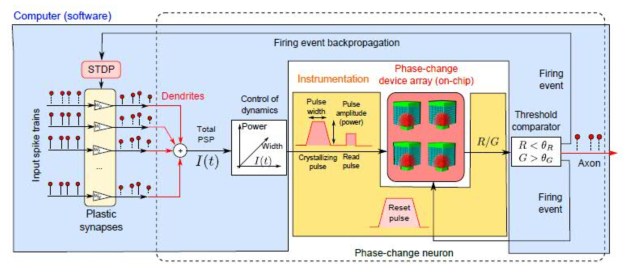
Second, these phase-change neurons are the closest we’ve come to creating artificial devices that behave like biological neurons, perhaps leading us towards efficient, massively parallel computer designs that apply neuromorphic approaches to decision-making and processing sensory information. IBM says that their new work is complementary to research being carried out into memristor-based synapses, too.

So far, IBM has built 10×10 crossbar arrays of neurons, connected five of those arrays together to create neuronal populations of up to 500 neurons, and then processed broadband signals in a novel, brain-like way. (In technical terms, the neurons showed the same „population coding“ that emerges in biological neurons, and the signal processing circumvented the Nyquist-Shannon sampling theorem).

There’s no reason to stop there, though. Now it’s time put thousands of these phase-change neurons onto a single chip—and then the difficult bit: writing some software that actually makes use of the chip’s neuromorphosity.

Nature Nanotechnology, 2016. DOI: 10.1038/nnano.2016.70 (About DOIs).

http://arstechnica.co.uk/gadgets/2016/08/ibm-phase-change-neurons

Move Over, 4G. Super-Fast 5G Has Been Approved by FCC

Mobile Carriers to Test Technology, Aiming for Deployment by 2020

Federal Communications Commission Chairman Tom Wheeler took a seat, grasped a set of controls, and guided an excavator — that happened to be 1,400 miles away.

By moving dirt in Dallas through a remote hook-up from the FCC’s Washington offices earlier this year, Mr. Wheeler showed the promise of what could be the largest and most lucrative expansion of the internet yet.

The agency on Thursday took a major step toward boosting wireless speeds 10-fold by voting unanimously to open little-used airwaves to purposes as varied as remote surgery, lightning-fast video downloads and factory robotics. The network that will flow over the frequencies in the next few years will be known as 5G, or fifth generation, to succeed the 4G networks that carry music and movies to smartphones today.

„We’re turning loose the incredible innovators of this country,“ Mr. Wheeler said just before the commissioners voted in Washington.

The airwaves involved were of little use until recently, because even though they carry a lot of data they don’t travel far and can be stopped by walls or even by rain drops. Engineers have begun to figure out how to aim and focus the transmissions to overcome these frailties, sending signals to new types of antennae that resemble compact smoke alarms rather than roadside towers.

The promise is an abundance of speedy information shot across short distances and linking up without the tiny delays known as latency that can plague even 4G connections, such as the barely perceptible delay that can make voice conversations awkward.

„These are huge blocks of spectrum that will deliver amazing applications to Americans,“ said Meredith Attwell Baker, president of CTIA, a trade group for wireless companies including the top four U.S. carriers, AT&T, Verizon Communications, Sprint and T-Mobile. „This is a critical first step to ensure the U.S. is in a position to lead the world in 5G.“

All four top U.S. mobile carriers have announced plans to test 5G technology, with partners including Cisco Systems, Ericsson AB, Nokia OYJ, Qualcomm andSamsung Electronics Co. Connections are projected to double by 2020 and reach 500 billion 10 years later as more mobile devices, robots, light sensors and drones all become part of the so-called internet of things.

5G will feed massive machine-to-machine communications that will encompass „everything from smart homes to real-time cargo tracking to enhanced environmental monitoring and myriad applications yet to be conceived,“ Reed Hundt, a former FCC chairman, said in a filing. Hundt is on the board of Ligado Networks, the wireless company formerly known as LightSquared.

„We’re talking about super-fast data rates, super-low latency: the kind of wireless any one would want that’s only a dream today,“ said Dean Brenner, senior vice president for government affairs at Qualcomm. The chipmaker based in San Diego, California, joined with Intel, Verizon, Samsung, Nokia and Ericsson to ask the FCC to allow higher power for base stations than the agency initially proposed.

It’s not entirely clear what uses may emerge, said Mr. Brenner.

„When we were devising 4G no one was thinking of Uber, no one in Washington was thinking of Snapchat or Instagram,“ Mr. Brenner said. „No one was thinking of Pokemon Go. The truth is, we don’t know.“

Qualcomm and competitors will work to deploy the technology as soon as possible, Mr. Brenner said. „This is going to be hyper-competitive, working with tremendous urgency,“ he said.

People in the field often talk of deployment by 2020, said Ms. Baker, the trade group leader. „We’ll see what our companies can do,“ she said.

The FCC slated airwaves in four different swathes for use by 5G. Some airwaves are to be auctioned for exclusive use by winning bidders, and others — mainly in frequencies that travel less far than the auctioned airwaves — are to be shared.

Interests including Alphabet’s Google and the New America public policy group asked that more airwaves be offered for shared use.

Carriers that win at auction may have incentive to deploy 5G only in crowded urban spaces, leaving other areas without coverage, said Michael Calabrese, director of the Wireless Future Project at the Washington-based New America.

„Nobody really knows yet what 5G will be,“ Mr. Calabrese said. „But the carriers have decided they want to control access to this spectrum for whatever it is that develops.“

http://adage.com/article/digital/move-4g-super-fast-5g-approved-fcc/304958