A few miles from Tesla Motors Inc’s Palo Alto headquarters, a Silicon Valley startup plans to challenge the electric car maker with a rival family of vehicles designed and built in the United States with major backing from Chinese investors.
Atieva plans to put a premium electric sedan on the road in 2018, followed by a pair of luxury crossovers in 2020-2021, company executives told Reuters in an exclusive interview. The company is racing not just against Tesla, but also against three China-based startups that are using Silicon Valley technologists.
Two of those startups are funded by the same Chinese internet billionaire backing Atieva. All three have opened technical facilities in Silicon Valley in the past year. Only one of those companies, Faraday Future, has said it also plans to build its electric vehicles in the United States.
Unlike those companies, Atieva was started in California. Former executives from Tesla and Oracle launched it in late 2007, and hired several former Tesla hands including Atieva Chief Technology Officer Peter Rawlinson.
„Secret sauce“
With its first car still at least two years away from production, Atieva is using a Mercedes-Benz Vito commercial van to test the drivetrain: a pair of high-output electric motors, a lithium-ion battery pack, inverters and controllers.
Rawlinson, who while at Tesla led engineering of the Model S sedan, said Atieva’s software is the „secret sauce“ tying all that hardware together to deliver a combined 900 horsepower to the 5,000-pound four-wheel-drive van he has named „Edna.“
The drivetrain propels the van from zero to 60 mph in just 3.1 seconds, a fraction slower than the fastest Tesla Model S. Atieva’s 0-60 acceleration target for its 2018 sedan is 2.7 seconds, faster than a 12-cylinder Ferrari supercar.
The Atieva sedan, being developed under the code name Project Cosmos, looks like a futuristic descendent of the Audi A7. Its headlamps are ultra-thin, with thousands of insect-inspired micro lenses. Its dashboard has a three-piece reconfigurable digital display that can be controlled by voice or touch.
Atieva has raised several hundred million dollars from investors including Mitsui & Co Ltd , the Japanese trading giant, and Venrock, a Silicon Valley venture capital firm connected with the Rockefeller family that once funded Intel and Apple.
Crowded field
Elon Musk, Chairman of SolarCity and CEO of Tesla Motors, speaks at SolarCity’s Inside Energy Summit in Manhattan, New York October 2, 2015.REUTERS/Rashid Umar Abbasi
Atieva’s launch schedule would add its new sedan to a bumper crop of electric luxury vehicles vying for customers in a rarified market Tesla now has largely to itself.
This week, Daimler AG’s Mercedes luxury car brand said it would unveil in October a long-range electric car it intends to put on sale before 2020. German rivals Volkswagen AG and BMW AG have said they are also working on premium electric cars.
Tesla did not reply to a request for comment about these would-be rivals, but the company is not sitting still and waiting for them to pounce. Chief Executive Officer Elon Musk raised $1.46 billion with a share sale last month, and outlined plans to launch a high-volume Model 3 sedan in 2017.
Tesla’s lead in the electric luxury vehicle segment has bolstered the price of its shares, which remain more than double their level of three years ago despite a 9 percent decline for the year to date.
Manufacturing plans
As Atieva looks for where it will build its U.S. factory, manufacturing director Brian Barron says the company has narrowed its search to two sites and expects to choose later this year. Barron, who spent 20 years overseeing various BMW plants, said the factory will be designed to build 20,000 electric cars a year initially, ramping up in stages to 130,000 a year.
Two of Atieva’s biggest shareholders are Chinese: State-owned Beijing Auto and a subsidiary of publicly traded LeEco, an internet company that has also declared it intends to offer an electric car. LeEco is controlled by Chinese tech entrepreneur Jia Yueting.
Jia also controls Faraday Future, an electric vehicle startup whose U.S. headquarters is based near Los Angeles and which also shares space in LeEco’s San Jose technical center in Silicon Valley.
A fourth Chinese-backed startup, NextEV, has a new San Jose facility near LeEco. NextEV is backed by Valley venture capital firm Sequoia Capital, which funded Google in its infancy. NextEV was launched in 2014 by William Li, the founder of Chinese website Bitauto, and financed in part by Tencent, the Chinese internet services provider.
Atieva design vice president Derek Jenkins said the company will set itself apart from its Chinese rivals using its „California DNA“ and its „California mindset.“ He did not provide specifics, but Jenkins led the team that designed the latest Mazda MX-5 Miata roadster.
Own, share or subscribe: Car ownership in the self-driving era
Fast-forward 20 years. Driverless cars coast around every street in the country without a human driver behind the wheel. They’ve reached market saturation — the technology is as commonplace as cruise control is today.
The rise of self-driving cars leads to a host of questions, of course, but for the moment let’s focus on just one: Will you still be able own a car? Would you even want to? I mean, why buy when you can take an autonomous pod everywhere for far less?
Thing is, the answer to that question isn’t a simple yes or no. But finding the answer is rooted in trends happening right now.
Companies like Lyft have partnered with General Motors to incentivize people out of car ownership with sweetheart rental deals, which may actually work. On the flip side, high-end carmakers — at least the ones I’ve spoken to — don’t see car sharing as a part of their future business.
When looking at the picture of car ownership in the driverless era, several scenarios become apparent.They range from outright ownership to pay-per-ride transportation (AKA „mobility as a service“) with a few options in between. With that in mind, let’s start at the top and work our way down.
1. Full ownership
Today, aside from a few current car-sharing programs, the vast majority of cars are used only by their owners, and not shared, at least not in a structured way. Even after the widespread implementation of driverless tech, the direct-sales business for top-end brands like Bentley, Lamborghini and Aston Martin won’t change. Right now, the average car sits unused 94% of its life. Likely, a Bentley sits idle even more than that — probably nearing the 99% mark, as the average Bentley buyer owns around nine other vehicles in addition.
Holographic butler Bentley concept.
Image: Bentley
To the luxury car buyer, there’s nothing more luxurious than owning a $400,000 car that you virtually never use — whether it drives itself or not. Moreover, there’s nothing luxurious about sharing a car. Even with the introduction of autonomous driving (something Bentley has said it is working on), the ownership model will likely never change.
But it will shrink. Ownership in all other parts of the market will likely drop considerably, as the following models expand and take hold.
2. Fractional ownership
At the launch of the CT6 sedan, I chatted with Cadillac President Johan de Nysschen about the how the brand will tackle car sharing and autonomy.
Speaking broadly, de Nysschen imagined a world in which luxury brands like Cadillac would offer not just a traditional sales model but rather a brand-wide subscription model. He likened this to a model already offered in the private jet market called fractional ownership.
Cadillac CT6
Image: Nick Jaynes/Mashable
In the world of jets, fractional ownership means you buy equity in an aircraft brand rather than buy a single jet. Of course, the price you pay depends on how much you intend to use the jet. However, the benefits of fractional ownership over outright ownership are many. For example, maintenance, fueling, hangar costs and other private jet ownership headaches are handled by the brand, rather than the customer.
De Nysschen hypothesized that Cadillac could implement a similar system. For a nominal monthly fee, every morning an autonomous Escalade could arrive at your home and drive you to work. If you were feeling sporty on a Saturday morning and wanted to do some track driving, however, you could — with a touch of a Cadillac app — order up an ATS-V to take you to a nearby racing circuit.
Of course, just like with fractional jet ownership, fractional car fee scales would increase with the amount you intend to use the brand vehicles.
This way, you’re not just investing in a single vehicle but rather a brand as whole. Along with not needing to insure, park or maintain the car, you also wouldn’t have to worry about fueling it — a benefit de Nysschen hypothesized Cadillac would put into effect for customers even before autonomy becomes prevalent.
The model has some clear benefits. Not only does it give the fractional owner flexible access to a fleet of vehicles, but it still allows the customer to invest in and identify with a single brand. In other words, you’ll still be able to one-up your neighbor.
High-income neighborhoods of the future, just like today, will be still lined with Mercedes-Benzes, BMWs and Cadillacs. Instead of being rooted in single vehicles at individual residences, however, the latest and greatest company offerings will simply roll into your driveway on a daily basis.
3. Own + share
The next level isn’t so much as a step down from fractional ownership as a step sideways. That’s because I see it also suiting luxury buyers, but those who are a bit more tied to the traditional car ownership concept. I call it the „own + share“ level.
For this example, let’s use Volvo as the brand and the XC90 as the vehicle, since it will likely be one of the first fully autonomous cars sold to customers. When it goes on sale, you’ll likely still be able to go into a dealership and get a lease on a $55,000 Volvo XC90 full-size SUV and drive it away (or rather, have it drive you away).
Self-parking Volvo XC90
Image: Volvo Cars
However, instead of letting the car sit idle in your driveway at night or your parking structure at work, you’ll be able to opt into a Volvo car-sharing program. Or, the program might not be manufacturer-affiliated — ride-sharing companies like Uber and Lyft may end up handling programs like these.
Think of it in the same way as leasing a condo in Aspen that you don’t use much of the time. You still own the car, but when you’re not using it, it’s autonomously driving and chauffeuring people around. Intriguingly, this model is already being implemented — sans autonomy, of course.
BMW is running one in Seattle right now called ReachNow that offers chauffeur-driven services, valet vehicle delivery service, short- and long-term rentals as well as peer-to-peer car sharing. Now, imagine the cars could drive themselves, removing human drivers from the equation altogether.
This would be a happy medium between brand fractional ownership and full-blown car sharing. People who feel — for whatever reason — tied to owning a car still can. However, when they’re not using it, the car is out there making (or saving, depending how you look at it) money that can counterbalance the costs of ownership like fuel, insurance and maintenance.
Autonomous Volvo XC90
Image: Volvo Cars
4. Mobility services
We’re finally down to the market where the majority of city-dwelling Americans will likely find themselves: mobility as a service. This includes the newly founded Maven from General Motors and Ford’s FordPass app.
While both offer different services, both aim for the same goal: to monetize getting people from A to B without having to sell them a 3,000-pound lump of steel.
That means — for a monthly fee — a mobility service app will get you where you need to go, whether that’s utilizing a shared car, hopping in a Lyft (a part of GM’s Maven), or riding an electrified Ford-branded bicycle to the train station (a pilot mobility solution tested by Ford).
Unlike fractional ownership or own + share, these services will be less about investing in a car, brand or quietly competing in an automotive cold war of one-upmanship with your neighbor. Instead, they’ll be about getting you places as efficiently and cheaply as possible, but still a step or two above public transportation.
Unlike the brand-driven fractional ownership, since Maven won’t be sexier in any way than FordPass (I assume), these services will be made and broken not by branding but by customer experience. They’ll also be driven by price. Think about it the way some people choose Amazon Prime over Hulu.
5. Pay per ride
We now come to the bottom rung of future mobility: pay-per-ride companies like Uber or Lyft. However, if you consider them in another light, these companies could be at the top of the pyramid, too, because — based upon current company models — they’re a great equalizer. Everybody uses them.
Regardless, these companies will likely operate similar to self-driving cars as they do with human-driven vehicles. The biggest difference being that Uber and Lyft will own the cars, rather than utilizing privately owned vehicles. Heck, Uber is rumored to have ordered $9.6 billion worth of Mercedes S-Class sedans.
However, as I suggested above with own + share, pay-per-ride companies could employ privately owned driverless cars, but I suspect the best business plan will be for the companies to own their own vehicles.
Whether Uber and Lyft own the cars or draw on private self-driving fleets, you’ll still be able to call up a car to your location and for a fee get to where you want to go.
General Motors and Lyft Inc. announced a long-term strategic alliance to create an integrated network of on-demand autonomous vehicles in the U.S.
Image: General Motors
Intriguingly, Lyft CEO Logan Green told me he imagines diversifying the ride experience in the future — beyond simply phasing in autonomous cars. Green envisions themed Lyft ride options. For example, Bostonians on the way to a Celtics game could opt for a Celtic-themed Lyft Line. Along those lines (pun intended), people could also choose a singles-themed ride coordinated with Match.com, for example.
Though Uber and Lyft might one day offer subscription services in addition to the pay-per-ride model, I suspect paying as you go will dominate, which could be the cheapest option for those who don’t need a regular mobility plan.
No longer the headline
Although I laid these examples from a most- to least-expensive structure, at least for the foreseeable future, these options will be available at all pricing levels.
By that I mean Chevrolet will likely continue to offer competitively priced (albeit autonomous) Silverado pickups to customers in rural Oklahoma, for example. That’s because a car-sharing or a mobility plan like Maven simply isn’t feasible when your nearest neighbor is 20 miles down the road.
Additionally, Bentley might well offer a fractional ownership plan in addition to its traditional bespoke sales model. Elite customers could desire a ground mobility plan similar to their private air travel experience.
Broadly, this all demonstrates that, although the mechanics of self-driving cars dominate headlines today, it’s the world after autonomy becomes commonplace — when driverless tech isn’t the headline anymore —- that will prove truly intriguing.
In this era, many more of us will be able to cast aside the idea of investing in a car for the next 11 years. Rather, we can just think about where we want to go and what we want to do we get there.
If Apple wants to bring a car to production, it’ll likely need a good bit of help to get it there. Right now, it’s looking like some of that help will likely come from the Canada-based automotive company Magna International.
Magna first began business in the early 1950’s. By the end of the decade, they were contracted out by General Motors to make small interior parts.
By the early 1960’s, Magna had two fully-operational plants running and its shares were being publicly traded on the Toronto Stock Exchange.
Now, Magna is the original equipment manufacturer of auto parts for a ton of different car brands and it also does full assembly for a handful of cars.
Though it has thrown the idea around of operating its own automotive brand, Magna’s primary involvement in the automotive world is primarily centered around part supplying.
Magna Steyr, Magna’s „contract manufacturing“ arm, currently assembles the Mercedes-Benz G-Class and the Mini Countryman.
Magna
Magna Steyr has plants across Europe and Asia.
Magna
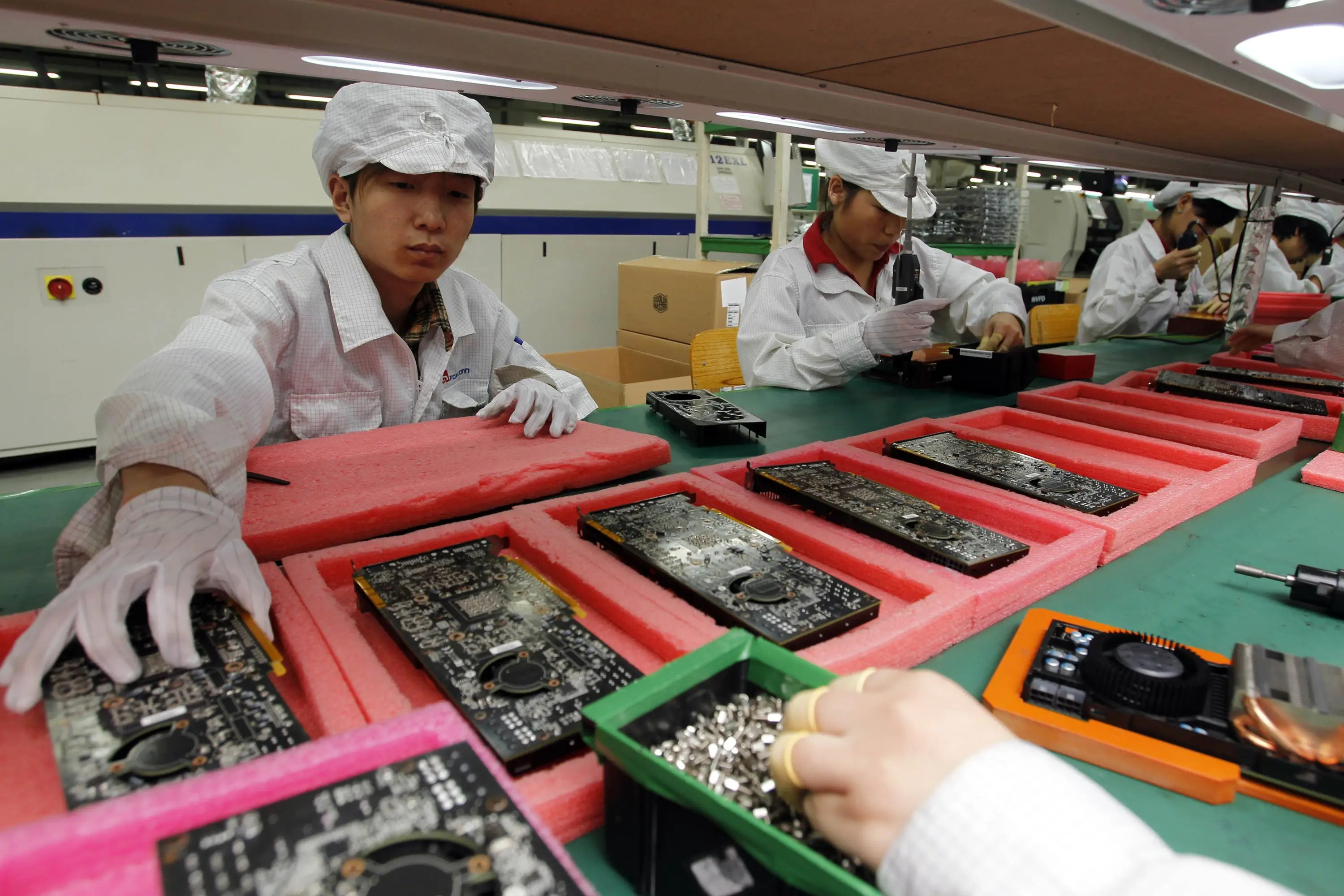
Similar to what Foxconn is to Apple currently, Magna would likely produce parts and assemble vehicles for Apple, if an Apple car was to hit production.
Kin Cheung/AP
The rumor is that the Apple car will be built at one of Magna’s Austrian facilities and that there’s currently research being done at a secret facility in Berlin.
It appears there’s a new wrinkle in the downsizing and turbocharging trend that’s putting a big dent in real-world fuel savings: Drivers aren’t shifting early enough. That shouldn’t be too surprising if you’ve driven something like Ford’s 1-liter EcoBoost Fiesta. With an offbeat 3-cylinder growl and the surge of turbo boost, that engine begs to be revved. Ford’s solution, according to a recent patent, is to fool these drivers by piping in artificial engine noise to simulate an engine with more cylinders.
Ford found that many drivers „shift by ear“ rather than watching the tachometer. And with these downsized, slower-revving engines that are becoming the industry norm, the auditory clues about shift points get lost on the drivers. Ford claims that this cancels out the advantages of the down-sized turbo engines because they’re not being driven within the envelope of greatest efficiency.
The solution is to train the driver to shift earlier by piping in a low-amplitude noise that occurs between cylinder firings, which increases the cylinder count to the driver’s ear. Ford’s patent allows the virtual cylinder count to be doubled or even tripled depending on how many artificial noises are superimposed between cylinder firings.
The company imagines this will be most beneficial on turbocharged 2- and 3-cylinder engines, and since manual transmissions aren’t terribly common in American mass-market cars, this seems aimed at two groups: Europeans (who still buy small cars with manual transmissions in large numbers) and sports car buyers. Whether you like Ford’s proposed system or not, at least it’s less-invasive fuel-saving solution than cutting power or artificially limiting RPM.
The Internet is still waking up from the madness that was the Model 3 unveiling, but Tesla CEO is – as always – looking towards the future. While in Norway recently, Musk talked about Tesla’s upcoming EV. No, not the 3, but the even cheaper and smaller electric vehicle that will be coming out after the 3 debuts. Musk said the following, talking about the Model 3 (to start):
I’m super excited about being able to produce a car that most people can afford. And there will be future cars that are even more affordable down the road, but, with something like the Model 3, it’s designed such that roughly half of the people will be able to afford the car. Then, with fourth generation and smaller cars, we’ll ultimately be in the position where almost everyone will be able to afford the car.
You can hear it for yourself at about 12 minutes into the video above. It’s worth watching the whole thing, because Musk also mentions fossil fuel subsidies, that mysterious mass transit solution thing and
dying on Mars.
What’s most interesting about Musk’s comments about Tesla’s future is that he may not be around to steer the ship when this next EV arrives. Musk has said that he will remain the Tesla CEO at least until the Model 3 production has ramped up, but after that, who knows. As he said a year and a half ago, „I will never leave Tesla forever, but I may not be CEO forever. Nobody should be CEO forever.“
Eager Tesla customers continue to reserve the Model 3, despite the ballooning wait times.
Reservations for Tesla’s recently unveiled, mainstream electric car, the Model 3, continue to climb.
According to a speech from Tesla’s Vice President of Business Development, Diarmuid O’Connell, this week, reservations for the car are now approaching 400,000.
That’s an eye-popping figure for an electric car that’s only been available to reserve for about two weeks and won’t start shipping until the end of 2017. Many of those reservations were made before the car was even unveiled on March 31. Now Tesla needs to figure out how to make and deliver those cars on time and budget.
Many of the later orders of the Model 3 likely won’t be fulfilled until 2019, or even into 2020 (four years from now).That’s assuming Tesla will remain on track to start shipping the car at the end of next year, too.
A driveable prototype of Tesla’s Model 3. Katie Fehrenbacher/Fortune
To get that volume of cars made and delivered on time, Tesla TSLA-2.56% could have to change the way it makes its cars considerably. Tesla has only delivered a little over 100,000 cars in total over its lifetime. During O’Connell’s speech at a conference in Amsterdam, he said the rapid reservation rate gives Tesla the “visibility” and “confidence” into what it would take to build the car.
Tesla CEO Elon Musk tweeted the day after revealing the Model 3 for the first time (when the car had close to 200,000 reservations) that Tesla is “definitely going to need to rethink production planning.” Tesla will likely have to expand production at both its Fremont, Calif. factory more quickly than expected, and it will soon have to start producing a greater number of batteries at its massive battery factory still under construction outside of Reno, Nevada.
O’Connell said that Tesla is “looking at ways to amplify early production.” The company is investigating possible ways to scale up initial investments and ramp up more quickly than previously anticipated. Tesla plans to use lessons learned from the difficulties it had with manufacturing the Model X, Tesla’s SUV electric car.
That car was delayed for years, and it faced slow production at the end of 2015 and into early 2016. The company has admitted hubris for the Model X in trying to fit in too many complex features into the first version of the car.
According to estimates from Cairn Energy Research Advisors, Tesla could ship a little over 400,000 of its Model 3 cars by the end of 2020. But before 2020, production of Model 3 could likely be constrained. For example, Tesla could ship 12,200 Model 3 cars in its first production year in 2017, and another 64,660 Model 3 cars in 2018.
During O’Connell’s speech, he boasted reservations for the Model 3 “have exceeded all of our expectations as far as the rate at which we received reservations,” further describing the Model 3 as “the car for which the company was really set up to build.”
O’Connell suggested that the great demand for the Model 3 delivers a message to the rest of the auto industry that there is “incredible demand” for great electric vehicles out there. In addition, the massive demand refutes the point that other automakers have made that no one wants electric cars, he argued.
To make a reservation for a Model 3 car, Tesla customers only have to put down a fully refundable deposit of $1,000. So it’s unclear how many of the reservation holders would turn into Model 3 buyers.
If all 400,000 reservation holders bought $35,000 Model 3 cars, Tesla would have booked $14 billion in orders. That’s an unprecedented sum—not just in the auto industry, but for a launch of a product in general.
I hate SUVs for the same reason I hate houseboats. Bad houses, bad boats. Luxury SUV’s make me sick. Is there anything more American than the idea that you can have it all, without compromise, for a price? You can’t, otherwise Escalades and Expeditions would be running in NASCAR.
Except now you can, because I just took a Tesla Model X P90D to Ojai, California, and for the first time in my life, I wanted an American car.
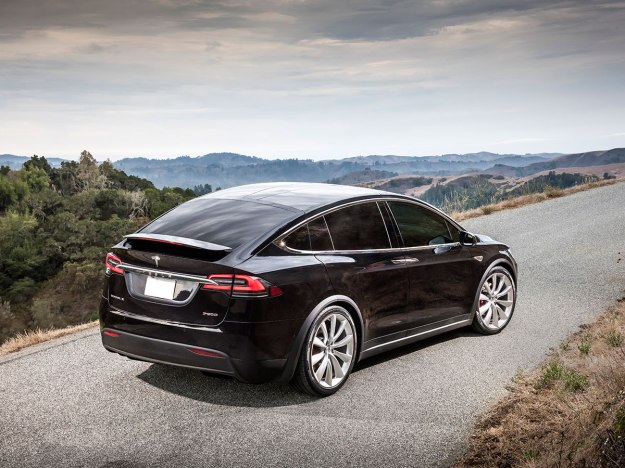
The Model X P90D represents everything I hate. It’s an awkwardly-proportioned, 5440 pound, electric, semi-autonomous, 7-seater SUV, packed full of technology that cannot possibly last, from a company critics claim cannot survive.
And I absolutely loved it.
Flaws? It’s a new company. If reliability is your concern, lease one and enjoy the most advanced, brilliant and fascinating vehicle in its class. The standard warranty is four years. Prepare for loaners.
The exterior is what it is. If you want the future now, this is what it looks like. If you’re satisfied with yesterday, you already know what’s available today. I think the X is handsome. Ish. Once behind the wheel, I didn’t care.
The Model X P90D gets about 250 miles of range. I’d like 50 more. Was it a problem? Only in my mind. As with any Tesla, you should install a high-speed charger at home. If not, prepare to meet some new friends at your nearest Tesla Supercharging station, and scratch 2-3 hours a week off your schedule.
The interior is spartan, at best. I still don’t buy into the wisdom of replacing all controls with a touchscreen, however large and gorgeous. The seats are the best I’ve ever used, and that includes the 1972 Citroen DS and SM, my personal benchmarks.
The Model X is a vehicle that makes no sense and yet perfect sense, an SUV with 716 horsepower that does 0-60 in 3.8 seconds, or 3.2 with the “Ludicrous” software upgrade.
A Ferrari Enzo does it in 3.14.
When an SUV can make you vomit while out-accelerating almost every Porsche, Ferrari or Lamborghini ever made, Modena and Stuttgart have a problem. Handling? The X is based on the same platform as the Model S sedan, which means it’s magnificent. Lower the air suspension, set the steering to Sport, and the X shrinks around you. I’ve never felt safe driving an SUV as I would a sports car, until now. Even my old Cayenne Turbo was a brick by comparison.
The Model X is the SUV someone else would have built if they had any balls.
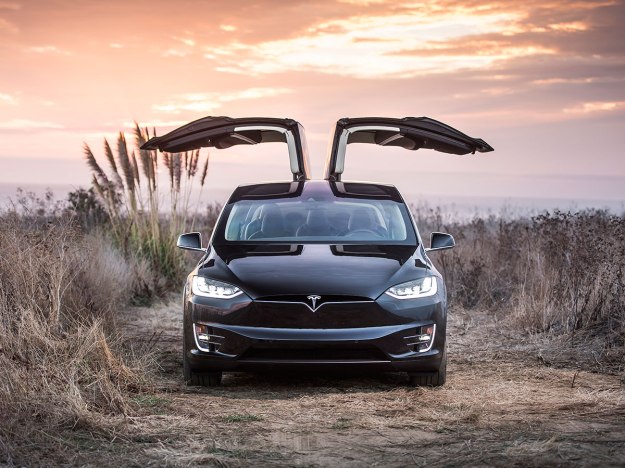
My god, those Falcon doors. Even if the X was utter junk, they could sell a year’s production based solely on these doors. Alas, you don’t need to be Nostradamus to know those will be a problem. If you lease past four years, get the extended warranty.
It has autopilot, which is what Tesla calls its Autonomous Driving suite. Light years ahead of competing systems, it is the only one today that approaches full autonomy. It’ll do 99% of the driving 90% of the time. It has a steep learning curve, but once mastered, autopilot is a revelation. Until Mercedes and Volvo come to the table, everything else is a joke.
The enormous one-piece panoramic windshield makes the cockpit feel like the first row in an IMAX theater. After driving the Model X, every other car feels like you have an eye infection. Why this windshield hasn’t been done before in the US, I don’t understand.
The Model X is the SUV someone else would have built if they had any balls. It is the world’s greatest SUV in a class of one…a class called The Future. The X is to SUV’s what the S is to luxury sedans, which is what Tesla is to the entire car industry: an icepick in the face of convention. Granted, there are stellar cars out there: the Cadillac CTS-V, the Porsche 911, the BMW M2, the Mercedes AMG-GT and the Volvo XC90, but these are jewels in the sediment of an industry left behind by true innovation. I love the Model X not merely as a vehicle, but as a profoundly American vehicle, the automotive manifestation of what this country is supposed to stand for. Ambition. Ingenuity. Confidence.
American inventor mythology is that of someone being told something couldn’t be done, and then doing it. Is there a more American story than Musk’s? The immigrant who became a tech titan, then launched a rocket company, then entered the car business?
The Model X, like Tesla the company, is an example of what happens when you apply that most American of methods to a problem. Throw out the book. Solve it from the ground up. Dealer networks suck? We’ll sell direct. Nowhere to charge? We’ll build our own network, and we’ll make it free. Autonomous Driving? Software updates? Let’s give Tesla owners access to the very best tech, and let’s wirelessly update it all the time.
By these standards, Tesla is the most American car company there is today, and the brilliant Model X is the most American car currently on the market. It is an example of what happens when a company is willing to take risks on our behalf rather than at our expense. Whatever critics may claim about Tesla’s ability to deliver, Musk’s greatest sin is his rush to sell us something truly better, which is why I deem the X worth every penny, flaws and all.
I can’t wait for the Model 3. If you believe in what really makes American great, neither should you.
With gull-wing doors and Lamborghini-like acceleration, Tesla’s Model X P90D Ludicrous—an electric all-wheel-drive luxury SUV—comes loaded with contradiction
WINGS OF DESIRE | The Falcon Wing Doors on the Tesla Model X P90D Ludicrous are at once thoughtfully engineered, largely impractical, and very, very cool. Photo: Tesla
By
Dan Neil
LET’S ADDRESS WHAT some might consider the morally inconsistent status of an all-electric luxury SUV costing $135,400. By design, the Tesla Model X P90D Ludicrous (that’s the real name, apparently) is meant to be green and efficient—and well-to-wheel, net-to-net, EVs are way cleaner than gas-powered cars. Electric vehicles are a technical expression of our belief that the atmosphere is the blue commons, owned by all. Egalitarian in impulse, in other words.
But the Model X is also the rarest sushi of materialism, class privilege under a blister of tinted glass, a suede-lined pachinko parlor of the soul. Just remember as you pull up to Nobu in West Hollywood and supermodels come running out to the valet to take a picture with your Model X with the doors up: You’re saving the planet.
Here’s the hard part for most people: It can be both. A feature of a free society is that some have more than others; such are the risks and rewards of capitalism. This is a given. This is gravity. But everyone, no matter their lifestyles, can consume less. And, by the power of numbers, a lot of lesses add up to quite a lot.
So some Hollywood celebrity downsizes to a Gulfstream IV and now she’s Mother Earth? Well, yes. Consider it a self-imposed carbon flat tax.
F. Scott Fitzgerald said the test of a first-rate intelligence is the ability to hold two opposed ideas in mind at the same time and still function. It also seems to apply to the Model X’s famous Falcon Wing Doors, since they are simultaneously unnecessary and absolutely vital to the entire enterprise; deeply thought-through yet completely spurious; impractical and…well, more impractical. But you get used to them, because they are so cool. See above re: supermodels.
Advertisement
Or retired aerospace engineers. Or French tourists. Or the hard-core, mainlining petrolheads who kept me waiting in the parking lot at Venice Beach, Calif., while they selfied themselves, laughing madly, sitting in mid-row seats while the doors were up. When all the doors are open you can look through the Model X as if it were a picture window with a Tesla-shaped sill and sash.
Would minivan-style doors have been a more sensible technical solution to a mid-row door opening? Infinitely. You could have done the doors off the Dubonnet Xenia easier that the Model X. But the spell these doors cast—let’s call it emotional engineering—is payoff for some of the shrewdest design money ever spent.
2016 Tesla Model X P90D Ludicrous
Photo: Tesla
Price, as tested: $135,400
Powertrain: all-electric all-wheel system comprising dual three-phase, four-pole AC induction motors; liquid-cooled lithium-ion battery pack (90kWh nominal); on-board charger and supercharger enabled; permanent all-wheel drive.
Horsepower/torque: 532 hp/713 pound-feet of torque
A bit of context: The Falcon Wing Doors came about because Tesla CEO Elon Musk liked them and wanted them, full stop. He has said he didn’t want the production car to be a dialed-back version of the concept car, which is just the sort of initiative and forward thinking that gets people cashiered from General Motors.
To aficionados, Mr. Musk’s move smacked of pride since in over a century of automotive design, from the Mercedes-Benz 300SL Gullwing to the DeLoreans to Lambos, gullwing doors have always looked cool and never really worked.
To name a few of the problems: ease of entry and exit, weather sealing and wind noise. From a safety standpoint, center-hinged overhead doors cut into the kind of rectangular geometry around a door opening that lends it rigidity.
What if it snows overnight? What if it’s raining? Where do you put the ski racks and bicycles and the Thule roof module full of hiking gear?
Who cares? Have you seen the doors open?
Most maddening was creating a dead-stable pivot point for the doors, which rise and fall slowly on the motorized breeze not like falcon wings but more like seagull wings, with a double fold. The solution required a heroic amount of costly magnesium in the car’s dorsal spine.
Mr. Musk has copped to overreach with the Model X. Maybe he tried to do too much, what with the Model X’s sensor-rich Autopilot driver aids; the dancing shuttle-craft seats; the HEPA air filtration system with the “Bioweapon Defense Mode” setting; the panoramic windscreen, a stunning soap bubble of a canopy over your head. Dude, you’re forgiven. But then again, I’m not a stockholder.
Practicality for fascination. This is the card Mr. Musk continues to play to his advantage. This is the part of the Tesla business plan that might as well have been quoted out of the Old Testament. The rich will want the riches.
2016 Tesla Model X P90D Ludicrous Photo: Tesla
Not to be confused with the Model 3 compact sedan that debuted so boffo this week, the Model X is a full-size SUV with dual electric motors front and rear, providing all-wheel drive. Although its body structure is almost entirely aluminum and magnesium, our flagship test car (P90D Ludicrous) was quoting a massive 5,381 pounds, most of it in the floor-mounted battery pack. Four-corner air suspension with five ride-height settings, from off-road to highway, is standard.
The Model X is a luxury family mover, with five-, six- or seven-passenger seating options, with a rear trunk and a frunk (a front trunk). The deeply tinted glass canopy creates a pretty magical space, although (another old lesson, relearned) the California sun is too bright through the roof glass. I understand additional tinting is available.
The front and mid-row seats are mounted on powered pedestals that glide forward as if to a Strauss waltz, easing access to the third row’s two cozy bucket seats. The seats’ pedestal mountings allow passengers more foot room than otherwise.
All the doors open electrically, which can take some getting used to. If you get in and put your right foot on the brake, the driver’s door will swing closed, even if you have not yet retrieved your left leg. The door will gently gnaw on it until you take your foot off the brake.
The price for the “standard” Model X 70S with a 70kWh battery is $80,000, which is about $5,000 more than a base Model S—a fact that is academic because Tesla won’t be building any base Model X’s for some time.
‘Elon Musk has copped to overreach with the Model X. Dude, you’re forgiven.’
The company will instead be filling orders for the flagship P90D (“P” for performance). These will come with a face-flapping 713 pound-feet of insta-torque from two huge four-pole AC induction motors ($35,000) and the famous “Ludicrous” Drive Mode ($10,000), which essentially permits the battery to violently eject electrons in pursuit of maximum acceleration. In Ludicrous Mode, the Model X P90D max output is 532 hp.
That’s the version that Tesla provided me, and I want them to know, I’m on to their game. It is very hard to find fault with a six-seat SUV that accelerates like a Formula Atlantic open-wheeler. Jeebus. Stamp the accelerator and it goes off like a sprung mousetrap. Tesla estimates 0-60 mph in a Lambo-like 3.2 seconds. While doing so, the Model X quietly withdraws everything from your pockets and scatters it conveniently under the back seats.
And then, between 50 and 100 mph, it’s goodbye, Charlie. The P90D Ludicrous operates at an entirely different frame rate than just about anything on the street in L.A. It takes a sustainably harvested baseball bat to Panzer wagons like Porsche Cayenne Turbo and Range Rover Sport SVR.
Around the City of Angels, the sweet, effortless blurt of our EV hot-rod tempted me to do, well, questionable things. No yellow light ever turns red for the Model X P90D. No hole that opens up in traffic is ever too small or far away.
Falcon wings? Maybe Icarus. But if the Model X flies too close to the sun, there’s always more window tint.
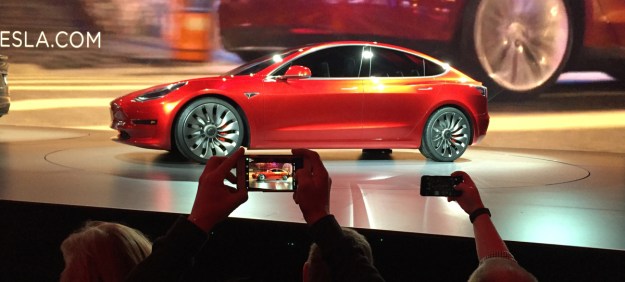
Tesla Motors unveils the new lower-priced Model 3 sedan at the Tesla Motors design studio in Hawthorne, Calif., Thursday, March 31, 2016. It doesn’t go on sale until late 2017, but in the first 24 hours that order banks were open, Tesla said it had more than 115,000 reservations. Long lines at Tesla stores, reminiscent of the crowds at Apple stores for early models of the iPhone, were reported from Hong Kong to Austin, Texas, to Washington, D.C. Buyers put down a $1,000 deposit to reserve the car.
In the first 72 hours, Tesla received 276,000 pre-orders for the upcoming Model 3. Given Tesla’s limited production capacity, the demand has by far surpassed the supply. Yet not one Tesla customer ever has to worry about paying some ridiculous dealer markup.
Before we go any further, let’s put that deposit number in perspective. The Model 3, with a starting price of $35,000 (before federal tax incentives) is entering one of the most hotly contested sales segments, the compact luxury sedan.
Cars like the BMW 3 Series, Audi A4, and Mercedes C-Class are crucial, high-volume vehicles to get buyers and lessees into the fold at a somewhat reasonable price point. The lease programs especially are designed to keep customers loyal and hopefully get buyers to move up the spectrum to more expensive vehicles as their income increases.
According to GoodCarBadCar.net, the top four best-selling small luxury sedans of 2015 were the 3 Series (94,527 units), C-Class (86,080 units), Acura TLX (47,080 units), and Lexus IS (46,430 units). In only three days, Tesla got more people to plunk down a deposit then the total combined sales of the top four compact sedans in an entire year. Of course, a deposit does not necessarily guarantee a sale, but the amount of interest in the Model 3 is staggering and turned out to be much more than initially predicted.
Usually, when an incredibly high-demand car hits the showrooms and dealers have waiting lists of customers, buyers tend to encounter something on the window sticker known as “ADM-Adjusted Dealer Markup” (you may see other acronyms that do the same thing.) Basically, the dealer tacks on an additional premium of extra profit that relates to what they think they can get for this car. They know some buyers won’t pay, but some will. It’s simple supply and demand economics. Some Porsche dealers are asking $115,000 for an $84,000 Cayman GT4. Ford dealers are tacking on markups to the Shelby GT350 that are almost twice the price of the car!
High-end cars like Porsches are targeted towards folks with a lot of income that probably can afford the premium if they so chose. The Model 3, on the other hand, is aimed at your average new car buyer—someone who most likely has to manage their budget a bit more carefully than your typical 911 GT3 buyer. It is important to Tesla’s success that when a potential customer runs the numbers and determines they can afford a Model 3 at whatever price point they desire, that the car is not snatched out of their reach by a dealership wanting to pad some profits.
Tesla’s direct sales model means that a dealer will never be able to sell a $35,000 Model 3 for $50,000, because out of the 276,000 people that are interested there will be at least a few hundred willing to pay the extra $15,000 to get one in their driveway. That’s not to say that folks willing to pay more aren’t getting preferential treatment. According to Tesla, Model 3 orders will not be first-come, first serve, but rather customers with more expensive configurations will get order priority over less expensive models. (Existing Model S and Model X owners get first crack too.)
But someone who ordered a $35,000 Model 3 can rest easy knowing that despite the popularity, as long as they are willing to wait, the price of that car will not change because some dealer wants to take advantage the market conditions.
People hate the car buying process because no matter how much research they do, at the end of the transaction they often feel like they got taken by the dealer. Whether or not that is reality doesn’t really matter. For many years, the dealers controlled the information, and while the internet has equalized the game in many respects, a lot of car buyers don’t walk away from a car purchase with a good feeling. This is why third party buying tools like TrueCar and haggle-free used car dealers like CarMax are so appealing; they reduce the price anxiety.
Of all the cool features that will be in the upcoming Model 3, the best might be the fact that you don’t have to be rich to buy a car and not feel like you got ripped off
It should be pretty clear by now that Apple (NASDAQ:AAPL) is very seriously considering making an electric car, having hired upwards of a thousand auto engineers. What’s completely up in the air is whether the company will actually release one or not. And no, it won’t look like the unicycle Apple Ride that the company teased last year.
As management debates this question internally, here is the most important argument on why Apple might be better off staying on the sidelines.
„A destroyer of capital“ Easily the most prominent reason is the sheer capital intensity of the auto business. This is a well-known characteristic of the auto industry, but it’s worth exploring in detail.
Last year, Fiat-Chrysler CEO Sergio Marchionne put out a detailed presentation, aptly entitled „Confessions of a Capital Junkie,“ arguing (again) for continued consolidation of the industry, in part citing severe overlap in development costs that could save the industry billions of dollars if they were shared. Combined with all of the capital required to manufacture vehicles, the auto industry is plagued with low returns on capital and low valuation multiples.
FCA
A group of industry veterans discussed the argument on Automotive News, and while there was consensus about the industry’s problems, there are no easy solutions. In no uncertain terms, Bob Lutz acknowledged, „The automobile business is a destroyer of capital.“
Apple has plenty of capital, but probably isn’t anxious to begin destroying it.
Apple’s newest investing metric: „gobs of money“ Cook was recently asked if Apple can afford to spend freely to explore new areas without commercializing products (in the context of its auto hires), to which he replied, „But once we start spending gobs of money — like when we start spending on tooling and things like that — we’re committed.“ When pressed further on whether or not hiring those auto engineers qualified as „gobs of money,“ Cook answered, „No. I wouldn’t call it gobs of money.“
Apple indeed has many gobs of money (roughly a millionty gobs by my count), and is also spending heavily on both capital expenditures and research and development. In fact, you might not realize that Apple spends more in both of these categories than incumbent Detroit automakers General Motors (NYSE:GM) and Ford (NYSE:F). Tesla’s (NASDAQ:TSLA) figures are also relevant as a neighboring Silicon Valley company just entering the auto market.
Company
Fiscal 2015 R&D
Fiscal 2015 Capital Expenditures
Apple
$8.1 billion
$11.2 billion
General Motors
$7.5 billion
$7.8 billion
Ford
$6.7 billion
$7.2 billion
Tesla
$718 million
$1.6 billion
DATA SOURCE: SEC FILINGS.
While Apple spends heavily on capital expenditures, the key difference here is that it earnssignificantly higher returns on invested capital, since Apple scales to incredible unit volumes.
Company
Return on Invested Capital (TTM)
Return on Assets (TTM)
Apple
29.6%
19.4%
General Motors
10.7%
5.2%
Ford
5%
3.4%
Tesla
(21.6%)
(12.8%)
DATA SOURCE: MORNINGSTAR. TTM = TRAILING 12 MONTH.
If you look at Tesla’s figures, this is what Apple should expect from its capital investments in the early years of building electric cars. Getting into the auto industry would inevitably dilute these profitability figures in a meaningful way.
(Domestic) cash is king Another important consideration is the location of Apple’s capital. Apple’s foreign reserves are well documented. Since Apple currently makes the vast majority of its products abroad via contract manufacturers, it is able to utilize those foreign reserves for the product tooling and manufacturing infrastructure. At the end of last fiscal year, Apple had $8.7 billion (net of depreciation) worth of long-lived assets in China.
But it wouldn’t be realistic or viable for Apple to manufacture vehicles in China and ship them home. An electric car weighing thousands of pounds is logistically quite different than a smartphone that fits in your pocket. Most automakers perform final assembly near the end market.
We don’t know what manufacturing model Apple would pursue, though. Contract manufacturing does exist in the realm of autos, but it’s not prevalent. For example, Magna Steyr assembles vehicles for Daimler Mercedes-Benz and BMW, and Rousch assembles prototype self-driving cars for Alphabet (domestically, no less, but in very small volumes).
If Apple pursued a similar contract manufacturing model (which Cook has hinted at), it would still likely purchase its own equipment like it does in its current model — that equipment just resides within partner facilities. There’s no avoiding the capital requirements, particularly as you increase volume expectations. And based on Cook’s comments above, the point of no return is when the company decides to start investing in tooling and manufacturing infrastructure.
However, Apple’s domestic reserves are primarily used to fund its capital return program, so committing to domestic manufacturing infrastructure would put pressure on its domestic cash position. Apple could continue raising debt to bolster domestic cash — the company enjoys extremely low costs of capital — but it would still be highly preferable to use foreign cash since most of it just idles anyway.
Itchy trigger finger It would be incredibly expensive to develop, manufacture, and launch an electric vehicle, which is partially why many traditional automakers historically disdained EVs and other alternative fuel vehicles so much, often referring to „compliance vehicles“ with great hostility. GM’s famous killing of the EV1 is the quintessential example, although GM has changed its tune under CEO Mary Barra, who recently declared that „your petrol-fueled car will become a thing of the past“ and has prioritized EV development in a big way.
All of this being said, capital efficiency is likely a secondary concern to Apple. The company has never been a follower of traditional resource allocation policies taught at business schools, even though Cook has a traditional MBA. Apple’s primary goals have always been to make great products that have a positive impact on people’s lives and the world at large. That’s especially true if Apple believes that it can help bring positive change to an industry (such as its efforts in TV).
In many ways, the auto industry is stuck in the past, particularly on the distribution side with antiquated dealer protectionist laws, and Apple has an opportunity to help catalyze its modernization. The company is also a big believer in climate change and environmental sustainability, adding to how an Apple EV would have a positive impact on the world.
Despite the high costs, I bet Cook pulls the trigger.

 Elon Musk, Chairman of SolarCity and CEO of Tesla Motors, speaks at SolarCity’s Inside Energy Summit in Manhattan, New York October 2, 2015. REUTERS/Rashid Umar Abbasi







 TheIdea – The Innovation Agency