If your car was powered by thorium, you would never need to refuel it. The vehicle would burn out long before the chemical did. The thorium would last so long, in fact, it would probably outlive you.
That’s why a company called Laser Power Systems has created a concept for a thorium-powered car engine. The element is radioactive, and the team uses bits of it to build a laserbeam that heats water, produces steam, and powers an energy-producing turbine.
Thorium is one of the most dense materials on the planet. A small sample of it packs 20 million times more energy than a similarly-sized sample of coal, making it an ideal energy source.
The thing is, Dr. Charles Stevens, the CEO of Laser Power Systems, told Mashable that thorium engines won’t be in cars anytime soon.
„Cars are not our primary interest,“ Stevens said. „The automakers don’t want to buy them.“
He said too much of the automobile industry is focused on making money off of gas engines, and it will take at least a couple decades for thorium technology to be used enough in other industries that vehicle manufacturers will begin to consider revamping the way they think about engines.
„We’re building this to power the rest of the world,“ Stevens said. He believes a thorium turbine about the size of an air conditioning unit could more provide cheap power for whole restaurants, hotels, office buildings, even small towns in areas of the world without electricity. At some point, thorium could power individual homes.
Stevens understands that people may be wary of Thorium because it is radioactive — but any such worry would be unfounded.
„The radiation that we develop off of one of these things can be shielded by a single sheet off of aluminum foil,“ Stevens said.“ „You will get more radiation from one of those dental X-rays than this.“
Pioneers Festival: Two founders, a palace and startups galore
Hofburg, Imperial Palace combined history and future technologies
Babywatch won this year’s Pioneers challenge
The Pioneers Festival provides a significant contribution to the Austrian business location”, Brigitte Jank, President of the Chamber of Commerce Vienna
Vienna, 31 October 2013 – Gathering together 2,500 international guests and speakers, including Charles Adler (Kickstarter co founder), Adam Cheyer (Siri founder) and Chris Barton (Shazam co founder), Pioneers successfully pulled off another Pioneers Festival, the second event of its kind. Pioneers Festival kicked off at the House of Industry on Tuesday with its infamous Investors Day, while the actual Festival combined history and technology at the Imperial Palace the following two days.
The Investors Day The Investors Day on Tuesday, 29 October 2013 in the House of Industry was devoted to the Top 50 startups of the Pioneers Challenge and key investors including Sequoia Capital, Earlybird, and Accel Partners. Each startup was given three minutes to pitch their company to high class a jury. More than 670 startups from around the globe had applied to take part. At the end of the day, only 16 were chosen to present their ideas on the conference days.
History and technology come together in the Imperial Palace On Wednesday morning the Imperial Palace opened its doors for more than 2,500 tech enthusiasts in an environment combined with history and future technologies. After the official welcome by the two founders Andreas Tschas and Juergen Furian, the program was officially kicked off. “It’s nice to get to know new people, find new stories, learn things from lots of people with lots of experience. It’s great for me to absorb their information and their know–‐how,” said festival attendee Nadim El Gawhary of Egypt. It was up to the participants to decide what their individual Pioneers Experience should be. While inspiring talks and technology demonstrations by speakers like Phil Libin (Evernote) or Charles Adler (Kickstarter) captured the audience in the Arena, the Academy provided the school lessons for entrepreneurs they were asking for. Supported by Konica Minolta, high caliber mentors such as Dave McClure (500startups) and Chris Barton (Shazam) taught attendees what daily business really looks like.
Nobody can beat Babywatch, the finest of the Top 50 Startups The Startup Challenge Finale topped off the last day as the Top 8 startups took the stage and presented their companies. The young entrepreneurs battled it out in the Pioneers Challenge – in the end Babywatch, the home ultrasound device startup from Croatia took home the victory prize, winning the Pioneers World Tour sponsored by Coca Cola with stops in Shenzhen, Singapore, Atlanta, New York and San Francisco, and the Pioneers Award 2013.
Some impressions:
Brigitte Jank explains the constant growth of the startup scene in Vienna and acknowledges the Pioneers Festival as one of its reasons:
“The Pioneers Festival provides a significant contribution here, being a platform bridging the contact between startups and potential investors, and turning Vienna into Europe’s creative capital city,”, explains Brigitte Jank, President of the Chamber of Commerce Vienna.
Christoph Leitl, WKO President was impressed by this year’s event and pointed out the importance of the entrepreneurial spirit for Austria’s economy regarding the valuable contribution of domestic founders to Austrian business location: “Even in challenging times Austria remains an attractive business location. This is clearly proven by recent numbers on newly created companies: 114 start ups per day contribute significantly to the employment record in Austria. That brings great dynamism to our country!”
Andreas Tschas reflects on this year’s Festival: “I am extremely happy about our results after one year of hard work and would like to express my sincere thanks to everyone who supported us. There are too many people to name, however I would like to point out Konica Minolta and Pro7Sat1Puls4 as our Global Partners and their support of young entrepreneurs as a part of their corporate responsibility, as well as the Federal Ministry of Economy, Family and Youth, the Federal Ministry for Transport, Innovation and Technology, the Austria Wirtschaftsservice, the Chamber of Commerce as well as the Vienna Business Agency.”
About Pioneers Festival: Pioneers Festival brings together national and international founders, startups, pioneers, investors, tech enthusiasts and media representatives once per year in Vienna to celebrate entrepreneurship and future technologies, to inspire and to educate. During the two day festival in the Vienna Hofburg, quality content by renowned speakers is discussed, the winners of the Pioneers Challenge are crowned, and a framework for a positive festival atmosphere is provided. Pioneers Festival was founded in the year 2012, making 30–‐31 October 2013 the second event.
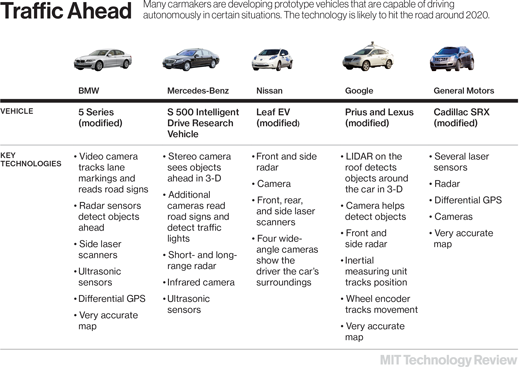
Carmakers are developing vehicles that have an increasing ability to autonomously drive themselves, potentially reducing accidents and traffic congestion.
A silver BMW 5 Series is weaving through traffic at roughly 120 kilometers per hour (75 mph) on a freeway that cuts northeast through Bavaria between Munich and Ingolstadt. I’m in the driver’s seat, watching cars and trucks pass by, but I haven’t touched the steering wheel, the brake, or the gas pedal for at least 10 minutes. The BMW approaches a truck that is moving slowly. To maintain our speed, the car activates its turn signal and begins steering to the left, toward the passing lane. Just as it does, another car swerves into the passing lane from several cars behind. The BMW quickly switches off its signal and pulls back to the center of the lane, waiting for the speeding car to pass before trying again.Putting your life in the hands of a robot chauffeur offers an unnerving glimpse into how driving is about to be upended. The automobile, which has followed a path of steady but slow technological evolution for the past 130 years, is on course to change dramatically in the next few years, in ways that could have radical economic, environmental, and social impacts.The first autonomous systems, which are able to control steering, braking, and accelerating, are already starting to appear in cars; these systems require drivers to keep an eye on the road and hands on the wheel. But the next generation, such as BMW’s self-driving prototype, could be available in less than a decade and free drivers to work, text, or just relax. Ford, GM, Toyota, Nissan, Volvo, and Audi have all shown off cars that can drive themselves, and they have all declared that within a decade they plan to sell some form of advanced automation—cars able to take over driving on highways or to park themselves in a garage. Google, meanwhile, is investing millions in autonomous driving software, and its driverless cars have become a familiar sight on the highways around Silicon Valley over the last several years.The allure of automation for car companies is huge. In a fiercely competitive market, in which the makers of luxury cars race to indulge customers with the latest technology, it would be commercial suicide not to invest heavily in an automated future. “It’s the most impressive experience we can offer,” Werner Huber, the man in charge of BMW’s autonomous driving project, told me at the company’s headquarters in Munich. He said the company aims to be “one of the first in the world” to introduce highway autonomy.
Thanks to autonomous driving, the road ahead seems likely to have fewer traffic accidents and less congestion and pollution. Data published last year by the Insurance Institute for Highway Safety, a U.S. nonprofit funded by the auto industry, suggests that partly autonomous features are already helping to reduce crashes. Its figures, collected from U.S. auto insurers, show that cars with forward collision warning systems, which either warn the driver about an impending crash or apply the brakes automatically, are involved in far fewer crashes than cars without them.
More comprehensive autonomy could reduce traffic accidents further still. The National Highway Traffic Safety Administration estimates that more than 90 percent of road crashes involve human error, a figure that has led some experts to predict that autonomous driving will reduce the number of accidents on the road by a similar percentage. Assuming the technology becomes ubiquitous and does have such an effect, the benefits to society will be huge. Almost 33,000 people die on the roads in the United States each year, at a cost of $300 billion, according to the American Automobile Association. The World Health Organization estimates that worldwide over 1.2 million people die on roads every year.
Meanwhile, demonstrations conducted at the University of California, Riverside, in 1997 and experiments involving modified road vehicles conducted by Volvo and others in 2011 suggest that having vehicles travel in high-speed automated “platoons,” thereby reducing aerodynamic drag, could lower fuel consumption by 20 percent. And an engineering study published last year concluded that automation could theoretically allow nearly four times as many cars to travel on a given stretch of highway. That could save some of the 5.5 billion hours and 2.9 billion gallons of fuel that the Texas Transportation Institute says are wasted by traffic congestion each year.
If all else fails, there is a big red button on the dashboard that cuts power to all the car’s computers. I practiced hitting it a few times.
But such projections tend to overlook just how challenging it will be to make a driverless car. If autonomous driving is to change transportation dramatically, it needs to be both widespread and flawless. Turning such a complex technology into a commercial product is unlikely to be simple. It could take decades for the technology to come down in cost, and it might take even longer for it to work safely enough that we trust fully automated vehicles to drive us around.
German engineering Much of the hype about autonomous driving has, unsurprisingly, focused on Google’s self-driving project. The cars are impressive, and the company has no doubt insinuated the possibility of driverless vehicles into the imaginations of many. But for all its expertise in developing search technology and software, Google has zero experience building cars. To understand how autonomous driving is more likely to emerge, it is more instructive to see what some of the world’s most advanced automakers are working on. And few places in the world can rival the automotive expertise of Germany, where BMW, Audi, Mercedes-Benz, and Volkswagen are all busy trying to change autonomous driving from a research effort into a viable option on their newest models.
Shortly after arriving in Munich, I found myself at a test track north of the city getting safety instruction from Michael Aeberhard, a BMW research engineer. As I drove a prototype BMW 5 Series along an empty stretch of track, Aeberhard told me to take my hands off the wheel and then issued commands that made the car go berserk and steer wildly off course. Each time, I had to grab the wheel as quickly as I could to override the behavior. The system is designed to defer to a human driver, giving up control whenever he or she moves the wheel or presses a pedal. And if all else fails, there is a big red button on the dashboard that cuts power to all the car’s computers. I practiced hitting it a few times, and discovered how hard it was to control the car without even the power-assisted steering. The idea of the exercise was to prepare me for potential glitches during the actual test drive. “It’s still a prototype,” Aeberhard reminded me several times.
After I signed a disclaimer, we drove to the autobahn outside Munich. A screen fixed to the passenger side of the dashboard showed the world as the car perceives it: three lanes, on which a tiny animated version of the car is surrounded by a bunch of floating blue blocks, each corresponding to a nearby vehicle or to an obstacle like one of the barriers on either side of the road. Aeberhard told me to activate the system in heavy traffic as we rode at about 100 kilometers per hour. When I first flicked the switch, I was dubious about even removing my hands from the wheel, but after watching the car perform numerous passing maneuvers, I found myself relaxing—to my astonishment—until I had to actually remind myself to pay attention to the road.
The car looked normal from the outside. There’s no place on a sleek luxury sedan for the huge rotating laser scanners seen on the prototypes being tested by Google. So BMW and other carmakers have had to find ways to pack smaller, more limited sensors into the body of a car without compromising weight or styling.
Concealed inside the BMW’s front and rear bumpers, two laser scanners and three radar sensors sweep the road before and behind for anything within about 200 meters. Embedded at the top of the windshield and rear window are cameras that track the road markings and detect road signs. Near each side mirror are wide-angle laser scanners, each with almost 180 degrees of vision, that watch the road left and right. Four ultrasonic sensors above the wheels monitor the area close to the car. Finally, a differential Global Positioning System receiver, which combines signals from ground-based stations with those from satellites, knows where the car is, to within a few centimeters of the closest lane marking.
Several computers inside the car’s trunk perform split-second measurements and calculations, processing data pouring in from the sensors. Software assigns a value to each lane of the road based on the car’s speed and the behavior of nearby vehicles. Using a probabilistic technique that helps cancel out inaccuracies in sensor readings, this software decides whether to switch to another lane, to attempt to pass the car ahead, or to get out of the way of a vehicle approaching from behind. Commands are relayed to a separate computer that controls acceleration, braking, and steering. Yet another computer system monitors the behavior of everything involved with autonomous driving for signs of malfunction.
Impressive though BMW’s autonomous highway driving is, it is still years away from market. To see the most advanced autonomy now available, a day later I took the train from Munich to Stuttgart to visit another German automotive giant, Daimler, which owns Mercedes-Benz. At the company’s research and development facility southeast of the city, where experimental new models cruise around covered in black material to hide new designs and features from photographers, I got to ride in probably the most autonomous road car on the market today: the 2014 Mercedes S-Class.
A jovial safety engineer drove me around a test track, showing how the car can lock onto a vehicle in front and follow it along the road at a safe distance. To follow at a constant distance, the car’s computers take over not only braking and accelerating, as with conventional adaptive cruise control, but steering too.
Using a stereo camera, radar, and an infrared camera, the S-Class can also spot objects on the road ahead and take control of the brakes to prevent an accident. The engineer eagerly demonstrated this by accelerating toward a dummy placed in the center of the track. At about 80 kilometers per hour, he took his hands off the wheel and removed his foot from the accelerator. Just when impact seemed all but inevitable, the car performed a near-perfect emergency stop, wrenching us forward in our seats but bringing itself to rest about a foot in front of the dummy, which bore an appropriately terrified expression.
Uncertain road With such technology already on the road and prototypes like BMW’s in the works, it’s tempting to imagine that total automation can’t be far away. In reality, making the leap from the kind of autonomy in the Mercedes-Benz S-Class to the kind in BMW’s prototype will take time, and the dream of total automation could prove surprisingly elusive.
For one thing, many of the sensors and computers found in BMW’s car, and in other prototypes, are too expensive to be deployed widely. And achieving even more complete automation will probably mean using more advanced, more expensive sensors and computers. The spinning laser instrument, or LIDAR, seen on the roof of Google’s cars, for instance, provides the best 3-D image of the surrounding world, accurate down to two centimeters, but sells for around $80,000. Such instruments will also need to be miniaturized and redesigned, adding more cost, since few car designers would slap the existing ones on top of a sleek new model.
Cost will be just one factor, though. While several U.S. states have passed laws permitting autonomous cars to be tested on their roads, the National Highway Traffic Safety Administration has yet to devise regulations for testing and certifying the safety and reliability of autonomous features. Two major international treaties, the Vienna Convention on Road Traffic and the Geneva Convention on Road Traffic, may need to be changed for the cars to be used in Europe and the United States, as both documents state that a driver must be in full control of a vehicle at all times.
Most daunting, however, are the remaining computer science and artificial-intelligence challenges. Automated driving will at first be limited to relatively simple situations, mainly highway driving, because the technology still can’t respond to uncertainties posed by oncoming traffic, rotaries, and pedestrians. And drivers will also almost certainly be expected to assume some sort of supervisory role, requiring them to be ready to retake control as soon as the system gets outside its comfort zone.
Despite the flashy demos, I sometimes detected among carmakers a desire to hit the brakes and temper expectations.
The relationship between human and robot driver could be surprisingly fraught. The problem, as I discovered during my BMW test drive, is that it’s all too easy to lose focus, and difficult to get it back. The difficulty of reëngaging distracted drivers is an issue that Bryan Reimer, a research scientist in MIT’s Age Lab, has well documented (see “Proceed with Caution toward the Self-Driving Car,” May/June 2013). Perhaps the “most inhibiting factors” in the development of driverless cars, he suggests, “will be factors related to the human experience.”
In an effort to address this issue, carmakers are thinking about ways to prevent drivers from becoming too distracted, and ways to bring them back to the driving task as smoothly as possible. This may mean monitoring drivers’ attention and alerting them if they’re becoming too disengaged. “The first generations [of autonomous cars] are going to require a driver to intervene at certain points,” Clifford Nass, codirector of Stanford University’s Center for Automotive Research, told me. “It turns out that may be the most dangerous moment for autonomous vehicles. We may have this terrible irony that when the car is driving autonomously it is much safer, but because of the inability of humans to get back in the loop it may ultimately be less safe.”
An important challenge with a system that drives all by itself, but only some of the time, is that it must be able to predict when it may be about to fail, to give the driver enough time to take over. This ability is limited by the range of a car’s sensors and by the inherent difficulty of predicting the outcome of a complex situation. “Maybe the driver is completely distracted,” Werner Huber said. “He takes five, six, seven seconds to come back to the driving task—that means the car has to know [in advance] when its limitation is reached. The challenge is very big.”
Before traveling to Germany, I visited John Leonard, an MIT professor who works on robot navigation, to find out more about the limits of vehicle automation. Leonard led one of the teams involved in the DARPA Urban Challenge, an event in 2007 that saw autonomous vehicles race across mocked-up city streets, complete with stop-sign intersections and moving traffic. The challenge inspired new research and new interest in autonomous driving, but Leonard is restrained in his enthusiasm for the commercial trajectory that autonomous driving has taken since then. “Some of these fundamental questions, about representing the world and being able to predict what might happen—we might still be decades behind humans with our machine technology,” he told me. “There are major, unsolved, difficult issues here. We have to be careful that we don’t overhype how well it works.”
Leonard suggested that much of the technology that has helped autonomous cars deal with complex urban environments in research projects—some of which is used in Google’s cars today—may never be cheap or compact enough to be employed in commercially available vehicles. This includes not just the LIDAR but also an inertial navigation system, which provides precise positioning information by monitoring the vehicle’s own movement and combining the resulting data with differential GPS and a highly accurate digital map. What’s more, poor weather can significantly degrade the reliability of sensors, Leonard said, and it may not always be feasible to rely heavily on a digital map, as so many prototype systems do. “If the system relies on a very accurate prior map, then it has to be robust to the situation of that map being wrong, and the work of keeping those maps up to date shouldn’t be underestimated,” he said.
Near the end of my ride in BMW’s autonomous prototype, I discovered an example of imperfect autonomy in action. We had made a loop of the airport and were heading back toward the city when a Smart car, which had been darting through traffic a little erratically, suddenly swung in front of me from the right. Confused by its sudden and irregular maneuver, our car kept approaching it rapidly, and with less than a second to spare I lost my nerve and hit the brakes, slowing the car down and taking it out of self-driving mode. A moment later I asked Aeberhard if our car would have braked in time. “It would’ve been close,” he admitted.
Despite the flashy demos and the bold plans for commercialization, I sometimes detected among carmakers a desire to hit the brakes and temper expectations. Ralf Herttwich, who leads research and engineering of driver assistance systems at Mercedes, explained that interpreting a situation becomes exponentially more difficult as the road becomes more complex. “Once you leave the highway and once you go onto the average road, environment perception needs to get better. Your interpretation of traffic situations, because there are so many more of them—they need to get better,” he said. “Just looking at a traffic light and deciding if that traffic light is for you is a very, very complex problem.”
MIT’s Leonard, for one, does not believe total autonomy is imminent. “I do not expect there to be taxis in Manhattan with no drivers in my lifetime,” he said, before quickly adding, “And I don’t want to see taxi drivers out of business. They know where they’re going, and—at least in Europe—they’re courteous and safe, and they get you where you need to be. That’s a very valuable societal role.”
I pondered Leonard’s objections while visiting BMW and Mercedes. I even mentioned some of them to a taxi driver in Munich who was curious about my trip. He seemed far from worried. “We have siebten Sinn—a seventh sense,” he said, referring to the instinctive road awareness a person builds up. As he nipped through the busy traffic with impressive speed, I suspected that this ability to cope deftly with such a complex and messy world could prove useful for a while longer.
Data gathered from Google’s self-driving Prius and Lexus cars shows that they are safer and smoother when steering themselves than when a human takes the wheel, according to the leader of Google’s autonomous-car project.
Chris Urmson made those claims today at a robotics conference in Santa Clara, California. He presented results from two studies of data from the hundreds of thousands of miles Google’s vehicles have logged on public roads in California and Nevada.
One of those analyses showed that when a human was behind the wheel, Google’s cars accelerated and braked significantly more sharply than they did when piloting themselves. Another showed that the cars’ software was much better at maintaining a safe distance from the vehicle ahead than the human drivers were.
“We’re spending less time in near-collision states,” said Urmson. “Our car is driving more smoothly and more safely than our trained professional drivers.”
In addition to painting a rosy picture of his vehicles’ autonomous capabilities, Urmson showed a new dashboard display that his group has developed to help people understand what an autonomous car is doing and when they might want to take over. “Inside the car we’ve gone out of our way to make the human factors work,” he said.
Although that might suggest the company is thinking about how to translate its research project into something used by real motorists, Urmson dodged a question about how that might happen. “We’re thinking about different ways of bringing it to market,” he said. “I can’t tell you any more right now.”
Urmson did say that he is in regular contact with automakers. Many of those companies are independently working on self-driving cars themselves (see “Driverless Cars Are Further Away Than You Think”).
Google has been testing its cars on public roads since 2010 (see “Look, No Hands”), always with a human in the driver’s seat who can take over if necessary.
Urmson dismissed claims that legal and regulatory problems pose a major barrier to cars that are completely autonomous. He pointed out that California, Nevada, and Florida have already adjusted their laws to allow tests of self-driving cars. And existing product liability laws make it clear that a car’s manufacturer would be at fault if the car caused a crash, he said. He also said that when the inevitable accidents do occur, the data autonomous cars collect in order to navigate will provide a powerful and accurate picture of exactly who was responsible.
Urmson showed data from a Google car that was rear-ended in traffic by another driver. Examining the car’s annotated map of its surroundings clearly showed that the Google vehicle smoothly halted before being struck by the other vehicle.
“We don’t have to rely on eyewitnesses that can’t act be trusted as to what happened—we actually have the data,” he said. “The guy around us wasn’t paying enough attention. The data will set you free.”
Pioneers Festival versammelt die beeindruckendsten Unternehmer, Investoren, Medien und Startups
● Stephen Lake (CEO Thalmic Labs, MYO), General Pete Worden (Direktor NASA Ames Research Center), Peter Platzer (Gründer Nanosatisfi), Adam Cheyer (Gründer von Apples Siri), Phil Libin (CEO Evernote) und viele mehr sind bestätigt
● Operationen im All – privat vs. staatlich, NASA vs. NanoSatisfi: eine Diskussion über
Expeditionen ins All moderiert von Olivia Solon (WIRED)
● Europäische Premiere: MYO Gründer präsentieren ihre neue Gesture Control Technologie
● Charles Adler (Gründer Kickstarter) und Tom Hulme (IDEO London) diskutieren über
Entrepreneurship und dessen Rolle in der Gesellschaft Vom 30. bis 31. Oktober versammelt das Pioneers Festival bekannte nationale und internationale Unternehmer, Investoren, Technologie-Experten, Medienvertreter und Pioniere aus den verschiedensten Bereichen, um ein neues Zeitalter des Pioniergeists einzuläuten. Mehr als 2.500 Teilnehmer tauschen sich in der Wiener Hofburg über Entrepreneurship und innovative Zukunftstechnologien aus. Somit treten sie in die Fußstapfen einiger der mächtigsten Menschen, die nicht nur Österreichs sondern auch Europas Geschichte in der Wiener Hofburg mitgeschrieben haben.
Die Finalisierung des Programms des Pioneers Festival steckt gerade im Endspurt und somit kann heute schon ein Ausblick auf einige der Highlights des diesjährigen Festivals gewährt werden.
Expeditionen ins All – privat vs. staatlich
Als der erste Mensch am Mond landete, war es der Staat, der ihn dorthin gebracht hatte und nicht ein privates Shuttle oder seine eigene Finanzierung. Bisher waren Expeditionen ins All rein staatliche Angelegenheit, doch im Laufe der letzten Jahre haben sich mehr und mehr private Initiativen in diese Richtung entwickelt. Der Direktor des NASA Ames Research Center General Pete Worden und NanoSatisfi Gründer Peter Platzer (von Präsident Barack Obama als “Champion of Change” ausgezeichnet) werden die Zukunft der Weltraumeinsätze diskutieren. Mit Olivia Solon von WIRED als Moderatorin ist eine hochkarätige Diskussion garantiert.
MYO’s Europa-Premiere
Thalmic Labs CEO Stephen Lake und seine zwei Mitgründer werden zum ersten Mal in Europa ihr beeindruckendes Gestenkontrollsystem live auf der Bühne präsentieren. Was ist Gestenkontrolle?
Stellen Sie sich einfach vor, ein Instrument zu spielen, ohne es in der Hand zu halten oder ganz einfach mit der Hand durch die Luft zu wischen, um die nächste Folie Ihrer Präsentation anzuzeigen.
Vor fünf Monaten sorgte das kanadische Startup mit einem Trailer für weltweite Begeisterung und eine 14,5 Millionen Dollar Finanzierung, die Thalmic Labs bei der Produktentwicklung sicher noch deutlich weitergebracht hat.
Vogelperspektive aufs Entrepreneurship – Was passiert?
Entrepreneurship ist das Herzstück der Diskussionen auf dem Pioneers Festival. Kritisch, provokativ und ehrlich – Themen wie der Einfluss des Individuums, „Lean Startup“, und die Daseinsberechtigung von Entrepreneurship sind geplant. Kickstarter Co-Gründer Charles Adler und Tom Hulme, Design Director bei IDEO London und Gründer von OpenIDEO, werden auf der Bühne ihre Sichtweise darstellen und den Status Quo von Entrepreneurship beleuchten. Diese Diskussion wird eines der Highlights des Festivals. Es wird in den Kern des Entrepreneurships eingetaucht und seine Auswirkungen auf die Gesellschaft
dargestellt.
Viele wunderbare Vortragende aus dem Vorjahr werden auch wieder dabei sein.
Co-Gründer von Siri Adam Cheyer zum Beispiel sagte 2012: „I came to inspire, but came away inspired. Amazing presentations, parties, and most of all people – unforgettable!”
Teilnehmer haben auch die einzigartige Möglichkeit, Evernote’s CEO Phil Libin zu einem persönlichen Meet & Greet zu treffen. Interessierte können sich hier anmelden um ihre Top 3 Fragen live auf der Bühne an Phil zu stellen.
Über Pioneers Festival:
Pioneers Festival versammelt einmal im Jahr nationale und internationale Gründer, Startups, Pioniere, Investoren, Tech-Begeisterte und Medienvertreter in Wien, um Unternehmertum und innovative Zukunftstechnologien gebührend zu feiern, zu inspirieren und Wissen zu vermitteln. Während der beiden Festival Tage in der Wiener Hofburg werden qualitativ hochwertige Inhalte von renommierten Speakern diskutiert, der Sieger der Pioneers Challenge gekürt und mit dem Rahmenprogramm wird für großartige Festivalstimmung gesorgt. Pioneers Festival wurde im Jahr 2012 gegründet und findet somit dieses Jahr zum zweiten Mal von 30. – 31. Oktober 2013 statt. Veranstalter ist Pioneers, dessen Gründer
Andreas Tschas und Jürgen Furian bereits die Jahre zuvor die europäische Startup Szene aktiv mitgestaltet haben.
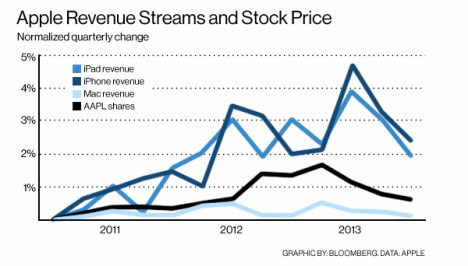
Vergleicht man den Verlauf der Einnahmen aus Apples iPad-Verkäufen der vergangenen Jahre, so fällt auf, dass sie sich ähnlich verhalten wie der Kursverlauf der Apple-Aktie. Auf diese Korrelation hat Mark Glassman von Bloombergs Businessweek hingewiesen.
Die Übereinstimmung erreicht 68 Prozent – im Vergleich dazu liegt sie zwischen iPhone-Verkäufen und Aktienkurs nur bei 62 Prozent, bei den Macs sogar nur bei 40 Prozent.
Für Börsenexperten und Anleger stellt diese Beobachtung eine äußerst verwertbare Information dar, die durchaus eine Grundorientierung auch für alle anderen bietet, die sich nicht sicher sind, wann sie am besten ihre Apple-Aktien kaufen oder loswerden sollten.
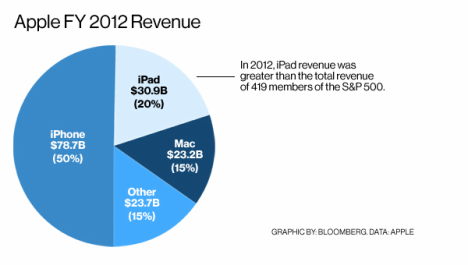
Einen weiteren guten Anhaltspunkt bietet natürlich auch die Verkaufszahl der jeweils einzelnen Einheiten an iPhones, iPads und Macs, wobei hier das iPhone – das etwa die Hälfte aller Apple-Einkünfte ausmacht – klar vorn liegt: mit 77-prozentiger Korrelation zum Aktienkurs, wohingegen die iPad-Verkaufszahl nur zu 68 Prozent dem Kursverlauf entspricht. Diese 68 Prozent sind wiederum viel angesichts der Tatsache, dass das iPad-Geschäft lediglich 20 Prozent der Gesamteinnahmen Apples ausmacht. Dies sind derzeit jedoch stolze 30,9 Milliarden Dollar. Dieser Wert ist größer als der Gesamtumsatz bei 419 Unternehmen des S&P 500 Index.
Kurz gefasst heißt das für den Anleger: eine klare Kaufempfehlung, wenn die iPhone-Verkaufszahlen und die iPad-Einkünfte ansteigen. Am 22. Oktober soll Apple die nächste Generation von iPads und iPad minis vorstellen, sechs Tage später wird das Unternehmen dann seine Bilanz für das vierte Quartal präsentieren. Und mit dem erst danach beginnenden Verkauf der neuen Tablets geht auch die Arbeit der Statistiker und Analysten, die den Erfolg oder Misserfolg des Geschäfts messbar aufbereiten, in die nächste Runde.
Although Yahoo! called everyone back to the office, you might be moving forward with an open, flexible work environment. Perhaps you don’t need all your employees physically present and you want to open the door to talented individuals across the country — or the globe.
Before you act, make sure you know what it takes to succeed as a virtual business.
Your Number-One Challenge: Social Interaction
Many people think the hardest part of transitioning to a virtual work life is learning the art of self-motivation. In reality, people struggle most with the social change. They don’t realize how much they interact with others in the office — or how those conversations break up the workday.
If you’ve hired solid employees, they’ll get their work done in either environment. But they’re not machines. They need personal connection; it’s what makes us human. Social interactions can waste time, but they’re also necessary for motivation.
Closing the Cultural Gap
As you transition, the biggest difference for leadership is the loss of subconscious culture. Leaders have to be intentional about how they communicate and fill the social gap. My companies implemented some tactics to make the change feel less drastic:
All meetings that can be held via video must be, and you should allot a few minutes at the beginning and end of each meeting for open conversation.
Send a “feel good” email every Monday. Ours contains personal announcements, such as employee birthdays or vacation photos, along with articles about motivation and happiness.
Maintain company practices of recognizing accomplishments. Share big successes and milestones in emails and meetings, and recognize those who got you there.
Managing Virtually
Managing in a virtual environment requires rethinking traditional approaches to management and how those tactics translate over calls, video chats and email.
Key management challenges include:
Vision casting. Do the vision and company direction “stick” even when management isn’t around? Management needs to find ways to mentor, coach and share its vision in a virtual environment.
Autonomy. Can employees understand assignments and self-motivate when working remotely? What feedback and review systems need to be in place to help team members self-correct? Is the team empowered to make specific decisions without waiting for supervisor approval?
Meeting Schedules. Finding the balance between focused work time and meeting time can be challenging in any environment, let alone a virtual one. Set guidelines for the length and space between meetings. You should encourage five-minute meetings driven by agendas, rather than rely on longer, sprawling meetings.
The Art of Simple, Clear Communication
The best virtual teams will learn the importance of packaging the “who,” “what” and “why” of an assignment concisely (e.g., “John needs an article about the history of sword-fighting kittens written and approved by Bob by next Wednesday so we can make it to print in two weeks.”).
This clear communication can reduce friction and clarify details in advance, removing the need for excessive back-and-forth communication. Traditional work communications are plagued by repetitive clarification; virtual teams will relish the time savings of streamlined communication.
Working with Different Personality Types from Afar
A huge factor to keep in mind as you move toward a virtual setting is the difference between tech-oriented people and creative people. To succeed, you need individuals who are self-motivated, and this is even more important in virtual companies.
People with highly technical job responsibilities (developers, programmers, technicians) react differently to tracking their work than those with more creative roles (graphic designers, account representatives, even managers).
The Tech Crowd: Tracking time or task completion makes sense for many tech projects; it helps techies stay motivated throughout lengthy development processes. A large percentage of these workers are introverts who work well alone, and most don’t mind their work being tracked in detail.
The Creative Types: This is where you’ll meet resistance to tracking. When you implement tracking — even logging hours — it interrupts their thought process. The more you track them, the more they feel like drones and the poorer their work is.
The best way to approach tracking with creatives is to focus on results. Face-to-face interactions (including video) help keep them motivated and energized, as many creatives need to bounce ideas off others.
If you have a virtual customer service team, create systems to listen in on representatives’ calls and offer feedback. You can still use customer satisfaction to rate work, but the process should be more involved and intentional.
If you can be completely results-focused for reviews and feedback, that’s great. You can track all employees on your own terms. If you have to bill clients, don’t be afraid to make everyone log hours — just keep in mind that some won’t like it.
If you decide to take the plunge and become a more virtual business, be smart about it. Consider what needs to be done differently and what will remain the same. Make your decisions based on what’s best for your company and team, and you’ll find that going virtual will only make your business stronger.
In der Heimat von Google und Facebook unterhalten sich „die mit den Ferraris“ auf Augenhöhe mit Jungunternehmern. Drei Österreicher erzählen von ihren ersten Gehversuchen im Silicon Valley.
Redwood city. Was die Bekleidung betrifft, erfüllen Patrick Schubert und Stefan Strohmer das Silicon-Valley-Klischee perfekt. Ihre kurzen Hosen, Stoffschuhe und T-Shirts passen zum Wetter: Es ist ein typisch heißer Sommertag in Redwood City, eine halbe Stunde südlich von San Francisco. Die 78.000-Einwohner-Stadt ist Sitz des US-Softwareriesen Oracle – und derzeit auch des Büros der beiden Waldviertler und ihrer Firma Questful. Im Rahmen des Programms „Go Silicon Valley“ der Wirtschaftskammer (WKO) und des Wirtschaftsministeriums sind sie von Juli bis September im Silicon Valley. Mit großen Zielen, aber ohne Illusionen. „Einer von zehn schafft es, aus seinem Start-up halbwegs etwas zu machen. Du musst richtig Gas geben“, sagt Schubert. Nur eine Idee mitzubringen, reiche nicht. Man müsse zumindest wissen, dass sie in der Praxis funktioniert – und im Idealfall schon Kunden haben. „Das Leben hier ist teuer. Mit leeren Händen herzukommen, ist Zeitverschwendung.“
Questful ist eine Internetseite, auf der die Teilnehmer von Veranstaltungen den Vortragenden Fragen schicken können. Die anderen Zuhörer können die Fragen „liken“ und der Vortragende so die beliebtesten auswählen. Schubert (24) programmiert, Strohmer (25) macht das Management. Questful ist nicht das erste, aber das „erste große“ Projekt der beiden. Ihr erstes entwarfen sie in einem Uni-Kurs – um dann den „klassischen Start-up-Fehler“ zu machen. „Du entwickelst ein Dreivierteljahr und kommst dann drauf, dass es keinen interessiert“, sagt Schubert. Perfektionismus in der Anfangsphase ist im Silicon Valley nicht gefragt. „Am besten bringt man sein Produkt möglichst früh auf den Markt. Man darf keine Angst haben, etwas zu Schlechtes herauszubringen“, sagt Strohmer.
Understatement nicht gefragt
Understatement ist fehl am Platz – besonders gegenüber potenziellen Investoren. „Man denkt hier in ganz anderen Dimensionen“, so Schubert. In Österreich fingen Unternehmer lieber klein an – anders im Valley: „Wenn du zu einem Investor sagst, du brauchst 100.000 Dollar, nimmt er dich nicht ernst. Du musst mindestens nach 500.000 bis einer Million suchen. Wenn du zu wenig verlangst, lachen sie dich aus.“ Auch der Wirtschaftsingenieur und der Wirtschaftsinformatiker haben gelernt, groß zu denken – und suchen einen Kapitalgeber, der fürs Erste 750.000 Dollar investiert.
Noch finanzieren sie fast alles selbst. WKO und Ministerium bezahlen den Arbeitsplatz in einem Großraumbüro. Für die Reise- und Lebenshaltungskosten müssen sie selbst aufkommen. Sie teilen sich Wohnung und Auto und brauchen zu zweit rund 3500 Dollar (2622 Euro) im Monat. „Wir haben in Österreich gearbeitet und Geld gespart. Das pulvern wir jetzt raus“, sagt Strohmer selbstbewusst.
Da ist der 33-jährige Gregor Zehetner in einer komfortableren Position. Sein Arbeitgeber, die IT-Firma Phactum, für die der Oberösterreicher im Management tätig ist, bezahlt ihm und seinem Kollegen Markus Minichmayr, 35, den Aufenthalt im Valley, um „Tapkey“ für den amerikanischen Markt aufzubauen. Mit Tapkey lassen sich Türen mit Smartphone und Google-Zugangsdaten aufsperren. In den USA wollen sie Schlosshersteller finden, die mit Tapkey zusammenarbeiten. Ihre Firma ist – anders als jene von Schubert und Strohmer – nicht mehr in der Anfangsphase. „Es ist nicht so, dass wir herkommen und schauen, was passiert. Es sind schon sehr viel Zeit und Geld in dieses Projekt geflossen.“
„Jeder hilft jedem“
Das Besondere im Silicon Valley ist für Zehetner, „dass jeder mit einer Idee im Kopf herumläuft und offen darüber spricht. Dadurch erhält man extrem wertvolles Feedback“. Jeder helfe jedem, ohne sofort eine Gegenleistung zu erwarten. „Weil die Leute davon ausgehen, dass ihnen bei Bedarf auch jemand hilft.“ Sympathisch und hilfreich findet er auch, dass es keine strengen Hierarchien gebe. „Die bereits Erfolgreichen mit den Ferraris“ unterhielten sich mit den Jungunternehmern auf Augenhöhe, sagt Zehetner. „Hier ist niemand besser.“
(„Die Presse“, Print-Ausgabe, 20.09.2013)
Quelle (Originalzitat aus Onlinepresse, 19.9.2013):
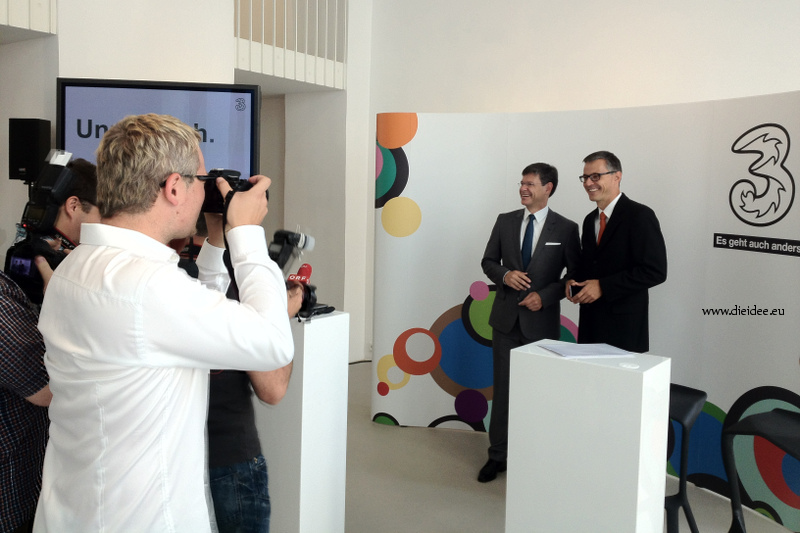
Das sind sie, die neuen Tarife des neuen Drei – präsentiert von dieIdee InnovationsAgentur
Die Tarife @Sprachtelefonie:
Unlimitierte Telefonie + Daten + SMS Hallo L PLUS, XL PLUS, XXL PLUS
Inklusive sind bis zu 10000 Sprachminuten unlimited/flat und 10000 SMS
25€ mit 2 GB
35€ mit 4 GB
45€ mit 6 GB
Österreich Tarife Hallo M, L, XL, XXL – Handy inklusive 15€ mit 1000 Minuten/1000 SMS/1GB
20€ mit 1000 Minuten/1000 SMS/2GB
30€ mit 2000 Minuten/1000 SMS/4GB
40€ mit 3000 Minuten/1000 SMS/6GB
Europa Tarife HalloEuropa M, L jeweils mit 1000 Österreichminuten inklusive
15€ mit 100 Europa Sprachminutenund 100 Europa SMS
30 € mit 300 Europa Sprachminuten und 1000 Europa SMS
Hallo Europa – Hallo Premium um 65 Euro Das absolute Sorglos-Paket mit
unlimiterter Sprachtelefonie in Österreich
unlimitierten SMS Ö+Europa
Datenübertragung österreichweit inklusive ohne Geschwindigkeits-Begrenzung
sowie 400 EU-Minuten innerhalb und in Europa
und 250 EU-Datenroaming MB
Bindungs-Frei ohne Handy – SIM Only
Hier wurden die alten Super-SIM Tarife, die weiterhin bei vorhandenem SUPERSIM Startpaket anmeldbar sind, kompakt verschlankt. HalloSIM M, XL
7,50€ mit 1000 Ö-Minuten, 1000 SMS, 1 GB Daten
15€ mit 2000 Ö-Minuten, 1000 SMS, 3 GB Daten
Wertkarte Nimm3
L, XL
10€ mit 1000 Minuten/1000 SMS, 1 GB
18€ mit 2000 Minuten/1000 SMS, 2 GB
Die Tarife @Datenübertragung:
HUI – die bekannte Marke neu etabliert HUI Flat 10, 20, 30, 100 – mit Endgerät und Bindung
15€, flat, 10mbit down/4 up
18€ nur für kurze Zeit, flat, 20down/5 up
24€, flat, 30down, 5 up
45 € GGB unlimited-flat, FLAT 100 mit 100mbit down, 50 upHUI SIM FLAT – ohne Endgerät ohne Bindung 15 €, flat, 10 mbit down, 4 up
Wertkarte NIMM 3 18 €, flat, 10 mbit down, 4 up ohne Endgerät ohne Bindung
@Zusatzpakete:
das liebgewonnene 3 Like Home wurde zum Zusatzpaket „3 Europa“ 1000 Freiminuten, 1000 SMS, 1 GB Daten in Italien, Großbritannien, Irland, Schweden und Dänemark und kostet monatlich 7,50 €
DieIdee InnovationsAgentur fragt in der Presseabteilung von Drei nach:
Können „alte“ SUPERSIM Wertkarten, auch noch in der kommenden Woche im SuperSIM XXL (Telefonie) und SuperSIM Flat (Internet) zu „alten Preisen“ angemeldet werden, sofern man ein solches Package in der letzten Woche gekauft, aber noch nicht aktiviert hat.
Die Pressesabteilung klärt auf:
Mit alten SIM-Karten können die bisherigen Tarife (egal ob Voice oder Data) weiterhin aktiviert werden.
Der Vertrag kommt eigentlich bereits mit dem Kauf des SuperSIM-Start Sets zustande. Schließlich kaufst du damit ein bestimmtes Wertkarten-Tarifangebot und kein Überraschungsei.
Wenn du die SIM-Karte aktivierst und eine entsprechende Tarifoption wählst, werden diese Informationen zusätzlich in allen technischen Systemen bei Drei hinterlegt (vom HLR bis zum Billingsystem). Damit bist du aktiver Kunde und kannst alle von Drei im Rahmen dieses Tarifs angebotenen Dienste tatsächlich nutzen. Um an die im Tarif inkludierten Freieinheiten zu kommen, ist es notwendig, (genügend) Guthaben aufzuladen. Wenn du das heute machst, bekommst du die Freieinheiten heute. Wenn du das in x Wochen machst, dann werden die Freieinheiten eben erst in x Wochen aktiviert. Wie du willst.
Das gilt auch für alle SuperSIM-Start Sets die als Restposten während der nächsten Wochen noch verkauft werden. Damit können auch nach dem 19.08. die bekannten SuperSIM-Wertkartentarife aktiviert werden.
Ein Umsteigen von den SuperSIM-Wertkartentarifen auf die entsprechenden Vertragstarife wird nach dem 19.08. mit sehr hoher Wahrscheinlichkeit nicht mehr möglich sein. Und da spielt es dann auch keine Rolle, wann der Wertkartentarif aktiviert worden ist.



 TheIdea – The Innovation Agency