Archiv des Autors: innovation

Edward Snowden Explains How To Reclaim Your Privacy

Source: https://theintercept.com/2015/11/12/edward-snowden-explains-how-to-reclaim-your-privacy/

I met Edward Snowden in a hotel in central Moscow, just blocks away from Red Square. It was the first time we’d met in person; he first emailed me nearly two years earlier, and we eventually created an encrypted channel to journalists Laura Poitras and Glenn Greenwald, to whom Snowden would disclose overreaching mass surveillance by the National Security Agency and its British equivalent, GCHQ.

This time around, Snowden’s anonymity was gone; the world knew who he was, much of what he’d leaked, and that he’d been living in exile in Moscow, where he’s been stranded ever since the State Department canceled his passport while he was en route to Latin America. His situation was more stable, the threats against him a bit easier to predict. So I approached my 2015 Snowden meeting with less paranoia than was warranted in 2013, and with a little more attention to physical security, since this time our communications would not be confined to the internet.

Our first meeting would be in the hotel lobby, and I arrived with all my important electronic gear in tow. I had powered down my smartphone and placed it in a “faraday bag” designed to block all radio emissions. This, in turn, was tucked inside my backpack next to my laptop (which I configured and hardened specifically for traveling to Russia), also powered off. Both electronic devices stored their data in encrypted form, but disk encryption isn’t perfect, and leaving these in my hotel room seemed like an invitation to tampering.

Most of the lobby seats were taken by well-dressed Russians sipping cocktails. I planted myself on an empty couch off in a nook hidden from most of the action and from the only security camera I could spot. Snowden had told me I’d have to wait awhile before he met me, and for a moment I wondered if I was being watched: A bearded man wearing glasses and a trench coat stood a few feet from me, apparently doing nothing aside from staring at a stained-glass window. Later he shifted from one side of my couch to the other, walking away just after I made eye contact.

Eventually, Snowden appeared. We smiled and said good to see you, and then walked up the spiral staircase near the elevator to the room where I would be conducting the interview, before we really started talking.

It also turns out that I didn’t need to be quite so cautious. Later, he told me to feel free to take out my phone so I could coordinate a rendezvous with some mutual friends who were in town. Operational security, or “opsec,” was a recurring theme across our several chats in Moscow.

In most of Snowden’s interviews he speaks broadly about the importance of privacy, surveillance reform, and encryption. But he rarely has the opportunity to delve into the details and help people of all technical backgrounds understand opsec and begin to strengthen their own security and privacy. He and I mutually agreed that our interview would focus more on nerdy computer talk and less on politics, because we’re both nerds and not many of his interviews get to be like that. I believe he wanted to use our chats to promote cool projects and to educate people. For example, Snowden had mentioned prior to our in-person meeting that he had tweeted about the Tor anonymity system and was surprised by how many people thought it was some big government trap. He wanted to fix those kinds of misconceptions.

Our interview, conducted over room-service hamburgers, started with the basics.


Micah Lee: What are some operational security practices you think everyone should adopt? Just useful stuff for average people.

Edward Snowden: [Opsec] is important even if you’re not worried about the NSA. Because when you think about who the victims of surveillance are, on a day-to-day basis, you’re thinking about people who are in abusive spousal relationships, you’re thinking about people who are concerned about stalkers, you’re thinking about children who are concerned about their parents overhearing things. It’s to reclaim a level of privacy.

  • The first step that anyone could take is to encrypt their phone calls and their text messages. You can do that through the smartphone app Signal, by Open Whisper Systems. It’s free, and you can just download it immediately. And anybody you’re talking to now, their communications, if it’s intercepted, can’t be read by adversaries. [Signal is available for iOS and Android, and, unlike a lot of security tools, is very easy to use.]
  • You should encrypt your hard disk, so that if your computer is stolen the information isn’t obtainable to an adversary — pictures, where you live, where you work, where your kids are, where you go to school. [I’ve written a guide to encrypting your disk on Windows, Mac, and Linux.]
  • Use a password manager. One of the main things that gets people’s private information exposed, not necessarily to the most powerful adversaries, but to the most common ones, are data dumps. Your credentials may be revealed because some service you stopped using in 2007 gets hacked, and your password that you were using for that one site also works for your Gmail account. A password manager allows you to create unique passwords for every site that are unbreakable, but you don’t have the burden of memorizing them. [The password manager KeePassX is free, open source, cross-platform, and never stores anything in the cloud.]
  • The other thing there is two-factor authentication. The value of this is if someone does steal your password, or it’s left or exposed somewhere … [two-factor authentication] allows the provider to send you a secondary means of authentication — a text message or something like that. [If you enable two-factor authentication, an attacker needs both your password as the first factor and a physical device, like your phone, as your second factor, to login to your account. Gmail, Facebook, Twitter, Dropbox, GitHub, Battle.net, and tons of other services all support two-factor authentication.]

We should not live lives as if we are electronically naked.

We should armor ourselves using systems we can rely on every day. This doesn’t need to be an extraordinary lifestyle change. It doesn’t have to be something that is disruptive. It should be invisible, it should be atmospheric, it should be something that happens painlessly, effortlessly. This is why I like apps like Signal, because they’re low friction. It doesn’t require you to re-order your life. It doesn’t require you to change your method of communications. You can use it right now to talk to your friends.

DSC_0650-color-1

Micah Lee and Edward Snowden, Moscow, Russia.

Photo: Sue Gardner

Lee: What do you think about Tor? Do you think that everyone should be familiar with it, or do you think that it’s only a use-it-if-you-need-it thing?

Snowden: I think Tor is the most important privacy-enhancing technology project being used today. I use Tor personally all the time. We know it works from at least one anecdotal case that’s fairly familiar to most people at this point. That’s not to say that Tor is bulletproof. What Tor does is it provides a measure of security and allows you to disassociate your physical location. …

But the basic idea, the concept of Tor that is so valuable, is that it’s run by volunteers. Anyone can create a new node on the network, whether it’s an entry node, a middle router, or an exit point, on the basis of their willingness to accept some risk. The voluntary nature of this network means that it is survivable, it’s resistant, it’s flexible.

[Tor Browser is a great way to selectively use Tor to look something up and not leave a trace that you did it. It can also help bypass censorship when you’re on a network where certain sites are blocked. If you want to get more involved, you can volunteer to run your own Tor node, as I do, and support the diversity of the Tor network.]

Lee: So that is all stuff that everybody should be doing. What about people who have exceptional threat models, like future intelligence-community whistleblowers, and other people who have nation-state adversaries? Maybe journalists, in some cases, or activists, or people like that?

Snowden: So the first answer is that you can’t learn this from a single article. The needs of every individual in a high-risk environment are different. And the capabilities of the adversary are constantly improving. The tooling changes as well.

What really matters is to be conscious of the principles of compromise. How can the adversary, in general, gain access to information that is sensitive to you? What kinds of things do you need to protect? Because of course you don’t need to hide everything from the adversary. You don’t need to live a paranoid life, off the grid, in hiding, in the woods in Montana.

What we do need to protect are the facts of our activities, our beliefs, and our lives that could be used against us in manners that are contrary to our interests. So when we think about this for whistleblowers, for example, if you witnessed some kind of wrongdoing and you need to reveal this information, and you believe there are people that want to interfere with that, you need to think about how to compartmentalize that.

Tell no one who doesn’t need to know. [Lindsay Mills, Snowden’s girlfriend of several years, didn’t know that he had been collecting documents to leak to journalists until she heard about it on the news, like everyone else.]

When we talk about whistleblowers and what to do, you want to think about tools for protecting your identity, protecting the existence of the relationship from any type of conventional communication system. You want to use something like SecureDrop, over the Tor network, so there is no connection between the computer that you are using at the time — preferably with a non-persistent operating system like Tails, so you’ve left no forensic trace on the machine you’re using, which hopefully is a disposable machine that you can get rid of afterward, that can’t be found in a raid, that can’t be analyzed or anything like that — so that the only outcome of your operational activities are the stories reported by the journalists. [SecureDrop is a whistleblower submission system. Here is a guide to using The Intercept’s SecureDrop server as safely as possible.]

And this is to be sure that whoever has been engaging in this wrongdoing cannot distract from the controversy by pointing to your physical identity. Instead they have to deal with the facts of the controversy rather than the actors that are involved in it.

Lee: What about for people who are, like, in a repressive regime and are trying to …

Snowden: Use Tor.

Lee: Use Tor?

Snowden: If you’re not using Tor you’re doing it wrong. Now, there is a counterpoint here where the use of privacy-enhancing technologies in certain areas can actually single you out for additional surveillance through the exercise of repressive measures. This is why it’s so critical for developers who are working on security-enhancing tools to not make their protocols stand out.

Lee: So you mentioned that what you want to spread are the principles of operational security. And you mentioned some of them, like need-to-know, compartmentalization. Can you talk more about what are the principles of operating securely?

Snowden: Almost every principle of operating security is to think about vulnerability. Think about what the risks of compromise are and how to mitigate them. In every step, in every action, in every point involved, in every point of decision, you have to stop and reflect and think, “What would be the impact if my adversary were aware of my activities?” If that impact is something that’s not survivable, either you have to change or refrain from that activity, you have to mitigate that through some kind of tools or system to protect the information and reduce the risk of compromise, or ultimately, you have to accept the risk of discovery and have a plan to mitigate the response. Because sometimes you can’t always keep something secret, but you can plan your response.

Lee: Are there principles of operational security that you think would be applicable to everyday life?

Snowden: Yes, that’s selective sharing. Everybody doesn’t need to know everything about us. Your friend doesn’t need to know what pharmacy you go to. Facebook doesn’t need to know your password security questions. You don’t need to have your mother’s maiden name on your Facebook page, if that’s what you use for recovering your password on Gmail. The idea here is that sharing is OK, but it should always be voluntary. It should be thoughtful, it should be things that are mutually beneficial to people that you’re sharing with, and these aren’t things that are simply taken from you.

If you interact with the internet … the typical methods of communication today betray you silently, quietly, invisibly, at every click. At every page that you land on, information is being stolen. It’s being collected, intercepted, analyzed, and stored by governments, foreign and domestic, and by companies. You can reduce this by taking a few key steps. Basic things. If information is being collected about you, make sure it’s being done in a voluntary way.

For example, if you use browser plugins like HTTPS Everywhere by EFF, you can try to enforce secure encrypted communications so your data is not being passed in transit electronically naked.

Lee: Do you think people should use adblock software?

Snowden: Yes.

Everybody should be running adblock software, if only from a safety perspective …

We’ve seen internet providers like ComcastAT&T, or whoever it is, insert their own ads into your plaintext http connections. … As long as service providers are serving ads with active content that require the use of Javascript to display, that have some kind of active content like Flash embedded in it, anything that can be a vector for attack in your web browser — you should be actively trying to block these. Because if the service provider is not working to protect the sanctity of the relationship between reader and publisher, you have not just a right but a duty to take every effort to protect yourself in response.

Lee: Nice. So there’s a lot of esoteric attacks that you hear about in the media. There’s disk encryption attacks like evil maid attacks, and cold-boot attacks. There’s all sorts of firmware attacks. There’s BadUSB and BadBIOS, and baseband attacks on cellphones. All of these are probably unlikely to happen to many people very often. Is this something people should be concerned about? How do you go about deciding if you personally should be concerned about this sort of attack and try to defend against it?

Snowden: It all comes down to personal evaluation of your personal threat model, right? That is the bottom line of what operational security is about. You have to assess the risk of compromise. On the basis of that determine how much effort needs to be invested into mitigating that risk.

Now in the case of cold-boot attacks and things like that, there are many things you can do. For example, cold-boot attacks can be defeated by never leaving your machine unattended. This is something that is not important for the vast majority of users, because most people don’t need to worry about someone sneaking in when their machine is unattended. … There is the evil maid attack, which can be protected against by keeping your bootloader physically on you, but wearing it as a necklace, for example, on an external USB device.

You’ve got BadBIOS. You can protect against this by dumping your BIOS, hashing it (hopefully not with SHA1 anymore), and simply comparing your BIOS. In theory, if it’s owned badly enough you need to do this externally. You need to dump it using a JTAG or some kind of reader to make sure that it actually matches, if you don’t trust your operating system.

There’s a counter to every attack. The idea is you can play the cat-and-mouse game forever.

You can go to any depth, you can drive yourself crazy thinking about bugs in the walls and cameras in the ceiling. Or you can think about what are the most realistic threats in your current situation? And on that basis take some activity to mitigate the most realistic threats. In that case, for most people, that’s going to be very simple things. That’s going to be using a safe browser. That’s going to be disabling scripts and active content, ideally using a virtual machine or some other form of sandboxed browser, where if there’s a compromise it’s not persistent. [I recently wrote about how to set up virtual machines.] And making sure that your regular day-to-day communications are being selectively shared through encrypted means.

Lee: What sort of security tools are you currently excited about? What are you finding interesting?

Snowden: I’ll just namecheck Qubes here, just because it’s interesting. I’m really excited about Qubes because the idea of VM-separating machines, requiring expensive, costly sandbox escapes to get persistence on a machine, is a big step up in terms of burdening the attacker with greater resource and sophistication requirements for maintaining a compromise. I’d love to see them continue this project. I’d love to see them make it more accessible and much more secure. [You can read more about how to use Qubes here and here.]

Something that we haven’t seen that we need to see is a greater hardening of the overall kernels of every operating system through things like grsecurity [a set of patches to improve Linux security], but unfortunately there’s a big usability gap between the capabilities that are out there, that are possible, and what is attainable for the average user.

Lee: People use smartphones a lot. What do you think about using a smartphone for secure communications?

Snowden: Something that people forget about cellphones in general, of any type, is that you’re leaving a permanent record of all of your physical locations as you move around. … The problem with cellphones is they’re basically always talking about you, even when you’re not using them. That’s not to say that everyone should burn their cellphones … but you have to think about the context for your usage. Are you carrying a device that, by virtue of simply having it on your person, places you in a historic record in a place that you don’t want to be associated with, even if it’s something as simple as your place of worship?

Lee: There are tons of software developers out there that would love to figure out how to end mass surveillance. What should they be doing with their time?

Snowden: Mixed routing is one of the most important things that we need in terms of regular infrastructure because we haven’t solved the problem of how to divorce the content of communication from the fact that it has occurred at all. To have real privacy you have to have both. Not just what you talked to your mother about, but the fact that you talked to your mother at all. …

The problem with communications today is that the internet service provider knows exactly who you are. They know exactly where you live. They know what your credit card number is, when you last paid, how much it was.

You should be able to buy a pile of internet the same way you buy a bottle of water.

We need means of engaging in private connections to the internet. We need ways of engaging in private communications. We need mechanisms affording for private associations. And ultimately, we need ways to engage in private payment and shipping, which are the basis of trade.

These are research questions that need to be resolved. We need to find a way to protect the rights that we ourselves inherited for the next generation. If we don’t, today we’re standing at a fork in the road that divides between an open society and a controlled system. If we don’t do anything about this, people will look back at this moment and they’ll say, why did you let that happen? Do you want to live in a quantified world? Where not only is the content of every conversation, not only are the movements of every person known, but even the location of all the objects are known? Where the book that you leant to a friend leaves a record that they have read it? These things might be useful capabilities that provide value to society, but that’s only going to be a net good if we’re able to mitigate the impact of our activity, of our sharing, of our openness.

Lee: Ideally, governments around the world shouldn’t be spying on everybody. But that’s not really the case, so where do you think — what do you think the way to solve this problem is? Do you think it’s all just encrypting everything, or do you think that trying to get Congress to pass new laws and trying to do policy stuff is equally as important? Where do you think the balance is between tech and policy to combat mass surveillance? And what do you think that Congress should do, or that people should be urging Congress to do?

Snowden: I think reform comes with many faces. There’s legal reform, there’s statutory reform more generally, there are the products and outcomes of judicial decisions. … In the United States it has been held that these programs of mass surveillance, which were implemented secretly without the knowledge or the consent of the public, violate our rights, that they went too far, that they should end. And they have been modified or changed as a result. But there are many other programs, and many other countries, where these reforms have not yet had the impact that is so vital to free society. And in these contexts, in these situations, I believe that we do — as a community, as an open society, whether we’re talking about ordinary citizens or the technological community specifically — we have to look for ways of enforcing human rights through any means.

That can be through technology, that can be through politics, that can be through voting, that can be through behavior. But technology is, of all of these things, perhaps the quickest and most promising means through which we can respond to the greatest violations of human rights in a manner that is not dependent on every single legislative body on the planet to reform itself at the same time, which is probably somewhat optimistic to hope for. We would be instead able to create systems … that enforce and guarantee the rights that are necessary to maintain a free and open society.

Lee: On a different note — people said I should ask about Twitter — how long have you had a Twitter account for?

Snowden: Two weeks.

Lee: How many followers do you have?

Snowden: A million and a half, I think.

Lee: That’s a lot of followers. How are you liking being a Twitter user so far?

Snowden: I’m trying very hard not to mess up.

Lee: You’ve been tweeting a lot lately, including in the middle of the night Moscow time.

Snowden: Ha. I make no secret about the fact that I live on Eastern Standard Time. The majority of my work and associations, my political activism, still occurs in my home, in the United States. So it only really make sense that I work on the same hours.

Lee: Do you feel like Twitter is sucking away all your time? I mean I kind of have Twitter open all day long and I sometimes get sucked into flame wars. How is it affecting you?

Snowden: There were a few days when people kept tweeting cats for almost an entire day. And I know I shouldn’t, I have a lot of work to do, but I just couldn’t stop looking at them.

Lee: The real question is, what was your Twitter handle before this? Because you were obviously on Twitter. You know all the ins and outs.

Snowden: I can neither confirm nor deny the existence of other Twitter accounts.

Pass und Führerschein in der Cloud – Zugriff Smartphone

Führerschein kann künftig am Smartphone hergezeigt werden
Führerschein kann künftig am Smartphone hergezeigt werden – Foto: Michael
Nicht im Silicon Valley, sondern in Österreich soll das Problem der sicheren digitalen Identität gelöst werden. Die österreichische Staatsdruckerei hat eine App entwickelt.

Die Frage, wie sich Menschen sicher digital ausweisen können, soll nicht von Facebook, Google und Co gelöst werden. Vielmehr soll österreichisches Know-how dazu beitragen, dass Personalausweise, Reisepässe und Führerscheine künftig nicht mehr in gedruckter Form mitgeführt werden müssen, sondern einfach und sicher auf dem Handy gespeichert werden können.

Ausweis am Smartphone MIA…
Foto: Michael Leitner

Eine entsprechende Lösung inklusive App präsentierte die Österreichische Staatsdruckerei (OeSD) am Donnerstag in Wien. Das System, das auf den Namen MIA („My Identity App“) hört, soll nicht nur Identitätskontrollen in Österreich revolutionieren, sondern kann theoretisch von jedem Staat übernommen werden, der eine digitale Entsprechung zu herkömmlichen Ausweisen umsetzen möchte. Es soll in einem ersten Schritt diversen Staaten weltweit angeboten werden.

System in der Cloud

Um Datenmissbrauch zu verhindern, werden die sensiblen Daten nicht auf dem Mobiltelefon, sondern zentral auf in der Cloud gespeichert, an die das Handy über eine verschlüsselte Internetverbindung andockt. Der Austausch der Daten bei einer Ausweiskontrolle erfolgt erst nach erneuter Bestätigung des Ausweis-Inhabers auf dem eigenen Handy. Das Fremdgerät bekommt dabei über einen generierten Hash bzw. Zifferncode ebenfalls nur Zugriff auf die Cloud – die Daten bleiben dort sicher verwahrt.

Für Behörden – etwa bei Verkehrskontrollen – könnte die Arbeit damit wesentlich erleichtert werden. Zulassungsschein und Führerschein werden inklusive Foto digital übermittelt, aber auch der Unfallort sowie ein Unfallhergang könnten sofort vor Ort elektronisch erfasst werden. Neben der Ausstellung eines Strafzettels in digitaler Form erlaubt das System auch, die Führerscheinberechtigung mit einem Klick zu entziehen oder bei Verdachtsmomenten die Person genauer zu überprüfen.

„Besserer Datenschutz“

Was auf den ersten Blick stark nach gläsernem Mensch klingt, kann in vielen Situationen auch zu einem besseren Datenschutz führen, ist OeSD-Geschäftsführer Lukas Praml im Gespräch mit der futurezone überzeugt. So bekommt ein Türsteher bei der Altersüberprüfung eines Lokalbesuchers lediglich dessen Foto sowie die Bestätigung übermittelt, dass jener über 18 Jahre alt ist. Andere Daten wie Name, genaues Geburtsdatum etc. bleiben bei dieser Ausweiskontrolle geschützt, da sie irrelevant sind.

OeSD Academy Spezial | Produktpräsentation 2015
Lukas Praml präsentierte die neue ID-Lösung – Foto: Österreichische Staatsdruckerei/Martin Hörmandinger

Selbiges kommt auch bei einem privaten Autoverkauf oder beim Ausweisen in einem Hotel zur Anwendung, wo man bisher ohne Zögern seinen Reisepass oder andere persönliche Dokumente aushändigte. Weitere Anwendungsszenarien sind das sichere Einkaufen im Internet oder etwa das Eröffnen eines Bankkontos online inklusive Identitäts-Check. Auch Gesundheitskarten und andere Firmen-ID-Ausweise könnten künftig in MIA hinterlegt werden.Um das System noch sicherer zu gestalten, wird die App zusätzlich mit Fingerprint- oder PIN-Eingabe geschützt. Auch der neue Authentifizierungsstandard FIDO wird bei der Zweifaktor-Umsetzung berücksichtigt. Geht das Handy verloren, können die für das Gerät erteilten Zertifikate gelöscht werden. Die darauf verknüpften Ausweise werden damit für Kriminelle wertlos – laut Praml ein weiterer Vorteil im Vergleich zu gedruckten Ausweispapieren, die nach dem Verlust oftmals in falsche Hände gelangen.

Innenministerium interessiert

Ob Ausweise in Österreich künftig am Handy gespeichert werden, hängt in erster Linie vom Gesetzgeber ab. Innenministerin Johanna Mikl-Leitner begrüßte die Lösung der Staatsdruckerei, die unter anderem für die Herstellung der Reisepässe verantwortlich zeichnet. „Die Chancen der Digitalisierung können nur genutzt werden, wenn wir wissen, mit welchem Gegenüber wir es zu tun haben. Es wäre wünschenswert, dass digitale Identitäten so sicher wie der Reisepass sind und solche Systeme auch in anderen Staaten zum Einsatz kommen“, sagte Mikl-Leitner.

MIA OeSD…
MIA auf der Apple Watch – Foto: /Martin Stepanek

Laut Praml ist das System technisch in einem halben Jahr umsetzbar. Bis die rechtlichen Rahmenbedingungen sowie Fragen zu Datenschutz und Kosten geklärt sind, dürfte es aber noch länger dauern. Die App ist für Android und iOS praktisch fertig entwickelt, auch Smartwatches auf Android-Wear-Basis sowie die Apple Watch werden mit adaptierten App-Versionen unterstützt. Wer bei der Entwicklung von MIA auf dem laufenden bleiben will, kann sich auf der Webseite der Staatsdruckerei per E-Mail eintragen.

Quelle: futurezone.at/digital-life/pass-und-fuehrerschein-kuenftig-auf-dem-handy/163.623.515

Taktikregeln für Verhandlungen

Wie verhandle ich erfolgreich? Wie überbringe ich schlechte Nachrichten? 10 Taktikregeln vom Profi

Weiß, wie man richtig verhandelt: Matthias Schranner. 

Richtig verhandeln zu können, ist eine Kunst. Und genau diese Kunst beherrscht Matthias Schranner in Perfektion. Er hat sein geballtes Wissen in einem Buch veröffentlicht.

Nutzt eure Intuition!

Wer gut verhandeln kann, kommt besser durchs Leben. Sei es beruflich oder privat. Genau dieser Angelegenheit widmet sich Matthias Schranner, der als angesehenster Verhandlungsexperte Deutschlands gilt, seit zehn Jahren. Er berät Konzerne, mittelständische Unternehmen und politische Parteien. Nun zieht er in seinem Buch „Teure Fehler – Die 7 größten Irrtümer in schwierigen Verhandlungen“ ein Fazit und erklärt, wie man bei einer schwierigen Verhandlung zum Ziel kommt. Wir veröffentlichen zehn von 25 Taktikregeln, die Matthias Schranner im Kapitel „Verhandeln ist eine Sache der Intuition“ darlegt.

1. Agenda

Starten Sie bitte jede Verhandlung mit einer Agenda. Auch und vor allem eine kurze und unstrittige Agenda ist Ihnen für den weiteren Verhandlungsverlauf eine große Hilfe. (…) Sie definieren gleich zu Beginn, was verhandelt wird und was nicht.

Zudem ist es sinnvoll, jeden Agendapunkt mit einer zeitlichen Begrenzung zu verknüpfen. Sie können beispielsweise kommunizieren, dass für Agendapunkt Nr. 2 ein zeitlicher Rahmen von 30 Minuten angedacht ist.

Somit können Sie während der Verhandlung von Punkt Nr. 2 nach 30 Minuten auf die Agenda verweisen und zum nächsten, Ihnen vielleicht besser ins Konzept passenden Punkt wechseln. Oder Sie schicken vorweg, dass gerade Punkt Nr. 2 für alle von großem Interesse ist und Sie deshalb möchten, dass nicht 30, sondern 45 Minuten auf seine Besprechung verwendet werden. So können Sie flexibel und ganz nach Ihrem Belieben Einfluss auf den zeitlichen Ablauf der Verhandlung nehmen.

2. Inhalt wiedergeben

Es mag sich banal anhören, aber Sie sollten Ihrem Gegenüber ständig zeigen, dass Sie sehr an ihm und seiner Position interessiert sind. Benutzen Sie oft kleine Ermutiger wie „Aha“ oder „OK“ und schreiben Sie viel mit.

Reflektieren Sie, dass Sie den Inhalt verstanden haben. Wiederholen Sie mit eigenen Worten, was Sie verstanden haben, und versichern Sie sich über die Richtigkeit.

Nutzen Sie Redewendungen wie: „Wenn ich Sie richtig verstehe …“ oder „Wenn ich das in eigenen Worten wiedergebe …“.

Wichtig ist hierbei, dass Sie das vom Gegenüber Gesagte paraphrasieren und zusammenfassen. So sind Sie in der Lage, der Verhandlung mit Ihrer Zusammenfassung eine neue, für Sie günstige Richtung zu geben.

3. Gefühl wiedergeben

Hier wird es schon sehr viel schwieriger. Das Beschreiben von Gefühlen in Verhandlungen kommt fast immer dem Betreten einer Eisfläche gleich. Ein falsches Wort oder eine falsche Betonung, und Sie verlieren den Halt und somit die Führung in der Verhandlung. (…) Gefühle sind universal, jeder kennt sie und jeder kann sie nach- vollziehen. Wenn Sie Gefühle beschreiben, haben Sie einen schnellen und authentischen Zugang zu Ihrem Gegenüber gefunden.  (…) Wenn Sie die Situation ansprechen, dann beschreiben Sie sie aus Ihrer Gewissheit heraus und verkünden nicht die Wahrheit über sie. Sie sagen dem Mitarbeiter (der entlassen werden soll, Anm. d. Red.), dass Sie – obwohl kinderlos und nicht verschuldet – seine Situation gut verstehen können. Diese Herangehensweise wird Ihr Gegenüber sofort als unauthentisch entlarven und als respektlos abtun: Wie können Sie sich als jemand in einer so anderen Lebenslage anmaßen, sich in die seinige einzufühlen? Sie werden als heuchlerisch und nicht glaubwürdig wahrgenommen. Und das ist wirklich schlimm in einer Verhandlung.

Wenn Sie aber die Gefühle ansprechen, wird Ihre Schilderung authentisch. Da Sie etwas beschreiben, das Sie wirklich kennen. Das Gefühl der Ausweglosigkeit, das jeder von uns schon einmal verspürt hat. Gehen Sie jedoch nicht zu sehr ins Detail. Sonst sprechen Sie wieder über sich und nicht über Ihr Gegenüber. Also nicht die eigene Situation beschreiben, sondern nur kundtun, dass Sie sein Gefühl kennen und daher nachvollziehen können.

4. Überbringen einer schlechten Nachricht

Das Aussprechen eine Kündigung gehört hierzu. Ich werde oft gefragt, wie ich solche Situationen aus meiner Erfahrung heraus bewerte. Sollte man die schlechte Nachricht gleich ansprechen oder mit Small Talk einleiten oder gar den Verhandlungspartner mit Andeutungen dazu bringen, dass er die schlechte Nachricht selbst entschlüsselt?

Hier habe ich einen sehr klaren Tipp: sofort ansprechen! Irgendwann müssen Sie es eh sagen. Wenn Sie um den heißen Brei herumreden, wird alles noch viel schlimmer. Sagen Sie, was Sache ist, und halten Sie dann den Mund.
 Sagen Sie beispielsweise „Hiermit spreche ich Ihnen die Kündigung aus!“ und halten Sie sich mit Erklärungen und Rechtfertigungen zurück. Alles, was Sie auf die schlechte Nachricht folgend nachschieben, verwässert Ihre Aussage. Zudem kann es gegebenenfalls gegen Sie verwendet werden.

Sollte Ihr Gegenüber emotional reagieren, dann vereinbaren Sie bitte einen baldigen Termin für die nächsten Schritte. Denken Sie bitte nie, dass es ja gar nicht so schlimm ist und Ihr Gegenüber Ihre Entscheidung schon irgendwie verstehen wird. Nein, er kann und wird sie nicht verstehen. Schlicht, weil in dem Moment der Wahrheit seine Synapsen den Zugang zum Großhirn nicht mehr ermöglichen und ihm somit jede Form von Rationalität abhanden gekommen ist.

5. Nichts sagen

Diese Taktik scheint die einfachste zu sein. Leider ist aber gerade das Nichtssagen äußerst schwer. Es bedeutet, wirklich nichts zu sagen, weder verbal noch durch Körpersprache, einfach nichts.

In meinen schwierigsten Verhandlungen gab es oft Situationen, in denen ich nicht wusste, was ich sagen sollte. Jede Aussage hätte als Provokation verstanden werden und die Verhandlung eskalieren lassen können.

Deshalb halte ich mich an einen alten Grundsatz der Dialektik: „Wenn Sie nichts zu sagen haben, sagen Sie nichts!“

Mit Ihrem Schweigen betonen Sie alles bisher Gesagte, steigern dessen Effekt und bringen zudem Ihr Gegenüber zum Reden.

6. Ratschläge vermeiden

Sehr unklug sind Ratschläge in einer Verhandlung. Im Wort Ratschlag steckt der Schlag, den Sie Ihrem Gegenüber lieber nicht verpassen. Ebenfalls zu vermeiden ist es, die Wahrheit für sich in Anspruch zu nehmen.

Vermeiden Sie also bitte:

­- Pausenloses Bedrängen à la „Jetzt kommen Sie schon.“

– Belehrungen à la „Das sehen Sie falsch.“

-Vorwürfe à la „Was haben Sie sich eigentlich dabei gedacht?“

– Bewertungen à la „Ich weiß schon, was Ihnen fehlt.“

– Dramatisieren à la „Wissen Sie, was Sie anderen damit antun?“

7. These und Antithese

Das Belehren des Gegenübers ist eine der großen Gefahren der Verhandlung. Sie können den Anschein der Belehrung leicht vermeiden, wenn Sie nicht nur die Vorteile, sondern auch die Nachteile Ihrer Vorschläge selbst in die Verhandlung einbringen.

Sagen Sie also nicht, wo alleine der konkrete Nutzen für Ihr Gegenüber liegt. Wer nur die Vorteile seines Produkts herausstellt, wird als Belehrender wahrgenommen.

Bringen Sie auch seine Nachteile in die Verhandlung ein. Solche, die tatsächlich gegen Sie sprechen. Stellen Sie dar, warum Sie dennoch von Ihrem Vorschlag überzeugt sind. Arbeiten Sie nach den Grundsätzen der Dialektik mit These und Antithese. Gut ist es, These und Antithese in ein synthetisches Fazit, das für Ihren Vorschlag spricht, münden zu lassen.

Dieses Fazit, diese Beurteilung sollte sich natürlich organisch in Ihre gesamte Vorgehensweise einfügen und Sie auf Ihrem Weg zu einer Einigung unterstützen.

An diesem Punkt ist die Abgrenzung zur affektiven Phase von Bedeutung, also von den ersten drei Minuten der Verhandlung. In der affektiven Phase sollten Sie negative Punkte tunlichst vermeiden. Während der kognitiven Phase, dem „Stabilisieren“ des Gegenübers, macht es Sinn, auch Negatives zu betonen, um glaubwürdig zu wirken.

8. Vermeiden Sie Rückgriffe auf frühere Aussagen

Greifen Sie nicht frühere Äußerungen Ihres Gegenübers auf, sofern sie Ihren Interessen widersprechen. „Sie hatten damals gesagt …“

Wenn Sie ihm seine Äußerungen vorhalten, bleibt ihm nichts anderes übrig, als bei seiner Meinung zu bleiben. Sie intensivieren so also nur das Ausmaß seiner Gegenwehr.

9. E contrario

Nun betreten wir die hohe Schule der Dialektik und argumentieren aus der Gegenposition – e contrario.

Sie bringen eine Meinung, die Sie absolut nicht teilen, in die Verhandlung ein und stellen heraus, wie wenig Sie mit ihr einverstanden sind. Daraufhin widerlegen Sie die Meinung selbst. Nachdem Sie nun deutlich gemacht haben, nicht dieser bestimmten Meinung zu sein, und diese Meinung auch noch überzeugend widerlegt haben, gibt es keinen Angriffspunkt für die Gegenseite mehr.

So drosseln Sie das Tempo der Verhandlung, indem Sie zweimal hintereinander auf die Bremse drücken. Wenn Sie das geschickt anstellen, wird Ihre „Nichtmeinung“ nicht mehr aufgegriffen und Sie behalten die Verhandlungsführung inne.

Ein Beispiel für eine selbst widerlegte „Nichtmeinung“: „Ich bin nicht der Meinung, dass der Preis der alleinige Maßstab für die Bewertung meines Angebotes sein sollte. Vielmehr zählt die Messbarkeit des Erfolgs, die ich anhand der folgenden Untersuchung darlegen kann.“

10. Sprechen Sie im Konjunktiv

Den Kern einer Verhandlung bildet das Handeln, Sie handeln mit Ihrem Gegenüber eine Einigung aus.

Wer signalisiert, dass er schon alles weiß und die Einigung bereits vor seinem geistigen Auge sieht, der wirkt arrogant und ruft beim Gegenüber eine Blockadehaltung hervor.

Tun Sie zumindest so, als ob Sie selbst noch nach dem geeigneten Weg zu einer Lösung suchen würden.

Zeigen Sie dem Gegenüber, dass Sie selbst in Teilbereichen noch unschlüssig sind und gerne seinen Rat hören würden.

Benutzen Sie deshalb keine dominanten und festlegenden Formulierungen, sondern sprechen Sie im Konjunktiv.

Bringen Sie jede Forderung im Konjunktiv in die Verhandlung ein. „Wäre es für Sie vorstellbar …“ oder „Würden Sie es für möglich halten …“ sind geschickte Formulierungen. Auch die Verbindung mit der Ich-Form ist gut geeignet: „Ich möchte meinen, dass …“ oder „Ich könnte mir vorstellen, dass …“.

Aus: Matthias Schranner: „ Teure Fehler: Die 7 größten Irrtümer in schwierigen Verhandlungen“, © Econ Verlag, Berlin, 2009, 18 Euro


Quelle: https://editionf.com/Wer-gut-verhandeln-will-muss-seiner-Intuition-vertrauen

Google Creates Terminator Like Email Response System

Source: http://googleresearch.blogspot.co.at/2015/11/computer-respond-to-this-email.html

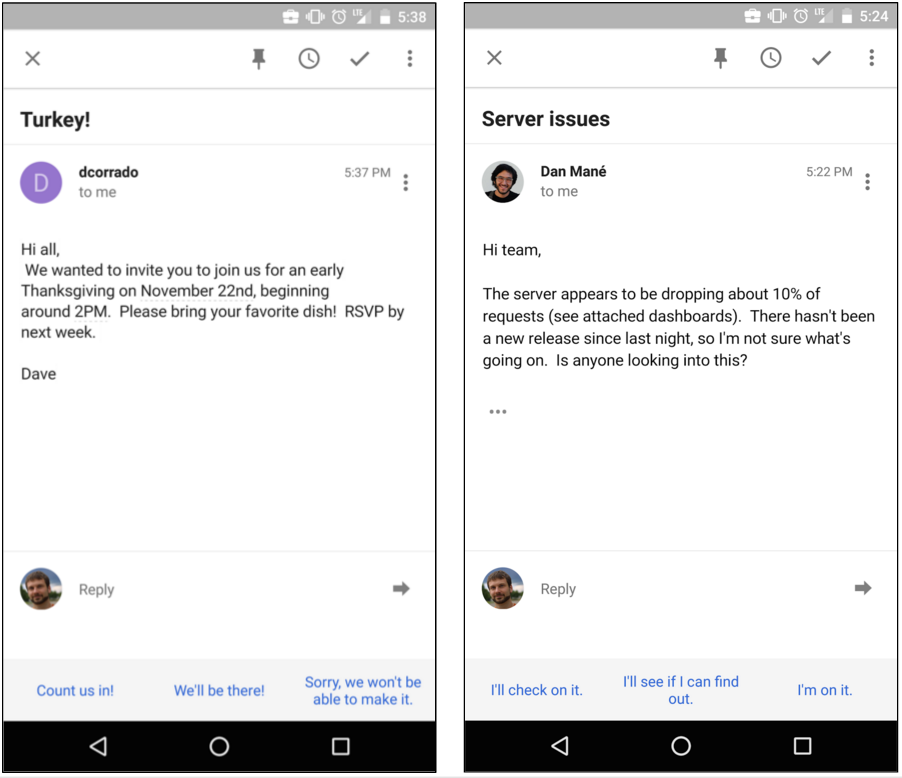
possible-response

Google Creates Terminator 2 Like E-Mail Response System and details the functionality:

Machine Intelligence for You

What I love about working at Google is the opportunity to harness cutting-edge machine intelligence for users’ benefit. Two recent Research Blog posts talked about how we’ve used machine learning in the form of deep neural networks to improve voice search and YouTube thumbnails. Today we can share something even wilder — Smart Reply, a deep neural network that writes email.

I get a lot of email, and I often peek at it on the go with my phone. But replying to email on mobile is a real pain, even for short replies. What if there were a system that could automatically determine if an email was answerable with a short reply, and compose a few suitable responses that I could edit or send with just a tap?

Some months ago, Bálint Miklós from the Gmail team asked me if such a thing might be possible. I said it sounded too much like passing the Turing Test to get our hopes up… but having collaborated before on machine learning improvements to spam detection and email categorization, we thought we’d give it a try.

There’s a long history of research on both understanding and generating natural language for applications like machine translation. Last year, Google researchers Oriol Vinyals, Ilya Sutskever, and Quoc Le proposed fusing these two tasks in what they called sequence-to-sequence learning. This end-to-end approach has many possible applications, but one of the most unexpected that we’ve experimented with is conversational synthesis. Early results showed that we could use sequence-to-sequence learning to power a chatbot that was remarkably fun to play with, despite having included no explicit knowledge of language in the program.

Obviously, there’s a huge gap between a cute research chatbot and a system that I want helping me draft email. It was still an open question if we could build something that was actually useful to our users. But one engineer on our team, Anjuli Kannan, was willing to take on the challenge. Working closely with both Machine Intelligence researchers and Gmail engineers, she elaborated and experimented with the sequence-to-sequence research ideas. The result is the industrial strength neural network that runs at the core of the Smart Reply feature we’re launching this week.

How it works

A naive attempt to build a response generation system might depend on hand-crafted rules for common reply scenarios. But in practice, any engineer’s ability to invent “rules” would be quickly outstripped by the tremendous diversity with which real people communicate. A machine-learned system, by contrast, implicitly captures diverse situations, writing styles, and tones. These systems generalize better, and handle completely new inputs more gracefully than brittle, rule-based systems ever could.

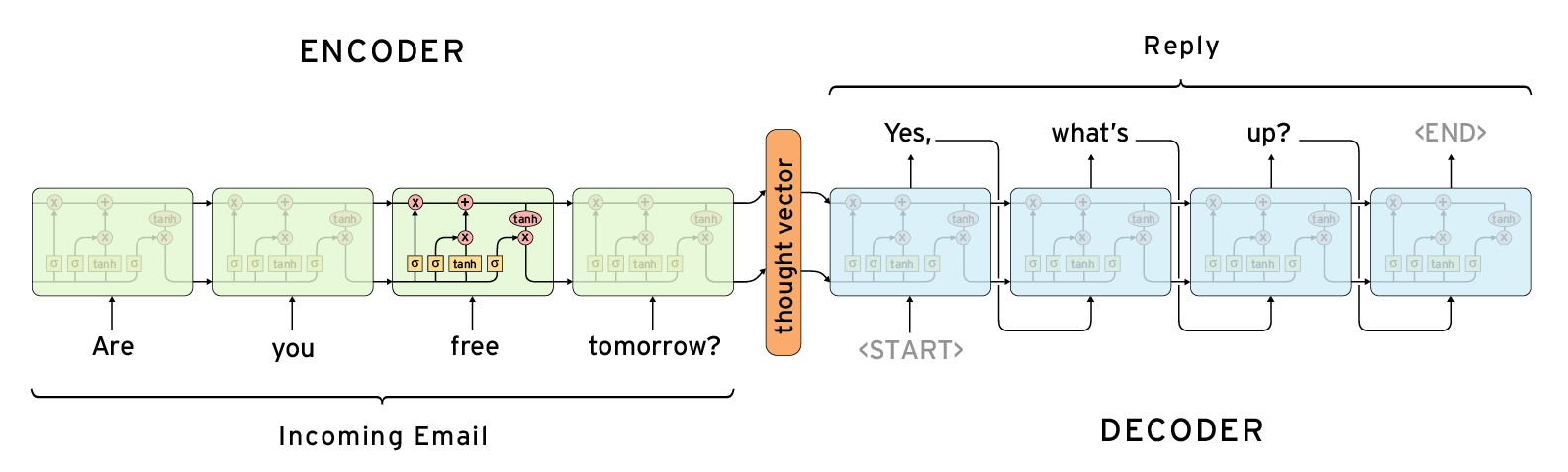
Diagram by Chris Olah

Like other sequence-to-sequence models, the Smart Reply System is built on a pair of recurrent neural networks, one used to encode the incoming email and one to predict possible responses. The encoding network consumes the words of the incoming email one at a time, and produces a vector (a list of numbers). This vector, which Geoff Hinton calls a “thought vector,” captures the gist of what is being said without getting hung up on diction — for example, the vector for „Are you free tomorrow?“ should be similar to the vector for „Does tomorrow work for you?“ The second network starts from this thought vector and synthesizes a grammatically correct reply one word at a time, like it’s typing it out. Amazingly, the detailed operation of each network is entirely learned, just by training the model to predict likely responses.

One challenge of working with emails is that the inputs and outputs of the model can be hundreds of words long. This is where the particular choice of recurrent neural network type really matters. We used a variant of a „long short-term-memory“ network (or LSTM for short), which is particularly good at preserving long-term dependencies, and can home in on the part of the incoming email that is most useful in predicting a response, without being distracted by less relevant sentences before and after.

Of course, there’s another very important factor in working with email, which is privacy. In developing Smart Reply we adhered to the same rigorous user privacy standards we’ve always held — in other words, no humans reading your email. This means researchers have to get machine learning to work on a data set that they themselves cannot read, which is a little like trying to solve a puzzle while blindfolded — but a challenge makes it more interesting!

Getting it right

Our first prototype of the system had a few unexpected quirks. We wanted to generate a few candidate replies, but when we asked our neural network for the three most likely responses, it’d cough up triplets like “How about tomorrow?” “Wanna get together tomorrow?” “I suggest we meet tomorrow.” That’s not really much of a choice for users. The solution was provided by Sujith Ravi, whose team developed a great machine learning system for mapping natural language responses to semantic intents. This was instrumental in several phases of the project, and was critical to solving the „response diversity problem“: by knowing how semantically similar two responses are, we can suggest responses that are different not only in wording, but in their underlying meaning.

Another bizarre feature of our early prototype was its propensity to respond with “I love you” to seemingly anything. As adorable as this sounds, it wasn’t really what we were hoping for. Some analysis revealed that the system was doing exactly what we’d trained it to do, generate likely responses — and it turns out that responses like “Thanks“, „Sounds good“, and “I love you” are super common — so the system would lean on them as a safe bet if it was unsure. Normalizing the likelihood of a candidate reply by some measure of that response’s prior probability forced the model to predict responses that were not just highly likely, but also had high affinity to the original message. This made for a less lovey, but far more useful, email assistant.

Give it a try

We’re actually pretty amazed at how well this works. We’ll be rolling this feature out on Inbox for Android and iOSlater this week, and we hope you’ll try it for yourself! Tap on a Smart Reply suggestion to start editing it. If it’s perfect as is, just tap send. Two-tap email on the go — just like Bálint envisioned.

Terminator Response

This blog post may or may not have actually been written by a neural network.


One Plus X applies Artificial Shortage Marketing Strategy to Reach Economic Equilibrium

Source: http://www.wired.com/2015/10/oneplus-x/


Carrier Deutsche Telekom Targets Startups After Europe Agrees Net Neutrality Rules

Source: http://techcrunch.com/2015/10/30/guaranteed-good-transmission-quality-vs-paid-prioritisation/

Well that was quick. Europe’s controversial new net neutrality rules haven’t even come into force yet and German mobile carrier Deutsche Telekom is suggesting it intends to charge startups to boost the quality of their services under the new rules — as many in the tech industry had feared.

One of the problems with the incoming rules, which will come into force on April 30, 2016, is their provision to allow for preferential treatment of Internet traffic for so called “specialized services”.

The EC has been couching these as “services like IPTV, high-definition videoconferencing or healthcare services like telesurgery” — which it says use the Internet protocol and the same access network but “require a significant improvement in quality or the possibility to guarantee some technical requirements to their end-users”.

Ergo it’s been trying to claim they are not the same as ‘normal’ Internet access services, whatever those might be.

Writing an explainer on this aspect of the rules back in June, it said: “The possibility to provide innovative services with enhanced quality of service is crucial for European start-ups and will boost online innovation in Europe. However, such services must not be a sold as substitute for the open Internet access, they come on top of it.”

The actual wording of the now agreed net neutrality rules — as pertains to these specialized services — states (emphasis mine):

There is demand on the part of providers of content, applications and services to be able to provide electronic communication services other than internet access services, for which specific levels of quality, that are not assured by internet access services, are necessary. Such specific levels of quality are, for instance, required by some services responding to a public interest or by some new machine-to-machine communications services. Providers of electronic communications to the public, including providers of internet access services, and providers of content, applications and services should therefore be free to offer services which are not internet access services and which are optimised for specific content, applications or services, or a combination thereof, where the optimisation is necessary in order to meet the requirements of the content, applications or services for a specific level of quality.

Critics of the net neutrality rules have dubbed this provision a loophole for the creation of a two tier Internet in Europe, as well as being critical of other aspects of the rules — such as the lack of a ban on the practice of zero-rating services (whereby carriers can, for instance, offer certain apps to users without data charges for accessing them), and other exceptions for certain types of congestion management.

The EC continually rebutted such criticism, with Günther Oettinger, the Commissioner for Digital Economy and Society, arguing the rules allow flexibility for “innovation and investments”, and going on to claim that specialized services “have to be in the public interest” (although the wording of the law indicates that public interest is not, in fact, a legal requirement, but merely a “for instance” example).

It looks like we’re now getting a glimpse of what the new rules will mean in practice. And specifically how these ‘specialized services’ are going to manifest themselves: as a route for carriers to open up new revenue streams by tapping into startup coffers. (Critics of the new rules have suggested ‘specialized services’ were the concession demanded by carriers for giving up roaming fees — the other key plank of the legislation. Bottom line: carriers’ revenues have been declining for years and they have to find alternatives.)

Writing in a blog post yesterday DT CEO Timotheus Höttges suggests the carrier is preparing to use the provision of specialized services to charge startups for “guaranteed good transmission quality” — arguing this will offer them a way to compete with better resourced rivals, such as large tech platforms like Google.

Höttges first likens specialized services to quality differentiation on the Internet — such as users of cloud storage services paying more for more storage or to view HD instead of SD quality videos — and then goes on to write (emphasis mine):

Opponents of special services claim that small providers can’t afford this. The opposite is true: Start-ups need special services more than anyone in order to have a chance of keeping up with large Internet providers. Google and co. can afford server parks all around the world, to bring content nearer to their customers and thus improve the quality of their services. Small companies cannot afford this. If they want to bring services to market which require guaranteed good transmission quality, it is precisely these companies that need special services. By our reckoning, they would pay a couple of percent for this in the form of revenue-sharing. This would be a fair contribution for the use of the infrastructure. And it ensures more competition on the Internet.

Carriers have long complained they are being turned into dumb pipes by the apps sitting atop their network and running data services that allow users to circumvent the likes of SMS via messaging apps, for instance. So you can just imagine how they are salivating over the prospect of leverage over startups via the ability to pit one Internet business against the other by selling “guaranteed good transmission quality”.

The phrase “guaranteed good transmission quality” implies those businesses not paying a couple of per cent revenue-share to the carrier can expect less reliable transmission quality over DT’s network — albeit the EC continually stated that “paid prioritisation” is explicitly not allowed under the new net neutrality rules.

So it will presumably be up to national regulatory authorities to determine whether “guaranteed good transmission quality” amounts to “paid prioritisation” or not.

Well you can’t say people didn’t see this coming…

Successful at the Age of 25


Um erfolgreich zu werden, gibt es kein Patentrezept. Das mussten auch die lernen, die es tatsächlich zu Erfolg, Ruhm, Ehre und internationaler Berühmtheit gebracht haben. Denn die Wege, die sie dorthin geführt haben, könnten unterschiedlicher nicht sein.

Donald Trump

Donald Trump arbeitete als Projektentwickler im Immobilienkonzern seines Vaters und übernahm mit 25 Jahren die Leitung des Unternehmens, das er als eine seiner ersten Handlungen von „Elizabeth Trump & Son“ in „The Trump Organization“ umtaufte.

Zugegeben, Donald Trump hatte es auch recht leicht im Leben. Der milliardenschwere Immobilien-Mogul, der aktuell vor allem durch das Rennen um die US-Präsidentschaftskandidatur Schlagzeilen macht, wuchs in einer reichen Familie auf. Sein Vater versuchte aber trotzdem, ihm den verantwortungsbewussten Umgang mit Geld beizubringen. Der junge Donald musste zum Beispiel leere Flaschen auf den Baustellen des Familienkonzerns einsammeln, um sein Taschengeld aufzubessern.

Elon Musk

Elon Musk führte mit 25 Jahren seine erste Internetfirma.

Im Alter von 24 Jahren schmiss Musk seine Promotion in angewandter Physik an der Stanford Universität hin und gründete Zip2. Mit seiner Firma, die online Geschäftsverzeichnisse und einen Kartendienst bereitstellte, wollte Musk von der boomenden Internetbranche in den späten 90er Jahren profitieren – und hatte Erfolg. Rund vier Jahre später wurde Zip2 von Compaq aufgekauft. Das Geld aus dem Verkauf, immerhin 307 Millionen Dollar, nutzte Musk um seine nächste Firma zu gründen: PayPal.

Eric Schmidt

Heute ist Eric Schmidt Vorstandsvorsitzender von Alphabet (ehemals Google). Als er 25 Jahre alt war, baute er sich gerade sein umfangreiches IT-Wissen auf, dass ihn letztendlich in diese Position brachte.

Nach seinem Masterabschluss blieb Schmidt an der Berkeley Universität um zu promovieren. Für seine Doktorarbeit, die er im Alter von 27 Jahren abschloss, befasste er sich mit der Vernetzung von Computern und komplexen Aspekten der Software-Entwicklung. Während des Sommers arbeitete er außerdem in der Forschungsabteilung des Xerox Palo Alto Research Centers. Dort wurde unter anderem der computergestützte Arbeitsplatz entwickelt, den wir heute kennen und nutzen.

Jeff Bezos

Jeff Bezos hatte mit 25 Jahren einen Job in der Bankenbranche.

Mit 24 Jahren heuerte der heutige Amazon-Chef bei Bankers Trust an, einer Bank mit Schwerpunkt auf Vermögensverwaltung und Investmentbanking. Dort entwickelte er eine für damalige Verhältnisse revolutionäre Software für die Bankenbranche. In der Folge wurde er nur zwei Jahre später, also mit 26, zum Vize-Präsidenten von Bankers Trust befördert.

Larry Ellison

Der Oracle-Gründer hielt sich mit Gelegenheitsjobs als Programmierer über Wasser.

Das Programmieren hat sich Ellison in seiner Jugend selbst beigebracht. Mit 22 Jahren zog er dann nach Berkeley, um damit auch Geld zu verdienen. Während der folgenden acht Jahre tingelte er von einem Job zum nächsten und arbeitet unter anderem für die US-Bank Wells Fargo oder den Multimedia-Konzern Ampex. Bei letzterem lernte Ellison auch Bob Miner und Ed Oats kennen, die späteren Mitgründer von Oracle.

Marissa Mayer

Marissa Mayer war Angestellte bei Google.

Genauer gesagt wurde sie im Alter von 24 Jahren als 20. Google-Mitarbeiter eingestellt. Sie war zu dieser Zeit auch die einzige Frau beim späteren Suchmaschinen-Giganten. Mayer blieb Google 13 Jahre lang treu, bevor sie ihren heutigen Posten als Chefin von Yahoo antrat.

Mark Cuban

Der Self-Made-Milliardär war mit 25 noch Barkeeper in Dallas.

Nachdem er seinen Abschluss an der Universität von Indiana in der Tasche hatte, zog Mark Cuban nach Dallas und arbeitete dort zunächst als Barkeeper. Anschließend verkaufte er Computerprogramme für die Firma Your Business Software, die ihn aber nach nicht einmal einem Jahr feuerte. Daraufhin gründete Cuban seine eigene Firma MicroSolutions, die er im Alter von 30 Jahren für 6 Millionen Dollar an CompuServe verkaufte.

Mark Zuckerberg

Mark Zuckerberg führte mit 25 Jahren ein Unternehmen, das endlich Geld einbrachte.

Der Facebook-Gründer hat früh angefangen: Bereits fünf Jahre harte Arbeit hatte er vor seinem 25. Geburtstag in Facebook gesteckt. Dafür bekam er mit 25 Jahren aber ein besonderes Geschenk: Im gleichen Jahr, nämlich 2009, schrieb Facebook erstmals schwarze Zahlen und überstieg die Marke von 300 Millionen Nutzern.

Richard Branson

Mit 25 Jahren stand der Virgin-Gründer bereits an der Spitze eines breit gefächerten Unternehmens.

Schon im Alter von 20 Jahren eröffnete Richard Branson seinen eigenen Plattenladen unter dem Namen „Virgin“. Zwei Jahre später folgte ein Tonstudio und mit 23 Jahren nannte Branson auch ein Plattenlabel sein eigen. In den Jahren zwischen seinem 25. und seinem 30. Geburtstag baute der Virgin-Chef sein Unternehmen weiter aus und machte es zu einem international agierenden Großkonzern.

Sheryl Sandberg

Im Alter von 25 Jahren machte Sheryl Sandberg ihren Master-Abschluss an der Harvard Business School.

Eigentlich hatte die Geschäftsführerin von Facebook ihr Studium in Harvard bereits im Alter von 22 Jahren mit dem Bachelor abgeschlossen und einen Job bei der Weltbank ergattert, wo sie mit dem späteren US-Finanzminister Larry Summers zusammenarbeitete. Sie beschloss dann jedoch, an der Harvard Business School doch noch ihren Master zu machen. Diesen hatte sie 1995 schließlich auch in der Tasche. Bis sie zu Facebook kam, sollte es anschließend aber noch einige Jahre dauern.

Steve Jobs

Apple-Gründer Steve Jobs brachte seine Firma mit 25 Jahren an die Börse und wurde so zum Millionär.

Nach dem ersten Handelstag der Apple-Aktie im Dezember 1980 war Steve Jobs Konzern am Markt bereits stolze 1,2 Milliarden Dollar wert. Das machte auch ihn schlagartig reich. Seinem Biografen erzählte Jobs später, dass er an diesem Tag einen Schwur geleistet hätte: Er würde es nicht zulassen, dass Geld irgendwann einmal sein Leben zerstöre.

Warren Buffett

Das Orakel von Omaha lebte mit 25 Jahren in Omaha (wer hätte es gedacht?) und arbeitet dort als Investmentbanker.

Bereits in seinen frühen 20ern fing Warren Buffett bei Buffet-Falk & Company an, dem Unternehmen seines Vaters, und tätigte dort Investitionen für seine Kunden. Mit 26 Jahren zog es ihn aber schließlich von Omaha nach New York, wo er als Wertpapieranalyst für seinen Mentor Benjamin Graham arbeitete. Im gleichen Jahr rief er mit Buffett Partnership Ltd. auch seine eigene Investmentfirma ins Leben und legte den Grundstein für seinen heute legendären Ruf.


Quelle: http://www.finanzen.net/nachricht/private-finanzen/Business-Insider-Was-Warren-Buffett-Jeff-Bezos-und-10-weitere-erfolgreiche-Menschen-im-Alter-von-25-Jahren-gemacht-haben-4584303

Source: http://uk.businessinsider.com/what-12-highly-successful-people-were-doing-at-25-2015-10?r=US&IR=T

Apple’s Growth Machine Starts to Sputter

Source: http://www.bloombergview.com/articles/2015-10-27/apple-s-iphone-growth-machine-starts-to-sputter

Apple has been corporate America’s most ridiculously unbelievable growth story. And now it’s over. Take a deep breath. Exhale. Get used to it.

Yes, the Apple we have come to know was a gravity-defying growth machine. Apple is the most valuable company in the world, yet it increased its revenue in the last 12 months by more than last year’s sales at Coca-Cola. Apple rang up enough operating cash in the last year to buy 625,000 Tesla Model X cars — nearly one for each person in San Francisco. (I’ll take blue with tan leather interior, please.) The company has given us so many eye-popping numbers that any feat short of Tim Cook colonizing Mars is underwhelming.

With the setup of high expectations, the most crucial numbers are now more low-Earth orbit than deep space. Unit sales of the iPhone for the three months ended Sept. 26 climbed 22 percent from those in the period a year earlier. Just a few months ago, Apple sold 60 percent more iPhones than it did a year before. Wall Street will be thrilled if iPhone sales increase at all in the holiday quarter, compared with the frenzied sales of the iPhone 6 during the 2014 holidays. Apple’s own forecast, which is often conservative, is for a tiny increase in revenue in the three months ending in December.

The existential question for Apple is whether the company is in another lull before a turbocharge from the iPhone 7 or something else, or whether nonspectacular growth is the new normal.

It’s true that this isn’t the first time Apple seemed to run out of steam. Just before the introduction of the iPhone 6 models a year ago, Apple posted five consecutive quarters of single-digit revenue growth, according to Bloomberg data. Sales took off again once people snapped up the larger-screen iPhones.

What’s different this time is Apple is in part to blame for doubts about its growth trajectory. The company has fallen into an unhealthy reliance on a single product: the iPhone. The smartphones generated just more than half of Apple’s sales before the introduction of the iPhone 6. That number has risen to 63 percent or more in each of the last four quarters.

90823-20151027204645000000000


Part of that shift, of course, is the remarkable sales run for the iPhone. It’s also because the Apple Watch, Apple Music or potential future electric minivans aren’t big enough to pick up the slack right now, and maybe never will. Sales of Mac computers are defying the shrinking PC market, but revenue gains are pedestrian. The iPad seems to have settled into a rut as a nice-but-not-essential consumer gadget that users don’t upgrade as often as the company would like. Revenue from iPads fell for the seventh quarter in a row, by 20 percent in the latest three months.

Apple is used to defying predictions that it can’t top itself. Those predictions look more likely to come true than ever before.

Apple’s Chinese Miracle Is Over

Source: http://www.bloombergview.com/articles/2015-10-28/apple-s-chinese-miracle-is-over

Perhaps the most important number in Apple’s quarterly release on Tuesday came from China, and it’s not the good news Apple makes out. The company’s over reliance on the Chinese market is starting to hinder its progress despite management’s attempts to give it a positive spin.

During Tuesday’s earnings call, Apple chief executive Tim Cook sang the praises of the Chinese market, saying it will one day be Apple’s largest. In fiscal 2015, which ended for Apple on Sept. 26, Greater China provided 25 percent of the company’s revenue, for the first time overtaking Europe, responsible for just 21.6 percent of Apple sales. An economic slowdown? Not according to Cook, who is worth quoting at length here:

Frankly, if I were to shut off my web and shut off the TV and just look at how many customers are coming in our stores regardless of whether they’re buying, how many people are coming online, and in addition looking at our sales trends, I wouldn’t know there was any economic issue at all in China. And so I don’t know how unusual we are with that. I think that there’s a misunderstanding, probably particularly in the Western world, about China’s economy, which contributes to the confusion. That said, I don’t think it’s growing as fast as it was; but I also don’t think that Apple’s results are largely dependent on minor changes in growth.

The statistics Cook cites in support of this view are impressive: 87 percent growth in iPhone sales year-on-year in Greater China (which includes Hong Kong, Taiwan and Macau) despite the entire market’s 4 percent growth; revenue almost twice as high in the last quarter as a year ago; and the iPhone 6 now the bestselling smartphone in China, with the iPhone 6 Plus at number three. These numbers are less relevant, however, than two others: a drop in quarter-on-quarter sales in Greater China and an erosion of Apple’s overall market share there.

In the last quarter of fiscal 2015, Apple made $12.5 billion in revenue in Greater China, a 5.4 percent drop compared to the previous three months, despite the inclusion of the first weekend of iPhone 6s sales in the fourth quarter, 2015 data. In 2014, the new iPhone 6 wasn’t immediately available in China, so the fourth quarter didn’t benefit from the new product boost — and still sales were higher than in the previous three months.

Apple in China

Cook is wrong to say the Chinese slowdown isn’t affecting his company’s sales. The effect has been immediate and quite obvious. But Apple’s market share in the Asia Pacific region, which includes China, wasn’t growing even before it manifested itself.

According to data compiled by Bloomberg Intelligence, in the second quarter of this year, Apple’s market share of smartphone unit shipments in the region dropped to 7.7 percent from 10.8 percent in the previous quarter as Chinese leaders Huawei and Xiaomi increased their shares. Apple is the Asian smartphone market leader in terms of value, but its share by that measure also dropped in the second quarter — to 34.1 percent from 42.7 percent in the previous three months. Again, Huawei and Xiaomi posted gains, although Korean producers such as Samsung and LG also managed to pick up some of Apple’s losses. As Apple’s revenue in the region dropped, it was unlikely to have made share gains in the last quarter.

Cook is banking on the future growth of the Chinese middle class, and that’s an obvious long-term bet to make, but under the current economic conditions, this growth is not likely to be explosive. Besides, Apple won’t even be able to grow its sales at the same rate because many Chinese consumers will opt for better-value devices from local producers, as they’re already doing, judging by the market share data.

Improving distribution in China yielded strong revenue gains for Apple this year. Greater China accounted for 53 percent of the company’s revenue growth in fiscal 2015. Unless China’s economic troubles are miraculously cured over the next year or Huawei and Xiaomi stop making cutting-edge devices for a fraction of Apple’s prices, this growth engine has stalled. Nor does Apple have any comparable opportunities for extensive growth anywhere else in the world.

Cook’s bet on China was, of course, no mistake: It would be a crime for a device producer not to develop a strong presence in the world’s most populous country. Focusing on China was a business decision that produced gains comparable to a ground-breaking product launch, especially in 2015. There are no more miracles coming out of China, however, and no more technological rabbits coming out of Apple’s hat. It’s time for some stagnation and retrenchment — at least by this company’s remarkably high standards.

Source: http://www.bloombergview.com/articles/2015-10-28/apple-s-chinese-miracle-is-over