If banking is something you do on an app, why shouldn’t your mobile carrier actually be your bank? It’s more than just an idea. Orange, Telenor, and O2 are all building their own operations.
In the UK alone, people use mobile banking apps more than 7,610 times a minute, or 4 billion times a year.
According to the “Way We Bank Now” report by the British Banking Association, they downloaded more than 13.8 million banking apps in 2015, up 25 percent from 2014.
All over the world people are switching away from branch-based banking, and even desktop Internet banking, to manage their financial lives through an app.
Why wouldn’t they? There’s no need to go anywhere. The user interface is typically better than it is on a PC. And the addition of biometrics (typically fingerprint) makes signing in so much easier and safer than passwords.
Of course, banking apps are made by banks. The carriers just provide the data packages that allow people to use use them.
But in the last year, a small number of European carriers have come to a radical conclusion: Let’s do more than just enable mobile banking apps; let’s build our own.
Groupama Banque is currently owned by insurance firm Groupama. When the deal is completed, Orange will own 65 percent of it. Thus, the telco will be able to launch Orange Bank in France in January 2017, with Spain and Belgium to follow.
Actually, Orange already has some experience in the area. In October 2014, it launched Orange Finanse as a joint venture between mBank and Orange Polska. It’s not alone. O2 Germany launched a bank with Fidor in July, while Telenor is two years into its Banka Serbia launch.
Other operators are experimenting. Telefonica Spain announced a joint venture with CaixaBank and Santander, while in the US, T-Mobile launched a Visa card with banking features linked to a smartphone app (though it is now being wound down).
Needless to say, financial services are nothing new for mobile operators. In developing markets, they have launched text-based mobile money systems that have transformed the lives of millions. Vodafone’s M-Pesa has 25 million customers and 261,000 agents in 11 countries.
Meanwhile Orange has its own Orange Money service, which launched in Ivory Coast in 2008 and has 18 million customers in 14 countries across Africa.
In mature markets, the emphasis has been on NFC payments. The typical model was a contactless wallet app, with account credentials stored in the secure element of a SIM card. There were numerous launches — Softcard (US), Valyou (Norway), Buyster (France), SixPack (Denmark), and so on. Most have closed.
So why would operators switch focus to banking? The simple reason is that they believe they can build new and intuitive products. Why? Because they are mobile-first.
The theory goes that banks have a tendency to approach new mobile services by layering them on top of legacy IT systems. By contrast, operators should have the know-how to build much better mobile experiences that are consumer centric.
So O2 Banking customers can, for example, sign up via a video chat session with an agent. They can have a current account with a free MasterCard inside five minutes. They can also earn rewards of mobile data rather than pennies of interest.
Telenor Banka in Serbia launched in September 2014. It carefully targeted “premium” tech-savvy customers and cultivated them as brand ambassadors and to quickly spread the word on social media. By summer 2016, the bank had 180,000 customers (the biggest traditional bank in the country has 500,000 mobile users).
The Telenor Banka app was built around specific “pain points” such as currency transfer. In Serbia, people like to transfer their dinars for euros. Typically, they queue to do so with an agent, then queue again at the bank to deposit the cash back into their accounts. Telenor Banka lets them do the same in two clicks inside the app.
Users can also activate and deactivate their cards from inside the app. This helps people combat online fraud as they can “turn off” their cards apart from when they are actually making a payment.
All these launches are indicative of a dynamic moment in banking. Technology is making it easier for digital-only challenger banks (including mobile operators) to launch rival products. Regulation is helping too. The EU Payment Services Directive 2, coming into force in 2018, mandates that banks must open up APIs so that third parties (with user permission) can have access to account information.
In its Essentials 2020 review, Orange set a target of making €400 million ($435 million) from financial services by 2018. This compares to overall group revenues at Orange of €10.3 billion ($11.2 billion) in the third quarter of 2015 alone.
This is ushering in the idea of “banking as a marketplace,” which operators are keen to leverage. Here, banking apps offer account services but also act as a mini mall in which users can “shop” for foreign exchange, insurance, loans, and so on from specialists.
For telcos, it’s an opportunity to experiment with new customer centric business models while delivering CRM and achieving churn reduction. For banks and other key players in financial services, it’s a call to action to leverage their own assets in a way that creates value for the discerning mobile consumer.
In times of uncertainty, the human instinct often leads us to use solutions that are safe and tested rather than stepping into the unknown.
As such, many leaders find themselves reacting to uncertain economic forecasts by cutting back rather than proactively investing.
It is precisely in times of uncertainty that organizations need bold leaders to align investments, source top talent, and foster innovation in order to gain a competitive edge.
Findings from the 2016 Deloitte Business Confidence Report show that more than half of all surveyed CXOs (C-suite) and CXO successors (CXOWs) believe they do not have the bold leadership they need at the highest levels of their organization.
The report, based on data from hundreds of cross-industry leaders, identifies six key behaviors that bold leaders regularly demonstrate.
Bold leaders regularly:
1. Set ambitious goals
Bold leaders demonstrate a relentless desire to excel and are able to create environments that stretch people to go above and beyond their natural limits. While adopting a more conservative approach for the overall business may be a smart play during periods of uncertainty, maintaining aspirational goals in those high-priority business areas can help sustain increased effort and motivation.
For example, during the 1980s, product delays and challenges in memory production led to a period of significant financial strain at Intel. During this time, the company implemented what they described as „the 10% solution,“ a request that their employees provide 10% greater effort despite 10% cuts to their paycheck.
While this was clearly a tough ask, most team members rose to the occasion, investing additional time on the products and pursuits that formed the backbone of the company’s success, leading them out of the woods.
2. Propose ideas their company might consider controversial
Widespread change simply cannot occur without challenging the status quo. Bold leaders do not let initial resistance prevent them from pursuing new ideas and pushing for needed change. However, less than half of CXOs and CXO successors reported proposing controversial ideas in their own organization. While groupthink (excessive focus on consensus) is problematic in any business, it can be particularly crippling during periods of unease, as it may give competitors a chance to step in and gain market share.
Founded in Wales the early 1950s, Laura Ashley’s clothing conjured up images of tea time in the English countryside. Founders Laura and Bernard Ashley maintained tight control over the business as it grew from a single shop to 500 stores worldwide. After Laura’s death in 1985, Bernard worked to keep her legacy alive, as Harvard Business Review reported.
However, times had changed, as had fashion. Women were entering the workforce in significant numbers and wanted practical, professional attire, and competitors were offshoring production to reduce labor costs. The company hired a consultant to update the brand and instituted a variety of cost-cutting activities, however, the 11 CEOs who took the reins over the next 15 years were slow to challenge the company’s beholden practices.
In the late 2000s, the company changed course to focus on furniture and housewares. This bold change invigorated a stalling business and serves as reminder that a willingness to challenge existing practices can determine a company’s survival over time.
3. Invite feedback from colleagues at all levels of seniority
Creating sustained improvements involves solutions that serve everyone’s interests. While quick action and decisiveness are often associated with bold leadership, these traits can isolate leaders and alienate their people. The most effective leaders seek feedback in a proactive and iterative fashion, incorporating the ideas they receive into synergistic solutions, paying attention to feedback that comes from both junior and senior colleagues.
When Alan Mulally took over as president and CEO of Ford Motor Company in 2006, he faced a tough reality. Ford was facing lost market share and serious production problems. In an effort to address these problems head on, Mulally began encouraging his team members to speak up about challenges early and often, rather than waiting to see if they could fix them alone. The leadership team, filled with independent and highly competent individuals used to managing their own operations, was initially slow to respond to these requests.
As they made the transition, Mulally served as an energizing and positive force, and when the team began respond, he was quick to praise their honesty and offer help, rather than assigning blame. By breaking the classically stoic leadership mold and inviting open communication from his team, Mulally was able to proactively overhaul Ford during the 2008-2009 recession and avoid the direct government intervention imposed on so many of their competitors.
4. Innovate and look for new ways of doing things
For bold leaders, the opportunity to drive improvements outweighs the fear of failure. They tend to remain open to a wide range of possibilities, constantly experimenting and never allowing themselves to be completely satisfied with the current approach. While nearly 60% of CXOs and CXOWs surveyed report that they look for new ways of doing things on a regular basis, fewer than 46% of CXOs and CXOWs said they propose ideas the company might consider controversial.
Ed Catmull, the cofounder and president of Pixar, is well known for embracing an experimental approach to his work. He freely acknowledges that all Pixar movies „suck“ when they are first conceptualized, and that is only through thousands of storyboards that the final product starts to come to shape.
Throughout the design process, Pixar employees are constantly experimenting with new approaches to get the designs right, often scrapping years of work if a vision doesn’t come together as effectively as expected. This is best embodied by John Lasseter, Pixar’s chief creative officer, who says, „we don’t actually finish out films, we just release them.“
5. Take risks
A willingness to step forward in the face of ambiguity enables bold leaders to respond quickly to new trends and proactively redefine the market. With only 34% of respondents in the Deloitte survey reporting that they take risks, this is clearly a concept that is easy to understand but hard to put into practice. Leaders who find ways to take risks while considering the importance of context find themselves on the cutting edge and hone their ability to develop a competitive advantage over their more cautious peers.
Jeff Bezos, Amazon’s charismatic and challenging leader is famous for setting a punishing standard for his teams, and has created an environment in which risk is encouraged in the pursuit of improved performance. Stephenie Landry, an operations executive, became a famous example of this after proposing an idea to ship items to urban customers in an hour or less. Less than four months later, this previously mid-level manager launched Prime Now, a service which is pushing the envelope in the industry for delivery speed.
6. Build strong teams and empower them to success
While many leaders focus on innovating their products and services, they often forget that the ideas for these innovations come from their team members. Additionally, leaders are often fearful of a looming brain drain, expecting their top talent to flee for more innovative, technology-savvy companies.
An eyebrow-raising 63% of CXOs and 80% of CXOWs surveyed feel that 1 in 3 or more of their best managers will leave before joining the senior ranks. Bold leaders appreciate that employees need ample opportunity to practice and experiment if they are going to excel. As a result, they think carefully about their team composition, the conditions that foster growth, and how to provide support in the form of both mentorship and sponsorship.
Leaders who provide a solid base of support and an opportunity for challenge aid their organizations in the ongoing war for talent. In addition, the increased loyalty they foster often leads to retention and in turn, attracts other top talent.
One of the greatest challenges facing companies today is the fact that physical separation and heavy reliance on e-mail communication can undermine effective team dynamics. To improve team harmony and prevent frustrations that can lead to a staff exodus, Dharmendra Modha at IBM developed a detailed contract for each product describing each team’s responsibilities and identifying how the product would work in conjunction with products from other teams.
As a result, each team member feels they are working towards a common purpose. In addition, if groups propose different approaches to solving a problem, he divides the team and has them each pursue their idea. Objective testing identifies the best solution and encourages staff to experiment with the approach they think will work best rather than succumbing to groupthink.
In reading these stories, it would be easy to equate bold leadership with courage — attributing it to personality or temperament. This is particularly true in times of uncertainty, where being bold feels exponentially riskier, but this framing doesn’t tell the most important part of the story.
While some of the elements listed above may come naturally, those that don’t can be developed by understanding and incorporating what the most effective leaders focus on into your own decision-making process. Effective leaders are not great because they are willing to jump blindly or rashly into the unknown, but because they know how to think through complex challenges and know specifically what to think about.
This approach involves an ability to quickly identify the most relevant variables in any situation and prioritize action. Combine this knowledge with a willingness to experiment and a high standard for success and you have a leader who can confidently launch new products and services and adjust people processes in the face of uncertainty.
It might save your life: MIT’s Moral Machine asks you to answer moral dilemmas
We humans err and err often. If it is not a small mistake like leaving the keys in the fridge, then it is a deadly one like leaving the oven on all day. We tend to be reckless, forgetful, overconfident, easily distracted — dangerous traits when steering a two-ton, metal machine across lanes at 70 mph. Four out of the top five causes for car crashes are the result of human error.
“Machine intelligence may have to deal with situations where someone has to die so someone else can live.”
But, as most drivers know, driving can require split-second decisions with no obvious right answer. A squirrel darts into the road — do you swerve and risk hitting other cars or drive straight and hope the squirrel survives. How would you react if a dog ran into the road? Or a criminal? Or a child? Which lives are worth risking? These questions are being asked by teams of researchers around the world. Now they are looking to you for answers.
“Self-driving cars are now practically inevitable,” Massachusetts Institute of Technology graduate student and research assistant Sohan Dsouza told Digital Trends. “That is a good thing, generally, because they would help save countless lives now being lost daily due to human driver error and can offer independent mobility to countless others who cannot drive.”
To that end, Dsouza, Edmond Awad, and their team at the MIT Media Lab developed Moral Machine, a platform that engages users in moral dilemmas and asks them how the self-driving car should respond. A handful of factors play into each scenario, including the age and gender of victims, their social status, and whether they are breaking the law. Participants are asked to make decisions in 13 dilemmas. The results then pooled as crowdsourced data and may one day be used to guide the development of ethical machines. After judging the dilemmas, users can compare their outcomes to others’ and even design their own for others to answer.
“One of our primary goals is provoking debate among the public,” Dsouza said, “and especially dialogue among users, manufacturers, insurers, and transport authorities.
“Not all crashes can be avoided, and the possibility remains that machine intelligence piloting vehicles may have to deal with situations where someone has to die so someone else can live — rather like the classic philosophical thought experiment known as the trolley problem.”
The trolley problem has been pondered for nearly 50 years. In it, a train car is en route to hit five people down the track. You have a switch that can steer the trolley down another set of tracks, where it will hit only one person. Would you intervene or do nothing?
“There are very few experiment-based studies regarding this possibility,” Dsouza said. “Hence, we needed to create a platform that would be able to generate large numbers of multi-factor scenarios and present them to users in an easy-to-understand, easy-to-use, and engaging way, so as to build a model of how people perceive the morality of machine-made decisions.”
“One of our primary goals is provoking debate among the public.”
Moral Machine has gathered answers on more than 11 million scenarios so far. Although the team has yet to perform a deep analysis, they are noticing regional trends that hint at the rocky road ahead. “On average, respondents from western countries place a relatively higher value on minimizing the number of overall casualties — that is, they approve more utilitarian choices — compared to respondents from eastern countries,” Dsouza said.
Revealing these cultural discrepancies fosters debate and dialogue, which is essential to making progress. “We believe we have already made an impact,” Dsouza said. “This dialogue will eventually help the stakeholders in this scene reach an equilibrium of legislation, liability assessment, moral comfort, and public safety.”
Recently, Google launched a video calling tool (yes, another one). Google Hangouts has been sidelined to Enterprise, and Google Duo is supposed to be the next big thing in video calling.
So now we have Skype from Microsoft, Facetime from Apple, and Google with Duo. Each big company has its own equivalent service, each stuck in its own bubble. These services may be great, but they aren’t exactly what we imagined during the dream years when the internet was being built.
The original purpose of the web and internet, if you recall, was to build a common neutral network which everyone can participate in equally for the betterment of humanity. Fortunately, there is an emerging movement to bring the web back to this vision and it even involves some of the key figures from the birth of the web. It’s called the Decentralised Web or Web 3.0, and it describes an emerging trend to build services on the internet which do not depend on any single “central” organisation to function.
So what happened to the initial dream of the web? Much of the altruism faded during the first dot-com bubble, as people realised that an easy way to create value on top of this neutral fabric was to build centralised services which gather, trap and monetise information.
Search Engines (e.g. Google), Social Networks (e.g. Facebook), Chat Apps (e.g. WhatsApp) have grown huge by providing centralised services on the internet. For example, Facebook’s future vision of the internet is to provide access only to the subset of centralised services it endorses (Internet.org and Free Basics).
Meanwhile, it disables fundamental internet freedoms such as the ability to link to content via a URL (forcing you to share content only within Facebook) or the ability for search engines to index its contents (other than the Facebook search function).
The Decentralised Web envisions a future world where services such as communication, currency, publishing, social networking, search, archiving etc are provided not by centralised services owned by single organisations, but by technologies which are powered by the people: their own community. Their users.
The core idea of decentralisation is that the operation of a service is not blindly trusted to any single omnipotent company. Instead, responsibility for the service is shared: perhaps by running across multiple federated servers, or perhaps running across client side apps in an entirely “distributed” peer-to-peer model.
Even though the community may be “byzantine” and not have any reason to trust or depend on each other, the rules that describe the decentralised service’s behaviour are designed to force participants to act fairly in order to participate at all, relying heavily on cryptographic techniques such as Merkle trees and digital signatures to allow participants to hold each other accountable.
There are three fundamental areas that the Decentralised Web necessarily champions:privacy, data portability and security.
Privacy: Decentralisation forces an increased focus on data privacy. Data is distributed across the network and end-to-end encryption technologies are critical for ensuring that only authorized users can read and write. Access to the data itself is entirely controlled algorithmically by the network as opposed to more centralized networks where typically the owner of that network has full access to data, facilitating customer profiling and ad targeting.
Data Portability: In a decentralized environment, users own their data and choose with whom they share this data. Moreover they retain control of it when they leave a given service provider (assuming the service even has the concept of service providers). This is important. If I want to move from General Motors to BMW today, why should I not be able to take my driving records with me? The same applies to chat platform history or health records.
Security: Finally, we live in a world of increased security threats. In a centralized environment, the bigger the silo, the bigger the honeypot is to attract bad actors. Decentralized environments are safer by their general nature against being hacked, infiltrated, acquired, bankrupted or otherwise compromised as they have been built to exist under public scrutiny from the outset.
Just as the internet itself triggered a grand re-levelling, taking many disparate unconnected local area networks and providing a new neutral common ground that linked them all, now we see the same pattern happening again as technology emerges to provide a new neutral common ground for higher level services. And much like Web 2.0, the first wave of this Web 3.0 invasion has walked among us for several years already.
Git is wildly successful as an entirely decentralised version control system – almost entirely replacing centralised systems such as Subversion. Bitcoin famously demonstrates how a currency can exist without any central authority, contrasting with a centralised incumbent such as Paypal. Diaspora aims to provide a decentralised alternative to Facebook. Freenet paved the way for decentralised websites, email and file sharing.
Less famously, StatusNet (now called GNU Social) provides a decentralised alternative to Twitter. XMPP was built to provide a decentralised alternative to the messaging silos of AOL Instant Messenger, ICQ, MSN, and others.
Telephone switchboard operators circa 1914. Photo courtesy Flickr and reynermedia.
However, these technologies have always sat on the fringe — favourites for the geeks who dreamt them up and are willing to forgive their mass market shortcomings, but frustratingly far from being mainstream. The tide is turning . The public zeitgeist is finally catching up with the realisation that being entirely dependent on massive siloed community platforms is not entirely in the users’ best interests.
Critically, there is a new generation of Decentralised Startups that have got the attention of the mainstream industry, heralding in the new age for real.
Blockstack and Ethereum show how Blockchain can be so much more than just a cryptocurrency, acting as a general purpose set of building blocks for building decentralised systems that need strong consensus. IPFS and the Dat Project provide entirely decentralised data fabrics, where ownership and responsibility for data is shared by all those accessing it rather than ever being hosted in a single location.
The real step change in the current momentum came in June at the Decentralised Web Summit organised by the Internet Archive. The event brought together many of the original “fathers of the internet and World Wide Web” to discuss ways to “Lock the web open” and reinvent a web “that is more reliable, private, and fun.”
Brewster Kahle, the founder of the Internet Archive, saw first hand the acceleration in decentralisation technologies whilst considering how to migrate the centralised Internet Archive to instead be decentralised: operated and hosted by the community who uses it rather being a fragile and vulnerable single service.
Additionally, the enthusiastic presence of Tim Berners-Lee, Vint Cerf, Brewster himself and many others of the old school of the internet at the summit showed that for the first time the shift to decentralisation had caught the attention and indeed endorsement of the establishment.
The web was designed to be decentralised so that everybody could participate by having their own domain and having their own webserver and this hasn’t worked out. Instead, we’ve got the situation where individual personal data has been locked up in these silos. […] The proposal is, then, to bring back the idea of a decentralised web.
To bring back power to people. We are thinking we are going to make a social revolution by just tweaking: we’re going to use web technology, but we’re going to use it in such a way that we separate the apps that you use from the data that you use.
We now see the challenge is to mature these new technologies and bring them fully to the mass market. Commercially there is huge value to be had in decentralisation: whilst the current silos may be washed away, new ones will always appear on top of the new common ground, just as happened with the original Web.
Github is the posterchild for this: a $2 billion company built entirely as a value-added service on top of the decentralised technology of Git — despite users being able to trivially take their data and leave at any point.
Similarly, we expect to see the new wave of companies providing decentralised infrastructure and commercially viable services on top, as new opportunities emerge in this brave new world.
Ultimately, it’s hard to predict what final direction Web 3.0 will take us, and that’s precisely the point. By unlocking the web from the hands of a few players this will inevitably enable a surge in innovation and let services flourish which prioritise the user’s interests.
Apple, Google, Microsoft, and others have their own interests at heart (as they should), but that means that the user can often be viewed purely as a source of revenue, quite literally at the users’ expense.
As the Decentralised Web attracts the interest and passion of the mainstream developer community, there is no telling what new economies will emerge and what kinds of new technologies and services they will invent. The one certainty is they will intrinsically support their communities and user bases just as much as the interests of their creators.
Google just debuted a digital assistant, which it hopes to place inside smartphones, watches, cars and every other imaginable internet-connected device. It’s already hit a snag.
The Alphabet division launched new smartphones last week with the artificially intelligent assistant deeply embedded. It also rolled out a speaker with the feature at its core and announced plans to let other companies tie their apps and services to the assistant.
At first, the deal looked like a counter-punch to Samsung rival Apple — Viv is run by the creators of Apple’s Siri assistant. But buying Viv may be more of a problem for Google, because Samsung is the biggest maker of phones running Google’s Android mobile operating system.
Google strategy is now centered on the assistant, rather than its search engine, because it’s a more natural way for people to interact with smartphones and other connected devices. Getting all Android phone makers to put the Google assistant on their devices would get the technology into millions of hands quickly. But Samsung’s Viv deal suggests assistants are too important for phone makers to let other companies supply this feature.
Last week, despite the Note 7 crisis, Samsung executive Injong Rhee said the company plans to put Viv’s technology in its smartphones next year and then embed it into other electronics and home appliances. A Samsung representative and a Google spokeswoman declined to comment.
That’s a necessity for Samsung, according to some analysts and industry insiders.
„As AI is becoming more sophisticated and valuable to the consumer, there’s no question it will be important for hardware companies,“ said Kirt McMaster, executive chairman of Cyanogen, a startup that makes Android software. Mr. McMaster, a frequent Google critic, said other Android handset makers will likely follow Samsung’s move.
„If you don’t have an AI asset, you’re not going to have a brain,“ he added.
Google may already have known that some Android phone makers — known as original equipment manufacturers, or OEMs — were reluctant to embrace its assistant.
„Other OEMs may want to differentiate“ Google’s Android chief Hiroshi Lockheimer told Bloomberg before it released its own smartphones. „They may want to do their own thing — their own assistant, for example.“
Samsung and Google have sparred in the past over distribution. Google requires Android handset makers to pre-install 11 apps, yet Samsung often puts its own services on its phones. And the South Korean company has released devices that run on its own operating system, called Tizen, not Android.
Viv was frequently on the short-list of startups that could help larger tech companies build assistant technology. Founded four-years ago by Dag Kittlaus, Adam Cheyer and Chris Brigham, the startup was working on voice technology to handle more complex queries than existing offerings.
While it drummed up considerable attention and investment, Viv has not yet released its product to the public. And some analysts are skeptical of Samsung’s ability to convert the technology into a credible service, given its mixed record with software applications.
„It will be very hard to compete with Google’s strength in data and their AI acquisitions,“ said Jitendra Waral, senior analyst with Bloomberg Intelligence. „Samsung would need to prove that its AI solutions are superior to that of Google’s. They are handicapped in this race.“
Samsung is also focused on handling the fallout from its exploding Galaxy Note 7 phones, potentially taking management time away from its Viv integration.
But it’s a race Samsung has to join. In recent years, Samsung acquired mobile-payments and connected-device startups to keep up with Apple, Google and Amazon. Digital voice-based assistants may be more important, if they become the main way people interact with devices.
Silicon Valley titans are rushing into the space because of this potential. Amazon is trying to sign up developers for its Alexa voice technology. Apple has recently touted more Siri capabilities and opened the technology to other developers. And now Google, considered the leader in artificial intelligence, is making its own push.
„I don’t ever remember a time when every single major consumer tech company — and even enterprise companies — have been singularly focused on an identical strategy,“ said Tim Tuttle, chief executive officer of MindMeld Inc., a startup working on voice interaction software. „They’re all following the exact same playbook.“
Google wants its Assistant to be more than just an order-taking robot — so it hired some clever writers from outside the company to help make it happen.
A new story from the Wall Street Journal’s Christopher Mims details the advancements of different artificial intelligence devices like Amazon Echo and Google’s rival product Home, and how they’re comforting for those who live alone thanks to how personable the AI’s have become.
For Google, that friendly personality is thanks to a team of writers from Pixar and The Onion who helped make the Assistant — which powers Google’s Home device — sound more like a human and less like a robot, according to the Journal. Google’s eventual goal is to help users build an emotional connection with the Assistant, the Journal reports.
Google unveiled its Assistant-enabled Home device last week, a direct competitor to other AI-powered hardware devices like Amazon’s Echo. The Assistant itself is similar to Alexa, which powers the Echo: It has voice-recognition software, natural language recognition, and it gets smarter over time.
You can ask the Assistant to tell you a joke, give you the weather or set a timer, but you can also ask it to do things like remember your favorite sports team or the city you live in. Much like other AI — like Alexa or Apple’s Siri — the Assistant can be equal parts sweet and sassy, which is what helps it seem more relatable and more human. The Assistant lives inside Google Home, but it’s also enabled in Google’s new messaging app, Allo and its new Pixel smartphone.
When the Audi R8 arrived on the world stage in 2007, the German supercar took the automotive world by storm. In short time, the stylish Audi became not just one of the most sought-after machines in the world, but also a pop-culture icon. („Iron Man,“ anybody?)But after a decade of excellence, it was time for a successor.
How do you improve upon an icon? We’ve all heard of the sophomore slump or the disappointing sequel. After all, disasters such as „Jaws 2“ or „Speed 2“ happen way more often than an „Empire Strikes Back“ or a „Dark Knight.“
With the R8, Audi had the tall task of coming up with a sequel to its flagship model. After all, this is Tony Stark’s official ride.
For 2017, there is indeed an all-new, second-generation R8. Recently, Audi dropped off this R8 V10 Coupe Quattro S tronic for Business Insider to check out. Our ibis-white R8 V10 had a base price of $162,900, but with options the car left the showroom at $183,050.
So does the sequel live up to the hype? Let’s find out.
Our stunning ibis-white test car is the latest car to carry the R8 badge. But it certainly wasn’t the first.
Hollis Johnson
The R8 road car we know today is named after Audi’s all-conquering R8 Le Mans Prototype race cars. In 1999, Audi debuted the open cockpit R8R …
Audi
… and the closed cockpit R8C race cars. In its first time out, at the grueling 24 Hours of Le Mans endurance race, the R8Rs finished third and fourth. Unfortunately, neither of the R8Cs made it to the finish.
Audi
In 2000, Audi returned with the R8 LMP.
AP
From 2000 until it was replaced in 2006, the R8 LMP racked up an astonishing 63 victories in 79 races.
REUTERS
This includes five outright victories at Le Mans in six years. Its only loss at Le Mans came at the hands of VW Group stablemate Bentley’s Speed 8. And even then, the Speed 8 that won can actually trace its roots back to the Audi R8C.
Audi
With this level of success. Audi was keen to provide its rivals with a lasting reminder of its prowess.
Audi
The result was the R8 — Audi’s first legitimate supercar. It arrived in 2007 with a 4.2-liter, 420-horsepower V8 and a 185-mph top speed.
Audi
Although the R8 immediately became infinitely cool and built a reputation for being great to drive and easy to live with, critics also felt the V8 lacked muscle compared with other supercars of its day.
Audi
That all changed with the arrival of a 525-horsepower, 5.2-liter V10 borrowed from the Lamborghini Gallardo. Now the R8 had the face-melting speed to go along with the looks.
Audi
For 2017, there’s a new second-generation version of the Audi supercar. It’s available in two different flavors:
Hollis Johnson
The hardcore R8 V10 Plus …
Hollis Johnson
… and the tamer — but still very capable — R8 V10. Our test car was an R8 V10.
Hollis Johnson
Aesthetically, the exterior of the new R8 is an evolution of the first-generation car. The design has aged rather gracefully. After all, you don’t fix what isn’t broken.
Hollis Johnson
Up front, Audi’s domineering front grille makes its presence felt. Whether this new grille is an improvement over the outgoing model is in the eye of beholder.
Hollis Johnson
However, the LED headlights look terrific.
Hollis Johnson
On the flanks, Audi changed one of the previous-gen car’s signature features by splitting the R8’s carbon-fiber blade into two — a potentially controversial move that some will applaud while others will lament.
Hollis Johnson
The R8’s gas cap is still located on the top portion of the carbon-fiber blade.
Hollis Johnson
The rear of the V10 gets an adjustable spoiler, which extends at 75 mph, while the V10 Plus gets a larger unit that’s permanently bolted to the rear deck lid.
Hollis Johnson
Although many of the car’s fans may prefer the aggressive front-end design …
Hollis Johnson
… I find the rear three-quarter view to be the car’s most appealing.
Hollis Johnson
Step inside and you’ll find the most impressive part of the R8.
Hollis Johnson
Although the first-generation R8’s exterior design aged well, its interior has not. For the all-new 2017 R8, Audi has completely revamped the cabin. The result is one of the finest in any supercar. It’s covered in rich nappa leather and alcantara.
Hollis Johnson
Every aspect of this cockpit is focused on the driver.
Hollis Johnson
As you can see, there isn’t much for the passenger to do.
Hollis Johnson
What would normally be found on the center stack …
Hollis Johnson
… has been relocated to the steering wheel.
Hollis Johnson
The start-stop and drive-select buttons are kinda hard to miss.
Hollis Johnson
What makes the R8 really stand out is the inclusion of Audi’s new Virtual Cockpit system. Instead of a traditional gauge cluster and infotainment screen, Virtual Cockpit integrates the two in a single 12.3-inch, high-definition display.
Hollis Johnson
Everything the driver needs to control the car’s many features can be accessed through Virtual Cockpit.
Hollis Johnson
This includes the car’s superb 12-speaker, 550-watt Bang & Olufsen stereo.
Hollis Johnson
The most incredible function the system offers is a full-screen map that’s unlike anything offered by other brands.
Hollis Johnson
The Virtual Cockpit is a fairly risky move for Audi. The company’s infotainment system is one of the — if not the — best in the business right now. And to make such a drastic change could have been a disaster. Fortunately for Audi, Virtual Cockpit is intuitively organized, very easy to use, and beautifully presented.
Hollis Johnson
Virtual Cockpit is controlled either through the traditional rotary controller and script pad, located on the center console …
Hollis Johnson
… or with steering-wheel-mounted buttons.
Hollis Johnson
The sparse center stack is populated only by the car’s climate controls.
Hollis Johnson
Our R8 test car came equipped with a pair of beautifully quilted nappa leather seats. Unlike the seats in many supercars, the R8’s 18-way adjustable seats are not only supportive, but also comfortable.
Hollis Johnson
The R8’s center armrest doubles as …
Hollis Johnson
… cup holders!
Hollis Johnson
Behind the driver is the R8’s 5.2-liter V10 engine. The V10, which is shared by the Lamborghini Huracan, is an absolute gem of a motor. It’s docile in normal driving, but capable of becoming a fire-breathing power plant when called upon.
Hollis Johnson
These days, the R8’s V10 is a dying breed. It’s one of the few remaining supercar powerplants to take a pass on turbocharging or hybridization. As a result, the Audi delivers a more connected driving experience. No need to wait for turbos to spool up!
Hollis Johnson
The R8 V10 Plus gets a 610-horsepower version of the engine.
Hollis Johnson
The R8 V10, our test car, came with a detuned 540-horsepower variant.
Hollis Johnson
According to Audi, the 540-horsepower R8 V10 is capable of making the run to 60 mph in 3.5 seconds and can reach a top speed of 199 mph.
Hollis Johnson
The more powerful V10 Plus speeds up the process with a claimed 0-60 mph time of 3.2 seconds and a top speed of 205 mph.
Hollis Johnson
All R8s get Audi’s highly capable seven-speed, dual-clutch transmission. Our V10 test car handled the engine’s prodigious power with ease. The shifts were smooth and immediate in every situation we encountered during our few days with the car.
Hollis Johnson
Stopping power comes courtesy of these ventilated wave-design disc brakes.
Hollis Johnson
The R8 is incredibly smooth, steady, and easygoing. It’s very difficult to the push the car beyond its capabilities. The combination of quattro all-wheel-drive and active aerodynamics gives the car endless traction. The V10 offers instant power to get you out of trouble.
Hollis Johnson
Alas, here lies our only issue with the R8 V10: While there’s no doubting its capabilities and competence on both road and track, the R8’s easygoing driving experience lacks the excitement and insanity one might hope for in a supercar.
Hollis Johnson
In fact, you can say that this car offers a very similar experience to other high-performance Audis such as the RS7 and the RS5. This sentence serves both as praise and criticism because the R8 V10’s relaxed nature offers buyers a relatively worry-free ownership experience. On the other hand, this clinical efficiency detracts from the car’s charisma and charm. The driving experience simply doesn’t feed your soul the way other supercars can.
Hollis Johnson
In other words, the R8 V10 is the car choice should you want to tackle the 24 Hours of Le Mans in style and comfort, but not if your goal is attention.
Hollis Johnson
More times than not, the purchase of a supercar is an emotional buy and not a rational one. Supercars are generally useless in most daily situations and can be a great hassle to live with. The R8 isn’t. It’s one of the few cars of this genre that can be rationally justified.
Hollis Johnson
Overall, the 2017 Audi R8 V10 is a worthy sequel to one of the most iconic cars in recent memory. Its combination of exotic looks, high performance, and day-to-day usability makes this a supercar you can live with.
Betont lässig: Daimler-Chef Dieter Zetsche brach in Paris mit den Traditionen der Autobranche. Er führte Freizeitmode vor und verkündete das neue Leitbild einer agilen Organisation.
(Foto: Daimler)
Dabei bremste Daimler bislang bei den alternativen Antrieben. Auch die jüngste Elektroauto-Studie geriet mutlos. Gelingt dennoch die Transformation zum Tech-Konzern?
Analyse von Joachim Becker
Die Schuhe sind Teil der Inszenierung: Wenn der 63-jährige Chef eines Weltunternehmens mit Jeans und Turnschuhen rumläuft, dann befindet er sich für gewöhnlich im Urlaub oder in der Midlife-Crisis. Dieter Zetsche will augenscheinlich nicht zum alten Eisen gehören. Doch sein Problem ist weniger privater als unternehmerischer Natur: Der Daimler-Boss will das Flaggschiff der deutschen Autoindustrie zur Tech-Company umbauen.
Vor einer Gründerzeit im Neckar-Valley muss er einige Altlasten bewältigen. Zum Beispiel den Erfolg des bewährten Geschäftsmodells: Trotz Rekordabsatzzahlen fordert Zetsche ein radikales Umdenken seiner Mitarbeiter. Statt sprudelnde Erlöse zu feiern, sollen sie sich an einer Revolution beteiligen. Ausgang offen.
Bisher stand Mercedes auf der Bremse
Was Zetsche auf dem Pariser Autosalon verkündet, ist eine Revolution von oben: „Wir wollen nicht nur die Verwandlung unserer Produkte vorantreiben, sondern auch die Verwandlung unserer Organisation signifikant beschleunigen.“ Bisher standen die Stuttgarter nicht nur bei alternativen Antrieben auf der Bremse. Kurz nach einer Welttournee mit Wasserstofffahrzeugen wurde 2013 die angekündigte Serienproduktion abgesagt. Im selben Jahr überließ man BMW i die Vorfahrt bei komplett neuen Elektroautos. Die ersten E-Smarts mit Hochtemperaturzellen hatten 2007 bloß Forschungscharakter. Später half Tesla auch bei der Mercedes-B-Klasse-e-cell mit Batterien nach. Trotzdem oder gerade deshalb zögerte der Elektroingenieur Zetsche, Milliarden auf eine ungewisse Elektro-Zukunft zu wetten.
Anzeige
Zetsche ist kein junger Wilder wie Elon Musk, der als New-Age-Guru einer emissionsfreien Zukunft auftritt. Der Erfolg von Tesla und vor allem die Geschwindigkeit, mit der sich das Start-up weiterentwickelt, sorgen im Daimler-Vorstand allerdings für Stirnrunzeln. Der Elektro-Pionier punktet mit Software-Updates, die neue Funktionen ins Auto bringen. Trotz gravierender Rückschläge wie beim Autopiloten will Tesla das erste autonome Auto auf den Markt bringen.
Die Serienversion des Generation EQ kommt 2018
Bei dem halsbrecherischen Technologietempo gibt es eine Reihe von Unwägbarkeiten: „Unser Zielkorridor für den Elektroabsatz im Jahr 2025 liegt zwischen 15 und 25 Prozent. Genauer können wir es einfach nicht prognostizieren“, gesteht Mercedes-Vertriebsvorstand Ola Källenius. Trotzdem legt Daimler jetzt den Schalter für die neue Elektro-Submarke EQ um. Die Serienversion des Pariser Showcars „Generation EQ“ wird ab 2018 zum Preis eines „vernünftig ausgestatteten Mercedes GLC“ (also für rund 60 000 Euro) angeboten. Mindestens neun weitere reine E-Mobile vom Kompaktauto bis zum Supersportler sollen bis 2025 folgen.
Mercedes will bis 2025 Tesla als Marktführer bei Premium-Elektrofahrzeugen ablösen. Die leistungsstarken Stromer werden aber schon Ende dieses Jahrzehnts Standard sein – als Unterscheidungsmerkmal einer Marke taugen sie dann nicht mehr. Deshalb stürzen sich die Blechbieger in weitere Abenteuer: „Viele Autohersteller wollen heute Mobilitätsanbieter werden. Das ist schön und gut. Aber die Transformation der Branche ist noch viel grundlegender“, warnt der Daimler-Boss.
Daimlers Erfolgsgeschichte geschieht zu langsam
130 Jahre lang definierte sich die Autoindustrie über Hardware. Daimler ist das beste Beispiel, wie schwierig nun das Umdenken ist: Die Stuttgarter haben zwar 2007 das flexible Einweg-Carsharing mit vollvernetzten Smarts erfunden. Doch es dauerte zehn Jahre, um Car2go auf zwei Millionen Nutzer zu bringen. Was Daimler als Erfolgsgeschichte verkauft, geschieht letztlich zu langsam, um mit neuen Wettbewerbern zu konkurrieren. Maßgeschneiderte, automatisierte Mobilitäts-Services könnten dem Verkauf von Privat-Pkw in Zukunft mehr und mehr Konkurrenz machen. Niemand weiß aber, wie und wann sich der Wandel genau vollziehen wird.
Bisher sind die Entwicklungsabteilungen der Autohersteller entlang von neuen Produkten aufgestellt. Genauso wichtig werden allerdings innovative Geschäftsmodelle sein. Daimler will den Technologiewandel vom Kundenerlebnis her neu denken: „Wir erwarten, dass sich das Auto von einem Produkt in eine ultimative Plattform verwandelt. Das ist ein fundamentaler Perspektivenwechsel“, sagt Dieter Zetsche. Diese Plattform ruhe auf vier Säulen: Vernetzung (Connected), Autonomes Fahren, Sharing und Elektromobilität. Zusammen ergeben die Anfangsbuchstaben das Wort Case. „Wir haben gerade einen neuen Unternehmensbereich mit diesem Namen gegründet, um diese Themenfelder zusammenbringen“, so Zetsche.
Noch ist unklar, was die Kunden wollen
Den Kunden in den Mittelpunkt zu stellen, ist eine prima Idee. Das Problem ist nur: Kaum ein Mercedes-Käufer hat bisher nach Elektromobilen gefragt. Geschweige denn Interesse an einer Internet-Plattform gezeigt, über die er seine Luxuskarosse mit anderen teilen kann. Genau das will Mercedes mit einer Sharing-Plattform ab November dieses Jahres in Deutschland erproben.
Zetsche stellt in Paris jedoch klar, das keine einzelne Technologie oder Dienstleistung den Unterschied machen werde, sondern ein neuartiges Gesamterlebnis von Mobilität: „Jede der Case-Säulen hat das Potenzial, die gesamte Automobilindustrie auf den Kopf zu stellen. Aber die wahre Revolution ist die Verbindung dieser Aspekte in einem umfassenden, nahtlosen Paket.“
Zetsches ständiger Balanceakt
Alt und neu, analog und digital, Sakko zur verwaschenen Jeans: Als Vordenker balanciert Zetsche ständig zwischen den Gegensätzen. Seine Grundsatzrede auf dem Pariser Autosalon klingt über weite Strekken wie ein Appell an die eigene Belegschaft: Das Schweizer Uhrwerk als Zeichen für Verlässlichkeit und Präzision im mechanischen Zeitalter – „das bleibt auch in Zukunft wichtig!“, beruhigt er seine Mitarbeiter. Schon im nächsten Moment predigt er jedoch das Credo des digitalen Zeitalters: Ihm gefalle die Idee einer „agilen Schwarmorganisation“, verkündet der Manager mit dem grauen Walrossbart: „Case wird als rechtlich getrennte Organisation ein perfekter Startpunkt für diese Vorstellung sein.“
Mehr Silicon Valley wagen, ohne die Stärken der Vergangenheit aufzugeben, lautet die Botschaft. Noch weiß allerdings niemand, wie dieses Autofahren 2.0 wirklich aussieht, geschweige denn, wie man damit Geld verdient. Elektro-Studien wie der Mercedes Generation EQ und der VW I. D. zeigen in Paris jedenfalls das genaue Gegenteil einer Design-Revolution. Mit ihren mutlos-monolithischen Grundformen pendeln sie irgendwo zwischen Van und Crossover. Bloß nicht auffallen!
Der Fluch der großen Reichweite
Damit sich die Hoffnungsträger wenigstens ein bisschen vom Mainstream unterscheiden, wurde ihnen das Dach tief ins Gesicht gedrückt. Doch der Trick funktioniert nur auf geschickt fotografierten Bildern. Wer versucht hat, auf den Rücksitzen des VW I. D. zu sitzen oder sich unter dem Dachholm des Mercedes EQ durchzuschlängeln, erkennt den Schwindel: In der Serie werden aus halbwegs schnittigen Showcars bleischwere Hochdachautos. Das ist der Fluch der großen Reichweite.
Die Physik lässt sich auch im digitalen Zeitalter nicht überlisten: Stromer mit 500 Kilometer Radius benötigen riesige Unterflur-Batteriepakete, auf denen die Passagiere thronen. Tesla kann dieses hochgebockte Kutschendesign mit einem flachen Batterieformat recht gut kaschieren. Weil kein anderer Hersteller die schmalen Rundzellen von Panasonic verwendet, werden sich die Designer mit ihren Tesla-Fightern mächtig anstrengen müssen.
Auch Matthias Müller beschwört ein „neues Zeitalter“
Dass die meisten Kunden 500 Kilometer Batteriereichweite gar nicht brauchen, ist die Ironie dieses Technologiewandels. Bisher hat kaum jemand die Stromer als Erstauto für die ganze Familie verwendet, geschweige denn Urlaubsfahrten damit geplant. Das Wettrennen um den größten Batterieradius wendet sich also nicht an die umweltbewussten Pioniere, sondern an den komfortorientierten Otto-Normalverbraucher: Einmal pro Woche Tanken ist gelernt. Bloß nicht umgewöhnen!
Auch Matthias Müller beschwört in Paris ein „neues Zeitalter“: „Die Elektromobilität und digitale Vernetzung werden zu Game Changern“. Welche Spielregeln für eine neue Generation von Kunden gelten werden, weiß aber auch das Oberhaupt des Volkswagen-Konzerns nicht sicher zu sagen. Vielleicht sind es digital animierte Innenwelten, die ein neues Markenerlebnis schaffen. Auf dem Mercedes-Stand ließ sich Müller lange die Bedienphilosophie der EQ-Studie erklären. Die hochauflösenden 3-D-Landschaften auf dem Riesenbildschirm sollten ihn wohl von der Tristesse im VW I. D. ablenken.
Ever wonder how much air vents cost on a Honda versus a Toyota, or how much a horn bracket weighs on a BMW? Unless you’re the most deeply obsessive car enthusiast in the world, probably not. But automakers care, and they’re always trying to figure out ways to outdo competitors—even at the tiniest level. Meet the company that tears down entire cars to help do that.
All automakers “cheat” off each other. They buy their competitors’ cars, disassemble them, and learn precisely how they work and how they’re made. This reverse engineering is called “competitive benchmarking,” and while sometimes it’s done in-house, there are also entire companies devoted to the practice. One of them is Munro and Associates, a firm of manufacturing experts contracted by OEMs and suppliers to tear down cars and car parts to the very last nut and bolt.
Imagine a place where auto engineers can check out parts of competitors’ cars like they’re library books. And where they can participate in deep-dive lectures on how other companies build vehicle systems, how the systems work, and how much they cost to make. That’s what Munro does.
Of course, there are some automakers out there who have their own internal labs for analyzing competitors’ cars, but Munro is a huge player in the industry, with multiple facilities teaching scores of companies the intricacies of automotive manufacturing, helping them learn about the competition and saving them time and money on their own future designs. Munro can do these kinds of teardowns more cheaply and effectively because it’s all they do. But not a ton of people outside the car industry know that they exist, or why they are necessary.
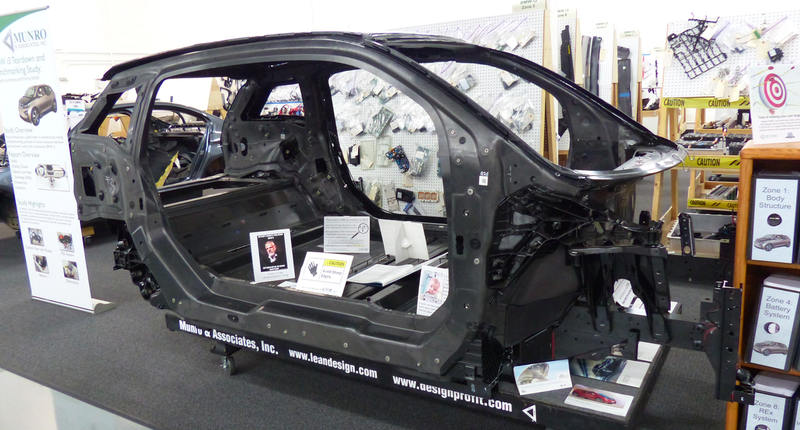
I stopped by Munro’s headquarters in Auburn Hills to take a look at what the company does, and was greeted by a building filled with completely— and I mean completely—dismantled automobiles, including that BMW i3 up top.
“Costing”
Munro tore that i3 into its more than 54,000 (that’s 31,000 mechanical, 23,000 electrical) individual parts, analyzing all of them for weight, cost, and manufacturing time needed, resulting in a 23,000 page report sold to automakers interested in learning the most minute of details of BMW’s plug-in hybrid electric city car.
If you don’t believe me when I say the company analyzed 54,000 parts, here’s a shelf filled with analyses of every part in the car, organized into different “zones.”
And these analyses don’t just include major components—it’s literally every single part, including fasteners. Here’s a look at just one of the books:
And here are two randomly-chosen pages from the enormous report. Want to know how much it costs BMW (or, more likely, its supplier) to make a horn bracket? Of course you do!
According to Munro, the horn bracket weighs 0.03 kg, and takes about 10 seconds to make for a paltry 18 cents.
And if that bracket isn’t exciting enough, you’re almost certainly chomping at the bit to learn how much it costs to make one of BMW’s fuse buss assemblies for its high voltage battery pack, and it looks like that 0.01 kg part is a whopping 89 cents that takes 39 seconds to build.
Sometimes a competitor interested in a certain vehicle buys that car for Munro to tear down. In other cases, Munro will buy it to sell the findings. The latter was the case with the i3.
How Munro comes up with these cost figures involves a lot of computerized modeling and expertise from people with decades of manufacturing experience.
That modeling can be visually depicted as a cost map, shown below. The cost map is essentially a second-by-second breakdown of the car’s—and its components’—exact manufacturing processes. Cost maps for entire cars are enormous, and—according to engineers at Munro—can span hundreds of yards in length when printed out. In the case of the i3, there were 196,000 manufacturing steps in total.
A closer look at this cost map reveals just how detailed Munro’s costing process is. It includes steps like “snap together,” “push on connector,” “twist wire,” “screw drive,” “turn assembly on” and other seemingly mundane—yet still time consuming—parts of the manufacturing sequence.
Each step has a time associated with it; Snap together, for example, takes one second, while “push on connector” takes two and “position lug” takes five.
In the end, the cost model shows how the car and its components are manufactured, and results in a report that accounts for everything from material cost to tool burden—which considers things like floor space required for certain tools, electricity to run those tools, and tool maintenance costs— to burden rate, which depends largely on labor costs associated with the countries in which the parts are made.
To come up with the right numbers, Munro has to know exactly which materials are used. Figuring that out part isn’t always simple, either. Sometimes bearings have exotic grades of steel, for example. So Munro might have to send out a sample to a lab to figure out the grade.
Munro also has to know how much of each component is made of each material to get an accurate cost. Take this BMW steering wheel above, which Munro had to cut into to figure out what and how much metal lies below the plastic cover.
For labor costs, it’s also not always straightforward figuring out where parts are made, either. Sure, it’s sometimes stamped into the part or there’s a sticker, but other times Munro either has to do research to figure out a part’s origin, or they just know where it’s made based on similar parts they’ve seen on other vehicles.
If you want the full report on that i3 I mentioned, it’ll cost you $150,000.
If you think I was kidding about Munro tearing down cars to every last nut and bolt: here are all the i3’s nuts and bolts connecting the various assemblies. Of course, they’re all weighed and priced.
How It Works
Baffled by how the company can have this kind of precision in their cost models, I sat down with Munro’s engineers to learn more.
They gave me an example of an instrument panel, saying they know it’s made of a certain type of plastic, requires a certain size tool (they also said the tool might require “slides” if there are special features involved) that takes a certain amount of money and time to operate , and the manufacturing sequence requires a certain amount of time to cool.
They know these things, they say, because they’ve done tons of research and built on decades of manufacturing experience from employees with backgrounds in various manufacturing and engineering disciplines.
I could tell the engineers I spoke with knew what they were talking about, as they could seemingly visualize how an instrument panel is made, waving their hands up and down trying to emulate the movement of the machines that turn a giant piece of plastic into a precisely formed dashboard.
Plus, the engineers told me, the cost models are proven. Some manufactures, they said, actually hand their own parts to Munro asking them to use their model to see how close they can get to the actual cost of manufacture. Munro says their numbers always come very close, and that they’ve even been accused of having insider information.
You Can Have Whatever You Like
But costing is only a part of what Munro does. A big part of what they offer to car companies is engineering expertise, holding detailed workshops for car companies to teach engineers how other companies are designing certain systems.
Let’s say a company interested in electrification might buy Munro a Tesla Model S. So Munro tears it down and invites engineers at that company to a series of workshops on various vehicle systems. One day, people from that company’s electrified powertrain team might attend a workshop on the Tesla’s battery pack. Or maybe people from the cooling system might show up to learn how Tesla keeps its cells and motors from overheating.
And the workshops aren’t just basic “here’s how this is built” presentations. Munro actually analyzes the systems and tries to answer complex questions like, for example, what Mazda does at a system level to give their 3 such good handling for its class. In some cases, they even send parts out to have them tested for strength of even waterproofness.
But one of the coolest things about Munro is the facilities are filled with torn-down car parts, all of which can be checked out like a library book for engineers to study and, if they want to, scan into their own CAD software for further analysis. That might sound like cheating, but that’s how engineers learn and stay current—SAE conferences aren’t always enough.
Want a piston? Sure. Want to study BMW’s seat foam? Why not? Hell, here’s the sound-deadening fiberglass found in the BMW i3’s muffler. It turns out there is 0.311 kg of fiberglass in there. Some muffler engineer out there might find that to be useful.
They had to disassemble the muffler to figure out what materials are inside and how much it costs to build the thing, as well as how it’s done— it all goes into that big, quarter-mile long costing map.
And if I still haven’t communicated just how far Munro actually takes this whole teardown thing, check this out: on the right is a wheel hub. It connects your suspension to your wheel, and normally, car manufacturers just buy that whole thing as an assembly.
But Munro didn’t just write “Hub Assembly: $50,” they actually tore into the assembly itself, cutting into the bearing surfaces to figure out exactly what materials comprise this hub, and how it’s all made.
Next, here are all the brake parts off the BMW i3:
Again, Munro didn’t just count the caliper assembly as one part, they tore it into its basic components: brackets, piston, bolts, etc— some of which are bagged, and all of which are tagged with information about what material comprises them is and how much they weigh.
Why Else Do Companies Need This Kind Of Detail?
Munro isn’t just there to help engineers learn about how the competition designs and assembles its cars, it’s also there to help automakers—who really should be called “auto assemblers”—figure out if they’re getting ripped off by their parts suppliers.
Knowing exactly how much it costs to build a wheel bearing, for example, can act as leverage for negotiation against a supplier of that part. At the same time, suppliers also go to Munro to learn. If, for example, one of their competitors is selling a part for what seems like impossibly too little, the supplier might ask Munro to tear it down and figure out how the competitor is saving cost.
And Munro does costing, benchmarking and even quality predictions for many different industries, not just automotive. That plane above is a Republic Seabee RC-3, which Munro says incorporated a “minimalist approach to Aircraft structural design,” making it a great way for Munro’s engineers to learn more about lightweight design.
Besides automotive and aerospace, Munro has worked with clients from the defense, marine, medical and the electronics industries. You name it, and Munro’s engineers tear it apart.
They even did analyses on rice-cookers for one company looking to reduce manufacturing costs and increase quality:
And that’s really their goal: they want to use their general manufacturing knowledge and their understanding of how various manufacturers accomplish certain tasks to help clients become more “lean”—to reduce time to market, to improve quality, to reduce research and development expenses, to reduce engineering and manufacturing costs, and to keep companies competitive.
Those are really the goals of competitive benchmarking in general, and Munro’s facility has demonstrated just to what lengths automakers go to scope out the competition.
Here’s more of what Munro does, particularly that i3:
The insides of a single battery cell
The high voltage battery pack casing
The little two-cylinder.
The baby crankshaft.
A baby piston.
Camshafts.
Charging module
Power modules from the battery pack.
Clutches found between electric drive and internal combustion engine.
Coils found in the electric motors.
An instrument panel beam (which, if I recall correctly, is magnesium).
Seat structure.
Suspension parts
More suspension parts.
More fasteners
windshields
Wiper motors
Passenger’s seat parts
The cooling system
This is the heater for the i3. It’s just a resistance coil plumbed in line with a 35 watt pump and the heater core.
The body-in-white of a Tata
Random parts
Republic Seabee RC-R
Airfoils from the Republic Seabee RC-R
Republic Seabee RC-R
Munro also tore down some air conditioning systems for an appliance company.
Mercedes-Benz just made a huge move to take on Tesla.
The German automaker unveiled its all-electric SUV concept at the Paris Motor Show Thursday, and with a competitive price tag and solid range potential, it’s poised to become a big competitor in the EV space.
Called Generation EQ, the SUV concept is expected to have a range up to 310 miles.
Mercedes-Benz
The production version of the SUV is expected to hit the roads in 2019, Dieter Zetsche, the head of the Mercedes-Benz car division, said at the Paris Motor Show press event. Mercedes is calling the SUV unveiled today a „close-to-production concept vehicle.“
Mercedes-Benz
The car will fall in the same price range as the GLC Crossover, which currently starts at $39,150. That’s a very competitive price for an electric SUV, considering Chevy Bolt’s all-electric SUV crossover will start at $37,500 when it hits showrooms at the end of 2016.
Mercedes-Benz
The interior comes with a massive, 24-inch display that shows speed, range, driving data, and navigation information. The display will alert the driver if the car is running low on battery and of nearby charging stations. The steering wheel also comes with touch controls.
Mercedes-Benz
The SUV comes with some autonomous features, but not many. Mercedes says the car can automatically adjust the speed and driving dynamics when approaching curves.
Mercedes-Benz
The car is part of Mercedes‘ efforts to ramp up its electric-car offerings. Daimler’s chief development officer, Thomas Weber, said in May that Mercedes-Benz was aiming to add four new electric cars to its model range by 2020.









 TheIdea – The Innovation Agency