Two years after highly classified exploits built by the National Security Agency were stolen and published, hackers are still using the tools for nefarious reasons.
Security researchers at Symantec say they’ve seen a recent spike in a new malware, dubbed Beapy, which uses the leaked hacking tools to spread like wildfire across corporate networks to enslave computers into running mining code to generate cryptocurrency.
Beapy was first spotted in January but rocketed to more than 12,000 unique infections across 732 organizations since March, said Alan Neville, Symantec’s lead researcher on Beapy, in an email to TechCrunch. The malware almost exclusively targets enterprises, host to large numbers of computers, which when infected with cryptocurrency mining malware can generate sizable sums of money.
The malware relies on someone in the company opening a malicious email. Once opened, the malware drops the NSA-developed DoublePulsar malware to create a persistent backdoor on the infected computer, and uses the NSA’s EternalBlue exploit to spread laterally throughout the network. These are the same exploits that helped spread the WannaCry ransomware in 2017. Once the computers on the network are backdoored, the Beapy malware is pulled from the hacker’s command and control server to infect each computer with the mining software.
Not only does Beapy use the NSA’s exploits to spread, it also uses Mimikatz, an open-source credential stealer, to collect and use passwords from infected computers to navigate its way across the network.
According to the researchers, more than 80 percent of Beapy’s infections are in China.
Hijacking computers to mine for cryptocurrency — known as cryptojacking — has been on the decline in recent months, partially following the shutdown of Coinhive, a popular mining tool. Hackers are finding the rewards fluctuate greatly depending on the value of the cryptocurrency. But cryptojacking remains a more stable source of revenue than the hit-and-miss results of ransomware.
In September, some 919,000 computers were vulnerable to EternalBlue attacks — many of which were exploited for mining cryptocurrency. Today, that figure has risen to more than a million.
Typically cryptojackers exploit vulnerabilities in websites, which, when opened on a user’s browser, uses the computer’s processing power to generate cryptocurrency. But file-based cryptojacking is far more efficient and faster, allowing the hackers to make more money.
In a single month, file-based mining can generate up to $750,000, Symantec researchers estimate, compared to just $30,000 from a browser-based mining operation.
Cryptojacking might seem like a victimless crime — no data is stolen and files aren’t encrypted, but Symantec says the mining campaigns can slow down computers and cause device degradation.
The warrants, which draw on an enormous Google database employees call Sensorvault, turn the business of tracking cellphone users’ locations into a digital dragnet for law enforcement. In an era of ubiquitous data gathering by tech companies, it is just the latest example of how personal information — where you go, who your friends are, what you read, eat and watch, and when you do it — is being used for purposes many people never expected. As privacy concerns have mounted among consumers, policymakers and regulators, tech companies have come under intensifying scrutiny over their data collection practices.
The Arizona case demonstrates the promise and perils of the new investigative technique, whose use has risen sharply in the past six months, according to Google employees familiar with the requests. It can help solve crimes. But it can also snare innocent people.
The confusing rollout of meaningful social interactions—marked by internal dissent, blistering external criticism, genuine efforts at reform, and foolish mistakes—set the stage for Facebook’s 2018. This is the story of that annus horribilis, based on interviews with 65 current and former employees. It’s ultimately a story about the biggest shifts ever to take place inside the world’s biggest social network. But it’s also about a company trapped by its own pathologies and, perversely, by the inexorable logic of its own recipe for success.
Facebook’s powerful network effects have kept advertisers from fleeing, and overall user numbers remain healthy if you include people on Instagram, which Facebook owns. But the company’s original culture and mission kept creating a set of brutal debts that came due with regularity over the past 16 months. The company floundered, dissembled, and apologized. Even when it told the truth, people didn’t believe it. Critics appeared on all sides, demanding changes that ranged from the essential to the contradictory to the impossible. As crises multiplied and diverged, even the company’s own solutions began to cannibalize each other. And the most crucial episode in this story—the crisis that cut the deepest—began not long after Davos, when some reporters from The New York Times, The Guardian, and Britain’s Channel 4 News came calling. They’d learned some troubling things about a shady British company called Cambridge Analytica, and they had some questions.
15 Months of Fresh Hell Inside Facebook
Scandals. Backstabbing. Resignations. Record profits. Time Bombs. In early 2018, Mark Zuckerberg set out to fix Facebook. Here’s how that turned out:
Excerpted from Tim Cook: The Genius Who Took Apple to the Next Level
They knew that they had to respond immediately. The writ would dominate the next day’s news, and Apple had to have a response. “Tim knew that this was a massive decision on his part,” Sewell said. It was a big moment, “a bet-the-company kind of decision.” Cook and the team stayed up all night—a straight 16 hours—working on their response. Cook already knew his position—Apple would refuse—but he wanted to know all the angles: What was Apple’s legal position? What was its legal obligation? Was this the right response? How should it sound? How should it read? What was the right tone?
iOS 8 added much stronger encryption than had been seen before in smartphones. It encrypted all the user’s data—phone call records, messages, photos, contacts, and so on—with the user’s passcode. The encryption was so strong, not even Apple could break it. Security on earlier devices was much weaker, and there were various ways to break into them, but Apple could no longer access locked devices running iOS 8, even if law enforcement had a valid warrant. “Unlike our competitors, Apple cannot bypass your passcode and therefore cannot access this data,” the company wrote on its website. “So it’s not technically feasible for us to respond to government warrants for the extraction of this data from devices in their possession running iOS 8.”
The War Room
For the next two months, the executive floor at One Infinite Loop turned into a 24/7 situation room, with staffers sending out messages and responding to journalists’ queries. One PR rep said that they were sometimes sending out multiple updates a day with up to 700 journalists cc’d on the emails. This is in stark contrast to Apple’s usual PR strategy, which consists of occasional press releases and routinely ignoring reporters’ calls and emails.
Cook also felt he had to rally the troops, to keep morale high at a time when the company was under attack. In an email to Apple employees, titled “Thank you for your support,” he wrote, “This case is about much more than a single phone or a single investigation.” He continued, “At stake is the data security of hundreds of millions of law-abiding people and setting a dangerous precedent that threatens everyone’s civil liberties.” It worked. Apple employees trusted their leader to make the decision that was right not only for them but also for the general public.
Cook was very concerned about how Apple would be perceived throughout this media firestorm. He wanted very much to use it as an opportunity to educate the public about personal security, privacy, and encryption. “I think a lot of reporters saw a new version, a new face of Apple,” said the PR person, who asked to remain anonymous. “And it was Tim’s decision to act in this fashion. Very different from what we have done in the past. We were sometimes sending out emails to reporters three times a day on keeping them updated.”
Outside Apple’s walls, Cook went on a charm offensive. Eight days after publishing his privacy letter, he sat down for a prime-time interview with ABC News. Sitting in his office at One Infinite Loop, he sincerely explained Apple’s position. It was the “most important [interview] he’s given as Apple’s CEO,” said the Washington Post. “Cook responded to questions with a raw conviction that was even more emphatic than usual,” wrote the paper. “He used sharp and soaring language, calling the request the ‘software equivalent of cancer’ and talking about ‘fundamental’ civil liberties.
What gaming will look like in a year or two, let alone 10, is a matter of some debate. Battle-royale games have reshaped multiplayer experiences; augmented reality marries the fantastic and real in unprecedented ways. Google is leading a charge away from traditional consoles by launching a cloud-gaming service, Stadia, later this year. Microsoft’s next version of the Xbox will presumably integrate cloud gaming as well to allow people to play Xbox games on multiple devices. Sony’s plans in this regard are still unclear—it’s one of the many things Cerny is keeping mum on, saying only that “we are cloud-gaming pioneers, and our vision should become clear as we head toward launch”—but it’s hard to think there won’t be more news coming on that front.
For now, there’s the living room. It’s where the PlayStation has sat through four generations—and will continue to sit at least one generation more.
Its surprise settlement with Qualcomm on Tuesday over a yearslong patent spat means it’s now in a position to keep pace with its competitors to bring a 5G-ready iPhone to market as soon as this year.
But even though Apple may win by getting a 5G iPhone to customers sooner than most people anticipated, it lost by settling with a company it loathes. Getting the iPhone to 5G means Apple was put in a sticky situation where it had to weigh four less-than-ideal options to make it all a reality.
In the end, Apple had to choose the lesser of all evils:
Option one: Settle with Qualcomm, the leader in 5G chips. Qualcomm’s 5G chips are already shipping in some devices today, with more expected as the year rolls on.
But Apple has seen Qualcomm’s business model as detrimental to the entire industry since it uses its dominant position to squeeze large fees out of each company that uses its chips and patents. Hence that nasty lawsuit. Apple CEO Tim Cook made his disdain for Qualcomm’s practices known in a January interview with CNBC’s Jim Cramer, and even blasted Qualcomm’s decision to hire a PR firm to write fake news stories about Apple, which Business Insider reported.
Option two: Wait for Intel to catch up in 5G. Even before Intel announced Tuesday night that it would abandon its plans to make 5G modems, there was speculation that the company was running behind to deliver the chips on time. Apple has been exclusively using Intel’s 4G modems in its latest iPhones as its dispute with Qualcomm raged on. If that dispute continued, a 5G iPhone might not have been possible until 2020 or even 2021.
Option four: Apple could make its own 5G chips. Apple is thought to be working on its own modems after opening an office in San Diego, Qualcomm’s hometown, and posting job listings for modem chip designers. But it would likely take Apple several years to develop its own 5G chip, putting it several years behind its rivals.
None of those options were ideal for Apple. It could’ve waited an extra year or two for Intel to get its 5G chips up to snuff. It could’ve waited several more years to develop a 5G chip of its own as competitors like Google and Samsung push out their 5G devices and market themselves as more innovative than Apple. It could’ve worked with Huawei, a company that still can’t sell products in the U.S. over security concerns.
Or it could’ve ended its dispute with Qualcomm, even if Cook is allergic to its business practices. Unfortunately for Apple, Qualcomm was the best bet.
Tuesday’s settlement could result in a 5G iPhone as soon as this fall, when Apple is expected to release its next iPhone. (For what it’s worth, timing on a 5G iPhone is still unclear. Qualcomm CEO Steve Mollenkopf said in an interview Wednesday on CNBC’s „Squawk Box “ that he couldn’t comment on Apple’s product plans that include Qualcomm chips.)
Qualcomm gets to take a victory lap this week. Its lead in 5G forced a settlement with Apple and added a massive boost to its stock. Qualcomm shares was up 12% Wednesday, adding to its 23% gain Tuesday. Intel was up about 4%. Apple was up just 1%.
The market agrees. Apple was the loser in this fight.
f you aren’t already protecting your most personal accounts with two-factor or two-step authentication, you should be. An extra line of defense that’s tougher than the strongest password, 2FA is extremely important to blocking hacks and attacks on your personal data. If you don’t quite understand what it is, we’ve broken it all down for you.
Two-factor authentication is basically a combination of two of the following factors:
Something you know
Something you have
Something you are
Something you know is your password, so 2FA always starts there. Rather than let you into your account once your password is entered, however, two-factor authentication requires a second set of credentials, like when the DMV wants your license and a utility bill. So that’s where factors 2 and 3 come into play. Something you have is your phone or another device, while something you are is your face, irises, or fingerprint. If you can’t provide authentication beyond the password alone, you won’t be allowed into the service you’re trying to log into.
So there are several options for the second factor: SMS, authenticator apps, Bluetooth-, USB-, and NFC-based security keys, and biometrics. So let’s take a look at your options so you can decide which is best for you.
Two-factor-authentication: SMS
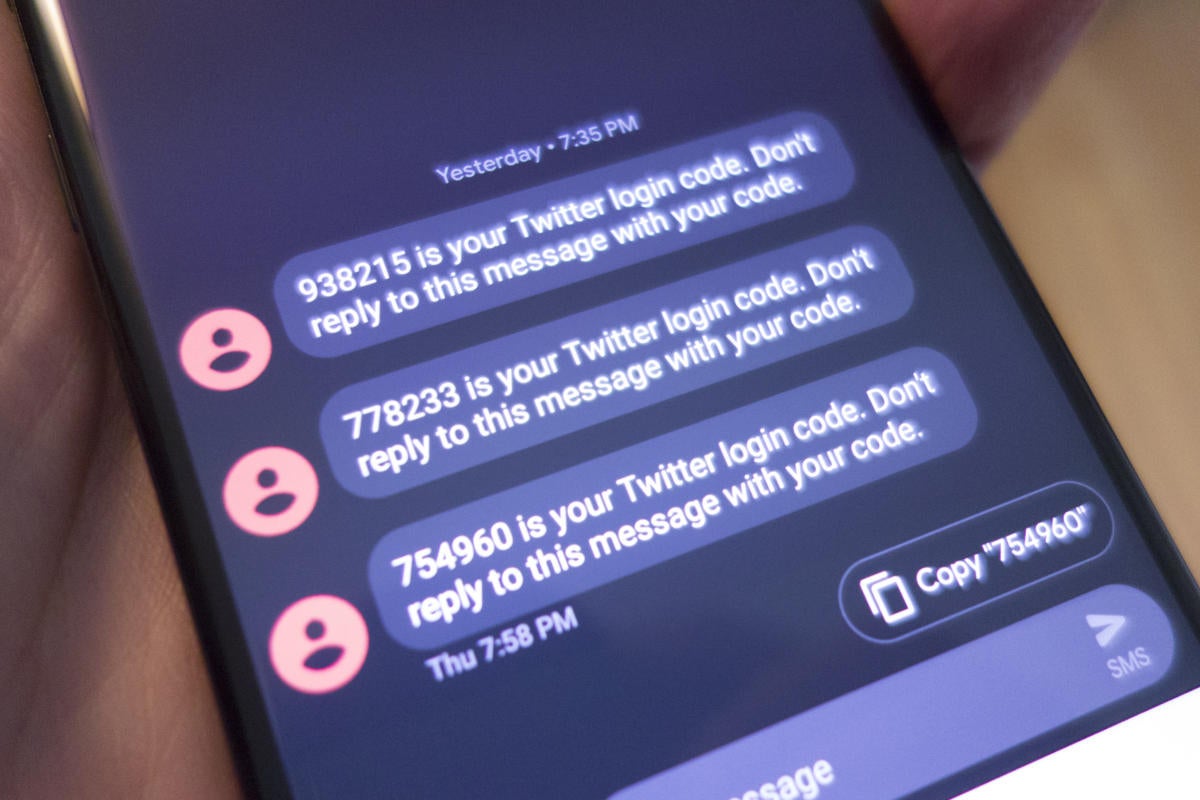
Michael Simon/IDGWhen you choose SMS-based 2FA, all you need is a mobile phone number.
What it is: The most common “something you have” second authentication method is SMS. A service will send a text to your phone with a numerical code, which then needs to be typed into the field provided. If the codes match, your identification is verified and access is granted.
How to set it up: Nearly every two-factor authentication system uses SMS by default, so there isn’t much to do beyond flipping the toggle or switch to turn on 2FA on the chosen account. Depending on the app or service, you’ll find it somewhere in settings, under Security if the tab exists. Once activated you’ll need to enter your password and a mobile phone number.
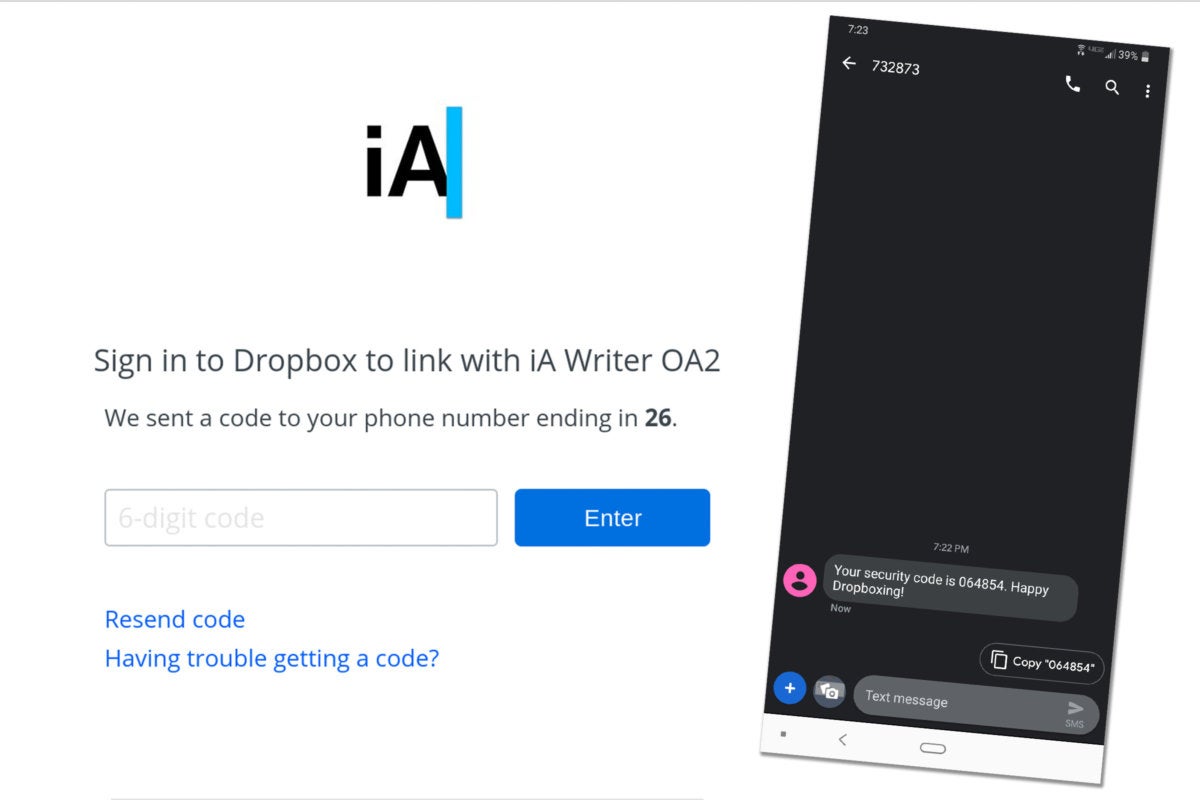
How it works: When you turn on SMS-based authentication, you’ll receive a code via text that you’ll need to enter after you type your password. That protects you against someone randomly logging into your account from somewhere else, since your password alone in useless without the code. While some apps and services solely rely on SMS-based 2FA, many of them offer numerous options, even if SMS is selected by default.
IDGWith SMS-based authentication, you’ll get a code via text that will allow access to your account.
How secure it is: By definition, SMS authentication is the least secure method of two-factor authentication. Your phone can be cloned or just plain stolen, SMS messages can be intercepted, and by nature most default messaging apps aren’t encrypted. So the code that’s sent to you could possibly fall into someone’s hands other than yours. It’s unlikely to be an issue unless you’re a valuable target, however.
How convenient it is: Very. You’re likely to always have your phone within reach, so the second authentication is super convenient, especially if the account you’re signing into is on your phone.
Should you use it? Any two-factor authentication is better than none, but if you’re serious about security, SMS won’t cut it.
Two-factor-authentication: Authenticator apps
Authenticator appsAuthenticator apps generate random codes that aren’t delivered over SMS.
What it is: Like SMS-based two-factor authentication, authenticator apps generate codes that need to be inputted when prompted. However, rather than sending them over unencrypted SMS, they’re generated within an app, and you don’t even need an Internet connection to get one.
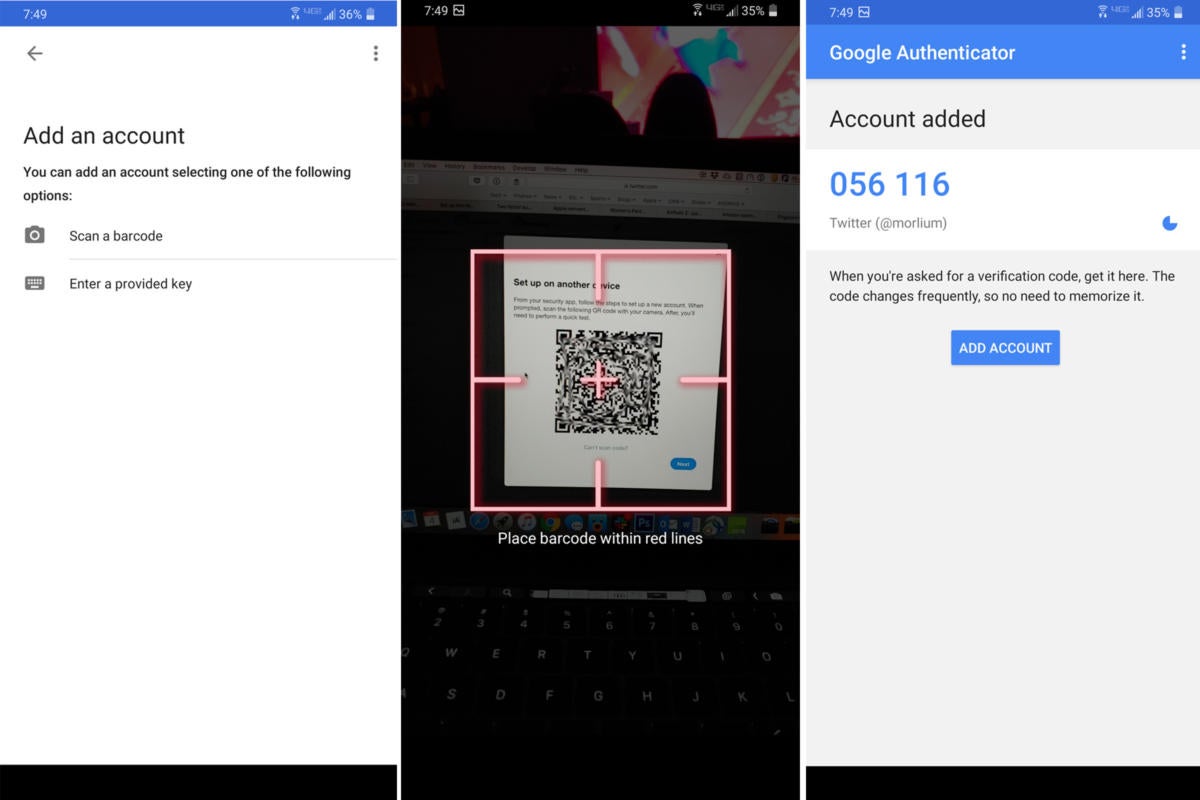
How to set it up: To get started with an authentication app, you’ll need to download one from the Play Store or the App Store. Google Authenticator works great for your Google account and anything you use it to log into, but there are other great one’s as well, including Authy, LastPass, Microsoft and a slew of other individual companies, such as Blizzard, Sophos, and Salesforce. If an app or service supports authenticator apps, it’ll supply a QR code that you can scan or enter on your phone.
How it works: When you open your chosen authenticator app and scan the code, a 6-figure code will appear, just like with SMS 2FA. Input that code into the app and you’re good to go. After the initial setup, you’ll be able to go into the app to get a code without scanning a QR code whenever you need one.
IDGAuthenticator apps generate randome codes every 30 seconds and can be used offline.
How secure it is: Unless someone has access to your phone or whatever device is running your authenticator app, it’s completely secure. Since codes are randomized within the app and aren’t delivered over SMS, there’s no way for prying eyes to steal them. For extra security, Authy allows you to set pin and password protection, too, something Google doesn’t offer on its authenticator app.
How convenient it is: While opening an app is slightly less convenient than receiving a text message, authenticator apps don’t take more than few seconds to use. They’re far more secure than SMS, and you can use them offline if you ever run into an issue where you need a code but have no connection.
Should you use it? An authenticator app strikes the sweet spot between security and convenience. While you might find some services that don’t support authenticator apps, the vast majority do.
Two-factor authentication: Universal second factor (security key)
Michael Simon/IDGAs their name implies, Security keys are the most secure way to lock down your account.
What it is: Unlike SMS- and authenticator-based 2FA, universal second factor is truly a “something you have” method of protecting your accounts. Instead of a digital code, the second factor is a hardware-based security key. You’ll need to order a physical key to use it, which will connect to your phone or PC via USB, NFC, or Bluetooth.
You can buy a Titan Security Key bundle from Google for $50, which includes a USB-A security key and a Bluetooth security key along with a USB-A-to-USB-C adapter, or buy one from Yubico. An NFC-enabled key is recommended if you’re going to be using it with a phone.
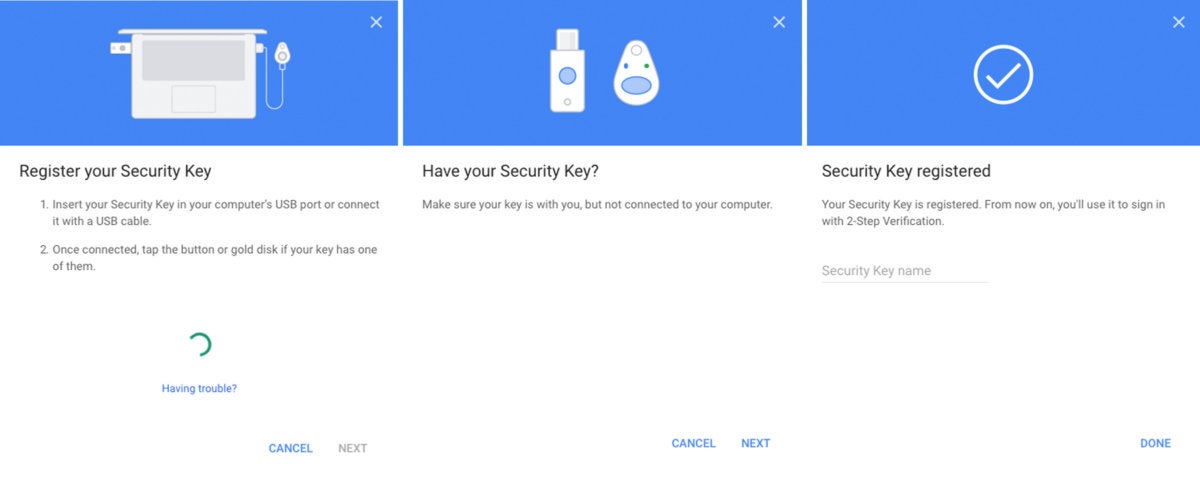
How to set it up: Setting up a security key is basically the same as the other methods, except you’ll need a computer. You’ll need to turn on two-factor authentication, and then select the “security key” option, if it’s available. Most popular accounts, such as Twitter, Facebook, and Google all support security keys, so your most vulnerable accounts should be all set. However, while Chrome, Firefox, and Microsoft’s Edge browser all support security keys, Apple’s Safari browser does not, so you’ll be prompted to switch during setup.
Once you reach the security settings page for the service you’re enabling 2FA with, select security key, and follow the prompts. You’ll be asked to insert your key (so make sure you have an USB-C adapter on hand if you have a MacBook) and press the button on it. That will initiate the connection with your computer, pair your key, and in a few seconds your account will be ready to go.
How it works: When an account requests 2FA verification, you’ll need to plug your security key into your phone or PC’s USB-C port or (if supported) tap it to the back of your NFC-enabled phone. Then it’s only a matter of pressing the button on the key to establish the connection and you’re in.
IDGSetting up your security key with your Google account is a multi-step process.
How secure it is: Extremely. Since all of the login authentication is stored on a physical key that is either on your person or stored somewhere safe, the odds of someone accessing your account are extremely low. To do so, they would need to steal your password and the key to access your account, which is very unlikely.
How convenient it is: Not very. When you log into one of your accounts on a new device, you’ll need to type your password and then authenticate it via the hardware key, either by inserting it into your PC’s USB port or pressing it against the back of an NFC-enabled phone. Neither method takes more than a few seconds, though, provided you have your security key within reach.
Two-factor authentication: Google Advanced Protection Program
What it is: If you want to completely lock down your most important data, Google offers the Advanced Protection Program for your Google account, which disables everything except security key-based 2FA. It also limits access your emails and Drive files to Google apps and select third-party apps, and shuts down web access to browsers other than Chrome and Firefox.
How to set it up: You’ll need to make a serious commitment. To enroll in Google Advanced Protection, you’ll need to purchase two Security Keys: one as your main key and one as your backup key. Google sells its own Titan Security Key bundle, but you can also buy a set from Yubico or Feitian.
Once you get your keys, you’ll need to register them with your Google account and then agree to turn off all other forms of authentication. But here’s the rub: To ensure that every one of your devices is properly protected, Google will log you out of every account on every device you own so you can log in again using Advanced Protection.
How it works: Advanced Protection works just like a security except you won’t be able to choose a different method if you forgot or lost your security key.
How secure it is: Google Advanced Protection is basically impenetrable. By relying solely on security keys, it makes sure that no one will be able to access your account without both your password and physical key, which is extremely unlikely.
How convenient it is: By nature, Google Advanced Protection is supposed to make it difficult for hackers to access your Google account and anything associated with it, so naturally it’s not so easy for the user either. Since there’s no fallback authentication method, you’ll need to remember your key whenever you leave the house. And when you run into a roadback—like the Safari browser on a Mac—you’re pretty much out of luck. But if you want your account to have the best possible protection, accept no substitute.
Two-factor authentication: Biometrics
Christopher Hebert/IDGNearly every smartphone made today has some form of secure biometrics built into it.
What it is: A password-free world where all apps and services are authenticated by a fingerprint or facial scan.
How to set it up: You can see biometrics at work when you opt to use the fingerprint scanner on your phone or Face ID on the iPhone XS, but at the moment, biometric security is little more than a replacement for your password after you login in and verify via another 2FA method.
How it works: Like the way you use your fingerprint or face to unlock your smartphone, biometric 2FA uses your body’s unique characteristics as your password. So your Google account would know it was you based on your scan when you set up your account, and it would automatically allow access when it recognized you.
How secure it is: Since it’s extremely difficult to clone your fingerprint or face, biometric authentication is the closest thing to a digital vault.
How convenient it is: You can’t go anywhere without your fingerprint or your face, so it doesn’t get more convenient than that.
Two-factor authentication: iCloud
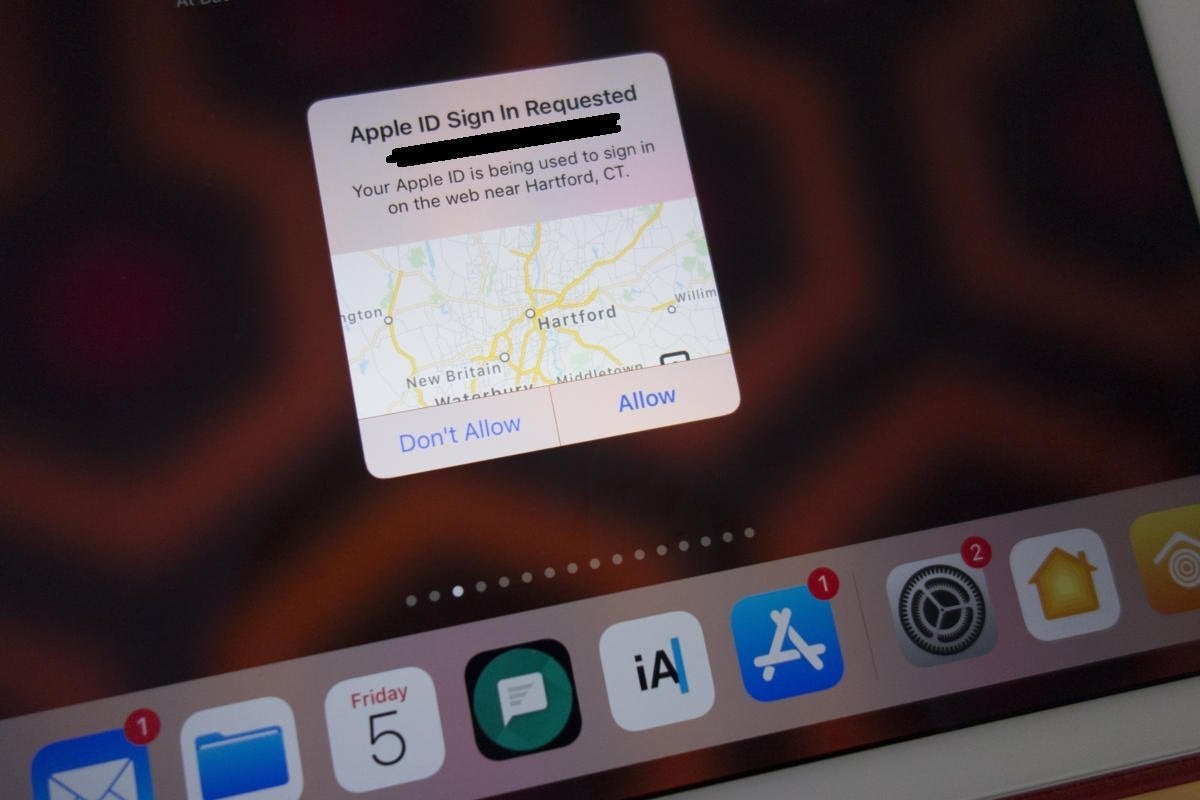
Michael Simon/IDGApple sends a code to one of your trusted devices when it needs authentication to access an account.
What it is: Apple has its own method of two-factor authentication or your iCloud and iTunes accounts that involves setting up trusted Apple devices (iPhone, iPad, or Mac—Apple Watch isn’t supported) that can receive verification codes. You can also set up trusted numbers to receive SMS codes or get verification codes via an authenticator app built into the Settings app.
How to set it up: As long as you’re logged into into your iCloud account, you can turn on two-factor authentication from pretty much anywhere. Just go into Settings on your iOS device or System Preferences on your Mac, PC, or Android phone, then Security, and Turn On Two-Factor Authentication. From there, you can follow the prompts to set up your trusted phone number and devices.
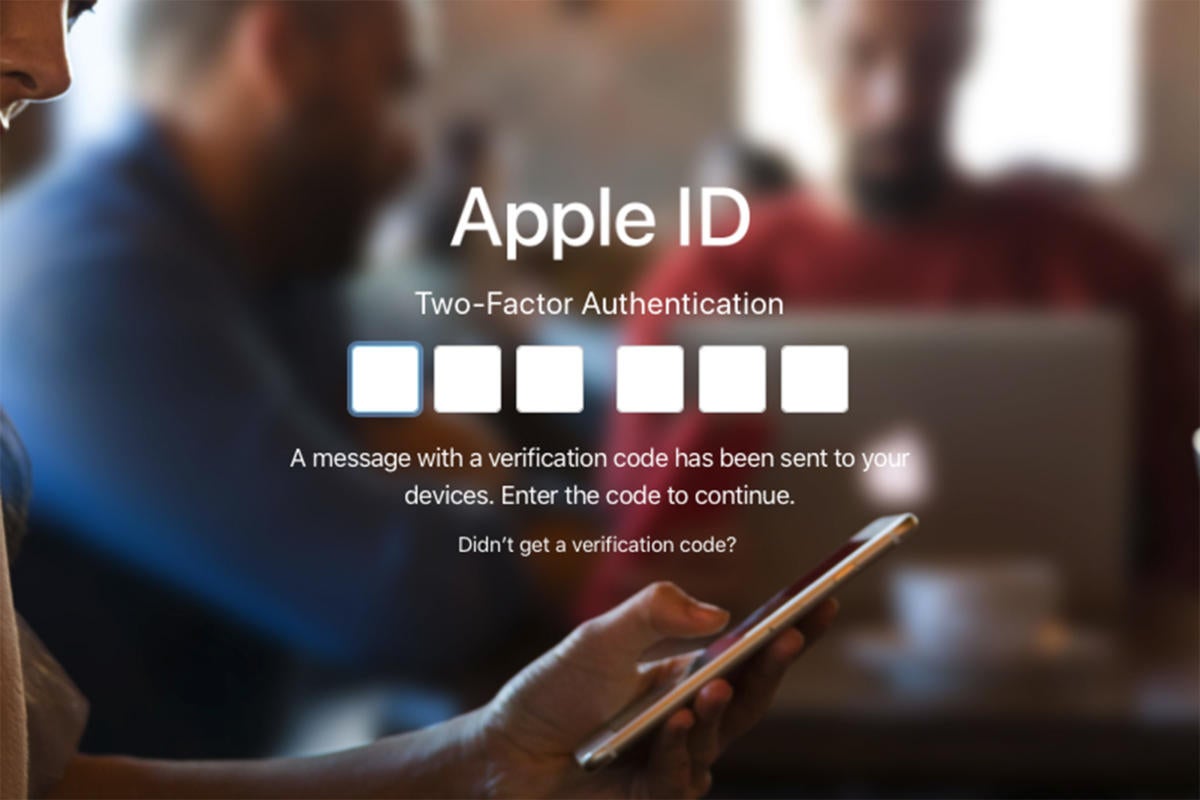
How it works: When you need to access an account protected by 2FA, Apple will send a code to one of your trusted devices. If you don’t have a second Apple device, Apple will send you a code via SMS or you can get one from the Settings app on your iPhone or System preferences on your Mac.
IDGWhen Apple needs a code to log into an account, it sends it to one of your trusted devices.
How secure it is: It depends on how many Apple devices you own. If you own more than one Apple device, it’s very secure. Apple will send a code to one of your other devices whenever you or someone else tries to log into your account or one of Apple’s services on a new device. It even tells you the location of the request, so if you don’t recognize it you can instantly reject it, before the code even appears.
If you only have one device, you’ll have to use SMS or Apple’s built-in authenticator, neither of which is all that secure, especially since it’s likely to both be done using the same device. Also, Apple has a weird snafu that sends the 2FA access code to the same device when you manage your account using a browser, which also defeats the purpose of 2FA.
How convenient it is: If you’re using an iPhone and have an iPad or Mac nearby, the process takes seconds, but if you don’t have an Apple device within reach or are away from your keyboard, it can be tedious.
The outages hit in the summer of 1991. Over several days, phone lines in major metropolises went dead without warning, disrupting emergency services and even air traffic control, often for hours. Phones went down one day in Los Angeles, then on another day in Washington, DC and Baltimore, and then in Pittsburgh. Even after service was restored to an area, there was no guarantee the lines would not fail again—and sometimes they did. The outages left millions of Americans disconnected.
The culprit? A computer glitch. A coding mistake in software used to route calls for a piece of telecom infrastructure known as Signaling System No. 7 (SS7) caused network-crippling overloads. It was an early sign of the fragility of the digital architecture that binds together the nation’s phone systems.
Leaders on Capitol Hill called on the one agency with the authority to help: the Federal Communications Commission (FCC). The FCC made changes, including new outage reporting requirements for phone carriers. To help the agency respond to digital network stability concerns, the FCC also launched an outside advisory group—then known as the Network Reliability Council but now called the Communications Security, Reliability, and Interoperability Council (CSRIC, pronounced “scissor-ick”).
Yet decades later, SS7 and other components of the nation’s digital backbone remain flawed, leaving calls and texts vulnerable to interception and disruption. Instead of facing the challenges of our hyper-connected age, the FCC is stumbling, according to documents obtained by the Project On Government Oversight (POGO) and through extensive interviews with current and former agency employees. The agency is hampered by a lack of leadership on cybersecurity issues and a dearth of in-house technical expertise that all too often leaves it relying on security advice from the very companies it is supposed to oversee.
Captured
CSRIC is a prime example of this so-called “agency capture”—the group was set up to help supplement FCC expertise and craft meaningful rules for emerging technologies. But instead, the FCC’s reliance on security advice from industry representatives creates an inherent conflict of interest. The result is weakened regulation and enforcement that ultimately puts all Americans at risk, according to former agency staff.
While the agency took steps to improve its oversight of digital security issues under the Obama administration, many of these reforms have been walked back under current Chairman Ajit Pai. Pai, a former Verizon lawyer, has consistentlysignaled that he doesn’t want his agency to play a significant role in the digital security of Americans’ communications—despite security being a core agency responsibility since the FCC’s inception in 1934.
The FCC’s founding statute charges it with crafting regulations that promote the “safety of life and property through the use of wire and radio communications,” giving it broad authority to secure communications. Former FCC Chairman Tom Wheeler and many legal experts argue that this includes cyber threats.
As a regulator, the FCC carries a stick: it can hit communications companies with fines if they don’t comply with its rules. That responsibility is even more important now that “smart” devices are networking almost every aspect of our lives.
But not everyone thinks the agency’s mandate is quite so clear, especially in the telecom industry. Telecom companies fight back hard against regulation; over the last decade, they spent nearly a billion dollars lobbying Congress and federal agencies, according to data from OpenSecrets. The industry argues that the FCC’s broad mandate to secure communications doesn’t extend to cybersecurity, and it has pushed for oversight of cybersecurity to come instead from other parts of government, typically the Department of Homeland Security (DHS) or the Federal Trade Commission (FTC)—neither of which is vested with the same level of rule-making powers as the FCC.
To Wheeler, himself the former head of industry trade group CTIA, the push toward DHS seemed like an obvious ploy. “The people and companies the FCC was charged with regulating wanted to see if they could get their jurisdiction moved to someone with less regulatory authority,” he told POGO.
But Chairman Pai seems to agree with industry. In a November 2018 letter to Senator Ron Wyden (D-Ore.) about the agency’s handling of SS7 problems, provided to POGO by the senator’s office, Pai wrote that the FCC “plays a supporting role, as a partner with DHS, in identifying vulnerabilities and working with stakeholders to increase security and resiliency in communications network infrastructure.”
The FCC declined to comment for this story.
Enlarge/ The current FCC declined comment, but POGO spoke with former chairman Tom Wheeler, seen here speaking with Ars back in 2016.
Jon Brodkin
Failing to protect the “crown jewels” of telecom
How the telecom industry leveraged lawmakers’ calls for FCC reform in the wake of the SS7 outages is a case study in how corporate influence can overcome even the best of the government’s intentions.
From the beginning, industry representatives dominated membership of the advisory group now known as CSRIC—though, initially, the group only provided input on a small subset of digital communications issues. Over time, as innovations in communications raced forward with the expansion of cellular networks and the Internet, the FCC’s internal technical capabilities didn’t keep up: throughout the 1990s and early 2000s, the agency’s technical expertise was largely limited to telephone networks while the world shifted to data networks, former staffers told POGO. The few agency staffers with expertise on new technologies were siloed in different offices, making it hard to coordinate a comprehensive response to the paradigm shift in communication systems. That gap left the agency increasingly dependent on advice from CSRIC.
During the early 1990s, the SS7-based software system was just coming into wide use. Today, though, it is considered outdated and insecure. Despite that, carriers still use the technology as a backup in their networks. This leaves the people who rely on those networks vulnerable to the technology’s problems, as Jonathan Mayer, a Princeton computer science and public affairs professor and former FCC Enforcement Bureau chief technologist, explained during a Congressional hearing in June 2018.
Unlike in the 1990s, the risks now go much deeper than just service disruption. Researchers have long warned that flaws in the system allow cybercriminals or hackers—sometimes working on behalf of foreign adversaries—to turn cell phones into sophisticated geo-tracking devices or to intercept calls and text messages. Security problems with SS7 are so severe that some government agencies and some major companies like Google are moving away from using codes sent via text to help secure important accounts, such as those for email or online banking.
A panel advising President Bill Clinton raised the alarm back in 1997, saying that SS7 was among America’s networking “crown jewels” and warning that if those crown jewels were “attacked or exploited, [it] could result in a situation that threatened the security and reliability of the telecommunications infrastructure.” By 2001, security researchers argued that risks associated with SS7 were multiplying thanks to “deregulation” and “the Internet and wireless networks.” They were proved right in 2008 when other researchers demonstrated ways that hackers could use flaws in SS7 to pinpoint the location of unsuspecting cell phone users.
By 2014, it was clear that foreign governments had caught on to the disruptive promise of the problem. That year, Russian intelligence used SS7 vulnerabilities to attack a Ukrainian telecommunications company, according to a report published by NATO’s Cooperative Cyber Defence Centre of Excellence, and more research about SS7 call interception made headlines in The Washington Post and elsewhere.
Despite the increasingly dire stakes, the FCC didn’t pay much attention to the issue until the summer of 2016, after Rep. Ted Lieu (D-Calif.) allowed 60 Minutes to demonstrate how researchers could use security flaws in the SS7 protocol to spy on his phone. The FCC—then led by Wheeler—responded by essentially passing the buck to CSRIC. It created a working group to study and make security recommendations about SS7 and other so-called “legacy systems.” The result was a March 2017 report with non-binding guidance about best practices for securing against SS7 vulnerabilities, a non-public report, and the eventual creation of yet another CSRIC working group to study similar security issues.
A POGO analysis of CSRIC membership in recent years shows that its membership, which is solely appointed by the FCC chairman, leans heavily toward industry. And the authorship of the March 2017 report was even more lopsided than CSRIC, overall. Of the twenty working-group members listed in the final report, only five were from the government, including four from the Department of Homeland Security. The remaining fifteen represented private-sector interests. None were academics or consumer advocates.
The working group’s leadership was drawn entirely from industry. The group’s co-chairs came from networking infrastructure company Verisign and iconectiv, a subsidiary of Swedish telecom company Ericsson. The lead editor of the group’s final report was CTIA Vice President for Technology and Cyber Security John Marinho.
Emails from 2016 between working group members, obtained by POGO via a Freedom of Information Act request, show that the group dragged its feet on resolving SS7 security vulnerabilities despite urging from FCC officials to move quickly. The group also repeatedly ignored input from DHS technical experts.
The problem wasn’t figuring out a fix, however, according to David Simpson, a retired rear-admiral who led the FCC’s Public Safety and Homeland Security Bureau at the time. The group was quickly able to discern some best practices—primarily through using different filtering systems—that some major carriers had already deployed and that others could use to mitigate the risks associated with SS7.
“We knew the answer within the first couple months from the technical experts in the working groups,” said Simpson, who consulted with the Working Group. But ultimately, the “consensus orientation of the CSRIC unfortunately allowed” the final report to be pushed from the lame-duck session into the Trump administration—which is not generally inclined toward introducing new federal regulations.
Overall, POGO’s analysis of emails from the group and interviews with former FCC staff found that industry dominance of CSRIC appears to have contributed to a number of issues with the process and the final report, including:
Industry members of the working group successfully pushed for the final recommendations to rely on voluntary compliance, according to former FCC staffers. Security experts say that strategy ultimately leaves the entire cellular network at risk because there are thousands of smaller providers, often in rural areas, that are unlikely to prioritize rolling out the needed protections without a firm rule.
An August 2016 email shows that, early on in the process, DHS experts objected to describing the working group’s focus as being on “legacy” systems because it “conveys a message that these protocols and associated threats are going away soon and that’s not necessarily the case.” The group did not revise the legacy language, and it remained in the final report.
In an email from September 2016, an FCC official emailed Marinho, noting that edits from DHS were not being incorporated into the working draft. Marinho responded that he received them too late and planned to incorporate them in a later version. However, in a May 2018 letter to the FCC, Senator Wyden said DHS officials told his office that “the vast majority of edits to the final report” suggested by DHS experts “were rejected.”
In the emails obtained by POGO, Marinho also refers to warnings about security issues with SS7 that came from panelists at an event organized by George Washington University’s Cybersecurity Strategy and Information Management Program as “hyperbolic.”
Marinho did not respond to a series of specific questions about the Working Group’s activities. In a statement to POGO, CTIA said, “[t]he wireless industry is committed to safeguarding consumer security and privacy and collaborates closely with DHS, the FCC, and other stakeholders to combat evolving threats that could impact communications networks.”
The working group’s report acknowledged that problems remained with SS7, but it recommended voluntary measures and put the onus on telecom users to take extra steps like using apps that encrypt their phone calls and texts.
Criminals, terrorists, and spies
Just a month after the CSRIC working group released its SS7 report, DHS took a much more ominous tone, releasing a report that warned that SS7 “vulnerabilities can be exploited by criminals, terrorists, and nation-state actors/foreign intelligence organizations” and said that “many organizations appear to be sharing or selling expertise and services that could be used to spy on Americans.”
DHS wanted action.
“New laws and authorities may be needed to enable the Government to independently assess the national security and other risks associated with SS7” and other communications protocols, the agency wrote.
But DHS also admitted it wasn’t necessarily the agency that would take the lead. A footnote in that section reads: “Federal agencies such as the FCC and FTC may have authorities over some of these issues.”
CTIA pushed back with a confidential May 2017 white paper that downplayed the risks associated with SS7 and argued against stronger security rules. The paper, which was sent to DHS and to members of Congress, was later obtained and published by Motherboard.
“Congress and the Administration should reject the [DHS] Report’s call for greater regulation,” the trade group wrote.
When CSRIC created yet another working group in late 2017 to continue studying network reliability issues during Pai’s tenure, the DHS experts who objected to the previous working group’s report were “not invited back to participate,” according to Wyden’s May 2018 letter. The final report from that working group lists just one representative from DHS, compared to four in the previous group.
When reached for comment, DHS did not directly address questions about the agency’s experience with CSRIC.
Aside from DHS and individual members of Congress, other parts of the US government have signaled concerns about SS7. For example, as the initial CSRIC working group was starting to review the issue in the summer of 2016, the National Institute of Standards and Technology (NIST), an agency that sets standards for government best practices, released draft guidance echoing that of Google and other tech companies. It warned people away from relying on text messaging to validate identity for various online accounts and services because of the security issues.
But the draft drew pushback from the telecom industry, including CTIA.
“There is insufficient evidence at this time to support removing [text message] authentication in future versions of the Digital Identity Guidelines,” CTIA argued in comments on the NIST draft. After the pushback, NIST caved to industry pressure and removed its warning about relying on texts from the final version of its guidance.
While the government was deliberating, criminals were finding ways to exploit SS7 flaws.
In the summer of 2017, German researchers found that hackers used vulnerabilities in SS7 to drain victims’ bank accounts—exploiting essentially the same type of problems that NIST tried to flag in the scrapped draft guidance.
“This threat is not merely hypothetical—malicious attackers are already exploiting SS7 vulnerabilities,” Wyden wrote. “One of the major wireless carriers informed my office that it reported an SS7 breach, in which customer data was accessed, to law enforcement” using a portal managed by the FCC, he wrote.
The details of that incident remain unclear, presumably due to an ongoing investigation. However, the senator’s alarm highlights the fact that SS7 continues to put America’s economic and national security at risk.
Indeed, a report by The New York Times in October 2018 suggests that even the president’s own communications are vulnerable due to security problems in cellular networks, potentially including SS7. Chinese and Russian intelligence have gained valuable information about the president’s policy deliberations by intercepting calls made on his personal iPhone “as they travel through the cell towers, cables, and switches that make up national and international cellphone networks,” the Times reported.
The president disputed this account of his phone-use habits in a tweet, apparently sent from “Twitter for iPhone.” The next month, President Trump signed a law creating a Cybersecurity and Infrastructure Security Agency (or CISA) within the Department of Homeland Security, the agency that industry often suggests should oversee communications infrastructure cybersecurity instead of the FCC.
“CISA works regularly with the FCC and the communications sector to address security vulnerabilities and enhance the resilience of the nation’s communications infrastructure,” the agency said in a statement in response to questions for this story. “Our role as the nation’s risk advisor includes working with companies to exchange threat information, mitigate vulnerabilities, and provide incident response upon request.”
Other than efforts to reduce the reliance of US networks on technology from Chinese manufacturers, driven by fears about “supply chain security,” the FCC has largely abandoned its responsibility for protecting America’s networks from looming digital threats.
As the FCC’s engagement on cybersecurity has waned, so has CSRIC’s activity. CSRIC VI, whose members were chosen and nominated by current Chairman Pai, created less than a third of the working groups of its predecessor.
CSRIC VI’s final meeting was in March 2019. It’s unclear who will be part of the group’s seventh iteration—or if they will represent the public over the telecom industry’s interests.
Tens of millions of people use smart speakers and their voice software to play games, find music or trawl for trivia. Millions more are reluctant to invite the devices and their powerful microphones into their homes out of concern that someone might be listening.
Sometimes, someone is.
Amazon.com Inc. employs thousands of people around the world to help improve the Alexa digital assistant powering its line of Echo speakers. The team listens to voice recordings captured in Echo owners’ homes and offices. The recordings are transcribed, annotated and then fed back into the software as part of an effort to eliminate gaps in Alexa’s understanding of human speech and help it better respond to commands.
{„contentId“:“PPRO1R6JIJUR01″,“position“:“box“,“dimensions“:{„mobile“:[[300,250],[1,1]]},“type“:“Mobile Body Box Ad“,“positionIncrement“:1,“targeting“:{„position“:“box1″,“positionIncrement“:1,“url“:“/news/articles/2019-04-10/is-anyone-listening-to-you-on-alexa-a-global-team-reviews-audio“},“containerId“:“box-ne0WDLx“}
The Alexa voice review process, described by seven people who have worked on the program, highlights the often-overlooked human role in training software algorithms. In marketing materials Amazon says Alexa “lives in the cloud and is always getting smarter.” But like many software tools built to learn from experience, humans are doing some of the teaching.
The team comprises a mix of contractors and full-time Amazon employees who work in outposts from Boston to Costa Rica, India and Romania, according to the people, who signed nondisclosure agreements barring them from speaking publicly about the program. They work nine hours a day, with each reviewer parsing as many as 1,000 audio clips per shift, according to two workers based at Amazon’s Bucharest office, which takes up the top three floors of the Globalworth building in the Romanian capital’s up-and-coming Pipera district. The modern facility stands out amid the crumbling infrastructure and bears no exterior sign advertising Amazon’s presence.
The work is mostly mundane. One worker in Boston said he mined accumulated voice data for specific utterances such as “Taylor Swift” and annotated them to indicate the searcher meant the musical artist. Occasionally the listeners pick up things Echo owners likely would rather stay private: a woman singing badly off key in the shower, say, or a child screaming for help. The teams use internal chat rooms to share files when they need help parsing a muddled word—or come across an amusing recording.
Amazon has offices in this Bucharest building.
Photographer: Irina Vilcu/Bloomberg
Sometimes they hear recordings they find upsetting, or possibly criminal. Two of the workers said they picked up what they believe was a sexual assault. When something like that happens, they may share the experience in the internal chat room as a way of relieving stress. Amazon says it has procedures in place for workers to follow when they hear something distressing, but two Romania-based employees said that, after requesting guidance for such cases, they were told it wasn’t Amazon’s job to interfere.
{„contentId“:“PPRO1R6JIJUR01″,“position“:“desktop-in-article1″,“dimensions“:{„large_desktop“:[[5,21]],“small_desktop“:[[5,21]]},“type“:“Desktop in article Native Ad“,“targeting“:{„position“:“desktop-in-article1″,“url“:“/news/articles/2019-04-10/is-anyone-listening-to-you-on-alexa-a-global-team-reviews-audio“},“containerId“:“desktop-in-article-1-PPRO1R6JIJUR01″}
“We take the security and privacy of our customers’ personal information seriously,” an Amazon spokesman said in an emailed statement. “We only annotate an extremely small sample of Alexa voice recordings in order [to] improve the customer experience. For example, this information helps us train our speech recognition and natural language understanding systems, so Alexa can better understand your requests, and ensure the service works well for everyone.
“We have strict technical and operational safeguards, and have a zero tolerance policy for the abuse of our system. Employees do not have direct access to information that can identify the person or account as part of this workflow. All information is treated with high confidentiality and we use multi-factor authentication to restrict access, service encryption and audits of our control environment to protect it.”
Amazon, in its marketing and privacy policy materials, doesn’t explicitly say humans are listening to recordings of some conversations picked up by Alexa. “We use your requests to Alexa to train our speech recognition and natural language understanding systems,” the company says in a list of frequently asked questions.
In Alexa’s privacy settings, Amazon gives users the option of disabling the use of their voice recordings for the development of new features. The company says people who opt out of that program might still have their recordings analyzed by hand over the regular course of the review process. A screenshot reviewed by Bloomberg shows that the recordings sent to the Alexa reviewers don’t provide a user’s full name and address but are associated with an account number, as well as the user’s first name and the device’s serial number.
The Intercept reported earlier this year that employees of Amazon-owned Ring manually identify vehicles and people in videos captured by the company’s doorbell cameras, an effort to better train the software to do that work itself.
“You don’t necessarily think of another human listening to what you’re telling your smart speaker in the intimacy of your home,” said Florian Schaub, a professor at the University of Michigan who has researched privacy issues related to smart speakers. “I think we’ve been conditioned to the [assumption] that these machines are just doing magic machine learning. But the fact is there is still manual processing involved.”
“Whether that’s a privacy concern or not depends on how cautious Amazon and other companies are in what type of information they have manually annotated, and how they present that information to someone,” he added.
When the Echo debuted in 2014, Amazon’s cylindrical smart speaker quickly popularized the use of voice software in the home. Before long, Alphabet Inc. launched its own version, called Google Home, followed by Apple Inc.’s HomePod. Various companies also sell their own devices in China. Globally, consumers bought 78 million smart speakers last year, according to researcher Canalys. Millions more use voice software to interact with digital assistants on their smartphones.
{„contentId“:“PPRO1R6JIJUR01″,“position“:“desktop-in-article2″,“dimensions“:{„large_desktop“:[[5,21]],“small_desktop“:[[5,21]]},“type“:“Desktop in article Native Ad“,“targeting“:{„position“:“desktop-in-article2″,“url“:“/news/articles/2019-04-10/is-anyone-listening-to-you-on-alexa-a-global-team-reviews-audio“},“containerId“:“desktop-in-article-2-PPRO1R6JIJUR01″}
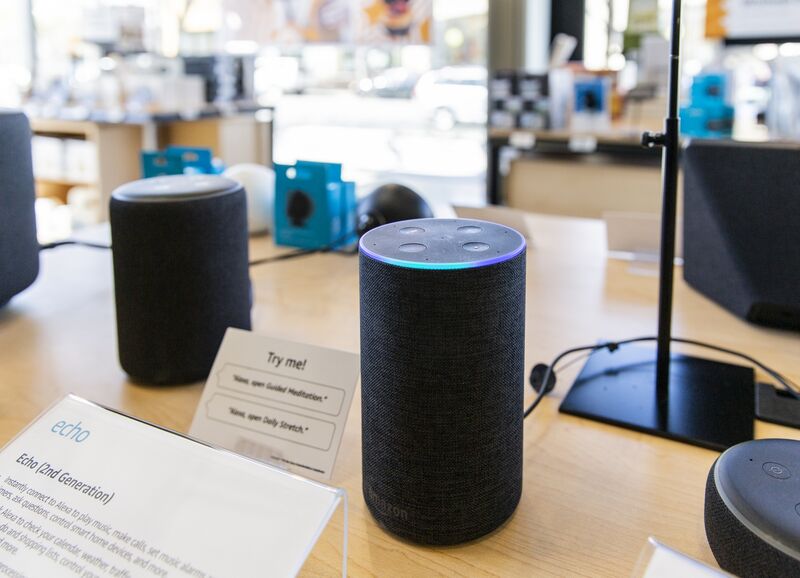
Alexa software is designed to continuously record snatches of audio, listening for a wake word. That’s “Alexa” by default, but people can change it to “Echo” or “computer.” When the wake word is detected, the light ring at the top of the Echo turns blue, indicating the device is recording and beaming a command to Amazon servers.
An Echo smart speaker inside an Amazon 4-star store in Berkeley, California.
Photographer: Cayce Clifford/Bloomberg
Most modern speech-recognition systems rely on neural networks patterned on the human brain. The software learns as it goes, by spotting patterns amid vast amounts of data. The algorithms powering the Echo and other smart speakers use models of probability to make educated guesses. If someone asks Alexa if there’s a Greek place nearby, the algorithms know the user is probably looking for a restaurant, not a church or community center.
But sometimes Alexa gets it wrong—especially when grappling with new slang, regional colloquialisms or languages other than English. In French, avec sa, “with his” or “with her,” can confuse the software into thinking someone is using the Alexa wake word. Hecho, Spanish for a fact or deed, is sometimes misinterpreted as Echo. And so on. That’s why Amazon recruited human helpers to fill in the gaps missed by the algorithms.
Apple’s Siri also has human helpers, who work to gauge whether the digital assistant’s interpretation of requests lines up with what the person said. The recordings they review lack personally identifiable information and are stored for six months tied to a random identifier, according to an Apple security white paper. After that, the data is stripped of its random identification information but may be stored for longer periods to improve Siri’s voice recognition.
At Google, some reviewers can access some audio snippets from its Assistant to help train and improve the product, but it’s not associated with any personally identifiable information and the audio is distorted, the company says.
A recent Amazon job posting, seeking a quality assurance manager for Alexa Data Services in Bucharest, describes the role humans play: “Every day she [Alexa] listens to thousands of people talking to her about different topics and different languages, and she needs our help to make sense of it all.” The want ad continues: “This is big data handling like you’ve never seen it. We’re creating, labeling, curating and analyzing vast quantities of speech on a daily basis.”
Amazon’s review process for speech data begins when Alexa pulls a random, small sampling of customer voice recordings and sends the audio files to the far-flung employees and contractors, according to a person familiar with the program’s design.
The Echo Spot
Photographer: Daniel Berman/Bloomberg
Some Alexa reviewers are tasked with transcribing users’ commands, comparing the recordings to Alexa’s automated transcript, say, or annotating the interaction between user and machine. What did the person ask? Did Alexa provide an effective response?
{„contentId“:“PPRO1R6JIJUR01″,“position“:“desktop-in-article3″,“dimensions“:{„large_desktop“:[[5,21]],“small_desktop“:[[5,21]]},“type“:“Desktop in article Native Ad“,“targeting“:{„position“:“desktop-in-article3″,“url“:“/news/articles/2019-04-10/is-anyone-listening-to-you-on-alexa-a-global-team-reviews-audio“},“containerId“:“desktop-in-article-3-PPRO1R6JIJUR01″}
Others note everything the speaker picks up, including background conversations—even when children are speaking. Sometimes listeners hear users discussing private details such as names or bank details; in such cases, they’re supposed to tick a dialog box denoting “critical data.” They then move on to the next audio file.
According to Amazon’s website, no audio is stored unless Echo detects the wake word or is activated by pressing a button. But sometimes Alexa appears to begin recording without any prompt at all, and the audio files start with a blaring television or unintelligible noise. Whether or not the activation is mistaken, the reviewers are required to transcribe it. One of the people said the auditors each transcribe as many as 100 recordings a day when Alexa receives no wake command or is triggered by accident.
In homes around the world, Echo owners frequently speculate about who might be listening, according to two of the reviewers. “Do you work for the NSA?” they ask. “Alexa, is someone else listening to us?”
— With assistance by Gerrit De Vynck, Mark Gurman, and Irina Vilcu
No one questions the good intent behind the EU’s General Data Protection Regulation (GDPR) legislation, or the need for companies to be more careful with the proprietary information they have about clients, patients, and other individuals they interact with regularly. While the provisions within the GDPR do help, they have also created new opportunities for hackers and identity thieves to exploit that data.
There’s no doubt that seeking to be fully GDPR compliant is more than just a good idea. Along the way, just make sure your organization doesn’t fall victim to one of the various scams that are surfacing. Let’s take a quick review of GDPR and then dive into the dirty tricks hackers have been playing.
Understanding the Basics of GDPR
In 2018, the GDPR established a set of guidelines for managing the collection and storage of consumer and proprietary data. Much of it pertains to personal information provided by individuals to an entity.
That entity may be a banking institution, insurance company, investing service, or even a health care facility. The primary goal is to ensure adequate protections are in place so that an ill-intentioned third party can’t exploit the personal information of those organizations’ employees, clients, and patients.
The GDPR addresses key areas of data security:
Explicit consent to collect and maintain personal data
Notification in the event of a data breach
Dedicated data security personnel within the organization
Data encryption that protects personal information in the event of a breach
Access to personal information for review of accuracy (integrity), and to set limitations on the intended use
While there has been pushback about some of the provisions within the GDPR (especially the need for additional data security personnel outside of the usual IT team), many organizations have been eager to adopt the measures. After all, being GDPR compliant can decrease the risk of a breach and would prove helpful if lawsuits resulted after a breach.
GDPR and Appropriate Security
There is an ongoing discussion about what represents adequate and appropriate security in terms of GDPR compliance. To some degree, the exact approach to security will vary, based on the type of organization involved and the nature of the data that is collected and maintained.
Even so, there is some overlap that would apply in every case. Compliance involves identifying and reinforcing every point in the network where some type of intrusion could possibly take place. Using Artificial Intelligence technology to reinforce points of vulnerability while also monitoring them for possible cyberattacks is another element. Even having an escalation plan in place to handle a major data breach within a short period of time is something any organization could enact.
One point that is sometimes lost in the entire discussion about GDPR security is that the guidelines set minimum standards. Entities are free to go above and beyond in terms of protecting proprietary data like customer lists. Viewing compliance as the starting point and continuing to refine network security will serve a company well in the long run.
So What Have Hackers Been Doing Since the Launch of GDPR?
There’s no doubt that hackers and others with less than honorable intentions have been doing their best to work around the GDPR guidelines even as they use them to their advantage. Some news reports claim that GDPR has made it easier for hackers to gain access to data. So what exactly have these ethically challenged individuals concocted?
Here are some examples:
Introducing Reverse Ransomware
As far as we know, it’s not really called reverse ransomware but that seems to be a pretty good way to describe this evil little scheme. As a review, a ransomware attack is when a hacker gets into your system and encrypts data so you can’t see or use it. Only with the payment of a ransom, typically in untraceable Bitcoin or other cryptocurrencies, will the hacker make your data usable again.
The sad ending to the ransomware saga is that more times than not, the data is never released even if the ransom is paid.
But GDPR has provided the inspiration for the bad guys to put a sneaky spin on the data drama. In this case, they penetrate the network by whatever means available to collect the customer lists, etc., which the EU has worked so hard to protect with the new regulations.
The threat with this variation, however, is that the data will be released publicly, which would put the organization in immediate violation of GDPR and make it liable for what could be a hefty fine — one that is substantially larger than the ransom the criminals are demanding.
Of course, the hacker promises not to release the data if the hostage company pays a ransom and might even further promise to destroy the data afterward. If you believe they’ll actually do that, I’d like to introduce you to the Easter Bunny and Tooth Fairy.
The attacker has already demonstrated a strong amoral streak. What’s to stop them from demanding another payment a month down the road? If you guessed nothing, you’re right. But wait, there’s more.
Doing a Lot of Phishing
Many organizations have seen a continual flow of unsolicited emails offering to help them become GDPR compliant. These range from offering free consultations that can be conducted remotely to conducting online training sessions to explain GDPR and suggest ways to increase security.
Typically, this type of phishing scheme offers a way to remit payments for services in advance, with the understanding that the client pays a portion now and the rest later.
Unsurprisingly, anyone who clicks on the link may lose more than whatever payment is rendered. Wherever the individual lands, the site is likely to be infected with spyware or worse. And if the email is forwarded throughout an organization or outside of it? The infection spreads.
I believe we need to be savvier with emails. That means training employees to never click on links in unsolicited emails, and to report suspicious emails to the security team at once.
What Can You Do?
As you can see, GDPR has provided a variety of crime opportunities for an enterprising hacker. These are just two examples of how they use GDPR for profit at the expense of hardworking business owners. The best first step when confronted with any of these types of threats is to not act on it. Instead, forward it to an agency that can properly evaluate the communication.
At the risk of sounding like Captain Obvious, have you done everything possible to fortify your network against advanced threats? Here are the basic preventive steps:
Web security software: The first line of defense is a firewall (updated regularly of course) that prowls the perimeter, looking to prevent any outside threat’s attempt to penetrate. In addition, be sure to implement network security software that detects malicious network activity resulting from a threat that manages to bypass your perimeter controls. It used to be that you could survive with a haphazard philosophy towards security, but those days are long gone. Get good security software and put it to work.
Encrypt that data: While the firewall and security software protects a network from outside penetration attempts, your data doesn’t always stay at home safe and sound. Any time a remote worker connects back to your network or an employee on premises ventures out to the open Internet, data is at risk. That’s why a virtual private network (VPN) should be a mandatory preventive security measure.
It’s a simple but strong idea. Using military grade protocols, a properly configured VPN service encrypts the flow of data between a network device and the Internet or between a remote device and the company network. The big idea here is that even if a hacker manages to siphon off data, they will be greeted with an indecipherable mess that would take the world’s strongest computers working in unison a few billion years to crack. They’ll probably move onto an easier game.
And while a VPN should be a frontline tool to combat hackers, there’s something else that might even be more important.
Education and Training: Through ignorance or inattention, employees can be the biggest threat to cybersecurity. It’s not enough to simply sit them down when you hire them and warn dire consequences if they let malware in the building. Owners need a thorough, ongoing education program related to online security that emphasizes its importance as being only slightly below breathing.
The Bottom Line
The GDPR does not have to be a stumbling block for you or an opportunity for a hacker. Stay proactive with your security measures and keep your antenna tuned for signs of trouble.


 Michael Simon/IDG
 IDG
IDG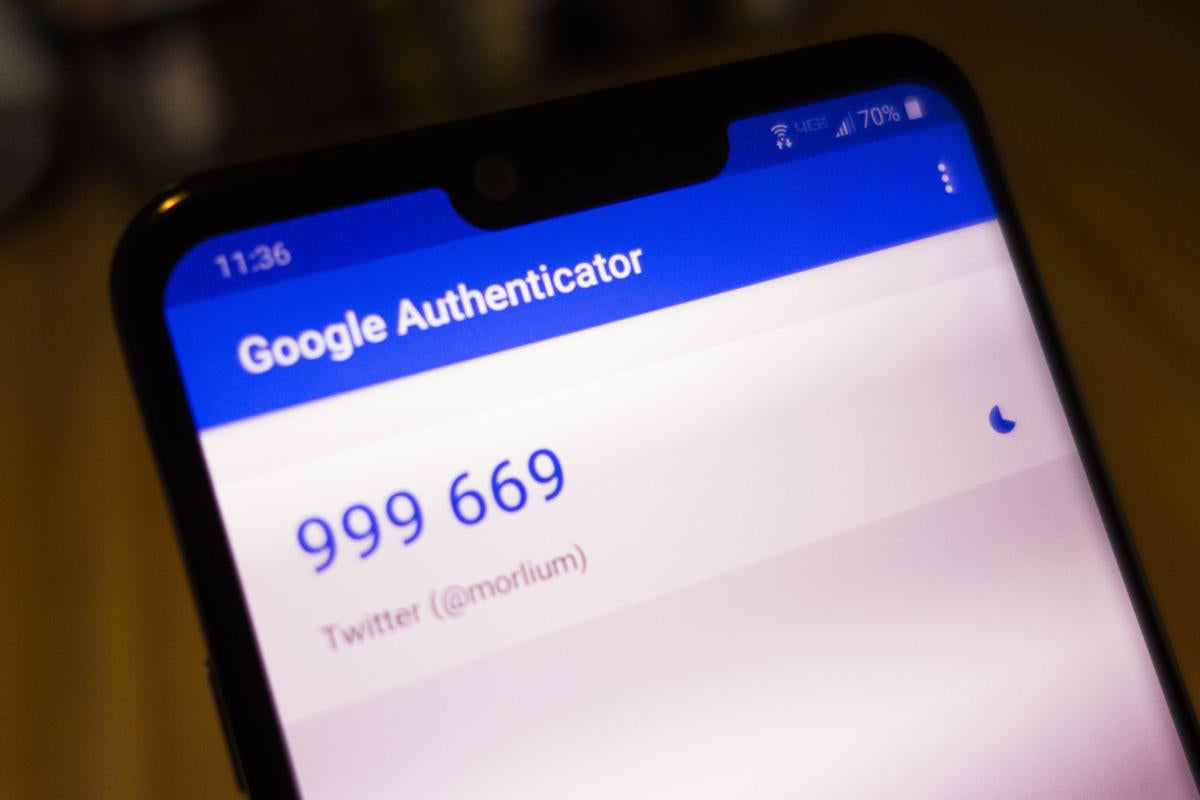 Authenticator apps
 IDG
IDG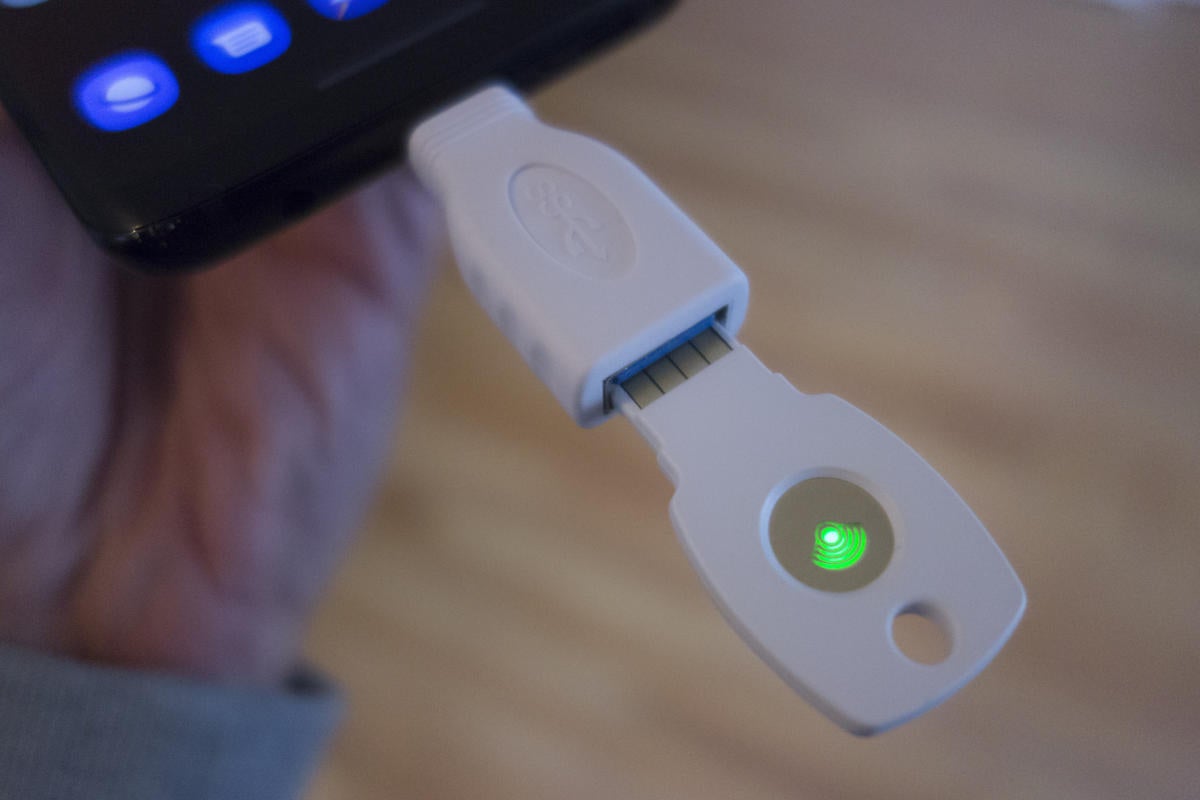 Michael Simon/IDG
 IDG
IDG Christopher Hebert/IDG
 Michael Simon/IDG
 IDG
IDG



 TheIdea – The Innovation Agency