Schlagwort-Archive: google+

Apples long way to build Cars

Apple has built no cars. Google has designed and outsourced the production of a small fleet of self-driving pod mobiles.

The newest carmaker on the block, Tesla, managed to build just 50,000 cars in 2015.

Meanwhile, in the US alone, the traditional auto industry built and sold 17.5 million cars and trucks.

This glaring imbalance between current reality and a highly speculative vision of the future hasn’t stopped pundits and tech and auto observers from transforming Apple and Google into serious auto-industry challengers.

For example, this is from a recent report by Reuters:

[G]oogle may choose to build its own engineering and design prototypes, then partner with a Chinese automaker or an Asian contractor such as Hon Hai Precision Industry’s Foxconn Technology Co that wants to enter the automotive field, several experts said.

Given Apple’s extensive iPhone and iPad manufacturing in China, it’s also been suggested that the Cupertino, California, colossus would skip out building a car in the US and would do it in the Middle Kingdom.

It’s an attractive idea, but it overlooks the vast gulf that exists between assembling smartphones and making cars. Tesla is among the most technologically advanced automakers around, and it still has to make its vehicles in a large factory with millions of dollars of giant robots and huge machines designed to bend metal. A large factory in Northern California.

The rest of the US auto industry builds the cars it sells in the US predominantly in the US. As such, the Detroit Big Three are major employers, as are the Japanese and German „transplants,“ as they’re know, which build cars and trucks in southern US states with nonunion workforces.

Some production has been moving to Mexico, but Mexico has been positioning itself as a NAFTA manufacturing partner to US companies for some time and has invested is developing an automotive supply chain.

China calls the shots

China is a different story. Ford, GM, Volkswagen, and others build cars there and sell them under familiar brands, but they can’t do this without entering into a joint venture with a Chinese partner. There’s an obvious compromise baked into this arrangement: Foreign automakers gain access to the enormous Chinese market, but they also end up sharing R&D.

Foxconn Kin Cheung APKin Cheung/APThey aren’t building cars.

It isn’t exactly a joining of equals, but Chinese automakers don’t see themselves as mere assembly lines for Western designs. They see themselves as developing a robust national manufacturing base. And while they’re building Buicks, they’re also building Chinese-brand cars and trucks.

With Apple and Google, the idea seems to be that these companies will try to transform consumer-goods manufacturers into automakers. There might be something to this in theory: Remake the automobile by designing and building it like a piece of internet-enabled consumer tech. But in practice, the car-building part of building an automobile, even an innovative self-driving one, tends to catch up to the visionaries, as Tesla has learned.

Profit margins under stress

Additionally, in Apple’s case it would be necessary to harvest a much wider profit margin than the auto industry typically throws off: 30% vs. 10% — or less, in bad times. And if you think Apple or Google has designs on selling all-electric driverless tech to willing Chinese customers, making China and not the US or Europe the main market, then you haven’t thought through either China’s congested big cities, a nightmare for driverless cars, or its still-developing roadway system, which is friendlier to trucks and SUVs.

So the game plan, as it’s being discussed outside Apple and Google, would be to build cars outside the US, using cheaper Asian labor, and then import them.

It sounds great because for Apple, in particular, that’s been a pathway to massive success.

But when it comes to the auto industry, it would be impossible. Not impossible to build some kind of more or less traditional car, but impossible to build the wildly disruptive car of the future.

www.businessinsider.de/impossible-apple-or-google-car-china-2016-3

tug-of-war over who controls and profits from the stream of user data in self-driving cars

google.carx299

Google’s self-driving car team is expanding and hiring more people with automotive industry expertise, underscoring the company’s determination to move the division past the experimental stage.

The operation now employs at least 170 workers, according to a Reuters review of their profiles on LinkedIn, the business-oriented social network. Many are software and systems engineers, and some come from other departments at Google.

More than 40 of the employees listed on LinkedIn have previous automotive industry experience, with skills ranging from exterior design to manufacturing.

They hail from a wide range of companies, including Tesla Motors Inc, Ford Motor Co. and General Motors Co.

For a look at the composition of Google’s self-driving car team, Google has not disclosed details about the size or composition of its self-driving car team, and Johnny Luu, spokesman for Google’s car team, declined to comment.

The team could have additional members who do not publish profiles on LinkedIn.

Google has said previously that it intends to ready the technology for a marketable self-driving car by 2020, but it may never manufacture vehicles itself.

The tech giant is more likely to contract out manufacturing — much like Apple does with iPhone — or to license technology to existing car manufacturers, automotive industry experts said.

Licensing would follow the model Google has used with its Android operating system for mobile devices.

In the past four weeks, Google has advertised nearly 40 new positions on the team, and many are related to manufacturing.

The team currently has six people with such experience, including purchasing, supplier development and supply chain management.

Hires with manufacturing skills could help Google find and coordinate with a partner to build a vehicle, said Paul Mascarenas, a former Ford executive who is president of FISITA, the International Federation of Engineering Societies.

Google is also engaged in discussions with federal and state regulators about how to revise motor vehicle safety standards to accommodate autonomous cars.

The competition for technical talent is intensifying as tech and automotive companies race to build driverless vehicles.

Beyond Google, the players include Tesla, established car makers such as Daimler AG and GM and, and technology companies such as Apple Inc and Uber Technologies Inc.

Google’s team is being assembled by John Krafcik, an industry veteran who previously headed Hyundai Motor Co’s  U.S. operations and is an expert in product development and manufacturing. Krafcik joined Google in September 2015.

Another senior executive with previous automotive experience, Paul Luskin, was hired last month as operations manager, according to his Linkedin profile.

An engineer with stints at Jaguar Cars, Ford and Japanese supplier Denso Corp, Luskin most recently was president of Ricardo Defense Systems, a unit of Britain’s Ricardo PLC, according to the Linkedin profile.

Google hired industry veteran Andy Warburton in July to head the vehicle engineering team, according to his Linkedin profile.

Warburton spent two years as a senior engineering manager at Tesla and 16 years as an engineering manager at Jaguar.

A third auto veteran, Sameer Kshisagar, joined Google in November as head of global supply management on the self-driving car team. Kshisagar is a manufacturing expert who previously worked for GM, according to his Linkedin profile.

Luskin, Warburton and Kshisagar did not respond to requests for comment.

Google’s self-driving car group also has tapped people with experience beyond the auto industry, including aerospace (Boeing, SpaceX, Jet Propulsion Lab) and electronics (Intel, Samsung, Motorola), according to LinkedIn profiles.

Krafcik and Chris Urmson, director of the car team, have said they want to forge partnerships with established automakers and others to build vehicles. Krafcik made a public pitch for alliances at an auto industry conference in Detroit in January.

However, Google may have to look farther than the auto industry to find a manufacturing partner, said Raj Rajkumar, a Carnegie-Mellon University professor who advises companies on self-driving car development.

The tug-of-war over who controls — and profits from — the stream of user data in self-driving cars is „an inherent and fundamental conflict“ between Google and traditional automakers, Rajkumar said.

Instead, Google may choose to build its own engineering and design prototypes, then partner with a Chinese automaker or an Asian contractor such as Hon Hai Precision Industry’s Foxconn Technology Co that wants to enter the automotive field, several experts said.

Michael Tracy, a Michigan-based auto manufacturing consultant, said Google sees the potential of several different revenue streams from its self-driving technology, including licensing its mapping database and vehicle control software, as well as an integrated package of software, sensors and actuators that would form the backbone of a self-driving vehicle.

The least likely prospect is that Google will manufacture its own vehicles, Tracy said, due to the massive expenditures required and the stiff competition from established automakers.

http://www.voanews.com/content/googles-self-driving-car-team-beefs-up-auto-experience/3217805.html

eSIM und die veränderte Rolle der etablierten Mobilfunk-Unternehmen

Source: http://t3n.de/news/koennten-mobilfunkanbieter-648323/

Darum könnten Mobilfunkanbieter in Zukunft überflüssig werden

In Zukunft wird mobiles Internet so selbstverständlich wie der Strom aus der Steckdose. Gut für die Nutzer, schlecht für die Mobilfunkanbieter, die immer austauschbarer werden.

Darum könnten Mobilfunkanbieter in Zukunft überflüssig werden
(Foto: © Ralf Kalytta – Fotolia.com)

Mobilfunkanbieter werden austauschbar

Weltweit gibt es sieben Milliarden Mobilfunkanschlüsse, davon in Deutschland 112 Millionen . Tendenz steigend. Läuft es also gut bei den Mobilfunkanbietern? Nur für den Moment. In Zukunft werden sie austauschbar, denn schon heute unterscheiden sie sich im Prinzip nur durch Preis, Datenvolumen und Netzabdeckung voneinander. Zusatzdienste, die zu den Anfängen des Mobilfunks für die Nutzer noch eine Rolle spielten, haben keine Bedeutung mehr. In Zeiten von WhatsApp oder iMessage brauchen Nutzer keine teuren SMS-Pakete mehr. Auch die Telefonie wird unwichtiger, was zählt ist die Datenverbindung.

Over-The-Top-Dienste (OTT) wie Skype, WhatsApp, iMessage und Co. legen kontinuierlich zu, während die klassischen Kommunikationsdienste wie Telefonie oder SMS in der Nutzung sinken. Laut der Bundesnetzagentur lag die mobile Datennutzung 2014 im Monatsmittel bei 288 Megabyte und damit viermal so hoch wie noch 2011. Mobil telefoniert wurde in Deutschland 2014 im Monat nur noch knapp 80 Minuten. Drastisch eingebrochen ist auch die SMS-Nutzung : von 60 Milliarden SMS im Jahr 2012 blieben 2014 nur noch 22,5 Milliarden übrig.

steckdose
Mobilfunkanbieter auf dem Weg zum Technologie-Anbieter. (Quelle: © Ralf Kalytta – Fotolia.com)

Die Kluft zwischen Nutzer und Mobilfunkanbieter wird größer

Gleichzeitig wird die Kluft zwischen Nutzer und Mobilfunkbetreiber immer Größer, wie die Umfrage des Marktforschungsinstituts für Servicequalität zeigt. Das Gesamturteil für die Mobilfunkbranche ist nur befriedigend und an erster Stelle stehen bei der Kundenzufriedenheit die Mobilfunkdiscounter. Die Netzbetreiber Telefonica, Telekom oder Vodafone bilden das Schlusslicht. Die qualitativen Unterschiede zwischen den Netzbetreibern, anfänglich noch deutlich größer, werden immer geringer.

„Es gibt kein wirklich schlechtes Mobilfunknetz mehr.“

Es gibt kein wirklich schlechtes Mobilfunknetz mehr, was auch zur Wechselfreudigkeit beiträgt. Dank der Möglichkeit der Mitnahme der Rufnummer sinkt die Bindung zu einem bestimmten Mobilfunkanbieter. Obwohl die Kluft zum Kunden immer größer wird, unternimmt die Branche viel zu wenig, um den Kunden zu binden. Auf den demografischen Wandel der Nutzer und die damit einhergehende Veränderungen im Nutzungsverhalten wird mit den falschen Maßnahmen reagiert. Die steigende Beliebtheit von Messaging-Diensten wie WhatsApp wurde anfänglich belächelt, bis dann vier Jahre nach dem Start von WhatsApp & Co der zaghafte Versuch unternommen wurde, mit der App Joyn eine Alternative zu bieten. Erfolglos, schaut man sich das Ranking im App-Store und der Anzahl der Bewertungen an.Gleichzeitig untersagen die Mobilfunkanbieter in ihren AGB die Nutzung von Diensten wie P2P (Peer-to-Peer), Instant Messaging oder VoIP (Voice over IP). Kein Problem hat man damit, Streaming-Dienste wie beispielsweise Spotify von der Berechnung des Datenvolumens auszuschließen. Mit Netzneutralität hat das nur noch wenig zu tun. Hauptsache der Rubel rollt. Statt sich auf den Nutzer zu fokussieren, wird selbiger lieber gemolken. So sind in kaum einem anderen Land die Kosten für mobiles Internet so hoch wie in Deutschland. Ist in Finnland ein Inklusiv-Volumen von 50 Gigabyte üblich, steht Deutschland mit einem Gigabyte hinter Italien, Tschechien oder Spanien und nur knapp vor Ungarn. Finde den Fehler.

Twin Design / Shutterstock.com
Der SMS-Killer. WhatsApp läutete den Untergang der SMS ein (Quelle: Twin Design / Shutterstock.com)

Zukunft der Mobilfunkanbieter ist düster

Die Liste der gescheiterten Unternehmungen, eigene Dienste zu etablieren, ist lang. Messaging, Musik-Streaming oder Mobile Payment, allesamt eher klägliche Versuche beim Nutzer zu punkten. Der Zugriff auf den Kunden wird in Zukunft weiter sinken, denn gemeinsam mit der GSM-Association, dem Verband der Mobilfunknetzbetreiber, verhandeln Samsung und Apple über die Einführung der eSim. Bei der eSIM handelt es sich um eine fest verbaute Sim-Karte, auf die jeder Mobilfunkbetreiber aufgeschaltet werden kann. Kunden brauchen in Zukunft keine Sim-Karte mehr für das Smartphone, sondern können sofort loslegen.

Der Wechsel zwischen den Mobilfunkanbietern wird damit entsprechend vereinfacht, da der lästige Wechsel der Sim-Karte entfällt. Die Hoheit der eSim liegt beim Hardware-Hersteller, also bei Apple und Samsung. Das heißt, dass sowohl Apple als auch Samsung einen Mobilfunkbetreiber anbieten, aber eben auch ausschließen können. Mobilfunkanbieter, die besonders restriktiv gegenüber bestimmten Onlinediensten sind, könnten einfach seitens der Smartphone-Hersteller ausgeschlossen werden. Mit der eSim geht ein weiterer Baustein in der Kundenbeziehung für die Mobilfunkanbieter verloren. Und es bröckelt weiter, denn Apple bietet, zunächst nur in den USA, das iPhone als Abo-Modell an.

Für einen Betrag von 39 US-Dollar kann das iPhone gemietet werden und der Kunde bekommt automatisch immer das neueste Gerät. Das Gleiche bietet Samsung auch an und andere Hersteller werden folgen. Mit neuen Smartphones gekoppelt an eine Vertragsverlängerung können die Mobilfunkanbieter künftig also auch nicht mehr locken. Die nicht abreißenden Gerüchte, Apple wolle ein VMNO, ein virtueller Mobilfunkanbieter werden, dürften bei den etablierten Mobilfunkbetreibern nur so mittelgut ankommen. Ganz abgesehen von Projekten wie Googles Loon, dessen Ziel nichts geringeres ist, als die Welt mit Internet auszustatten.

Sri Lanka ist das erste Land, welches mit Hilfe von Google Loon einen landesweiten universellen Internetzugang über WLAN bekommt. Auch wenn Sri Lanka nur eine Insel und nicht Europa ist, sieht man, wohin die Reise bei Google geht. Für Unternehmen wie Google, Facebook oder Apple ist mobiles Internet die Basis für alle Produkte. Die Abhängigkeit von Mobilfunkprovidern ist, wie man am gerade von Google gestarteten Accelerated-Mobile-Pages-Project sehen kann, ein Problem.

Project Loon soll im Dezember in Australien getestet werden. (Foto: Google)
Project Loon als Gefahr für den klassischen Mobilfunk? (Foto: Google)

Fazit

Die Frage ist nicht, ob es die Mobilfunkanbieter in Zukunft noch geben wird, sondern viel mehr welche Rolle sie spielen werden. Die Bindung zum Kunden geht zunehmend an Unternehmen wie Apple, Google, Facebook oder Amazon verloren. Ein Ökosystem, wo Kunden Lösungen aus einer Hand bekommen, die nahtlos mit einander funktionieren, ist heute essentiell. Apple, Google, Facebook und Amazon haben das erkannt und bieten genau das: einzelne Lösungen aus einer Hand für unterschiedliche Anwendungsfälle mit Fokussierung auf den Nutzer.

Im Mobilfunk wird das vernachlässigt und es fehlen innovative Ideen und Lösungen. Themen werden entweder zu spät oder nicht nutzerzentriert angegangen, wie man an den Entwicklungen im Bereich Mobile Payment sehen kann. Anstatt sich mit den Kundenbedürfnissen zu beschäftigen, steht am Anfang das Geschäftsmodell. Am Ende bleibt nur noch die Rolle des Technologie-Anbieters, die in etwa so spannend ist wie Strom aus der Steckdose. Gar nicht.


Chris Urmson – Leader of Google Self Driving Car Project on TED

0:11 So in 1885, Karl Benz invented the automobile. Later that year, he took it out for the first public test drive, and — true story — crashed into a wall. For the last 130 years, we’ve been working around that least reliable part of the car, the driver. We’ve made the car stronger. We’ve added seat belts, we’ve added air bags, and in the last decade, we’ve actually started trying to make the car smarter to fix that bug, the driver.

0:40 Now, today I’m going to talk to you a little bit about the difference between patching around the problem with driver assistance systems and actually having fully self-driving cars and what they can do for the world. I’m also going to talk to you a little bit about our car and allow you to see how it sees the world and how it reacts and what it does, but first I’m going to talk a little bit about the problem. And it’s a big problem: 1.2 million people are killed on the world’s roads every year. In America alone, 33,000 people are killed each year. To put that in perspective, that’s the same as a 737 falling out of the sky every working day. It’s kind of unbelievable. Cars are sold to us like this, but really, this is what driving’s like. Right? It’s not sunny, it’s rainy, and you want to do anything other than drive. And the reason why is this: Traffic is getting worse. In America, between 1990 and 2010, the vehicle miles traveled increased by 38 percent. We grew by six percent of roads, so it’s not in your brains. Traffic really is substantially worse than it was not very long ago.

1:49 And all of this has a very human cost. So if you take the average commute time in America, which is about 50 minutes, you multiply that by the 120 million workers we have, that turns out to be about six billion minutes wasted in commuting every day. Now, that’s a big number, so let’s put it in perspective. You take that six billion minutes and you divide it by the average life expectancy of a person, that turns out to be 162 lifetimes spent every day, wasted, just getting from A to B. It’s unbelievable. And then, there are those of us who don’t have the privilege of sitting in traffic. So this is Steve. He’s an incredibly capable guy, but he just happens to be blind, and that means instead of a 30-minute drive to work in the morning, it’s a two-hour ordeal of piecing together bits of public transit or asking friends and family for a ride. He doesn’t have that same freedom that you and I have to get around. We should do something about that.

2:48 Now, conventional wisdom would say that we’ll just take these driver assistance systems and we’ll kind of push them and incrementally improve them, and over time, they’ll turn into self-driving cars. Well, I’m here to tell you that’s like me saying that if I work really hard at jumping, one day I’ll be able to fly. We actually need to do something a little different. And so I’m going to talk to you about three different ways that self-driving systems are different than driver assistance systems. And I’m going to start with some of our own experience.

3:17 So back in 2013, we had the first test of a self-driving car where we let regular people use it. Well, almost regular — they were 100 Googlers, but they weren’t working on the project. And we gave them the car and we allowed them to use it in their daily lives. But unlike a real self-driving car, this one had a big asterisk with it: They had to pay attention, because this was an experimental vehicle. We tested it a lot, but it could still fail. And so we gave them two hours of training, we put them in the car, we let them use it, and what we heard back was something awesome, as someone trying to bring a product into the world. Every one of them told us they loved it. In fact, we had a Porsche driver who came in and told us on the first day, „This is completely stupid. What are we thinking?“ But at the end of it, he said, „Not only should I have it, everyone else should have it, because people are terrible drivers.“ So this was music to our ears, but then we started to look at what the people inside the car were doing, and this was eye-opening. Now, my favorite story is this gentleman who looks down at his phone and realizes the battery is low, so he turns around like this in the car and digs around in his backpack, pulls out his laptop, puts it on the seat, goes in the back again, digs around, pulls out the charging cable for his phone, futzes around, puts it into the laptop, puts it on the phone. Sure enough, the phone is charging. All the time he’s been doing 65 miles per hour down the freeway. Right? Unbelievable. So we thought about this and we said, it’s kind of obvious, right? The better the technology gets, the less reliable the driver is going to get. So by just making the cars incrementally smarter, we’re probably not going to see the wins we really need.

4:59 Let me talk about something a little technical for a moment here. So we’re looking at this graph, and along the bottom is how often does the car apply the brakes when it shouldn’t. You can ignore most of that axis, because if you’re driving around town, and the car starts stopping randomly, you’re never going to buy that car. And the vertical axis is how often the car is going to apply the brakes when it’s supposed to to help you avoid an accident. Now, if we look at the bottom left corner here, this is your classic car. It doesn’t apply the brakes for you, it doesn’t do anything goofy, but it also doesn’t get you out of an accident. Now, if we want to bring a driver assistance system into a car, say with collision mitigation braking, we’re going to put some package of technology on there, and that’s this curve, and it’s going to have some operating properties, but it’s never going to avoid all of the accidents, because it doesn’t have that capability. But we’ll pick some place along the curve here, and maybe it avoids half of accidents that the human driver misses, and that’s amazing, right? We just reduced accidents on our roads by a factor of two. There are now 17,000 less people dying every year in America.

6:01 But if we want a self-driving car, we need a technology curve that looks like this. We’re going to have to put more sensors in the vehicle, and we’ll pick some operating point up here where it basically never gets into a crash. They’ll happen, but very low frequency. Now you and I could look at this and we could argue about whether it’s incremental, and I could say something like „80-20 rule,“ and it’s really hard to move up to that new curve. But let’s look at it from a different direction for a moment. So let’s look at how often the technology has to do the right thing. And so this green dot up here is a driver assistance system. It turns out that human drivers make mistakes that lead to traffic accidents about once every 100,000 miles in America. In contrast, a self-driving system is probably making decisions about 10 times per second, so order of magnitude, that’s about 1,000 times per mile. So if you compare the distance between these two, it’s about 10 to the eighth, right? Eight orders of magnitude. That’s like comparing how fast I run to the speed of light. It doesn’t matter how hard I train, I’m never actually going to get there. So there’s a pretty big gap there.

7:10 And then finally, there’s how the system can handle uncertainty. So this pedestrian here might be stepping into the road, might not be. I can’t tell, nor can any of our algorithms, but in the case of a driver assistance system, that means it can’t take action, because again, if it presses the brakes unexpectedly, that’s completely unacceptable. Whereas a self-driving system can look at that pedestrian and say, I don’t know what they’re about to do, slow down, take a better look, and then react appropriately after that.

7:38 So it can be much safer than a driver assistance system can ever be. So that’s enough about the differences between the two. Let’s spend some time talking about how the car sees the world.

7:48 So this is our vehicle. It starts by understanding where it is in the world, by taking a map and its sensor data and aligning the two, and then we layer on top of that what it sees in the moment. So here, all the purple boxes you can see are other vehicles on the road, and the red thing on the side over there is a cyclist, and up in the distance, if you look really closely, you can see some cones. Then we know where the car is in the moment, but we have to do better than that: we have to predict what’s going to happen. So here the pickup truck in top right is about to make a left lane change because the road in front of it is closed, so it needs to get out of the way. Knowing that one pickup truck is great, but we really need to know what everybody’s thinking, so it becomes quite a complicated problem. And then given that, we can figure out how the car should respond in the moment, so what trajectory it should follow, how quickly it should slow down or speed up. And then that all turns into just following a path: turning the steering wheel left or right, pressing the brake or gas. It’s really just two numbers at the end of the day. So how hard can it really be?

8:49 Back when we started in 2009, this is what our system looked like. So you can see our car in the middle and the other boxes on the road, driving down the highway. The car needs to understand where it is and roughly where the other vehicles are. It’s really a geometric understanding of the world. Once we started driving on neighborhood and city streets, the problem becomes a whole new level of difficulty. You see pedestrians crossing in front of us, cars crossing in front of us, going every which way, the traffic lights, crosswalks. It’s an incredibly complicated problem by comparison. And then once you have that problem solved, the vehicle has to be able to deal with construction. So here are the cones on the left forcing it to drive to the right, but not just construction in isolation, of course. It has to deal with other people moving through that construction zone as well. And of course, if anyone’s breaking the rules, the police are there and the car has to understand that that flashing light on the top of the car means that it’s not just a car, it’s actually a police officer. Similarly, the orange box on the side here, it’s a school bus, and we have to treat that differently as well.

9:49 When we’re out on the road, other people have expectations: So, when a cyclist puts up their arm, it means they’re expecting the car to yield to them and make room for them to make a lane change. And when a police officer stood in the road, our vehicle should understand that this means stop, and when they signal to go, we should continue.

10:08 Now, the way we accomplish this is by sharing data between the vehicles. The first, most crude model of this is when one vehicle sees a construction zone, having another know about it so it can be in the correct lane to avoid some of the difficulty. But we actually have a much deeper understanding of this. We could take all of the data that the cars have seen over time, the hundreds of thousands of pedestrians, cyclists, and vehicles that have been out there and understand what they look like and use that to infer what other vehicles should look like and other pedestrians should look like. And then, even more importantly, we could take from that a model of how we expect them to move through the world. So here the yellow box is a pedestrian crossing in front of us. Here the blue box is a cyclist and we anticipate that they’re going to nudge out and around the car to the right. Here there’s a cyclist coming down the road and we know they’re going to continue to drive down the shape of the road. Here somebody makes a right turn, and in a moment here, somebody’s going to make a U-turn in front of us, and we can anticipate that behavior and respond safely.

11:04 Now, that’s all well and good for things that we’ve seen, but of course, you encounter lots of things that you haven’t seen in the world before. And so just a couple of months ago, our vehicles were driving through Mountain View, and this is what we encountered. This is a woman in an electric wheelchair chasing a duck in circles on the road. (Laughter) Now it turns out, there is nowhere in the DMV handbook that tells you how to deal with that, but our vehicles were able to encounter that, slow down, and drive safely. Now, we don’t have to deal with just ducks. Watch this bird fly across in front of us. The car reacts to that. Here we’re dealing with a cyclist that you would never expect to see anywhere other than Mountain View. And of course, we have to deal with drivers, even the very small ones. Watch to the right as someone jumps out of this truck at us. And now, watch the left as the car with the green box decides he needs to make a right turn at the last possible moment. Here, as we make a lane change, the car to our left decides it wants to as well. And here, we watch a car blow through a red light and yield to it. And similarly, here, a cyclist blowing through that light as well. And of course, the vehicle responds safely. And of course, we have people who do I don’t know what sometimes on the road, like this guy pulling out between two self-driving cars. You have to ask, „What are you thinking?“ (Laughter)

12:27 Now, I just fire-hosed you with a lot of stuff there, so I’m going to break one of these down pretty quickly. So what we’re looking at is the scene with the cyclist again, and you might notice in the bottom, we can’t actually see the cyclist yet, but the car can: it’s that little blue box up there, and that comes from the laser data. And that’s not actually really easy to understand, so what I’m going to do is I’m going to turn that laser data and look at it, and if you’re really good at looking at laser data, you can see a few dots on the curve there, right there, and that blue box is that cyclist. Now as our light is red, the cyclist’s light has turned yellow already, and if you squint, you can see that in the imagery. But the cyclist, we see, is going to proceed through the intersection. Our light has now turned green, his is solidly red, and we now anticipate that this bike is going to come all the way across. Unfortunately the other drivers next to us were not paying as much attention. They started to pull forward, and fortunately for everyone, this cyclists reacts, avoids, and makes it through the intersection. And off we go.

13:25 Now, as you can see, we’ve made some pretty exciting progress, and at this point we’re pretty convinced this technology is going to come to market. We do three million miles of testing in our simulators every single day, so you can imagine the experience that our vehicles have. We are looking forward to having this technology on the road, and we think the right path is to go through the self-driving rather than driver assistance approach because the urgency is so large. In the time I have given this talk today, 34 people have died on America’s roads.

13:55 How soon can we bring it out? Well, it’s hard to say because it’s a really complicated problem, but these are my two boys. My oldest son is 11, and that means in four and a half years, he’s going to be able to get his driver’s license. My team and I are committed to making sure that doesn’t happen.

14:13 Thank you.

14:15 (Laughter) (Applause) Chris Anderson: Chris, I’ve got a question for you.

14:22 Chris Urmson: Sure.

14:25 CA: So certainly, the mind of your cars is pretty mind-boggling. On this debate between driver-assisted and fully driverless — I mean, there’s a real debate going on out there right now. So some of the companies, for example, Tesla, are going the driver-assisted route. What you’re saying is that that’s kind of going to be a dead end because you can’t just keep improving that route and get to fully driverless at some point, and then a driver is going to say, „This feels safe,“ and climb into the back, and something ugly will happen.

14:58 CU: Right. No, that’s exactly right, and it’s not to say that the driver assistance systems aren’t going to be incredibly valuable. They can save a lot of lives in the interim, but to see the transformative opportunity to help someone like Steve get around, to really get to the end case in safety, to have the opportunity to change our cities and move parking out and get rid of these urban craters we call parking lots, it’s the only way to go.

15:20 CA: We will be tracking your progress with huge interest. Thanks so much, Chris. CU: Thank you.

Menschheit 2.0


Quelle: http://derstandard.at/2000017016766/Menschheit-20

Ausblick auf eine nicht ganz so schöne neue Welt, in der das technisch Machbare die zentrale Rolle spielen wird.

Ein Herrscher der Welt – oder zumindest einer seiner engsten Mitarbeiter – ist am 26. März in Wien öffentlich aufgetreten. Und nein, es war nicht Barack Obama, auch kein US-Regierungsvertreter, sondern Peter Norvig, Forschungsdirektor bei Google und Experte für intelligente Maschinen. Er war Gast der TU Wien im Rahmen der „Gödel Lectures“, benannt nach dem berühmten österreichischen Mathematiker, der vor den Nazis fliehen musste und seine Karriere in Princeton fortsetzte.

Der große Hörsaal der TU in der Gußhausstraße war zum Bersten voll, mit Hunderten von Lehrpersonen und Informatikstudenten, die alle begierig waren, zu erfahren, wie Computer selbstständig lernen können, ohne von Menschen speziell darauf programmiert zu sein. Wie viele von den Zuhörern in diesem Saal haben davon geträumt, eines Tages für Google zu arbeiten ?

Norvig war nicht im Anzug gekommen, er trug das unorthodoxe Outfit derer, die die Welt revolutionieren wollen: Fünf-Dollar-Hose und farbig getupftes T-Shirt. Es waren nicht nur seine Aussagen, die beeindruckten, sondern auch sein Aussehen.

Bemerkenswert war auch, dass sich der Amerikaner sofort auf das Universum der Science-Fiction berief, ein Genre, welches im deutschen Sprachraum eher als Jugendunterhaltungslektüre verachtet wird. Der Schriftsteller Philip K. Dick (1928-1982) ist beispielsweise weitgehend unbekannt, obwohl er erfolgreiche Hollywoodfilme inspiriert hat.

Zu perfekte Replikanten

Blade Runner (1982), ein Werk des Regisseurs Ridley Scott über einen Polizisten, der zu perfekte Replikanten, die sich unter die Menschen mischen, eliminieren soll, fußt auf einem von Dicks Romanen, ebenso wie Total Recall (1990) von Paul Verhoeven, mit Arnold Schwarzenegger als einem Arbeiter, dem man falsche Erinnerungen implantiert hat. Desgleichen geht Steven Spielbergs Minority Report(2002), eine Filmstory über eine Polizeitruppe, die vorsorglich zukünftige Kriminelle aufspüren und verhaften kann, auf eine Erzählung von Philip K. Dick aus dem Jahr 1956 zurück.

Dick stellte sich vor, dass die Zukunftspolizei sich sogenannter „Precogs“ bedienen könnte, Menschen mit hellseherischen Fähigkeiten. So visionär Dick auch gewesen sein mag, der Kalifornier konnte sich noch nicht die unfassbaren Rechenleistungen der Computer vorstellen. Heute leben wir in einer Welt, die Dick damals zumindest erahnte: In mehreren US- Städten gibt es das System PredPol (Predictive Policing), das mit Google Street View verbunden ist und auf Algorithmen aufbaut, die es der Polizei möglich machen, vorauszusagen, in welchem Viertel einer Stadt Einbrecherbanden oder Plünderer aktiv werden. Pred- Pol wird bald auch nach Europa kommen.

Roboter machen sich in unserem täglichen Leben breit, unser (zukünftiges) Verhältnis zu ihnen ist beispielsweise im Zentrum der schwedischen TV-Serie Real Humans (auf Arte). Haben diese Wesen Rechte? Wird man sich strafbar machen, wenn man sich ihnen gegenüber grausam verhält – wie bei der Misshandlung von Tieren?

Diese Fragen werden die westlichen Juristen und Philosophen beschäftigen, aber es ist in Asien, wo die reale Entwicklung die Debatte entscheiden wird. Die Überalterung der Bevölkerung, der Mangel an Arbeitskräften und an Frauen wegen der selektiven Abtreibung von weiblichen Föten (einer Folge der chinesischen Ein-Kind-Politik) werden immer mehr Substitute erfordern.

Man braucht nur „Yangyang“ anzuschauen, jenen weiblichen Humanoiden, der am 29. April auf der Global Mobile Internet Conference in Peking vorgestellt wurde, „um das junge Publikum für die Robotik anzusprechen“. Nehmen wir diesem von einem Japaner konzipierten und in Schanghai gebauten Roboter die Brillen ab und kleiden wir ihn reizvoll: Dann kann man sich das Potenzial vorstellen, wenn künftig 20 bis 30 Prozent der Männer in China und Indien dem Economist zufolge mangels Partnerinnen zum Zölibat verdammt sein werden …

Norvig ist nicht der Einzige, der in der Science-Fiction stimulierende und beunruhigende Hypothesen findet, wie in dem schönen Film Ex Machina von Alex Garland. Am 1. Mai 2014 haben vier hochkarätige Wissenschafter – die Briten Stephen Hawking (Astrophysiker) und Stuart Russell (Spezialist für künstliche Intelligenz, KI) sowie die Amerikaner Max Tegmark (Kosmologe und Wissenschaftsphilosoph) und Frank Wilczek (Nobelpreisträger für Physik) – anlässlich des Filmstarts von Transcendence in der britischen Tageszeitung The Independent ihre Verwunderung darüber ausgedrückt, dass es völlig an einer öffentlichen Diskussion über die intelligenten Maschinen mangle.

Johnny Depp spielt in Transcendence einen Forscher, dessen Gehirn mit einem Computer verschmilzt, während eine Gruppe „Revolutionäre Unabhängigkeit von Technologie“ (RIFT) subversive Attentate gegen KI-Forschungslabore organisiert. Das Thema des Films ist die „Singularität“: Damit ist der Moment gemeint, zu dem sich eine Maschine mittels künstlicher Intelligenz erstmals selbst verbessern kann. Gerade dieser Singularitätsmoment ist es, der unsere vier Wissenschafter beunruhigt.

„Wenn eine außerirdische Zivilisation uns eine Nachricht senden würde: ,Wir kommen in einigen Jahrzehnten‘, würden wir dann nur antworten: ,Okay, ruft dann an, wir werden das Licht anmachen‘? Wohl nicht. Aber das ist es mehr oder weniger, was mit der künstlichen Intelligenz passiert“, stellen sie fest. Ihnen zufolge wäre die Erfindung von Maschinen, die unsere Intelligenz übersteigen, „das größte Ereignis in der Geschichte der Menschheit. Leider könnte es auch das letzte sein.“

Einer Kirche näher als Nasdaq

Im deutschsprachigen Raum wird die Gegenwart immer vor dem Hintergrund der Vergangenheit interpretiert, d. h. der Naziherrschaft und des Kommunismus. „Stasi-Barbie“, schrieben die deutschen Blätter, als man erfuhr, dass die Firma Mattel Ende 2015 eine vernetzte Puppe auf den Markt bringen wird. Das Problem geht jedoch weit über die ständige Überwachung des Einzelnen, wie von Edward Snowden angeprangert, oder über die kommerzielle Ausbeutung von gesammelten Daten hinaus. Denn Google, das in den nur 17 Jahren seines Bestehens zum mächtigsten Unternehmen der Welt geworden ist, ist viel mehr als eine Firma, die nach Profit strebt: Es ist die Matrix einer Religion der Technologie.

Der Zusammenbruch des kommunistischen Systems hat zu seinem Wachstum wesentlich beigetragen. Es ist nicht mehr der vom Marxismus geforderte Wandel der sozialen Verhältnisse, der zu einer Verbesserung der Gesellschaft beiträgt, auch nicht, wie nach alten humanistischen Idealen, Erziehung und Kultur. Es ist der technische Fortschritt, der die Armut beseitigen, die Umwelt retten, Leid, Krankheit und, warum auch nicht, auch den Tod besiegen soll. „Wenn Sie von religiösem Mythos sprechen“, meint der Anthropologen Eric Guichard, „denken Sie wohl immer an ferne Völker, bei denen man sich unter einem Mangobaum versammelt. Hier haben Sie Megamessen mit Leuten in Anzug und Krawatte“ (oder eben in einem farbig getupften T-Shirt).

In den letzten zwei Jahren hat Google über zehn Spitzenbetriebe der Robotik und der KI gekauft, wie etwa Deep Mind, ein Start-up, das auf sogenanntes Deep Learning spezialisiert ist: das Selbstlernen von Maschinen dank einer dem menschlichen Hirn nachempfundenen IT-Architektur. Die in Mountain View ansässige Firma hat auch Calico gegründet, ein Projekt mit dem Anspruch, die „Grenzen des Todes hinauszuschieben“.

Dieser regelrechte Kaufrausch kommt einem qualitativen Sprung gleich, den die Konkurrenten von Google nicht antizipiert hatten. Einer der wenigen in Frankreich, die das System hinter diesen Übernahmen verstanden haben, ist der Chirurg Laurent Alexandre, der in der Beilage Sciences & Médecine von Le Monde schreibt. Für ihn ist Google „einer Kirche näher als dem Nasdaq“. Alexandre ließe sich schwer in das Lager der Modernisierungsfeinde einordnen: Er ist mit der Medizin-Webseitedoctissimo zu Reichtum gekommen und leitet eine Firma, die sich auf DNA-Sequenzierung spezialisiert hat. Und er ist überzeugt, dass Google sich zum Ziel gesetzt hat, „seine Suchmaschine zur KI hin zu entwickeln“ . Politische Probleme wären dann nicht auszuschließen: Sollte nämlich die Firma die weltweite Führung im Bereich NBIC (Nanotechnologie, Biomedizin, Informatik und Kognitionswissenschaften) übernehmen, „könnte sie mächtiger werden als viele Staaten“.

Dass Ray Kurzweil Ende 2012 zum Gesamtverantwortlichen für die Forschungstätigkeit von Google ernannt wurde, lässt auf die Strategie des Megakonzerns schließen. Mit seinen 67 Jahren ist Kurzweil nicht nur ein genialer Informatiker, ein Pionier der optischen Erkennung von Schriftzeichen, Inhaber so mancher Patente, und Berater amerikanischer Militärs. Kurzweil ist darüber hinaus auch so etwas wie der Papst des Transhumanismus.

Diese in den 1950er-Jahren entstandene Strömung hat lange Zeit kaum mehr Einfluss auf unsere Gesellschaft gehabt als die Rosenkreuzer, auch wenn es von Anfang an nicht an Militanz in den Forschungseinheiten z. B. bei der Nasa oder bei Arpanet, dem Vorfahren des Internets, gemangelt hat. Aber seit die transhumanistische Ideologie die Führungsetage von Google derart beeinflusst, dass diese gar ihren bekanntesten Repräsentanten in eine Schlüsselposition hievt, ändert sich die Perspektive grundlegend.

Kurzweil leitet die „Singularity University“, die von Google und der Nasa finanziert wird: Sie bietet Seminare, die die Eliten der Welt auf den Moment vorbereiten sollen, zu dem Maschinen uns übertreffen werden. Für die Transhumanisten wäre es unnötig, ja sogar gefährlich, sich einer derartigen Entwicklung entgegenzustemmen. Das würde bedeuten, Forschung in den Untergrund zu verbannen, wo deren Ergebnisse von bösen Mächten genutzt werden könnten.

Um dem ungleichen Wettbewerb mit den intelligenten Maschinen standhalten zu können, die die Macht der Zahlen und der Kommunikation im Netz beherrschen, bestehe die einzige Chance der Menschen in ihrer Fähigkeit, ihre eigene Intelligenz zu „steigern“, sei es durch elektronische Implantate, die auf das Gehirn wirken (Google Glass ist ein Prototyp), sei es durch die Beeinflussung der natürlichen Auslese. Das ist das „Bio-Engineering“, das im Westen ethischer Argumente wegen in Verruf steht, jedoch heimlich in den asiatischen Dependancen der technisch-industriellen Galaxie mit enormem Aufwand betrieben wird.

Kein Tabu in China

Es ist wohl kein Zufall, dass ein chinesisches Team in den Medien der ganzen Welt mit der Meldung Schlagzeilen gemacht hat, dass es das genetische Erbgut nicht lebensfähiger Embryonen manipuliert habe. Anfang 2013 hat China mit einer großen Kohorte von Freiwilligen ein Programm zur Sequenzierung der DNA von Hochbegabten gestartet. Der damalige Chef dieses Projektes am Beijing Genomics Institute (BGI), das „Wunderkind“ Zhao Bowen, zeigte sich völlig entspannt: Für den Westen, erklärte er dem Wall Street Journal, sei der genetische Anteil an der Intelligenz ein Tabu, nicht jedoch für China.

Bis jetzt ist das fragliche „Gen der Intelligenz“ nicht entdeckt worden. Aber das BGI, ein Freischärler am Rande der offiziellen Wissenschaft (das Institut ist wegen seiner „verrückten“ Ideen aus der chinesischen Akademie der Wissenschaften ausgeschlossen worden, hat aber immerhin ein Viertel der DNA-Analysen des Planeten erzeugt), will ein Labor zukünftiger Entwicklungen sein. Wie sein Vorstand Jian Wang dem Magazin New Yorker sagte: „Sie [der Westen] brauchen, dass jemand das alles sprengt.“ Gemeint waren die lästigen bioethischen Regeln und Protokolle.

Wozu die Veranlagung besonderer Intelligenz besser verstehen, wenn man in der Folge nicht bereit ist, dank der Präimplantationsdiagnostik eine Selektion der Embryonen mit dem besten neurogenetischen Erbgut vorzunehmen? Gerade zu einer Zeit, in der Wissenschafter die Hypothese in den Raum stellen, dass dank des erfolgreichen Kampfs gegen die Säuglingssterblichkeit die Mechanismen zur natürlichen Auslese beim Menschen allmählich abnehmen, gerade in einer solchen Zeit wäre die Versuchung groß, unsere Spezies auf anderem Weg zu verbessern. Schließlich sind wir einem unbarmherzigen Wettbewerb mit den intelligenten Maschinen ausgesetzt.

Menschheit 2.0 ist der Titel des letzten Buches von Kurzweil, der mit Prognosen nie gegeizt hat. Eine typisch transhumanistische Sorge, „den Tod zu euthanasieren“, scheint daher nur sinnvoll. Wozu zig Milliarden Dollar investieren, um das menschliche Hirn zu verbessern, wenn man ohnehin mit 65 an Krebs oder mit 85 durch Schlaganfall stirbt?

Kurzweil und Sergey Brin, einer der beiden Erfinder von Google neben Larry Page, haben den Tod herausgefordert. Brin weiß, dass er genetisch für Parkinson prädisponiert ist. Seine Frau, die Biologin Anne Wojcicki, hat 23andMe gegründet, eine Firma für Gentests. Diese gehört zu Google Life Sciences, die heute ein Drittel des Forschungsbudgets der Firma beansprucht und Verträge mit dem Pharmariesen Novartis geschlossen hat. Kurzweil und Brin setzen voll auf „Nano-Bots“: Unsichtbar gemacht, um den Antikörpern zu entgehen, werden sie sich in unserem Körper tummeln, wie die Miniaturmediziner in derFantastischen Reise (1966), dem Science-Fiction-Film von Richard Fleischer.

Für die Anthropologin Daniela Cerqui von der Universität Lausanne, die seit Jahren über die Mensch-Maschine-Hybridisierung nachdenkt, wird die praktisch grenzenlose Erweiterung der therapeutischen Anwendung dank der NBIC vor allem die Chancenungleichheit beim Zugang zur Medizin verstärken. Und die Idee, „dass man nichts zu ändern braucht außer uns selbst“, verfestigen.

Wir sollten uns auf eine mögliche Allianz von Google und China gefasst machen. China, ein Fünftel der Weltbevölkerung, ist das einzige Beispiel einer sehr alten Zivilisation, die niemals das Konzept der Transzendenz gekannt hat: Religiöse Überlegungen spielen keine Rolle, nur Ordnung und Harmonie zählen, beide werden heute mit eiserner Hand vom kommunistischen Staat gesichert. Wenn die Entscheidung an der Staatsspitze getroffen würde, den Weg der Menschheit 2.0 zu beschreiten, wird es dazu kommen.

Man beginnt erst allmählich, die Auswirkungen des allgemeinen Einsatzes von Robotern auf die Arbeitswelt durchzudenken. Der Chirurg Laurent Alexandre erwartet, dass um 2040 niemand mehr akzeptiert, von menschlicher Hand operiert zu werden, genauso wie wir heute uns weigern würden, ein Flugzeug mit ausgeschaltetem Bordcomputer zu besteigen. Wenn die Robotik selbst zu derart komplexen Bewegungen wie denen eines Chirurgen fähig sein wird, werden wesentlich weniger qualifizierte Arbeitsposten verschwinden. Die enormen durch die Robotik erreichten Produktivitätsgewinne würden es wohl erlauben, den Verlust der Jobs mit einem von jeder Arbeit unabhängigen Mindesteinkommen zu kompensieren.

Ehe man beginnt, von einem künftigen Paradies zu träumen, sollte man sich darauf einstellen, dass diese Entwicklungen kaum friedlich ablaufen dürften. Gegen Transhumanisten werden sich „Bio-Konservative“ formieren: die Mehrheit der Umweltschützer, Souveränisten, die auf die Unabhängigkeit ihrer Nationen setzen, die etablierten Religionen und wohl auch die Verlierer der neuen Entwicklung, von denen ein Teil aus Verzweiflung gewaltsam gegen die künstliche Intelligenz vorgehen würde. Die Neo-Ludditen des RIFT (im England des beginnenden 19. Jahrhunderts zerstörten die Ludditen die ersten Spinnereien der Textilindustrie), wie sie in Transcendence zu sehen sind, wären nicht so fern der Realität.

Bereits 2013 warnten Google-CEO Eric Schmidt und der junge Jared Cohen, ein demokratischer Ex-Diplomat, der den Thinktank Google Ideas leitet, in ihrem Buch The New Digital Age davor, dass die 52 Prozent der Weltbevölkerung unter 30, die in benachteiligten Regionen leben, ein enormes gewaltbereites Reservoir bildeten – und dass nur die Firmen, die sich mit Spitzentechnologie beschäftigen, dieses Reservoir zähmen könnten.

Abschließende Worte von George Dyson, einem US-Wissenschaftshistoriker mit bemerkenswerter Laufbahn: Seine Eltern waren Professoren am berühmten Institute of Advanced Study in Princeton (er Physiker, sie Mathematikerin), seine Babysitterin die Assistentin von Einstein. Dyson selbst verließ sein komfortables Lebensumfeld, um zwanzig Jahre lang in einem Baumhaus zu leben und, wie die Ureinwohner von Alaska, Kajaks zu bauen.

Für diesen atypischen Beobachter sollten sich die Menschen nichts vormachen: Die Maschinen haben schon die Oberhand. Und ihr „Urteilsvermögen“ werde vielleicht das der Institutionen, „denen wir so lange die Macht anvertraut haben, wie der Kirche, die sie nicht notwendigerweise gut genutzt haben“, übertreffen. Die Technologie, hat Dyson dem französischen Dokumentaristen Antoine Viviani erklärt, sei „ein umfassenderer Geist als der des Menschen“, ein Geist, der „Fähigkeiten besitzt, die wir in der Religion suchen, um den Tod zu überwinden“. Wir erleben die Geburt eines neuen Universums, „als ob man im Teleskop die ersten Sekunden nach dem Big Bang beobachten würde“. Und wenn einmal künftige Generationen („sollte es sie noch geben“, fügt er mit trockenem Humor hinzu) auf unsere Epoche zurückblicken, werden sie sich sagen: „Welch eine Chance hatten sie, all das mitzuerleben.“ Aber Dyson warnt uns: „Vielleicht wartet der Teufel noch immer, und er will sich der Computer bedienen. Unsere Aufgabe als menschliche Wesen ist es, sicherzustellen, dass die Computer nicht die Instrumente des Teufels werden. Dass sie das sein könnten, wäre durchaus möglich.“ (Joëlle Stolz, 7.6.2015)“

Google und Facebook geben Satelliten-Internet auf

Sowohl Google als auch Facebook haben ihre ambitionierten Pläne für eigene Internet-Satelliten aufgegeben, weil die Vorhaben schlicht zu teuer sind. Doch es gibt ja noch Virgin Galactic und Elon Musks SpaceX, die ebenfalls hoch hinaus wollen.

Facebook hat nach einem Bericht von The Information den Plan aufgegeben, eine Milliarde US-Dollar für den Bau und den Start eines Satelliten auszugeben, der Kontinente mit Internetdiensten versorgen kann. The Information hat die Bestätigung von zwei Personen erhalten, die mit dem Projekt vertraut sind.

Facebook ist nicht etwa allein mit dieser Entscheidung. Google will auch keine großen Investitionen in ein eigenes, satellitengestütztes Internet machen, berichtet die Website. Vorher gab es Pläne, mit kleinen Satelliten eine Netzverbindung für entlegene Regionen zu schaffen. Das wollten die Unternehmen nicht aus reinem Enthusiasmus, sondern aus knallharten geschäftlichen Überlegungen heraus tun, um mehr Kunden für ihre Angebote zu gewinnen. Doch die Kosten scheinen einfach zu hoch zu sein und in keinem Verhältnis zu möglichen Einnahmen zu stehen, so The Information.

Facebook will künftig lieber Kapazitäten von bestehenden Satellitenverbindungen mieten oder mit anderen Projekten sein Ziel erreichen. Facebook wollte sogar einen eigenen Satelliten bauen. Diese Pläne wurden nun aufgegeben. Angeblich wollte Facebook vor kurzem noch ins Satelliten-Startup von Greg Wyler investieren, dessen Projekt Oneweb Hunderte von Satelliten ins All transportieren wolle. Beteiligt an dem Unternehmen sind Qualcomm und Richard Bransons Virgin Group.

Google hatte kürzlich erst eine Milliarde US-Dollar in Elon Musks SpaceX investiert. Das Unternehmen will Raketen zur Beförderung der Satelliten und wohl auch die Erdtrabanten selbst bauen. SpaceX teilte später mit, dass die Investition und das Satelliten-Internet-Projekt nichts miteinander zu tun haben.

Googles Drohnen-Experiment für die Internetversorgung weiter Flächen läuft zwar weiter, hat aber einen herben Dämpfer erlitten. Das riesige Forschungsflugzeug stürzte während eines Testflugs ab.

Nach Angaben von The Information hätte einer von Facebooks Satelliten 500 Millionen US-Dollar gekostet. Die Technik besitzt zudem eine hohe Latenz, so dass der Nutzen bei vielen Anwendungen auf der Strecke bleibt.

Google verfolgt auch Pläne, einen Internetzugang mit hochfliegenden Ballons zu realisieren. Googles Project Loon, das auf eine Internetversorgung von abgelegenen Regionen mit ungelenkten Wetterballons setzt, wird eifrig weiterverfolgt.

Zitat: http://www.golem.de/news/geplatzte-traeume-google-und-facebook-geben-satelliten-internet-auf-1506-114541.html

Self-driving cars and the Trolley problem

Google recently announced that their self-driving car has driven more than a million miles. According to Morgan Stanley, self-driving cars will be commonplace in society by ~2025. This got me thinking about the ethics and philosophy behind these cars, which is what the piece is about.

autonomousdriveadoptionrate
Source: Morgan Stanley Research

Laws of Robotics

In 1942, Isaac Asimov introduced three laws of robotics in his short story “Runaround”.

They were as follows:

  1. A robot may not injure a human being or, through inaction, allow a human being to come to harm.
  2. A robot must obey the orders given it by human beings, except where such orders would conflict with the First Law.
  3. A robot must protect its own existence as long as such protection does not conflict with the First or Second Law.

He later added a fourth law, the zeroth law:

0. A robot may not harm humanity, or, by inaction, allow humanity to come to harm.

Though fictional, they provide a good philosophical grounding of how AI can coexist with society. If self driving cars, were to follow them, we’re in a pretty good spot right? (Let’s leave aside the argument that self-driving cars lead to loss of jobs of taxi drivers and truck drivers and so should not exist per the 0th/1st law)

Trolley Problem

However, there’s one problem which the laws of robotics don’t quite address.

It’s a famous thought experiment in philosophy called the Trolley Problem and goes as follows:

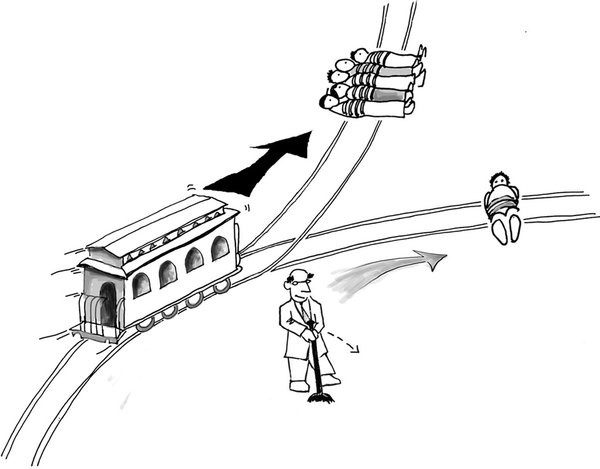
Say a trolley is heading down the railway tracks. Ahead, on the tracks are five people tied down who cannot move. The trolley is headed straight for them, and will kill them. You are standing some distance ahead, next to a lever. If you pull this lever, the trolley switches to a different set of tracks, on which there is one person. You have two options:

1. Do nothing, in which case the trolley kills the 5 people on the main track.

2. Pull the lever, in which case the trolley changes tracks and kills the one person on the side track.

What should you do?

Trolley

The trolley problem illustrated

It’s not hard to see how a similar situation would come up in a world with self-driving cars, with the car having to make a similar decision.

Say for example a human-driven car runs a red light and a self-driving car has two options:

  1. It can stay its course and run into that car killing the family of five sitting in that car
  2. It can turn right and bang into another car in which one person sits, killing that person.

What should the car do?

From a utilitarian perspective, the answer is obvious: to turn right (or “pull the lever”) leading to the death of only one person as opposed to five.

Incidentally, in a survey of professional philosophers on the Trolley Problem, 68.2% agreed, saying that one should pull the lever. So maybe this “problem” isn’t a problem at all and the answer is to simply do the Utilitarian thing that “greatest happiness to the greatest number”.

But can you imagine a world in which your life could be sacrificed at any moment for no wrongdoing to save the lives of two others?

Now consider this version of the trolley problem involving a fat man:

As before, a trolley is heading down a track towards five people. You are on a bridge under which it will pass, and you can stop it by putting something very heavy in front of it. As it happens, there is a very fat man next to you — the only way for you to stop the trolley is to push him over the bridge and onto the track, killing him to save five people. Should you do it?

Most people that go the utilitarian route in the initial problem say they wouldn’t push the fat man. But from a utilitarian perspective there is no difference between this and the initial problem — so why do they change their mind? And is the right answer to “stay the course” then?

Kant’s categorical imperative goes some way to explaining it:

Act only according to that maxim whereby you can, at the same time, will that it should become a universal law.

In simple words, it says that we shouldn’t merely use people as means to an end. And so, killing someone for the sole purpose of saving others is not okay, and would be a no-no by Kant’s categorical imperative.

Another issue with utilitarianism is that it is a bit naive, at least how we defined it. The world is complex, and so the answer is rarely as simple as perform the action that saves the most people. What if, going back to the example of the car, instead of a family of five, inside the car that ran the red light were five bank robbers speeding after robbing a bank. And sat in the other car was a prominent scientist who had just made a breakthrough in curing cancer. Would you still want the car to perform the action that simply saves the most people?

So may be we fix that by making the definition of Utilitarianism more intricate, in that we assign a value to each individuals life. In that case the right answer could still be to kill the five robbers, if say our estimate of utility of the scientist’s life was more than that of the five robbers.

But can you imagine a world in which say Google or Apple places a value on each of our lives, which could be used at any moment of time to turn a car into us to save others? Would you be okay with that?

And so there you have it, though the answer seems simple, it is anything but, which is what makes the problem so interesting and so hard. It will be a question that comes up time and time again as self-driving cars become a reality. Google, Apple, Uber etc. will probably have to come up with an answer. To pull, or not to pull?

Lastly, I want to leave you another question that will need to be answered, that of ownership. Say a self-driving car which has one passenger in it, the “owner”, skids in the rain and is going to crash into a car in front, pushing that car off a cliff. It can either take a sharp turn and fall of the cliff or continue going straight leading to the other car falling of the cliff. Both cars have one passenger. What should the car do? Should it favor the person that bought it — its owner?

Google launching its Self-Driving Car in Silicon Valley This Summer 2015

Further Reading:

http://www.nytimes.com/2015/05/16/technology/google-to-test-bubble-shaped-self-driving-cars-in-silicon-valley.html?smid=nytcore-ipad-share&smprod=nytcore-ipad&_r=0

Photo

A prototype of Google’s self-driving car. Credit Tony Avelar/Associated Press

SAN FRANCISCO — The world is one step closer to the day when people can, in good conscience, drive to work while sipping coffee, texting with a friend and working on a laptop computer.

On Friday, Google announced that sometime this summer several prototype versions of its self-driving cars are set to hit the streets of Mountain View, Calif., the search giant’s hometown. The move is still just another round of testing but it is a significant step toward a pilot program in which regular consumers could ride in self-driving cars.

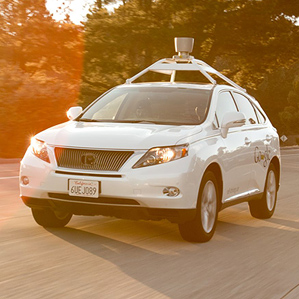
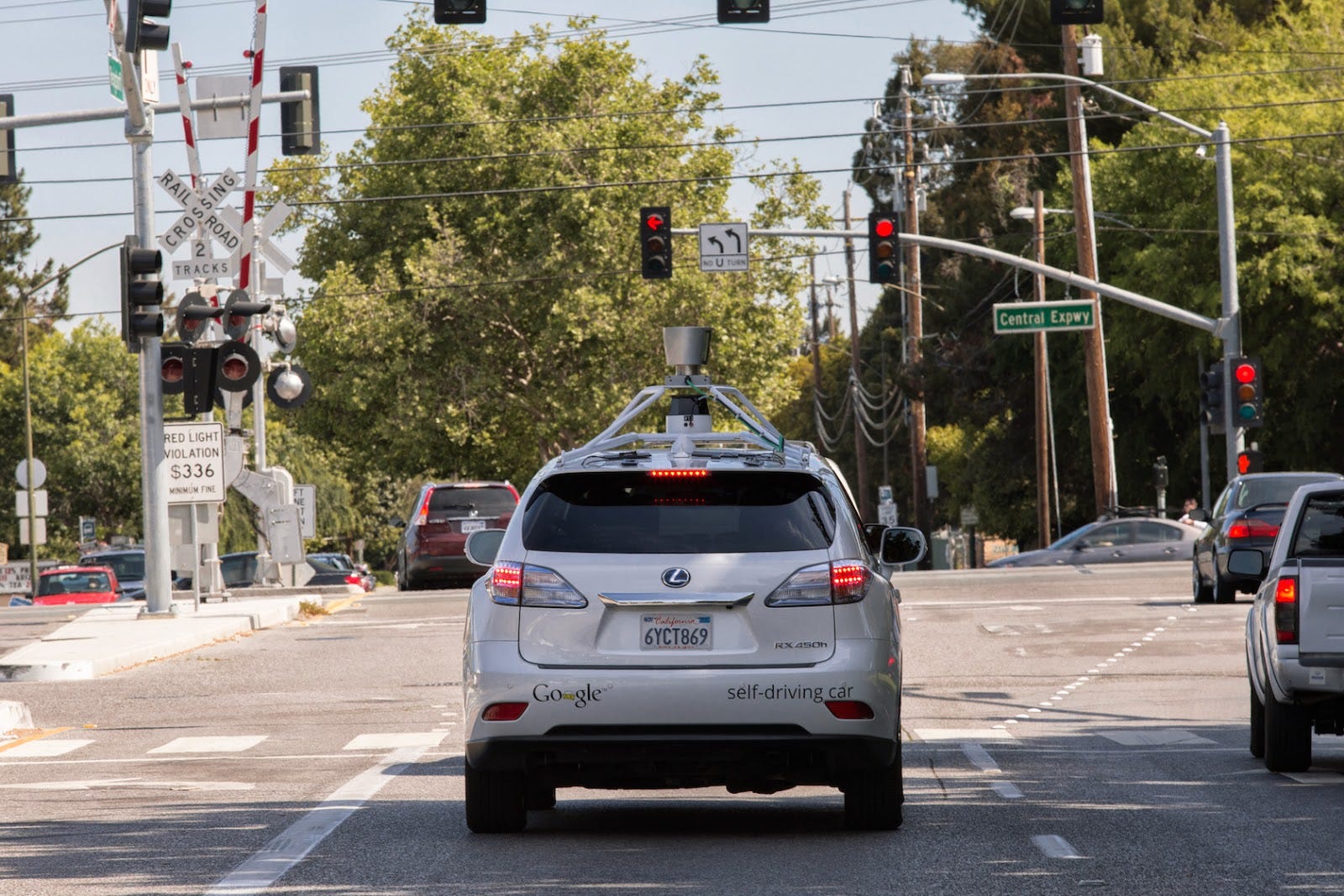
Google has long been testing its self-driving car technology with a fleet of Lexus sport utility vehicles that have driven about a million miles on public roads, and that continue to put in 10,000 miles each week.

Traditional automakers are also pushing the envelope of driverless tech with on-the-road testing of their own autonomous prototypes, and the industry predicts that by 2020 those dreams could come true.

Getting there is now much more about software than hardware. The systems of radar, lasers and cameras currently used by Google and automakers have grown so sophisticated that the vehicles can easily monitor the road in all directions — even beyond what the eye can see. The tough part is figuring out what to do with all that information.

In essence, the cars need an electronic brain that knows how to drive in a world where human drivers, as well as pedestrians and bicyclists, often do unpredictable things.

They also need to understand regional differences. Drivers in Boston, for instance, often behave differently than those in Atlanta or Los Angeles, where unspoken rules of the road and cultural cues can vary.

City environments are particularly challenging, and require software with much more flexibility and power. That’s one of the reasons Google (and its rival, Apple) hope their software acumen can help them solve the puzzle. And now that Google will be testing its new bubble-shaped cars on public roads near its Mountain View headquarters, it’s getting one step closer to honing its predictive technology for urban settings.

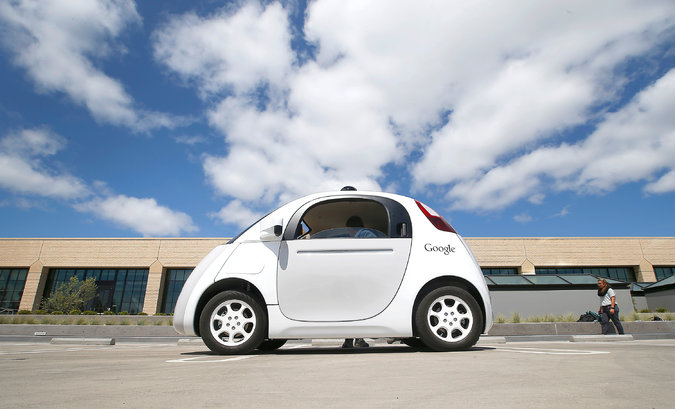
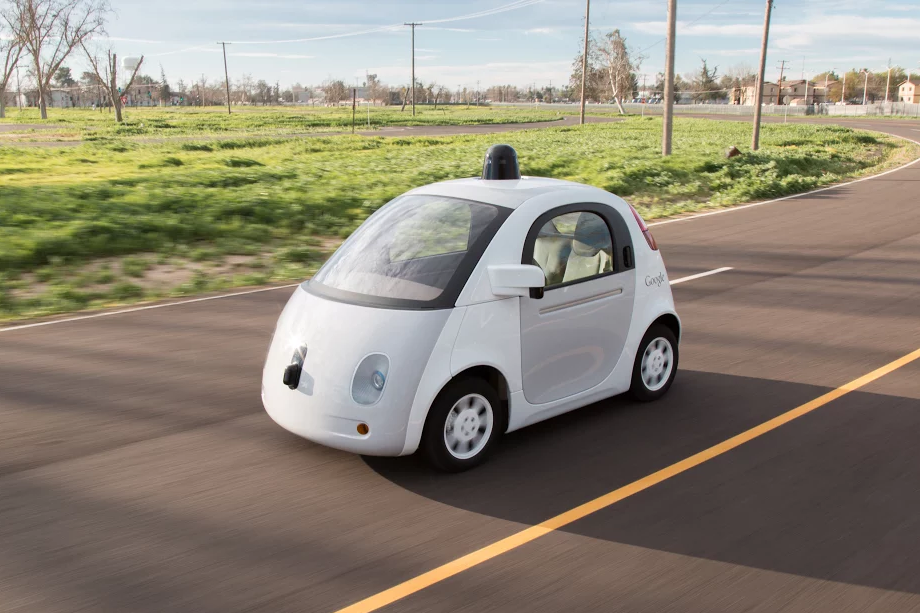
Unlike the fleet of self-driving Lexuses that are already on the road, Google’s prototype, which looks like a golf cart with doors, is designed to be a fully autonomous car in which people get in, set their destination and relax as the car does the work. The prototypes cannot go faster than 25 miles per hour and, for now, have a steering wheel and pedals so that a “safety driver” could take over.

The steering wheel is a legal requirement, but Google’s plan is to take the driver out of driving completely.

Earlier this year, during a presentation at the South by Southwest festival in Austin, Astro Teller, head of the Google X research division that created the self-driving car, said that in autumn 2012 the company started allowing Google employees to take the Lexus version home and self-drive on the freeway, so long as they kept paying attention in the event of an emergency.

Despite this, the employees got used to self-driving and stopped paying attention.

“The assumption that humans can be a reliable backup for the system was a total fallacy,” Mr. Teller said in the presentation. “Once people trust the system, they trust it.” Google realized the best thing to do “was to make a car that has no steering wheel, that has no brake pedal, that has no acceleration pedal — that drives itself all the time, from point A to point B, at the push of a button.”

Of course, nothing is accident-proof. Earlier this week, Chris Urmson, director of Google’s Self-Driving Car Project, disclosed that self-driving cars had been in 11 “minor accidents” in which there was only light damage and no injuries, and that “not once was the self-driving car the cause of the accident.”

This included seven rear-end collisions, a couple of wrecks in which cars were sideswiped and one crash in which the self-driving car was hit by a driver who rolled through a stop sign.

The challenge of city driving is one reason driverless technology has first arrived on highways. In the coming months, Tesla Motors has promised to introduce an “autopilot” feature that can take over highway driving in certain conditions. Next year, other automakers will do the same, such as General Motors’ “Super Cruise,” which will allow hands-off-the-wheel, foot-off-the-pedals highway driving.

Parking is another area that is poised for an overhaul. Companies like Ford already offer cars that pull into parking spaces automatically. The French supplier Valeo, which works with multiple automakers, is now working on technology aimed at parking garages where you can pull up to a garage and get out, leaving your car to find an available space and park itself.

When you’re ready to leave, the car acts like a robotic valet as it unparks and meets you out front.

Google gets green lights for their self-driving vehicle prototypes

http://googleblog.blogspot.co.at/2015/05/self-driving-vehicle-prototypes-on-road.html

„When we started designing the world’s first fully self-driving vehicle, our goal was a vehicle that could shoulder the entire burden of driving. Vehicles that can take anyone from A to B at the push of a button could transform mobility for millions of people, whether by reducing the 94 percent of accidents caused by human error (PDF), reclaiming the billions of hours wasted in traffic, or bringing everyday destinations and new opportunities within reach of those who might otherwise be excluded by their inability to drive a car.

Now we’re announcing the next step for our project: this summer, a few of the prototype vehicles we’ve created will leave the test track and hit the familiar roads of Mountain View, Calif., with our safety drivers aboard.

Our safety drivers will test fully self-driving vehicle prototypes like this one on the streets of Mountain View, Calif., this summer.

We’ve been running the vehicles through rigorous testing at our test facilities, and ensuring our software and sensors work as they’re supposed to on this new vehicle. The new prototypes will drive with the same software that our existing fleet of self-driving Lexus RX450h SUVs uses. That fleet has logged nearly a million autonomous miles on the roads since we started the project, and recently has been self-driving about 10,000 miles a week. So the new prototypes already have lots of experience to draw on—in fact, it’s the equivalent of about 75 years of typical American adult driving experience.

Each prototype’s speed is capped at a neighborhood-friendly 25mph, and during this next phase of our project we’ll have safety drivers aboard with a removable steering wheel, accelerator pedal, and brake pedal that allow them to take over driving if needed. We’re looking forward to learning how the community perceives and interacts with the vehicles, and to uncovering challenges that are unique to a fully self-driving vehicle—e.g., where it should stop if it can’t stop at its exact destination due to construction or congestion. In the coming years, we’d like to run small pilot programs with our prototypes to learn what people would like to do with vehicles like this. If you’d like to follow updates about the project and share your thoughts, please join us on our Google+ page. See you on the road!

Accident Causes of the Google Self-Driving Car

Source: https://medium.com/backchannel/the-view-from-the-front-seat-of-the-google-self-driving-car-46fc9f3e6088


The View from the Front Seat of the Google Self-Driving Car

After 1.7 million miles we’ve learned a lot — not just about our system but how humans drive, too.

About 33,000 people die on America’s roads every year. That’s why so much of the enthusiasm for self-driving cars has focused on their potential to reduce accident rates. As we continue to work toward our vision of fully self-driving vehicles that can take anyone from point A to point B at the push of a button, we’re thinking a lot about how to measure our progress and our impact on road safety.

One of the most important things we need to understand in order to judge our cars’ safety performance is “baseline” accident activity on typical suburban streets. Quite simply, because many incidents never make it into official statistics, we need to find out how often we can expect to get hit by other drivers. Even when our software and sensors can detect a sticky situation and take action earlier and faster than an alert human driver, sometimes we won’t be able to overcome the realities of speed and distance; sometimes we’ll get hit just waiting for a light to change. And that’s important context for communities with self-driving cars on their streets; although we wish we could avoid all accidents, some will be unavoidable.

The most common accidents our cars are likely to experience in typical day to day street driving — light damage, no injuries — aren’t well understood because they’re not reported to police. Yet according to National Highway Traffic Safety Administration (NHTSA) data, these incidents account for 55% of all crashes. It’s hard to know what’s really going on out on the streets unless you’re doing miles and miles of driving every day. And that’s exactly what we’ve been doing with our fleet of 20+ self-driving vehicles and team of safety drivers, who’ve driven 1.7 million miles (manually and autonomously combined). The cars have self-driven nearly a million of those miles, and we’re now averaging around 10,000 self-driven miles a week (a bit less than a typical American driver logs in a year), mostly on city streets.

In the spirit of helping all of us be safer drivers, we wanted to share a few patterns we’ve seen. A lot of this won’t be a surprise, especially if you already know that driver error causes 94% of crashes.

If you spend enough time on the road, accidents will happen whether you’re in a car or a self-driving car. Over the 6 years since we started the project, we’ve been involved in 11 minor accidents (light damage, no injuries) during those 1.7 million miles of autonomous and manual driving with our safety drivers behind the wheel, and not once was the self-driving car the cause of the accident.

Rear-end crashes are the most frequent accidents in America, and often there’s little the driver in front can do to avoid getting hit; we’ve been hit from behind seven times, mainly at traffic lights but also on the freeway. We’ve also been side-swiped a couple of times and hit by a car rolling through a stop sign. And as you might expect, we see more accidents per mile driven on city streets than on freeways; we were hit 8 times in many fewer miles of city driving. All the crazy experiences we’ve had on the road have been really valuable for our project. We have a detailed review process and try to learn something from each incident, even if it hasn’t been our fault.

Not only are we developing a good understanding of minor accident rates on suburban streets, we’ve also identified patterns of driver behavior (lane-drifting, red-light running) that are leading indicators of significant collisions. Those behaviors don’t ever show up in official statistics, but they create dangerous situations for everyone around them.

Lots of people aren’t paying attention to the road. In any given daylight moment in America, there are 660,000 people behind the wheel who are checking their devices instead of watching the road. Our safety drivers routinely see people weaving in and out of their lanes; we’ve spotted people reading books, and even one playing a trumpet. A self-driving car has people beat on this dimension of road safety. With 360 degree visibility and 100% attention out in all directions at all times; our newest sensors can keep track of other vehicles, cyclists, and pedestrians out to a distance of nearly two football fields.

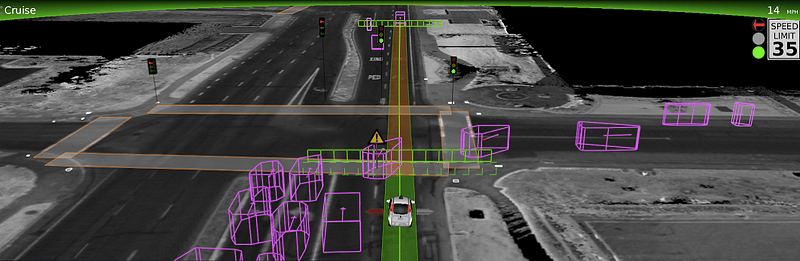
Intersections can be scary places. Over the last several years, 21% of the fatalities and about 50% of the serious injuries on U.S. roads have involved intersections. And the injuries are usually to pedestrians and other drivers, not the driver running the red light. This is why we’ve programmed our cars to pause briefly after a light turns green before proceeding into the intersection — that’s often when someone will barrel impatiently or distractedly through the intersection.

In this case, a cyclist (the light blue box) got a late start across the intersection and narrowly avoided getting hit by a car making a left turn (the purple box entering the intersection) who didn’t see him and had started to move when the light turned green. Our car predicted the cyclist’s behavior (the red path) and did not start moving until the cyclist was safely across the intersection.

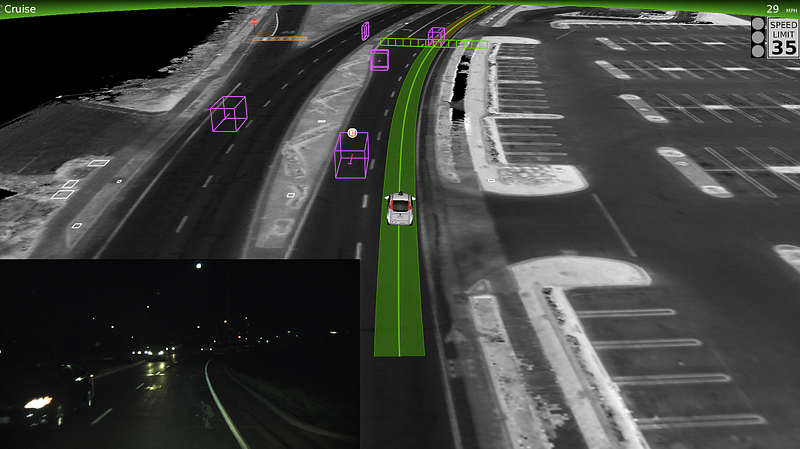
Turns can be trouble. We see people turning onto, and then driving on, the wrong side of the road a lot — particularly at night, it’s common for people to overshoot or undershoot the median.

In this image you can see not one, but two cars (the two purple boxes on the left of the green path are the cars you can see in the photo) coming toward us on the wrong side of the median; this happened at night on one of Mountain View’s busiest boulevards.

Other times, drivers do very silly things when they realize they’re about to miss their turn.

A car (the purple box touching the green rectangles with an exclamation mark over it) decided to make a right turn from the lane to our left, cutting sharply across our path. The green rectangles, which we call a “fence,” indicate our car is going to slow down to avoid the car making this crazy turn.

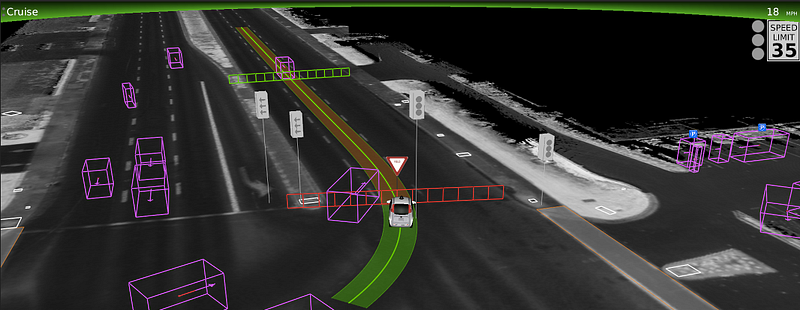
And other times, cars seem to behave as if we’re not there. In the image below, a car in the leftmost turn lane (the purple box with a red fence through it) took the turn wide and cut off our car. In this case, the red fence indicates our car is stopping and avoiding the other vehicle.

These experiences (and countless others) have only reinforced for us the challenges we all face on our roads today. We’ll continue to drive thousands of miles so we can all better understand the all too common incidents that cause many of us to dislike day to day driving — and we’ll continue to work hard on developing a self-driving car that can shoulder this burden for us.

Chris Urmson is director of Google’s self-driving car program.