Archiv der Kategorie: Innovation

Why Amazon has no profit—and why it works

Amazon has a tendency to polarize people. On one hand, there is the ruthless, relentless, ferociously efficient company that’s building the Sears Roebuck of the 21st century. But on the other, there is the fact that almost 20 years after it was launched, it has yet to report a meaningful profit. This chart captures the contradiction pretty well—massive revenue growth, no profits, or so it would seem. But actually, neither of these lines gives you a good sense of what’s really going on.

Amazon discloses revenue in three segments—Media, Electronics & General Merchandise (‘EGM’) and ‘Other’, which is mostly AWS. As this chart shows, these look very different (this and most of the following ones use ’TTM’—trailing 12 months, which smooths out the seasonal fluctuations and makes it easier to see the underlying trends). The media business is still growing, but it’s the general merchandise that has powered the explosion in revenue in the past few years. Meanwhile, the ‘Other’ line is growing but is still much smaller.

Splitting out the detail, we can see this trend both in North America (NA) and internationally…

Though the takeoff is particularly strong in the USA.

Media overall was only 25% of Amazon’s revenue last quarter, and 20% of North America.

And if we go back to ‘Other’ and zoom in, the growth is pretty dramatic there too.

It seems pretty likely that these businesses, selling very different products bought with different bargaining positions to different people with different shipping costs, have different margin potential.

This still doesn’t really give an accurate picture, though. Amazon is in fact organized not just in these segments, but in dozens and dozens of separate teams, each with their own internal P&L and a high degree of autonomy. So, say, shoes in Germany, electronics in France or makeup in the USA are all different teams. Each of these businesses, incidentally, sets its own prices. Meanwhile, all of these businesses are at different stages of maturity. Some are relatively old, and well established, and growing slower, and are profitable. Others are new startups building their business and losing money as they do so, like any other new business. Some are very profitable, and some sell at cost or at as loss-leaders to drive traffic and loyalty to the site. Books are a good example. There’s a widespread perception that Amazon sells books at a loss, but the average sales price actually seems to be very close to physical retailers—it discounts some books, but not all, and despite all the argument in the Agency lawsuits, quite how many and how much is (deliberately) as clear as mud.

Amazon is a bundle.

The clearest  expression of this is Prime, in which (amongst other things) entertainment content is included at a high fixed cost to Amazon (buying the rights) but no marginal cost beyond bandwidth, as a way to enhance the appeal of being a Prime ‘member’. Prime membership in turn draws people to switch more and more of their online and offline spending to Amazon. Trying to look at the profitability of the video alone misses the point.

And then there are the third party sales. Just as AWS is a platform both for Amazon’s own internal technologies and for thousands of startups, so too the logistics and commerce infrastructure themselves are a platform for lots and lots of different Amazon businesses, and also for lots of other companies selling physical products through Amazon’s site. Third party sales of products through Amazon’s own platform are now 40% of unit sales, and the fees charged to these vendors are now 20% of Amazon’s revenue.

This means, in passing, that for close to half of the units sold on Amazon.com, Amazon does not set the price, it just takes a margin. This alone should point to the weakness of the idea that Amazon’s growth is based on selling at cost or at a loss.

The tricky thing about these third party (‘3P’) sales is that Amazon only recognizes revenue from the services it provides to those companies, not the value of the goods sold. So if you buy a pair of shoes on Amazon from a third party, Amazon might collect payment through your Amazon account and ship them from its warehouse using its shipping partners—but only show the shipping and payment fees it charged to the shoe vendor as revenue. It does not disclose the gross revenue (‘GMV’). Given that (as it does disclose) third party sales tend to have a higher unit value, this means that the total value of goods that pass though Amazon with Amazon taking a percentage is perhaps double the revenue that Amazon actually reports. So, the revenue line is not really telling you what’s going on, and this is also one reason why gross margin is pretty misleading too. Gross profit has risen from 22.4% in 2011 to 27.2% in 2013, but this does not really reflect a change in consumer pricing and margins thereof, but rather this change in mix.

So, we have dozens of separate businesses within Amazon, and over two million third party seller accounts, all sitting on top of the Amazon fulfillment and commerce platform. Some of them are mature and profitable, and some are not. And someone at Amazon has the job of making sure that each quarter, this nets out to as close to zero as possible, at least as far as net income goes. That is, the problem with net income is that all it tells us is that every quarter, Amazon spends whatever’s left over to get the number to zero or thereabouts. There’s really no other way to achieve that sort of consistency.

If you listen closely, Amazon itself tells us this. The image below comes straight from Amazon—originally it was a napkin sketch by Jeff Bezos. Note that there’s no arrow pointing outwards labeled  ‘take profits.’ This is a closed loop.

(Source: Amazon)

(Source: Amazon)

In any case, profits as reported in the net income line are a pretty bad way to try to understand a business like this—actual cash flow is better. As the saying goes, profit is opinion but cash is a fact, and Amazon itself talks about cash flow, not net income (Enron, for obvious and nefarious reasons, was the other way around). Amazon focuses very much on free cash flow (FCF), but it’s very useful to look also at operating cash flow (OCF), which is simply what you get adding back capital expenditure (‘capex’). In effect, OCF is the bulk of  running the business before the costs of the infrastructure, M&A and financing costs. This shows you the effect of selling at low prices. As we can see here, Amazon’s OCF margin has been very roughly stable for a decade, but the FCF has fallen, due to radically increased capex.

In absolute terms, you can therefore see a business that is spinning out rapidly growing amounts of operating cash flow—over $5bn in the last 12 months—and ploughing it back into the business as capex.

Charting this as lines rather than areas shows just how consistent the growth in capex has been.

One might suggest that in a logistics business with rapid revenue growth, rapid capex growth is only natural, and one should look at the ratio of capex to sales by itself. But in fact, the increase here is even more dramatic. Starting in 2009, Amazon began spending far more on capex for every dollar that comes in the door, and there’s no sign of the rate of increase slowing down.

If Amazon had held capex/sales at the same ratio from 2009, before it exploded, then FCF would look like this. That difference adds up to just over $3bn of cash in the last 12 months. That is, if Amazon was spending the same on capex per dollar of revenue as it was in 2009, it would have kept $3bn more in cash in the last 12 months.

So where’s all the extra capex going? And, crucially, does it need to stay at these new, higher levels to support Amazon’s business, or can it come back down in the future?

It’s pretty apparent that the money is going into more fulfillment capacity (warehouses, to put it crudely) and to AWS. Hence, this chart shows an enormous increase in Amazon’s physical infrastructure, as measured in square feet—this is almost all fulfillment rather than data centers, though Amazon no longer gives a split.

Pulling apart precisely where the money’s going, though, is a little fiddlier. The increase is driven by some combination of four things:

  1. More capacity for more products, including 3P products
  2. Proximity—as Amazon builds warehouses closer to customers, the shipping time goes down and so too does the shipping cost, a further flywheel effect for Prime
  3. AWS
  4. More expensive warehouses—that is, the existing business is becoming more expensive to run

The first two of these are straightforward investment in the future, often delivering higher future margins. AWS is a black box and a much debated puzzle, but it is also pretty much the definition of a new business that requires investment to grow. The real bear case here would be the last point— that the existing business is becoming more capex-intensive—that more dollars of capex are needed for every dollar of current revenue.

Just to make life harder for those looking to understand Amazon’s financials, the warehouse expansion, capex expansion and AWS build-out all started at roughly the same time, and at that same moment Amazon changed the way it reports to make it very hard to pick them apart. Until 2010 it split both property and asset value between fulfillment and data centers, but at that point it stopped, probably not by coincidence (in 2010 Amazon had just 775,000 square feet for data centers and customer service combined). In the meantime, there are various metrics (capex per square foot, for example) that would show a shift of spending from cheap warehouse to expensive data centers—but they would also show a shift from maintaining existing warehouses to building new ones. So there is no direct, easy way we can see the split.

We can still, though, get a something of a sense of the key warehouse question—has the business gotten more expensive to run? It looks like the answer is no. First, the third party sales do not seem to be the issue: ratio of 3P units has not gone up at anything like the way the capex/sales has over the same period (here’s that chart again).

Neither is there any sign of a shift in the fulfillment costs over the period (Amazon seems to have forgotten to stop disclosing these). The physical product mix hasn’t got dramatically more expensive to ship, so would it get dramatically more capex-intensive to warehouse? This is obviously not an exact proxy, but it seems unlikely.

15.png

So, though we can’t be sure, it looks like the capex is not going up because Amazon’s existing business has become more expensive to run, but because Amazon is investing the growing pool of operation cash flow into the future. All of this brings us back to the beginning—Amazon’s business is delivering very rapid revenue growth but not accumulating any surplus cash or profits, because every penny of cash is being ploughed back into expanding the business further. But, this is not because any given business runs permanently at a loss—it is because the profits from what is already there are spent on making new businesses. In the past, that was mostly in operations, but in recent years the investment firehose has again been pointed at capex.

How long will this investment go on for? Well, do we believe that the conversion of products and businesses to online commerce is finished? Let’s rebase that revenue chart, and look at it as share of US retail revenue. Excluding gasoline, food and things like timber and plants, all hard to ship, at least for now, Amazon has about 1%.

Overall, US commerce is growing very consistently:

And Amazon is taking an accelerating share of it.

Amazon has perhaps 1% of the US retail market by value. Should it stop entering new categories and markets and instead take profit, and by extension leave those segments and markets for other companies? Or should it keep investing to sweep them into the platform? Jeff Bezos’s view is pretty clear: keep investing, because to take profit out of the business would be to waste the opportunity. He seems very happy to keep seizing new opportunities, creating new businesses, and using every last penny to do it.

Still, investors put their money into companies, Amazon and any other, with the expectation that at some point they will get cash out. With Amazon, Bezos is deferring that profit-producing, investor-rewarding day almost indefinitely into the future. This prompts the suggestion that Amazon is the world’s biggest ‘lifestyle business’—Bezos is running it for fun, not to deliver economic returns to shareholders, at least not any time soon.

But while he certainly does seem to be having fun, he is also building a company, with all the cash he can get his hands on, to capture a larger and larger share of the future of commerce. When you buy Amazon stock (the main currency with which Amazon employees are paid, incidentally), you are buying a bet that he can convert a huge portion of all commerce to flow through the Amazon machine. The question to ask isn’t whether Amazon is some profitless ponzi scheme, but whether you believe Bezos can capture the future. That, and how long are you willing to wait?


Source: http://qz.com/262701/why-amazon-has-no-profit-and-why-it-works/

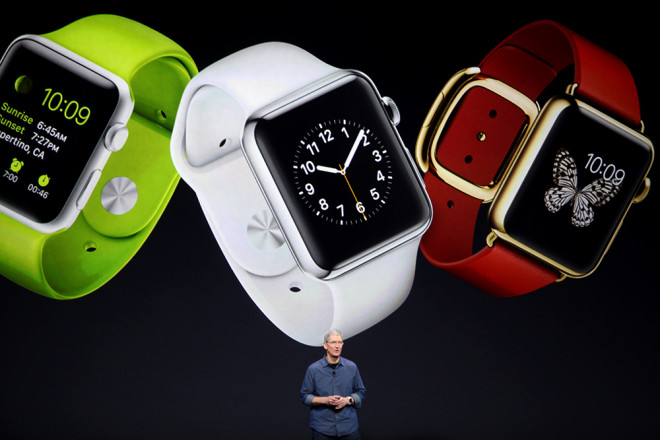
Apple Watch Event: Uhrsache (sic!) und Wirkung

Der Spiegel Online analysiert knallhart:

„Erst eingehende Tests werden zeigen, ob die Benutzung der neuen Uhren tatsächlich so intuitiv und angenehm ist, wie Cook und sein Team das bei der Vorstellung ein ums andere Mal betont haben. Sicher ist, dass Apple bis heute einen Vertrauensvorsprung hat, wenn es um die Einführung neuer Geräte geht. Steve Jobs versprach einst: Wenn wir etwas anfassen, dann machen wir es so, dass die Kunden es lieben werden. Löst die Apple Watch dieses Versprechen ein, dann kann sie einmal mehr einer Gerätekategorie zum Durchbruch verhelfen, bei denen andere die undankbare Vorreiterrolle übernommen haben. So wie das bei MP3-Playern, Touchscreen-Handys oder tragbaren Touch-Computern schon der Fall war.“

Und subsummiert, die Ängste, aller Beteiligten, Mitarbeiter, Fan-Boys, überzeugten Innovationsliebhabern, und Aktionären:

„Erweist sich die Apple Watch aber als überflüssiger Schnickschnack, als allzu klobiges Anhängsel mit zu wenig echtem Mehrwert für seinen Preis, dann kann die Uhr das Gegenteil bewirken: Wenn der Konzern nur einmal unter Beweis stellt, dass nicht jedes seiner Produkte automatisch zum unverzichtbaren Alltagsgegenstand wird, könnte das der Beginn eines rapiden Abstiegs werden.“

Tim-Cook


Spiegel Online resümmiert:

„Die Ankündigung mit der vermutlich nachhaltigsten Wirkung aber ist die zugleich am wenigsten spektakuläre. Der berührungslose Bezahldienst Apple Pay ist einmal mehr eine aufpolierte Kopie bereits im Markt befindlicher Angebote, man denke nur an Google Wallet. Android-Handys mit NFC-Chips gibt es längst, das Zahlen per Handy aber hat sich bislang nirgends durchgesetzt. Apple aber hat im Smartphone-Bereich in den USA bis heute einen Marktanteil von 40 Prozent – und Cooks Mannschaft hat es offenbar verstanden, sich mit vielen großen Laden- und Restaurantketten zu verbünden.

Schafft Apple es, mit seinen neuen Geräten schnell große Kundenzahlen zu erreichen – und die Geschichte legt nahe, dass das klappen könnte, – könnte mit einem Mal auch das Zahlen mit dem Handy – oder der Uhr – zur Alltagsgeste werden.

Für Ladenketten könnte die Anschaffung der entsprechenden Hardware mit einer ausreichend großen, zahlungskräftigen Klientel plötzlich doch interessant werden, und genau das sind Apples Kunden. Und stehen die Scanner erst einmal an den Ladenkassen, sind auch die NFC-Chips in allen anderen Handyfabrikaten plötzlich wieder im Spiel. Wenn das geschieht, wenn unsere digitalen Alltagsbegleiter auch zu unserem bevorzugten Zahlungsmittel werden, ist das zwar bequem – es bringt aber auch völlig neue Datenschutz– und Sicherheitsprobleme mit sich.“

Derstandard ergänzt:

„Das US-Magazin „Fortune“ würdigte Cook seinerzeit als „das Genie hinter Steve“. Als Zuständiger für das operative Geschäft sorgte er dafür, dass nach Umsetzung der kühnen Visionen schwarze Zahlen in den Büchern standen. Jetzt muss Cook mit der Computeruhr beweisen, dass sein Apple die gleiche visionäre Kraft wie zu Zeiten von Jobs hat. Dieses Image hilft dem Konzern, weltweit Millionen seiner teuren Premium-Smartphones und Tablets zu verkaufen.“

Original-Zitate nachzulesen bei: http://www.spiegel.de/netzwelt/gadgets/apple-watch-iphone-6-und-smartwatch-koennten-bezahlverhalten-aendern-a-990734.html und http://derstandard.at/2000005390426/Tim-Cook-tritt-mit-Apple-Watch-aus-dem-Schatten-von

2014′ Apple Special Event unboxing new Iphones, Apple Pay, Apple Watch and many more

See All the Glorious Gadgets From Apple’s Big Event

CUPERTINO, California—Today Apple unveiled a trifecta of new products that are surely sending worrisome ripples down the spines of the company’s competitors.

At a massive media event here at the Flint Center for Performing Arts, Apple announced two new large-screen iPhones, a new mobile payment platform, and an advanced touchscreen wristwatch. Judging by the numerous outbreaks of applause and the occasional standing ovation, the new products were met with great support by the huge audience of press, Apple employees, and VIPs from the entertainment, technology, and fashion industries.

But don’t worry if your eyes weren’t glued to the video livestream—or if you were one of the countless viewers who suffered from numerous drop-outs and technical problems and were left in the dark for much of the event. Here are the most important things you need to know about Apple’s big day.

The New iPhones: iPhone 6 and iPhone 6 Plus

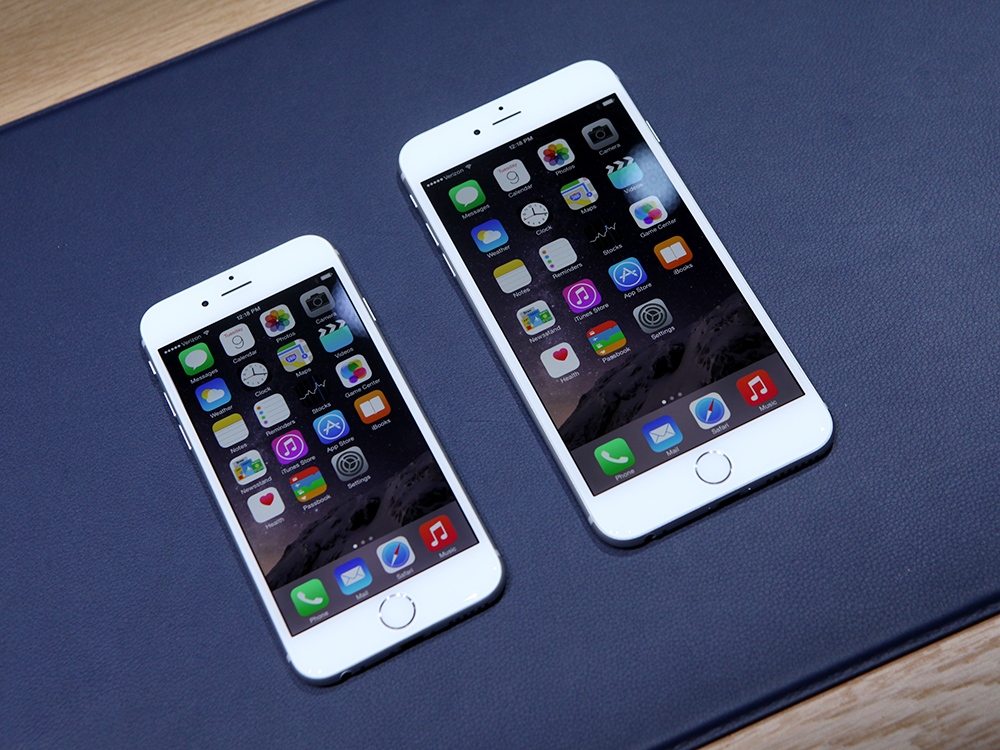
After a dramatic introductory video, Apple senior vice president Phil Schiller unveiled two new iPhone models today, the iPhone 6 and iPhone 6 Plus. Both are styled with a smooth, brushed aluminum rear face that curves gently into the front face. They look like small iPads.

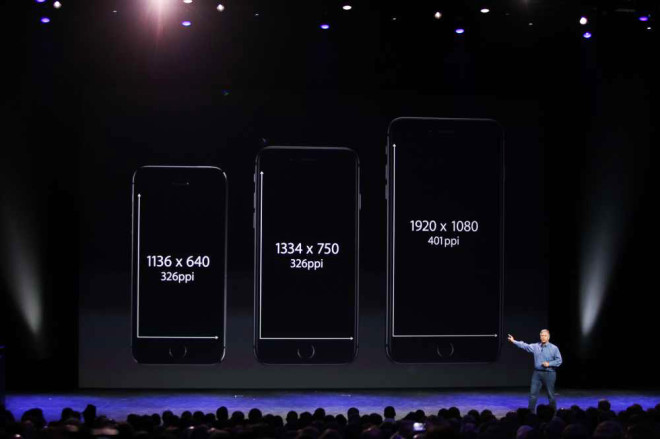
The iPhone 6 has a 4.7-inch display with a 1334×750 pixel resolution. The iPhone 6 Plus features a 5.5-inch screen with full HD 1920×1080 display resolution. Other than this size difference, the phones are essentially the same.


AppleSpecialEvent20140909-Iphones

iphone6

On the rear, they’ve got an 8-megapixel shooter with an f/2.2 aperture 8-megapixel camera. It’s got a new sensor and speedier autofocus. The 6 has digital image stabilization, but the 6 Plus also has additional optical image stabilization that uses its gyroscope and the M8 coprocessor to cancel out extra shakiness. The front-facing camera gets some new features like HDR and a burst-shot mode.

Inside, an A8 processor promises to be up to 87 percent more efficient than its predecessor, offering CPU processing power up to 25 percent faster and GPU speeds up to 50 percent faster than the iPhone 5s’ A7 chip. The M8 motion coprocessor, in addition to aiding in image stabilization, can now tell when you’re walking, running or cycling, and can give you credit if you’re traversing up and down stairs thanks to a barometer that detects changes in air pressure.

Both devices feature Touch ID home buttons and NFC (more on that in a sec). The iPhone 6 goes on sale Friday, September 19th starting at $200 on contract for 16 GB, $300 for 64 GB, and $400 for 128 GB. The iPhone 6 Plus starts at $100 more.

ApplePay, Apple’s Mobile Payment Initiative

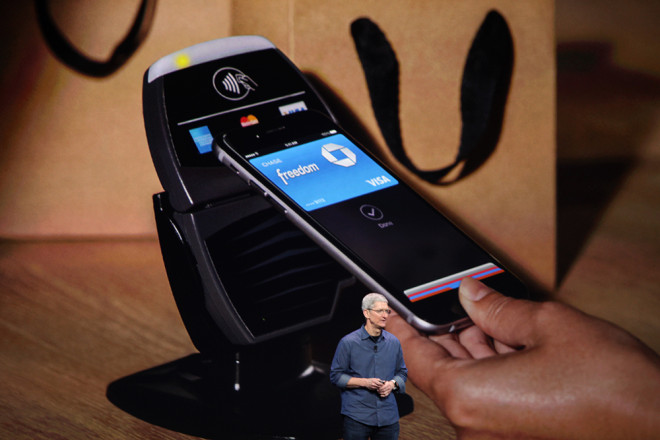
“Payments is a huge business. Every day between credit and debit, we spend $12 billion, and that’s just in the United States,” Cook said to introduce what a huge space payments is—a huge space digital payments have yet to crack.

AppleSpecialEvent20140909-ApplePay

applepayday

Working with American Express, MasterCard, and Visa, the new ApplePay systemas been designed to work with over 220,000 merchants at launch, including familiar locations like Walgreens, Whole Foods, Macy’s, and Target. Using NFC, you simply tap your phone on a payment terminal to purchase things. It’s that easy. How it works is a bit more complicated though. It uses a combination of NFC, Touch ID, and a secure chip Apple calls the Secure Element. You add a card by snapping a photo of it, then getting verification from your bank. During a transaction, a unique device number, rather than the actual credit card information, is sent to the merchant along with a dynamic security code. Apple doesn’t collect your data—what you buy is between you and the merchant. And if you lose your iPhone, you can suspend payments with Apple’s standard-issue Find My Friends app without needing to cancel your actual credit card.

It will launch in the U.S. in October as an update to iOS 8.

Apple’s Wearable: The Apple Watch

The biggest question mark surrounding today’s event was whether Apple would actually unveil its long-rumored wearable computing product. The company did not disappoint. The Apple Watch is officially here.

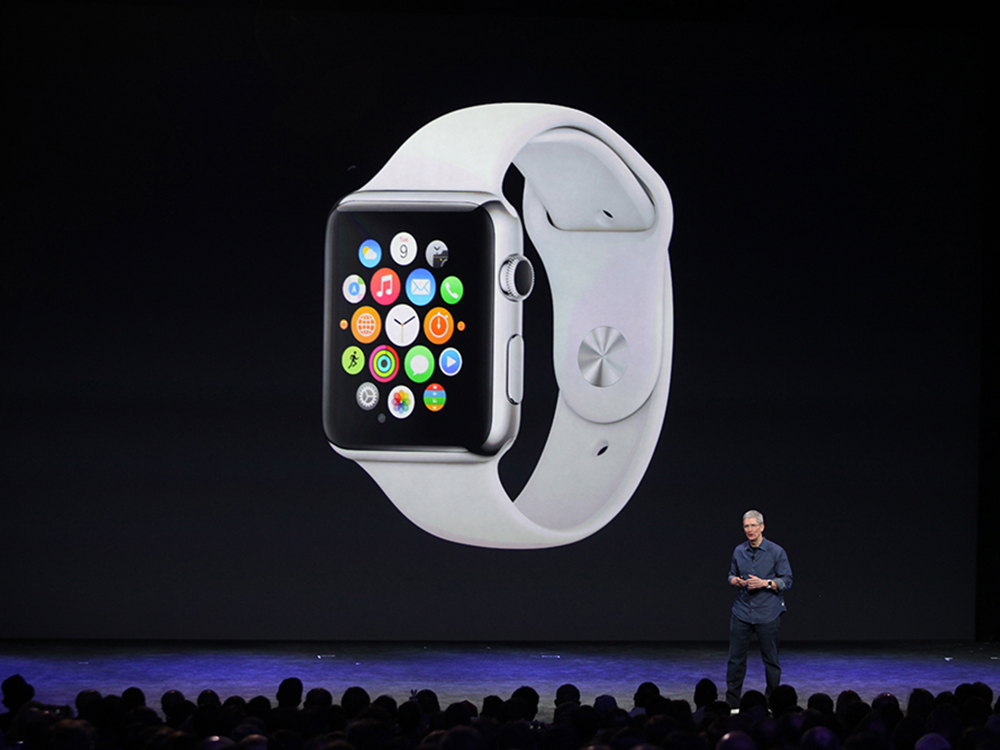
“Apple watch is the most personal device we’ve ever created,” Cook said after receiving a standing ovation and a round of wild applause. Apple’s CEO calls it “a new intimate way to connect and communicate direction from your wrist.”

The timepiece, which is accurate to within plus or minus 50 milliseconds, is not just technologically impressive. It’s also quite stylish. The faces and the different hardware choices let you trick out the watch to match your own personal style.

AppleSpecialEvent20140909-AppleWatch1

AppleWatchWristApps

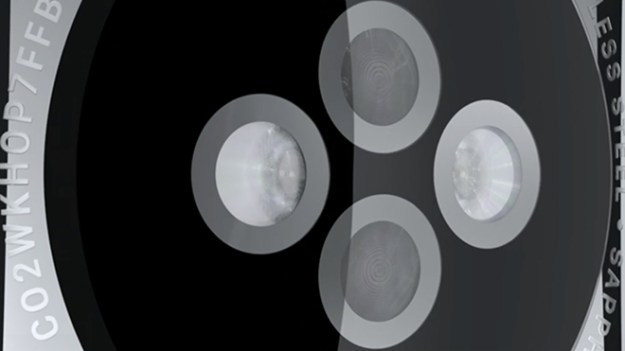
The watch face looks very similar to a traditional watch, including a dial on the side that Apple calls the “digital crown” that translates movement into digital data. Apple kept some of the tech specs on the vague side—the product won’t actually ship until next year. What we do know is that the display is a sheet of sapphire, and inside is a custom designed chip encapsulated to protect the electronics. On the rear are four sapphire lenses which hold LEDs and photo sensors for detecting your heart rate.

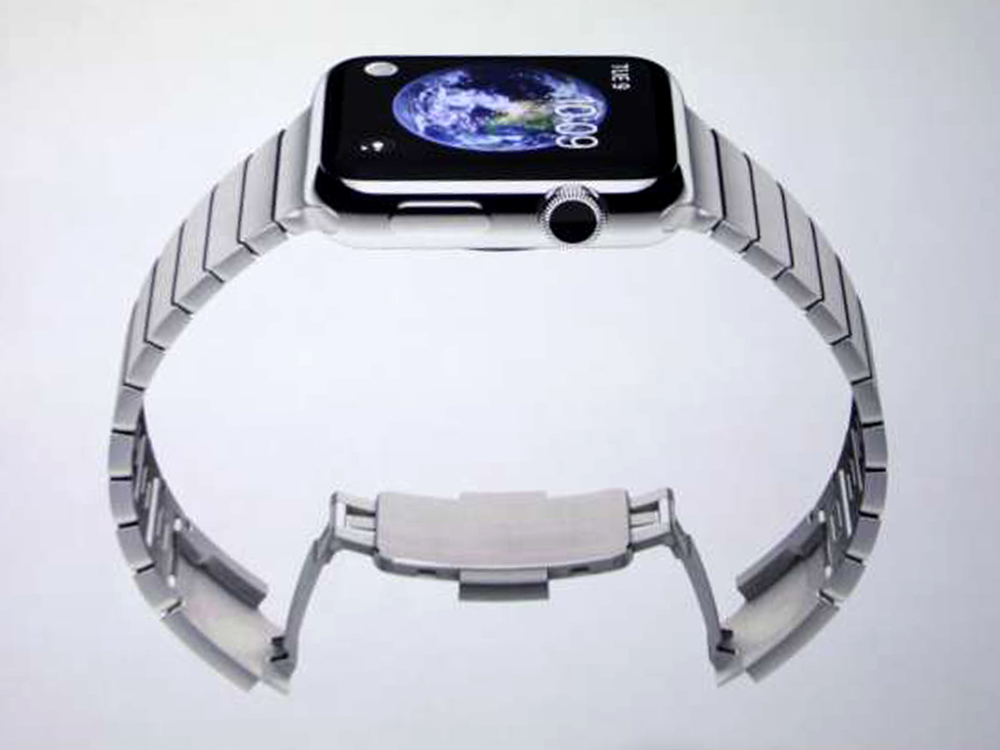
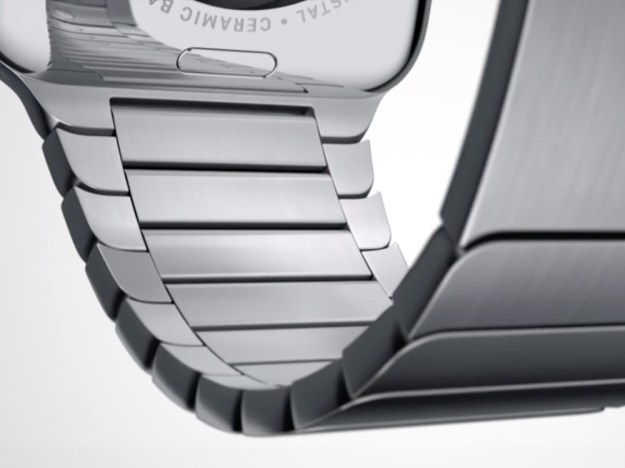
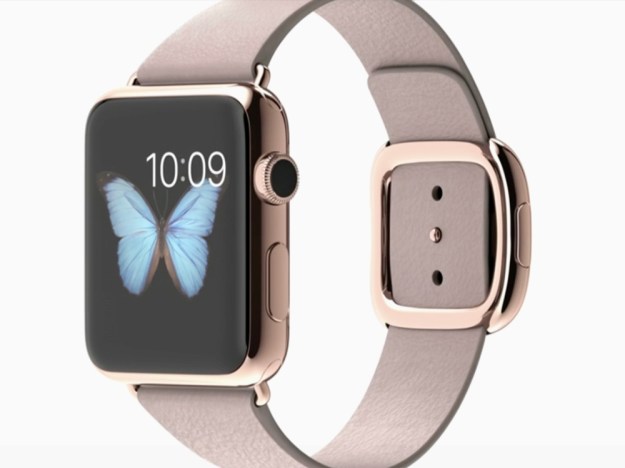
With regards to looks, the Apple Watch is a bit of a chameleon. It comes in three editions: Apple Watch, Watch Sport, and Watch Edition. Apple Watch is the most basic, Watch Sport is more durable, and Watch Edition is more exotic and made of gold. There are six different straps you can mix and match to suit your needs: a quilted leather strap with a magnetic clasping band, a traditional leather buckle, a stainless steel link bracelet, and a mesh chain loop are among the choices. The device comes in not just two band sizes, but two watch face sizes, to suit folks with different-sized wrists.

But it’s not just the hardware that’s customizable. “With every breakthrough, Apple has also had to have a breakthrough in user interface,” Cook said. What Apple didn’t do, he says, is take the iPhone and shrink the interface and strap it on your wrist. The display is too small, and it would make for a terrible user experience. Instead the digital crown is a key part of the navigation experience, as are onscreen taps and swipes.

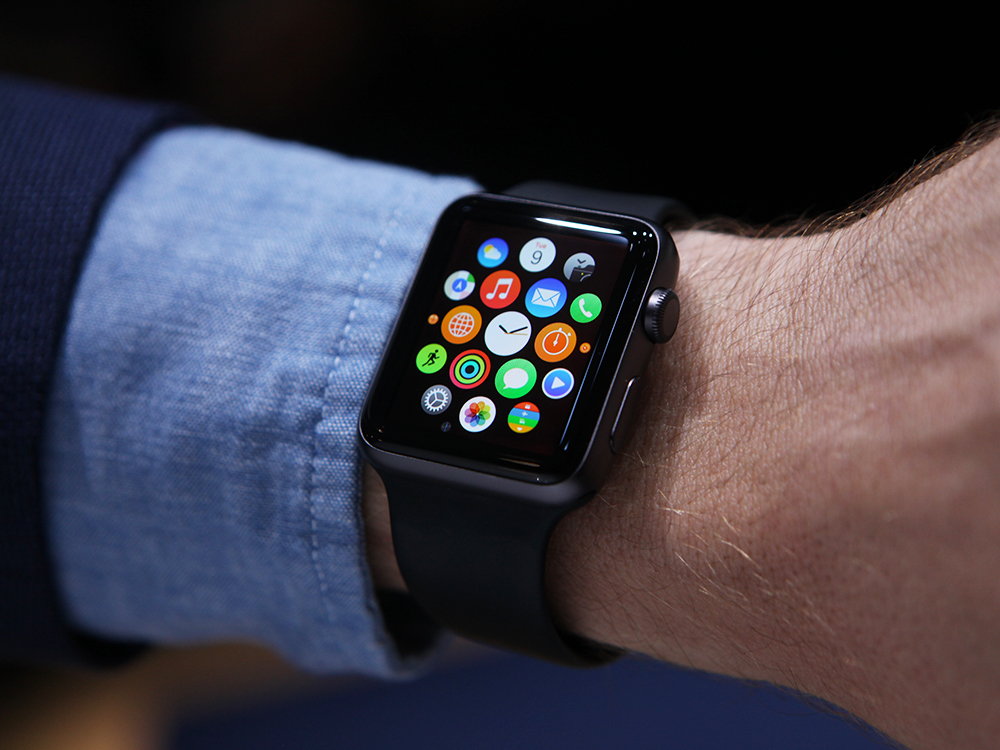
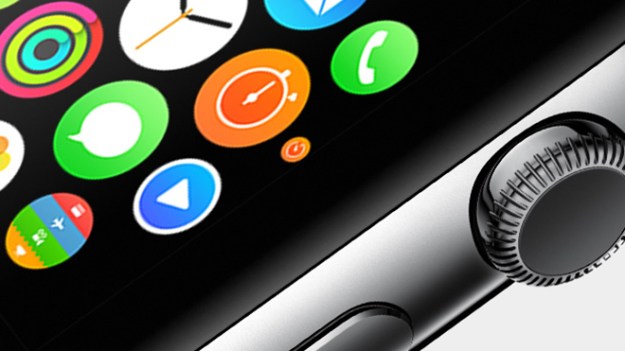
The menu screen is composed of bubbles of circular app icons you can arrange however you like, including grouping them by “neighborhood” of related apps. Twisting the crown zooms in and out on the group of apps. To open an app, you tap it. A feature called Glances lets you swipe upwards from the bottom of the screen to cycle through a customizable series of data screens. Siri is built into the watch, so you can dictate questions like “What movies are playing tonight?” A new feature called Digital Touch lets you select a contact then send a super-quick message just based on taps and drawings that your contact can then feel (via a vibration) when it reaches their wrist. It’s intended for messages that have a more personal context—and are a lot less wordy—than your usual text message.

The Apple Watch has a number of other apps including Maps, notifications from third-party apps, and a lot of customizable watch faces. Third-party apps, like ones from American Airlines and W Hotels, are also on the way. A pair of Apple-built health and fitness apps use both the watch and your iPhone’s sensors to give you a holistic view of your daily activities, combining the features of a general activity tracker and an advanced sport watch.

The Apple Watch charges using an inductive charger that fits on the back of its rectangular face. There’s no word about exact battery life yet. Few details were given about pricing, as well. All we know is that the Apple Watch will start at $350, and that it will go on sale in early 2015.

AppleWatchMetal

Source: http://www.wired.com/2014/09/apple-event-faq

Apple Watch – Apples Latest Consumer Innovation


Everything You Need to Know About the Apple Watch

AppleWatch      AppleWatchMetal

The wearable space just got bigger. Way bigger. Apple debuted its long-awaited wearable Tuesday, simply called Apple Watch.

There are actually three products: Apple Watch, Apple Watch Sport, and Apple Watch Edition. The differences between them are only apparent in the different materials (including aluminum, 18K gold, and pink gold) and wrist strap choices, which vary between feminine, masculine and youthful.

The Apple Watch starts at $350, and it will be available “early next year,” according to the company. Pricing for Apple Watch Sport and Apple Watch Edition were not announced at today’s event. The watch will require an iPhone to operate, but it works with the iPhone 5 or later and isn’t limited to just the new iPhone 6 devices.

AppleWatchSportsEdition

The interfaces of all three phones are alike, and there are a number of standout features.

Instead of interfacing with the watch by touching the screen, which just gets your fingers in the way and blocks your view, you can navigate through the menus and apps by touching the crown. Twist it to zoom in and out of screens and menus. Press it and you go back to the home screen (just like on the iPhone).

There’s an additional button just beneath the crown. Tapping it brings up something Apple calls “Digital Touch” communication. It’s based around a list of friends you’ve communicated with recently. You can send small pictures and sketches to your friends with just a few taps.

The screen itself works much like a Retina display on iPhones and iPads, but it can also sense force. So the familiar two-dimensional touch input system gains a third, vertical dimension.


AppleWatchSensorClose

On the back, there’s a crystal with LEDs that can measure your heart rate—this adds health-tracking capability to the watch. Also on the back is a wireless, inductive charging mechanism. The charger attaches to the back of the watch via a magnet. There’s also vibrating mechanism on the back so you can get notifications and haptic feedback for each of your finger taps.

Raising your wrist awakens the display. When it pops to life, you see a simplified list of apps made just for the watch. There are also several watch faces to choose from. You get sporty, chrono-style faces, retro digital readouts, and even a whimsical Mickey Mouse face. You can customize the color of the face by rotating the crown, or swipe to change the contents of the face so it shows the date and other fields of information on its screen.

AppleWatchGold

There are some health-tracking features to help you make your fitness goals for steps, calories burned, and so on. The watch also works with Apple Pay, the company’s new mobile payments system.

“We’ve been working on Apple watch for a long time,” Cook says. “It covered every discipline at Apple.”

AppleWatchMetal2

Kevin Lynch, a new face on Apple’s media event stage who led the software effort, stepped onstage in Cupertino to give us the first live demo of the watch.

Apple wanted to build the watch so functions were easy to find and use. The menu screens are bubbles of circular app icons you can arrange how you like. You can arrange “neighborhoods” of apps. To open an app, you tap it.


AppleWatchApple


Apple also thought it was important to relay other information in a glanceable way. It does this using a new interaction it calls Glances, a swipe up from the bottom of the watch face. You can arrange these how you like, swapping through the water, the music you’re playing on other devices, et cetera. You can also send some sort of silly 3-D animated smiley face, allowing you to share a lot of emotion without doing a whole lot.

AppleWatchHomeButtonClose

Siri is also built into the watch, so you can do things like ask what movies are playing tonight. You can use the crown or your finger to scroll through the list. There’s also a photo app. You can see an overview of photos, displayed in a grid-like Photostream, and you can use the crown to zoom into them, or swipe to scroll through them. You can pull up any collection of photos here.

AppleWatchGold2

In a map, you can pan around by swiping, you can also zoom out by rotating the crown. When you press the bottom left, it takes you back to where you are. There’s also a search command, you can search by diction or look through your favorites. Search a location like Whole Foods, you can get store information as well as directions for walking or driving.

AppleWatchWristApps

A big key to whether the watch succeeds or fails is the buy-in of third-party developers. Using the new development software pack called WatchKit, developers can create rich, actionable notifications for the device. Apple has been busy with partnerships and client applications for the launch, as well. The watch can alert you to friend requests on Facebook. Twitter’s there too. For an incoming tweet, you can reply straight from the message. You can view things on your timeline, look at trending tweets, or tap the top to compose a tweet. For when you’re traveling, American Airlines has an app. You can even unlock hotel room doors at some hotels using the watch. You can also get notified when you’re walking near sight seeing spots you’ve pinned on Pinterest and get walking directions to them. The watch works with BMW cars, you can challenge friends to runs on the Nike app, and you can control things in your home using the Honeywell app.

AppleWatchFemale


Source: http://www.wired.com/2014/09/apples-new-wearable

IPhone 6 and Iphone 6 Plus hitting the stores September 19 2014

Meet Apple’s Super-Sized iPhone 6 and iPhone 6 Plus

iphone6

As foretold by the rumors, Apple announced two new larger iPhone models today: the iPhone 6 and iPhone 6 Plus. Sized at 4.7-inches and 5.5-inches respectively, the phones sport a slick new style and landmark new features.

The iPhone 6 is priced at $200 for 16 GB, $300 for 64 GB, and $400 for 128 GB, with a two year contract. The larger iPhone 6 Plus commands a premium: $300 for 16 GB, $400 for 64 GB, and $500 for 128 GB. Both phones come in silver, gold, and black.

Pre-orders start this Friday, September 12, and the phones go on sale Friday the 19th.

Both phones sport new designs. The iPhone 6 and 6 Plus, with their larger displays, now feel reminiscent of a miniature iPad. The rear of each device is smooth brushed anodized aluminum that curves softly into its glass front face rather than being completely flat on the back with largely squared-off edges—the look the past four iPhones adopted. On the front, you’ve also got the familiar Touch ID home button.

The iPhone 6 has a 1334×750 display, the 6 Plus 1920×1080 display. That’s over 1 million pixels on the iPhone 6 and over 2 million on the iPhone 6 plus. These new display sizes use a new generation of Retina display Apple is calling Retina HD. The new reengineered displays use ion-strengthened glass on top, and on the bottom, an ultrathin backlight. Even with the larger display, Apple is promising the iPhone 6 and iPhone 6 Plus will have equal or better battery life than the last generation of iPhones.

apple-event-140909-Iphone6Sizecomparision


To use these big-screened phones, Apple’s introduced a few new software tricks to iOS. In the iPhone 6 Plus, the Messages app has a new horizontal split display. Stocks also has a two panel horizontal view, as does Mail. The keyboard takes advantage of the display area, too, and there’s a new horizontal homescreen view. These views obviously make better use of the increased screen real estate, but I wonder how easy it is to use with your fingers as you type.

You can also use swiping gestures for navigation in Mail, Messages, and Safari. There’s also a new gesture called reachability: If you double touch the home button, the display slides down so you can reach things at the top of the display without having to readjust your hand. This seems like a better solution than Samsung’s one-handed mode, but it’s still kind of awkward that it’s necessary.

Both phones will ship with iOS 8. Software updates will go out to older iPhones (the 4S and later) on September 17.

On the iPhone 6 line, Apple updated the camera hardware and software. Apple’s using a 8-megapixel camera with a f/2.2 aperture. There’s also a new sensor inside that’s an improvement over previous iPhone cameras, and a faster auto-focus. There’s the standard digital image stabilization at work in both phones, but in the bigger iPhone 6 Plus, there’s also an optical image stabilization system that uses the phone’s gyroscope and M8 processor to cancel out movements and shaking hands. Video is stabilized too, and there’s a new slow-mo mode that shoots at 240 fps.

Inside, a new A8 processor promises to keep things humming faster than any iPhone before, and the M8 chip has improved performance for motion-sensing and health-tracking. Working along side these updated processors is a new sensor: a barometer.

Source: http://www.wired.com/2014/09/apple-iphone-6-announced

Siri’s Inventors Are Building a New Artificial Intelligence That Does Anything You Ask

Siri14_1

Viv was named after the Latin root meaning live. Its San Jose, California, offices are decorated with tsotchkes bearing the numbers six and five (VI and V in roman numerals). Ariel Zambelich

When Apple announced the iPhone 4S on October 4, 2011, the headlines were not about its speedy A5 chip or improved camera. Instead they focused on an unusual new feature: an intelligent assistant, dubbed Siri. At first Siri, endowed with a female voice, seemed almost human in the way she understood what you said to her and responded, an advance in artificial intelligence that seemed to place us on a fast track to the Singularity. She was brilliant at fulfilling certain requests, like “Can you set the alarm for 6:30?” or “Call Diane’s mobile phone.” And she had a personality: If you asked her if there was a God, she would demur with deft wisdom. “My policy is the separation of spirit and silicon,” she’d say.

Over the next few months, however, Siri’s limitations became apparent. Ask her to book a plane trip and she would point to travel websites—but she wouldn’t give flight options, let alone secure you a seat. Ask her to buy a copy of Lee Child’s new book and she would draw a blank, despite the fact that Apple sells it. Though Apple has since extended Siri’s powers—to make an OpenTable restaurant reservation, for example—she still can’t do something as simple as booking a table on the next available night in your schedule. She knows how to check your calendar and she knows how to use Open­Table. But putting those things together is, at the moment, beyond her.

Now a small team of engineers at a stealth startup called Viv Labs claims to be on the verge of realizing an advanced form of AI that removes those limitations. Whereas Siri can only perform tasks that Apple engineers explicitly implement, this new program, they say, will be able to teach itself, giving it almost limitless capabilities. In time, they assert, their creation will be able to use your personal preferences and a near-infinite web of connections to answer almost any query and perform almost any function.

“Siri is chapter one of a much longer, bigger story,” says Dag Kittlaus, one of Viv’s cofounders. He should know. Before working on Viv, he helped create Siri. So did his fellow cofounders, Adam Cheyer and Chris Brigham.

For the past two years, the team has been working on Viv Labs’ product—also named Viv, after the Latin root meaning live. Their project has been draped in secrecy, but the few outsiders who have gotten a look speak about it in rapturous terms. “The vision is very significant,” says Oren Etzioni, a renowned AI expert who heads the Allen Institute for Artificial Intelligence. “If this team is successful, we are looking at the future of intelligent agents and a multibillion-dollar industry.”

Viv is not the only company competing for a share of those billions. The field of artificial intelligence has become the scene of a frantic corporate arms race, with Internet giants snapping up AI startups and talent. Google recently paid a reported $500 million for the UK deep-learning company DeepMind and has lured AI legends Geoffrey Hinton and Ray Kurzweil to its headquarters in Mountain View, California. Facebook has its own deep-learning group, led by prize hire Yann LeCun from New York University. Their goal is to build a new generation of AI that can process massive troves of data to predict and fulfill our desires.

Viv strives to be the first consumer-friendly assistant that truly achieves that promise. It wants to be not only blindingly smart and infinitely flexible but omnipresent. Viv’s creators hope that some day soon it will be embedded in a plethora of Internet-connected everyday objects. Viv founders say you’ll access its artificial intelligence as a utility, the way you draw on electricity. Simply by speaking, you will connect to what they are calling “a global brain.” And that brain can help power a million different apps and devices.

“I’m extremely proud of Siri and the impact it’s had on the world, but in many ways it could have been more,” Cheyer says. “Now I want to do something bigger than mobile, bigger than consumer, bigger than desktop or enterprise. I want to do something that could fundamentally change the way software is built.”

Viv labs is tucked behind an unmarked door on a middle floor of a generic glass office building in downtown San Jose. Visitors enter into a small suite and walk past a pool table to get to the single conference room, glimpsing on the way a handful of engineers staring into monitors on trestle tables. Once in the meeting room, Kittlaus—a product-whisperer whose career includes stints at Motorola and Apple—is usually the one to start things off.

He acknowledges that an abundance of voice-navigated systems already exists. In addition to Siri, there is Google Now, which can anticipate some of your needs, alerting you, for example, that you should leave 15 minutes sooner for the airport because of traffic delays. Microsoft, which has been pursuing machine-learning techniques for decades, recently came out with a Siri-like system called Cortana. Amazon uses voice technology in its Fire TV product.

But Kittlaus points out that all of these services are strictly limited. Cheyer elaborates: “Google Now has a huge knowledge graph—you can ask questions like ‘Where was Abraham Lincoln born?’ And it can name the city. You can also say, ‘What is the population?’ of a city and it’ll bring up a chart and answer. But you cannot say, ‘What is the population of the city where Abraham Lincoln was born?’” The system may have the data for both these components, but it has no ability to put them together, either to answer a query or to make a smart suggestion. Like Siri, it can’t do anything that coders haven’t explicitly programmed it to do.

Viv breaks through those constraints by generating its own code on the fly, no programmers required. Take a complicated command like “Give me a flight to Dallas with a seat that Shaq could fit in.” Viv will parse the sentence and then it will perform its best trick: automatically generating a quick, efficient program to link third-party sources of information together—say, Kayak, SeatGuru, and the NBA media guide—so it can identify available flights with lots of legroom. And it can do all of this in a fraction of a second.

Viv is an open system that will let innumerable businesses and applications become part of its boundless brain. The technical barriers are minimal, requiring brief “training” (in some cases, minutes) for Viv to understand the jargon of the specific topic. As Viv’s knowledge grows, so will its understanding; its creators have designed it based on three principles they call its “pillars”: It will be taught by the world, it will know more than it is taught, and it will learn something every day. As with other AI products, that teaching involves using sophisticated algorithms to interpret the language and behavior of people using the system—the more people use it, the smarter it gets. By knowing who its users are and which services they interact with, Viv can sift through that vast trove of data and find new ways to connect and manipulate the information.

Kittlaus says the end result will be a digital assistant who knows what you want before you ask for it. He envisions someone unsteadily holding a phone to his mouth outside a dive bar at 2 am and saying, “I’m drunk.” Without any elaboration, Viv would contact the user’s preferred car service, dispatch it to the address where he’s half passed out, and direct the driver to take him home. No further consciousness required.

Siri14_2

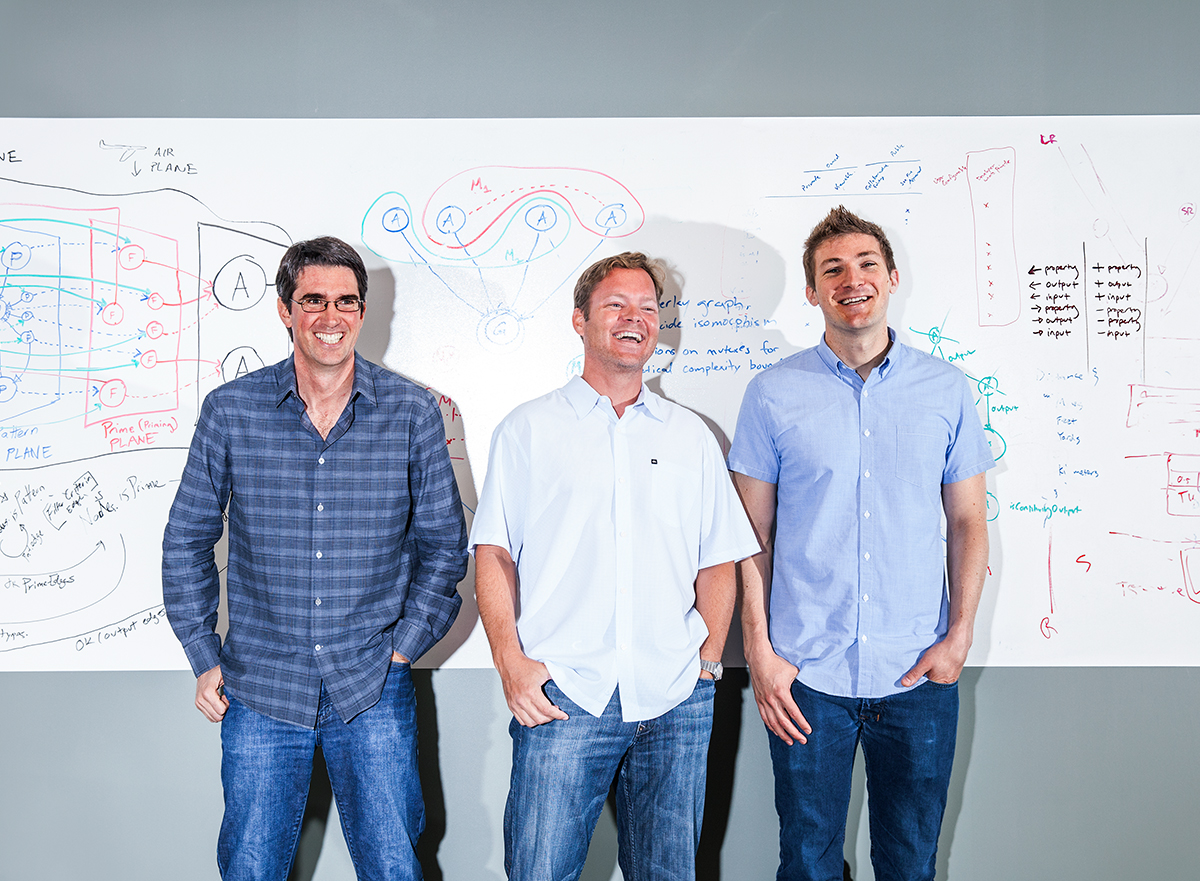
The founders of a stealth startup called Viv Labs—Adam Cheyer, Dag Kittlaus, and Chris Brigham—are building a Siri-like digital assistant that can process massive troves of data, teach itself, and write its own programs on the fly. The goal: to predict and fulfill our desires. Ariel Zambelich

If Kittlaus is in some ways the Steve Jobs of Viv—he is the only non-engineer on the 10-person team and its main voice on strategy and marketing—Cheyer is the company’s Steve Wozniak, the project’s key scientific mind. Unlike the whimsical creator of the Apple II, though, Cheyer is aggressively analytical in every facet of his life, even beyond the workbench. As a kid, he was a Rubik’s Cube champion, averaging 26 seconds a solution. When he encountered programming, he dove in headfirst. “I felt that computers were invented for me,” he says. And while in high school he discovered a regimen to force the world to bend to his will. “I live my life by what I call verbally stated goals,” he says. “I crystallize a feeling, a need, into words. I think about the words, and I tell everyone I meet, ‘This is what I’m doing.’ I say it, and then I believe it. By telling people, you’re committed to it, and they help you. And it works. ”

He says he used the technique to land his early computing jobs, including the most significant—at SRI International, a Menlo Park think tank that invented the concept of computer windows and the mouse. It was there, in the early 2000s, that Cheyer led the engineering of a Darpa-backed AI effort to build “a humanlike system that could sense the world, understand it, reason about it, plan, communicate, and act.” The SRI-led team built what it called a Cognitive Assistant that Learns and Organizes, or CALO. They set some AI high-water marks, not least being the system’s ability to understand natural language. As the five-year program wound down, it was unclear what would happen next.

That was when Kittlaus, who had quit his job at Motorola, showed up at SRI as an entrepreneur in residence. When he saw a CALO-related prototype, he told Cheyer he could definitely build a business from it, calling it the perfect complement to the just-released iPhone. In 2007, with SRI’s blessing, they licensed the technology for a startup, taking on a third cofounder, an AI expert named Tom Gruber, and eventually renaming the system Siri.

The small team, which grew to include Chris Brigham, an engineer who had impressed Cheyer on CALO, moved to San Jose and worked for two years to get things right. “One of the hardest parts was the natural language understanding,” Cheyer says. Ultimately they had an iPhone app that could perform a host of interesting tasks—call a cab, book a table, get movie tickets—and carry on a conversation with brio. They released it publicly to users in February 2010. Three weeks later, Steve Jobs called. He wanted to buy the company.

“I was shocked at how well he knew our app,” Cheyer says. At first they declined to sell, but Jobs persisted. His winning argument was that Apple could expose Siri to a far wider audience than a startup could reach. He promised to promote it as a key element on every iPhone. Apple bought the company in April 2010 for a reported $200 million.

The core Siri team came to Apple with the project. But as Siri was honed into a product that millions could use in multiple languages, some members of the original team reportedly had difficulties with executives who were less respectful of their vision than Jobs was. Kitt­laus left Apple the day after the launch—the day Steve Jobs died. Cheyer departed several months later. “I do feel if Steve were alive, I would still be at Apple,” Cheyer says. “I’ll leave it at that.” (Gruber, the third Siri cofounder, remains at Apple.)

After several months, Kittlaus got back in touch with Cheyer and Brigham. They asked one another what they thought the world would be like in five years. As they drew ideas on a whiteboard in Kittlaus’ house, Brigham brought up the idea of a program that could put the things it knows together in new ways. As talks continued, they lit on the concept of a cloud-based intelligence, a global brain. “The only way to make this ubiquitous conversational assistant is to open it up to third parties to allow everyone to plug into it,” Brigham says.

In retrospect, they were re-creating Siri as it might have evolved had Apple never bought it. Before the sale, Siri had partnered with around 45 services, from AllMenus.com to Yahoo; Apple had rolled Siri out with less than half a dozen. “Siri in 2014 is less capable than it was in 2010,” says Gary Morgenthaler, one of the funders of the original app.

Cheyer and Brigham tapped experts in various AI and coding niches to fill out their small group. To produce some of the toughest parts—the architecture to allow Viv to understand language and write its own programs—they brought in Mark Gabel from the University of Texas at Dallas. Another key hire was David Gondek, one of the creators of IBM’S Watson.

Funding came from Solina Chau, the partner (in business and otherwise) of the richest man in China, Li Ka-shing. Chau runs the venture firm Horizons Ventures. In addition to investing in Facebook, DeepMind, and
Summly (bought by Yahoo), it helped fund the original Siri. When Viv’s founders asked Chau for $10 million, she said, “I’m in. Do you want me to wire it now?”

It’s early May, and Kittlaus is addressing the team at its weekly engineering meeting. “You can see the progress,” he tells the group, “see it get closer to the point where it just works.” Each engineer delineates the advances they’ve made and next steps. One explains how he has been refining Viv’s response to “Get me a ticket to the cheapest flight from SFO to Charles de Gaulle on July 2, with a return flight the following Monday.” In the past week, the engineer added an airplane-seating database. Using a laptop-based prototype of Viv that displays a virtual phone screen, he speaks into the microphone. Lufthansa Flight 455 fits the bill. “Seat 61G is available according to your preferences,” Viv replies, then purchases the seat using a credit card.

Viv’s founders don’t see it as just one product tied to a hardware manufacturer. They see it as a service that can be licensed. They imagine that everyone from TV manufacturers and car companies to app developers will want to incorporate Viv’s AI, just as PC manufacturers once clamored to boast of their Intel microprocessors. They envision its icon joining the pantheon of familiar symbols like Power On, Wi-Fi, and Bluetooth.

“Intelligence becomes a utility,” Kittlaus says. “Boy, wouldn’t it be nice if you could talk to everything, and it knew you, and it knew everything about you, and it could do everything?”

That would also be nice because it just might provide Viv with a business model. Kittlaus thinks Viv could be instrumental in what he calls “the referral economy.” He cites a factoid about Match.com that he learned from its CEO: The company arranges 50,000 dates a day. “What Match.com isn’t able to do is say, ‘Let me get you tickets for something. Would you like me to book a table? Do you want me to send Uber to pick her up? Do you want me to have flowers sent to the table?’” Viv could provide all those services—in exchange for a cut of the transactions that resulted.

Building that ecosystem will be a difficult task, one that Viv Labs could hasten considerably by selling out to one of the Internet giants. “Let me just cut through all the usual founder bullshit,” Kittlaus says. “What we’re really after is ubiquity. We want this to be everywhere, and we’re going to consider all paths along those lines.” To some associated with Viv Labs, selling the company would seem like a tired rerun. “I’m deeply hoping they build it,” says Bart Swanson, a Horizons adviser on Viv Labs’ board. “They will be able to control it only if they do it themselves.”

Whether they will succeed, of course, is not certain. “Viv is potentially very big, but it’s all still potential,” says Morgenthaler, the original Siri funder. A big challenge, he says, will be whether the thousands of third-party components work together—or whether they clash, leading to a confused Viv that makes boneheaded errors. Can Viv get it right? “The jury is out, but I have very high confidence,” he says. “I only have doubt as to when and how.”

Most of the carefully chosen outsiders who have seen early demos are similarly confident. One is Vishal Sharma, who until recently was VP of product for Google Now. When Cheyer showed him how Viv located the closest bottle of wine that paired well with a dish, he was blown away. “I don’t know any system in the world that could answer a question like that,” he says. “Many things can go wrong, but I would like to see something like this exist.”

Indeed, many things have to go right for Viv to make good on its founders’ promises. It has to prove that its code-making skills can scale to include petabytes of data. It has to continually get smarter through omnivorous learning. It has to win users despite not having a preexisting base like Google and Apple have. It has to lure developers who are already stressed adapting their wares to multiple platforms. And it has to be as seductive as Scarlett Johansson in Her so that people are comfortable sharing their personal information with a robot that might become one of the most important forces in their lives.

The inventors of Siri are confident that their next creation will eclipse the first. But whether and when that will happen is a question that even Viv herself cannot answer. Yet.

Siri14_3

Source: http://www.wired.com/2014/08/viv/

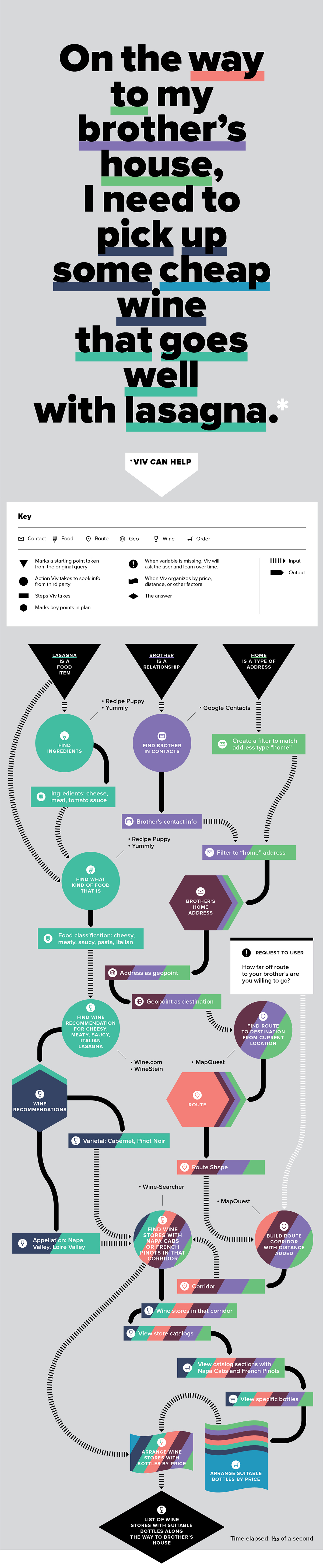
Airbnb Is Quietly Building the Smartest Travel Agent of All Time

Airbnb-14

Airbnb overhauled its logo, its website, and its mobile app this morning. But there’s something deeper going on with the sharing economy’s most popular travel site.

Under the covers, Airbnb has quietly begun an ambitious effort to painstakingly mine the treasure trove of data contained in the site’s customer reviews and host descriptions to create a smarter way of traveling. It turns outs Airbnb is more than a travel website—it’s a stealth big data company.

“For a long time now, Airbnb has been an awesome place to go if you know where you’re going and you know when you’re going,” says Mike Curtis, Airbnb’s vice president of engineering. “But we realized that we have all of this data that other people don’t have. We have travel patterns. We have the reviews. We have the descriptions of the listings. We know a lot about neighborhoods that we can infer from the text in there.”

To do this, the company has formed an eight-person Discovery team. Their mission? To build language processing software that mines Airbnb’s data and figures out what’s really happening out there in the travel world. In other words, Airbnb is building a kind of omniscient, machine-powered travel agent of the future.

‘WE REALIZED THAT WE HAVE ALL OF THIS DATA THAT OTHER PEOPLE DON’T HAVE. WE HAVE TRAVEL PATTERNS, WE HAVE THE REVIEWS, WE HAVE THE DESCRIPTIONS OF THE LISTINGS.’

You can see the early hints of this in the new recommendations that debut on the site today. Airbnb figures out where you’re from, and then drops you a few travel ideas. “We try to figure out exactly where you are and who the people are around you and where they like to travel,” says Surabhi Gupta, an engineer on the Discovery team.

If you’re booking from Knoxville, Tennessee, for example, there’s a pretty good chance you’ll want to take in the sights in Washington, DC. If you’re from the San Francisco or Brooklyn, you may very well be looking for a booking in the same city (folks in these places are more likely to be using Airbnb to book accommodations for friends or relatives).


Airbnb-Discovery-14


The Discovery team figures this out by extracting interesting words from the site’s reviews and descriptions. An open-source tool called the Stanford Part of Speech Tagger comes in handy for this. It then uses custom-build algorithms to assign 150 different attributes—beaches, hiking, sunsets, and so on—to different locations.

What you see on the homepage is a start, but Airbnb wants to get to the point where it can give very specific recommendations based on who you are, not just where you live. “A lot of what we’re doing is the foundational work for user-level personalization,” says Lu Cheng, another Discovery team engineer. That means, in a few years, you may very well be using Airbnb to not only book your next vacation, but to figure out where the heck you want to go.


Source: http://www.wired.com/2014/07/airbnb_recommendations/

Wenn Software über Leben und Tod entscheidet

Wen soll ein selbstfahrendes Auto rammen, wenn es einen Unfall nicht verhindern kann – den SUV links oder den Kleinwagen rechts? Eine Frage nicht nur von Ethik und Recht.

Ein selbstfahrendes Auto fährt auf der Mittelspur der Autobahn, plötzlich kreuzt direkt vor ihm jemand die Spur. Die Elektronik des Autos ist zwar schneller als jeder Mensch, aber eine Kollision lässt sich nicht verhindern – das autonome Auto kann nur auswählen, ob es gar nicht ausweicht oder links den Geländewagen rammt, oder rechts den Kleinwagen. Wie entscheidet die Software, wessen Leben sie aufs Spiel setzt?

Patrick Lin, Direktor der Ethics + Emerging Sciences Group an der California Polytechnic State University, hat solche Gedankenexperimente für das Magazin Wired durchgespielt. Schließlich würden autonom fahrende Autos wie das von Google vor allem deshalb entwickelt, weil sie in solchen Situationen aufgrund ihrer immer wachen Sensoren und ihrer Reaktionsschnelligkeit bessere Entscheidungen treffen können als ein Mensch. Sie können den zu erwartenden Schaden minimieren. Aber nach welchen Regeln das geschieht, müssen vorher die Programmierer festlegen.

Anders gefragt: Wessen Tod nehmen die autonomen Fahrzeuge (beziehungsweise deren Entwickler) in Kauf, wenn sie die eigenen Insassen schützen wollen? Für Lin sind das Fragen von Softwareethik, Moral und auch von Gesetzen und Geschäftsmodellen.

Allzu viel Zeit bleibt vielleicht nicht mehr, bis sie beantwortet werden müssen. Google will seine selbstfahrenden Autos schon 2017 so weit entwickelt haben, dass sie für die Öffentlichkeit auch jenseits der heutigen Testfahrten taugen. Vor Kurzem hat das Unternehmen bekanntgegeben, mittlerweile Tausende von Verkehrssituationen in der Stadt zu beherrschen.
Den behelmten Motoradfahrer verschonen oder den ohne Helm?

Lin beschreibt zunächst das Beispiel mit dem Geländewagen und dem Kleinwagen. Die Vernunft sagt: Der Geländewagen ist stabiler, seine Insassen sind besser geschützt als die des Kleinwagens. Also sollte das fahrerlose Auto besser mit dem Geländewagen kollidieren. Aber darf dessen Besitzer per Softwareprogrammierung eines anderen Fahrzeugs dafür bestraft werden, kein kleineres Auto gekauft zu haben? Dürfen Hersteller von besonders stabilen Autos bestraft werden, wodurch ihr Geschäftsmodell leiden könnte?
Und was Lin noch nicht einmal erwähnt: Muss man einen Kleinwagen fahren, um sich vor Unfällen mit autonomen Fahrzeugen zu schützen, wenn man damit gleichzeitig das Risiko eingeht, bei einem Unfall mit einem normalen Auto größere Schäden davonzutragen? Kommt es vielleicht auch darauf an, wie viele Menschen in den Autos links und rechts sitzen und in Gefahr geraten, und nicht nur auf die Bauart der beiden Wagen?

Beispiel zwei: Wenn ein selbstfahrendes Auto einen Unfall nicht mehr verhindern und nur noch entscheiden kann, ob es links den Motorradfahrer mit Helm oder rechts den ohne Helm trifft – welche Entscheidung ist dann die weniger falsche?

Die Vernunft sagt, der Motorradfahrer mit Helm hat die größere Chance, den Unfall zu überleben. Die Moral sagt, der ohne Helm sollte für sein verantwortungsloses oder sogar illegales Handeln nicht auch noch belohnt werden. Das Auto könnte dem Zufall die Entscheidung überlassen

„Schleier der Ignoranz“

Lin spielt eine Reihe von Lösungsmöglichkeiten durch. Die erste wäre ein Zufallszahlengenerator. Er würde anspringen, sobald das Auto einen Zusammenstoß links oder rechts als unausweichlich erkennen würde. Kommt dabei eine ungerade Zahl heraus, würde das Auto nach links ausweichen, bei einer geraden Zahl nach rechts. Das würde menschliches Handeln ansatzweise simulieren, weil Menschen in solchen Momenten keine durchdachte Reaktion mehr zeigen könnten.

Entscheidet das Auto aber zufällig, würde es sich praktisch selbst überflüssig machen. Die überlegene Reaktionsgeschwindigkeit in solchen kritischen Situationen ist einer der Hauptgründe, warum selbstfahrende Autos überhaupt entwickelt werden.

Eine Alternative zum Zufall wäre laut Lin ein „Schleier der Ignoranz“: Die Entwickler der selbstfahrenden Autos könnten dafür sorgen, dass der Unfall-Algorithmus nicht weiß, was für Autos links und rechts von ihm fahren – ob es sich um Geländewagen oder Kleinwagen handelt. Dabei wäre es aber ein Unterschied, ob die Information gar nicht erst erhoben wird, oder ob sie von den Sensoren erfasst wird, aber nicht in den Algorithmus einfließt. Letzteres könnte ein rechtliches Problem sein, glaubt Lin. Denn die Autohersteller könnten möglicherweise dafür belangt werden, vorhandene Informationen nicht genutzt zu haben, um das Leben eines Menschen zu beschützen.

Kommt es zum Prozess – weil etwa die Angehörigen eines Unfallopfers den Hersteller des autonomen Fahrzeugs verklagen – ergeben sich laut Lin ganz neue rechtliche Fragen: Die Software-Programmierer hätten ja bei der Entwicklung genug Zeit gehabt, die „richtige“ Entscheidung einzuprogrammieren. Damit würde der Affekt als Ursache für den Tod eines Menschen also ausfallen. Der Unfall wäre möglicherweise näher am Mord als am Totschlag.

Es gibt noch eine ganze Reihe weiterer Fragen und Gedankenspiele, die sich anschließen und die Lin zum Teil hier nennt: Welche Versicherung versichert den Geländewagenfahrer gegen Unfälle mit autonom fahrenden Fahrzeugen? Wer haftet, wenn deren Bordcomputer abstürzt und keine „am wenigsten falsche“ Reaktion mehr zeigen kann? Lässt sich ein fahrerloses Auto austricksen – kann man ihm als Motorradfahrer vorgaukeln, ein Geländewagen zu sein?

Aus Lins Gedankenspielen könnten schon bald drängende Fragen werden. Das wissen die Entwickler autonom fahrender Autos wie zum Beispiel Daniel Göhring. Er ist Teamleiter der Autonomos Labs der FU Berlin, die ein solches Fahrzeug entwickeln, und sagt: „Unser autonomes Fahrzeug verwendet für die Erfassung anderer Verkehrsteilnehmer sowie von Hindernissen vorrangig Laserscanner, Radarsysteme sowie Stereokamerasysteme. Damit wäre es möglich und auch wünschenswert, Fahrzeugklassen und unterschiedliche Verkehrsteilnehmer zu unterscheiden. Für die Situationsvorhersage ist das schon heute relevant. Mit fortschreitender technologischer Entwicklung werden ethische Fragen an Relevanz gewinnen.“

Bisher behandele das Auto der FU „alle Verkehrsteilnehmer äquivalent“, sagt Göhring. „Fahren wir beispielsweise auf einer zweispurigen Straße und es befindet sich ein Hindernis auf unserer Spur, führen wir Spurwechsel nur dann durch, wenn die andere Fahrspur frei ist und keine Gefährdung anderer Verkehrsteilnehmer entsteht. Um solche gefährlichen Situationen innerhalb unserer Entwicklung gänzlich zu vermeiden, befindet sich an Bord unserer autonomen Fahrzeuge immer ein Sicherheitsfahrer.“ Was aber passiert, wenn der nicht mehr rechtzeitig eingreifen kann?

Der Preis, den wir zahlen müssen?

Kate Darling, Expertin für Roboterethik am MIT Media Lab in Cambridge, Massachusetts, sagt: „Manche mögen argumentieren, dass solche Unfälle sehr selten sein werden. Da fahrerlose Autos sehr viel sicherer und vorhersehbarer fahren als Menschen es tun, könnte man das unausgewogene Verhalten der Autos in diesen Extremfällen als vernünftigen Preis ansehen, den wir halt zahlen müssen. Aber solche Unfälle und ihre Entstehungsgeschichte könnten die öffentliche Wahrnehmung massiv beeinflussen. Das kann von Gerichtsurteilen bis hin zu einem generellen Widerstand gegen die Technik reichen.“

Es sei wohl in jedermanns Interesse, wenn das Verhalten der Autos gesetzlichen Standards unterliege, sagt Kate Darling: „Standards, die nicht nur direkte Kosten berücksichtigen, sondern auch das, was die Gesellschaft von diesen Autos erwartet.“ Der erste Schritt sei es, öffentliche Aufmerksamkeit zu schaffen, denn „das hier ist keine Science-Fiction-Zukunft, wir müssen jetzt darüber reden“

Quelle: http://www.golem.de/news/autonome-fahrzeuge-wenn-software-ueber-leben-und-tod-entscheidet-1405-106457.html

Google geht unter die Autohersteller

„Google geht unter die Autohersteller: Der Internetkonzern hat einen ersten Prototyp seines eigenen selbst fahrenden Fahrzeugs vorgestellt.

Die Vision sind kleine Zweisitzer mit Elektroantrieb, die komplett auf Lenkrad und Pedale verzichten. Zunächst sollen rund 100 Testfahrzeuge gebaut werden, kündigte der Konzern in einem Blogeintrag in der Nacht auf heute an.

Sie sollen anfangs noch die altbekannten Steuerelemente haben. Die Arbeit an einer marktreifen Version werde gemeinsam mit Partnern noch einige Jahre dauern, schrieb Projektleiter Chris Urmson.

Tests mit Prius
Google testet bereits seit 2009 Fahrzeuge mit Autopilot. Dabei wurden bestehende Fahrzeugtypen wie etwa der Prius von Toyota mit Lasersensoren und Radargeräten ausgestattet. Bisher ist aber vorgesehen, dass der Fahrer in bestimmten Situationen wieder die Kontrolle des Fahrzeugs übernehmen kann. Erste Gerüchte, dass der Internetkonzern auch komplett eigene Autos entwickelt, gab es im vergangenen Jahr.

Die Autobranche sieht in dem autonomen Fahren einen vielversprechenden Zukunftstrend. Alle großen Hersteller sowie Zulieferer und auch einige branchenfremde Konzerne arbeiten mittlerweile an dem Projekt Fahren ohne Fahrer.“

Quelle:
http://googleblog.blogspot.co.at/2014/05/just-press-go-designing-self-driving.html
http://orf.at/#/stories/2231789/
http://derstandard.at/2000001614203/Ohne-Lenkrad-und-Bremspedal-Google-stellt-selbstfahrendes-Auto-vor