Archiv der Kategorie: Innovation

Samsungs Marktpotentiale von Analysten durchleuchtet

Quelle: http://futurezone.at/b2b/samsung-ist-als-marke-gegen-apple-chancenlos/146.760.814

Kann Samsung mit dem Galaxy Note 5 und dem S6 Edge+ das Ruder herumreißen? Marktexperten kritisieren Samsung-Geräte als zu teuer, die Galaxy-Serie als zu verwässert.

Mit dem Galaxy Note 5 und dem S6 Edge+ startet Samsung früh in den Produkt-lastigen Herbst. Ob der koreanische Hersteller mit den Riesen-Smartphones punkten kann, werden die nächsten Wochen und Monate zeigen. Die Verkaufszahlen der jüngsten Highend-Modelle Galaxy S5 und S6 waren hinter den Erwartungen geblieben. Im Kampf um die Smartphone-Krone war Apple mit dem iPhone 6 und 6 Plus der eindeutige Sieger. Auf der anderen Seite setzten ambitionierte chinesische Hersteller wie Huawei, ZTE, Oneplus und Xiaomi den Koreanern mit leistungsstarken, aber weitaus günstigeren Geräten zu.

Bisheriger Vorteil weg

„Samsung macht gerade eine schwierige Phase durch. Wie sich jetzt zeigt, ist die Marke einfach nicht stark genug, um gegen Apple auf der einen Seite und den chinesischen Herausforderern auf der anderen zu punkten“, sagt IDC-Analyst Francisco Jeronimo im Gespräch mit der futurezone. Bis zum iPhone 6 habe Samsung mit seinen größeren Displays davon profitiert, besser auf die Kundenwünsche eingegangen zu sein. Dieser Vorteil sei nun dahin. Gegenüber Herstellern wie Huawei oder ZTE besitze die Marke zwar eine größere Strahlkraft, diese sei aber nicht stark genug, dass Käufer Hunderte Euro mehr für ein Samsung-Gerät ausgeben, so Jeronimo.

Auch die bekannte Marktanalystin Carolina Milanesi von Kantar Worldpanel ortet bei Samsung ein Marken- und ein Preisproblem. „Samsung leidet darunter, dass Konsumenten die Preise für die Flaggschiff-Geräte als zu hoch empfinden. Mit dem Galaxy hatte sich Samsung eigentlich eine gute Marke aufgebaut, diese über die Jahre aber mit viel zu vielen unterschiedlichen Produkten verwässert. Heute wissen Käufer überhaupt nicht mehr, wofür die Galaxy-Reihe eigentlich steht“, kritisiert Milanesi.

Ebenfalls nicht aufgegangen sei die Strategie, beim Galaxy S6 und S6 Edge erstmals auf hochwertige Materialien und ein innovativeres Design zu setzen. Dies habe den Preis nach oben getrieben, gleichzeitig aber zu weniger Nachfrage als erwartet geführt. Das teurere, aber stärker nachgefragte Galaxy S6 Edge habe seine Vorzüge zudem nicht optimal ausspielen können, weil die Verfügbarkeit über Monate hinweg schlecht war, so Milanesi. „Im Großen und Ganzen würde Samsung ein schlankeres und fokussierteres Portfolio gut tun.“

Samsung zu teuer

Für den IDC-Analysten Jeronimo müssen die Samsung-Geräte wieder billiger werden, damit der Hersteller an frühere Erfolge anschließen kann. „Samsung hat enorm viel Geld für Marketing und gestützte Verkäufe ausgegeben. Es wird ihnen kaum etwas anderes übrig bleiben, als beim Marketing zurückzufahren, die Firmenstruktur zu verschlanken und dafür wieder mit einer aggressiveren Preispolitik in den Markt zu gehen“, sagt Jeronimo. Das sei das Um und Auf, um chinesische Hersteller einzubremsen und auch Apple im Highend-Segment etwas entgegenzusetzen.

„Wer 700 Euro und mehr für ein Smartphone ausgeben will, nimmt die stärkste Marke, und die ist und bleibt Apple. Das ist wie beim Autokauf – wer es sich leisten kann, kauft auch einen BMW oder Mercedes und keinen Ford“, ist Jeronimo überzeugt. Im Highend-Bereich habe Samsung auch den Fehler gemacht, einige Features zu nachlässig umgesetzt zu haben: „Der Fingerprint-Sensor ist ein gutes Beispiel. Während er bei Apple von Anfang an perfekt funktionierte, musste man bei Samsung zunächst mehrmals mit dem Finger drüberstreichen, bis der Abdruck erkannt wurde.“

„Zum Scheitern verurteilt“

Das Urteil von Asymco-Analyst Horace Dediu fällt noch weniger schmeichelhaft für Samsung aus. „Samsung war nie gut darin, worin Apple gut war. Apple schafft eine einzigartige User Experience, da sie Software, Hardware und Services aus einer Hand anbieten können. Samsung macht mehr oder weniger das selbe, was 1000 Android-Konkurrenten auch machen. Der Erfolg kam eher daher, dass Samsung mit Jahresbudgets von 14 Milliarden Dollar für Marketing, Verkaufspromotionen und Werbung seine Produkte besser verkaufen konnte als die Android-Mitbewerber“, sagt Horace.

Eine derartige Strategie sei langfristig aber immer zum Scheitern verurteilt, da sie nicht nachhaltig sei, denn es werde immer neue Marken geben, welche  Nischen besetzen. Wenn Samsung sich über die Android-Welt hinaus profilieren möchte, müsse der Konzern eine Plattform-Firma mit einem starken Ökosystem werden und stark in Software und Services investieren. „Dazu müsste Samsung aber erst eine firmeninterne Kultur entwickeln, die solche langfristigen Ziele absteckt und umsetzt“, sagt Horace zur futurezone.

Trendumkehr möglich

Auch Milanesi sieht Samsung in der Verbesserung von Software-Features bzw. der optimalen Abstimmung von Software und Hardware verstärkt in der Pflicht, ortet aber auch Stärken. „Man darf nicht vergessen, dass Samsung weiterhin in vielen Märkten der führende Smartphone-Hersteller ist. Im Gegensatz zu anderen, teilweise bereits gefallenen Branchengrößen wie Nokia hat Samsung den großen Vorteil, dass sie über wertvolle Produktionsanlagen für Bildschirme, Akkus und die Chipherstellung verfügen. Wenn sie es schaffen, ihre Marke noch stärker zu positionieren und zu schärfen, ist eine Trendwende möglich“, zeigt sich Milanesi gegenüber der futurezone überzeugt.

SayMore – not a new Tariff from T-Mobile but Call Strangers On The Phone by YouTube’s Brent Hurley


Somewhere between texting and video chat, the mobile phone stopped being a phone. But there’s a special intimacy unique to simply talking to someone, and early YouTuber Brent Hurley wants to bring it back with SayMore. His new app lets you browse pre-made discussion topics, preview the profile of a conversation partner, and start a free VOIP call with them. You know, so you can just talk about your feelings.

Backed by Brent’s brother, YouTube co-founder Chad Hurley, plus its early CFO Gideon Yu and biz dev wizard Chris Maxcy, SayMore is now available on iOS.

While it might be novel to chat up a stranger, attempts in the meatspace like Highlight and over video like ChatRoulette and Airtime have petered out. SayMore will need a way to keep people coming back to blather or home in on some truly lonely users who need the company of strangers. Otherwise, it might see its line go dead.

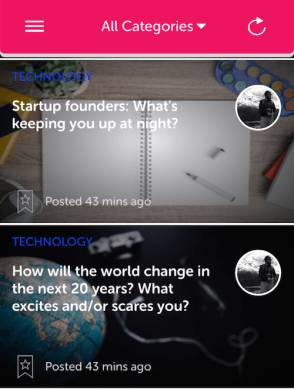
IMG_1666Once you fill out a brief profile blurb, SayMore gives you a curated list of things to talk about. Some examples include:

  • Eurozone: What’s next for Greece and the EU?
  • Fashion: Share tips on how to spruce up your summer wardrobe!
  • Technology: Is Uber good for the world?
  • Parenting: What can I do to give my kids a leg up in this world?
  • Trending: Is social media bringing us closer together or driving us apart?

Pick one you like, vet the person you’ll connect with, and you start the call with one tap. For privacy, you never enter your phone number or see anyone else’s, or their last name. The calls run with HD voice over cellular or Wi-Fi for free, and sound better than a normal phone call.

If you’re the only one interested in a topic right now, SayMore lets you select it and a couple other topics you’re into, and choose how long to be available for someone to call you. Then you can go about your day and wait for a ping.

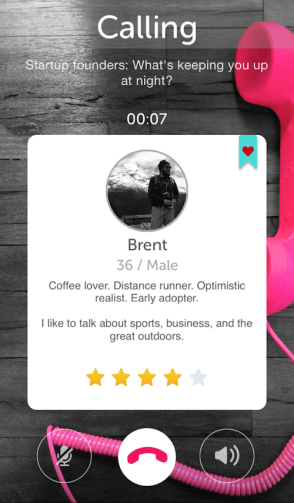
Conveniently, when I first tried using SayMore, I got connected to Brent. I’d picked through some of the tech topic prompts and chose one about “Startup Founders: What’s keeping you up at night?”

Brent came up with SayMore after an inspired conversation with the guy next to him on a plane. We gabbed about whether people really needed another way to communicate. Brent explained that it can be tough to cut through the manicured success theater people purport on a place like Facebook, but the power of voice can trigger real emotions.

SayMore COnvo“We do think that humans are social creatures by nature,” Brent says. SayMore is there “Anytime they want to have a deeper connection rather than posting a status update where people might just Like it or retweet it, but there isn’t a dialogue that takes place.” He concludes, “the current social networks are more broadcast platforms.”

Eventually, SayMore wants to let you friend the people you chat with “to create a conversation graph — a new friend list centered around conversations.” Then when you have something you want to talk about, you could send the topic out to all your SayMore friends, and whoever’s free could jump on the line with you. That could be the answer to how SayMore avoids people getting bored of strangers and never coming back.

Still, with all the vivid communication mediums and other digital distractions, it’s hard to imagine SayMore occupying people’s time. It’s nice to imagine people looking up from their phones and taking a stroll through their neighborhood, observing life outside the screen while they chat about something they care about. But the reason people love texting is that phone calls take energy to keep alive. Most people would rather just bury their face in something mindless like Candy Crush, or browse their News Feed where there’s no pressure to create, just consume.

Loneliness and alienation are real problems worth solving. But SayMore will have to fight the current as everyone says less.

Call Strangers On The Phone (Gasp!) With SayMore From YouTube’s Brent Hurley

World’s New Blood Test

http://www.wired.com/2015/07/tech-worlds-blood-test-darling-gets-nods-fda/?mbid=nl_72115

155149909grey-sClick to Open Overlay Gallery


Apple’s Shyness around Apple Watch

http://www.wired.com/2015/07/apple-doesnt-want-know-many-watches-sold/

Apple Doesn’t Want You to Know How Many Watches It Sold

A display case containing the Apple Watch Sport at the company's flagship store in San Francisco, on June 17, 2015.

Chris Urmson – Leader of Google Self Driving Car Project on TED

0:11 So in 1885, Karl Benz invented the automobile. Later that year, he took it out for the first public test drive, and — true story — crashed into a wall. For the last 130 years, we’ve been working around that least reliable part of the car, the driver. We’ve made the car stronger. We’ve added seat belts, we’ve added air bags, and in the last decade, we’ve actually started trying to make the car smarter to fix that bug, the driver.

0:40 Now, today I’m going to talk to you a little bit about the difference between patching around the problem with driver assistance systems and actually having fully self-driving cars and what they can do for the world. I’m also going to talk to you a little bit about our car and allow you to see how it sees the world and how it reacts and what it does, but first I’m going to talk a little bit about the problem. And it’s a big problem: 1.2 million people are killed on the world’s roads every year. In America alone, 33,000 people are killed each year. To put that in perspective, that’s the same as a 737 falling out of the sky every working day. It’s kind of unbelievable. Cars are sold to us like this, but really, this is what driving’s like. Right? It’s not sunny, it’s rainy, and you want to do anything other than drive. And the reason why is this: Traffic is getting worse. In America, between 1990 and 2010, the vehicle miles traveled increased by 38 percent. We grew by six percent of roads, so it’s not in your brains. Traffic really is substantially worse than it was not very long ago.

1:49 And all of this has a very human cost. So if you take the average commute time in America, which is about 50 minutes, you multiply that by the 120 million workers we have, that turns out to be about six billion minutes wasted in commuting every day. Now, that’s a big number, so let’s put it in perspective. You take that six billion minutes and you divide it by the average life expectancy of a person, that turns out to be 162 lifetimes spent every day, wasted, just getting from A to B. It’s unbelievable. And then, there are those of us who don’t have the privilege of sitting in traffic. So this is Steve. He’s an incredibly capable guy, but he just happens to be blind, and that means instead of a 30-minute drive to work in the morning, it’s a two-hour ordeal of piecing together bits of public transit or asking friends and family for a ride. He doesn’t have that same freedom that you and I have to get around. We should do something about that.

2:48 Now, conventional wisdom would say that we’ll just take these driver assistance systems and we’ll kind of push them and incrementally improve them, and over time, they’ll turn into self-driving cars. Well, I’m here to tell you that’s like me saying that if I work really hard at jumping, one day I’ll be able to fly. We actually need to do something a little different. And so I’m going to talk to you about three different ways that self-driving systems are different than driver assistance systems. And I’m going to start with some of our own experience.

3:17 So back in 2013, we had the first test of a self-driving car where we let regular people use it. Well, almost regular — they were 100 Googlers, but they weren’t working on the project. And we gave them the car and we allowed them to use it in their daily lives. But unlike a real self-driving car, this one had a big asterisk with it: They had to pay attention, because this was an experimental vehicle. We tested it a lot, but it could still fail. And so we gave them two hours of training, we put them in the car, we let them use it, and what we heard back was something awesome, as someone trying to bring a product into the world. Every one of them told us they loved it. In fact, we had a Porsche driver who came in and told us on the first day, „This is completely stupid. What are we thinking?“ But at the end of it, he said, „Not only should I have it, everyone else should have it, because people are terrible drivers.“ So this was music to our ears, but then we started to look at what the people inside the car were doing, and this was eye-opening. Now, my favorite story is this gentleman who looks down at his phone and realizes the battery is low, so he turns around like this in the car and digs around in his backpack, pulls out his laptop, puts it on the seat, goes in the back again, digs around, pulls out the charging cable for his phone, futzes around, puts it into the laptop, puts it on the phone. Sure enough, the phone is charging. All the time he’s been doing 65 miles per hour down the freeway. Right? Unbelievable. So we thought about this and we said, it’s kind of obvious, right? The better the technology gets, the less reliable the driver is going to get. So by just making the cars incrementally smarter, we’re probably not going to see the wins we really need.

4:59 Let me talk about something a little technical for a moment here. So we’re looking at this graph, and along the bottom is how often does the car apply the brakes when it shouldn’t. You can ignore most of that axis, because if you’re driving around town, and the car starts stopping randomly, you’re never going to buy that car. And the vertical axis is how often the car is going to apply the brakes when it’s supposed to to help you avoid an accident. Now, if we look at the bottom left corner here, this is your classic car. It doesn’t apply the brakes for you, it doesn’t do anything goofy, but it also doesn’t get you out of an accident. Now, if we want to bring a driver assistance system into a car, say with collision mitigation braking, we’re going to put some package of technology on there, and that’s this curve, and it’s going to have some operating properties, but it’s never going to avoid all of the accidents, because it doesn’t have that capability. But we’ll pick some place along the curve here, and maybe it avoids half of accidents that the human driver misses, and that’s amazing, right? We just reduced accidents on our roads by a factor of two. There are now 17,000 less people dying every year in America.

6:01 But if we want a self-driving car, we need a technology curve that looks like this. We’re going to have to put more sensors in the vehicle, and we’ll pick some operating point up here where it basically never gets into a crash. They’ll happen, but very low frequency. Now you and I could look at this and we could argue about whether it’s incremental, and I could say something like „80-20 rule,“ and it’s really hard to move up to that new curve. But let’s look at it from a different direction for a moment. So let’s look at how often the technology has to do the right thing. And so this green dot up here is a driver assistance system. It turns out that human drivers make mistakes that lead to traffic accidents about once every 100,000 miles in America. In contrast, a self-driving system is probably making decisions about 10 times per second, so order of magnitude, that’s about 1,000 times per mile. So if you compare the distance between these two, it’s about 10 to the eighth, right? Eight orders of magnitude. That’s like comparing how fast I run to the speed of light. It doesn’t matter how hard I train, I’m never actually going to get there. So there’s a pretty big gap there.

7:10 And then finally, there’s how the system can handle uncertainty. So this pedestrian here might be stepping into the road, might not be. I can’t tell, nor can any of our algorithms, but in the case of a driver assistance system, that means it can’t take action, because again, if it presses the brakes unexpectedly, that’s completely unacceptable. Whereas a self-driving system can look at that pedestrian and say, I don’t know what they’re about to do, slow down, take a better look, and then react appropriately after that.

7:38 So it can be much safer than a driver assistance system can ever be. So that’s enough about the differences between the two. Let’s spend some time talking about how the car sees the world.

7:48 So this is our vehicle. It starts by understanding where it is in the world, by taking a map and its sensor data and aligning the two, and then we layer on top of that what it sees in the moment. So here, all the purple boxes you can see are other vehicles on the road, and the red thing on the side over there is a cyclist, and up in the distance, if you look really closely, you can see some cones. Then we know where the car is in the moment, but we have to do better than that: we have to predict what’s going to happen. So here the pickup truck in top right is about to make a left lane change because the road in front of it is closed, so it needs to get out of the way. Knowing that one pickup truck is great, but we really need to know what everybody’s thinking, so it becomes quite a complicated problem. And then given that, we can figure out how the car should respond in the moment, so what trajectory it should follow, how quickly it should slow down or speed up. And then that all turns into just following a path: turning the steering wheel left or right, pressing the brake or gas. It’s really just two numbers at the end of the day. So how hard can it really be?

8:49 Back when we started in 2009, this is what our system looked like. So you can see our car in the middle and the other boxes on the road, driving down the highway. The car needs to understand where it is and roughly where the other vehicles are. It’s really a geometric understanding of the world. Once we started driving on neighborhood and city streets, the problem becomes a whole new level of difficulty. You see pedestrians crossing in front of us, cars crossing in front of us, going every which way, the traffic lights, crosswalks. It’s an incredibly complicated problem by comparison. And then once you have that problem solved, the vehicle has to be able to deal with construction. So here are the cones on the left forcing it to drive to the right, but not just construction in isolation, of course. It has to deal with other people moving through that construction zone as well. And of course, if anyone’s breaking the rules, the police are there and the car has to understand that that flashing light on the top of the car means that it’s not just a car, it’s actually a police officer. Similarly, the orange box on the side here, it’s a school bus, and we have to treat that differently as well.

9:49 When we’re out on the road, other people have expectations: So, when a cyclist puts up their arm, it means they’re expecting the car to yield to them and make room for them to make a lane change. And when a police officer stood in the road, our vehicle should understand that this means stop, and when they signal to go, we should continue.

10:08 Now, the way we accomplish this is by sharing data between the vehicles. The first, most crude model of this is when one vehicle sees a construction zone, having another know about it so it can be in the correct lane to avoid some of the difficulty. But we actually have a much deeper understanding of this. We could take all of the data that the cars have seen over time, the hundreds of thousands of pedestrians, cyclists, and vehicles that have been out there and understand what they look like and use that to infer what other vehicles should look like and other pedestrians should look like. And then, even more importantly, we could take from that a model of how we expect them to move through the world. So here the yellow box is a pedestrian crossing in front of us. Here the blue box is a cyclist and we anticipate that they’re going to nudge out and around the car to the right. Here there’s a cyclist coming down the road and we know they’re going to continue to drive down the shape of the road. Here somebody makes a right turn, and in a moment here, somebody’s going to make a U-turn in front of us, and we can anticipate that behavior and respond safely.

11:04 Now, that’s all well and good for things that we’ve seen, but of course, you encounter lots of things that you haven’t seen in the world before. And so just a couple of months ago, our vehicles were driving through Mountain View, and this is what we encountered. This is a woman in an electric wheelchair chasing a duck in circles on the road. (Laughter) Now it turns out, there is nowhere in the DMV handbook that tells you how to deal with that, but our vehicles were able to encounter that, slow down, and drive safely. Now, we don’t have to deal with just ducks. Watch this bird fly across in front of us. The car reacts to that. Here we’re dealing with a cyclist that you would never expect to see anywhere other than Mountain View. And of course, we have to deal with drivers, even the very small ones. Watch to the right as someone jumps out of this truck at us. And now, watch the left as the car with the green box decides he needs to make a right turn at the last possible moment. Here, as we make a lane change, the car to our left decides it wants to as well. And here, we watch a car blow through a red light and yield to it. And similarly, here, a cyclist blowing through that light as well. And of course, the vehicle responds safely. And of course, we have people who do I don’t know what sometimes on the road, like this guy pulling out between two self-driving cars. You have to ask, „What are you thinking?“ (Laughter)

12:27 Now, I just fire-hosed you with a lot of stuff there, so I’m going to break one of these down pretty quickly. So what we’re looking at is the scene with the cyclist again, and you might notice in the bottom, we can’t actually see the cyclist yet, but the car can: it’s that little blue box up there, and that comes from the laser data. And that’s not actually really easy to understand, so what I’m going to do is I’m going to turn that laser data and look at it, and if you’re really good at looking at laser data, you can see a few dots on the curve there, right there, and that blue box is that cyclist. Now as our light is red, the cyclist’s light has turned yellow already, and if you squint, you can see that in the imagery. But the cyclist, we see, is going to proceed through the intersection. Our light has now turned green, his is solidly red, and we now anticipate that this bike is going to come all the way across. Unfortunately the other drivers next to us were not paying as much attention. They started to pull forward, and fortunately for everyone, this cyclists reacts, avoids, and makes it through the intersection. And off we go.

13:25 Now, as you can see, we’ve made some pretty exciting progress, and at this point we’re pretty convinced this technology is going to come to market. We do three million miles of testing in our simulators every single day, so you can imagine the experience that our vehicles have. We are looking forward to having this technology on the road, and we think the right path is to go through the self-driving rather than driver assistance approach because the urgency is so large. In the time I have given this talk today, 34 people have died on America’s roads.

13:55 How soon can we bring it out? Well, it’s hard to say because it’s a really complicated problem, but these are my two boys. My oldest son is 11, and that means in four and a half years, he’s going to be able to get his driver’s license. My team and I are committed to making sure that doesn’t happen.

14:13 Thank you.

14:15 (Laughter) (Applause) Chris Anderson: Chris, I’ve got a question for you.

14:22 Chris Urmson: Sure.

14:25 CA: So certainly, the mind of your cars is pretty mind-boggling. On this debate between driver-assisted and fully driverless — I mean, there’s a real debate going on out there right now. So some of the companies, for example, Tesla, are going the driver-assisted route. What you’re saying is that that’s kind of going to be a dead end because you can’t just keep improving that route and get to fully driverless at some point, and then a driver is going to say, „This feels safe,“ and climb into the back, and something ugly will happen.

14:58 CU: Right. No, that’s exactly right, and it’s not to say that the driver assistance systems aren’t going to be incredibly valuable. They can save a lot of lives in the interim, but to see the transformative opportunity to help someone like Steve get around, to really get to the end case in safety, to have the opportunity to change our cities and move parking out and get rid of these urban craters we call parking lots, it’s the only way to go.

15:20 CA: We will be tracking your progress with huge interest. Thanks so much, Chris. CU: Thank you.


Drones for Maintenance

One of the drones used in Nokia’s network testing. Image: Nokia

Nokia has showed off how it plans to use drones to replace some of the inspection and maintenance work on cell towers which is currently done by human technicians.

Amazon hopes drones will one day be used to bring packages to Prime customers, free from the constraints of road traffic and costly human delivery drivers. In the same vein, postal services in France and Switzerland have launched drone trials to see whether the unmanned aerial vehicles could be used to deliver the post in the next five years.

Now Nokia is examining whether it should require human technicians to climb cell towers to inspect them when a drone can do the job faster and without the risk of falling.

For a recent trial of the drones, Nokia teamed up with operator du in the United Arab Emirates. While inspecting the towers, the drones carried smartphones to help with radio planning and line of sight testing between radio towers.

The proof of concept was conducted in the contained environment of the Dubai International Stadium, a sports stadium that seats 25,000 people.

According to Nokia, its telco drones offered a number of advantages over humans, including covering manual walk tests faster than humans. Thanks to a network testing app installed on the smartphones which the drones carried, they were able to automatically send test data for processing at Nokia’s global delivery centre.

The drones could be used to cut down the frequency of technicians climbing up and down a telecoms tower, which Nokia says can be very dangerous in bad weather conditions. In addition, with a single passover the drones could generate a panoramic view of the lattice tower and offer the potential to remotely monitor installations.

The drones were useful for helping engineers design the network, and detecting if trees interfered with a frequency being used, determining power requirements, and latency simulation.

Nokia and its partners employed Secutronic INSPIRE1 drones for network optimisation at the stadium and MICRODRONES d4-1000 models for tower inspection, line of sight testing, and radio site planning.

Nokia isn’t the first to think of drones for network maintenance. Fluke Networks last year launched a drone edition of its Wireless Work Advisor with a focus on safety and efficiency.

Source: http://www.zdnet.com/article/nokia-puts-telco-drones-to-work-inspecting-cell-towers/

Facebook Messenger On Android Hits 1 Billion Downloads

Only two companies have apps with over 1 billion Google Play downloads, and the other is Google. Today Facebook proved just how big a business replacing SMS can be, as its leader David Marcus announced Messenger has now been downloaded over 1 billion times on Android. It joins Facebook and WhatsApp, and Google’s Gmail, YouTube, Search, and Maps in this very exclusive club.

Messenger’s strategy of layering modern mobile sharing features over a speedy texting app has paid off, and it looks like Facebook’s just getting started. With VOIP, video calling, stickers, voice clips, peer-to-peer payments, location, and a whole platform of third-party content creation apps, Messenger wants to own every way you communicate. And it partially is for well over 600 million users.

11406840_10155749985835195_5645524173167231589_n

Combined with WhatsApp’s streamlined SMS alternative, Facebook controls messaging in a way that deeply insulates it from disruption. Snapchat and Yik Yak might steal a few users from its social network feed, but Facebook’s already focusing on the next fundamental communication utility.

In fact, Facebook has been subtly baking Messenger munch deeper into its product.

When you graph search for people, like friends who like a certain band, Facebook shortcuts you to ping them on Messenger, not visit their profile. When it’s a friend’s birthday, in some cases Facebook now recommends that you message them Happy Birthday, rather than writing it on their wall.

Messenger In Facebook

Just last week, Facebook overhauled how Messenger handles map and location sharing to lay the groundwork for a slew of new GPS-enabled features. Before, finding where to meet up with people was the domain of Nearby Friends in the main Facebook app.

And Facebook’s secret weapon in the messaging wars is that chat isn’t where it makes its money. Rather than having to cram Messenger full of ads or convince you to buy Sticker packs, it just has to tie people closer to its big brother Facebook where lucrative mobile ads earn enough money to provide for the whole family.

messenger-location-sharing3

Getting to this point wasn’t easy. Facebook had offend the pride of its whole userbase by telling them they were required to download whole other app for Messaging. It wasn’t sweet, but the medicine went down, and Facebook saw engagement rise once chat wasn’t buried in its blue behemoth. Freed from the extra weight, Messenger was thin and agile enough to build out its bells and whistles.

With former PayPal President David Marcus in command and expert product guy Stan Chudnovsky as his first mate, in just the last six months Messenger has:

Meanwhile, the other giant with deep enough pockets to fund a true attempt at owning messaging has spent the past few years distracted by moonshots. Google was late to launch its mobile messenger, which was dragged down by Google Plus. It squandered its Hangouts product’s early lead in video chat, and missed on the chance to acquire WhatsApp, which could have turned this into a two-horse race.

facebooks-family

Instead, Facebook saw that messaging was the center of mobile, the app you use the most times per day. If it’s the reason you open your phone at first, it’s wedged a foot in the door to become the second and third thing you do too. And with China’s WeChat pioneering the chat-app-as-a-portal roadmap, Facebook can just port what works to the rest of the world.

After years of people asking what would be the Facebook killer, Facebook happily provided its own answer.

Quote: http://techcrunch.com/2015/06/09/the-new-facebook

Google und Facebook geben Satelliten-Internet auf

Sowohl Google als auch Facebook haben ihre ambitionierten Pläne für eigene Internet-Satelliten aufgegeben, weil die Vorhaben schlicht zu teuer sind. Doch es gibt ja noch Virgin Galactic und Elon Musks SpaceX, die ebenfalls hoch hinaus wollen.

Facebook hat nach einem Bericht von The Information den Plan aufgegeben, eine Milliarde US-Dollar für den Bau und den Start eines Satelliten auszugeben, der Kontinente mit Internetdiensten versorgen kann. The Information hat die Bestätigung von zwei Personen erhalten, die mit dem Projekt vertraut sind.

Facebook ist nicht etwa allein mit dieser Entscheidung. Google will auch keine großen Investitionen in ein eigenes, satellitengestütztes Internet machen, berichtet die Website. Vorher gab es Pläne, mit kleinen Satelliten eine Netzverbindung für entlegene Regionen zu schaffen. Das wollten die Unternehmen nicht aus reinem Enthusiasmus, sondern aus knallharten geschäftlichen Überlegungen heraus tun, um mehr Kunden für ihre Angebote zu gewinnen. Doch die Kosten scheinen einfach zu hoch zu sein und in keinem Verhältnis zu möglichen Einnahmen zu stehen, so The Information.

Facebook will künftig lieber Kapazitäten von bestehenden Satellitenverbindungen mieten oder mit anderen Projekten sein Ziel erreichen. Facebook wollte sogar einen eigenen Satelliten bauen. Diese Pläne wurden nun aufgegeben. Angeblich wollte Facebook vor kurzem noch ins Satelliten-Startup von Greg Wyler investieren, dessen Projekt Oneweb Hunderte von Satelliten ins All transportieren wolle. Beteiligt an dem Unternehmen sind Qualcomm und Richard Bransons Virgin Group.

Google hatte kürzlich erst eine Milliarde US-Dollar in Elon Musks SpaceX investiert. Das Unternehmen will Raketen zur Beförderung der Satelliten und wohl auch die Erdtrabanten selbst bauen. SpaceX teilte später mit, dass die Investition und das Satelliten-Internet-Projekt nichts miteinander zu tun haben.

Googles Drohnen-Experiment für die Internetversorgung weiter Flächen läuft zwar weiter, hat aber einen herben Dämpfer erlitten. Das riesige Forschungsflugzeug stürzte während eines Testflugs ab.

Nach Angaben von The Information hätte einer von Facebooks Satelliten 500 Millionen US-Dollar gekostet. Die Technik besitzt zudem eine hohe Latenz, so dass der Nutzen bei vielen Anwendungen auf der Strecke bleibt.

Google verfolgt auch Pläne, einen Internetzugang mit hochfliegenden Ballons zu realisieren. Googles Project Loon, das auf eine Internetversorgung von abgelegenen Regionen mit ungelenkten Wetterballons setzt, wird eifrig weiterverfolgt.

Zitat: http://www.golem.de/news/geplatzte-traeume-google-und-facebook-geben-satelliten-internet-auf-1506-114541.html

Self-driving cars and the Trolley problem

Google recently announced that their self-driving car has driven more than a million miles. According to Morgan Stanley, self-driving cars will be commonplace in society by ~2025. This got me thinking about the ethics and philosophy behind these cars, which is what the piece is about.

autonomousdriveadoptionrate
Source: Morgan Stanley Research

Laws of Robotics

In 1942, Isaac Asimov introduced three laws of robotics in his short story “Runaround”.

They were as follows:

  1. A robot may not injure a human being or, through inaction, allow a human being to come to harm.
  2. A robot must obey the orders given it by human beings, except where such orders would conflict with the First Law.
  3. A robot must protect its own existence as long as such protection does not conflict with the First or Second Law.

He later added a fourth law, the zeroth law:

0. A robot may not harm humanity, or, by inaction, allow humanity to come to harm.

Though fictional, they provide a good philosophical grounding of how AI can coexist with society. If self driving cars, were to follow them, we’re in a pretty good spot right? (Let’s leave aside the argument that self-driving cars lead to loss of jobs of taxi drivers and truck drivers and so should not exist per the 0th/1st law)

Trolley Problem

However, there’s one problem which the laws of robotics don’t quite address.

It’s a famous thought experiment in philosophy called the Trolley Problem and goes as follows:

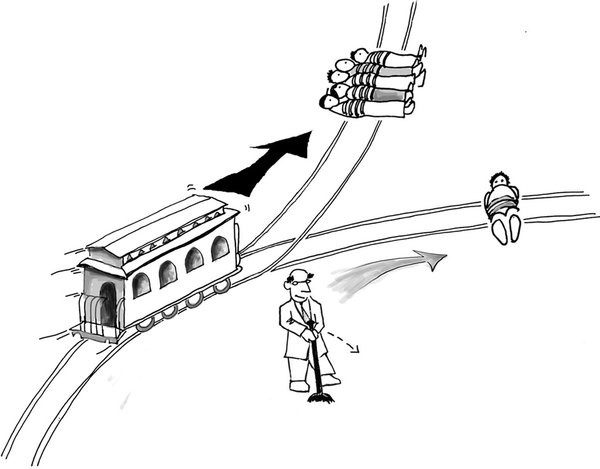
Say a trolley is heading down the railway tracks. Ahead, on the tracks are five people tied down who cannot move. The trolley is headed straight for them, and will kill them. You are standing some distance ahead, next to a lever. If you pull this lever, the trolley switches to a different set of tracks, on which there is one person. You have two options:

1. Do nothing, in which case the trolley kills the 5 people on the main track.

2. Pull the lever, in which case the trolley changes tracks and kills the one person on the side track.

What should you do?

Trolley

The trolley problem illustrated

It’s not hard to see how a similar situation would come up in a world with self-driving cars, with the car having to make a similar decision.

Say for example a human-driven car runs a red light and a self-driving car has two options:

  1. It can stay its course and run into that car killing the family of five sitting in that car
  2. It can turn right and bang into another car in which one person sits, killing that person.

What should the car do?

From a utilitarian perspective, the answer is obvious: to turn right (or “pull the lever”) leading to the death of only one person as opposed to five.

Incidentally, in a survey of professional philosophers on the Trolley Problem, 68.2% agreed, saying that one should pull the lever. So maybe this “problem” isn’t a problem at all and the answer is to simply do the Utilitarian thing that “greatest happiness to the greatest number”.

But can you imagine a world in which your life could be sacrificed at any moment for no wrongdoing to save the lives of two others?

Now consider this version of the trolley problem involving a fat man:

As before, a trolley is heading down a track towards five people. You are on a bridge under which it will pass, and you can stop it by putting something very heavy in front of it. As it happens, there is a very fat man next to you — the only way for you to stop the trolley is to push him over the bridge and onto the track, killing him to save five people. Should you do it?

Most people that go the utilitarian route in the initial problem say they wouldn’t push the fat man. But from a utilitarian perspective there is no difference between this and the initial problem — so why do they change their mind? And is the right answer to “stay the course” then?

Kant’s categorical imperative goes some way to explaining it:

Act only according to that maxim whereby you can, at the same time, will that it should become a universal law.

In simple words, it says that we shouldn’t merely use people as means to an end. And so, killing someone for the sole purpose of saving others is not okay, and would be a no-no by Kant’s categorical imperative.

Another issue with utilitarianism is that it is a bit naive, at least how we defined it. The world is complex, and so the answer is rarely as simple as perform the action that saves the most people. What if, going back to the example of the car, instead of a family of five, inside the car that ran the red light were five bank robbers speeding after robbing a bank. And sat in the other car was a prominent scientist who had just made a breakthrough in curing cancer. Would you still want the car to perform the action that simply saves the most people?

So may be we fix that by making the definition of Utilitarianism more intricate, in that we assign a value to each individuals life. In that case the right answer could still be to kill the five robbers, if say our estimate of utility of the scientist’s life was more than that of the five robbers.

But can you imagine a world in which say Google or Apple places a value on each of our lives, which could be used at any moment of time to turn a car into us to save others? Would you be okay with that?

And so there you have it, though the answer seems simple, it is anything but, which is what makes the problem so interesting and so hard. It will be a question that comes up time and time again as self-driving cars become a reality. Google, Apple, Uber etc. will probably have to come up with an answer. To pull, or not to pull?

Lastly, I want to leave you another question that will need to be answered, that of ownership. Say a self-driving car which has one passenger in it, the “owner”, skids in the rain and is going to crash into a car in front, pushing that car off a cliff. It can either take a sharp turn and fall of the cliff or continue going straight leading to the other car falling of the cliff. Both cars have one passenger. What should the car do? Should it favor the person that bought it — its owner?

Project Fi – Google degradiert die Mobilfunker weltweit

Lesen Sie den ganzen Artikel unter: http://www.zeit.de/digital/mobil/2015-04/google-project-fi-mobiles-breitband-netz

google-project-fi-mobile-network

„So richtig überrascht sein dürfte eigentlich niemand, dass Google nun auch einen eigenen Mobilfunktarif vertreibt. Ständig macht das Unternehmen irgendetwas mit Raketen, Drohnen oder zumindest selbstfahrenden Autos. Warum also nicht auch eine neue Art von Mobilfunk? Klingt im Vergleich doch sogar eher bieder. Doch das ist das Project Fi mitnichten.

Im Rahmen des Projekts verkauft Google in den USA seit Mittwoch einen Tarif, bei dem Nutzer ständig zwischen verschiedenen Netzen hin- und herspringen, ohne es zu merken. Je nach der aktuell zur Verfügung stehenden Verbindungsqualität wählt sich der Dienst in die Netze von Sprint oder T-Mobile US ein. Und wann immer möglich, nimmt er einen von rund einer Million drahtloser Hotspots, die Google landesweit ausgesucht hat. Um an Project Fi teilzunehmen, braucht man eine Einladung von Google und zudem zwingend das Google-Smartphone Nexus 6. Dass der Dienst in Zukunft auch mit anderen Geräten nutzbar sein wird, ist aber abzusehen.

Für Project Fi sollen Nutzer monatlich zwanzig Dollar zahlen. Darin sind aber nur die Kosten für Telefon, SMS und Datenverkehr im WLAN enthalten. Jedes Gigabyte an Daten in den Netzwerken von Sprint und T-Mobile kostet weitere zehn Dollar. Die Pakete buchen Nutzer im Voraus. Nicht verbrauchtes Datenvolumen wird auf den nächsten Monat angerechnet. Das ist in den USA in dieser Konsequenz einzigartig. Project Fi wird es US-Nutzern außerdem erlauben, in mehr als 120 Staaten Daten-Roaming ohne Preiszuschlag zu nutzen. Google liegt mit Project Fi insgesamt unter dem Preis von US-Konkurrenten wie AT&T.

Über den Preis allein will Google seinen Dienst aber nicht verkaufen. Das Versprechen von Google geht weiter: Mit Project Fi sollen Nutzer künftig flexibler und breitbandiger kommunizieren können als andere. Je mobiler das Internet wird und je mehr tragbare Geräte es gibt, desto wichtiger wird das.

Telefonnummer ist nicht mehr telefongebunden

Bislang mussten sich Kunden für einen Tarif bei einem Provider entscheiden, der Telefonie und mobiles Internet abdeckte. In den USA haben die mobilen Datennetze aber teilweise erhebliche Funklöcher. Ähnlich ist die Situation in Deutschland. Nur etwa 91 Prozent Abdeckung erreicht etwa die Deutsche Telekom als bester Netzanbieter. Dieser Wert gilt allein für Großstädte. In der Kleinstadt sind es 86 Prozent, auf dem Land dürfte es noch schlechter aussehen.

Solche „Funklöcher“ oder „weißen Flecken“ will Google mit Project Fi vermeiden. Sein Konzept nennt das Unternehmen „Netzwerk der Netzwerke“. Ein Meta-Netzwerk sozusagen, wie es auch das Internet selbst ist. Der Wechsel zwischen den Netzwerken soll auch während eines Anrufs funktionieren. Verlässt man etwa das Café mit Hotspot, verbindet sich das Telefon automatisch mit dem Mobilfunknetz, das die höchste Verbindungsgeschwindigkeit bietet. Das Gespräch läuft dabei weiter. Die teilnehmenden Provider werden dabei zu Gelegenheitsanbietern degradiert.

Project Fi wird Nutzer mittelfristig nicht nur von einem einzigen Netzanbieter entkoppeln, sondern auch vom Endgerät. Das funktioniert mithilfe einer Project-Fi-fähigen SIM-Karte. Künftig wird die Telefonnummer der Nutzer in der Google-Cloud liegen. Man kann die Nummer dann von jedem internetfähigen Gerät aus nutzen, nicht mehr nur vom Nexus 6.

Einen ähnlichen Ansatz wie Googles Project Fi verfolgt Apple mit seinem Betriebssystem OS X. Damit ist es möglich, auch von einem Macbook aus zu telefonieren. Das funktioniert allerdings nur, wenn das eigene iPhone samt SIM-Karte in der Nähe ist, und auch nur von Apple-Gerät zu Apple-Gerät.

Google geht mit seinem entkoppelten Telefonieren weiter. Noch ist unklar, wie die Margen zwischen den Netzanbietern und Google aufgeteilt sind. Auch ist nicht bekannt, nach welchen Maßstäben Google die Netzanbieter und vor allem verifizierten Hotspots auswählt. Eines immerhin verspricht Google, wenn auch mit wolkigen Formulierungen: Mit den Hotspots sollen sich Project-Fi-Nutzerüber einen sicheren „Tunnel“ verbinden. Damit könnte ein sogenannter VPN-Tunnel gemeint sein, mit welchem man verschlüsselt im Netz surfen kann.

Project Fi sorgt für mehr Wettbewerb

Netzanbieter, die beim Projekt mitmachen wollen, müssen sich auf einen harten Wettbewerb einstellen. Denn wer das schnellste Netz hat, der bekommt nach Googles Modell auch die meisten Nutzer und dementsprechend am meisten Geld.

Dieser Wettbewerb beginnt nun in den USA: Google kooperiert dort erst einmal mit kleineren Anbietern, die sich mehr Nutzer erhoffen. Sowohl T-Mobile als auch Sprint haben ungefähr 15 Prozent Anteil am US-Markt für mobiles Breitband. Verizon und AT&T teilen sich mit jeweils 34 Prozent die Spitze. Sowohl für T-Mobile und Sprint bietet Project Fi also die Chance, mit einem hochwertigen Angebot zusätzliche Kunden zu gewinnen – auch wenn es sich bei diesen nur um Teilzeitkunden handelt. John Legere, CEO von T-Mobile USA, ist dennoch begeistert: Er liebe die Idee von Google, schrieb er in einem Blog-Eintrag.“

Lesen Sie den ganzen Artikel unter: http://www.zeit.de/digital/mobil/2015-04/google-project-fi-mobiles-breitband-netz