Archiv des Autors: innovation

creating new product ideas – by creating new possibilities for the user

Jony Ive talking about creation process of new products, why Apply doesn’t use focus groups, and why the simple asking for problems doesn’t automatically produce good world-class products.

It’s simple, because users of today are not aware of the usage possibilities of the future.
Only if you are at least a few steps ahead of the market
– with current todays‘ views – and you are really trying hard to achieve something that is not new, but solves one of the problems – you are not yet aware about that you are facing them – then you are likely to succeed.
dieIdee InnovationsAgentur, March 2012

Sir Jonathan Ive, Jony to his friends, is arguably one of the world’s most influential Londoners. The 45-year-old was born in Chingford — and went to the same school as David Beckham. He met his wife, Heather Pegg, while in secondary school. They married in 1987, have twin sons and now live in San Francisco.

(c) by http://www.thisislondon.co.uk

As Apple’s Senior Vice President of Industrial Design, he is the driving force behind the firm’s products, from the Mac computer to the iPod, iPhone and, most recently the iPad. He spoke exclusively to the Evening Standard at the firm’s Cupertino headquarters.

Q: You recently received a Knighthood for services to design – was that a proud moment?

A: I was absolutely thrilled, and at the same time completely humbled. I am very aware that I’m the product of growing up in England, and the tradition of designing and making, of England industrialising first. The emphasis and value on ideas and original thinking is an innate part of British culture, and in many ways, that describes the traditions of design.

Q: Is London still an important city for design?

A: I left London in 1992, but I’m there 3-4 times a year, and love visiting. It’s a very important city, and makes a significant contribution to design, to creating something new where previously something didn’t exist.

Q: How does London differ from Silicon Valley?

A: The proximity of different creative industries and London is remarkable, and is in many ways unique. I think that has led to a very different feel to Silicon Valley.

Q: Why did you decide to move to California?

A: What I enjoy about being here is there is a remarkable optimism, and an attitude to try out and explore ideas without the fear of failure. There is a very simple and practical sense that a couple of people have an idea and decide to form a company to do it. I like that very practical and straightforward approach.

There’s not a sense of looking to generate money, its about having an idea and doing it – I think that characterises this area and its focus.

Q: What makes design different at Apple?

A: We struggle with the right words to describe the design process at Apple, but it is very much about designing and prototyping and making. When you separate those, I think the final result suffers. If something is going to be better, it is new, and if it’s new you are confronting problems and challenges you don’t have references for. To solve and address those requires a remarkable focus. There’s a sense of being inquisitive and optimistic, and you don’t see those in combination very often.

Q: How does a new product come about at Apple?

A: What I love about the creative process, and this may sound naive, but it is this idea that one day there is no idea, and no solution, but then the next day there is an idea. I find that incredibly exciting and conceptually actually remarkable.

The nature of having ideas and creativity is incredibly inspiring. There is an idea which is solitary, fragile and tentative and doesn’t have form.

What we’ve found here is that it then becomes a conversation, although remains very fragile.

When you see the most dramatic shift is when you transition from an abstract idea to a slightly more material conversation. But when you made a 3D model, however crude, you bring form to a nebulous idea, and everything changes – the entire process shifts. It galvanises and brings focus from a broad group of people. It’s a remarkable process.

Q: What makes a great designer?

A: It is so important to be light on your feet, inquisitive and interested in being wrong. You have that wonderful fascination with the what if questions, but you also need absolute focus and a keen insight into the context and what is important – that is really terribly important. Its about contradictions you have to navigate.

Q: What are your goals when setting out to build a new product?

A: Our goals are very simple – to design and make better products. If we can’t make something that is better, we won’t do it.

Q: Why has Apple’s competition struggled to do that?

A: That’s quite unusual, most of our competitors are interesting in doing something different, or want to appear new – I think those are completely the wrong goals. A product has to be genuinely better. This requires real discipline, and that’s what drives us – a sincere, genuine appetite to do something that is better. Committees just don’t work, and it’s not about price, schedule or a bizarre marketing goal to appear different – they are corporate goals with scant regard for people who use the product.

Q: When did you first become aware of the importance of designers?

A: First time I was aware of this sense of the group of people who made something was when I first used a Mac – I’d gone through college in the 80s using a computer and had a horrid experience. Then I discovered the mac, it was such a dramatic moment and I remember it so clearly – there was a real sense of the people who made it.

Q: When you are coming up with product ideas such as the iPod, do you try to solve a problem?

A: There are different approaches – sometimes things can irritate you so you become aware of a problem, which is a very pragmatic approach and the least challenging.

What is more difficult is when you are intrigued by an opportunity. That, I think, really exercises the skills of a designer. It’s not a problem you’re aware of, nobody has articulated a need. But you start asking questions, what if we do this, combine it with that, would that be useful? This creates opportunities that could replace entire categories of device, rather than tactically responding to an individual problem. That’s the real challenge, and that’s what is exciting.

Q: Has that led to new products within Apple?

A: Examples are products like the iPhone, iPod and iPad. That fanatical attention to detail and coming across a problem and being determined to solve it is critically important – that defines your minute by minute, day by day experience.

Q: How do you know consumers will want your products?

A: We don’t do focus groups – that is the job of the designer. It’s unfair to ask people who don’t have a sense of the opportunities of tomorrow from the context of today to design.

Q: Your team of designers is very small – is that the key to its success?

A: The way we work at Apple is that the complexity of these products really makes it critical to work collaboratively, with different areas of expertise. I think that’s one of the things about my job I enjoy the most. I work with silicon designers, electronic and mechanical engineers, and I think you would struggle to determine who does what when we get together. We’re located together, we share the same goal, have exactly the same preoccupation with making great products.

One of the other things that enables this is that we’ve been doing this together for many years – there is a collective confidence when you are facing a seemingly insurmoutable challenge, and there were multiple times on the iPhone or ipad where we have to think ‘will this work’ we simply didn’t have points of reference.

Q: Is it easy to get sidetracked by tiny details on a project?

A: When you’re trying to solve a problem on a new product type, you become completely focused on problems that seem a number of steps removed from the main product. That problem solving can appear a little abstract, and it is easy to lose sight of the product. I think that is where having years and years of experience gives you that confidence that if you keep pushing, you’ll get there.

Q: Can this obsession with detail get out of control?

A: It’s incredibly time consuming, you can spent months and months and months on a tiny detail – but unless you solve that tiny problem, you can’t solve this other, fundamental product.

You often feel there is no sense these can be solved, but you have faith. This is why these innovations are so hard – there are no points of reference.

Q: How do you know you’ve succeeded?

A :It’s a very strange thing for a designer to say, but one of the things that really irritates me in products is when I’m aware of designers wagging their tails in my face.

Our goal is simple objects, objects that you can’t imagine any other way. Simplicity is not the absence of clutter. Get it right, and you become closer and more focused on the object. For instance, the iPhoto app we created for the new iPad, it completely consumes you and you forget you are using an iPad.

Q: What are the biggest challenges in constantly innovating?

A: For as long as we’ve been doing this, I am still surprised how difficult it is to do this, but you know exactly when you’re there – it can be the smallest shift, and suddenly transforms the object, without any contrivance.

Some of the problem solving in the iPad is really quite remarkable, there is this danger you want to communicate this to people. I think that is a fantastic irony, how oblivious people are to the acrobatics we’ve performed to solve a problem – but that’s our job, and I think people know there is tremendous care behind the finished product.

Q: Do consumers really care about good design?

A: One of the things we’ve really learnt over the last 20 years is that while people would often struggle to articulate why they like something – as consumers we are incredibly discerning, we sense where has been great care in the design, and when there is cynicism and greed. It’s one of the thing we’ve found really encouraging.

Q: Users have become incredibly attached, almost obsessively so, to Apple’s products – why is this?

A: It sound so obvious, but I remember being shocked to use a Mac, and somehow have this sense I was having a keen awareness of the people and values of those who made it.

I think that people’s emotional connection to our products is that they sense our care, and the amount of work that has gone into creating it.

Article quote from : http://www.thisislondon.co.uk/lifestyle/london-life/sir-jonathan-ive-the-iman-cometh-7562170.html?

Additional reading from: Waugh, Rob (20 March 2011). „How did a British polytechnic graduate become the design genius behind £200billion Apple?“. London: Dailymail. Retrieved 2 January 2012.
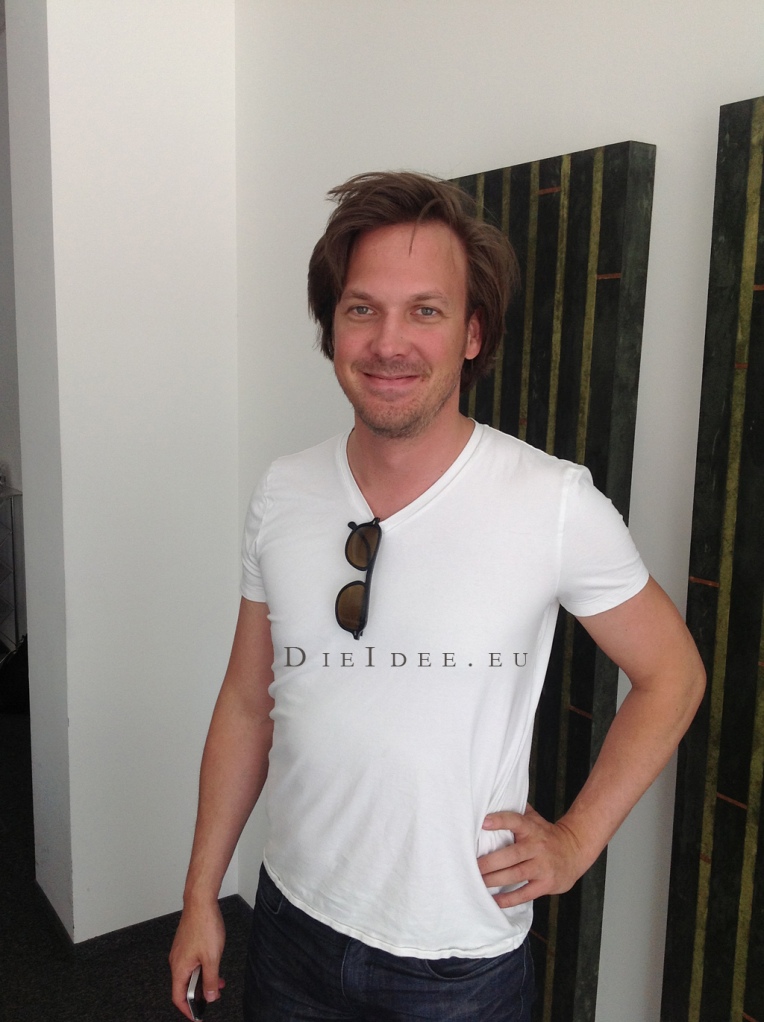
Investor Markus Wagner (i5invest) über Herzblut, Fokussierung und die Liebe zu Innovation

Gernot Pfingstl traf sich mit der österreichischen Investor-Legende Markus Wagner (i5invest).

„Wagner gründete 1999 mit fünf weiteren Studenten der FH Salzburg das Startup wap.at Internetservices GmbH. Das Unternehmen des gebürtigen Wieners konzentrierte sich auf Handyapplikationen.“ Wagner entwickelte mit seinen Studienkollegen in der Boomzeit der Mobiltelefonie technische Möglichkeiten, wie zB. Mobiles Ticketing oder auch mobile E-Commerce Applikationen (m-commerce, Bezahlen per Handy am Colaautomaten). Sie ermöglichten auch das „Handyvoting“ bei „Starmania“.

Wagner war ab 2001 Geschäftsführer der nun unter dem Namen Xidris tätigen Firma. 2004 fusionierte man mit zwei weiteren Firmen zur 3united, Wagner wurde Vorstand für Technology & Media Partnerships.

2006 – nach einem Jahr Investorensuche wurde die Firma um 55 Millionen Euro vom US-Internet- und Kommunikationskonzern VeriSign gekauft. Wagner, der mit der nahtlosen Integration von 3united in Verisign betraut war, verließ ein Jahr später das Unternehmen und gründete das Unternehmen i5invest zur Förderung von Internet-Start-Ups. Aktuelle Projekte sind unter anderem die Personensuche 123people.at und die Iphone/Android App Runtastic sowie weitere innovative B2C Applikationen.

Quelle: http://www.salzburg.com/wiki/index.php/Markus_Wagner

Markus Wagner (i5invest) und dieIdee.eu

DieIdee InnovationsAgentur (www.dieIdee.eu): Markus, aus Deiner bisherigen Erfahrung heraus: Was sind die wichtigsten Eigenschaften, die einen erfolgreichen Unternehmer klassifizieren.

Markus Wagner (i5invest): Ganz klar die Fähigkeit, das Ganze (Anm. die Idee) umzusetzen. Dazu braucht es Menschen, die etwas zustande bringen. Ein Büro, also ein Geschäftslokal, in dem sich das ganze abspielt. Also eine bestehende Konstruktion, nicht nur einen Businessplan.
Das wichtigste neben einem gewissen Startkapital ist die Begeisterung, die man einer Idee gegenüber mitbringt. Und auch das Team, die Menschen.

Für mich ist es wichtig, dargestellt zubekommen, wer sind die Menschen, die die Idee auch tatsächlich umsetzen. Wieviel Zeit investieren sie, machen sie das nebenbei, oder sind sie mit Leib und Seele Unternehmer.

Eine Einzelperson, oder ein schlampig zusammengestoppeltes Team hat keine Chance auf Förderung. Begeisterung ist extrem wichtig für den weiteren Firmenaufbau. Das Team sollte Referenzen und Commitment besitzen.

DieIdee InnovationsAgentur (www.dieIdee.eu): „Was sind die Eigenschaften des erfolgreichen Start-up Teams? Was sollte man mitbringen?“

Markus Wagner (i5invest):  Credibility also Glaubwürdigkeit ist sehr wichtig um zu reüssieren. Als Junger Kreativdesigner, könnte das zum Beispiel eine gute Story sein, also gutes Storybuilding ist wichtig.
Eine ausgezeichnete Vertriebsfähigkeit ist wichtig, um in weiterer Folge Umsätze zu generieren, und somit sich für Investoren attraktiv positionieren zu können. Die wirtschaftliche Entwicklung plausibel darstellen zu können, ist essentiell.

Generell ist die Mentalität in Österreich im Vergleich zu Amerika (wo ich in New York für Verisign die Transition von 3 United erledigt habe), eine viel offenere.
In Amerika werden auch Produkte, die man in Europa eher produktlastig vermarktet, eher vertriebslastig „angepriesen“. Kurioserweise wirkt Europa trotz oftmals höherer Produktqualität fast schüchtern. Ich kann nur jedem raten, nicht schüchtern zu sein, sich professionell zu vermarkten, auf Veranstaltungen zu gehen, mit Leuten zu reden, und es einfach zu probieren.

DieIdee InnovationsAgentur (www.dieIdee.eu): Besteht dabei nicht die Gefahr des Ideenklaus?

Markus Wagner (i5invest): Es ist oftmals besser, Input für seine Ideen zu bekommen, Austausch zu leben. Gerade in meinem Bereich (Anm. Business 2 Consumer) ist Ideenklau keine große Sache. Anders sieht es aus, wenn Patente im Spiel wären. Dort reicht schon die reine Erwähnung in einer Diskussion als Veröffentlichung im engeren Sinne.

DieIdee InnovationsAgentur (www.dieIdee.eu): Wie lassen sich Gesellschafter-Streitigkeiten nach der Gründungsphase vermeiden?

Markus Wagner (i5invest): Eine lose schriftliche Vereinbarung ist ausreichend, wo klar gelegt wird, wie die Eigentumsverhältnisse zum Start geregelt sind. Auch sollte enthalten sein, was im Ausstiegsfall eines Kollegen mit dessen Anteilen geschieht. Dies im Hinblick darauf, dass ein Neuer ihn vertreten kann.

DieIdee InnovationsAgentur (www.dieIdee.eu): Was bedeutet Investment für Dich?

Markus Wagner (i5invest): Ein Investment ist Zeit gegen Anteile zu tauschen. Also Zeit gegen Anteile, für die Leistung im Marktpreis plus Gewinnaufschlag gerechnet wird.
Stichwort: „Geiles Setup“
Eine Idee, ohne Attraction, ohne Nachweis eines bisherigen Markterfolges, ohne Förderungen, ohne Investoren, ohne Umsatz wird anders bewertet werden müssen, als eine Firma, mit guten Leuten, wo bereits Umsätze fließen und ein gewisser Markterfolg erkennbar ist.

Ein Beispiel: Im Speedinvest (Anm. http://speedinvest.com/) bewerten wir, wie sich ein fiktives 100.000 Euro Investment rechnen würde. Wir operieren mit Ausfalls- und Gewinnwahrscheinlichkeiten. Mit einer Wahrscheinlichkeit von z.B. 10% wird das Investment von 100.000 einen Gewinn von mehr als 1 Mio. erzielen. Ist das genug, um als Investor langfristig erfolgreich zu sein? Nein. Kosten müssen gedeckt sein, Gewinn muss erzielt werden, das Risiko langfristig sicher abgedeckt sein, und die Opportunitätskosten (100.000 als Anzahlung für ein Strandhaus) ebenfalls zumindest überlegt werden.

DieIdee InnovationsAgentur (www.dieIdee.eu): Wie würdest Du als Start-UP eine Firma groß machen?

Markus Wagner (i5invest): Um eine Firma vorzubereiten, die „echt geil“ ist?
Sich niemals mit Mittelmaß zufrieden geben. Eine High-Quality Mannschaft zusammenstellen, die Großartiges zu verändern imstande ist. Teilen, Anteile an großartige Menschen abgeben, sodass die Chance größer wird, dass die Firma zu Erfolg kommt!

DieIdee InnovationsAgentur (www.dieIdee.eu): Du bekommst, jährlich 1000 Projektanfragen, wie hoch ist die Quote, derer, die Du förderst?

Markus Wagner (i5invest):  Von 1000 Projektanfragen hört man im Laufe der Jahre nur von 20 wieder Positives. Es gilt zu bewerten, wohin die Reise geht.

Ein Beispiel. In einem potentiellen Milliardenmarkt kann man in 50 Firmen investieren. Wenn eines davon reüssiert, hat man die Anfangsinvestitionen für die anderen 49 durch den Gewinn des einen über-kompensiert. 1:20 oder 1:50 funktioniert in einem Milliardenmarkt. Die Frage ist, wieviel Risiko ist man bereit zu tragen. 50:50 ist eine sichere Sache und meistens kein gewinnträchtiges Geschäft, außer in monopolisierenden Geschäftsbereichen.

DieIdee InnovationsAgentur (www.dieIdee.eu): Hast Du eine Entscheidung, eine Firma unterstützt zu haben, in Deiner Laufbahn bisher bereut?

Markus Wagner (i5invest): „Nein, denn in der bisherigen Zeit war es möglich viel coolere Projekte zu machen. Damals hätte es einfach bei diesen Firmen nicht gepasst.“

DieIdee InnovationsAgentur (www.dieIdee.eu): Was sind die für Dich wichtigsten Startbedingungen für ein Startup? Deine Checkliste?

Markus Wagner (i5invest):

  • Das Netzwerk, die Community, in der man agiert. Wer sind die Menschen, auf die ich zurückgreifen kann?
  • In welchen Bereichen liegt meine Kernkompetenz, wo kenne ich mich gut aus?
  • Wissen und unternehmerischer Wille. Der Biss weiterzumachen, wo andere aufhören
  • Das Erkennen von nötigen Komplementärbausteinen
  • Konzentriert auf 1 Idee fokussieren, nicht 10 Dinge gleichzeitig machen

Die Eintrittswahrscheinlichkeit für ein cooles Setup ist dort hoch, wo Kompetenz, Wissen und Wille da sind. Dort beginnt eine Idee aufzugehen. Eine faire Chance auf Erfolg erhält man mit dem richtigen Team und mit dem richtigen Netzwerk, auch mit Pressekontakten (befreundeter Journalisten)

DieIdee InnovationsAgentur (www.dieIdee.eu): Thema Scheitern als Kultur USA vs. Europa

Markus Wagner (5invest): Es ist ein Mythos, dass Scheitern in den USA besser angesehen ist, als in Europa. In Wirklichkeit geht es um die Menschen, die sich in der Vergangenheit bewiesen haben; wenn ein guter Mann gescheitert ist, bleibt er ein guter Mann. Eine Pflaume jedoch bleibt immer eine Pflaume. Interessanterweise gehen Unternehmer, mit Herzblut nicht mehr in ein Angestelltenverhältnis zurück. Einmal als Selbständiger Blut geleckt, immer Unternehmer…

DieIdee InnovationsAgentur (www.dieIdee.eu): Wie würde Dein „Dream-Team“ konkret aussehen?

Markus Wagner (i5invest): Ich würde die Besten am Markt von meiner Idee begeistern, und mit Ihrer Expertise und Erfahrung ein Unternehmen gründen. Ihnen Anteile am gemeinsamen Unternehmen überschreiben und durchstarten.

Dies könnte bei einem Mobilfunk-Startup z.B. Alexander Oswald (eh. Nokia Alps) für Vertriebserfahrung sein, kombiniert mit Boris Nemsic (eh. Generaldirektor Mobilkom Austria, Telekom Austria).

Sinnvoll ist es gute Leute zu einer gemeinsamen Idee zusammenzubringen. Gutes Marketing und gute Medienkontakte runden das Bild ab. Tüftler müssen raus aus ihrer Rolle als Tüftler. Es gibt keine Alternative als in den Vertrieb zu gehen. („Anrufen, Treffen, vermeiden zu Hause zu sitzen und sich zu beschweren, dass Österreich so schwierig ist.“)

Nicht abschrecken lassen von Kritik. Feedback ernst nehmen. Einfach Energie investieren. Das zahlt sich aus!

DieIdee InnovationsAgentur (www.dieIdee.eu): Wodurch entscheiden sich Investoren und wie bewerten sie?

Markus Wagner (i5invest): Der Branchenerfolg des Investors ist entscheidend.

„Ein gutes Team kann mit Geld viel anfangen. Den Anspruch an coole Leute kann man nicht runterschrauben!“

1000 Firmen buhlen um 50 Investoren! Es gibt genügend Förderinstitutionen in Österreich ZIT (www.zit.co.at/foerderungen.html) , AWS(www.awsg.at/) , FFE (http://www.fraunhoferventure.de/leistungen/finanzierung/FFE/index.jsp) Jedes dritte Projekt wird in Österreich gefördert. Bewirbt man sich bei 3 Förderinstitutionen mit dem richtigen Setup ist die Wahrscheinlichkeit groß, rasch durchstarten zu können.

Jeder Investor beurteilt die Schnelligkeit (Time-to-Market), wie schnell man das Produkt am Markt herzeigen kann. Auch das Feedback, die Begeisterung der Gründer und die Attraction des Produkts. Weiters ist es wichtig so rasch wie möglich das Produkt am Markt zu launchen, sonst sind Investoren nicht interessiert. (Falle!)

Investor USA: hat 100 Projekte und kalkuliert mit einer Ausfallswahrscheinlichkeit von 1 zu 20.

Investor EU: hat 5 bis 10 Projekte und kalkuliert mit einer Ausfallswahrscheinlichkeit von 1 zu 3.

„Gar keinen Investor zu brauchen ist der beste Weg einen Investor zu finden“

DieIdee InnovationsAgentur (www.dieIdee.eu): Wie ist der 3United Verkauf an Verisign in die Wege geleitet worden?

Markus Wagner (i5invest): „Im Jahr 2005 begannen wir den Verkauf von 3 United vorzubereiten. Von 10 Firmen kamen 2 in die nähere Auswahl. Es ging darum Market-Awareness in Amerika zu generieren. Der Weg dazu war beim Prestige-trächtigsten Pitch in Amerika zu der Zeit zu gewinnen. Wir gewannen den Pitch zum „American Idol“, erlangten dadurch die Awareness in Amerika, standen in der Auslage und Verisign hatte die Wahl, selbst zu kaufen, oder jemand anderer hätte gekauft. Wenn jemand anderer gekauft hätte, hätte Verisign später ein Problem gehabt.“

DieIdee InnovationsAgentur (www.dieIdee.eu): Rätst Du Jungunternehmern ohne perfektes Setup zu starten?

Markus Wagner (i5invest): Wichtig ist es mit exzellenten Leuten zusammenzuarbeiten. Nur im Team erreicht man, dass mehr weitergeht, auch wenn man selbst krank ist, und jemand für dich weiterarbeitet. Wenn Du einmal down bist, werden exzellente Leute Dich wieder aufrichten, und weiter geht es. Das ist der Teamspirit. „Das Team hat einen hohen Wert für den Erfolg der Firma“

DieIdee InnovationsAgentur (www.dieIdee.eu): Wie wichtig ist Geld für einen Investor?

Markus Wagner (i5invest): Grundgedanke von Investition ist mehr Geld raus zubekommen, als investiert wurde. Das ist nicht die einzige Motivation. Wert schaffen, ist die zweite.

Viele Millionäre sind aus Spaß dabei an der Sache. Ein positiver unternehmerischer Antrieb überbrückt Momente, wo es schwierig weitergeht.

Nichtsdestoweniger hört eine Unterstützung einer Firma nach 12-18 Monaten bei Nichterfolg auf. Dies wird klar kommuniziert, mit klarem Schnitt am Ende. Erwartet wird vom Gründer ein Vollzeitcommittment. „Ganz oder gar nicht!“

DieIdee InnovationsAgentur (www.dieIdee.eu): Wordrap. „Auffallen?“

Markus Wagner (i5invest): … ist schwieriger geworden unter der Masse der Startups. Performance Marketing wichtiger und gute Co-Kollegen.

DieIdee InnovationsAgentur (www.dieIdee.eu): Grundantrieb?

Markus Wagner (i5invest): … ist nicht Geld machen. Mitaufbauen, Erfolge teilen. Sich miteinbringen. Kontakte gegenseitig herstellen. Positive Incentivierung. Mit Leuten und Team zusammenarbeiten. Wer bringt wieviel Zeit ein? Konzept nicht verstecken, weil ein offenes Konzept viel mehr Kommunikation ermöglicht.

DieIdee InnovationsAgentur (www.dieIdee.eu): Umsatz?

Markus Wagner (i5invest): … Das schwierigste ist auf Umsatz zu kommen. Viel Energie ist notwendig um dorthin zu kommen.

Umsatz ist ein Qualitäts-Siegel für den Erfolg eines Unternehmens. Und oftmals vernachlässigt in Europäischen Unternehmen ist der Verkauf. Bei Verisign ist sogar der Entwicklungschef in Verkaufsgespräche mit Kunden miteingebunden.

DieIdee InnovationsAgentur (www.dieIdee.eu): Aus Anerkennung gegenüber dem Kunden, als Wertschätzung und auch um Kundenbedürfnisse direkt wahrzunehmen.

Markus Wagner (i5invest): Auch um Mehrwerte zu generieren. Keine Angst vor Abfuhr. Sales Kultur ist oftmals bei Start-Ups unterentwickelt, im Vergleich zur Produkt und Technologie-Verliebtheit.

DieIdee InnovationsAgentur (www.dieIdee.eu): Wordrap. Absatzmarkt?

Markus Wagner (i5invest): Tirol liegt von Wien ausgehend gleich weit entfernt wie Köln. Also zur Tiroler Tageszeitung gehen oder zur RTL-Gruppe. Mit dem Zug liegt München näher und ist schneller erreichbar als Bregenz. Es gibt keine Grenze zu Deutschland mehr. Der Deutschsprachige Raum besteht aus mehr als 90 Millionen Konsumenten. Schweiz ist extrem innovativ.

DieIdee InnovationsAgentur (www.dieIdee.eu): Austesten?

Markus Wagner (i5invest): … man muss viele Sachen mit Feedback austesten. „Um dem Glück eine Chance zu geben, ist es wirkliche Arbeit. Ein Team muss mühsam zusammengekratzt werden.“

Man muss die Schlagzahl hoch halten. Termine kurz halten, wenn es keinen Sinn macht. Schneller Zyklus, hoher Takt: Zeit sinnvoll nutzen. In 3 Tagen kann man mittels Bahn im Team in Deutschland 30 Kundenkontakte erledigen; Rail-Plus-Ticket sei dank.

DieIdee InnovationsAgentur (www.dieIdee.eu): Kochabo.at, Michael Ströck?

Markus Wagner (i5invest): Unternehmer aus Bekannten Familien (www.stroeck.at bzw. http://www.wirtschaftsblatt.at/home/service/509444/index.do?index=8&direct=) wollen Neues ausprobieren.

Kochabo.at – wichtig hierbei:

  • Kundenzufriedenheit
  • Customer Lifetime Value
  • Deckungsbeitrag
  • Weiterempfehlungrate
  • ABO-Verlängerungsrate
  • Wieviele Abonnenten?
  • Wie Nachhaltig?
  • Sinnvoll definierte KPIs.
  • Onlinemarketing vs. Print / Flugzettel
  • Logistik
  • Qualitätssiegel
  • Produktentwicklung und Konzeption
  • Frische
  • Rezepte müssen gut sein
  • Veganer, Laktose, Milchintoleranzen
  • Mutationen wie Volumen, Skalierbarkeit
  • Kundenwert

DieIdee InnovationsAgentur (www.dieIdee.eu): Wie siehst Du ob ein Segment funktioniert, z.B. Kochabo-Zustelldienste?

Markus Wagner (i5invest):  Bei bestehenden Ideen fährt man hin und sieht es sich selbst an. Wichtig ist der Marktüberblick, das Firmenbuch, Presseartikel, und Branchenüberblicke. Auch Infos, ob andere Investoren bereits investiert sind, und wie hoch das Werbebudget ist lassen Rückschlüsse auf die Erfolgswahrscheinlichkeit zu.

DieIdee InnovationsAgentur (www.dieIdee.eu): Vielen Dank für das Gespräch.

Markus Wagner (i5invest): Vielen Dank.

Dieser Text unterliegt dem Copyright von dieIdee InnovationsAgentur. Auszüge auch nur teilweise bedürfen der ausdrücklichen schriftlichen Genehmigung von dieIdee InnovationsAgentur. Anfragen bitte unter copyrights@dieIdee.eu

Ciao Facebook! Facebook Ade!

Facebook Ade

Gastkommentar von Univ.Prof. Dr. Sarah Spiekermann, Head of Institute for Management Information Systems, Vienna University of Economics and Business, 1090 Vienna

Gestern habe ich mich von Facebook abgemeldet. Was für ein super Gefühl! Genau so, wie Hape Kerkeling es in seinem Buchtitel ausdrückt: „Ich bin dann mal weg“. Ich weiß, daß einige meiner prominentesten Postingfreunde mich für verrückt erklären werden. Wie kann man nur so einen günstigen Vertriebskanal für die Eigenmarke aufgeben? Aber ich finde das eigentlich einen ganz normalen Schritt. Facebook ist doch out, oder nicht? Ist der fallende Aktienkurs nicht ein klares Indiz dafür?

Auf jeden Fall ist es so, dass in meinen eigenen Studien mit über 1500 Facebook-Usern in Österreich und Deutschland im letzten Winter 53% der Befragten angaben, schon mal darüber nachgedacht zu haben, ihre Zeit auf Facebook zu reduzieren. 47% haben zugestimmt, dass Facebook sie zunehmend langweilt. Und 72 % sagen sogar, dass wenn Facebook alle ihre Informationen morgen löschen würde, würden sie diesen nicht nachtrauern.

Also wozu länger Zeit dort verlieren? Nur aus Mangel an Alternativen? Was interessiert mich die alte Pizza auf dem Essenstisch eines entfernten Verwandten? Die meisten Leute geben ohnehin auf Facebook nicht das preis, was sie wirklich beschäftigt. Nur rund 20% tun das. Der Rest der Gemeinde sind Mitleser (34%) oder sogar Zyniker (34%)! Und nur 11% glauben daran, dass sich die Leute in Facebook ehrlich so darstellen, wie sie sind.

Channel Overload

Neben dieser recht ernüchternden Faktenlage, die gegen die langfristige Dominanz des sozialen Netzwerks spricht, gibt es aus meiner Sicht noch drei weitere Gründe, warum Facebook den Zenit seiner eigenen Bedeutung überschritten hat (zumindest in der gegenwärtigen Form): Zum einen ist da der „Channel Overload“. „Channel Overload“ bezieht sich auf ein Gefühl der Überforderung, das sich einstellt, wenn das breite Spektrum von digitalen Kanälen Überhand nehmen, die heute zeitgleich und permanent unsere Aufmerksamkeit einfordern.

Irgendwann kippt das Ganze und die Leute steigen bei der einen oder anderen Plattform aus. Zweitens glaube ich, dass sich viele Leute die Haltung der Firma Facebook zum Datenschutz nicht mehr lange gefallen lassen. Wenn beispielsweise die Schufa beginnt, die Kreditwürdigkeit von Leuten auch auf Basis von deren Facebook-Profilen zu bewerten, dann hört jeder Spaß am like-button-Duddeln auf. 72% meiner Befragten gaben übrigens an, dass sie die Weiternutzung ihrer Facebook Informationen am liebsten unterbinden würden. Und schließlich ist da noch dieses wissenschaftlich interessante Phänomen der Besitzpsychologie. Wir finden dieses ganz klar bei unseren untersuchten Facebook-Usern. Ungefähr 30% haben sie ausgebildet.

Wer sie hat, der identifiziert sich stark mit seinem eigenen Profil, empfindet die eigenen Informationen als persönlichen Besitz und fühlt sich auf der Plattform zu Hause. Aber wie bei so vielen Anschaffungen, die man so macht, ist doch eins klar: irgendwann muss mal wieder was Neues her!“
(Sarah Spiekermann)

Ciao Facebook!

„Yesterday I quit Facebook. What a great feeling! It is like Hape Kerkeling’s book title „I’m Off Then“.

Yesterday I quit Facebook. What a great feeling! It is like Hape Kerkeling’s book title „I’m Off Then“. I know that some of my most prominent posting-friends on the platform will call this step crazy foolishness. How can you give up such a cheap sales-channel for your personal brand? But I actually find this step totally natural. I think Facebook is out, or not? The stock exchange may predict this very well already. For sure, my own studies on Facebook with over 1500 Austrian and Germany users last winter showed that 53% have already thought about reducing time on the platform. 47% agreed that they are increasingly bored by the platform. And 72% even said that if Facebook deleted all their data tomorrow they wouldn’t feel sorry. So why lose more time there? Only because there aren’t many alternatives right now? Why waste my time with photos of an old pizza of some acquaintances? Most people don’t tell what they care about anyways. Only 20% do. The rest of the folks on Facebook are just reading along (34%) or are even cynical about what their ‚friends‘ are posting (34%). And only 11% believe that people present themselves on Facebook in the way they really are.

„Channel overload“

Besides these facts that challenge the long-term dominance of this social network there are three other reasons why I believe that Facebook has passed its own best: First there is „channel overload“. I define channel overload as a perception of overload that sets in when the broad spectrum of digital channels that require our attention become rampant. At some point the whole thing collapses and people drop out of one or the other platform. Second, I think that people will get more and more upset with the poor protection of their privacy on Facebook. The German credit-rating agency Schufa has announced, for example, that they want to use Facebook data to add to their understanding of peoples‘ credit-worthiness. If Facebook allows for this kind of activity on the basis of their user data, then users‘ fun will soon drop. And finally there is this interesting phenomenon of psychology of ownership. We clearly find it among some 30% of Facebook users. Those who perceive psychology of ownership identify strongly with their personal profile, perceive their information as personal property and feel at home on the platform. But as with so many acquisitions: At some point one needs a change!“
(Sarah Spiekermann)

mit freundlicher Genehmigung von Sarah Spiekermann, Head of Institute for Management Information Systems, Vienna University of Economics and Business, 1090 Vienna

Origininal derStandard.at, 20.8.2012 publiziert auf http://derstandard.at/1345164561340/Facebook-Ade
Originally derStandard.at, 20.8.2012 published @ http://derstandard.at/1345164560796/Ciao-Facebook

Das Ende von Facebook? Top Investor Peter Thiel steigt aus

Peter Thiel Gründer von Paypal steigt aus Facebook aus.

2004 mit einem Investment von 500.000 Dollar gestartet, sind seine 22.3 Mio. Aktien nunmehr 446 Mio. Dollar wert. Die Aktie verlor seit dem Börsendebut mehr als die Hälfte an Wert.

Ein „Insider“, der beim erstmöglichen Zeitpunkt Kasse macht: Zeichen des drohenden Innovationsrückgangs bei Facebook?

Den Mangel eines eigenen Betriebssystems für mobile Rechner auszugleichen und sich gleich gegen drei potente Gegner zu positionieren (Apple mit IOS, Google mit Android und Microsoft mit Windows Phone) erscheint als wenig gangbare Alternative. Was bleibt?

Ein Kundenstock, der sich weniger häufig einloggt als früher, quasi ein E-mail für die Welt, mit gleichzeitiger Sharing-Möglichkeit von digitalen Daten.

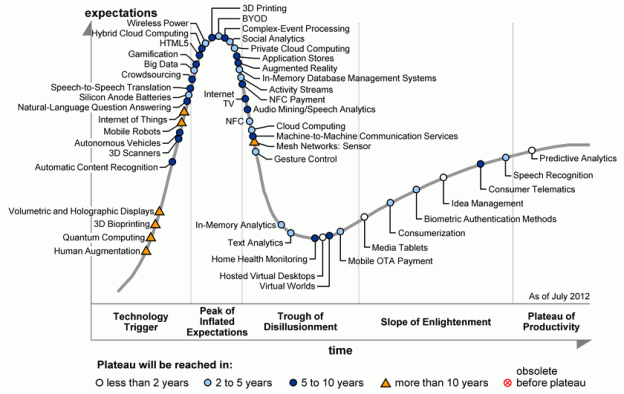
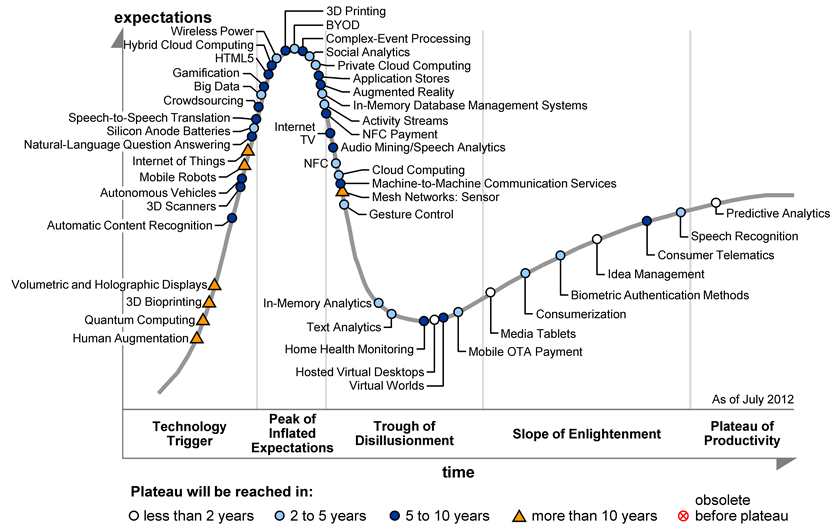
Gartner’s 2012 Hype Cycle for Emerging Technologies

2012 Hype Cycle Special Report Evaluates the Maturity of More Than 1,900 Technologies

„Big data, 3D printing, activity streams, Internet TV, Near Field Communication (NFC) payment, cloud computing and media tablets are some of the fastest-moving technologies identified in Gartner Inc.’s 2012 Hype Cycle for Emerging Technologies.

The Hype Cycle graphic has been used by Gartner since 1995 to highlight the common pattern of overenthusiasm, disillusionment and eventual realism that accompanies each new technology and innovation.

The Hype Cycle for Emerging Technologies report is the longest-running annual Hype Cycle, providing a cross-industry perspective on the technologies and trends that senior executives, CIOs, strategists, innovators, business developers and technology planners should consider in developing emerging-technology portfolios.

Some of the more significant scenarios, and the tipping point technologies, need to mature so that enterprises and governments can deliver new value and experiences to customers and citizens include:

Any Channel, Any Device, Anywhere — Bring Your Own Everything

The technology industry has long talked about scenarios in which any service or function is available on any device, at anytime and anywhere. This scenario is being fueled by the consumerization trend that is making it acceptable for enterprise employees to bring their own personal devices into the work environment. The technologies and trends featured on this Hype Cycle that are part of this scenario include BYOD, hosted virtual desktops, HTML5, the various forms of cloud computing, silicon anode batteries and media tablets. Although all these technologies and trends need to mature for the scenario to become the norm, HTML 5, hosted virtual networks and silicon anode batteries are particularly strong tipping point candidates.

Smarter Things

A world in which things are smart and connected to the Internet has been in the works for more than a decade. Once connected and made smart, things will help people in every facet of their consumer, citizen and employee lives. There are many enabling technologies and trends required to make this scenario a reality. On the 2012 Hype Cycle, Gartner has included autonomous vehicles, mobile robots, Internet of Things, big data, wireless power, complex-event processing, Internet TV, activity streams, machine-to-machine communication services, mesh networks: sensor, home health monitoring and consumer telematics. The technologies and trends that are the tipping points to success include machine-to-machine communication services, mesh networks: sensor, big data, complex-event processing and activity streams.

Big Data and Global Scale Computing at Small Prices

This broad scenario portrays a world in which analytic insight and computing power are nearly infinite and cost-effectively scalable. Once enterprises gain access to these resources, many improved capabilities are possible, such as better understanding customers or better fraud reduction. The enabling technologies and trends on the 2012 Hype Cycle include quantum computing, the various forms of cloud computing, big data, complex-event processing, social analytics, in-memory database management systems, in-memory analytics, text analytics and predictive analytics. The tipping point technologies that will make this scenario accessible to enterprises, governments and consumers include cloud computing, big data and in-memory database management systems.

The Human Way to Interact With Technology

This scenario describes a world in which people interact a lot more naturally with technology. The technologies on the Hype Cycle that make this possible include human augmentation, volumetric and holographic displays, automatic content recognition, natural-language question answering, speech-to-speech translation, big data, gamification, augmented reality, cloud computing, NFC, gesture control, virtual worlds, biometric authentication methods and speech recognition. Many of these technologies have been „emerging“ for multiple years and are starting to become commonplace, however, a few stand out as tipping point technologies including natural-language question answering and NFC.

What Payment Could Really Become

This scenario envisions a cashless world in which every transaction is an electronic one. This will provide enterprises with efficiency and traceability, and consumers with convenience and security. The technologies on the 2012 Hype Cycle that will enable parts of this scenario include NFC payment, mobile over the air (OTA) payment and biometric authentication methods. Related technologies will also impact the payment landscape, albeit more indirectly. These include the Internet of Things, mobile application stores and automatic content recognition. The tipping point will be surpassed when NFC payment and mobile OTA payment technologies mature.

The Voice of the Customer Is on File

Humans are social by nature, which drives a need to share — often publicly. This creates a future in which the „voice of customers“ is stored somewhere in the cloud and can be accessed and analyzed to provide better insight into them. The 2012 Hype Cycle features the following enabling technologies and trends: automatic content recognition, crowdsourcing, big data, social analytics, activity streams, cloud computing, audio mining/speech analytics and text analytics. Gartner believes that the tipping point technologies are privacy backlash and big data.

3D Print It at Home

In this scenario, 3D printing allows consumers to print physical objects, such as toys or housewares, at home, just as they print digital photos today. Combined with 3D scanning, it may be possible to scan certain objects with a smartphone and print a near-duplicate. Analysts predict that 3D printing will take more than five years to mature beyond the niche market.“

Quelle: http://www.gartner.com/it/page.jsp?id=2124315

Voice-over-LTE am Samsung Galaxy S3

„Über den offiziellen Unternehmensblog Samsung Tomorrow http://global.samsungtomorrow.com hat der Elektronikkonzern den Start von Voice over LTE (VoLTE) mit dem Galaxy S3 LTE bekannt gegeben. Damit kann das Modell nicht nur für Datenübertragungen, sondern auch für einfache Telefongespräche die vierte Mobilfunk-Generation nutzen. Praktisch zeitgleich hat in Südkorea freilich auch LG mit dem Optimus LTE2 ein VoLTE-fähiges Modell vorgestellt. Damit startet das Rennen um die neue Service-Generation.

LTE-Update

VoLTE nutzt einen IP-Paket-basierten Dienst sowohl für Sprach- als auch Datenübertragungen und ist damit praktisch ein Technologie-Update. Denn die Regel bei LTE-Netzen ist im Moment noch das sogenannte Circuit-Switched Fallback (CSFB), bei dem Daten via 4G übertragen werden, für Gespräche aber noch das 3G- oder gar 2G-Netz zum Einsatz kommt. Dem gegenüber bietet VoLTE laut Samsung eine Reihe von Vorteilen.

Ein Beispiel sind neue Multimedia-Services wie beispielsweise der nahtlose Übergang von Sprach- zu Videotelefonie. Dank HD-Audio-Codec soll außerdem die Sprachqualität vergleichbar mit einem Gespräch von Angesicht zu Angesicht sein. Im Gegensatz zu herkömmlichem mobilen VoIP ist bei VoLTE auch keine eigene App für Telefondienste nötig. Damit freilich Kunden VoLTE tatsächlich nutzen können, muss die Technologie auch vom Netzwerkbetreiber unterstützt werden.

Erste Betreiber

Dass Samsung gerade jetzt ein VoLTE-Smartphone vorstellt, ist kein Zufall, denn die ersten Betreiber starten jetzt ihre VoLTE-Dienste. Die südkoreanische SK Telecom http://www.sktelecom.com wird diese zunächst speziell Kunden mit Galaxy S3 LTE anbieten. In Südkorea hat auch LG Uplus http://www.uplus.co.kr/com/main/pemain/PeMain.hpi den VoLTE-Start angekündigt, klarerweise mit dem LG-Smartphone. Dritter im Vorreiter-Bunde ist mit MetroPCS Communications ein kleinerer US-Mobilfunker, der ebenfalls diese Woche einen Start des Dienstes mit passendem LG-Gerät verlautbart hat.

Samsung zufolge soll das Galaxy S3 LTE mit VoLTE-Unterstützung in weiterer Folge in LTE-Märkten weltweit angeboten werden. Konkrete Pläne für die DACH-Region liegen allerdings noch nicht vor, heißt es auf Nachfrage von pressetext. Das hängt damit zusammen, dass der LTE-Ausbau hierzulande noch nicht so weit fortgeschritten ist wie in Südkorea, wo SK Telecom nach eigenen Angaben bereits 99 Prozent der Bevölkerung mit der 4G-Technologie erreicht.“

Artikel als Originalzitat von: http://www.pressetext.com/news/20120809015

Displays mit taktilem Feedback – Elektroaktive Polymere (EAPs) machen es möglich

Elektroaktive Polymere (EAPs)

„Tactus Technology is the developer of a new tactile user interface for touch-screen devices. Tactus provides a new dimension of user interface with a fundamentally unique solution: application-controlled, completely transparent physical buttons that rise up from the touch-screen surface on demand. With the buttons enabled, users can push and type or rest their fingers as they would with any physical button or keyboard. When the buttons are disabled, they recede into the screen, becoming invisible and leaving a smooth, seamless flat touch-screen with maximum viewing area.“

„Elektroaktive Polymere sind weich, dehnbar und sie können elektrische Signale in mechanische wandeln – oder umgekehrt. Die Forscher unterschieden zwei Hauptklassen: ionische (feuchte) und elektrische EAPs.

-Zu den ionischen oder feuchten EAPs zählen Hydro-Gele, leitfähige Polymere oder auch ionische Polymer-Metall-Komposite. Sie enthalten wässrige Elektrolyte, die für den Betrieb zuverlässig gekapselt werden müssen. Die Dehnung bei Anlegen elektrischer Spannung funktioniert – wie es der Name schon sagt – per Ionentransport. Vorteil gegenüber elektrischen EAP: Niedrigere Steuerspannungen, höhere übertragene Drücke (> 100 MPa), dafür aber deutlich geringere Dehnungen und erhöhter Fertigungsaufwand.

-Bei elektrischen EAPs dehnt sich der Polymer durch elektrostatische Effekte. Dafür wird elektrische Spannung angelegt, unter der sich Elektroden und Elastomer verformen. Hier sind deutlich höhere Spannungen von einigen 100 V bis zu einigen kV vonnöten und die übertragenen Drücke sind mit einigen 10 MPa geringer. Dafür muss nicht gekapselt werden und sie dehnen sich unter Spannung um das Doppelte bis Dreifache ihres Ausgangszustandes.“

Quelle:
http://www.vdi-nachrichten.com/artikel/E-Muskeln-statt-E-Motoren/57331/1
http://www.tactustechnology.com/technology.html

Smartphones verhindern Verkehrsunfälle

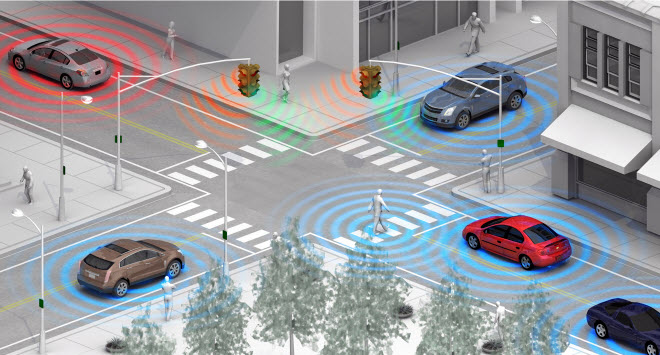
Wifi Direct ist bei jedem Smartphone mit an Bord. Der nachfolgende Artikel erklärt, wie Smartphones in Zukunft intelligent mit Fahrzeugen kommunizieren, um Unfälle zu vermeiden.

„There are plenty of airbags and restraints to keep occupants of most modern cars safe from injury during an accident, and more automakers are deploying driver assistance technology to keep collisions from occurring in the first place – even with pedestrians and others outside the vehicle. Volvo’s pedestrian detection system keeps walkers from inadvertently becoming hood ornaments, and the Swedish brand that’s synonymous with safety has even unveiled a pedestrian airbag.

By developing a system that alerts drivers to the presence of pedestrians, cyclists, road construction workers and others who have a high chance of coming in contact with a moving vehicle, General Motors hopes to reduce the 4,280 pedestrians and 618 bicyclists deaths caused by collisions with motor vehicles in 2010, according to National Highway Traffic Safety Administration. GM researchers are working on technology that will use the Wi-Fi Direct peer-to-peer wireless connection standard to allow smartphones and other connected devices to communicate with cars. Wi-Fi Direct would be integrated with existing driver-assistance systems that use sensor-based object detection to identify pedestrians and others carrying smartphones equipped with a Wi-Fi Direct app that the automaker is also developing.

According to the Wi-Fi Alliance, Wi-Fi Direct has an effective range of just over 200 yards, or roughly more than two football fields. And unlike the type of Wi-Fi you sponge off of at Starbucks, where each user connects to a central access point, Wi-Fi Direct is an ad-hoc network that allows device-to-device connection. “Seven to eight seconds is the amount of time it takes to connect to a Wi-Fi access point,” Donald Grimm, GM’s Global R&D senior researcher of perception and vehicle control systems, told Wired. And even more time if it has to authenticate the user by providing credentials. But with Wi-Fi Direct that time is reduced to one second, according to Grimm, for critical hit-or-miss applications like the one that GM is working on. GM also claims that Wi-Fi Direct has less latency than even cellular networks in order to quickly communicate between two parties on a collision course.

Cars would, of course, first need to be Wi-Fi connected, but that could happen very quickly, according toa report released this week by Strategy Analytics. “Wi-Fi is disrupting the automotive connectivity landscape,” writes the report’s author, Roger Lanctot. “Wi-Fi adoption in cars is rapidly enhancing automotive device connectivity options and applications. The speed, range and volume of data that can be transmitted via Wi-Fi will enable everything from higher quality content distribution in the car and enhanced vehicle diagnostics to inter-vehicle communication.” Lanctot told Wired that he predicts that applications of the latest Wi-Fi and Bluetooth chipsets on smartphones such as Samsung’s Galaxy line-up will prompt automakers to accelerate their in-car Wi-Fi plans, and adds that tier-on suppliers are gearing up to integrate Wi-Fi into automotive systems.

GM is also getting help in setting up a connected-car network from the federal government and by collaborating with its competitors in a pilot program that kicks off next month in Ann Arbor, Michigan to test vehicle-to-vehicle (V2V) and vehicle-to-infrastructure (V2I) communication. “The purpose of the pilot is to gather data on the potential benefits of V2V and V2I technology,” says Grimm. “From that data NHTSA will determine whether to mandate the technology or provide some incentives for car makers to deploy it.”

As for the timing of when pedestrians and others could rely on their smartphones to keep from getting mowed down by careless motorists, Grimm says, “We’re probably looking at five years out, or by the end of the decade. We see that we can extend these applications to include pedestrians, bicyclists and other roadside users.”

The automotive adoption of Wi-Fi Direct could also have side benefits. GM points out that the technology could be used to transfer digital music files or address book information between a home network and a vehicle’s infotainment or navigation system equipped with Wi-Fi Direct. And it could possibly replace Bluetooth as the primary means of device connection in the car – and the compatibility problemsassociated with it. “Wi-Fi Direct uses of the same data transport mechanism as Bluetooth,” GM’s Grimm adds. “And the way you connect to and discover devices is similar to Bluetooth.” Except with Wi-Fi it works more often than not.“

Quelle: http://www.wired.com/autopia/2012/07/gm-wifi-pedestrians/