„Taking a nap, we’ve seen time and again, is like rebooting your brain. Everyone likes to get a quick nap in every now and then, but napping may be as much of an art as it is a science. The Wall Street Journal offers recommendations for planning your perfect nap, including how long to nap and when.
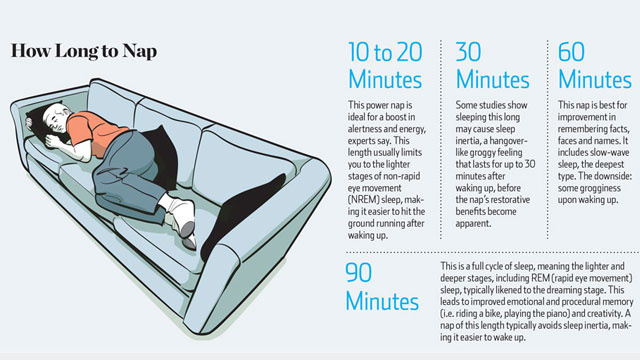
The sleep experts in the article say a 10-to-20-minute power nap gives you the best “bang for your buck,” but depending on what you want the nap to do for you, other durations might be ideal. For a quick boost of alertness, experts say a 10-to-20-minute power nap is adequate for getting back to work in a pinch.
For cognitive memory processing, however, a 60-minute nap may do more good, Dr. Mednick said. Including slow-wave sleep helps with remembering facts, places and faces. The downside: some grogginess upon waking.
“If you take it longer than 30 minutes, you end up in deep sleep. Have you ever taken a nap and felt worse when you woke up? That’s what’s happening — you’re sleeping too long and you’re going into a stage of sleep that’s very difficult to get out of.” – Dr. Michael Breus
Finally, the 90-minute nap will likely involve a full cycle of sleep, which aids creativity and emotional and procedural memory, such as learning how to ride a bike. Waking up after REM sleep usually means a minimal amount of sleep inertia, Dr. Mednick said.
In fact, a study published in PubMed in 2002 found that napping even for 5-10 minutes creates a heightened sense of alertness and increased cognitive ability in comparison to no nap. So really, you want to be taking a 10-20 minute nap for a quick recharge, or a 60-90 minute nap for a deep sleep rejuvenation.
In addition to those recommendations, one surprising suggestion is to sit slightly upright during your nap, because it will help you avoid a deep sleep. And if you find yourself dreaming during your power naps, it may be a sign you’re sleep deprived.“
The tech sector is booming. If you’ve used a smartphone or logged on to a computer at least once in the last few years, you’ve probably noticed this.
As a result, coding skills are in high demand, with programming jobs paying significantly more than the average position. Even beyond the tech world, an understanding of at least one programming language makes an impressive addition to any resumé.
The in-vogue languages vary by employment sector. Financial and enterprise systems need to perform complicated functions and remain highly organized, requiring languages like Java and C#. Media- and design-related webpages and software will require dynamic, versatile and functional languages with minimal code, such as Ruby, PHP, JavaScript and Objective-C.
With some help from Lynda.com, we’ve compiled a list of 10 of the most sought-after programming languages to get you up to speed.
What it is:Java is a class-based, object-oriented programming language developed by Sun Microsystems in the 1990s. It’s one of the most in-demand programming languages, a standard for enterprise software, web-based content, games and mobile apps, as well as the Android operating system. Java is designed to work across multiple software platforms, meaning a program written on Mac OS X, for example, could also run on Windows.
What it is: A general-purpose, imperative programming language developed in the early ’70s, C is the oldest and most widely used language, providing the building blocks for other popular languages, such as C#, Java, JavaScript and Python. C is mostly used for implementing operating systems and embedded applications.
Because it provides the foundation for many other languages, it is advisable to learn C (and C++) before moving on to others.
What it is:C++ is an intermediate-level language with object-oriented programming features, originally designed to enhance the C language. C++ powers major software like Firefox, Winamp and Adobe programs. It’s used to develop systems software, application software, high-performance server and client applications and video games.
What it is: Pronounced „C-sharp,“ C# is a multi-paradigm language developed by Microsoft as part of its .NET initiative. Combining principles from C and C++, C# is a general-purpose language used to develop software for Microsoft and Windows platforms.
What it is: Objective-C is a general-purpose, object-oriented programming language used by the Apple operating system. It powers Apple’s OS X and iOS, as well as its APIs, and can be used to create iPhone apps, which has generated a huge demand for this once-outmoded programming language.
What it is: PHP (Hypertext Processor) is a free, server-side scripting language designed for dynamic websites and app development. It can be directly embedded into an HTML source document rather than an external file, which has made it a popular programming language for web developers. PHP powers more than 200 million websites, including WordPress, Digg and Facebook.
What it is:Python is a high-level, server-side scripting language for websites and mobile apps. It’s considered a fairly easy language for beginners due to its readability and compact syntax, meaning developers can use fewer lines of code to express a concept than they would in other languages. It powers the web apps for Instagram, Pinterest and Rdio through its associated web framework, Django, and is used by Google, Yahoo! and NASA.
What it is: A dynamic, object-oriented scripting language for developing websites and mobile apps, Ruby was designed to be simple and easy to write. It powers the Ruby on Rails (or Rails) framework, which is used on Scribd, GitHub, Groupon and Shopify. Like Python, Ruby is considered a fairly user-friendly language for beginners.
What it is: JavaScript is a client and server-side scripting language developed by Netscape that derives much of its syntax from C. It can be used across multiple web browsers and is considered essential for developing interactive or animated web functions. It is also used in game development and writing desktop applications. JavaScript interpreters are embedded in Google’s Chrome extensions, Apple’s Safari extensions, Adobe Acrobat and Reader, and Adobe’s Creative Suite.
What it is: Structured Query Language (SQL) is a special-purpose language for managing data in relational database management systems. It is most commonly used for its „Query“ function, which searches informational databases. SQL was standardized by the American National Standards Institute (ANSI) and the International Organization for Standardization (ISO) in the 1980s.
BMW arbeitet an Fahrzeugen, die ohne Eingriffe des Fahrers ihr Ziel erreichen.
Wieweit BMW derzeit mit seinem „hochautomatisierten“ Fahren ist, konnten wir in einem Testfahrzeug nördlich von München ausprobieren: Unser BMW fuhr nicht nur selbstständig gerade aus, sondern überholte auch wie von Geisterhand. Wir zeigen die Testfahrt im Video und beantworten im Interview mit einem BMW-Experten die wichtigsten Fragen rund um das „automatisierte Fahren.
Im November 2013 rückte PC-WELT mit der Video-Kamera im BMW-Forschungszentrum im Nordwesten von München an: Wir filmten eine längere Ausfahrt mit einem hochautomatisiertem Testwagen, der vollgestopft mit Umgebungserfassungssensoren und leistungsfähigen Rechnern eine vorgegebene Route über die A9 und die A92 zum Münchner Flughafen und zurück fuhr. Michael Aeberhard, Teilprojektleiter Hochautomatisiertes Fahren bei der BMW Group Forschung und Technik, saß hinter dem Steuer des 5er BMW – und machte während der Fahrt mit Tempo 120 lange Zeit nichts. Wobei: Ein paar Mal musste Aeberhard doch eingreifen, aber dazu später.
Nach unserer Rückkehr am BMW-Forschungszentrum beantwortete uns Dr. Werner Huber, Leiter Fahrerassistenz und Perzeption bei der BMW Group Forschung und Technik, die wichtigsten Fragen zu technischen und juristischen Details rund um das Thema automatisiertes Fahren.
Begriffsdefinition: Assistiertes, teilautomatisiertes, hochautomatisiertes und vollautomatisiertes Fahren
Was bedeutet hochautomatisiertes Fahren eigentlich? BMW unterscheidet hierzu zwischen fünf verschiedenen Stufen des Fahrens:
a) Der Fahrer fährt komplett selbstständig und ohne nennenswerte Technik-Eingriffe
b) Der Fahrer fährt selbstständig, wird aber durch Fahr- und Sicherheitsassistenten unterstützt. Hier sind ACC, Totwinkelassistent und Spurhalteassistent sowie zunehmend auch Notbrems-Assistenten als typische Beispiele zu nennen. Dieses so genannte assistierte Fahren war lange Zeit hochpreisigen Fahrzeugen aus der Kategorie 5er/7er BMW, Audi A6 oder Mercedes-Benz E- und S-Klasse vorbehalten, findet aber mittlerweile auch immer größere Verbreitung in preiswerten PKWs wie beispielsweise dem Golf VII oder dem neuen Mazda 3.
c) Der Fahrer fährt teilautomatisiert mit deutlichen Eingriffen der Technik. Ein typisches Beispiel ist die Stop-and-Go-Funktion für Staus auf der Autobahn. Doch immer noch muss der Fahrer die Hände am Lenkrad haben und das Fahrzeug führen. Diese Technik hält nun so langsam Einzug in die Autos, BMW beispielsweise führt sie Ende 2013 als kostenpflichtige Option ein. Die neue S-Klasse bietet ebenfalls Stop-and-Go.
d) Das hochautomatisierte Fahren: Hier fährt das Fahrzeug bis zu einem bestimmten Grad selbstständig, man muss ihm nur noch die Geschwindigkeit und das Ziel vorgeben. Der Fahrer kann die Hände vom Lenkrad nehmen und beispielsweise auf dem Bildschirm im Armaturenbrett seine Mails checken. Er muss aber innerhalb eines vorgegebenen Zeitraums auf ein Warnzeichen des PKWs hin jederzeit und sofort eingreifen können. Der Fahrer kontrolliert also immer noch das Fahrzeug. Das demonstrierte uns BMW erstmals am 6. Juni 2013 auf der A9 nördlich von München im durchaus dichten Verkehr. In unserem heutigen Video dreht sich alles um dieses hochautomatisierte Fahren. BMW rechnet damit, diese Technologie um das Jahr 2020 herum serienreif anbieten zu können.
e) Das vollautomatisierte Fahren: Hier kann der Fahrer im Prinzip auf der Rücksitzbank bequem sich hinlegen und etwas schlafen. Er muss seinen PKW nicht mehr überwachen. Das ist aber noch völlige Zukunftsmusik, daran ist derzeit nicht zu denken.
Ausfahrt mit einem hochautomatisiertem BMW 5er auf der Autobahn
Am 28. November 2013 zeigte uns BMW den aktuellen Stand beim hochautomatisierten Fahren. Dazu fuhren wir in einem Testfahrzeug vom BMW Forschungszentrum in München aus auf der dreispurigen Autobahn A9 zunächst Richtung Norden und dann weiter Richtung Franz-Josef-Strauß-Flughafen auf der A92.
Unser Testfahrzeug wurde von unserem Fahrer Michael Aeberhard durch den Münchner Stadtverkehr auf die Autobahn gesteuert. Insofern war bis zum Erreichen der rechten Autobahnspur alles wie bei einem normalen Auto. Das Fahrzeug benötigte einige Sekunden, bis es seine Position korrekt auf dem Überwachungs-Bildschirm anzeigte. Der Fahrer stellte im Tempomat die gewünschte Geschwindigkeit (um die 120 Stundenkilometer) und im Navigationsgerät das Ziel, nämlich Richtung Norden, ein. Und nahm dann die Hände vom Lenkrad.
Aeberhard hatte während der Fahrt reichlich Zeit um uns technische Details des Testwagens zu erklären – weil der 5er tatsächlich die meiste Zeit ohne Lenk- oder Bremseingriffe des Fahrers fuhr. Konkret heißt das: Aeberhard hatte seine beiden Hände NICHT am Lenkrad und seinen rechten Fuß weder auf dem Gas- noch auf dem Bremspedal. Unser BMW fuhr aber keinswegs stur auf der rechten Spur einfach nur geradeaus, sondern wechselte selbstständig die Spur, um langsamer fahrend Fahrzeuge, beispielsweise LKWs, zu überholen. Nach dem Überholvorgang scherte unser Testwagen dann wieder selbstständig nach rechts ein.
Computer setzt den Blinker
Der BMW zeigte ein sehr defensives Fahrverhalten. So wurde er aus Gründen der Verkehrssicherheit eben programmiert. Ein menschlicher Fahrer hätte sicherlich schneller überholt und auch kleinere Lücken im vorbei fließenden Verkehr für Überholmanöver ausgenutzt. Unser BMW ging es dagegen gemütlich an und setzte erst dann links zum Überholen eines vor uns fahrenden LKWs an, als die Lücke zwischen zwei PKWs auf der mittleren Spur wirklich sehr groß war. Der Überholvorgang erfolgte jedoch völlig selbstständig: Der Testwagen setzte den linken Blinker und zog dann nach links auf die mittlere der drei Fahrspuren auf der A9. Nachdem wir an dem LKW vorbei gezogen waren, scherte der Testwagen wieder selbstständig auf die rechte Fahrspur ein. Das machte er mehrmals während der Testfahrt.
Auf dem Kontrollbildschirm sahen wir ständig blaue Rechtecke, die PKWs und LKWs um uns herum symbolisierten. Dabei wurden auch Fahrzeuge angezeigt, die sich auf Parkplätzen befanden, an denen wir vorbei fuhren. Der vorne am BMW angebrachte Laser konnte sogar einige PKWs erfassen, die vor einem LKW fuhren, der wiederum direkt vor uns fuhr. Wir konnten also mit Hilfe des Lasers sozusagen durch den LKW durchschauen und sahen auf dem Kontrollbildschirm Autos, die wir mit bloßem Auge überhaupt nicht sehen konnten. Das lag daran, dass der Laser, der wie gesagt relativ tief am vorderen Stoßfänger des Testwagens angebracht war, unter dem vor uns fahrenden LKW „durchblicken“ konnte und damit das vor dem relativ hoch gebauten LKW fahrende Auto noch erfassen konnte.
Ohne Zweifel war es beeindruckend zu sehen, wie das Auto wie von Geisterhand selbstständig überholt und wieder einschert. Der Fahrer muss das Ganze aber immer überwachen und auf ein Warnsignal hin jederzeit eingreifen können. Man kann also nicht während der Fahrt ein Nickerchen, sondern muss auf dem Fahrersitz bleiben. Nur müssen eben die Hände nicht mehr am Lenkrad sein und man muss nicht mehr die Fußpedale bedienen.
Der Kontrollbildschirm vor dem Beifahrerplatz. In den Ecken links und rechts oben sieht man die Bilder von der Front- und von der Heckkamera unseres Testwagens. In der Mitte des Bildschirms ist die Autobahn mit den Fahrzeugen darauf abgebildet. Und wir mitten drin.
Ein paar Mal musste Aeberhard tatsächlich eingreifen. Beispielsweise als wir vor dem Autobahnkreuz von der A9 auf die A92 wechselten. Das hätte das hochautomatisierte Fahrzeug zwar grundsätzlich auch selbst geschafft, doch gerade in diesem Moment verhinderte ein rechts neben uns fahrender LKW den Spurwechsel – hier war menschliches Eingriffen einfach nötig.
In einem anderen Fall fuhren wir rechts und ein LKW links von uns wollte auf unsere Spur wechseln, um von der Autobahn abfahren zu können. Da unser Testwagen den Abbiegewunsch des LKWs nicht erkennen konnte und mit stoischer Ruhe einfach weiterfuhr ohne den LKW einscheren zu lassen, entschloss sich unser Fahrer doch zum Eingreifen und bremste den BMW ab – im Zweifelsfall haben 40 Tonnen eben doch mehr Überzeugungskraft als 1,7 Tonnen…
Doch insgesamt verlief die Fahrt im hochautomatisiertem Fahren beeindruckend souverän. Die Zukunft kann kommen. Was bis dahin aber noch passieren muss (technisch und rechtlich), wie der aktuelle Stand der Entwicklung ist und wann Sie das erste hochautomatisierte Fahrzeug kaufen können – das alles erfahren Sie im obigen Video.
Fahrzeugausstattung
Unser Testfahrzeug mit Automatik-Getriebe war rundherum mit Sensoren bestückt, mit denen es seine Umgebung wahrnimmt. Zusätzlich zu den von den bereits erhältlichen Sicherheitsassistenten bekannten Sensoren wie Radar, Ultraschall, Surround-View-Kameras sowie der Kamera hinter der Windschutzscheibe für den Spurverlassenswarner waren weitere Lasersensoren sowie Kameras eingebaut. Vorne, seitlich und hinten. Im Fahrzeug befand sich vor dem Beifahrersitz ein zusätzlicher Bildschirm, auf dem durchgehend die Position des Testfahrzeugs und die Lage aller erkannten anderen Fahrzeuge um uns herum angezeigt wurde.
Damit die Überwachungsrechner die genaue Position des Testwagens ermitteln können, sind GPS-Sender auf ihm befestigt. Das verwendete GPS-Signal wird noch zusätzlich verbessert, um die für GPS typischen Abweichungen heraus zu filtern und die Positionsbestimmung zentimetergenau zu machen.
Der Rechner steht im Kofferraum – und C++ ist auch mit von der Partie
Alle gesammelten Daten werden derzeit von einem mehr oder weniger handelsüblichen PC ausgewertet, der zusammen mit einem UMTS-Router im Kofferraum des Testwagens verbaut ist. Diesen Rechner können die Ingenieure direkt vom Fahrer- und Beifahrersitz aus bedienen, eine PC-Tastatur befindet sich hierzu vorne im Wagen und der kleine Monitor vor dem Beifahrersitz dient dann als PC-Bildschirm. Die Entwicklungsumgebung Visual Studio ist auf dem Rechner ebenfalls installiert, die Test-Ingenieure können also während der Fahrt sofort den Quellcode der Steuerungssoftware für das hochautomatisierte Fahren umprogrammieren (der Code wird übrigens mit dem bewährten Klassiker C++ geschrieben).
Straßenzulassung der Testfahrzeuge
Wieso darf BMW überhaupt Autos auf deutschen Autobahnen fahren lassen, bei denen der Fahrer die Hände vom Lenkrad nehmen darf? Diese Frage stellten wir Stefanie Schindler von der Forschungskommunikation von BMW. Die Antwort: „Alle unsere Forschungsfahrzeuge (egal, ob hochautomatisiert oder teilautomatisiert) haben eine spezielle Zulassung als Werkstestwagen/Versuchsfahrzeug. Diese Zulassung berechtigt uns dazu, so oft wie nötig mit unseren Versuchsfahrzeugen (auch mit unseren hochautomatisiert fahrenden Testfahrzeugen) auf der Autobahn zu fahren. Es muss jedoch stets ein geschulter Testfahrer den Wagen begleiten.“
Marktreife
BMW rechnet derzeit damit, so ein hochautomatisiertes Fahrzeug in zirka zehn Jahren anbieten zu können (bereits im Jahr 2011 fuhr ein Versuchsfahrzeug der BMW Group Forschung und Technik ohne Fahrereingriff auf der mehrspurigen Autobahn A9 von München in Richtung Nürnberg). Damit dieses Ziel erreicht werden kann, müssen nicht nur noch viele technische Hürden genommen werden (nur ein Beispiel: Wie erkennt der Wagen selbstständig eine Autobahn-Baustelle mit den vielen durchgestrichenen Fahrbahnlinien und verhält sich dort richtig?), sondern es muss auch noch die Rechtslage geklärt werden. Denn BMW will nicht haften, wenn ein Fahrer mit einem hochautomatisierten PKW selbstverschuldet einen Unfall baut. Wie uns BMW bestätigte, gebe es durchaus intensive Verhandlungen unter den Rechtsexperten und den zuständigen Behörden. Und die KFZ-Versicherer werden hier sicherlich auch noch ein gewichtiges Wort mitreden wollen.
LAS VEGAS — When you think about autonomous cars, it is often in reference to the sensor technology making the car aware of objects and other vehicles around it. Here at CES 2014, BMW showed off another technology key to making autonomous cars a reality, the systems needed to steer, accelerate, and brake.
And BMW demonstrated it on a racetrack with a 6 Series tackling a wet corner, a slalom, and s-turns at serious speed.
In fact, the 6 Series went as fast as its computer said it could without losing grip. I sat in the passenger seat while a BMW staffer sat in the driver’s seat. He kept his hands off the wheel and feet off the pedals as the car roared toward the turns, hit the brakes, and swung the wheel over.
This BMW 6 Series manages to automatically counter-turn to avoid a spinout in the wet.(Credit: BMW)
The most amazing part of the demonstration was the wet corner. To show the system’s car control, BMW turned off the vehicle stability systems. As the car hit the wet, it lost grip and went into a sideways slide. The system counter-steered to prevent the car from doing a 180, keeping the slide under control until the car was back on dry pavement.
BMW added these highly accurate GPS antennas to the car for this demonstration.(Credit: Wayne Cunningham/CNET)
It may seem like cheating that, for this demonstration, BMW programmed the car’s route in through GPS, which gave it the path around the track. But all the car control was handled by automated systems using sensors and an accelerometer to see how close the car was to losing grip, and braking or steering to maintain its path.
Werner Huber of BMW described how the system in the car was made up of a Lateral Control Unit and a Longitudinal Control Unit, each handling and interpreting their respective vectors of motion in the car. These components will be essential to a future fully autonomous vehicle.
In BMW’s conception, the autonomous car could handle high-speed driving situations or unexpected low-traction surfaces.
Huber said that, before the introduction of a fully autonomous vehicle, BMW would use this type of research to add features under what it calls Highly Automated Driving. Throwing out a few ideas, Huber suggested that BMW could launch an Intersection Assist, which would contribute to safety when crossing intersections, an Evasion Assist, which would help the car steering around objects or stalled cars, and a Lateral Control Assist, a type of technology that could complement or even replace vehicle stability control systems.
Of course, all these future systems would need a complement of sensors to help the car recognize objects and other vehicles, but BMW certainly seems to have gotten its car control systems right.
Offizielle Ankündigung nächste Woche bei Elektronik-Messe CES in Las Vegas
Google und Audi planen laut einem Zeitungsbericht eine groß angelegte Kooperation. Dabei gehe es darum, dass Unterhaltungs- und Informationssysteme in Audi-Fahrzeugen künftig mit dem Google-Betriebssystem Android laufen, berichtete das „Wall Street Journal“ unter Berufung auf informierte Personen. Der Plan solle kommende Woche auf der Elektronik-Messe CES in Las Vegas vorgestellt werden.
Größeres Projekt
Das Vorhaben sei Teil eines größeren Projekts, das Android im Auto etablieren wolle, hieß es. Weiterer Teilnehmer dieser Allianz sei der Chip-Spezialist Nvidia. Android dominiert im Smartphone-Markt mit einem Marktanteil von zuletzt rund 80 Prozent.
Auch Apple im Auto
Auch Apple arbeitet daran, seine iPhones besser im Auto einzubinden. Seit vergangenem Jahr handelte der Google-Rivale Vereinbarungen für eine vertiefte Integration seiner Geräte und Dienste unter anderem mit General Motors, Daimler und BMW aus.
How writing about your own industry makes You an Irresistible Job Candidate?
By Alexis Grant
When it comes to standing out online, your best bet is to offer your own original content. Blog posts or tweets that revolve around your unique ideas will make you a standout candidate.
But the truth is, not everyone has the time, writing ability or even confidence to grow a quality blog or social media account, and plenty of people who don’t have a blog still want to move up the career ladder, into more challenging and better-paying positions.
What if there was a way to show the world just how smart you are, without creating your own content?
Whether you curate on Twitter, Pinterest, LinkedIn, Tumblr or all of the above, here are five things sharing content created by others says about you — and why it can move your career forward.
1. You know your industry inside and out.
When you share an abundance of interesting information, people begin to realize you know your stuff. Not only do you know what’s going on, but you understand what’s valuable to people in your industry and what they want to read, which is just as important.
Even if you don’t consider yourself highly knowledgeable on a certain topic — if, for example, you’re looking to change careers and are using your online presence to pivot — you’ll become knowledgeable on that topic as you sift through blogs and tweets looking for quality information to share. In other words, curating content can help you become an authority in your field and help others see you as an authority.
2. You’re innovative.
Not only do you use the latest social tools to share advice and ideas, the information you share is often about your industry’s latest trends and developments, which suggests you’re forward thinking.
Anyone can say in an interview that they like to follow tech trends, but serving your community as a content curator shows the hiring manager you’re serious about learning, brainstorming and innovating.
3. You enjoy helping others.
So many people talk about themselves on social media. You’ll stand out if you get off the soapbox and instead offer helpful, valuable information, giving props to whoever created it.
This is helpful not only to the minions who read your tweets, but also to the industry leaders who wrote the blog post, tweets or updates to begin with, since you’re helping spread their content and ideas. Those thought leaders will likely appreciate your efforts and might even look to connect further with you, which could lead to more opportunities.
4. You’re familiar with the big (and little) players in your field.
Knowing who the thought-leaders are in your field and where they hang out is just as important — if not more — than being in-the-know about innovative developments. Why? Because those people likely are part of those developing trends, or at least talking about them. In many ways, they are the trends.
In their book The Startup of You, Reid Hoffman and Ben Casnocha wrote, “If you’re looking for an opportunity, you’re really looking for people.” Knowing who’s doing what in your industry can go a long way toward helping you take the next step in your career. Curating content is a solid way to keep up with what everyone’s doing.
5. In some cases, you have access to those industry players.
Know what every employer wants more than an awesome, skilled employee? An awesome, skilled employee who knows people. Every one of your connections means a connection for your company.
If you don’t know any of the major players in your industry now, look to create those connections through sharing other people’s content. Your generosity could lead to online conversations with those people as they leave comments on your blog posts or reply to you through Twitter. Really want to get on their radar? Try an email introduction after you’ve mentioned that contact on your blog or Twitter, with the hope that they’ll recognize your name.
If you’re keen to give this a go, you’re probably wondering: What’s the best way to find quality information to share with your growing online community?
Try using an RSS tool like Feedly, organizing tweeps who share valuable information into Twitter lists, and streamlining the sharing process with apps like Hootsuite, Buffer and Twitterfeed. Before you know it, you’ll be the one who people in your industry turn to for all the best information, which makes you that much more marketable.
Rule one: You don’t have to respond to everything.
November 07, 2013
If you’re like most people, you feel overwhelmed and frustrated by the amount of email you receive. You would rather spend time on high-impact projects instead of digging through your inbox.
But as we advance in our creative careers and add responsibility to our jobs, the amount of email (and texts, and calls, and meeting invites) we receive is likely only to increase. Getting on top of your communications—and staying ahead—requires subtle, yet important shifts in your mindset and strategies.
If you don’t have the time to complete your essential job functions, answering miscellaneous emails needs to fall off your to-do list.
Mainly, those who feel overwhelmed by email usually work from the assumption that if someone sends them something, they absolutely must read it and respond. However, effective people tackle email differently. Here’s how:
They always add value.
Before you send a reply, ask yourself: are you responding just to reply, to show you’re paying attention, or just to say “thanks?” If so, you’re typically wasting time that could be spent producing something of value and only encouraging people to respond, thus adding more email to your inbox.
They prioritize replies.
Give yourself freedom to delete messages that don’t require a response and/or from strangers. If you don’t have the time to complete your essential job functions, answering miscellaneous emails needs to fall off your to-do list. This saves you time by avoiding typing up the reply and reclaiming the mental space it takes to think about how to respond to random messages where the appropriate answer is unclear.
They save articles and videos for later.
From a video to a podcast to a survey, effective people know that a quick run through your inbox can turn into an hour or more lost productivity if you start following email rabbit holes. Put a time limit on how long you can spend going through your email. (Many of my clients set an alarm.) Wait to watch videos, read that article, or do other learning until you have some time set aside for such activities by keeping a “to watch/read” later list or folder or by using a service like Pocket. When you are in your inbox, you should only be doing one thing: answering emails.
They aim for a 24-hour turnaround.
If you reply within about 24 hours, you’re still being professional and many issues get sorted out without you. Recognize when the pressure to reply is real and required for things to get done, and when it is all in your head to “appear” responsive. Your career will be made on your ability to get things done, not your ability to answer emails immediately.
They use standard responses.
Text expanders are tremendously useful tools that you can use to quickly reply to emails that need a simple standard response (some text expanders for OSX are available here, here, and here). Text expanders, which are simple to use and inexpensive, allow you to type a two- or three-letter abbreviation that will expand to phrases like “Thanks! All the best, Elizabeth” or “I’ll take a look at the material and get back to you soon. Regards, Elizabeth.” You can also have entire paragraphs of text show up for commonly needed responses. This can cut down answering time from minutes to seconds.
They make answering tough emails an item on their to-do list.
Most of us work best when focusing on a single task for 45 minutes at a time and taking a short break afterward. For those emails that really do need you to reply but require some extra time, make them into a to-do item for later in the day. That way, you can quickly clean out your inbox (focusing on a single task) and then later come back to the messages that need 20 minutes or more for a thoughtful reply (again, a single task).
When possible, they bypass email all together.
If you find that the response would end up being too long by email, pop over to someone’s desk for a face-to-face chat or give them a call. A five-minute conversation can straighten out an issue that could have led to an extended email debate that would have disrupted an entire day. Particularly when emotions, miscommunication, and/or complex coordination are involved, consider transferring the discussion from email to another mode of discourse.
A new mobile application called Impala is picking up where Everpix left off, in terms of automatically categorizing your photo collections using computer vision technology. Once installed, the app works its way through your entire photo library on your iPhone, sorting photos into various categories like “outdoor,” “architecture,” “food,” “party life,” “friends,” “sunsets,” and more. But there’s a key difference between what Impala does and how Everpix worked. Impala’s mobile app has no server-side component – that is, your photos aren’t stored in the cloud. The software that handles the photo classification runs entirely on your device instead.
Impala is not a polished and professional app like Everpix was, of course, and photo classification is its only trick, while Everpix did much more. But its classification capabilities aren’t terrible. In tests, it ran through thousands of my iPhone photos over the course of some 20 minutes or so, placing photos into various albums, some more accurate than others. For example, it did well as gathering all the “food” and “beach” photos, and could easily tell the difference between “men,” “women,” and “children,” but it classified some beach scenes as “mountains,” and photos of my dog under “cats.”
But that latter one is by design, laughs Harro Stokman, Impala’s creator and CEO at Euvision Technologies, which develops the software. “We don’t like dogs,” he says.
The app, in its present form, is not meant to be a standalone business at this time, but more of an example of the technological capabilities of the company’s software.
Euvision Technologies, Stokman explains, was spun out from the University of Amsterdam where he earned his PhD in computer vision. The technology that makes Impala possible has been in development for over 10 years, he tells us. Today, many of Euvision eight-person team also work at the university, which owns a 15% stake in the company.
Meanwhile, Euvision has the rights to commercialize the technology, but doesn’t have outside funding. Instead, it licenses its software, which until today was only available as a server technology used by nearly a dozen clients ranging from the Netherlands police department (for tracking down child abuse photos), to a large social media website, which uses the technology for photo moderation on its network.
By putting Impala out there on the App Store, the hope is now to introduce the technology to even more potential licensing customers.
Stokman notes that the mobile version is not as accurate as the company’s core product, though. But it’s still a technological feat in and of itself. “We don’t have venture capital, so we couldn’t afford paying for the bandwidth and for the compute power,” he explains as to why there’s no cloud component. “We were forced to think of something that could run on the mobile phone.”
That’s especially interesting in light of Everpix’s recent shut down of its photo storage and sharing platform this week. At the time, one of the reasons the company cited was the high cost involved with hosting user photos on Amazon Web Services. An unsustainable cost, as it turned out.
Impala ditches the idea of using the cloud, and instead worked to compress its software to be under 100 MB in size, down from the 600 MB it was when they first began working on the app. “The memory the software needs that stores the models that allow us to recognize babies from cars from friends and so on took the most work to compress down,” admits Stokman.
Like other image classification systems, Impala uses artificial intelligence and computer vision to “see” what’s in the photo. The system is trained using thousands of images from clients and elsewhere on the web, including both those that are like the category (e.g. “sunsets” or “indoor,” etc.) that are being taught, as well as those that are different.
To make the system run on mobile, the company had to create a stripped-down version of its classification engine. When it runs on a server, for comparison’s sake, it takes four times as much compute power. “The more compute power, the more memory, the better the results,” Stokman says.
In other words, the resulting albums in Impala may be hit or miss, as the case may be. And the app is fairly basic, too. After it runs through your photos, you can tap a button to save the images to your iPhone’s photo gallery. Each album also has a section where photos it wasn’t sure of are listed, but there’s not currently a way to manually approve or re-organize these items by moving them elsewhere.
As for the dogs that get listed as cats? It’s nothing personal, it’s just that the Impala engineers are more cat people. “We don’t like dogs, so we didn’t put the category in there,” jokes Stokman. “You can take pictures of dogs, and it won’t recognize them as dogs. It will be cats,” he says.
If the app takes off, that’s something that may change with future improvements over time. For now, the company is working on its next creation: a camera app that can instantly identify 1,000 objects – like sunglasses or keyboards, for example – as you shoot. They’ll be submitting it in a contest at an upcoming conference, and may consider integrating that technology into Impala at some later date.
Amsterdam-based Euvision Technolgoies, co-founded by Prof. Arnold Smeulders, Ph. D., M.Sc., is bootstrapped with investment from Stokman and Chief Commercial Officer, Jan Willem F. Klerkx, M.Sc.



 TheIdea – The Innovation Agency