Marketiers im Disruptionsstress

Kaum eine Branche oder Traditions-Marke, die nicht vom Aufstieg neuer Wettbewerber betroffen ist. Marketing und Werbung dürfen die Innovationen des digitalen Zeitalters nicht weiter ignorieren. Es ist ihre letzte Chance, die Rolle des Vorreiters zu übernehmen.

Das Ergebnis der diesjährigen Studie „Die Lieblingsmarken der Deutschen“ der Brandmeyer Markenberatung gleicht einer Sensation: Coca-Cola, im vergangenen Jahr noch die bestplatzierte Lebensmittelmarke, verliert elf Rangplätze. Die Marke – nunmehr auf Rang 25 – muss sich sogar von der Bio-Marke Alnatura schlagen lassen, die zum ersten Mal den Aufstieg in die Top 50 der beliebtesten Lebensmittelmarken schafft und gleich auf Rang 12 landet.

Bei Frauen steht Bionade sogar auf Platz sieben. Die klebrige US-Brause liegt inzwischen gleichauf mit dem Bio-Pionier Demeter, der es ebenfalls unter die bestplatzierten Marken schaffte. Bio schlägt Brause.

Selbst mit den Trend-Marken Apple und Samsung geht es bergab. Es stellt sich nun die Frage: Wann sind die Nächsten dran? Wann stürzen Nivea und womöglich auch BMW und Audi in der Gunst der Verbraucher ab? Tesla steht bereits in den Startlöchern.

An solche Sensationen werden sich die Traditionsmarken ebenso wie ganze Branchen gewöhnen müssen. Schuld daran ist die Digitalisierung. Sie macht die Märkte mitsamt ihrer tradierten Marken transparent wie noch nie. Sie gibt dem Verbraucher mehr Macht als je zuvor, seine Bedürfnisse zu formulieren und seine Gunst neu auf die Markenwelt zu verteilen. Vor allem aber macht sie es neuen Anbietern leichter denn je, sich in der neu formierenden Markenwelt zu platzieren – und die vormals unangreifbaren Größen des Marktes abzuhängen.

Disruption ersetzt business as usual

Ganze Märkte stehen vor ungeahnten Disruptionen. Jeder weiß, dass Amazon und Ebay den Einzelhandel verändern, gar die Existenz ganzer Branchen wie den Buchhandel gefährden; dass Buchungsplattformen wie Booking.com und HRS.de die Reisebüros überflüssig machen. Dafür sorgt jeder von uns täglich. Und nirgends wird der Kampf der stationären Einzelhandels-Bastionen deutlicher als bei den bislang fruchtlosen Bemühungen von MediaMarkt und Saturn, ihre Kunden zu halten und zurückzugewinnen.

iTunes revolutionierte den Musikmarkt. Zalando stellt den stationären Schuh- und Textilhandel in Frage. Der textile Fachhandel muss zudem mit ansehen, wie neue Anbieter namens Modomoto und Outfittery die individuelle Kundenberatung übernehmen und damit ebenso wie unzählige Fashion-Blogger an die Stelle der ehemaligen (meist ohnehin schlecht ausgebildeten) Fachverkäufer treten.

Sie übernehmen die Empfehlungsfunktion und verlinken gleich auf Online-Shops – allerdings eher auf net-a-porter.com als auf peek-cloppenburg.de. Keine Branche ist mehr sicher vor den Umwälzungen des digitalen Wandels. Business as usual kann sich niemand mehr erlauben.

Die „Share Economy“ lässt überall neue Online-Vermittlungsbörsen entstehen. Uber stellt das herkömmliche Taxi-Unternehmen in Frage, Airbnb greift erfolgreich nach Marktanteilen im Hotelgewerbe. Jeder fünfte Deutsche hat solche Angebote bereits wahrgenommen. Tendenz steigend. Vor allem aber: Diese innovativen Start-ups beschreiben und betreiben das neue, digitale Marketing in seiner reinsten Form.

Glaubte die Lufthansa bislang, Air Berlin sei der größte Wettbewerber, muss sie nun mit ansehen, wie der Billigflieger Easyjet die Streikphase der Kranich-Piloten ausnutzt und erstmals um deutsche Geschäftskunden wirbt. Das Unternehmen wildert ausgerechnet mit dem Thema Pünktlichkeit in der Kernzielgruppe des Noch-Marktführers. Das neue Motto im Marketing heißt „Jeder gegen Jeden“. Keine Marke ist mehr vor Angriffen sicher.

Die Kleinen fressen die Großen. Die größten Marken werden zum Freiwild für die schier unüberschaubare Schar der neuen Kleinen, die die Vorzüge der digitalen Medienwelt nutzen, um sich fast mühelos Bekanntheit und Vertrauen in ihren immer größer werdenden Zielgruppen zu ergattern.

Alyssa McDonald lehrt mit Blyss die Schokoladen-Konzerne das Fürchten und zeigt vorbildlich, wie man echte Schokolade macht. Emmas Enkel definieren den Lebensmittel-Einkauf neu. Nur ihr Name ist noch eine Leihgabe aus der guten, alten Tante Emma-Zeit.

Immer mehr Marken greifen nach Marktanteilen, ohne sich dabei traditioneller Werbung zu bedienen. Sie bauen ihre Markenwelten mithilfe sozialer Netzwerke und YouTube-Kanälen auf. Dass dabei nicht alle Old-Economy-Unternehmen tatenlos zusehen, beweist die Otto-Gruppe mit ihrem Start-up „Collins“, das jüngst den neuen Online-Shop „About You“ startete. Auch Rewe ist inzwischen aufgewacht und stellt sich den neuen Marktanforderungen.

Wie sehr die jungen, digitalen Unternehmen bereits an den Märkten der Old Economy nagen, zeigt sich auch an der Erhebung der weltweit beliebtesten Arbeitgeber. Darin platzieren sich Uber, Adobe, Airbnb und Booking.com erstmals unter den Top 100, während Traditionsunternehmen wie Procter & Gamble, Shell, McKinsey, Boston Consulting und Danone zu den Verlierern zählen. BMW und Roche büßen innerhalb eines einzigen Jahres sogar 22 Rangplätze ein.

Sie alle verlieren im Kampf um die besten Arbeitnehmer zunehmend an Gunst und Rang. Vier der ersten fünf Plätze belegen ohnehin die Digital-Fürsten Google, Apple, Microsoft und Facebook. Wenn die Traditions-Unternehmen auch den Kampf um die besten Leute verlieren, sind sie in Zukunft nichts mehr wert.
Quelle: http://www.wiwo.de/unternehmen/handel/werbesprech-jeder-gegen-jeden-klein-gegen-gross/10923412-2.html

Offenheit, Rückhalt, Freiräume: Was die Generation Y von ihrem Chef erwartet

GenerationY2014Boss

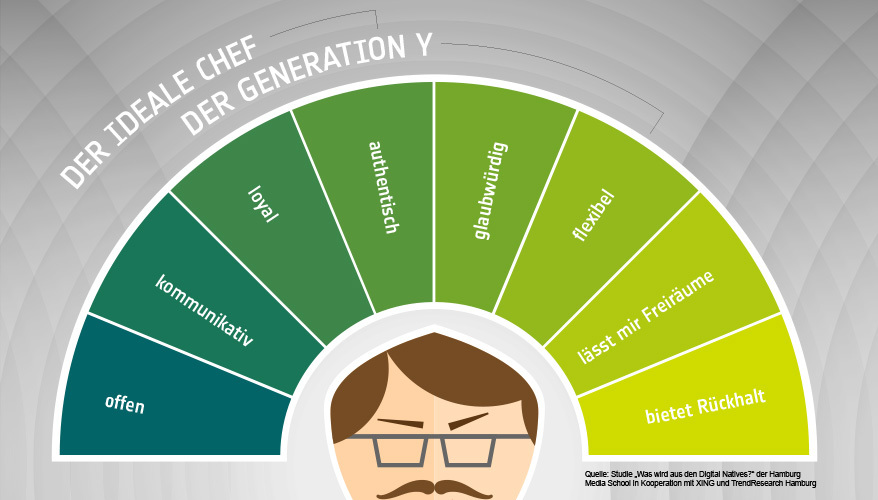
Ein gutes Gehalt ist verlockend, aber für die Generation Y nicht das Wichtigste. Wenn junge Erwachsene ihren Arbeitsplatz wählen, sind für sie andere Qualitäten von Bedeutung: Sinn, Weiterbildungsmöglichkeiten oder die Vereinbarkeit von Familie und Beruf. Dazu gehört selbstredend eine Führungskraft, die dies auch ermöglicht – doch welche Eigenschaften muss diese mitbringen? Welche Führungsqualitäten wünscht sich die Generation Y konkret von ihrem Chef oder ihrer Chefin? Der ideale Vorgesetzte muss vor allem offen und ein guter Kommunikator sein, so das jüngste Ergebnis des Forschungsprojekts „Was wird aus den ‚Digital Natives‘?“ der Hamburg Media School in Zusammenarbeit mit XING.

Im Umkehrschluss: Wer hoch qualifizierte junge Leute sucht, der sollte seine starren Hierarchien aufweichen, aufs übliche Chefgetue verzichten und Frontalanweisungen nach dem Top-Down-Prinzip vermeiden – für viele Unternehmen der „Old Economy“ eine Herausforderung. Mehr als tausend berufstätige Erwachsene zwischen 23 und 35 Jahren wurden unter anderem gefragt: Wie wichtig ist Ihnen Loyalität? Hätten Sie lieber klare Handlungsanweisungen? Mögen Sie direktes und häufiges Feedback? Ist Ihnen berufliche Weiterbildung wichtig? Brauchen Sie offene Kommunikation mit Ihrem Chef?

GenerationY2014

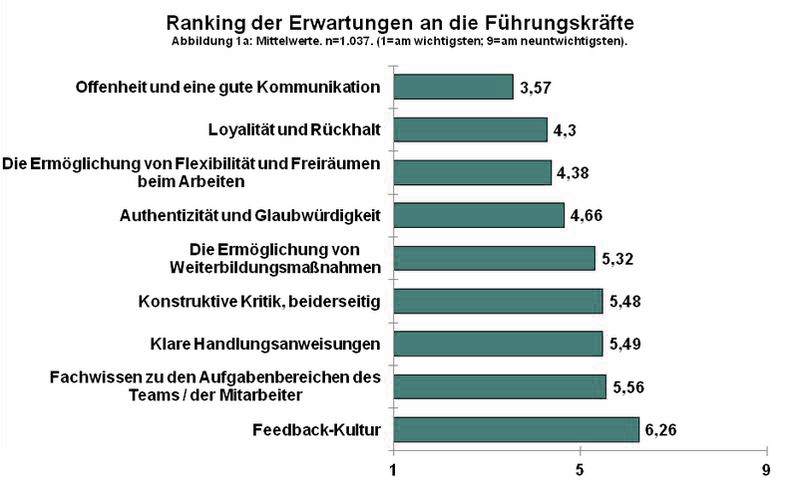
Die Ergebnisse zeigen deutlich, was die „Generation Y“ erwartet. Vor allem für die jüngeren Frauen ist besonders wichtig, dass der Vorgesetzte sich offen und kommunikativ verhält. Zudem ist der ideale Chef ein loyaler, authentischer und glaubwürdiger Typ, der auch Rückhalt bietet. Bemerkenswert: Flexibilität beim Arbeiten ist den Digital Natives sehr viel wichtiger als etwa Weiterbildungsmöglichkeiten. Überraschend auch, dass eine gute Feedback-Kultur und gegenseitige konstruktive Kritik für die junge Generation eine eher untergeordnete Rolle spielt.

Und wie sieht die Realität aus? Wie erleben die Digital Natives ihre Vorgesetzten am Arbeitsplatz, wie groß also ist die Kluft zwischen Führungsanforderung und Führungspraxis?

Das wichtigste Ergebnis: Die Mehrheit der jungen Erwachsenen ist mit dem Führungsstil im eigenen Unternehmen zufrieden. Vor allem die ganz Jungen finden, dass die Vorgesetzten ihnen zur Seite stehen und sie gut anleiten. Allerdings sagt jeder Vierte, bei ihm würden die Führungskräfte die Mitarbeiter nicht genügend wertschätzen. Und insbesondere viele ältere Digital Natives fühlen sich von ihren Vorgesetzten verunsichert, kontrolliert und unter Druck gesetzt.


Eckdaten der Erhebung:
Seit Frühjahr 2014 führt das Team des „HMS Think Tank Journalismusforschung“ (Leitung: Prof. Dr. Michael Haller) in Kooperation mit dem Business-Netzwerk XING und TrendResearch Hamburg jeden Monat eine Befragung der „Generation Y“ durch. Im Zentrum der Studie „Was wird aus den Digital Natives?“ stehen Fragen zum Informations- und Mediennutzungsverhalten sowie zur neuen Arbeitswelt. Sie ist Teil des Forschungsprojekts „Die Zukunft der Medien“. Diese Erhebungswelle fand im September / Oktober 2014 statt. Es wurde eine Stichprobe von 1.037 jungen Berufstätigen zwischen 23 und 35 Jahren (mindestens mittlere Reife als formaler Bildung) mit einem standardisierten Fragebogen online be-fragt; die Befragten gehören zur ersten Generation, die mit den digitalen Medien (Computer, Computerspiele, Handy, Smartphone) aufgewachsen ist („Digital Natives“). Weitere Informationen: http://www.hamburgmediaschool.com/forschung/think-tank-journalismus/aktuelle-studie/

Quelle: https://spielraum.xing.com/2014/10/offenheit-rueckhalt-freiraeume-was-die-generation-y-von-ihrem-chef-erwartet/?pid=b7237_cnwsl

Why Amazon has no profit—and why it works

Amazon has a tendency to polarize people. On one hand, there is the ruthless, relentless, ferociously efficient company that’s building the Sears Roebuck of the 21st century. But on the other, there is the fact that almost 20 years after it was launched, it has yet to report a meaningful profit. This chart captures the contradiction pretty well—massive revenue growth, no profits, or so it would seem. But actually, neither of these lines gives you a good sense of what’s really going on.

Amazon discloses revenue in three segments—Media, Electronics & General Merchandise (‘EGM’) and ‘Other’, which is mostly AWS. As this chart shows, these look very different (this and most of the following ones use ’TTM’—trailing 12 months, which smooths out the seasonal fluctuations and makes it easier to see the underlying trends). The media business is still growing, but it’s the general merchandise that has powered the explosion in revenue in the past few years. Meanwhile, the ‘Other’ line is growing but is still much smaller.

Splitting out the detail, we can see this trend both in North America (NA) and internationally…

Though the takeoff is particularly strong in the USA.

Media overall was only 25% of Amazon’s revenue last quarter, and 20% of North America.

And if we go back to ‘Other’ and zoom in, the growth is pretty dramatic there too.

It seems pretty likely that these businesses, selling very different products bought with different bargaining positions to different people with different shipping costs, have different margin potential.

This still doesn’t really give an accurate picture, though. Amazon is in fact organized not just in these segments, but in dozens and dozens of separate teams, each with their own internal P&L and a high degree of autonomy. So, say, shoes in Germany, electronics in France or makeup in the USA are all different teams. Each of these businesses, incidentally, sets its own prices. Meanwhile, all of these businesses are at different stages of maturity. Some are relatively old, and well established, and growing slower, and are profitable. Others are new startups building their business and losing money as they do so, like any other new business. Some are very profitable, and some sell at cost or at as loss-leaders to drive traffic and loyalty to the site. Books are a good example. There’s a widespread perception that Amazon sells books at a loss, but the average sales price actually seems to be very close to physical retailers—it discounts some books, but not all, and despite all the argument in the Agency lawsuits, quite how many and how much is (deliberately) as clear as mud.

Amazon is a bundle.

The clearest  expression of this is Prime, in which (amongst other things) entertainment content is included at a high fixed cost to Amazon (buying the rights) but no marginal cost beyond bandwidth, as a way to enhance the appeal of being a Prime ‘member’. Prime membership in turn draws people to switch more and more of their online and offline spending to Amazon. Trying to look at the profitability of the video alone misses the point.

And then there are the third party sales. Just as AWS is a platform both for Amazon’s own internal technologies and for thousands of startups, so too the logistics and commerce infrastructure themselves are a platform for lots and lots of different Amazon businesses, and also for lots of other companies selling physical products through Amazon’s site. Third party sales of products through Amazon’s own platform are now 40% of unit sales, and the fees charged to these vendors are now 20% of Amazon’s revenue.

This means, in passing, that for close to half of the units sold on Amazon.com, Amazon does not set the price, it just takes a margin. This alone should point to the weakness of the idea that Amazon’s growth is based on selling at cost or at a loss.

The tricky thing about these third party (‘3P’) sales is that Amazon only recognizes revenue from the services it provides to those companies, not the value of the goods sold. So if you buy a pair of shoes on Amazon from a third party, Amazon might collect payment through your Amazon account and ship them from its warehouse using its shipping partners—but only show the shipping and payment fees it charged to the shoe vendor as revenue. It does not disclose the gross revenue (‘GMV’). Given that (as it does disclose) third party sales tend to have a higher unit value, this means that the total value of goods that pass though Amazon with Amazon taking a percentage is perhaps double the revenue that Amazon actually reports. So, the revenue line is not really telling you what’s going on, and this is also one reason why gross margin is pretty misleading too. Gross profit has risen from 22.4% in 2011 to 27.2% in 2013, but this does not really reflect a change in consumer pricing and margins thereof, but rather this change in mix.

So, we have dozens of separate businesses within Amazon, and over two million third party seller accounts, all sitting on top of the Amazon fulfillment and commerce platform. Some of them are mature and profitable, and some are not. And someone at Amazon has the job of making sure that each quarter, this nets out to as close to zero as possible, at least as far as net income goes. That is, the problem with net income is that all it tells us is that every quarter, Amazon spends whatever’s left over to get the number to zero or thereabouts. There’s really no other way to achieve that sort of consistency.

If you listen closely, Amazon itself tells us this. The image below comes straight from Amazon—originally it was a napkin sketch by Jeff Bezos. Note that there’s no arrow pointing outwards labeled  ‘take profits.’ This is a closed loop.

(Source: Amazon)

(Source: Amazon)

In any case, profits as reported in the net income line are a pretty bad way to try to understand a business like this—actual cash flow is better. As the saying goes, profit is opinion but cash is a fact, and Amazon itself talks about cash flow, not net income (Enron, for obvious and nefarious reasons, was the other way around). Amazon focuses very much on free cash flow (FCF), but it’s very useful to look also at operating cash flow (OCF), which is simply what you get adding back capital expenditure (‘capex’). In effect, OCF is the bulk of  running the business before the costs of the infrastructure, M&A and financing costs. This shows you the effect of selling at low prices. As we can see here, Amazon’s OCF margin has been very roughly stable for a decade, but the FCF has fallen, due to radically increased capex.

In absolute terms, you can therefore see a business that is spinning out rapidly growing amounts of operating cash flow—over $5bn in the last 12 months—and ploughing it back into the business as capex.

Charting this as lines rather than areas shows just how consistent the growth in capex has been.

One might suggest that in a logistics business with rapid revenue growth, rapid capex growth is only natural, and one should look at the ratio of capex to sales by itself. But in fact, the increase here is even more dramatic. Starting in 2009, Amazon began spending far more on capex for every dollar that comes in the door, and there’s no sign of the rate of increase slowing down.

If Amazon had held capex/sales at the same ratio from 2009, before it exploded, then FCF would look like this. That difference adds up to just over $3bn of cash in the last 12 months. That is, if Amazon was spending the same on capex per dollar of revenue as it was in 2009, it would have kept $3bn more in cash in the last 12 months.

So where’s all the extra capex going? And, crucially, does it need to stay at these new, higher levels to support Amazon’s business, or can it come back down in the future?

It’s pretty apparent that the money is going into more fulfillment capacity (warehouses, to put it crudely) and to AWS. Hence, this chart shows an enormous increase in Amazon’s physical infrastructure, as measured in square feet—this is almost all fulfillment rather than data centers, though Amazon no longer gives a split.

Pulling apart precisely where the money’s going, though, is a little fiddlier. The increase is driven by some combination of four things:

  1. More capacity for more products, including 3P products
  2. Proximity—as Amazon builds warehouses closer to customers, the shipping time goes down and so too does the shipping cost, a further flywheel effect for Prime
  3. AWS
  4. More expensive warehouses—that is, the existing business is becoming more expensive to run

The first two of these are straightforward investment in the future, often delivering higher future margins. AWS is a black box and a much debated puzzle, but it is also pretty much the definition of a new business that requires investment to grow. The real bear case here would be the last point— that the existing business is becoming more capex-intensive—that more dollars of capex are needed for every dollar of current revenue.

Just to make life harder for those looking to understand Amazon’s financials, the warehouse expansion, capex expansion and AWS build-out all started at roughly the same time, and at that same moment Amazon changed the way it reports to make it very hard to pick them apart. Until 2010 it split both property and asset value between fulfillment and data centers, but at that point it stopped, probably not by coincidence (in 2010 Amazon had just 775,000 square feet for data centers and customer service combined). In the meantime, there are various metrics (capex per square foot, for example) that would show a shift of spending from cheap warehouse to expensive data centers—but they would also show a shift from maintaining existing warehouses to building new ones. So there is no direct, easy way we can see the split.
We can still, though, get a something of a sense of the key warehouse question—has the business gotten more expensive to run? It looks like the answer is no. First, the third party sales do not seem to be the issue: ratio of 3P units has not gone up at anything like the way the capex/sales has over the same period (here’s that chart again).
Neither is there any sign of a shift in the fulfillment costs over the period (Amazon seems to have forgotten to stop disclosing these). The physical product mix hasn’t got dramatically more expensive to ship, so would it get dramatically more capex-intensive to warehouse? This is obviously not an exact proxy, but it seems unlikely.

15.png

So, though we can’t be sure, it looks like the capex is not going up because Amazon’s existing business has become more expensive to run, but because Amazon is investing the growing pool of operation cash flow into the future. All of this brings us back to the beginning—Amazon’s business is delivering very rapid revenue growth but not accumulating any surplus cash or profits, because every penny of cash is being ploughed back into expanding the business further. But, this is not because any given business runs permanently at a loss—it is because the profits from what is already there are spent on making new businesses. In the past, that was mostly in operations, but in recent years the investment firehose has again been pointed at capex.

How long will this investment go on for? Well, do we believe that the conversion of products and businesses to online commerce is finished? Let’s rebase that revenue chart, and look at it as share of US retail revenue. Excluding gasoline, food and things like timber and plants, all hard to ship, at least for now, Amazon has about 1%.

Overall, US commerce is growing very consistently:

And Amazon is taking an accelerating share of it.

Amazon has perhaps 1% of the US retail market by value. Should it stop entering new categories and markets and instead take profit, and by extension leave those segments and markets for other companies? Or should it keep investing to sweep them into the platform? Jeff Bezos’s view is pretty clear: keep investing, because to take profit out of the business would be to waste the opportunity. He seems very happy to keep seizing new opportunities, creating new businesses, and using every last penny to do it.

Still, investors put their money into companies, Amazon and any other, with the expectation that at some point they will get cash out. With Amazon, Bezos is deferring that profit-producing, investor-rewarding day almost indefinitely into the future. This prompts the suggestion that Amazon is the world’s biggest ‘lifestyle business’—Bezos is running it for fun, not to deliver economic returns to shareholders, at least not any time soon.

But while he certainly does seem to be having fun, he is also building a company, with all the cash he can get his hands on, to capture a larger and larger share of the future of commerce. When you buy Amazon stock (the main currency with which Amazon employees are paid, incidentally), you are buying a bet that he can convert a huge portion of all commerce to flow through the Amazon machine. The question to ask isn’t whether Amazon is some profitless ponzi scheme, but whether you believe Bezos can capture the future. That, and how long are you willing to wait?


Source: http://qz.com/262701/why-amazon-has-no-profit-and-why-it-works/

Is Amazon A Giant Ponzi Scheme Dressed In Drag?

The recent run-up in Amazon.com’s (NASDAQ:AMZN) stock price inspired me to revisit an old thorn in my side. AMZN is up 12.2% since the beginning of 2013, despite a very tough retail sales environment and despite the fact that California and some other states now collect what is known as „the Amazon tax.“ In addition, a bill to collect a Federal Internet sales tax was reintroduced in Congress two weeks ago: Online sales tax.

With this in mind, I decided to peruse AMZN’s 2012 10-K, something I had not done in years, to see what was going beneath the headline „veneer“ applied heavily to AMZN’s quarterly sales and net income results.

I knew that AMZN was using some controversial accounting methodologies, but when I pulled apart the financial statements and applied some old fashioned financial analysis, what I found with regard to AMZN’s cost structure, cash flow and true profitability was quite shocking. Looking at some income statements, cash flow from operations and balance sheet indicators, some of which Wall Street never discusses – AMZN looks somewhat like a Ponzi scheme. I say this because I believe it is likely that a serious cash problem for AMZN will develop if its sales growth slows down or even goes flat.

Let’s look at some numbers I put together by „pulling apart“ AMZN’s financial statements from its 2012 10-K (linked for your convenience). I created the table below to focus on what I consider to be the key metrics in understanding the true ability of AMZN’s business model to generate meaningful cash flow. Standard GAAP/adjusted-GAAP accounting statements often use accounting gimmicks that mask true profitability, which I’ll demonstrate below:

Amazon-Ponzi-Scheme

First, I wanted to look at cash flow generated by operations. This number is a fairly „clean“ indicator of how profitable the business model is, as it adjusts the reported income for all non-cash charges, adjusts for any non-operating gains/losses and reflects cash required to finance receivables and make vendor financing payments. As you can see, despite robust sales growth over the last three years, the cash generated by each additional dollar of sales is decreasing rapidly, as reflected by the trend shown in line (1) above. While it’s true that a smaller percentage of a growing sales number is still an increase, you can see that from 2011 to 2012 sales jumped by $13 billion but operational cash flow only increased by $271 million. This is a red flag. Please note, this cash flow number does not include AMZN’s big capex program – it’s purely a measure of AMZN’s organic operational profitability

Second, I believe a big part of the declining cash flow margin comes from AMZN’s cost of fulfillment – the cost delivering products to the end-buyer. I have always believed that AMZN’s business model generated tremendous sales growth because AMZN’s fulfillment strategy, in effect, heavily „subsidizes“ the all-in price paid by the customer. As you can see in (2) above, AMZN’s fulfillment costs have increased as a percent of its cost of goods sold in each of the last three years.

In fact, the way AMZN accounts for fulfillment is quite controversial: AMZN’s accounting. AMZN does not include fulfillment costs in its cost of goods sold (COGS), despite the fact that shipping – getting sold products to the buyer – is an integral part of the all-in cost of products sold in AMZN’s business model/strategy. AMZN’s „holy grail“ is that it can sell products over the Internet more profitably than „brick and mortar“ retailers, so the cost of delivery should be part of the cost of sales.

It’s a grey area of FASB rules, but not including this expense in the COGS distorts AMZN’s gross margins vs. that of competitors. (2) in the table above shows AMZN’s gross margin with and without fulfillment costs. As you can see from the difference in the two metrics, AMZN is heavily incentivized to keep the cost of fulfillment out of its COGS calculation. Gross margin is a key metric for analyzing profitability. In 2012, Target’s (NYSE:TGT) gross margin was 31%, Wal-Mart’s (NYSE:WMT) was 25% and Best Buy’s (NYSE:BBY) was 24.6%. You can see why AMZN has refused to consider fulfillment costs as part of the cost of a product, despite the fact that it is a key component in generating revenue. Fulfillment costs have been a rising part of AMZN’s overall product cost. As the cost of energy, and there the cost of shipping, increases it will put even more of a squeeze on the cash margin AMZN earns with each sale.

Third, AMZN’s operating margin is razor thin compared to its comparables. You can see from (3) in the table above that it’s been deteriorating quickly over the last three years. For 2012, TGT and WMT had operating margins of 7.6% and 5.6%, respectively. Remember, AMZN’s theory with its business model is that it can operate less expensively than its „brick and mortar“ rivals. The numbers for the last three years suggest that AMZN fails to deliver on this.

Let’s now look a little more deeply at the cash being generated by AMZN’s operations and why I believe AMZN resembles more of a Ponzi scheme than people realize. In addition to cash being generated by sales, „cash provided by operations“ also includes changes in working capital. Inventory is a use of cash; accounts receivable, accounts payable and other current liability accruals are sources of cash.

Retailers tend to have a much larger amount of accounts payable than they do receivables. Cash comes immediately from sales and companies negotiate payment terms from vendors, etc, thereby giving retailers the „float“ on cash generated by operations. In order for this model to work, it is important for sales to grow over time, as the „velocity“ of „cash in“ needs to stay ahead of the velocity of „cash out,“ otherwise a liquidity problem can develop.

I chose to isolate and focus on AMZN’s accrued expenses because the payables have been increasing at a normal rate. However, the accrued expense account (3) has been increasingly a significant portion of AMZN’s „cash provided by operations,“ – its „cash in.“ As you can see from the table above, accrued expenses are growing and have gone from just 17% of cash flow from operations to over 47%. This is a big red flag.

Accrued expenses are largely cash from the sale of gift cards. If gift cards go unused, and some do, they accrue 100% to operating income. AMZN doesn’t disclose the other sources of accrued expenses, but it isolates „unearned revenues“ in its cash flow statement (4) – this is gift card cash. As you can see, gift card sales have been a growing source of cash funding over the last three years, representing 43% of cash generated by operations in 2012. If I didn’t know exactly what business AMZN was in, I would be under the impression that it was trying to become a gift card sales operation.

My point here is that – at 43% of cash generated by operations – AMZN is become increasingly reliant on the „float“ it gets from gift cards in order to fund its operations on a short term basis. If AMZN’s revenues slow down or its expenses unexpectedly increase, for whatever reason, AMZN could face liquidity problems.

What happens if sales slow down because of a bad economy or predatory competitors? On Monday (March 3) Wal-Mart announced that it was going to start going after AMZN’s „Marketplace“ web vendor business: Wal-Mart/Amazon. This will likely „cannibalize“ AMZN’s „net service sales,“ which has gone from 10% of revenues to nearly 15% over the last three years. AMZN doesn’t break out its income from its revenue segments, but its Marketplace business is likely very high margin, meaning it’s become an important part of cash generated by operations. In addition, the imposition of the internet „Amazon tax“ will increase the customer’s all-in cost to buy from AMZN, which could significantly impact sales negatively.

AMZN’s market cap as of the 3/7/2013 close is $124.5 billion. Based on 2012 operating income, it’s trading at 185x operating income. For comparison purposes, WMT and TGT trade respectively at 9.2x and 8x their 2012 operating income. The p/e comparison is irrelevant because AMZN lost money on a net income basis in 2012, but that multiple of cash flow unequivocally represents an irrational „bubble“ valuation.

AMZN’s market cap has always been one of the unsolved mysteries of the stock market. Moreover, in its entire operating history, AMZN has never generated meaningful income or cash flow. It is clearly highly overvalued relative to its peers. But, I have rarely made money either shorting the stock or buying puts. It’s been a long-time source of frustration and at this point I’m going to wait until I see the signs that the Ponzi-like cash funding scheme AMZN has in place starts to deteriorate and then I’m going to pounce hard on the short side. Given that retail sales seem to be slowing down – and by some metrics declining – with the economy, and given that Wal-Mart is going to start throwing its weight around at one of AMZN’s key sources of cash flow, I don’t think I’ll have to wait much longer.

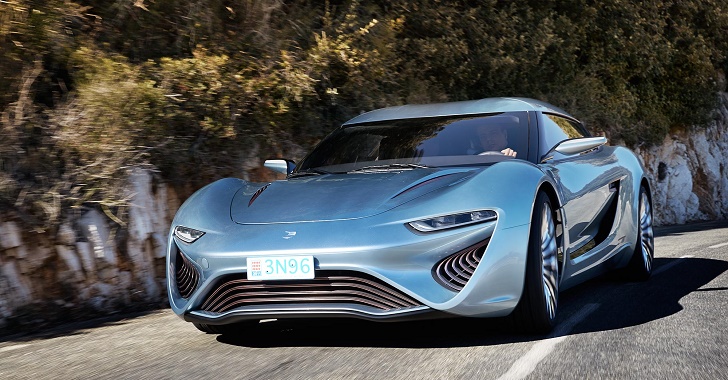
QUANT e-Sportlimousine powered by Saltwater top speed 350 km/h (217.5 mph) 0-100 2.8 seconds maximum power 920 horsepower (680 kW) – 600 km (373 mi) with a full tank

image_quant_05

QUANT e-Sportlimousine powered by Saltwater
top speed 350 km/h (217.5 mph)
0-100 2.8 seconds
maximum power  920 horsepower (680 kW)
range 600 km (373 mi) with a full tank


In a breakthrough that is bound to catch the attention of the oil industry and even electric car makers, a company has just gained approval for its ‘salt water’ powered car in Europe.

A car called the Quant e-Sportlimousine that was presented at the 2014 Geneva Motor Show is the first electric car powered by salt water and is now certified for use on European public roads.

The e-Sportlimousine, built by the German company Quant, runs on an electrolyte flow cell power system made by NanoFlowcell that generates a staggering 920 horsepower, goes 0-62 mph in 2.8 seconds, and propels the car to a top speed of 217.5 mph!

What is an electrolyte flow cell you ask? According to Green Car Congress“Flow cells or flow batteries combine aspects of an electrochemical battery cell with those of a fuel cell. The electrolytic fluids in flow cells—usually metallic salts in aqueous solution(salt water)—are pumped from tanks through the cell. This forms a kind of battery cell with a cross-flow of electrolyte liquid.”

For the first time an automobile featuring flow-cell electric drive will appear on Germany’s roads,” said Nunzio La Vecchia, chief technical officer at NanoFlowcell, a company which designed the car. “We are extremely proud that as a small company we have developed such visionary technology and are now able to put it into practice. But this is only the beginning of our journey of discovery.”

A few months after making a debut at the 2014 Geneva Motor Show, the Quant e-Sportlimousine underwent an in-depth inspection and received official approval to be tested on public roads in Germany and Europe from certification provider TÜV Süd based in Munich, Germany.

The car is powered by the electrolyte flow cell power system, which is a part of the NanoFlowcell technology. The system works in a similar way to a hydrogen fuel cell, except for the fact that salt water is used for storing power. In particular, two liquids with metallic salts, which act as the electrolyte, are combined in such a way that the electrochemical reaction takes place. After that, electric motors use this reaction to generate electricity, which is then stored and distributed by super capacitors. The efficiency of this system reaches 80%, since the car has almost no moving parts in it, and the produced waste heat is insignificant in comparison with cars powered by lithium-ion batteries.

The company claims that the Quant e-Sportlimousine can reach the speed of 350 km/h (217.5 mph), accelerate from 0-100 in 2.8 seconds and has maximum power of 920 horsepower (680 kW). Moreover, the car is claimed to be able to travel up to 600 km (373 mi) with a full tank, which is five times greater than with a conventional battery system. At the same time, the car is safe to drive and environmentally friendly.

However, the market price of the Quant e-Sportlimousine is estimated to exceed $1.7. It is not yet clear if the company plans to use the NanoFlowcell technology on more affordable cars, but it can be said for sure that this technology has a great potential and could be used in a wide range of applications which go beyond the automobile industry.

Using this platform, the e-Sportlimousine is able to produce a massive amount of power while emitting zero emissions. While the e-Sportlimousine is bound to be very expensive, there is hope for the electrolyte flow cell power platform to be used more practically in the future.

This technology has potential uses for other industries as well, says NanoFlowcell spokesman Prof. Jens-Peter Ellermann, “The potential of the NanoFlowcell is much greater, especially in terms of domestic energy supplies as well as in maritime, rail and aviation technology. The NanoFlowcell offers a wide range of applications as a sustainable, low cost and environmentally-friendly source of energy.”  

“Low cost”, that sounds good to me.

Source: http://themindunleashed.org/2014/09/move-tesla-new-car-powered-salt-water-900-horsepower.html

Apple Watch Event: Uhrsache (sic!) und Wirkung

Der Spiegel Online analysiert knallhart:

„Erst eingehende Tests werden zeigen, ob die Benutzung der neuen Uhren tatsächlich so intuitiv und angenehm ist, wie Cook und sein Team das bei der Vorstellung ein ums andere Mal betont haben. Sicher ist, dass Apple bis heute einen Vertrauensvorsprung hat, wenn es um die Einführung neuer Geräte geht. Steve Jobs versprach einst: Wenn wir etwas anfassen, dann machen wir es so, dass die Kunden es lieben werden. Löst die Apple Watch dieses Versprechen ein, dann kann sie einmal mehr einer Gerätekategorie zum Durchbruch verhelfen, bei denen andere die undankbare Vorreiterrolle übernommen haben. So wie das bei MP3-Playern, Touchscreen-Handys oder tragbaren Touch-Computern schon der Fall war.“

Und subsummiert, die Ängste, aller Beteiligten, Mitarbeiter, Fan-Boys, überzeugten Innovationsliebhabern, und Aktionären:

„Erweist sich die Apple Watch aber als überflüssiger Schnickschnack, als allzu klobiges Anhängsel mit zu wenig echtem Mehrwert für seinen Preis, dann kann die Uhr das Gegenteil bewirken: Wenn der Konzern nur einmal unter Beweis stellt, dass nicht jedes seiner Produkte automatisch zum unverzichtbaren Alltagsgegenstand wird, könnte das der Beginn eines rapiden Abstiegs werden.“

Tim-Cook


Spiegel Online resümmiert:

„Die Ankündigung mit der vermutlich nachhaltigsten Wirkung aber ist die zugleich am wenigsten spektakuläre. Der berührungslose Bezahldienst Apple Pay ist einmal mehr eine aufpolierte Kopie bereits im Markt befindlicher Angebote, man denke nur an Google Wallet. Android-Handys mit NFC-Chips gibt es längst, das Zahlen per Handy aber hat sich bislang nirgends durchgesetzt. Apple aber hat im Smartphone-Bereich in den USA bis heute einen Marktanteil von 40 Prozent – und Cooks Mannschaft hat es offenbar verstanden, sich mit vielen großen Laden- und Restaurantketten zu verbünden.

Schafft Apple es, mit seinen neuen Geräten schnell große Kundenzahlen zu erreichen – und die Geschichte legt nahe, dass das klappen könnte, – könnte mit einem Mal auch das Zahlen mit dem Handy – oder der Uhr – zur Alltagsgeste werden.

Für Ladenketten könnte die Anschaffung der entsprechenden Hardware mit einer ausreichend großen, zahlungskräftigen Klientel plötzlich doch interessant werden, und genau das sind Apples Kunden. Und stehen die Scanner erst einmal an den Ladenkassen, sind auch die NFC-Chips in allen anderen Handyfabrikaten plötzlich wieder im Spiel. Wenn das geschieht, wenn unsere digitalen Alltagsbegleiter auch zu unserem bevorzugten Zahlungsmittel werden, ist das zwar bequem – es bringt aber auch völlig neue Datenschutz– und Sicherheitsprobleme mit sich.“

Derstandard ergänzt:

„Das US-Magazin „Fortune“ würdigte Cook seinerzeit als „das Genie hinter Steve“. Als Zuständiger für das operative Geschäft sorgte er dafür, dass nach Umsetzung der kühnen Visionen schwarze Zahlen in den Büchern standen. Jetzt muss Cook mit der Computeruhr beweisen, dass sein Apple die gleiche visionäre Kraft wie zu Zeiten von Jobs hat. Dieses Image hilft dem Konzern, weltweit Millionen seiner teuren Premium-Smartphones und Tablets zu verkaufen.“

Original-Zitate nachzulesen bei: http://www.spiegel.de/netzwelt/gadgets/apple-watch-iphone-6-und-smartwatch-koennten-bezahlverhalten-aendern-a-990734.html und http://derstandard.at/2000005390426/Tim-Cook-tritt-mit-Apple-Watch-aus-dem-Schatten-von

2014′ Apple Special Event unboxing new Iphones, Apple Pay, Apple Watch and many more

See All the Glorious Gadgets From Apple’s Big Event

CUPERTINO, California—Today Apple unveiled a trifecta of new products that are surely sending worrisome ripples down the spines of the company’s competitors.

At a massive media event here at the Flint Center for Performing Arts, Apple announced two new large-screen iPhones, a new mobile payment platform, and an advanced touchscreen wristwatch. Judging by the numerous outbreaks of applause and the occasional standing ovation, the new products were met with great support by the huge audience of press, Apple employees, and VIPs from the entertainment, technology, and fashion industries.

But don’t worry if your eyes weren’t glued to the video livestream—or if you were one of the countless viewers who suffered from numerous drop-outs and technical problems and were left in the dark for much of the event. Here are the most important things you need to know about Apple’s big day.

The New iPhones: iPhone 6 and iPhone 6 Plus

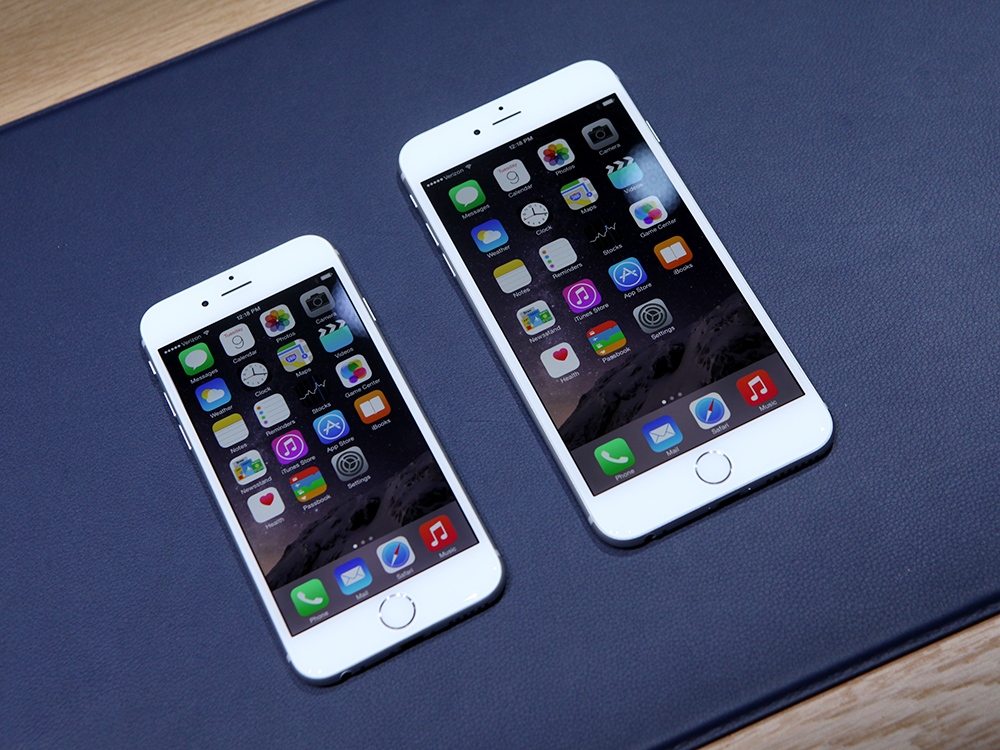
After a dramatic introductory video, Apple senior vice president Phil Schiller unveiled two new iPhone models today, the iPhone 6 and iPhone 6 Plus. Both are styled with a smooth, brushed aluminum rear face that curves gently into the front face. They look like small iPads.

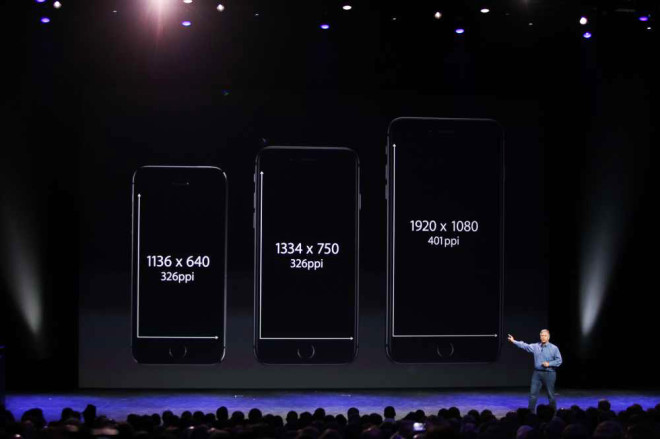
The iPhone 6 has a 4.7-inch display with a 1334×750 pixel resolution. The iPhone 6 Plus features a 5.5-inch screen with full HD 1920×1080 display resolution. Other than this size difference, the phones are essentially the same.


AppleSpecialEvent20140909-Iphones

iphone6

On the rear, they’ve got an 8-megapixel shooter with an f/2.2 aperture 8-megapixel camera. It’s got a new sensor and speedier autofocus. The 6 has digital image stabilization, but the 6 Plus also has additional optical image stabilization that uses its gyroscope and the M8 coprocessor to cancel out extra shakiness. The front-facing camera gets some new features like HDR and a burst-shot mode.

Inside, an A8 processor promises to be up to 87 percent more efficient than its predecessor, offering CPU processing power up to 25 percent faster and GPU speeds up to 50 percent faster than the iPhone 5s’ A7 chip. The M8 motion coprocessor, in addition to aiding in image stabilization, can now tell when you’re walking, running or cycling, and can give you credit if you’re traversing up and down stairs thanks to a barometer that detects changes in air pressure.

Both devices feature Touch ID home buttons and NFC (more on that in a sec). The iPhone 6 goes on sale Friday, September 19th starting at $200 on contract for 16 GB, $300 for 64 GB, and $400 for 128 GB. The iPhone 6 Plus starts at $100 more.

ApplePay, Apple’s Mobile Payment Initiative

“Payments is a huge business. Every day between credit and debit, we spend $12 billion, and that’s just in the United States,” Cook said to introduce what a huge space payments is—a huge space digital payments have yet to crack.

AppleSpecialEvent20140909-ApplePay

applepayday

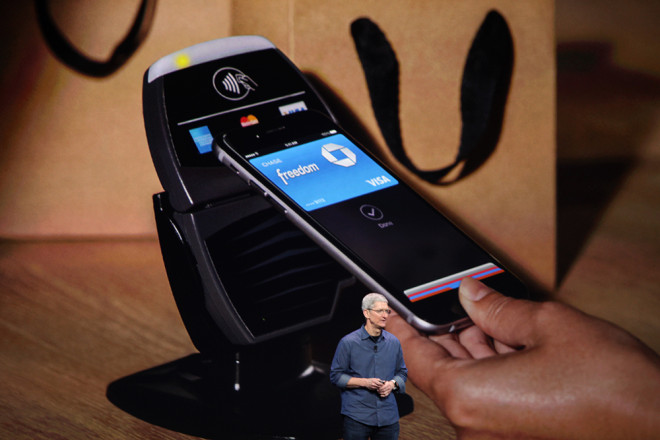
Working with American Express, MasterCard, and Visa, the new ApplePay systemas been designed to work with over 220,000 merchants at launch, including familiar locations like Walgreens, Whole Foods, Macy’s, and Target. Using NFC, you simply tap your phone on a payment terminal to purchase things. It’s that easy. How it works is a bit more complicated though. It uses a combination of NFC, Touch ID, and a secure chip Apple calls the Secure Element. You add a card by snapping a photo of it, then getting verification from your bank. During a transaction, a unique device number, rather than the actual credit card information, is sent to the merchant along with a dynamic security code. Apple doesn’t collect your data—what you buy is between you and the merchant. And if you lose your iPhone, you can suspend payments with Apple’s standard-issue Find My Friends app without needing to cancel your actual credit card.

It will launch in the U.S. in October as an update to iOS 8.

Apple’s Wearable: The Apple Watch

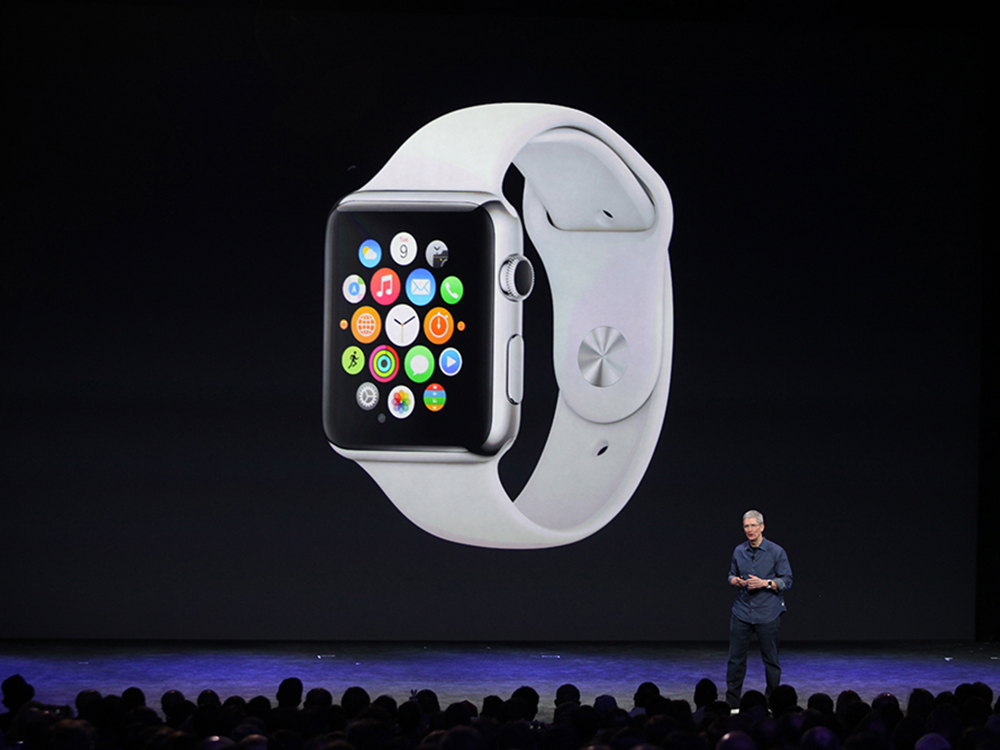
The biggest question mark surrounding today’s event was whether Apple would actually unveil its long-rumored wearable computing product. The company did not disappoint. The Apple Watch is officially here.

“Apple watch is the most personal device we’ve ever created,” Cook said after receiving a standing ovation and a round of wild applause. Apple’s CEO calls it “a new intimate way to connect and communicate direction from your wrist.”

The timepiece, which is accurate to within plus or minus 50 milliseconds, is not just technologically impressive. It’s also quite stylish. The faces and the different hardware choices let you trick out the watch to match your own personal style.

AppleSpecialEvent20140909-AppleWatch1

AppleWatchWristApps

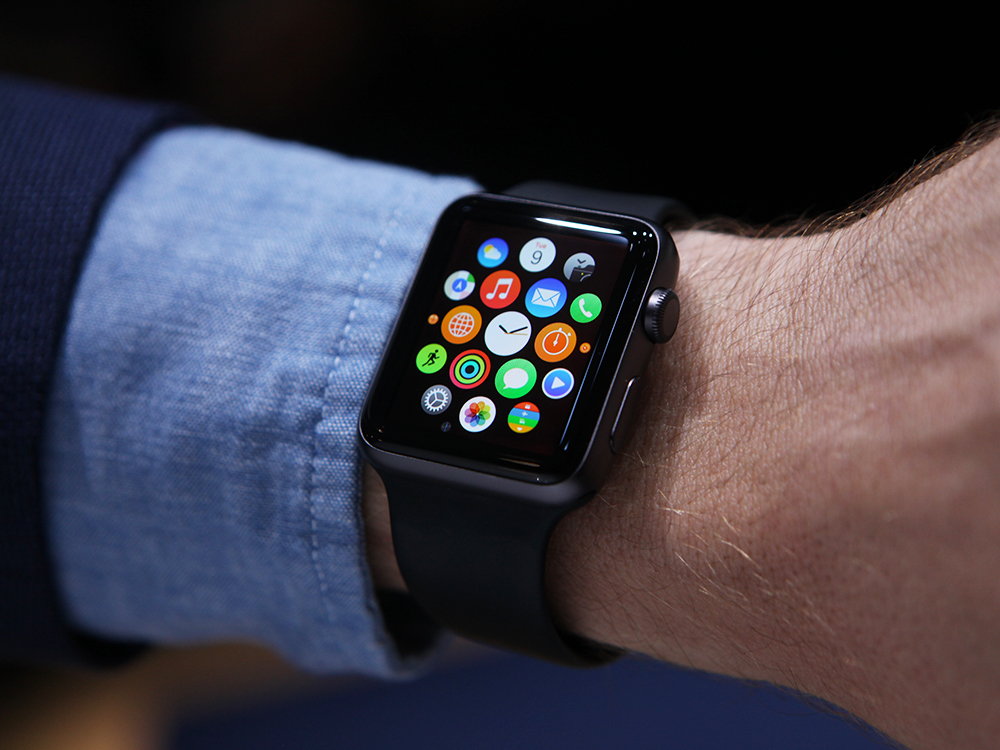
The watch face looks very similar to a traditional watch, including a dial on the side that Apple calls the “digital crown” that translates movement into digital data. Apple kept some of the tech specs on the vague side—the product won’t actually ship until next year. What we do know is that the display is a sheet of sapphire, and inside is a custom designed chip encapsulated to protect the electronics. On the rear are four sapphire lenses which hold LEDs and photo sensors for detecting your heart rate.

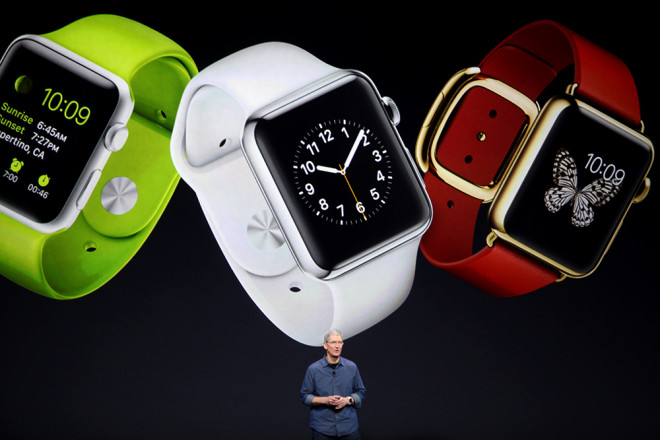
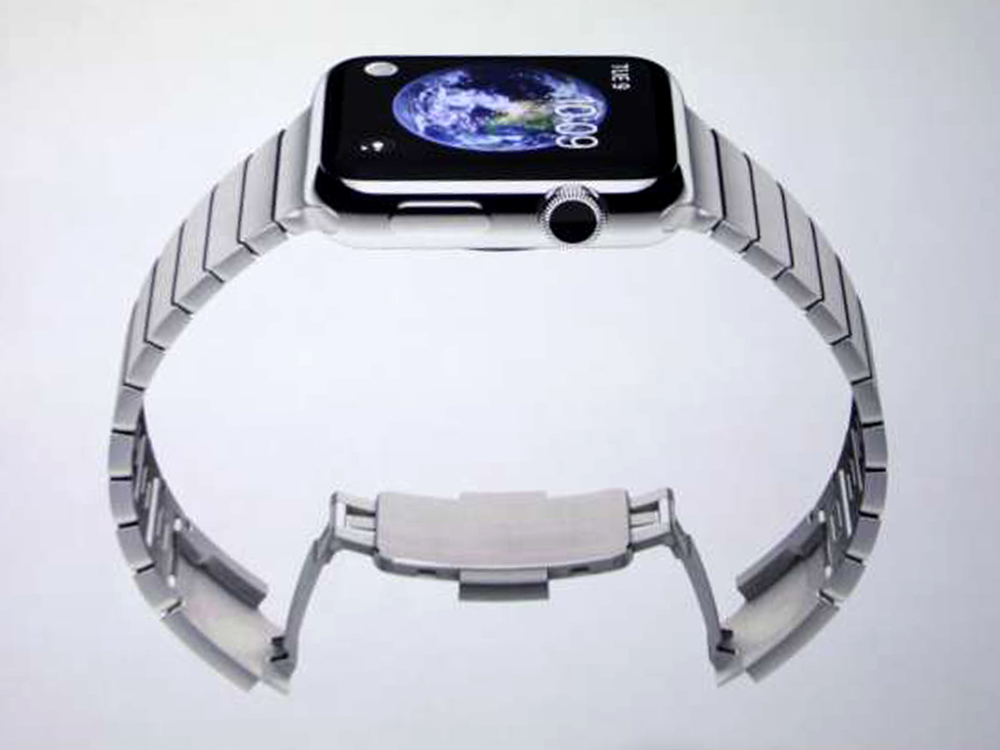
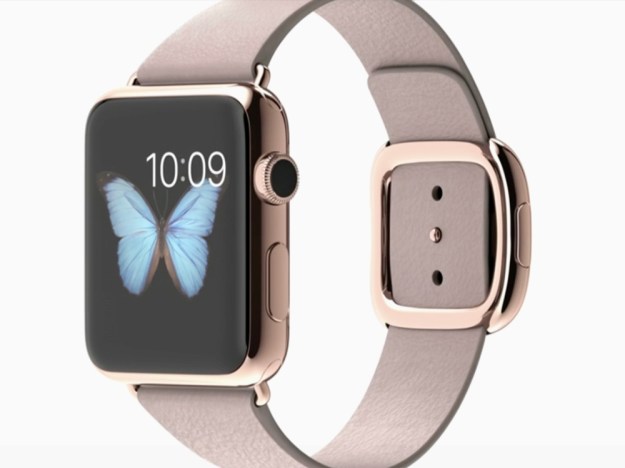
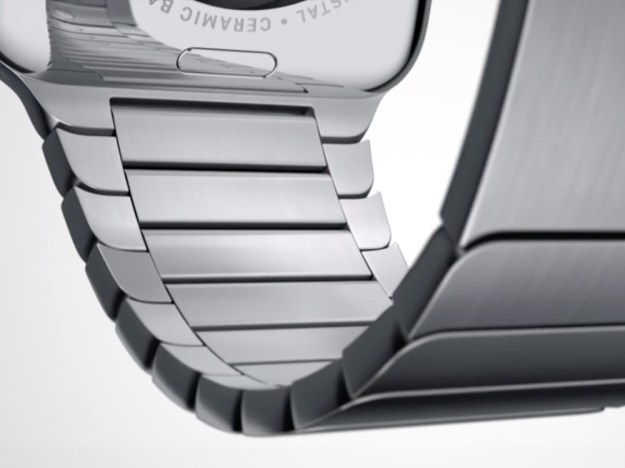
With regards to looks, the Apple Watch is a bit of a chameleon. It comes in three editions: Apple Watch, Watch Sport, and Watch Edition. Apple Watch is the most basic, Watch Sport is more durable, and Watch Edition is more exotic and made of gold. There are six different straps you can mix and match to suit your needs: a quilted leather strap with a magnetic clasping band, a traditional leather buckle, a stainless steel link bracelet, and a mesh chain loop are among the choices. The device comes in not just two band sizes, but two watch face sizes, to suit folks with different-sized wrists.

But it’s not just the hardware that’s customizable. “With every breakthrough, Apple has also had to have a breakthrough in user interface,” Cook said. What Apple didn’t do, he says, is take the iPhone and shrink the interface and strap it on your wrist. The display is too small, and it would make for a terrible user experience. Instead the digital crown is a key part of the navigation experience, as are onscreen taps and swipes.

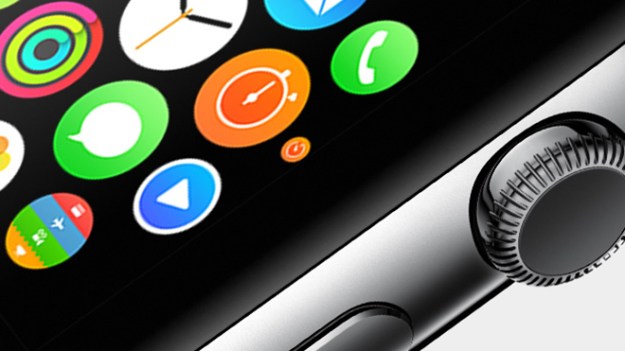
The menu screen is composed of bubbles of circular app icons you can arrange however you like, including grouping them by “neighborhood” of related apps. Twisting the crown zooms in and out on the group of apps. To open an app, you tap it. A feature called Glances lets you swipe upwards from the bottom of the screen to cycle through a customizable series of data screens. Siri is built into the watch, so you can dictate questions like “What movies are playing tonight?” A new feature called Digital Touch lets you select a contact then send a super-quick message just based on taps and drawings that your contact can then feel (via a vibration) when it reaches their wrist. It’s intended for messages that have a more personal context—and are a lot less wordy—than your usual text message.

The Apple Watch has a number of other apps including Maps, notifications from third-party apps, and a lot of customizable watch faces. Third-party apps, like ones from American Airlines and W Hotels, are also on the way. A pair of Apple-built health and fitness apps use both the watch and your iPhone’s sensors to give you a holistic view of your daily activities, combining the features of a general activity tracker and an advanced sport watch.

The Apple Watch charges using an inductive charger that fits on the back of its rectangular face. There’s no word about exact battery life yet. Few details were given about pricing, as well. All we know is that the Apple Watch will start at $350, and that it will go on sale in early 2015.

AppleWatchMetal

Source: http://www.wired.com/2014/09/apple-event-faq

Apple Watch – Apples Latest Consumer Innovation


Everything You Need to Know About the Apple Watch

AppleWatch      AppleWatchMetal

The wearable space just got bigger. Way bigger. Apple debuted its long-awaited wearable Tuesday, simply called Apple Watch.

There are actually three products: Apple Watch, Apple Watch Sport, and Apple Watch Edition. The differences between them are only apparent in the different materials (including aluminum, 18K gold, and pink gold) and wrist strap choices, which vary between feminine, masculine and youthful.

The Apple Watch starts at $350, and it will be available “early next year,” according to the company. Pricing for Apple Watch Sport and Apple Watch Edition were not announced at today’s event. The watch will require an iPhone to operate, but it works with the iPhone 5 or later and isn’t limited to just the new iPhone 6 devices.

AppleWatchSportsEdition

The interfaces of all three phones are alike, and there are a number of standout features.

Instead of interfacing with the watch by touching the screen, which just gets your fingers in the way and blocks your view, you can navigate through the menus and apps by touching the crown. Twist it to zoom in and out of screens and menus. Press it and you go back to the home screen (just like on the iPhone).

There’s an additional button just beneath the crown. Tapping it brings up something Apple calls “Digital Touch” communication. It’s based around a list of friends you’ve communicated with recently. You can send small pictures and sketches to your friends with just a few taps.

The screen itself works much like a Retina display on iPhones and iPads, but it can also sense force. So the familiar two-dimensional touch input system gains a third, vertical dimension.


AppleWatchSensorClose

On the back, there’s a crystal with LEDs that can measure your heart rate—this adds health-tracking capability to the watch. Also on the back is a wireless, inductive charging mechanism. The charger attaches to the back of the watch via a magnet. There’s also vibrating mechanism on the back so you can get notifications and haptic feedback for each of your finger taps.

Raising your wrist awakens the display. When it pops to life, you see a simplified list of apps made just for the watch. There are also several watch faces to choose from. You get sporty, chrono-style faces, retro digital readouts, and even a whimsical Mickey Mouse face. You can customize the color of the face by rotating the crown, or swipe to change the contents of the face so it shows the date and other fields of information on its screen.

AppleWatchGold

There are some health-tracking features to help you make your fitness goals for steps, calories burned, and so on. The watch also works with Apple Pay, the company’s new mobile payments system.

“We’ve been working on Apple watch for a long time,” Cook says. “It covered every discipline at Apple.”

AppleWatchMetal2

Kevin Lynch, a new face on Apple’s media event stage who led the software effort, stepped onstage in Cupertino to give us the first live demo of the watch.

Apple wanted to build the watch so functions were easy to find and use. The menu screens are bubbles of circular app icons you can arrange how you like. You can arrange “neighborhoods” of apps. To open an app, you tap it.


AppleWatchApple


Apple also thought it was important to relay other information in a glanceable way. It does this using a new interaction it calls Glances, a swipe up from the bottom of the watch face. You can arrange these how you like, swapping through the water, the music you’re playing on other devices, et cetera. You can also send some sort of silly 3-D animated smiley face, allowing you to share a lot of emotion without doing a whole lot.

AppleWatchHomeButtonClose

Siri is also built into the watch, so you can do things like ask what movies are playing tonight. You can use the crown or your finger to scroll through the list. There’s also a photo app. You can see an overview of photos, displayed in a grid-like Photostream, and you can use the crown to zoom into them, or swipe to scroll through them. You can pull up any collection of photos here.

AppleWatchGold2

In a map, you can pan around by swiping, you can also zoom out by rotating the crown. When you press the bottom left, it takes you back to where you are. There’s also a search command, you can search by diction or look through your favorites. Search a location like Whole Foods, you can get store information as well as directions for walking or driving.

AppleWatchWristApps

A big key to whether the watch succeeds or fails is the buy-in of third-party developers. Using the new development software pack called WatchKit, developers can create rich, actionable notifications for the device. Apple has been busy with partnerships and client applications for the launch, as well. The watch can alert you to friend requests on Facebook. Twitter’s there too. For an incoming tweet, you can reply straight from the message. You can view things on your timeline, look at trending tweets, or tap the top to compose a tweet. For when you’re traveling, American Airlines has an app. You can even unlock hotel room doors at some hotels using the watch. You can also get notified when you’re walking near sight seeing spots you’ve pinned on Pinterest and get walking directions to them. The watch works with BMW cars, you can challenge friends to runs on the Nike app, and you can control things in your home using the Honeywell app.

AppleWatchFemale


Source: http://www.wired.com/2014/09/apples-new-wearable

IPhone 6 and Iphone 6 Plus hitting the stores September 19 2014

Meet Apple’s Super-Sized iPhone 6 and iPhone 6 Plus

iphone6

As foretold by the rumors, Apple announced two new larger iPhone models today: the iPhone 6 and iPhone 6 Plus. Sized at 4.7-inches and 5.5-inches respectively, the phones sport a slick new style and landmark new features.

The iPhone 6 is priced at $200 for 16 GB, $300 for 64 GB, and $400 for 128 GB, with a two year contract. The larger iPhone 6 Plus commands a premium: $300 for 16 GB, $400 for 64 GB, and $500 for 128 GB. Both phones come in silver, gold, and black.

Pre-orders start this Friday, September 12, and the phones go on sale Friday the 19th.

Both phones sport new designs. The iPhone 6 and 6 Plus, with their larger displays, now feel reminiscent of a miniature iPad. The rear of each device is smooth brushed anodized aluminum that curves softly into its glass front face rather than being completely flat on the back with largely squared-off edges—the look the past four iPhones adopted. On the front, you’ve also got the familiar Touch ID home button.

The iPhone 6 has a 1334×750 display, the 6 Plus 1920×1080 display. That’s over 1 million pixels on the iPhone 6 and over 2 million on the iPhone 6 plus. These new display sizes use a new generation of Retina display Apple is calling Retina HD. The new reengineered displays use ion-strengthened glass on top, and on the bottom, an ultrathin backlight. Even with the larger display, Apple is promising the iPhone 6 and iPhone 6 Plus will have equal or better battery life than the last generation of iPhones.

apple-event-140909-Iphone6Sizecomparision


To use these big-screened phones, Apple’s introduced a few new software tricks to iOS. In the iPhone 6 Plus, the Messages app has a new horizontal split display. Stocks also has a two panel horizontal view, as does Mail. The keyboard takes advantage of the display area, too, and there’s a new horizontal homescreen view. These views obviously make better use of the increased screen real estate, but I wonder how easy it is to use with your fingers as you type.

You can also use swiping gestures for navigation in Mail, Messages, and Safari. There’s also a new gesture called reachability: If you double touch the home button, the display slides down so you can reach things at the top of the display without having to readjust your hand. This seems like a better solution than Samsung’s one-handed mode, but it’s still kind of awkward that it’s necessary.

Both phones will ship with iOS 8. Software updates will go out to older iPhones (the 4S and later) on September 17.

On the iPhone 6 line, Apple updated the camera hardware and software. Apple’s using a 8-megapixel camera with a f/2.2 aperture. There’s also a new sensor inside that’s an improvement over previous iPhone cameras, and a faster auto-focus. There’s the standard digital image stabilization at work in both phones, but in the bigger iPhone 6 Plus, there’s also an optical image stabilization system that uses the phone’s gyroscope and M8 processor to cancel out movements and shaking hands. Video is stabilized too, and there’s a new slow-mo mode that shoots at 240 fps.

Inside, a new A8 processor promises to keep things humming faster than any iPhone before, and the M8 chip has improved performance for motion-sensing and health-tracking. Working along side these updated processors is a new sensor: a barometer.

Source: http://www.wired.com/2014/09/apple-iphone-6-announced

Apples Pay Day

Apple’s New Mobile Wallet Lets You Pay With a Tap of Your iPhone, Wired Online, 9.9.2014

applepayday

„Apple’s new payment system Apple Pay lets people pay merchants using their iPhones. All of the major credit cards—American Express, MasterCard, and Visa—are on board, and will be accepted by more than 220,000 merchants at launch.

Using Apple Pay couldn’t be easier—simply tap your iPhone at a payment terminal. Apple CEO Tim Cook conceded that Apple isn’t the first to attempt replacing the card-based payment system we’ve known for decades, but so far no one’s had much luck.

“People have dreamed of replacing these for years,” Cook said. “But most have been a disappointment or not yet worked well enough for mainstream adoption.”

Instead of a card, Apple Pay uses the iPhone 6, the larger iPhone 6 Plus and the Apple Watch announced today. Want to make a payment? Tap your phone at a retailer’s payment terminal. The phone uses a combination of NFC, Touch ID, and a secure chip called the Secure Element to complete the payment. To add a card, simply snap a pic of it using the iPhone’s camera. After verifying with your bank, the card is added to Passbook. Apple doesn’t store the number, or transfer it to the merchant during a transaction. Instead, it has a device number that’s relayed during payments along with a dynamic security code. If you lose your iPhone, you can use Find My iPhone to suspend payments for that device without having to cancel your credit card.

Apple says that the banks included in Apple Pay make up 83 percent of all credit card purchases in the U.S., and it will be accepted by more than 220,000 retailers. Apple specifically called out Macy’s, Bloomingdales, Walgreens, Staples, McDonalds, and Whole Foods.“

Source: http://www.wired.com/2014/09/apple-pay/