Archiv des Autors: innovation

Google und Facebook geben Satelliten-Internet auf

Sowohl Google als auch Facebook haben ihre ambitionierten Pläne für eigene Internet-Satelliten aufgegeben, weil die Vorhaben schlicht zu teuer sind. Doch es gibt ja noch Virgin Galactic und Elon Musks SpaceX, die ebenfalls hoch hinaus wollen.

Facebook hat nach einem Bericht von The Information den Plan aufgegeben, eine Milliarde US-Dollar für den Bau und den Start eines Satelliten auszugeben, der Kontinente mit Internetdiensten versorgen kann. The Information hat die Bestätigung von zwei Personen erhalten, die mit dem Projekt vertraut sind.

Facebook ist nicht etwa allein mit dieser Entscheidung. Google will auch keine großen Investitionen in ein eigenes, satellitengestütztes Internet machen, berichtet die Website. Vorher gab es Pläne, mit kleinen Satelliten eine Netzverbindung für entlegene Regionen zu schaffen. Das wollten die Unternehmen nicht aus reinem Enthusiasmus, sondern aus knallharten geschäftlichen Überlegungen heraus tun, um mehr Kunden für ihre Angebote zu gewinnen. Doch die Kosten scheinen einfach zu hoch zu sein und in keinem Verhältnis zu möglichen Einnahmen zu stehen, so The Information.

Facebook will künftig lieber Kapazitäten von bestehenden Satellitenverbindungen mieten oder mit anderen Projekten sein Ziel erreichen. Facebook wollte sogar einen eigenen Satelliten bauen. Diese Pläne wurden nun aufgegeben. Angeblich wollte Facebook vor kurzem noch ins Satelliten-Startup von Greg Wyler investieren, dessen Projekt Oneweb Hunderte von Satelliten ins All transportieren wolle. Beteiligt an dem Unternehmen sind Qualcomm und Richard Bransons Virgin Group.

Google hatte kürzlich erst eine Milliarde US-Dollar in Elon Musks SpaceX investiert. Das Unternehmen will Raketen zur Beförderung der Satelliten und wohl auch die Erdtrabanten selbst bauen. SpaceX teilte später mit, dass die Investition und das Satelliten-Internet-Projekt nichts miteinander zu tun haben.

Googles Drohnen-Experiment für die Internetversorgung weiter Flächen läuft zwar weiter, hat aber einen herben Dämpfer erlitten. Das riesige Forschungsflugzeug stürzte während eines Testflugs ab.

Nach Angaben von The Information hätte einer von Facebooks Satelliten 500 Millionen US-Dollar gekostet. Die Technik besitzt zudem eine hohe Latenz, so dass der Nutzen bei vielen Anwendungen auf der Strecke bleibt.

Google verfolgt auch Pläne, einen Internetzugang mit hochfliegenden Ballons zu realisieren. Googles Project Loon, das auf eine Internetversorgung von abgelegenen Regionen mit ungelenkten Wetterballons setzt, wird eifrig weiterverfolgt.

Zitat: http://www.golem.de/news/geplatzte-traeume-google-und-facebook-geben-satelliten-internet-auf-1506-114541.html

Self-driving cars and the Trolley problem

Google recently announced that their self-driving car has driven more than a million miles. According to Morgan Stanley, self-driving cars will be commonplace in society by ~2025. This got me thinking about the ethics and philosophy behind these cars, which is what the piece is about.

autonomousdriveadoptionrate
Source: Morgan Stanley Research

Laws of Robotics

In 1942, Isaac Asimov introduced three laws of robotics in his short story “Runaround”.

They were as follows:

  1. A robot may not injure a human being or, through inaction, allow a human being to come to harm.
  2. A robot must obey the orders given it by human beings, except where such orders would conflict with the First Law.
  3. A robot must protect its own existence as long as such protection does not conflict with the First or Second Law.

He later added a fourth law, the zeroth law:

0. A robot may not harm humanity, or, by inaction, allow humanity to come to harm.

Though fictional, they provide a good philosophical grounding of how AI can coexist with society. If self driving cars, were to follow them, we’re in a pretty good spot right? (Let’s leave aside the argument that self-driving cars lead to loss of jobs of taxi drivers and truck drivers and so should not exist per the 0th/1st law)

Trolley Problem

However, there’s one problem which the laws of robotics don’t quite address.

It’s a famous thought experiment in philosophy called the Trolley Problem and goes as follows:

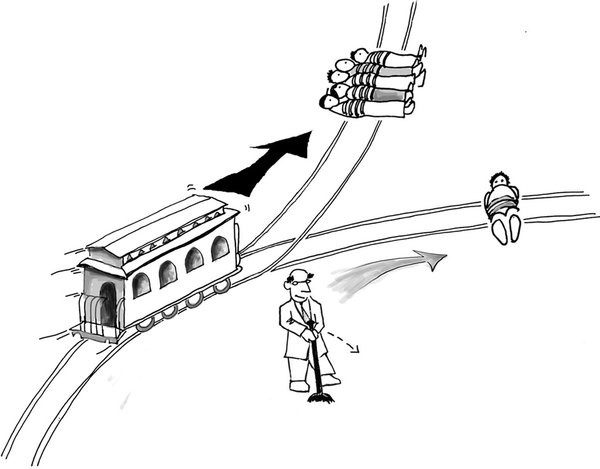
Say a trolley is heading down the railway tracks. Ahead, on the tracks are five people tied down who cannot move. The trolley is headed straight for them, and will kill them. You are standing some distance ahead, next to a lever. If you pull this lever, the trolley switches to a different set of tracks, on which there is one person. You have two options:

1. Do nothing, in which case the trolley kills the 5 people on the main track.

2. Pull the lever, in which case the trolley changes tracks and kills the one person on the side track.

What should you do?

Trolley

The trolley problem illustrated

It’s not hard to see how a similar situation would come up in a world with self-driving cars, with the car having to make a similar decision.

Say for example a human-driven car runs a red light and a self-driving car has two options:

  1. It can stay its course and run into that car killing the family of five sitting in that car
  2. It can turn right and bang into another car in which one person sits, killing that person.

What should the car do?

From a utilitarian perspective, the answer is obvious: to turn right (or “pull the lever”) leading to the death of only one person as opposed to five.

Incidentally, in a survey of professional philosophers on the Trolley Problem, 68.2% agreed, saying that one should pull the lever. So maybe this “problem” isn’t a problem at all and the answer is to simply do the Utilitarian thing that “greatest happiness to the greatest number”.

But can you imagine a world in which your life could be sacrificed at any moment for no wrongdoing to save the lives of two others?

Now consider this version of the trolley problem involving a fat man:

As before, a trolley is heading down a track towards five people. You are on a bridge under which it will pass, and you can stop it by putting something very heavy in front of it. As it happens, there is a very fat man next to you — the only way for you to stop the trolley is to push him over the bridge and onto the track, killing him to save five people. Should you do it?

Most people that go the utilitarian route in the initial problem say they wouldn’t push the fat man. But from a utilitarian perspective there is no difference between this and the initial problem — so why do they change their mind? And is the right answer to “stay the course” then?

Kant’s categorical imperative goes some way to explaining it:

Act only according to that maxim whereby you can, at the same time, will that it should become a universal law.

In simple words, it says that we shouldn’t merely use people as means to an end. And so, killing someone for the sole purpose of saving others is not okay, and would be a no-no by Kant’s categorical imperative.

Another issue with utilitarianism is that it is a bit naive, at least how we defined it. The world is complex, and so the answer is rarely as simple as perform the action that saves the most people. What if, going back to the example of the car, instead of a family of five, inside the car that ran the red light were five bank robbers speeding after robbing a bank. And sat in the other car was a prominent scientist who had just made a breakthrough in curing cancer. Would you still want the car to perform the action that simply saves the most people?

So may be we fix that by making the definition of Utilitarianism more intricate, in that we assign a value to each individuals life. In that case the right answer could still be to kill the five robbers, if say our estimate of utility of the scientist’s life was more than that of the five robbers.

But can you imagine a world in which say Google or Apple places a value on each of our lives, which could be used at any moment of time to turn a car into us to save others? Would you be okay with that?

And so there you have it, though the answer seems simple, it is anything but, which is what makes the problem so interesting and so hard. It will be a question that comes up time and time again as self-driving cars become a reality. Google, Apple, Uber etc. will probably have to come up with an answer. To pull, or not to pull?

Lastly, I want to leave you another question that will need to be answered, that of ownership. Say a self-driving car which has one passenger in it, the “owner”, skids in the rain and is going to crash into a car in front, pushing that car off a cliff. It can either take a sharp turn and fall of the cliff or continue going straight leading to the other car falling of the cliff. Both cars have one passenger. What should the car do? Should it favor the person that bought it — its owner?

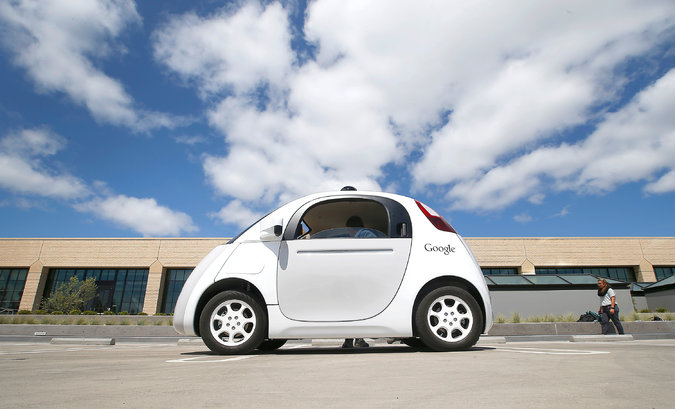
Google launching its Self-Driving Car in Silicon Valley This Summer 2015

Further Reading:

http://www.nytimes.com/2015/05/16/technology/google-to-test-bubble-shaped-self-driving-cars-in-silicon-valley.html?smid=nytcore-ipad-share&smprod=nytcore-ipad&_r=0

Photo

A prototype of Google’s self-driving car. Credit Tony Avelar/Associated Press

SAN FRANCISCO — The world is one step closer to the day when people can, in good conscience, drive to work while sipping coffee, texting with a friend and working on a laptop computer.

On Friday, Google announced that sometime this summer several prototype versions of its self-driving cars are set to hit the streets of Mountain View, Calif., the search giant’s hometown. The move is still just another round of testing but it is a significant step toward a pilot program in which regular consumers could ride in self-driving cars.

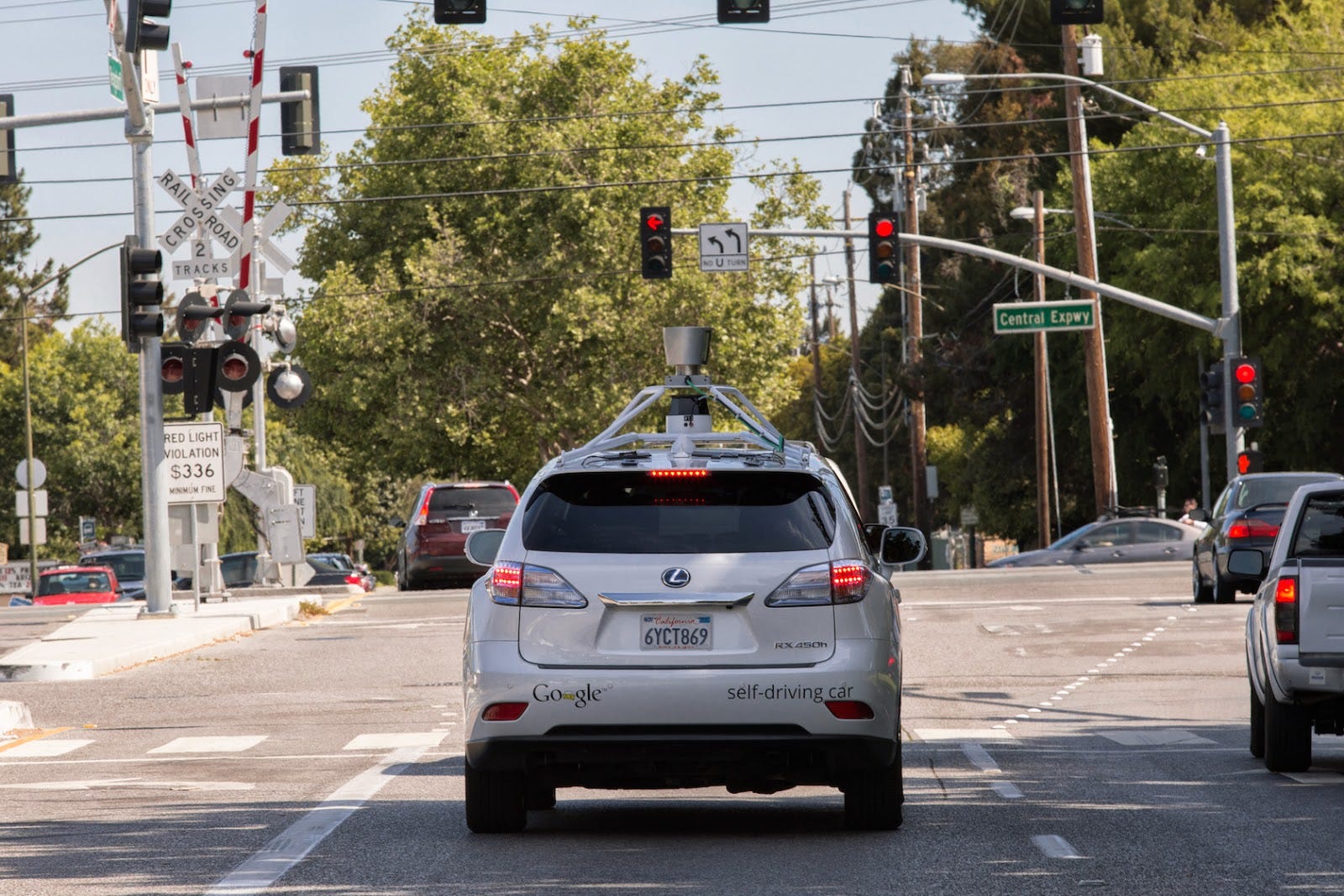
Google has long been testing its self-driving car technology with a fleet of Lexus sport utility vehicles that have driven about a million miles on public roads, and that continue to put in 10,000 miles each week.

Traditional automakers are also pushing the envelope of driverless tech with on-the-road testing of their own autonomous prototypes, and the industry predicts that by 2020 those dreams could come true.

Getting there is now much more about software than hardware. The systems of radar, lasers and cameras currently used by Google and automakers have grown so sophisticated that the vehicles can easily monitor the road in all directions — even beyond what the eye can see. The tough part is figuring out what to do with all that information.

In essence, the cars need an electronic brain that knows how to drive in a world where human drivers, as well as pedestrians and bicyclists, often do unpredictable things.

They also need to understand regional differences. Drivers in Boston, for instance, often behave differently than those in Atlanta or Los Angeles, where unspoken rules of the road and cultural cues can vary.

City environments are particularly challenging, and require software with much more flexibility and power. That’s one of the reasons Google (and its rival, Apple) hope their software acumen can help them solve the puzzle. And now that Google will be testing its new bubble-shaped cars on public roads near its Mountain View headquarters, it’s getting one step closer to honing its predictive technology for urban settings.

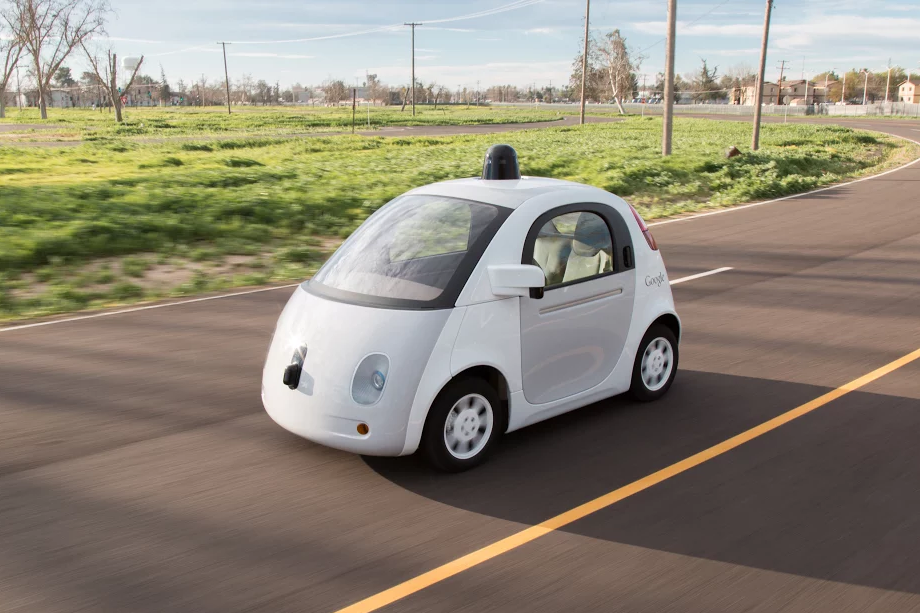
Unlike the fleet of self-driving Lexuses that are already on the road, Google’s prototype, which looks like a golf cart with doors, is designed to be a fully autonomous car in which people get in, set their destination and relax as the car does the work. The prototypes cannot go faster than 25 miles per hour and, for now, have a steering wheel and pedals so that a “safety driver” could take over.

The steering wheel is a legal requirement, but Google’s plan is to take the driver out of driving completely.

Earlier this year, during a presentation at the South by Southwest festival in Austin, Astro Teller, head of the Google X research division that created the self-driving car, said that in autumn 2012 the company started allowing Google employees to take the Lexus version home and self-drive on the freeway, so long as they kept paying attention in the event of an emergency.

Despite this, the employees got used to self-driving and stopped paying attention.

“The assumption that humans can be a reliable backup for the system was a total fallacy,” Mr. Teller said in the presentation. “Once people trust the system, they trust it.” Google realized the best thing to do “was to make a car that has no steering wheel, that has no brake pedal, that has no acceleration pedal — that drives itself all the time, from point A to point B, at the push of a button.”

Of course, nothing is accident-proof. Earlier this week, Chris Urmson, director of Google’s Self-Driving Car Project, disclosed that self-driving cars had been in 11 “minor accidents” in which there was only light damage and no injuries, and that “not once was the self-driving car the cause of the accident.”

This included seven rear-end collisions, a couple of wrecks in which cars were sideswiped and one crash in which the self-driving car was hit by a driver who rolled through a stop sign.

The challenge of city driving is one reason driverless technology has first arrived on highways. In the coming months, Tesla Motors has promised to introduce an “autopilot” feature that can take over highway driving in certain conditions. Next year, other automakers will do the same, such as General Motors’ “Super Cruise,” which will allow hands-off-the-wheel, foot-off-the-pedals highway driving.

Parking is another area that is poised for an overhaul. Companies like Ford already offer cars that pull into parking spaces automatically. The French supplier Valeo, which works with multiple automakers, is now working on technology aimed at parking garages where you can pull up to a garage and get out, leaving your car to find an available space and park itself.

When you’re ready to leave, the car acts like a robotic valet as it unparks and meets you out front.

Media Companies: Don’t Let Your Traffic Run Out the Side Door

With the launch of Facebook’s Instant Articles, media companies have two choices: (a) integrate deeply with Facebook — fast load times! better experience! (b) skip this opportunity and risk falling further behind in the traffic race driven from Facebook. Given that Facebook has become such a huge traffic driver to so many media sites, in reality, most have no choice to make. Yet while Facebook and, of course, Google drive significant traffic volume, that traffic is not always the best. It is often one page only, and comes with very short sessions. Especially on mobile. It doesn’t have to be this way.

Before the Internet, when readers picked up a newspaper, magazine, a book, pretty much any piece of media, they started at the front. An editor chose what went first, what was shown biggest, what might appear “above the fold”. This was the “front door” and it mattered.

But as media began to flourish online, this shifted dramatically. The “side door” became the new “front door”. Traffic came directly to articles — links indexed by Google, links shared on Facebook, Twitter, Digg, Reddit, email, etc. Importantly, users who entered through the side door compounded the metrics that media companies could monetize.

Subsequently, editors have moved from deciding what goes on the front door to managing data and optimizing getting the most traffic from SEO or social. Some start-up media companies are now going as far as giving up on owning houses all together and instead living inside the halls of social platforms like Facebook.

No question, side door traffic is important. But the truly valuable and beloved companies have built a real front door — one that converts to repeatable, direct visits.

Social media companies understand this — traditional media companies could stand to learn from them. Instagram is a great example of a company that started through the side door, and quickly transitioned users to its own version of a front door. Users who came to Instagram via links shared on Facebook and Twitter quickly learned to visit Instagram directly. Every opportunity for exposure of this content was obsessively converted into users who began to sign up for Instagram and got sucked into it as a preferred way to view photos and content from celebrities, media, and friends. Similarly, Meerkat is working hard to pull off the same. (Disclosure: Josh Elman is an investor in Meerkat.) For Meerkat, a strong front door is everything now — it means an audience of people opening the app and using Meerkat to discover the live streams they want to see instead of just keeping an eye out for a tweet in their stream.

Jonah Peretti discussed the potential of recognizing your distributed audiences and finding ways to monetize them during his recent keynote at SXSW. But he didn’t touch on the significant numbers that BuzzFeed sees in their direct audience on site. With over 200 million uniques, Buzzfeed has developed a dedicated, loyal and fanatical audience which has become a key part of spreading into the larger distributed audiences.

The Three Audiences for Any Online Property

There is a framework for how to think about users in these different groups — the Loyalists, the Subscribers and the Casuals — and why it’s important to get as many of them to come regularly to your front door.

The Loyalists

Loyalists are what make companies worth billions of dollars. Loyalists love a property enough to come to it directly and regularly. They are an audience that is sticky and not going away. At HuffingtonPost, when a big news story would break, the front page traffic would surge — not just the side door traffic from the article of the story spreading. People had learned to think of it in the context of important news. This applies to non-media properties, too. For Uber, this means opening the app when I need a ride.

Loyalists are also vital to growing the Subscribers and Casuals audience. It is the loyalists who share content seconds after publish — creating opportunities for the company to grow the Subscribers and Casuals audience.

The Subscribers

Subscribers come back to a property over and over — though often through the side door. Subscribers will like a property on Facebook, follow them on Twitter and/or subscribe to their emails. Their discovery mechanism is still Facebook, Twitter, Email etc. But they have decided to consciously invite that property into their stream. They often engage with that content, clicking to sites as often as 10x a week and frequently sharing the content with their network.

Subscribers are living in a world where their feed is getting increasingly confusing and over-saturated. They will miss most of the content from the properties they subscribe to — especially as the algorithmic feeds on those platforms shift.

The Casuals

If an online property is built correctly, the casuals should be the largest audience. This is the group of people who come by and visit when they are exposed to an interesting link. In the best cases, casuals have become familiar with the property enough to recognize it in their streams, but they are still not yet enticed to dive deeper and to start actively following that property.

If the most successful media companies were tracking and releasing their casual audience numbers, they would be well past 10 billion and likely nearing on 20 to 30 billion impressions. For media companies, it is increasingly vital that they find ways to monetize these audiences, giving opportunities to premium sponsors to play part in this extended reach.

The Long View on Conversion

When a Casual user visits a site for the first time, the property often tries very hard to convert them. Immediately, the user is bombarded by popup screens to “like on Facebook”, or “subscribe by email”, or ads which attempt to monetize the user. All of these experiences can scare the Casual right off of the site.

Better to play it cool. Perhaps wait until the third time a Casual user visits to say, “Hi! We see you here a lot. Do you want to subscribe?”

It takes time to do this, but the right investments can lead to significant numbers of Loyalists. At RebelMouse we are seeing this happen with clients like the Dodo, who had a single video on Facebook reach more than 30 million casuals. The foundation is built on a core group of loyalists who make Dodo their homescreen, install the app and come back through native notifications. This has allowed their organic reach to grow exponentially and build a material subscriber audience in a short period of time.

The best companies need to prove that they can use the side door not just as an endgame but as way to convert into real front door traffic. Companies who abandon the quest for a loyalist audience are deciding — consciously or not — to build a much less ambitious company, one that relies on an ecosystem that can change its rules on a whim. They also are unlikely to be able to build the same size of extended audience because they lack the consistent seeding of content that loyalists bring.

Google gets green lights for their self-driving vehicle prototypes

http://googleblog.blogspot.co.at/2015/05/self-driving-vehicle-prototypes-on-road.html

„When we started designing the world’s first fully self-driving vehicle, our goal was a vehicle that could shoulder the entire burden of driving. Vehicles that can take anyone from A to B at the push of a button could transform mobility for millions of people, whether by reducing the 94 percent of accidents caused by human error (PDF), reclaiming the billions of hours wasted in traffic, or bringing everyday destinations and new opportunities within reach of those who might otherwise be excluded by their inability to drive a car.

Now we’re announcing the next step for our project: this summer, a few of the prototype vehicles we’ve created will leave the test track and hit the familiar roads of Mountain View, Calif., with our safety drivers aboard.

Our safety drivers will test fully self-driving vehicle prototypes like this one on the streets of Mountain View, Calif., this summer.

We’ve been running the vehicles through rigorous testing at our test facilities, and ensuring our software and sensors work as they’re supposed to on this new vehicle. The new prototypes will drive with the same software that our existing fleet of self-driving Lexus RX450h SUVs uses. That fleet has logged nearly a million autonomous miles on the roads since we started the project, and recently has been self-driving about 10,000 miles a week. So the new prototypes already have lots of experience to draw on—in fact, it’s the equivalent of about 75 years of typical American adult driving experience.

Each prototype’s speed is capped at a neighborhood-friendly 25mph, and during this next phase of our project we’ll have safety drivers aboard with a removable steering wheel, accelerator pedal, and brake pedal that allow them to take over driving if needed. We’re looking forward to learning how the community perceives and interacts with the vehicles, and to uncovering challenges that are unique to a fully self-driving vehicle—e.g., where it should stop if it can’t stop at its exact destination due to construction or congestion. In the coming years, we’d like to run small pilot programs with our prototypes to learn what people would like to do with vehicles like this. If you’d like to follow updates about the project and share your thoughts, please join us on our Google+ page. See you on the road!

Accident Causes of the Google Self-Driving Car

Source: https://medium.com/backchannel/the-view-from-the-front-seat-of-the-google-self-driving-car-46fc9f3e6088


The View from the Front Seat of the Google Self-Driving Car

After 1.7 million miles we’ve learned a lot — not just about our system but how humans drive, too.

About 33,000 people die on America’s roads every year. That’s why so much of the enthusiasm for self-driving cars has focused on their potential to reduce accident rates. As we continue to work toward our vision of fully self-driving vehicles that can take anyone from point A to point B at the push of a button, we’re thinking a lot about how to measure our progress and our impact on road safety.

One of the most important things we need to understand in order to judge our cars’ safety performance is “baseline” accident activity on typical suburban streets. Quite simply, because many incidents never make it into official statistics, we need to find out how often we can expect to get hit by other drivers. Even when our software and sensors can detect a sticky situation and take action earlier and faster than an alert human driver, sometimes we won’t be able to overcome the realities of speed and distance; sometimes we’ll get hit just waiting for a light to change. And that’s important context for communities with self-driving cars on their streets; although we wish we could avoid all accidents, some will be unavoidable.

The most common accidents our cars are likely to experience in typical day to day street driving — light damage, no injuries — aren’t well understood because they’re not reported to police. Yet according to National Highway Traffic Safety Administration (NHTSA) data, these incidents account for 55% of all crashes. It’s hard to know what’s really going on out on the streets unless you’re doing miles and miles of driving every day. And that’s exactly what we’ve been doing with our fleet of 20+ self-driving vehicles and team of safety drivers, who’ve driven 1.7 million miles (manually and autonomously combined). The cars have self-driven nearly a million of those miles, and we’re now averaging around 10,000 self-driven miles a week (a bit less than a typical American driver logs in a year), mostly on city streets.

In the spirit of helping all of us be safer drivers, we wanted to share a few patterns we’ve seen. A lot of this won’t be a surprise, especially if you already know that driver error causes 94% of crashes.

If you spend enough time on the road, accidents will happen whether you’re in a car or a self-driving car. Over the 6 years since we started the project, we’ve been involved in 11 minor accidents (light damage, no injuries) during those 1.7 million miles of autonomous and manual driving with our safety drivers behind the wheel, and not once was the self-driving car the cause of the accident.

Rear-end crashes are the most frequent accidents in America, and often there’s little the driver in front can do to avoid getting hit; we’ve been hit from behind seven times, mainly at traffic lights but also on the freeway. We’ve also been side-swiped a couple of times and hit by a car rolling through a stop sign. And as you might expect, we see more accidents per mile driven on city streets than on freeways; we were hit 8 times in many fewer miles of city driving. All the crazy experiences we’ve had on the road have been really valuable for our project. We have a detailed review process and try to learn something from each incident, even if it hasn’t been our fault.

Not only are we developing a good understanding of minor accident rates on suburban streets, we’ve also identified patterns of driver behavior (lane-drifting, red-light running) that are leading indicators of significant collisions. Those behaviors don’t ever show up in official statistics, but they create dangerous situations for everyone around them.

Lots of people aren’t paying attention to the road. In any given daylight moment in America, there are 660,000 people behind the wheel who are checking their devices instead of watching the road. Our safety drivers routinely see people weaving in and out of their lanes; we’ve spotted people reading books, and even one playing a trumpet. A self-driving car has people beat on this dimension of road safety. With 360 degree visibility and 100% attention out in all directions at all times; our newest sensors can keep track of other vehicles, cyclists, and pedestrians out to a distance of nearly two football fields.

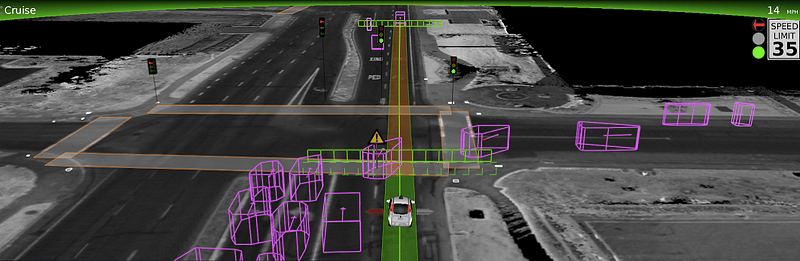
Intersections can be scary places. Over the last several years, 21% of the fatalities and about 50% of the serious injuries on U.S. roads have involved intersections. And the injuries are usually to pedestrians and other drivers, not the driver running the red light. This is why we’ve programmed our cars to pause briefly after a light turns green before proceeding into the intersection — that’s often when someone will barrel impatiently or distractedly through the intersection.

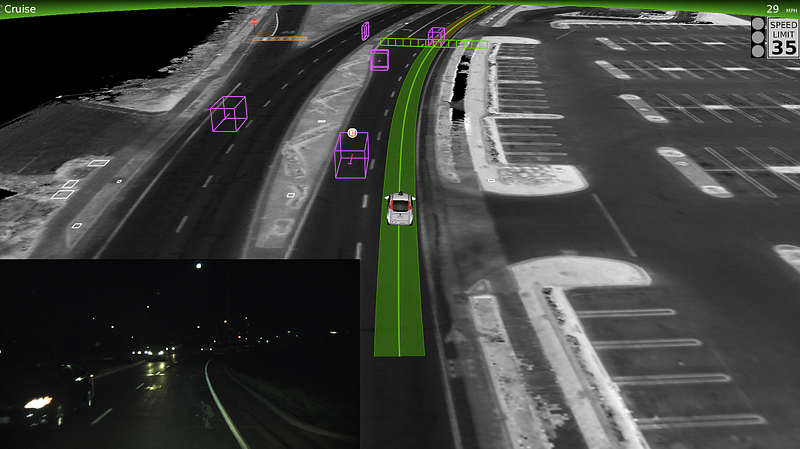
In this case, a cyclist (the light blue box) got a late start across the intersection and narrowly avoided getting hit by a car making a left turn (the purple box entering the intersection) who didn’t see him and had started to move when the light turned green. Our car predicted the cyclist’s behavior (the red path) and did not start moving until the cyclist was safely across the intersection.

Turns can be trouble. We see people turning onto, and then driving on, the wrong side of the road a lot — particularly at night, it’s common for people to overshoot or undershoot the median.

In this image you can see not one, but two cars (the two purple boxes on the left of the green path are the cars you can see in the photo) coming toward us on the wrong side of the median; this happened at night on one of Mountain View’s busiest boulevards.

Other times, drivers do very silly things when they realize they’re about to miss their turn.

A car (the purple box touching the green rectangles with an exclamation mark over it) decided to make a right turn from the lane to our left, cutting sharply across our path. The green rectangles, which we call a “fence,” indicate our car is going to slow down to avoid the car making this crazy turn.

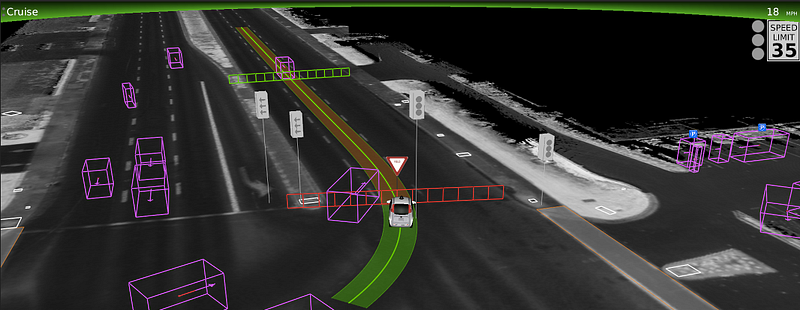
And other times, cars seem to behave as if we’re not there. In the image below, a car in the leftmost turn lane (the purple box with a red fence through it) took the turn wide and cut off our car. In this case, the red fence indicates our car is stopping and avoiding the other vehicle.

These experiences (and countless others) have only reinforced for us the challenges we all face on our roads today. We’ll continue to drive thousands of miles so we can all better understand the all too common incidents that cause many of us to dislike day to day driving — and we’ll continue to work hard on developing a self-driving car that can shoulder this burden for us.

Chris Urmson is director of Google’s self-driving car program.

Screenshots, die Teenager nicht mehr verstehen

1. Wenn Du cool warst, hast Du mit Netscape gesurft

Wenn Du cool warst, hast Du mit Netscape gesurft

2. So hast Du CDs gehört

So hast Du CDs gehört

Microsoft / Via guidebookgallery.org

3. Und Deine ersten MP3 Dateien mit Winamp

Und Deine ersten MP3 Dateien mit Winamp

4. Encarta war Dein Wikipedia

Encarta war Dein Wikipedia

poncheeto / Via reddit.com

5. Bei Solitaire konntest Du Dich nie für eine Kartenrückseite entscheiden

Bei Solitaire konntest Du Dich nie für eine Kartenrückseite entscheiden

Blinkle / Via reddit.com

6. Und Hearts hast Du eigentlich nie so richtig verstanden

Und Hearts hast Du eigentlich nie so richtig verstanden

Microsoft / Via compu-seite.de

7. Das war Dein liebster Windows 98 Hintergrund

Das war Dein liebster Windows 98 Hintergrund

Microsoft / Via imgur.com

Ouuuh! Man kann voll in meinen Computer reingucken!

8. Altavista war Dein Google

Altavista war Dein Google

9. Das Uh-Oh von ICQ wirst Du bis an Dein Lebensende im Ohr haben

Das Uh-Oh von ICQ wirst Du bis an Dein Lebensende im Ohr haben

Mail ru Group

10. Vor Photoshop hattest Du Paint

Vor Photoshop hattest Du Paint

Microsoft / Via designmeans.com

11. Und dann Kai’s Power Goo

Und dann Kai's Power Goo

MetaTools / Via amazon.de

12. Dein erstes Online-Verbrechen hast Du mit Napster begangen

Dein erstes Online-Verbrechen hast Du mit Napster begangen

Shawn Fanning, Sean Parker

13. So hast Du Pinball spielen gelernt

So hast Du Pinball spielen gelernt

14. Und Earthworm Jim hat Dir eine ganz neue Meinung zu Regenwürmer verschafft

Und Earthworm Jim hat Dir eine ganz neue Meinung zu Regenwürmer verschafft

Shiny Entertainment / Via youtube.com

Noch vor Worms!

15. “Keine Panik, ich hab noch 1 GB freien Speicher. Das reicht bis ans Ende der Welt!”

"Keine Panik, ich hab noch 1 GB freien Speicher. Das reicht bis ans Ende der Welt!"

Microsoft / Via sites.google.com

16. Minesweeper hast Du nach der ersten verlorenen Runde gleich immer wieder genervt ausgemacht

Minesweeper hast Du nach der ersten verlorenen Runde gleich immer wieder genervt ausgemacht

Microsoft

17. WinZip war Dein bester Freund, um Programme auf mehrere Disketten zu kopieren

WinZip war Dein bester Freund, um Programme auf mehrere Disketten zu kopieren

18. Die Windows 95 Bildschirmschoner waren 1995 dein erstes Whoa-Erlebnis

23 Screenshots, die Jugendliche von heute nicht mehr verstehen

19. Deine erste ernstzunehmende Spiel-Abhängigkeit hieß Moorhuhn

Deine erste ernstzunehmende Spiel-Abhängigkeit hieß Moorhuhn

phenomedia publishing

Auch wenn Du das nie zugeben würdest.

20. So bist Du ins Internet gegangen

So bist Du ins Internet gegangen

21. Myst war das Schwerste, das Du je gespielt hast

Myst war das Schwerste, das Du je gespielt hast

Cyan Worlds

Wie Monkey Island. Nur ohne Affen. Und ohne Humor.

22. Und You Don’t Know Jack das Lustigste

23 Screenshots, die Jugendliche von heute nicht mehr verstehen

23. Und: Du hast Computer noch wirklich richtig ausgeschaltet

Und: Du hast Computer noch wirklich richtig ausgeschaltet


Quelle: http://www.buzzfeed.com/philippjahner/arbeitsplatz


Project Fi – Google degradiert die Mobilfunker weltweit

Lesen Sie den ganzen Artikel unter: http://www.zeit.de/digital/mobil/2015-04/google-project-fi-mobiles-breitband-netz

google-project-fi-mobile-network

„So richtig überrascht sein dürfte eigentlich niemand, dass Google nun auch einen eigenen Mobilfunktarif vertreibt. Ständig macht das Unternehmen irgendetwas mit Raketen, Drohnen oder zumindest selbstfahrenden Autos. Warum also nicht auch eine neue Art von Mobilfunk? Klingt im Vergleich doch sogar eher bieder. Doch das ist das Project Fi mitnichten.

Im Rahmen des Projekts verkauft Google in den USA seit Mittwoch einen Tarif, bei dem Nutzer ständig zwischen verschiedenen Netzen hin- und herspringen, ohne es zu merken. Je nach der aktuell zur Verfügung stehenden Verbindungsqualität wählt sich der Dienst in die Netze von Sprint oder T-Mobile US ein. Und wann immer möglich, nimmt er einen von rund einer Million drahtloser Hotspots, die Google landesweit ausgesucht hat. Um an Project Fi teilzunehmen, braucht man eine Einladung von Google und zudem zwingend das Google-Smartphone Nexus 6. Dass der Dienst in Zukunft auch mit anderen Geräten nutzbar sein wird, ist aber abzusehen.

Für Project Fi sollen Nutzer monatlich zwanzig Dollar zahlen. Darin sind aber nur die Kosten für Telefon, SMS und Datenverkehr im WLAN enthalten. Jedes Gigabyte an Daten in den Netzwerken von Sprint und T-Mobile kostet weitere zehn Dollar. Die Pakete buchen Nutzer im Voraus. Nicht verbrauchtes Datenvolumen wird auf den nächsten Monat angerechnet. Das ist in den USA in dieser Konsequenz einzigartig. Project Fi wird es US-Nutzern außerdem erlauben, in mehr als 120 Staaten Daten-Roaming ohne Preiszuschlag zu nutzen. Google liegt mit Project Fi insgesamt unter dem Preis von US-Konkurrenten wie AT&T.

Über den Preis allein will Google seinen Dienst aber nicht verkaufen. Das Versprechen von Google geht weiter: Mit Project Fi sollen Nutzer künftig flexibler und breitbandiger kommunizieren können als andere. Je mobiler das Internet wird und je mehr tragbare Geräte es gibt, desto wichtiger wird das.

Telefonnummer ist nicht mehr telefongebunden

Bislang mussten sich Kunden für einen Tarif bei einem Provider entscheiden, der Telefonie und mobiles Internet abdeckte. In den USA haben die mobilen Datennetze aber teilweise erhebliche Funklöcher. Ähnlich ist die Situation in Deutschland. Nur etwa 91 Prozent Abdeckung erreicht etwa die Deutsche Telekom als bester Netzanbieter. Dieser Wert gilt allein für Großstädte. In der Kleinstadt sind es 86 Prozent, auf dem Land dürfte es noch schlechter aussehen.

Solche „Funklöcher“ oder „weißen Flecken“ will Google mit Project Fi vermeiden. Sein Konzept nennt das Unternehmen „Netzwerk der Netzwerke“. Ein Meta-Netzwerk sozusagen, wie es auch das Internet selbst ist. Der Wechsel zwischen den Netzwerken soll auch während eines Anrufs funktionieren. Verlässt man etwa das Café mit Hotspot, verbindet sich das Telefon automatisch mit dem Mobilfunknetz, das die höchste Verbindungsgeschwindigkeit bietet. Das Gespräch läuft dabei weiter. Die teilnehmenden Provider werden dabei zu Gelegenheitsanbietern degradiert.

Project Fi wird Nutzer mittelfristig nicht nur von einem einzigen Netzanbieter entkoppeln, sondern auch vom Endgerät. Das funktioniert mithilfe einer Project-Fi-fähigen SIM-Karte. Künftig wird die Telefonnummer der Nutzer in der Google-Cloud liegen. Man kann die Nummer dann von jedem internetfähigen Gerät aus nutzen, nicht mehr nur vom Nexus 6.

Einen ähnlichen Ansatz wie Googles Project Fi verfolgt Apple mit seinem Betriebssystem OS X. Damit ist es möglich, auch von einem Macbook aus zu telefonieren. Das funktioniert allerdings nur, wenn das eigene iPhone samt SIM-Karte in der Nähe ist, und auch nur von Apple-Gerät zu Apple-Gerät.

Google geht mit seinem entkoppelten Telefonieren weiter. Noch ist unklar, wie die Margen zwischen den Netzanbietern und Google aufgeteilt sind. Auch ist nicht bekannt, nach welchen Maßstäben Google die Netzanbieter und vor allem verifizierten Hotspots auswählt. Eines immerhin verspricht Google, wenn auch mit wolkigen Formulierungen: Mit den Hotspots sollen sich Project-Fi-Nutzerüber einen sicheren „Tunnel“ verbinden. Damit könnte ein sogenannter VPN-Tunnel gemeint sein, mit welchem man verschlüsselt im Netz surfen kann.

Project Fi sorgt für mehr Wettbewerb

Netzanbieter, die beim Projekt mitmachen wollen, müssen sich auf einen harten Wettbewerb einstellen. Denn wer das schnellste Netz hat, der bekommt nach Googles Modell auch die meisten Nutzer und dementsprechend am meisten Geld.

Dieser Wettbewerb beginnt nun in den USA: Google kooperiert dort erst einmal mit kleineren Anbietern, die sich mehr Nutzer erhoffen. Sowohl T-Mobile als auch Sprint haben ungefähr 15 Prozent Anteil am US-Markt für mobiles Breitband. Verizon und AT&T teilen sich mit jeweils 34 Prozent die Spitze. Sowohl für T-Mobile und Sprint bietet Project Fi also die Chance, mit einem hochwertigen Angebot zusätzliche Kunden zu gewinnen – auch wenn es sich bei diesen nur um Teilzeitkunden handelt. John Legere, CEO von T-Mobile USA, ist dennoch begeistert: Er liebe die Idee von Google, schrieb er in einem Blog-Eintrag.“

Lesen Sie den ganzen Artikel unter: http://www.zeit.de/digital/mobil/2015-04/google-project-fi-mobiles-breitband-netz

Facebook’s WhatsApp Will Be How the World Makes Phone Calls

Further Reading: http://www.wired.com/2015/04/facebooks-whatsapp-worlds-next-phone

WhatsApp is the world’s most popular smartphone messaging app, letting more than 800 million people send and receive texts on the cheap. But it’s evolving into something more.

On Tuesday, the company, which is owned by Facebook, released a new version of the app that allows people with iPhones to not only text people, but actually talk to them. This built on a similar move the company made at the end of March, when it quietly released an Android update that did the same thing. And in the week following the addition of voice calling on Android, WhatsApp-related traffic increased about 5 percent on carrier networks, according to a study by Allot Communications—an Israeli company that helps manage wireless network traffic worldwide.

That figure will likely get a lot bigger as WhatsApp shifts from being the world’s favorite messaging app to become a more wide-ranging—and bandwidth-intensive—communication tool.

Others have offered internet voice calls on smartphones, most notably Skype and Viber. But WhatsApp is different. So many people already use the app, and the company is intent on keeping it free (or nearly free). Though it has little traction here in the US, WhatsApp is enormously popular in parts of Europe and the developing world—areas where there’s a hunger for cheap communication. The result is an app that could bring inexpensive Internet calls to an audience of unprecedented size.

Developing World

The rapidly evolving WhatsApp is but one face of the dramatic technological changes sweeping across the developing world. So many companies are working to bring affordable smartphones to the market, from China’s Xiaomi to the Silicon Valley’s Cyanogen, as many others, from China’s WeChat to Viber, push cheap communication services onto these devices.

These technologies face the usual obstacles—and WhatsApp is no exception. Though the app is expected to reach a billion users by year’s end, its push into voice calls could alienate many wireless carriers. If you have free internet calls, after all, you don’t need to pay for cellular calls. Some carriers may fight the tool as a result, says Allot associate vice president Yaniv Sulkes.

But the same could be said of messaging on WhatsApp. It too cuts into the carriers’ way of doing things. And yet, WhatsApp has thrived. It has so much traction in large part because it has cultivated partnerships with carriers, striking deals that bundle its app with lost-cost wireless services. According another Allot survey, about 37 percent of the carriers now have deals with WhatsApp or similar inexpensive Internet-based services—a sharp rise over the past few years. “More and more operators are adopting the strategy of ‘let’s partner with them’ rather than ‘let’s fight them,’” Sulkes says.

In the meantime, Facebook is pushing for somewhat similar arrangements, through its Internet.org initiative, that bundle limited Internet access with access to specific apps. Mark Zuckerberg and company have encountered some opposition to these deals. But the combined might of Facebook and WhatsApp will be hard for carriers to resist.

Video Next?

As WhatsApp spreads, Sulkes believes, it will keep pushing into new services. After rolling out voice calling, he says, it may venture into video calling. The app already lets you send files, including videos, and other messaging apps, such as SnapChat, already have ventured into video calls.

None of these tools—video calls, voice calls, file sharing—are new technologies. But not everyone has them. WhatsApp has the leverage to change that. The app has grabbed hold of the developing world in rapid fashion, and now it can serve as a platform for bringing all sorts of modern communications to the far reaches of the globe. Yes, there’s another major obstacle to overcome: so much of the developing world doesn’t have the network infrastructure to accommodate these kinds of modern services. But Facebook is set to change that, too.

Project Fi – Google Revolutioniert den Mobilfunk

Der ganze Artikel unter: http://www.welt.de/wirtschaft/webwelt/article139952153/So-will-Google-den-Mobilfunk-revolutionieren.html

„Mit eigenen Mobilfunk-Verträgen in den USA wird Google womöglich den Markt umkrempeln. Dabei kommt eine Netzwechsel-Technik zum Einsatz. Die üblichen Preis-Modelle werden über den Haufen geworfen.

Internetgigant Google will seinen Nutzern in den USA künftig eigene Mobilfunk-Verträge anbieten. Der Konzern stellte am Mittwoch sein „Project Fi“ vor. Was nonchalant per Blogpost veröffentlicht wird, hat das Potential, die Mobilfunkwelt auf den Kopf zu stellen. Denn Google baut kein eigenes Netz auf – stattdessen suchen sich Mobilfunkgeräte mit Fi-Vertrag automatisch die jeweils besten Netzsignale von Googles Geschäftspartnern.

Zu denen zählen bislang T-Mobile, die US-Tochter der deutschen Telekom, sowie der Mobilfunkbetreiber Sprint. Technisch neu ist, dass Fi-Geräte sich bei Verfügbarkeit blitzschnell auch in freie WLAN-Netzwerke einwählen sollen, ohne dass dabei Gespräche abbrechen. Google kündigt an, dafür eine neue Technologie entwickelt zu haben, mit der die Mobilgeräte automatisch das schnellstmögliche Netz-Signal suchen, und dabei zwischen WLAN sowie den LTE-Mobilfunk-Netzwerken von Sprint und T-Mobile hin- und herwechseln.

Dank der Netzwechsel-Technik sollen Fi-Kunden eine möglichst breite Highspeed-Netzabdeckung nutzen können. Dabei setzt Google auf eine proprietäre Verschlüsselungstechnik, um die Datenverbindung vor Lauschern zu schützen – augenscheinlich kommt eine VPN-Variante zum Einsatz, die auch bei schnellem Wechsel zwischen WLAN und LTE-Mobilfunk die verschlüsselte Verbindung aufrecht erhält.

Erstes kompatibles Gerät soll Googles Nexus 6 sein

Für ein normales Smartphone mit einer normalen SIM-Karte wäre der schnelle und dazu konstant verschlüsselte Netzwechsel zwischen Providern unmöglich, Google möchte daher wie auch bei seiner Nexus-Geräteserie mit verschiedenen Smartphone-Herstellern zusammenarbeiten, um die Fi-Technik zu verbreiten. Das erste kompatible Gerät ist Googles aktuelles Nexus-6-Smartphone, das für den Fi-Einsatz mit einer Google-Sim-Karte kombiniert werden muss.

Google bricht mit weiteren Dogmen der Branche, indem der Konzern die Mobilfunknummer nicht fest an ein Gerät oder eine SIM-Karte koppelt, sondern an das jeweilige Google-Nutzerkonto. Anrufe und Nachrichten können mit jedem Laptop oder Tablet empfangen werden, vorausgesetzt die Nutzer sind mit ihrem Google-Hangout-Konto dort eingeloggt – eine zweite SIM-Karte ist nicht nötig.

Ähnliches realisiert Apple bereits mit dem iPhone, iOS 8 und dem neuen OS X Yosemite-Betriebssytem – doch anders als bei Apple spielt bei Googles Fi keine Rolle, ob das Smartphone im selben WLAN-Netz online ist wie die übrigen Geräte. Die Mobilfunknummer ist bei Fi völlig unabhängig von der SIM und dem Smartphone in Googles Cloud hinterlegt. Für die Mobilfunk-Provider ist das ein enormer Kontrollverlust, für Google eine Möglichkeit, seine Nutzer noch enger an sich zu binden.

Keine Roaming-Kosten für Daten-Verbindungen im Ausland

Nicht zuletzt wirft Google die üblichen Preis-Modelle im Markt über den Haufen, indem der Konzern für seinen Basisdienst 20 Dollar verlangt – und danach die Datentarife nach Verbrauch abrechnet. 1 Gigabyte Transfervolumen schlägt mit 10 Dollar zu Buche, wer das bezahlte Volumen am Ende des Monats nicht verbraucht hat, bekommt Geld zurück.

Roaming-Kosten für Daten-Verbindungen im Auslandseinsatz sieht Google nicht vor, in 120 Ländern bleibt der Datenpreis pro Gigabyte gleich – eine Droh-Geste an alle Provider, die sich aktuell selbst innerhalb Europas oft Datenroaming noch in Megabyte-Häppchen bezahlen lassen. Eine Mindestvertragslaufzeit sieht Google ebenfalls nicht vor, Fi-Verträge lassen sich jederzeit zum Monatsende kündigen.

Zunächst bietet Google den Fi-Dienst in einer Pilotphase nur in den USA und nur auf Einladung an, zudem müssen Nutzer ein aktuelles Nexus 6-Smartphone besitzen. Das ist aus Sicht von Google nur logisch – in diversen US-Ballungsgebieten baut der Konzern aktuell ein eigenes Glasfasernetz auf, und überall dort wo bereits Google-Leitungen im Boden liegen, kann der Konzern die eigene Infrastruktur für die WLAN-Anbindung der Fi-Geräte nutzen. Es ist fraglich, ob Google in Europa Mobilfunkprovider findet, die bereit dazu sind, ihre LTE-Infrastruktur mit dem Netzriesen zu teilen.

Kontrolle der Netznutzung von Kunden

Doch Projekt Fi zeigt deutlich die Vision der Google-Manager: Mit der Fi-SIM-Karte und der verschlüsselten Verbindung, die alle Verbindungsdaten außer Reichweite der Partner-Mobilfunkprovider hält, kontrollieren sie auch den Aspekt der Netznutzung der Kunden, der bislang noch außer Reichweite war: Die Online-Daten-Verbindung läuft über Googles Fi-Infrastruktur, die Mobilfunkprovider haben bei Fi keinen Einfluss darauf, wofür der Kunde sie nutzt.

Die Smartphone-Software Android sichert eine Google-kompatible Betriebsumgebung auf dem verwendeten Netzgerät, Googles Dienste Hangout und Gmail wickeln alle Kommunikation des Nutzers ab, auf dem Smartphone läuft Googles Play-Appstore, Googles Internet-Browser Chrome und Googles Kartendienst Maps. Hardware-Bauer Motorola – verantworlich für die Produktion des Nexus 6 – oder die Provider T-Mobile und Sprint müssen sich mit der Rolle der Zulieferer in Googles Ökosystem begnügen.

Google setzt mit der aggressiven Preis-Struktur, dem einheitlichen Design aller Nutzeroberflächen, der Zusammenfassung aller Dienste und Nutzerdaten unter einem Konto und mit einem Login und Features wie der virtuellen Rufnummer die herkömmlichen Mobilfunk-Anbieter erheblich unter Innovations-Druck.

Eine ähnlich übergreifende Nutzerbindung bietet so sonst nur Konkurrent Apple – doch dem fehlt das passende Mobilfunknetz. Apples Vorstoß mit der eigenen Apple-Simkarte auf Software-Basis, die für das aktuelle iPad vorgestellt wurde, ist erstens schon im Ansatz von den Providern blockiert worden, und geht zweitens nicht so konsequent einen neuen Weg über mehrere Provider-Netze gleichzeitig wie Fi.

Sollte Google genügend Partner finden, um das Projekt aus der Pilotphase heraus weltweit erfolgreich anzubieten, hat es das Potential, den klassischen Mobilfunkmarkt zu überwerfen. Dafür aber müssen sowohl die Smartphone-Bauer wie auch mindestens ein Mobilfunkprovider pro Land mitspielen. Sollte Fi dagegen auf Nexus-Geräte beschränkt bleiben, könnte es eine bloße Drohgeste gegenüber den etablierten Netzbesitzern bleiben.“

Der ganze Artikel unter: http://www.welt.de/wirtschaft/webwelt/article139952153/So-will-Google-den-Mobilfunk-revolutionieren.html