Schlagwort-Archive: Apple

Doing Business the Steve Jobs Way

Source: http://mashable.com/2015/03/24/steve-jobs-leadership-biography/

Steve Jobs started out as an asshole — but, a new book says, he got better.

That, in a nutshell, is the takeaway from Becoming Steve Jobs, a new biography of the late Apple CEO, which tries to provide nuance to the oft-told story of Jobs‘ professional rise at Apple, including the wilderness years that followed after being pushed out and his triumphant return.

The book’s authors, Brent Schlender and Rick Tetzli, suggest that much of Jobs’s professional image as a mercurial manager was shaped by „stereotypes that had been created way back in the 1980s,“ before he and Apple retreated from the press. „Perhaps that’s why the posthumous coverage reflected those stereotypes,“ the authors speculate.

Between that initial wave of press coverage and his return to Apple, Jobs‘ personality and management style shifted in subtle and not so subtle ways as a result of the struggles of NeXT, his follow-up effort, as well as inspiration from the creatives at Pixar, which he acquired and later sold to Disney. Just as importantly, the book claims Jobs was changed by falling in love with his wife, Laurene Powell Jobs, and starting a family.

Some elements of Jobs‘ management style stayed consistent, however.

He continued to push for „outrageous goals,“ as the authors put it, and he could still be severe and argumentative with colleagues. Yet the book suggests that his level of discipline, empathy and flexibility increased over the years to help compensate for his negative traits.

The book provides good lessons for all leaders, insofar as Jobs has become a widely observed case study for the archetype of the genius founder. The book highlights the sometimes contradictory leadership traits of a man who is quoted in the book as saying, „I didn’t want to be a businessman,“ and then went on to become arguably the most influential businessman of his generation. Here are the most revealing anecdotes.

Even visionaries need to hear realtalk

While Jobs often acted like someone who thought he knew best, the CEO nonetheless sought out mentors in the tech industry, including the founders of Intel, Hewlett Packard, Polaroid, National Semiconductor and others. Some, like Andy Grove, the former CEO of Intel, would remain lifelong advisors, sometimes to the exhaustion of the mentors:

Unable to sleep that night, Steve called his friend and confidant Andy Grove at 2 a.m. Steve told Grove that he was torn about whether or not to return as Apple’s CEO, and wound his way through his tortured deliberations. As the conversation dragged on, Grove, who wanted to get back to sleep, broke in and growled: „Steve, look. I don’t give a shit about Apple. Just make up your mind.“

Steve Jobs, the father figure

At NeXT, the computer company he launched after leaving Apple, Jobs was guilty of micromanaging, making impulsive bad hires and is described as an „equal-opportunity abuser“ who yelled at engineers as well as executives. But he also tried to be more of a „father figure,“ according to one former employee quoted in the book. His paternal instincts coincided with his own first attempt at being a father to the daughter he’d had out of wedlock and publicly rejected.

„Steve hosted annual ‚family picnics‘ for his employees in Menlo Park. They were kid-oriented Saturday affairs, featuring clowns, volleyball, burgers and hot dogs, and even hokey events like sack races,“ according to the book.

Later, at Pixar, Jobs gave a top filmmaker a small bonus and demanded he use it to buy a better car. „It has to be safe, and I have to approve it,“ Jobs is quoted as saying.

When he returned to Apple, Job is compelled to cut much of the staff and reorganize, but he expresses grief in a way that the brash young Jobs may not have.

„I still do it because that’s my job,“ Jobs is quoted as telling the authors. „But when I look at people when this happens, I also think of them as being five years old, kind of like I look at my kids. And I think that that could be me coming home to tell my wife and kids that I just got laid off. Or that it could be one of my kids in twenty years. I never took it so personally before.“

No reviews, little praise for direct reports

Those who worked for Jobs could expect an earful from the executive when dealing with him on any given day, but they rarely received formal reviews and feedback. „Steve didn’t believe in reviews,“ one former employee says. „He disliked all the formality. His feeling was, ‚I give you feedback all the time, so what do you need a review for?“

Likewise, he was less than generous in doling out praise to employees. Instead, he would show it by taking the best employees on walks. „Those walks mattered,“ recalled another employee. „You’d think to yourself, ‚Steve is a rock star,‘ so getting quaity time felt like an honor in some ways.“

Jobs‘ work/life balance

Early in his career, Jobs burned the midnight oil in the office along with much of his team, but by the time he returned to Apple, he was more focused on trying to balance his work with his new family.

Rather than hover over the shoulders of star engineers and programmers, he could do much of his work via email. So he would make it home for dinner almost every night, spend time with Laurene and the kids, and then work at his computer late into the night…

On many nights, Jobs would work alongside his wife, Laurene, at home. As his wife tells the authors, „Neither of us had much of a social life. It was never that important to us.“

Make time for spirituality and meditation

Some have wondered over the years how a man who famously went off to India and embraced Buddhism could reconcile that with running the largest corporation in the world. As it turns out, he continued to meditate until he and his wife had kids, which cut down what little free time he had left. In fact, according to the book, Jobs „arranged for a Buddhist monk by the name of Kobun Chino Otogawa to meet with him once a week at his office to counsel him on how to balance his spiritual sense with his business goals.“

Embrace life

After his first cancer surgery in 2004, Jobs‘ leadership style changed again. He had more sense of „urgency“ to pursue innovative products, and less time and energy to handle other business issues, ranging from human resources to manufacturing.

„When he came back from that surgery he was on a faster clock,“ Tim Cook, Apple’s current CEO, tells the authors. „The company is always running on a fast-moving treadmill that doesn’t stop. But when he came back there was an urgency about him. I recognized it immediately.“

Perhaps that’s why he and his team at Apple went on to accomplish so much in the seven years he had left.

Could Wearable Computers Be as Harmful as Cigarettes?

The Health Concerns in Wearable Tech

This article is from NyTimes and is published on the Idea due to exigent health concerns:
http://www.nytimes.com/2015/03/19/style/could-wearable-computers-be-as-harmful-as-cigarettes.html?_r=0

Photo

Credit Tim Robinson

In a similar vein, some researchers and consumers are now asking whether wearable computers will be considered harmful in several decades’ time.

We have long suspected that cellphones, which give off low levels of radiation, could lead to brain tumors, cancer, disturbed blood rhythms and other health problems if held too close to the body for extended periods.

Yet here we are in 2015, with companies like Apple and Samsung encouraging us to buy gadgets that we should attach to our bodies all day long.

While there is no definitive research on the health effects of wearable computers (the Apple Watch isn’t even on store shelves yet), we can hypothesize a bit from existing research on cellphone radiation.

The most definitive and arguably unbiased results in this area come from the International Agency for Research on Cancer, a panel within the World Health Organization that consisted of 31 scientists from 14 countries.

After dissecting dozens of peer-reviewed studies on cellphone safety, the panel concluded in 2011 that cellphones were “possibly carcinogenic” and that the devices could be as harmful as certain dry-cleaning chemicals and pesticides. (Note that the group hedged its findings with the word “possibly.”)

The W.H.O. panel concluded that the farther away a device is from one’s head, the less harmful — so texting or surfing the Web will not be as dangerous as making calls, with a cellphone inches from the brain. (This is why there were serious concerns about Google Glass when it was first announced and why we’ve been told to use hands-free devices when talking on cellphones.)

A longitudinal study conducted by a group of European researchers and led by Dr. Lennart Hardell, a professor of oncology and cancer epidemiology at Orebro University Hospital in Sweden, concluded that talking on a mobile or cordless phone for extended periods could triple the risk of a certain kind of brain cancer.

There is, of course, antithetical research. But some of this was partly funded by cellphone companies or trade groups.

One example is the international Interphone study, which was published in 2010 and did not find strong links between mobile phones and an increased risk of brain tumors. The Centers for Disease Control and Prevention concluded in 2014 that “more research is needed before we know if using cell phones causes health effects.”

Another study, in The BMJ, which measured cellphone subscription data rather than actual use, said there was no proof of increased cancer. Yet even here, the Danish team behind the report acknowledged that a “small to moderate increase” in cancer risk among heavy cellphone users could not be ruled out.

But what does all this research tell the Apple faithful who want to rush out and buy an Apple Watch, or the Google and Windows fanatics who are eager to own an alternative smartwatch?

Dr. Joseph Mercola, a physician who focuses on alternative medicine and has written extensively about the potential harmful effects of cellphones on the human body, said that as long as a wearable does not have a 3G connection built into it, the harmful effects are minimal, if any.

“The radiation really comes from the 3G connection on a cellphone, so devices like the Jawbone Up and Apple Watch should be O.K.,” Dr. Mercola said in a phone interview. “But if you’re buying a watch with a cellular chip built in, then you’ve got a cellphone attached to your wrist.” And that, he said, is a bad idea.

(The Apple Watch uses Bluetooth and Wi-Fi to receive data, and researchers say there is no proven harm from those frequencies on the human body. Wearables with 3G or 4G connections built in, including the Samsung Gear S, could be more harmful, though that has not been proved. Apple declined to comment for this article, and Samsung could not be reached for comment.)

Researchers have also raised concerns about having powerful batteries so close to the body for extended periods of time. Some reports over the last several decades have questioned whether being too close to power lines could cause leukemia (though other research has also negated this).

So what should consumers do? Perhaps we can look at how researchers themselves handle their smartphones.

While Dr. Mercola is a vocal proponent of cellphone safety, he told me to call him on his cell when I emailed about an interview. When I asked him whether he was being hypocritical, he replied that technology is a fact of life, and that he uses it with caution. As an example, he said he was using a Bluetooth headset during our call.

In the same respect, people who are concerned about the possible side effects of a smartwatch should avoid placing it close to their brain (besides, it looks a little strange). But there are some people who may be more vulnerable to the dangers of these devices: children.

While researchers debate about how harmful cellphones and wearable computers actually are, most agree that children should exercise caution.

In an email, Dr. Hardell sent me research illustrating that a child’s skull is thinner and smaller than an adult’s, which means that children’s brain tissues are more exposed to certain types of radiation, specifically the kind that emanates from a cellphone.

Children should limit how much time they spend talking on a cellphone, doctors say. And if they have a wearable device, they should take it off at night so it does not end up under their pillow, near their brain. Doctors also warn that women who are pregnant should be extra careful with all of these technologies.

But what about adults? After researching this column, talking to experts and poring over dozens of scientific papers, I have realized the dangers of cellphones when used for extended periods, and as a result I have stopped holding my phone next to my head and instead use a headset.

That being said, when it comes to wearable computers, I’ll still buy the Apple Watch, but I won’t let it go anywhere near my head. And I definitely won’t let any children I know play with it for extended periods of time.

Addendum: March 21, 2015 Editors’ Note on NyTimes.com
The Disruptions column in the Styles section on Thursday, discussing possible health concerns related to wearable technology, gave an inadequate account of the status of research about cellphone radiation and cancer risk.

Neither epidemiological nor laboratory studies have found reliable evidence of such risks, and there is no widely accepted theory as to how they might arise. According to the World Health Organization, “To date, no adverse health effects have been established as being caused by mobile phone use.” The American Cancer Society, the National Cancer Institute, the Food and Drug Administration and the Centers for Disease Control and Prevention have all said there is no convincing evidence for a causal relationship. While researchers are continuing to study possible risks, the column should have included more of this background for balance.

In addition, one source quoted in the article, Dr. Joseph Mercola, has been widely criticized by experts for his claims about disease risks and treatments. More of that background should have been included, or he should not have been cited as a source.

An early version of the headline for the article online — “Could Wearable Computers Be as Harmful as Cigarettes?” — also went too far in suggesting any such comparison.

Worldwide Mobile Phone Sales 2014


Led By iPhone 6, Apple Passed Samsung In Q4 Smartphone Sales, 1.9B Mobiles Sold Overall In 2014

If 2014 goes down as the year when smartphone sales globally passed the 1 billion mark (1.2 billion, to be exact, from a total of 1.9 billion mobile phones overall), Q4 will go down as the quarter when Samsung lost its footing as the world’s leader in the category for the first time since 2011. Today, Gartner published its figures for smartphone sales for the year and final quarter of 2014, and the numbers point to the juggernaut of the moment that is Apple.

In a period when overall there were 367.5 million devices sold, the iPhone maker overtook Samsung to sell the most smartphones in Q4, selling nearly 75 million devices compared to Samsung’s 73 million. While the margin between them does not seem particularly wide — it works out to a difference of 0.5 percentage points — it’s a significant reversal for the two.

The year before, Samsung sold over 83 million smartphones led by its Android-based Galaxy line, while Apple sold only 50 million devices. Samsung’s market share dropped 10 percentage points over the year. But with the introduction of the iPhone 6, things have changed.

Worldwide Smartphone Sales to End Users by Vendor in 4Q14 (Thousands of Units)

Company 4Q14Units 4Q14 Market Share (%) 4Q13Units 4Q13 Market Share (%)
Apple 74,832 20.4 50,224 17.8
Samsung 73,032 19.9 83,317 29.5
Lenovo* 24,300 6.6 16,465 5.8
Huawei 21,038 5.7 16,057 5.7
Xiaomi 18,582 5.1 5,598 2.0
Others 155,701.6 42.4 111,204.3 39.3
Total 367,484.5 100.0 282,866.2 100.0

Source: Gartner (March 2015) *Results for Lenovo include sales of mobile phones by Lenovo and Motorola.

“Samsung continues to struggle to control its falling smartphone share, which was at its highest in the third quarter of 2013,” writes Anshul Gupta, principal research analyst at Gartner. “This downward trend shows that Samsung’s share of profitable premium smartphone users has come under significant pressure.”

Indeed, the profits have been an important measure of how mobile handset makers have been faring. Strategy Analytics points out that Apple accounted for nearly 90% of all smartphone profits in Q4.

Other notable movers in the quarter were Lenovo, Huawei and Xiaomi. The last of these more than tripled the number of units that it sold between Q4 2013 and Q4 2014, with its most recent figure of 18.6 million quickly catching up to Huawei’s 21 million and Lenovo’s 24 million handsets. Still, even combined, the three are not yet at the same market share as Samsung or Apple at the moment.

The overall figures for the year point to Samsung’s problems starting directly in the wake of Apple’s renewed energy in the market after the launch of its two iPhone 6 models. There, Samsung still more than dominated, with 307.6 million handsets sold and a 24.7% share of the market, compared to Apple’s 191.4 million and 15.4%.

Worldwide Smartphone Sales to End Users by Vendor in 2014 (Thousands of Units)

Company 2014Units 2014 Market Share (%) 2013Units 2013 Market Share (%)
Samsung 307,597 24.7 299,795 30.9
Apple 191,426 15.4 150,786 15.5
Lenovo* 81,416 6.5 57,424 5.9
Huawei 68,081 5.5 46,609 4.8
LG Electronics 57,661 4.6 46,432 4.8
Others 538,710 43.3 368,675 38.0
Total 1,244,890 100.0 969,721 100.0

Source: Gartner (March 2015) *Results for Lenovo include sales of mobile phones by Lenovo and Motorola.

So what will Samsung have to do differently to try to reverse course? Gartner suggests a more exclusive and unique approach for the handset maker, not unlike what Apple and OEMs like Xiaomi working on forked Android devices are doing.

“With Apple dominating the premium phone market and the Chinese vendors increasingly offering quality hardware at lower prices, it is through a solid ecosystem of apps, content and services unique to Samsung devices that Samsung can secure more loyalty and longer-term differentiation at the high end of the market,” writes Roberta Cozza, research director at Gartner.

This is a bit of a broken record, of course: people have been talking for years about how Samsung and others like HTC need to create more differentiated experiences for its Galaxy devices to avoid the fate of being me-too Android acolytes. But despite its work on Tizen and other developments such is its Knox security suite aimed at enterprises, I’d argue that Samsung has yet to take that kind of strategy to heart, considering that its Galaxy line continues to be the mainstay and core of its smartphone strategy.

The reason for this is because Android continues to be a have a very powerful pull in the market. In 2014, Google’s operating system saw its share inch up past the 80% mark of all devices sold, or over 1 billion units (a figure that echoes those from other analysts).

This not only drives stickiness and familiarity with the operating system among consumers, but there is a whole ecosystem around Android apps, by way of the Google Play store, and native services that Google itself develops. Part from Google’s Android implementations, and you part ways with these services — a prospect that is not insurmountable but requires years of effort and investment to do so.

The bigger picture for other operating systems, in comparison to Android, is of shrinking market share even amidst wider growth. Apple’s and Windows’ market shares declined even as volumes respectively rose to 191 million and 35 million units. And BlackBerry continued to drop, now with only 0.6% of all smartphone sales on unit sales of 8 million — a drop of 10 million units.

Worldwide Smartphone Sales to End Users by Operating System in 2014 (Thousands of Units)

Operating System 2014Units 2014 Market Share (%) 2013Units 2013 Market Share (%)
Android 1,004,675 80.7 761,288 78.5
iOS 191,426 15.4 150,786 15.5
Windows 35,133 2.8 30,714 3.2
BlackBerry 7,911 0.6 18,606 1.9
Other OS 5,745 0.5 8,327 0.9
Total 1,244,890 100.0 969,721 100.0

Source: Gartner (March 2015)

Drilling into Apple’s performance geographically, Gartner says that sales in China were up 56% while those in the U.S. were up 88% as the company finally played to the big screen crowd.

“Apple’s strong ecosystem and its new iPhone 6 and iPhone 6 Plus drove strong replacements within the iOS base. These new smartphones also offered new users, who are looking for larger screen phones, a strong alternative to Android,” Gartner writes.

The bigger picture for mobile phone sales points to another interesting trend. While smartphones are now at 1.2 billion in annual unit sales, there is still a very sizeable feature phone market, with 700 million of these sold in 2014. And with the exception of Samsung, Apple and Microsoft — which now also counts Nokia’s legacy feature phone business among its total sales — we have a very even and long spread of other handset makers.

And “others” accounted for 33.5% of all sales, the biggest category of all — a timely reminder of the long tail of the industry, given this week’s Mobile World Congress event in Barcelona. “All regions recorded growth in 2014, except Japan and Western Europe, which recorded declines of 2.8 per cent and 9.1 per cent, respectively,” Gartner notes.

As with smartphones, Samsung is also leading in the overall mobile category, with 20.9% market share although that is down by about four percentage points over 2013.

Worldwide Mobile Phone Sales to End Users by Vendor in 2014 (Thousands of Units)

Company 2014Units 2014 Market Share (%) 2013Units 2013 Market Share (%)
Samsung 392,546 20.9 444,472 24.6
Apple 191,426 10.2 150,786 8.3
Microsoft 185,660 9.9 250,835 13.9
Lenovo* 84,029 4.5 66,463 3.7
LG Electronics 76,096 4.0 69,094 3.8
Huawei 70,499 3.8 53,296 2.9
TCL Communication 64,026 3.4 49,538 2.7
Xiaomi 56,529 3.0 13,423 0.7
ZTE 53,910 2.9 59,903 3.3
Sony 37,791 2.0 37,596 2.1
Micromax 37,094 2.0 25,431 1.4
Others 629,360 33.5 587,764 32.5
Total 1,878,968 100.0 1,808,600 100.0

Source: Gartner (March 2015) *Results for Lenovo include sales of mobile phones by Lenovo and Motorola.


Source: http://techcrunch.com/2015/03/03/led-by-iphone-6-apple-passed-samsung-in-q4-smartphone-sales-1-9b-mobiles-sold-overall-in-2014/#PdYOm3:nD6J

Apple Watch Event: Uhrsache (sic!) und Wirkung

Der Spiegel Online analysiert knallhart:

„Erst eingehende Tests werden zeigen, ob die Benutzung der neuen Uhren tatsächlich so intuitiv und angenehm ist, wie Cook und sein Team das bei der Vorstellung ein ums andere Mal betont haben. Sicher ist, dass Apple bis heute einen Vertrauensvorsprung hat, wenn es um die Einführung neuer Geräte geht. Steve Jobs versprach einst: Wenn wir etwas anfassen, dann machen wir es so, dass die Kunden es lieben werden. Löst die Apple Watch dieses Versprechen ein, dann kann sie einmal mehr einer Gerätekategorie zum Durchbruch verhelfen, bei denen andere die undankbare Vorreiterrolle übernommen haben. So wie das bei MP3-Playern, Touchscreen-Handys oder tragbaren Touch-Computern schon der Fall war.“

Und subsummiert, die Ängste, aller Beteiligten, Mitarbeiter, Fan-Boys, überzeugten Innovationsliebhabern, und Aktionären:

„Erweist sich die Apple Watch aber als überflüssiger Schnickschnack, als allzu klobiges Anhängsel mit zu wenig echtem Mehrwert für seinen Preis, dann kann die Uhr das Gegenteil bewirken: Wenn der Konzern nur einmal unter Beweis stellt, dass nicht jedes seiner Produkte automatisch zum unverzichtbaren Alltagsgegenstand wird, könnte das der Beginn eines rapiden Abstiegs werden.“

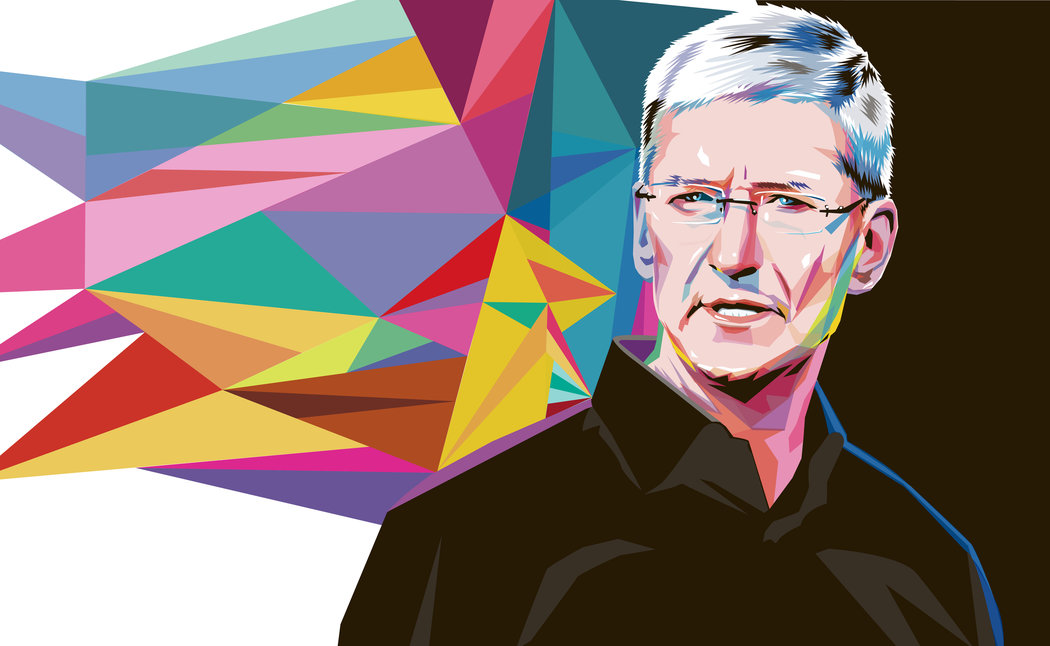
Tim-Cook


Spiegel Online resümmiert:

„Die Ankündigung mit der vermutlich nachhaltigsten Wirkung aber ist die zugleich am wenigsten spektakuläre. Der berührungslose Bezahldienst Apple Pay ist einmal mehr eine aufpolierte Kopie bereits im Markt befindlicher Angebote, man denke nur an Google Wallet. Android-Handys mit NFC-Chips gibt es längst, das Zahlen per Handy aber hat sich bislang nirgends durchgesetzt. Apple aber hat im Smartphone-Bereich in den USA bis heute einen Marktanteil von 40 Prozent – und Cooks Mannschaft hat es offenbar verstanden, sich mit vielen großen Laden- und Restaurantketten zu verbünden.

Schafft Apple es, mit seinen neuen Geräten schnell große Kundenzahlen zu erreichen – und die Geschichte legt nahe, dass das klappen könnte, – könnte mit einem Mal auch das Zahlen mit dem Handy – oder der Uhr – zur Alltagsgeste werden.

Für Ladenketten könnte die Anschaffung der entsprechenden Hardware mit einer ausreichend großen, zahlungskräftigen Klientel plötzlich doch interessant werden, und genau das sind Apples Kunden. Und stehen die Scanner erst einmal an den Ladenkassen, sind auch die NFC-Chips in allen anderen Handyfabrikaten plötzlich wieder im Spiel. Wenn das geschieht, wenn unsere digitalen Alltagsbegleiter auch zu unserem bevorzugten Zahlungsmittel werden, ist das zwar bequem – es bringt aber auch völlig neue Datenschutz– und Sicherheitsprobleme mit sich.“

Derstandard ergänzt:

„Das US-Magazin „Fortune“ würdigte Cook seinerzeit als „das Genie hinter Steve“. Als Zuständiger für das operative Geschäft sorgte er dafür, dass nach Umsetzung der kühnen Visionen schwarze Zahlen in den Büchern standen. Jetzt muss Cook mit der Computeruhr beweisen, dass sein Apple die gleiche visionäre Kraft wie zu Zeiten von Jobs hat. Dieses Image hilft dem Konzern, weltweit Millionen seiner teuren Premium-Smartphones und Tablets zu verkaufen.“

Original-Zitate nachzulesen bei: http://www.spiegel.de/netzwelt/gadgets/apple-watch-iphone-6-und-smartwatch-koennten-bezahlverhalten-aendern-a-990734.html und http://derstandard.at/2000005390426/Tim-Cook-tritt-mit-Apple-Watch-aus-dem-Schatten-von

2014′ Apple Special Event unboxing new Iphones, Apple Pay, Apple Watch and many more

See All the Glorious Gadgets From Apple’s Big Event

CUPERTINO, California—Today Apple unveiled a trifecta of new products that are surely sending worrisome ripples down the spines of the company’s competitors.

At a massive media event here at the Flint Center for Performing Arts, Apple announced two new large-screen iPhones, a new mobile payment platform, and an advanced touchscreen wristwatch. Judging by the numerous outbreaks of applause and the occasional standing ovation, the new products were met with great support by the huge audience of press, Apple employees, and VIPs from the entertainment, technology, and fashion industries.

But don’t worry if your eyes weren’t glued to the video livestream—or if you were one of the countless viewers who suffered from numerous drop-outs and technical problems and were left in the dark for much of the event. Here are the most important things you need to know about Apple’s big day.

The New iPhones: iPhone 6 and iPhone 6 Plus

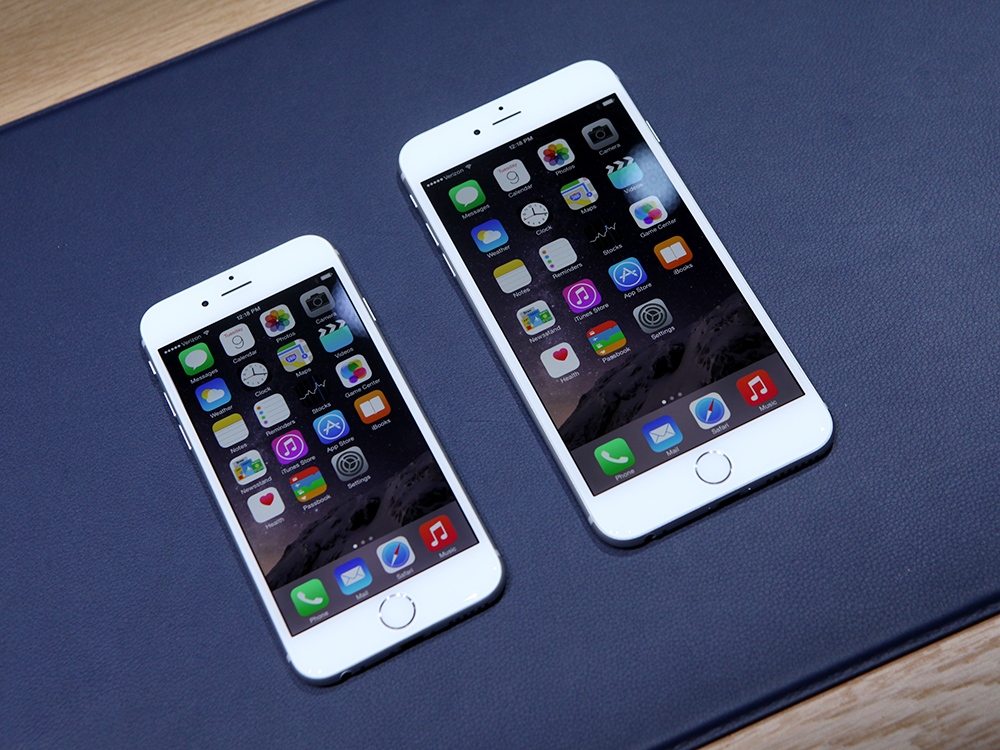
After a dramatic introductory video, Apple senior vice president Phil Schiller unveiled two new iPhone models today, the iPhone 6 and iPhone 6 Plus. Both are styled with a smooth, brushed aluminum rear face that curves gently into the front face. They look like small iPads.

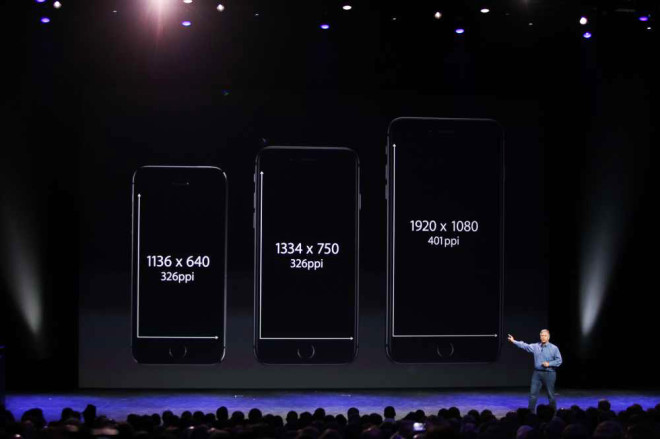
The iPhone 6 has a 4.7-inch display with a 1334×750 pixel resolution. The iPhone 6 Plus features a 5.5-inch screen with full HD 1920×1080 display resolution. Other than this size difference, the phones are essentially the same.


AppleSpecialEvent20140909-Iphones

iphone6

On the rear, they’ve got an 8-megapixel shooter with an f/2.2 aperture 8-megapixel camera. It’s got a new sensor and speedier autofocus. The 6 has digital image stabilization, but the 6 Plus also has additional optical image stabilization that uses its gyroscope and the M8 coprocessor to cancel out extra shakiness. The front-facing camera gets some new features like HDR and a burst-shot mode.

Inside, an A8 processor promises to be up to 87 percent more efficient than its predecessor, offering CPU processing power up to 25 percent faster and GPU speeds up to 50 percent faster than the iPhone 5s’ A7 chip. The M8 motion coprocessor, in addition to aiding in image stabilization, can now tell when you’re walking, running or cycling, and can give you credit if you’re traversing up and down stairs thanks to a barometer that detects changes in air pressure.

Both devices feature Touch ID home buttons and NFC (more on that in a sec). The iPhone 6 goes on sale Friday, September 19th starting at $200 on contract for 16 GB, $300 for 64 GB, and $400 for 128 GB. The iPhone 6 Plus starts at $100 more.

ApplePay, Apple’s Mobile Payment Initiative

“Payments is a huge business. Every day between credit and debit, we spend $12 billion, and that’s just in the United States,” Cook said to introduce what a huge space payments is—a huge space digital payments have yet to crack.

AppleSpecialEvent20140909-ApplePay

applepayday

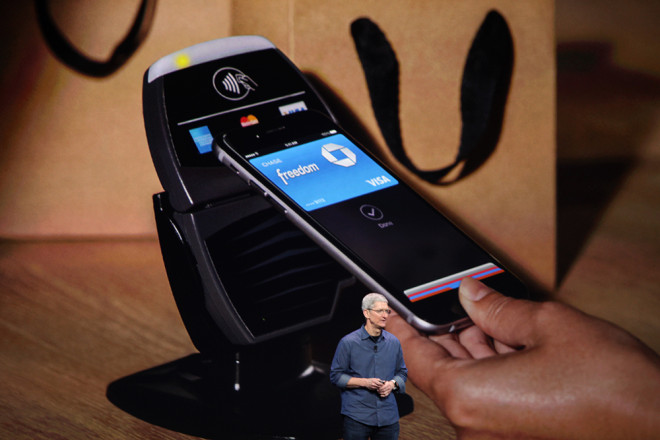
Working with American Express, MasterCard, and Visa, the new ApplePay systemas been designed to work with over 220,000 merchants at launch, including familiar locations like Walgreens, Whole Foods, Macy’s, and Target. Using NFC, you simply tap your phone on a payment terminal to purchase things. It’s that easy. How it works is a bit more complicated though. It uses a combination of NFC, Touch ID, and a secure chip Apple calls the Secure Element. You add a card by snapping a photo of it, then getting verification from your bank. During a transaction, a unique device number, rather than the actual credit card information, is sent to the merchant along with a dynamic security code. Apple doesn’t collect your data—what you buy is between you and the merchant. And if you lose your iPhone, you can suspend payments with Apple’s standard-issue Find My Friends app without needing to cancel your actual credit card.

It will launch in the U.S. in October as an update to iOS 8.

Apple’s Wearable: The Apple Watch

The biggest question mark surrounding today’s event was whether Apple would actually unveil its long-rumored wearable computing product. The company did not disappoint. The Apple Watch is officially here.

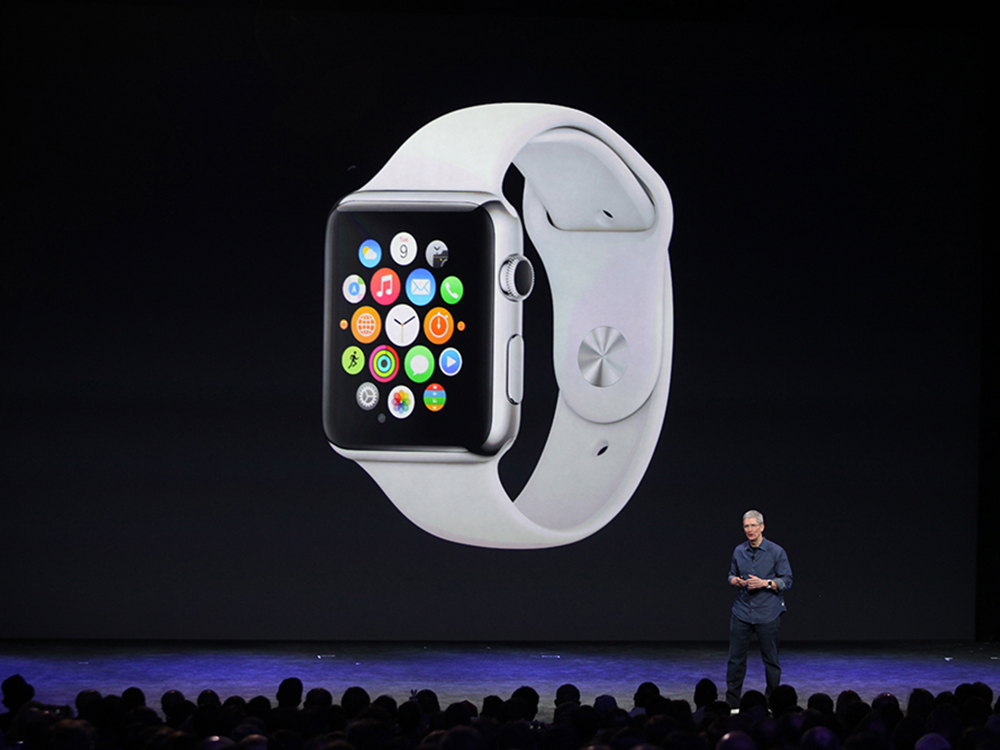
“Apple watch is the most personal device we’ve ever created,” Cook said after receiving a standing ovation and a round of wild applause. Apple’s CEO calls it “a new intimate way to connect and communicate direction from your wrist.”

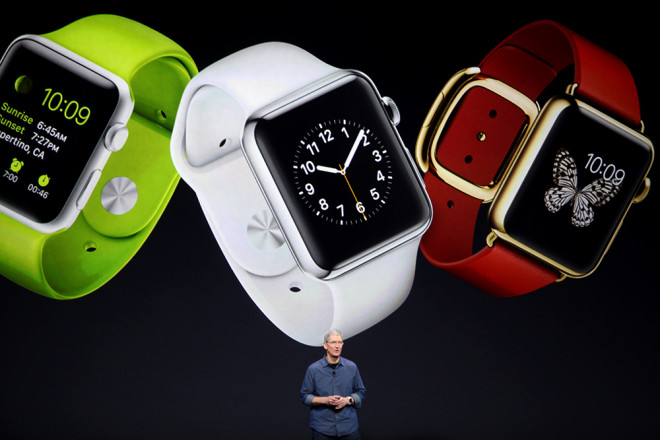
The timepiece, which is accurate to within plus or minus 50 milliseconds, is not just technologically impressive. It’s also quite stylish. The faces and the different hardware choices let you trick out the watch to match your own personal style.

AppleSpecialEvent20140909-AppleWatch1

AppleWatchWristApps

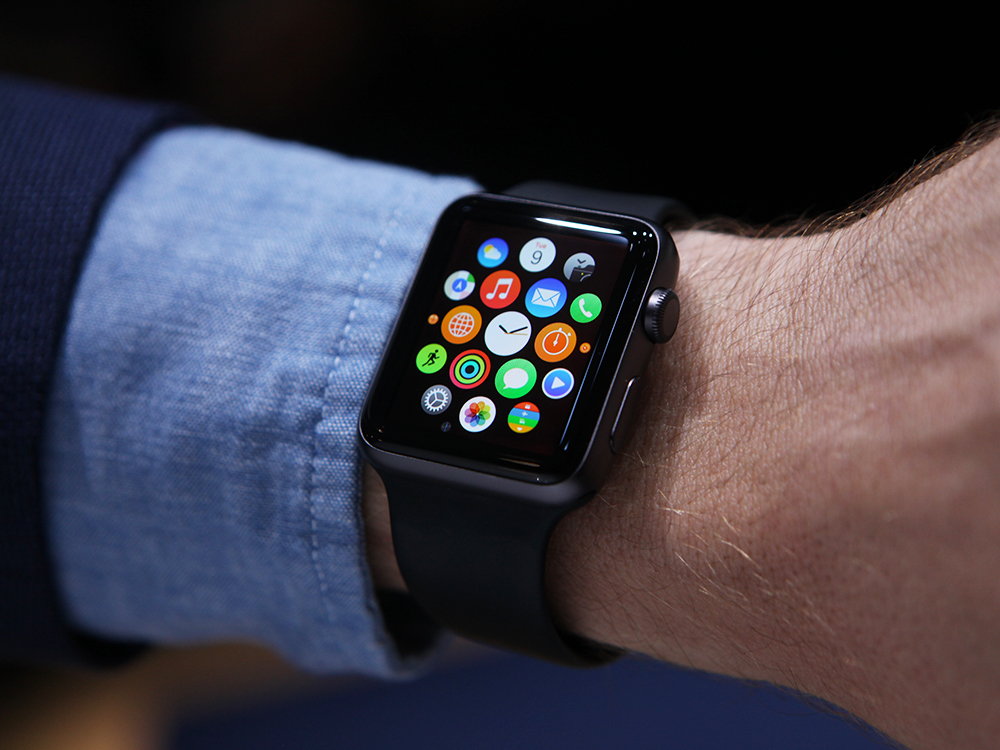
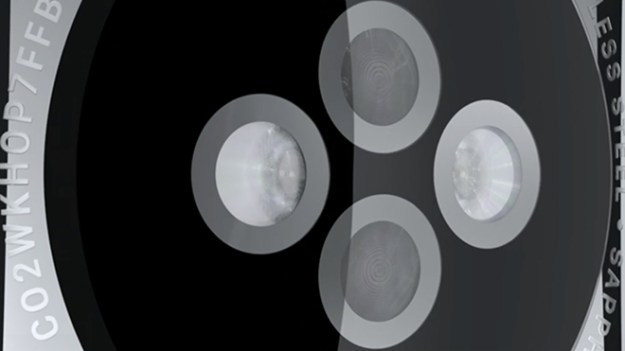
The watch face looks very similar to a traditional watch, including a dial on the side that Apple calls the “digital crown” that translates movement into digital data. Apple kept some of the tech specs on the vague side—the product won’t actually ship until next year. What we do know is that the display is a sheet of sapphire, and inside is a custom designed chip encapsulated to protect the electronics. On the rear are four sapphire lenses which hold LEDs and photo sensors for detecting your heart rate.

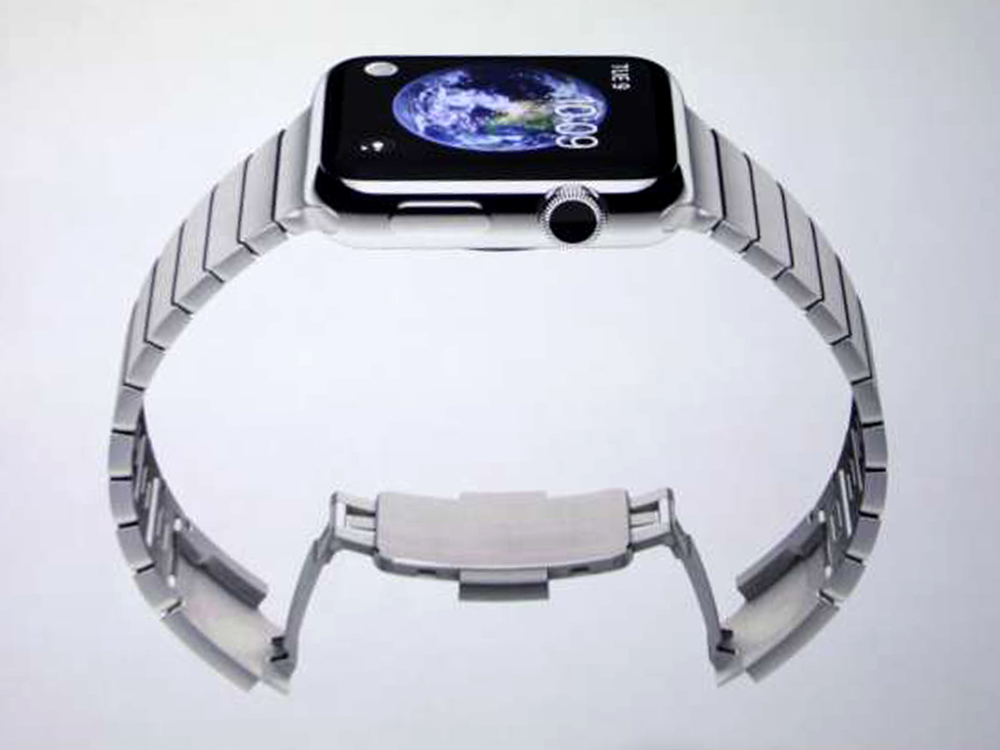
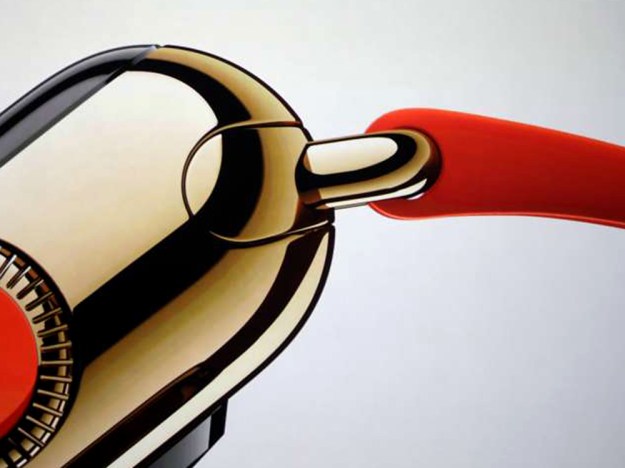
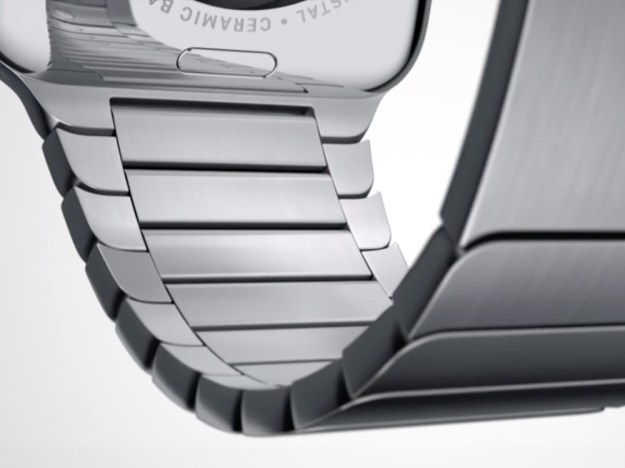
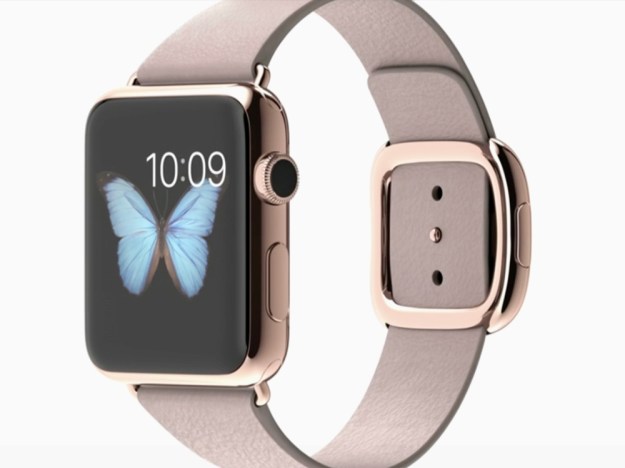
With regards to looks, the Apple Watch is a bit of a chameleon. It comes in three editions: Apple Watch, Watch Sport, and Watch Edition. Apple Watch is the most basic, Watch Sport is more durable, and Watch Edition is more exotic and made of gold. There are six different straps you can mix and match to suit your needs: a quilted leather strap with a magnetic clasping band, a traditional leather buckle, a stainless steel link bracelet, and a mesh chain loop are among the choices. The device comes in not just two band sizes, but two watch face sizes, to suit folks with different-sized wrists.

But it’s not just the hardware that’s customizable. “With every breakthrough, Apple has also had to have a breakthrough in user interface,” Cook said. What Apple didn’t do, he says, is take the iPhone and shrink the interface and strap it on your wrist. The display is too small, and it would make for a terrible user experience. Instead the digital crown is a key part of the navigation experience, as are onscreen taps and swipes.

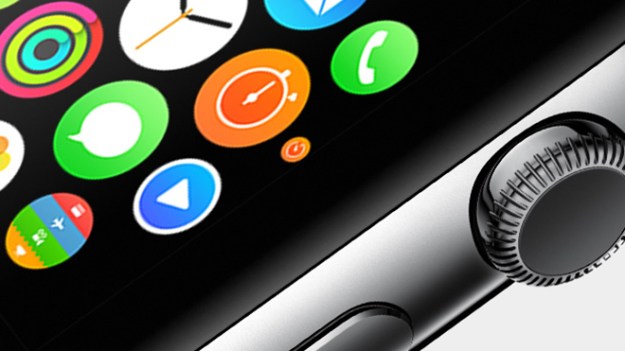
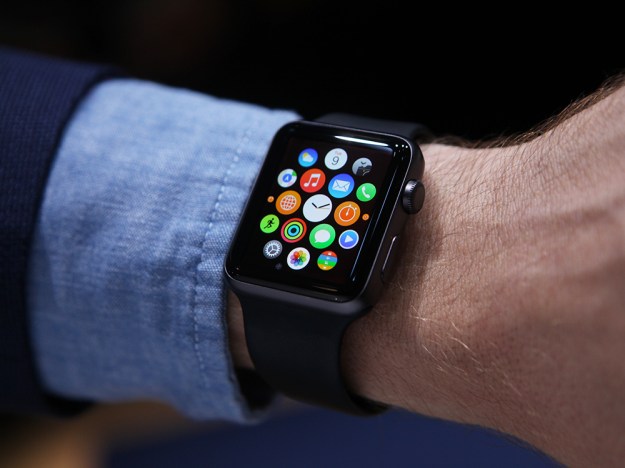
The menu screen is composed of bubbles of circular app icons you can arrange however you like, including grouping them by “neighborhood” of related apps. Twisting the crown zooms in and out on the group of apps. To open an app, you tap it. A feature called Glances lets you swipe upwards from the bottom of the screen to cycle through a customizable series of data screens. Siri is built into the watch, so you can dictate questions like “What movies are playing tonight?” A new feature called Digital Touch lets you select a contact then send a super-quick message just based on taps and drawings that your contact can then feel (via a vibration) when it reaches their wrist. It’s intended for messages that have a more personal context—and are a lot less wordy—than your usual text message.

The Apple Watch has a number of other apps including Maps, notifications from third-party apps, and a lot of customizable watch faces. Third-party apps, like ones from American Airlines and W Hotels, are also on the way. A pair of Apple-built health and fitness apps use both the watch and your iPhone’s sensors to give you a holistic view of your daily activities, combining the features of a general activity tracker and an advanced sport watch.

The Apple Watch charges using an inductive charger that fits on the back of its rectangular face. There’s no word about exact battery life yet. Few details were given about pricing, as well. All we know is that the Apple Watch will start at $350, and that it will go on sale in early 2015.

AppleWatchMetal

Source: http://www.wired.com/2014/09/apple-event-faq

Apple Watch – Apples Latest Consumer Innovation


Everything You Need to Know About the Apple Watch

AppleWatch      AppleWatchMetal

The wearable space just got bigger. Way bigger. Apple debuted its long-awaited wearable Tuesday, simply called Apple Watch.

There are actually three products: Apple Watch, Apple Watch Sport, and Apple Watch Edition. The differences between them are only apparent in the different materials (including aluminum, 18K gold, and pink gold) and wrist strap choices, which vary between feminine, masculine and youthful.

The Apple Watch starts at $350, and it will be available “early next year,” according to the company. Pricing for Apple Watch Sport and Apple Watch Edition were not announced at today’s event. The watch will require an iPhone to operate, but it works with the iPhone 5 or later and isn’t limited to just the new iPhone 6 devices.

AppleWatchSportsEdition

The interfaces of all three phones are alike, and there are a number of standout features.

Instead of interfacing with the watch by touching the screen, which just gets your fingers in the way and blocks your view, you can navigate through the menus and apps by touching the crown. Twist it to zoom in and out of screens and menus. Press it and you go back to the home screen (just like on the iPhone).

There’s an additional button just beneath the crown. Tapping it brings up something Apple calls “Digital Touch” communication. It’s based around a list of friends you’ve communicated with recently. You can send small pictures and sketches to your friends with just a few taps.

The screen itself works much like a Retina display on iPhones and iPads, but it can also sense force. So the familiar two-dimensional touch input system gains a third, vertical dimension.


AppleWatchSensorClose

On the back, there’s a crystal with LEDs that can measure your heart rate—this adds health-tracking capability to the watch. Also on the back is a wireless, inductive charging mechanism. The charger attaches to the back of the watch via a magnet. There’s also vibrating mechanism on the back so you can get notifications and haptic feedback for each of your finger taps.

Raising your wrist awakens the display. When it pops to life, you see a simplified list of apps made just for the watch. There are also several watch faces to choose from. You get sporty, chrono-style faces, retro digital readouts, and even a whimsical Mickey Mouse face. You can customize the color of the face by rotating the crown, or swipe to change the contents of the face so it shows the date and other fields of information on its screen.

AppleWatchGold

There are some health-tracking features to help you make your fitness goals for steps, calories burned, and so on. The watch also works with Apple Pay, the company’s new mobile payments system.

“We’ve been working on Apple watch for a long time,” Cook says. “It covered every discipline at Apple.”

AppleWatchMetal2

Kevin Lynch, a new face on Apple’s media event stage who led the software effort, stepped onstage in Cupertino to give us the first live demo of the watch.

Apple wanted to build the watch so functions were easy to find and use. The menu screens are bubbles of circular app icons you can arrange how you like. You can arrange “neighborhoods” of apps. To open an app, you tap it.


AppleWatchApple


Apple also thought it was important to relay other information in a glanceable way. It does this using a new interaction it calls Glances, a swipe up from the bottom of the watch face. You can arrange these how you like, swapping through the water, the music you’re playing on other devices, et cetera. You can also send some sort of silly 3-D animated smiley face, allowing you to share a lot of emotion without doing a whole lot.

AppleWatchHomeButtonClose

Siri is also built into the watch, so you can do things like ask what movies are playing tonight. You can use the crown or your finger to scroll through the list. There’s also a photo app. You can see an overview of photos, displayed in a grid-like Photostream, and you can use the crown to zoom into them, or swipe to scroll through them. You can pull up any collection of photos here.

AppleWatchGold2

In a map, you can pan around by swiping, you can also zoom out by rotating the crown. When you press the bottom left, it takes you back to where you are. There’s also a search command, you can search by diction or look through your favorites. Search a location like Whole Foods, you can get store information as well as directions for walking or driving.

AppleWatchWristApps

A big key to whether the watch succeeds or fails is the buy-in of third-party developers. Using the new development software pack called WatchKit, developers can create rich, actionable notifications for the device. Apple has been busy with partnerships and client applications for the launch, as well. The watch can alert you to friend requests on Facebook. Twitter’s there too. For an incoming tweet, you can reply straight from the message. You can view things on your timeline, look at trending tweets, or tap the top to compose a tweet. For when you’re traveling, American Airlines has an app. You can even unlock hotel room doors at some hotels using the watch. You can also get notified when you’re walking near sight seeing spots you’ve pinned on Pinterest and get walking directions to them. The watch works with BMW cars, you can challenge friends to runs on the Nike app, and you can control things in your home using the Honeywell app.

AppleWatchFemale


Source: http://www.wired.com/2014/09/apples-new-wearable

IPhone 6 and Iphone 6 Plus hitting the stores September 19 2014

Meet Apple’s Super-Sized iPhone 6 and iPhone 6 Plus

iphone6

As foretold by the rumors, Apple announced two new larger iPhone models today: the iPhone 6 and iPhone 6 Plus. Sized at 4.7-inches and 5.5-inches respectively, the phones sport a slick new style and landmark new features.

The iPhone 6 is priced at $200 for 16 GB, $300 for 64 GB, and $400 for 128 GB, with a two year contract. The larger iPhone 6 Plus commands a premium: $300 for 16 GB, $400 for 64 GB, and $500 for 128 GB. Both phones come in silver, gold, and black.

Pre-orders start this Friday, September 12, and the phones go on sale Friday the 19th.

Both phones sport new designs. The iPhone 6 and 6 Plus, with their larger displays, now feel reminiscent of a miniature iPad. The rear of each device is smooth brushed anodized aluminum that curves softly into its glass front face rather than being completely flat on the back with largely squared-off edges—the look the past four iPhones adopted. On the front, you’ve also got the familiar Touch ID home button.

The iPhone 6 has a 1334×750 display, the 6 Plus 1920×1080 display. That’s over 1 million pixels on the iPhone 6 and over 2 million on the iPhone 6 plus. These new display sizes use a new generation of Retina display Apple is calling Retina HD. The new reengineered displays use ion-strengthened glass on top, and on the bottom, an ultrathin backlight. Even with the larger display, Apple is promising the iPhone 6 and iPhone 6 Plus will have equal or better battery life than the last generation of iPhones.

apple-event-140909-Iphone6Sizecomparision


To use these big-screened phones, Apple’s introduced a few new software tricks to iOS. In the iPhone 6 Plus, the Messages app has a new horizontal split display. Stocks also has a two panel horizontal view, as does Mail. The keyboard takes advantage of the display area, too, and there’s a new horizontal homescreen view. These views obviously make better use of the increased screen real estate, but I wonder how easy it is to use with your fingers as you type.

You can also use swiping gestures for navigation in Mail, Messages, and Safari. There’s also a new gesture called reachability: If you double touch the home button, the display slides down so you can reach things at the top of the display without having to readjust your hand. This seems like a better solution than Samsung’s one-handed mode, but it’s still kind of awkward that it’s necessary.

Both phones will ship with iOS 8. Software updates will go out to older iPhones (the 4S and later) on September 17.

On the iPhone 6 line, Apple updated the camera hardware and software. Apple’s using a 8-megapixel camera with a f/2.2 aperture. There’s also a new sensor inside that’s an improvement over previous iPhone cameras, and a faster auto-focus. There’s the standard digital image stabilization at work in both phones, but in the bigger iPhone 6 Plus, there’s also an optical image stabilization system that uses the phone’s gyroscope and M8 processor to cancel out movements and shaking hands. Video is stabilized too, and there’s a new slow-mo mode that shoots at 240 fps.

Inside, a new A8 processor promises to keep things humming faster than any iPhone before, and the M8 chip has improved performance for motion-sensing and health-tracking. Working along side these updated processors is a new sensor: a barometer.

Source: http://www.wired.com/2014/09/apple-iphone-6-announced

Apples Pay Day

Apple’s New Mobile Wallet Lets You Pay With a Tap of Your iPhone, Wired Online, 9.9.2014

applepayday

„Apple’s new payment system Apple Pay lets people pay merchants using their iPhones. All of the major credit cards—American Express, MasterCard, and Visa—are on board, and will be accepted by more than 220,000 merchants at launch.

Using Apple Pay couldn’t be easier—simply tap your iPhone at a payment terminal. Apple CEO Tim Cook conceded that Apple isn’t the first to attempt replacing the card-based payment system we’ve known for decades, but so far no one’s had much luck.

“People have dreamed of replacing these for years,” Cook said. “But most have been a disappointment or not yet worked well enough for mainstream adoption.”

Instead of a card, Apple Pay uses the iPhone 6, the larger iPhone 6 Plus and the Apple Watch announced today. Want to make a payment? Tap your phone at a retailer’s payment terminal. The phone uses a combination of NFC, Touch ID, and a secure chip called the Secure Element to complete the payment. To add a card, simply snap a pic of it using the iPhone’s camera. After verifying with your bank, the card is added to Passbook. Apple doesn’t store the number, or transfer it to the merchant during a transaction. Instead, it has a device number that’s relayed during payments along with a dynamic security code. If you lose your iPhone, you can use Find My iPhone to suspend payments for that device without having to cancel your credit card.

Apple says that the banks included in Apple Pay make up 83 percent of all credit card purchases in the U.S., and it will be accepted by more than 220,000 retailers. Apple specifically called out Macy’s, Bloomingdales, Walgreens, Staples, McDonalds, and Whole Foods.“

Source: http://www.wired.com/2014/09/apple-pay/

Auf den Spuren von Steve Jobs: “Stay hungry, stay foolish”

Auf den Spuren von Steve Jobs: “Stay hungry, stay foolish”


Steve Jobs erzählt in seiner Rede drei Geschichten, in der deutschen Übersetzung, am Ende des Artikels könnt ihr euch das Video zur Rede im Originalton ansehen.

“Stay hungry, stay foolish” – “Bleibt hungrig, bleibt verrückt”

Es ist mir eine grosse Ehre, zur Feier Ihres Abschlusses an einer der besten Universitäten der Welt heute zu Ihnen sprechen zu dürfen. Ich habe keinen Studienabschluss. Aber ich muss sagen, für mich kommt dieser Tag einem Abschluss sehr nahe. Ich möchte Ihnen heute drei Geschichten aus meinem Leben erzählen. Nichts Besonderes, einfach drei Geschichten.

Die erste handelt davon, eine Verbindungslinie zwischen den Punkten zu ziehen.

Ich habe das Studium am Reed College schon nach sechs Monaten hingeworfen, blieb aber noch anderthalb Jahre, bevor ich endgültig ging. Warum eigentlich?

Das reicht zurück in die Zeit vor meiner Geburt. Meine biologische Mutter war eine junge, unverheiratete Studentin, die beschlossen hatte, mich zur Adoption freizugeben. Ihr war es sehr wichtig, dass ich von studierten Leuten adoptiert würde. Ein Rechtsanwalt und seine Frau waren bereit, alles wurde in die Wege geleitet. Doch in letzter Minute erklärten die beiden, dass ihnen ein Mädchen lieber sei. Meine Eltern, die auf einer Warteliste standen, erhielten mitten in der Nacht einen Anruf: «Wir haben ganz überraschend einen kleinen Jungen, sind Sie interessiert?» Sie antworteten: «Ja, natürlich.» Meine biologische Mutter fand später heraus, dass meine Mutter keinen Uni-Abschluss und mein Vater keinen Highschool-Abschluss hatte. Sie weigerte sich, die Adoptionspapiere zu unterschreiben. Erst ein paar Monate später lenkte sie ein, als meine Eltern ihr versprachen, dass ich eines Tages studieren würde.

Und siebzehn Jahre später war es dann tatsächlich so weit. Aber naiverweise suchte ich mir ein College, das fast so teuer wie Stanford war, und alle Ersparnisse meiner Eltern, einfacher Leute, gingen für mein Studium drauf. Nach sechs Monaten wusste ich nicht mehr, wozu das alles gut sein sollte. Ich hatte keine Ahnung, was ich mit meinem Leben anfangen wollte und inwiefern mir das College helfen würde, eine Antwort zu finden. Und gab dabei das ganze Geld aus, das meine Eltern in ihrem Leben zusammengespart hatten. Ich beschloss, das Studium abzubrechen und darauf zu vertrauen, dass schon alles gut werde. Damals war ich verunsichert, aber aus heutiger Sicht muss ich sagen, dass es eine der besten Entscheidungen war, die ich je getroffen habe. Kaum hatte ich beschlossen, mein Studium hinzuschmeissen, brauchte ich die ganzen uninteressanten Sachen nicht mehr zu lernen und konnte in die Kurse gehen, die mich interessierten.

Es war alles andere als romantisch. Ich schlief bei Freunden auf dem Fussboden, weil ich kein Zimmer im Wohnheim hatte. Von dem Pfand, das ich für leere Cola-Flaschen bekam, kaufte ich mir etwas zu essen, und jeden Sonntagabend bin ich zehn Kilometer durch die ganze Stadt gelaufen, um einmal in der Woche im Hare-Krishna-Tempel eine anständige Mahlzeit zu bekommen. Ich fühlte mich wohl. Und vieles, was mir dank Neugier und Intuition über den Weg kam, erwies sich später als unschätzbar. Um nur ein Beispiel zu nennen:

Am Reed College gab es damals den vielleicht besten Kalligrafie-Kurs im ganzen Land. Jedes Plakat auf dem Campus, jedes Etikett war schön beschriftet. Weil ich ausgestiegen war und nicht an den üblichen Pflichtkursen teilnehmen musste, beschloss ich, mich mit Kalligrafie zu beschäftigen. Ich erfuhr etwas über Serifenschriften und serifenlose Schriften, über die unterschiedlichen Zwischenräume zwischen verschiedenen Buchstabenkombinationen, ich lernte, was wirklich gute Typografie ausmacht. Das war schön, historisch informativ und von einer Ästhetik, der man in den Naturwissenschaften nicht begegnet. Ich war fasziniert.

Von einer praktischen Anwendung schien das meilenweit entfernt zu sein. Aber zehn Jahre später, als wir den ersten Macintosh-Computer entwickelten, war alles wieder da. Und wir packten alles in den Mac. Es war der erste Computer mit schöner Typografie. Hätte ich diesen einen Kurs nicht besucht, hätte es beim Mac nie verschiedene Schrifttypen oder Proportionalschriften gegeben. Und da Windows einfach den Mac kopierte, hätte es das vermutlich auch nicht bei Personalcomputern gegeben. Wenn ich nicht ausgestiegen wäre, hätte ich nie diesen Kalligrafiekurs besucht, und Personalcomputer hätten nicht die schöne Typografie. Natürlich war es unmöglich, schon auf dem College die Punkte miteinander zu verbinden. Aber zehn Jahre später, im Rückblick, war alles ganz klar.

Noch einmal: Man kann die Punkte nicht verbinden, wenn man sie vor sich hat. Die Verbindung ergibt sich erst im Nachhinein. Man muss also darauf vertrauen, dass sich die Punkte irgendwann einmal zusammenfügen. Man muss an etwas glauben – Intuition, Schicksal, Leben, Karma, was immer. Diese Haltung hat mich nie enttäuscht, sie hat mein Leben entscheidend geprägt.

Die zweite Geschichte handelt von Liebe und Verlust.

Ich hatte Glück – ich habe schon früh herausgefunden, was ich gern machen wollte. Ich war zwanzig, als Woz [Anm.: Steve Wozniak] und ich in der Garage meiner Eltern mit Apple anfingen. Wir haben hart gearbeitet, und nach zehn Jahren war Apple von zwei Leuten in einer Garage angewachsen auf ein Zwei-Milliarden-Dollar-Unternehmen mit über 4000 Mitarbeitern. Im Jahr zuvor hatten wir unser bestes Produkt vorgestellt, den Macintosh, und ich war gerade dreissig geworden. Und dann wurde ich entlassen. Wie kann man aus seiner eigenen Firma fliegen? Nun ja, mit wachsendem Erfolg bei Apple stellten wir jemanden ein, der mir sehr geeignet erschien, das Unternehmen gemeinsam mit mir zu führen, und im ersten Jahr funktionierte es auch recht gut. Doch allmählich gingen unsere Vorstellungen auseinander, und schliesslich kam es zu Streit. In der Situation stellte sich unser Verwaltungsrat auf seine Seite. Mit dreissig war ich also entlassen. Und zwar sehr öffentlich entlassen. Der Inhalt meines ganzen Arbeitslebens war auf einmal weg. Es war niederschmetternd.

Eine ganze Weile wusste ich wirklich nicht, wie es weitergehen sollte. Ich sagte mir, dass ich die ältere Unternehmergeneration enttäuscht hatte, dass ich den Stab hatte fallen lassen, der mir gerade übergeben worden war. Ich setzte mich mit David Packard und Bob Noyce zusammen, wollte mich entschuldigen. Ich war gescheitert, öffentlich gescheitert und überlegte sogar, wegzugehen. Aber irgendwie stellte ich fest, dass mir meine Arbeit noch immer am Herzen lag. Die Entwicklung bei Apple hatte daran überhaupt nichts geändert.
Man hatte mich rausgeworfen, aber ich brannte noch immer. Und so beschloss ich, neu anzufangen.

Damals war mir das nicht klar, aber es zeigte sich, dass diese Entlassung das Beste war, was mir je passieren konnte. Statt der Bürde des Erfolgs erlebte ich wieder die Leichtigkeit des Anfängers, der unsicher sein darf. Es gab mir die Freiheit, eine der schöpferischsten Phasen meines Lebens zu beginnen.

In den nächsten fünf Jahren gründete ich Next, ich gründete Pixar und verliebte mich in eine wunderbare Frau, die dann meine Ehefrau wurde. Pixar produzierte den ersten computeranimierten Spielfilm, «Toy Story», und ist heute das weltweit erfolgreichste Zeichentrickfilmstudio. Dann, in einer erstaunlichen Wendung, wurde Next von Apple gekauft, ich kehrte zu Apple zurück, und die Technologie, die wir bei Next entwickelt hatten, ist der Kern der gegenwärtigen Apple-Renaissance. Und Laurene und ich haben eine wunderbare Familie.

All das wäre gewiss nicht passiert, wenn Apple mich damals nicht gefeuert hätte. Es war eine bittere Arznei, aber vermutlich brauchte sie der Patient. Manchmal knallt einem das Leben etwas an den Kopf. Dann darf man nicht das Vertrauen verlieren. Weitergemacht habe ich wohl nur deswegen, weil es mir Spass gemacht hat. Man muss herausfinden, was einem wichtig ist. Das gilt für die Arbeit wie für Liebesbeziehungen. Die Arbeit wird einen Grossteil Ihres Lebens einnehmen, aber wirklich erfüllt ist man nur, wenn man weiss, dass es etwas wirklich Grosses ist. Und das geht nur, wenn man seine Arbeit liebt. Wenn Sie noch nichts gefunden haben, suchen Sie weiter. Arrangieren Sie sich nicht. Wie bei allen Herzensangelegenheiten weiss man, dass es das Richtige ist, wenn man es gefunden hat. Und wie bei jeder wichtigen Beziehung wird es mit den Jahren immer besser. Suchen Sie also so lange, bis Sie das Richtige gefunden haben. Arrangieren Sie sich nicht.

Meine dritte Geschichte handelt vom Tod.

Als ich 17 war, las ich einen Satz, der etwa so ging: «Wenn man jeden Tag lebt, als wäre es der letzte, wird man irgendwann recht haben.» Das hat mich beeindruckt, und seitdem habe ich jeden Morgen in den Spiegel geschaut und mich gefragt: Wenn heute mein letzter Tag wäre, würde ich dann tun wollen, was ich heute tun werde? Und wenn ich allzu oft mit Nein antwortete, dann wusste ich, dass ich etwas ändern musste.

Die Überlegung, dass ich bald tot sein werde, ist für mich die wichtigste Hilfe bei den wirklich grossen Entscheidungen im Leben. Denn fast alles – anderer Leute Erwartungen, Stolz, Versagensangst – wird im Angesicht des Todes unwichtig, es bleibt nur, was wirklich wichtig ist. Wer bedenkt, dass er sterben wird, fällt nicht der Illusion anheim, er habe etwas zu verlieren. Man ist sowieso nackt. Es gibt keinen Grund, nicht der Stimme des Herzens zu folgen. Vor etwa einem Jahr wurde bei mir Krebs diagnostiziert. Morgens um halb acht wurde der Scan gemacht, der Tumor in der Bauchspeicheldrüse war unübersehbar. Ich wusste nicht einmal, was die Bauchspeicheldrüse ist. Die Ärzte meinten, es sei höchstwahrscheinlich ein unheilbarer Tumor, sie gaben
mir höchstens drei bis sechs Monate. Mein Arzt riet mir, nach Hause zu gehen und alles zu regeln, was im medizinischen Jargon nichts anderes heisst als: Richte dich auf den Tod ein. Es heisst, seinen Kindern in wenigen Monaten all das zu erzählen, wofür man eigentlich geglaubt hatte, noch zehn Jahre Zeit zu haben. Es heisst, alles zu regeln, so dass es für die Familie möglichst leicht ist. Es heisst, allen Lebewohl zu sagen.

Mit dieser Diagnose habe ich den Tag verbracht. Abends hatte ich eine Biopsie. Dabei wird ein Endoskop durch Schlund und Magen bis in den Darm geführt, mit einer Nadel werden der Bauchspeicheldrüse ein paar Tumorzellen entnommen. Ich war betäubt, aber meine Frau berichtete mir, dass die Ärzte weinten, als sie unter dem Mikroskop feststellten, dass es eine sehr seltene, therapierbare Form von Pankreaskrebs war. Ich wurde operiert, heute geht es mir gut.

So nahe war ich dem Tod noch nie gewesen, und ich hoffe, dabei bleibt
es noch ein paar Jahrzehnte. Heute, nachdem ich das überstanden habe, kann ich mit etwas mehr Gewissheit sagen als damals, als der Tod eine nützliche, aber rein intellektuelle Vorstellung war:

Niemand stirbt gern. Selbst diejenigen, die in den Himmel wollen, möchten deswegen nicht sterben. Und doch ist der Tod unser aller Schicksal. Niemand entkommt ihm. Und so soll es auch sein, denn der Tod ist vermutlich die beste Erfindung des Lebens. Er ist der Motor des Wandels. Er räumt mit Altem auf, um Platz zu schaffen für Neues. Heute sind Sie das Neue, aber irgendwann werden Sie die Alten sein und abtreten. Entschuldigen Sie diese drastische Formulierung, aber so ist es nun einmal.

Ihre Zeit ist begrenzt, also vergeuden Sie sie nicht, indem Sie ein fremdbestimmtes Leben führen. Hüten Sie sich vor Dogmen, denn das heisst nichts anderes, als sein Leben an den Ansichten anderer Leute auszurichten. Sehen Sie zu, dass der Lärm fremder Meinungen nicht Ihre innere Stimme übertönt. Und vor allem: Haben Sie den Mut, Ihrem Herzen und Ihrer Intuition zu folgen. Die beiden wissen schon, was Sie wirklich werden wollen. Alles andere ist sekundär.

In meiner Jugend gab es ein bemerkenswertes Buch, es hiess «The Whole Earth Catalog» und war eine der Bibeln für meine Generation. Geschrieben hatte es ein gewisser Stewart Brand, nicht weit von hier, in Menlo Park, und er brachte es mit seiner poetischen Ader zum Leben. Das war in den späten 1960er Jahren, vor Personalcomputer und Desktop Publishing, alles wurde mit Schreibmaschine, Schere und Polaroidkamera gemacht. Es war so etwas wie Google in Taschenbuchform, 35 Jahre vor Google – idealistisch, voller nützlicher Dinge und guter Ideen.

Stewart und sein Team brachten mehrere Auflagen heraus, und als das Buch seinen Weg gemacht hatte, gab es noch eine allerletzte Auflage. Das war Mitte der 1970er Jahre, ich war so alt wie Sie. Auf dem Umschlag der letzten Auflage war hinten eine Foto einer Landstrasse im frühen Morgenlicht, wie man das vielleicht erlebt, wenn man als unternehmungslustiger Tramper unterwegs ist. Darunter standen die Worte: «Bleibt hungrig, bleibt verrückt.» Das war die Abschiedsbotschaft. Bleibt hungrig, bleibt verrückt. Ich habe mir das immer für mich selbst gewünscht. Und heute, da Sie vor einem neuen Lebensabschnitt stehen, ist das mein Wunsch für Sie.

Bleibt hungrig, bleibt verrückt.
Vielen Dank.

Quelle: http://www.apfellike.com/2014/05/auf-den-spuren-von-steve-jobs-folge-3/


Siri’s Inventors Are Building a New Artificial Intelligence That Does Anything You Ask

Siri14_1

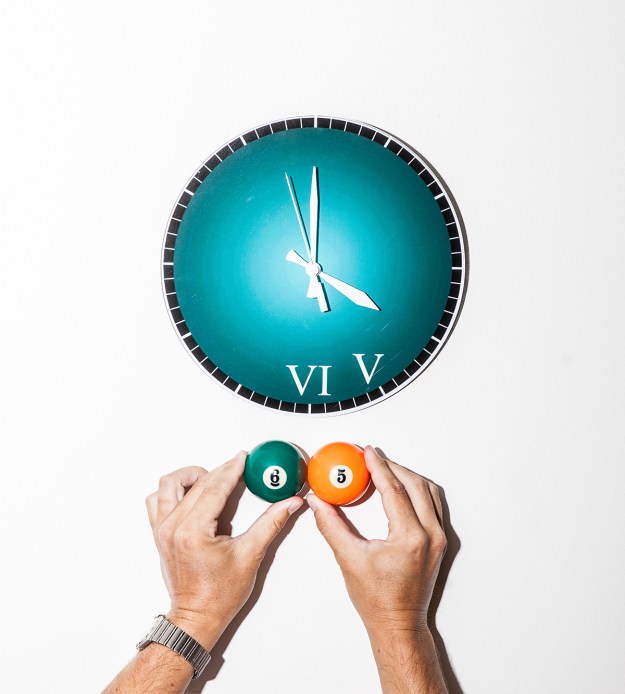
Viv was named after the Latin root meaning live. Its San Jose, California, offices are decorated with tsotchkes bearing the numbers six and five (VI and V in roman numerals). Ariel Zambelich

When Apple announced the iPhone 4S on October 4, 2011, the headlines were not about its speedy A5 chip or improved camera. Instead they focused on an unusual new feature: an intelligent assistant, dubbed Siri. At first Siri, endowed with a female voice, seemed almost human in the way she understood what you said to her and responded, an advance in artificial intelligence that seemed to place us on a fast track to the Singularity. She was brilliant at fulfilling certain requests, like “Can you set the alarm for 6:30?” or “Call Diane’s mobile phone.” And she had a personality: If you asked her if there was a God, she would demur with deft wisdom. “My policy is the separation of spirit and silicon,” she’d say.

Over the next few months, however, Siri’s limitations became apparent. Ask her to book a plane trip and she would point to travel websites—but she wouldn’t give flight options, let alone secure you a seat. Ask her to buy a copy of Lee Child’s new book and she would draw a blank, despite the fact that Apple sells it. Though Apple has since extended Siri’s powers—to make an OpenTable restaurant reservation, for example—she still can’t do something as simple as booking a table on the next available night in your schedule. She knows how to check your calendar and she knows how to use Open­Table. But putting those things together is, at the moment, beyond her.

Now a small team of engineers at a stealth startup called Viv Labs claims to be on the verge of realizing an advanced form of AI that removes those limitations. Whereas Siri can only perform tasks that Apple engineers explicitly implement, this new program, they say, will be able to teach itself, giving it almost limitless capabilities. In time, they assert, their creation will be able to use your personal preferences and a near-infinite web of connections to answer almost any query and perform almost any function.

“Siri is chapter one of a much longer, bigger story,” says Dag Kittlaus, one of Viv’s cofounders. He should know. Before working on Viv, he helped create Siri. So did his fellow cofounders, Adam Cheyer and Chris Brigham.

For the past two years, the team has been working on Viv Labs’ product—also named Viv, after the Latin root meaning live. Their project has been draped in secrecy, but the few outsiders who have gotten a look speak about it in rapturous terms. “The vision is very significant,” says Oren Etzioni, a renowned AI expert who heads the Allen Institute for Artificial Intelligence. “If this team is successful, we are looking at the future of intelligent agents and a multibillion-dollar industry.”

Viv is not the only company competing for a share of those billions. The field of artificial intelligence has become the scene of a frantic corporate arms race, with Internet giants snapping up AI startups and talent. Google recently paid a reported $500 million for the UK deep-learning company DeepMind and has lured AI legends Geoffrey Hinton and Ray Kurzweil to its headquarters in Mountain View, California. Facebook has its own deep-learning group, led by prize hire Yann LeCun from New York University. Their goal is to build a new generation of AI that can process massive troves of data to predict and fulfill our desires.

Viv strives to be the first consumer-friendly assistant that truly achieves that promise. It wants to be not only blindingly smart and infinitely flexible but omnipresent. Viv’s creators hope that some day soon it will be embedded in a plethora of Internet-connected everyday objects. Viv founders say you’ll access its artificial intelligence as a utility, the way you draw on electricity. Simply by speaking, you will connect to what they are calling “a global brain.” And that brain can help power a million different apps and devices.

“I’m extremely proud of Siri and the impact it’s had on the world, but in many ways it could have been more,” Cheyer says. “Now I want to do something bigger than mobile, bigger than consumer, bigger than desktop or enterprise. I want to do something that could fundamentally change the way software is built.”

Viv labs is tucked behind an unmarked door on a middle floor of a generic glass office building in downtown San Jose. Visitors enter into a small suite and walk past a pool table to get to the single conference room, glimpsing on the way a handful of engineers staring into monitors on trestle tables. Once in the meeting room, Kittlaus—a product-whisperer whose career includes stints at Motorola and Apple—is usually the one to start things off.

He acknowledges that an abundance of voice-navigated systems already exists. In addition to Siri, there is Google Now, which can anticipate some of your needs, alerting you, for example, that you should leave 15 minutes sooner for the airport because of traffic delays. Microsoft, which has been pursuing machine-learning techniques for decades, recently came out with a Siri-like system called Cortana. Amazon uses voice technology in its Fire TV product.

But Kittlaus points out that all of these services are strictly limited. Cheyer elaborates: “Google Now has a huge knowledge graph—you can ask questions like ‘Where was Abraham Lincoln born?’ And it can name the city. You can also say, ‘What is the population?’ of a city and it’ll bring up a chart and answer. But you cannot say, ‘What is the population of the city where Abraham Lincoln was born?’” The system may have the data for both these components, but it has no ability to put them together, either to answer a query or to make a smart suggestion. Like Siri, it can’t do anything that coders haven’t explicitly programmed it to do.

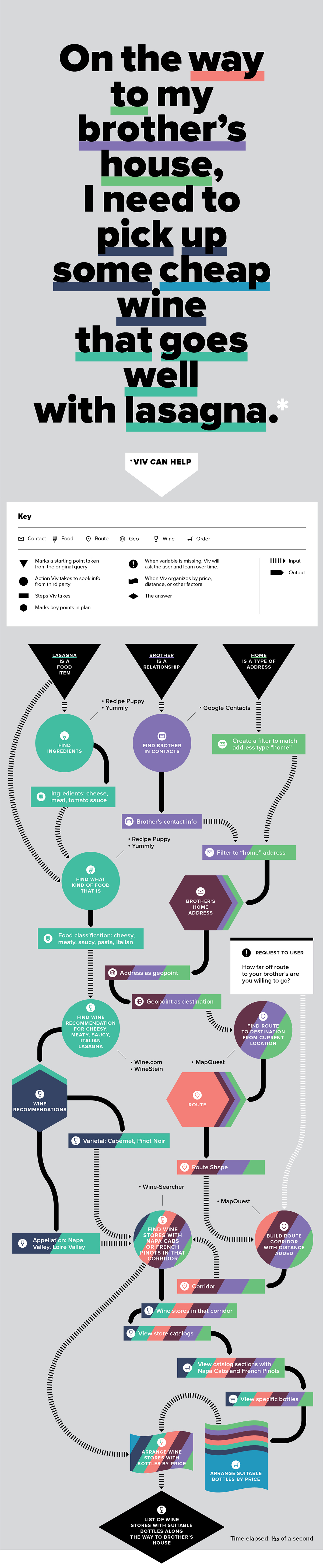
Viv breaks through those constraints by generating its own code on the fly, no programmers required. Take a complicated command like “Give me a flight to Dallas with a seat that Shaq could fit in.” Viv will parse the sentence and then it will perform its best trick: automatically generating a quick, efficient program to link third-party sources of information together—say, Kayak, SeatGuru, and the NBA media guide—so it can identify available flights with lots of legroom. And it can do all of this in a fraction of a second.

Viv is an open system that will let innumerable businesses and applications become part of its boundless brain. The technical barriers are minimal, requiring brief “training” (in some cases, minutes) for Viv to understand the jargon of the specific topic. As Viv’s knowledge grows, so will its understanding; its creators have designed it based on three principles they call its “pillars”: It will be taught by the world, it will know more than it is taught, and it will learn something every day. As with other AI products, that teaching involves using sophisticated algorithms to interpret the language and behavior of people using the system—the more people use it, the smarter it gets. By knowing who its users are and which services they interact with, Viv can sift through that vast trove of data and find new ways to connect and manipulate the information.

Kittlaus says the end result will be a digital assistant who knows what you want before you ask for it. He envisions someone unsteadily holding a phone to his mouth outside a dive bar at 2 am and saying, “I’m drunk.” Without any elaboration, Viv would contact the user’s preferred car service, dispatch it to the address where he’s half passed out, and direct the driver to take him home. No further consciousness required.
Siri14_2

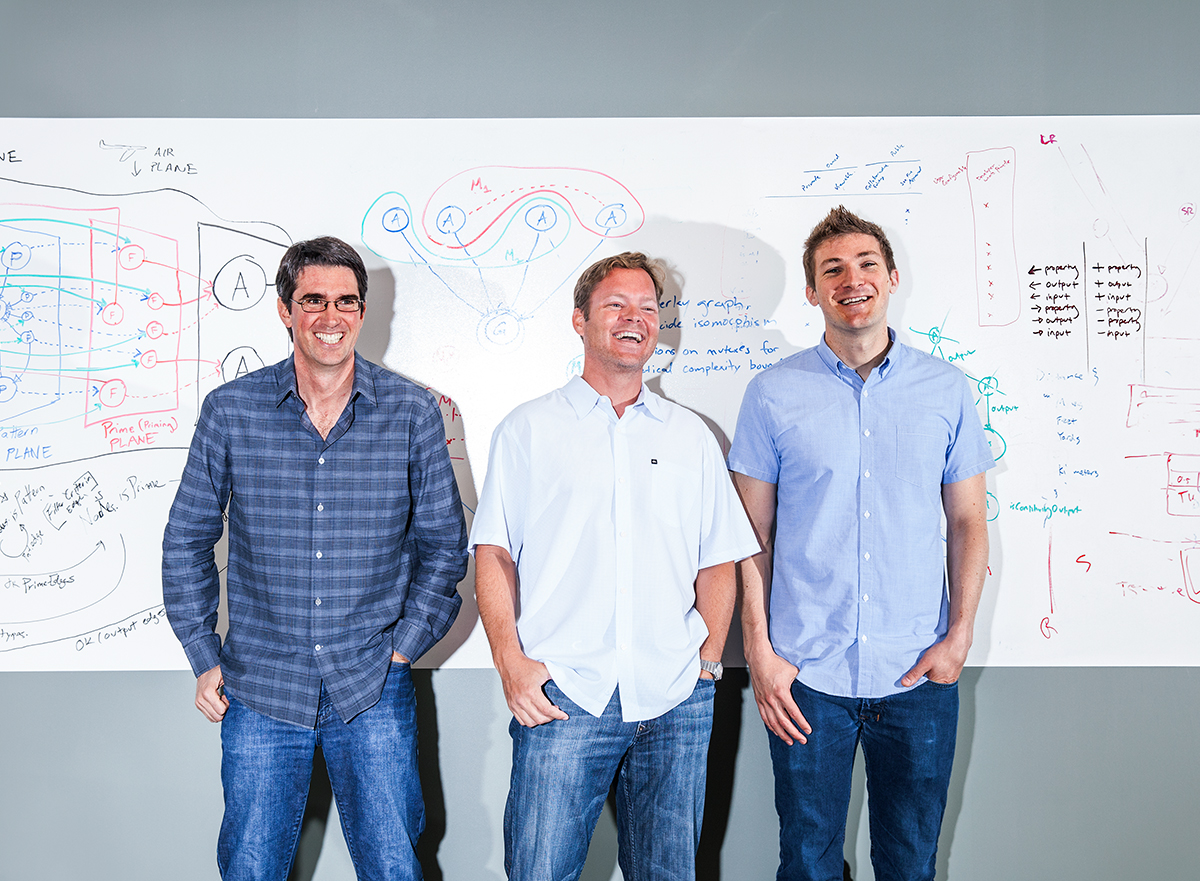
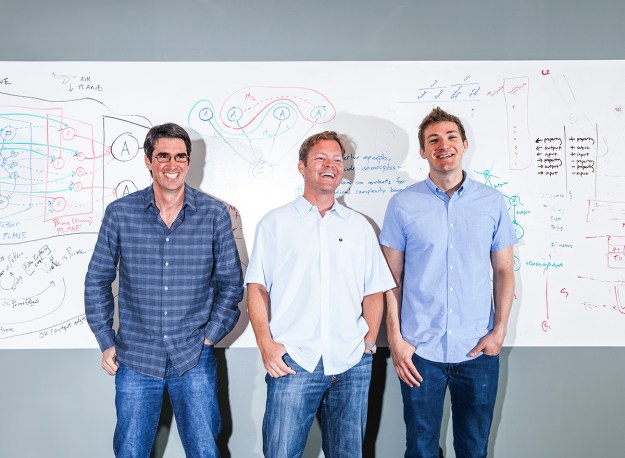
The founders of a stealth startup called Viv Labs—Adam Cheyer, Dag Kittlaus, and Chris Brigham—are building a Siri-like digital assistant that can process massive troves of data, teach itself, and write its own programs on the fly. The goal: to predict and fulfill our desires. Ariel Zambelich

If Kittlaus is in some ways the Steve Jobs of Viv—he is the only non-engineer on the 10-person team and its main voice on strategy and marketing—Cheyer is the company’s Steve Wozniak, the project’s key scientific mind. Unlike the whimsical creator of the Apple II, though, Cheyer is aggressively analytical in every facet of his life, even beyond the workbench. As a kid, he was a Rubik’s Cube champion, averaging 26 seconds a solution. When he encountered programming, he dove in headfirst. “I felt that computers were invented for me,” he says. And while in high school he discovered a regimen to force the world to bend to his will. “I live my life by what I call verbally stated goals,” he says. “I crystallize a feeling, a need, into words. I think about the words, and I tell everyone I meet, ‘This is what I’m doing.’ I say it, and then I believe it. By telling people, you’re committed to it, and they help you. And it works. ”

He says he used the technique to land his early computing jobs, including the most significant—at SRI International, a Menlo Park think tank that invented the concept of computer windows and the mouse. It was there, in the early 2000s, that Cheyer led the engineering of a Darpa-backed AI effort to build “a humanlike system that could sense the world, understand it, reason about it, plan, communicate, and act.” The SRI-led team built what it called a Cognitive Assistant that Learns and Organizes, or CALO. They set some AI high-water marks, not least being the system’s ability to understand natural language. As the five-year program wound down, it was unclear what would happen next.

That was when Kittlaus, who had quit his job at Motorola, showed up at SRI as an entrepreneur in residence. When he saw a CALO-related prototype, he told Cheyer he could definitely build a business from it, calling it the perfect complement to the just-released iPhone. In 2007, with SRI’s blessing, they licensed the technology for a startup, taking on a third cofounder, an AI expert named Tom Gruber, and eventually renaming the system Siri.

The small team, which grew to include Chris Brigham, an engineer who had impressed Cheyer on CALO, moved to San Jose and worked for two years to get things right. “One of the hardest parts was the natural language understanding,” Cheyer says. Ultimately they had an iPhone app that could perform a host of interesting tasks—call a cab, book a table, get movie tickets—and carry on a conversation with brio. They released it publicly to users in February 2010. Three weeks later, Steve Jobs called. He wanted to buy the company.

“I was shocked at how well he knew our app,” Cheyer says. At first they declined to sell, but Jobs persisted. His winning argument was that Apple could expose Siri to a far wider audience than a startup could reach. He promised to promote it as a key element on every iPhone. Apple bought the company in April 2010 for a reported $200 million.

The core Siri team came to Apple with the project. But as Siri was honed into a product that millions could use in multiple languages, some members of the original team reportedly had difficulties with executives who were less respectful of their vision than Jobs was. Kitt­laus left Apple the day after the launch—the day Steve Jobs died. Cheyer departed several months later. “I do feel if Steve were alive, I would still be at Apple,” Cheyer says. “I’ll leave it at that.” (Gruber, the third Siri cofounder, remains at Apple.)

After several months, Kittlaus got back in touch with Cheyer and Brigham. They asked one another what they thought the world would be like in five years. As they drew ideas on a whiteboard in Kittlaus’ house, Brigham brought up the idea of a program that could put the things it knows together in new ways. As talks continued, they lit on the concept of a cloud-based intelligence, a global brain. “The only way to make this ubiquitous conversational assistant is to open it up to third parties to allow everyone to plug into it,” Brigham says.

In retrospect, they were re-creating Siri as it might have evolved had Apple never bought it. Before the sale, Siri had partnered with around 45 services, from AllMenus.com to Yahoo; Apple had rolled Siri out with less than half a dozen. “Siri in 2014 is less capable than it was in 2010,” says Gary Morgenthaler, one of the funders of the original app.

Cheyer and Brigham tapped experts in various AI and coding niches to fill out their small group. To produce some of the toughest parts—the architecture to allow Viv to understand language and write its own programs—they brought in Mark Gabel from the University of Texas at Dallas. Another key hire was David Gondek, one of the creators of IBM’S Watson.

Funding came from Solina Chau, the partner (in business and otherwise) of the richest man in China, Li Ka-shing. Chau runs the venture firm Horizons Ventures. In addition to investing in Facebook, DeepMind, and
Summly (bought by Yahoo), it helped fund the original Siri. When Viv’s founders asked Chau for $10 million, she said, “I’m in. Do you want me to wire it now?”

It’s early May, and Kittlaus is addressing the team at its weekly engineering meeting. “You can see the progress,” he tells the group, “see it get closer to the point where it just works.” Each engineer delineates the advances they’ve made and next steps. One explains how he has been refining Viv’s response to “Get me a ticket to the cheapest flight from SFO to Charles de Gaulle on July 2, with a return flight the following Monday.” In the past week, the engineer added an airplane-seating database. Using a laptop-based prototype of Viv that displays a virtual phone screen, he speaks into the microphone. Lufthansa Flight 455 fits the bill. “Seat 61G is available according to your preferences,” Viv replies, then purchases the seat using a credit card.

Viv’s founders don’t see it as just one product tied to a hardware manufacturer. They see it as a service that can be licensed. They imagine that everyone from TV manufacturers and car companies to app developers will want to incorporate Viv’s AI, just as PC manufacturers once clamored to boast of their Intel microprocessors. They envision its icon joining the pantheon of familiar symbols like Power On, Wi-Fi, and Bluetooth.

“Intelligence becomes a utility,” Kittlaus says. “Boy, wouldn’t it be nice if you could talk to everything, and it knew you, and it knew everything about you, and it could do everything?”

That would also be nice because it just might provide Viv with a business model. Kittlaus thinks Viv could be instrumental in what he calls “the referral economy.” He cites a factoid about Match.com that he learned from its CEO: The company arranges 50,000 dates a day. “What Match.com isn’t able to do is say, ‘Let me get you tickets for something. Would you like me to book a table? Do you want me to send Uber to pick her up? Do you want me to have flowers sent to the table?’” Viv could provide all those services—in exchange for a cut of the transactions that resulted.

Building that ecosystem will be a difficult task, one that Viv Labs could hasten considerably by selling out to one of the Internet giants. “Let me just cut through all the usual founder bullshit,” Kittlaus says. “What we’re really after is ubiquity. We want this to be everywhere, and we’re going to consider all paths along those lines.” To some associated with Viv Labs, selling the company would seem like a tired rerun. “I’m deeply hoping they build it,” says Bart Swanson, a Horizons adviser on Viv Labs’ board. “They will be able to control it only if they do it themselves.”

Whether they will succeed, of course, is not certain. “Viv is potentially very big, but it’s all still potential,” says Morgenthaler, the original Siri funder. A big challenge, he says, will be whether the thousands of third-party components work together—or whether they clash, leading to a confused Viv that makes boneheaded errors. Can Viv get it right? “The jury is out, but I have very high confidence,” he says. “I only have doubt as to when and how.”

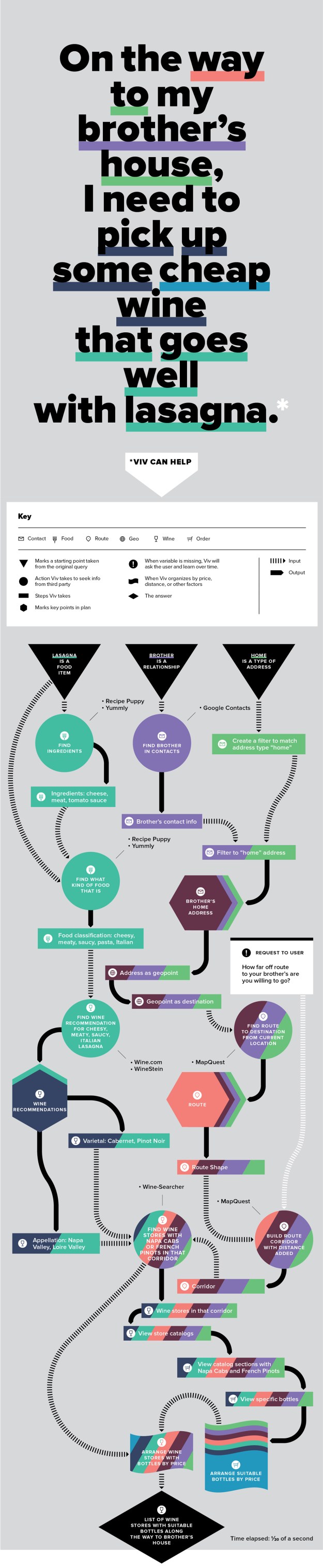
Most of the carefully chosen outsiders who have seen early demos are similarly confident. One is Vishal Sharma, who until recently was VP of product for Google Now. When Cheyer showed him how Viv located the closest bottle of wine that paired well with a dish, he was blown away. “I don’t know any system in the world that could answer a question like that,” he says. “Many things can go wrong, but I would like to see something like this exist.”

Indeed, many things have to go right for Viv to make good on its founders’ promises. It has to prove that its code-making skills can scale to include petabytes of data. It has to continually get smarter through omnivorous learning. It has to win users despite not having a preexisting base like Google and Apple have. It has to lure developers who are already stressed adapting their wares to multiple platforms. And it has to be as seductive as Scarlett Johansson in Her so that people are comfortable sharing their personal information with a robot that might become one of the most important forces in their lives.

The inventors of Siri are confident that their next creation will eclipse the first. But whether and when that will happen is a question that even Viv herself cannot answer. Yet.
Siri14_3

Source: http://www.wired.com/2014/08/viv/