Apple is known for being one of the most challenging and exciting places to work, so it’s not surprising to learn that getting a job there is no easy task.
Like Google and other big tech companies, Apple asks both technical questions based on your past work experience and some mind-boggling puzzles.
We combed through recent posts on Glassdoor to find some of the toughest interview questions candidates have been asked.
Some require solving tricky math problems, while others are simple but vague enough to keep you on your toes.
“If you have 2 eggs, and you want to figure out what’s the highest floor from which you can drop the egg without breaking it, how would you do it? What’s the optimal solution?” — Software Engineer candidate
„You have a 100 coins laying flat on a table, each with a head side and a tail side. 10 of them are heads up, 90 are tails up. You can’t feel, see or in any other way find out which side is up. Split the coins into two piles such that there are the same number of heads in each pile.“ — Software Engineer candidate
AP Photo/Ariel Schalit
„Describe yourself, what excites you?“ — Software Engineer candidate
„There are three boxes, one contains only apples, one contains only oranges, and one contains both apples and oranges. The boxes have been incorrectly labeled such that no label identifies the actual contents of the box it labels. Opening just one box, and without looking in the box, you take out one piece of fruit. By looking at the fruit, how can you immediately label all of the boxes correctly?“ — Software QA Engineer candidate
„Scenario: You’re dealing with an angry customer who was waiting for help for the past 20 minutes and is causing a commotion. She claims that she’ll just walk over to Best Buy or the Microsoft Store to get the computer she wants. Resolve this issue.“ — Specialist candidate
„Have you ever disagreed with a manager’s decision, and how did you approach the disagreement? Give a specific example and explain how you rectified this disagreement, what the final outcome was, and how that individual would describe you today.“ — Software Engineer candidate
Jamie Squire / Getty
“You put a glass of water on a record turntable and begin slowly increasing the speed. What happens first — does the glass slide off, tip over, or does the water splash out?“ — Mechanical Engineer candidate
Digital Trends
„Tell me something that you have done in your life which you are particularly proud of.“ — Software Engineering Manager candidate
„Given an iTunes type of app that pulls down lots of images that get stale over time, what strategy would you use to flush disused images over time?“ — Software Engineer candidate
iTunes
„If you’re given a jar with a mix of fair and unfair coins, and you pull one out and flip it 3 times, and get the specific sequence heads heads tails, what are the chances that you pulled out a fair or an unfair coin?“ — Lead Analyst candidate
slgckgc/flickr
„What was your best day in the last 4 years? What was your worst?“ — Engineering Project Manager candidate
Kreatives Denken, knifflige Logikprobleme Den Jobkandidaten werden je nach dem Bereich, für den sie sich bewerben, Fragen zu ihrem technischen Verständnis gestellt. Teilweise müssen sie Empathie beweisen oder Logikrätsel lösen und kreatives Denken an den Tag legen.
Frage an einen Softwareentwickler: Wenn Sie zwei Eier halten und überprüfen möchten aus welcher Höhe Sie sie fallen lassen können, ohne sie kaputt zu machen. Wie würden Sie das angehen?
Frage an einen Hardware-Ingenieur: Sie stellen ein Glas Wasser auf einen Plattenspieler, der sich zunehmend schneller dreht. Was geschieht zuerst: rutscht das Glas herunter, schwappt das Wasser über oder kippt das Glas um?
Frage an einen Kandidaten für den Telefonsupport: Erklären Sie einem Achtjährigen wie ein Modem/Router funktioniert.
Frage an einen Bewerber im globalen Vertrieb: Wie viele Kinder kommen täglich zur Welt?
Frage für einen Family-Room-Bewerber: Sie wirken sehr positiv, was sorgt bei Ihnen für schlechte Laune?
Frage an einen Apple-Specialist-Kandidaten: Warum änderte Apple seinen Namen von Apples Computer Incorporated zu Apple Inc.?
Frage an einen Software-Entwickler: Auf einem Tisch liegen 100 Münzen. Zehn mit der Kopfseite nach oben, 90 mit der Zahl. Sie können weder erfühlen, noch sehen, noch auf irgendeine andere Weise herausfinden mit welcher Seite die Münzen nach oben zeigen. Wie teilen sie die Münzen in zwei Stapel, damit bei beiden dieselbe Anzahl mit dem Kopf nach oben zeigt?
Frage an einen Software-Entwickler: Wie würden Sie einen Toaster testen?
Frage an einen Bewerber im globalen Vertrieb: Wie berechnen Sie die Kosten für einen Kugelschreiber?
Frage an einen Apple-Specialist-Kandidaten: Sie haben es mit einer verärgerten Kundin zu tun, die seit 20 Minuten auf Hilfe wartet und für Wirbel sorgt. Sie sagt, dass sie nun zu Best Buy oder einem Microsoft-Store geht, um den Computer zu kaufen, die sie möchte. Lösen Sie dieses Problem.
Fragen an einen Bewerber für den Apple-Care-Telefonsupport: Ein Mann ruft an und hat einen Computer, der im Grunde nur noch Schrott ist. Was tun Sie?
This historical chart compiled by Statista shows how quickly and utterly Apple has dominated the smartphone market. Samsung is now the only other major handset company earning significant profits from smartphones.
Five years ago, the iPhone was still the top profit-maker, but a lot of other companies were in the game. Since then, the platform battle has become a two-player race between Apple’s iOS and Google’s Android, driving third-way competitors like BlackBerry and Microsoft/Nokia down into the loss zone. The fierce competition between Android handset makers, particularly with the rise of inexpensive Chinese Android phones, has also sucked a lot of profit out of the market.
Apple has been corporate America’s most ridiculously unbelievable growth story. And now it’s over. Take a deep breath. Exhale. Get used to it.
Yes, the Apple we have come to know was a gravity-defying growth machine. Apple is the most valuable company in the world, yet it increased its revenue in the last 12 months by more than last year’s sales at Coca-Cola. Apple rang up enough operating cash in the last year to buy 625,000 Tesla Model X cars — nearly one for each person in San Francisco. (I’ll take blue with tan leather interior, please.) The company has given us so many eye-popping numbers that any feat short of Tim Cook colonizing Mars is underwhelming.
With the setup of high expectations, the most crucial numbers are now more low-Earth orbit than deep space. Unit sales of the iPhone for the three months ended Sept. 26 climbed 22 percent from those in the period a year earlier. Just a few months ago, Apple sold 60 percent more iPhones than it did a year before. Wall Street will be thrilled if iPhone sales increase at all in the holiday quarter, compared with the frenzied sales of the iPhone 6 during the 2014 holidays. Apple’s own forecast, which is often conservative, is for a tiny increase in revenue in the three months ending in December.
The existential question for Apple is whether the company is in another lull before a turbocharge from the iPhone 7 or something else, or whether nonspectacular growth is the new normal.
It’s true that this isn’t the first time Apple seemed to run out of steam. Just before the introduction of the iPhone 6 models a year ago, Apple posted five consecutive quarters of single-digit revenue growth, according to Bloomberg data. Sales took off again once people snapped up the larger-screen iPhones.
What’s different this time is Apple is in part to blame for doubts about its growth trajectory. The company has fallen into an unhealthy reliance on a single product: the iPhone. The smartphones generated just more than half of Apple’s sales before the introduction of the iPhone 6. That number has risen to 63 percent or more in each of the last four quarters.
Part of that shift, of course, is the remarkable sales run for the iPhone. It’s also because the Apple Watch, Apple Music or potential future electric minivans aren’t big enough to pick up the slack right now, and maybe never will. Sales of Mac computers are defying the shrinking PC market, but revenue gains are pedestrian. The iPad seems to have settled into a rut as a nice-but-not-essential consumer gadget that users don’t upgrade as often as the company would like. Revenue from iPads fell for the seventh quarter in a row, by 20 percent in the latest three months.
Apple is used to defying predictions that it can’t top itself. Those predictions look more likely to come true than ever before.
Perhaps the most important number in Apple’s quarterly release on Tuesday came from China, and it’s not the good news Apple makes out. The company’s over reliance on the Chinese market is starting to hinder its progress despite management’s attempts to give it a positive spin.
During Tuesday’s earnings call, Apple chief executive Tim Cook sang the praises of the Chinese market, saying it will one day be Apple’s largest. In fiscal 2015, which ended for Apple on Sept. 26, Greater China provided 25 percent of the company’s revenue, for the first time overtaking Europe, responsible for just 21.6 percent of Apple sales. An economic slowdown? Not according to Cook, who is worth quoting at length here:
Frankly, if I were to shut off my web and shut off the TV and just look at how many customers are coming in our stores regardless of whether they’re buying, how many people are coming online, and in addition looking at our sales trends, I wouldn’t know there was any economic issue at all in China. And so I don’t know how unusual we are with that. I think that there’s a misunderstanding, probably particularly in the Western world, about China’s economy, which contributes to the confusion. That said, I don’t think it’s growing as fast as it was; but I also don’t think that Apple’s results are largely dependent on minor changes in growth.
The statistics Cook cites in support of this view are impressive: 87 percent growth in iPhone sales year-on-year in Greater China (which includes Hong Kong, Taiwan and Macau) despite the entire market’s 4 percent growth; revenue almost twice as high in the last quarter as a year ago; and the iPhone 6 now the bestselling smartphone in China, with the iPhone 6 Plus at number three. These numbers are less relevant, however, than two others: a drop in quarter-on-quarter sales in Greater China and an erosion of Apple’s overall market share there.
In the last quarter of fiscal 2015, Apple made $12.5 billion in revenue in Greater China, a 5.4 percent drop compared to the previous three months, despite the inclusion of the first weekend of iPhone 6s sales in the fourth quarter, 2015 data. In 2014, the new iPhone 6 wasn’t immediately available in China, so the fourth quarter didn’t benefit from the new product boost — and still sales were higher than in the previous three months.
Cook is wrong to say the Chinese slowdown isn’t affecting his company’s sales. The effect has been immediate and quite obvious. But Apple’s market share in the Asia Pacific region, which includes China, wasn’t growing even before it manifested itself.
According to data compiled by Bloomberg Intelligence, in the second quarter of this year, Apple’s market share of smartphone unit shipments in the region dropped to 7.7 percent from 10.8 percent in the previous quarter as Chinese leaders Huawei and Xiaomi increased their shares. Apple is the Asian smartphone market leader in terms of value, but its share by that measure also dropped in the second quarter — to 34.1 percent from 42.7 percent in the previous three months. Again, Huawei and Xiaomi posted gains, although Korean producers such as Samsung and LG also managed to pick up some of Apple’s losses. As Apple’s revenue in the region dropped, it was unlikely to have made share gains in the last quarter.
Cook is banking on the future growth of the Chinese middle class, and that’s an obvious long-term bet to make, but under the current economic conditions, this growth is not likely to be explosive. Besides, Apple won’t even be able to grow its sales at the same rate because many Chinese consumers will opt for better-value devices from local producers, as they’re already doing, judging by the market share data.
Improving distribution in China yielded strong revenue gains for Apple this year. Greater China accounted for 53 percent of the company’s revenue growth in fiscal 2015. Unless China’s economic troubles are miraculously cured over the next year or Huawei and Xiaomi stop making cutting-edge devices for a fraction of Apple’s prices, this growth engine has stalled. Nor does Apple have any comparable opportunities for extensive growth anywhere else in the world.
Cook’s bet on China was, of course, no mistake: It would be a crime for a device producer not to develop a strong presence in the world’s most populous country. Focusing on China was a business decision that produced gains comparable to a ground-breaking product launch, especially in 2015. There are no more miracles coming out of China, however, and no more technological rabbits coming out of Apple’s hat. It’s time for some stagnation and retrenchment — at least by this company’s remarkably high standards.
Darum könnten Mobilfunkanbieter in Zukunft überflüssig werden
In Zukunft wird mobiles Internet so selbstverständlich wie der Strom aus der Steckdose. Gut für die Nutzer, schlecht für die Mobilfunkanbieter, die immer austauschbarer werden.
Weltweit gibt es sieben Milliarden Mobilfunkanschlüsse, davon in Deutschland 112 Millionen . Tendenz steigend. Läuft es also gut bei den Mobilfunkanbietern? Nur für den Moment. In Zukunft werden sie austauschbar, denn schon heute unterscheiden sie sich im Prinzip nur durch Preis, Datenvolumen und Netzabdeckung voneinander. Zusatzdienste, die zu den Anfängen des Mobilfunks für die Nutzer noch eine Rolle spielten, haben keine Bedeutung mehr. In Zeiten von WhatsApp oder iMessage brauchen Nutzer keine teuren SMS-Pakete mehr. Auch die Telefonie wird unwichtiger, was zählt ist die Datenverbindung.
Over-The-Top-Dienste (OTT) wie Skype, WhatsApp, iMessage und Co. legen kontinuierlich zu, während die klassischen Kommunikationsdienste wie Telefonie oder SMS in der Nutzung sinken. Laut der Bundesnetzagentur lag die mobile Datennutzung 2014 im Monatsmittel bei 288 Megabyte und damit viermal so hoch wie noch 2011. Mobil telefoniert wurde in Deutschland 2014 im Monat nur noch knapp 80 Minuten. Drastisch eingebrochen ist auch die SMS-Nutzung : von 60 Milliarden SMS im Jahr 2012 blieben 2014 nur noch 22,5 Milliarden übrig.
Die Kluft zwischen Nutzer und Mobilfunkanbieter wird größer
Gleichzeitig wird die Kluft zwischen Nutzer und Mobilfunkbetreiber immer Größer, wie die Umfrage des Marktforschungsinstituts für Servicequalität zeigt. Das Gesamturteil für die Mobilfunkbranche ist nur befriedigend und an erster Stelle stehen bei der Kundenzufriedenheit die Mobilfunkdiscounter. Die Netzbetreiber Telefonica, Telekom oder Vodafone bilden das Schlusslicht. Die qualitativen Unterschiede zwischen den Netzbetreibern, anfänglich noch deutlich größer, werden immer geringer.
„Es gibt kein wirklich schlechtes Mobilfunknetz mehr.“
Es gibt kein wirklich schlechtes Mobilfunknetz mehr, was auch zur Wechselfreudigkeit beiträgt. Dank der Möglichkeit der Mitnahme der Rufnummer sinkt die Bindung zu einem bestimmten Mobilfunkanbieter. Obwohl die Kluft zum Kunden immer größer wird, unternimmt die Branche viel zu wenig, um den Kunden zu binden. Auf den demografischen Wandel der Nutzer und die damit einhergehende Veränderungen im Nutzungsverhalten wird mit den falschen Maßnahmen reagiert. Die steigende Beliebtheit von Messaging-Diensten wie WhatsApp wurde anfänglich belächelt, bis dann vier Jahre nach dem Start von WhatsApp & Co der zaghafte Versuch unternommen wurde, mit der App Joyn eine Alternative zu bieten. Erfolglos, schaut man sich das Ranking im App-Store und der Anzahl der Bewertungen an.Gleichzeitig untersagen die Mobilfunkanbieter in ihren AGB die Nutzung von Diensten wie P2P (Peer-to-Peer), Instant Messaging oder VoIP (Voice over IP). Kein Problem hat man damit, Streaming-Dienste wie beispielsweise Spotify von der Berechnung des Datenvolumens auszuschließen. Mit Netzneutralität hat das nur noch wenig zu tun. Hauptsache der Rubel rollt. Statt sich auf den Nutzer zu fokussieren, wird selbiger lieber gemolken. So sind in kaum einem anderen Land die Kosten für mobiles Internet so hoch wie in Deutschland. Ist in Finnland ein Inklusiv-Volumen von 50 Gigabyte üblich, steht Deutschland mit einem Gigabyte hinter Italien, Tschechien oder Spanien und nur knapp vor Ungarn. Finde den Fehler.
Der SMS-Killer. WhatsApp läutete den Untergang der SMS ein (Quelle: Twin Design / Shutterstock.com)
Zukunft der Mobilfunkanbieter ist düster
Die Liste der gescheiterten Unternehmungen, eigene Dienste zu etablieren, ist lang. Messaging, Musik-Streaming oder Mobile Payment, allesamt eher klägliche Versuche beim Nutzer zu punkten. Der Zugriff auf den Kunden wird in Zukunft weiter sinken, denn gemeinsam mit der GSM-Association, dem Verband der Mobilfunknetzbetreiber, verhandeln Samsung und Apple über die Einführung der eSim. Bei der eSIM handelt es sich um eine fest verbaute Sim-Karte, auf die jeder Mobilfunkbetreiber aufgeschaltet werden kann. Kunden brauchen in Zukunft keine Sim-Karte mehr für das Smartphone, sondern können sofort loslegen.
Der Wechsel zwischen den Mobilfunkanbietern wird damit entsprechend vereinfacht, da der lästige Wechsel der Sim-Karte entfällt. Die Hoheit der eSim liegt beim Hardware-Hersteller, also bei Apple und Samsung. Das heißt, dass sowohl Apple als auch Samsung einen Mobilfunkbetreiber anbieten, aber eben auch ausschließen können. Mobilfunkanbieter, die besonders restriktiv gegenüber bestimmten Onlinediensten sind, könnten einfach seitens der Smartphone-Hersteller ausgeschlossen werden. Mit der eSim geht ein weiterer Baustein in der Kundenbeziehung für die Mobilfunkanbieter verloren. Und es bröckelt weiter, denn Apple bietet, zunächst nur in den USA, das iPhone als Abo-Modell an.
Für einen Betrag von 39 US-Dollar kann das iPhone gemietet werden und der Kunde bekommt automatisch immer das neueste Gerät. Das Gleiche bietet Samsung auch an und andere Hersteller werden folgen. Mit neuen Smartphones gekoppelt an eine Vertragsverlängerung können die Mobilfunkanbieter künftig also auch nicht mehr locken. Die nicht abreißenden Gerüchte, Apple wolle ein VMNO, ein virtueller Mobilfunkanbieter werden, dürften bei den etablierten Mobilfunkbetreibern nur so mittelgut ankommen. Ganz abgesehen von Projekten wie Googles Loon, dessen Ziel nichts geringeres ist, als die Welt mit Internet auszustatten.
Sri Lanka ist das erste Land, welches mit Hilfe von Google Loon einen landesweiten universellen Internetzugang über WLAN bekommt. Auch wenn Sri Lanka nur eine Insel und nicht Europa ist, sieht man, wohin die Reise bei Google geht. Für Unternehmen wie Google, Facebook oder Apple ist mobiles Internet die Basis für alle Produkte. Die Abhängigkeit von Mobilfunkprovidern ist, wie man am gerade von Google gestarteten Accelerated-Mobile-Pages-Project sehen kann, ein Problem.
Project Loon als Gefahr für den klassischen Mobilfunk? (Foto: Google)
Fazit
Die Frage ist nicht, ob es die Mobilfunkanbieter in Zukunft noch geben wird, sondern viel mehr welche Rolle sie spielen werden. Die Bindung zum Kunden geht zunehmend an Unternehmen wie Apple, Google, Facebook oder Amazon verloren. Ein Ökosystem, wo Kunden Lösungen aus einer Hand bekommen, die nahtlos mit einander funktionieren, ist heute essentiell. Apple, Google, Facebook und Amazon haben das erkannt und bieten genau das: einzelne Lösungen aus einer Hand für unterschiedliche Anwendungsfälle mit Fokussierung auf den Nutzer.
Im Mobilfunk wird das vernachlässigt und es fehlen innovative Ideen und Lösungen. Themen werden entweder zu spät oder nicht nutzerzentriert angegangen, wie man an den Entwicklungen im Bereich Mobile Payment sehen kann. Anstatt sich mit den Kundenbedürfnissen zu beschäftigen, steht am Anfang das Geschäftsmodell. Am Ende bleibt nur noch die Rolle des Technologie-Anbieters, die in etwa so spannend ist wie Strom aus der Steckdose. Gar nicht.
Kann Samsung mit dem Galaxy Note 5 und dem S6 Edge+ das Ruder herumreißen? Marktexperten kritisieren Samsung-Geräte als zu teuer, die Galaxy-Serie als zu verwässert.
Mit dem Galaxy Note 5 und dem S6 Edge+ startet Samsung früh in den Produkt-lastigen Herbst. Ob der koreanische Hersteller mit den Riesen-Smartphones punkten kann, werden die nächsten Wochen und Monate zeigen. Die Verkaufszahlen der jüngsten Highend-Modelle Galaxy S5 und S6 waren hinter den Erwartungen geblieben. Im Kampf um die Smartphone-Krone war Apple mit dem iPhone 6 und 6 Plus der eindeutige Sieger. Auf der anderen Seite setzten ambitionierte chinesische Hersteller wie Huawei, ZTE, Oneplus und Xiaomi den Koreanern mit leistungsstarken, aber weitaus günstigeren Geräten zu.
Bisheriger Vorteil weg
„Samsung macht gerade eine schwierige Phase durch. Wie sich jetzt zeigt, ist die Marke einfach nicht stark genug, um gegen Apple auf der einen Seite und den chinesischen Herausforderern auf der anderen zu punkten“, sagt IDC-Analyst Francisco Jeronimo im Gespräch mit der futurezone. Bis zum iPhone 6 habe Samsung mit seinen größeren Displays davon profitiert, besser auf die Kundenwünsche eingegangen zu sein. Dieser Vorteil sei nun dahin. Gegenüber Herstellern wie Huawei oder ZTE besitze die Marke zwar eine größere Strahlkraft, diese sei aber nicht stark genug, dass Käufer Hunderte Euro mehr für ein Samsung-Gerät ausgeben, so Jeronimo.
Auch die bekannte Marktanalystin Carolina Milanesi von Kantar Worldpanel ortet bei Samsung ein Marken- und ein Preisproblem. „Samsung leidet darunter, dass Konsumenten die Preise für die Flaggschiff-Geräte als zu hoch empfinden. Mit dem Galaxy hatte sich Samsung eigentlich eine gute Marke aufgebaut, diese über die Jahre aber mit viel zu vielen unterschiedlichen Produkten verwässert. Heute wissen Käufer überhaupt nicht mehr, wofür die Galaxy-Reihe eigentlich steht“, kritisiert Milanesi.
Ebenfalls nicht aufgegangen sei die Strategie, beim Galaxy S6 und S6 Edge erstmals auf hochwertige Materialien und ein innovativeres Design zu setzen. Dies habe den Preis nach oben getrieben, gleichzeitig aber zu weniger Nachfrage als erwartet geführt. Das teurere, aber stärker nachgefragte Galaxy S6 Edge habe seine Vorzüge zudem nicht optimal ausspielen können, weil die Verfügbarkeit über Monate hinweg schlecht war, so Milanesi. „Im Großen und Ganzen würde Samsung ein schlankeres und fokussierteres Portfolio gut tun.“
Samsung zu teuer
Für den IDC-Analysten Jeronimo müssen die Samsung-Geräte wieder billiger werden, damit der Hersteller an frühere Erfolge anschließen kann. „Samsung hat enorm viel Geld für Marketing und gestützte Verkäufe ausgegeben. Es wird ihnen kaum etwas anderes übrig bleiben, als beim Marketing zurückzufahren, die Firmenstruktur zu verschlanken und dafür wieder mit einer aggressiveren Preispolitik in den Markt zu gehen“, sagt Jeronimo. Das sei das Um und Auf, um chinesische Hersteller einzubremsen und auch Apple im Highend-Segment etwas entgegenzusetzen.
„Wer 700 Euro und mehr für ein Smartphone ausgeben will, nimmt die stärkste Marke, und die ist und bleibt Apple. Das ist wie beim Autokauf – wer es sich leisten kann, kauft auch einen BMW oder Mercedes und keinen Ford“, ist Jeronimo überzeugt. Im Highend-Bereich habe Samsung auch den Fehler gemacht, einige Features zu nachlässig umgesetzt zu haben: „Der Fingerprint-Sensor ist ein gutes Beispiel. Während er bei Apple von Anfang an perfekt funktionierte, musste man bei Samsung zunächst mehrmals mit dem Finger drüberstreichen, bis der Abdruck erkannt wurde.“
„Zum Scheitern verurteilt“
Das Urteil von Asymco-Analyst Horace Dediu fällt noch weniger schmeichelhaft für Samsung aus. „Samsung war nie gut darin, worin Apple gut war. Apple schafft eine einzigartige User Experience, da sie Software, Hardware und Services aus einer Hand anbieten können. Samsung macht mehr oder weniger das selbe, was 1000 Android-Konkurrenten auch machen. Der Erfolg kam eher daher, dass Samsung mit Jahresbudgets von 14 Milliarden Dollar für Marketing, Verkaufspromotionen und Werbung seine Produkte besser verkaufen konnte als die Android-Mitbewerber“, sagt Horace.
Eine derartige Strategie sei langfristig aber immer zum Scheitern verurteilt, da sie nicht nachhaltig sei, denn es werde immer neue Marken geben, welche Nischen besetzen. Wenn Samsung sich über die Android-Welt hinaus profilieren möchte, müsse der Konzern eine Plattform-Firma mit einem starken Ökosystem werden und stark in Software und Services investieren. „Dazu müsste Samsung aber erst eine firmeninterne Kultur entwickeln, die solche langfristigen Ziele absteckt und umsetzt“, sagt Horace zur futurezone.
Trendumkehr möglich
Auch Milanesi sieht Samsung in der Verbesserung von Software-Features bzw. der optimalen Abstimmung von Software und Hardware verstärkt in der Pflicht, ortet aber auch Stärken. „Man darf nicht vergessen, dass Samsung weiterhin in vielen Märkten der führende Smartphone-Hersteller ist. Im Gegensatz zu anderen, teilweise bereits gefallenen Branchengrößen wie Nokia hat Samsung den großen Vorteil, dass sie über wertvolle Produktionsanlagen für Bildschirme, Akkus und die Chipherstellung verfügen. Wenn sie es schaffen, ihre Marke noch stärker zu positionieren und zu schärfen, ist eine Trendwende möglich“, zeigt sich Milanesi gegenüber der futurezone überzeugt.
Apple Doesn’t Want You to Know How Many Watches It Sold
A display case containing the Apple Watch Sport at the company’s flagship store in San Francisco, on June 17, 2015. Robert Galbraith/Reuters/CorbisWhat about the Watch?Apple released its fiscal third-quarter results today—its first earnings report since the Apple Watch launched in April in nine countries. But it didn’t break out Watch sales separately, as it does with iPhones and iPads. Instead, Apple folded Watch revenue into its “other products” category, which also includes the iPod, Apple TV, Beats headphones, and other accessories. This reticence isn’t exactly surprising; Apple CEO Tim Cook has said in the past that he intends to keep quiet on actual sales numbers for competitive reasons. But it’s still hard not to think that if the Apple Watch really was a blockbuster, Apple would say so.
“We had an amazing quarter, with iPhone revenue up 59 percent over last year, strong sales of Mac, all-time record revenue from services, driven by the App Store, and a great start for Apple Watch,” Apple CEO Tim Cook said in a statement. But how great a start Apple wasn’t saying.
What’s New
Here’s what we do know for sure: Apple reported $2.6 billion in revenue for its “other products” during the third fiscal quarter, up from $1.7 billion one quarter ago. Apple doesn’t break out the number of units shipped in this category, so there’s not a simple way to determine exactly how many watches Apple has sold by comparing to past results. Yes, the nearly $1 billion bump in “other products” does stop a downward slide. It seems reasonable to infer that the Watch seems to have added to Apple’s bottom line. But by how much, and thanks to how many watches, are both difficult to say.
The performance of the Apple Watch is of particular interest not just because of the marketing hype, but because it’s Apple’s first foray into a major new product category under CEO Tim Cook. The wild success of newer iPhone models has taken pressure off Cook to show Apple still has its mojo in the post-Steve Jobs era. But staking a first-mover claim to a new category the way Apple under Jobs did with the iPhone and iPad is still a bullet point missing from Cook’s résumé.
That’s Saying Something
And in the past, after Apple has released major new products, it has said, well, something. When the iPhone launched in the third quarter of 2007, Apple revealed specific numbers: 270,000 iPhones sold in the first two days after it was released at the end of the quarter. The “iPhone is off to a great start—we hope to sell our one-millionth iPhone by the end of its first full quarter of sales,” Jobs said in a statement at the time—a mark it did hit after 74 days.
In the third quarter of 2010, after the iPad first went on sale, Jobs specifically broke out the number of tablets the company moved. “It was a phenomenal quarter that exceeded our expectations all around,” Jobs said. “iPad is off to a terrific start.” The company announced it had sold nearly 3.3 million iPads that quarter—300,000 units globally the first day and 1 million sales in 28 days.
All of which makes Apple’s silence around the Apple Watch fairly deafening. (We’re waiting to see what Tim Cook might say about the Watch during his call with analysts in a few minutes.) Anything short of hard numbers leaves us with just anecdotal evidence. If Apple isn’t willing to save us from the anecdotal, maybe that’s the most revealing anecdote of all.
„WhatsApp, the popular mobile messaging service owned by Facebook, has released a major update to its iPhone app today. The update includes the highly-anticipated WhatsApp Calling feature, which rolled out to every Android user late last month. The WhatsApp Calling feature is comparable to Skype and the FaceTime Audio service on iOS. Data charges may apply while using the WhatsApp Calling feature.
“Call your friends and family using WhatsApp for free, even if they’re in another country. WhatsApp calls uses your phone’s Internet connection rather than your cellular plan’s voice minutes,” said WhatsApp in its app update description.
Unfortunately, The WhatsApp Calling feature is rolling out slowly so you may not see it right away. The new calling feature should be available for every iOS user within the next few weeks. Prior to launching WhatsApp Calling for Android, the messaging company ran a lengthy beta test.
WhatsApp version 2.12.1 also includes an iOS 8 share extension, a quick camera button in chats, the ability to edit your contacts right from WhatsApp and an option to send multiple videos at once. You can also crop and rotate videos before sending them. The iOS 8 share extension lets you share photos, videos and links to WhatsApp from other apps. And the quick camera button lets you seamlessly capture photos and videos or choose a recent camera roll photo or video.
How does WhatsApp Calling for iOS work? If someone calls you through WhatsApp, you will see a push notification from the messaging service showing who the call is from. Once you answer the call, you will notice that there are options to mute the call or put it on speakerphone. You can also send a message to the person calling you. If the WhatsApp Calling feature for iOS is similar to the Android app, then you will see a Calls tab that has a list of your incoming, outgoing and missed WhatsApp calls. Personally, I do not have access to WhatsApp Calling for iOS app yet.
Earlier this month, WhatsApp hit 800 million monthly active users. WhatsApp has been adding about 100 million monthly active users every four months since August. In January, WhatsApp hit 700 million monthly active users. WhatsApp now has more users than every other messaging app, including Facebook Messenger. It took Facebook about 8 years to hit 1 billion users. Facebook now has about 1.4 billion monthly users and Facebook Messenger has roughly 600 million users.“
„After promising to deliver voice calling capabilities back in 2014, WhatsApp has finally delivered, introducing voice over IP features in its latest update. With the new version of the app, it’s possible for WhatsApp users to call friends and family directly within the app using a Wi-Fi or cellular connection at no cost.
The introduction of voice calling to the Facebook-ownedWhatsApp app puts it on par with Facebook’s other messaging app, Facebook Messenger, which gained voice calling back in 2013. It also allows the app to better compete with other iOS-based VoIP calling options like Skype and FaceTime Audio.
Today’s WhatsApp update also brings a few other features, including the iOS 8 share extension for sharing videos, photos, and links to WhatsApp from other apps, contact editing tools, and the ability to send multiple videos at one time.
What’s new
-WhatsApp Calling: Call your friends and family using WhatsApp for free, even if they’re in another country. WhatsApp calls use your phone’s Internet connection rather than your cellular plan’s voice minutes. Data charges may apply. Note: WhatsApp Calling is rolling out slowly over the next several weeks.
-iOS 8 share extension: Share photos, videos, and links right to WhatsApp from other apps.
-Quick camera button in chats: Now you can capture photos and videos, or quickly choose a recent camera roll photo or video.
-Edit your contacts right from WhatsApp.
-Send multiple videos at once and crop and rotate videos before sending them.
WhatsApp can be downloaded from the App Store for free. The new WhatsApp calling feature will be rolling out to users over the next few weeks.“
A column from Farhad Manjoo that examines how technology is changing
It took three days — three long, often confusing and frustrating days — for me to fall for the Apple Watch. But once I fell, I fell hard.
First there was a day to learn the device’s initially complex user interface. Then another to determine how it could best fit it into my life. And still one more to figure out exactly what Apple’s first major new product in five years is trying to do — and, crucially, what it isn’t.
It was only on Day 4 that I began appreciating the ways in which the elegant $650 computer on my wrist was more than just another screen. By notifying me of digital events as soon as they happened, and letting me act on them instantly, without having to fumble for my phone, the Watch became something like a natural extension of my body — a direct link, in a way that I’ve never felt before, from the digital world to my brain. The effect was so powerful that people who’ve previously commented on my addiction to my smartphone started noticing a change in my behavior; my wife told me that I seemed to be getting lost in my phone less than in the past. She found that a blessing.
Photo
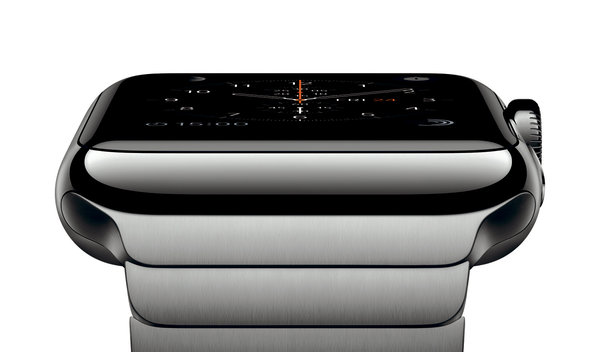
With a selection of stylish leather and metallic bands, the Apple Watch starts at $350 and goes all the way up to $17,000.Credit Apple
The Apple Watch is far from perfect, and, starting at $350 and going all the way up to $17,000, it isn’t cheap. Though it looks quite smart, with a selection of stylish leather and metallic bands that make for a sharp departure from most wearable devices, the Apple Watch works like a first-generation device, with all the limitations and flaws you’d expect of brand-new technology.
What’s more, unlike previous breakthrough Apple products, the Watch’s software requires a learning curve that may deter some people. There’s a good chance it will not work perfectly for most consumers right out of the box, because it is best after you fiddle with various software settings to personalize use. Indeed, to a degree unusual for a new Apple device, the Watch is not suited for tech novices. It is designed for people who are inundated with notifications coming in through their phones, and for those who care to think about, and want to try to manage, the way the digital world intrudes on their lives.
Still, even if it’s not yet for everyone, Apple is on to something with the device. The Watch is just useful enough to prove that the tech industry’s fixation on computers that people can wear may soon bear fruit. In that way, using the Apple Watch over the last week reminded me of using the first iPhone. Apple’s first smartphone was revolutionary not just because it did what few other phones could do, but also because it showed off the possibilities of a connected mobile computer. As the iPhone and its copycats became more powerful and ubiquitous, the mobile computer became the basis of a wide range of powerful new tech applications, from messaging to ride-sharing to payments.
Similarly, the most exciting thing about the Apple Watch isn’t the device itself, but the new tech vistas that may be opened by the first mainstream wearable computer. On-body devices have obvious uses in health care and payments. As the tech analyst Tim Bajarin has written, Apple also seems to be pushing a vision of the Watch as a general-purpose remote control for the real world, a nearly bionic way to open your hotel room, board a plane, call up an Uber or otherwise have the physical world respond to your desires nearly automatically.
Photo
Credit Stuart Goldenberg
These situations suggest that the Watch may push us to new heights of collective narcissism. Yet in my week with the device, I became intrigued by the opposite possibility — that it could address some of the social angst wrought by smartphones. The Apple Watch’s most ingenious feature is its “taptic engine,” which alerts you to different digital notifications by silently tapping out one of several distinct patterns on your wrist. As you learn the taps over time, you will begin to register some of them almost subconsciously: incoming phone calls and alarms feel throbbing and insistent, a text feels like a gentle massage from a friendly bumblebee, and a coming calendar appointment is like the persistent pluck of a harp. After a few days, I began to get snippets of information from the digital world without having to look at the screen — or, if I had to look, I glanced for a few seconds rather than minutes.
If such on-body messaging systems become more pervasive, wearable devices can become more than a mere flashy accessory to the phone. The Apple Watch could usher in a transformation of social norms just as profound as those we saw with its brother, the smartphone — except, amazingly, in reverse.
For now, the dreams are hampered by the harsh realities of a new device. The Watch is not an iPhone on your wrist. It has a different set of input mechanisms — there’s the digital crown, a knob used for scrolling and zooming, and a touch screen that can be pressed down harder for extra options. There is no full on-screen keyboard, so outbound messages are confined to a set of default responses, emoji and, when you’re talking to other Watch users, messages that you can draw or tap.
The Watch also relies heavily on voice dictation and the voice assistant Siri, which is more useful on your wrist than on your phone, but still just as hit-or-miss. I grew used to calling on Siri to set kitchen timers or reminders while I was cooking, or to look up the weather while I was driving. And I also grew used to her getting these requests wrong almost as often as she got them right.
Photo
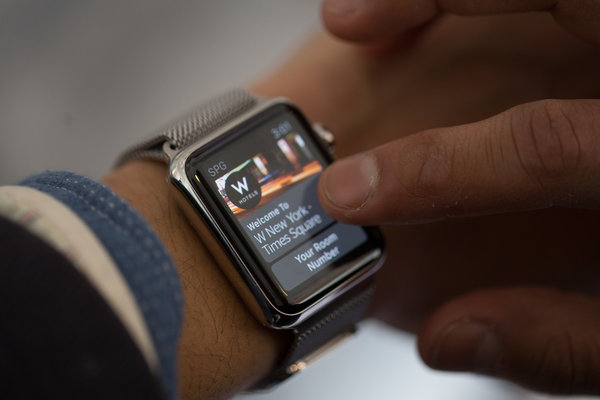
An Apple Watch app allows hotel guests to open the door to their room by touching the watch face to the door.Credit Michael Appleton for The New York Times
The Watch also has a completely different software design from a smartphone. Though it has a set of apps, interactions are driven more by incoming notifications as well as a summary view of some apps, known as glances. But because there isn’t much room on the watch’s screen for visual cues indicating where you are — in an app, a notification or a glance — in the early days, you’ll often find yourself lost, and something that works in one place won’t work in another.
Finding nirvana with the watch involves adjusting your notification settings on your phone so that your wrist does not constantly buzz with information that doesn’t make sense on the Watch — like Facebook status updates, messages from Snapchat, or every single email about brownies in the office kitchen. Apple’s notification settings have long been unduly laborious; battling them while your hand is buzzing off the hook is an extra level of discomfort.
Other problems: Third-party apps are mostly useless right now. The Uber app didn’t load for me, the Twitter app is confusing and the app for Starwood hotels mysteriously deleted itself and then hung up on loading when I reinstalled it. In the end, though, it did let me open a room at the W Hotel in Manhattan just by touching the watch face to the door.
I also used the Watch to pay for New York cabs and groceries at Whole Foods, and to present my boarding pass to security agents at the airport. When these encounters worked, they were magical, like having a secret key to unlock the world right on my arm. What’s most thrilling about the Apple Watch, unlike other smartwatches I’ve tried, is the way it invests a user with a general sense of empowerment. If Google brought all of the world’s digital information to our computers, and the iPhone brought it to us everywhere, the Watch builds the digital world directly into your skin. It takes some time getting used to, but once it clicks, this is a power you can’t live without.
The New York Times announced last week that it had created “one-sentence stories” for the Apple Watch, so let me end this review with a note that could fit on the watch’s screen: The first Apple Watch may not be for you — but someday soon, it will change your world.
„Along the way, the Apple team landed upon the Watch’s raison d’être.
It came down to this: Your phone is ruining your life.
Like the rest of us, Ive, Lynch, Dye, and everyone at Apple are subject to the tyranny of the buzz—the constant checking, the long list of nagging notifications. “We’re so connected, kind of ever-presently, with technology now,” Lynch says. “People are carrying their phones with them and looking at the screen so much.”
They’ve glared down their noses at those who bury themselves in their phones at the dinner table and then absentmindedly thrust hands into their own pockets at every ding or buzz. “People want that level of engagement,” Lynch says. “But how do we provide it in a way that’s a little more human, a little more in the moment when you’re with somebody?” Our phones have become invasive. But what if you could engineer a reverse state of being?
What if you could make a device that you wouldn’t—couldn’t—use for hours at a time? What if you could create a device that could filter out all the bullshit and instead only serve you truly important information? You could change modern life. And so after three-plus decades of building devices that grab and hold our attention—the longer the better—Apple has decided that the way forward is to fight back.
Apple, in large part, created our problem. And it thinks it can fix it with a square slab of metal and a Milanese loop strap.