Status des Startup-Ecosystems in Österreich und CEE

Status des Startup-Ecosystems in Österreich und CEE


Das Startup-Ecosystem in Österreich boomt. Mit Superlativen wie „Boom“ sollte man zwar vorsichtig umgehen, aber zur Beschreibung des aktuellen Zustandes der Mobile- und Internetszene hierzulande scheint es angebracht. Die subjektive Wahrnehmung wird durch die Zahlen und Fakten gestützt, die – i5invest und SpeedInvest – in den letzten Monaten gesammelt und ausgewertet haben.
Hier kann man die Infografik hochaufgelöst herunterladen:
Download1Download2.

Hier die Zusammenfassung der Inhalte eines Pressegesprächs mit i5invest-Gründer Markus Wagner, SpeedInvest-CEO Oliver Holle, StartEurope Co-Founder Jürgen Furian und Niki Ernst, Initiator von Austrian Innovation Center Silicon Valley:

Speaker: Markus Wagner
i5invest 2007 gegründet als Inkubator (“Brutkasten”) für Online- und Mobile-Startups. Aktueller Track Record (“Exited”): 123people, adaffix, tupalo.com, integra performance, payolution.

Markus Wagner (i5invest) und dieIdee.eu

“Branche mit neuem Selbstbewusstsein – wenig Jammern, viel Tun”
“Noch nie gab es in Österreich eine so hohe Dichte an Online- und Mobile Startups”
“Österreichische Top-Startups halten im internationalen Vergleich mit, weitere Initiativen in diese Richtung sind aber gefragt”
“Wien hat große Chancen als Hub zwischen West- und Zentraleuropa. Damit wir das nicht ver¬schlafen starten wir die Initiative ‘Made in Austria goes Global’.”

Startup Eco-System 2007
– Initiative ging von einzelnen

Gründer-Persönlichkeiten aus
– Wenige Neugründungen
– „Gründen“ war keine Job-Option für Studienabgänger und Manager
– keine österreichische Startup-Szene
– kein internationales Netzwerk

Startup Eco-System 2013
– Die erste Nachwuchsgeneration gründet selbst (vom Trainee zum Gründer, Entrepreneur in Residence „EiR“-Programm bei i5invest etc.)
– Gründer coachen Gründer (i5/ SpeedInvest/Sektor5/austrianstartups.com/Startup Academy)
– Erste Serial Entrepreneurs investieren in Startups –> Business Angel Nachwuchs
– Zunehmend professionalisierte Gründerszene: Startup-Cluster Spengergasse, Events (Pioneers, StartupLIVE …)
– Strukturen besser etabliert, die Neugründungen begünstigen: Coworking-Spaces (Sektor5 …), Business Angels & Early Stage Fonds
– Eine sich organisierende Startup-Szene mit eigenen Medien (inventures.eu, austrianstartups.com, …)
– Internationale Sichtbarkeit für österreichische Startups, Unternehmen und „Innovation made in Austria“
– Die Startup-Szene entwickelt sich zu einem unkontrollierten chaotischen System – im besten Sinne!

Gründe
– Success-Stories einiger Unternehmen (3UnitedAG 2006, Qpass/ucp morgen 2007)
– Erfolgreiche Gründer bringen Kapital & Netzwerk in Neugründungen bzw.
– Professionalisierung der Startup-Strukturen ein
– Auf technischer Seite auch im internationalen Vergleich extreme hohes
– Ausbildungsniveau (TU Wien, WU, Hagenberg,…)
– Beginn des App-Booms, Boom im Performance Marketing
– i5invest: Seither rund 20 erfolgreiche Inkubationen mit einer Exit-Quote von aktuell bisher 30 Prozent, operative Erfolgsquote 75 Prozent, alle Unternehmen sind international tätig – das zeigt: Gründen muss nicht immer hochriskant sein, sondern ist auch eine Karriereoption!
– Startup-Boom in Deutschland strahlt aus
– Unser Binnenmarkt ist zu klein für klassische Copy-Cat Modelle – das zwingt uns zur Innovation und Internationalisierung
– SpeedInvest: Substanzielles Risikokapital für Early Stage Finanzierungen in der österreichischen Digital Industry
– Entwicklung der Shared Offices-Infrastruktur als Hubs für Startups der Creative Industry (aktuell über 20 relevante Coworking-Spaces)
– Zahlreiche Event- und Netzwerkserien für potentielle Unternehmer (u.a. Pioniers Festival mit internationaler Leuchtkraft)
– Staatliche Initiativen: AWS, „GmbH light“

Was wünsche ich mir für die nächsten 3 Jahre?
– Österreich/Wien wird #1 Startup-Location in der Region (Bratislava 40 Minuten entfernt und ungenutztes Kooperationspotential)
– Series A/B/C Investoren in Österreich
– Ausgebautes internationales Series A/B/C Finanzierungsnetzwerk (Investoren müssen sich kennen und gemeinsame Erfolgsbeispiele haben) – Return on Investment Fallbeispiele –> Exits
– Internationalisierungs-Unterstützung für Startups (Die beste Unternehmensfinanzierung ist Kundenumsatz)
– Breite Standortvermarktung von Österreich/Wien in CEE als Gründerzentrum
– Kein Jammern, tun!

Über Markus Wagner
Born in Vienna, Markus Wagner has worked in mobile & internet communication from the outset of his career. In 2000 he founded Xidris and acted as the company’s managing director until 2004. Xidris soon became one of Europe’s lead¬ing providers of mobile communication services. It was subsequently merged into the 3united AG which was sold to the US company VeriSign Inc. in early 2006. As Vice-President for Product Innovations & Business Development of VeriSign Markus divided his time between Vienna and New York and worked with US media companies such as NBC, CBS, FOX and ClearChannel to launch new interactive and content services. In 2007 Markus founded the business incubator i5in¬vest (CEE). He hold several supervisory board positions in European venture capital funds as well as startups. Markus was awarded as the Austrian Business Angel 2010 and won the Austrian Private Equity & Venture Capital Award 2010. Markus is co-founder of the Austrian web/mobile/high-tech cluster InitialFactor located in Vienna and co-organizer of the STARTUP WEEK.

Speaker: Oliver Holle
SpeedInvest 2011 gegründet als Super-Angel Fonds (aktuell rund 11 Millionen Euro). Bündelt Kapital privater Business Angels. Investiert in Online- und Mobile-Startups (Fokus bisher Österreich, zunehmend Fokus auf CEE). Aktuelle Investments (Auszug): kochabo.at, Shpock, Sip:Wise, Joblocal.

– „Es mangelt nach wie vor an österreichischem Risikokapital, es gibt aber positive Entwicklungen“
– „2012 konnten österreichische Online-Startups ein Exit-Volumen von über einer halben Milliarde Euro realisieren“
– „Österreichische Startups reüssieren in SV: INdoo.rs, runtastic, Sip:Wise, Everbill, BUFFER
– „Die aktuell heißesten Startups Österreichs kommen aus den Bereichen Mobile Apps, Mobile Fitness Tracking und E-Commerce“
– Speedinvest verdoppelt US-Ressourcen: 2. Senior Partner im Valley, Office in San Francisco, strategische Partnerschaft mit Blackbox Ventures und Rainmaker Capital

Austrian Startup Report 2011/2012
(Initator Speedinvest, Partner StartEurope, WU-Wien / Institut Franke)
– 1500 Startups, 250 Investoren, 200 Stakeholders befragt
– Ökosystem hat sich in letzten 2-3 Jahren massiv verbessert
– 40 Prozent der Gründer haben schon vorher Startup-Erfahrung gesammelt
– 70 Prozent der Startups sind mit Produkt oder zumindest Prototyp live
– geringe Kapitalanforderungen: 50% suchen 100.000-300.000 Euro
– Größere Finanzierungsrunden sehr selten und schwierig
– Steuern, Regulierungen als problematisch gesehen
– Förderlandschaft: positiv, aber noch zu intransparent
– Viele Gründer reden über die “Option Ausland”, kaum jemand tut es!

Nach wie vor ist in Österreich weniger privates Risikokapital vorhanden, als der Markt benötigen würde. Vor allem im Bereich der Anschlussfinanzierung, also der Finanzierung der Wachstumsphase der Startups, ist ein schwieriger Bereich. Bessere Strukturen und eine verbesserte Organisation des vorhandenen Business Angel Capitals hat nicht zuletzt SpeedInvest geschaffen.

Bei den Gründungsfinanzierungen wird der Mangel an Venture Capital durch das umfangreiche öster¬reichische Förderungssystem zumindest zum Teil ausgeglichen. Vor allem die Österreichische Forschungsförderungsgesellschaft (FFG) und die Fonds der Austria Wirtschaftsservice GmbH (AWS) haben in den letzten vielen Tech-Startups finanzielle Starthilfe gegeben.
Das AWS legt in Kürze einen neuen Fonds auf und erweitert damit das Förderangebot weiter:
– AWS Business Angel Fonds
– AWS Gründerfonds

2012 ist auch „Media for Equity“ in Österreich angekommen. In Deutschland schon lange von den großen Verlagen getrieben, haben hierzulande mittlerweile SevenOneMedia und das Verlagshaus Styria dedizierte Media for Equity-Angebote.
Im Bereich der Finanzierung scheint mit 1000×1000.at nun auch das Thema Crowdfunding in Österre¬ich Einzug zu finden.

Ein weiterer Trend ist die Professionalisierung des Business Angel Netzwerkes, das nicht zuletzt in der Gründung der AAIA (austrian angels investors association) seine Ausprägung findet.

Einer der wichtigsten Motoren der Wachstumsdynamik des Startup-Ecosystems sind erfolgreiche Exits. Anhand dieser Kennziffer ist die aktuelle Entwicklung in Österreich schön zu verfolgen. 2012 verzeichneten wir die Exits von insgesamt acht österreichischen Online- und Mobile-Startups. Dabei wurde ein geschätztes Volumen von rund 500 Millionen Euro realisiert (Details siehe Infografik).

Exits/Transaktionen österreichischer Online- und Mobile-Startups:
2012: acht Exits, 2011: neun Exits, 2010: sechs Exits, 2009: kein Exit, 2009: ein Exit, 2007: 2 Exits

Auszug aus den aktuell heißesten österreichischen Startup-Eisen
runtastic.com
Mobile Fitness Tracking. Über 15 Millionen App Downloads, Sportcommunity mit drei Millionen Usern. 45 Mitarbeiter.
shpock.com
Mobiler Flohmarkt, bereits mehr als 150k Downloads und #1 in Deutschland und Österreich.
wikifolio.com
Social Investment und Social Trading. 12 Millionen Euro „Assets under Management“ in wikifo¬lios nach nur fünf Monaten. Live in Deutschland, in Kürze Marktstart in Österreich.
kochabo.at
Lieferservice für Lebensmittel & Rezepte. Start in Österreich, bereits Akquisitation in der Schweiz, Start in Deutschland.
buusuu.com
Mobile Learning. Sitz in London.
SipWise.com
Open Source VOIP Provider mit Kunden in ganz Europa. 2010 gestartet, bereits Umsätze im sie¬benstelligen Bereich, am Sprung in USA.
Everbill.com
In Ö bekannt als EPUNet, jetzt finanziert durch Dave Mac Lure’s 500 Startups und zuhause im Silicon Valley.

Über Oliver Holle
Oliver is a serial entrepreneur with deep experience in the mobile and internet industry. While still a student in 1992, Oliver founded his first company SYSIS, one of the first European internet startups. A few years and much learnings later, Together with Werner and Daniel, Oliver turned SYSIS’s focus towards mobile, which resulted in 2004 in the formation of 3united AG, a local 3-way merger that created a top European player in the mobile content industry. Early 2006, 3united was acquired by VeriSign Inc. at a valuation of USD 67m. Oliver spent two years in Santa Cruz, working for VeriSign, building a US network and learning to surf. As a CEO of Speedinvest, Oliver is responsible for all things related to corporate development and strategy, from fundraising to strategic partnerships, all the way to M&A. Oliver has an MPhil in Economics from Columbia University.

Speaker: Jürgen Furian
STARTeurope wurde Ende 2009 als Organisation zur Aktivierung und Förderung von Unternehmertum in Österreich und Europa gegründet. Track Record: 35+ Startup Live – Veranstaltungen in ganz Europa, Organisation der Startup Week und des Pioneers Festivals in Wien, welches erstmals die Aufmerksamkeit der internationalen Startup Szene auf den Wirtschaftsstandort Österreich brachte. Verantwortlich für die Organisation von monatlichen Networkingveranstaltungen für die österreichische Startup Szene unter dem Namen “Startup Lounge”. Initiator des interdisziplinären Universitätskurses “Garage” (Wirtschaftsstudenten arbeiten an konkreten und realen Geschäftsideen mit Studenten anderer Universitäten).

– “Noch nie gab es innerhalb Österreichs so viel Aufmerksamkeit für das Thema Tech Startups – das hat Vor- und Nachteile”
– “Neben dem Bereich Finanzierung hat vor allem der Bereich ‘Ausbildung’/ ‘Aufklärung’(Gründen, Finanzierung, Trends, Know How …) einen großen Verbesserungsbedarf im österreichischen Ecosystem”
– “Internationale Vernetzung ist für österreichische Startups eine Pflichtaufgabe. Veranstaltungen wie das Pioneers Festival treiben diese voran”
– “Wien befindet sich in einem internationalen Standortwettbewerb und muss seine Rolle darin finden.”

Zahlen, Daten, Fakten zum Gründerevent Startup Live:
2009: 145 Teilnehmer 2 Veranstaltungen
2010: 293 Teilnehmer 4 Veranstaltungen
2011: 475 Teilnehmer 8 Veranstaltungen
2012: 1134 Teilnehmer 21 Veranstaltungen

Alter der Teilnehmer:
37% 25-29
33% 18-24
15% 30-34
6% 40-49

50% Studenten
22% weiblich, 78 % männlich

Erkenntnisse
– Interesse an dem Thema “Tech Startups” gestiegen
– Unterstützung innerhalb der Szene deutlich gestiegen
– Frauenquote immer noch zu gering
– Hauptsächlich dominiert von jungen Personen

Über Jürgen Furian
Jürgen is Co-Founder and Head of Business Development at STARTeurope.at.
STARTeurope, provides early stage start-up intelligence and support to entrepreneurs across Europe. STARTeurope are specialists in networking and connecting the start-up community with the right synergistic blend of technical and business expertise, including investment direction to private and public resources and mentoring help. The start-up event brands, Pioneers’ Festival, Startup Live and Startup Lounge, create positive environments that nurture, educate and promote entrepreneurship both nationally and internationally. Additionally, STARTeurope is uniquely positioned to provide corporations and start-ups a pathway to mutually benefit from each other — both in terms of new innovative products and from an intellectual, talent resource perspective.

Speaker: Niki Ernst
Austrian Innovation Center Silicon Valley ist eine Non-Profit-Organsiation. Sie wurde 2013 in Wien unter dem Claim “Connecting the Danube with Silicon Valley” gegründet.

– „Im Silicon Valley gibt es das vitalste und kompetitivste Online- und Mobile-Startupecosystem der Welt. Österreichische Unternehmen müssen dort Anschluss finden.“
– „Der österreichische Online- und Mobile-Markt hinkt Jahre hinter der Entwicklung im Silicon Valley. Diesen Gap müssen wir schließen.“

The aicsv connects Austrian companies, startups, researchers with the Silicon Valley by helping them find business & investment opportunities and scout technologies. We are facilitating connections among investors, business partners, influencers, thought leaders. Our goal is to support Austrians opening labs and regional subsidiaries. We are evangelizing and educating on values of innovation, entrepreneurship, diversity, open-mindedness, creativity etc. The aicsv is highlighting newest trends in the Silicon Valley and shows innovative potential of Austrian (and CEE) companies.

Über Niki Ernst
Niki has been working in the advertising industry since he was 8 years old. For some annoying, for some fun, for some kult, the tv commercial he acted in as a child in 1980 in was aired over 13 years without interruption. However his career continued after school in international advertising agencies like BBDO or McCann Erickson where he focussed on client service and network coordination for international clients like DaimlerChrysler or Siemens mobile. 2005 he graduated executive MBA at the Danube University in Krems. In 2008 he started with his own Agency, planetsisa and raised offices in Vienna and Salzburg. Since 2009 he is attached to the TEDx network and was assigned TEDxAmbassador in 2011. With his personal motivation both to connect and combine his passions and to reinvent the business model “advertising agency” he initiated the Innovationagency, a worldwide network of companies in the creative business in 2012. The innovationagency is a network of 12 companies in Berlin, Vienna, Zagreb, New York, Los Angeles and San Francisco – where he met other Austrian veterans to launch the AICsv.

Source: http://i5invest.com/2013/01/status-des-startup-ecosystems-in-osterreich-und-cee/#respond

Young people value access over ownership

The smartphone generation will be perfectly happy not dealing with the expense and hassle of car ownership — why would they when they can order up an autonomous Zipcar with a tap on their iPhone X?

Zitat aus: http://www.wired.com/geekdad/2012/10/self-driving-cars/

Self-Driving Cars

Google Self-Driving Car (photo by Flickr user MarkDoliner, CC Licensed)

Google Self-Driving Car (photo by Flickr user MarkDoliner, CC Licensed)


Over the past few years, there has been steady progress in the development of self-driving automobiles, and it’s pretty clear that we’re finally on the cusp of this technology going mainstream. As far as I’m concerned, driving is a waste of time, energy, and human life, so I, for one, welcome our autonomous vehicular overlords.

Signs of Change

The assertion that self-driving cars are on the verge of becoming a practical reality may seem a little bold, but the signs are clearly there. For example, California recently legalized autonomous vehicles, making them now legal in three states (Nevada and Florida are the other two). In fact, in relation to this, Bernard Lu, an attorney for the California Department of Motor Vehicles even went so far as to state that “The technology is ahead of the law in many areas” — and that was back in 2010.

And it’s not just some random GeekDad blogger that considers self-driving vehicles to be a near-term probability. GM predicts partially autonomous vehicles by 2015 and fully autonomous vehicles by 2020. Looking even further ahead, the IEEE predicts that 75% of vehices will be fully autonomous by 2040.

Simply put, the technology required to make self-driving cars a reality already exists right now. It’s currently expensive, but the cost will drop as economies of scale kick in.

The Tech Behind It

So what is the tech that makes autonomous vehicles possible? Well, the poster child for self-driving cars is definitely Google’s ongoing Driverless Car project. At last tally, the Google fleet has driven accident-free for over 300,000 miles (480,000 km), making it clear that the concept is completely viable. Each Google Driverless car is equipped with GPS, radar, video cameras, lidar (laser radar), and a lot of real-time computing power. Basic navigation relies on maps and GPS, with live sensor input to react to real-time changes. The entire setup costs about $150,000, which is obviously well beyond the reach of 99% of drivers, but, as mentioned above, this cost will scale down readily.

Another emerging technology that figures prominently in the future of autonomous vehicles is the concept of vehicular communication systems. Obviously vehicle-to-vehicle (V2V) communication and vehicle-to-infrastructure (V2I) communication will make it possible to dynamically route traffic in such a way as to maximize flow and minimize travel times. Say good-bye to traffic jams and road rage, kids.

Why it Will Be Great

In addition to no more traffic jams, self-driving cars promise many other benefits:

  • Fewer traffic collisions (computers are better than humans at focused, repetitive tasks such as driving)
  • Increased roadway capacity and reduced traffic congestion (V2V and V2I make dynamic traffic routing possible)
  • Relief of vehicle occupants from driving chores (you can sleep, watch a movie, read a book, knit a pair of socks, etc. instead of wasting time behind the wheel)
  • Everyone can enjoy the benefits of travel regardless of their physical abilities, age, or other current restrictions (and, yes, that means no more drunk drivers and innocent victims)
  • You’ll never need to worry about finding a parking spot close to your destination (the car will drop you off, then go park itself until you signal it back again)
  • Improved energy efficiency due to minimization of start/stop driving, and elimination of the weight of the unnecessary driver in some circumstances
  • Car-sharing services like Zipcar will be much more practical
  • Reduced need for traffic police, red light cameras, and other safety enforcement measures
  • Cargo transport and delivery vehicles will not need a driver at all

All of the above and more will make the society of the future a very different place than what we’re used to now. That kind of change is likely going to take some adjustment for us older folks, but what about the upcoming generations that will grow up with this? Well, we’re already seeing some signs of a change in attitude there.

The Millennials

Interestingly, the Millennials (people born between 1980 and 2000, approximately) have very different attitudes toward driving than us older folks. In particular, the Millennials are far less interested in drivingthan their parents and grand-parents. There are, of course, plenty of reasons for this attitude, including rising gas costs, an anemic economy, depressed wages, and increasing re-urbanization – none of which is likely to change much in the near future. All of these factors lead to a demographic that is open to the reinvention of vehicular transportation. As Sheryl Connelly, head of global consumer trends at Ford, said, “Young people value access over ownership.

The smartphone generation will be perfectly happy not dealing with the expense and hassle of car ownership — why would they when they can order up an autonomous Zipcar with a tap on their iPhone X?

Obstacles

Of course, there are going to be some bumps in the road on the way to our self-driving future. First up is the usual human resistance to change, though 50% of people surveyed today said they would be comfortable riding in a driverless car. That degree of acceptance suggests a rapid uptake once the technology becomes reasonable in price.

Another guaranteed problem is concern about safety. As mentioned before, autonomous vehicles will be far more reliable than human drivers; however, there will inevitably be an accident involving a self-driving car, and the event will be sensationalized by the media. In the end though, the desire to decrease the number of traffic-related fatalities in the world will drive adoption (just for reference, over 30,000 people die each year in vehicle-related deaths in the US alone).

From the GeekDad perspective, the most worrisome thing about autonomous vehicles that I can think of is the possibility of vulnerabilities in the software. We have serious issues with exploits in current operating systems and applications — how much riskier will it be when the compromised computer is rolling along at 60mph? Clearly these systems are going to require a level of security that will embarrass today’s military-grade gear.

Future Consequences

So what are the implications of large-scale adoption of self-driving vehicles? An obvious thought is the corresponding redesign of the road system. Just as we now have commuter lanes, there will undoubtedly be dedicated lanes for driverless vehicles. In fact, eventually the majority of lanes will be reserved for autonomous vehicles, with a few “slow” lanes left over for manually-operated cars and horse-drawn buggies. And if we look even further ahead, eventually it will be illegal to drive a car on public roads.

Another anticipated change relates to the fact that driverless cars need not even be “cars.” Vehicles of the future won’t necessarily just transport humans, so there will likely be a wide spectrum of designs, from large cargo transports to small pizza delivery mini-mobiles. Of course, the technology behind self-driving cars will transfer easily to trains, streetcars, subways, ships, and possibly even aircraft (though that last one makes me a little nervous).

As with any other labor-saving advance in technology, an inevitable consequence of autonomous vehicles will be the elimination of a lot of jobs. Yes, there will be new jobs created to build and service these vehicles, but I’m pretty sure that far more jobs will be eliminated than created. In theory, this should mean that the overall efficiency of the system is increased, and humans will have increased time available to do more valuable work; in practice though, the transition involves a lot of disruption.

Conclusion…

The signs are clear: autonomous vehicles are coming. The technology is already real, and it’s just a matter of scaling down the cost. Once that happens, there will be rapid adoption of driverless automobiles that will result in a complete redefinition of travel. Yes, there are some negatives to this impending transition, but overall, the shift to self-driving vehicles will be a net-positive for society.

And If you’re interested in autonomous vehicles, be sure to check out Brad Templeton’s Robocar page.

The Future of Automobiles (Autonomous Driving)

Clifford Nass talks about why the automobile is so central to modern life. He discusses the future of autonomous vehicles and describes the human element of auto-mobility.

There is the Google Car Approach and there is the Car Manufacturers Approach.

Originally presented in the Stanford Continuing Studies Program.


Stanfords Autonomous Audi TTS Pikes Peak

Audi präsentierte auf der CES International 2013 die weltweit erste Lizenz für den Betrieb von Computergesteuerten Fahrzeugen.

Die Kooperation zwischen der US-Universität Stanford und Audi mündete bereits vor einigen Monaten in einem Rennwagen, der selbstständig eine vorgegebene Route befährt und darin sicherer als ein menschlicher Rennfahrer rascher auf Bodengegebenheiten und Verkehrssituationen reagieren kann.

Nevada grants Audi the first automaker permit to operate autonomous vehicles on public roads

• Audi gets second-ever license from the state to test Audi piloted driving
• Audi piloted driving and parking technology will be a focus at 2013 CES
• Audi has been an autonomous driving pioneer through work by its Electronics Research Lab in Silicon Valley and Stanford University

Die Zukunft des Individualverkehrs – Automatisiertes Fahren 2020

Was geschieht mit dem Individualverkehr, wenn Fahrzeuge uns autonom überall hintransportieren, wohin wir wollen?

Die Antwort darauf, beantwortet ein Zitat aus der Kommentarsektion von Spiegel Online:

„Ich lese mit großer Begeisterung diesen Beitrag. Es ist ja schon verschiedentlich über die Versuche, den Staßenverkehr zu automatisieren, berichtet worden, was mich dazu veranlasst hat, ein wenig weiterzudenken.

Was geschieht denn, wenn Autos sich selbsttätig bewegen können?
Gibt es dann noch einen Grund, ein eigenes Fahrzeug zu besitzen?

Der Individualverkehr ist ein System, das so vielfach redundant Kapazitäten bereithält, dass dem Systemtheoretiker der Irrsinn dieses Zustandes beispielhaft ist.

Die Abschaffung dieses Systems [Anm. des Individualverkehrs] zugunsten eines Fahrzeugparkes, der von geeigneten Unternehmen vorrätig gehalten wird und auf die jeder gegen Vergütung zugreifen kann (Führerschein? worzu!) birgt wirtschaftliche Vorteile einer solchen Dimension, dass der Privat- PKW verschwinden wird.
Die städtebaulichen Folgen werden ebenso enorm sein.
Das ist eine der aufregendsten Zukunftsvisionen, die ich kenne.

Weiters – Funktionsweise des Radars:

„Wissen Sie, wie die modernen Radar-Säulen arbeiten? Ein solch modernes Auto hätte natürlich (Radar-)Sensoren. Mit diesen Sensoren könnte es gleichzeitig den Vordermann, alle Autos um das Fahrzeug herum und auch eventuelle Fußgänger und sonstige Objekte um das Fahrzeug einzeln(!!!) beobachten. Das schaffen wir Menschen nicht annähernd. Sobald ein Objekt sich dem zu erwartenden Fahrweg des Fahrzeugs gefährlich nähert, leitet der Computer (Ausweich-)Maßnahmen ein. Der Computer weiß allerdings dann bereits, dass links neben uns ein weiteres Fahrzeug fährt, während der menschliche Autofahrer das erst beim instinktiven Ausweichen feststellt. Außerdem könnte dieses Fahrzeug dann alle nachfahrenden Fahrzeuge über die bevorstehende Notbremsung warnen und so Auffahrunfälle beinahe gänzlich ausschließen.
Automatisches Fahren auf der Autobahn wäre für mich ein Traum. Es würden Tonnen an Kraftstoff und Nerven gespart. Wie oft erlebe ich, dass ich ein Fahrzeug überhole, anschließend von diesem Fahrzeug wiederrum überholt werde um es dann einige Zeit später wieder zu überholen.
Ich fahre jedoch mit Tempomat immer gleichschnell (sofern es der Verkehr erlaubt) und möglichst weit rechts! Dass dann alle gleich langsam fahren müssen, halte ich nicht für notwendig.
Bei wenig Verkehr sollte man seine Wunschgeschwindigkeit wählen können und bei viel Verkehr werden 2 oder 3 Geschwindigkeiten vorgegeben und dann vom Fahrzeug im Verkehrsfluss selbständig gehalten.“

Diskutieren Sie mit uns: innovativer@dieidee.eu

Artikel: http://www.spiegel.de/auto/aktuell/automatisiertes-fahren-2025-fahren-autos-selbststaendig-a-873582.html

Quelle: http://www.spiegel.de/auto/aktuell/automatisiertes-fahren-2025-fahren-autos-selbststaendig-a-873582.html#spCommentsBoxPager

the reversed Osborne Effect


I’ve spent the last few days checking out the fourth-generation iPad, looking — no, hunting — for ways Apple‘s new flagship tablet differentiates itself from the previous model. While it’s hardly coal mining, it been an extremely challenging task.

iPad 4 looks almost exactly the same as what I’ll refer to from now on as the iPad 3, the tiny Lightningconnector port being the only sign this is a different product. While Apple has found a new love for progress in debuting the fourth-gen iPad a mere six months after iPad 3 (its mobile products used to iterate on tight annual schedule), it’s clearly not messing with success.

It’s also not going to do anything to upstage the pretty young ingenue in its product lineup, the iPad mini. Whereas the mini was the star of Apple’s most recent product circus, the company’s chief gadget wrangler, Phil Schiller, said everything he had to say about iPad 4 in less than three minutes. If you blinked, you missed a whole new iPad.

The result: Most people don’t even know there’s a new 10-inch iPad, which is probably just what Apple wants. While the iPad mini provides curious onlookers and anyone considering a smaller tablet something to look at, the same big-screen iPad is still there, still starting at $499, still setting the standard for the whole tablet market. The message: Sleep easy, world, because nothing’s changed.

Except it has. The iPad 4 performs noticeably better than the iPad 3. This isn’t just a matter of benchmarks or “theoretical” numbers, but those are certainly superior. Web sites load faster, apps launch quicker and the most processor-taxing iPad games run perfectly on the new iPad. Whether you’re a casual surfer or a power user, the new iPad improves your experience.

More Guts, a Bit More Glory

Apple A6X

The iPad 4′s powers are due largely to the new A6X processor. Apple launched the A6 chip with the iPhone 5 in September, and the iPad takes it up a notch with quad-core graphics. Just like the iPad 3, the beefier graphics processing is needed to render images for the 2,048 x 1,536 retina display. The screen is the same, but Apple says it now performs up to twice as fast.

It’s not a lie. In benchmark tests, we found the iPad 4 performs at least twice as fast, looking at raw processing power. RunningGeekbench’s app, the iPad 4 got an overall score of 1,769 while its predecessor was ranked at just 768 — a massive difference. In repeated runs of SpeedTest.net, which tests connection speed, the iPad 4 was on average about 20% faster than iPad 3 on the same Wi-Fi network.

In real-world tasks, that translates into media-rich websites such as CNN.com (and Mashable, come to think of it) loading almost instantaneously and graphics-intensive apps launching lickety-split. In launching Solar Walk, for instance, a retina-optimized app loaded with high-res renderings of the solar system, the iPad 4 called it up a lot faster than iPad 3, saving several seconds. (Check out the video below for the full demo.)

Games launch faster, too. However, for actual gameplay, I couldn’t detect any difference at all. Slices, parries and stabs against the monstrous rivals in Infinity Blade II was fast and responsive on both iPads. Blasting pirates in Galaxy on Fire HD 2 was a pixel-perfect exercise on the two tablets, even at maximum resolution. And zombie brains from The Walking Dead spattered just as well on the iPad 3 as the iPad 4.

Playing games continuously on both tablets, the iPad 3 appeared to lose battery life considerably faster than the iPad 4. Apple does say the new processor runs more efficiently than the iPad 3′s, but the extra juice could be attributable to the device simply being brand new.

In any case, game developers have clearly built their games for the iPad 3, which was the best possible iPad experience for the last six months, so no game is going to choke the tablet the way Crysis used to be the gaming stress test for PCs. It’s going to take time for devs to create apps that really challenge the iPad 4, but when they do, the A6X processor will be waiting.

Eyes Front

The other upgrade to the iPad 4 is the front-facing camera, which is now an improved model able to capture 1.2-megapixel photos and 720p video. The upgrade puts it in line with pretty much all of Apple’s other products with front-facing cameras — from the MacBook Air to the iPad mini to the iPod touch.

The improvement is welcome. The iPad is an excellent device for video chatting because of its portability and Apple’s FaceTime service, which is generally superior in quality to rivals like Skype. With a good connection, the clarity is markedly better than on the iPad 3.

Any self-portraits you take with the front camera are improved as well. Shots are more detailed, with better color. Of course, if you really need to snap some pics of something, you may as well use the 5-megapixel camera in back, which is the same design as iPad 3.

Apple says the A6X chip improves both image stabilization and facial recognition, but in my short time with the iPad 4, I couldn’t detect any improvement over the iPad 3 on either of those features.

Lightning Strikes

lightning-thin

Then of course there’s the Lightning connector, the big physical change from the previous model. In the iPad, though, Lightning’s small size doesn’t provide much benefit, Whereas Apple was able to shrink the iPhone considerably by replacing the dock connector with the smaller port, the iPad retains the same weight and dimensions.

To the user, Lightning doesn’t provide a lot of benefit over the old dock connector other than ensuring your iPad won’t go obsolete overnight. It’s great for Apple, though. Adding Lightning to the iPad proper brings the new port to all of Apple’s portable devices in time for the holiday — an impressive feat considering the connector didn’t exist officially until a month and a half ago.

Apart from the connector, there’s really no physical difference from the iPad 3. On our iPad, the label that indicates the storage capacity is missing, although that might simply be because it’s a review unit.

Why the iPad 4 Exists Now

When Apple unveiled the fourth-generation iPad, many owners of the iPad 3 were angry. After all, they had shelled out serious cash for the new iPad with retina display with a confidence that it wouldn’t be obsolete six months later. It was the Osborne Effect, but in reverse.

Yet here we are. Now there’s a shinier, newer iPad with a much faster processor, a better camera and that oh-so-cute Lightning connector. Dammit.

But there’s really nothing to be angry about, because iPad 3 owners aren’t missing out on anything significant. The iPad 2′s screen to a retina display — that was a major upgrade, but the spec bumps in iPad 4, while significant, don’t have much practical benefit yet.

It will take awhile for A6X-optimized apps to arrive, and the iPad 3 is already plenty fast. The front camera is improved, but it’s not like I was unrecognizable on FaceTime before. About the only thing with serious, tangible benefits is upgraded Wi-Fi, but in that case we’re talking only a few seconds difference, typically.

Forget the iPad 3 for a second, though, and it’s hard not to marvel at what Apple’s created here. Not only is the iPad 4 a turbocharged tablet with an impressive display, but it’s got a large selection of apps (275,000, at Apple’s last count) made especially for it.

That’s something no Android or Windows tablet can claim. As impressive as the Microsoft Surface and Nexus 10 are as devices, good luck finding Infinity Blade in either one of their app stores.

So while the iPad 4 isn’t worth the upgrade for iPad 3 owners, for anyone else thinking about a new full-size tablet this holiday, the choice is clear. The iPad, already the standard-bearer in the category, is now twice as powerful, has even faster connectivity and — oh yeah — is supported by the most consistent and easy-to-use mobile ecosystem in existence and the deepest tablet app selection by far.

Rival tablets may be able to beat Apple on price, and perhaps even a spec or two, but no one else comes close in terms of experience. Come to your senses and get an iPad already. There’s a reason it’s the most popular tablet in the world, and it’s never been clearer than in the iPad 4.

At least until the iPad 5 comes out.

Source: http://mashable.com/2012/11/09/ipad-4-review/#view_as_one_page-gallery_box8643

Apple to lose market leadership – stock plunges


Apple logo

Apple’s stock dropped by more than 4% in early trading Wednesday, to as low as $556 a share, its lowest price in five months.

More significantly for investors, the stock is now down more than 20% in less than two months from its peak price of $705 a share on Sept. 21 when the iPhone 5 hit store shelves. This trading situation is commonly referred to as a bear market, with no bottom in sight.

For Apple, a combination of factors have plagued the stock over the past six weeks and continue to push down the price.

Supply Constraints

The stock’s initial downfall was caused largely by concern about supply constraints impacting sales of the iPhone 5. The stock began to decline after Apple reported lower-than-expected opening weekend sales for the device in late September, a fact that the company suggested was due to limited supply rather than demand.

Since then, CEO Tim Cook has assured investors that Foxconn, Apple’s manufacturing partner, has significantly improved production and will continue to catch up to demand. However, Foxconn’s chief renewed concerns Wednesday by noting at a business event that the manufacturer is still “falling short” of demand for the iPhone 5. 

Executive Shake-Up

Apple dropped a bombshell last week when it announced a big executive shake-up, including the departures of the company’s iOS chief Scott Forstall and retail chief John Browett. Apple shrewdly announced the move on a day when the stock market was closed because of Hurricane Sandy, but once trading resumed, the stock began to drop.

For investors, the announcement raised concerns about the stability of Apple’s elite management team without Steve Jobs, and the departure of Forstall in particular raised concerns about the future of Apple’s mobile product innovations.

Competition in the Tablet Space

A particularly negative research report about Apple’s dwindling dominance in the tablet market didn’t exactly help the company’s stock either. According to IDC, Apple’s share of the tablet market declined from nearly 60% in the third quarter of 2011 to 50% in the third quarter this year, showing just how much the competition has grown.

Declining Profit Margin

Apple is clearly working to maintain its hold on the tablet market with the release of a new smaller and cheaper iPad mini. However, the downside, as the company pointed out in its most recent earnings call, is that this and other new devices are expected to cut into the company’s profit margins.

Apple projects that it will report a much lower profit margin in the December quarter than analysts had previously expected. Cook attributed this to the prolific roll out of new products, which have higher costs, and the fact that some products like the iPad mini are being sold closer to cost. At the end of the day, Apple’s absurdly high profit margins for its product is the big selling point for investors. As a result, some analysts reacted to the news by cutting their price targets for the stock.

Patent Verdict

Most recently, the stock took another hit after a federal jury in Texas ruled that Apple’s FaceTime video chat feature infringed on several patents held by VirnetX, a patent holding firm. The court ordered Apple to pay $368 million and VirnetX could potentially push to ban sales of Apple products that use these patents.

All in all, it has been a tough few weeks for Apple even with the successful launch of several new products.

AAPL Chart

Image courtesy of Flickr, kevin dooley

Source: http://mashable.com/2012/11/07/why-apple-stock-is-tanking/

IPAD 5 soon out on the Market (2012)

The IPad out on the market for some days now, the successor is on the way already. Rumors tell that Apple will react in the first or second Quarter of 2013 to the introduction of the Google Nexus.

Analyst Ming-Chi Kuo of KGI Securities thinks Apple may feel pressure from Microsoft’s new Surface tablet, especially considering that the fourth-generation iPad is the same weight and thickness as the third-generation model.

„Though the iPad mini is expected to be successful, we think launching the lighter, thinner 9.7″ iPad as quickly as possible matters more for Apple strategically,“ Kuo explained.

If Microsoft Surface does catch on with consumers and businesses, it would pose a risk to Apple’s current dominance of the „post-PC“ world. For that reason, he thinks Apple will move quickly to redesign the iPad once again in the near future.

Apple is expected to employ „GF DITO“ touchscreen technology, otherwise known as GF2, in its redesigned iPad, according to Kuo. In combination with more power-efficient chips, Apple is expected to „dramatically lower the weight and thickness of the 9.7″ iPad,“ Kuo wrote.

Apple is said to already be employing GF2 display technology in the new iPad mini. That helped to make the device 23 percent thinner and 53 percent lighter than the full-size iPad.

The fourth-generation iPad unveiled by Apple on Tuesday marked an uncharacteristically short product life cycle for the company. It completely replaced the third-generation model, while the $399 iPad 2 remains without a high-resolution Retina display.

The new fourth-generation iPad carries the same price points as its predecessor, while packing in faster performance with a new A6X processor that Apple said doubles the speed of the system’s CPU and GPU. It also features Apple’s new Lightning connector, replacing the legacy 30-pin design found on the third-generation model.

Customers who recently purchased a third-generation iPad may be able to return their purchase and exchange it for the updated fourth-generation model at certain Apple retail stores.

Source: http://appleinsider.com/articles/12/10/24/apple-predicted-to-launch-lighter-thinner-97-ipad-as-quickly-as-possible

Why Google will crack Apple on the Tablet-Front soon

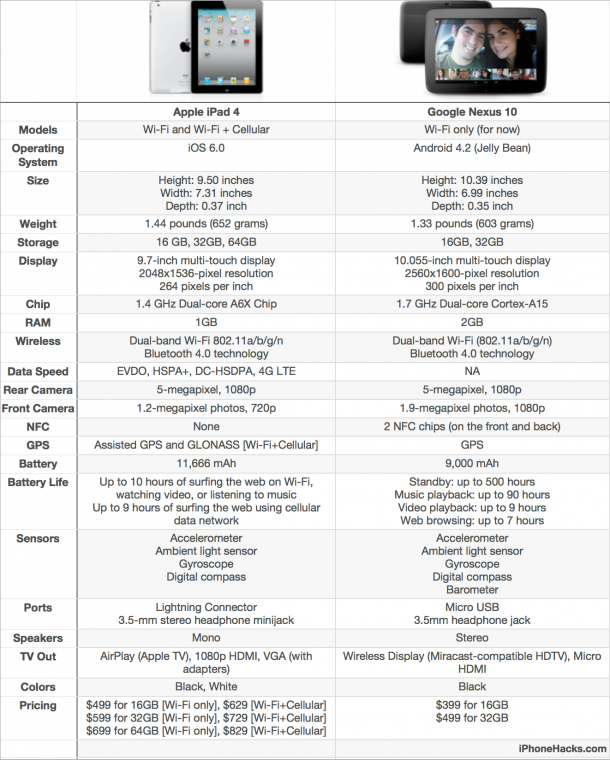
The Nexus 10 has the weaker eco-system in comp. with the IPAD 4 (Ipad with retina display) but is due to the introduction of Android 4.2 on the best track to become the new leader on the Tablet-Market.

The IOS System has lost its pace and is made competitive again with a new processor.

The specs tell the truth. Apple with its IPAD 4 has lost the lead and Google with the Nexus 10 has become the winner (on numbers). X-Mas 2012 will reflect in sales numbers who will be number one.

Source: Iphonehacks.com